Tag: Sacramento

  • Is California About to Clobber Local Control?

    The gradual decimation of local voice in planning has become accepted policy in Sacramento. The State Senate is now considering two dangerous bills, SB 35 and SB 167, that together severely curtail democratic control of housing.

    SB 35: Housing Accountability and Affordability Act (Wiener)

    SB 35, the brainchild of San Francisco State Senator Scott Wiener, would force cities that haven’t met all their state-mandated Regional Housing Need Allocations to give by-right approval to infill market-rate housing projects with as little as 10% officially affordable housing. 

    SB 35 is anti-free speech and civic engagement. No public hearings, no environmental review, no negotiation over community benefits. Just “ministerial,” i.e., over-the-counter- approval.

    SB 35 is pro-gentrification. As a statewide coalition of affordable housing advocacy organizations has written:

    Since almost no local jurisdiction in the State of California meets 100% of its market rate RHNA goal on a sustained basis, this bill essentially ensures by-right approval for market-rate projects simply by complying with a local inclusionary requirement [for affordable housing] or by building 10% affordable units.

    The practical result is that all market rate infill development in most every city in California will be eligible for by-right approval per this SB 35-proposed State law pre-emption.

    Berkeley Housing Commissioner Thomas Lord also has pointed out, the RHNA program itself is a pro-gentrification policy. It follows that passage of SB 35 would further inflate real estate values and worsen the displacement of economically vulnerable California residents.

    SB 35 is pro-traffic congestion. It would prohibit cities from requiring parking in a “streamlined development approved pursuant” to SB  35, located within a half-mile of public transit, in an architecturally and historically significant historic district, when on-street parking permits are required but not offered to the occupants of the project, and when there is a car share vehicle located within one block of the development. Other projects approved under the measure would be limited to one space per unit.

    Absent the provision of ample new public transit, the prohibition of parking in new development will worsen neighborhood traffic problems. SB 35 says nothing about new transit.

    The construction of on-site parking is expensive, up to $50,000 a space. A measure that exempts new development, as designated above, from including parking without requiring developers to transfer the savings to affordable housing is a giveaway to the real estate industry.

    Nor does SB 35 say anything about funding the amount of infrastructure and local services—fire and police, schools, parks—that would be required by the massive amount of development it mandates. Are local jurisdictions expected to foot the bill?

    The lineup of SB’s supporters and opponents reveals serious splits in the state’s environmental and affordable housing advocates. SB 35 has revealed serious splits among advocates for both environmental protection and affordable housing.

    Supporters include Bay Area Council, the lobby shop of the Bay Area’s biggest employers; BAC’s Silicon Valley counterpart, the Silicon Valley Leadership Group; the San Francisco and LA Chambers of Commerce; the Council of Infill Builders; several nonprofit housing organizations, including the Non-Profit Housing Association of Northern California and BRIDGE Housing; the Natural Resources Defense Council; the California League of Conservation Voters; and a panoply of YIMBY groups, including East Bay Forward and YIMBY Action.

    Opponents include the Sierra Club; the League of California Cities; the Council of Community Housing Organizations; the California Fire Chiefs Association; the Fire Districts Association of California; a handful of cities, including Hayward, Pasadena, and Santa Rosa; the Marin County Council of Mayors and Councilmembers; and many building trades organizations, including IBEW Locals 1245, 18, 465 and 551, and the Western States Council of Sheet Metal Workers.

    SB 167: Housing Accountability Act (Skinner)

    This bill, introduced by State Senator Nancy Skinner, who represents Berkeley and other East Bay cities, and sponsored by the Bay Area Renters Federation (BARF), is a companion to SB 35. It would prohibit cities from disapproving a housing project containing units affordable to very low-, low- or moderate-income renters, or conditioning the approval in a manner that renders the project financially infeasible, unless, among other things, the city has met or exceeded its share of regional housing needs for the relevant income category. (As of November 2016, HUD defined a moderate-income household of four people in Alameda County as one earning under $112,300 a year.)

    The bill defines a “feasible” project as one that is “capable of being accomplished in a successful manner within a reasonable period of time, taking into account economic environmental, social, and technological factors.” It does not define “successful” or “reasonable.”

    If a city does disapprove such a project, it is liable to a minimum fine of $1,000 per unit of the housing development project, plus punitive damages, if a court finds that the local jurisdiction acted in bad faith.

    SB 167 authorizes the project applicant, a person who would be eligible to apply for residency in the development or emergency shelter, or a housing organization, to sue the jurisdiction to enforce SB 167’s provisions. The bill defines a housing organization as

    a trade or industry group whose local members are primarily engaged in the construction or management of housing units or a nonprofit organization whose mission includes providing or advocating for increased access to housing for low-income households and have filed written or oral comments with the local agency prior to action on the housing development project [emphasis added].

    The highlighted passage was added to the existing Housing Accountability Act to encompass BARF’s legal arm, the California Renters Legal Advocacy and Education Fund (CaRLA), whose lawsuit of Lafayette recently failed. Last week CaRLA re-instituted its lawsuit of Berkeley over the city’s rejection of a project at 1310 Haskell.

    SB 167 further amends the existing Housing Accountability Act to entitle successful plaintiffs to “reasonable attorney’s fees and costs.”

    Predictably, the bill is supported by the Bay Area Council, the lobby shop for the region’s largest employers; the California Building Industry Association; the Terner Center at UC Berkeley; the San Francisco Housing Action Coalition; and YIMBY groups, including East Bay Forward, Abundant Housing LA, and of course CaRLA.

    Opponents include the California Association of Counties and the American Planning Association.

    If these bills—especially SB 35—become law, Californians will have lost a good deal of their right to a say the life and governance of the communities in which they live.

    This piece was first published in Berkeley Daily Planet and Marin Post.

    Zelda Bronstein, a journalist and a former chair of the Berkeley Planning Commission, writes about politics and culture in the Bay Area and beyond.
  • Eco-Modernism, Meet Opportunity Urbanism

    California has always been friendly ground for new ideas and bold proposals. That was a good thing when California’s economic and social policies encouraged middle-class opportunity, entrepreneurship, and social mobility, way back in the 1960s. But the contemporary California political elite tends to pioneer policies that endanger the spirit of opportunity that once made California great.

    Fortunately, some alternative ways of thinking are emerging. An environmental policy think-tank in Oakland called The Breakthrough Institute has been pioneering a new, pro-growth environmentalism called Eco-Modernism, premised on the idea of technological decoupling. That is, it is based on the principle that by intensifying the use of resources, human needs could be met with far less material. If technologies that do more with less were to be developed, more of the environment would be allowed to flourish independent of human exploitation.

    The Eco-Modernist’s answer to a problem as vast as climate change would not be to reduce emissions through cap-and-trade schemes or to put limits on the use of fossil fuels. Instead, Eco-Modernists would encourage investments in next-generation technologies capable of replacing fossil fuels. Hydroelectric and nuclear facilities have been providing such clean, carbon-free energy for decades. Eco-Modernists support government-funded construction of nuclear plants and hydroelectric systems to reduce carbon emissions and fight climate change while providing affordable energy. Technological advancement and government investment can both promote prosperity and save the environment, if used properly.

    Meanwhile, a Houston-based think-tank, the Center for Opportunity Urbanism, (directed by New Geography’s Southern California-based Executive Editor, Joel Kotkin, where I am a research associate) has been suggesting that urban planning and macroeconomic policy ought to be conducted with the goal of expanding opportunities for social mobility and a middle-class lifestyle. The center favors policies that maximize the availability of work and minimize the cost of living. In practice, this means promoting business and development-friendly tax, regulatory, and zoning codes, and investments in effective public infrastructure and education. The goals include removing unreasonable land and energy regulations that drive up the cost of housing and utilities, and investment in quality public education and in infrastructure.

    These two philosophies offer compelling, positive alternatives to the reigning green-and-blue consensus. Their shared goal: a wealthy, high-tech society, replete with opportunities for upward mobility, leaving little environmental impact. A meld of Eco-Modernism and Opportunity Urbanism could provide a thoughtful, compelling alternative to the California’s current orthodoxy; a path that would neither stifle economic growth, nor be uncaring towards the environment or the working class.
    There are at least two policy areas where the philosophies conflict, however, and if such a synthesis were to become viable, these differences would need to be addressed.

    Eco-Modernism doesn’t particularly support suburban sprawl, because it takes up more land than dense urban cores, while Opportunity Urbanism strongly encourages suburb formation. And Opportunity Urbanists support fossil fuel use for the indefinite future to provide cheap energy, while Eco-Modernists seek a gradual phasing-out of fossil fuels, and their replacement with nuclear energy.

    There’s a fairly straightforward policy compromise evident here. Eco-Modernists ought to accept suburban sprawl as important to economic growth and opportunity, and recognize that human housing needs take up comparatively little land. Opportunity Urbanists, for their part, should accept that nuclear energy can provide more sustainable and lasting energy than fossil fuels, and that a more nuclearized power system would be healthier, provide cheaper energy, and would generally provide a better quality of life for more people than fossil fuels ever could.

    If Eco-Modernists gave up their hostility to suburbia they would gain a zero-carbon nuclear platform, while Opportunity Urbanists that gave up on fossil fuels would retain an opportunity society with more advanced energy technology.

    Aside from this great compromise, Eco-Modernism and Opportunity Urbanism could complement each other very well. Intensive government investments in infrastructure, technology, and education drive the economy; market principles and expanded economic opportunity distribute its fruits. This strong-government/ market-based synthesis begins to resemble the economic philosophy of Henry Clay and Abraham Lincoln, that old Whig tradition that has unfortunately left us for the time being. Perhaps these new ideas will resurrect it.

    What better state to articulate new philosophies and a new synthesis based on innovation and opportunity, and put it into practice? California has always been about creating something new, and giving individuals the chance to create themselves anew. The state’s policy should reflect the state’s character. But two recent stories illustrate the lunacy that our political class substitutes for good policy.

    In September, a whole raft of Governor Jerry Brown’s anti-climate change legislation was soundly defeated. The boldest of these proposals called for a 50 percent cut in petroleum usage statewide by 2030 (amended later to 2050). The agenda was clear: bring California’s carbon emissions down to lead the fight against climate change through the force of example. An earlier drama occurred in June, when the Los Angeles City Council passed, nearly unanimously, a resolution to raise L.A.’s minimum wage to $15 an hour by the year 2020. Almost immediately, the move was condemned by business leaders and policy wonks across the state and nation on the grounds that it would raise the cost of doing business and drive industries out.

    This heavy-handed regulatory mode of problem-solving — a crucial component of what commentator Walter Russell Mead calls the “Blue Model” — dominates areas of California policy from water quality to food prices to pensions.

    The Republican alternative isn’t much better. Out of power and lost in the wilderness since the follies of the Pete Wilson administration, California Republicans typically unload pseudo-Reaganite market-based ideas when asked significant policy questions. In the above two cases, their solutions would be don’t put restrictions on carbon emissions, and don’t raise the minimum wage. But the problems still would not be fixed.

    New ideas need to be out there in response. Perhaps it’s time for Eco-Modernists and Opportunity Urbanists to enter into a dialogue and establish a common policy agenda for the Golden State. The dominant Democratic Party and the floundering Republicans don’t have these ideas. Someone needs to show them the way.

    Luke Phillips is a student studying International Relations at the University of Southern California. He has written for the magazine The American Interest and is a research associate at the Center for Opportunity Urbanism.

    Flickr photo by Jim Bowen: Sacramento, the California Statehouse.

  • California in 2060?

    The California Department of Finance (DOF) has issued population projections for the state’s counties to 2060.  Forecasts are provided for every decade, from a 2010 base. The DOF projects that the the state will grow from 37.3 million residents in 2010 to 51.7 million in 2060. This is a 0.7 percent annual growth rate over the next 50 years. By contrast, California’s growth rate was 1.7 percent annually over the last 50 years (1960-2010), and a much higher 3.0 percent in the growth heyday of 1940 to 1990. However, even with this slower rate, California is expected to grow slightly more quickly than the nation (0.6 percent annually).

    The current projections are considerably more conservative than those made by DOF less than a decade ago. In 2007, DOF forecast that California would have 60 million residents in 2050. The current population project for 2050 is substantially smaller, at 49.8 million.

    Metropolitan Complexes

    To understand where this growth is projected to take place — and not — we look at CSA’s (consolidated statistical areas).  CSA’s are economically connected, adjacent metropolitan areas. CSA’s require a 15 percent employment interchange between the metropolitan areas. Metropolitan areas themselves are defined by a 25 percent commuting interchange between outlying counties and central counties, each of which must have at least one-half of its population in the core urban area.

    As Michael Barone pointed out in his analysis of the 2014 population estimates, sometimes it is not obvious when one metropolitan area changes into another, as in the cases of San Francisco/San Jose and Los Angeles/Riverside-San Bernardino, which are CSA’s. Another example is New York and the southwestern Connecticut suburbs in Fairfield and New Haven counties. This is because there is no break in the continuous urbanization.

    Metropolitan Complexes in 2060

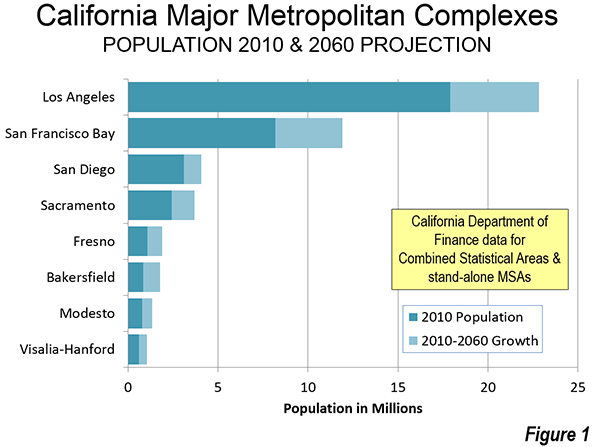
    If the DOF has it right, in a half century, California will be home to eight major metropolitan complexes. which I am defining as combined statistical areas (CSA’s) or  "stand alone" metropolitan areas with more than 1,000,000 population (Figure 1).

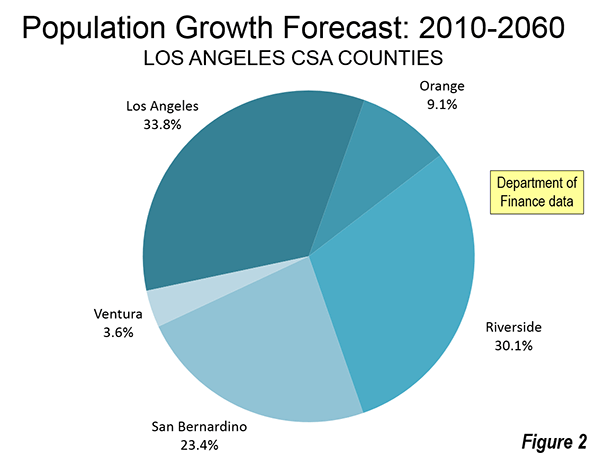
    The Los Angeles metropolitan complex (Los Angeles-Riverside, including Los Angeles, Orange, Riverside, San Bernardino and Ventura counties) would remain by far the largest, growing from 17.9 million to 22.8 million. One-third of the growth would be in Los Angeles County, and two-thirds outside. Riverside and San Bernardino counties would receive most of the growth (53 percent). Riverside County would grow the fastest, adding 68 percent to its population (Figure 2). Overall, the Los Angeles metropolitan complex would grow 27.3 percent, well below the projected state rate of 38.4 percent. This is quite a turnaround for a metropolitan complex that was once among the fastest growing in human history.

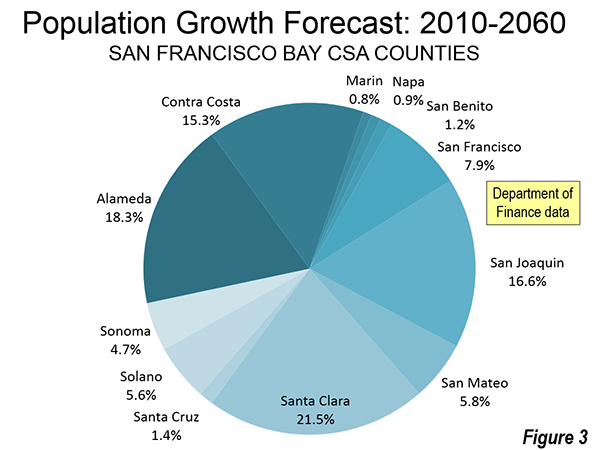
    The San Francisco Bay metropolitan complex, including the San Francisco, San Jose, Santa Cruz, Vallejo, Santa Rosa and Stockton metropolitan areas would grow a much faster 45.6 percent, from 8.1 million in 2010 to 11.9 million in 2060. The core city of San Francisco would add nearly 300,000, growing 36.3 percent to 1.1 million, (nearly the state rate). However, only 8 percent of the Bay Area growth would be in San Francisco, and 92 percent outside (Figure 3).  Four counties would add more than 500,000 residents, including Santa Clara (800,000), Alameda (680,000), Contra Costa (519,000), and newly added San Joaquin county, which is defined as the Stockton metropolitan area (620,000). San Joaquin County would also grow the fastest, at 90 percent, reaching 1.3 million. This growth is to be expected, since San Joaquin is one of the more peripheral counties, and where the metropolitan fringe (which includes the commuting shed) has been expanding the most.

    The San Diego metropolitan complex, a "stand alone" metropolitan area, would grow nearly as slowly as Los Angeles. San Diego’s population of 3.1 million in 2010 would rise to 4.1 million in 2060, an increase of 30.8 percent.

    Sacramento’s metropolitan complex includes the Sacramento, Truckee-Grass Valley and Yuba City metropolitan areas. Sacramento is projected to grow 52.8 percent, from 2.4 million in 2010 to 3.7 million in 2060.

    Four additional metropolitan complexes with more than 1 million population are projected, all in the San Joaquin Valley.

    Fresno, which includes Fresno County and Madera County, would grow from 1.1 million to 1.9 million, for a nearly 75 percent growth rate.

    Bakersfield (Kern County) would be the fastest growing among major metropolitan complexes. Bakersfield would grow from 840,000 in 2010 to 1.8 million in 2060, for a growth rate of 111 percent.

    Modesto (Stanislaus and Merced counties) would be the seventh largest metropolitan complex. From a 2010 population of 770,000, Modesto would grow 74 percent to 1,340,000. However, it is possible that by 2060 the commuting shed will reach the San Francisco Bay metropolitan complex, causing it to consume Modesto, as it already has Stockton.

    In 2060, California would get its eighth major metropolitan area, with Visalia-Hanford reaching 1,040,000, up 74 percent from 2010 (Tulare and Kings Counties).

    Outside of these areas, the largest metropolitan complex would be Salinas, which is projected to have 530,000 residents by 2060. However, Salinas is close enough to the San Francisco Bay Area that it could be added to that area’s commuting shed by 2040. The next largest metropolitan area would be El Centro (Imperial County), with a population projected to reach 340,000 by 2060. El Centro, however, could be included in the San Diego commuter shed by that time, making it a part of the San Diego metropolitan complex. The next largest metropolitan complexes would be in the northern Sacramento Valley, Redding and Chico, both approximately 300,000.

    Only 2.4 million Californians lived outside the 8 major metropolitan complexes, or 7 percent of the population. Growth in these areas is expected to be slow, with only a 27 percent increase to 2060.

    The Difficulty of Projections

    Of course, it is virtually impossible to accurately predict demographic trends 50 years into the future. California’s slower than expected growth in recent decades reflected general economic weakness since 1990, and the impact of ultra-high housing prices, particularly on the coast. However, the 2060 California projections provide an interesting view of the future from today’s perspective.

    Photo: Bakersfield: Fastest Growth Projected 2010 to 2060. “Bakersfield CA – sign” by nickchapman – originally posted to Flickr as P1000493. Licensed under CC BY 2.0 via Wikimedia Commons.

    Wendell Cox is principal of Demographia, an international public policy and demographics firm. He is co-author of the "Demographia International Housing Affordability Survey" and author of "Demographia World Urban Areas" and "War on the Dream: How Anti-Sprawl Policy Threatens the Quality of Life." He was appointed to three terms on the Los Angeles County Transportation Commission, where he served with the leading city and county leadership as the only non-elected member. He served as a visiting professor at the Conservatoire National des Arts et Metiers, a national university in Paris. Wendell Cox is Chair, Housing Affordability and Municipal Policy for the Frontier Centre for Public Policy (Canada), is a Senior Fellow of the Center for Opportunity Urbanism and is a member of the Board of Advisors of the Center for Demographics and Policy at Chapman University.

  • The Big Idea: California Is So Over

    California has met the future, and it really doesn’t work. As the mounting panic surrounding the drought suggests, the Golden State, once renowned for meeting human and geographic challenges, is losing its ability to cope with crises. As a result, the great American land of opportunity is devolving into something that resembles feudalism, a society dominated by rich and poor, with little opportunity for upward mobility for the state’s middle- and working classes. 

    The water situation reflects this breakdown in the starkest way. Everyone who follows California knew it was inevitable we would suffer a long-term drought. Most of the state—including the Bay Area as well as greater Los Angeles—is semi-arid, and could barely support more than a tiny fraction of its current population. California’s response to aridity has always been primarily an engineering one that followed the old Roman model of siphoning water from the high country to service cities and farms.  

    But since the 1970s, California’s water system has become the prisoner of politics and posturing. The great aqueducts connecting the population centers with the great Sierra snowpack are all products of an earlier era—the Los Angeles aqueduct (1913), Hetch-Hetchy (1923), the Central Valley Project (1937), and the California Aqueduct (1974). The primary opposition to expansion has been the green left, which rejects water storage projects as irrelevant. 

    Yet at the same time greens and their allies in academia and the mainstream pressare those most likely to see the current drought as part of a climate change-induced reduction in snowpack. That many scientists disagree with this assessment is almost beside the point. Whether climate change will make things better or worse is certainly an important concern, but California was going to have problems meeting its water needs under any circumstances.  

    Not Meeting the Challenges. 

    It’s not like we haven’t been around this particular block before. In the 1860s, a severe drought all but destroyed LA’s once-flourishing cattle industry. This drought was followed by torrential rains that caused their own havoc. The state has suffered three major droughts since I have lived here—in the mid ’70s, the mid ’80s and again today—but long ago (even before I got there) some real whoppers occurred, including dry periods that lasted upwards of 200 years.  

    This, like the threat of earthquakes, is part of the price we pay to live in this most beautiful and usually temperate of states. The real issue is how to meet this challenge, and here the response has been slow and lacking in vision. Not all of this is to be blamed on the greens, who dominate the state politically. California agriculture, for example, was among the last in the nation to agree to monitoring of groundwater. Farmers have also been slow to adjust their crops toward less water-dependent varieties; they continue to plant alfalfa, cotton, and other crops that may be better grown in more water-rich areas. 

    Many cities, too, have been slow to meet the challenge. Some long resisted metering of water use. Other places have been slow to encourage drought-resistant landscaping, which is already pretty de rigeur in more aridity-conscious desert cities like Tucson. This process may take time, but it is already showing value in places like Los Angeles where water agencies provide incentives. 

    But ultimately the responsibility for California’s future lies with our political leadership, who need to develop the kind of typically bold approaches past generations have embraced. One step would be building new storage capacity, which Governor Jerry Brown, after opposing it for years, has begun to admit is necessary. Desalinization, widely used in the even more arid Middle East, notably Israel, has been blocked by environmental interests but could tap a virtually unlimited supply of the wet stuff, and lies close to the state’s most densely populated areas. Essentially the state could build enough desalinization facilities, and the energy plants to run them, for less money than Brown wants to spend on his high-speed choo-choo to nowhere. This piece of infrastructure is so irrelevant to the state’s needs that even many progressives, such as Mother Jones’ Kevin Drum, consider it a “ridiculous” waste of money. 

    And there needs to be, at least for the short term,an end to dumping water into San Francisco Bay for the purpose of restoring a long-gone salmon run, or to the Delta, in order to save a bait-fish, the Delta smelt, which may already be close to extinct. This dumping of water has continued even as the state has faced a potentially crippling water shortage; nothing is too good for our fish, or to salve the hyper-heated consciousness of the environmental illuminati. 

    The Political Equation 

    The biggest reason California has been so slow, and uncharacteristically feckless, in meeting this existential challenge lies with psychology and ends with political power. The generation that built the sinews of modern California—most notably the late Governor Pat Brown Sr., the current governor’s father—sprang from the old progressive spirit which saw in infrastructure development a chance not only to create new wealth, but also provide opportunity to working- and middle-class Californians. 

    Indeed, if you look at California’s greatest achievements as a society, the Pat Brown legacy stands at the core. The California Aqueduct turned vast stretches of the Central Valley into one of the most productive farming regions in the world. The freeway system, now in often shocking disrepair, allowed for the construction of mass suburbia that offered millions a quality of life never experienced by previous generations. At the same time the development of energy resources—California still boasts the nation’s third-largest oil production—helped create a huge industrial base that included aerospace, semiconductors, and a host of specialized industries, from logistics to garment manufacturing. 

    In contrast, Jerry Brown has waged a kind of Oedipal struggle against his father’s legacy. Like many Californians, he recoiled against the sometimes haphazard and even ugly form of development that plowed through much of the state. Cutting off water is arguably the most effective way to stop all development, and promote Brown’s stated goal of eliminating suburban “sprawl.” It is typical that his first target for cutbacks this year has been the “lawns” of the middleclass suburbanite, a species for which he has shown little interest or tolerance.  

    But it’s not just water that exemplifies the current “era of limits” psychology. Energy development has always been in green crosshairs and their harassment has all but succeeded in helping drive much of the oil and gas industry, including corporate headquarters, out of the state. Not building roads—arguably to be replaced by trains—has not exactly reduced traffic but given California the honor of having eight of the top 20 cities nationally with poor roads; the percentage of Los Angeles-area residents who take transit has, if anything, declined slightlysince train-building began. All we are left with are impossible freeways, crumbling streets, and ever more difficulty doing anything that requires traveling.  

    The Road to Feudalism 

    These policies have had numerous impacts, like weakening California’s industrial sector, which cannot afford energy prices that can be twice as high as in competing states. Some of those who might have worked in the factories, warehouses, and farms of California now help swell the numbers of the welfare recipients, who remarkably make up one-third of the nation’s total. As recently as the 1970s and ’80s, the percentage of people living in poverty in California wasbelow the national average; California today, based on cost of living, has thehighest poverty rate in the country.  

    Of course, the rich and entitled, particularly in Silicon Valley have achieved unprecedented riches, but those middle-class Californians once served by Pat have largely been abandoned by his son. California, long a relative beacon of equality and opportunity, now has the fourth-highest rate of inequality in the country. For those who, like me, bought their first home over 30 years ago, high housing prices, exacerbated by regulation, are a personal piggybank. But it’s doubtful either of my daughters will ever be able to buy a house here. 

    What about “green jobs”? California leads in total number of green jobs, simply by dint of size, but on a per-capita basis, a recent Brookings study notes, California is about average. In wind energy, in fact, California is not even in first place; that honor goes to, of all places, Texas, which boasts twice Californias level of production. Today even  The New York Timeshas described Governor Jerry Brown’s promise about creating a half-million green jobs as something of a “pipe dream.” Even surviving solar firms, busy in part to meet the state’s strict renewable mandates, acknowledge that they won’t be doing much of the manufacturing here, anyway. 

    The Cost of Narcissism 

    Ultimately this is a story of a state that has gotten tired, having lost its “animal spirits” for the policy equivalent of a vegan diet. Increasingly it’s all about how the elites in the state—who cluster along the expensive coastal areas—feel about themselves. Even Brown knows that his environmental agenda will do little, or nothing, to combat climate change, given the already minimal impact of the state on carbon emissions compared to escalating fossil fuel use in China, India and elsewhere. But the cosmopolitan former Jesuit gives more priority to his spiritual service to Gaia than the needs of his non-affluent constituents.  

    But progressive narcissism is, as some conservatives assert, not the main problem. California greens are, to be sure, active, articulate, well-organized, and well-financed. What they lack is an effective counterpoint from the business class, who would be expected to challenge some of their policies. But the business leadership often seems to be more concerned with how to adjust the status quo to serve privileged large businesses, including some in agriculture, than boosting the overall economy. The greens, and their public-sector allies, can dominate not because they are so effective as that their potential opposition is weak, intimidated, and self-obsessed. 

    What we are witnessing the breakdown of a once-expansive, open society into one dominated by a small group of plutocrats, largely in Silicon Valley, with an “amen” crew among the low-information donors of Hollywood, the public unions, the green lobby, and wealthy real estate developers favored by Brown’s pro-density policies. This coalition backs Brown and helps maintain the state’s essentially one-party system. No one is more adamant about reducing people’s carbon footprint than the jet set of Silicon Valley or the state’s planning elite, even if they choose not to live in a manner that they instruct all others.

    This fundamentally hypocritical regime remains in place because it works—for the powerful and well-placed. Less understandable is why many Hispanic politicians, such as Senate Leader Kevin de Leon, also prioritize “climate change” as his leading issue, without thinking much about how these policies might worsen the massive poverty in his de-industrializing L.A. district—until you realize that de Leon is bankrolled by Tom Steyer and others from the green uberclass.

    So, in the end, we are producing a California that is the polar opposite of Pat Brown’s creation. True, it has some virtues: greener, cleaner, and more “progressive” on social issues. But it’s also becoming increasingly feudal, defined by a super-affluent coastal class and an increasingly impoverished interior. As water prices rise, and farms and lawns are abandoned, there’s little thought about how to create a better future for the bulk of Californians. Like medieval peasants, millions of Californians have been force to submit to the theology of our elected high priest and his acolytes, leaving behind any aspirations that the Golden State can work for them too.

    This piece originally appeared at The Daily Beast.

    Joel Kotkin is executive editor of NewGeography.com and Roger Hobbs Distinguished Fellow in Urban Studies at Chapman University, and a member of the editorial board of the Orange County Register. He is also executive director of the Houston-based Center for Opportunity Urbanism. His newest book, The New Class Conflict is now available at Amazon and Telos Press. He is also author of The City: A Global History and The Next Hundred Million: America in 2050.  He lives in Los Angeles, CA.

    Los Angeles aqueduct photo by BigStockPhoto.com.

  • The California Economy: A Strength Vs Weakness Breakdown

    Part two of a two-part report. Read part 1.

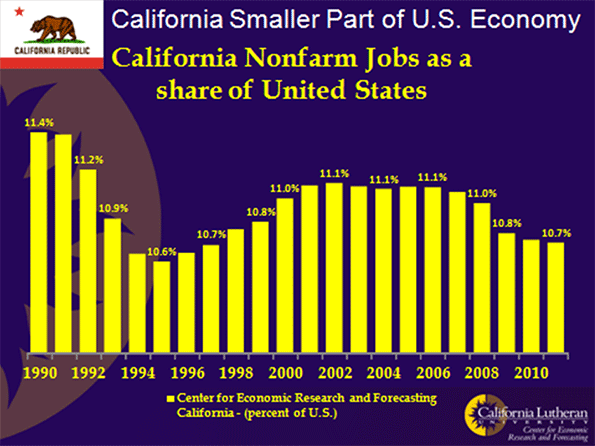
    The problem with analyzing California’s economy — or with assessing its vigor — is that there is not one California economy. Instead, we have a group of regions that will see completely different economic outcomes. Then, those outcomes will be averaged, and that average of regional outcomes is California’s economy. It is possible, even likely, that no region will see the average outcome, just as we rarely see average rainfall in California.

    California’s Silicon Valley region continues to be a source of innovation, economic vigor, and wealth creation. But the Silicon Valley, named because silicon is the primary component of computer chips, no longer produces any chips. The demands for venture capital are also changing, with the demand for cash falling because new products often take the form of apps instead of something that is manufactured. This type of investing doesn’t need the infrastructure that the Silicon Valley provides. Increasingly, other communities such as Boston, Northern Virginia, and Houston are becoming centers of technological innovation.

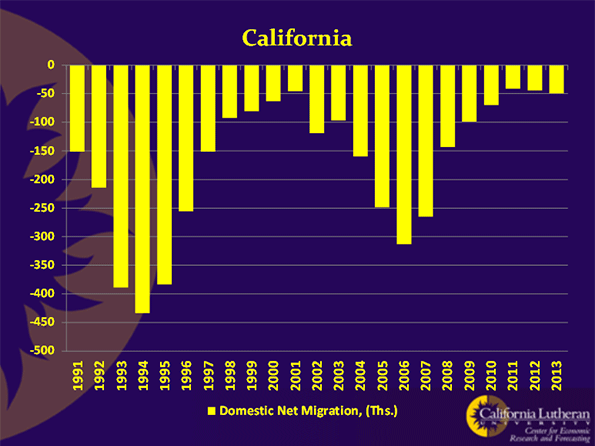
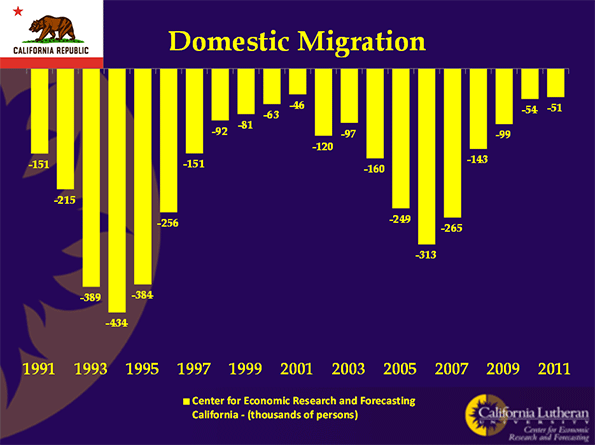
    Workers recognize the changes. They may not know the reasons, but they know the impacts, and they are voting with their feet. Domestic migration — migration between states, — is a good measure of how workers see opportunity. California’s domestic migration, in a dramatic reversal of a 150-year trend, has now been negative for over 20 consecutive years. That is, for over 20 years more people have left California for other states than have come to California from other states. Workers simply haven’t seen opportunity in California. How can this be? Why would people be leaving when jobs are being created in the Silicon Valley?

    The Silicon Valley jobs are rather specific. They require higher skill sets than most workers possess. One consequence is that the Silicon Valley’s prosperity hasn’t helped California’s other workers much. We are left with a situation where California’s tech firms search worldwide for workers, while California workers search for work.

    It didn’t have to be this way. High housing prices and environmental regulations, a result of state policies, have driven away the jobs that could be performed by typical California workers. Those jobs are now in Oregon, Texas, or China.

    A short distance away, in California’s Great Central Valley, there is poverty as persistent, deep, and widespread as anyplace in the United States. A recent report shows that California has three of the 20 fastest growing US cities in terms of jobs. It has four in the bottom 20.

    For a while, at least, the differences between California’s fastest growing regions and its slowest (or declining) areas will grow. In general, coastal areas will see more rapid economic growth than inland ones. Even within these broad regions, there will great heterogeneity. Bakersfield, boosted by a booming oil sector, will see stronger growth than Stockton. San Jose, with its thriving tech sector, will see far more growth than Santa Barbara or Monterey. Furthermore, the best performer among California’s inland cities will probably see faster growth than the slowest growing coastal city.

    On average, California’s economic growth will be far below its potential. In most of the state it will be disappointingly low to dismal, as California’s economy is held back by well-meaning but seriously flawed regulations. At the same time, a few super-performing cities may see spectacular growth, at least for a few years.

    Eventually, even California’s most vibrant economies will slow, gradually strangled by the lack of affordable housing and of an infrastructure necessary to move people from affordable housing to their jobs. People are willing to drive very long distances daily in pursuit of the twin goals of income security and the American dream of a home in the suburbs. The traffic on Highway 14 between Palmdale and Los Angeles reminds us of this twice every working day. But, they need roads, and affordable housing within commuting distance.

    Different growth rates and different levels of economic vitality will exacerbate the vast gulf that exists between California’s wealthiest communities and its poorest. Inequality will increase as California’s fabulously wealthy become ever wealthier, and California’s poor suffer in surprising silence, living on whatever aid we give them, denied the hope and the basic dignity that comes from a job.

    Domestic outmigration will increase, but the people who leave won’t be California’s poorest. Instead, young middle-class people will lead the exodus, as they move to wherever opportunity is more abundant. This, of course, will further increase California’s inequality and decrease its economic vitality.

    We will also see an increase in consumption communities. Already, many of California’s coastal communities are reflexively averse to any new activity that actually creates value, opting instead to become ever more exclusive playgrounds for the very rich. These communities will see rising home prices as they restrict new units, and will see rising demand, a result of ever greater concentrations of wealth worldwide and the unmatched amenities available in Coastal California.

    By contrast, some inland areas will see declining home values and eventually declining populations, as the lack of opportunity drives potential home buyers to places like Phoenix and Houston.

    For many of us, this is a depressing forecast, and it is fair to ask whether or not it is inevitable. It isn’t. Few things are. At a statewide level, I hope that representatives of California’s large and growing minority communities demand policies that support the opportunity that previous generations of Californians enjoyed. Absent such demands, California’s policies are unlikely to change.

    At a local level, cities would do well to eliminate all policies that contribute to economic stagnation. When a business is making locational decisions, it reviews lists of positive and negatives for the candidate communities. No place has only positives, and few places have only negatives. California cities are endowed with one huge positive: California is a wonderful place to live. That’s not enough, though. A city would do well to minimize the list of negatives.

    For businesses, an aggressive minimum wage is a negative, as it raises costs. Uncertainty and delay in a city’s response to an economic proposal increases the risk and costs of proposals. It’s a negative. So is unaffordable housing, as it increases wage demands and makes it harder for businesses to recruit top talent. The best way for a city to encourage the supply of affordable housing is to allow new-home development.

    Finally, areas of economic blight increase crime, raise city costs, reduce city revenues, and are unattractive to businesses considering moving to or expanding in an area. Cities need to be flexible in responses to proposals for these areas. Our work at CERF convinces us that we will need less commercial space in the future. Therefore, almost any proposal for dealing with these areas is preferable to inflexible adherence to existing zoning or plans.

    California cities are constrained by California policy. That doesn’t mean that California cities are without tools for economic development. Almost any California city — no matter which region it is in — is a better place to live than almost any city in, say, Texas. If that can be leveraged by minimized costs, flexibility, and creativity in adapting to the needs of job-creating businesses, a California city, even today, can assist businesses creating opportunity for its citizens

    This is the second part of a two-part report. Bill Watkins is a professor at California Lutheran University and runs the Center for Economic Research and Forecasting, which can be found at clucerf.org

    Flickr photo by Aude Lising: The Central California Coast, viewed from the Pacific Coast Highway — one of California’s unmatched amenities.

  • The California Economy: When Vigor and Frailty Collide

    Part one of a two-part report

    California is a place of extremes. It has beaches, mountains, valleys and deserts. It has glaciers and, just a few miles away, hot, dry deserts. Some years it doesn’t rain. Some years it rains all winter. Those extremes are part of what makes California the attractive place that it is, and, west of the high mountains, California is mostly an extremely comfortable place to live.

    Today, we have some new extremes. Some of our coastal communities are as wealthy as any in the world. At the other extreme, we have some of America’s poorest communities. San Bernardino, for example, has America’s second-highest poverty rate for cities with population over 200,000.

    From the beginning, we’ve had the fabulously wealthy. For the first 140 years after gold was found, California was a place where people could find, or, more correctly, build, success. The new part is the poverty. It used to be that the poor were mostly newcomers, people who hadn’t yet had time to show that they had what it takes. Today, our poverty is dominated by families who have been here a long time. While San Bernardino certainly has some newcomers, it is mostly a city of native Californians.

    The change became visible in the early 1990s. Many analysts will tell you that the change was caused by the collapse of the Soviet Union and the resulting peace dividend, which led to a dramatic downsizing of America’s defense sector, once a major component of California’s economy.

    I believe the way to think about this is that the downsizing of the defense sector exposed the weaknesses in California’s economy, as opposed to causing them. Sure, the downsizing had an economic impact. California lost hundreds of thousands of jobs. But the defense sector eventually bounced back and again became a source of good jobs. The problem is that it bounced back someplace else. It didn’t come back in California. In fact, it continues to decline in California.

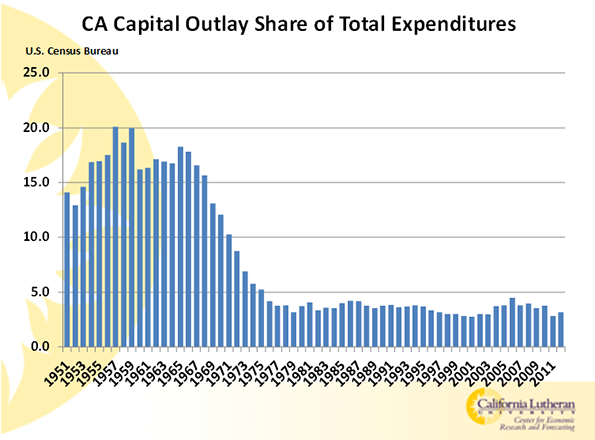
    The decline in California’s economic opportunities began way before the 1990s. As the 1960s progressed, Californians, or at the least the ones making decisions, changed their priorities. California’s spending for infrastructure had once consumed between 15 and 20 percent of the State’s budget. It precipitously fell to five percent or below.

    In the ’50s and early ’60s, governors Goodwin Knight and Pat Brown presided over a fabulous investment boom in universities, highways, water projects and the like. None of their successors has even attempted anything on that scale. The profound prosperity that accompanied and followed California’s investment boom hid the impacts of subsequent policy changes for decades.

    The decline in public capital spending wasn’t the cause of our changed priorities. It was the change in priorities that caused the change in spending. It is as if we decided that we were wealthy enough, and that future spending would be on social and environmental programs. If we weren’t looking for economic growth, why invest?

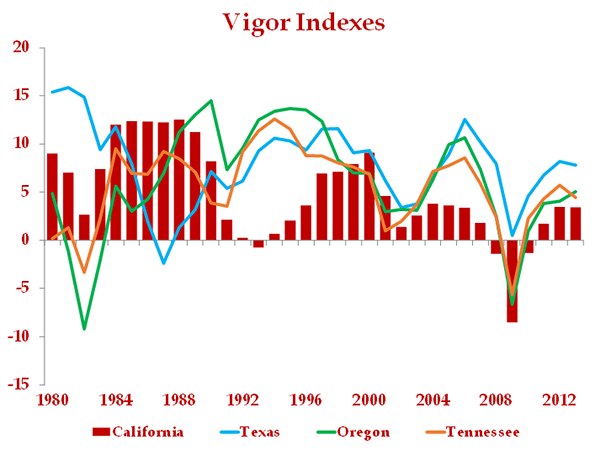
    At California Lutheran University’s Center for Economic Research and Forecasting, we’ve created a vigor index. It’s composed of net in-migration, job creation, and new housing permits, each equally weighted. It is quite sensitive to changes in economic opportunity. For example, in 2000, North Dakota had the nation’s lowest score, 0.9, and Nevada led the nation with a score of 24.1. By 2013, North Dakota led the country with a score of 20.0, while Nevada had seen its index value fall to only 6.4.

    In the following chart, we show California’s index (red bars) compared to that of Texas, Oregon, and Tennessee, from 1980 through 2013.

    California is apparently different than the comparison states. The Tennessee, Oregon, and Texas indexes have behaved more similarly to each other than to California since the late 1980s. Texas’ index behaved uniquely in the early 1980s, because of its dependency on oil and the long-term decline in oil prices that occurred during the 1980s.

    California appears to be different than the other states throughout the period, but the nature of the difference has changed. Prior to the late 1980s, California tended to outperform the others. For example, its score didn’t decline nearly as much as the others during the early 1980s recession. Given California’s resource endowment, we think this is natural.

    Since 1990, though, California’s vigor index has generally remained below those of Texas, Tennessee, and Oregon. Indeed, since 1990, California’s score has rarely exceeded the score of any of the comparison states, and it has never led them all.

    The index also shows that California’s investment in infrastructure during the 1950s and 1960s helped drive economic opportunity for two decades. It took two decades without any investment before we saw the consequences of the decision to not invest.

    Recently, California has seen budget surpluses and faster job growth than the average American state. The forces for the status quo now claim that this confirms the wisdom of their policies. They are wrong.

    California’s budget surpluses are a product of a temporary tax, and an incredible bull market in equities. Our dependence on a highly progressive income tax means that California’s fiscal condition swings on the fortunes of a small group of wealthy individuals.

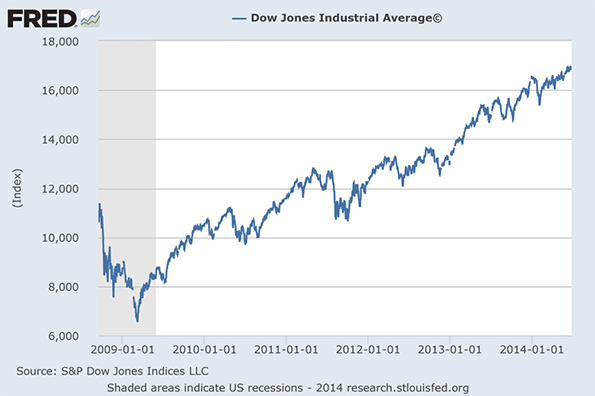
    Equity markets have been amazing over the past few years. The Dow has increased by over 10,000 since it bottomed out on March 9, 2009, and it appears to be divorced from economic activity. It increases on good news and bad, propelled by an unprecedented monetary expansion. Right now, California’s largest taxpayers are reaping huge profits in the stock markets, and California is reaping huge windfalls in its tax revenues.

    Someday, the market gains will cease, or worse reverse. Someday, too, the temporary tax will expire. California’s surpluses will wash away like sand on a beach. The state will face a new crisis, a result of a progressive tax structure where revenues swing on paper profits and losses, not on economic activity.
    As for our job gains being better than the average state’s, California should not be average.

    Employment should be far higher than it is. Even the weak job growth we’ve seen is largely a legacy of a previous age. California has the world’s best venture capital infrastructure, partly because of the investment previous generations of Californians made in the university system. It is also, in part, a result of chance.

    An amazing period of innovation was initiated in Coastal California by a few incredibly talented individuals, who were funded by a few far-sighted capitalists. It was one of those rare coincidences that happen from time to time and change the world. The eventual result was the Silicon Valley and economic powerhouses such as Intel, HP, Apple, Yahoo, Google, Facebook, Twitter, and many more.

    Another result was the creation of a private, capitalist, vibrant infrastructure. It takes time and vast sums of money before a new idea generates profits. Product design is just the first step. An organization needs to be created to produce and sell the product. Factories need to be designed. Marketing plans need to be put in place.

    No inventor or entrepreneur can be expected to have all of the necessary skills or money to turn an idea into a profitable firm. So, an infrastructure appeared. The Silicon Valley’s world-leading venture capital markets and the support structure to enable the fabulous innovation and economic value created there was not the result of any government program or initiative. It was the spontaneous result of lots of people driven to innovate and profit from those innovations. It was capitalism at its very best.

    California’s Silicon Valley became the place for talented young people to turn great ideas into reality. It was also the place to go if you had money and wished to invest in vibrant, risky new technologies, or if you knew how to design factories, how to market products, how to build organizations, or how to finance rapid growth. The infrastructure that arose is supporting California today. This amazing capitalist engine of jobs, innovation and wealth is the source of most of California’s economic vigor. But it is a legacy that will eventually slip away, unless California changes its priorities.

    This is the first part of a two-part report. Bill Watkins is a professor at California Lutheran University and runs the Center for Economic Research and Forecasting, which can be found at clucerf.org.

    Flickr photo by mlhradio. A California extreme: Mountains on The Trona-Wildrose Road, at the edge of the Panamint Valley. One of the most remote deserts in North America, in one of the most remote corners of California; the salt flats of Panamint Valley to the west, and Death Valley to the east.

  • High Speed Rail Decision: Victory for Rule of Law

    California Judge Michael Kenny has barred state bond funding for the California high speed rail system, finding that “the state’s High-Speed Rail Authority failed to follow voter-approved requirements designed to prevent reckless spending on the $68 billion project.” These protections had been an important in securing voter approval of a $10 billion bond issue in 2008. Sacramento Bee columnist Dan Walters suggested that without the protections in Proposition 1A, the measure “probably would have failed” to obtain voter approval.

    According to the court decision, the California High Speed Rail Authority (CHSRA) had failed to identify $25 billion of the funding that would be necessary to complete the first 300 mile segment. This was required by the terms of Proposition 1A as enacted by the legislature and approved by the voters. Yet, without a legally valid business plan, CHSRA was steaming ahead, at least until the court decision.

    The principal longer-term significance of the ruling is that “rule of law” remains in effect in California. Elizabeth Alexis, co-founder of Californians for Responsible Rail Design (CARRD), a group opposed to the project,  told the Los Angeles Times that CHSRA had been conducting itself as if it were “above the law” (Note 1).

    Judge Kenny’s decision means that the state of California cannot ignore its laws, even when its leadership finds them politically inexpedient. Just like the businesses from the largest companies to the smallest used car lot, the law forbids the state from making legally binding promises and then casting them aside arbitrarily.

    The Court Decision

    The San Diego Union-Tribune summarized the court decision as follows:

    Superior Court Judge Michael Kenny ruled that the California High-Speed Rail Authority could not proceed with using billions of dollars in bond funds to begin construction because it had not credibly identified funding sources for the entire $31 billion it will take to finish the 300-mile initial segment, nor had it completed necessary environmental reviews for the segment. These requirements were among the taxpayer protections written into law by California voters in November 2008, when they voted narrowly for Proposition 1A to allow the state to issue $9.95 billion in bonds as seed money for the project. Kenny said the state must develop a plan that comports with these requirements.

    The Union Tribune further reported that Judge Kenny rejected arguments by the state Attorney General that state the legislature, rather than Proposition 1A (now state law which has not been repealed) was the final authority on how the bonds are used.

    The Los Angeles Daily Newsindicated that the decision left the high speed rail project without either a funding plan or the ability to borrow money. The only remaining source of construction funding is a federal grant, which requires a match of state funding.

    Background

    Proposition 1A and the high speed rail project have had a difficult history.

    A $10 billion high speed rail bond issue to support the project (then called Proposition 1) was scheduled for 2008, after having been postponed twice. There was concern, however, in the state legislature that Proposition 1 had insufficient fiscal, environmental and management guarantees to attract a majority vote of the electorate. As a result, legislature enacted and Gov. Arnold Schwarzenegger signed Assembly Bill 3034, which added substantial protections and recast the ballot measure as Proposition 1A. Assemblywoman Catherine Gagliani, the author, said that the legislation “establishes additional fiscal controls on the expenditure of state bond funds to ensure that they are directed to construction activities in the most cost-effective and efficient way.”

    Leading high speed rail proponent and then CHSRA Chairman Quentin Kopp (Note 2), applauded Assembly Bill 3034 indicating that “Californians will now be able to vote on a high-speed train system grounded in public-private financing and guided by fiscal accountability with the guarantee of no new taxes to fund the system,"

    The Promised System

    In the voter ballot pamphlet, proponents told voters that the proposed system would operate from San Francisco to Los Angeles and Anaheim, as well as through the Inland Empire (Riverside-San Bernardino) to San Diego and to Sacramento. This complete system was to cost $45 billion, according to the proponents (a figure that had already risen substantially).

    Like many other large infrastructure projects, costs were soon to explode. By 2011, the cost had escalated to a range of almost $100 billion to more than $115 billion. Further, the promised extensions to Sacramento and the Inland Empire and San Diego were not included in that price (Note 3).

    From High Speed Rail to “Blended” System

    The political reaction to the cost escalation was negative, leading the CHSRA to radically revise the remaining San Francisco to Los Angeles and Anaheim line. CHSRA removed exclusive high-speed rail tracks in the San Francisco-San Jose and Los Angeles metropolitan areas. The cost of this "blended" system was estimated at $68 billion. CHSRA maintained its claim that the legislatively required travel time of 2:40 could be achieved without the genuine high speed rail configurations in the two metropolitan areas. Sacramento Beecolumnist Walters characterized this expectation as based on “assumptions that defy common sense.”

    Former CHSRA Chair Quentin Kopp withdrew his support at this point, referring to the “blended system” as “the great train robbery.” Kopp also raised the possibility that the new plan could violate Proposition 1A, a judgment that Judge Kenny’s decision confirmed.

    Kevin Drum, of Mother Jones may have provided the best summary of situation as it stands today:

    Its numbers never added up, its projections were woefully rose-colored, and it was fanciful to think it would ever provide the performance necessary to compete against air and highway travel. Since then, things have only gotten worse as cost projections have gone up, ridership projections have gone down, and travel time estimates have struggled to stay under three hours.

    Drum had previously characterized CHSRA claims as “jaw-droppingly shameless,”adding that “A high school sophomore who turned in work like this would get an F.”

    Where From Here?

    Proponents have not given up. As The Economistreported, proponents took comfort in the fact that “Judge Kenny did not cancel the project altogether.” The Economist continued “But if that is a victory, it is not clear how many more wins California high-speed rail can handle.”

    The stalwart supporter San Francisco Chronicle editorialized that the court decision was a “bump” in the path for the project. Yet even the Chronicle conceded that: “The court results are a serious warning sign that the financial fundamentals need work.” 

    Too Big to Fail?

    Columnist Columnist Dan Walters fears that to make the financial fundamentals work would require making the project “too big to fail:”

    As near as I can tell, the HSR authority’s plan all along has been to simply ignore the law and spend the bond money on a few initial miles of track. Once that was done, no one would ever have the guts to halt the project because it would already have $9 billion sunk into it. So one way or another, the legislature would keep it on a funding drip.

    Such a strategy would force California taxpayers to fill the gargantuan funding gap, which for the entire Los Angeles to San Francisco line now stands at approximately $65 billion. With the federal funding of approximately $3 billion, the state is 95 percent short of the $68 billion it needs.

    California taxpayers may not be so accommodating. Even before Judge Kenny’s decision, LA Weekly reports that a USC/Los Angeles Times poll shows statewide opposition now to have risen to 53 percent of voters, while 70 percent would like to have a new vote on Proposition 1A (see “Californians Turn Against LA to SF Bullet Train”).

    Even the federal funding is being questioned.  California Congressman Jeff  Denham, also a former supporter of the project, joined with Congressman Tom Latham to ask (link to letter) the United States Government Accountability Office if  further federal disbursements could be illegal, given the uncertainty of the state funding needed to “match” the federal grant.

    Congressman Kevin McCarthy, the majority whip in the US House of Representatives has indicated that he will work with others in Congress to deny further federal funding to the project.

    The San Jose Mercury-News, which like the Chronicle had been a strong supporter of Proposition 1A in 2008 has long since climbed off the train. In an editorial following Judge Kenny’s decision, the Mercury-News decried the project’s “bait and switch,” tactics and called for “an end to this fraud.”

    The Winners: California Citizens

    At this point, the words of legendary New York Yankees catcher Yogi Berra seem appropriate: “It ain’t over till it’s over.” However, Judge Kenny has rewarded California citizens with something that never should have been taken away from them – a government that follows its laws.

    —-

    Note 1: This is not the first time that the state has run afoul of the law on the high speed rail project. According to the Sacramento Bee:

    The Howard Jarvis Taxpayers Association had challenged the ballot language for Proposition 1A, arguing the Legislature used its pen to “lavish praise on its measure in language that virtually mirrored the argument in favor of the proposition.” The appeals court sided with HJTA [stating], “the Legislature cannot dictate the ballot label, title and official summary for a statewide measure unless the Legislature obtains approval of the electorate to do so prior to placement of the measure on the ballot.”

    Unlike the present decision, the state suffered no consequences for its violation and Proposition 1A was not invalidated.

    Note 2: Chairman Kopp is a retired judge, former state Senator and former member of the San Francisco Board of Supervisors.

    Note 3: Joseph Vranich and I have authored two reports questioning the ability of the California high speed rail system to meet its objectives (financial, environmental, ridership, and operations). The first, The California High Speed Rail Proposal: A Due Diligence Report, was published by the Reason Foundation, Citizens Against Government Waste and the Howard Jarvis Taxpayers Association in 2008. The second, California High Speed Rail: An Updated Due Diligence Report, was published by the Reason Foundation in 2012.

    —-

    Wendell Cox is a Visiting Professor, Conservatoire National des Arts et Metiers, Paris and the author of “War on the Dream: How Anti-Sprawl Policy Threatens the Quality of Life.

    Photo: US Constitution (from National Archives)

  • California’s Poor Long-term Prognosis

    California’s current economic recovery may be uneven at best, but things certainly look better now than the pits-of-hell period in 2008. A cautiously optimistic New York Times piece proclaimed "signs of resurgence," and there was even heady talk in Sacramento of eventually sighting that rarest of birds, a state budget surplus.

    Yet such outbreaks of optimism should not blind us to the bigger issue: the long-term secular decline of the state’s economy. Whether you believe that the new higher taxes may now slow our growth, as my colleagues at Chapman University now believe, or right the fiscal ship, as is widely hoped in the blue California press, it’s more important to look more at the long-term trends, and assess where we stand compared with our domestic competitors.

    California, despite its enormous natural and human resources, is losing ground in most basic areas. Its unemployment rate, a still-horrendous 10 percent, stands as the nation’s third-highest. This is not a new development or the product of a run of bad luck. The state’s unemployment rate has been consistently above the national average for almost all of the past 20 years. Most interior counties, including the Inland Empire and the Central Valley, now suffer unemployment rates well into the double digits, with some approaching 15 percent.

    Overall, the state is still down a half-million jobs during the recession. California’s losses since its employment peak have been considerably above the national average, some 3 percent, far worse than the 2.3 percent erosion seen nationwide. Despite the modest recent uptick, the California Budget Project projects the state would need to add twice as many jobs per month to fully recover from the recession by the summer of 2015.

    Other long-term trends confirm the state’s secular decline in competitiveness. Take per capita income – a decent indicator of relative progress. In 1945, journalist John Gunther, writing his famous "Inside USA," gushingly described California "the most spectacular and most diversified American state … so ripe, golden." At the time, the state boasted the third-highest per capita income in the nation. As late as 1980, the state still ranked fourth. Today, despite Silicon Valley’s money machine, California has fallen to 12th and appears headed for further decline.

    Despite hopes in Sacramento and in the media, high-tech alone can not bail out the state. The much hoped-for windfall around the time of the Facebook IPO has failed to produce the expected fiscal bonanza for the state treasury. Silicon Valley famously gets nearly half the country’s venture capital, but its impact on the rest of the state has diminished. In the 1980s and 1990s, tech booms stretched prosperity throughout its surrounding regions and as far as Sacramento. Now it barely covers half the Bay Area; unemployment in Oakland remains at around 13 percent and one child in three lives in poverty.

    Part of this reflects the shift from an industrial high-tech focus to one fixated on software and social media. Given the extraordinary ease with which support and even research operations can be moved, once companies start to grow, they easily head to India, China or over to lower-cost locales like Utah or Texas. "Sure, we are getting half of all the venture capital investment but in the end we have relatively small research and development firms only," observes Jack Stewart, president of the California Technology and Manufacturing Association. "Once they have a product or go to scale, the firms move elsewhere. The other states end up getting most of the middle-class jobs."

    This can be seen in the long-term trends in STEM (science, technology, engineering, mathematics-related) jobs. Over the past decade, even with the current bubble, Silicon Valley’s STEM employment, according to estimates by Economic Modeling Specialists Inc., has increased by a mere 4 percent over the past decade. In contrast, science-based employment jumped 25 percent in Seattle, 20 percent in Houston and 16.8 percent in Austin, Texas.

    The tech scene in the Los Angeles Basin is doing even worse. STEM employment in the Los Angeles-Santa Ana area is still stuck below 2002 levels, partially a residue of the continued decline of the region’s once-globally dominant aerospace industry. The region, once arguably the world’s largest agglomeration of scientists and engineers, has now dipped below the national average in proportion of STEM jobs.

    Far greater problems can be seen further down the economic food chain, where many working-class and middle-class Californians traditionally have been employed. The state’s heavy industry – traditionally the source of higher-paid blue-collar employment – has missed out on the nation’s broad manufacturing resurgence. Over the past 10 years, according to an analysis by the Praxis Strategy Group, California has ranked 45th among the states in terms of heavy metal job creation, losing 126,000 jobs – more than 27 percent; San Francisco-Oakland ranked last among 51 large metropolitan areas. Both Los Angeles-Orange and San Bernardino ranked in the bottom 10.

    Despite hype about "green jobs," the immediate prospect for a big manufacturing turnaround is not bright. Because of its high energy costs and other regulatory costs, industrial investment has dried up in California. According to the California Technology and Manufacturing Association, California in 2011 did not even make the top 10 states in terms of new industrial investment, accounting for a paltry 2 percent. This was about one-third or less the share garnered by rivals such as Texas, North Carolina and rebounding "rust belt" states, like Pennsylvania.

    Construction, another pillar of higher-paid blue-collar employment, has recovered a bit but remains in worse shape than elsewhere. Overall, the state has lost almost 300,000 construction jobs from the 2007 peak, an almost 40 percent loss compared with 29 percent for the country as a whole.

    Even the trade sector, stalwart performer in producing high-wage jobs, may soon be declining. Recent labor disputes by highly paid, politically powerful California port workers – shutting down operations for eight days in Los Angeles and Long Beach – has reinforced the notion that the state’s an increasingly unreliable place to do business. After peaking around 2002, our ports are watching growth shift to the Gulf ports, such as Houston, and to the ports of the south Atlantic. The challenge will become far greater once the Panama Canal is widened in 2014 to accommodate larger ships from Asia.

    California is also squandering its chance to participate in a potential fourth source of basic employment, the massive expansion in domestic oil-and-gas production. The Golden State sits on potentially the largest gusher in the nation – the Monterey Formation is now estimated to be four times as rich in oil as North Dakota’s Bakken Formation. But our green consciousness dictates we don’t exploit our resources too much. In the past decade, Texas created some 200,000 generally high-paying energy jobs, while greener-than-thou California has generated barely one-tenth as many.

    As a result, wealthier, older, whiter, generally better-educated coastal areas can recover, but the prospects are dismal the further you head into the increasingly Latino, younger and less-educated inland areas. You have flush times for venture capitalists and celebrities, but growing poverty elsewhere. For at least two decades California’s poverty rate has remained higher than the national average. Now, notes a new Census estimate, the Golden State has a poverty rate of more than 23 percent, the highest in the country, something unthinkable a generation ago.

    Clearly, progressive policies are having socially regressive effects. Over the past few years the state, as a recent Public Policy Institute of California study demonstrates, has become ever substantially more unequal than the rest of the nation. Typical California middle-income workers have seen their median wage, adjusted for inflation, decline 4.5 percent since 2006, and now is at the lowest level since 2008. Only the highest-paid workers have avoided a decline in earnings.

    Fortunately, the elements to regain our former broad-based prosperity are still in place. The critical human assets are there: entrepreneurs, hardworking immigrants, top universities. We boast advantages from legacy industries – entertainment and fashion to technology and agriculture. And, perhaps most importantly, California retains its remarkable natural blessings of massive energy resources, fertile soil and a benign climate.

    The imperative now is to take fuller advantage of all these blessings in the coming years. Otherwise California will become poorer, more socially bifurcated and relegated by other places to the proverbial "dustbin of history."

    This piece first appeared in the Orange County Register.

    Joel Kotkin is executive editor of NewGeography.com and is a distinguished presidential fellow in urban futures at Chapman University, and contributing editor to the City Journal in New York. He is author of The City: A Global History. His newest book is The Next Hundred Million: America in 2050, released in February, 2010.

  • A Housing Preference Sea Change? Not in California

    For some time, many in the urban planning community have been proclaiming a “sea-change” in household preferences away from suburban housing in the United States.

    Perhaps no one is more identified with the "sea-change" thesis than Arthur C. Nelson, Presidential Professor, City & Metropolitan Planning, University of Utah. Professor Nelson has provided detailed modeled market estimates for California in a paper published by the Urban Land Institute, entitled The New California Dream: How Demographic and Economic Trends May Shape the Housing Market: A Land Use Scenario for 2020 and 2035 (He had made generally similar points in a Journal of the American Planning Association article in 2006).

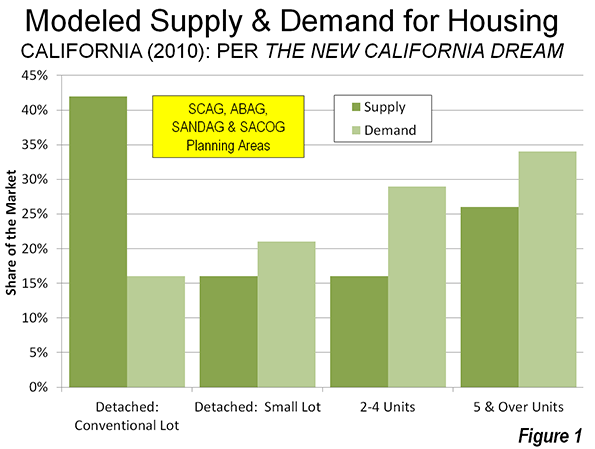
    Professor Nelson says that the supply of detached housing on what he defines as conventional sized lots (more than 1/8 acre) is far greater than the demand in California (Note 1). He further finds that the demand of detached housing on smaller lots is far greater than the supply. Professor Nelson’s conclusions are principally modeled from stated preference surveys, which can mislead if people act differently when they make choices in the real world.

    The Modeled Demand Estimates

    Nelson models the demand for housing types in California’s largest four planning regions (Southern California Association of Governments for the Los Angeles area, and the Bay Area Association of Governments for the San Francisco-San Jose area, the San Diego Association of Governments and the Sacramento Area Council of Governments). He estimates 2010 both supply and demand. His demand estimates rely strongly on data from three early 2000s stated preference surveys conducted by the Public Policy Institute of California (PPIC).

    • Nelson’s data indicates a strong preference for multi-family housing, which he places at 62% of demand in 2010, compared to the 2000 supply of 42%. Thus, the demand for multi-family housing is suggested to be one half above the supply.
    • The most stunning conclusion, however, is an over-supply of detached housing on conventional lots that Nelson estimates. Compared to a 2000 supply of 42% of the market, Nelson estimates the demand to be only 16%. This would indicate the supply of such housing to be more than 2.5 times the demand as is indicated in Figure 1.

    Nelson’s findings on conventional lot detached housing have obtained the most attention. He surmises that virtually all of the demand over the next 25 years can be met by the existing stock of conventional lot detached housing. This is music to the ears of many urban planners, who have for decades demonized  the suburbanization that has been preferred by the overwhelming majority of Californians (and Americans, and people elsewhere in the world where they can afford them).

    Actual Demand: Revealed Preferences: 2000-2008

    To perform a similar analysis, we used revealed preference data: the actual change in housing by type from the 2000 Census data to the latest American Community Survey (ACS) 2006-2010 data at the census tract level (Note 2).  

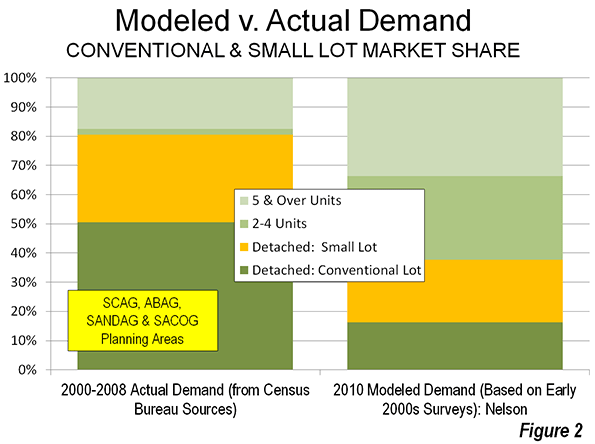
    In contrast to Professor Nelson’s estimates, the demand data indicates a strong continuing preference among Californians for detached housing on conventional lots. From 2000 to 2008 (the middle year for the 2006-2010 data), 51 percent of the new occupied housing in the four planning areas is estimated to have been detached on conventional lots (Figure 2). This is more than three times the 16% demand estimate in Professor Nelson’s data. In fact, the actual demand was higher than the 2000 supply (42%), indicating that the demand for detached houses on conventional lots has increased.

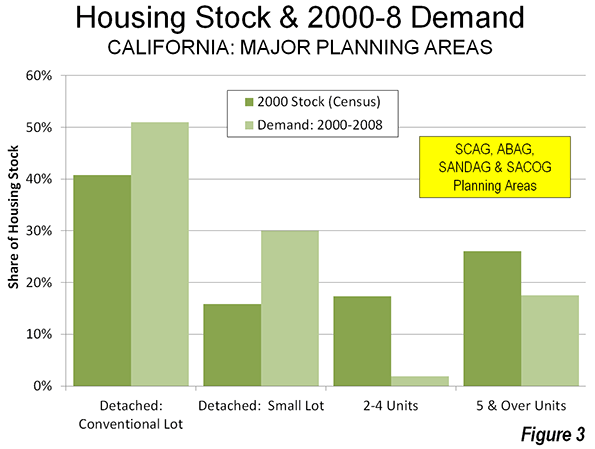
    If there is a sea change, it would appear to be in multi-family housing. In contrast with the 62% share for multi-family dwellings modeled by Nelson, the actual demand indicated in the census tract data was two-thirds less, at 19% (Figure 3), well below the supply of 43 percent in 2000. This suggests a tanking of demand for multi-family housing, even as builders, in California and elsewhere, put more product on the market.

    Why Accounts for the Difference

    Various factors appear likely to contribute to the difference between the modeled demand and the actual demand.

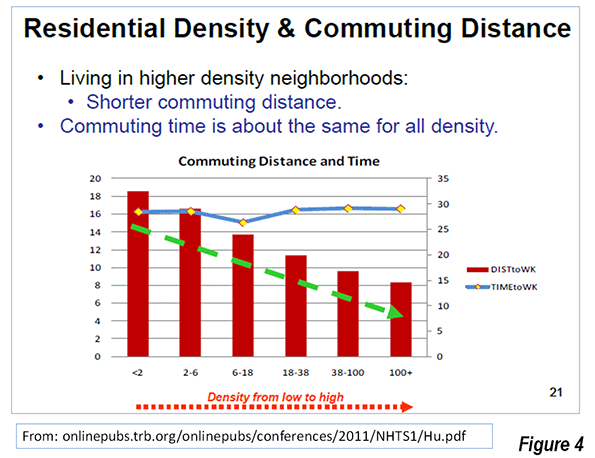
    Smaller Lots and Higher Density Do Not Mean Shorter Commutes: The PPIC survey questions implied a connection between larger lots (lower density) and longer commutes. This is the broadly shared perception, but in reality houses on smaller lots (necessarily in higher density neighborhoods) do not mean shorter commutes. This is illustrated in a chart by Southern California Association of Governments (SCAG) researchers on page 62 of The New California Dream. In the original SCAG document, the authors note that "commuting time is about the same for all density" (Figure 4).  This is not surprising, since higher densities are associated with more intense traffic congestion and with greater transit use, both of which lengthen commutes (Note 3).

    The "higher density means shorter commute" myth is rooted in the obsolete mono-centric conception of the city. Almost all US urban areas have become poly-centric with job locations highly-dispersed, as jobs have followed people to the suburbs. Gordon and Lee (Note 4) have shown that work trip travel times in the United States are shorter to dispersed employment locations than to central business districts or secondary business centers (such as "Edge Cities").  

    Invalid Perceptions of Transit Mobility: Professor Nelson also stresses stated preference responses showing that many people would prefer to live near transit service. All things being equal, who wouldn’t?

    But all things are not equal. Living near transit does not mean practical transit access to most of the urban area. In most cases, only a car can provide that. Transit systems are necessarily focused on downtown areas (central business districts), which contain, on average, only 8% of employment in the four planning regions. , Travel to other destinations is usually inconvenient, because of time-consuming transfers, or   not available at all.

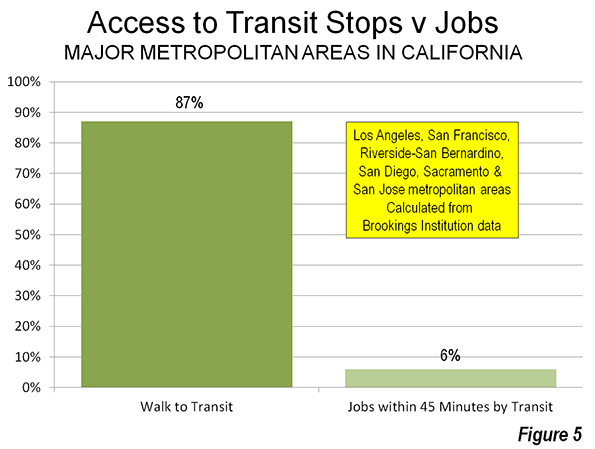
    A Brookings Institution report indicated that 87 percent of people in California’s major metropolitan areas (Los Angeles, San Francisco, Riverside-San Bernardino, San Diego and Sacramento) live within walking distance of transit. Yet, the average employee can reach only 6% of the jobs in their respective metropolitan area in 45 minutes (Figure 5). By contrast, the average work trip travel time ranges from 25 minutes to under 30 minutes in the four planning regions .

    Households thinking about a move to higher density could have been, upon more serious examination, deterred by transit’s severe mobility limitations. 

    Data Insufficiently Robust for the Modeling: There is also the potential that the PPIC surveys, with their general questions, were not of sufficient robustness to support Professor Nelson’s assertions. For example, PPIC did not define the size of small lots.

    Planning and Reality

    If households were so eager to move from detached houses on conventional lots to smaller lots, 2000 to 2008 would have been the ideal time. The mortgage industry was literally falling over itself to fund home purchases. Urban core wannabes could have flooded the market pursuing their smaller lot "stated preferences." The actual, revealed preference data says they did not, which is also indicated by the continuing strength of suburban growth relative to central city growth (Note 5).

    Thus, the modeled demand estimates in The New California Dream appear to be at substantial odds with the actual demand.This is much more than an academic issue. The conclusions of The New California Dream have achieved the status of sacred text in the canon of urban planning and are mouthed unquestioningly by organizations like the Urban Land Institute.

    Worse, demand estimates from The New California Dream are being relied upon in regional transportation plans being developed by California’s metropolitan planning organizations (MPOs). This is particularly risky because these same MPOs have been granted greater power over housing under California’s Senate Bill 375, goaded on by a sue-happy state Attorney General’s office. The attempt by MPOs to impose their housing plans and regulations on consumers could well backfire, for investors in condominium and multifamily housing.  This would not be a first time that   developers followed urban planning illusions like lemmings over a cliff, to which huge losses in the last decade attest. The more destructive effects, however, are likely to be paid by households and the economies of California’s metropolitan areas.

    ———

    Note 1: More than 70% of the detached housing stock was on conventional lots in 2000.

    Note 2: There is no census tract data on detached house lot size. We scaled the detached housing data from the 2000 census to match Professor Nelson’s distribution of detached housing supply by lot size, using population density. Nelson’s method and ours were sufficiently similar that the results should have been roughly comparable. As the text indicates, they were not.

    Note 3: In each of the three PPIC surveys, respondents are asked to choose between housing alternatives that are high in the questions to commute "lengths." From the description and survey instruments in the PPIC reports, there is no indication that respondents were given any idea what commute "length" means. There are two way to judge commute "length." One is distance or miles, while the other is time. Based upon the PPIC survey instrument, it cannot be known which definition was perceived by the respondents.

    Even so, it seems more likely that the term "commute length" was perceived by respondents in time rather than in distance by respondents. Each day, people have only so many hours and minutes available. However, distance is not so constrained, depending upon the speed of the commute. Further, the extensive research on commuting often refers to "travel budgets," which are expressed in time, not distance.

    Note 4: Reference: Gordon, P. and B. Lee (2012), "Spatial Structure and Travel: Trends in Commuting and Non-Commuting Travels in US Metropolitan Areas," draft chapter for the International Handbook on Transport and Development edited by Robin Hickman, David Bonilla, Moshe Givoni and David Banister.

    Note 5: The most recent year (2010-2011), for which the Census Bureau had issued invalid municipal population estimates, indicated a continued the trend toward suburban rather than urban core growth, as has been shown by Trulia Chief Economist Jed Kolko (see: Even After the Housing Bust, Americans Still Love the Suburbs).

    =======

    Photograph: Suburban San Diego

    Wendell Cox is a Visiting Professor, Conservatoire National des Arts et Metiers, Paris and the author of “War on the Dream: How Anti-Sprawl Policy Threatens the Quality of Life.”

  • How California Lost its Mojo

    The preferred story for California’s economy runs like this:

    In the beginning there was prosperity.  It started with gold.  Then, agriculture thrived in California’s climate.  Movies and entertainment came along in the early 20th Century.  In the 1930s there was migration from the Dust Bowl.  California became an industrial powerhouse in World War II.  Defense, aerospace, the world’s best higher education system, theme parks, entertainment, and tech combined to drive California’s post-war expansion.

    Then, in the evening of November 9th, 1989, the Berlin Wall came down.  On December 25, 1991, the Soviet Union was dissolved.  The Cold War was over.  America responded by cutting defense spending and called the savings the Peace Dividend.

    California paid that peace dividend.  A huge portion of California’s military industrial complex was destroyed.  The aerospace industry was downsized, never to come back.  Hundreds of thousands of well-paying manufacturing and engineering jobs were lost.

    The ever-resilient California bounced back though.  Tech, driven by an entrepreneurial culture and fed by California’s great universities drove California’s economy to new heights.

    Then, there was the dot.com bust.  A mild national recession was much more painful for a California dependent on its tech sector.  Eventually California recovered.  California’s tech sector and climate, aided by a housing boom, restored California’s prosperity.

    The housing boom was followed by a housing bust.  Again, California paid a high price, and unemployment skyrocketed to 30 percent above the national average.

    Today, California is recovering.  Its tech sector is once again bringing prosperity to the state.  Furthermore, California’s green legislation is providing the motivation for a brave new future of economic growth and environmental virtue.

    The story is true through the Peace Dividend.  California did pay a high price for the collapse of the Soviet Union.  California’s defense sector did begin a decline, and it never recovered.  But, defense recovered in other places, as the country expanded defense spending by 21 percent in the 2000s.  The United States has constantly been engaged in wars and conflicts for over a decade.  On a real-per-person basis, the United States is spending as much on defense as it has at any time since 1960. 

    But when it comes to the present, the narrative falls down.  Defense has rebounded, but not in California.  California’s defense sector is small and declining, not because of a permanently smaller U.S. defense sector, but because of something about California.

    California’s tech sector did boom after the collapse of California’s defense sector, but that doesn’t mean that California recovered.  In fact, much of California never recovered.  It’s the aggregation problem. 

    The 1990s’ recovery was largely a Bay Area recovery.  Los Angeles hardly saw any uptick in employment.  Here is a chart comparing Los Angeles County’s jobs growth rate with the San Jose Metropolitan Statistical Area (MSA): 

    San Jose probably had California’s fastest growing job market in the 1990s.  Los Angeles was not the states slowest.  Still, the differences are striking.

    A few years ago, a couple of my graduate students looked at California data from 1990 through 1999.  They divided California into two regions, the Bay Area and everywhere else.  The Bay Area was defined as Sonoma, Marin, Napa, Solano, Contra Costa, Alameda, Santa Clara, Santa Cruz, San Mateo, and San Francisco counties.  Using seven indicators of economic growth, they performed relatively simple statistical tests to see if the two geographies experienced similar economies.  The indicators were employment, wages, home prices, bank deposits, population growth, construction permits, and household income.

    By every measure except population growth, the Bay Area outperformed the rest of the state.  The exception was probably due to commuters to the Bay Area, given that region’s exceptionally high housing prices. 

    Some economists will tell you that California saw faster-than-national job growth from the mid 1990s until the great recession.  This is another aggregation problem.  The claim is technically true, but only in the sense that California had a higher proportion of the nation’s jobs in 2007 than it did in 1995.  If you look at annual data, you will see that California’s share of the nation’s jobs only grew from 1995 through 2002.  Since then, California’s share of United States jobs resumed its decline:

    In reality, California never recovered from the dot.com bust.  California, perhaps the best place on the planet to live, couldn’t keep up in a housing boom.  Something was wrong.

    California had lost its mojo. 

    Opportunity is now greater outside California than inside California.  For almost 150 years, California was as widely known for its opportunity as it was for its sunshine.  The combination was like a drug.  George Stoneman, an army officer destined to become California’s 15th governor, spoke for millions when he said "I will embrace the first opportunity to get to California and it is altogether probable that when once there I shall never again leave it." 

    They did come to California, and they made an amazing place.  Opportunity-driven migrants are different than other people.  They take big risks to leave everything they know for an uncertain future in a new place.  They are confident, bold, and brash.   California became just as confident, bold, and brash.  The Anglo-American novelist Taylor Caldwell spoke the truth when she said "If they can’t do it in California, it can’t be done anywhere."

    That was then.  Today, California can’t even rebuild an old Hotel.

    The Miramar Hotel is a partially-demolished eyesore beside the 101 Freeway in Montecito, just south of Santa Barbara.  The Hotel’s initial structure was built in 1889.  Over the years, it was expanded to a 29 structure luxury hotel and resort.  In September 2000 it was closed for renovations which were expected to take 18 months.  That was when the fighting started.  Community groups, neighbors, and governments all had their own idea of what the Miramar should be.  Two owners later, and after millions of dollars, the future to the Miramar is still uncertain.

    The Miramar Hotel is a case study of what is wrong with post-industrial California, precisely because it should have been easy, and because it is not unique.  Everything is hard to do in California.  The state that once moved rivers of water hundreds of miles across deserts and over or through mountain ranges can’t rebuild a hotel.

    The situation will get worse.  California has become the place people are leaving.  The following chart shows that for 20 years more people have left California for other states than came to California from other states:

    California’s population is still increasing because of births and international immigration. 

    Two decades of negative domestic migration has taken its toll.  Millions of risk-taking, confident, bold, and brash people have left California.  They took California’s mojo with them.

    That seems pretty clear when you look at some statistics:  California’s unemployment is way above the national average.  With only about 12 percent of the nation’s population, California has over 30 percent of the nation’s welfare recipients.  San Bernardino has the nation’s second highest poverty rate among cities over 200,000.

    Sometimes though, aggregated data can hide California’s weakness, and some, representing the always-present constituency for the status quo, use these data to deny that California’s future is any less golden. 

    Most recently, those representing the constituency for the status quo have used California’s aggregated jobs data to argue that all is well in California.  They argue that California’s tech sector is leading California to a new golden future.

    Year-over-year data confirm that, through August 2012, California gained jobs at a faster pace than the United States.  Once again, though, that growth is largely confined to one industry and one geography.  California’s tech sector is recovering, and amidst a generally weak recovery, it appears strong enough to generate pretty impressive aggregated results.  If we disaggregate California’s data, we will find that there is not just one California.  There is a rich and mostly coastal California, with a few smaller inland counties on the San Francisco-Lake Tahoe corridor.  Another California is very poor and mostly inland.

    Here’s a list of California’s poorest counties by poverty rate:

    County

    Poverty Rate

    Child Poverty Rate

    Rank

    Del Norte

    23.5

    30.6

    3

    Fresno

    26.8

    38.2

    1

    Imperial

    22.3

    31.8

    6

    Kern

    21.4

    30.3

    10

    Kings

    22.5

    29.7

    5

    Madera

    21.7

    31.7

    8

    Merced

    23.1

    31.4

    4

    Modoc

    21.9

    32.5

    7

    Siskiyou

    21.5

    30.7

    9

    Tulare

    33.6

    33.6

    2

    Here’s a list of California richest counties by poverty rate:

    County

    Poverty Rate

    Child Poverty Rate

    Rank

    Calaveras

    11.1

    18.3

    10

    Contra Costa

    9.3

    12.7

    4

    El Dorado

    9.4

    11.6

    5

    Marin

    9.2

    10.9

    3

    Mono

    10.8

    15

    8

    Napa

    10.7

    14.7

    7

    Placer

    9.1

    10.7

    2

    San Mateo

    7

    8.5

    1

    Santa Clara

    10.6

    13.3

    6

    Ventura

    11

    15.3

    9

    There are some big differences here.  The percentage of Fresno’s children living in poverty is four and half times the percentage of San Mateo children living in poverty.  In fact, the data for California’s poorest counties looks like third-world data.

    When disaggregated, the job-growth data shows the same story.  Through 2012’s second quarter, jobs in the San Jose MSA were up 3.6 percent on a year-over-year basis.  In Los Angeles, jobs were up only 1.1 percent, while in Sacramento they were up only 0.6 percent.  For comparison, U.S. jobs were up about 1.3 percent for the same time period.

    You can perform this analysis for all types of data.  When the data are disaggregated, the story is always the same.  It’s telling us that California needs to get its mojo back, and the current tech boom is likely not to be enough for its recovery.

    Bill Watkins is a professor at California Lutheran University and runs the Center for Economic Research and Forecasting, which can be found at clucerf.org.

    Unemployment photo by BigStockPhoto.com.