Tag: Sacramento

  • California’s Green Jihad

    Ideas matter, particularly when colored by religious fanaticism, wreaking havoc even in the most favored of places. Take, for instance, Iran, a country blessed with a rich heritage and enormous physical and human resources, but which, thanks to its theocratic regime, is largely an economic basket case and rogue state.

    Then there’s California, rich in everything from oil and food to international trade and technology, but still skimming along the bottom of the national economy. The state’s unemployment rate is now worse than Michigan’s and ahead only of neighboring Nevada.  Among the nation’s 20 largest metropolitan regions, four of the six with the highest unemployment numbers are located in the Golden State: Riverside, Los Angeles, San Diego and San Francisco. In a recent Forbes survey, California was home to six of the ten regions where the economy is poised to get worse.

    One would think, given these gory details, California officials would be focused on reversing the state’s performance. But here, as in Iran, officialdom focuses more on theology than on actuality.   Of course, California’s religion rests not on conventional divinity but on a secular environmental faith that nevertheless exhibits the intrusive and unbending character of radical religion.

    As with its Iranian counterpart, California’s green theology often leads to illogical economic and political decisions. California has decided, for example,  to impose a rigid regime of state-directed planning related to global warming, making a difficult approval process for new development even more onerous.  It has doubled-down on climate change as other surrounding western states — such as Nevada, Utah and Arizona — have opted out of regional greenhouse gas agreements.

    The notion that a state economy — particularly one that has lost over 1.15 million jobs in the past decade — can impose draconian regulations beyond those of their more affluent neighbors, or the country, would seem almost absurd.

    Californians are learning what ideological extremism can do to an economy. In the Islamic Republic, crazy theology leads to misallocating resources to support repression at home and terrorism abroad. In California green zealots compel companies to shift their operations to states that are still interested in growing their economy — like Texas. The green regime is one reason why CEO Magazine has ranked California the worst business climate in the nation.

    Some of these green policies often offer dubious benefits for the environment. For one thing, forcing California businesses to move to less energy-efficient states, or to developing countries like China, could have a negative impact overall since shifting production to Texas or China might lead to higher greenhouse gas production given California’s generally milder climate.   A depressed economy also threatens many worthy environmental programs, delaying necessary purchases of open space and forcing the closure of parks. These programs enhance life for the middle and working classes without damaging the overall econmy.

    But people involved in the tangible, directly carbon-consuming parts of the economy — manufacturing, warehousing, energy and, most important, agriculture — are those who bear   the brunt of the green jihad. Farming has long been a field dominated by California, yet environmentalist pressures for cutbacks in agricultural water supplies have turned a quarter million acres of prime Central Valley farmland fallow, creating mass unemployment in many communities.

    “California cannot have it both ways, a desire for economic growth yet still overregulating in the areas of labor, water, environment,” notes Dennis Donahue, a Democrat and mayor of Salinas, a large agricultural community south of San Jose. Himself a grower, Donahue sees agricultural in California being undermined by ever-tightening regulations, which have led some to expand their operations to other sections of the country, Mexico and even further afield.

    Other key blue collar industries are also threatened, from international trade to manufacturing. Since before the recession California manufacturing has been on a decline.  Los Angeles, still the nation’s largest industrial area, has lost a remarkable one-fifth of its manufacturing employment since 2005.

    California’s ultra-aggressive greenhouse gas laws will further the industrial exodus out of the state and further impoverish Californians.  Grandiose plans to increase the percentage of renewable energy in the state from the current unworkable 20% to 33% by 2020 will boost the state’s electricity costs, already among the highest in the nation, and could push the average Californian’s bill up a additional 20%.

    Ironically California, still the nation’s third largest oil producer, should be riding the rise in commodity prices, but the state’s green politicians seem determined to drive this sector out of the state.. In Richmond, east of San Francisco, onerous regulations pushed by a new Green-led city administration may drive a huge Chevron refinery, a major employer for blue collar workers, out of the city entirely. Roughly a thousand jobs are at stake, according to Chevron’s CEO, who also questioned whether the company would continue to make other investments inside the state.

    Being essentially a religion, the green regime answers its critics with a well-developed mythology about how these policies can be implemented without economic distress.  One common delusion in Sacramento holds that the state’s vaunted “creative” economy — evidenced by the current bubble over   surrounding social media firms — will make up for any green-generated job losses.

    In reality the creative economy simply cannot  make up for losses in more tangible industries. Over the past decade, as the world digitized, the San Jose area experienced one of the stiffest drops in employment of any of the 50 largest regions of the country; its 18% decline was second only to Detroit.  Much of the decline was in manufacturing and services, but tech employment has generally suffered. Over the past decade California’s number of workers in science, technology, engineering and math-related fields actually shrank. In contrast, the country’s ranks of such workers expanded 2.3% and prime competitors such as Texas , Washington and Virginia enjoyed double-digit growth.

    So who really benefits from the green jihad? To date,  the primary winners have been crony capitalists, like President Obama’s newly proposed commerce secretary, John Bryson, who built a fantastically lucrative  career (he was once named Forbes’  “worst valued chief executive”) while  running the regulated utility Edison International. A lawyer by training, Bryson helped found the green powerhouse National Resources Defense Council. He’s been keen to promote strict  renewable energy  standards  that also happen to benefit solar power and electric car companies in which he holds large financial stakes.

    Other putative winners would be large international companies, like Siemens, that hope to build California’s proposed high-speed rail line, the one big state construction project favored by the green-crony capitalist alliance. Fortunately , the states dismal fiscal situation and  rising cost estimates for the project, from $42 to as high as $67 billion, as well as cuts in federal subsidies, are undermining support for this project even among some liberal Democrats.  Even in a theocracy, reality does, at times, intrude.

    Finally, there are the lawyers — lots of them. A hyper-regulatory state requires legal services just like a theocracy needs mobs of mullahs and bare knuckled religious enforcers. No surprise the number of lawyers in California increased by almost a quarter last decade, notes Sara Randazzo of the Daily Journal. That’s two and a half times the rate of population growth.

    The legal boom has been most exuberant along the affluent coast.  Over the past decade, the epicenter of the green jihad, San Francisco, the number of practicing attorneys increased by 17%, five times the rate of the city’s population increase. In the Silicon Valley, Santa Clara and San Mateo counties boosted their number of lawyers at a similar rate. In contrast, lawyer growth rate in interior counties has generally been far slower, often a small fraction of their overall population growth.

    If California is to work again for those outside the yammering classes, some sort of realignment with economic reality needs to take place.  Unlike Iran, California does not need a regime change, just a shift in mindset that would jibe with the realities of global competition and the needs of the middle class. But at least with California we won’t have to worry too much about national security: Given the greens anti-nuke proclivities, it’s unlucky the state will be developing a bomb in the near future.

    This piece originally appeared at Forbes.com.

    Joel Kotkin is executive editor of NewGeography.com and is a distinguished presidential fellow in urban futures at Chapman University, and an adjunct fellow of the Legatum Institute in London. He is author of The City: A Global History. His newest book is The Next Hundred Million: America in 2050, released in February, 2010.

    Photo by msun523

  • California: Club Med Meets Third World?

    On March 25th, the Bureau of Labor statistics released a report that showed that California jobs had increased by 96,000 in February.  The state’s cheerleaders jumped into action. Never mind that the state still has a 12.2 percent unemployment rate, and part of the decline from 12.4 percent is because just under 32,000 discouraged workers left California’s labor force in February. 

    Unfortunately, the cheerleaders are likely to once again be disappointed.  It is unwise to build a case on one data point.  Data are volatile and subject to all sorts of technical issues.  For example, the estimate of California’s job growth is seasonally adjusted data and subject to revision.

    More importantly, even if California did see 96,000 new jobs in February, that pace is unlikely to be maintained.  California’s economy is just too burdened by the State’s DURT: Delay, Uncertainty, Regulation, and Taxes.  Instead of enjoying the truly vibrant recovery one would expect given its climate, location, natural resources, university network, workforce, and natural and manmade amenities, California’s economy will grow far below its potential, burdened by its DURT. 

    People often ask me to identify the most important impediment to California’s economic growth, but there isn’t just one.  Every business is different.  One may be most impacted by regulation, another by taxes.  Instead, it is the total cost of the DURT.

    Taxes are certainly one component of DURT.  The Tax Foundation ranked California 49th in business taxes and Kiplinger ranks California worst in retiree’s taxes, which serves as a good proxy for individual tax burdens.  No doubt, California’s taxes are high, but that alone wouldn’t be too big a problem.  People happily pay to live in California.  Higher taxes and home costs are just the beginning.

    California is in its own class when it comes to regulation; nothing is unimaginable in a state where bulk of the executive leadership comes from the San Francisco-Oakland area.  Today, there are two regulations that are particularly hurting California’s economy, AB32 and SB375.  AB32 is California’s attempt to unilaterally solve the planet’s global warming problem.  It will have serious implications, all of them detrimental to economic activity.  SB375 attempts to advance its global warming  goals through regional planning mandates.  Here’s a sympathetic analysis of SB375 from a smart guy.

    Those are just the most onerous regulations.  California has thousands of regulations and more come daily.  California had 725 new laws come into effect on January 1, 2011, and the state has over 500 constitutional amendments, averaging over four new constitutional amendments a year.

    Which brings us to uncertainty.

    Uncertainty about the future regulatory environment is detrimental to economic activity.  It is extraordinarily difficult to plan when the regulatory environment is in such a state of flux, and nothing is unimaginable.

    Regulatory uncertainty is far from California’s only source of uncertainty.  California’s local governments are notoriously fickle, particularly in the generally affluent coastal areas.  I know of one project that spent four years in planning, only to be denied by the City Council, even though the project was supported by the planning department.  That’s just expensive.  Developers spend hundreds of thousands of dollars on architects, engineers, and planning consultants while jumping through the hoops set up by the planning department, neighborhood groups, environmentalists, and other special interest groups.

    This type of story is all too common in Coastal California.  Some California communities, such as Santa Monica, require that prior to building a new house, you must use two by fours, string, and flags to provide the outline of the proposed structure for up to 90 days.  This is to facilitate neighbor complaints before the project is built.

    The previous story also relates to delay.  Delay in California is legendary, a result of regulatory hurdles, demand for studies, and legal action.  California newspapers often describe projects as controversial, but this is redundant.  Every project is controversial in California. 

    Want to rebuild an aging bridge?  Someone will sue you and claim the old bridge is a historical landmark.  Want to put in a solar farm?  Someone will sue you because the land is home to endangered rats, turtles, salamanders, toads, fairy shrimp, or something.  Endangered species are everywhere in California.  Want to put a condominium project in a depressed part of town?  Someone will sue you because it doesn’t match the neighborhood.  Want to build a house?  Someone will sue you because it will block their view.

    All these things and more happen in California.  It’s no surprise that businesses find California a very challenging place to be profitable.  California’s markets are huge.  No doubt about it.  So, some business will operate in the state.  California’s location on the Pacific Rim and it ports also compel some business to be in California, even if costs are high.  California is a fantastic place to live.  So, people who can afford to will live here.  Some business owners will locate businesses where the owner wants to live.  But, most businesses are too competitive to give up profits to live in California.  Many keep their headquarter s here while shipping their new jobs to other states, or abroad.

    Even so, California is unlikely to become Detroit.  It, sadly, is also unlikely to achieve its potential or regain its previous economic vigor.  The cost of California DURT is just too high.  Instead, the place will become increasingly divided.  Coastal regions, for the foreseeable future, will become even more affluent, heavily white and increasingly Asian.  Hosts of unseen, less fortunate people support them, often commuting from more hardscrabble interior locations.

    Considerable poverty will coexist uncomfortably in California’s coastal paradise.  Working class families already crowd into housing units designed for one family, and this will likely only get worse. 

    What Coastal California won’t have is much of a middle class.  Lack of opportunity and high housing costs makes the most pleasant parts of California an unattractive place for people who define quality of life by opportunity and affordable housing, young families.  Domestic migration is likely to continue to be negative.

    For its part, inland California is already depressed, 27 counties have unemployment rates over 15 percent.  Eight have unemployment rates above 20 percent.  Even during the boom, many of California’s inland areas had extraordinarily high unemployment rates.  Central California’s poverty and blight will only get worse.

    All this is courtesy of expensive California DURT.  Because of it, California’s economy will lag.  More importantly, California seems to be morphing into almost a Hollywood caricature.  The self-absorbed hedonistic wealthy live side by side with the poor, like  a combination of a Club Med and Leisure Village in a third-world country.

    Bill Watkins is a professor at California Lutheran University and runs the Center for Economic Research and Forecasting, which can be found at clucerf.org.

    Photo by chavez25

  • California’s Demographic Dilemma: A Class And Culture Clash

    The newly released Census reports reveal that California faces a profound gap between the cities where people are moving to and the cities that hold all the political power. It is a tale that divides the state between its coastal metropolitan regions that dominate the state’s politics — particularly the San Francisco Bay Area, but also Los Angeles — and its still-growing, largely powerless interior regions.

    Indeed, the “progressives” of the coast are fundamentally anti-growth, less concerned with promoting broad-based economic growth — despite 12.5% statewide unemployment — than in preserving the privileges of their sponsors among public sector unions and generally affluent environmentalists. This could breed a big conflict between the coastal idealists and the working class and increasingly Latino residents in the more hardscrabble interior, whose economic realities are largely ignored by the state’s government.

    The Census shows that the Bay Area and Los Angeles are growing at their slowest rate in over 160 years under American rule. Between 2000 and 2010 Los Angeles gained less population than in any decade since the 1890s. Its growth rate was slower than metropolitan Chicago, St. Louis and virtually every region that has reported to date, with the exception of New Orleans.

    This reflects not only the poor economy of the past few years, but also a widely cited drop-off in foreign immigration and continued massive outmigration of residents to other states. One reason for this mass exodus may be soaring house prices — largely the product of strong regulatory restraints — which appear to have contributed to slowing population growth after 2003.

    Yet not all of California is stagnating demographically. The state’s interior region — what I call “The Third California” — is growing steadily. While  Orange County, Los Angeles, San Francisco, San Jose and the Silicon Valley increased their population by only 6% or less over the last decade, inland areas such as Riverside-San Bernardino, Sacramento and the Central Valley saw growth of 20% or more. Overall, the interior counties together gained 2 million residents , roughly twice as many as the combined coastal metropolitan areas.

    The reasons for this growth are not difficult to comprehend. In boom times and hard times, housing prices in the coastal regions tend to equal as much as seven or eight times a median family income. The prices in the interior can be three times or less.

    In addition, during the past two decades, the interior region enjoyed fairly strong economic growth. Pro-business county governments promoted the expansion not only of housing, which boosted construction, but of basic industries such as food processing, manufacturing and warehousing. According to economist John Husing, the Inland Empire alone accounted for over 40% of the state’s total job growth.

    Today, in the wake of the collapsed housing bubble, these interior counties are reeling, with double-digit unemployment (in some cases reaching closer to 20%) and what appear to be diminishing prospects. Five of the nation’s 10 metro areas for foreclosures are located in California’s interior.

    Under normal circumstances, lower housing prices and business costs would lead — as in past recessions — to a spate of new economic growth, but this the radical turn in California government could keep these areas permanently poor.

    Essentially, the Third California has become hostage to the coastal cities and their increasingly bizarre economic policies. Under first Arnold Schwarzenegger and now Jerry Brown, California has embraced a series of radical environmental edicts that spell disaster for the more blue-collar interior. These include dodgy land use policies designed to combat “climate change” but essentially seek to steer middle- and working-class Californians out of their cherished suburban homes and into densely packed urban apartment complexes.

    The last election confirmed the Bay Area’s ascendency in Sacramento. Gov. Jerry Brown was previously mayor of Oakland (a city that actually lost population this decade), while the lieutenant governor, former San Francisco Mayor Gavin Newsom, and the new attorney general, Kamala Harris, are from the city by the Bay.  The San Francisco area’s population may be about the same as the Inland Empire’s, but its political perspective now dominates the state.

    Husing describes San Francisco as “a bastion of elitist thinking” due to a large “trustifarian” class who have turned the city into favorite spot for green and fashionably “progressive” think tanks. This thinking is increasingly influential as well in a rapidly changing Silicon Valley. In the past the Valley was a manufacturing powerhouse and had to worry about such things as energy prices, water availability and regulatory relief. But the increasingly dominant information companies such as Apple, Facebook, Twitter, Google and their wannabes are widely unconnected to industrial production in the region. To be sure, they have created a financial bubble in the area that has made some fantastically rich, but according to researcher Tamara Carleton they have contributed very little in new net job creation, particularly for blue-collar or middle-class workers.

    There’s a bit of a snob factor here. Fashionable urbanistas extol San Francisco as a role model for the nation. The City, as they call it, has adopted the lead on everything from getting rid of plastic bags and Happy Meals is now considering a ban on circumcision. When it comes to everything from gay rights to bike lanes, no place is more consciously “progressive” than San Francisco. So why should that charmed city care about what happens to farmworkers or construction laborers in not-so-pretty Fresno?

    Class and occupational profile also has much to do with this gap between the Californias. Husing notes that the Bay Area has far more people with college degrees  (42%) than either Southern California (30%) or the Central Valley (where the percentage is even lower). Green policies that impact blue-collar workers — restraining the growth of the LA port complex, restricting new single-family home construction or cutting off water supplies to farmers — mean little distress for the heavily white, aging and affluent Bay Area ruling circles.

    But such moves could have a devastating impact on the increasingly Latino, younger and less well-educated populace of the interior. Outside of the oft-promised green jobs — which Husing calls “more propaganda than economics” — it is these less privileged residents’ employment that is most likely to be exported to other states and countries, places where broad-based economic growth is still considered a worthy thing.  “By our ferocious concentration on the environment, we have created a huge issue of social justice,” Husing points out. “We are telling blue collar workers we don’t want you to have a job.”

    This all presages what could be the greatest issue facing California — and much of the country — in the decades to come. In places where San Francisco-like fantasy politics preside, expect to witness a growing class and ethnic divide, with consequences that could prove catastrophic to the future of our increasingly diverse society.

    This piece originally appeared at Forbes.com

    Joel Kotkin is executive editor of NewGeography.com and is a distinguished presidential fellow in urban futures at Chapman University, and an adjunct fellow of the Legatum Institute in London. He is author of The City: A Global History. His newest book is The Next Hundred Million: America in 2050, released in February, 2010.

    Photo by wstera2

  • Population Dispersion Continues in Riverside-San Bernardino, San Diego and Sacramento

    Population growth continued the strongest in the suburban areas of Riverside-San Bernardino, San Diego and Sacramento, while unusually strong growth occurred in the historical core municipalities, all of which are dominated by a suburban urban form.

    Riverside-San Bernardino: Riverside-San Bernardino experienced by far the fastest growth of any metropolitan area in California, at 30 percent from 2000 to 2010. This growth rate placed the metropolitan area otherwise known locally as the "Inland Empire" fourth in growth rate among the 26 reporting major metropolitan areas, behind Raleigh, Las Vegas and Austin. The Riverside-San Bernardino metropolitan area grew from a population of 3,255,000 in 2000 to 4,225,000 in 2010. At the growth rates of the past decade, Riverside-San Bernardino would pass San Francisco, to become the state’s second largest metropolitan area by 2012.

    Riverside-San Bernardino is virtually an all suburban metropolitan area. The historical core municipality of San Bernardino grew 11.4 percent, from 188,000 in 2000 to 210,000 in 2010, capturing two percent of the metropolitan area growth. Suburban areas accounted for 98 percent of the growth.

    San Diego: The San Diego metropolitan area grew 10 percent from 2000 to 2010, rising from 2,814,000 to 3,095,000. This growth rate was nearly double or more than that of the other major coastal metropolitan areas in California (Los Angeles, San Francisco and San Jose). Even so, the actual population count was approximately 130,000 below the California State Department of Finance estimate. We had previously questioned the aggressive population projections released by the State Department of Finance in an Orange County Register op-ed, 60 Million Californians: Don’t Bet on It).

    The historical core municipality grew 6.9 percent from 1,223,000 to 1,307,000 and, as in 2000 is the nation’s eighth largest municipality (having been passed by San Antonio and having passed Dallas). The city of San Diego, with a largely suburban urban form, attracted 30 percent of the metropolitan area population growth. The California State Department of Finance estimate for the city was much higher, at 1,376,000, indicating an estimate of two new residents for every actual resident counted.

    Sacramento: The Sacramento metropolitan area grew strongly between 2000 and 2010, at 19.6 percent. The population rose from 1,797,000 to 2,149,000, adding more new residents than the much larger combined metropolitan areas of San Francisco and San Jose.

    The historical core municipality of Sacramento grew from 407,000 to 466,000 (a gain of 14.6 percent) and accounted for 17 percent of the metropolitan population growth. Suburban areas grew 21.1 percent and accounted for 83 percent of the metropolitan area growth.

  • California’s Third Brown Era

    Jerry Brown’s no-frills inauguration today as California governor will make headlines, but the meager celebration also marks the restoration of one of the country’s most illustrious political families. Save the Kennedys of Massachusetts no clan has dominated the political life of a major state in modern times than the Browns of California. A member of this old California Irish clan has been in statewide office for most of the past half century; by the end of Jerry Brown’s new term, his third, the family will have inhabited the California chief executive office for a remarkable two full decades since 1958.

    Brown, at 72 the oldest governor in state history, may well determine the final legacy of this remarkable family. His biggest challenge will be to reverse the state’s long-term secular decline — a stark contrast to the heady days of the first Brown era, presided over by paterfamilias Edmund “Pat” Brown.

    Pat Brown was a committed progressive who actually believed in both social and economic progress. He did not focus on re-distributing wealth or expanding bureaucratic controls; his priority was to use government to help generate greater opportunities for Californians.

    Under Pat roughly 20% of the state budget was devoted to capital outlays. He expanded wealth creating infrastructure such as freeways and the State Water Project, which created vast expanses of new, highly fertile farmland. He also increased the state’s parklands so that middle-class Californians could enjoy the state’s unmatched natural beauty.

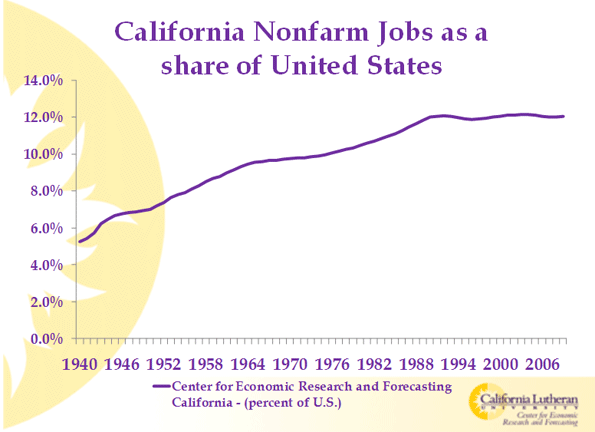
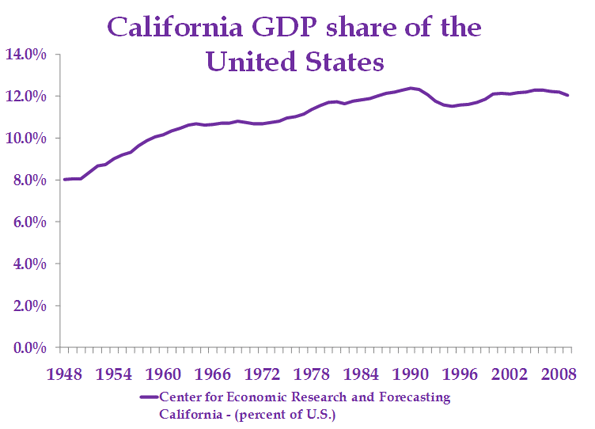
    Pat, as historian Kevin Starr notes, also transformed California into “a mecca for education.” Inexpensive and quality training — from the elite university to the extensive network of community colleges — fostered high-tech industries across the state. Under Pat Brown, California’s share of the nation’s employment rose from some 8% to 10% as its GDP swelled by a similar percent.

    Pat, not surprisingly, remains an iconic figure for many older Californians. What ended his career was not so much his embrace of big government — although its growing scope and cost concerned many voters  – but backlash against the 1964 “free speech” riots at Berkeley and the far deadlier civil unrest in Watts the following year.  Running as the candidate of law and order, as well as fiscal conservatism, Ronald Reagan in 1966 defeated Brown’s bid for a third term.

    Yet so great was the reservoir of affection for the Pat Brown that in 1974 the voters elected his 36-year-old son as Reagan’s successor. As the late Joe Cerrell, a key operative for both Browns, put it: “If he had run as Edmund G. Green, he wouldn’t have bet on his running in the top 14.”

    Jerry Brown turned out to be of a very different political hue than his father. Sometimes he sounded more anti-government even than Reagan. He disdained his father’s traditional focus on   infrastructure spending and instead preached about amore environmentally friendly “era of limits.”  Brown cut the percentage of spending on such capital improvements from roughly 10% of state spending under Reagan to barely 5%, where it remains mired today.

    Arguably Brown’s biggest mistake was signing legislation in 1978 that allowed collective bargaining for public employee unions. This opened the door for a power grab that eventually drove the state toward semi-permanent penury. Brown’s early embrace of environmentalism also set a pattern of state green engineering that, although clearly avant garde , also tipped the state’s competitive edge.

    Brown, however, also showed a pragmatic side.   Although initially opposed to Howard Jarvis’ 1978 Proposition 13 limits on property taxes, he later embraced it  so enthusiastically that the casual voter might have mistaken him for its author. In his second term Brown also evolved into an avid cheerleader for the state’s burgeoning high-tech industry.

    He also had good fortune to govern California at a time when surging Japanese investment, the high tech boom and, perhaps most important of all, the military buildup accelerated by the 1979 Soviet invasion of Afghanistan generated a remarkable economic boom. Between 1976 and 1980 aerospace and electronics-related employment jumped by a third. California’s share of the nation’s GDP, population and jobs rose steadily, while job growth surpassed the national average.

    The third Brown era, sadly, starts with far less favorable prospects. The state’s share of the nation’s economy and employment has been shrinking for at least a decade. Per capita income has fallen in comparison with the national average by nearly 20%. Once the nation’s high tech wunderkind, California’s share of new high-tech jobs has fallen to a fraction of the national average, while other states, notably Texas, Virginia, Utah and Washington have surged ahead.

    Things have been toughest on the state’s working class. Despite an ever-expanding welfare state, California’s 36 million people suffer a rate of poverty at least one-third higher than the national average when adjusted for cost of living.  Unemployment now is higher than any major state outside Michigan.

    Meanwhile, even as state social spending has surged, reminders of the heroic period — from the state system of higher education to the power, water and freeway systems — have fallen into disrepair. The state’s finances are in even worse shape. Under the feckless Arnold Schwarzenegger, state debt jumped from $34 billion to $88 billion. California now spends twice as much on servicing its interest (more than $6 billion annually) than on the University of California.

    Brown himself recently conceded that the state budget deficit may widen to $28 billion over the next 18 months while the state’s Legislative Analyst’s Office predicts that $20 billion deficits are likely to persist at least through 2016. Not surprisingly, once golden California suffers consistently near the worst debt rating of any state. And things are not likely to turn around quickly: State and local tax revenues in the third quarter of last year rose a paltry 0.6% compared with a 5.2 % gain nationwide.

    Brown’s proven taste for austerity could make him far more effective at addressing the state fiscal crisis than the clueless Terminator. His biggest problem on fiscal matters, one close advisor confided, may lie with his own Democrats in the legislature, many of whom are little more than satraps of the public employee interests.

    Brown’s support for the state’s increasingly draconian green polices may prove more problematic.  As Attorney General, Brown played the bully in enforcing radical green measures that seek to limit developments — industrial and residential — suspected of creating greenhouses gases. Brown suggested during the campaign that such policies would help create an estimated 500,000 green jobs, but few outside the environmental lobby take this seriously. Brownsupporter Tom Hayden points out that these jobs can only be created by higher energy prices and considerable tax increases — not exactly the elixir for an already weak economy.

    More troubling still, Brown, the Democratic leadership and their media supporters continue to deny that “progressive” policies have created  ”a hostile business climate.” Until they wake up to the reality of the state’s dire economic situation, little in the way of serious reform can be expected.

    To succeed, Brown must move beyond delusions and rediscover the pro-business pragmatism that characterized his second gubernatorial term. If not, we can expect the final obliteration of Pat Brown’s great  legacy of pro-growth progressivism, in no small part due to the misjudgments of his son and heir.

    Joel Kotkin is executive editor of NewGeography.com and is a distinguished presidential fellow in urban futures at Chapman University, and an adjunct fellow of the Legatum Institute in London. He is author of The City: A Global History. His newest book is The Next Hundred Million: America in 2050, released in February, 2010.

    Photo by Thomas Hawk

  • If California Is Doing So Great, Why Are So Many Leaving?

    Superficially at least, California’s problems are well known. Are they well understood? Apparently not.

    About a year ago Time ran an article, “Why California is Still America’s future,” touting California’s future, a future that includes gold-rush-like prosperity in an environmentally pure little piece of heaven, brought to us by “public-sector foresight.”

    More recently, Brett Arends’ piece at Market Watch, “The Truth About California,” is more of the same. California’s governor elect, Jerry Brown, liked this piece so much that he tweeted a link to it.

    The optimist’s argument about California’s future ultimately hinges on the creativity of the state’s vaunted tech sector, in large part driven by regulation promulgated by an enlightened political class and funded by a powerful venture capital sector.

    No fundamentalist evangelical speaks with more conviction or faith than a California cheerleader expounding on the economic benefits of environmental purity brought about by command and control regulation.

    The more honest cheerleaders acknowledge that California has challenges, including persistent budget problems. Arends denies even the existence of a budget problem, demanding “Er, no, actually. It’s your assertion. You do the math.” Let me help you, Brett. The non-partisan California Legislative Analyst’s Office has done the math. You can find it here. They expect budget shortfalls in excess of $20 billion a year throughout their forecast horizon. This is on annual revenues of less than $100 billion.

    Last week the numbers got even worse, as the Governor-elect, Jerry Brown, acknowledged. The deficit may now be as much as $28 billion this year, and over $20 billion for the foreseeable future. This is more than a nuisance. There’s a reason, after all, why California has among the worst credit ratings of any state.

    Most people outside of California haven’t drank from this vat of the economic equivalent of LSD-laced Kool-Aid. People know that a state is in trouble when it has persistent intractable budget deficits, chronic domestic net out-migration, and 30 percent higher unemployment than the national average. Indeed, California’s joblessness, chronic budget deficits, governors, and credit rating have made the state the butt of jokes worldwide.

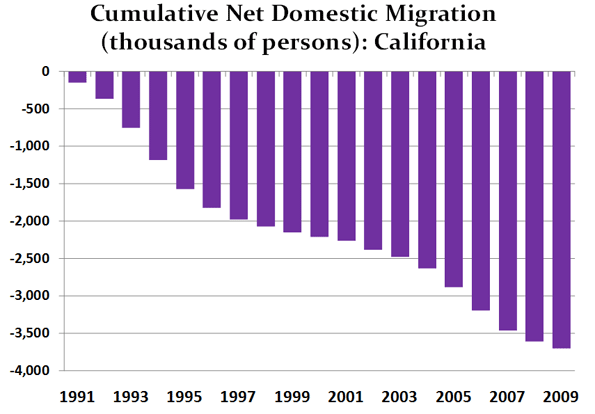
    How bad are things in California? California’s domestic migration has been negative every year since at least 1990. In fact, since 1990, according to the U.S. Census, 3,642,490 people, net, have left California. If they were in one city, it would be the third largest city in America, with a population 800,000 more than Chicago and within 200,000 of Los Angeles’ population.

    We’re seeing a reversal of the depression-era migration from the Dust Bowl to California. While California has seen 3.6 million people leave, Texas has received over 1.4 million domestic migrants. Even Oklahoma and Arkansas have had net-positive domestic migration trends from California.

    Those ultimate canaries in the coal mine, illegal immigrants, recognize California’s problems. Twenty years ago, about half of all United States illegal immigrants went to California. Today, that’s down to about one in four.

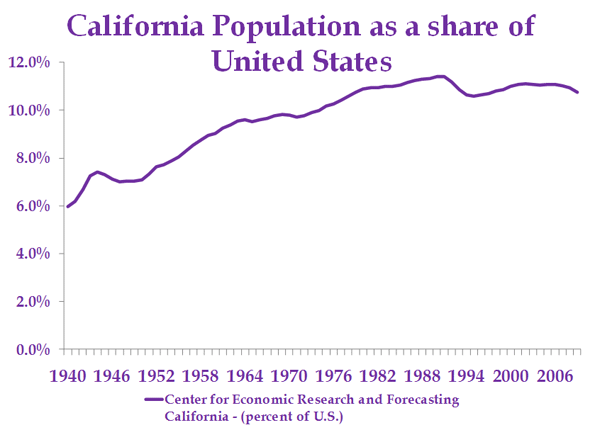
    The result of these migration trends is that California’s share of the United States population has been declining.

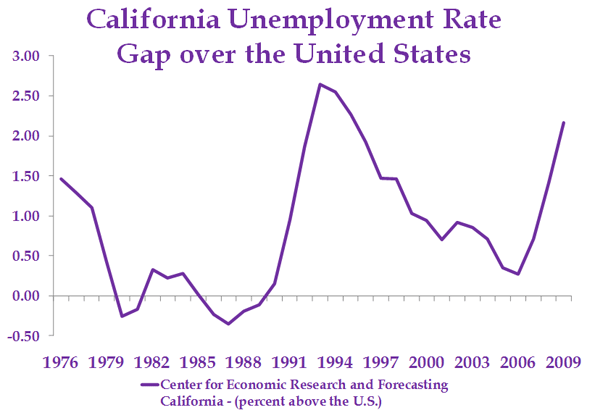
    What do these migrants see that so many of California’s political class do not see? They see a lack of opportunity. California’s share of United States jobs and output has declined since 1990, and its unemployment rate has remained persistently above the United States Average, only approaching the average during the housing boom.

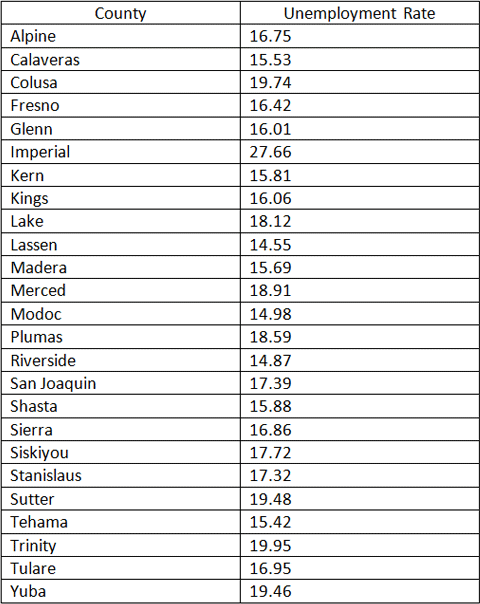
    California’s unemployment is particularly troubling. As of October 2010, only two states, Nevada at 14.2 percent and Michigan at 12.8 percent, had higher unemployment rates than California’s 12.4 percent. California’s unemployment problem is particularly severe in its more rural counties. Twenty-five of California’s 58 counties have unemployment rates higher than Nevada’s:


    These unemployment rates approach depression levels. Some will excuse many of them because they are in agricultural areas, but many assert that low Midwest unemployment rates are due to a booming agricultural sector. Which one is it?

    California’s unemployment problems are not limited to rural and agricultural areas. Most of Riverside County’s population is very urban, yet the County’s unemployment rate is 14.87 percent. On December 7th, the Wall Street Journal listed the unemployment rates for 49 of America’s largest urban regions. California had six of the 19 metro areas with double-digit unemployment. These include such major cities San Diego, San Jose, and Los Angeles.

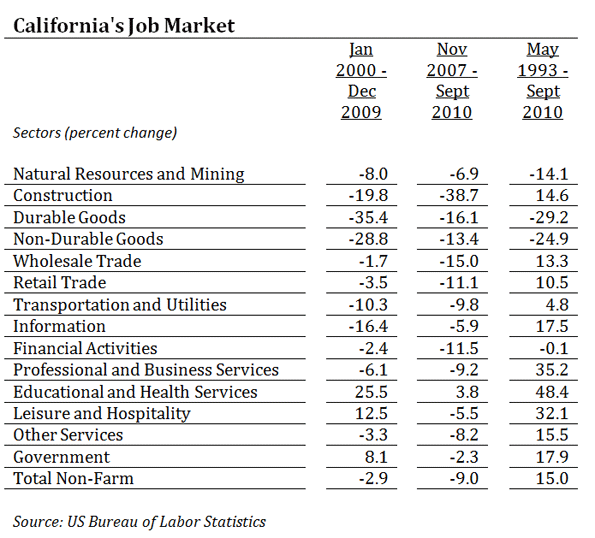
    Just as rural areas are not California’s only depressed areas, agriculture is not California’s only ailing sector. From 2000 to 2009, the only California sectors to gain jobs were government, education and health services, and leisure and hospitality.

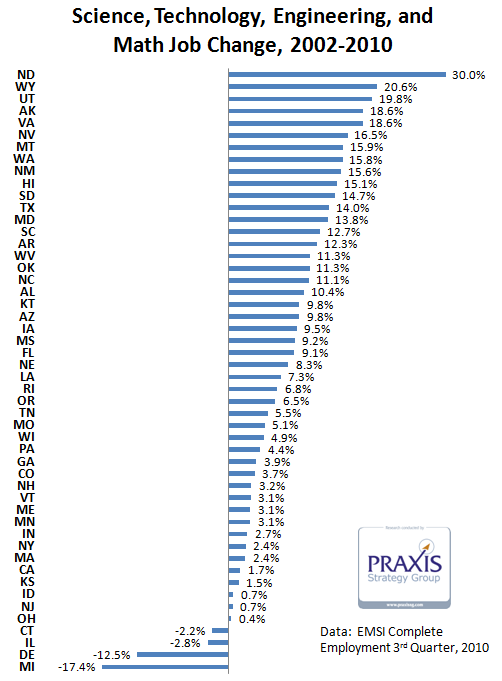
    California’s cheerleaders claim that the state’s future is assured by a vibrant tech sector, but the data do not support that assertion. North Dakota’s Praxis Strategy Group has performed analysis by job skills. They compare Scientific, Technical, Engineering, and Math (STEM) jobs across states. Their analysis shows that California is the Nation’s ninth worst state in creating STEM jobs in post dot-com-bust years. It has produced far fewer new tech jobs than Texas, and far less on average, than the country over the past decade:


    In this respect, California’s precipitous decline is really quite shocking. In just a couple of decades, California has gone from being America’s economic star, a destination for ambitious people from around the world and abundant with opportunity, to home of some of America’s most distressed communities. It has been a man-made, slow motion tragedy perpetuated by a political class that is largely deluded.

    The cheerleader’s faith in command and control regulation and environmental purity is so strong they cannot see anything that contradicts that faith.

    But that faith is misplaced. Joel Kotkin, Zina Klapper, and I performed an extensive review of the economic impacts of one of California’s most important greenhouse gas regulation, AB 32, and found that command and control regulation in general and AB 32 in particular is inefficient, cost jobs, and depress economic activity. California’s Legislative Analyst’s Office agrees, as evidenced by this report.

    More depressing still are the growing ranks of what could be called “the resigned”. They simply have given up. These include a business leadership that is more interested in survival and accommodation than pushing an agenda for growth. Easier to get along here, and expand jobs and opportunities elsewhere, whether in other states or overseas.

    Yet ultimately California’s future is what Californians make of it. No place on Earth has more natural amenities or a more benevolent climate. No place has a location more amenable to prosperity, located between thriving Pacific Rim economies and the entire North American market. No place has more economic potential.

    But unless policy is changed, California’s future is dismal, with the specter of stubbornly high unemployment, limited opportunity, and the continued exodus of the middle class. California’s political class needs first to confront reality before we can hope to avoid a dismal future.

    Bill Watkins is a professor at California Lutheran University and runs the Center for Economic Research and Forecasting, which can be found at clucerf.org.

    Photo by Stuck in Customs

  • Building the Train to Nowhere

    The California High Speed Rail Authority has approved building its first 54 miles in the San Joaquin Valley. A somewhat longer route, 65 miles, has been indicated in a number of press reports, but Authority documents indicate that only 54 miles of high speed rail track will be built. The route would start in Corcoran, and go through Fresno to Borden, a small, unincorporated community south of Madera. All of this would cost $4.15 billion. The route would include two stations, in Fresno and Hanford/Visalia.

    The segment was adopted under pressure by the United States Department of Transportation, which was interested in ensuring that the line would be usable (have “independent utility”) by Amtrak should the high speed rail project be cancelled due to lack of funds. The first section of the California high speed rail line would instead be a somewhat incongruously high-tech Corcoran to Borden spur, or perhaps more accurately stub to the region’s rather sparse conventional rail services.

    There are appear to have been concerns that growing opposition movements in the San Francisco and Los Angeles areas could have delayed construction, which could have put the federal money at risk. The Sacramento Bee’s Dan Walters, perhaps the leading political columnist in the state implied an ulterior motive:

    “You’d have to be terminally naive not to believe that the splashy announcement, made personally by an Obama administration official in Fresno, was to help an embattled local congressman, Democrat Jim Costa, stave off a very stiff Republican challenge.”

    Officials representing communities – many of them with high levels of unemployment – on the segment itself were elated, as any would be at the prospect of a rush of new construction jobs, regardless of what was being built. But, most everywhere else the reaction to the selection largely has been negative. Walters labeled it the “train to nowhere” in a November 29 commentary. State Senator Alan Lowenthal, who chairs the legislative committee overseeing the high speed rail project said that the Authority “could be creating an ‘orphan’ stretch of track, that will never be used by high-speed trains.”

    Richard Tolmach, president of the California Rail Foundation, an intercity rail advocacy organization, told Authority members ” It’s a crazy idea. He went on to say that “You guys are gonna be a laughingstock in Congress.”

    Already, problems are building in the now more decidedly more conservative Congress. California Republican Congressman Jerry Lewis and 27 colleagues have introduced the “American Recovery and Reinvestment Rescission Act,” which would apply unspent stimulus money to the deficit, including $2 billion that has been promised to the California high speed rail line.

    Batteries (and Trains) Not Included: Even after the $4.15 billion has been spent, the Corcoran to Borden rail stub will be incomplete. The Authority’s plan includes only the building of the rail bed and the necessary viaducts. There is no money for trains. There is no money for the electrical infrastructure necessary to power the trains. Trains and electricity infrastructure would add at least 15 percent to the bill, based upon previous California High Speed Rail reports. Thus, when and if completed, the trains and electrification would lift the cost of the Corcoran to Borden high speed rail stub to at least $4.8 billion.

    Bare Bones Stations: The plan calls for building only “basic” stations, with two tracks (one in each direction). That is fine if the line is serving Amtrak and there are only a few trains per day. But the high speed rail plan assumes frequent trains, including some that stop at all stations, some express trains that skip some stations and some express trains running non-stop from the Transbay Terminal in San Francisco to Union Station in Los Angeles. The only place that an express train can pass a slower train is at a station. That means that passing tracks must be built at virtually all stations. The passing tracks (two interior tracks in addition to the two tracks for stopped trains) required in stations are illustrated in this California High Speed Rail illustration (also above).

    The full system, or (perhaps the more likely outcome) a truncated San Jose to Palmdale line (with slower running lines over the commuter rail tracks into San Francisco and Los Angeles), would require passing tracks at the Fresno and Hanford/Visalia stations. Rebuilding these stations would increase the cost above the $4.8 billion, and that’s before the seemingly inevitable cost escalation.

    Indeed, the Corcoran to Borden stub entails a potentially large cost increase compared to previous California High Speed Rail Authority documents. After making all of the necessary adjustments to update the last available segment costs to the cost accounting method (“year of expenditure” dollars), the cost of the Corcoran to Borden stub could be at least 30 percent higher than would have been expected in the present $43 billion San Francisco to Anaheim cost.

    Applied to the entire line, a 30 percent cost escalation could take the price of the San Francisco to Anaheim line to more than $55 billion. Based upon cost ratios released by the Authority in 2008, the later extensions to Sacramento and San Diego would lift the bill to more than staggering $80 billion. Even that does not pay the entire bill, because promises have been made in state legislation for improvements across Altamont pass from Stockton to the East Bay and Oakland.

    Not that coming up with any of this money will be easy, particularly with a more deficit conscious Congress. Congressman John Mica of Florida, who will likely lead the House of Representatives Transportation and Infrastructure Committee has promised a review of all federal high speed rail grants. The Authority expects to obtain funding from local governments in California, a number of which are teetering toward financial insolvency.

    The Authority expects between $10 and $12 billion from private investors. These potential investors will all be aware of the fact that virtually every dollar of private investment in new high-speed rail lines has been lost or required a government bailout. They will not participate without subsidies, which are prohibited by California law. Finally, all these elements of the financing plan will be made even more problematic if the first phase of the project continues to rise from $43 billion to $55 billion.

    Washington analyst C. Kenneth Orski noted that the Corcoran to Borden stub could “become a huge embarrassment for the Administration” and that by its train to nowhere ”casts doubt on the soundness of the entire federal high-speed rail program and its decision-making process.”

    Then, even if California gets to keep the federal money, there are still formidable financial barriers. A likely result is high speed rail in Amtrak mode which probably won’t make much difference to passengers riding the infrequent San Joaquin service. After the Authority action, Bill Bronte, who heads the rail division of the California Department of Transportation said that “The improvements in performance might be less than one would expect.” But that might not bother contractors and consultants who can feast on what might prove to be the most expensive conventional intercity train project in history.

    Wendell Cox is a Visiting Professor, Conservatoire National des Arts et Metiers, Paris and the author of “War on the Dream: How Anti-Sprawl Policy Threatens the Quality of Life

  • California’s Failed Statesmen

    The good news? Like most rock or movie stars, there’s nothing fundamentally wrong with California. It’s still talented, and retains great physical gifts. Our climate, fertility and location remain without parallel. The state remains pre-eminent in a host of critical fields from agriculture to technology, entertainment to Pacific Rim trade.

    California can come back only if it takes a 12-step program to jettison its delusions. This requires, perhaps more than anything, a return to adult supervision. Most legislators, in both parties, appear to be hacks, ideologues and time-servers. This time, when the danger is even greater, we see no such sense of urgency. Instead we have a government that reminds one more of the brutally childish anarchy of William Golding’s 1954 novel “Lord of the Flies.”

    Arnold Schwarzenegger has not turned out to be that supervision. Rather than the “post-partisan” leader hailed by the East Coast press, he has proven to be the political equivalent of the multi-personality Sybil. One day he’s a tough pro-business fiscal conservative; next he’s the Jolly Green Giant who seems determined to push the green agenda to a point of making California ever more uncompetitive.

    Contrast this pathetic performance with what happened after our last giant recession in the early 1990s. At that time, a bipartisan coalition of leaders – Speaker Willie Brown, State Senator John Vasconcellos and Governor Pete Wilson – worked together to address what was perceived as a deep economic crisis. They addressed some key problems and brought the state back from the brink. California recovered smartly between the mid-90s and the new millennium.

    Overall though, things are worse now. California has been flirting for the past year with its highest unemployment rate since the Great Depression. The last time we could blame the end of the Cold War for much of our economic distress; now the problem is a more broadly based, largely self-inflicted secular decline.

    A bloated government is part of the problem: Between 2003 and 2007, California state and local government spending grew 31 percent, even as the state’s population grew just 5 percent. The overall tax burden as a percentage of state income, once middling among the 50 states, has risen to the sixth-highest in the nation, says the Tax Foundation. Even worse, the state is getting ever less benefit from these revenues; since the Pat Brown era the percentage of budget spent on basic infrastructure has dropped from 20 to barely 5 percent.

    Although these taxes are often portrayed as “progressive,” California has continued to become more socially bifurcated. Our ranks of middle-wage earners are dropping faster than the national average even as the numbers of the affluent and poor swell. Overall California’s per capita income, roughly 20 percent above the national average in 1980, now barely stays with the national average. When housing and other costs are factored in, Los Angeles, San Francisco and Fresno rank among the top five major urban areas in America in terms of percentage of people in poverty, according researcher Deborah Reed of the Public Policy Institute of California. Only New York and Washington, D.C. do worse.

    At the root of these problems is an increasing lack of economic competitiveness. An analysis of the economy made for the Manhattan Institute shows California losing its edge in everything from migration, income, jobs and in entertainment industry employment. Tech companies may cluster in Silicon Valley but many are sending their new jobs abroad or to other sites. Recently, several leading Bay Area firms – Twitter, Adobe, eBay, Oracle and Adobe – have established major new operations in the Salt Lake area alone.

    So how do we turn it around? First, let’s find some adults, like former Speaker Robert Hertzberg or GOP financer Gerald Parsky, who know what it is to run a business and comprehend that the economy actually matters, and get them to head up a commission on the economy. Second, our leaders and policy elites must engage the emerging new business leadership of the state, which is increasingly immigrant, Asian and Latino.

    Right now neither party seems focused on the state’s future besides enriching their core constituencies. Lower taxes – the favored strategy of the right – on the already wealthy reflects an understandable desire to preserve one’s asset but is insufficient as a strategy.

    Democrats meanwhile seem determined to defend public sector pensions, Draconian labor, the high-speed rail boondoggle and environmental regulations, no matter what the cost to the economy.

    However contradictory their sound bites, the established parties are each following a script that would assure the next generation of Californians – largely Latino – remain an underclass that will have to move elsewhere to reach their aspirations. The left would do it by killing jobs in such fields as agriculture, manufacturing, construction and warehousing. As Robert Eyler, chairman of the economics department Sonoma State puts it, “the progressives have become the regressives.”

    For their part the GOP would kill the new California by starving it. They have no plan to bolster the basic services – like community colleges, roads, water and power systems – that will allow future working-class Californians to thrive.

    Their interests ignored by the parties, the immigrants and their offspring still represent the very key source of demographic energy and entrepreneurship that can revitalize the state. If you still want to see hopeful stirrings in California, go to places like Plaza Mexico in Lynwood or the new Irvine center recently built by the Diamond Development Group. Appealing to young families and distinct tastes, these retail facilities have thrived as the rest of the state’s overall retail economy has declined.

    More important still are the companies started by immigrant entrepreneurs like John Tu, CEO of Kingston Technology or scores of smaller Asian-owned firms in places like the San Gabriel Valley. Since the 1990s, newcomers have launched roughly one in four Silicon Valley startups.

    Add to this the muscle of the emerging Latino economy, led by food processing companies like the Cardenas Brothers, who now provide Costco with its frozen Mexican food.

    Due to their strong family and cultural ties in California, such ethnic firms appear less likely to move than more Anglo-dominated companies. But if the state keeps eroding public services and adding new regulations, these firms – like their counterparts in Silicon Valley and elsewhere – will place most of their new jobs as well in Utah, Texas or overseas.

    What we have here, in the end, is a massive disconnect between economics and politics. Does anyone in Sacramento talk to or even know about the largely Middle Eastern-led L.A. fashion industry? Is anyone talking to the hip sportswear mavens of Orange County’s own “Velcro valley”? Or what about agriculture, our traditional ace in the hole, which is largely disdained by the state’s intellectual and media class who see in large farms the work of the corporate devil?

    Somehow these productive voices – essential to our comeback – must be placed at the center of the debate. Sacramento’s leaders need to talk not just to lobbyists but to the key job-creators.

    These are the people who, even in hard times, are showing how we can grow an economy based on our natural advantages of climate, ethnic diversity, entrepreneurship and location.

    Ultimately we must make the creation of new jobs a priority that goes beyond formulaic mantras about lower taxes or illusory, state-supported “green jobs.” With a return to growth, California can still address its basic problems and challenges. But first we must corral the ideological hobbyhorses now running wild through Sacramento and make the needs of job-creators the central issue for our policy-makers.

    This article originally appeared in the Orange County Register.

    Joel Kotkin is executive editor of NewGeography.com and is a distinguished presidential fellow in urban futures at Chapman University. He is author of The City: A Global History. His newest book is The Next Hundred Million: America in 2050, released in February, 2010.

    Photo by Nate Mandos

  • Misunderstanding the Bubble and Burst in Sacramento

    An opinion piece in the Sacramento Bee by Sean Wirth of the Environmental Council of Sacramento could not have been more wrong in its characterization of the causes of the housing bubble in Sacramento.

    The article starts out promisingly, correctly noting that:

    • The housing bubble spawned the Great Recession
    • Demand exceeded the inventory of houses in the Sacramento area
    • Sacramento prices “soared sky high”


    But it is all downhill from there, with the suggestion that the extraordinary price increases in Sacramento were the result of too much suburbanization (the theological term in urban planning circles is “sprawl”). In fact, all things being equal, house prices tend to escalate where the supply is more constrained, not less. Where suburbanization is allowed, the market can supply enough housing to avoid inordinate house price increases. Where suburbanization is severely constrained, a legion of evidence indicates that house prices are prone to rise. It is all a matter of basic economics. George Mason University economist Daniel Klein puts it this way:

    Basic economics acknowledges that whatever redeeming features a restriction may have, it increases the cost of production and exchange, making goods and services less affordable. There may be exceptions to the general case, but they would be atypical.

    Housing is not atypical and Sacramento house prices soared in response to the tough use regulations. By the peak of the bubble, the Median Multiple (median house price divided by median household income) had risen to 6.8, well above the historic norm of 3.0. Many houses were built, but not enough to satisfy the demand, as Mr. Wirth indicates. Building many houses is not enough. There need to be enough houses to supply the demand, otherwise land prices soar, driving up house prices.

    Unless a sufficient supply is allowed, speculators and flippers will “smell the blood” of windfall profits, which are there for the taking in excessively regulated markets.

    During the housing bubble, house prices rose well above the historic Median Multiple norm only in metropolitan areas that had severe constraints land use constraints (called “smart growth” or “growth management”). This included Sacramento, other California markets, Miami, Portland, and Seattle and other markets around the country.

    At the same time, more liberal development regulations allowed a sufficient inventory of housing to meet the demand in high growth areas like Atlanta, Dallas-Fort Worth, Houston and Austin. In each of these places (and many others), the Median Multiple remained near or below the historic norm of 3.0, even with the heightened demand generated by a finance sector that had lost interest in credit-worthiness. As would be expected, speculators and flippers avoided the traditionally regulated markets, where an adequate supply of affordably priced housing continued to be produced.
    Wirth expresses understandable concern about the house price losses since the bust. From the peak to the trough, the drop in Sacramento median house prices was more than 55%. However, this is to be expected once a serious economic decline is precipitated, especially in the sector that precipitated the crash (in this case housing). Economists Ed Glaeser of Harvard and Joseph Gyourko of Wharton have shown that not only (1) are house prices higher in more restricted markets but also that (2) there is greater price volatility in more highly regulated markets. Indeed, it is likely that the housing bust would have been much less severe or even avoided altogether if constraints on land had not driven the prices and subsequent mortgage losses so high in California and a few other states that they could not be absorbed by financial institutions. At the time of the Lehman Brothers collapse, 11 “ground zero” markets (including Sacramento), all highly regulated, accounted for 75% of the mortgage losses in the nation, with a per house loss rate of 15 times that of traditionally regulated markets.

    Wirth’s article expresses opposition to a Sacramento County decision to allow more development to occur on the urban fringe. He would prefer to force development into the existing urban footprint. The economic consequences of such folly are well known. In Australia, such policies have driven led to a doubling or tripling of house costs relative to incomes. The annual mortgage cost of the median priced house has risen to 50% of the median pre-tax household income, in a country that defines mortgage stress at the 35% level. Before the adoption of smart growth policies, Australia’s housing affordability was similar to that of liberally regulated markets in the United States.

    Avoiding the next housing bubble requires not repeating the mistakes that led to the last. Sacramento’s young and lower income households can only hope that the additional land approved by the Board of Supervisors will be enough of a safety valve to keep housing affordable so that they can become owners rather than renters.

    Photograph: Sacramento (author)

  • The Myth of the Strong Center

    At the height of the foreclosure crisis the problems experienced by some so-called “sprawl” markets, like Phoenix and San-Bernardino-Riverside, led some observers to see the largest price declines as largely confined to outer ring suburbs. Some analysts who had long been predicting (even hoping for) the demise of the suburbs skipped right over analysis to concoct theories not supported by the data. The mythology was further enhanced by the notion – never proved – that high gas prices were forcing home buyers closer to the urban core.

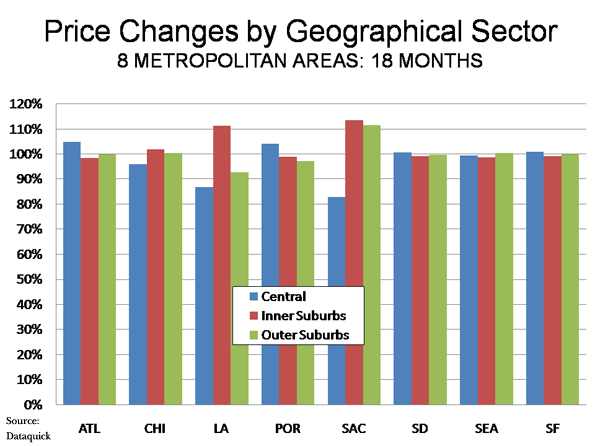
    Yet a summary of the trends over the past 18 months show only minor disparities between geographies within leading urban regions. Overall house prices escalated similarly in virtually all areas within the same metropolitan areas and the price drops appear to have also been similar. This is in contrast to a theory that suggests that huge price drops occurred in the outer suburbs while central city prices held up well.

    Summary of 18 Month Subarea Price Declines: This is indicated by a review of 8 metropolitan areas: Los Angeles, the San Francisco Bay Area, San Diego, Sacramento, Atlanta, Chicago, Portland and Seattle (see end note), for which subarea data is readily available (see table). On average, central area median house prices (all houses, including condominiums), fell 3% in relation to the overall metropolitan area average. Inner suburban areas experienced a 3% gain relative to metropolitan area prices, while outer suburban areas changed at the metropolitan area average. In actual price reduction terms, core areas declined 28.8%, inner suburban areas declined 25.7%, and outer suburban areas declined 27.1%. The overall average metropolitan area decline was 27.2%. There was, however, considerable variation in the figures by metropolitan area (see figure below).

    MEDIAN HOUSE PRICE CHANGES BY GEOGRAPHICAL SECTOR
    8 Metroplitan Areas
    CALIFORNIA MARKETS Central Inner Suburbs Outer Suburbs Overall
    Los Angeles -45.3% -30.0% -41.5% -37.1%
    San Francisco Bay -38.0% -39.1% -38.6% -38.6%
    San Diego -36.5% -37.4% -37.0% -36.9%
    Sacramento -53.6% -36.3% -37.5% -44.0%
    OTHER MARKETS
    Atlanta -11.6% -17.0% -15.8% -15.8%
    Chicago -21.0% -16.3% -17.5% -17.8%
    Portland -10.0% -14.5% -15.7% -13.5%
    Seattle -14.2% -14.7% -13.2% -13.7%
    AVERAGE -28.8% -25.7% -27.1% -27.2%
    Estimated from Data Quick information
    California Markets: July 2008 to January 2010
    Other Markets: 2008-2nd Quarter to 2009-4th Quarter

    Where Central Area Losses were Greatest: Over the past 18 months, central areas posted the largest losses in three of the areas. Further, in each of these areas, the smallest price drops were experienced in the inner suburbs.

    • Sacramento had the steepest central area relative price decline. Central area prices declined 37% relative to inner suburban prices, where the smallest losses occurred. The central area price loss averaged 53.6%, compared to the overall metropolitan area loss of 44.0%. The inner suburbs experienced the smallest loss, at 36.3%.
    • Los Angeles also had a steep central area relative price decline. Central area prices declined 45.3%, compared to the overall metropolitan area loss of 37.1%. The inner suburbs experienced the smallest loss, at 30.0% while outer suburbs lost 41.5%.
    • Chicago’s greatest losses also occurred in the central area, but were of a much smaller magnitude. Central area prices declined 21.0%, compared to the overall metropolitan area loss of 17.8%. The inner suburbs experienced the smallest loss, at 16.3%. The outer suburbs lost 17.5%.

    Where Suburban Losses were the Greatest: In two areas, the central area price losses were the least, Atlanta and Portland. Yet, the magnitude of these losses was modest. It is interesting to note that the metropolitan areas with the smallest relative losses in the central areas pursued radically different policies with respect to development. Portland’s “smart growth” policies favor central development at the expense of suburban development, while Atlanta’s more liberal policies do not attempt to steer development to the core.

    • Atlanta’s greatest price declines occurred in the inner suburbs, which experienced a loss of 17.0%, slightly more than that of the outer suburbs (15.8%). In comparison, the central area price drop was the least, at 11.6%, The metropolitan area loss was 15.8%.
    • Portland’s greatest price declines occurred in the outer suburbs which experienced a 15.7% loss, compared to the inner suburbs, at 14.5. The lowest decline was in the central area at 10.0%. The metropolitan area loss was 13.5%.

    Little Difference in Some Markets: There was little difference in the price declines among geographic sectors in three of the metropolitan areas. In the San Francisco Bay area, San Diego and Seattle, the differences between central, inner suburban and outer suburban price declines were all within a 2% range.

    Core Condominium Market Crisis

    However, core area markets where condominiums predominate indicate substantial difficulties in some of the metropolitan areas. These markets are generally only a small part of central cities, principally around downtown areas or major centers. For example, in the Portland area, the core condominium areas ring the downtown area and include the Pearl District and the South Waterfront District. The central area, which encompasses the entire city of Portland, however, is much larger and has a much larger share of detached housing.

    Demand has been so weak in the core condominium markets that substantial price reductions have occurred and a number of buildings have been forced to sell units at auction. Other buildings have given up altogether on selling and have rented condominiums. Some of the price drops, especially in Atlanta, Portland and Seattle are far greater than occurred overall in the respective metropolitan markets. The condominium implosion has not received nearly the level of attention in the national or local media that was accorded the housing bubble and collapse itself.

    Portland: A local television station video indicates that Portland’s condominium market is in crisis. A report in The Oregonian indicates that the downtown area has a “glut” of condominiums and that February sales prices averaged 30% below list. A luxury new 15-story building in the Pearl District (The Wyatt) is now being leased instead. Units at The Atwater in the South Waterfront district were auctioned, with minimum bid prices more than 50% lower than list. The John Ross, also in the South Waterfront District, is Portland’s largest condominium project and will be auctioning its units. Minimum bid prices average 70% below the previous top list prices. The smallest units have a minimum bid price of $110,000. By comparison, over the past year, the median house price in the Portland metropolitan area has dropped approximately 10%.

    Atlanta: Atlanta has a “vast oversupply” of condominiums. The uptown (including Atlantic Station) and Buckhead markets of Atlanta appear to be experiencing some of the worst market conditions in the nation. The prestigious Mansion on Peachtree, a combination hotel and condominium development, was unable to sell 75% of its residences and was recently sold in foreclosure at approximately $0.30 on the dollar. The winning auction bids at The Aqua condominium in Uptown averaged 50% below the last asking price. In Atlantic Station, units at The Element were auctioned at substantial discounts. Among conventional sales, condominium price reductions of up to 40% have been reported. One building has offered discounts of $100,000 per bedroom. Some new buildings have been converted to rentals, while planned projects have been placed upon hold.

    Seattle: Things are little better in Seattle. The overbuilt downtown area condominium market has experienced a median price decline of 35% over the past year. Units at The Gallery in tony Belltown were auctioned off at minimum prices 50% below the last list prices (which had already been discounted). Units at The Brix, on Capitol Hill, attracted bids at auction averaging 30% below previous list prices. Later this month, unsold units at 5th & Madison will be auctioned, at minimum prices below 50% of previous list. For comparison, median house prices in the Seattle metropolitan area declined 6% over the past year.

    Chicago: The downtown area of Chicago has been among the most vibrant condominium markets for more than a decade. However, in 2009, condominium sales fell to the lowest level since 1997. At current sales rates, the downtown area has a supply of more than five years, with annual sales of less than 600 and more than 3,000 units available or under construction.

    Los Angeles: Few markets have seen as many condominium buildings planned as downtown Los Angeles, and few have seen so many put on hold. A recent issue of the Los Angeles Downtown News lists approximately 50 downtown condominium projects. More than three-quarters of the projects have been scaled back, have had construction slowed or are on “hold.” The market has been so weak that a number of developers have taken losses by auctioning condominium units that they have not been able to sell conventionally.

    San Diego: The downtown San Diego condominium is substantially overbuilt. Developers have leased units that were to have been sold and there is virtually no construction of new units.

    Rental Conversions: Even these grim reports, however, may mask an even bigger problem. It is estimated that more than 20,000 condominiums units are completed or nearly completed, but are not listed for sale in Miami. In what is by far the nation’s strongest condominium market, Manhattan, more than 6,000 condominium units are completed or nearly completed, but not listed for sale.

    In core cities, few issues have been as divisive as the conversion of rental units to condominiums. But, now the opposite is now occurring – condominiums are being converted into apartments for rent: This is trend that undermines markets in a way that cannot be measured by median prices, since it replaces generally high-paying condo owners for generally less flush renters. This puts those who bought at higher prices in these markets at a particular disadvantage.

    Conclusion: Overall, contrary to the mythology developed early in the bubble, suburbs and even exurbs have generally performed about as well as closer in markets. The big imponderable will be the future of the core condominium market, which is experiencing significant financial reverses largely ignored by the national media.


    Note: As used in this article, the Los Angeles metropolitan area is the Los Angeles-Riverside Combined Statistical Area, the San Francisco area is the San Francisco-San Jose Combined Statistical Area and all other metropolitan areas are the corresponding metropolitan statistical areas. http://demographia.com/db-prdistr2010.pdf>Subareas defined.

    Photograph: Condominium construction, Atlanta, weekend of the Lehman Brothers collapse.

    Wendell Cox is a Visiting Professor, Conservatoire National des Arts et Metiers, Paris. He was born in Los Angeles and was appointed to three terms on the Los Angeles County Transportation Commission by Mayor Tom Bradley. He is the author of “War on the Dream: How Anti-Sprawl Policy Threatens the Quality of Life.