Tag: San Francisco

  • The Cycles of Industrial and Post-Industrial in Silicon Valley

    For many locals, Silicon Valley surrendered to the tyranny of development when it lost its last major fruit orchard in 1996. Olson’s family cherry orchards, a 100-year player in the valley’s agricultural history, shut down its main operations, and Deborah Olson mournfully told a local reporter then, “We’re down to 15 acres at this point.” There is a happy ending. With community support, the Olson family continues to sell its famous cherries at its fruit stand in Sunnyvale, Calif.

    Ultimately, Silicon Valley’s history is predicated on a continual progression from industrial to post-industrial. Adding to the chaotic ferment and success, multiple sectors co-exist at different stages of maturity at any given moment.

    Before its industrial period, the region was an agrarian economy. At the height of the farming boom in the 1920s and 1930s, over 100,000 acres of orchards blanketed the valley. In 2006, farming continued to thrive across the broader San Francisco Bay Area in resilient specialty pockets, which included organic farms, gourmet cheese producers, and wine vineyards. Stett Holbrook reported that roughly 20,000 acres of agriculture remained, most of it clustered in southern Santa Clara County around Morgan Hill, Gilroy, and the Coyote Valley. New technologies and tools modernized local farming practices, so that what exists today is a far cry from efforts a century ago. Now the region produces 1.3 million tons of food annually, according to the Greenbelt Alliance.

    By the 1920s, as farms began to industrialize, a big push occurred next in manufacturing, namely in automobile production, shipbuilding, and food canning.

    The local auto industry shows a constant rise and fall. In the 1920s, Oakland became known as the “Detroit of the West” with factories operated by General Motors, Chrysler, Fageol Motor Company, and Durant Motors. All closed over the next 30 years or so, as the auto industry first consolidated to the Great Lakes and later shifted overseas, as well as the southeast.

    The Bay Area saw a resurgent interest in car manufacturing in the 1980s when Toyota – a complete unknown in the earlier era – teamed up with GM to open the New United Motor Manufacturing Inc. (NUMMI) plant in Fremont, Calif. Now 25 years later, Toyota announced that all NUMMI operations will close by March in response to recent economic pressures.

    NUMMI’s closing is emblematic of the nature of employment change that accompanies broader industrial change. Currently, 4,700 people work at the auto factory, and another 50,000 people work for suppliers and other businesses that depend on NUMMI’s ongoing operations.

    Local and state leaders are concerned about the larger regional impact. Over the last 12 months, the East Bay has lost 4,400 manufacturing jobs, a decline of 5 percent in that industry, according to the U.S. Bureau of Labor Statistics. In comparison, Silicon Valley lost 13,800 manufacturing jobs, an 8 percent decline. Bruce Kern, executive director of the East Bay Economic Development Alliance, told the press, “You have the jobs from suppliers and other vendors that provide goods and services to NUMMI.” Most of these workers are stranded with skills only suitable for the industrial Silicon Valley, so Gov. Arnold Schwarzenegger announced that California state will focus on retraining them, as well as finding alternative uses for the roughly 5 million-square-foot NUMMI factory.

    On the other side of the Bay, Tesla Motors today is making the transition from a cottage to a production industry, and it has also shifted gears in its manufacturing plans. The highly subsidized company had originally planned to build an electric car factory in San Jose earlier this year, but Tesla is now close to a deal to build an electric car factory at the site of a former N.A.S.A. manufacturing plant in Downey, Calif., a blue-collar city south of Los Angeles.

    Shipbuilding offers a counter example. While efforts have largely vanished from the area, a few notable examples have survived in new form. For instance, Kaiser Shipyards in Richmond, Calif., developed a new medical system for its shipyard workers in WWII that eventually became the basis for Kaiser Permanente, a highly successful modern health care organization. Here is an early example of a company converting its business model from hardware to service.

    But the high point of the industrial era dates from the 1950s when U.S. defense contracts spurred the area’s growth, building aerospace and other military equipment largely through Lockheed Martin. Then, as magnetic core memories were replaced by semiconductor memory chips in computers, semiconductor and chip manufacturing soared in the 1960s and 1970s, dominating the Valley with industrial fervor.

    By the late 1970s, however, Silicon Valley had lost its lead in memory chips, thanks to several revolutionary measurement tools from Hewlett-Packard’s Japanese partnership. The Japanese soon took over the memory chip business, going from less than 10% to over 80% of worldwide chips in six short years. Today, the memory chip market is an $18 billion worldwide market with virtually no U.S. manufacturers. In order to thrive against this fierce competition, Silicon Valley companies had to re-invent themselves, such as Intel’s adoption of the microcomputer chipsets now known as Pentium.

    Other areas of the information technology (IT) industry have also undergone reinvention. Charles House, in The HP Phenomenon, points out that Hewlett-Packard has re-invented itself six times in seven decades. Apple has also done so in spectacular fashion, first with computers, then with music, and now smartphones. Since 1976, Apple has gradually evolved from a computer hardware manufacturer into a consumer electronics company. The company originally handled most manufacturing locally, but by 1992, Apple had closed its plant in Fremont, Calif., and moved all operations out to Colorado, Ireland, and East Asia. For a time, Apple elevated its role in the industrial process, noting on its products: “Designed in California, assembled in China.”

    Apple’s decision reflects a larger trend in Silicon Valley to shift more to post-industrialized work, marked by higher value technology services within a knowledge economy.

    Another example is VIA Technologies, a chip manufacturer founded in Fremont in 1987, which moved its headquarters in 1992 to Taiwan. Richard Brown, vice president of international marketing at VIA, explained, “The main reason was that we saw that Taiwan would replace Silicon Valley as the global hub for PC, notebook, and motherboard design and manufacturing.” He added, “It enabled us to get closer with key manufacturing partners in Taiwan.”

    Now expanded as a fabless semiconductor design company, VIA has kept a strong presence in Silicon Valley these last two decades. About 250 employees work locally. Brown said, “We conduct advanced R&D work on chipsets and graphics in our Fremont office, and we also have extensive customer support and sales operations covering the U.S. and Latin America.”

    Beyond IT, where is new industrial growth occurring in the Bay Area?

    One economic indicator is demand in office and warehouse space. The U.S. industrial vacancy rate hit a decade high last quarter, marking the eighth consecutive quarter of increasing vacancy, according to real estate services firm Colliers International. Nationally, warehouses under construction declined to the lowest number Colliers has on record, and both bulk warehouse space and tech/R&D space showed larger decreases in rental rates than prior years.

    The Silicon Valley market was the third largest contributor to the national drop after Chicago and the Los Angeles basin. Jeff Fredericks, senior managing partner out of Colliers’ San Jose office, has observed that no sector has been left unscathed locally.

    He noted, “Very little manufacturing or industrial space has been built in Silicon Valley in the last 10 years, and that trend is likely to continue.” Fredericks believes, however, that some light manufacturing will continue to exist within the region, either to support local technology companies or simply because the business owners choose to live here.

    He added, “Certainly, green tech is a market favorite right now, but that really only forms a small percentage of Silicon Valley’s total market. Nonetheless, it is a sector that is experiencing better growth than others.”

    Richard Ogawa has seen a similar regional boom in the clean tech industry. As an intellectual property attorney with Townsend and Townsend and Crew LLP, Ogawa currently advises several clean tech start-up companies that are funded by Khosla Ventures, among others. Several companies, such as Stion Corporation and Solaria Corporation, have built pilot production lines. Part of the clean tech growth can be attributed to stricter state regulations, which push for greater reliance on renewable energy sources. He said, “It’s very geographic-centric.”

    Ogawa has also seen a rise in small-scale manufacturing in other industries. For example, within the local apparel business, Levi Strauss & Co. shuttered its last operating factory in 2002, which had been operating since 1906. Many locals were discouraged to see the longtime factory close. Today, retail manufacturers like Golden Bear Sportswear and Timbuk2 actively operate in San Francisco, but of course with far smaller workforces.

    Personally, Ogawa is a wonderful embodiment of industrial and post-industrial Silicon Valley. As a third generation Northern Californian, whose father owned a farm in the Central Valley, Ogawa specializes in post-industrial work. His clients in semiconductors, software, networking, and lately clean tech mix industrial and post-industrial work, either shifting manufacturing abroad or undertaking light production locally.

    Reflecting on the changes he has witnessed over time, Ogawa said, “I’m not aware of any industry that’s left the area, at least in my lifetime.” In Silicon Valley, most industries simply take on new form as part of the constant evolution from industrial to post-industrial.

    Tamara Carleton is a doctoral student at Stanford University, studying innovation culture and technology visions. She is also a Fellow of the Foundation for Enterprise Development and the Bay Area Science and Innovation Consortium.

  • Migration: Geographies In Conflict

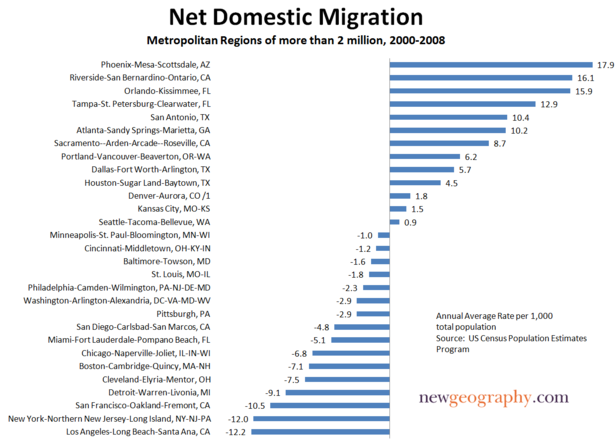
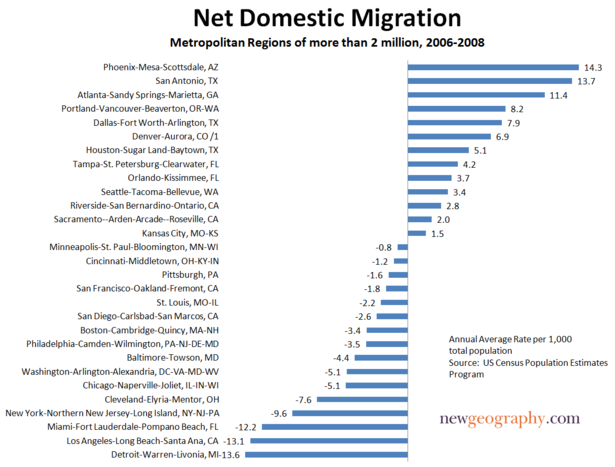
    It’s an interesting puzzle. The “cool cities”, the ones that are supposedly doing the best, the ones with the hottest downtowns, the biggest buzz, leading-edge new companies, smart shops, swank restaurants and hip hotels – the ones that are supposed to be magnets for talent – are often among those with the highest levels of net domestic outmigration. New York City, Los Angeles, San Francisco, Boston, Miami and Chicago – all were big losers in the 2000s. Seattle, Denver, and Minneapolis more or less broke even. Portland is the only proverbially cool city with a regional population over two million that gained any significant number of migrants.

    Those who find this an occasion for a schadenfreude moment attribute it to tax and regulatory climates. Clearly, things like cost of doing business are clearly very important. And indeed this is often under-rated by cool city proponents. And other things equal, people do prefer low tax jurisdictions. Still, is this the only answer, or is there another explanation? Could it be that rather than high costs driving migration, both costs and migration are being driven by other underlying factors?

    Perhaps the root problem is structural change in the economy in the age of globalization. As business became more globalized and more virtualized, this created demand for new types of financial products and producer services – notably in the law, accounting, consultancy, and marketing areas – to help businesses service and control their far flung networks. Unlike many activities, financial and producer services are subject to clustering economics, and have ended up concentrated in a relatively small number of cities around the world.

    These so-called “global cities” serve as control nodes for various global networks and key production sites for these services, along with other specialized niches they long had. In effect, more distributed economic activities requires increasing centralization of select functions, particularly the most highly value-added functions. Yet these activities are not set in stone; for example, areas that were once centers for global business, like Cleveland or Detroit, are fading; others like Houston and Dallas are rising.

    Yet unlike the Texas cities, which retain a strong middle-class and middle-echelon economy, many of the more elite, established urban centers – for example New York and London – increasingly create parallel economies and labor markets in those cities. These cities now generally contain two kinds of people and firms: those who are part of the global city functions and those who are not. Those who are engaged in global city functions operate in a world of very high value-added activities; specialized, niche skill markets; and rising demand conditions. Those skills are not readily acquired outside of global cities. Often, they are sub-specialized to particular places as different global cities specialize in different niches.

    In many cases, these functions have not yet migrated to India or China or often even another global city. This tends to inflate salaries significantly for these specialized, niche skill jobs.

    On the other hand, many people who once thrived in these cities have not benefited from these economic forces. They often are in occupations where labor arbitrage is feasible, and their jobs can either be off-shored, or readily transferred to lower cost locales in the US. This includes manufacturing work, but also important but less specialized white collar occupations like basic accounting, loan officers, corporate IT, and HR. In short, the routine side of the traditional monolithic corporate headquarters and services firm.

    In effect, in these global cities, two economic geographies share the same physical geography – and those economic geographies are in conflict. One set requires catering to high skill, highly paid workers and firms where cost is a secondary concern. The other involves occupations and industries where cost is very much a concern. The occupants of these two geographies have very different public policy priorities. Which of them will win out?

    In a global city, particularly a mature and expensive one, the elite geography wins. It is generating the most money, and with money comes power and influence. Additionally, the high wage workers in these industries are simply able to pay more for real estate and other items. Their mere paychecks are driving up costs in the city they live in. They are re-ordering the city in their own high income image, aided and abetted by a speculative financial fueled housing bubble.

    The prestige of these industries burnishes the civic brand, making them attractive to civic boosters. What’s more, leaders in global cities feel that these are their businesses of their future. For them the attractiveness of concentrating in areas where you think you can create a “wide moat” advantage makes sense.

    This is why cities like Portland, Minneapolis, Denver, and Seattle haven’t fared nearly so badly – they aren’t really full metal global cities and thus, while not always cheap, have remained relatively affordable versus places like San Francisco and New York.

    At the same time it is not easy for these more expensive cities to adopt a low tax, low cost approach. For many reasons, places like San Francisco, New York, and London will never, no matter what they do, be able to match Atlanta, Houston, or Dallas, or even Chicago in a war on costs. That would be a suicide mission. Their logical strategy is to follow the law of comparative advantage, and specialize where you have the best competitive position in the market, and that’s global city functions.

    Many other cities have followed this strategy, but with differing success. Fearing to end up like the next Michigan and Detroit pair, many states and cities have invested heavily to build up urban amenities to cater to the global city firms and their workers: transit systems, showplace public buildings, art and culture events, bike lanes, and beautification. Cost fell by the wayside as a concern, as did investments in priorities of the traditional middle class.

    This explains why, for example, not only have taxes gone up, but things like schools and other basic services have declined so badly in places like California. Traditional primary and secondary education is not important to industries where California is betting its future. Silicon Valley, Hollywood, and biotech draw their workers from the best and brightest of the world. They source globally, not locally. Their labor force is largely educated elsewhere. Basic education and investments in poorer neighborhoods has no ROI for those industries. With the decline of high tech manufacturing in Silicon Valley, even previously critical institutions such as community colleges are no longer as needed.

    The same goes for growth and sprawl. They are playing a game of quality over quantity. They specialize in elite urban areas and elite suburbs or exurbs. For example, San Francisco also has Marin, Palo Alto and Los Altos Hills. New York has, in addition to Manhattan, Greenwich and northern Westchester. The only thing they need size for is sheer scale in certain urban functions, and they already have it. Growth is unnecessary for them and only brings problems.

    It also explains the highly pro-immigration stance of these cities, as a large service class is needed for globalization’s new aristocrats. Immigrants are needed as low cost labor in the burgeoning restaurant and hotel business. In America’s global cities immigrant housekeepers, landscapers, and nannies are common. They may not dress like His Lordship’s butler, but that doesn’t make them any less servants.

    Lastly, it explains why we have seen the same polarizing class pattern so consistently despite broad geographic and socio-political differences between places like Los Angeles, Boston, and Chicago, to say nothing of overseas locales like London. A common global phenomenon probably has a common underlying cause.

    The traditional middle class, feeling the squeeze, is simply moving to where its own kind is king and its own priorities are catered to. In a battle of conflicting economic geographies, the one with higher value added wins, displacing others in what Jane Jacobs termed the “self-destruction of diversity”. First, an attractive environment draws diverse uses, then one becomes economically dominant and, through superior purchasing power, displaces other uses over time. The story ends when that dominant economic activity exhausts itself – the true danger facing global cities, though fortunately they are generally not dependent on just one small niche. It’s basic comparative advantage.

    If you are just an average middle class guy, why live in one of those global cities anyway? Unless you have roots there that you value, take advantage of something you can’t get anywhere else such as by having a passion for world class opera, or are one of globalization’s courtiers – a hanger on like a high end chef, artist, or indie rocker, perhaps – why put up with the high cost and hassles? It makes no sense. You’re better off living in suburban Cincinnati than suburban Chicago.

    And frankly, the folks on the global city side prefer it if you leave anyway. Immigrants are unlikely to start trouble, but a middle class facing an economic squeeze and threat to its way of life might raise a ruckus. That won’t happen if enough of them move to Dallas and rob the rest of critical mass and resulting political clout.

    Many of those leaving are college educated, especially, when they get older, get married, and start having families. A relatively large number of these people could be replaced by a smaller number of elite bankers, biotech PhDs, and celebrity chefs. In that case, both “narratives” could hold simultaneously. One type of talent moves in, while a greater number of a different kind moves out. As with trade generally, this could even be viewed as a win-win in some regard.

    Again, it is easy to blame the costs and public policy. Clearly there is room for improvement in governance such as reigning in out of control civil service pay and pensions in places like California and New York. But what is more pernicious is the rising income gap in America, and the likely outcomes it drives when a city acquires a small elite economic class with incomes that far outstrip the average, and lacks strong economic linkages to the rest of the city other than for personal services. It sets in motion economic logic that undermines the traditional middle class, which then starts leaving, exacerbating the gap.

    For years we worried that a large, stable middle class with a permanent, largely minority underclass constituted an unjust order. As it turns out, the alternatives are sometimes worse. Ultimately some American cities have come to take on the cast of their third world brethren, a perhaps somewhat less extreme version of Mexico City or São Paulo, where vast wealth and glitter exist side by side with the favelas.

    This explains why America’s global cities often feel more kinship with their international peers than with many of the places in their own country. The global cities, which now enjoy something of a political ascendency, are also sundering the American commonwealth. Taking steps to prevent a further widening of the income gap may be the only way to save these cities’ middle class – and maintain the solidarity of the country.

    Aaron M. Renn is an independent writer on urban affairs based in the Midwest. His writings appear at The Urbanophile.

  • California: The Housing Bubble Returns?

    To read the periodic house price reports out of California, it would be easy to form the impression that house prices are continuing to decline. Most press reports highlight the fact that house prices are lower this year than they were at the same time last year. This masks the reality of robust house price increases that have been underway for nearly half a year. The state may have forfeited seven years of artificially induced house price escalation in just two years but has recovered about one-fifth of it since March.

    California Housing Market Since 2000: In 2000, the average median house price among California markets with more than 1,000,000 population was $291,000. The Median Multiple (median house price divided by median household income) was 4.5, making houses in California approximately 50% more costly relative to incomes than in the rest of the nation.

    According to the California Association of Realtors, the average median price peaked at $644,000 between 2005 and 2007, depending upon the particular market. This nearly 140% price increase translated into a more than doubling of the Median Multiple, to 9.2.

    Median prices fell rapidly from the peak, dropping at their low point to an average of $315,000. The average Median Multiple fell to 4.4, slightly below the 2000 level, but still well above the national level. All markets reached their low points in the first part of 2009.

    It is at this point that the business press lost track of what was going on. Of course, year on year price declines continued, but only because the price declines had been so severe early 2008. Since the bottoming out of house prices, there have been strong gains. As of September, the average median house price among the major metropolitan areas was $383,000, a nearly 20% increase from the low point. Moreover, in dollar terms, median house prices recovered nearly 20% of their loss from the peak to the low point.

    Major California Markets: Median House Prices: 2000 to Present
    Metropolitan Area (MSA) 2000 Peak Low Point 2009/09 Loss: Peak to Low Pt Change from Low-Pt
    Los Angeles: Los Ang. County  $ 215,900  $ 605,300  $  295,100  $  351,700 -51.2% 19.2%
    Los Angeles: Orange County  $ 316,200  $ 747,300  $  423,100  $  496,800 -43.4% 17.4%
    Riverside-San Bernardino  $ 144,000  $ 415,200  $  156,800  $  172,400 -62.2% 9.9%
    Sacramento  $ 172,000  $ 394,500  $  167,300  $  184,200 -57.6% 10.1%
    San Diego  $ 231,000  $ 622,400  $  321,000  $  386,100 -48.4% 20.3%
    San Francisco  $ 508,000  $ 853,900  $  399,000  $  536,100 -53.3% 34.3%
    San Jose  $ 448,000  $ 868,400  $  445,000  $  553,000 -48.8% 24.3%
    Average  $ 290,700  $ 643,800  $  315,300  $  382,900 -52.1% 19.4%
    Exhibit: Median Multiple            4.5            9.2            4.4            5.2
    Above Historic Norm (3.0) 50% 208% 46% 73%
    Derived from California Association of Realtors and National Association of Realtors data
    Note: California Association of Realtors divides the Los Angeles MSA into Los Angeles and Orange counties

    Profligate Lending: It is critical to note that the inflated house prices that existed two to three years ago were wholly artificial. Prices had been driven up by the special and hopefully never to be repeated conditions of profligate lending, which increased demand.

    California: Regulating Away Housing Affordability: But the increase in demand alone would not have been enough to produce the unprecedented house price increases had public officials and voters not established a veritable mish-mash of housing supply regulations. The house price increases were driven ever higher by these severe land use restrictions, which prevented housing markets state from meeting demand.

    Supply restrictions, which go under various names, such as compact development, urban containment and “smart growth,” have been a feature of California housing for some time. Examples of such policies are urban growth boundaries, building moratoria and expensive development impact fees which disproportionately tax new homes for the expanded community infrastructure a rising population requires.

    As more loose lending practices increased the demand for home ownership, the inability (and unwillingness) of the state’s land use regulations prevented the housing supply from increasing in a corresponding manner. With demand for housing far outstripping supply, prices had nowhere to go but up. The result was short term house price escalation that may have never occurred before in a first-world nation.

    Contrast with Healthy Housing Supply Markets: There was a stark contrast with house price increases in the liberally regulated markets around the nation. For example, in Atlanta, Dallas-Fort Worth and Houston, house prices remained near or below the historic Median Multiple norm of 3.0, as the supply vent was allowed to operate. This is despite the fact that there was a strong underlying increase in demand for home ownership (measured by domestic migration) in these and other liberally regulated markets. In the California markets, on the other hand, there was overall negative underlying demand, with significant domestic out-migration. Of course, speculation ran rampant in California, as could be expected in any market where asset values are responding to a severe shortage of supply relative to demand.

    By the 1990s, Dartmouth’s William Fischel had associated California’s high house prices relative to the nation with the intensity of its land use regulation. In 1970, as the more severe regulations were beginning, house prices in California were at approximately the same level relative to incomes as in metropolitan areas in the rest of the nation.

    California’s disproportionate losses are illustrated by the fact that its major metropolitan areas have less than twice as many total owned houses as those in Texas (Dallas-Fort Worth, Houston, San Antonio and Austin), yet experienced gross value losses 85 times as great as the Texas metropolitan areas by Meltdown Monday (September 15, 2008, when Lehman Brothers failed).

    Recent Price Increase Rate Exceeds the Bubble: While widely unnoticed, the post-bottom median house price has increased 20%. In six months or less, the average median price increase among California metropolitan areas exceeded the annual price increase for all of the bubble years except one, which was 22% in 2004. The 2009 price increase rate, annualized, is nearly double that. As a result, despite the widely reported bubble collapse, California’s housing affordability now is worsening relative to the rest of the nation. The prospect could be for further inflation of the bubble, with the passage of Senate Bill 375, which is likely to lead to even more intensive land use restrictions, on the false premise that higher densities will materially reduce greenhouse emissions. As governments increasingly force development to occur only where it prefers, the property owning winners can extract much higher prices than would occur if there were more competition.

    This of course will mean that the more dense housing units built will be even more expensive, even as the market is prohibited from supplying the larger detached homes that households overwhelmingly prefer. All this will make California less competitive, something the increasingly uncompetitive Golden State could do without.

    Another View: The recent price escalation, however, may be illusory. The widely read California real estate blog, Dr. Housing Bubble suggests that the first wave of “sub-prime” loan failures that constituted the bubble burst could be followed by a second wave over the next few years, driven by “option arm” mortgage resets. The Doctor notes that these loans are concentrated in California and other ground zero states (Florida, Arizona and Nevada), unlike the previous wave, which was more evenly spread around the nation.

    In the End: Regulation Will Lose the Day: Thus, the “jury is still out.” The bubble may be re-inflating in California, or another bust could be on the horizon. However, in a state that has given new meaning to regulatory excess, the longer run prospects call for artificially higher housing prices, unaffordable to much of the state’s middle class. This means that California will continue to become an ever-more bifurcated state, between an aging, largely affluent coastal homeowning population and, well, just about everyone else.

    Photograph: Los Angeles (Porter Ranch in the San Fernando Valley)

    Wendell Cox is a Visiting Professor, Conservatoire National des Arts et Metiers, Paris. He was born in Los Angeles and was appointed to three terms on the Los Angeles County Transportation Commission by Mayor Tom Bradley. He is the author of “War on the Dream: How Anti-Sprawl Policy Threatens the Quality of Life.

  • Boomer Economy Stunting Growth in Northern California

    The road north across the Golden Gate leads to some of the prettiest counties in North America. Yet behind the lovely rolling hills, wineries, ranches and picturesque once-rural towns lies a demographic time bomb that neither political party is ready to address.

    Paradise is having a problem with the evolving economy. A generational conflict is brewing, pitting the interests and predilections of well-heeled boomers against a growing, predominately Latino working class. And neither the emerging “progressive” politics nor laissez-faire conservatism is offering much in the way of a solution.

    These northern California counties–which include Sonoma, Napa, Solano and Marin–have become beacons for middle- and upper-class residents from the Bay Area. These generally liberal people came in part to enjoy the lifestyle of this mild, bucolic region, and many have little interest in changing it.

    “The yuppies have insulated themselves here for the long term,” notes Robert Eyler, a director at the Center for Regional Economic Analysis at Sonoma State University. “The boomers have blocked everyone else different in age and skill from rising up and making their place.”

    Nowhere is this more evident than in the “green,” anti-growth movement so prevalent in these places. Strong restrictions of business growth, bolstered by California’s draconian land-use regulations, have turned these areas into business no-go zones. This has become increasingly clear after the collapse of the real estate boom, which created thousands of jobs for agents, mortgage brokers and construction workers.

    Hard times have come to paradise. Unemployment in Sonoma now tops 10%, up from barely 3% two years ago, notes Eyler. The rate is slightly higher in neighboring Solano County but a bit lower in wealthy Marin and Napa. Across the region, vacancy rates for offices and other commercial buildings have reached as high as 30%. Overall, by some estimates, the vacancy rate is higher in Sonoma than in Detroit.

    These conditions, local business leaders suggest, seem to have no effect on the region’s well-organized and well-financed greenies, who often see any growth as a threat to their quality of life

    Of course, economic reversal can sometimes hurt the balance sheets of wealthy yuppies and early retirees, but Eyler suggests the change could prove most devastating to the next generation of residents. In 2000 these counties were almost 70% white; Eyler projects that by 2030 they will be majority minority, with the Latino percentage more than doubling to almost one-third the population.

    At the same time, the predominant white population will be getting older and even less supportive of economic growth. The boomers who moved to paradise may not have “put up a parking lot” as much as rooted themselves firmly into the ground. Already Marin, the wealthiest county, is among the oldest in California, vying with other high-end places like San Francisco and Orange and Ventura Counties.

    Today in Marin, there are still more people aged 40 to 55 than over 65. But by 2025 the over-65 crowd will be as large as the prime working-age population (which comprises those in their 30s and 40s) and should be larger than the under-25 population. The old and young also will diverge greatly in their ethnicities. In virtually all North Bay areas, the bulk of the codgers will be white, while most young people will be Hispanic or other minorities.

    In the past, besides construction, these young workers might have found employment in the area’s once-burgeoning electronics and telecommunications industry. But many of these companies have moved operations to more business-friendly regions or overseas. “When these kids who are in school now grow up, we are going to have a huge job crisis here,” Eyler warns. “But when the boomers are gone, what happens when all the jobs have moved to Des Moines?”

    Of course, the widely accepted solution to this dilemma comes in the color green–that environment jobs will provide the new employment. Indeed by some accounts, most embarrassingly in a recent Time magazine cover, the shift to green technologies has already created a “thriving” economy.

    This would be news to a state that suffers 12% unemployment, massive outmigration and among the worst business climates in the country. Time extols Google, Apple, Facebook, Twitter and the other Silicon Valley companies as exemplars leading to a glorious prosperity; somehow the article missed the empty factories, vacant offices and abandoned farms across the state.

    Not surprisingly, California’s middle class is getting hammered, and has for years. Since 1999, according to research at the California Lutheran University forecast project, the state has experienced a far more dramatic drop in households earning between $35,000 and $75,000, than the national average. At the same time California’s poverty rate has grown at a more rapid pace than the national average, with a huge spike since 2006.

    This reflects a strange disjunction between the optimism of the top-tier boomers–venture capitalists, academics and the self-described progressives–and the realities facing most Californians. For Apple’s Steve Jobs, Google’s Eric Schmidt and venture capitalists connected to Al Gore, these could well be the best of times. Fed policy prints money for investment bankers to speculate; stock prices rise as people have nowhere else to invest. And for the much celebrated venture community, there’s also an Energy Department that pours hundreds of millions into “green” start-ups that build things like expensive electric cars.

    California’s high-tech greens may talk a liberal streak in terms of diversity and social justice, but their prescriptions offer little for those who would like to build a career and raise a family in 21st century California. Their policies in terms of land use regulation and greenhouse gas emissions will make it even harder for existing factories, warehouses, homebuilders and other traditional employers of the middle- or working class. “In effect,” Eyler notes, “the progressives have become regressives.”

    In the real world hype and enthusiasm are not sufficient to create a sustainable economic model. In order to grow a “green” economy, you first have to have an economy. To be sure, there are potential opportunities in the development and implementation of energy-saving technologies in the next decade, including wind and solar energy, but it’s doubtful that many jobs can be generated without a major shift in the economic climate here.

    One key problem, as suggested in a recent analysis by Rob Sentz at Economic Modeling Specialists, is that green is not really about “what” you make but about “how” you make it. Green jobs, for the most part, will come from growth in construction, manufacturing and warehousing industries.

    Yet the “greenest” parts of the country–places like the northern end of the Bay Area–are among the toughest places to build or manufacture anything, without huge public-sector subsidies. Indeed, California’s new green requirements, compared with places like Texas or China where manufacturing has other advantages, would further undermine an already struggling sector. Few businesspeople see much growth in the near future in office or residential construction.

    This leaves “green” industries reduced to largely improving the energy footprint of existing structures, an effort that will no doubt be further undermined by the deteriorating picture for many commercial mortgages. At best, Eyler notes, this may create a small temporary surge in jobs, but the long-term effects will likely be limited.

    Ultimately, the only way out of this looming crisis lies with the boomer gentry doing something totally out of character: getting past their self-interest and self-love for the good of the next generation. In the process, they do not have to give up preserving paradise, but focus as well on creating economic opportunity for the emerging working and middle class majority. If not, their Eden will end up as a green version of a gated community.

    This article originally appeared at Forbes.com.

    Joel Kotkin is executive editor of NewGeography.com and is a distinguished presidential fellow in urban futures at Chapman University. He is author of The City: A Global History. His next book, The Next Hundred Million: America in 2050, will be published by Penguin Press early next year.
  • A Slow Job Recovery in Silicon Valley

    Although job growth is gradually returning to Silicon Valley, don’t break out the champagne quite yet.

    Lucia Mokres moved to the area five years ago. Last year, when she was working at a contract engineering and manufacturing firm, she saw several clients lose their jobs, as well as both large and small companies go under in the economic crunch. She remembers one conference vividly. While manning the event booth, instead of seeing people pitch work they had for her firm, they instead passed out resumes, asking her team for work.

    Soon after, her job was cut back from 5 days per week to 4 days, which included a 20% pay cut. Mokres said, “That was really hard, as my rent and student loans did not also get cut 20%.”

    She persisted over “many months” to find a better position, which ultimately resulted in a higher salary and better benefits as a clinical scientist in a medical device company based in Menlo Park, Calif. Looking ahead now, Mokres feels optimistic about her future in Silicon Valley and said, “I am in the medical industry, and there will always be a demand for medical technology and healthcare.”

    “There are worse places to be,” she added. “I’m in one of the top two biotech hotspots in the country. Silicon Valley breeds innovation, and therefore will survive.”

    Harold Lee* feels less cheerful. He was the class president at a tier one university several years ago, and since graduating in 2004, he has worked at several of the top companies in Silicon Valley. He is now a product manager at a social networking startup based in Mountain View, Calif. While he couldn’t imagine leaving the area, he summarized his long-term prospects in one word: “limited.”

    Lee counts himself lucky to have a job at a popular startup, when the signs around him are still troubling. “There’s definitely a palpable feeling of companies scaling back,” he said. “Free lunches are no longer free, snacks are rationed out a bit more, and there’s a lot more focus on measured productivity.”

    Reports from friends and peers, particularly those who have been laid off in the last year, have not lifted the gloom. Said Lee, “Things have settled down to the point where people aren’t frightened, but I doubt anyone would be surprised if they got a pink slip tomorrow.” He added, “Trying to get a job is immensely difficult. I have friends who returned to get their graduate degrees in business, who now can’t land anything.”

    The lagging indicator in economics is jobs, which, for the average worker, has the biggest personal impact. Over the last year, California lost 732,700 jobs, the worst hit of all U.S. states, according to the U.S. Bureau of Labor Statistics.

    The job situation in Silicon Valley has not rebounded as quickly as hoped. The area’s jobless rate is nearly double what it was a year ago, according to the state’s Employment Development Department. Nearly three times as many people are actively looking for work, versus during the dot-com bust, when the jobless rate peaked at 9.2 percent in early 2003. The recent number of unemployed is 110,900, representing an 87 percent increase from the prior year, according to the EDD.

    The technology industry has continued to take a beating in the past six months. Cisco cut 700 local jobs in July, and Lockheed Martin slashed nearly 500 local jobs in August, based on state filings. Most recently in October, Sun Microsystems Inc. announced that it would eliminate up to 3,000 jobs across all sites, or 10 percent of its worldwide work force through the new year, due to the takeover by Oracle Corp.

    The larger question is if the recovery in Silicon Valley will be technology-led. Many believe that the tech industry, which dominates local economics, will lead other companies out of the recession. Does a rising tide lift all boats? Due to the slower return of jobs, it will likely take more time for tech companies to generate the tax revenue needed to support the service sector and other programs again.

    However, local leaders and economists feel that the worst has passed. The usual suspects are optimistic. Stanford University recently hosted its fourth annual roundtable, and the panel discussion dove immediately into the economic crisis. Moderated by television host Charlie Rose, the panel included Eric Schmidt, chairman of the board and chief executive officer of Google; Penny Pritzker, who serves on President Barack Obama’s Economic Recovery Advisory Board; Guillermo Ortiz, governor of the Bank of Mexico; Stanford Economics Professor Caroline Hoxby; Garth Saloner, dean of the Stanford Graduate School of Business; and Stanford President John Hennessy.

    Google’s CEO Schmidt told the audience: “We know that things are improving. We’re seeing everyone come up at the same time, which is a good sign.”

    Other experts, who track economic growth, echo similar sentiments. The perennially optimist Stephen Levy of the Center for Continuing Study of the California Economy has told press that, while Silicon Valley will continue to lose some jobs, revival signs are encouraging. He said, “We’re on the road to recovery.”

    Not everyone has the same rosy forecast. Job growth in the Valley has not been creating net jobs for over a decade. Some individuals have done well, but the path to upward mobility may not be as cheery as the professional boosters and Valley insiders suggest. While the information sector for the three major Valley cities – specifically the cluster of San Jose, Sunnyvale, and Santa Clara – grew the fastest of all nonfarm sectors at nearly 31 percent since 2003, overall employment has actually dropped by 6 percent over the last 12 years, according to data from the U.S. Bureau of Labor Statistics.

    Judy Huang has learned this lesson the hard way. After working nine years with local technology companies, she has returned to job hunting and found that the road to recovery is much rockier up close. After witnessing several friends struggle similarly, she set up a community group called “Yes We All Can” to support other job seekers with emotional support and job tips. Huang explained, “We have more fun doing it with a little help from our friends.” Since she started the group in May, roughly a quarter of group members have found job positions.

    Hiring specialists have also seen slow growth. Andrew Adelman has not seen any particular sector bounce back yet in Silicon Valley, although he thinks that the recovery will likely start with companies that focus on efficiencies in operations. Adelman directs CoreTechs, Inc., a temporary contract staffing firm that specializes in technical and accounting positions. He noted, “Most companies we speak to are on freezes until they feel confident in either maintaining their current revenue or some pick up. Until they have that confidence, nothing is going to change.”

    He felt that the last economic crash was focused mainly on Internet companies and supporting services. In his view, the current downturn is much more widespread. Many companies outside the tech industry have had to face staff cutbacks and shrinking revenue, and their paranoia feeds a deeper dread. He said, “The fear this time around is much more pervasive and thus much more damaging in the stagnation it causes. Once the fear starts to wane will be when a true recovery starts to take hold.”

    Lei Han agrees. Based in San Francisco, she started a blog, “Career Coach – I am in your corner,” in February, which allows her to mentor and encourage individuals on a broader scale. From the worker’s perspective, she said, “They are all worrying more about their careers and jobs. Almost everyone I know knows someone who has been laid off.”

    She added, “Ironically, people who have a job are also worried. There is a bit of survivor guilt, as well as survivor nonchalance.”

    Despite recent challenges, there are several reasons for workers to be optimistic. At the top of the list, Silicon Valley still remains the world’s hotbed of innovation.

    John Lekashman, an engineering executive who has lived in Silicon Valley since 1983, has seen the region survive many downturns. He laughed, “We have been iron oxide valley, and silicon valley, and software valley, and social media valley and biotech valley, and solar valley, and nanotech valley, and any of a bunch of other random new ideas that fly.”

    From his experience, workers in Silicon Valley persevere. The region fosters a culture of renewal and failure, which will provide an economic buffer until the jobs become plentiful again.

    * Not his real name

    Tamara Carleton is a doctoral student at Stanford University, studying innovation culture and technology visions. She is also a Fellow of the Foundation for Enterprise Development and the Bay Area Science and Innovation Consortium.

  • Numbers Don’t Support Migration Exodus to “Cool Cities”

    For the past decade a large coterie of pundits, prognosticators and their media camp followers have insisted that growth in America would be concentrated in places hip and cool, largely the bluish regions of the country.

    Since the onset of the recession, which has hit many once-thriving Sun Belt hot spots, this chorus has grown bolder. The Wall Street Journal, for example, recently identified the “Next Youth-Magnet Cities” as drawn from the old “hip and cool” collection of yore: Seattle, Portland, Washington, New York and Austin, Texas.

    It’s not just the young who will flock to the blue meccas, but money and business as well, according to the narrative. The future, the Atlantic assured its readers, did not belong to the rubes in the suburbs or Sun Belt, but to high-density, high-end places like New York, San Francisco and Boston.

    This narrative, which has not changed much over the past decade, is misleading and largely misstated. Net migration, both before and after the Great Recession, according to analysis by the Praxis Strategy Group, has continued to be strongest to the predominately red states of the South and Intermountain West.

    This seems true even for those seeking high-end jobs. Between 2006 and 2008, the metropolitan areas that enjoyed the fastest percentage shift toward educated and professional workers and industries included nominally “unhip” places like Indianapolis, Charlotte, N.C., Memphis, Tenn., Salt Lake City, Jacksonville, Fla., Tampa, Fla., and Kansas City, Mo.

    The overall migration numbers are even more revealing. As was the case for much of the past decade, the biggest gainers continue to include cities such as San Antonio, Dallas and Houston. Rather than being oases for migrants, some oft-cited magnets such as New York, Boston, Los Angeles and Chicago have all suffered considerable loss of population to other regions over the past year.

    Much the same pattern emerges when you look at longer-term state demographic patterns. A recent survey by the Empire Center for New York State Policy found that the biggest net losers in terms of per capita outmigration between 2000 and 2008 were, with the exception of Louisiana, all blue state bastions. New York residents lead in terms of rate of exodus, closely followed by the District of Columbia, Michigan, Pennsylvania, Massachusetts and California.

    An even greater shock to the sensibilities of the insular, Manhattan-centric media, the report found that most of the movement from the Empire State was not from the much-dissed suburbia, but from that hip and cool paragon, New York City. This can not be ascribed as a loss of the unwanted: According to the report, those leaving the city had 13% higher incomes than those coming in.

    How can this be, when everyone who’s smart and hip is headed to the Big Apple? This question was addressed in a report by the center-left, New York-based Center for an Urban Future. True, considerable numbers of young, educated people come to New York, but it turns out that many of them leave for the suburbs or other states as they reach their peak earning years.

    Indeed, it’s astonishing given the many clear improvements in New York that more residents left the five boroughs for other locales in 2006, the peak of the last boom, than in 1993, when the city was in demonstrably worse shape. In 2006, the city had a net loss of 153,828 residents through domestic out-migration, compared to a decline of 141,047 in 1993, with every borough except Brooklyn experiencing a higher number of out-migrants in 2006.

    Of course, blue state boosters can point out that the exodus has slowed with the recession, as opportunities have dried up elsewhere. True, the flood of migration has slowed across the nation. Yet it has only slowed, not dried up. When the economy revives, it’s likely to start flowing heavily again.

    More important, the key group leaving New York and other so-called “youth-magnets” comprises the middle class, particularly families, critical to any long-term urban revival. This year’s Census shows that the number of single households in New York has reached record levels; in Manhattan, more than half of all households are singles. And the Urban Future report’s analysis found that even well-heeled Manhattanites with children tend to leave once they reach the age of 5 or above.

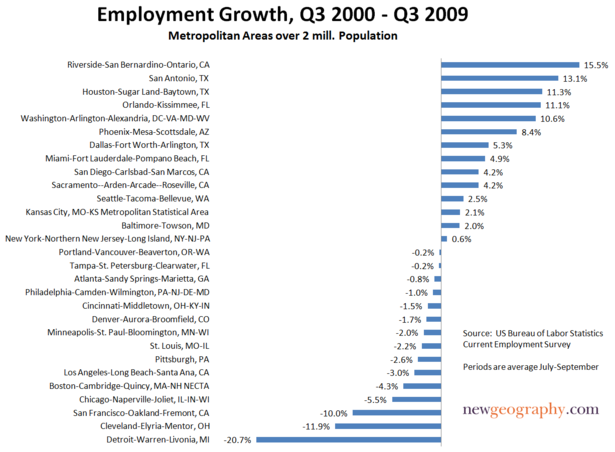
    The key factor here may well be economic opportunity. Virtually all the supposedly top-ranked cities cited in this media narrative have suffered below-average job growth throughout the decade. Some, like Portland and New York, have added almost no new jobs; others like San Francisco, Boston and Chicago have actually lost positions over the past decade.

    In contrast, even after the current doldrums, San Antonio, Orlando, Houston, Dallas and Phoenix all boast at least 5% more jobs now than a decade ago. Among the large-narrative magnet regions only one–government-bloated greater Washington–has enjoyed strong employment growth.

    The impact of job growth on the middle class has been profound. New York City, for example, has the smallest share of middle-income families in the nation, according to a recent Brookings Institution study; its proportion of middle-income neighborhoods was smaller than that of any metropolitan area except Los Angeles.The same pattern has also emerged in what has become widely touted as America’s “model city”–President Obama’s adopted hometown of Chicago.

    The likely reasons behind these troubling trends are things rarely discussed in “the narrative”–concerns like high costs, taxes and regulations making it tough on industries that employ the middle class. One clear culprit: out of control state spending. State spending in New York is second per capita in the nation (anomalous Alaska is first); California stands fourth and New Jersey seventh. Illinois is down the list but coming up fast. Over the past decade, while its population grew by only 7%, Illinois’ spending grew by an inflation-adjusted 39%.

    The problem here is more than just too-large government; it lies in how states spend their money. Massive public spending increases over the past decade in California, New Jersey, Illinois and New York have gone overwhelmingly into the pockets and pensions of public employees. It certainly has not flowed into such basic infrastructure as roads, bridges and ports that are needed to keep key industries competitive.

    The American Association of State Highway Transportation, for example, ranked New York 43rd in the country and New Jersey dead last in terms of quality of roads. Some 46% of the Garden State’s roads were rated in poor condition, compared with the national average of 13%, even as the state’s spending reached new highs. The typical New Jersey driver spends almost $600 a year in auto repairs necessitated by the poor conditions of the roads.

    In contrast, states in the South and parts of the Plains tend to pour their public resources into productive uses. Cities like Mobile, Ala., Houston, Charleston, S.C., and Savannah, Ga., have been investing in port facilities to take advantage of the planned widening of the Panama Canal. The primary goal is to take business away from the increasingly expensive, overregulated and under-invested ports of the Northeast and West Coast. Similarly, places like Kansas City and the Dakotas are looking to boost their basic rail and road networks to support export-heavy industries.

    Even in the face of the Obama administration’s strongly urban-centric, blue state-oriented economic policy, these generally less than hip places appear poised to grow as the economy recovers. Virtually all the top 10 economies that have withstood the recession come from outside the “youth-magnet” field: San Antonio; Oklahoma City; Little Rock, Ark.; Dallas, Baton Rouge, La.; Tulsa, Okla., Omaha, Neb.; Houston and El Paso, Texas. The one exception to this rule, Austin, also benefits from being located in solvent, generally low-tax Texas.

    This continued erosion of jobs and the middle class from the blue states and cities is not inevitable. Many of these places enjoy enormous assets in terms of universities, strategic location, concentrations of talented workers and entrenched high-wage industries. But short of a massive and continuing bailout from Washington, the only way to reverse their decline will be a thorough reformation of their governmental structure and policies. No narrative, no matter how well spun, can make up for that reality.

    This article originally appeared at Forbes.com.

    Joel Kotkin is executive editor of NewGeography.com and is a distinguished presidential fellow in urban futures at Chapman University. He is author of The City: A Global History. His next book, The Next Hundred Million: America in 2050, will be published by Penguin Press early next year.
  • Go to Middle America, Young Men & Women

    A few weeks ago, Eamon Moynihan reviewed economic research on cost of living by state in a newgeography.com article. The results may seem surprising, given that some of the states with the highest median incomes rated far lower once prices were taken into consideration. The dynamic extends to the nation’s 51 metropolitan areas with more than 1,000,000 population (See Table).

    There is a general perception that the most affluent metropolitan areas are on the east coast and the west coast. Indeed, 8 of the 10 metropolitan areas with the highest nominal per capita income in 2006 were on the two coasts. These included San Francisco, San Jose and Seattle on the west coast and Washington, Boston, New York, Hartford and Philadelphia on the east coast. Middle-America is represented by Denver and Minneapolis-St. Paul. However, as anyone who has lived on the coasts and Middle America knows, a dollar in New York or San Francisco does not buy nearly as much as a dollar in Dallas-Fort Worth or Cincinnati.

    Per Capita Income: Purchasing Power Parity
    US Metropolitan Areas over 1,000,000 Population
        2006 Per Capita Income  
    Rank Metroplitan Area Purchasing Power Adjusted Nominal Nominal Rank
    1 San Francisco $46,287 $57,747 1
    2 Washington $45,178 $51,868 3
    3 Denver $44,798 $44,691 8
    4 Minneapolis-St. Paul $44,326 $44,237 9
    5 Houston $42,815 $43,174 11
    6 Boston $42,571 $50,542 4
    7 Pittsburgh $41,716 $38,550 20
    8 St. Louis $41,613 $37,652 27
    9 Milwaukee $41,572 $39,536 19
    10 Baltimore $41,451 $43,026 12
    11 Seattle $41,448 $45,369 6
    12 Kansas City $41,329 $37,566 28
    13 Hartford $41,104 $44,835 7
    14 New Orleans $40,935 $40,211 16
    15 Philadelphia $40,725 $43,364 10
    16 Dallas-Fort Worth $40,643 $39,924 17
    17 Cleveland $39,997 $37,406 30
    18 Indianapolis $39,843 $37,735 26
    19 Chicago $39,752 $41,591 14
    20 Richmond $39,282 $38,233 22
    21 New York $39,201 $49,789 5
    22 Birmingham $39,057 $37,331 31
    23 Cincinnati $38,691 $36,650 36
    24 Nashville $38,680 $37,758 25
    25 Detroit $38,670 $38,119 24
    26 Charlotte $38,632 $38,164 23
    27 Miami $38,555 $40,737 15
    28 San Jose $38,505 $55,020 2
    29 Jacksonville $38,413 $37,519 29
    30 Louisville $38,262 $36,000 41
    31 Oklahoma City $38,156 $35,637 42
    32 Las Vegas $37,691 $38,281 21
    33 Salt Lake City $37,381 $35,145 45
    34 San Diego $37,358 $42,801 13
    35 Rochester $37,066 $36,179 38
    36 Columbus $37,058 $36,110 39
    37 Atlanta $36,691 $36,060 40
    38 Memphis $36,501 $35,470 44
    39 Tampa-St. Petersburg $36,260 $35,541 43
    40 Portland $36,131 $36,845 35
    41 Buffalo $36,091 $33,803 48
    42 Norfolk (Virginia Beach metropolitan area) $35,418 $34,858 46
    43 Raleigh $35,087 $37,221 32
    44 San Antonio $34,913 $32,810 50
    45 Providence $34,690 $37,040 34
    46 Austin $33,832 $36,328 37
    47 Phoenix $33,809 $34,215 47
    48 Sacramento $32,750 $37,078 33
    49 Los Angeles $32,544 $39,880 18
    50 Orlando $32,095 $33,092 49
    51 Riverside-San Bernardino $25,840 $27,936 51
    Source:        
    http://www.bea.gov/scb/pdf/2008/11%20November/1108_spotlight_parities.pdf

    Purchasing Power Parity: Things change rather dramatically when purchasing power is factored in. Some years ago, international economic organizations, such as the Organization for Economic Cooperation and Development, the World Bank and the International Monetary Fund began using costs of living by nation to compare national economic performance, rather than currency exchange rate. This practice, called “purchasing power parity” is based upon the recognition that there may be substantial differences in the cost of living between nations.

    This can be illustrated by comparing Switzerland and the United States. For years, Switzerland has had a higher per capita GDP than the United States on an exchange rate basis. Switzerland’s gross domestic product per capita was $53,300 in 2006, nearly 30% above that of the United States ($42,000). However price levels in Switzerland are so high that incomes do not go nearly as far as the exchange rate would suggest. Once adjusted for purchasing power parity, the Swiss GDP per capita in 2006 drops to $39,000, well below that of the United States. Much of the difference has to do with regulation. The more liberal economy of the United States produces a lower cost economy than in Switzerland, or for that matter most of Western Europe. The US economic advantage would be even greater measured on a household basis, since US households include nearly 10% more members (generally children) than those in Western Europe.

    The same concept was applied by the Department of Commerce Bureau of Economic Analysis researchers in their review of purchasing power parities between US metropolitan areas in 2006. When purchasing power is factored in, five of the top metropolitan areas in nominal per capita income (not adjusted for purchasing power) drop out and are replaced by other metropolitan areas rarely thought of as among the nation’s most affluent.

    Among the three west coast nominal leaders, San Francisco remains as #1, in both nominal and purchasing power adjusted per capita income. Seattle dropped from 6th to 11th position. However, the real surprise is San Jose, which dropped from 2nd position to 28th.

    The east coast regions ranked among the top 10 metropolitan areas in nominal income also were decimated by their high costs, with only Washington (which rose from 3rd to 2nd) and Boston (which fell from 4th to 6th) remaining. New York fell from 5th to 21st, Hartford from 7th to 13th and Philadelphia from 10th to 16th.

    The two non-coastal metropolitan areas in the nominal top 10 remain, with Denver rising from to 3rd and Minneapolis-St. Paul rising from 9th to 4th.

    It can be argued that Middle-America replaced the five metropolitan areas dropping out of the top ten. Houston, long one of the most disparaged metropolitan areas among urbanists, occupies the 5th position (compared to its 11th ranking in the nominal list). Three of the new entrants are confirmed members of the Rust Belt: Pittsburgh (7th), St. Louis (8th) and Milwaukee (9th). Finally, there is a new east coast entrant, blue-collar Baltimore (10th).

    The Impact of Taxes: But that is just the beginning. Taxes also diminish the purchasing power of households. Unfortunately, there is virtually no readily available information on state and local taxation by metropolitan area. There is, however state and local government taxation data at the state level. If it is assumed that this data is representative of metropolitan differences (weighted proportionately by state in multi-state metropolitan areas), there would be changes in rank among the top 10. Denver would displace Washington in the number two position, closing more than one-half the gap with San Francisco. Even more surprisingly, St. Louis would move ahead of both Boston and Pittsburgh to rank 6th. Kansas City would leap over #11 Seattle, Baltimore, Milwaukee and Pittsburgh to rank 8th, trailing #7 Boston by $25, not much more than the price of a Red Sox standing room ticket. Pittsburgh would occupy the #9 position and Milwaukee #10 (See Figure).

    More than Housing: The largest differences in purchasing power stem from housing, with east coast and west coast metropolitan areas having generally higher housing costs. As a result of the housing bust and the larger house price drops in those areas, purchasing power adjusted incomes could recover relative to those of Middle America. However, the high cost of living on the east and west coasts extend to more than housing prices. Generally, according to proprietary (and for sale) ACCRA cost of living data, the west coast and east coast metropolitan areas have higher costs of living even without housing. These differences are largely in grocery costs, which probably reflects the anti-big box store planning regulations and politics that exist in many of these areas. Grocery costs in the more affluent middle-American metropolitan areas tend to be lower.

    Other Surprises: Outside the top 10 most affluent metropolitan areas, there are other surprises. Urban planning favorite Portland ranks 40th, just above Buffalo. Rust Belt Cleveland ranks 17th, a few positions above New York. Kansas City, with its highly decentralized civic architecture, ranks 12th, just behind Seattle. Indianapolis (17th) is more affluent than Chicago (18th) and both are more affluent than New York.

    Five of the bottom 10 metropolitan areas are in the south, including Virginia Beach, Raleigh, Austin, San Antonio and Orlando. But perhaps the biggest surprise of all is that four of the five lowest ranking metropolitan areas are in the southwest: Phoenix (47th), Sacramento (48th), Los Angeles (49th) and Riverside-San Bernardino (51st).

    The Dominance of Middle America: But among the 10 most affluent metropolitan areas in the nation, six or seven may be counted as Middle-America (depending on how Baltimore is classified). Only three are from the original group that supplies 8 of the top metropolitan areas when purchasing power is not considered.


    Related articles:
    Gross Domestic Product per Capita, PPP: World Metropolitan Regions
    Gross Domestic Product per Capita, PPP: China Metropolitan Regions

    Photograph: Pittsburgh

    Wendell Cox is a Visiting Professor, Conservatoire National des Arts et Metiers, Paris. He was born in Los Angeles and was appointed to three terms on the Los Angeles County Transportation Commission by Mayor Tom Bradley. He is the author of “War on the Dream: How Anti-Sprawl Policy Threatens the Quality of Life.

  • Can Silicon Valley Attract the Right Workforce for its Next Turnaround?

    In less than 30 years, Silicon Valley has rocketed to celebrity status. The region serves as the top magnet for innovation, often occupying the coveted #1 position of global hot spot rankings. More of an informal shared experience than a physical place, Silicon Valley capitalizes on being centrally located in the San Francisco Bay Area, a broader regional zone that is an economic powerhouse.

    Keeping this leadership position requires constant transformation. The region has weathered and reinvented itself through previous downturns. These next few years, in the wake of what some have termed the Great Recession, will provide another test of economic recovery and relevance.

    Based on a recent in-depth research study of global innovation networks, several elements will be essential to the future success of the Bay Area. Two critical but often overlooked factors are specifically community colleges and local demographics. Both are tied directly to people.

    Almost any conversation of innovation assumes that the top research institutions are prerequisites. Boston has MIT and Harvard; the Bay Area has Stanford University and the University of California at Berkeley. One university professor said frankly, “Stanford is part of what the outside world sees as part of the Silicon Valley secret.”

    These tier-one universities do play a critical role within the local economy, receiving the greatest doses of federal research dollars and enjoying their pick of top young talent. They also soak up the spotlight, so much so that the tiers below them are often ignored by local policymakers.

    This elitist mentality dominates the top of the Bay Area food chain. An eminent faculty leader of a biotech institute was astounded when asked about the role of the other local schools for regional growth. He remarked, “We are more focused on the entrepreneurs than the foot soldiers. We kind of believe that [latter] part will take care of itself.”

    This kind of thinking is delusional. In truth, community colleges provide the bedrock for the region’s university ecosystem. They channel bright students up the local educational chain, helping train and transfer them to the upper tiers. Within the Bay Area, the Foothill-De Anza Community College has served a diverse student body, which includes a combination of younger, older, and re-entry students, for over 50 years.

    In particular, community colleges serve as a gateway to ambitious foreign-born talent. Foothill-De Anza admits more international students than any other community college in the U.S., notes Peter Murray, Foothill’s Dean of Physical Sciences, Mathematics and Engineering. Many of these students from outside the U.S. seek a natural entry to Silicon Valley. Once on a student visa, they aggressively pursue their career interests, often transferring to another state school, such as Stanford or the University of California system, to finish their degrees and join the local workforce. Others gain critical technical skills – such as in database management or bioinformatics – critical to operating sophisticated, technology-based companies.

    The community colleges also learn to do more with less. Although state-assisted, Foothill-De Anza funds students at a relatively low rate of $4019 per student, even compared to other national community colleges that average $8041 per student, according to Community College League of California statistics. This is far below what it costs to send students to Berkeley or Stanford.

    Most recently, the school’s administration has faced painfully deep state budget cuts, re-juggling curriculum priorities and teaching staff loads. They adjust by being flexible. The community college system recently announced a partnership with the University of California at Santa Cruz with ambitious plans to build a new billion-dollar multi-university campus at the NASA Ames Research Center. Carnegie-Mellon University in Pittsburgh and San Jose State University in San Jose, Calif., have joined the unique venture that mixes private, public, and industry spheres.

    The new campus will include a new School of Management, major science laboratories, engineering facilities, classrooms, and homes for 3,000 people on 75 acres. The backers are hopeful that this will lead to a “sustainable community for education and research.” If all goes accordingly to plan, this university will offer a new model of education that combines the best of a local community college, local metropolitan school, two universities at a distance, and a strong industry partner.

    Education constitutes only one part of the region’s human capital outlook. Local population trends can reflect the overall strength of the workforce and its ability for continued growth. On a more fundamental level, innovation efforts rest on people who start and grow new ventures. By understanding current demographics, you garner strong hints for future gaps and issues.

    Looking just at Silicon Valley, the area’s population grew modestly by 1.6% to a total of 2.6 million residents for 2008, according to the latest Silicon Valley Index. Compared to California and the U.S., Silicon Valley’s population consists of fewer children and more people between working ages (25–64). This combination bodes well for work productivity, but also indicates that many who start families soon drift to other states to raise the next set of young workers.

    Silicon Valley does better attracting and retaining foreign talent, who seek new opportunity and prosperity. AnnaLee Saxenian, a dean at the University of California at Berkeley, considers this global migration and circulation to be critical in maintaining regional advantage. Foreign immigration has driven Silicon Valley’s population growth. Looking solely at U.S. Census data estimates for the period of 2000 and 2003, foreign migration to the metropolitan cluster of San Francisco, Oakland, and Fremont rose by 10 percent each year, while domestic migration dropped by nearly 14 percent on average.

    Another good sign is that foreign students, particularly those receiving degrees in science and engineering, continue to stay higher in Silicon Valley than other U.S. regions. Unfortunately, when the student visas end, many of these bright workers, who would otherwise stay in the area, take their skills and dreams back home.

    More worrying, college graduates – both foreign and domestic – are leaving the region on their own volition. No city in the greater Bay Area sits in the top 20 list of places to work after college. If American youth are relocating to other areas, then the region may be destined to simply age in place. Local parents in my recent research study simply did not make the connection that nearly all their grown children lived elsewhere – and what that implication entailed for long-term regional vitality.

    Part of this difference in understanding can be explained by generational biases. Each generation brings a dominant set of traits that shape the tone and direction for local innovation. Baby Boomers (born 1943–1960) are focused on their own pursuits. Even when retired, Boomers stay active as consultants and independent contractors, partly to offset decreased life savings as well as enjoy a self-sufficient lifestyle. Often criticized for being narcissistic, they can help to influence innovation activities for others through policy and funding decisions. A senior research policymaker said emphatically, “What are we going to do for the generations out ahead of us? That’s what I care more about than anything.”

    Generation X (born 1961–1981) is the most entrepreneurial generation in U.S. history, but the smallest in size, so policymakers easily overlook them. Certain tensions exist with the prior generation. Research from Neil Howe and William Strauss show that the Boomers are increasingly resisting the decisions made by Gen X to the point of overlooking their contributions in favor of the next generation.

    This is a drastic mistake for two reasons. First, the average age for a U.S.-born technology entrepreneur to start a company is 39, which sits squarely in Gen X. This generation has already become the primary engine for Silicon Valley. Second, this generation has the best academic training and international experience in American history. They may be small in their weight class, but Gen X packs a hefty punch overall. The challenge will be for the Bay Area to retain this population group, as their family and career needs shift.

    In contrast, the Millennials (born 1982–2005) are generally focused on social bonding, authority approval, and civic duty – attributes that may make parents happy, but do not usually drive new economic growth. As the largest generation in American history, they are proving to be massive consumers of technology and social advocates. By and large, Millennials steer away from high-risk ventures, preferring community-oriented activities, and they bring a different set of demands to the Bay Area.

    In the innovation lifecycle, if Boomers serve as advisors and Gen Xers as the entrepreneurs, then the Millennials could provide potent networkers. Each plays an essential role in regional growth, and all frequently vote with their feet. The critical question is whether the Bay Area is positioned to retain the right workforce mix to harness its next turnaround, or whether the dynamism will shift to other regions both in America and abroad.

    Tamara Carleton is a doctoral student at Stanford University, studying innovation culture and technology visions. She is also a Fellow of the Foundation for Enterprise Development and the Bay Area Science and Innovation Consortium.

  • Purple Politics: Is California Moving to the Center?

    You don’t have to be a genius, or a conservative, to recognize that California’s experiment with ultra-progressive politics has gone terribly wrong. Although much of the country has suffered during the recession, California’s decline has been particularly precipitous–and may have important political consequences.

    Outside Michigan, California now suffers the highest rate of unemployment of all the major states, with a post-World War II record of 12.2%. This statistic does not really touch the depth of the pain being felt, particularly among the middle and working classes, many of whom have become discouraged and are no longer counted in the job market.

    Even worse, there seems little prospect of an immediate recovery. The most recent projections by California Lutheran University suggest that next year the state’s economy will lag well behind the nation’s. Unemployment may peak at close to 14% by late 2010. Retail sales, housing and commercial building permits are not expected to rise until the following year.

    This decline seems likely to slow–or even reverse–the state’s decade-long leftward lurch. Let’s be clear: This is not a red resurgence, just a shift toward a more purplish stance, a hue that is all the more appropriate given the economy’s profound lack of oxygen.

    There is growing disenchantment with the status quo. The percentage of Californians who consider the state “one of the best places” to live, according to a recent Field poll, has plummeted to 40%, from 76% two decades ago. Pessimism about the state’s economy has risen to the highest levels since Field started polling back in 1961.

    Inevitably, this angst has affected political attitudes. Though still lionized by the national media, Gov. Schwarzenegger’s approval ratings have fallen from the mid-50s two years ago into the low 30s. The 12% approval rate for the state legislature, according to a Public Policy Institute of California survey in May, stands at half the pathetic levels recorded by Congress.

    Moreover, voters now favor lower taxes and fewer services by a 49-to-42 margin–as opposed to higher taxes and more services. Support for ultra-green policies aimed to combat global warming has also begun to ebb. For the first time in years, a majority of Californians favors drilling off the coast. Californians might largely support aggressive environmental protections, but not to the extreme of losing their jobs in the process.

    Remarkably, state government seems largely oblivious to these growing grassroots concerns. The legislature continues to pile on ever more intrusive regulations and higher taxes on a beleaguered business sector. Agriculture, industry and small business–the traditional linchpins of the economy–continue to be hammered from Sacramento.

    Agriculture now suffers from massive cutbacks in water supplies, brought about in part by drought, but seriously worsened by the yammerings of powerful environmental interests. Large swaths of the fertile central valley are turning into a set for a 21st-century version of Steinbeck’s Grapes of Wrath.

    At the same time, the state’s industrial base is rapidly losing its foundation. Toyota recently announced it was closing its joint venture plant in Fremont, the last auto assembly operation in the state, shifting production to Canada and Texas. Even the film business has been experiencing a secular decline; feature film production days have fallen by half over the decade, as movie-making exits for other states and Canada.

    Most important, California may be undermining its greatest asset: its diverse, highly creative and adaptive small-business sector. A recent survey by the Small Business and Entrepreneurship Council ranked California’s small-business climate 49th in the nation, behind even New York. Only New Jersey performed worse.

    Regulation plays a critical role in discouraging small-business expansion, a new report from the Governor’s Office of Small Business Advocate suggests. Prepared by researchers from California State University at Sacramento, the report estimates that regulations may be costing the state upward of 3.8 million jobs. California currently has about 14 million jobs, down 1 million since July 2007.

    Ironically, the regulatory noose is now slated to tighten even further as a result of radical measures–from energy to land use–tied to reducing greenhouse gases. Another study, authored by California State University researchers, estimates these new laws could cost an additional million jobs.

    Many in the state’s top policy circles, as well as academics and much of the media, dismiss the notion that regulations could be deepening the recessionary pain. Some of this stems from the delusion–always an important factor in this amazing state–that ultra-green policies will actually solidify California’s 21st-century leadership. Few seem to realize that other states, witnessing the Golden State’s economic meltdown, might not rush to emulate California’s policy agenda.

    Internally, discontent with the current agenda seems particularly strong in the blue-collar, interior regions of the state. Brookings demographer Bill Frey and I have described this area as the “Third California.” In the first part of the decade, this region expanded roughly three times as rapidly as Southern California, while the Bay Area’s population remained stagnant.

    Today the Third California represents roughly 30% of the state’s population, compared with barely 18% for the ultra-blue Bay Area. The most conservative part of the state has skewed somewhat more Democratic in recent elections, largely due to migration from coastal California and an expanding Latino population.

    But the intense economic distress now afflicting the interior counties–where unemployment rates are approaching 20%–may now reverse this process. The ultra-green politics embraced by the Democrats’ two prospective gubernatorial nominees-Attorney General Jerry Brown and San Francisco Mayor Gavin Newsom–may not appeal much to a workforce heavily dependent on greenhouse-gas-emitting industries like farming, manufacturing and construction.

    Eventually, the Democrats may rue their failure to run a pro-business, pro-growth candidate, particularly one with roots in the interior region. This oversight could cost them votes among, say, Latinos, who have been far harder hit by the recession than the more affluent (and overwhelmingly white) coastal progressives epitomized by Brown and Newsom. Along with independents, roughly one-fifth of the electorate, Latinos could prove the critical element in the state’s purplization.

    This, of course, depends on the Republicans developing an attractive pro-growth alternative. In recent years, the party’s emphasis on conservative cultural issues and xenophobic anti-immigrant agitation has hurt the GOP in the increasingly socially liberal and ethnically diverse California.

    Although he has proved a poor chief executive, Gov. Schwarzenegger did at least show such a political approach could work. The recent emergence of three attractive Silicon Valley-based candidates, including former eBay CEO Meg Whitman and State Insurance Commissioner Steve Poizner, as well as the likable libertarian-leaning former congressman Tom Campbell, could score well at the polls.

    This political course-correction should be welcomed not only by Republicans but by California’s moderate Democrats and Independents. However blessed by nature and its entrepreneurial legacy, California needs to move back to the pro-growth center if it hopes to revive both its economy and the aspirations of its people.

    This article originally appeared at Forbes.

    Joel Kotkin is executive editor of NewGeography.com and is a distinguished presidential fellow in urban futures at Chapman University. He is author of The City: A Global History. His next book, The Next Hundred Million: America in 2050, will be published by Penguin Press early next year.
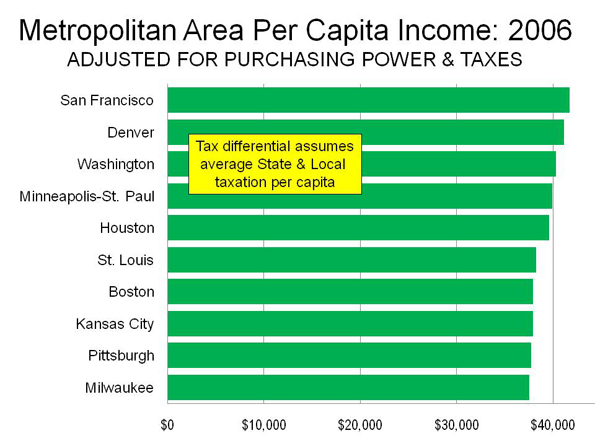
  • California Golden Dreams

    California may yet be a civilization that is too young to have produced its Thucydides or Edward Gibbon, but if it has, the leading candidate would be Kevin Starr. His eight-part “Dream” series on the evolution of the Golden State stands alone as the basic comprehensive work on California. Nothing else comes remotely close.

    His most recent volume, “Golden Dreams: California in an Age of Abundance, 1950-1963,” covers what might be seen as the state’s true Golden Age. To be sure, there is some intriguing history before—the evolution of Hollywood in the 1920s, the reaction to the Depression and the fevered buildup during the Second World War—but this was California’s great moment, its Periclean peak or Augustan age.

    “It was a time of growth and abundance,” Starr writes in his preface, and provides the numbers to prove it. In 1950, California was home to 10.7 million, making it a large state to be sure, but hardly a dominant one. By the early 1960s, the population passed 16 million, slipping by New York state in population.

    Yet it was not a mere matter of numbers that made California so appealing or important. It was the idea of California as not only a part of America, but also something more. To millions in America and around the world, California grew to mean opportunity, sunshine and innovation.

    The state’s business elite, for example, did not identify with the button-down hierarchy that sat atop teeming New York, and its second-tier competitors like Chicago. The leaders of Los Angeles would never consider it a second city, but simply a different, and generally, better one. There was no need for the excessive Manhattan penis envy that led Chicago to keep trying to build higher buildings than Gotham.

    In a different way, San Francisco’s top executives also did not crave that their city be New York—it was always more beautiful, nuttier, freer and more creative than Gotham. What they shared with their downstate rivals was a sense of superiority over the old part of the country. If anything, they felt a mixture of contempt—particularly the conservatives—and condescension about an older, decaying society that fixated on tradition, order and breeding.

    “California,” Cyril Magnin, scion of one of San Francisco’s great families, told me back in the late 1970s, “has recaptured what America once had—the spirit of pioneering. People in business out here are creative; they’re willing to take risks.”

    Geography also plays a role here. Leaders in California, starting at least by the turn of the last century, looked out across the Pacific and saw themselves as part of an emerging shift from Europe to Asia, a process that continues and will dominate the rest of this century. This connection, suggested Pete Hannaford, a public relations executive and partner of Ronald Reagan’s Svengali, Michael Deaver, took on an almost Spenglerian inevitability. “Out here there’s a sense of being where the action is,” Hannaford believed, “with Japan and the Pacific.”

    Starr captures these attitudes, which already had become deeply entrenched by the late 1950s and early 1960s. There was, as he writes, “a conviction that California was the best place to seek and attain a better American life.” However, it was more than money or power. It was about the quality of life. Success in California was not a matter of living by the rules, sheltered in a dark Manhattan apartment, but about the seduction of the physical world. In California, Starr writes, “Eros vanquished Thanatos.”

    Yet Starr’s book is not merely about the rich, the powerful, and even the culturally influential. He finds his primary muse not in the Bohemian realms of San Francisco or the mansions of Beverly Hills, but in that most democratic of everyman’s places, the San Fernando Valley, the place author Kevin Roderick aptly dubbed “America’s Suburb.”

    To see long excerpts from “Golden Dreams,” click here.

    “The Valley” lies over the Santa Monica Mountains from the Los Angeles Basin. As late as the 1930s, it was largely an arid district of ranches, citrus orchards and chicken farms. The area’s postwar expansion was rapid, even by California standards. Between 1945 and 1950 alone, the Valley’s population more than doubled to nearly 500,000. By 1960, it had doubled again.

    This growth was far more than the mindless bedroom sprawl often depicted by aesthetes and urban intellectuals. People in the Valley did not depend largely on the old part of Los Angeles the way, for example, Long Island lived off Manhattan. Most of the Valley’s growth was homegrown—driven by local industry such as aerospace, entertainment, electronics and until the 1960s automobiles.

    Even today, the Valley has very much its own economy and sense of separation from Los Angeles. However, more important, the Valley was, first, a middle-class phenomenon. A cosmopolitan of the first order, Starr manages to chronicle California’s artistic and literary elites, but does not see in them the essence of the state’s appeal. Instead, he explores the everyday wonders of the Valley’s families, single-family homes and swimming pools—6,000 permitted in one year, between 1959 and 1960!

    As a Valley resident myself, I can still see the basic imprint of that culture, what Starr calls its “way of life.” Compared to the tony Westside and hardscrabble east and southside of Los Angeles, the Valley has remained a relatively safe “child-oriented” society, with a big emphasis on restaurants, malls, ball fields, churches and synagogues.

    The single-family tracts, of course, have changed hands, and the majority of the owners have changed. The primarily WASP and second-generation Eastern European Jews are still there, but they have steadily been augmented, and sometimes outnumbered, by others—Armenians, Orthodox Jews, Israelis, Persians, Thais, Chinese, Mexicans, Salvadorans, African-Americans and at least 10 groups I somehow will neglect and no doubt offend.

    Yet the essential way of life forged in the 1950s and 1960s has remained a constant, and that remains the source of California’s attraction. Of course, it is no longer just a “Valley” phenomenon. As California has grown, there are many such places, outside San Diego, in Orange County, the Inland Empire, outside Sacramento, Fresno and scores of other towns. Almost all have the same imprint—an auto-dominated culture, dispersed workplaces, pools and a culture of aspiration.

    In the ensuing decades, perhaps to be covered in Starr’s next book, this archetype evolved mightily. The San Gabriel Valley, once a plain vanilla suburban appendage, has morphed into the country’s largest Asian suburbia, complete with a shopping center jokingly referred to as “the Great Mall of China.” The often-monotonous housing tracts between San Jose and Palo Alto, on the San Francisco Peninsula, also attracted hundreds of thousands of Asians but also produced something equally astounding—the Silicon Valley, the world’s leading center for technology.

    These suburban developments long ago surpassed in importance the urban roots of California metropolises. A serious corporate center during the time covered by Starr’s volume, San Francisco has devolved in a ultra-politically correct, hip and cool urban Disneyland for Silicon Valley, providing good restaurants and housing for those still too young to crave a house on the Peninsula. The San Gabriel Chinatown long ago replaced the older one in downtown Los Angeles as the center of Asian culture and cuisine.

    These places grew before the current malaise infected the state. As Starr points out, California based its ascendancy on two seemingly contradictory principles: entrepreneurship and activist government. Under Gov. Earl Warren, but also Goodwin Knight and finally Pat Brown, the state made a commitment both to basic infrastructure—energy, water, roads, schools, parks—and expanding its economy.

    By the early 1960s, this system was hitting on all cylinders. New roads, power plants and water systems opened lands for development for farms, subdivisions, factories. Ever expanding and improving schools produced a work force capable of performing higher-end tasks, and capable of earning higher wages. New parks preserved at least some of the landscape, and gave families a place to recreate.

    For Pat Brown, arguably the greatest governor in American history, this was all part of California’s “destiny.” Starr describes Brown’s California as “a modernist commonwealth, a triumph of engineering, a megastate committed to growth as its first premise.” Yet within this great modernist project was also stirring opposition, on both left and right, that would soon place this Golden Age at its end.

    Many of the objections were legitimate. The Sierra Club and its many spinoffs rightfully saw the Brown development machine as threatening California’s landscape, wildlife and, in important ways, the appeal of its way of life. More careful controls on growth clearly were needed. The battle over the nature of those controls continues to this day.

    Some more angry voices, then as now, targeted the very existence of suburbia, the dominant form of the state’s growth, and eventually sought its eradication. This struggle goes on to this day with a religious fervor, led, ironically, by the former and perhaps future governor, Jerry Brown, currently attorney general and leading Torquemada of the greens.

    Minorities also began to stir amid the celebrations of the 1950s and early 1960s. Woefully underrepresented in the halls of power and the corridors of business, Asians and Latinos remained largely passive politically. However, by the early 1960s acceptance of exclusion was giving way to more assertive attitudes. Ultimately the massive immigration that swelled both their numbers in the 1970s and beyond would ensure these groups far more influence both on the politics and in the economy of the state.

    Yet it was the African-American who would really upset the balance of the golden era. Never discriminated against as in the South, black Californians felt the lash of a thousand, often-informal exclusions. As the civil rights movement grew, with it less deferential attitudes, particularly toward the police, a powder keg was building. In 1964, the first year after the era chronicled in “Golden Dreams,” Watts blew up, shattering the comfortable assumptions of a progressive, post-racial state.

    Finally, as Starr reports, there was mounting thunder on the right. The business elite and the middle class were financing the ever-expanding California state. They saw their money go to the poor, to minorities and state employees. Particularly annoying were the university students, many of whom were in open revolt against the state, in the mind of much of the public that had nurtured them.

    By the early 1960s many of these latter Californians also were angry, but their rage would express itself not in riots, but at the ballot box, ushering in the age of Ronald Reagan. The period that follows “Golden Dreams” emerges as one of conflicting visions, between greens, students and minorities, on the one hand, and largely suburban middle-class workers and business owners on the other.

    These two groups would battle over the next generation, with the advantage oscillating over time. Today the heirs of the protesters—greens, minority activists and former ’60s radicals—hold the political advantage, although the state they dominate has fallen on parlous times.

    In retrospect, the golden era before these conflicts does indeed seem like a high point. The question now is whether California, down on its luck, will find a way to rebound, much as imperial Rome did after the demise of the Julian dynasty, or fall, like Athens, into ever more squalid decline. Does the state have a bright “destiny” ahead or only more ruin?

    This, of course, will be the basis for another historical epoch. Let us hope Kevin Starr be around to chronicle it for the rest of us.

    This piece originally appeared at Truthdig.com

    Golden Dreams: California in an Age of Abundance, 1950-1963 at Amazon.com.

    Joel Kotkin is executive editor of NewGeography.com and is a distinguished presidential fellow in urban futures at Chapman University. He is author of The City: A Global History. His next book, The Next Hundred Million: America in 2050, will be published by Penguin Press early next year.