Tag: San Francisco

  • Major Metropolitan Commuting Trends: 2000-2010

    As we indicated in the last article, solo automobile commuting reached an all time record in the United States in 2010, increasing by 7.8 million commuters. At the same time, huge losses were sustained by carpooling, while the largest gain was in working at home, which includes telecommuting. Transit and bicycling also added commuters.  This continues many of the basic trends toward more personalized employment access that we have seen since 1960.

    Solo Automobile Commuting: Among the nation’s 51 metropolitan areas with more than 1 million population, 38 experienced increases in solo automobile commuting between 2000 and 2010. More than 80% of commuting is by solo automobile in 25 of the 51 largest metropolitan areas, with the highest rates being in Birmingham, Detroit, Cincinnati, Indianapolis and Kansas City. Another 28 metropolitan areas have single automobile commute shares of between 70% and 80%, with Boston, Washington and San Francisco between 60% and 70%. As would be expected, the lowest solo automobile commute share was in New York at 51%.

    Car Pools: The national data also showed a nearly 2.4 million loss in carpool use. The losses were pervasive, occurring in all 51 metropolitan areas. Riverside-San Bernardino had the highest carpool market share at just under 15%, while all other major metropolitan areas were below 12%. Car pools have been losing market share for decades.

    Work at Home (Includes Telecommuting): In what we have previously labeled as The Decade of the Telecommute, the nation experienced a 1.7 million increase in working at home over the past decade. The market share gains in working at home were as pervasive as the losses in carpooling, with all 51 metropolitan areas registering increases. Austin had the strongest work-at-home market share, at 7.3%, followed by Portland at 6.5%, San Francisco and Denver at 6.2%, Phoenix at 6.0%, with San Diego, Raleigh and Atlanta above 5.5%. Overall, working at home exceeded transit commuting in 37 major metropolitan areas out of 51 in 2010, up from 27 in 2000. Three metropolitan areas had work at home market shares of less than 3%, including Memphis, New Orleans and last place Buffalo.

    Transit: As noted before, transit enjoyed its first 10 year gain since journey to work data was first collected by the Census Bureau 50 years ago. Overall, transit added 900,000 daily commuters, roughly half that for telecommuters. Transit’s market share increased in 25 of the top 51 metropolitan areas. It is also notable that in a number of the metropolitan areas with the largest expenditures for new rail systems, there were either losses or commuting gains were concentrated in the more flexible bus services.

    New York: As so often has been the case, transit was largely a "New York story." More than one half of the new transit commuters were in the New York metropolitan area, more than 450,000 of the 900,000 increase. New York boasts by far the most extensive transit system in the nation, which serves the second largest central business district in the world and by far the nation’s most important. In 2000, New York had a transit work trip market share of 27.4%. By 2010, New York’s transit work trip market share had risen to 30.7%, more than double that of any other metropolitan area. More than 70% of the new transit commuters in the New York area were on its subway (Metro), suburban rail and light rail systems.

    San Francisco: San Francisco retained its position as the second strongest transit metropolitan area, with a 14.6% work trip market share in 2010. This is up from 13.8% in 2000.

    Washington: Washington was the third strongest transit commuting market, with a 14.0% work trip market share in 2010. This modest increase from 13.4% nonetheless produced the second largest ridership increase in the nation, at more than 130,000. This reflects the strength of Washington’s job market over the decade. Rail ridership accounted for 53% of this increase, while buses accounted for the other 47%.

    Boston and Chicago: Boston passed Chicago to become the fourth strongest transit market, at 11.8% in 2010. This is an increase from 11.2% in 2000. Chicago ranked fifth at 11.2%, a small reduction from the 11.3% in 2000.

    Los Angeles: Los Angeles had the third largest increase in transit commuting, adding 60,000 daily transit commuters. Approximately 75% of these new commuters were attracted by the region’s extensive bus system as opposed to its very expensive but limited rail system. This increase placed Los Angeles in a virtual tie with Portland, with a work trip market share of 6.2%.

    Portland: Portland continued to experience its now 30 year transit market share erosion, despite having added three new light rail lines between 2000 and 2010. Portland’s transit work trip market share fell to 6.2% from 6.3% and now trails the work at home and telecommute market share of 6.5%.

    Seattle:Seattle added 29,000 new transit commuters for the fourth strongest growth in the nation. Approximately 75% of the new commuters were on the metropolitan area’s bus system.

    Atlanta: Atlanta, which is home to the third largest postwar Metro system in the nation (MARTA) gained nearly 9000 new transit commuters, all of them on the bus, while losing more than 3000 rail commuters.

    Miami:Miami added 16,000 new transit commuters, though more than 90% were attracted to the bus system, rather than the rail services.

    Rail and Bus in Texas: Other metropolitan areas with new and expanded rail systems did not fare as well. In Dallas-Fort Worth, the light rail system was more than doubled in length, yet there was a reduction of more than 3000 daily transit commuters. The transit work trip market share in Dallas-Fort Worth dropped from 1.8% to 1.4%, approximately one quarter lower than that of any other major metropolitan area with a new light rail or Metro system. Houston, which built its first light rail line during the period, lost nearly 3000 daily transit commuters, with its transit work trip market share dropping by nearly one-third, from 3.2% to 2.3%. By contrast, the third largest metropolitan area in Texas, San Antonio, lost no commuters from its bus only transit system.

    Other New Rail Metropolitan Areas: Other metropolitan areas with new rail systems experienced modest ridership increases, with 60 to 70 percent of the increase on the bus systems in Charlotte, Minneapolis-St. Paul and Phoenix. Salt Lake City experienced a small decline in transit commuting.

    Below 1 Percent: Four metropolitan areas had transit work trip market shares of less than 1%, including Indianapolis, Raleigh, Birmingham and last place Oklahoma City, with a market share of 0.4%.

    Bicycles: It was also a good decade for bicycle commuting, with the national increase of nearly 250,000. The bicycle commuting market share rose in 45 of the 51 largest metropolitan areas. Portland had the highest bicycle market share at 2.2%, with three other metropolitan areas at 1.5% or above, Sacramento, San Francisco and San Jose. The lowest bicycle commuting market shares were in San Antonio, Cincinnati, Birmingham and Memphis, all at 0.1 percent.

    Walking: There was little change in walking among the nations major metropolitan areas. The largest shares were in New York (5.9%) and Boston (5.4%), with the smallest shares in Raleigh (1.1%), Orlando (1.1%) and Birmingham (1.0%).

    Drifting Away from Shared Commuting: In some ways, the 2000s were different than previous decades, especially with the reversals in bicycle commuting and transit. However, overall, shared ride commuting (transit and car pools) lost share due to the precipitous decline in car pooling. Longer term share increase trends also continued in single-occupant automobile commuting and working at home. The bottom line: personal employment access (personal mobility plus working at home) continues to carve away at the smallish share still held by shared commuting.

    ————-

    Data: The 2000 and 2010 commuting market shares by mode are shown in Tables 1 and 2 (2010 metropolitan area boundaries).

    ————

    Table 1
    Work Trip Market Share: 2000
    Metropolitan Areas Over 1,000,000 Population in 2010
    Metropolitan Area Car, Truck or Van: Alone Car/Van Pool Transit Bicycle Walk Other Work at Home (Includes Telecommute)
    Atlanta 77.0% 13.7% 3.4% 0.1% 1.3% 1.1% 3.5%
    Austin 76.5% 13.7% 2.5% 0.6% 2.1% 1.1% 3.6%
    Baltimore 75.5% 11.5% 5.9% 0.2% 2.9% 0.9% 3.2%
    Birmingham 83.3% 12.0% 0.7% 0.1% 1.2% 0.7% 2.1%
    Boston 71.1% 8.6% 11.2% 0.5% 4.6% 0.8% 3.3%
    Buffalo 81.7% 9.4% 3.3% 0.2% 2.7% 0.5% 2.1%
    Charlotte 80.7% 12.8% 1.4% 0.1% 1.2% 0.8% 2.9%
    Chicago 70.4% 11.0% 11.3% 0.3% 3.1% 1.0% 2.9%
    Cincinnati 81.3% 10.1% 2.8% 0.1% 2.3% 0.6% 2.7%
    Cleveland 81.3% 8.8% 4.1% 0.2% 2.2% 0.6% 2.7%
    Columbus 82.1% 9.7% 2.1% 0.2% 2.3% 0.6% 3.0%
    Dallas-Fort Worth 78.7% 13.9% 1.8% 0.1% 1.5% 1.0% 3.0%
    Denver 76.0% 11.7% 4.4% 0.4% 2.1% 0.8% 4.6%
    Detroit 84.7% 9.2% 1.7% 0.1% 1.4% 0.6% 2.2%
    Hartford 82.6% 8.7% 2.8% 0.2% 2.5% 0.6% 2.6%
    Houston 77.0% 14.3% 3.2% 0.3% 1.6% 1.1% 2.5%
    Indianapolis 82.8% 10.4% 1.3% 0.2% 1.7% 0.7% 3.0%
    Jacksonville 80.3% 12.6% 1.3% 0.5% 1.7% 1.4% 2.3%
    Kansas City 82.6% 10.6% 1.2% 0.1% 1.4% 0.7% 3.5%
    Las Vegas 74.6% 14.7% 4.4% 0.5% 2.3% 1.3% 2.3%
    Los Angeles 71.9% 14.6% 5.6% 0.7% 2.7% 1.0% 3.5%
    Louisville 81.8% 11.2% 2.0% 0.2% 1.7% 0.7% 2.5%
    Memphis 80.7% 13.3% 1.6% 0.1% 1.3% 0.9% 2.2%
    Miami-West Palm Beach 77.3% 13.1% 3.2% 0.5% 1.7% 1.2% 3.1%
    Milwaukee 79.7% 9.9% 4.2% 0.2% 2.9% 0.6% 2.6%
    Minneapolis-St. Paul 78.3% 10.0% 4.4% 0.4% 2.4% 0.6% 3.8%
    Nashville 80.5% 13.1% 0.8% 0.1% 1.5% 0.8% 3.2%
    New Orleans 72.9% 14.6% 5.4% 0.6% 2.7% 1.3% 2.4%
    New York 52.7% 9.3% 27.4% 0.3% 6.0% 1.5% 2.9%
    Oklahoma City 81.6% 12.1% 0.5% 0.2% 1.7% 1.0% 2.9%
    Orlando 80.6% 12.1% 1.6% 0.4% 1.3% 1.1% 2.9%
    Philadelphia 73.1% 10.2% 8.9% 0.3% 3.9% 0.7% 2.9%
    Phoenix 74.6% 15.3% 1.9% 0.9% 2.1% 1.4% 3.7%
    Pittsburgh 77.5% 9.8% 5.9% 0.1% 3.6% 0.6% 2.5%
    Portland 73.1% 11.5% 6.3% 0.8% 2.9% 0.8% 4.6%
    Providence 80.7% 10.5% 2.4% 0.2% 3.3% 0.8% 2.2%
    Raleigh 80.8% 12.1% 0.9% 0.2% 1.6% 1.0% 3.5%
    Richmond 81.7% 10.9% 1.9% 0.2% 1.8% 0.8% 2.7%
    Riverside-San Bernardino 73.5% 17.6% 1.6% 0.5% 2.2% 1.2% 3.5%
    Rochester 81.7% 9.1% 2.0% 0.2% 3.5% 0.6% 2.9%
    Sacramento 75.3% 13.5% 2.7% 1.4% 2.2% 0.9% 4.0%
    Salt Lake City 76.0% 13.4% 3.3% 0.5% 2.1% 0.7% 4.0%
    San Antonio 76.2% 14.9% 2.7% 0.1% 2.4% 1.2% 2.6%
    San Diego 73.9% 13.0% 3.3% 0.6% 3.4% 1.4% 4.4%
    San Francisco-Oakland 62.8% 12.7% 13.8% 1.1% 3.9% 1.3% 4.3%
    San Jose 77.2% 12.4% 3.4% 1.2% 1.8% 0.9% 3.1%
    Seattle 71.6% 12.7% 7.0% 0.6% 3.1% 0.8% 4.2%
    St. Louis 82.5% 10.0% 2.2% 0.1% 1.7% 0.6% 2.9%
    Tampa-St. Petersburg 79.7% 12.4% 1.3% 0.6% 1.7% 1.2% 3.1%
    Virginia Beach-Norfolk 78.8% 12.1% 1.7% 0.3% 2.7% 1.6% 2.7%
    Washington 67.5% 13.4% 11.2% 0.3% 3.0% 0.9% 3.7%
    Top 51 Metropolitan Areas 73.2% 11.8% 7.5% 0.4% 2.9% 1.0% 3.2%
    Calculated from Census Bureau data
    Metropolitan areas as defined in 2010
    Table 2
    Work Trip Market Share: 2010
    Metropolitan Areas Over 1,000,000 Population in 2010
    Car, Truck or Van: Alone Car/Van Pool Transit Bicycle Walk Other Work at Home (Includes Telecommute)
    Atlanta 77.6% 10.3% 3.4% 0.2% 1.3% 1.5% 5.8%
    Austin 75.6% 10.5% 2.3% 0.6% 1.9% 1.8% 7.3%
    Baltimore 76.5% 9.6% 6.0% 0.2% 2.6% 1.0% 4.1%
    Birmingham 84.8% 10.0% 0.6% 0.1% 1.0% 0.5% 3.1%
    Boston 69.5% 7.5% 11.8% 0.7% 5.4% 0.8% 4.4%
    Buffalo 82.0% 7.5% 3.8% 0.3% 3.0% 1.1% 2.3%
    Charlotte 80.6% 10.0% 2.0% 0.2% 1.5% 0.6% 5.1%
    Chicago 71.0% 8.5% 11.2% 0.6% 3.1% 1.0% 4.5%
    Cincinnati 84.1% 7.9% 2.1% 0.1% 2.0% 0.4% 3.4%
    Cleveland 82.3% 7.2% 3.6% 0.3% 2.2% 0.7% 3.7%
    Columbus 82.4% 8.0% 1.7% 0.5% 2.3% 0.6% 4.6%
    Dallas-Fort Worth 81.3% 10.1% 1.4% 0.2% 1.2% 1.4% 4.6%
    Denver 76.3% 9.6% 4.1% 0.8% 1.9% 1.1% 6.2%
    Detroit 84.6% 8.5% 1.5% 0.2% 1.4% 0.8% 3.0%
    Hartford 81.5% 7.9% 3.1% 0.3% 3.0% 1.0% 3.2%
    Houston 79.4% 11.5% 2.3% 0.3% 1.4% 1.7% 3.4%
    Indianapolis 83.9% 8.2% 0.9% 0.3% 1.5% 0.8% 4.3%
    Jacksonville 82.5% 8.9% 1.0% 0.5% 1.4% 1.2% 4.5%
    Kansas City 83.7% 8.5% 1.2% 0.2% 1.4% 0.9% 4.1%
    Las Vegas 78.9% 10.5% 3.8% 0.6% 1.6% 1.3% 3.3%
    Los Angeles 73.5% 10.7% 6.2% 0.9% 2.6% 1.2% 5.0%
    Louisville 83.5% 9.2% 1.9% 0.2% 1.3% 0.9% 3.1%
    Memphis 83.6% 10.3% 1.0% 0.1% 1.5% 0.9% 2.7%
    Miami-West Palm Beach 78.8% 9.4% 3.5% 0.6% 2.0% 1.4% 4.4%
    Milwaukee 80.1% 9.3% 3.4% 0.5% 2.6% 0.7% 3.4%
    Minneapolis-St. Paul 78.3% 7.9% 4.8% 0.7% 2.4% 0.9% 4.9%
    Nashville 81.3% 10.7% 1.0% 0.2% 1.2% 1.0% 4.6%
    New Orleans 78.1% 11.0% 3.2% 0.7% 2.6% 1.9% 2.5%
    New York 50.5% 6.8% 30.7% 0.5% 5.9% 1.6% 3.9%
    Oklahoma City 82.7% 10.6% 0.5% 0.3% 1.6% 1.0% 3.4%
    Orlando 82.1% 9.2% 1.6% 0.3% 1.1% 1.4% 4.4%
    Philadelphia 73.9% 8.0% 9.6% 0.5% 3.5% 0.8% 3.8%
    Phoenix 76.7% 11.8% 2.0% 0.6% 1.5% 1.5% 6.0%
    Pittsburgh 77.0% 8.9% 5.6% 0.3% 3.7% 0.9% 3.5%
    Portland 72.1% 8.8% 6.2% 2.2% 3.3% 0.9% 6.5%
    Providence 81.3% 8.3% 2.6% 0.5% 3.2% 0.9% 3.2%
    Raleigh 82.0% 8.7% 0.9% 0.3% 1.1% 1.1% 5.9%
    Richmond 81.2% 10.1% 1.8% 0.4% 1.2% 0.7% 4.6%
    Riverside-San Bernardino 76.1% 14.8% 1.7% 0.4% 1.8% 1.4% 3.8%
    Rochester 82.6% 7.1% 1.8% 0.4% 3.9% 0.7% 3.6%
    Sacramento 75.6% 11.2% 2.9% 1.7% 1.9% 1.1% 5.5%
    Salt Lake City 77.7% 11.3% 2.9% 0.8% 2.3% 1.0% 4.0%
    San Antonio 79.5% 11.5% 2.1% 0.1% 2.0% 1.4% 3.3%
    San Diego 76.2% 10.1% 3.3% 0.8% 2.8% 1.0% 5.9%
    San Francisco-Oakland 61.5% 10.6% 14.6% 1.7% 4.2% 1.2% 6.2%
    San Jose 77.5% 10.3% 2.9% 1.6% 1.8% 0.9% 5.1%
    Seattle 70.5% 10.2% 8.2% 1.1% 3.5% 1.0% 5.5%
    St. Louis 83.0% 7.7% 2.6% 0.2% 1.9% 0.8% 3.7%
    Tampa-St. Petersburg 80.3% 9.5% 1.6% 0.8% 1.4% 1.4% 5.0%
    Virginia Beach-Norfolk 80.9% 9.4% 1.8% 0.5% 3.3% 0.9% 3.1%
    Washington 65.6% 10.6% 14.0% 0.5% 3.5% 1.0% 4.9%
    Top 51 Metropolitan Areas 73.7% 9.4% 7.9% 0.6% 2.8% 1.2% 4.4%
    Calculated from Census Bureau data
    Metropolitan areas as defined in 2010

    Wendell Cox is a Visiting Professor, Conservatoire National des Arts et Metiers, Paris and the author of “War on the Dream: How Anti-Sprawl Policy Threatens the Quality of Life

    Photo: Manhattan (New York), with the Woolworth Building in the distance (by author)
  • The Golden State Is Crumbling

    The recent announcement that California’s unemployment again nudged up to 12 percent—second worst in the nation behind its evil twin, Nevada—should have come as a surprise but frankly did not. From the beginning of the recession, the Golden State has been stuck bringing up a humbled nation’s rear and seems mired in that less-than-illustrious position.

    What has happened to my adopted home state of over last decade is a tragedy, both for Californians and for America. For most of the past century, California has been “golden” not only in name but in every kind of superlative—a global leader in agriculture, energy, entertainment, technology, and most important of all, human aspiration.

    In its modern origins California was paean to progress in the best sense of the word. In 1872, the second president of the University of California, Daniel Coit Gilman, said science was “the mother of California.” Today, California may worship at the altar of science, but increasingly in the most regressive, hysterical, and reactionary way.

    California’s dominant ruling class—consisting of public-employee unions, green jihadis, and Democratic machine politicians—has no real use for science as Gilman saw it: as a way to create prosperity for its citizens. Instead, the prevailing credo of the state has been how to do everything possible to return to its pre-settlement condition, with little regard for what that means to the average Californian.

    Nowhere was California’s old technological ethos more pronounced than in agriculture, where great Californians such as William Mulholland, creator of the Los Angeles Aqueduct, and Pat Brown, who forged the state water project, created the greatest water-delivery system since the Roman Empire. Their effort brought water from the ice-bound Sierra Nevada mountains down to the state’s dry but fertile valleys and to the great desert metropolis of Southern California. Now, largely at the behest of greens, California agriculture is being systematically cut down by regulation. In an attempt to protect a small fish called the Delta smelt, upward of 200,000 acres of prime farmland have been idled, according to the state’s Department of Conservation. Even in the current “wet” cycle, California’s agricultural industry, which exports roughly $14 billion annually, is slowly being decimated. Unemployment in some Central Valley towns tops 30 percent, and in cases even 40 percent.

    And now, notes my friend, Salinas Mayor Dennis Donohue, green regulators are imposing new groundwater regulations that may force the shutdown of production even in areas like his that have their own ample water supplies.

    Salinas was the home town of John Steinbeck, author of The Grapes of Wrath and great chronicler of Depression-era California. Today for many in hardscrabble, majority-Latino Salinas, home to 150,000 people, The Grapes of Wrath is less lyrical than real. “California,” notes Donohue, a lifelong Democrat, “remains intent on job destruction and continued hyper-regulation.”

    California’s pain is not restricted to farming towns. The state’s regulatory vigilantes have erected a labyrinth of rules that increasingly makes doing almost anything that might contribute to increased carbon emissions—manufacturing, conventional energy, home construction—extraordinarily onerous. Not surprisingly, the state has not gained middle-skilled jobs (those requiring two years of college or more) for a decade, while the nation boosted them by 5 percent and archrival Texas by a stunning 16 percent over the same time period.

    There is little chance that the jobs lost in these fields will ever be recovered under the current regime. As decent blue-collar and midlevel jobs disappear, California has gone from a rate of inequality about the national average in 1970, to among the most unequal in terms of income. The supposed solution to this—Gov. Jerry Brown’s promise of 500,000 “green jobs”—is being shown for what it really is, the kind of fantasy you tell young children so they will go to sleep.

    Many Californians who aren’t slumbering are moving out of the state—and not only the pathetic remains of the old Reaganite majority. According to the most recent census, those leaving the state include old boomers, middle-aged families, and increasingly, many Latinos as well. Outmigration rates from places like Los Angeles and the Bay Area now rival those of such cities as Detroit. In the last decade, California’s population grew only 10 percent, about the national average, largely due to immigrants and their offspring. Population increases in the Bay Area were less than half that rate, while the City of Los Angeles gained fewer new residents—less than 100,000—than in any decade since the turn of the last century!

    Increasingly, California no longer beckons ambitious newcomers, except for a handful of the most affluent, best educated, and well connected. Through the 1980s and even through the late ’90s, the aspirational classes came to California. Now they head to other, more opportunity-friendly places like Austin, Houston, Dallas, Raleigh-Durham, even former “dust bowl” burghs like Des Moines, Omaha, and Oklahoma City. Meanwhile, Golden California, particularly its expensive, ultragreen coast, gets older and older. Marin County, the onetime home of the Grateful Dead and countless former hippies, is now one of the grayest urban counties in the country, with a median age of 44.

    Of course, the self-described “progressive” mafia that runs California will point to Silicon Valley and its impressive array of startups. But for the most part, firms like Google, Twitter, and Facebook employ only a small cadre of highly educated workers. Overall, during the past decade the state’s high-tech employment fell by almost 4 percent, while Texas’s science-based employment grew by a healthy 11 percent. The sad reality is that turning T-shirt-wearing kids like Mark Zuckerberg into multibillionaires doesn’t do much to reduce unemployment, which even in San Jose—the largely blue-collar “capital” of Silicon Valley—now hovers around 10 percent.

    Magazine cover stories and movies cannot obscure the fact that entrepreneurial growth—the state’s most critical economic asset—has now stalled. In fact, according to a study by Economic Modeling Specialists Inc., last year the Golden State ranked 50th among the states in creating new businesses.

    California remains rich in promise, home to spectacular scenery; a great Pacific location; leading firms like Apple and Disney; and a still-impressive residue of talented, diverse, entrepreneurial, and ingenious people. But the state will never return until the success of the current crop of puerile billionaires can be extended to enrich the wider citizenry. Until the current regime is toppled, California’s decline—in moral as well as economic terms—will continue, to the consternation of those of us who embraced it as our home for so many years.

    This piece originally appeared at The Daily Beast.

    Joel Kotkin is executive editor of NewGeography.com and is a distinguished presidential fellow in urban futures at Chapman University, and an adjunct fellow of the Legatum Institute in London. He is author of The City: A Global History. His newest book is The Next Hundred Million: America in 2050, released in February, 2010.

    Photo by wstera2.

  • Moving from the Coast

    For years both government and media have been advancing the notion that   America’s coastal counties are obtaining most of the population growth at the expense of interior counties. For example, the National Oceanic and Atmospheric Administration reported in the 1990s: Coastal areas are crowded and becoming more so every day. More than 139 million people–about 53% of the national total–reside along the narrow coastal fringes.

    NOAA went on to say that the population of the coastal counties is expected to increase by an average of 3600 people per day and noted further that the coastal counties were growing faster than the nation as a whole. NOAA has designated 673 counties on four coasts (Atlantic, Gulf, Pacific and Great Lakes) in the contiguous United States, Hawaii and Alaska as coastal counties.

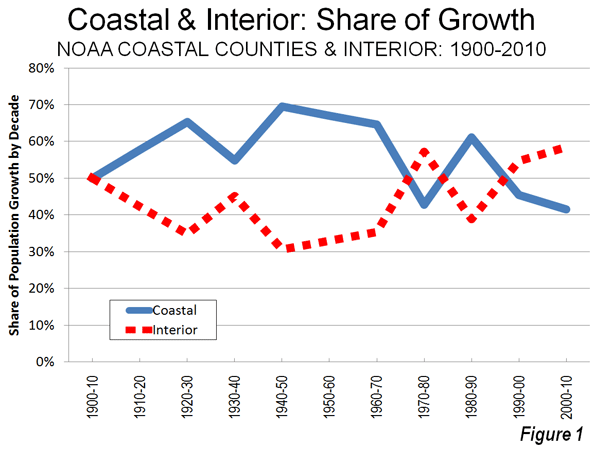
    Population Growth: In fact, coastal counties are not growing faster than the nation as a whole and were not when NOOA issued the 1990s report. For most of the last 40 years, the nation’s interior counties have been adding more population. From 1970 to 2010, interior counties added 55.7 million new residents, compared to 49.7 million new residents in coastal counties. This is a reversal from 1940 to 1970, when two thirds of the nation’s population growth was in the coastal counties.

    The trends today actually have become more favorable for the interior than at any time in a century. From 2000 to 2010, the interior counties captured more of the nation’s growth than in any decade since 1900 (Table). From 2000 to 2010, the interior counties added 16.0 million residents, 59.6 percent of the nation’s growth compared to 11.4 million new residents in the coastal counties.

    Coastal and Interior Population: Counties
    1900-2010
    Coastal Counties Interior Counties United States
    Year Population Share Change Population Share Change Population Change
    1900         30.2 39.7%         46.0 60.3%         76.2
    1910         38.2 41.4%           8.0         54.0 58.6%           8.0         92.2         16.0
    1920         46.2 43.6%           8.0         59.8 56.4%           5.8       106.0         13.8
    1930         57.4 46.6%         11.2         65.8 53.4%           6.0       123.2         17.2
    1940         62.3 47.1%           4.9         69.8 52.9%           4.0       132.2           9.0
    1950         75.2 49.9%         12.9         75.5 50.1%           5.7       150.7         18.5
    1960         94.4 52.6%         19.2         85.0 47.4%           9.5       179.3         28.6
    1970       109.9 54.0%         15.6         93.5 46.0%           8.5       203.4         24.1
    1980       119.8 52.9%           9.9       106.7 47.1%         13.2       226.5         23.2
    1990       133.4 53.6%         13.6       115.3 46.4%           8.6       248.7         22.2
    2000       148.2 52.7%         14.9       133.2 47.3%         17.9       281.4         32.7
    2010       159.6 51.7%         11.4       149.1 48.3%         16.0       308.7         27.3
    Population in Millions
    Calculated from US Census Bureau Data
    Coastal counties designated by NOAA (673 counties)
    Totals may vary due to rounding


    As of 2010, the coastal counties have 51.7 percent of the nation’s population, having dropped from 52.7 percent in 2000 and a peak of 54.0 percent in 1970 (Figure 1). Rather than adding 3600 new people every day, coastal counties added 3100 people per day, while interior counties added 4400 per day during the 2000s. A smaller sample of 559 counties that was examined by economists Jordan Rapaport and Jeffrey Sachs in the early 2000s experienced an even more pronounced movement away from the coasts between 2000 and 2010, with more than 60 percent of the nation’s growth taking place in the interior counties.

    There may also be some concern about density in coastal counties.   Yet Malthusian fears need not grip coastal residents. With a population density of approximately 315 per square mile (120 per square kilometer), the coastal counties of the contiguous United States have only a slightly higher density than the post-enlargement 27-nation European Union. The coastal counties have a density one-half that of Germany. In contrast, the interior counties are far less dense, at 60 persons per square mile.

    There has also been significant change in coastal population trends since the middle 1990s. The largest Pacific Coast metropolitan areas, such as Los Angeles, San Francisco, San Diego, San Jose and Seattle have seen their growth slow considerably. In the 1990s, NOAA was projecting huge population increases for Los Angeles and San Diego counties. It appears likely that these 2015 projections will fall at least 600,000 short in both counties. Even Seattle, arguably the healthiest economically among the west coast metropolitan areas, is now growing more slowly than former laggards Oklahoma City, Indianapolis and Columbus in the interior.

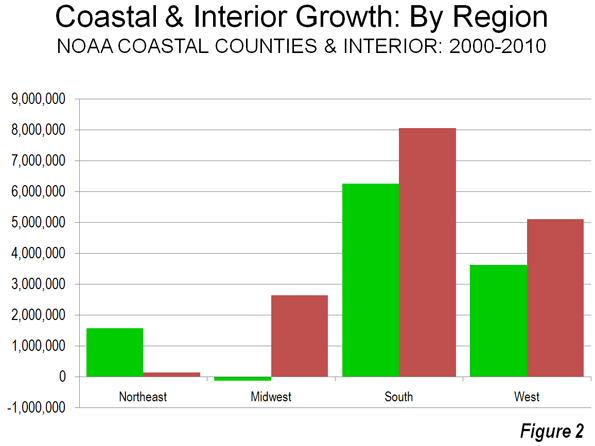
    Regional Population Growth: There was significant variation in growth among the varied regions of the country. In the Northeast, there was much stronger growth on the coast, which added 1.6 million people, compared to a gain of less than 150,000 in the interior. In the Midwest, the coastal counties (along the Great Lakes) lost 120,000 people, while the interior counties gained 2.7 million. In the South, the interior grew more, at 8.1 million, slightly more than 6.3 million in coastal counties.  In the West, interior counties gained 5.1 million people, while the coastal counties gained 3.7 million (Figure 2). This drop in coastal growth was a principal reason why the West grew less quickly than the South, which experienced the most robust coastal growth. For this reason, the West failed to be the nation’s fastest growing region for the first time since 1900.

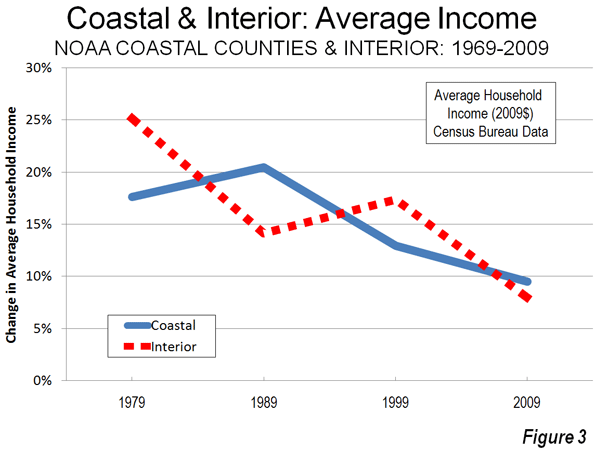
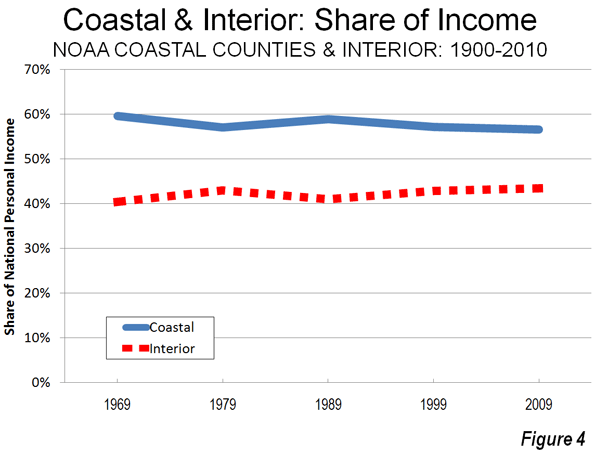
    Personal Income: Rappaport and Sachs noted in their early 2000s work that the density of economic activity was far greater in the coastal counties. Of course this is to be expected, due to their greater population density. However the data with respect to the distribution of personal income is less clear. Since 1969, coastal and interior counties have been alternating leadership in personal income growth per capita. During the 2000s, interior counties experienced average personal income growth slightly less than that of the coastal counties (Figure 3). However, average per capita income since 1970 has risen 81 percent, compared to a lower 75 percent in the coastal counties (adjusted for inflation).  Overall, the share of income in the interior counties has been growing modestly (Figure 4).

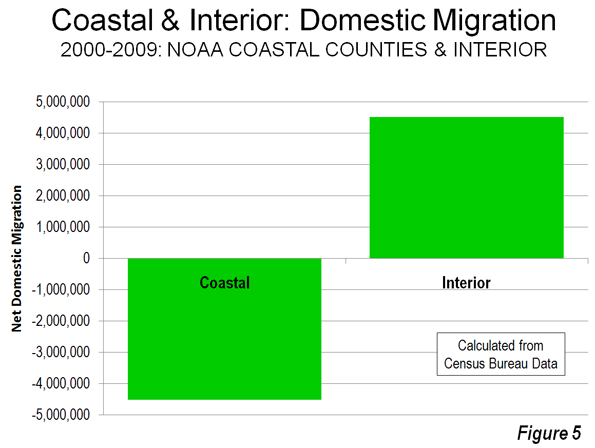
    Domestic Migration: The most important factor in the growth of the interior counties in the 2000s lies with net domestic migration, with more residents moving from the coastal counties to the interior counties. Between 2000 and 2009, 4.5 million people moved to the interior counties, while 4.5 million people moved away from the coastal counties, according to Census Bureau estimates (Figure 5).

    Rappaport and Sachs had theorized that the greater concentration of population and economic activity in the coastal counties could be reflective of a more attractive quality of life. The domestic migration data would suggest that, at least over the last decade, people are opting for the interior, perhaps sensing that the coastal quality of life may not be as affordable and accessible as in the past.  

    Cost of Living: The key here lies with the cost of living, which has become far higher on the coasts then in the interior. The most significant cost of living differences for households are in the cost of housing.   

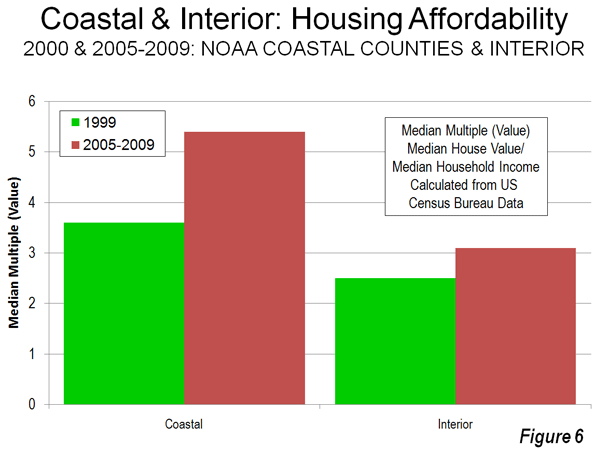
    From 2000 to 2009, housing affordability deteriorated markedly in the coastal counties. Census Bureau data indicates that the Median Multiple (median house founded divided by median household income) rose from 3.6 to 5.4 in the coastal counties (population weighted). By contrast, housing affordability worsened far less in the interior counties, where the Median Multiple rose from 2.5 to 3.1. Thus, the median household saw owned housing increase 22 months worth of income in value in coastal counties, compared to seven months worth of income in interior counties (Figure 6). At the same time, these higher coastal house prices developed as demand for housing was dropping substantially, with 4.5 million people moving away from coastal counties (above).

    Many of the coastal counties have strong land use regulation (smart growth or urban containment regulation), especially in California, Oregon, Washington, Florida and the metropolitan areas of Boston, New York and Washington. A considerable body of research, both econometric and descriptive, has associated more restrictive land use regulation (called smart growth, urban consolidation or urban containment) with higher house price increases, reaching back at least to the seminal 1970s work by Sir Peter Hall and his associates in the United Kingdom. It thus seems likely that the deterioration of housing affordability in coastal counties is materially associated with their less robust growth. The quality of life on the coasts may simply have become too expensive.

    The Future? It is unclear whether the recent higher population growth rates, stronger migration trends and improved economic performance of the interior will continue into the future. The 1940 to 1970 dominance of the coastal counties surged as coastal metropolitan areas, especially in Florida and California, grew much more quickly. Now that pattern has been reversed.  More favorable trends over the past 40 years in the interior counties seem likely continue, unless coastal house prices and the cost of living begin to swing back toward the national norm.

    —-

    Note: Complete county data is at County Coastal Population (also attached to this article)

    Photograph: San Diego, which experienced greater domestic outmigration than Pittsburgh in the 2000s.

  • California Wages War On Single-Family Homes

    In recent years, homeowners have been made to feel a bit like villains rather than the victims of hard times, Wall Street shenanigans and inept regulators. Instead of being praised for braving the elements, suburban homeowners have been made to feel responsible for everything from the Great Recession to obesity to global warming.

    In California, the assault on the house has gained official sanction. Once the heartland of the American dream, the Golden State has begun implementing new planning laws designed to combat global warming. These draconian measures could lead to a ban on the construction of private residences, particularly on the suburban fringe. The new legislation’s goal is to cram future generations of Californians into multi-family apartment buildings, turning them from car-driving suburbanites into strap-hanging urbanistas.

    That’s not what Californians want: Some 71% of adults in the state cite a preference for single-family houses. Furthermore, the vast majority of growth over the past decade has taken place not in high-density urban centers but in lower-density peripheral areas such as Riverside-San Bernardino. Yet popular preferences mean little in a state where environmental zealotry increasingly dictates how people should live their lives.

    Some advocates do cite market forces to justify their policies. Economists on the left and right have cited the recent housing bust as proof that homes are not great investments, suggesting people would be better off leaving their money to the tender mercies of Wall Street speculators. Some demographers also suggest that young people will choose to live in high-density regions throughout their lives and that as boomers age they too will opt out of suburbs for urban apartment living.

    These “facts” may be more grounded in academic mythology than reality. Some widely quoted experts, like the Anderson Forecast at UCLA, cite Census information to say that demographics are shifting demand from single-family homes to condos and apartments, although the Census asked no such question. These experts also fail to address why condo prices have dropped even more in the major California markets than single-family home prices; the percentage of starts that come from single-family houses shifts from year to year, but last year’s number tracks around the same level as seen in the 1980s.

    Perhaps the biggest weakness in the analysis lies with long-term demographic factors. As I wrote last week, many of the “young and restless” folks whom city planners try to court tend to move into suburbs and affordable low-density regions as they grow older and begin starting families. Similarly, the vast majority of boomers, according to AARP, want to remain in their old homes as long as possible. Most of those homes are located in suburban, low- to medium-density neighborhoods.

    But who needs facts when you have religion? Take the Association of Bay Area Governments (ABAG) and Metropolitan Transit Commission’s (MTC) new “sustainable communities strategy,” a document designed to meet the requirements of the state’s draconian anti-greenhouse gas legislation.

    This “strategy” seeks to all but reduce growth in the region’s lower-density outer fringe – eastern Contra Costa County as well as the Napa, Vallejo and Santa Rosa metropolitan areas — which grew more than twice as fast as the core and inner suburbs. Instead the ABAG-MTC projects a soaring increase in demand for high-density housing and its latest “vision” report calls for 97% of all the region’s future housing be built in urban areas, virtually all of it multi-family apartments, to accommodate an estimated 2 million residents

    The projections underpinning ABAG’s strategy are absurd. Over the past decade the population of the region’s historic core cites San Francisco and Oakland — where much of the dense growth would be expected to take place — increased by 1.7%, compared with 6.5% for the suburbs. Overall regional growth stood at a modest 5.1%, roughly half that of the previous decade and just about half of the national and state averages.

    Given this record, a more reasonable assumption would be population growth at something closer to 1 million, half the projected amount. Assumptions about the economy to support even this growth are also dubious. The ABAG report, for example, fantasizes that by 2030 the Bay Area will increase its employment by 900,000 — a neat trick for an area that overall lost 300,000 positions over the past decade.

    So, why wage war on the house? Some greens seem to regard the single-family house as an assault on eco-consciousness. Yet in many cases, these objections are overstated. Research supporting higher-density housing , for example, has routinely excluded the greater emissions from construction material extraction and production, building construction itself and& greenhouse gas emissions from common areas like parking levels, entrances and elevators.

    Further, higher densities are associated with greater congestion, which retards fuel efficiency and increases greenhouse gas emissions, a factor not sufficiently considered. Given that less than 10% of Bay Area residents take transit — and barely 3% in its economic engine Silicon Valley — higher density likely would create greater, not fewer, emissions.

    The ABAG report also studiously avoids mentioning the potential greenhouse gas reductions to be had by expanding telecommuting, which is growing six times faster than the fervently pushed transit commuting in the region. The Silicon Valley already has 25% more telecommuters than transit users. Clearly, by pushing telecommuting, you could get big reductions in GHG without a “cramming” agenda.

    Ultimately the density agenda reflects less a credible strategy to reduce GHG than a push among planners to “force” Californians, as one explained to me, out of their homes and into apartments. In pursuit of their “cramming” agenda planners have also enlisted powerful allies – or perhaps better understood as ”useful idiots” — developers and speculators who see profit in the eradication of the single family by forcibly boosting the value of urban core properties.

    In the end, however, substituting religion for markets and people’s preferences is counterproductive. For one thing, people “forced” to live densely will find other places to live the way they like — even if it means leaving California. This is already happening to middle class families in places like San Francisco and may soon be true of California’s traditionally middle-class-friendly interior as well.

    In the end, two markets are likely to grow in the Bay Area. One is low-end rental housing for students and an expanding servant class — after all Google millionaires need people to walk their dogs and paint their toenails. The other is luxury retirement facilities for the region’s growing population of aging affluents. Once a self-consciously “cool” youth magnet, Marin County, for example, is now one of the country’s oldest urban counties, with a median age of 44.5; San Francisco is headed in the same direction.

    Developers can drool over the prospects of building high-end assisted living joints for all those aging hippies who made their bundle during the state’s glory days and settled into places like Mill Valley. After all, unlike young families, these affluent oldsters will be able to afford indulging in the state’s mild climate, natural food restaurants and brilliant scenery. And with easily accessible medical marijuana and a good sound system for playing Grateful Dead recordings, the gray-ponytail set could be in for a hell of a good time, at least as long as it lasts.

    This piece originally appeared at Forbes.com.

    Joel Kotkin is executive editor of NewGeography.com and is a distinguished presidential fellow in urban futures at Chapman University, and an adjunct fellow of the Legatum Institute in London. He is author of The City: A Global History. His newest book is The Next Hundred Million: America in 2050, released in February, 2010.

    Photo by Mike Behnken

  • The New State of Coastal California?

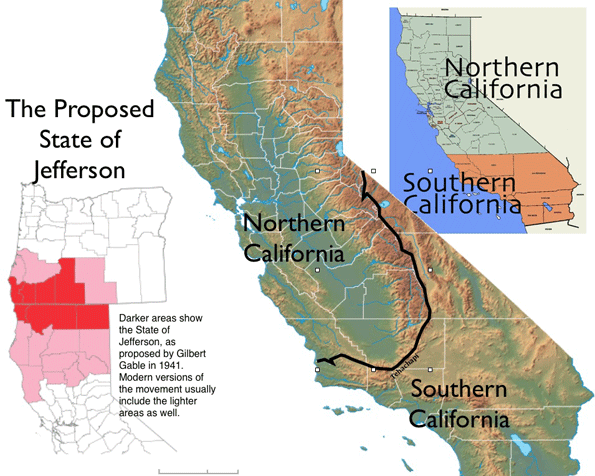
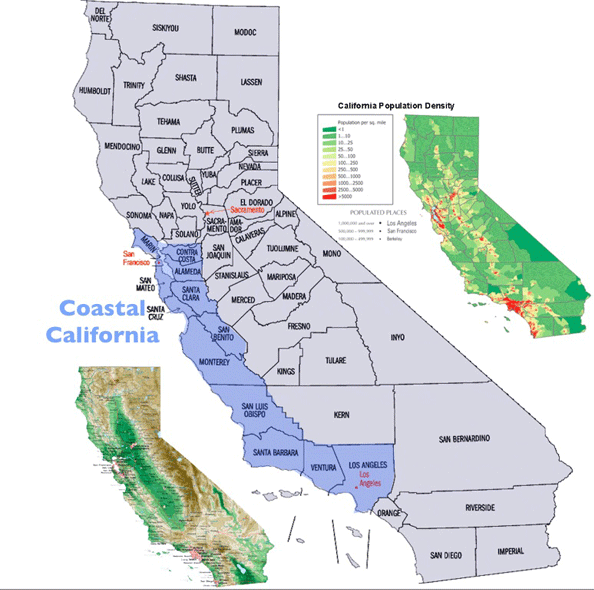
    In 2009, former California legislator Bill Maze proposed dividing his state, hiving off thirteen counties as Coastal (or Western) California (see map). Maze, a conservative from the agricultural Central Valley, objects to the domination of state politics by the left-leaning Los Angeles and San Francisco metropolitan areas. The initial impetus for his proposal was the passage by state voters in 2008 of Proposition 2, requiring larger pens and cages for farm animals. Agricultural interests denounced the measure, arguing that it would increase their costs and threaten their livelihoods. Meanwhile, the state’s on-going water crisis, which largely pits farmers against environmentalists, widens the divide. Unforgiving invective marks both sides of the debate. A post in Politics Daily characterized secessionist farmers as dolts fighting against “liberal Hollywood types [who] don’t understand the importance of torturing animals.” The Downsize California website, on the other side, fulminates against coastal “radicals” who are “infatuated with nature over mankind and are sympathetic to illegals and criminals.”

    The desire to divide unwieldy California may be quixotic but it is nothing new; at least 27 divisional schemes have been proposed since statehood in 1850. Most have sought to split the state along north-south lines. In the mid 1800s, southern California secessionists felt marginalized and ill-served by a state government based in the distant Sacramento. By the mid 1900s, the tables had been turned, as northern Californians came to resent the demographically and economically dominant greater Los Angeles (LA) area. The California State Water Project, with its vast pipes snaking over the Tehachapi Mountains, was a particular irritant. As a child growing up in northern California’s Bay Area in the 1960s, I almost never heard positive statements about LA, which was widely condemned as a vast suburban wasteland inhabited by shallow people scheming to “steal our water.” Such naked regional bigotry was spouted by people who would have been ashamed to say anything remotely smacking of racial or religious prejudice.

    Economic and political evolution, coupled with substantial immigration and emigration, gradually reduced the tensions between the Los Angeles and San Francisco metropolitan areas while accentuating the division between urban coastal and interior agricultural regions. But as the 2004 “voter index map” reproduced above shows, the state’s actual political divide is far more complex than that. Close inspection reveals a Democratic voting zone essentially split between coastal northern California and the Los Angeles area, with a few interior outliers in college towns, urban cores, Hispanic rural areas, and mountainous recreation sites. Contrasting to this area is a spatially larger and more contiguous but demographically smaller Republican-voting block covering the rest of the state.

    Maze’s scheme places several relatively conservative countries (Ventura, San Luis Obispo) in liberal Coastal California, doing so largely for reasons of geographical contiguity. Less explicable is his exclusion of the left-voting northern coastal countries of Sonoma, Mendocino, and Humboldt. These may be relatively rural counties, but where the main crops are wine grapes and marijuana one should not expect conservative voting patterns. Note that certainly highly rural and relatively remote regions have solidly left electoral records, an unusual pattern. These include the Big Sur coast in Monterrey County, with its artistic heritage, and the counter-cultural “hippy” centers of Mendocino and southern Humboldt counties, such as Willits and Garberville.

    Martin W. Lewis has taught college-level geography for 20 years, and is currently a senior lecturer at Stanford University. He is a co-author on two leading textbooks in world geography, Diversity Amid Globalization and Globalization and Diversity. He is also the author of Green Delusions: An Environmentalist Critique of Radical Environmentalism, and Wagering the Land: Ritual, Capital, and Environmental Degradation in the Cordillera of Northern Luzon, and is co-author of The Myth of Continents.

  • Growing a Productive Urban Economy

    Suggestions that we can grow the Auckland, NZ economy by encouraging business into the central business district (CBD) in the interests of innovation do not reflect the weight of experience.  Sure, higher order professions have tended to concentrate there, and become relatively more important as manufacturing, retailing, and distribution have decamped.  And in Auckland, at least, tertiary education has become a major player in the CBD.  University employment has boosted the scientific as well as education sector.

    But much as introductions might be made and ideas swapped over coffee, the real capacity to bring innovation to fruition belongs in the workshops, laboratories, production lines, and sales office of real companies. 

    Obvious as it may seem, we need more – and bigger – businesses to lead the way if Auckland is to grow through innovation and the resulting productivity gains.  This blog is about why this is so and how we might help.

    Firm growth and local linkages

    The argument reflects a long-standing interest in industry, but the principles also apply to things like financial services, software, and design. 

    My most compelling experience is dated.  In the seventies I visited 120 firms in the emergent electronics industry in inner London (the heart of creativity according to the density gurus), outer London, and central Scotland.  What I learnt then still seems relevant today.

    I wanted to know how businesses in different localities grow.  I examined where they made their purchases and where their markets were.  I was particularly interested in how much they depended on the local area to sustain their growth.

    The results were no surprise: the more successful firms depended least on their local area.  As higher value, higher growth firms expanded, though, they did strengthen reliance on their local workforce.  Critical local skills became embedded even as businesses became international in scope.  A commitment to and dependence on an established workforce became a key to maintaining the presence of innovative or high tech firms in an area.  This experience still rings true when we think about firms like Fisher and Paykel, Glidepath, and Rakon in Auckland today.

    Growth firms are nevertheless highly likely to invest away from their home base.  By itself that’s no bad thing.  It may be the beginning of the end, though, if they cannot raise the finance locally.  As the weight of their equity shifts offshore, so their local presence becomes more tenuous.

    The best outcome is probably when innovative and growing firms can be supported locally, generating local jobs, deepening local skills, and building local household and business income even as their business with the rest of the world grows.

    And that’s where we seem to struggle in Auckland, despite some exceptions.  As firms succeed here they often cannot find the resources they need to grow and maintain their local roots. 

    Relocating to grow

    The companies I analysed all those years ago more or less sorted themselves out.  In Inner London there were still a few post-war innovators beavering away.  For the most part these had not grown much.  The real inner London success stories, the firms that had prospered, were largely gone.  They may have kept an office in the city but R & D, production, and distribution had moved elsewhere.

    Elsewhere was outer London, or the new towns, villages, and cities in southeast England.  This included a world-leading electronics belt centered on Reading, an hour from the City of London. 

    A key step in firm growth is the ability to relocate from small start-up premises.  Consequently, localities away from congested inner cities were where the real innovation was taking place.

    The new firm nurseries

    Where do new companies come from in the first instance?  It’s not coffee shops in the CBD and there aren’t too many enduring ideas sketched on beer coasters in inner city pubs.  Some – the exceptions – may be born of enthusiasts working in garages. 

    Most new firms I found in the UK research were outside London.  Many had spun-off established companies.  This suggested one key to innovation: knowledgeable employees leaving firms to do it their way.  Often they spied opportunities in their former employment that the established business could not exploit – new processes or materials, new products or applications, or new markets. 

    In some cases, existing businesses spun off their own new enterprises to exploit new opportunities outside existing operations. 

    The rise of innovative, growth firms in low density areas outside London was hardly surprising.  Space was affordable, whether a start-up factory unit or land or premises for expansion.  Firms could attract staff because the living and commuting was easy.  Compared with London, costs were favourable.  And when they relocated, firms tried to go where key staff could easily follow.

    Later – in the late eighties – I visited the Cambridge Technology Park some 90 minutes north of London.  This was a highly successful centre of innovation and investment.  A low density environment attracted innovative light industry to easily accessed sites on the fringes of a provincial city –itself a university centre – set in an attractive living environment. 

    The dynamics behind Silicon Valley near San Francisco were similar.  Leading edge firms here have continued to spin off imitators and innovators in an area with room to expand and access to great living conditions.  Again, a key university, Stanford, is a contributor to ongoing success and business vitality.

    The ingredients of a dynamic economy

    This, then, is another key to a dynamic economy: the capacity of larger, older firms (and other institutions) to create the seed bed from which the new ones grow and expand in a continuous process of industry evolution – birth, growth, decline, and death. 

    As a variation aside, the process of firm evolution today includes the take over and reconfiguration of the old and tired.  Under-performing businesses are acquired and their assets rationalised, potentially renewing creative energy.  Leaner businesses may result, with new capital, a new sense of direction, and more vigorous management. 

    (Of course, a takeover may also be a financial play, with assets stripped, pumped, and packaged for a share market float, with precious little value added).

    We need the places — and space — where old firms can operate without incurring endlessly increasing costs, growth firms can expand, and new firms come into being.  What we cannot expect to do is conjure new enterprise out of an entrepreneurial vacuum.  And we definitely shouldn’t seek to straitjacket new firms and old within an inner city environment.

    What can we do?

    One reason for Auckland’s under-performance may be that our planning has acted inadvertently against sustained business renewal and growth.  Plans have may have over-focused on the inner city.  Planners have concentrated on how and where we can live and failed to plan for where we might work.  We dragged our feet in the zoning of substantial areas of affordable business land.  As a result, we have pushed up the cost and pushed down the appeal of Auckland as a place for growing firms. 

    One simple thing we could do is make sure that there is plenty of industrial land available.  This should be well connected, preferably removed from the congestion of inner Auckland.  There are a few good opportunities on the books of the council at the moment.  Large parcels at Silverdale, Massey North, Drury, and Pokeno are in various stages of planning, for example.  Bringing these plans to fruition will lift the prospect of Auckland participating in a productivity-led recovery.  Tying the areas together – and to the ports and airport – through the motorway system will provide the connections they need locally and internationally. 

    There are other issues to be addressed.  We could do with a focus in education on the skills, culture, and aptitude to make things happen.  Our universities must continue to connect individually and jointly with diverse vocational needs across the business board.  And let’s continue to explore how to attract capital to invest in expanding firms within the region.

    I am not assuming we can compete with the cheap land and labour of Asia, or match the host of engineers that Asian universities turn out each year.  But when people with the right skills and background do come along, let’s ensure that they encounter an environment that supports entrepreneurship and growth, and not leave them doodling and dreaming in inner city coffee shops.  And let’s do what we can to make sure that leaving town is no longer the mark of a successful firm.

    Phil McDermott is a Director of CityScope Consultants in Auckland, New Zealand, and Adjunct Professor of Regional and Urban Development at Auckland University of Technology.  He works in urban, economic and transport development throughout New Zealand and in Australia, Asia, and the Pacific.  He was formerly Head of the School of Resource and Environmental Planning at Massey University and General Manager of the Centre for Asia Pacific Aviation in Sydney. This piece originally appeared at is blog: Cities Matter.

    Photo by man’s pic

  • Outlawing New Houses in California

    UCLA’s most recent Anderson Forecast indicates that there has been a significant shift in demand in California toward condominiums and apartments. The Anderson Forecast concludes that this will cause problems, such as slower growth in construction employment because building multi-unit dwellings creates less employment than building the detached houses that predominate throughout California and most of the nation. The Anderson Forecast says that this will hurt inland areas (such as the Riverside-San Bernardino area and the San Joaquin Valley) because their economies are more dependent on construction than coastal areas, such as Los Angeles, the San Francisco Bay Area and San Diego.

    Detached Housing Permits Remain Strong in the Historic Context: The Anderson Forecast reports that multi-unit building permits have recovered more quickly than building permits for detached housing. However, any such shift is likely to be highly volatile. Since the peak of the bubble, the distribution of building permits between detached and multi-unit in California has been on a roller coaster. Indeed the Anderson Forecast characterizes the "2010 US Census" as "showing a significant shift in demand toward condominiums and apartments." Actually, the 2010 US Census asked no question from which such a conclusion about housing types or any question from which such a conclusion could be drawn.

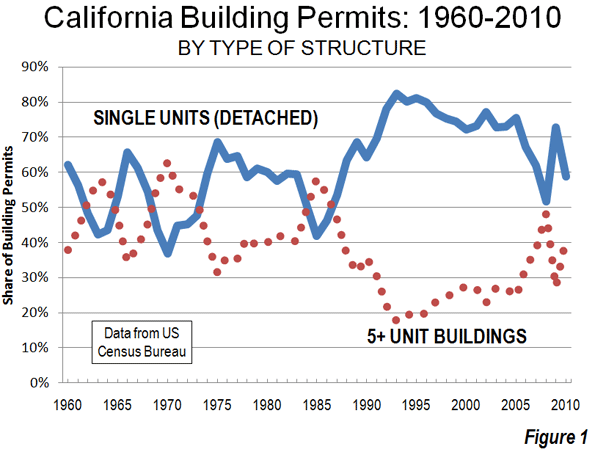
    The trends in the building permit data are not completely clear. In 2005, the year before prices started to collapse, 75 percent of building permits in California were for detached housing. This trended downward, reaching a low of 52 percent in 2008. In 2009, the detached housing recovered to account for 73 percent of all housing building permits. Then the figure fell back to 59 percent in 2010.

    With these erratic trends, it is tricky to forecast longer term market trends and consumer demand.  Economic projections in 1934 would have suffered from a similar problem, as the Great Depression was continuing and no one could really tell when it would end. Today’s continuing housing depression may be similar.

    Moreover, as the Anderson Forecast notes, detached housing construction declined in the early 1980s, dropping to 42 percent in 1985. In fact, over the 25 years between 1960 and 1985, detached houses accounted for an average of only 54 percent of new housing construction in California, well below the 2010 figure of 59 percent (Figure 1).

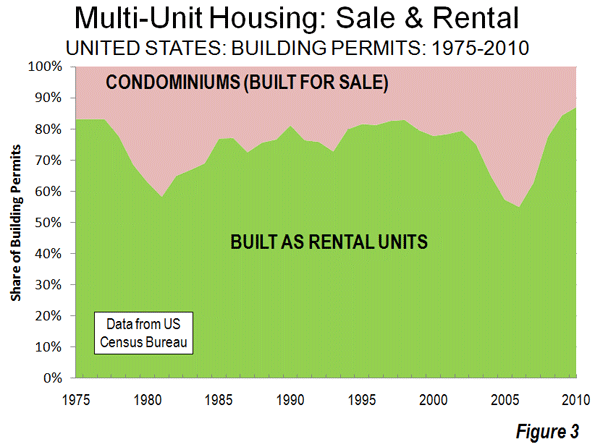
    Equally important, the condominium market remains in a deep depression. In 2010, less than four percent of houses built for sale in the United States were multi-unit buildings, including condominiums (Figure 2), as an increasing majority of multi-unit buildings have been built as rentals (Figure 3). Comparable California data is not available, but from the peak of the bubble (2006/7) to 2009, there was a loss of more than 3,000 owner occupied  multi-unit dwellings with 10 or more units, while owner occupied detached houses increased by nearly 100,000 (Note 1).

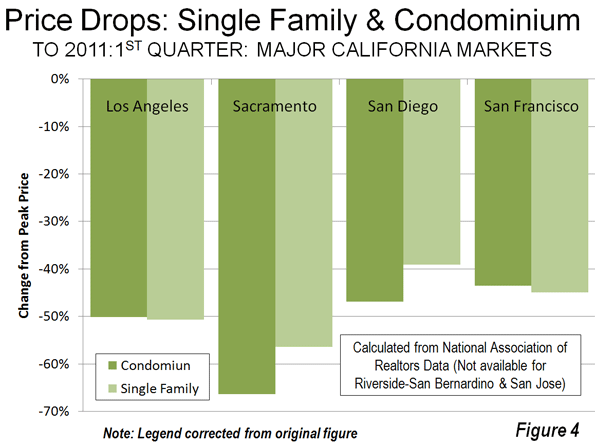
    If there is an intrinsic pent-up preference for condominium living, it is not evident in the poor performance of high-density developments even in such theoretically desirable places as Santa Monica, San Francisco, Oakland, San Jose and North Hollywood. Condominium prices, for example, have fallen 52 percent in the major California metropolitan areas, compared to 48 percent for single-family houses (Figure 4). Naïve developers, relying too much on the much promoted notion that suburban empty-nesters were chomping at the bit to move to new housing in the core area, often watched their empty units liquidated at $0.50 or less on the dollar or turned into rentals.  Further, if people are moving to apartments, it’s not for love of density but more likely due weakening economic circumstances.

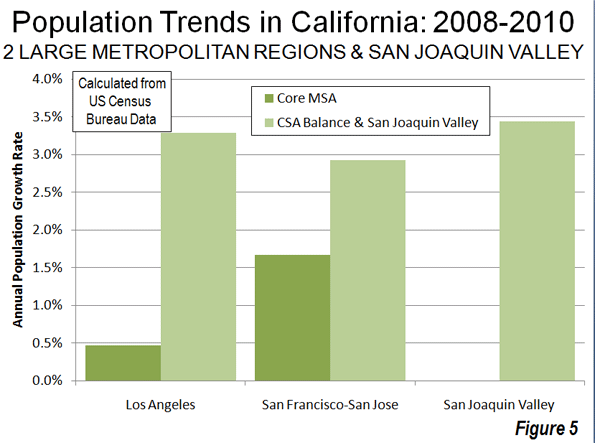
    Inland California Continues to Grow Faster: The Anderson Forecast also suggests that growth in interior California will suffer because "workers are less likely to move inland into an apartment and commute toward the coast." This assumption of slower inland growth reflects the conventional wisdom that areas outside the large coastal metropolitan areas have stopped growing since the burst of the housing bubble as people flock towards the coastal urban core (Note 2). The reality is different, as interior California and the peripheral metropolitan areas of the larger metropolitan regions (Note 3) continue to grow more strongly even in bad economic times. After the burst of the bubble, from 2008 to 2010 (Figure 5):

    • In the Los Angeles area, the adjacent Riverside-San Bernardino ("Inland Empire") and Oxnard metropolitan areas, combined, have grown at seven times the rate of the core Los Angeles metropolitan area.
    • In the San Francisco Bay area, the adjacent Napa, Santa Cruz, Santa Rosa and Vallejo metropolitan areas, combined, have grown nearly twice as quickly as the core San Francisco and San Jose metropolitan areas.
    • California’s deep interior, the San Joaquin Valley has grown even faster than the exurban areas of Los Angeles and San Francisco.

    One key reason: most people who move to interior areas do not commute toward the core.  For example, less than 10 percent of workers in the Riverside-San Bernardino metropolitan area commute into Los Angeles County, a market share that declined 15 percent between 2000 and 2007. Many also simply cannot afford the higher cost of living in the coastal metropolitan areas, which likely will continue to retard growth in the core metropolitan areas.

    The Policy Threat to New Houses : A survey by the Public Policy Institute of California suggests a vast preference (70%) for detached housing among the state’s consumers.  This continuing preference is demonstrated by detached housing prices that are generally two times historic norms relative to incomes in the coastal metropolitan areas (Los Angeles, San Francisco, San Diego and San Jose).

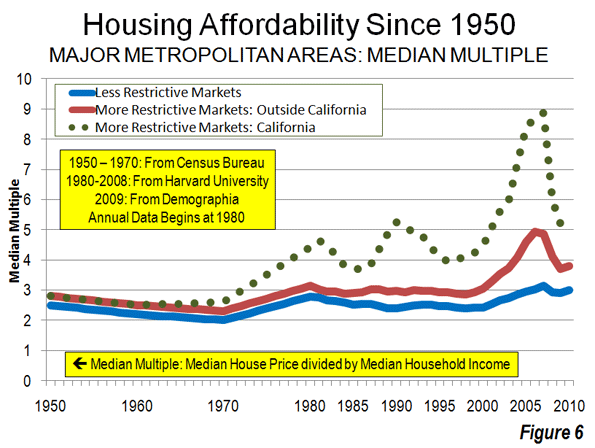
    Yet now, this choice is under a concerted assault by both the state and many local governments, cheered on by most media and the academic community.  For years, planning regulations have driven land prices so high that house prices have risen to well above the rest of the nation (Figure 5) under regulations referred to by terms such as "smart growth" and "urban containment." The regulations and the inevitably resulting speculation propelled a disproportionate rise (nearly $2 trillion) in California house prices compared to national norm. If California house prices had risen at the same rate relative to incomes as in more liberally regulated areas, the loss to financial markets could have been hundreds of billions of dollars less when the bubble burst (Figure 6).

    Planning for Crowding and Density: California’s assault on detached housing is taking on a distinctly religious fervor.  The state’s global warming law (Assembly Bill 32) and urban planning law (Senate Bill 375) is providing a new basis to impose draconian limits on the construction of detached housing. For example, in the San Francisco Bay area, it has been proposed that 97 percent of new housing be built within the existing urban footprint. That would mean an emphasis on multi-unit housing and little or no new housing on the urban fringe. The option of a single family home will be all but non-existent for   even solidly middle income Californians.

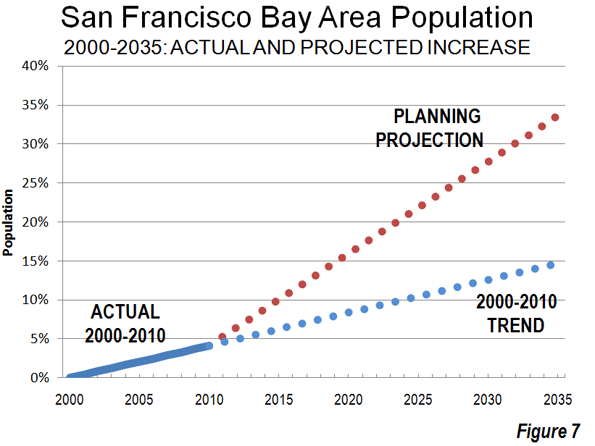
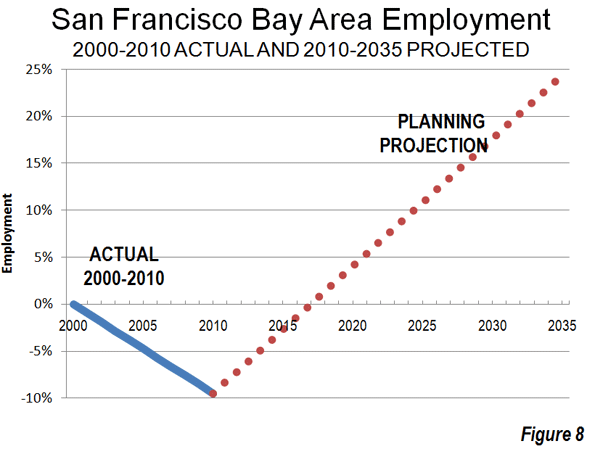
    Planning authorities in the Bay Area seem oblivious to the fact that destroying affordability also destroys growth, already evident by the state’s poor economic performance and ebbing demographic vigor.    Planners rosily project 2 million more people between 2010 and 2035 in the San Francisco Bay area. The growth rate over the past 10 years suggests a number less than half that (Figure 7) and given the rapid aging of the area, even this estimate may be too high. The planners also project more than 1.2 million   new jobs, something difficult to believe given the more than 300,000 job loss (Note 4) that occurred in the Bay Area between 2000 and 2010 (Figure 8).

    The Environmental "Fig Leaf:" The environmental justification for these policies is fragile . Research supporting higher density housing has routinely excluded the greater emissions from construction material extraction and production, building construction itself and common greenhouse gas emissions from energy consumption that does not appear on consumer bills. Further, higher densities are associated slower and more erratic speeds, which retards fuel efficiency and increases greenhouse gas emissions, a factor not sufficiently considered.

    The report seems to ignore any other options besides rapid densification, which as McKinsey Global Institute has pointed out is not at all necessary to reduce GHG emission reductions. They point to other factors as more fuel efficient cars.   

    Oddly, the San Francisco Bay Area proposal does not even mention working at home (much of it telecommuting), the most environmentally friendly way of accessing employment. Working at home has grown six times the rate of transit since 2000 in the Bay Area.

    Outlawing New Houses Detached housing remains the overwhelming choice of Californians. There is no indication that this preference is about to be replaced by a preference for high-density housing.  Current and future middle class Californians could be corralled into more crowded conditions, because questionable planning doctrines mandate that detached housing should be outlawed.

    —-

    Notes:

    1. Calculated from 2006, 2007 and 2009 American Community Survey data. The over ten unit category is used because is more generally reflective of the dense condominium development generally favored by densification advocates (Latest data available).

    2.  Another questionable tenet of conventional wisdom is that the price declines in the outer suburbs were greater than in the cores. When the price declines reached their nadir, core California markets were generally at least as depressed from their peak prices as suburban markets.

    3. Metropolitan region refers to combined statistical areas, which have a core metropolitan area, such as the Los Angeles MSA and include surrounding metropolitan areas, such as the Riverside-San Bernardino MSA and the Oxnard MSA.

    4. Annual, 2000 to 2010, calculated from California Economic Development Department data.

    Lead photo: Houses in Los Angeles. Photograph by author.

    Wendell Cox is a Visiting Professor, Conservatoire National des Arts et Metiers, Paris and the author of “War on the Dream: How Anti-Sprawl Policy Threatens the Quality of Life

  • California’s Green Jihad

    Ideas matter, particularly when colored by religious fanaticism, wreaking havoc even in the most favored of places. Take, for instance, Iran, a country blessed with a rich heritage and enormous physical and human resources, but which, thanks to its theocratic regime, is largely an economic basket case and rogue state.

    Then there’s California, rich in everything from oil and food to international trade and technology, but still skimming along the bottom of the national economy. The state’s unemployment rate is now worse than Michigan’s and ahead only of neighboring Nevada.  Among the nation’s 20 largest metropolitan regions, four of the six with the highest unemployment numbers are located in the Golden State: Riverside, Los Angeles, San Diego and San Francisco. In a recent Forbes survey, California was home to six of the ten regions where the economy is poised to get worse.

    One would think, given these gory details, California officials would be focused on reversing the state’s performance. But here, as in Iran, officialdom focuses more on theology than on actuality.   Of course, California’s religion rests not on conventional divinity but on a secular environmental faith that nevertheless exhibits the intrusive and unbending character of radical religion.

    As with its Iranian counterpart, California’s green theology often leads to illogical economic and political decisions. California has decided, for example,  to impose a rigid regime of state-directed planning related to global warming, making a difficult approval process for new development even more onerous.  It has doubled-down on climate change as other surrounding western states — such as Nevada, Utah and Arizona — have opted out of regional greenhouse gas agreements.

    The notion that a state economy — particularly one that has lost over 1.15 million jobs in the past decade — can impose draconian regulations beyond those of their more affluent neighbors, or the country, would seem almost absurd.

    Californians are learning what ideological extremism can do to an economy. In the Islamic Republic, crazy theology leads to misallocating resources to support repression at home and terrorism abroad. In California green zealots compel companies to shift their operations to states that are still interested in growing their economy — like Texas. The green regime is one reason why CEO Magazine has ranked California the worst business climate in the nation.

    Some of these green policies often offer dubious benefits for the environment. For one thing, forcing California businesses to move to less energy-efficient states, or to developing countries like China, could have a negative impact overall since shifting production to Texas or China might lead to higher greenhouse gas production given California’s generally milder climate.   A depressed economy also threatens many worthy environmental programs, delaying necessary purchases of open space and forcing the closure of parks. These programs enhance life for the middle and working classes without damaging the overall econmy.

    But people involved in the tangible, directly carbon-consuming parts of the economy — manufacturing, warehousing, energy and, most important, agriculture — are those who bear   the brunt of the green jihad. Farming has long been a field dominated by California, yet environmentalist pressures for cutbacks in agricultural water supplies have turned a quarter million acres of prime Central Valley farmland fallow, creating mass unemployment in many communities.

    “California cannot have it both ways, a desire for economic growth yet still overregulating in the areas of labor, water, environment,” notes Dennis Donahue, a Democrat and mayor of Salinas, a large agricultural community south of San Jose. Himself a grower, Donahue sees agricultural in California being undermined by ever-tightening regulations, which have led some to expand their operations to other sections of the country, Mexico and even further afield.

    Other key blue collar industries are also threatened, from international trade to manufacturing. Since before the recession California manufacturing has been on a decline.  Los Angeles, still the nation’s largest industrial area, has lost a remarkable one-fifth of its manufacturing employment since 2005.

    California’s ultra-aggressive greenhouse gas laws will further the industrial exodus out of the state and further impoverish Californians.  Grandiose plans to increase the percentage of renewable energy in the state from the current unworkable 20% to 33% by 2020 will boost the state’s electricity costs, already among the highest in the nation, and could push the average Californian’s bill up a additional 20%.

    Ironically California, still the nation’s third largest oil producer, should be riding the rise in commodity prices, but the state’s green politicians seem determined to drive this sector out of the state.. In Richmond, east of San Francisco, onerous regulations pushed by a new Green-led city administration may drive a huge Chevron refinery, a major employer for blue collar workers, out of the city entirely. Roughly a thousand jobs are at stake, according to Chevron’s CEO, who also questioned whether the company would continue to make other investments inside the state.

    Being essentially a religion, the green regime answers its critics with a well-developed mythology about how these policies can be implemented without economic distress.  One common delusion in Sacramento holds that the state’s vaunted “creative” economy — evidenced by the current bubble over   surrounding social media firms — will make up for any green-generated job losses.

    In reality the creative economy simply cannot  make up for losses in more tangible industries. Over the past decade, as the world digitized, the San Jose area experienced one of the stiffest drops in employment of any of the 50 largest regions of the country; its 18% decline was second only to Detroit.  Much of the decline was in manufacturing and services, but tech employment has generally suffered. Over the past decade California’s number of workers in science, technology, engineering and math-related fields actually shrank. In contrast, the country’s ranks of such workers expanded 2.3% and prime competitors such as Texas , Washington and Virginia enjoyed double-digit growth.

    So who really benefits from the green jihad? To date,  the primary winners have been crony capitalists, like President Obama’s newly proposed commerce secretary, John Bryson, who built a fantastically lucrative  career (he was once named Forbes’  “worst valued chief executive”) while  running the regulated utility Edison International. A lawyer by training, Bryson helped found the green powerhouse National Resources Defense Council. He’s been keen to promote strict  renewable energy  standards  that also happen to benefit solar power and electric car companies in which he holds large financial stakes.

    Other putative winners would be large international companies, like Siemens, that hope to build California’s proposed high-speed rail line, the one big state construction project favored by the green-crony capitalist alliance. Fortunately , the states dismal fiscal situation and  rising cost estimates for the project, from $42 to as high as $67 billion, as well as cuts in federal subsidies, are undermining support for this project even among some liberal Democrats.  Even in a theocracy, reality does, at times, intrude.

    Finally, there are the lawyers — lots of them. A hyper-regulatory state requires legal services just like a theocracy needs mobs of mullahs and bare knuckled religious enforcers. No surprise the number of lawyers in California increased by almost a quarter last decade, notes Sara Randazzo of the Daily Journal. That’s two and a half times the rate of population growth.

    The legal boom has been most exuberant along the affluent coast.  Over the past decade, the epicenter of the green jihad, San Francisco, the number of practicing attorneys increased by 17%, five times the rate of the city’s population increase. In the Silicon Valley, Santa Clara and San Mateo counties boosted their number of lawyers at a similar rate. In contrast, lawyer growth rate in interior counties has generally been far slower, often a small fraction of their overall population growth.

    If California is to work again for those outside the yammering classes, some sort of realignment with economic reality needs to take place.  Unlike Iran, California does not need a regime change, just a shift in mindset that would jibe with the realities of global competition and the needs of the middle class. But at least with California we won’t have to worry too much about national security: Given the greens anti-nuke proclivities, it’s unlucky the state will be developing a bomb in the near future.

    This piece originally appeared at Forbes.com.

    Joel Kotkin is executive editor of NewGeography.com and is a distinguished presidential fellow in urban futures at Chapman University, and an adjunct fellow of the Legatum Institute in London. He is author of The City: A Global History. His newest book is The Next Hundred Million: America in 2050, released in February, 2010.

    Photo by msun523

  • Is The Information Industry Reviving Economies?

    For nearly a generation, the information sector, which comprises everything from media and data processing to internet-related businesses, has been ballyhooed as a key driver for both national and regional economic growth. In the 1990s economist Michael Mandell predicted cutting-edge industries like high-tech would create 2.8 million new jobs over 10 years.  This turned out to be something of a pipe dream. According to a recent 2010 New America Foundation report, the information industry shed 68,000 jobs in the past decade.

    Yet this year, information-related employment finally appears to be on the upswing, according to statistics compiled by Pepperdine University economist Michael Shires. The impact of this growth is particularly marked in such long-time tech hot beds as Huntsville, Ala., Madison, Wis., and San Jose-Sunnyvale-Santa Clara, Calif., in the heart of Silicon Valley, all of which have relatively high concentrations of such jobs.

    The San Jose area, home of Silicon Valley, arguably has benefited the most from the  information job surge. Much of this gain can be traced to the increase in social networking sites such as Facebook, LinkedIn and Twitter, all of which have been incubated in the Valley. Good times among corporations  have led many to invest heavily in software productivity tools, while those marketing consumer goods have boosted spending for software and internet-related advertising.

    The 5,000 mostly well-paying information jobs added this year was enough to boost San Jose’s standing overall among all big metros 20 places to a healthy No. 27 in our ranking of the best cities for jobs.

    But as economists enthuse over the tech surge, we need to note the limitations of information jobs even in the Valley. Software and internet jobs, which have increased 40% over the past decade, have not come close to making up for the region’s large declines in other fields, notably manufacturing, construction, business and financial services. Overall, the region has lost 18% of its jobs in the past decade — about 190,000 — the second-worst performance, after Detroit, among the nation’s largest metros. It still suffers unemployment of close to 10%, well above the national average of 9.0%.

    This dual reality can also be seen in the local real estate industry. Office vacancies may be back in the low single digits in some markets popular with social networking firms, such as Mountain View, but they remain around 14 or higher throughout the region — 40% higher than in 2008. No matter how impressive reporters find a new headquarters for high-fliers like Facebook, the surplus of redundant space, particularly in the southern parts of the Valley, suggest we are still far from a 1990s style boom.

    Some observers also warn that the long-term prospects for the Valley may not be as good as local boosters assume.  Analyst Tamara Carleton cites many long-term factors — like the financial condition of local cities and diminishing prospects for less skilled workers — that make it tougher on those who live below the higher elevations of the information economy. She also says that a precipitous decline in foreign immigration could slow future innovation.

    This dichotomy is even more evident in the other big information gainer among our large cities, Los Angeles. Although it is little known by the media or pundit class, the Big Orange actually boasts the nation’s single largest number of information jobs. Its over 5% growth in information jobs translates to roughly 10,000 new positions over the past year. In LA, the big sector for information jobs is likely not social media but traditional entertainment, one of the area’s core industries.

    Yet information growth clearly is not bailing out the overall economy. Other much larger sectors, such as manufacturing and business services, continue to shrink. The area still suffers from an unemployment rate of roughly 12%.

    Other information winners among our large metros include Boston and Seattle, both traditional centers for software-related jobs. These areas have not been as hard-hit by the real estate and industrial declines as their California counterparts, so increasing information employment does not constitute the outlier that we see in the Golden State.

    Less expected gains were notched by some of our other big information sector winners. One big surprise was New Orleans-Metairie-Kenner, whose information sector, including a growing film and television industry, expanded almost 39% in past year. As is the case with its strong overall rankings in our best cities survey, the Big Easy’s comeback from the devastation of Katrina is heartening. But we must curb our enthusiasm by pointing out that total regional employment remains 100,000 less than it was before the hurricane.

    Equally intriguing has been the strong performance of Warren-Troy-Farmington, Hills, Mich., and Detroit-Livonia, each of which has benefited from the resurgence of the American auto industry. In these areas, information jobs tend to be tied to the needs of large industrial companies. The state has also waged a major campaign for film and television jobs, as part of an attempt to diversify its economy.

    Yet for all the hype that surrounds industries like media and software, it’s critical to point out that overall this is not a huge employment sector. Even in Seattle — home to Microsoft, Amazon and other software based companies — information jobs account for barely 6% of the total. In Los Angeles, it’s 5%, compared with 10% each for manufacturing and hospitality. In media-centric New York, information accounts for barely 4% of jobs, less than half that of financial services and one-third that of the huge business service sector.

    In most other areas, including those experiencing strong growth, information jobs constitute an even smaller part of the economy. In New Orleans, Warren, Mich., and Detroit, such jobs account for less than 2% of employment . Still, the growth of this sector is a promising one for  economies that have long been dominated, like New Orleans, by the generally low-paying hospitality industry, or in the case of the Michigan cities, the volatile and often chronically hurting manufacturing sector.

    The increase in information jobs, however welcome, should not be sold as a universal elixir for  creating widespread prosperity. Over time, strong regional economies are those that rely on diverse employment sources rather than one.  Growth in high-tech and media jobs can wow impressionable reporters and earn economic developers bragging reights, but they can do only so much to lessen the recession’s impact on the vast majority of workers and the broader regional economy.

    Top Cities for Information Job Growth, 2009-2010
    New Orleans-Metairie-Kenner, LA 38.86%
    Honolulu, HI 25.11%
    Shreveport-Bossier City, LA 18.85%
    Huntsville, AL 14.71%
    Leominster-Fitchburg-Gardner, MA  13.33%
    Redding, CA 10.53%
    Madison, WI 10.20%
    San Jose-Sunnyvale-Santa Clara, CA 10.01%
    Grand Rapids-Wyoming, MI 7.63%
    Providence-Fall River-Warwick, RI-MA 6.33%
    Top Big Cities for Information Job Growth, 2009-2010
    New Orleans-Metairie-Kenner, LA 38.86%
    San Jose-Sunnyvale-Santa Clara, CA 10.01%
    Providence-Fall River-Warwick, RI-MA 6.33%
    Los Angeles-Long Beach-Glendale, CA  5.08%
    Warren-Troy-Farmington Hills, MI  3.97%
    Boston-Cambridge-Quincy, MA  3.54%
    Riverside-San Bernardino-Ontario, CA 3.46%
    Charlotte-Gastonia-Rock Hill, NC-SC 3.02%
    Detroit-Livonia-Dearborn, MI  2.48%
    Seattle-Bellevue-Everett, WA  1.47%

    Joel Kotkin is executive editor of NewGeography.com and is a distinguished presidential fellow in urban futures at Chapman University, and an adjunct fellow of the Legatum Institute in London. He is author of The City: A Global History. His newest book is The Next Hundred Million: America in 2050, released in February, 2010.

    Photo by Angelo Amboldi

  • Local Stakeholders Debate Changes to San Francisco Neighborhood Demographics

    Despite one of the highest population densities in California and a prohibitive cost of living, San Francisco keeps packing them in. Figures released by the U.S. Census last month show that “the City” added 28,502 people during the last ten years, a modest population bump of 3.7 percent from 2000.

    The racial composition of the city changed significantly during the “naughts.” The 2010 Census numbers indicate that the city lost nearly a quarter of its black population with 14,000 fewer residents than in 2000. Although still the largest group as described by race, there were 48,000 fewer white residents than in 2000, a 14 percent decrease. Both the number of Asian and Hispanic residents increased by 11 percent, constituting 33 and 15 percent of the city’s population, respectively.

    Additionally, San Francisco saw its already small percentage of children sink further: there were 5,000 fewer residents under the age of 18 residing in the city than in 2000. Although the former head of the city’s Department Children, Youth and Their Families believes that this number is low due to the number of undocumented children, the findings confirm the anecdote familiar to all San Francisco residents that there very well may be more dogs than children.

    Although the Census has not yet released data more specific smaller geographic units to help decipher the precise demographic shifts, Castro neighborhood stakeholders believe the area has changed in the last ten years. Despite the findings of the Census, many neighborhood observers have seen an increase in the number of children in the area, anecdotally suggesting that the increase in youngsters was absorbed by decreases in other neighborhoods. Perhaps families who can afford to raise children in such an expensive city are choosing to do so among the plush hills and restored Victorians of the Castro and nearby areas – nearby Noe Valley has long derisively been called “Stroller Valley” by the city’s hipsters.

    “The Castro has always been diverse in a number of ways,” Supervisor Scott Wiener said. “I think the biggest demographic changes over the past decade have been an increase in the number of parents, gay and straight, with children, and fewer young people because of the cost of housing in the neighborhood.”

    The 2000 Census showed the 94114 zip code with markedly different demographics than the rest of the City. For instance, 83 percent of the population was white, compared to nearly 50 percent citywide in 2000, and nearly 60 percent of residents in the zip code were male.

    “I do think that the area has become more diverse,” Mark Dicko, a realtor based at Herth Real Estate on Castro Street, said, agreeing with Wiener.

    However, the realtor did not share the same opinion on the area becoming grayer. “I’ve seen quite a few younger people moving into the area, many of the Google, Facebook, Apple employees have been able to purchase homes and condos or just want to rent in the area to be in the city. I have seen all ethnicities and sexual orientations deciding that they want to live in this area which is just fantastic.”

    “Certainly up in Buena Vista Park in the last 10-15 years, many families who had been there for a long time have moved out,” Richard Magary, chair of the Buena Vista Neighborhood Association, said. “Lots of upper-middle class houses changed hands to families with kids. It’s nice to see the fresher and younger families coming in.”

    Overall, the state added almost 4.5 million new residents, an increase of 10 percent from 2000. Much of this growth occurred in the Inland Empire and other counties in the San Joaquin Valley.

    Nationwide, the population grew by 9.7 percent to nearly 309 million.

    A version of this article was originally published in the Castro Courier neighborhood newspaper in San Francisco. Andy Sywak is the former publisher of the Courier. He now lives in Sacramento.

    Photo by stephanie vacher