Tag: Seattle

  • Seattle’s Minimum Wage Killing Jobs Per City Funded Study

    A report by University of Washington economists has concluded that the most recent minimum wage increase in the city of Seattle is costing jobs. The Seattle Times reported:

    “The team concluded that the second jump had a far greater impact, boosting pay in low-wage jobs by about 3 percent since 2014 but also resulting in a 9 percent reduction in hours worked in such jobs. That resulted in a 6 percent drop in what employers collectively pay — and what workers earn — for those low-wage jobs.”

    According to the Times, this translates into a pay reduction of $125 per month for a low wage earner. This can be a lot of money, according to a study author, Mark Long, who noted that “It can be the difference between being able to pay your rent and not being able to pay your rent.”

    The study also indicated that there were 5,000 fewer low-wage jobs in the city as a result of the minimum wage increase. This is more than one percent of the approximately 440,000 private sector jobs in the city of Seattle in 2015, according to the American Community Survey. It is likely that most of the job losses occurred in the private sector, as opposed to government.

    The study was partially funded by the City of Seattle, which enacted the minimum wage increase.

  • Seattle Booms in Latest Census City-Level Estimates

    Seattle tops the growth charts among the top 25 cities in the Census Bureau’s latest release of 2016 city and town population estimates.

    Seattle, a land-locked (no annexation) city in the Pacific Northwest with a limited history of high density, managed to add 20,847 people last year, a growth rate of over 3% – tops among the 25 largest cities. Seattle has added about 94,000 people just since 2010. That’s over 15% growth. The total population growth in Seattle last year was about the same as that in New York City. Even if you rank by total change instead of percentage, Seattle would still be 5th out of the top 25 – ahead of some much larger places and some much sprawlier places.

    Seattle’s urban and regional population growth are strong. It is a national bright spot for transit growth. Its tech economy is nova hot. I haven’t been there in a while, but it seems to me that Seattle is a city undergoing a significant transformation to the next level.

    All but three of the top 25 cities posted growth in population, showing that there’s definitely central city growth happening in many places, even if the preponderance of national growth is suburban. The older cores of NYC, SF, DC, Boston, and Philly are all growing. Even the cities of Dallas and Ft. Worth grew nicely. Only Chicago, Detroit, and Memphis lost population. Houston, a geographically gigantic central city, posted fairly weak growth compared to what one might have expected.

    In the Midwest, Columbus passed Indianapolis to become the 14th largest city in the country. Detroit, despite enormous population loss, is still about the same population as Boston and Washington, DC.

    Here are the 25 largest cities in the country in 2016, ranked by year over year population growth rate:

    Rank City 2015 2016 Total Change Pct Change
    1 Seattle city, WA 683,505 704,352 20,847 3.05%
    2 Fort Worth city, TX 834,171 854,113 19,942 2.39%
    3 Phoenix city, AZ 1,582,904 1,615,017 32,113 2.03%
    4 Denver city, CO 680,032 693,060 13,028 1.92%
    5 Austin city, TX 930,152 947,890 17,738 1.91%
    6 Charlotte city, NC 826,395 842,051 15,656 1.89%
    7 San Antonio city, TX 1,468,037 1,492,510 24,473 1.67%
    8 Washington city, DC 670,377 681,170 10,793 1.61%
    9 Dallas city, TX 1,297,327 1,317,929 20,602 1.59%
    10 Jacksonville city, FL 867,164 880,619 13,455 1.55%
    11 Columbus city, OH 850,044 860,090 10,046 1.18%
    12 San Diego city, CA 1,390,915 1,406,630 15,715 1.13%
    13 Boston city, MA 665,984 673,184 7,200 1.08%
    14 San Francisco city, CA 862,004 870,887 8,883 1.03%
    15 Nashville-Davidson metropolitan government (balance), TN 654,078 660,388 6,310 0.96%
    16 Houston city, TX 2,284,816 2,303,482 18,666 0.82%
    17 Los Angeles city, CA 3,949,149 3,976,322 27,173 0.69%
    18 El Paso city, TX 678,570 683,080 4,510 0.66%
    19 Indianapolis city (balance), IN 852,295 855,164 2,869 0.34%
    20 San Jose city, CA 1,022,627 1,025,350 2,723 0.27%
    21 New York city, NY 8,516,502 8,537,673 21,171 0.25%
    22 Philadelphia city, PA 1,564,964 1,567,872 2,908 0.19%
    23 Memphis city, TN 654,454 652,717 -1,737 -0.27%
    24 Chicago city, IL 2,713,596 2,704,958 -8,638 -0.32%
    25 Detroit city, MI 676,336 672,795 -3,541 -0.52%

    And here are the top 25 ranked by the 2010-2016 growth rate.

    Rank City 2010 2016 Total Change Pct Change
    1 Austin city, TX 815,587 947,890 132,303 16.22%
    2 Seattle city, WA 610,403 704,352 93,949 15.39%
    3 Denver city, CO 603,329 693,060 89,731 14.87%
    4 Fort Worth city, TX 748,719 854,113 105,394 14.08%
    5 Charlotte city, NC 738,561 842,051 103,490 14.01%
    6 Washington city, DC 605,183 681,170 75,987 12.56%
    7 San Antonio city, TX 1,333,952 1,492,510 158,558 11.89%
    8 Phoenix city, AZ 1,450,629 1,615,017 164,388 11.33%
    9 Dallas city, TX 1,200,711 1,317,929 117,218 9.76%
    10 Houston city, TX 2,105,625 2,303,482 197,857 9.40%
    11 Nashville-Davidson metropolitan government (balance), TN 604,893 660,388 55,495 9.17%
    12 Columbus city, OH 790,864 860,090 69,226 8.75%
    13 Boston city, MA 620,701 673,184 52,483 8.46%
    14 San Francisco city, CA 805,766 870,887 65,121 8.08%
    15 San Diego city, CA 1,306,153 1,406,630 100,477 7.69%
    16 San Jose city, CA 955,290 1,025,350 70,060 7.33%
    17 Jacksonville city, FL 823,318 880,619 57,301 6.96%
    18 El Paso city, TX 650,604 683,080 32,476 4.99%
    19 Los Angeles city, CA 3,796,292 3,976,322 180,030 4.74%
    20 New York city, NY 8,192,026 8,537,673 345,647 4.22%
    21 Indianapolis city (balance), IN 821,659 855,164 33,505 4.08%
    22 Philadelphia city, PA 1,528,427 1,567,872 39,445 2.58%
    23 Chicago city, IL 2,697,736 2,704,958 7,222 0.27%
    24 Memphis city, TN 652,456 652,717 261 0.04%
    25 Detroit city, MI 711,088 672,795 -38,293 -5.39%

    And the top 25 ranked by total 2016 population:

    Rank City 2016
    1 New York city, NY 8,537,673
    2 Los Angeles city, CA 3,976,322
    3 Chicago city, IL 2,704,958
    4 Houston city, TX 2,303,482
    5 Phoenix city, AZ 1,615,017
    6 Philadelphia city, PA 1,567,872
    7 San Antonio city, TX 1,492,510
    8 San Diego city, CA 1,406,630
    9 Dallas city, TX 1,317,929
    10 San Jose city, CA 1,025,350
    11 Austin city, TX 947,890
    12 Jacksonville city, FL 880,619
    13 San Francisco city, CA 870,887
    14 Columbus city, OH 860,090
    15 Indianapolis city (balance), IN 855,164
    16 Fort Worth city, TX 854,113
    17 Charlotte city, NC 842,051
    18 Seattle city, WA 704,352
    19 Denver city, CO 693,060
    20 El Paso city, TX 683,080
    21 Washington city, DC 681,170
    22 Boston city, MA 673,184
    23 Detroit city, MI 672,795
    24 Nashville-Davidson metropolitan government (balance), TN 660,388
    25 Memphis city, TN 652,717

    This post originally appeared on Urbanophile.

    Aaron M. Renn is a senior fellow at the Manhattan Institute, a contributing editor of City Journal, and an economic development columnist for Governing magazine. He focuses on ways to help America’s cities thrive in an ever more complex, competitive, globalized, and diverse twenty-first century. During Renn’s 15-year career in management and technology consulting, he was a partner at Accenture and held several technology strategy roles and directed multimillion-dollar global technology implementations. He has contributed to The Guardian, Forbes.com, and numerous other publications. Renn holds a B.S. from Indiana University, where he coauthored an early social-networking platform in 1991.

    Photo by Rattlhed at English Wikipedia (Transferred from en.wikipedia to Commons.) [Public domain], via Wikimedia Commons

  • Vancouverizing Seattle?

    A recent Wall Street Journal article (“For Chinese buyers, Seattle is the new Vancouver”) reported that Seattle was replacing Vancouver as the most popular destination for Chinese buyers in North America. For years, there has been considerable concern about foreign investment in the Vancouver housing market, especially Chinese investment. This   demand is widely believed to have driven Vancouver house prices “through the roof.” In response, the British Columbia government recently imposed a 15 percent foreign buyers tax that has had the impact of significantly reducing new foreign investment in Vancouver’s housing market.

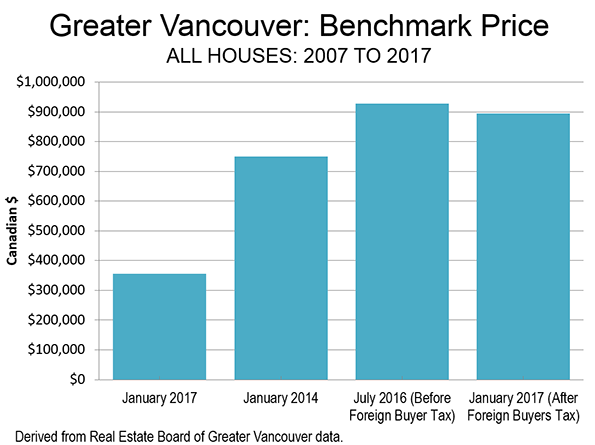
    Yet the impact of the tax has still been muted. Houses remain just about as unaffordable as before. The Real Estate Board of Greater Vancouver benchmark price has dropped less than four percent from six months ago, before the foreign buyers tax was imposed. This compares to an 80 percent increase over the last 10 years and 47 percent increase over just the last three years (Figure).

    Clearly there is something other than Chinese investment driving up Vancouver house prices. Since 2004, Vancouver’s median multiple (median house price divided by median household income) has risen from 5.3 to 11.8. This means that that the median house has increased in price more than six times the annual median household income.

    The primary cause of Vancouver’s difficulties is a rigged housing market. For decades, Vancouver has had some of the strongest urban containment policy in the world. Regional land-use authorities have prohibited  housing development from being built on a large agricultural reserve. This land is hardly needed for such use in a nation that has increased its gross agricultural output more than 150 percent since 1961, while reducing its land in farms by three times as many acres as is occupied by all urban settlements combined, according to the 2016 Canadian census. Of course, urban containment restrictions on new housing have driven up house prices, just as Middle East oil supply reductions used to drive up gasoline prices, before the recent supply increases from Canadian and US oil production.

    Vancouver has literally become the third most unaffordable city (metropolitan area) in the nine nations covered by the Demographia International Housing Affordability Survey. This makes a mockery of the Vancouver’s frequent citation as one of the most livable cities in the world. The first principle of livability is affordability — you cannot live where you cannot afford. Most young families of normal economic means cannot hope to ever buy a modest detached house with a yard as their parents or grandparents did decades ago in the Vancouver area. Only Hong Kong and Sydney are less affordable.

    In a recent column (“Not much can or will be done to make Vancouver housing more affordable”) by Gordon Clark in The Province (Vancouver newspaper) describes how things have changed, in a story similar to what you will hear in Sydney, San Francisco and others of the world’s most unaffordable cities. In 1941, his postal supervisor grandfather purchased a house on Oak Street (a main central arterial leading toward downtown) for 1.5 years of income. In 1979 his teacher mother purchased a house in the city of Vancouver for 2.5 times her income. Now with houses costing nearly 12 times incomes, Clark regretfully concludes that nothing can be done: “because the solutions are unacceptable to most people.”

    This illustrates what is perhaps the most powerful characteristic of urban containment regulation — that it creates a strong lobby of support among those who have seen their house values irrationally escalate as a result of unwise government policy. In this environment, public officials simply wring their hands, decry the problem and implement nothing of substance to change the essentially flawed policies. 

    With this rigged market, it should not be surprising that people with money from outside Vancouver, and abroad, would seek to buy houses in Vancouver. After all, the policies all but guaranteed strong returns to anyone with enough capital to enter the market.   It is as if a “Speculators Welcome” banner has been hung from Lion’s Gate Bridge. Not so welcome are those middle-income households being driven out of the market

    Lessons for Seattle

    All of this is a cautionary tale for the Seattle metropolitan area, which also has urban containment policy, but of more recent vintage. Just 140 miles or 225 kilometers south of Vancouver, Seattle’s has housing affordability that already as bad as Vancouver’s  only 12 years ago.

    Seattle has a severely unaffordable median multiple of 5.5, slightly worse than Vancouver’s 5.3 in 2004. In the late 1980s, before Seattle imposed its metropolitan- urban containment policy, the median multiple was as low as 2.4 (Table). Today, a Seattle household with the median income must pay three additional years of income for the median priced house.

    Rising housing demand with severely constricted supply is associated with higher house prices compared to incomes. In this regard, Seattle has multiple risks, from households escaping California to escape from the even higher prices, Seattle is a bargain compared to the “dogs breakfast” of unaffordable housing associated with California where median multiples now exceed 8.0 in all of the major coastal metropolitan areas (Los Angeles, San Francisco, San Diego and San Jose). Prices are so high in California that a seller can buy a comparable house in Seattle for hundreds of thousands less. There may not be as much sun in Seattle, but there’s plenty of money left over for umbrellas and other goods and services.

    Now the pressure is likely to increase as foreign investors who shop the world for rigged housing markets promise quick profits now turn their attention to the Puget Sound. In this environment, it would not be surprising for additional serious house price escalation to be in the offing, and Seattle to indeed become the new Vancouver in the next decade or two.

    Given these forces, we can expect Seattle housing prices   will continue to increase disproportionately to incomes unless there is land use policy reform. Sufficient supply must be allowed on greenfield land to keep house prices from rising farther. And “building to the sky”— which is very expensive and not very family friendly —  is not likely to restore housing affordability in Seattle any more than it has anywhere else. For example, the Manhattanization of central Toronto, with its many new residential towers, has not prevented its median multiple from doubling from 3.9 to 7.7 in the last 12 years. Nor has it prevented a far less obvious (at least to the press) 80 percent share of population growth to be in the suburbs between 2011 and 2016.

    Lost in all of this are ordinary middle and working class people, who routinely take a back seat in public policy to planning obsessions over urban form, and a “sense of place.” Middle-income households are far more in need of a “decent place” to live at a reasonable price. Architectural marvels or sleek streetscapes are no substitute. The issue is not ideological, it is rather practical and human. Nor is it about property rights, or free markets. The issue is that people are being denied the housing they desire by urban containment policy and its distorted priorities. As Paul Cheshire, Max Nathan and Henry G. Overman of the London School of Economics have pointed out, “people rather than places” should be the focus of urban policy.

    It is ironic that progressive metropolitan areas, like Vancouver, where inclusionary zoning drip feeds housing to lower income households, have become, large exclusionary zones where average income households cannot afford houses. Seattle is headed down the same path.  Soon it may be time to hang a “Speculators Welcome” banner from the Space Needle.

    Photograph: Downtown Seattle (by author)            

    Wendell Cox is principal of Demographia, an international public policy and demographics firm. He is a Senior Fellow of the Center for Opportunity Urbanism (US), Senior Fellow for Housing Affordability and Municipal Policy for the Frontier Centre for Public Policy (Canada), and a member of the Board of Advisors of the Center for Demographics and Policy at Chapman University (California). He is co-author of the "Demographia International Housing Affordability Survey" and author of "Demographia World Urban Areas" and "War on the Dream: How Anti-Sprawl Policy Threatens the Quality of Life." He was appointed to three terms on the Los Angeles County Transportation Commission, where he served with the leading city and county leadership as the only non-elected member. He served as a visiting professor at the Conservatoire National des Arts et Metiers, a national university in Paris.

  • How Silicon Valley’s Oligarchs Are Learning to Stop Worrying and Love Trump

    The oligarchs’ ball at Trump Tower revealed one not-so-well-kept secret about the tech moguls: They are more like the new president than they are like you or me.

    In what devolved into something of a love fest, Trump embraced the tech elite for their “incredible innovation” and pledged to help them achieve their goals—one of which, of course, is to become even richer. And for all their proud talk about “disruption,” they also know that they will have to accommodate, to some extent, our newly elected disrupter in chief for at least the next four years.

    Few tech executives—Peter Thiel being the main exception—backed Trump’s White House bid. But now many who were adamantly against the real-estate mogul, such as Clinton fundraiser Elon Musk, who has built his company on subsidies from progressive politicians, have joined the president-elect’s Strategic and Policy Forum. Joining Musk will be Uber’s Travis Kalanick, who half-jokingly threatened to “move to China” if Trump was elected.

    These are companies, of course, with experience making huge promises, and then changing those promises to match new circumstances. Uber, for instance, touted itself as a better deal than a cab for both riders and drivers before it prepared to tout a better deal for riders by replacing its own soon-to-be obsolete drivers with self-driving cars.

    Silicon Valley and its leading mini-me, the Seattle area, did very well under Barack Obama, and expected the good times to continue under Hillary Clinton. Tech leaders were able to emerge as progressive icons even as they built vast fortunes, largely by adopting predictably politically correct issues such as gay rights and climate change, which doubled as a perfect opportunity to cash in on Obama’s renewable-energy subsidies. Increasingly tied to the ephemeral economy of software and media, they felt little impact from policies that might boost energy costs or force long environmental reviews for new projects.

    No wonder Silicon Valley gave heavily to Obama and then Clinton. In 2016, Google was the No. 1 private-sector source of donations to Clinton, while Stanford was fifth. Overall the electronics and communications sector gave Democrats more than $100 million in 2016, twice what they offered the GOP. In terms of the presidential race, they handed $23 million to Hillary, compared to barely $1 million to Trump.

    Yet, there is one issue on which the Valley has not been “left,” and that is, predictably, wealth. It may have liked Obama’s creased pants and intellectually poised manner, but it did not want to see the Democrats become, God forbid, a real populist party. That is one reason why virtually all the oligarchs favored Clinton over Sanders, who had little use for their precious “gig economy,” the H-1B high-tech indentured-servants program, or their vast and little-taxed wealth.

    Jeff Bezos, the Amazon founder with a net worth close to $70 billion, used his outlet, The Washington Post, to help bring down Bernie, before being unable, despite all efforts, to stop Trump. So now Bezos sits by Trump’s side, hoping perhaps that the president-elect’s threats to unleash antitrust actions against Amazon will be conveniently forgotten as an artful “deal” is struck.

    For these and other reasons, there’s little doubt that the tech elite would have been better off under Clinton, who likely would have, like Obama, disdained antitrust actions and let them keep hiding untaxed fortunes offshore. Now, they will have to share the head table with the energy executives they’d hoped to replace with their own climate-change-oriented activities.

    The tech oligarchs have long had a problem with what many would consider social justice. Although the tech economy itself has expanded in the current period, its overall impact on the economy has been less than stellar. For all of its revolutionary hype, it’s done little to create a wide range of employment gains or boost worker productivity.

    To be sure, there have been large surges of employment in the Bay Area, Seattle, and a handful of other places. California alone has more billionaires than any country in the world except China, and nearly half of America’s richest counties.

    But for much of the country, notably those areas that embraced Trump, the tech “disruption” has been anything but welcome news. This includes heavily Latino interior sections, home to many of America’s highest employment rates. Overall, the “booming” high-wage California economy celebrated by progressive ideologues like Robert Reich does not extend much beyond the Valley. In most of California, job gains have been concentrated in low-wage professions.

    Despite its vast wealth, California has the highest cost-adjusted poverty rate in the country, with a huge percentage of the state’s Latinos and African Americans barely able to make ends meet. California metropolitan areas, including the largest, Los Angeles, account for six of the 15 metro areas with the worst living standards, according to a recent report from demographer Wendell Cox. Meanwhile, the middle and working class, particularly young families, continue to leave, with more people exiting the state for other ones than arriving to it from the, in 22 of the past 25 years.

    Even in Silicon Valley itself the boom has done little for working-class people, or for Latinos and African Americans—who continue to be badly underrepresented at the top tech firms as many of those same firms aggressively promote diversity. A study out of the California Budget and Policy Center (PDF) concluded that with housing costs factored in, the poverty rate in Santa Clara County soars to 18 percent, covering nearly one in every five residents, and almost one-and-a half times the national poverty rate. Since 2007, amidst an enormous boon, adjusted incomes for Latinos and African Americans in the area actually dropped (PDF).

    Much of this has to do with change in the Valley’s industrial structure, which has shifted from manufacturing to software and media. The result has been a kind of tech alt-dystopia, with massive levels of homelessness, and housing costs that are prohibitive to all but a small sliver of the local population.

    With a president whose base is outside the Bay Area, and dependent on support in areas where jobs are the biggest issue, the tech moguls will need to find ways to fit into the new agenda. The old order of relentless globalization, offshoring, and keeping profits abroad may prove unsustainable under a Trump regime that has promised to reverse these trends. In some senses the Trump constituency is made up of people who are the target of Silicon Valley’s “war on stupid people.” Inside the Valley, such people are seen as an obstacle to progress, who should be shut up with income supports and subsidies.

    So can Silicon Valley make peace with Donald Trump, the self-appointed tribune of the “poorly educated”? There are two key areas where there could be a meeting of minds. One is around regulation. One of the great ironies of the tech revolution is that the very places that are home to many techies—notably blue cities such as San Francisco, Austin, and New York—also tend to be the very places most concerned with the economic impacts of the industry.

    Opposition to disruptive market makers in the so-called sharing economy like Uber, Lyft, and Airbnb is greatest in these dense, heavily Democratic cities. What’s left of the private-sector union movement and much of the progressive intelligentsia is ambivalent if not downright hostile to the “gig” economy. Ultimately, resistance to regulations relating to this tsunami of part-time employment could be something that Trump’s big business advisers might share in common with the techies.

    More important will be the issue of jobs. It may not work anymore for firms to lower tech wages by offshoring jobs or importing lots of foreign workers under the H-1B visa program, since Trump has denounced it. IBM’s Ginni Rometty, who had been busily replacing U.S. workers with ones in India, Brazil, and Costa Rica, has now agreed to create 25,000 domestic jobs. Other tech companies—including Apple—have also been making noises shifting employment to the United States from other countries. Trump may well feel what “worked” with Carrier can now be expanded to the most dynamic part of the U.S. economy.

    If the tech industry adjusts to the new reality, they may find the Trump regime, however crude, to be more to their liking than they might expect. Companies like Google may never again have the influence they had under Obama, but many techies may be able to adjust. As long as the new president “deals” them in, the techies may be able to stop worrying about Trump and begin to embrace, if not love, him.

    This article first appeared on The Daily Beast.

    Joel Kotkin is executive editor of NewGeography.com. He is the Roger Hobbs Distinguished Fellow in Urban Studies at Chapman University and executive director of the Houston-based Center for Opportunity Urbanism. His newest book, The Human City: Urbanism for the rest of us, was published in April by Agate. He is also author of The New Class ConflictThe City: A Global History, and The Next Hundred Million: America in 2050. He lives in Orange County, CA.

    Photo by Gage Skidmore from Peoria, AZ, United States of America (Donald Trump) [CC BY-SA 2.0], via Wikimedia Commons

    Photo: MCR World
  • Super Bowl: Super Subsidy Sunday

    Imagine what it would cost to fly from New York to Los Angeles if the country tolerated a National Airline League? Answer: about what a “personal seat license” will cost at the new City of Champions Stadium in Los Angeles, say $28,000.

    In the latest shifting of NFL deckchairs, the League raided St. Louis, San Diego, and Oakland — cities that need things to cheer about — and told team owners that they are free to move to Los Angeles, the city of tomorrow, because of its willingness, today, to chip in on the construction of a $2.66 billion stadium in Inglewood, a city within Los Angeles, for the Rams and possibly the Chargers. Around the opulent new stadium the league will even have an NFL campus, maybe for all those ‘communications majors’ who play in the game?

    Rather than take subsides on its construction bonds, the new LA stadium prefers to limit its local taxes until “costs are amortized.” That way it can boast: “No tax dollars or public funding will be used for the construction of the City of Champions Revitalization Project, including the new stadium.” The operative phrase is “for the construction.” Afterwards, the football depletion allowance will kick in, big-time.

    The reason that the National Football League can move around its franchises is because Congress, in the Sports Broadcasting Act of 1961, deemed professional football a sacred national resource and conferred an exemption from anti-trust rules on the manufacturers of professional football.

    Instead of running a sport where there is no limit on teams or competition, the NFL is the pigskin equivalent of OPEC, and its main function isn’t to govern a league of competitive teams, but to protect monopoly pricing and practices.

    The National Football League runs on backhand payments to athletic organizations, sweetheart contracts, and monopoly pricing, in addition to screwing over its fan base by moving teams around. Its reward for urban price fixing isn’t prosecution for collusion under antitrust laws (it is exempt). Instead, it is awarded a national day of reverence, Super Sunday, during which 30 seconds of ad time costs $5 million, and the strategic national stockpile of guacamole is severely threatened.

    The owners don’t actually own teams, but are general partners in a football trust, which allows them to share equally in all television revenues and collectively ‘bargain’ with concussed players, who are only free agents after five years of indentured service. By then, most are broken men. The league’s attitude toward the declining mental of health of its retired players could be summarized as “So sue me”.

    Yes, a few stars make big money, for a while, but teams are rarely on the hook for long-term guaranteed contracts and salaries are “capped,” they say, “in the interest of competition.”

    Although NFL teams wave the flags of their home cities (best understood as their allocated captive markets), hometown fans have no sway over their local teams, which can pack up their pads in the night and move, as long as the new location is authorized by the League.

    Nevertheless, St. Louis will still get the pleasure of paying off $100 million in outstanding debt on the Rams’ Edward Jones stadium, even though the team will be playing in LA.

    What keeps NFL teams constantly on the move? Promises of state and city subsidies for new, multibillion stadiums, and then the granting of nearly all local revenues to the owner.

    The new Santa Clara stadium, home to the hype of Super Bowl 50, has $950 million in hidden public finance, even though while the deal was being made the city was laying off teachers and firefighters.

    According to Stadium Subsidy Trickle-Down Economic Theory, a new NFL stadium helps to ‘revitalize’ some downtrodden city. In reality, stadiums add little to urban life other than mountains of debt and part-time jobs for Sunday ushers and parking lot attendants.

    The reason that NFL teams do little for their home cities is that the league’s economic model is akin to strip mining or wildcat drilling. Unlike coal or natural gas, though, the price of the harvested commodity is controlled at the league’s head office, although still for the benefit of absentee landlords. National revenues are shared, while local revenues flow into the pockets of the team’s owner, often a billionaire.

    If, instead of a football trust, the US had an open market for gridiron services, when there was a demand in a growing city for a pro team tryouts would be held for players, and shareholders would gather to invest in the new franchise. Maybe when the franchise got good enough, it could compete with more established teams.

    Think about it: if the city of Green Bay (population about 104,000) can support a championship team which is owned by the fans, it means that there are 278 larger cities in the country that could well duplicate its model and host professional football. Instead, only 31 other cities have pro teams, thanks to the league’s attitude toward parity and level playing fields. Metropolitan areas with populations greater than two million that don’t have a team include San Antonio, Las Vegas, Portland (Oregon), and Orlando, St. Louis and, possibly soon, San Diego and Oakland. Many other large American cities could easily support three or four professional teams.

    All that these outlier cities can do to get a franchise is to promise the NFL ownership monopoly stadium subsidies and political tolerance for continuing the anti-trust exemption. Cities that want to keep their teams (such as San Diego) can pay ransom money in the form of a new, subsidized stadium and other favors. Challenge this payoff system and the league will vote away your team faster than you can say antidisestablishmentarianism.

    The irony of Los Angeles now becoming the holy grail of two, or even three football teams is that, in the past, the city has had several franchises —ironically, the Rams, Chargers, and Raiders — and all left because the fan base preferred the beach and the Lakers to Sunday afternoons in the archaic LA Memorial Coliseum.

    What has changed since Sid Gilman coached the Los Angeles Chargers in 1960 is that shared NFL television contracts make it irrelevant whether fans show up or not for the in-studio fan game experience, although generally most stadiums sell out.

    What of the cities that have ransomed their future to an NFL team? How have they fared? Just because Forbes Magazine values pro football franchises at between $2 and $3 billion does not mean that the citizenry sees much benefit from having a team.

    For example, the Hackensack Meadowlands Giants are now said to be worth $2.8 billion, but New Jersey taxpayers are still paying interest on the old Giants Stadium, where the end zone was rumored to be Jimmy Hoffa’s resting place, and which was torn down so that a new stadium could be built in its place (“without public money”).

    Most cities get a paltry rental stream from their subsidized ballparks, and that’s it. From the Seahawks, owned by Microsoft bigwig Paul Allen, Seattle gets $1 million a year in stadium rental income, while the team rakes in more than $200 million. And state taxpayers are on the hook for some $300 million in outstanding CenturyLink stadium bonds. (The 12th man abides.)

    No wonder Allen’s $160 million yacht has been out tearing up the coral reefs of the Caribbean. Even to Hoffa, that red zone opportunity would be worth some dabbin’.

    Matthew Stevenson, a contributing editor of Harper’s Magazine, is the author most recently of Remembering the Twentieth Century Limited, a collection of historical travel essays, and Whistle-Stopping America. His next book, Reading the Rails, will be published in 2016. He went to his first professional football game in 1960, and saw the New York Titans plays the Dallas Texans. He lives in Switzerland.
    Flickr photo by Mike Morbeck: Cam Newton of the Carolina Panthers

  • Who Should Pay for the Transportation Infrastructure?

    Urban regions are significantly more important than any one city located within them. Housing, transportation, economy, and politics help produce uneven local geographies that shape the individual identities of places and create the social landscapes we inherit and experience. As such, decisions made within one city can ripple through the entire urban region. When affordable housing is systematically ignored by one city, neighboring cities become destinations for those who cannot afford higher housing costs. Even when the minimum wage is adjusted in one city, others cannot ignore it.

    In fact, a differential wage structure can produce diverse economic and labor geographies. Affordable housing and uneven economic development, in their turn, impact the regional transportation and infrastructure: if the cost of living and wages in one city in a particular region are high (as in San Francisco and Seattle), then low and middle-income workers will move to a more affordable neighboring city and pay a higher price, particularly in time spent, for transportation. They also pay more in fuel, and hence taxes that fund infrastructure maintenance and expansion.

    In other words, while companies and the more affluent population benefit from the agglomeration economies of alpha cities, it is the lower-wage workers and the population at large that pay for these uneven development. Therefore, a company deciding to locate in Seattle or San Francisco, or any location, does not have to bear the cost their decision imposes on urban transportation and the infrastructure needed to support their operation. Instead it’s their employees, particularly those with lower earning power, who do.

    How many LEED certified buildings and downtown redevelopment projects does it take to make up for this inequity?  Should a city be considered green, if a significant portion of its low earners has to commute to neighboring cities to afford a home? Can a city be seen as sustainable, if in a style akin to medieval cities, serfs have to leave every evening and return in the morning to make sure that the ‘creative class’ is adequately served?

    As states such as Washington engage with the old “pay as you go” policy of increasing fuel taxes to pay for the infrastructure, the question of what forces created the emergent commuting patterns remains unanswered. Was it just the commuters, acting as informed participants in the market economy, who sought to optimize their housing and transportation trade offs? Or did the locational choices of employers contribute to the growing commuting problems in the region? If commuters are subjected to “pay as you go” policies, shouldn’t employers who locate in expensive housing markets, irrespective of their employees’ income profile, be subjected to “pay as you locate” policies?

    Perhaps no metro region will make a better case study for this inequity than the area that ‘serves’ Seattle. The Puget Sound Region consists of four counties; however, to make sure that no one county that might have an economic connection with Seattle is left behind, we can look at six counties: Snohomish, King (where Seattle is located), Pierce, Kitsap, Thurston, and Mason.

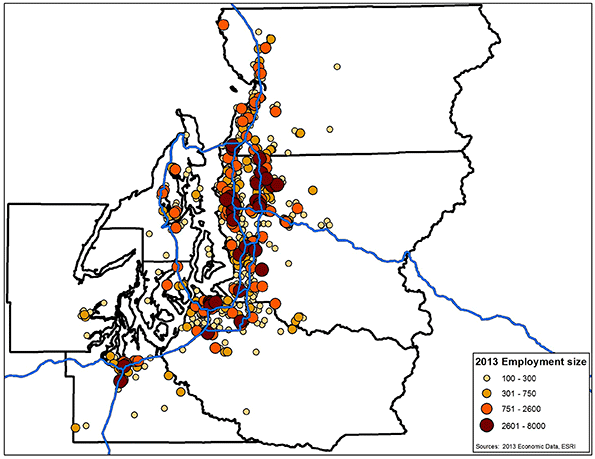
    The entire urban region is served by a small number of highways, including Interstate 5. According to 2013 economic data, these six counties housed nearly 62% of all firms in the state. Furthermore, a quarter of all businesses in these counties were located within half a mile of a freeway. In terms of total employees, the six counties contained 69% of the state employment, and workplaces within half a mile of a freeway employed 37% of all employees in the counties. The inequity in the regional economic distribution is further exacerbated by the fact that the small area in West King county bounded by I-405 houses 30% of workplaces and 47% of employment, and generates a significant portion of the sales/revenue in the six counties. This area relies on I-5, I-405 and I-90 for the delivery of its employees from near and far.   

    The economic calculus of the early days of Interstate construction may have suggested that the trucking industry would benefit from this transportation infrastructure, but 1960s economists might be surprised by the type of companies now located within half a mile of freeways. In the six counties in Western Washington, the economic sectors over-represented in these geographies are: services and finance, real estate, and insurance (FIRE). Anyone driving on I-5 and I-405 (where Microsoft and other corporations are visible) can see this.  None of these workplaces require trucking. While their well-paid employees can afford to live in well-to-do places, including Bellevue and Seattle, many others reside in less expensive places such as Auburn, Tukwila, Tacoma, and Federal Way.

    A map of the region clearly suggests that neighboring counties and cities are housing those who work in West King County. Mobility has been the answer to unaffordability in this and other similar urban regions. If a city is unaffordable, is it fair to ask those who search for affordability in ‘other’ geographies pay for their so-called choices? Is this truly a choice? Are employers, current and future, asked to pay for their locational ‘choices?’ 

    Surely, we can do better than asking employees to bear the burden of a regional economic imbalance. Freeways should not be freer to some than others.  If this nation is about people paying for choices they make, then everyone should do so: employers and employees alike.

    Ali Modarres is the Director of Urban Studies at University of Washington Tacoma.  He is a geographer and landscape architect, specializing in urban planning and policy. He has written extensively about social geography, transportation planning, and urban development issues in American cities.

    Seattle photo courtesy of BigStockPhoto.com.

  • Thinking About Housing in the Northwest

    With one of the most successful economies in the nation, the real estate news in the Pacific Northwest is positive and gives hope for a housing sector recovery, albeit at different rates in different markets. CNNMoney reports that from the third quarter in 2012 to the third quarter in 2013, the median home price in the Seattle-Bellevue and Everett area increased by 13.7%. The forecast for changes from the third quarter in 2013 to the third quarter in 2014 is another 5.2%. Tacoma’s (Pierce County) housing prices did not grow as quickly, with an increase of 9.3% from 2012 to 2013, but it is expected to witness a sharper increase in 2014, with a healthy 8.6% change from the third quarter of 2013 to 2014. 

    As rosy as the real estate picture is, we should also remember that in the second quarter of 2013, as housing values began to climb in both markets, median family incomes were already too low compared to median home prices. In Seattle, the ratio of median home prices to median family income was 4.7, and in Tacoma it was 3.6. That made Tacoma a relatively affordable city. However, an expected increase of 8.6% in home values, without a corresponding increase in median family incomes will not do much for its affordability.

    Without a major change in its employment structure that might lead to higher incomes for current and future residents of Tacoma, the differential in home prices could make Tacoma a residential destination for Seattle employees finding this city comparatively more affordable. Living half an hour from work, but paying significantly less for housing, is a great incentive, especially for young, single or double income, and childless families. For them, a two-bedroom condo with a view of Commencement Bay may do the job. For Tacoma residents whose median family income is about $20,000 less than their Seattle counterparts, rising home values may prove to be a challenge that cannot be easily overcome without a higher number of well-paying jobs that keep pace with rising home values.

    Regional patterns of housing affordability

    It is no longer news to anyone that most unaffordable cities rely on their less costly neighbors to house their working populations. The city of Los Angeles relies on the vast sprawl of its own suburbs and the Inland Empire. San Francisco does the same by having people commute from the larger urban region, all the way from the San Joaquin Valley.

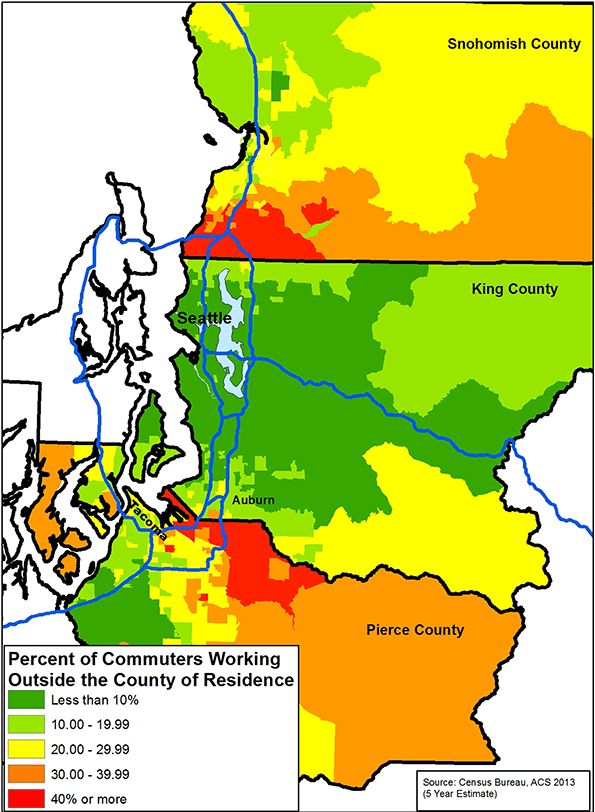
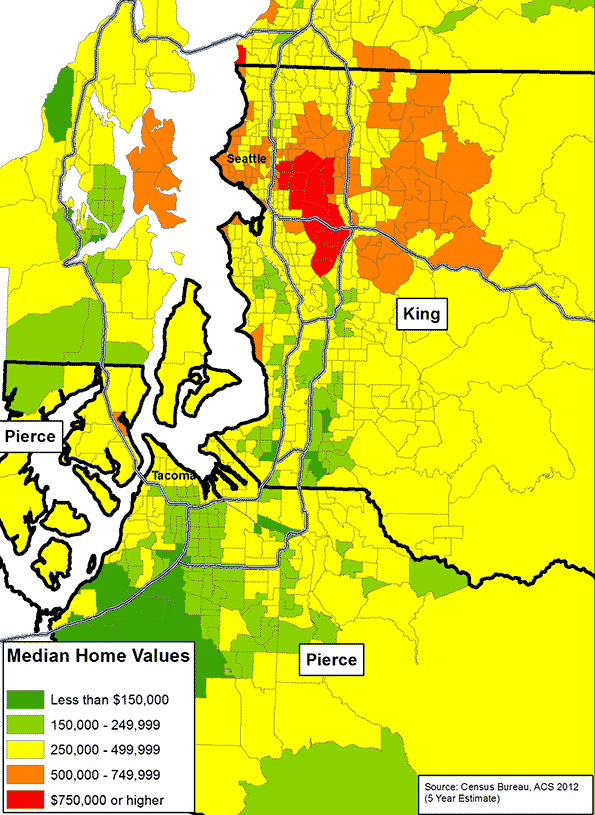
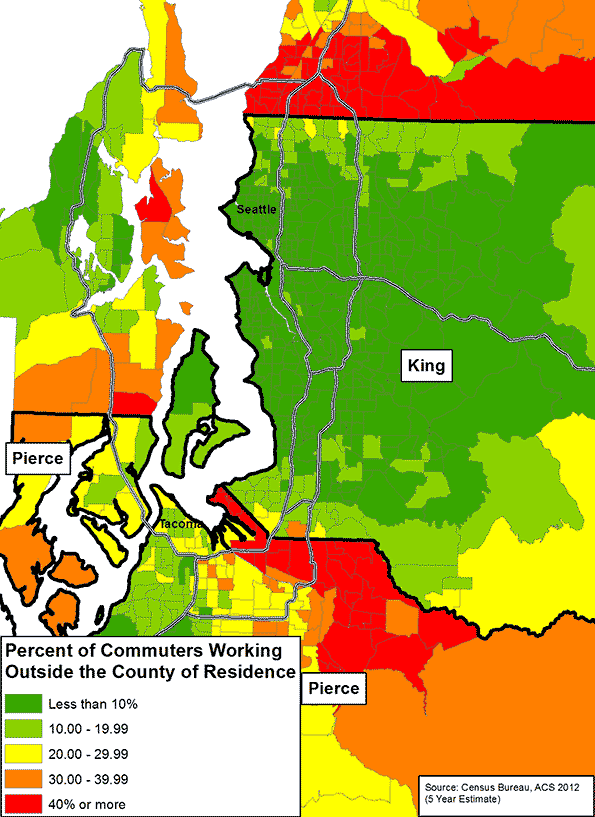
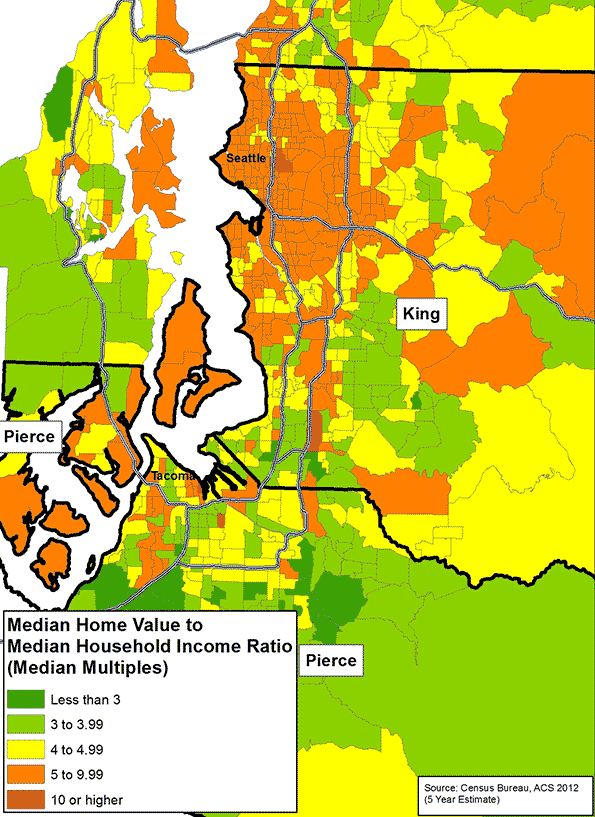
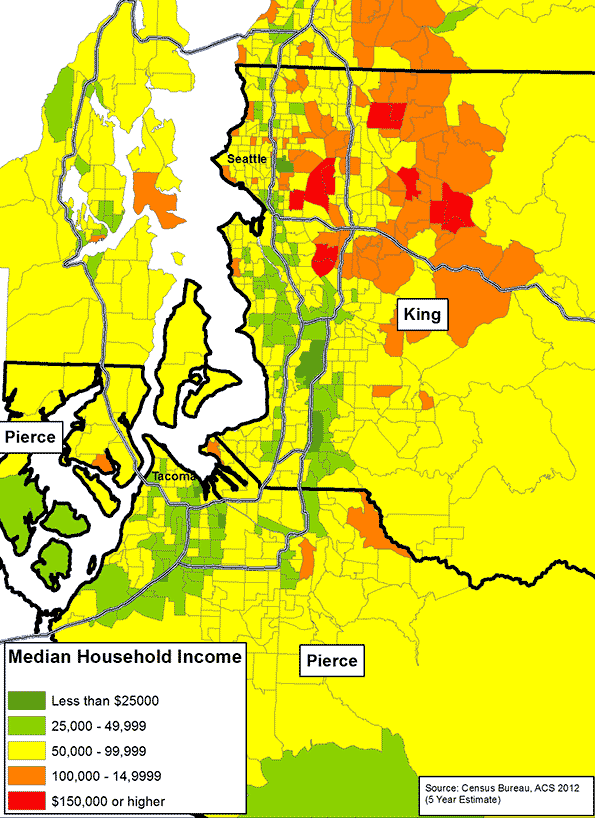
    The relationship between Seattle and other cities in King and Pierce Counties already follows the same script. Morning commutes into Seattle and afternoon rush hour traffic heading out of Seattle do not require statistics. The numbers are felt by anyone driving during those hours. However, two maps will help paint a vivid picture of the regional urban dynamics created by the unholy triangle of housing market price differentials, economic development patterns, and the resulting spatial mismatch between home and work places. 

    Maps for median housing values and commuting patterns in King and Pierce Counties clearly show that a good number of people who work in unaffordable regions of King County (including Seattle) rely on more affordable housing elsewhere. As the map of commuting patterns illustrates, for Pierce County, this starts right at the county border, where housing prices are lower (compared to median household incomes). This has already turned certain portions of Pierce County into bedroom communities, feeding economic growth elsewhere. In other words, job-rich areas are resolving their housing problems by pushing their employed populations to other areas, where home prices are more affordable. However, will the growth of housing demand in areas outside employment centers translate to increased housing values in previously affordable regions and push long-time residents out of the housing market?

    To answer this question, we need to engage in a more detailed level of analysis.


    Micro-geographies of affordability

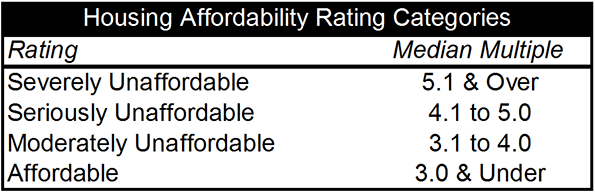
    In order to get a better sense of housing affordability patterns, we can rely on a simple indicator called median multiples (the ratio of median housing value to median household income). While this measure has its critics, it is easily understandable. The basic premise is that when median housing value exceeds median household income more than three fold, an area becomes unaffordable.

    A few years ago, Wendell Cox used this method to identify the least affordable cities in the nation. He used the following table to classify various cities in the U.S.:

    Demographia
    Housing Affordability Ratings

    Rating

    Median Multiple

    Severely Unaffordable

    5.1 & Over

    Seriously Unaffordable

    4.1 to 5.0

    Moderately Unaffordable

    3.1 to 4.0

    Affordable

    3.0 or Less

    Median Multiple: Median House Price divided by Median Household Income


    The map of median multiples for King and Pierce Counties reveals a pattern of housing affordability that indicates a looming problem as the housing market recovers. As of Census 2012, almost all Seattle and Bellevue areas were unaffordable, with median multiples exceeding 5. Comparatively speaking, Tacoma has had more affordable housing areas (with more census tracts with median multiples ranging from 3 to 4).  Between Tacoma and Seattle, areas such as Federal Way have more affordable housing for the income levels found there. Tacoma’s North East community, adjacent to Federal Way, has higher housing values matching residents’ income levels. Given the commuting patterns, this region is clearly home to many who work elsewhere, earn better incomes, and spend a smaller portion of it on their homes.


    In some areas, where median multiples exceed 5, current residents may have purchased their houses when prices were lower. In other words, at one point in time, the median multiple had a lower value. Under such conditions, residents have accumulated substantial equities, allowing them to sell in a more expensive market. However, the next group of occupants will need substantially higher incomes to afford these houses. With the potential arrival of a sellers’ market, any transition in the composition of homeowners will also coincide with a shift to higher socioeconomic status.  

    Given the overall housing affordability patterns, it is clear that with the looming hike in home prices, the last of the semi-affordable housing pockets in the region extending from Seattle to Tacoma could vanish quickly. Clearly, the well-paid employees in King County could choose to live in Pierce County, enjoy the views, but struggle with traffic up and down I-5. They could even benefit from a publicly funded transportation system. But this won’t resolve the growing traffic and the emerging spatial mismatch between housing and employment. At this point the entire urban region from Seattle to Tacoma should focus on job-housing balance, where the quantity and cost of housing are comparable to employment volume and average salaries paid. To be truly ‘green,’ decision makers need to think regionally. Passing housing or employment problems to neighboring cities is not the best approach to sustainability.

    As for Tacoma, like any other urban region on the fringes of a major metropolitan area, the city has a few options moving forward. First, it could act as a satellite city and build more houses for people who work in the larger urban region. Second, it could imagine itself as a major urban center with little interest in being a “second city.” In that case, it needs to focus on economic development, bringing more well-paying jobs that are suitable for its current and future residents, and build houses that are affordable for the types of incomes generated in the area. This strategy requires coordination between housing and economic development that reduces the spatial mismatch between housing and employment and improves the job-housing balance. This will help both housing and transportation conditions. That will also keep Tacoma affordable and make it unpretentiously ‘green.’

    The National Association of Home Builders ranks Tacoma 103rd for housing affordability on a list of 224 cities. Spokane ranks 62 and Seattle 202 on the same list. Tacoma should aspire to appear on the list of the top 50 most affordable cities by 2020, and be recognized for the quality of life and employment opportunities it offers to current and future residents.

    Ali Modarres is the Director of Urban Studies at University of Washington Tacoma.  He is a geographer and landscape architect, specializing in urban planning and policy. He has written extensively about social geography, transportation planning, and urban development issues in American cities.

  • Boeing’s Long Shadow

    The recent wrangling over decisions on where to build the next version of Boeing’s 777 has left a residue of bitterness and rancor around the Puget Sound region. Were the Machinists forced to give too much? Were the taxpayers squeezed too far? While views will differ on those questions, one thing is clear: jobs lost at Boeing are very difficult, if not impossible to replace.

    In the Seattle region we can easily forget how insanely fortunate we are to have Boeing Commercial Airplanes located here. As much as we love to talk about software, gaming, life sciences, internet commerce and other 21st century industries, Seattle owes its status as a large and prosperous metropolitan area almost entirely to the economic base established by Boeing fifty years ago.

    And if we can avoid becoming another San Francisco, with high levels of income inequality, outrageous housing prices, a shrinking middle class and a consequent increase in social tensions, we will owe Boeing for that too.

    Maybe we paid too much for the 777. But the alternative – Puget Sound minus Boeing – is a frightening idea. Ever since the Boeing Bust of 1969, Seattle area leaders have been trying to diversify the region’s manufacturing economy, and with few major successes. The reason for this is obvious: our location in the upper left hand corner of the map.

    Manufacturing industries tend to locate near their customers and suppliers to minimize transportation costs. Puget Sound is simply too far from national markets to make sense as a location for heavy industry. By the 1950s, the region had maxed out its potential in timber, fishing and shipping, and the economy stagnated. The manufacturing boom that followed World War II largely passed the region by, and in 1957 a prominent businessman accurately described the Northwest as "America’s most important colony."

    Then came Boeing’s entry into the commercial jet aircraft business. Prior to World War II Boeing had served as a sort of R&D shop for the U.S. government, developing innovative military and airmail planes that never sold very well. Boeing developed the first modern commercial transport, the 247, which was immediately eclipsed by the Douglas DC-3. Boeing had some commercial success, but was still a minor player in the propeller age.

    After World War II the military stopped buying B-17 and B-29 bombers, for obvious reasons, and Boeing fell into a slump. It gradually revived itself with the successful B-47 and B-52 jet bomber programs. But it was another military program–developing a jet powered refueling tanker that could keep up with the new jet bombers–that was the key. That tanker airframe was repurposed into the 707, an aircraft that revolutionized civilian air transport and led to the transformation of the Puget Sound economy.

    With commercial jet aircraft factories, the region finally had a large, scalable manufacturing industry that did not depend on low transportation costs. In fact, the products deliver themselves! With the success of the 707 Boeing began a very aggressive strategy, launching four new airplane programs during the 1960s: the 727, 737, 747 and the ill-fated SST. Before the bust of 1969, Boeing employed well over 100,000 people in the region, accounting for nearly all the net job growth of the decade.

    Since then, Boeing’s Puget Sound area employment has fluctuated between 60,000 and 110,000. And although it is gradually shrinking as a share of the economy, Boeing provides one thing that fewer and fewer industries can offer: large numbers of secure, high-paying blue collar jobs. Boeing investments are measured in decades, and even with recent give-backs, the machinists enjoy a very nice compensation package. The layer of middle class employment at Boeing is what makes the Puget Sound region different from San Francisco, and holds the line against our evolution into a Superstar City.

    Yes, Boeing’s tactics have wounded pocketbooks and left a bad taste in the region’s mouth. And its status as a largely Midwestern company (just try to find any Northwest connections on its board) further diminishes the emotional tie. But we cannot lose sight of the value it brings. There is simply no better industry around which to build a regional economy and we are incredibly lucky to have it here. So we’ll swallow some pride and hold tight to a company that every region in the world would kill to get its hands on.

    The Seahawks 12th Man paint job that Boeing workers put on a brand new 747 freighter just before the Super Bowl brought back a glimpse of the Boeing connection that we used to take for granted. The challenge for Boeing and for regional leaders is to rebuild that connection. In Seattle we will always live in the "Jet City."

    Michael Luis is a consultant in public affairs and communications, based in the Seattle area, and is the author of Century 21 City: Seattle’s Fifty Year Journey from World’s Fair to World Stage. He also serves as councilmember and Mayor of the city of Medina, Washington. He can be reached at luisassociates@comcast.net.

    Seattle photo courtesy of BigStockPhoto.com.

  • Life as a Second City

    Imagine someone writes a newspaper story about you and prints the picture of your older, well-known sibling next to the column. It is clear to you why this was done: your sibling is more famous and recognizable. But how does that make you feel?

    Following the January 28th State of the Union address, PBS interviewed a number of civic leaders. One of those interviewed was the mayor of Tacoma, a city with many of the challenges and attributes of a second child.

    The older sibling (that is, Seattle) has a nationally recognizable architectural landmark and a larger economy, and there is a higher likelihood that people around the country have heard its name rather than Tacoma’s.  Should we be surprised, therefore, that when Mayor Marilyn Strickland was being interviewed, “(D) Tacoma Washington,” was written at the bottom of the screen, but behind her was an image of Seattle’s skyline? The Tacoma Dome, Downtown Tacoma, the Museum of Glass, and other Tacoma landmarks were notably absent on the screen. Instead of using the Seattle image and perhaps to suggest where the program was being taped, PBS had an opportunity to educate the public (and to be factually correct) by showing a picture of Ms. Strickland’s town, Tacoma. Instead, PBS reinforced Tacoma’s “second city” image by visually identifying it with a picture of its more famous sibling. You cannot imagine how bothersome this is to people who live in Tacoma. A local columnist lamented that with Seattle’s picture as the backdrop, it was hard to focus on what the mayor was saying.

    The “second city” phenomenon is not exclusively a Tacoma issue. Glasgow, Melbourne, Milan, Montreal, St. Paul, Long Beach, California and many other cities around the globe face a similar challenge. Either their identity has not been well-articulated, or it has not been understood by external observers. This is not a logo problem. It is not about a catchy phrase, and it is not about another cultural event. Unique architectural landmarks can create memorable identities, but these phallic symbols already dot cities the world over. Whether in Dubai, Barcelona, or Beijing, starchitects would be happy to add the next jaw-dropper to any city willing to deposit a large sum of public funds at their altars.

    But for smaller cities, this level of economic competition is not affordable. This is where the notion of “urban branding” comes in. Cities need an internally generated and well-articulated narrative of identity before they can be recognized externally. At the beginning of the twenty first century, many cities, including Tacoma, are finding themselves struggling with this notion at local, regional, and international scales. How does a city get out of the shadow of another city? How do you broadcast who you are? Creating hipster colonies or 24 hour entertainment districts does not always work. Cities like Tacoma already house museums, artist colonies, hip hangouts, and, yes, waterfront condos with killer views. Nevertheless, the glitzy brother 20 miles north casts a long shadow that may stunt growth and contribute to a feeling of self-doubt.

    To get out of this position, cities like Tacoma need more than cultural fairs and gimmicky tourist attractions. They need an inclusively created branding strategy. It is important that they know what works and what doesn’t, but strategies need to be based on a vision that gives the city the self-confidence it needs to move forward. Tacoma cannot be and should not be Seattle, in the same way that Long Beach is not and should not be Los Angeles. The identity of a city does not arise out of a formula calculated by the latest intellectual fashion, but from an inclusively-created vision that seeks input from the public, and asks help from experts, not the other way around. Perhaps one the worst ideas of the last twenty years has been an excessive reliance on “best practices” and “experts.” We need to learn about each other, but we need to do it our way and articulate a clear vision of who we are. The second child can also succeed.

    Table: Tacoma is about a third of Seattle in population. With a lower density, less expensive housing and a more affordable cost of living, its households are on average slightly larger than those living in Seattle. Its small city charm, stunning views and history rival any urban area in the nation.

    Tacoma & Seattle Quick Facts Seattle Tacoma Washington
    Population, 2012 estimate     634,535 202,010 6,895,318
    Population, 2010 (April 1) estimates base     608,660 198,397 6,724,543
    Population, percent change, April 1, 2010 to July 1, 2012     4.30% 1.80% 2.50%
    Persons under 5 years, percent, 2010     5.30% 7.00% 6.50%
    Persons under 18 years, percent, 2010     15.40% 23.00% 23.50%
    Persons 65 years and over, percent,  2010     10.80% 11.30% 12.30%
           
    White alone, percent, 2010  69.50% 64.90% 77.30%
    Black or African American alone, percent, 2010  7.90% 11.20% 3.60%
    American Indian and Alaska Native alone, percent, 2010      0.80% 1.80% 1.50%
    Asian alone, percent, 2010      13.80% 8.20% 7.20%
    Native Hawaiian and Other Pacific Islander alone, percent, 2010      0.40% 1.20% 0.60%
    Two or More Races, percent, 2010     5.10% 8.10% 4.70%
    Hispanic or Latino, percent, 2010      6.60% 11.30% 11.20%
    White alone, not Hispanic or Latino, percent, 2010     66.30% 60.50% 72.50%
           
    Foreign born persons, percent, 2008-2012     17.50% 13.50% 13.00%
    High school graduate or higher, percent of persons age 25+, 2008-2012     92.90% 88.00% 90.00%
    Bachelor’s degree or higher, percent of persons age 25+, 2008-2012     56.50% 24.70% 31.60%
           
    Housing units, 2010     308,516 85,786 2,885,677
    Homeownership rate, 2008-2012     47.30% 52.80% 63.80%
    Housing units in multi-unit structures, percent, 2008-2012     50.50% 35.00% 25.70%
    Median value of owner-occupied housing units, 2008-2012     $441,000 $230,100 $272,900
           
    Households, 2008-2012     285,476 78,447 2,619,995
    Persons per household, 2008-2012     2.06 2.46 2.52
    Per capita money income in past 12 months (2012 dollars), 2008-2012     $42,369 $25,990 $30,661
    Median household income, 2008-2012     $63,470 $50,439 $59,374
    Persons below poverty level, percent, 2008-2012     13.20% 17.60% 12.90%
           
    Land area in square miles, 2010     83.94 49.72 66,455.52
    Persons per square mile, 2010     7,250.90 3,990.20 101.2
    Source: US Census Bureau State & County QuickFacts
    Downloaded: February 8, 2014

    None of this, however, diminishes the responsibility of media outlets. Tacoma is not Seattle. A major news outlet should educate itself and the public by using accurate images. The next time a TV station invites the mayor of Tacoma to participate in a program, here’s hoping they don’t show the Space Needle in the background. 

    For now, people will be sleepless in Tacoma until they figure out their way out of being the second city.

    Ali Modarres is the Director of Urban Studies at University of Washington Tacoma.  He is a geographer and landscape architect, specializing in urban planning and policy. He has written extensively about social geography, transportation planning, and urban development issues in American cities.

    Tacoma photo by Flickr user Michael D. Martin.

  • Affordability: Seattle’s Ace in Becoming the Next Tech Capital

    Silicon Valley has been well recognized as the nation’s hub of technology, having easily surpassed both Southern California and Massachusetts, but it’s now Seattle that may emerge as its greatest rival. Home to tech giants such as Microsoft and Amazon, Seattle has attracted creative and entrepreneurial talent, which has been the foundation to its low unemployment rate of 5.9% and continuous economic growth. Many former employees from Microsoft and Amazon have founded startups and small businesses in Seattle.

    The primary reason for Seattle’s continuous expansion: the metro beats Silicon Valley in affordability on many different avenues. For instance, one of Silicon Valley’s major turnoffs for up and coming entrepreneurs has been its unaffordable housing.

    Increasing wages in Silicon Valley have been matched with skyrocketing housing prices in the Bay area, which has become one of the most expensive places to live in the nation. Due to the low number of homes available, bidding wars have become a common problem when buying a home in the area. As a result, San Francisco has witnessed 20+% increases in median home prices over the past year. In May, San Francisco’s median home price was $1 million, a 32% jump from the previous year. Average listing prices in cities such as Los Gatos, San Francisco, Cupertino, Redwood City, San Mateo, and Sunnyvale are anywhere between $1.1 and $1.4 million. To illustrate what this means to a young entrepreneur or skilled technologist looking for a home, the median price to buy a 2-bedroom home in San Francisco would cost $880,000, whereas in Seattle it would cost $385,000.

    Seattle’s lower office rent and expanding office space development also have made Seattle become an appealing alternative to Silicon Valley. Jones Lang LaSalle reported this year that Seattle’s average office rental rate is $20.86 with a 0.2% annual rent growth, as opposed to San Francisco’s average office rental rate, which is $25.80, with a 0.9% annual rent growth rate. The Seattle-Bellevue area also has the second highest number of office leases in the country, behind Houston. This is one reason why so many tech companies have moved or expanded its office space in Seattle. For example, Facebook recently doubled its current rental space and Zynga, an online gaming company, rented space in downtown Seattle as well. Google also has created two centers in Seattle and its suburbs, bringing in a total of over 900 employees.  

    Washington also bests California in tax incentives, a large factor in attracting tech companies and keeping existing ones at home. California has the second highest individual capital gains tax in the nation, while Washington has none. Recently, a judge ruled California’s Qualified Small Business tax bill to be unconstitutional; the policy used to give tech companies a deduction that reduced the state’s capital gains tax rate from 9% to 4.5%. The state’s tax board is estimated to retroactively collect about $128 million from 2,500 entrepreneurs (amounting to about $50,000 per person).

    Washington also has no income tax and offers a plethora of tax incentives to high tech companies. The state gives a good number of sales tax deferrals, waivers, and business tax credits to the high tech sector, particularly for research and development spending. The business and occupation tax credit also saved $50 million to almost 1,700 high tech-firms in 2010. Computer software companies accounted for the $12 million property-tax break in the same year. Tech companies, especially Microsoft, have been able to avoid sales tax on construction costs, materials, and new equipment because Washington gives deferrals for the construction of buildings for high-tech projects dedicated to research and development. Evidently, the growth in the tech sector has contributed to Seattle’s expansion in office space development.

    This year, there is a developing  36-acre office and apartment development and a grocery distribution center one mile from Bellevue’s downtown area that is slated to be converted into a $2.3 billion district of stores, apartments, and office buildings, two of which will have 490,000 square feet. Expansions of Microsoft and Amazon are expected to fill the office space. Research firm Reis Inc. estimates about 30 million square feet of office buildings, apartments, and stores will be completed in 2013, according to the Wall Street Journal.

    But perhaps most of all, Seattle could be highly appealing for tech companies and individual entrepreneurs simply because the cost of living is cheaper. Providing much of the high tech environment of  Silicon Valley   Seattle also gives a greater bang for your buck than San Francisco. The Department of Housing and Urban Development estimates that San Francisco County’s median income is $99,400 and King County’s median income is $85,600. However, $100,000 salary in San Francisco is comparable to living on roughly a $70,000 salary in Seattle, according to CNN’s Cost of Living Calculator. Keeping these comparisons in mind, housing costs about 53% less in Seattle and groceries costs about 13% less. Utilities, transportation, and health care costs are roughly the same.

    In addition, Washington also has the fourth lowest electricity prices in the nation, another major incentive for tech companies. This reflects the region’s huge hydroelectric generating capacity. In contrast California’s electricity prices — driven up by mandates for renewable energy sources like solar and wind — are now almost double that of Washington.

    One final notable difference is that unlike Silicon Valley, Seattle’s economy also rests on a healthy composition of many different established industries. The strong mix of the tech, retail, and manufacturing have been the key factor in Seattle’s staggering job growth, which has grown four times faster than the rest of the country; retail and manufacturing jobs have increased twice as fast. Boat building companies such as Kvichak Marine Industries, retail companies such as Nordstrom, Nike, and Costco, and travel companies like Expedia Inc., Boeing, and Alaska Airlines create Seattle’s diverse portfolio.

    Despite its well-recognized reputation and sophisticated style, Silicon Valley ultimately may lose its edge largely on this issue of affordability. When it comes down to it, a sustainable and cost-friendly environment is what makes a desirable destination for tech companies and entrepreneurs. Lower housing prices, lower office rent, numerous tax incentives, and lower costs of living could very well be the pivotal determinants in taking Silicon Valley’s place as the next tech capital.

    Tina Kim is an undergraduate at UCLA majoring in Communications and minoring in Urban Planning. 

    Photo by Wendell Cox.