Tag: Silicon Valley

  • Calling Out the High-Tech Hypocrites

    The recent brouhaha over Indiana’s religious freedom law revealed two basic things: the utter stupidity of the Republican Party and the rising power of the emerging tech oligarchy. As the Republicans were once again demonstrating their incomprehension of new social dynamics, the tech elite showed a fine hand by leading the opposition to the Indiana law.

    This positioning gained the tech industry an embarrassingly laudatory piece in the   New York Times, portraying its support for gay rights as symbolic of a “new social activism” that proves their commitment to progressive ideals.

    “So many tech companies have embraced a mission that they say is larger than profits,” Glenn Kelman, chief executive of Redfin, the online real estate firm, told the Times. “Once you wrap yourself up in a moral flag, you have to carry it to the top of other hills.”

    Yet beneath the veneer of good intentions, the world being created by the tech oligarchs   both within and outside of Silicon Valley fails in virtually every area dear to traditional liberals. On a host of issues—from the right to privacy to ethnic and feminine empowerment and social justice—the effects of the tech industry are increasingly regressive.

    The valley elite may have won its gender discrimination lawsuit against Ellen Pao, but this does not dispel the notion that it runs largely on testosterone. The share of women in the tech industry is barely half of their 47 percent share in the total workforce.  Stanford researcher Vivek Wadhwa describes Silicon Valley as still “a boys’ club that regarded women as less capable than men and subjected them to negative stereotypes and abuse.”

    Race is another hot spot for progressives, but outside of Asians, the valley’s record is nothing short of miserable. Some of this reflects the rapid de-industrialization of the industry—the valley has lost 80,000 manufacturing jobs alone since 2000—as companies shift their industrial facilities either to China or to states like Utah and Texas, where they can escape the tax and regulatory regime that they so avidly support back in California.

    So good blue-collar jobs go elsewhere, and the valley’s  own  African-Americans and Hispanics (who  make up roughly one-third of the population) now occupy  barely 5 percent of jobs in the top Silicon Valley firms.  They have not done well in the current tech “boom”: Between  2009 and 2011,  earnings dropped  18 percent for blacks and 5 percent for Latinos, according to a 2013 Joint Venture Silicon Valley eport. 

    Nor can we expect tech firms to go out of their way to train or develop too many American-born workers, of whatever race, for their jobs. Instead the industry’s elites seek to get their employees through H-1B immigrants, largely from Asia. These workers are likely to be more docile, and more limited in their job options than native born or naturalized citizens. Given that there is a surplus of American IT workers, this brings to mind not global consciousness but instead the importation of the original coolie labor force brought to California to build the railroads.

    Similarly, despite claims of a commitment to personal freedom, valley firms like Google are  renowned for their calculated violations of privacy. Support the free movement of labor? Others, notably Apple, are also leaders in seeking to restrain employees  from changing jobs.

    And what about the sensible liberal idea that the rich and corporations should pay their “fair share” of taxes?  That’s a progressive ideal paid for by your Main Street businessman or your local dentists, but don’t expect your tech oligarchs to play by the same rules.  True, Bill Gates has voiced public support for higher taxes on the rich but tech companies, including Microsoft, have bargained to evade paying their own taxes. Facebook paid no taxes in 2012, despite profits in excess of $1 billion.  Apple, which even the New York Times described as “a pioneer in tactics to avoid taxes,” has kept much of its cash hoard abroad to keep away from Uncle Sam.

    If these actions were taken by oil companies or suburban developers, the mainstream media would be up in arms. Yet by embracing “progressive” values on issues like gay rights, the tech oligarchs are trying to secure a politically correct “get out of jail free” card. Monopolistic behavior, tax avoidance, misogyny, and privacy violations are OK, as long as you mouth the right words about gay rights and climate change—and have the money and  the channels to broadcast your message.

    Like other plutocrats, the tech oligarchs seek to buy political protection, usually from the Democrats. In 2012, tech firms gave Democrats roughly twice as much  campaign money to Democrats than to Republicans.

    If anything, grassroots techies are even more left-oriented, with 91 percent  of the contributions of Apple employees in the 2012 presidential race going to President Obama.

    Yet despite these leanings, the tech oligarchs manage to get a pass from conservatives. Perhaps some have over-imbibed Ayn Rand, becoming prisoners of an ideology that suggests the valley elites reflect a  “meritocratic” ideal driven by profits. That’s an interesting take since so many leading tech firms, from Amazon to Twitter, actually earn little or no profit. They benefit instead from easy access to capital markets, from which they can extract enormous earnings through stock inflation.

    Other conservatives also seem to share the views of the most prominent tech libertarian, Paypal co-founder Peter Thiel, who claims that non-conformist business is now “increasingly rare outside of Silicon Valley.” Yet given the “me too” nature of much of what passes for tech today, and the huge advantages to those who can access venture capital,  perhaps American farmers, wildcat oil drillers and even cutting edge restaurateurs take bigger risks, and provide better bigger social rewards to the overall economy.

    Commentators on the right and much of the left  seem to have forgotten that the valley is no longer dominated by scraggly outsiders creating amazing innovative products. In most cases now they are essentially extending the power of the Internet—developed by the U.S. military and paid for by American taxpayers—into a host of fields from transportation to renting out rooms. In many cases they are simply redistributing to themselves money that once went to publishing companies, taxi drivers and hotels. That’s capitalism, but not inherently moral, or compassionate.

    In reality the valley elite is increasingly nothing more than the latest iteration of   oligopolistic crony capitalism. Firms like Google, Apple and Microsoft hold market shares in their fields upwards of 80 percent. In some cases, they do it without improving their products, as anyone using Microsoft products can certainly attest. Their control of their markets is far greater than those of  the  largest oil, automobile or home-building firms.  Tech firms, particularly in California, have also been primary beneficiaries of crony capitalism, particularly in terms of “green energy” schemes that are far from market-worthy. Despite this, Google and their ilk get subsidies to reap profits while forcing California’s middle and working classes to pay higher bills.

    As a country, it is time to understand that the tech oligarchs are not much different from, and no better than, previous business elites. Like oil companies under the Bushes, they relish their ties to the powerful, as evidenced by Google’s weekly confabs with Obama administration officials. No surprise that a host of former top  Obama aides—including former campaign manager David Plouffe (Uber) and White House press secretary Jay Carney (Amazon)—have signed up to work for tech giants.  

    None of this is to say that the tech elites need to be broken up like Standard Oil or stigmatized like the tobacco industry. But it’s certainly well past the time for people both left and right to understand that this oligarchy’s rise similarly poses a danger to our society’s future. By their very financial power, plutocratic elites — whether their names are Rockefeller, Carnegie, Page, Bezos or Zuckerberg —  need  to be closely watched for potential abuses instead of being the subjects of mindless celebration from both ends of the political spectrum.

    This piece first appeared at Real Clear Politics.

    Joel Kotkin is executive editor of NewGeography.com and Roger Hobbs Distinguished Fellow in Urban Studies at Chapman University, and a member of the editorial board of the Orange County Register. He is also executive director of the Houston-based Center for Opportunity Urbanism. His newest book, The New Class Conflict is now available at Amazon and Telos Press. He is also author of The City: A Global History and The Next Hundred Million: America in 2050.  He lives in Los Angeles, CA.

    Official White House Photo by Pete Souza.
  • How the California Dream Became a Nightmare

    Important attention has been drawn to the shameful condition of middle income housing affordability in California. The state that had earlier earned its own "California Dream" label now limits the dream of homeownership principally to people either fortunate enough to have purchased their homes years ago and to the more affluent. Many middle income residents may have to face the choice of renting permanently or moving away.

    However, finally, an important organ of the state has now called attention to the housing affordability problem. The Legislative Analyst’s Office (LAO) has published "California’s High Housing Costs: Causes and Consequences," which provides a compelling overview of how California’s housing costs have risen to be by far the most unaffordable in the nation. It also sets out the serious consequences.

    The LAO says that:

    Today, an average California home costs $440,000, about two-and-a-half times the average national home price ($180,000). Also, California’s average monthly rent is about $1,240, 50 percent higher than the rest of the country ($840 per month).

    LAO describes the evolution:

    Beginning in about 1970, however, the gap between California’s home prices and those in the rest country started to widen. Between 1970 and 1980, California home prices went from 30 percent above U.S. levels to more than 80 percent higher. This trend has continued.

    Much of the LAO focus is on California’s coastal counties, where:

    ….community resistance to housing, environmental policies, lack of fiscal incentives for local governments to approve housing, and limited land constrains new housing construction.

    These causes result from conscious political decisions. While California’s coastal counties do not have the vast stretches of flat, appropriately developable land that existed 50 years ago, building is increasingly  prohibited on that which remains (for example, Ventura County, northern Los Angeles county and the southern San Jose metropolitan area).

    Demonstrating an understanding of economic basics not generally shared by California policymakers or the urban planning community, LAO squarely places the blame on the public policy limits to new housing construction:

    This competition bids up home prices and rents.

    In other words, where the supply of a demanded good is limited, prices can be expected to rise, other things being equal. LAO describes the impact of so-called "growth control" policies, which are also called "urban containment" or "smart growth:"

    Many Coastal Communities Have Growth Controls. Over two-thirds of cities and counties in California’s coastal metros have adopted policies (known as growth controls) explicitly aimed at limiting housing growth. Many policies directly limit growth—for example, by capping the number of new homes that may be built in a given year or limiting building heights and densities. Other policies indirectly limit growth—for example, by requiring a supermajority of local boards to approve housing projects. Research has found that these policies have been effective at limiting growth and consequently increasing housing costs.

    According to LAO, the problem is exacerbated by voter initiatives: "More often than not, voters in California’s coastal communities vote to limit housing development when given the option." It is hard to imagine a more sinister disincentive to aspiration, under which voters can deny equality of opportunity in housing to others by artificially driving up the price.  Because new housing further from coast is also limited, options for a middle income living standard are also diminished.

    These public policies have consequences.

    Notable and widespread trade-offs include (1) spending a greater share of their income on housing, (2) postponing or foregoing homeownership, (3) living in more crowded housing, (4) commuting further to work each day, and (5) in some cases, choosing to work and live elsewhere

    Each of these consequences is described below.

    LAO Consequence #1: Spending a Greater Share of Income on Housing

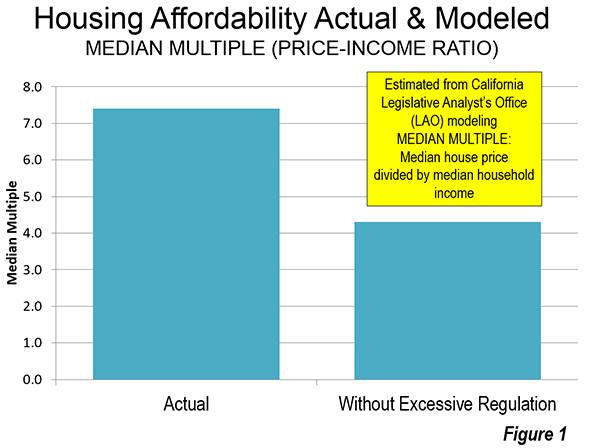
    LAO models the market situation from 1980 to 2010 to estimate the prices that would have prevailed if the regulatory environment had permitted building sufficient to satisfy customer demand at previous lower price levels. In both years, LAO estimates that the median priced house would have cost 80% more than in the rest of the nation (actual data in 1980, modeled data in 2010). This would have kept California house price increases at the national level. I think it would have been better to have modeled from 1970, before the huge house prices before 1980 described by Dartmouth economist William Fischel.

    I have applied this LAO model estimate to the median multiple for California’s six major metropolitan areas (Los Angeles, San Francisco-Oakland, Riverside-San Bernardino, San Diego, Sacramento, and San Jose) to identify how much better middle income housing affordability would be without California’s excessive regulation. Using the LAO estimates the median multiple (median house price divided by median household income) in 2014 would have been at least 40% lower than the actual level in each of the metropolitan areas (Figure 1).

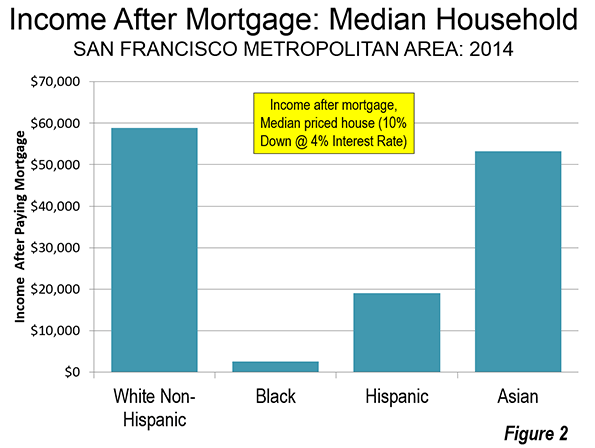
    Many California households already have been priced out of the market. In the worst case, it is estimated that in the San Francisco metropolitan area, a median income White Non-Hispanic household will have nearly $60,000 annually left over after paying the mortgage on the median priced house. This is less than they would have if house prices had remained reasonable, but it’s enough to live on. The median income Asian household would do almost as well, with about $50,000 left over. The median income Hispanic household would have less than $20,000 left, which is considerably less than is likely to be needed for other essentials. The median income Black household would have less than $3,000 left over (Figure 2). If the price ratios of 1980 were controlling, that amount would rise by $16,000.

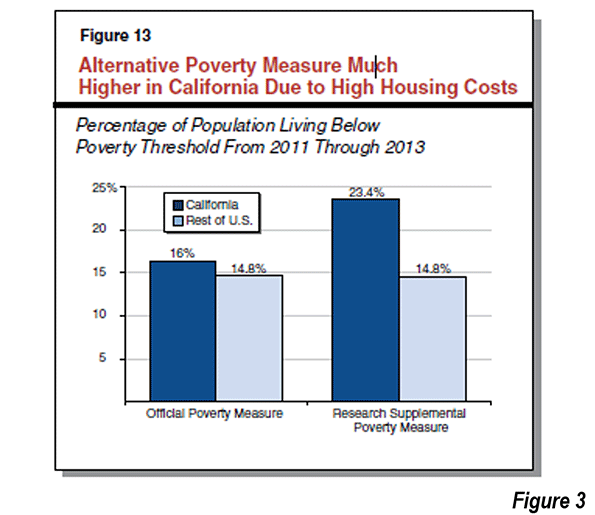
    LAO also points out that the Golden State has the highest housing cost adjusted poverty rate in the nation. The latest data shows housing-adjusted poverty rate is far higher even than that in states with a reputation for grinding poverty. California’s housing adjusted poverty rate is more than 50% higher than that of Mississippi and approaches double that of West Virginia (Figure 3, LAO Figure 13)

    LAO Consequence #2:  Postponing or Forgoing Homeownership

    LAO indicates that California ranks 48th in homeownership percentage, behind only New York and Nevada. LAO emphasizes the value of home ownership:

    Homeownership helps households build wealth, requiring them to amass assets over time. Among homeowners, saving is automatic: every month, part of the mortgage payment reduces the total amount owed and thus becomes the homeowner’s equity. For renters, savings requires voluntarily foregoing near-term spending. Due to this and other economic factors, renter median net worth totaled $5,400 in 2013, a small fraction of the $195,400 median homeowner’s net worth.

    Californians are buying their first houses later. LAO indicates that the average first home buyer in California is three years older than the national average.

    LAO Consequence #3:  Living in More Crowded Housing

    The nation’s worst overcrowding is an unfortunate result of California’s housing policies.

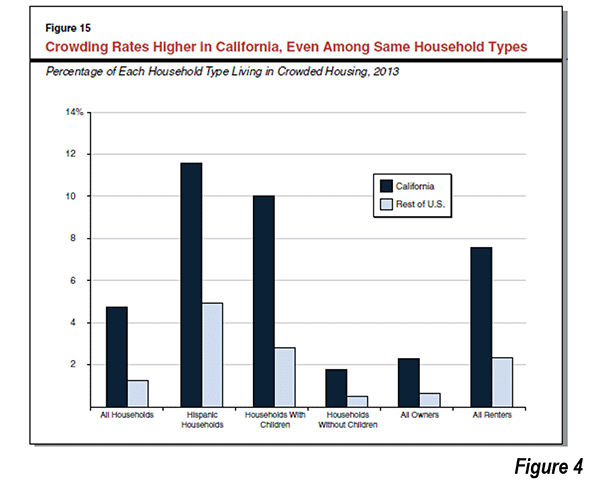
    LAO indicates that California’s overcrowding rate is well above that of the rest of the nation’s rate. Among Hispanics, which were expected to exceed the White-Non-Hispanic population in 2014, to become the state’s largest ethnic group, California overcrowding is more than 2.5 times the Hispanic rate elsewhere. Among households with children, overcrowding in California is four times the national households with children rate. Among renters, overcrowding in California is more than three times the national renter rate (Figure 4, LAO Figure 15).

    This has important negative social consequences. According to LAO, research indicates that overcrowding retards well-being and educational achievement:

    Individuals who live in crowded housing generally have worse educational and behavioral health outcomes than people that do not live in crowded housing. Among adults, crowding has been shown to increase stress and aggression, lead to social isolation, and weaken relationships between parents and their children. Crowding also has particularly notable effects on children. Researchers have found that children in crowded housing score lower on standardized math and reading exams. A lack of available and distraction-free studying space appears to affect educational achievement. Crowding may also result in sleep interruptions that affect mood and behavior. As a result, children in crowded housing also displayed more behavioral problems at school.

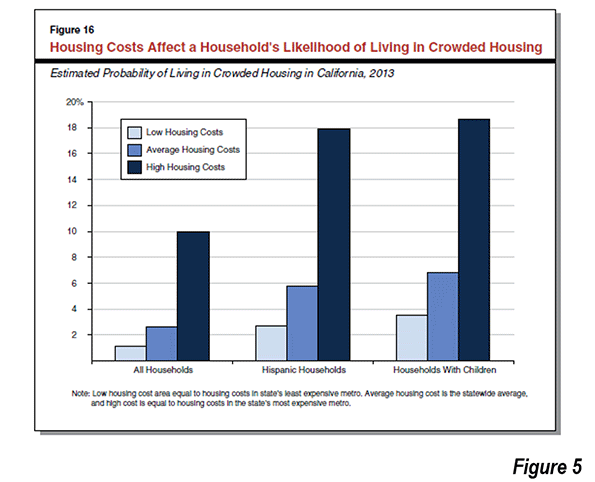
    Overcrowding is particularly acute in the higher cost coastal metropolitan areas of Los Angeles, San Francisco, San Diego, and San Jose. There, overcrowding among households with children reaches 10%, and among Hispanic households, overcrowding reaches 18%. Among households with children the figure is slightly higher (Figure 5, LAO Figure 16). Overcrowded housing is generally worse, according to LAO, in areas with higher house prices.

    In a state with a political establishment that prides itself in watching out for low income citizens and ethnic minorities, the need to reform the responsible policies could not be clearer.

    LAO Consequence #4: Commuting Farther to Work

    LAO finds that California’s average work trip commuting times are only moderately above the national average. However, LAO suggests that the commute lengthening impact of higher house prices may be reduced by California’s widespread (I call it dispersed) development pattern, its freeway system and the "above-average share of commuters who drive to work. (Driving commutes are generally fast, and therefore metros with higher shares of driving commuters tend to have shorter commute times.)"

    Nonetheless, according to LAO:

    …our analysis suggests that California’s high housing costs cause workers to live further from where they work, likely because reasonably priced housing options are unavailable in locations nearer to where they work.

    LAO Consequence #5:  Choosing to Work and Live Elsewhere

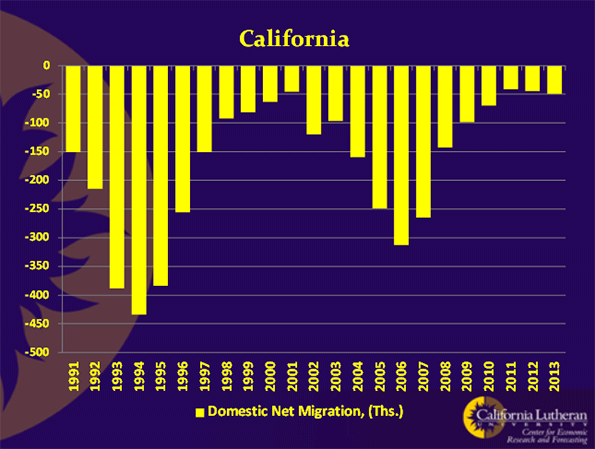
    LAO also indicates that California’s high housing prices are likely to have reduced its population (and economic) growth. LAO sites the strong net outmigration of California households to other states. LAO also finds in its national metropolitan area analysis that counties with higher growth rates tend to have better housing affordability than counties with lower growth rates.

    There has also been strong net outmigration from the coastal counties to inland counties. This is most evident in the growth of the Riverside-San Bernardino metropolitan area (the Inland Empire) between 2000 and 2010. The Inland Empire captured more than two thirds of the population growth of the Los Angeles Combined Statistical Area (Los Angeles, Orange, Riverside, San Bernardino and Ventura counties). LAO notes the impact of the excess of demand in the coastal counties, again recognizing the nexus between overzealous regulation and the loss of housing affordability:

    This competition bids up home prices and rents. Some people who find California’s coast unaffordable turn instead to California’s inland communities, causing prices there to rise as well.

    LAO also refers to the difficulty that employers have in retaining and recruiting staff. LAO cited survey data from the Silicon Valley, which has for years been California’s economic "Golden Goose" in recent years:

    In a 2014 survey of more than 200 business executives conducted by the Silicon Valley Leadership Group, 72 percent of them cited “housing costs for employees” as the most important challenge facing Silicon Valley businesses.

    In addition, there has been a strong movement of California companies to other parts of the nation, where more liberal regulations foster a better business climate.

    Restoring Housing Affordability

    LAO indicates the importance of fundamental reform and calls for putting "all policy options on the table."

    Major changes to local government land use authority, local finance, CEQA (California Environmental Quality Act), and other major polices would be necessary to address California’s high housing costs.

    In addition:

    The greatest need for additional housing is in California’s coastal urban areas. We therefore recommend the Legislature focus on what changes are necessary to promote additional housing construction in these areas.

    Perhaps the only weakness of the report deals with densification, particularly in coastal counties. For example, LAO suggests that without the housing restrictions the city of San Francisco is population would be 1.7 million, rather than the approximately 800,000 who live there today. In fact that would be unprecedented beyond belief. No core city that had become fully developed and reached 500,000 people by 1950 has achieved growth of this magnitude. The greatest growth was less than 10%, in this category of 60 core cities (which includes the city of San Francisco). Even less likely would be public support for such huge population growth in the second densest major municipality in the nation.

    While LAO does not indicate the additional population that its estimates would have placed in the core of Los Angeles, given the scale of the San Francisco increase, this could be a number of up to 3 million. This area, the broadest expanse of over 10,000 population per square mile density in the nation outside New York City is in the middle of the urban area with the nation’s worst traffic congestion, according to the Texas A&M Transportation Institute. It is doubtful that residents would have the "stomach" to expand roadway capacity to keep the traffic moving. Transit could not have made much difference. Even with its now extensive rail network that has opened since the early 1990s, driving alone accounted for 85% of the additional travel to work from 2000 to 2013 in the city of Los Angeles. Yet, the city of Los Angeles has the most extensive transit in the metropolitan area, including service by all rail lines.

    In reality, core densification is likely to be modest. Keeping housing affordability from getting worse requires regulatory liberalization throughout California, including coastal and inland areas
    The reality is that if California had permitted growth, it would naturally occurred mostly on the periphery. Even with the restrictions on building, the preference for suburban living (largely in detached housing) could not be repressed between 2000 and 2010. Less than 10% of the population growth in the Los Angeles and San Francisco Bay areas occurred in the cores.

    The Challenge

    Should the state of California begin to seriously discuss housing affordability, it will be important to ease restrictions throughout the state, not just in the coastal counties. There are serious barriers to placing the appropriate priority on improving the standard of living and minimizing poverty rates among California’s diverse population. Perhaps the biggest impediment is Senate Bill 375, which is being interpreted by the state and its regional planning agencies to require even more stringent land-use regulation.

    In this environment, LAO rightly raises this concern:

    If California continues on its current path, the state’s housing costs will remain high and likely will continue to grow faster than the nation’s. This, in turn, will place substantial burdens on Californians—requiring them to spend more on housing, take on more debt, commute further to work, and live in crowded conditions. Growing housing costs also will place a drag on the state’s economy.

    It is to be hoped that California’s distorted policy priorities will be righted to restore the California Dream.

    Photograph: Dense suburban development: Inland Empire (San Bernardino Freeway with Uplard toward the top and Ontario toward the bottom) – By author

    Wendell Cox is an international public policy consultant and principal of Demographia in St. Louis. He is a native Los Angelino, having been born within two miles of City Hall. He was appointed to three terms on the Los Angeles County Transportation Commission by Mayor Tom Bradley. Full biography is here.

  • 10 Most Affluent Cities in the World: Macau and Hartford Top the List

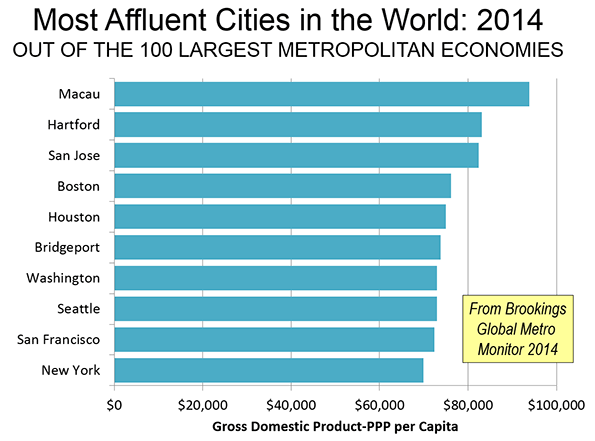
    The United States and Europe continue to dominate the list of strongest metropolitan areas (city) economies in the world, according to the Brookings Institution’s recently released Global Metro Monitor 2014. This is measured by gross domestic product per capita, adjusted for purchasing power parity (GDP-PPP). Brookings points out that this does not indicate personal income, but "proxies the average standard of living in an area."

    The Global Metro Monitor 2014 provides detailed ratings for the 300 largest metropolitan economies in the world, measured by gross domestic product adjusted for purchasing power parity. The list is defined by total size of the economy, with some cities with very high GDP-PPPs per capita, but small populations are excluded. For example, Midland, Texas, with the highest GDP-PPP per capita metropolitan area according to the United States by the Department of Commerce Bureau of Economic Analysis, is excluded.  Other cities, with large populations and low GDP-PPP s per capita were included, such as megacity Kolkata, with a GDP-PPP of $4,000, a fraction of the top 10 average of $77,000. Megacities such as Lagos, Dhaka and Kinshasa were excluded from the top 300, owing to their low GDP-PPPs per capita

    According to data in the Global Metro Monitor website and report, 90 of the top 100 cities were in the United States or Europe in 2014, 68 in the United States and 20 in Europe. The US figure matches that of the previous Global Metro Monitor (2012), while Europe has fallen from 22 to 20 cities.

    Macau: The Most Affluent City

    Last year’s most affluent city, Hartford, was replaced by Macau, which, with Hong Kong is one of China’s two special economic regions. Brookings estimates Macau’s GDP-PPP per capita at $93,849, opening a substantial lead on Hartford of more than $10,000.

    Macau’s economy has expanded rapidly the last decade, principally due to legalized gaming industry and related tourism. Macau displaced Las Vegas as the largest gaming center in 2006. According to the Las Vegas Review Journal, Macau’s gaming revenues had exploded to nearly seven times that of the Las Vegas Strip ($44.1 billion compared to $6.4 billion). Revenue declined, however, in 2014, partly due to China’s anti-corruption drive and competition from other growing East Asian centers, such as Singapore and the Philippines.

    Macau is the one of the smallest cities in the Brookings 300, with a population of only 575,000. Only three other richest cities have populations less than 600,000 including Durham, North Carolina the smallest, ranked 12th, Pennsylvania’s capital, Harrisburg (with a core city that filed for bankruptcy), ranked 25th and Scotland’s capital, Edinburgh, at ranked 37th.

    Balance of the Top 10 Cities

    As was the case last year, nine of the 10 largest GDP-PPP’s per capita were in the United States (Figure). Like Macau, the second and third ranking cities were also smaller than the average, a population of 4.7 million. Second ranked Hartford, with a GDP-PPP per capita of $83,100 has 1.1 million residents. Hartford’s economy strong in finance, especially insurance and benefits and is an important government center, as the capital of Connecticut.

    San Jose, with 1.9 million residents, ranked third, with a GDP-PPP per capita of $82,400. San Jose is home to the larger part of the world’s leading technology center, suburban Silicon Valley. Tech and University hub Boston ranked fourth.

    Leading energy hub Houston ranked as the fifth most affluent city, with a GDP-PPP per capita of nearly $75,000 (Note 1). With 6.4 million residents, Houston is the largest city among the top five. Among the top ten, only New York is larger.

    Bridgeport, Connecticut, a metropolitan area adjacent to New York that includes suburban business centers such as Stamford, Westport and Greenwich is ranked 6th.

    The balance of the top 10 also includes cities specializing in technology, finance and government. Number seven Washington has probably the world’s largest government complex   and has nurtured a huge technology center centered in the Virginia and Maryland suburbs. Seattle ranks eighth, continuing its historic leadership in the technology driven aerospace industry besides its emergence as one of leading information technology centers in the world.

    San Francisco which includes part of the Silicon Valley in its suburbs (sharing with San Jose) and has a strong social media industry in its urban core, ranks 9th. The top 10 was rounded out by New York, perennially ranked as one of the two top global cities, along with London (see: Size is not the Answer: The Changing Face of the Global City, referred to as the Global Cities Report, described further in Note 2)

    Additional Highlights

    Europe:Unlike the United States, which placed 37 of its most affluent cities in the top 50 and 31 in the second 50, Europe’s 20 most affluent economies were concentrated in the second 50, with only six in the top 50. Comparatively small Edinburgh, cited above, was the most affluent, at 37th. Paris was ranked 40th most affluent by Brookings and 3rd in the Global Cites report, just ahead of London at 42nd, the perennial global city co-leader (which was ranked number one in the Global Cities Report).

    Hong Kong:Along with Macau, China’s other special economic region, Hong Kong continued to be among the world’s most affluent, at 39th. The Global Cities Report ranked Hong Kong as the sixth Global City, with a GDP-PPP PPP higher than that of former its former imperial capital   London.

    China: Perhaps most significantly, mainland China has begun to enter the top 100. Suzhou, partly exurban to Shanghai (Kunshan), now ranks 68th. Suzhou has been the recipient of considerable business park investment, including cooperative ventures with Singapore. China’s economic prosperity may be shifting toward the Yangtze Delta (which extends from Ningbo and Hangzhou, through Shanghai to Nanjing). Along with Suzhou, Wuxi, Changzhou and Nanjing now have GDP-PPP’s per capita exceeding $30,000. By contrast, among the large manufacturing centers of the Pearl River Delta, only Shenzhen exceeds a GDP-PPP of $30,000, while Guangzhou, Dongguan and Foshan are below that level (Note 2). According to a new Economist Intelligence Unit report, Jiangsu (which includes the urban corridor from Suzhou to Nanjing) now accounts for more manufacturing employment than any other province.

    Surprisingly Low Rankings: Some cities that might have been expected to be among the world’s most affluent, ranked comparatively low. For example Tokyo, the world’s largest city, ranked fourth in the Global Cities Report, made it only to the third 50 in affluence. Seoul-Incheon, a burgeoning corporate and tech center, remained outside the top 100.

    Canada’s largest city, Toronto managed only a ranking of 100, well below the Prairie behemoths of Calgary (11th) and Edmonton (23rd). Australia’s largest city, Sydney also barely made the top 100, at 95th, far below energy and commodities capital Perth (17th).

    European cities with reputations for unusual prosperity also ranked lower than expected. Financial center Zurich was ranked 45th. Scandinavia’s most affluent city  was Stockholm (48th), followed by energy leader Oslo (62nd), Helsinki (87th) and Copenhagen, which failed to make the top 100 and ranked in the third 50. Singapore,which the Global Cities Report ranks fourth, is ranked 14th most affluent.  

    Evaluating City Performance

    Cities grow as migrants are attracted by hope for better lives. This is as true in Africa and India as it is in Europe or the United States. Cities achieve their primary purpose when they produce a higher standard of living for their residents. Some cities do very well at this, as the Brookings data indicates, and some do less well. The Global Metro Monitor provides crucial information that can be used by national, regional and local officials to measure how well their policies are performing in improving living conditions in relation to both their own past and other cities.

    Note 1: Purchasing power can vary greatly even within nations. Because of this, the United States Department of Commerce, Bureau of Economic Analysis has developed a regional price parities (RPP) program to adjust for metropolitan area costs of living. For example, in 2012, the unadjusted per capita income in San Jose was 30 percent above that of Houston. In the same year, the per capita income-RPP (or in international terms, the per capita income-PPP) in San Jose was just six percent above that of Houston, indicating cost of living at least 20 percent higher in San Jose. 

    Note 2:  Joel Kotkin was principal author of Size is not the Answer: The Changing Face of the Global City, which included contributing authors Ali Modarres, Aaron M. Renn and me. The report was jointly published by the Civil Service College of Singapore and Chapman University. The report is available here.

    Note 3: The 2012 Global Metro Monitor ranked some cities of China higher, though Note 19 expressed concerns about population data for some cities, which might have excluded migrant populations (the "floating population"). There are no such difficulties in the 2014 Global Metro Monitor.

    Wendell Cox is principal of Demographia, an international public policy and demographics firm. He is co-author of the "Demographia International Housing Affordability Survey" and author of "Demographia World Urban Areas" and "War on the Dream: How Anti-Sprawl Policy Threatens the Quality of Life." He was appointed to three terms on the Los Angeles County Transportation Commission, where he served with the leading city and county leadership as the only non-elected member. He was appointed to the Amtrak Reform Council to fill the unexpired term of Governor Christine Todd Whitman and has served as a visiting professor at the Conservatoire National des Arts et Metiers, a national university in Paris.

    Photo: St. Paul’s Church (Facade), Macau, photo by authors

  • New Class Order

    In this predictably difficult year for the Democrats, the party of the people is turning, of all people, to its plutocrats. However much the party stigmatizes right-wing billionaires like the Koch brothers, a growing proportion of America’s ultra-rich have become devoted Democrats, giving them an edge in fund-raising. Indeed, an analysis of billionaire contributors this year by Politifact found that 13 supported liberals while only nine backed Republicans.

    The left plutocracy helps explain how Harry Reid’s Democratic Senatorial Campaign Committee has greatly outraised their Republican rivals. Overall, Democratic-aligned committees have achieved a lopsided edge in fundraising – $453 million opposed to $289 million, according to Politico. Overall, the top three donors to the political Super PACs this year all lean to the left.

    Democrats counter that many Republican groups, notably the Koch-funded Americans for Prosperity, generally don’t reveal their finances. But as the New York Times’ Tom Edsall notes, “Liberals do the same, and the press in large part gives them a pass.” He points particularly to the “Democracy Alliance,” a conglomerate of some 100 very rich donors who contribute some $30 million annually to progressive organizations and causes.

    All this reflects a changing class system far more nuanced than the overworked meme about the “1 percent” arrayed against the toiling masses. Instead, we have a plutocracy increasingly divided, mostly along regional and industry lines, among themselves. It’s no surprise voters, notes columnist John Kass, are confused by this recent headline in the Chicago Tribune: “Obama decries income inequality in speech after $50,000-a-person fundraiser for Quinn.”

    The Democrats’ Plutocrats

    The Democratic plutocracy is largely rooted in such industries as telecommunications, entertainment, software, legal services and, surprisingly, a large section of Wall Street. Financial firms, such as Goldman Sachs, supported the president even before his first election. Although the firm did shift towards Mitt Romney in 2012, it maintains close, even intimate, ties to the president, as spelled out in the left-leaning Huffington Post. Wall Street has been the big winner in the Obama economy due to the Federal Reserve’s policy of ultra-low interest rates, which work to force investors into stocks.

    Others sectors also have good reasons to embrace the Democrats. Lawyers often benefit from increased regulation, although that does not apply to most businesses. Overall, legal firms have contributed more than twice as much to Democrats than they have to Republicans.

    Another powerful force for the Democrats lies in the high-tech sector. The same Fed policy that helps Wall Street asset managers also boosts venture capitalists by making investment in even dodgy start-ups irresistible. Once a minor force in campaigns, the tech firms, including software, have greatly expanded their campaign spending, up three-fold since 2000, with a tilt that, in 2012, saw Democrats harvest roughly twice as much high- tech cash as their GOP rivals.

    Most of the leading tech industry figures – Yahoo’s Melissa Mayer, Google’s Sergei Brin, venture capitalist Reid Hoffman as well as Facebook’s Mark Zuckerberg and Sheryl Sandberg – strongly tilt toward the Democrats. The grassroots nerdistan may be even more bluish; 91 percent of the contributions of Apple employees in the 2012 presidential race went to President Obama.

    Concerns over climate change are a big plus for the Democrats with Silicon Valley. Mega-figures like Google’s Eric Schmidt and Tom Steyer, a former big time investor in fossil fuels, oppose all fossil fuels, including natural gas. Apple’s CEO Tim Cook, who has Al Gore on his board, has even asked that what he considers climate change “deniers” not invest in his company.

    Silicon Valley is not just content to proselytize the masses. Firms like Google and investors have been quick to exploit the Democrats’ green politics, investing heavily in highly subsidized renewable fuels. Being green has become yet another business opportunity for some of America’s wealthiest investors and companies.

    Then there’s always geography. Most of the major Democratic plutocrats live in solidly blue states such as Washington, California, Illinois and New York, where political influence means, for the most part, appealing to Democrats.

    In contrast, being a conservative Republican in Silicon Valley avails one little; you are pretty much excluded from the biggest political events and any ideological misstep, as the former head of Mozilla learned the hard way, can lead to virtual banishment.

    The Republican Residue

    None of this suggests that the Republicans have become the new de facto populist party. The GOP still gathers in millions of dollars from big businesses, but these tend to be very different industries than those of the Democrats. Particularly prominent are fossil fuel companies, caught in the crosshairs of the White House and its regulatory apparatus. In 2012, oil and gas executives doubled their federal contributions to $70 million, with some 90 percent going to Republicans.

    This year, energy firms are again making big bets on the GOP, hoping to block environmentalist-backed regulations by helping Republicans gain a majority in the Senate.

    Republicans also do well with old-line oligarchs in agribusiness firms, home builders, casino owners, commercial banks and insurance companies. Once more divided in their loyalties, these appear to becoming increasingly GOP oriented in recent years. The party’s embattled governors have been raising millions from energy moguls like the Kochs, casino magnate Sheldon Adelson and tobacco firm Reynolds American.

    There’s also a strong regional tilt here. Most strong energy, home-building and agribusiness firms are concentrated in the middle of the country, most prominently in Texas, Oklahoma, and the Dakotas. Voters in these states, particularly Republicans, tend to be more favorable, according to Gallup, to expanding natural gas and oil production than their Democratic counterparts who are generally more partial to wind and solar.

    Other players tip the scales to the Democrats.

    Traditionally, Democrats have balanced the disproportionate business support for Republicans with strong backing from unions.

    Since 1989, six of the largest political donors have come from labor. Today, business may be effectively divided, but organized labor remains rock solid in its backing for President Obama and his party.

    Some private sector unions are upset by presidential policies on such things as Keystone XL pipeline.

    But increasingly, the dominant union force behind the Democrats is not hard-hats but public employee unions, whose power in many blue states is all but incontestable.

    Looking forward: The Gentry Liberal Ascendancy

    Despite the fund-raising shortfall, Republicans could do well this November.

    Even brilliantly targeted get-out-the-vote efforts, or effective use of social media, may not be enough to save Harry Reid’s Senate majority, and certainly will not be enough to break the GOP stranglehold on the House. But this may prove only a temporary triumph, as most long-term trends in political fund-raising favor the Democrats.

    The most profound is the movement of money away from the tangible economy – oil and gas, manufacturing, home-building, logistics – to such activities as financial transactions, digital technology, media and entertainment.

    Unless the Democratic Party rediscovers its populist soul, these sectors, and those who derive their fortunes from it, will enjoy friendly treatment from Democrats, whether in mergers, as in the case of Comcast, or in evading privacy controls, which impacts much of the social media sector.

    More important will be the progressive orientation of the trustifarians, the inheritor generation, which is just emerging from Hollywood, Silicon Valley and Wall Street.

    Already the bulk of nonprofits are now solidly liberal, with roughly 70 percent of their funds going to left-of-center causes. This trend will likely increase in the future. The new gentry – like the inheritors of the fortunes of the once-reactionary Ford, MacArthur and Rockefeller families – is likely to ignore basic business concerns and instead adopt the generally leftist culture in their favored locales.

    Ultimately, the American oligarchy is transforming in ways injurious to Republicans and favorable to the Democrats. The Supreme Court has dropped restrictions on fundraising and the economy has boosted the incomes of the super-rich, but not much for anyone else.

    That may upset Democrats in principle, but, in the long run, they are likely to be the biggest beneficiaries.

    This piece originally appeared at The Orange County Register.

    Joel Kotkin is executive editor of NewGeography.com and Distinguished Presidential Fellow in Urban Futures at Chapman University, and a member of the editorial board of the Orange County Register. His newest book, The New Class Conflict is now available at Amazon and Telos Press. He is author of The City: A Global History and The Next Hundred Million: America in 2050. His most recent study, The Rise of Postfamilialism, has been widely discussed and distributed internationally. He lives in Los Angeles, CA.

  • The Reluctant Suburbanite, Or Why San Francisco Doesn’t Always Work

    This week I’m helping a friend move house after watching her grapple with some unappealing options for the last couple of years. In the end she’s leaving San Francisco and moving to the suburbs forty-seven miles to the south. She absolutely hates the suburbs, but given all the possibilities it really is the right thing to do under the circumstances. Here’s a little background. She attended Berkeley University in the 1990′s as a foreign exchange student and fell in love with the Bay Area. She went back home, worked very hard, jumped through a million bureaucratic hoops, and eventually became a naturalized citizen. She’s lived here in San Francisco for the last fifteen years. Eight years ago she bought an apartment next door and we became good friends.

     Screen Shot 2014-11-05 at 9.30.52 PM

    Screen Shot 2014-11-05 at 10.52.01 PM Screen Shot 2014-11-05 at 10.52.46 PM Screen Shot 2014-11-05 at 11.56.50 PM   Screen Shot 2014-11-06 at 12.01.32 AM Screen Shot 2014-11-05 at 10.56.12 PM Screen Shot 2014-11-05 at 11.57.26 PM Screen Shot 2014-11-05 at 10.48.27 PM

    Over the years she went from being a starving student to having a good paying job in the tech sector. Her work was initially downtown which was an effortless ten minute commute by BART (the local rail system). But a few years back she landed a job with one of the big companies in Silicon Valley. She had absolutely no desire to schlep that far to work so one of the terms of her employment was she would work from home most of the time and appear in person at the office once in a blue moon when absolutely necessary. That arrangement worked really well in the beginning. But then the nature of her position changed, she was promoted, she got a raise, and she found herself at the office more and more often. She bought a car and endured the long miserable commute with bumper to bumper traffic that took two hours each way and left her in a foul mood. She took the so-called “Google” bus (all the tech companies have private shuttle buses but they’re all generically referred to as the “Google” bus) but there were problems with that too. The company bus takes just as long as driving. While she was able to be more productive as a WiFi enabled passenger she was still spending an extra four hours a day schlepping back and forth. This was in addition to some very long hours at the office that sometimes involved spending the night solving complex urgent problems or synchronizing with coworkers in India or Singapore. Her life essentially became her job and her commute with little room for anything else. She wasn’t happy and she wasn’t even able to enjoy the things that she loved about living in San Francisco.

    Screen Shot 2014-11-06 at 3.32.25 AM

    There’s another aspect of the situation here in San Francisco that motivated her to leave. On three separate occasions in the last year she was approached by strangers as she got on or off the company bus. One guy spit on her, another called her a (well, I won’t use the actual word here, but it’s a crude reference to a female body part) and another guy lectured her about how all the newly arrived tech people were destroying the city. She began to feel distinctly unwelcome in her own neighborhood – and by people who may not even have lived here as long as she has. The irony of the situation is that because she plans to eventually return to San Francisco she needs to keep her apartment. She can’t sell it because she may never be able to afford to buy a new place here. But she can’t rent it either because local regulations make it extraordinarily difficult to remove tenants once they get settled in. In effect she wouldn’t be able to move back into her own home without a significant amount of sturm and drang and a big financial and legal battle. She’d love to rent the place for a few years so the rental income would cover her mortgage, but instead she’s leaving her apartment empty and paying both the city and suburban mortgages. It’s the only logical thing to do under the circumstances. The ordinances that are designed to protect renters are working to take units off the market since no sane person wants to be a landlord in the city.

    You might ask why she doesn’t just quit her job. She did consider it. But she does a very specific kind of thing and doesn’t want to give up her position and the challenges that only a particular kind of company can provide. If she wants to continue in her career she’s most likely going to have to work for one of the other big companies in the southern suburbs. The job wasn’t the problem. The commute was. Now I can picture some of you out there rolling your eyes about this woman and her “problems”. Poor baby. But her dilemma is very similar to a lot of people who need to stay in a job for all sorts of reasons. For example, I know teachers and cops who are so over their jobs, but they’ve been plugging away for an eternity and they just need to hang in there for a few more years in order to collect a full pension. I know other people who lost their jobs and are now forced to do work elsewhere in order to make ends meet. People have their reasons and it’s hard to argue when you start poking at the particulars.

    Screen Shot 2014-11-06 at 2.22.17 AM  Screen Shot 2014-11-06 at 2.21.37 AM Screen Shot 2014-11-06 at 2.48.31 AM Screen Shot 2014-11-06 at 2.46.56 AM Screen Shot 2014-11-06 at 2.47.07 AM Screen Shot 2014-11-05 at 9.32.48 PM Screen Shot 2014-11-05 at 9.48.08 PM

    So here’s what her new place is like. The house is a 1947 tract home with a patch of front lawn and a wee little back yard. She’s got two bedrooms and two baths. It’s cute and she and I agree that it’s very comfortable and has everything most people would want or need in a home. And at $645,000 it’s significantly bigger and less expensive than her one bedroom apartment in the city which is estimated at around $850,000. (She didn’t pay anything like that eight years ago, but prices have skyrocketed lately.) The really important thing about this house is its location a mile from her office. She could ride a bicycle to work if she wanted to, although she will almost certainly drive or take the light rail. It’s physically possible to ride a bike, but it isn’t necessarily safe or pleasant given the wide roads and high speed of the cars and trucks whizzing by. In fact, once you step off the front lawn there really isn’t anything in her neighborhood that’s even remotely worth walking to or as pleasant as what she’s leaving behind in San Francisco. The only place to buy milk and eggs was the corner gas station. But here’s where it gets interesting…

    Screen Shot 2014-11-06 at 2.50.13 AM Screen Shot 2014-11-06 at 2.50.59 AM Screen Shot 2014-11-06 at 2.55.41 AM Screen Shot 2014-11-06 at 2.54.48 AM Screen Shot 2014-11-06 at 2.55.15 AM

    I asked her where she’d eat since the only places in evidence were drive-thru fast food joints and low end chain restaurants in strip malls. She explained that her company (like all the companies in Silicon Valley) provides a variety of high quality heavily subsidized restaurants within the corporate campus. In fact she invited me to explore the place and we had lunch together a couple of times. Once I registered, went through security, and entered the complex there was an entire self-contained world to explore. These places employ tens of thousands of people from all over the world. At lunch there was excellent dim sum, samosas, saag paneer, dolmas, kibbeh, long salad bars, boreks, beef steaks and potatoes – all locally sourced, organic, seasonal, and beautifully prepared by professional chefs. Kosher? Sure. Halal? No problem. Vegetarian? Of course. Special menu for Diwali? You bet. It was all very good and ridiculously inexpensive. Breakfast, lunch, dinner, late night healthy snacks… they have it covered. We dined indoors, but most people drifted out to one of the many al fresco areas. As we walked from building to building I noticed well populated lounges for relaxation and socializing, Starbucks, volleyball courts, pool tables. There’s a farmers market in the parking lot. There’s a dry cleaners. A masseuse or manicurist can be summoned if need be. These companies have essentially taken over the functions of a town and provided them internally for their employees. Partly they do these things to keep their workers happy. Partly it keeps people at work longer than they might otherwise be willing to stay. But on a fundamental level these companies must know that their location in soul crushing sprawl is so lifeless and unsatisfying that they need to compensate by recreating all the aspects of a real town inside the landscaped berms of low rise office parks. And what about the people who live in the area but don’t work for one of these companies and don’t have security clearance to enjoy the buffet and foreign cinema night?

    I understand why she’s moving, but I wouldn’t want to live there myself.

    John Sanphillippo lives in San Francisco and blogs about urbanism, adaptation, and resilience at granolashotgun.com. He’s a member of the Congress for New Urbanism, films videos for faircompanies.com, and is a regular contributor to Strongtowns.org. He earns his living by buying, renovating, and renting undervalued properties in places that have good long term prospects. He is a graduate of Rutgers University.

  • Silicon Valley’s Giants Are Just Gilded Age Tycoons in Techno-Utopian Clothes

    Silicon Valley’s biggest names—Google, Apple, Intel and Adobe—reached a settlement today in a contentious $3 billion anti-trust suit brought by workers who accused the tech giants of secretly colluding to not recruit each other’s employees. The workers won, but not much, receiving only a rumored $300 million, a small fraction of the billions the companies might have been forced to pay had they been found guilty in a trial verdict. 

    The criminality that the case exposed in the boardrooms the tech giants, including from revered figures like Steve Jobs who comes off as especially ruthless, should not be jarring to anyone familiar with Silicon Valley.  It may shock much of the media, who have generally genuflected towards these companies, and much of the public, that has been hoodwinked into thinking the Valley oligarchs represent a better kind of plutocrat—but the truth is they are a lot like the old robber barons.

    Starting in the 1980s, a mythology grew that the new tech entrepreneurs represented a new, progressive model that was not animated by conventional business thinking. In contrast to staid old east coast corporations, the new California firms were what futurist Alvin Toffler described as “third wave.” Often dressed in jeans, and not suits, they were seen as inherently less hierarchical and power-hungry as their industrial age predecessors.  

    Silicon Valley executives were not just about making money, but were trying, as they famously claimed, to “change the world.” One popularizing enthusiast, MIT’s Nicholas Negroponte, even suggested that “digital technology” could turn into “a natural force drawing people into greater world harmony.”

    This image has insulated the tech elite from the kind of opprobrium meted out to their rival capitalist icons in other, more traditional industries. In 2011, over 72 percent of Americans had positive feelings about the computer industry as opposed to a mere 30 percent for banking and 20 percent for oil and gas. Even during the occupy protests in 2012, few criticisms were hurled by the “screwed generation” at tech titans. Indeed, Steve Jobs, a .000001 per center worth $7 billion, the ferocious competitor who threatened “war” against Google if they did not cooperate in his wage fixing scheme, was openly mourned by protestors when news spread that he had passed away.

    But the collusion case amply proves what has been clear to those watching the industry: greed and the desire to control drives tech entrepreneurs as much as any other business group. The Valley is great at talking progressive but not so much in practice. In the very place where private opposition to gay marriage is enough to get a tech executive fired, the big firms have shown a very weak record of hiring minorities and women. And not surprisingly, firms also are notoriously skittish about revealing their diversity data. A San Jose Mercury report found that the numbers of Hispanics and African Americans employees in Silicon Valley tech companies, already far below their percentage in the population, has actually been declining in recent years. Hispanics, roughly one quarter of the local labor force, account for barely five percent of those working at the Valley’s ten largest companies. The share of women working at the big tech companies – despite the rise of high profile figures in management—has also showed declines.    

    In terms of dealing with “talent,” collusion is not the only way the Valley oligarchs work to keep wages down.  Another technique is the outsourcing of labor to lower paid foreign workers, the so called “techno-coolies.” The tech giants claim that they hire cheap workers overseas because of a critical shortage of skilled computer workers but that doesn’t hold up to serious scrutiny. A 2013 report from the labor-aligned Economic Policy Institute found that the country is producing 50% more IT professionals per year than are being employed. Tech firms, notes EPI, would rather hire “guest workers” who now account for one-third to one half of all new IT job holders, largely to maintain both a lower cost and a more pliant workforce.

    Some of this also reflects a preference for hiring younger employees at the expense of older software and engineering workers, many of whom own homes and have families in the area.  

     “I want to stress the importance of being young and technical,” Facebook’s CEO Mark Zuckerberg said at an event at Stanford University in 2007. “Young people are just smarter. Why are most chess masters under 30? I don’t know. Young people just have simpler lives. We may not own a car. We may not have family. Simplicity in life allows you to focus on what’s important.”

    Of course what’s really “important” to Zuckerberg, like moguls in any time and place, is maximizing profits and raking in money, both for themselves and their investors. The good news for the bosses has been that employees are rarely in the way.  Unlike the aerospace, autos or oil industries, the Valley has faced little pressure from organized labor, which has freed them to hire and fire at their preference.  Tech workers wages, on the other hand, have been restrained both by under the table agreements and the importation of “technocoolies.”

    Rather than being a beacon of a new progressive America, the Valley increasingly epitomizes the gaping class divisions that increasingly characterize contemporary America.  Employees at firms like Facebook and Google enjoy gourmet meals, childcare services, even complimentary house-cleaning to create, as one Google executive put it, “the happiest most productive workplace in the world.” Yet, the largely black and Hispanic lower-end service workers who clean their offices, or provide security, rarely receive health care or even the most basic retirement benefits. Not to mention the often miserable conditions in overseas factories, notably those of Apple.

    It’s critical to understand that the hiring restrictions exposed by Friday’s settlement, reflect only one part of the Valley’s faux progressiveness and real mendacity. These same companies have also been adept at circumventing user privacy and avoiding their tax obligations.

    One might excuse the hagiographies prepared by the Valley’s ever expanding legion of public relations professionals, and their media allies,  but the ugly reality remains. The  Silicon Valley tech firms tend to be  every bit as cutthroat and greedy as any capitalist enterprise before it. We need to finally see the tech moguls not as a superior form of oligarch, but as just the latest in long line whose overweening ambition sometimes needs to be restrained, not just celebrated.

    This story originally appeared at The Daily Beast.

    Joel Kotkin is executive editor of NewGeography.com and Distinguished Presidential Fellow in Urban Futures at Chapman University, and a member of the editorial board of the Orange County Register. He is author of The City: A Global History and The Next Hundred Million: America in 2050. His most recent study, The Rise of Postfamilialism, has been widely discussed and distributed internationally. He lives in Los Angeles, CA.

  • Focusing on People, Not Sprawl

    For seven decades urban planners have been seeking to force higher urban population densities through urban containment policies. The object is to combat "urban sprawl," which is the theological (or ideological) term applied to the organic phenomenon of urban expansion. This has come at considerable cost, as house prices have materially increased relative to incomes, which is to be expected from urban containment strategies that ration land (and thus raise its price, all things being equal).

    Smart Growth America is out with its second report that rates urban sprawl, with the highest scores indicating the least sprawl and the lowest scores indicating the most (Measuring Sprawl 2014).

    Metropolitan Areas and Metropolitan Divisions

    For the second time in a decade Smart Growth America has assigned a "sprawl" rating to what it calls metropolitan areas. I say "what it calls," because, as a decade ago, the new report classifies "metropolitan divisions" as metropolitan areas (Note 1). Metropolitan divisions are parts of metropolitan areas. This is not to suggest that a metropolitan division cannot have a sprawl index, but metropolitan divisions have no place in a ranking of metropolitan areas. Worse, metropolitan areas with metropolitan divisions were not rated (New York, Los Angeles, Chicago, Dallas-Fort Worth, Philadelphia, Washington, Miami, San Francisco, Detroit, and Seattle).

    This year’s highest rating among 50 major metropolitan areas (over 1,000,000 population) goes to part of the New York metropolitan area (the New York-White Plains-Wayne metropolitan division) at 203.36. The lowest rating (most sprawling) is in Atlanta, at 40.99. This contrasts with 2000, when the highest rating was in part of the New York metropolitan area (the New York PMSA), at 177.8, compared to the lowest, in the Riverside-San Bernardino PMSA portion of the since redefined Los Angeles metropolitan area, at 14.2. Boston is excluded due to insufficient data (Note 2)

    Rating Sprawl

    The sprawl ratings are interesting, though obviously I would have done them differently.

    Overall urban population density would seem to be a more reliable indicator (called urbanized areas in the United States, built-up urban areas in the United Kingdom, population centres in Canada, and urban areas just about everywhere else). For example, the Los Angeles metropolitan area (combining its two component metropolitan divisions), has an index indicating greater sprawl than Springfield, Illinois. Yet, the Los Angeles urban area population density is about four times that of Springfield (6,999 residents per square mile, compared to 1747 per square mile, approximately the same as bottom ranking Atlanta). The implication is that if Los Angeles were to replicate the individual ratings that make up its index, and covered (sprawled) over four times as much territory, it would be less sprawling than today.

    This case simply illustrates the fact that sprawl has never been well defined. Indeed, the world’s most dense major urban area, Dhaka (Bangladesh), with more than 15 times the urban density of Los Angeles and 65 times the urban density of Springfield, has been referred to in the planning literature as sprawling.

    Housing Affordability

    The principal problem with the report lies with its assertions regarding housing affordability. Measuring Sprawl 2014 notes that less sprawling areas have higher housing costs than more sprawling areas (Note 3). However, it concludes that the lower costs of transportation offset much more all of the difference. This conclusion arises from reliance the US Department of Housing and Urban Development (HUD) and US Department of Transportation (DOT) Location Affordability Index, which bases housing affordability for home owners on median current expenditures, not the current cost of buying the median priced home. Nearly two thirds of the nation’s households are home owners, and most aspire to be.

    HUD-DOT describes its purpose as follows:

    "The goal of the Location Affordability Portal is to provide the public with reliable, user-friendly data and resources on combined housing and transportation costs to help consumers, policymakers, and developers make more informed decisions about where to live, work, and invest." 

    Yet, a consumer relying on the Location Affordability Index could be seriously misled. The HUD-DOT index (Note 4) does not begin to tell the story to people seeking to purchase homes. The costs are simply out of pocket housing costs, regardless of whether the mortgage has been paid off and regardless of when the house was bought (urban containment markets have seen especially strong house price increases).An index including people who have no mortgage and people who have lower mortgage payments as a result of having purchased years ago cannot give reliable information to consumers in the market today.

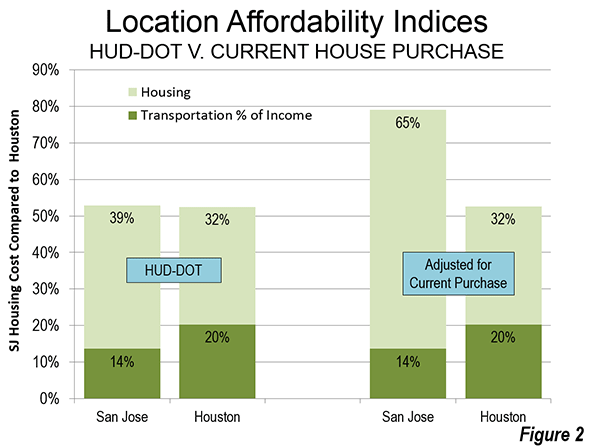
    A household relying on this source of information would be greatly misled. For example, comparing Houston with San Jose, according to HUD-DOT, owned housing and transportation consume virtually the same share of the median household income in each of the two metropolitan areas. In Houston, 52.5 percent of income is required for housing and transportation, while the number is marginally higher than San Jose (52.9 percent).

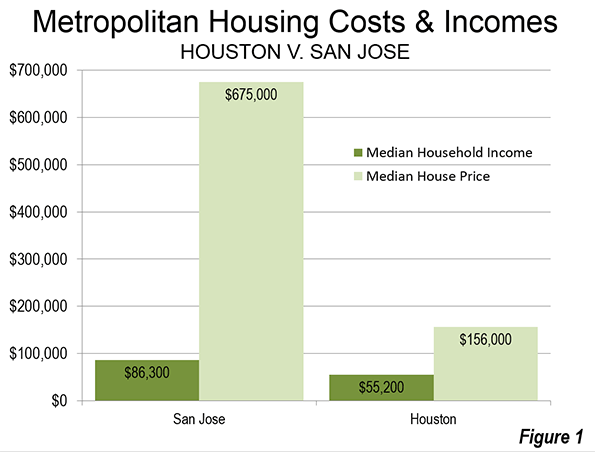
    But the HUD-DOT numbers reflect nothing like the actual costs of housing in San Jose relative to Houston. The median price house in Houston was approximately $155,000, 2.8 times the median household income of $55,200 (this measure is called the median multiple) during the 2006-10 period used in calculating the HUD-DOT index. In San Jose, the median house price was approximately $675,000, 7.8 times the median household income of $86,300 (Figure 1).

    If the Location Affordability Index reflected the real cost for a prospective home owner (HUD-DOT costs including a market rate mortgage for the house), a considerable difference would emerge between San Jose and Houston. The combined San Jose Location Affordability Index for home owners would rise to 85 percent of median household income, a full 60 percent above the Houston figure, rather than the minimal difference of less than one percent indicated by HUD-DOE (Figure 2).

    Under-Estimating the Cost of Urban Containment

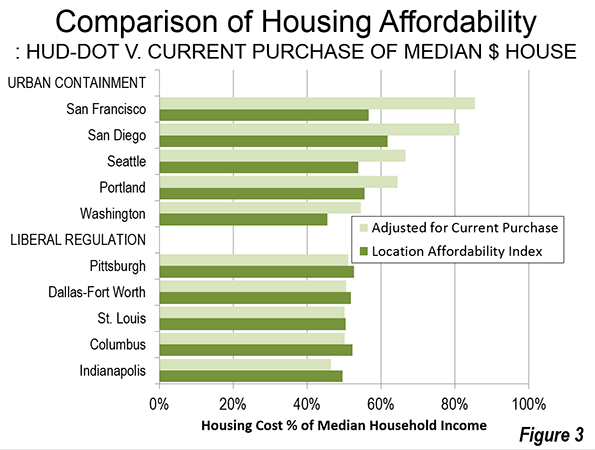
    There is a substantial difference between the HUD–DOT housing and transportation cost and the actual that would be paid by prospective buyers. Five selected urban containment markets indicate a substantially higher actual housing cost than reflected in the HUD–DOT figures. On the other hand, in the selected liberally regulated markets (or traditionally regulated markets), the HUD–DOE figure is much closer to the current cost of home ownership (Figure 3). This is a reflection of the greater stability (less volatility) of house prices in liberally regulated markets. Overall, based on data in the 50 major metropolitan areas, owned housing costs relative to incomes rise approximately 6 percent for each 10 percent increase in the sprawl index – that is, less sprawl is associated with higher house prices relative to incomes (Note 6).

    The increasing impacts of urban containment’s housing cost increases have been limited principally to households who have made recent purchases. The effect will become even more substantial in the years to come as the turnover of the more expensive housing stock continues.

    Granted, the 2006 to 2010 housing data includes part of the housing bubble and its higher house prices. However, house prices relative to incomes have returned to levels at or above that recorded during the period covered by Measuring Sprawl 2014 in "urban containment" markets, such as San Francisco, San Jose, Los Angeles, San Diego, Seattle, Portland, and Washington.

    Economic Mobility and Human Behavior

    Another assertion requires attention: economic mobility is greater in less sprawling metropolitan areas. The basis is research by Raj Chetty and Nathaniel Hendren of Harvard University and Patrick Kline and Emmanuel Saez of the University of California, Berkeley. However, the realities of domestic migration suggest caution with respect to the upward mobility conclusions, as is indicated in Distortions and Reality About Income Mobilityand in commentary by Columbia University urban planner David King.

    Virtually all urban history shows city growth to have occurred as people have moved to areas offering greater opportunity. Jobs, not fountains, theatres and art districts, drive nearly all the growth of cities. This means that there should be a strong relationship between the cities net domestic migration and the economic mobility conclusions of the research. The strongest examples show the opposite relationship.

    Domestic migration is strongly away from some metropolitan areas identified in the research as having the greatest upward income mobility also had substantial net domestic migration losses. For example, despite claims of high economic mobility New York, Los Angeles and the San Francisco Bay area, each lost approximately 10 percent of their population to net domestic migration in the 2000s. On the other hand, some metropolitan areas scoring the lowest in upward economic mobility drew substantial net domestic migration gains. For example, low economic mobility Charlotte and Atlanta gained 17 percent and 10 percent due to net domestic migration in the 2000s. Thus, the results of the economic research appear to be inconsistent with expected human behavior (Note 7).

    Sprawl: An Inappropriate Priority

    The new sprawl report is just another indication that urban planning policy has been elevated to a more prominent place than appropriate among domestic policy priorities. The usual justification for urban containment is a claimed sustainability imperative for its densification and anti-mobility policies. Yet, these policies are hugely expensive and thus ineffective at reducing greenhouse gas emissions, and thus have the potential to unduly retard economic growth (read "the standard of living and job creation"). Far more cost-effective alternatives are available, which principally rely on technology.

    There is a need to reverse this distortion of priorities. Little, if anything is more fundamental than improving the standard of living and reducing poverty (see Toward More Prosperous Cities). Housing is the largest element of household budgets and policies of that raise its relative costs necessarily reduce discretionary incomes (income left over after paying taxes and paying for basic necessities). There is no legitimate place in the public policy panoply for strategies that reduce discretionary incomes.

    London School of Economics Professor Paul Cheshire may have said it best, when he noted that urban containment policy is irreconcilable with housing affordability.

    ———

    Note 1: The previous Smart Growth America report used primarily metropolitan statistical areas (PMSAs), which have been replaced by metropolitan divisions. The primary metropolitan statistical areas were also subsets of metropolitan areas (labor market areas). This is problem is best illustrated by the fact that the Jersey City PMSA, composed only of Hudson County, NJ, is approximately one mile across the Hudson River from Manhattan in New York. Manhattan is the world’s second largest central business district and frequent transit service connects the two. Obviously, Jersey City is a part of the New York metropolitan area (labor market area), not a separate labor market.

    Note 2: Because of incomplete data, Boston is not given a sprawl rating in Measuring Sprawl 2014. A different rating system in the previous edition resulted in a Boston rating among the least sprawling. Yet, the Boston metropolitan area is characterized by low density development. Outside a 10 mile radius from downtown, the population density within the urban area is slightly lower than that of Atlanta (same square miles of land area used).

    Note 3: Higher house prices relative to household incomes are more associated with policies to control urban sprawl (such as urban growth boundaries and other land rationing devices), than with the extent of sprawl. More compact (less sprawling) urban areas do not necessarily have materially higher house prices. For example, in 1970, the Los Angeles urban area was one of the most dense in the United States, yet it was within the historical affordability range (a median multiple of less than 3.0). The emergence of Los Angeles as the nation’s most dense urban area in the succeeding decades (and 30 percent increase in density) is largely the result of a change in urban area criteria. Through 1990, the building blocks of urban areas were municipalities, which meant that many square miles of San Gabriel Mountains wilderness were included, because it was in the city of Los Angeles. Starting in 2000, the building blocks or urban areas became census blocks, which are far smaller and thus exclude the large swaths of rural territory that were included before in some urban areas.

    Note 4: The transport costs from the Location Affordability Index are accepted for the purposes of this article.

    Note 5: The current purchase housing cost is based on the average price to income multiple over the period of 2006 to 2010, relative to the median household income (calculated from quarterly data from the Joint Center for Housing Studies of Harvard University, State of the Nation’s Housing 2011). It is assumed that the buyer would finance 90 percent of the house cost at the average 30 year fixed mortgage rate with points over the period. The 10 percent down payment is allocated annually in equal amounts over the 360 months (30 years). The final annual cost estimate is calculated by adding the monthly mortgage payment and down payment allocation to the median monthly housing cost in each metropolitan area for households without a mortgage.

    HUD-DOT uses the "selected monthly owner cost" from the American Community Survey (ACS) for its cost of home ownership. According to ACS, “Selected monthly owner costs are calculated from the sum of payment for mortgages, real estate taxes, various insurances, utilities, fuels, mobile home costs, and condominium fees."

    Note 6: This is based on a two-variable regression estimation (log-log) with the sprawl index as the independent variable and the substituted housing share of income as the dependent variable for the 50 largest metropolitan areas (excluding Boston), It is posited that most of the variation in housing costs is accounted for by variation in land costs. Other significant factors, such as construction costs and financing costs in this sample vary considerably less. A sprawl index for each metropolitan areas represented by metropolitan divisions (not provided in the sprawl report) is estimated by population weighting.

    Note 7: Another difficulty with that research is that it measured geographic economic mobility at age 30, well before people reach their peak earning level. This is likely to produce less than reliable results, since those who achieve the highest incomes as well as the most educated such as medical doctors and people with advanced degrees) are likely to have larger income increases after age 30 than other workers.

    Wendell Cox is principal of Demographia, an international public policy and demographics firm. He is co-author of the “Demographia International Housing Affordability Survey” and author of “Demographia World Urban Areas” and “War on the Dream: How Anti-Sprawl Policy Threatens the Quality of Life.” He was appointed to three terms on the Los Angeles County Transportation Commission, where he served with the leading city and county leadership as the only non-elected member. He was appointed to the Amtrak Reform Council to fill the unexpired term of Governor Christine Todd Whitman and has served as a visiting professor at the Conservatoire National des Arts et Metiers, a national university in Paris.

    Suburban neighborhood photo by Bigstock.

  • East of Egan: Success in California is Not Evenly Distributed

    The New York Times ran a Timothy Egan editorial on California on March 6.  The essay entitled Jerry Brown’s Revenge was reverential towards our venerable Governor.  It did, however, fall short of declaring Brown a miracle worker, as the Rolling Stone did last August.  These and other articles are part of an adoring press’s celebratory spasm occasioned by the facts that California has a budget surplus and has had a run of strong job growth.

    Egan at least pauses in his panegyrical prose to mention that all is not perfect in California:

    Without doubt, California has serious structural problems, well beyond the byzantine hydraulic system that allows the state to flourish. For all the job growth, the unemployment rate is one of the highest in the nation. It has unsustainable pension obligations, a bloated public-employee sector led by the prison guard union. And it is so expensive to live here that clashes over the class divide are threatening to get nasty.

    That’s not the worst of it.  Before going there, though, let’s consider Brown’s most celebrated achievement, a budget surplus. 

    California has a budget surplus because of a temporary income tax on its highest earning citizens and because of large capital gains reaped during an amazing year for stocks.  The S&P 500 was up almost 30 percent last year, an event unlikely to be repeated.  California’s tax revenues are excessively dependent on a relatively few wealthy tax payers.  This makes revenues extremely volatile.  When these tax payers do well, Sacramento is flush with cash.  When the high end tax payers don’t do well, Sacramento has very serious problems.

    By increasing California’s reliance on a few wealthy tax payers, Brown’s tax increase made California’s revenues more volatile.  The ongoing bull stock market would have generated higher tax revenues for California without the tax increase.  It generated even more with the tax increase.  When a bear market comes, the state will again face deficits.  This is one reason that Standard and Poors ranks California’s credit as second worst in the country, only above Illinois.

    So far, to his credit and in stark contrast to what we saw in the dot-com boom under Gray Davis, Jerry Brown has, with the exception of his pet project, the high-speed train, effectively resisted the legislature’s knee-jerk impulse to increase long-term spending commitments.  What he has not done is perhaps more important: addressing California’s other financial issues, the ones that are contributing to California’s dismal credit rating.

    California has had several quarters of stronger-than-the-nation job growth, but is still 113,500 jobs below the level in 2007; in contrast Texas is 844,300 jobs above that number.  

    Nor can it be sure that growth will continue. Unfortunately, the day after Egan’s celebratory essay, California’s Economic Development Department announced that the state had lost 31,600 jobs in January.  That’s an initial estimate, and it will be changed, but it’s hard to tell which direction.  The data released with that estimate appear to be a bit of a mess and are internally inconsistent.  We’ve asked for some clarification.

    Regardless of the most recent data point, California’s job performance has been better than expected, and we should all be thankful for that.  However, comparison with the United States average is not the only metric.  Comparison with California’s potential is the correct metric, and there California is underperforming in a big way.  Given all of its advantages, California should be leading the nation in job creation and opportunity.

    California has been averaging about 27,000 new jobs a month over the most recent 12 months for which we have data.  It should be averaging at least 40,000.  This would be slightly more than Texas’ average of 33,900,.  But, it still represents only 3.2 percent job growth, well below Texas’ 3.7 percent job growth rate.

    The state is sitting over estimated oil reserves that are about four times as large as the Bakken Shield, a major contributor to North Dakota’s boom.  Any serious effort to tap that resource would generate huge numbers of jobs.  Many of those jobs would be high wage positions for less educated workers who were hurt the most by the recession.

    California has many advantages over North Dakota, or Texas for that matter, besides oil.  These are well known and include location between Pacific Rim producers and the world’s largest consumer market, ports, workforce, and climate.  Even without oil, we should be doing better.  Policy though, particularly environmental policy, is restraining the state’s job creation.

    Egan makes a big deal of migration.  Here is his first paragraph (emphasis is his):

    Let’s review. Just a few years ago California was a punching bag for conservative scolds — a failed state, profligate with its spending and promiscuous with its ambition. Ungovernable. And everybody’s leaving.

    Later, he returned to the topic:

    Third, the great exodus never happened. Since the dawn of the recession, the state has added about 1.5 million people — almost three Wyomings. And yes, 67,702 people moved from California to Texas in 2012. But 43,005 people moved from Texas to California. (Population growth is not necessarily a good thing, especially in this overstuffed state, but that’s another topic).

    This is really curious.  A whopping 57 percent more people moved from California to Texas than moved from Texas to California, which was the case for decades.  This is an argument that people aren’t leaving California?  California’s population is up 1.5 million?  California’s population growth is mostly a result of California’s fertile young people.  Census data show that California’s domestic migration has been negative for over 20 consecutive years.   It may not be The Great Exodus, but it’s a reversal of about a 150 year of migratory trend.

    Then there is poverty and unemployment.  Poverty, unemployment and lack of opportunity are why California’s domestic migration data is negative.  Lack of opportunity may be hard to measure, but we have lots of data on unemployment and poverty.   Some examples:

    • San Bernardino has the second highest poverty rate of any major U.S. metropolitan areas.  Only Detroit is worse.
    • California, with about 12 percent of the U.S. population, has 34 percent of U.S. welfare recipients.
    • Two California counties, the geographically separated Colusa and Imperial, have unemployment rates over 20 percent.
    • Thirty-one of California’s 58 counties have unemployment rates in double digits.

    The geographic distribution of California’s poverty is one reason many people fail to understand California.  Most of California’s poverty is concentrated in regions where the political class —or wayfaring editorialists — seldom venture.  It’s mostly inland, not where most of California’s elite live or travel.  If you stay on the 101 corridor, or hug scenic Route 1, it’s easy to avoid.  You can find it, but you have to have eyes that are open to it, and it helps if you get off the beaten path. 

    Egan wrote his piece in Santa Barbara, where life can be as good as it gets, particularly for the affluent and boomers who bought their homes decades ago.  But, the city of Guadalupe in Santa Barbara County could give him a taste of how the other half lives. Just take a look sometime: it’s about as hardscrabble a town as the Texas town in the movie “The Last Picture Show”.

    California’s poverty is harder to ignore along the 99, but is even more evident in roads like 33 which winds along the eastern side of the coastal range.  Go there, and you will find it hard to believe that you are still in the United States, much less California.  There you will find grinding, hopeless poverty more reminiscent of the Third World than the center of the economic jobs.

    A high speed train won’t help these people.  Neither will Silicon Valley tech jobs, even if they don’t shrink in the inevitable social media shakeout.  Neither will Sacramento, apparently.  Until we start doing something for the state’s huge and struggling working and middle class, and that means creating opportunity for them, we should refrain from congratulating ourselves and each other for our good work.

    Bill Watkins is a professor at California Lutheran University and runs the Center for Economic Research and Forecasting, which can be found at clucerf.org. A slightly different version of this story appeared in CLU Center for Economic Research and Forecasting’s September, 2013 California Economic Forecast.

  • Bubble Trouble in Silicon Valley

    Third-generation venture capitalist Tim Draper believes he has a solution for California’s problems that will make the Silicon Valley safe for its wealthy: secession. In a recent interview, Draper suggested that California be divided into six states, including one dominated by the Valley and its urban annex, San Francisco.

    By jettisoning California’s deeply troubled components – the Central Valley, the Inland Empire, Los Angeles – the Silicon Valleyites can create their own enclave, where incomes will be far higher – $63,288 per capital compared with the $46,477 for the whole state. If adopted, Draper’s proposal would mean our self-styled cognitive leaders wouldn’t have to deal with interior California’s massive poverty, double-digit unemployment, farmer demands for scarce water supplies or manufacturers seeking reasonable energy prices.

    Yet, for some in the Valley, Draper’s proposals don’t go far enough. Another venture capitalist recently suggested that the Valley do away with this whole United States thing entirely and form its own Republic. “We need to run the experiment, to show what a society run by Silicon Valley looks like,” venture capitalist Chamath Palihapitiya argued.

    The notion here is that Silicon Valley might do best if detached from the limitations of American citizenship, with firms essentially running their own countries from islands or man-made, offshore facilities, as proposed by libertarian investor Peter Thiel. What the Valley wants, then, is to be left alone – unencumbered by the masses – so that the clever crowd can live with low taxes, in a perfectly socially liberated environment, but without the encumbrances that come with having to worry about the less-cognitively gifted.

    “People,” as technology author Jaron Lanier has noted, “are the flies in Moore’s Law’s ointment.”

    This can be seen in the growing pushback over such things as massive wealth accumulation for dubiously useful ventures, and egregious privacy violations. The luxurious Google employee buses shuttling in and out of San Francisco are resented by some residents stuck riding the often poorly maintained, sometimes awful Muni.

    One top venture capitalist, Thomas Perkins was so upset over what he sees as scapegoating of the rich that he compared their condition to Jews in Nazi Germany. His directness upset some, but may have expressed more of what is really thought by smoother, younger, more PC-conscious executives.

    This is more than simply the usual case of rich people being out of touch. These are not media constructs like Kim Kardashian or Paris Hilton but very powerful, incredibly wealthy people who increasingly are a dominant force in California and national politics. Yet, their political positions often have a “let them eat cake” character. And to be sure, some new oligarchs lean right, mostly on the libertarian side, but these are a distinct minority. The notion of some in the Republican Party who see the Valleyites as saviors is nothing short of delusional.

    For the most part, executive and workers at firms such as Google, Apple, Facebook and Twitter are strong proponents of every politically correct idea from climate change legislation to opposing the expansion of suburbia and favoring gay marriage. Yet they are also becoming the wealthiest entities in the nation; besides GE, a classic conglomerate, the largest cash hoards now belong to Apple, Microsoft, Cisco, Oracle and Google, all of which sometimes have more dollars on hand than the U.S. government. Seven of the eight biggest individual winners from stock gains in 2013 were tech entrepreneurs. They were led by Amazon’s Jeff Bezos, who added $12 billion to his paper wealth; Mark Zuckerberg, who raked in an additional $11.9 billion; and Google co-founders Sergey Brin and Larry Page, who each gained roughly $9 billion.

    Given their phenomenal wealth, one observer compared Silicon Valley politics to those of a mall outlet selling Che Guevara t-shirts. They no doubt nod their heads when President Obama speaks of economic inequality, but when it comes to doing something about it, their general response is: Nevermind.

    However they color themselves politically, the oligarchs live above and apart from the rest of society – and, like Draper, want to keep it that way. Their desire to separate from the hoi polloi is natural and stems, in part, from their notion of being a class apart from mere mortals. “We live in a bubble, and I don’t mean a tech bubble or a valuation bubble. I mean a bubble as in our own little world,” Google CEO Eric Schmidt boasted to the San Francisco Chronicle in 2011. “And what a world it is. Companies can’t hire people fast enough. Young people can work hard and make a fortune. Homes hold their value. Occupy Wall Street isn’t really something that comes up in a daily discussion, because their issues are not our daily reality.”

    Certainly, politically correct gestures, like support for climate change legislation, don’t change this calculus. Google executives, for example, urge the middle class and working class to pay for subsidized, expensive energy – which they also invest in – but maintain their own fleet of private planes.

    The distinct sets of rules for oligarchs and everyone else extends even to the most personal issues. Yahoo’s Marissa Mayer, a former Google executive, banned telecommuting options for employees – particularly critical for those unable to house their families anywhere close to Yahoo’s ultrapricey Sunnyvale home town. Yet, Mayer, pregnant at the time, saw no contradiction in building a nursery in her office.

    Nor can it be said that the Valley elite gives at the office. Rather than “share the pain,” tech firms are notorious for not paying much in the way of taxes, including taxes on their properties. Facebook, for example, paid no taxes in 2012, despite making a profit of over $1 billion. Apple, which the New York Times recently described as “a pioneer in tactics to avoid taxes,” has kept much of its cash hoard as part of its basic corporate strategy.

    Individuals like Microsoft Chairman Bill Gates have voiced support for higher taxes on the rich, yet Microsoft has saved nearly $7 billion on its U.S. tax bill since 2009 by using loopholes to shift profits offshore, a Senate panel said in a recent report. As former congressman Barney Frank noted recently, Microsoft and other tech titans “have as good a record of tax evasion as anybody.”

    Such miserliness also extends to private philanthropy. There is no equivalent financed by Silicon Valley of anything comparable with the energy-industry-financed Texas Medical Center, nor can we expect any of the tech elite to leave behind anything so durable as the Carnegie libraries. For all their loud advocacy on environmental and education issues, the Valleyites are generally considered miserly when it comes to charity, as only four of the top 50 charitable contributors in 2011 came from the tech sector.

    They may give big to the elite universities, like Stanford, but they seem oddly unengaged in the struggles of the vast working-class population around them: Poverty rates in the Valley’s home of Santa Clara County since 2001 have soared from 8 percent to 14 percent, a jump of 75 percent. The self-proclaimed “capital of Silicon Valley,” the city of San Jose,notes urban geographer Jim Russell, is beginning to resemble a post-industrial “rust belt” city. To expect the Valley elite, ensconced in superpricey Palo Alto or San Francisco, to concern themselves with the Central Valley, beyond the Diablo Range to the east, is beyond wishful thinking.

    Remarkably some people, on both the right and left, believe that the Valley’s tech community should reform the nation, and recreate the government in their image. True, the likes of Harry Reid and Mitch McConnell do not inspire much confidence, but a society run by the tech lords would be very cold, and highly stratified.

    Silicon Valley’s problem, as author Jaron Lanier has put it, “is people.” Ultimately, human beings will resent being transformed into little more than digits in a Google algorithm that is then sold to advertisers. Most Americans reject being looked down on by a group that, given accidents of birth, access to money, social networks or even high intelligence, wishes not to share a state, or even a nation, with those who have less. That these attitudes now emanate from people who consider themselves both progressive and uniquely enlightened is not only hypocritical, but almost qualifies as obscene.

    This story originally appeared at The Orange County Register.

    Joel Kotkin is executive editor of NewGeography.com and Distinguished Presidential Fellow in Urban Futures at Chapman University, and a member of the editorial board of the Orange County Register. He is author of The City: A Global History and The Next Hundred Million: America in 2050. His most recent study, The Rise of Postfamilialism, has been widely discussed and distributed internationally. He lives in Los Angeles, CA.

  • High Tech Leaves NYC Behind

    Is New York City ready to contest in high-tech against Silicon Valley? Fuggedaboutit.

    Gotham is so far behind in every conceivable measurement — from engineering prowess to employment and venture funding — that even the idea is somewhat ludicrous.

    While Madison Alley has marketed the city’s tech prowess before, going back to when owners of lower Manhattan real estate promoted “Silicon Alley,” the action has been elsewhere.

    And while some urban boosters such as Richard Florida and Bruce Katz predict that new tech centers will not be the traditional suburban nerdistans, but instead the dense places where “smart” people cluster, there’s reason to be skeptical.

    To some extent, their ideas do apply in San Francisco, though mostly because of its proximity to the people and, more importantly, the venture capital in nearby Silicon Valley. It may even apply to Seattle, where large tech companies like Microsoft and Amazon are based.

    But most tech employment has continued to be concentrated in suburban locations. Even as the social media boomlet has created a few high-profile urban firms, core counties nationwide actually lost about 1.1% of their tech jobs over the last decade, while more peripheral areas gained 3.5%.

    Despite a few modest successes, New York has not produced any business that approaches the top five firms of social media. Facebook, Twitter, Pinterest, Google and LinkedIn are all based in the Valley or its urban satellite city, San Francisco.

    Crucially, New York remains a laggard in Science Technology Engineering and Mathematics (or STEM) employment, with slightly fewer tech jobs per capita than the national average, or a third as many as Silicon Valley.

    And it’s not only the Bay that New York is behind — it also trails less hyped locales such as San Diego, Raleigh, Portland, Seattle, Houston and Dallas.

    New York’s most glaring weakness is a lack of engineering talent. Behind venture capital, the greatest asset of Silicon Valley is its huge proportion of engineers, roughly 45 out of every 1,000 workers. Other high concentrations can be found in such varied burgs as San Diego, Boston, Houston and Denver.

    While the coming Cornell Technion may start to change that dynamic, Gotham has a long way to climb. Right now its concentration is 78th out of 85 metros — just behind Omaha.

    And it’s been headed in the wrong direction. Between 2001 and 2011, the New York area ranked a dismal 44th out of 52 metropolitan areas in tech growth, losing a net 84,000 jobs.

    Even as things picked up after 2009 with the social-media boom, tech employment here expanded about one-tenth as quickly as in Silicon Valley, as well as Columbus, Salt Lake City and Raleigh. Growth in Seattle was eight times faster.

    Without deep engineering talent, regions have a difficult time adjusting to technological changes that periodically reshape the high-tech industry. Silicon Valley is already beginning to move beyond social media; Google and Apple are focused increasingly on building their own pipes to move their content, and expanding into other promising tech fields from household appliances, electric cars and robotics to space exploration. New York simply does not have the engineering heft to make this transition.

    Inevitably, the social media boomlet, like the previous dotcom version, will slow, as companies merge and start moving operations to less expensive areas such as Salt Lake City, Denver, Austin and even Columbus, Ohio. Urban tech firms, particularly in media-drenched places like New York, nearly collapsed when the last bubble burst, with Silicon Alley hemorrhaging 15,000 of its 50,000 information jobs between 2000 and 2005.

    What’s more, the new tech oligarchs are gaining at the expense of New York’s traditional media industries and their elites. Since 2001, the book publishing industry, dominated by New York, has contracted nationally by 17,000 jobs. Newspapers lost 190,000 positions and magazines 50,000 in that same span. But internet publishing, dominated by the Bay Area, expanded by 77,000 jobs.

    Given the cultural tepidness of Silicon Valley, the oligarchs may still exploit talent in places like New York or LA, where artists concentrate. But while New Yorkers talk a good game, money, power and control are shifting away, perhaps permanently, to the left coast.

    This story originally appeared at the New York Daily News.

    Joel Kotkin is executive editor of NewGeography.com and Distinguished Presidential Fellow in Urban Futures at Chapman University, and a member of the editorial board of the Orange County Register. He is author of The City: A Global History and The Next Hundred Million: America in 2050. His most recent study, The Rise of Postfamilialism, has been widely discussed and distributed internationally. He lives in Los Angeles, CA.

    Photo by Mike Lee