Tag: Silicon Valley

  • How Houston’s Missing Media Gene Hobbles Its Global City Ambitions

    In an upcoming study I am working on with Chapman University’s Center for Demographics and Policy, we show that San Francisco and Houston are North America’s “emerging” global cities. They are also rival representative champions and exemplars of two models of civic development. San Francisco is the world’s technology capital; focused on the highest levels of the economic food chain; paragon of the new, intangible economy; and promoter environmental values and compact development.  Houston is the closest thing to American laissez-faire; unabashed embracer of the old economy of tangible stuff, including unfashionable, but highly profitable, industries like oil, chemicals, and shipping.

    San Francisco embraces development restrictions that it sees as environmentally sustainable — and not coincidentally produced the highest housing costs compared to income in the nation, rendering the region unaffordable to all but the elite — whereas Houston has risen as an “opportunity city” for the non-elite; and the land of no-zoning and unrestricted development.  Somewhat unexpectedly, both cities are remarkably socially tolerant. Houston has an openly lesbian Democratic mayor and is extremely diverse, and while San Francisco may be a bit more free wheeling with its Folsom Street Fair and such, it’s also more strictly enforces its intellectual and political orthodoxy.

    Yet to date the competition between these two emerging models has been non-existent, at least from Houston’s perspective. Simply put, the Bay Area has played its hand brilliantly, and is lavished with praise in the media. In contrast Houston seems to be missing the self-promotion gene, at least outside what it has to pay for with advertising. The Bay Area has built its own image, often with the avid support of journalists who grant tech moguls demi-god status, and understandably prefer San Francisco’s spectacular scenery, mild weather and world-class restaurants to flat, steamy Houston, whose exciting food scene is typically housed in nondescript strip malls.

    In conventional (that is New York or London) terms it’s easy to see San Francisco as a global capital. It has long been established as an elite national center, the financial capital of the West Coast, as well as the traditional center, along with parts of New York, of the American counter-culture. With the comparative decline of Los Angeles, the Bay Area reigns supreme on the west coast. Its technology industry strides the globe like a colossus, its tech titans have managed, at least to date, to play simultaneously the roles of both modern day robber barons and populist heroes.

    Houston is less obvious. Though the energy capital of the world, Houston is still emerging as a prominent national and global city. It’s less mature, and was a small, obscure city when San Francisco was already emerging as the uncontested capital of the west coast.  And unlike San Francisco, whose only real rival is much smaller Seattle, Houston competes with an equally large, and in many ways also rising rival in Dallas-Ft. Worth.

    Unlike tech, energy has produced few rockstars, but many who are castigated as demons. Although there are 5,000 energy companies and 26 Fortune 500 headquarters in Houston, few of its leaders have achieved public prominence apart from Dick Cheney and Enron’s Jeff Skilling and Ken Lay — not exactly folk heroes.

    This is not to say some energy people don’t deserve celebration. For example, few Americans noticed the recent death of George Mitchell, the father of the fracking revolution that has driven America’s greenhouse gas emissions down at the fastest rate in the world, and one of America’s premier developers of master planned developments in the form of The Woodlands near Houston. The Economist said of this son of poor Greek immigrants, “Few businesspeople have done as much to change the world as George Mitchell.”  (Most people hearing the name would probably think of former Maine Senator George Mitchell).

    The maturity curve alone isn’t enough to account for the difference. Two additional factors are at work. First, the Bay Area self-consciously sees itself as a leader and moral exemplar. It wants to world to follow where it leads. Houston it seems, perhaps in line with its laissez-faire approach, wants to leave others alone, and be left to its own.  It may boast of having a great model, but whether others adopt has been of no particularly great local concern.

    The second big divergence relates to media. After all, the media, understood broadly, is how we come to have knowledge about or opinions of many things. Simply put, San Francisco and the tech industry get the power of media, while Houston doesn’t.

    The content creators may still prefer a New York, LA, or DC but the tech moguls are circling the last redoubts of entertainment and information.   Apple now has a dominant position in content distribution for music and is expanding in other areas.  Google generates huge advertising revenues that are greater than the entire newspaper and magazine industry.  Despite its many troubles, Yahoo remains one of the most-visited news sites. Meanwhile in just last year or two, Facebook co-founder Chris Hughes has bought the venerable New Republic while Seattle’s Jeff Bezos  recently bought the Washington Post. Pierre Omidyar, founder of Ebay, recently announced a $250 million new media venture featuring Glenn Greenwald and other well-known leftist media types.

    This isn’t just hubris, it’s good business. With Silicon Valley magnates starting to come under the same scrutiny as their 1% peers in other industries, it pays to have the means to control the narrative. Glenn Greenwald helped break the story on NSA snooping, but now that he’s on Silicon Valley’s payroll, how likely is it that he’ll take a similarly tough line on tech company privacy matters?  Give the Bay Area/tech crowd their due – they know what they are doing.

    Houston, by contrast, has close to zero media influence or impact and seems not to care. It’s much less an influencer of media than one whose reputation has been shaped by it, and often not in a good way. Though there are many sprawl dominated metropolises in America, it’s Houston that has become the bête noire of urbanists.

    It’s easy to understand historically why Houston has so little media influence, but harder to understand why the city is so blasé about it.  Tory Gattis, a former McKinsey consultant and local Houston blogger, suggests that it has to do with the DNA of the energy industry.  Most energy companies in Houston are B2B operations, so have little need for mass media. Energy has always been a political game and the industry’s approach has been a fairly direct one: employ a phalanx of lobbyists and former politicians around the world to help secure deals.  Also, unlike with the latest smart phone or social media app, you don’t need to convince anybody to fill up his gas tank or turn on his furnace in the winter.  The product is already completely understood by the end customer and literally sells itself.

    This mindset explains why the city has a blind spot, a missing gene if you will, that keeps it from understanding the necessity of having a robust media presence as part of its ambition to become a true global city. The Bay Area tech community may have been slow to the party when it comes to lobbying, but they are spending big to catch up fast and many of their executives have political as well as media aspirations. But despite its incredible wealth and surfeit of billionaires, Houston is absolute nowhere when it comes to media or thought leadership, and seems indifferent to the fact.

    Beyond merely asserting a role on the stage, getting in the media game is critical to the survival of Houston and its model.  The Bay Area sees itself as a model for a future America and world. It is spending big, lobbying big, and invading politics to create the kind of future it wants to see. Its mindset is to dominate.

    Houston may be content to let San Francisco go its own way but the reverse does not hold.  Silicon Valley has its sights set on overturning the fossil fuel industry through big investments (and good ol’ government pork) in green tech companies. Legal mandates that favor their investments are popular. It should be no surprise that folks like Bay Area billionaire Thomas Steyer have been vocal opponents of the KeystoneXL pipeline. (Such opposition is not uniform. Mark Zuckerberg’s Fwd.us organization supports KeystoneXL. But there’s clearly a lot of Silicon Valley support for policies that aren’t great for the Houston model).

    Houston can brag all its wants about its legitimate accomplishments in important areas like job and population growth and in providing middle-class opportunity. But if it wants to claim the mantle of global city, or even just head off threats to its way of doing business, it needs, like the Bay Area, to self-consciously stake out the role of leader.  For starters, that means putting its bigtime financial and intellectual muscle behind getting its message out. That means, like it or not, investing not only in oil wells, but inkwells.

    Aaron M. Renn is an independent writer on urban affairs and the founder of Telestrian, a data analysis and mapping tool. He writes at The Urbanophile.

    Photo by telwink.

  • How Silicon Valley Could Destabilize The Democratic Party

    Much has been written, often with considerable glee, about the worsening divide in the Republican Party between its corporate and Tea Party wings. Yet Democrats may soon face their own schism as a result of the growing power in the party of high-tech business interests.

    Gaining the support of tech moguls is a huge win for the Democrats — at least initially. They are not only a huge source of money, they also can provide critical expertise that the Republicans have been far slower to employ. There have always been affluent individuals who backed liberal or Democratic causes, either out of conviction or self-interest, but the tech moguls may be the first large capitalist constituency outside Hollywood to identify almost entirely with the progressives.

    This alliance of high tech and Democrats is relatively new. In the 1970s and 1980s the politics of Silicon Valley’s leaders tended more to middle-of-the-road Republican. But the new generation oligarchs are very different from the traditional “propeller heads” who once populated the Valley. More media savvy and less dependent on manufacturing, the new leaders have less interest in the kind of infrastructure and business policies generally favored by more traditional businesses. They also tend to have progressive views on gay marriage and climate change that align with the gospel of the Obama Democratic Party.

    In the process, the Bay Area, particularly the Silicon Valley – San Francisco corridor, has become one of the most solidly liberal regions in the country. The leading tech companies, mostly based in the area, send over four-fifths of their contributions to Democratic candidates.

    This tech alliance is creating a pool of potential business-tested candidates for the party, including Twitter co-founder Jack Dorsey, who has said he wants to run for mayor of New York someday, even if he now resides in San Francisco.

    The tech oligarchs are also poised to reinforce the media dominance enjoyed by the Democrats. Over the past two years we have seen one tech entrepreneur and Obama ally, Chris Hughes, take over the venerable New Republic, while another, Amazon’s Jeff Bezos, bought the Washington Post.More important, pro-Democratic tech firms such as Microsoft, Yahoo and Google now dominate the online news business, while others, such as Netflix and Amazon, are moving aggressively into music, film and television.

    Yet for all the advantages of this burgeoning alliance with tech interests, it threatens to create tensions with the party’s traditional base — minorities, labor unions and the public sector — as the party tries accommodate a constituency that combines social liberalism and environmentalist sentiments withvaguely libertarian instincts. The fact that this industry has a pretty awful record on labor and equity issues is something that could prove inconvenient to Democrats seeking to adopt class warfare as their primary tactic.

    Indeed, despite its counter-cultural trappings and fashionably progressive leanings, Silicon Valley has turned out to be every bit as cutthroat and greedy as any gaggle of capitalists. Leftist journalists like John Judis may rethink their support for the Valley agenda once they realize that they have become poster children for overweening elite power and outrageous inequality.

    Privacy is one issue that should divide liberals from the tech oligarchs. Historically liberals have been on the front line of the battle to protect personal information. But now tech interests have worked hard, with considerable Democratic support, to block privacy protections that would damage their profits in Europe, and closer to home.

    Another inevitable flashpoint regards unions, a core progressive constituency. Venture capitalist Mark Andreesen recently declared that “there doesn’t seem to be a role” for unions in the modern economy because people are “marketing themselves and their skills.” Amazon has battled unions not only in the United States, but in more union-friendly Europe as well.

    Avatars of equality? Valley boosters speak of the “glorious cocktail of prosperity” they have concocted, but have been very slow to address, or even seek to ameliorate, the vast social chasm that exists under their feet.

    Many core employees at firms like Facebook and Google enjoy gourmet meals, childcare services, even complimentary house-cleaning in an effort to create, as one Google executive put it, “the happiest most productive workplace in the world.”  Yet the reality is less pleasant for other workers in customer support or retail, like the Apple stores, and even more so for contracted laborers in security, maintenance and food service jobs.

    Indeed over the past decade the Valley itself has grown almost entirely in ways that have benefited the affluent, largely white and Asian professional population. Large tech firms are notoriously skittish about revealing their diversity data, but one recent report found the share of Hispanics and African-Americans, already far below their percentage in the population, declined in the last decade; Hispanics, roughly one quarter of the local workforce, held 5.2% of the jobs at 10 of the Valley’s largest companies in 2008, down from 6.8% in 1999, according to the San Jose Mercury News. The share of women in management also has declined, despite the headlines generated by the rise of high-profile figures like Yahoo’s Marissa Mayer and Facebook’s Sheryl Sandberg.

    The mostly male white and Asian top geeks in Palo Alto or San Francisco should celebrate their IPO windfalls, but wages for the region’s African-Americans and Latinos, roughly a third of the local population, have dropped, down 18% for blacks and 5% for Latinos between 2009 and 2011, according to a 2013 Joint Venture Silicon Valley report. Indeed as the Valley has de-industrialized, losing over 80,000 jobs in manufacturing since 2000, some parts of the Valley, notably San Jose, where manufacturing firms were clustered, look more like a Rust Belt city than an exemplar of tech prosperity.

    Overall, most new jobs in the Valley pay less than $50,000 annually, according to an analysis by the liberal Center for American Progress, far below what is needed to live a decent life in this ultra-high cost area. Part-time security workers often have no health or retirement benefits, no paid sick leave and no vacation. Much the same applies to janitors, who clean up behind the tech elites.

    The poverty rate in Santa Clara County has climbed from 8% in 2001 to 14%, despite the current tech boom; today one out of four people in the San Jose area is underemployed, up from 5% a decade ago. The food stamp population in Santa Clara County has mushroomed from 25,000 a decade ago to almost 125,000. San Jose is also home to the largest homeless camp in the continental U.S., known as “the Jungle.” As Russell Hancock, president of Joint Venture Silicon Valley, admitted: “Silicon Valley is two valleys. There is a valley of haves, and a valley of have-nots.”

    These realities suggest that the tech oligarchs, despite their liberal social views, are creating an environment for the “one percent” every bit as stratified as that associated with Wall Street. Google maintains a fleet of private jets at San Jose airport, making enough of a racket to become a nuisance to their working-class neighbors. Google executives tout its green agenda but have burned the equivalent of upwards of tens of millions of gallons of crude oil, which seems somewhat less than consistent.

    At the same time, the moguls have a record of tax evasion — a persistent progressive issue — that would turn castigated plutocrats like Mitt Romney green with envy. Individuals like Bill Gates have voiced public support for higher taxes on the rich, yet Microsoft, Facebook and Apple have all saved billions by exploiting the tax code to shelter profits offshoreTwitter’s founders creatively exploited various arcane loopholes to avoid paying taxes on some of the proceeds of their IPO that they set aside for heirs.

    The set of differing rules for oligarchs and everyone else extends even to the most personal issues. Yahoo’s Mayer, a former Google executive, banned telecommuting for employees — particularly critical for those unable to house their families anywhere close to ultra-pricey Palo Alto. Yet Mayer, herself pregnant at the time, saw no contradiction in building a nursery in her own office.

    This model of economic development seems it would be more appealing to those who believe in “the survival of the fittest” than people with more traditional liberal values. The alliance with tech may well be a critical boon to the progressive cause and its champions for the time being, but at some time even the most deluded progressives will begin to realize with whom they have chosen to share their bed.

    This story originally appeared at Forbes.

    Joel Kotkin is executive editor of NewGeography.com and Distinguished Presidential Fellow in Urban Futures at Chapman University, and a member of the editorial board of the Orange County Register. He is author of The City: A Global History and The Next Hundred Million: America in 2050. His most recent study, The Rise of Postfamilialism, has been widely discussed and distributed internationally. He lives in Los Angeles, CA.

    Official White House Photo by Pete Souza.

  • Silicon Valley is No Model for America

    Its image further enhanced by the recent IPO of Twitter, Silicon Valley now stands in many minds as the cutting edge of the American future. Some, on both right and left, believe that the Valley’s geeks should reform the nation, and the government, in their image.

    Increasingly, the basic meme out of the Valley, and its boosters, is that, as one venture capitalist put it: “We need to run the experiment, to show what a society run by Silicon Valley looks like.” The rest of the country, that venture capitalist, Chamath Palihapitiya, recently argued, needs to recognize that “it’s becoming excruciatingly, obviously clear to everyone else, that where value is created is no longer in New York, it’s no longer in Washington, it’s no longer in L.A. It’s in San Francisco and the Bay Area.”

    But do we really want these people in control? Not if we care at all about privacy, social justice, upward mobility and the future of our democracy.

    In control

    Let’s start with the Valley’s political agenda, which is increasingly enmeshed with that of the Obama-led Democratic Party. The scary thing about the Valley’s political push is not its ideology, which is not particularly coherent, but its unparalleled potential to dominate the national political agenda.

    Joe Green, a former roommate of Facebook founder Mark Zuckerberg and head of the Valley lobbying group FWD.us, made this clear in a memo leaked to the political site Politico. Green contended that “people in tech” can become “one of the most powerful political forces” since they increasingly “control” what he labeled “the avenues of distribution.”

    Some liberals might be thrilled by the prospect of having such powerful allies, but not if they retain any concern, for example, for civil liberties. This is not merely a matter of informing people, as traditional media does, but using technology to penetrate the private lives of every individual consumer, largely for the economic gain of those “people in tech.”

    There certainly seems no desire to curtail their ongoing invasion of people’s privacy. Facebook, for example, recently disabled a key feature in its website to guarantee privacy. The Huffington Post has already constructed a long list of Google’s more-egregious violations. No surprise, then, that Silicon Valley firms have been prominent in trying the quell bills addressing Internet privacy, in both Europe and closer to home.

    Increasingly, the oligarchs see invasive technology as something of their divine right, as well as a source of unlimited profits. As Google boss Eric Schmidt put it: “We know where you are. We know where you’ve been. We can more or less know what you’re thinking about.”

    Tax avoiders

    Perhaps more shocking for many liberal friends of the Valley folks is their attitude toward paying taxes. Here, the tech firms appear to have developed at least as much skill at manipulating the political system as the financial system. The New York Times recently described Apple as “a pioneer in tactics to avoid taxes,” while Facebook paid no taxes last year, despite making a profit of over $1 billion. For its part, Google avoided paying $2 billion by putting its revenue in a shell company in Bermuda.

    OK, you can argue that the Valley tech types are a bit arrogant, dismissive of privacy rights and greedy. But is all that offset by their benefit to the economy? Tech industry boosters, such as UC Berkeley’s Enrico Moretti, extol the virtues of the “technigentsia,” claiming they constitute the key to a growing economy. This is also the conventional wisdom in both parties, among both Left and Right and throughout the media.

    Yet, over the past decade, the Valley’s record on job creation is far from superlative. From 2000-12, Valley tech companies lost well over 80,000 jobs in high-tech manufacturing. Even with the current surge in hiring, Silicon Valley’s employment in fields related to science, technology, engineering and mathematics has still not recovered all the earlier losses, according to estimates by Economic Modeling Specialists Inc.

    You hope your kid may get a good job at Facebook or Google. Well, increasingly those being sought by Valley employers are not the sons and daughters of the American middle – much less, working – class. A recent study by the left-leaning Economic Policy Institute points out that many Valley tech firms would rather hire “guest workers” – now accounting for one-third to one half of all new IT job holders. These workers are valued partly because they will work for less, and do not mind living in crowded, overpriced apartments as much as do native-born Americans.

    The Valley defends its expanding the ranks of what Indians often refer to as “technocoolies,” based on an alleged critical shortage of skilled workers in the STEM fields. But, as EPI demonstrates, this country is producing 50 percent more information-technology graduates each year than are being employed, so the preference for foreign guest workers seems more tied to finding cheaper, more-pliable workers.

    Even worse, those kinds of tech jobs being created in the Valley produce opportunities only for a narrow subset of highly skilled, or well-connected, employees. As industrial jobs – the mainstay of the Valley’s heavily minority working and middle classes – have cratered, most new jobs in the Valley, according to an analysis by the liberal Center for American Progress, earn less than $50,000 annually, far below what is needed to live a decent life in this ultrahigh-cost area.

    New Feudalism

    Rather than a beacon for upward mobility, the Valley increasingly represents a high-tech version of a feudal society, where the vast majority of the economic gains go to a very select few. The mostly white and Asian tech types in Palo Alto or San Francisco may celebrate their IPO windfalls, but wages for the region’s African American and large Latino populations, roughly on third of the total, have actually dropped, notes a recent Joint Venture Silicon Valley report, down 18 percent for blacks and 5 percent for Latinos, from 2009-11.

    Meanwhile, the poverty rate in Santa Clara County since 2001 has soared from 8 percent to 14 percent; today one of four people in the San Jose area is underemployed, up from a mere 5 percent just a decade ago. The food-stamp population in Santa Clara County, meanwhile, has mushroomed from 25,000 a decade ago to almost 125,000 last year. San Jose, the Santa Clara County seat, is also home to North America’s largest homeless encampment, known as “the Jungle.”

    What the Valley increasingly offers America is an economic model dominated by the ultrarich, and generally well-educated, with few opportunities for working-class people, women and minorities. As Russell Hancock, president of Joint Venture Silicon Valley, recently acknowledged, “Silicon Valley is two valleys. There is a valley of haves, and a valley of have-nots.”

    This is a far cry from the kind of aspirational place for middle- and working-class people that the Valley represented just a decade or so ago. Instead, the Valley, and its urban annex San Francisco, increasingly resemble a “gated” community, where those without the proper academic credentials, and without access to venture funding, live a kind of marginal existence in crowded housing, or are forced to commute to distant jobs as servants to the Valley’s upper crust.

    This exclusive future is being further enhanced by gentry liberal policies – as opposed to traditional social democratic policies – widely embraced by the Valley leadership. Instead of looking to spark growth in construction, logistics, manufacturing and other traditional sources of middle-class employment, the Valley’s leadership generally embrace “green” policies that limit suburban homebuilding, drive up energy prices and otherwise make it impossible for businesses capable of offering better paying blue-collar, or even middle-management work.

    None of this suggests that the Valley does not have a critical role to play in the recovery of the American economy. Just like Wall Street, Beverly Hills or, for that matter, Newport Beach, clusters of well-connected and well-educated people play a critical role in taking risks in investment and innovation, whether it involves technology, finance, fashion or media. Yet given their dangerous hubris, disdain for privacy rights, lower rates of tax compliance and minimal ability to create middle-class jobs, the Valley’s elite should not be held up as supreme role models, much less the hegemons, of the Republic. That is, unless we have decided that we wish to live in a high-tech, 21st century version of a highly ossified, feudal society.

    This story originally appeared at The Orange County Register.

    Joel Kotkin is executive editor of NewGeography.com and Distinguished Presidential Fellow in Urban Futures at Chapman University, and a member of the editorial board of the Orange County Register. He is author of The City: A Global History and The Next Hundred Million: America in 2050. His most recent study, The Rise of Postfamilialism, has been widely discussed and distributed internationally. He lives in Los Angeles, CA.

  • Affordability: Seattle’s Ace in Becoming the Next Tech Capital

    Silicon Valley has been well recognized as the nation’s hub of technology, having easily surpassed both Southern California and Massachusetts, but it’s now Seattle that may emerge as its greatest rival. Home to tech giants such as Microsoft and Amazon, Seattle has attracted creative and entrepreneurial talent, which has been the foundation to its low unemployment rate of 5.9% and continuous economic growth. Many former employees from Microsoft and Amazon have founded startups and small businesses in Seattle.

    The primary reason for Seattle’s continuous expansion: the metro beats Silicon Valley in affordability on many different avenues. For instance, one of Silicon Valley’s major turnoffs for up and coming entrepreneurs has been its unaffordable housing.

    Increasing wages in Silicon Valley have been matched with skyrocketing housing prices in the Bay area, which has become one of the most expensive places to live in the nation. Due to the low number of homes available, bidding wars have become a common problem when buying a home in the area. As a result, San Francisco has witnessed 20+% increases in median home prices over the past year. In May, San Francisco’s median home price was $1 million, a 32% jump from the previous year. Average listing prices in cities such as Los Gatos, San Francisco, Cupertino, Redwood City, San Mateo, and Sunnyvale are anywhere between $1.1 and $1.4 million. To illustrate what this means to a young entrepreneur or skilled technologist looking for a home, the median price to buy a 2-bedroom home in San Francisco would cost $880,000, whereas in Seattle it would cost $385,000.

    Seattle’s lower office rent and expanding office space development also have made Seattle become an appealing alternative to Silicon Valley. Jones Lang LaSalle reported this year that Seattle’s average office rental rate is $20.86 with a 0.2% annual rent growth, as opposed to San Francisco’s average office rental rate, which is $25.80, with a 0.9% annual rent growth rate. The Seattle-Bellevue area also has the second highest number of office leases in the country, behind Houston. This is one reason why so many tech companies have moved or expanded its office space in Seattle. For example, Facebook recently doubled its current rental space and Zynga, an online gaming company, rented space in downtown Seattle as well. Google also has created two centers in Seattle and its suburbs, bringing in a total of over 900 employees.  

    Washington also bests California in tax incentives, a large factor in attracting tech companies and keeping existing ones at home. California has the second highest individual capital gains tax in the nation, while Washington has none. Recently, a judge ruled California’s Qualified Small Business tax bill to be unconstitutional; the policy used to give tech companies a deduction that reduced the state’s capital gains tax rate from 9% to 4.5%. The state’s tax board is estimated to retroactively collect about $128 million from 2,500 entrepreneurs (amounting to about $50,000 per person).

    Washington also has no income tax and offers a plethora of tax incentives to high tech companies. The state gives a good number of sales tax deferrals, waivers, and business tax credits to the high tech sector, particularly for research and development spending. The business and occupation tax credit also saved $50 million to almost 1,700 high tech-firms in 2010. Computer software companies accounted for the $12 million property-tax break in the same year. Tech companies, especially Microsoft, have been able to avoid sales tax on construction costs, materials, and new equipment because Washington gives deferrals for the construction of buildings for high-tech projects dedicated to research and development. Evidently, the growth in the tech sector has contributed to Seattle’s expansion in office space development.

    This year, there is a developing  36-acre office and apartment development and a grocery distribution center one mile from Bellevue’s downtown area that is slated to be converted into a $2.3 billion district of stores, apartments, and office buildings, two of which will have 490,000 square feet. Expansions of Microsoft and Amazon are expected to fill the office space. Research firm Reis Inc. estimates about 30 million square feet of office buildings, apartments, and stores will be completed in 2013, according to the Wall Street Journal.

    But perhaps most of all, Seattle could be highly appealing for tech companies and individual entrepreneurs simply because the cost of living is cheaper. Providing much of the high tech environment of  Silicon Valley   Seattle also gives a greater bang for your buck than San Francisco. The Department of Housing and Urban Development estimates that San Francisco County’s median income is $99,400 and King County’s median income is $85,600. However, $100,000 salary in San Francisco is comparable to living on roughly a $70,000 salary in Seattle, according to CNN’s Cost of Living Calculator. Keeping these comparisons in mind, housing costs about 53% less in Seattle and groceries costs about 13% less. Utilities, transportation, and health care costs are roughly the same.

    In addition, Washington also has the fourth lowest electricity prices in the nation, another major incentive for tech companies. This reflects the region’s huge hydroelectric generating capacity. In contrast California’s electricity prices — driven up by mandates for renewable energy sources like solar and wind — are now almost double that of Washington.

    One final notable difference is that unlike Silicon Valley, Seattle’s economy also rests on a healthy composition of many different established industries. The strong mix of the tech, retail, and manufacturing have been the key factor in Seattle’s staggering job growth, which has grown four times faster than the rest of the country; retail and manufacturing jobs have increased twice as fast. Boat building companies such as Kvichak Marine Industries, retail companies such as Nordstrom, Nike, and Costco, and travel companies like Expedia Inc., Boeing, and Alaska Airlines create Seattle’s diverse portfolio.

    Despite its well-recognized reputation and sophisticated style, Silicon Valley ultimately may lose its edge largely on this issue of affordability. When it comes down to it, a sustainable and cost-friendly environment is what makes a desirable destination for tech companies and entrepreneurs. Lower housing prices, lower office rent, numerous tax incentives, and lower costs of living could very well be the pivotal determinants in taking Silicon Valley’s place as the next tech capital.

    Tina Kim is an undergraduate at UCLA majoring in Communications and minoring in Urban Planning. 

    Photo by Wendell Cox.

  • American Cities May Have Hit ‘Peak Office’

    Despite some hype and a few regional exceptions, the construction of office towers and suburban office parks has not made a significant resurgence in the current recovery. After a century in which office space expanded nationally with every uptick in the economy, we may have reached something close to “peak office” in most markets.

    The amount of new office space in development is extraordinarily low by historical standards, outside of a handful of markets. Back in the mid-1980s, according to the commercial real-estate research firm CoStar, upward of 200 million square feet of office space was built annually. After dropping precipitously in the early 1990s, construction rose again to 200 million square feet a year in the early 2000s before dropping well under 150 million square feet in 2006, and lower after that. This year, in what is purported to be the middle of an economic recovery,  we will add barely 30 million square feet,according to Reis Inc.

    Even with this paltry construction, vacancy rates nationwide have barely moved, hovering around 17%. This is nowhere near low enough to justify much more construction in the vast majority of markets, where office rents remain well below 2007 levels.

    Indeed, the trend in real estate remains to convert office spaces to other uses,particularly residential. Large-scale office construction is happening in just a handful of markets; New York and Houston are the only ones with 10 million square feet being built, with smaller amounts in the works in Boston, Washington, Dallas-Ft. Worth and the San Francisco Bay Area.

    Most of the current anemic growth is happening outside downtown areas. Silicon Valley, which is essentially a sprawling suburb, currently has about as much construction as San Francisco. In Houston, another big metro area with robust job growth, there is a new 47-story high-rise being developed downtown, but much of the action is taking place on the periphery, notably in the Energy Corridor. ExxonMobil’s massive new campus, at 3 million square feet, ranks with One World Trade Center in Manhattan as the nation’s largest new office projects.

    Through the third quarter this year, the amount of new office space under construction in suburban areas was roughly double the amount being built in central business districts, by CoStar’s count. Furthermore, only 7.1 million square feet of office space was absorbed downtown in the first nine months of 2013, compared to 51.5 million in suburban areas, CoStar says. But overall there is still 100 million square feet less space being used today than in 2007, and at current absorption rates, it could take six or seven years just to get back to where we were before the recession.

    The Weak Economy

    The key question here is not the geography of office space but why so little is being built. As long as economic growth is modest, don’t expect much change in the skyline in most downtowns, or suburbs. Job growth has been mediocre at best, and much of that has been in the low-wage and part-time category. McJobs and part-time workers do not generally fill office towers.

    The dirty little secret of this recovery is that labor participation rates are at the lowest level since 1978. Underemployment is rife, at around 18% to 20%, and much of that likely includes large numbers of people who used to work in offices.

    This is true even in New York City, where the rate of “office-using employment” has been dropping since the late 1960s and even in the recovery, has yet to rebound to the levels of 2000.

    Changing Use of Space

    Just as we have gotten used to more fuel-efficient cars, companies now utilize space more efficiently than before, largely through information technology. This is a trend many companies plan to accelerate. In the past, for example, your average mid-level executive had his own secretary; now it’s more common to have perhaps one aide for several managers. Historically office developers assumed that each worker would require 250 square feet of space; by the end of the decade this could drop to 100 to 125 square feet.

    Even the most notoriously bureaucratic of professions, law, is scaling back. A recent Cushman and Wakefield survey  found that most firms — many already downsizing — were working to reduce their office footprint per attorney from 800 to 500 square feet. Almost two out of five expect to use “hoteling,” or the sharing of offices among attorneys, something very rare a decade ago.

    At the same time, some of the sectors that are the best bets for expansion, such as information technology and media, are increasingly seeking out unconventional office space. Mayor Mike Bloomberg’s drive to upzone large parts of Midtown Manhattan to create ever-taller towers works operates on the assumption that new users will be much like the old ones. But some experts, such as New York-based architect Robert Stern, suggest that ultra high-rise development does not appeal to either creative businesses and tourists, while preserving older districts, with already developed buildings, does.

    Self-Employment and Home-Based Businesses

    Perhaps the biggest long-term threat lies in the shift from corporate to self-employment. From 2001 to 2012, the number of self-employed workers grew by 14%, according to a recent study by Economic Modeling Specialists. This is occurring not only in the metro areas that suffered the worst during the recession, such as Phoenix, Los Angeles and Riverside-San Bernardino, but also in the healthiest economies such as Houston and Seattle.

    Some of these now self-employed workers may end up in small offices, but many don’t leave home at all. Working at home is growing far faster than commuting by either car or transit, and in most U.S. metro areas, far exceeds those who get to work by public conveyance, most often to downtown areas. Over the past decade the number of U.S. telecommuters expanded 41% to some 1.7 million, almost double the much-ballyhooed increase of 900,000 transit riders.

    Are We Blowing Another Bubble?

    In some specialized, fast-growing markets, new office construction may well be justified. Raleigh is seeing some new construction in its small downtown, as are hot job markets such as Austin and oil-rich Midland, Texas, where a proposed 53-story office tower would be the tallest building between Dallas and Los Angeles.

    But in New York, plans for massive new office tower construction seem to contradict an unemployment rate considerably above the national average. Financial services, the primary driver of the Manhattan market, is showing signs of economic distress, with firms moving middle-management jobs to more affordable places such as Richmond, Va.; Pittsburgh; St. Louis; and Jacksonville, Fla.

    Perhaps even more worrisome, less than half of the space in new buildings in Manhattan is preleased, compared to over 70% in both Houston and Boston, and a remarkable 92% in San Jose/Silicon Valley. This reflects an apparent dearth of large employers in New York who could conceivably afford and fill ultra-expensive office space in the coming years, a recent article in Crain’s New York points out. Tech companies might be expected to help fill the gap, but we have to remember that after the last boomlet Silicon Alley suffered asteep contraction; it has since recovered, but could be hit hard again if the current bubble pops.

    San Francisco, the other current darling of office developers, is even more dependent on the current dot-com boom. The IPOs of Frisco-based firms such as Twitter appear to suggest the prospect of a whole new generation of office occupants. By one account, there is as much as 12 million square feet of new office space in the pipeline in the city, enough to satisfy historical demand for the next 16 years.

    Yet past experience shows many of these companies will likely dissolve or merge in the next few years. They may be fewer in numbers and longer established than last time around, as some local boosters eagerly suggest, but most are still unprofitable and many may never be truly viable. Following the 2000 dot-com crash, San Francisco office occupancy dropped roughly 10 million square feet, while tech employment crashed from a high of 34,000 in 2000 to barely 18,000 four years later.  As one real-estate executive put it at the time, “The office-space market here ”reminds me of the Road Runner cartoon where the Coyote runs into the wall.”

    Observers also point out that more traditional businesses, such as banks, continue to ship jobs elsewhere, in large part due to extraordinarily high costs. The fact that pre-leasing for SF’s new office buildings is barely 33% should add to the caution.

    None of this suggests there are not some good opportunities for new construction, but the office building’s role as a key indicator of the strength of the U.S. economy has faded. In great cities, rather than a ballyhooed era of new office skyscrapers we will see more conversions and the construction of residential high-rises, as well as medical buildings. The secular trend is for the dispersion of business service employment to smaller markets, and into people’s homes. The glory days of the American office tower are over, and not likely to return soon, given technological trends and a persistently tepid economy.

    This story originally appeared at Forbes.

    Joel Kotkin is executive editor of NewGeography.com and Distinguished Presidential Fellow in Urban Futures at Chapman University, and a member of the editorial board of the Orange County Register. He is author of The City: A Global History and The Next Hundred Million: America in 2050. His most recent study, The Rise of Postfamilialism, has been widely discussed and distributed internationally. He lives in Los Angeles, CA.

    Photo by Mark Lyon — Full Floor For Rent.

  • Plan Bay Area: Telling People What to Do

    The San Francisco area’s recently adopted Plan Bay Area may set a new standard for urban planning excess. Plan Bay Area, which covers nearly all of the San Francisco, San Jose, Santa Rosa, Vallejo and Napa metropolitan areas, was recently adopted by the Metropolitan Transportation Commission (MTC) and the Association of Bay Area Governments (ABAG). This article summarizes the difficulties with Plan Bay Area, which are described more fully in my policy report prepared for the Pacific Research Institute (Evaluation of Plan Bay Area).

    Plan Bay Area would produce only modest greenhouse gas emissions reductions, while imposing substantial economic costs and intruding in an unprecedented manner into the lives of residents. The Plan would require more than three quarters of new residences and one third of net additional employment to be located in confined "priority development areas." These measures have been referred to as “pack and stack” by critics. The net effect would be to virtually ban development on the urban fringe, where the organic expansion of cities has occurred since the beginning of time.

    Irrational Planning

    Violating perhaps the most fundamental requirement of a rational plan, Plan Bay Area begins with a situation that no longer exists. Further, it is based on exaggeration, systematic disregard of official federal government projections and overly optimistic planning assumptions.

    Exaggerated Population Projection: The Plan assumes that the Bay Area will grow 55 percent more rapidly between 2010 and 2040 than official California state Department of Finance population projections indicate. These state-produced estimates have tended themselves to be on the high side (Figure 1). The planners scurried about to resolve these differences, but there is no indication that the state will be revising its projections. Plan Bay Area’s population projection would require growth in the Bay Area to increase by more than one-half from the 2000-2010 annual rate. The exaggeration of population growth has its uses: it leads to a higher greenhouse gas emissions projection for 2040, providing a rationale for stronger policy interventions.

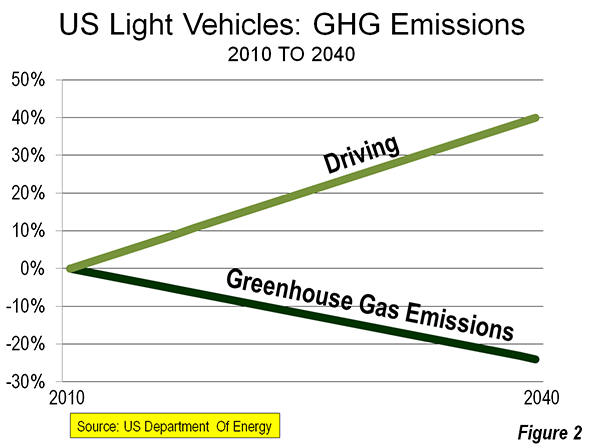
    Ignoring Current Greenhouse Gas Emissions Projections: The Plan also ignores the new, more favorable DOE fuel economy projections (Figure 2). These projections were issued in December, well before the publication of the draft plan in April and the adoption of the final plan in July. Indeed, if the new DOE projections had been published the day before, Plan Bay Area should have been placed on hold and revised. In short, Plan Bay Area was out of date when adopted.

    Overly Optimistic Planning Assumptions: The Plan assumes that travel by light vehicle (automobiles, sport utility vehicles and pickups) would be reduced by substantial increases in transit ridership. Plan Bay Area presumes that expanding transit service 27 percent over the next 30 years will lead to a near doubling of transit ridership. This is stupefying, since over the last 30 years, transit ridership remained virtually the same, while service was expanded nearly twice as much as would be planned from 2010 to 2040.

    The plan also assumes that residents forced into the priority development areas will use transit and walking much more, materially reducing their use of light vehicles. This research behind this assumption is skewed toward transit oriented developments located on rail lines with good access to downtown. But nearly nine out of 10 employees in the Bay Area work outside the downtowns of San Francisco and Oakland, and that number is increasing (according to Plan Bay Area).

    Given recent history, it seems wishful thinking to believe that small transit service expansions and downtown oriented transit development can do much to attract drivers from cars. The modest gains greenhouse gas emissions reductions projected in Plan Bay Area are likely exaggerations.

    Plan Bay Area’s “pack and stack” densification is likely to produce even less than the modest substitution of transit and walking for driving (see The Transit-Density Disconnect). Traffic congestion, in this already highly congested area, is likely to be worsened, which could nullify part or all of the greenhouse gas emission reductions expected from reduced vehicle use.

    Correcting Plan Bay Area Forecasts

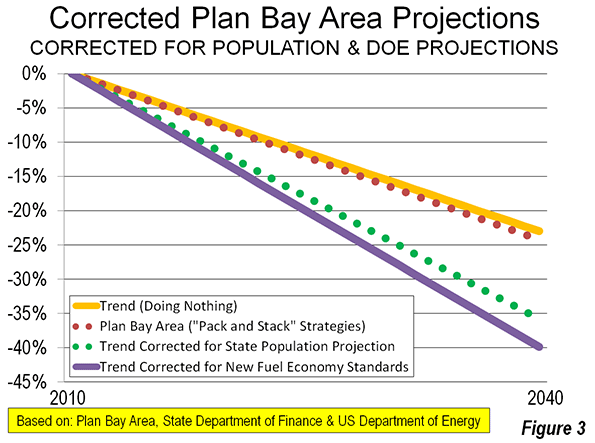
    Plan Bay Area would only modestly reduce light vehicle travel and greenhouse gas emissions. This is illustrated in Figure 3, which shows that the “pack and stack” strategies that would force most new residents and jobs into priority development areas, Plan Bay Area would reduce greenhouse gas emissions by 2 percent (“Plan Bay Area” line compared to the “Trend” or “doing nothing” line).

    By contrast, correcting the Plan Bay Area 2040 population estimates to reflect the state population projections would reduce greenhouse gas emissions more than eight times as much (17 percent), without the “pack and stack” strategies. A further correction of the Plan Bay Area 2040 estimates to reflect the latest DOE fuel economy projections, would reduce greenhouse gas emissions 22 percent, 11 times as much as the “pack and stack” strategies.

    Heavy Costs for Households and Businesses

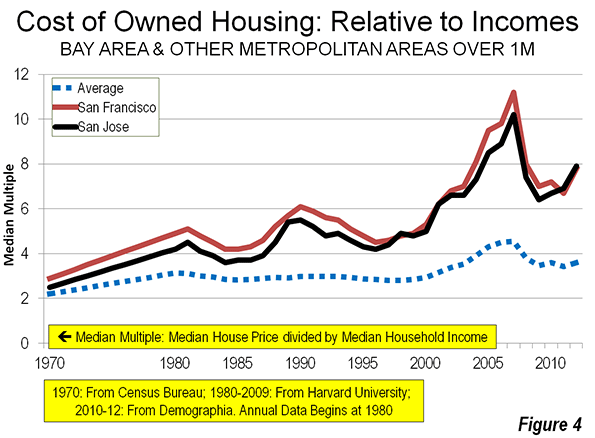
    The Plan’s “pack and stack” strategies seem likely to exacerbate the Bay Area’s already high cost of living. Currently, the San Francisco and San Jose metropolitan areas have the worst housing affordability among the nation’s 52 metropolitan areas with more than 1 million residents. San Jose’s median house price relative to its median household income was 7.9 last year, according to the Demographia International Housing Affordability Survey. San Francisco’s median multiple was 7.8. This severely unaffordable housing results from recent decades of urban containment or smart growth policies, which have severely restricted the land on which development can occur. This drives up prices (other things being equal), consistent with economic principle. This has been made worse by house and apartment impact fees imposed on developers that are far above the national average.

    By comparison, in major metropolitan areas that have not implemented strong urban containment policies, the median multiple has typically been 3.0 or less since World War II, including the Bay Area before its adoption (Figure 4). The “pack and stack” strategies would largely limit new development to small parts of the Bay Area, an even more draconian prohibition than the long standing restrictions on urban fringe development. This further rationing of land could be expected to drive land prices even higher, making it even more difficult for households and businesses to live within their means.

    The problem is already acute. The new US Census Bureau housing cost adjusted data shows California to have the highest poverty rate among the states and the District of Columbia (metropolitan area data is not available). An early 2000s Public Policy Institute of California report showed Bay Area poverty to be nearly double the official rate, adjusted for the cost of living. Ultra pricey San Francisco had among the ten highest poverty rates – over twenty percent – of any urban county in the country.

    Unaffordable housing has also fueled an exodus to the San Joaquin Valley (Central Valley). Now more than 15 percent of the workers in the Stockton metropolitan area commute to the Bay Area, which led the Federal Office of Management and Budget adding Stockton to the San Jose-San Francisco combined metropolitan area (combined statistical area). In addition, the greater traffic congestion is likely to lengthen work trip travel times. This is likely to further increase emission while also burdening job creation and economic growth (see Traffic Congestion, Time and Money).

    Ignoring the Economy and Poverty

    Plan Bay Area effectively ignores these costs (despite rhetoric to the contrary), by failing to subject its strategies to a cost per ton metric. According to the United Nation’s Intergovernment Panel on Climate Change (IPCC), sufficient greenhouse gas emissions reductions can be achieved at a cost between a range of $20 to $50 per ton. The previous regional plan (through 2035) included such estimates. Only highway strategies achieved the IPCC range. Transit and land use strategies cost from four to more than 100 times the top of the IPCC range. Even those estimates did not include the prohibitively higher housing costs that result from urban containment policies. The cost metric is crucial, because spending more than necessary to reduce greenhouse gas emissions limits job creation and economic growth, which leads to reduced household affluence and greater poverty. This is the very opposite of the economic objectives of public policy. Virtually all political jurisdictions around the world seek greater prosperity for their residents and less poverty. A legitimate regional plan requires subjecting its strategies to economic metrics.

    Opposition

    There is opposition to Plan Bay Area. A citizen movement worked for rejection and has now filed suit claiming that the Plan violates the California Environmental Quality Act. The suit also alleges that MTC and ABAG used a questionable interpretation of state law and regulation to justify the irrational Plan outcomes.

    Recorded Votes

    Opponents were also successful in obtaining a rare recorded vote at ABAG. The governing board (General Assembly) is composed of selected elected officials from cities and counties who are not elected to their ABAG positions. ABAG adopts virtually all of its actions by consensus, rather by recorded votes, as occurs in many of the nation’s regional planning boards.

    Consensus decision making seem especially odd in California, where inability to obtain sufficient votes in the legislature for the state budget required a constitutional amendment. Neither do city councils and county commissions operate on a consensus basis on controversial issues.

    There is no shortage of controversial issues, at ABAG or other regional planning agencies. A good first reform would be for recorded votes to be the rule, rather than the exception. Consensus decision making may be appropriate for clubs, but it is not for representative bodies in a democracy.

    Impeding the Quality of Life

    Plan Bay Area was outdated when approved and reflects a world that no longer exists. Drafters have insisted on extravagantly expensive and intrusive policies that produce only minimal greenhouse gas reductions, and at great cost, using, among other things, unreasonably bloated population forecasts to bolster their approach. Unless changed, the Plan will likely be more successful in driving up housing prices, limiting options for households, and further congesting traffic than meeting its stated goal of reducing   greenhouse gas emissions.

    Wendell Cox is a Visiting Professor, Conservatoire National des Arts et Metiers, Paris and the author of “War on the Dream: How Anti-Sprawl Policy Threatens the Quality of Life.

    Photo: San Francisco (by author)

  • Economy Needs More than Tech Sector

    We are entering a domain where looms a lost decade of income, growth and opportunity – and maybe it’s time to address that fact. Yes, the stock market is high, social-media types are rolling in billions, and asset inflation now extends to the residential home, the one investment where the middle and upper-middle classes can make a "killing." But, overall, everyone but the wealthy – the top 7 percent – are continuing to get pummeled, notes a recent Pew study.

    Actually, it’s worse than that in terms of the great progressive value, "equality." Hurt particularly has been the middle class – whatever the ethnicity – whose jobs have been decreasing most rapidly, while much of the new employment is in very low-paid work. In reality, many of the major metro regions with the greatest degree of inequality are in deep-blue states like California, New York or, in the belly of the beast, Washington D.C.

    But, outside of pontificating, neither political party is ready to address this issue. Under an alliance of the ostensible "party of the people" and the corporate serfs of the Republican Party, Wall Street, arguably the primary felon of the Great Recession, has been protected from any serious reform. Indeed, with Federal Reserve Chairman Ben Bernanke essentially giving it free money, the financial industry gets to party on, while middle-class incomes stagnate or fall.

    All most of us are left with is the hopeful upside in housing, but this boom is being fueled largely by investors, including some investment interests who fueled the previous bubble. Meanwhile, in California and other states, the pipeline for new housing, particularly the single-family homes preferred by the vast majority of people, faces an ever-more rigorous regulatory torture test.

    The entire political system reflects the growing class divisions in our society. Essentially, it is devolving into a battle between two factions – the tech oligarchs, allied with the public sector and much of academia, against the old power structure of agribusiness, energy, manufacturing and consumer products, including housing. It is a conflict that holds little promise.

    Popular oligarchs?

    Like Skynet in the "Terminator" films, the Silicon Valley billionaires, and their counterparts in places like Seattle, are now conscious of their real and potential power. "Politics for me is the most obvious area [to be disrupted by the Web]," suggests former Facebook President Sean Parker.

    The success with which the tech industry assisted President Obama’s re-election effort offers clear support for Parker’s assertion. In addition, the tech oligarchs have lots of quick money – of the world’s 29 billionaires under age 40, 10 come from the tech sector.

    Perhaps more important still, unlike most of American business, the tech oligarchs are widely beloved by much of the population. As Christopher Lasch noted, modern society teaches "people to want a never-ending supply of new toys." People love their toys, and as long as Apple, Google and the rest keep supplying them, those firms are likely to remain something of American heroes.

    Yet, for the most part, these people – including those in the entertainment sector – are not generating lots of middle-wage jobs, or any at all. Over the past decade, the information sector has lost more than 850,000 jobs. Social-media firms do not employ very many people overall; and many of their employees do not require high salaries as long as they get to play in the glitiziest sandbox. There are still 40,000 fewer people working in Silicon Valley than in 2001.

    Blue-collar heroes

    In contrast, energy continues to create a high number of good-paying jobs – 200,000 in Texas alone – for both white- and blue-collar professions. Manufacturing has made a modest recovery, and there are at least some stirrings in construction, as well. Oil riggers, machine-tool firms and suburban homebuilders may not often be celebrated, but they certainly do more for the middle-class economy, at least in terms of jobs, than the tech oligarchs.

    This is not to suggest that we should favor one sector over another. Or that there are not many positive effects from social media and the Internet. Information technology could provide the basis for a more practical way of life, with more people working from home, higher levels of productivity and less need to waste so much time – and resources – in travel.

    But the real world matters at least as much, if not more. The next generation, we can safely say, will not have it easy. Degrees in the liberal arts and, of course, law, are no longer guaranteed tickets to the upper-middle class; sometimes they serve as little more than calling cards for far less-prestigious work. Even many American IT graduates, perhaps nearly half, notes a recent Economic Policy Institute study, are having a hard time finding steady work.

    The key for society – and for geographic regions – lies not in obliterating one economy in favor of another. Some firms, such as Google, seem committed to energy policies, for example, that guarantee high electricity prices and, likely, poorer reliability. They can play with green-sponsored land policies, which help make new homes in the Bay Area absurdly expensive, because their employees already have houses and, if not, they can afford almost anything, anyway.

    Yet, such policies cause havoc in the real economy; high energy prices, and likely reliability problems, are a potential negative for many industries, particularly manufacturing. Regulations that favor high-density occupancy and impose ultrarigorous rules make it difficult to build new housing projects. Yet, by itself the tech economy is no panacea, in large part because it is less and less focused on middle-class jobs. Those can be pushed out to other countries or to the cheaper, more business-friendly great American interior. Tech doesn’t seem likely to turn around the economy in Oakland, much less in Stockton, Sacramento or Santa Ana.

    Work together

    What needs to happen – and soon – is a truce between the tech sector and the "real economy." They need each other; innovation can help make Detroit competitive, but society really benefits if that car is designed and made in the United States. Tech can drive the economy, but it is simply not enough by itself. Living on the creative edge cannot create sufficient employment, opportunities or an overall positive impact on day-to-day life. A generation hooked on Facebook – and working at Starbucks – is not likely to be terribly productive or successful.

    California, particularly Southern California, could prove a leader here. The region’s legacy – from the aqueducts to the development of aerospace, planned communities and entertainment visual effects – has been about the applications of technology. It retains the intellectual firepower through its concentration of universities and retains at least a residue of talent from the aerospace sector. The still-dominant entertainment industries, and the influential design community, also provide powerful assets that could spur new local industries with jobs potential.

    But if we are to move this notion forward, there must be a clear idea of what our goal is – not a few very good jobs but a broad array of opportunities. Detached from productive use, tech by itself can be largely a diversion and, sometimes, painfully disruptive. Rather than seeing tech as some kind of alchemy that will save us all, we need to see it, as the French sociologist Marcel Mauss noted, as "a traditional action made effective" – and a way to kick our lethargic economic engine into higher gear.

    Joel Kotkin is executive editor of NewGeography.com and a distinguished presidential fellow in urban futures at Chapman University, and a member of the editorial board of the Orange County Register. He is author of The City: A Global History and The Next Hundred Million: America in 2050. His most recent study, The Rise of Postfamilialism, has been widely discussed and distributed internationally. He lives in Los Angeles, CA.

    This piece originally appeared in the Orange County Register.

  • America’s New Oligarchs—Fwd.us and Silicon Valley’s Shady 1 Percenters

    When Steve Jobs died in October 2011, crowds of mourners gathered outside of Apple stores, leaving impromptu memorials to the fallen businessman. Many in Occupy Wall Street, then in full bloom, stopped to mourn the .001 percenter worth $7 billion, who didn’t believe in charity and whose company had more cash in hand than the U.S. Treasury while doing everything in its power to avoid paying taxes.

    A new, and potentially dominant, ruling class is rising. Today’s tech moguls don’t employ many Americans, they don’t pay very much in taxes or tend to share much of their wealth, and they live in a separate world that few of us could ever hope to enter. But while spending millions bending the political process to pad their bottom lines, they’ve remained far more popular than past plutocrats, with 72 percent of Americans expressing positive feelings for the industry, compared to 30 percent for banking and 20 percent for oil and gas. 

    Outsource Manufacturing, Import Engineers

    Perversely, the small number of jobs—mostly clustered in Silicon Valley—created by tech companies has helped its moguls avoid public scrutiny. Google employs 50,000, Facebook 4,600, and Twitter less than 1,000 domestic workers. In contrast, GM employs 200,000, Ford 164,000, and Exxon over 100,000. Put another way, Google, with a market cap of $215 billion, is about five times larger than GM yet has just one fourth as many workers.

    This is an equation that defines inequality: more and more wealth concentrated in fewer hands and benefiting fewer workers.

    While Facebook and Twitter have little role in the material economy, Apple, which continues to collect the bulk of its profit from physical goods—computers, iPads, iPhones and so on—has outsourced nearly all of its manufacturing to foreign companies like Foxconn that employ workers, often in appalling conditions, in China and elsewhere. About 700,000 people work on Apple’s physical products for subcontractors, according to the New York Times, but almost none of them are in the U.S. “The jobs aren’t coming back,” Jobs bluntly told President Obama at a 2011 dinner in Silicon Valley.

    Not so much anti-union as post-union, the tech elite has avoided issues with labor by having so few laborers who could be organized. Andrew Carnegie and Henry Ford exploited workers in Pittsburgh and Detroit, and had to deal with the political consequences; the risks are much less if the exploited are in Chengdu and Guangzhou.

    “There doesn’t seem to be a role” for unions in this new economy, explained Internet entrepreneur and venture capitalist Marc Andreessen, because people are “marketing themselves and their skills.” He didn’t mention what people without skills in demand at tech companies might do.

    But Americans with those skills shouldn’t rest easy, either. These same companies are always looking to cut down their domestic labor costs. Mark Zuckerberg, in particular, is pouring money into a new advocacy group, Fwd.us, with a board consisting of big-name Valley luminaries, to push “comprehensive immigration reform” (read: letting Facebook bring in a cheaper labor force). In a remarkably cynical move, Fwd.us has separate left- and right-leaning subgroups to prod politicians across the political spectrum to sign on to the bill that would pad the company’s bottom line.

    Ostensibly, the increase in visas for high-skilled computer workers is a needed response to the critical shortage of such workers here—a notion that has been repeatedly dismissed, including in a recent report from the Obama-aligned Economic Policy Institute, which found that the country is producing 50 percent more IT professionals each year than are being employed in the field. The real appeal of the H1B visas for “guest workers”—who already take between a third and half of all new IT jobs in the States—is that they are usually paid less than their pricy American counterparts, and are less likely to jump ship since they need to remain employed to stay in the country. Facebook’s lobbyists, reports the Washington Post, have pressed lawmakers to remove a requirement from the bill that companies make a “good faith” effort to hire Americans first.

    The Valley of the Oligarchs

    Even as market caps rise, the number of Americans collecting any cut of that new wealth has scarcely moved. Since 2008, while IPOs have generated hundreds of billions of dollars of paper worth, Silicon Valley added just 30,000 new tech–related jobs—leaving the region with 40,000 fewer jobs than in 2001, when decades of rapid job growth came to an end.

    The good jobs that are being created are also heavily clustered in one region, the west side of the San Francisco peninsula—a distinct and geographically constrained zone of privilege. The area boasts both formidable technical talent and, more important still, roughly one third of the nation’s venture funds along with the world’s most sophisticated network of tech-savvy investment banks, publicists, and attorneys.

    But little of the Valley’s wealth reaches surrounding communities. Just across the bridge to the East Bay are high crime rates and an economy that’s lost about 60,000 jobs since 2001 with few signs of recovery. Inland, in the central Valley, double-digit unemployment is the norm and local governments are cutting police and other core services and even trying to declare bankruptcy.

    “We live in a bubble, and I don’t mean a tech bubble or a valuation bubble. I mean a bubble as in our own little world,” Google’s Schmidt boasted to the San Francisco Chroniclein 2011. “And what a world it is. Companies can’t hire people fast enough. Young people can work hard and make a fortune. Homes hold their value. Occupy Wall Street isn’t really something that comes up in a daily discussion, because their issues are not our daily reality.”

    Inside the bubble zone, centered around the bucolic university town of Palo Alto, employees at firms like Facebook and Google enjoy gourmet meals, child-care services, even complimentary house-cleaning. With all these largely male, well-paid geeks around, there’s even a burgeoning sex industry, with rates upwards of $500 an hour.

    Those at top of the tech elite live very well, occupying some of the most expensive and attractive real estate in the country. They travel in style: Google maintains a fleet of private jets at San Jose airport, making enough of a racket to become a nuisance to their working-class neighbors. They have even proposed an $85 million flight center, called Blue City Holdings, to manage airplanes belonging to Google’s founders, Larry Page and Sergey Brin, and its executive chairman, Eric Schmidt. Like the Russian oligarchs, currently making a run on Tuscany’s castles and resorts, the Valley elite have embraced conspicuous consumption, albeit dressed up in California casual. In San Francisco, San Mateo, and Santa Clara counties combined, luxury vehicles accounted for nearly 21 percent of new car registrations from April 2011 to March 2012, more than twice the national average. Home prices in places like Palo Alto and the fashionable precincts of San Francisco go for well over a million—and routinely trigger all-cash bidding wars.

    We’re the best thing happening in America,” one tech entrepreneur told the Los Angeles Times. Even a reporter for the New York Times, usually worshipful in its Valley coverage, described the spending as “obscene.” An industry party he attended included a 600-pound tiger in a cage and a monkey that posed for Instagram photos.

    But past the conspicuous consumption, the most outstanding characteristic of the new oligarchs may be how quickly they have made their fortunes—and how much of the vast wealth they’ve held on to, rather than paid out to shareholders or in taxes. Ten of the world’s 29 billionaires under 40 come from the tech sector, with four from Facebook and two from Google. The rest of the list is mostly inheritors and Russian oligarchs.

    Tech oligarchs control portions of their companies that would turn oilmen or auto executives green with envy. The largest single stockholder at Exxon, CEO and chairman Rex Tillerson, controls .04 percent of its stock. No direct shareholder owns as much as 1 percent of GM or Ford Motors. In contrast, Mark Zuckerberg’s 29.3 percent stake in Facebook is worth $9.8 billion. Sergey Brin, Larry Page and Eric Schmidt control roughly two thirds of the voting stock in Google. Brin and Page are worth over $20 billion each. Larry Ellison, the founder of Oracle and the third richest man in America, owns just under 23 percent of his company, worth $41 billion. Bill Gates, who’s semi-retired from Microsoft, is worth a cool $66 billion and still controls 7 percent of his firm. 

    The concentration of such vast wealth in so few hands mirrors the market dominance of some of the companies generating it. Google and Apple provide almost 90 percent of the operating systems for smart phones. Over half of Americans and Canadians and 60 percent of Europeans use Facebook. Those numbers dwarf the market share of the auto Big Five—GM, Ford, Chrysler, Toyota, and Honda—none of whom control much more than a fifth of the U.S. market. Even the oil-and-gas business, associated with oligopoly from the days of John Rockefeller, is more competitive; the world’s top 10 oil companies collectively account for just 40 percent of the world’s production.

    Greater Representation with Minimal Taxation

    Despite this vast wealth, and their newfound interest in lobbying Washington, the tech firms are notorious for paying as little as possible to the taxman. Facebook paid no taxes last year, while making a profit of over $1 billion. Apple, “a pioneer in tactics to avoid taxes,”has kept much of its cash hoard abroad, out of reach of Uncle Sam. Microsoft has staved off nearly $7 billion in tax payments since 2009 by using loopholes to shift profits offshore, according to a recent Senate panel report.

    And now, these 1 percenters—who invested heavily in Obama—are looking to help shape the “public good” in Washington and, as with Fwd.us, what they’re selling as good for us all is what aligns with their interests.

    There’s been a huge surge of Valley investment in Washington lobbying, not just on immigration but also on issues effecting national, industrial, and science policy. Facebook’s lobbying budget grew from $351,000 in all of 2010 to $2.45 million in just the first quarter of this year. Google spent a record $18 million last year. In the process, they have hired plenty of professional Washington parasites to make their case; exactly the kind of people Valley denizens used to demean.

    The oligarchs believe their control of the information network itself gives them a potential influence greater than more conventional lobbies. The prospectus for Fwd.usheaded up by one of Zuckerberg’s old Harvard roommates—suggests tech should become “one of the most powerful political forces,” noting “we control massive distribution channels, both as companies and individuals.”

    One traditional way the wealthy attain influence is purchasing their own news and media companies. Facebook billionaire and former Obama tech guru Chris Hughes (who owes his fortune to having been another of Zuckerberg’s college roommates) has already started on this road by buying the New Republic. (His husband, perhaps not incidentally, is running for the New York State Assembly.) Leaving old-media legacy purchases aside, Yahoo is now the most-read news site in the U.S., with over 100 million monthly viewers, and the Valleyites are also moving into the culture business with both Google-owned YouTube and Netflix getting into the entertainment-content business.

    Great wealth, and high status, particularly at a young age, often persuades people that they know best about the future and how we should all be governed. Twitter founder Jack Dorsey, a 37-year-old resident of San Francisco, recently announced on 60 Minutes that he’d like to be mayor—of New York, a city he’s never lived in.

    Expect more of this kind of hubris from the new oligarchs. Some cities, ranging from Seattle, where Amazon is leading the charge, to Las Vegas and even Detroit now are counting on tech giants to expand or restore their damaged central cores.

    But if those oligarchs do come, they will have little interest in retaining or expanding blue-collar jobs in construction or manufacturing, which they see as passé; the housing they build and even the public amenities they invest in will be for their own employees and other members of the “creative class.” The best the masses can hope for are jobs cutting hair, mowing grass, and painting the toenails of the oligarchs and their favored minions. You won’t see much emphasis, either, on basic skills training and community colleges, which are critical to auto manufacturers, oil refiners, and other older businesses and can provide opportunity for upward mobility for middle- and working-class youth.

    Yet these limitations will not circumscribe the ambitions of the new oligarchs, who see their triumph over cyberspace as a prelude to a power grab in the real world, a proposition they’ve tested over the last three presidential cycles. “Politics for me is the most obvious area [to be disrupted by the Web],” suggests former Facebook president and Napster founder Sean Parker.

    If You’re the Customer, You’re the Product

    Perhaps an even bigger danger stems from the ability of “the sovereigns of cyberspace” to collect and market our most intimate details. Moving beyond the construction of platforms for communication, the oligarchs trade on the value of the personal information of the individuals using their technology, with little regard for social expectations about privacy, or even laws meant to protect it. Google has already been caught bypassing Apple’s privacy controls on phones and computers, and handing the data over to advertisers. The Huffington Post has constructed a long list of the firm’s privacy violations. Apple is being hauled in front of the courts for its own alleged violations while Consumer Reports recently detailed Facebook’s pervasive privacy breaches—culling information from users as detailed as health conditions, details an insurer could use against you, when one is going out of town (convenient for burglars), as well as information pertaining to everything from sexual orientation to religious affiliation to ethnic identity.

    As Google’s Eric Schmidt put it: “We know where you are. We know where you’ve been. We can more or less know what you’re thinking about.”

    But while Facebook and Google have been repeatedly cited both in the United States and Europe for violating users’ privacy, the punishments have been puny compared to the money they’ve made by snatching first and accepting a slap on the wrist later. 

    It’s no surprise then that Silicon Valley firms have been prominent in trying to quell bills addressing Internet privacy, both in Europe and closer to home. Washington is where big firms have always gone to change the rules to protect their own prerogatives and pull the ladder up on smaller competitors. Like previous oligarchical interests, the Valley, predictably, has become a regular and crucial fundraising stop for Obama and other Democrats crafting those rules.

    Al Gore—who owes much of his Romney-sized fortune to lucrative positions on the board of Apple and as a senior adviser to Google, as well as to energy investments heavily backed by federal funds—has emerged as the symbol of the lucrative, if shady, intersection of those two worlds.

    Green is an easy sell in the Valley. If California electricity is too unreliable or expensive, firms will just shift their power-consuming server farms to places with cheap electricity, such as the Pacific Northwest or the Great Plains. Middle-class employees who, in part due to green “smart growth” policies, can no longer afford to live remotely close to Palo Alto or in San Francisco, can be shifted either abroad or to more affordable locales such as Salt Lake City, Phoenix, or Austin, Texas. Meanwhile, with supply restricted, the prices on houses owned by the oligarchs and their favored employees continue to rise into the stratosphere.

    What we have then is something at once familiar and new: the rise of a new ruling class, arrogant and self-assured, with a growing interest in shaping how we are governed and how we live. Former oligarchs controlled railway freight, energy prices, agricultural markets, and other vital resources to the detriment of other sectors of the economy, individuals, and families. Only grassroots opposition stopped, or at least limited, their depredations.

    But today’s new autocrats seek not only market control but the right to sell access to our most private details, and employ that technology to elect candidates who will do their bidding. Their claque in the media may allow them to market their ascendency as “progressive” and even liberating, but the new world being ushered into existence by the new oligarchs promises to be neither of those things.

    Joel Kotkin is executive editor of NewGeography.com and a distinguished presidential fellow in urban futures at Chapman University, and a member of the editorial board of the Orange County Register. He is author of The City: A Global History and The Next Hundred Million: America in 2050. His most recent study, The Rise of Postfamilialism, has been widely discussed and distributed internationally. He lives in Los Angeles, CA.

    This piece originally appeared in the The Daily Beast.

    Official White House Photo by Pete Souza.

  • Prescription for an Ailing California

    Only a fool, or perhaps a politician or media pundit, would say California is not in trouble, despite some modest recent improvements in employment and a decline in migration out of the state. Yet the patient, if still very sick, is curable, if the right medicine is taken, followed by the proper change in lifestyle regimen.

    The first thing necessary: Identify the root cause of California’s maladies. The biggest challenge facing our state is not climate change, or immigration, corporate greed, globalization or even corruption. It’s the demise of upward mobility for the vast majority of Californians, and the rise of an increasingly class-ridden, bifurcated society.

    California’s class problem spills into virtually every aspect of our malaise. It is reflected in both the nation’s highest poverty rate, above 23 percent, and a leviathan welfare state; California, with roughly 12 percent of the population, now accounts for roughly one-third of the nation’s welfare recipients. This burgeoning underclass exacerbates the demand for public services, deprives the state of potential taxpayers and puts enormous pressure on the private sector middle-class to come up with revenue.

    The growing class chasm also distorts state priorities, creating an inordinate demand for public sector employment – and related jobs in health and education – while inculcating deep-seated resentment among private-sector entrepreneurs and professionals toward a state that asks much of them, but gives increasingly little.

    Conservatives generally have recoiled from a class-based analysis, hoping to play on ethnic or cultural fears to advance their agenda of lower taxes and less regulation. Their incoherence and inability to adjust to changing demographics have left them increasingly irrelevant.

    On the other hand, progressives feel comfortable with class as an issue, but see more regulation and ever higher taxes on the private sector as the solution. Yet the experience of the past decade has shown their folly, as California’s middle class has continued to shrink, and poverty has worsened, particularly in the state’s interior. The dangers of a large permanent underclass of unemployed and underemployed should be clear even to the most dreamy progressive.

    Essentially, there is only one practical solution to this dilemma: a program that promotes economic growth. This strategy would transcend the recent reliance on asset-based bubbles that have boosted property markets and technology stocks. Another bubble, whether an investor-driven spike in property values in Newport Beach or a stock mania in Silicon Valley, may provide a temporary boost in revenue but will do very little to improve employment for the vast majority or to stabilize long-term finances.

    The recent surge in tech employment in places like Silicon Valley is neither likely to persist or improve conditions for many Californians. The days of huge employment gains in Silicon Valley – where jobs more than tripled from 1970-2000 – are over. Even in the current boom, the Valley’s employment remains down from a decade ago, and the rest of the state is doing decidedly worse. Social media simply will never be a major job producer or productivity enhancer; Facebook has 4,300 American employees, while old-line firms, like Intel, which have been shifting employment out of the state, have 10 times as many.

    Other proposed bromides, like Gov. Jerry Brown’s promised 500,000 "green jobs," need to be dismissed for what they are – stories we tell our children so they will fall asleep. High-speed rail, another modern-day Moonbeam program, is seen, even by many progressives, such as Mother Jones’ Kevin Drum, as an "ever more ridiculous" boondoggle based on "jaw-droppingly shameless" assumptions.

    Instead of delusion, California needs policies that can boost economic growth in precisely those areas – construction, agriculture, manufacturing and energy – with the best prospects for creating good, high-paying jobs for both blue- and white-collar Californians. Yet, right now the Legislature and, even more so, the empowered state apparat, seem determined to do everything they can to strangle an incipient recovery in these industries.

    Sadly, much of this is done in the name of the environment, but often based on dubious assumptions. Laws that seek to reduce water allocations to the Central Valley are justified as protecting a bait fish, but create windswept new deserts, along with shocking poverty, in the state hinterland. It is no longer enough to protect the still-wild environment; mankind itself must be pushed away from areas that, in some cases, for generations, has provided food for the world, income for families and revenue to the state.

    Concerns over climate change have justified much of the state’s regulatory tsunami. Yet it is absurd to assert that California by itself can change global climate conditions in any meaningful way, given that the big increases of carbon emissions are all coming from the developing world; overall, America’s emissions already are dropping far more quickly than in other high-income parts of the world, largely due to the natural gas boom.

    Yet such mundanities matter little when our greatest policy goal seems to be to make the regulatory apparat, Hollywood and Silicon Valley moguls and their favored nonprofits feel better about themselves; if it provides job opportunity for zealots or the rent-seeking kind for favored venture capitalists and companies like Google, all the better.

    Worse, the consequences of these policies, such as soaring energy prices, likely will not be felt in Portola Valley, Corona del Mar or Pacific Palisades, but, rather, in Santa Ana, Modesto and Oakland. Our regulatory regime already has cost California the opportunity to cash in on two significant booms – in manufacturing and in fossil fuel energy – that are creating middle-income job opportunities and upward mobility in other parts of the country.

    On the environmental side, these policies could have an overall negative effect by driving both people and industries to areas that, because of climate and regulatory environment in their new homes, likely will expand their carbon footprint. Arguably the best thing California can do to reduce global carbon emissions would be to boost its industrial profile. The state also should be leading the shift to natural gas, which California, a potentially big player, so far largely has refused to join.

    Another great opportunity lies in housing, a key source of both white- and blue-collar jobs. Population growth may have slowed, but the pent-up demand, largely from immigrants and millennials, for single-family homes, remains potentially strong. If the supply was increased, and prices moderated, homebuying would become more attractive for families with children. Emissions could be cut in more family-friendly ways, by encouraging more fuel-efficient cars, the dispersion of industry and, most particularly, telecommuting.

    Sparking the revival of these basic industries and higher-wage employment would enhance California’s budget situation over time far more than increasing taxes on the remaining residue of entrepreneurs and professionals. Energy work, in particular, pays high wages, often more than for many tech jobs, and both manufacturing and construction generally provide higher incomes than the low-wage service work that has become the only option for millions of Californians.

    Getting kids from the Central Valley or East Los Angeles working on housing sites, factories and energy facilities is both the most humane, and practical, way to right our fiscal ship. Growth in these industries would also spur the knowledge sector of the economy; many of the strongest gains in STEM (science, technology, engineering and mathematics) jobs in recent years have occurred in manufacturing regions, such as Detroit, or in the energy belt, notably Houston. California’s technical know-how should not be expended simply on developing computer games and social networks; resuscitating the tangible economy would also diversify employment opportunities for the highly skilled.

    Government can play a critical, even determinative, role here. But it needs to shift priorities from redistribution and wealth suppression to providing the basic infrastructure essential for a growth economy. It means transforming our education system from a jobs and pension program for public sector workers and corporate rent-seekers to a focus on providing our economy with the skills – including those used in basic industries – needed for a revived California. It means spending money on the kind of infrastructure, such as gas pipelines, roads, urban bus lines, water and energy systems, that can spur growth instead of misallocations such as high-speed rail and subsidized green energy boondoggles.

    This back-to-basics approach could restore California’s aspirational promise, and not only for a favored few in a handful of favored places, but for the majority of our people, from the mountains to the sea.

    Joel Kotkin is executive editor of NewGeography.com and a distinguished presidential fellow in urban futures at Chapman University, and a member of the editorial board of the Orange County Register. He is author of The City: A Global History and The Next Hundred Million: America in 2050. His most recent study, The Rise of Postfamilialism, has been widely discussed and distributed internationally. He lives in Los Angeles, CA.

    This piece originally appeared in the Orange County Register.

  • The New Places Where America’s Tech Future Is Taking Shape

    Technology is reshaping our economic geography, but there’s disagreement as to how. Much of the media and pundits like Richard Florida assert that the tech revolution is bound to be centralized in the dense, often “hip” places where  “smart” people cluster. Some, like Slate’s David Talbot, even fear the new tech wave may erode whatever soul is left to increasingly family free, neo-gilded age San Francisco.

    Such claims have been bolstered by the tech boom of the past few years — especially the explosion of social media firms in places like Manhattan and San Francisco. Yet longer-term trends in tech employment suggest such favored media memes will ultimately prove well off the mark. Indeed, according to an analysis by the Praxis Strategy Group, the fastest growth over the past decade in STEM (science, technology, engineering and mathematics-related) employment has taken place not in the most fashionable cities but smaller, less dense metropolitan areas.

    From 2001 to 2012, STEM employment actually was essentially flat in the San Francisco and Boston regions and  declined 12.6% in San Jose. The country’s three largest mega regions — Chicago, New York and Los Angeles — all lost tech jobs over the past decade. In contrast, double-digit rate expansions of tech employment have occurred in lower-density metro areas such as Austin, Texas; Raleigh, N.C.; Columbus, Ohio; Houston and Salt Lake City. Indeed, among the larger established tech regions, the only real winners have been Seattle, with its diversified and heavily suburbanized economy, and greater Washington, D.C., the parasitical beneficiary of an ever-expanding federal power, where the number of STEM jobs grew 21% from 2001 to 2012, better than any other of the 51 largest U.S. metropolitan statistical areas over that period.

    The question is whether the last two to three years, during which places like San Francisco, New York and Boston have enjoyed stronger STEM growth than their peripheries, represents a paradigm shift or is just a cyclical phenomenon. As with tech in general, the long-term trends are not so city-centric; over the past decade,  the core counties nationwide overall have lost about 1.1% of their tech jobs while more peripheral areas have experienced a gain of 3.5%.

    Today’s urban tech boom looks a lot like a rerun of the dot-com boom of the late 1990s. In that period media-savvy dot-com startups proliferated in such places as South of Market in San Francisco and the Silicon Alley in lower Manhattan. At their height, these firms and their founders were as likely to be covered in the fashion and lifestyle sections as on the business pages.

    Yet by the early 2000s, many of these dot-com darlings had merged, been acquired or simply gone out of business. Anchored largely on hype, they fell victim to flawed business models, and rapid industry consolidation.  In San Francisco, for example, tech employment crashed from a high of 34,000 in 2000 to barely 18,000 four years later. Silicon Alley suffered a similar downward trajectory, losing 15,000 of its 50,000 information jobs in the first five years of the decade.

    The peaking social media boom, marked by the weak performance of Facebook’s IPO last year, suggest another bust at the end of the “hype cycle.” Urban darlings such as  San Francisco’s Zynga and Chicago’s Groupon have floundered in spectacular fashion. More are likely to join them.

    These firms may have generated buzz, but they have done not so well at the mundane task of making money. One problem may be that  the most avid users of social media are largely young people from the “screwed” generation who lack much in the way of spending power — a clear turnoff to advertisers. Now , with venture capital flows declining overall,  cooler heads in the Valley are shifting bets to more business-oriented engineering and research-intensive fields more grounded in marketplace realities.

    And what about the future of the Valley — still home to virtually all the Bay Area’s top tech firms? Its glory days as a job generator and economic exemplar seem to have passed. Between 1970 and 1990 the number of people employed in tech in the Valley more than doubled to 268,000, and then burgeoned to over 540,000 in the 1990s. At the peak of the last tech boom in 2001, the unemployment rate in Santa Clara County was a tiny 3%; the Silicon Valley Manufacturing Group confidently predicted there would be another 200,000 jobs by 2010.

    However, at what may be the peak of the current boom, the number of tech jobs in the Valley remains down from a decade ago and unemployment is over 7.7%, just around the national average. In reality, social media was never going to reverse the downward trajectory in the rate of job growth. Old-line companies like  Hewlett-Packard or Intel, with over 50,000 employees in the U.S. alone, were capable of creating a broad range of opportunities for workers; in contrast, the social media big three of Facebook, LinkedIn and Twitter together have less than 6,500 employees.

    As the social media industry matures and consolidates,   employment is likely to continue shifting to less expensive, business-friendly areas. The Bay Area, where the overall cost of living is 68% higher than the national average and housing is the most expensive in the nation, may continue to attract and retain only the highest-end, best-paid workers. But for the most part they will follow the path of established tech firms such as  Apple, Intel, Adobe, eBay and IBM  to lower-cost places like Austin, Columbus and Salt Lake City. A similar phenomena also can be seen in other urban-centered industries, such as entertainment and finance where  virtually all employment growth is in places like St. Louis, Des Moines and Phoenix, even as the largest centers, New York, Chicago, Boston, Los Angeles and San Francisco have suffered significant job losses.

    Demographic forces may further accelerate these trends. The critical fuel for tech growth, educated labor, is now expanding faster in places like Columbus, Austin, Raleigh, Dallas and Houston than in Boston, San Jose and San Francisco. The old centers may still enjoy a lead in brains, but other places are catching up rapidly.

    Companies may also discover that with many millennials starting to hit their 30s, some may seek to leave their apartments to buy houses and start families. In California new local regulations essentially ban the construction of new single-family homes in some of the state’s biggest metro areas, pricing this option out of reach for all but a few, and forcing a key demographic group to seek residence elsewhere.

    Under these conditions, Silicon Valley will be forced to rely increasingly on inertia and mustering of financial resources than innovation. As a result, the nation’s tech map will continue to expand from the Bay Area, Boston, Seattle and Southern California to emerging metropolitan areas in North Carolina, Texas, Utah, Colorado and the Pacific Northwest. In the future parts of Florida, Phoenix, and even Great Plains cities like Sioux Falls and Fargo could also achieve some critical mass.

    Ultimately, one of the main dynamics of the information age — that even sophisticated tasks  can be done from anywhere — works against the dominion of single hegemonic industry centers like Wall Street, Hollywood and Silicon Valley. The tech sector is particularly vulnerable to declustering, due in large part thanks to the freedom from geography created by technologies of its own making.   Silicon Valley may continue to reap riches from the periodic technology  gold rush , but in the longer term, tech growth will continue its long-term dispersion to ever more parts of the country.

    STEM Occupations in the Nation’s 51 Largest Metropolitan Areas
    MSA Name 2001 – 2012 Growth 2005 – 2012 Growth 2010 – 2012 Growth 2012 Location Quotient LQ Change, 2001 – 2012
    Washington-Arlington-Alexandria, DC-VA-MD-WV 21.1% 12.7% 3.7% 2.19 10.6%
    Riverside-San Bernardino-Ontario, CA 18.6% -1.4% 2.2% 0.57 1.8%
    San Antonio-New Braunfels, TX 18.3% 17.2% 4.5% 0.83 1.2%
    Baltimore-Towson, MD 17.9% 11.4% 3.9% 1.37 15.1%
    Raleigh-Cary, NC 17.9% 14.6% 6.2% 1.53 0.0%
    Las Vegas-Paradise, NV 17.2% -2.6% 0.8% 0.52 4.0%
    Salt Lake City, UT 16.3% 18.1% 7.4% 1.16 4.5%
    Houston-Sugar Land-Baytown, TX 15.7% 17.2% 6.6% 1.20 -2.4%
    Seattle-Tacoma-Bellevue, WA 15.4% 22.2% 6.7% 1.86 8.1%
    Jacksonville, FL 13.0% 6.5% 2.4% 0.87 8.7%
    Austin-Round Rock-San Marcos, TX 12.2% 17.2% 9.1% 1.82 -8.5%
    San Diego-Carlsbad-San Marcos, CA 11.3% 8.0% 2.1% 1.38 6.2%
    Columbus, OH 10.4% 12.8% 4.7% 1.27 7.6%
    Orlando-Kissimmee-Sanford, FL 9.4% -1.1% 0.8% 0.84 -3.4%
    Indianapolis-Carmel, IN 6.9% 6.5% 2.7% 1.04 2.0%
    Nashville-Davidson–Murfreesboro–Franklin, TN 6.7% 3.5% 2.4% 0.77 -1.3%
    Sacramento–Arden-Arcade–Roseville, CA 6.4% 3.5% 0.4% 1.33 2.3%
    Oklahoma City, OK 5.5% 9.6% 6.4% 0.89 -1.1%
    Pittsburgh, PA 5.3% 10.3% 4.9% 1.07 5.9%
    Virginia Beach-Norfolk-Newport News, VA-NC 4.8% 2.3% 0.5% 1.10 3.8%
    Charlotte-Gastonia-Rock Hill, NC-SC 4.3% 8.2% 5.7% 0.99 -3.9%
    Kansas City, MO-KS 4.0% 5.8% 4.6% 1.12 4.7%
    Richmond, VA 3.8% 4.4% 3.4% 0.99 0.0%
    Cincinnati-Middletown, OH-KY-IN 3.7% 5.5% 6.8% 1.02 4.1%
    Buffalo-Niagara Falls, NY 3.2% 6.4% 3.6% 0.90 4.7%
    Dallas-Fort Worth-Arlington, TX 3.1% 11.4% 5.5% 1.19 -5.6%
    San Francisco-Oakland-Fremont, CA 2.5% 15.0% 9.9% 1.63 5.8%
    Phoenix-Mesa-Glendale, AZ 2.3% 3.5% 3.9% 1.05 -6.3%
    Minneapolis-St. Paul-Bloomington, MN-WI 2.2% 6.7% 5.9% 1.31 1.6%
    Portland-Vancouver-Hillsboro, OR-WA 1.6% 6.4% 5.4% 1.19 -3.3%
    Louisville/Jefferson County, KY-IN 0.9% 9.6% 6.9% 0.76 0.0%
    Denver-Aurora-Broomfield, CO 0.5% 10.8% 3.7% 1.43 -2.1%
    Atlanta-Sandy Springs-Marietta, GA -1.0% 5.5% 6.5% 1.07 -2.7%
    Boston-Cambridge-Quincy, MA-NH -1.3% 11.2% 6.0% 1.64 -1.2%
    Providence-New Bedford-Fall River, RI-MA -1.5% -1.6% 1.9% 0.88 2.3%
    Philadelphia-Camden-Wilmington, PA-NJ-DE-MD -2.8% -1.4% 1.4% 1.06 -1.9%
    Hartford-West Hartford-East Hartford, CT -4.5% 1.5% 0.3% 1.10 -3.5%
    New York-Northern New Jersey-Long Island, NY-NJ-PA -4.6% 2.8% 3.2% 0.90 -6.2%
    St. Louis, MO-IL -4.8% -1.7% 1.4% 1.05 -0.9%
    Milwaukee-Waukesha-West Allis, WI -6.1% -0.8% 4.0% 1.00 0.0%
    Tampa-St. Petersburg-Clearwater, FL -6.3% -4.3% 2.5% 0.89 -3.3%
    Miami-Fort Lauderdale-Pompano Beach, FL -6.4% -8.3% 0.6% 0.67 -8.2%
    Los Angeles-Long Beach-Santa Ana, CA -7.1% -3.5% 3.1% 0.98 -5.8%
    Memphis, TN-MS-AR -7.3% -4.0% 0.7% 0.62 -4.6%
    Cleveland-Elyria-Mentor, OH -8.8% -2.1% 4.3% 0.89 1.1%
    Chicago-Joliet-Naperville, IL-IN-WI -10.8% -1.4% 3.5% 0.87 -7.4%
    Birmingham-Hoover, AL -11.4% -8.0% -2.0% 0.76 -8.4%
    Rochester, NY -12.0% -2.1% 4.1% 1.14 -10.2%
    San Jose-Sunnyvale-Santa Clara, CA -12.6% 12.4% 8.3% 3.18 -4.8%
    New Orleans-Metairie-Kenner, LA -16.0% -7.4% -2.4% 0.74 0.0%
    Detroit-Warren-Livonia, MI -17.7% -10.3% 10.5% 1.42 -3.4%
    Analysis by Mark Schill, Praxis Strategy Group
    Data Source: EMSI 2012.4 Class of Worker – QCEW Employees, Non-QCEW Employees & Self-Employed 

    The LQ (location quotient) figure in the table above is the local share of jobs that are STEM occupations divided by the national share of jobs that are STEM occupations. A concentration of 1.0 indicates that a region has the same concentration of STEM occupations as the nation. The analysis covers 80 STEM occupations in all industries.

    Joel Kotkin is executive editor of NewGeography.com and a distinguished presidential fellow in urban futures at Chapman University, and a member of the editorial board of the Orange County Register . He is author of The City: A Global History and The Next Hundred Million: America in 2050. His most recent study, The Rise of Postfamilialism, has been widely discussed and distributed internationally. He lives in Los Angeles, CA.

    This piece originally appeared at Forbes.com.

    Computer engineer photo by BigStockPhoto.com.