Tag: St. Louis

  • Super Bowl: Super Subsidy Sunday

    Imagine what it would cost to fly from New York to Los Angeles if the country tolerated a National Airline League? Answer: about what a “personal seat license” will cost at the new City of Champions Stadium in Los Angeles, say $28,000.

    In the latest shifting of NFL deckchairs, the League raided St. Louis, San Diego, and Oakland — cities that need things to cheer about — and told team owners that they are free to move to Los Angeles, the city of tomorrow, because of its willingness, today, to chip in on the construction of a $2.66 billion stadium in Inglewood, a city within Los Angeles, for the Rams and possibly the Chargers. Around the opulent new stadium the league will even have an NFL campus, maybe for all those ‘communications majors’ who play in the game?

    Rather than take subsides on its construction bonds, the new LA stadium prefers to limit its local taxes until “costs are amortized.” That way it can boast: “No tax dollars or public funding will be used for the construction of the City of Champions Revitalization Project, including the new stadium.” The operative phrase is “for the construction.” Afterwards, the football depletion allowance will kick in, big-time.

    The reason that the National Football League can move around its franchises is because Congress, in the Sports Broadcasting Act of 1961, deemed professional football a sacred national resource and conferred an exemption from anti-trust rules on the manufacturers of professional football.

    Instead of running a sport where there is no limit on teams or competition, the NFL is the pigskin equivalent of OPEC, and its main function isn’t to govern a league of competitive teams, but to protect monopoly pricing and practices.

    The National Football League runs on backhand payments to athletic organizations, sweetheart contracts, and monopoly pricing, in addition to screwing over its fan base by moving teams around. Its reward for urban price fixing isn’t prosecution for collusion under antitrust laws (it is exempt). Instead, it is awarded a national day of reverence, Super Sunday, during which 30 seconds of ad time costs $5 million, and the strategic national stockpile of guacamole is severely threatened.

    The owners don’t actually own teams, but are general partners in a football trust, which allows them to share equally in all television revenues and collectively ‘bargain’ with concussed players, who are only free agents after five years of indentured service. By then, most are broken men. The league’s attitude toward the declining mental of health of its retired players could be summarized as “So sue me”.

    Yes, a few stars make big money, for a while, but teams are rarely on the hook for long-term guaranteed contracts and salaries are “capped,” they say, “in the interest of competition.”

    Although NFL teams wave the flags of their home cities (best understood as their allocated captive markets), hometown fans have no sway over their local teams, which can pack up their pads in the night and move, as long as the new location is authorized by the League.

    Nevertheless, St. Louis will still get the pleasure of paying off $100 million in outstanding debt on the Rams’ Edward Jones stadium, even though the team will be playing in LA.

    What keeps NFL teams constantly on the move? Promises of state and city subsidies for new, multibillion stadiums, and then the granting of nearly all local revenues to the owner.

    The new Santa Clara stadium, home to the hype of Super Bowl 50, has $950 million in hidden public finance, even though while the deal was being made the city was laying off teachers and firefighters.

    According to Stadium Subsidy Trickle-Down Economic Theory, a new NFL stadium helps to ‘revitalize’ some downtrodden city. In reality, stadiums add little to urban life other than mountains of debt and part-time jobs for Sunday ushers and parking lot attendants.

    The reason that NFL teams do little for their home cities is that the league’s economic model is akin to strip mining or wildcat drilling. Unlike coal or natural gas, though, the price of the harvested commodity is controlled at the league’s head office, although still for the benefit of absentee landlords. National revenues are shared, while local revenues flow into the pockets of the team’s owner, often a billionaire.

    If, instead of a football trust, the US had an open market for gridiron services, when there was a demand in a growing city for a pro team tryouts would be held for players, and shareholders would gather to invest in the new franchise. Maybe when the franchise got good enough, it could compete with more established teams.

    Think about it: if the city of Green Bay (population about 104,000) can support a championship team which is owned by the fans, it means that there are 278 larger cities in the country that could well duplicate its model and host professional football. Instead, only 31 other cities have pro teams, thanks to the league’s attitude toward parity and level playing fields. Metropolitan areas with populations greater than two million that don’t have a team include San Antonio, Las Vegas, Portland (Oregon), and Orlando, St. Louis and, possibly soon, San Diego and Oakland. Many other large American cities could easily support three or four professional teams.

    All that these outlier cities can do to get a franchise is to promise the NFL ownership monopoly stadium subsidies and political tolerance for continuing the anti-trust exemption. Cities that want to keep their teams (such as San Diego) can pay ransom money in the form of a new, subsidized stadium and other favors. Challenge this payoff system and the league will vote away your team faster than you can say antidisestablishmentarianism.

    The irony of Los Angeles now becoming the holy grail of two, or even three football teams is that, in the past, the city has had several franchises —ironically, the Rams, Chargers, and Raiders — and all left because the fan base preferred the beach and the Lakers to Sunday afternoons in the archaic LA Memorial Coliseum.

    What has changed since Sid Gilman coached the Los Angeles Chargers in 1960 is that shared NFL television contracts make it irrelevant whether fans show up or not for the in-studio fan game experience, although generally most stadiums sell out.

    What of the cities that have ransomed their future to an NFL team? How have they fared? Just because Forbes Magazine values pro football franchises at between $2 and $3 billion does not mean that the citizenry sees much benefit from having a team.

    For example, the Hackensack Meadowlands Giants are now said to be worth $2.8 billion, but New Jersey taxpayers are still paying interest on the old Giants Stadium, where the end zone was rumored to be Jimmy Hoffa’s resting place, and which was torn down so that a new stadium could be built in its place (“without public money”).

    Most cities get a paltry rental stream from their subsidized ballparks, and that’s it. From the Seahawks, owned by Microsoft bigwig Paul Allen, Seattle gets $1 million a year in stadium rental income, while the team rakes in more than $200 million. And state taxpayers are on the hook for some $300 million in outstanding CenturyLink stadium bonds. (The 12th man abides.)

    No wonder Allen’s $160 million yacht has been out tearing up the coral reefs of the Caribbean. Even to Hoffa, that red zone opportunity would be worth some dabbin’.

    Matthew Stevenson, a contributing editor of Harper’s Magazine, is the author most recently of Remembering the Twentieth Century Limited, a collection of historical travel essays, and Whistle-Stopping America. His next book, Reading the Rails, will be published in 2016. He went to his first professional football game in 1960, and saw the New York Titans plays the Dallas Texans. He lives in Switzerland.

    Flickr photo by Mike Morbeck: Cam Newton of the Carolina Panthers
  • Life is Good in St. Louis

    The headline line in the Sunday St. Louis Post-Dispatch asked "Are St. Louis Area’s Home Prices too Low?” This is could not possibly have appeared describing any major metropolitan area of Australia, New Zealand, or the United Kingdom. Nor will newspapers in Vancouver, Toronto, Calgary, Portland, Seattle, Boston, New York or in any of the overpriced markets of California decry low prices any time soon.

    The March 8, 2015 article by Jim Gallagher rightly noted that house prices tended to be higher in cities outside St. Louis, there are "restrictions on building, either geographical or political." Gallagher quotes William Rogers, an economist at the University of Missouri- St. Louis says that "Developers have really serious problems putting up houses in Los Angeles or San Francisco."

    The 11th Annual Demographia International Housing Affordability Survey, produced with Hugh Pavletich of Performance Urban Planning in Christchurch New Zealand,  confirms the low house prices in St. Louis. In 2014, the median multiple, a price to income ratio calculated by dividing the median house price by the median household income, was 2.7 in the St. Louis metropolitan area. St. Louis is tied for fifth most affordable middle-income housing market among the 86 major metropolitan area markets (over 1,000,000 population) in nine nations.

    No one should imagine that the low prices of St. Louis are the result of a depressed economy. Yes, St. Louis is on the periphery of the rustbelt. And yes, the city (core municipality) of St. Louis has lost a larger share of its population than any other large municipality in modern history. Since 1950, the city of St. Louis – a mere 11 percent of the metropolitan area – has lost 63.2 percent of its population, slightly more than the city of Detroit, at 61.4 percent.

    Yet, somehow the city of St. Louis has avoided the financial train wreck of Detroit, nor do planners suggest the next industry should be urban agriculture. At a minimum, the difference suggests that St. Louis, even as it has lost population, has been much better led than the Motor City. Further, the much larger St. Louis metropolitan area (which is the area described in the Gallagher article and rated in the Demographia Survey) is anything but depressed.

    Gallagher indicates that "lots of people here could pay more for houses, but they don’t have to." That is correct. However, households in St. Louis pay approximately the same percentage of their income to buy houses today that most people have since World War II. That is also the same amount that Angelos and San Franciscans paid until the coming of excessive regulation (see Fischel) in the 1970s; since then  house prices there have increased between 2.5 and 3 times.

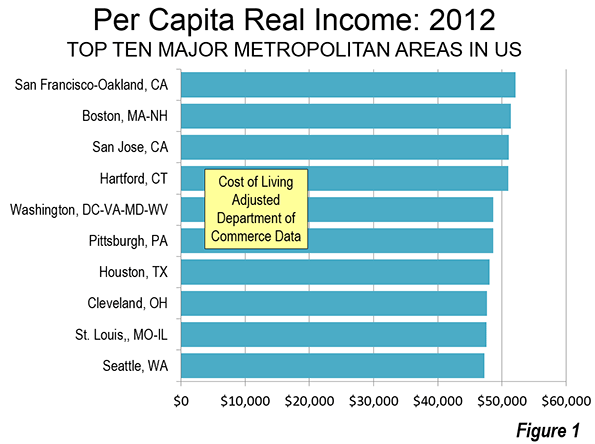
    On the surface, St. Louis appears about average in income. St. Louis ranks 25th, slightly above the middle of the 52 major metropolitan areas in per capita income. But that’s just the beginning of the story. As anyone looking for employment in other metropolitan areas quickly finds out, housing cost differences can be huge and make up most, if not all the difference in cost of living. When the cost of living is considered, real personal incomes in St. Louis rank ninth among the 52 major metropolitan areas. It may be surprising, but St. Louis ranks above number 10 Seattle. While nominal incomes in Seattle are nearly 20% above that of St. Louis, when the cost of living is considered, St. Louisans had nearly 1% more income than Seattleites in 2012 (Figure).

    The metropolitan areas ranked above St. Louis are the usual suspects of nominal affluence. No one would be surprised that San Francisco has the highest incomes, both nominal and adjusted for cost-of-living. San Francisco’s nearly 50% advantage in nominal personal income over St. Louis drops to less than 10% when the cost of living is considered. Given the graduated nature of the federal income tax, the difference could be less. The other most affluent cities are Boston, San Jose, Hartford, and Washington. The cost of living conversion factor (regional price parity) is more than 25% in San Francisco, San Jose and Washington and 18% in Boston. Only in Hartford, among the leaders, has anything similar to a normal cost of living (6% above the national average)

    There are other surprises in the top 10. Both Pittsburgh and Cleveland have higher cost of living adjusted incomes than St. Louis. Less surprising is that Houston is in the top 10, given its robust economy, at least before oil prices dropped.

    There are some interesting omissions from the top 10. Global city New York ranks 17th, just behind "Music City" Nashville. Portland, America’s incubator of house price increasing planning policies, finds itself ranked 39th. Even in Jackson, Mississippi, not large enough to make the over 1,000,000 list, has higher real per capita income than Portland.. Perhaps the biggest surprise is Los Angeles. Like New York, often considered a Global City, the city of my birth is anything but Global City real per capita incomes. Even depressed Detroit (though the suburbs of Detroit are anything but depressed) is ranked 10 positions above Los Angeles and has real per capita income 10% higher.

    All of this should be regarded as good news for St. Louis. Once, to be sure, St. Louis was far more important. As late as 1910, St. Louis was the fourth largest municipality in the United States, trailing only New York, Chicago and Philadelphia. While St. Louis is not depressed, it has grown much more slowly than most metropolitan areas. But the decline has been more in the urban core city than the surrounding areas. Over the past the past 60 years the city of St. Louis lost more than 500,000 residents, while between 1950 and 2010, while the suburbs added 1,400,000.

    Gallagher indicates that construction prices are reasonable in St. Louis. In fact they are not much less than in the stratospheric housing markets of San Francisco and Los Angeles. For example, a 2,500 square foot starter house in the East Bay of San Francisco would cost less than 10 percent more to build than in St. Louis, according to data at building-cost.net.The difference between housing costs in St. Louis and high-cost market is in the land, which is where the cost of excess regulation shows up

    As a metropolitan area, St. Louis has competitive difficulties (see: Shrinking City, Flourishing Region: St. Louis Region). The weather is not as nice as in California. The winters are tougher than in Texas or Florida. But the one great advantage St. Louis possesses is reasonable middle income housing affordability. This is an important competitive advantage that led to only modest domestic migration losses during the 2000, when high priced Los Angeles and New York were bleeding more than 1.3 million net domestic out migrants.

    Also, with the money they don’t have to pay for over-priced housing, St. Louisans can buy more "stuff" or take longer vacations. Nor do St. Louisans get less for their less money. The median sized detached house is the same in St. Louis (1,800 square feet) as in  San Francisco and slightly larger than in Los Angeles (1,744 square feet), according to the American Housing Survey in 2012, yet St. Louisans pay much less.

    The bottom line is that for all of the competitive difficulties, life is good in St. Louis. And, one big reason is housing prices middle-income households can afford.

    Wendell Cox is principal of Demographia, an international public policy and demographics firm. He is co-author of the “Demographia International Housing Affordability Survey” and author of “Demographia World Urban Areas” and “War on the Dream: How Anti-Sprawl Policy Threatens the Quality of Life.” He was appointed to three terms on the Los Angeles County Transportation Commission, where he served with the leading city and county leadership as the only non-elected member. He was appointed to the Amtrak Reform Council to fill the unexpired term of Governor Christine Todd Whitman and has served as a visiting professor at the Conservatoire National des Arts et Metiers, a national university in Paris.

    Photo: St. Louis Skyline (by author)

  • Roadmap to Surprises of the Rustbelt

    Back in New York, no one quite believed my accounts of urban renewal across the Midwest, through a piece of the Rustbelt, and then back — that St. Louis is the Brooklyn of the heartland, or that even downtown Buffalo has charms. I tended to be on safer ground when I described Targeted small towns in Ohio, or drive-by shootings in Chicago.

    Despite the skepticism I knew I would eventually encounter, my idea was to go intercity with mass transit and to get around locally with my bike. I found that the downtown areas of many Midwestern cities are vibrant, rust free, and often ideal for biking, as well as for hotels, trendy restaurants, and funky businesses.

    It’s on the periphery of these Potemkin-convention cities that the bright lights dim on the porches of ramshackle wooden frame houses. That’s where the new ghettos look less like rundown public housing and more like rural shanties that have washed up in earlier working-class suburbs.

    Does it work to travel from Chicago to New York with a folding bike on trains and buses? Give or take, I managed fine. Amtrak grudgingly accepts folding bikes as normal luggage (it is easier to take a gun on board Amtrak than a full-sized bike), and intercity bus drivers (many are cheerful souls) are indifferent about baggage stowed below.

    The bigger problem in my planning was that few trains other than freights cut across the heartland from St. Louis to Cleveland. While buses do make the connections — say, from Terre Haute to Bloomington, Indiana — many of my departures took place between 5 and 6 a.m., the time that a friend calls o’dark.

    Nor were the intermodal connections seamless. Routinely, I was dumped off the bus at a Hardee’s in Nowheresville. Between Quincy, Illinois, and Hannibal, Missouri, the only place open at lunchtime was an adult superstore, but I hadn’t worked up an appetite for lace underwear.

    Herewith, by city, are some observations from behind the handlebars:

    Chicago: I went all over Chicago on the bike, from Frank Lloyd Wright’s show-homes in Oak Park to the South Side slums (where that weekend twelve people were wounded in assorted shootings). I also made it to the old stockyards, Haymarket Square (of anarchist fame), and the Hyde Park home of President Barack Obama, which now is unpleasantly hidden away behind tall trees, concrete anti-terror barriers, and snarling guards, giving it the air of a Beirut embassy.

    Beyond the elegant Loop, lakefront, university districts, and various solid neighborhoods, Chicago has endless stretches of abandoned warehouses—no man’s lands between the city and suburbs, belts in search of manufacturing.

    I felt better when I found where the Marx Brothers had lived when they were still playing vaudeville; Ernest Hemingway’s boyhood home (when he sported curls in what he famously called that place of “broad lawns and narrow minds”); and a magnificent bike lane that sweeps along Lake Michigan. I even found myself agreeing with former vice president Dan Quayle, who said “It is wonderful to be here in the great state of Chicago.”

    St. Louis: Few city downtowns are as pleasant as that of St. Louis, which struck me as having a perfect mix of parks, restaurants, stadiums, hotels, and office buildings converted into residential lofts, many with views of the Mississippi and the Gateway Arch. I biked out as far as Clayton, Missouri, through the incomparable Forest Park, and looped around several universities, hospitals, and museums, all of which add to the city’s infrastructure luster.

    Most of what I saw was white St. Louis, as gracious as a southern plantation, although coming and going I went through northern and eastern satellite suburbs — Ferguson is one of many — where the local economy seems to revolve around selling tires, check cashing, and all-night convenience stores.

    Indianapolis: On the way from St. Louis to Indianapolis, I stopped in Springfield (part of a Lincoln haj) and Terre Haute. My bus into the Indiana capital left me at the “downtown transit center,” a dreary cave of broken vending machines, now that the former railroad station is an elegant hotel.

    The rest of downtown Indianapolis sparkled, and I spent the best day of my travels ducking into the Eiteljorg Museum of American Indians and Western Art, drinking coffee on sunny terraces, following bike paths, exploring the canals, and touring the city’s many universities, Butler and Indiana-Purdue among them.

    Only when I went out on the bike that night looking for the boyhood home of writer Kurt Vonnegut did I find the other Indianapolis, which is camped out in dilapidated wooden frame houses or low-rise housing projects, clearly off the convention-city grid. No wonder Vonnegut wrote “So it goes.”

    Canton: So poorly is Ohio served with public transportation that I was forced to rent a car to go from Dayton Trotwood (a sad shopping center where the Indianapolis bus dropped me) to Canton and Cleveland. I stuck mainly to the secondary roads, often clogged with traffic and slow lights. Unless someone can add a dome, Astroturf, and The Gap to Hometown USA, it will be lost.

    Canton was the saddest city on my travels. Not even the presence of the Pro Football Hall of Fame or William McKinleyism can put a positive spin on the vacant lots and boarded-up storefronts.

    Cleveland: I was back on the bike, and loved much of what I saw downtown in the canyons of Art Deco office buildings.

    Cleveland is more of an extended suburb than a city — if not a state of mind with a football team — although it can quickly change from blocks of lakefront mansions to rows of seedy body shops… emphasis here on the word “body”.

    Buffalo: On my night bike ride into the city from Amtrak’s suburban Depew Station, I passed through a series of depressing slums and at one point had to out-sprint a highwayman who wanted to steal my rig. (“Give me that fucking bike,” is how he introduced himself.)

    The new ghetto arose from the old working class neighborhoods; a nether world in the shadows of subsidized convention centers and urban renewal towers. Buffalo at night is a ghost town, although I loved riding north along Delaware Avenue to the state university.

    In upstate New York, I made a loop around the Finger Lakes through such rustbelt stalwarts as Corning, Binghamton, Syracuse, and Auburn. The delight was Elmira, with its local college that has the Mark Twain writing studio in which he wrote Tom Sawyer and Huckleberry Finn. Ithaca is a labyrinth of universities and dead-end streets that gets my vote for the most confusing city grid in America.

    Syracuse at night — on the bike or waiting at the bus station — felt like the set of a sci-fi movie in which everyone has been vaporized. Binghamton aspires to hipness, but, well, it’s Binghamton. At least Auburn has the prison, and at midnight its strange aurora borealis of klieg lights made my bike vest glow like medieval chain-mail.

    A series of buses and commuter trains took me down to New York City. I had booked on Amtrak, but its Lake Shore Limited was routinely seven or more hours late. One conductor blamed the delays on the weather from the previous winter, although my seat mate said impoverished locals robbed the copper from the track signals.

    At the end of my riding, I think I came across as someone as morose as the novelist Theodore Dreiser, who took what he called “a Hoosier holiday,” at a time when, as he wrote, “America was in the furnace stage of its existence.” But I defy anyone who doesn’t take heart from a Lake Erie sunrise.

    Photo by the author: Downtown Cleveland from Lake Erie

    Matthew Stevenson, a contributing editor of Harper’s Magazine, is the author, most recently, of Remembering the Twentieth Century Limited, a collection of historical travel essays, and Whistle-Stopping America. His next book, Reading the Rails, will be published in 2015. He lives in Switzerland.

  • To Rebuild, the Midwest Must Face Its Real and Severe Problems

    Despite well-publicized problems that earned it the nickname of the “Rust Belt”, on paper the Midwest possesses some formidable strengths. These include the largest concentration of engineers in America, world class educational institutions, a plethora of headquarters of global champions ranging from Proctor and Gamble to Caterpillar to the Chicago Mercantile Exchange, the world’s greatest reserves of fresh water, and an expanding immigrant population.

    Yet with limited exceptions, these have been around for a while, but haven’t produced much growth across the region. Instead, outside of an archipelago of successful outliers (mostly select parts of major metros or college towns), the region has seen its population, job, and income growth badly trail the nation.  During the 2000s US population grew by 9.7%, the Midwest* 3.8%. For jobs, the US lost 1.5% but the Midwest 7.8%.

    Reversing this requires not just leveraging strengths and building on assets, but facing the very real and severe structural challenges that plague the region. However, most of the strategies out there remain outside the region’s essential DNA:

    • Economic clusters like high tech startups or water industries are in effect attempts to build new success enclaves outside the system.
    • Rebuilding downtowns into urban playgrounds for the upscale often takes place against a backdrop of vacant lots, abandoned structures, and depopulation – in other words, empty space.
    • The Rust Belt Chic movement suggests that many of the problems are actually the solution.  But while there are intriguing and important elements to this, it bypasses core issues.

    These are all good as far as they go, but they require little broad-based reform (as opposed to district or enclave based solutions) to structural problems and thus are limited in what they can achieve.

    What are these structural problems? Among the key ones are:

    1. Racism. The modern history of Midwest cities is enmeshed in the history of race relations, particularly between black and white. Places like Chicago and Milwaukee remain among the absolutely most segregated in America. Race riots have been defining feature of cities ranging from Detroit to Cincinnati (which had a race-influenced riot as recently as 2001). In all of these places, a large population of black residents live in segregated neighborhoods plagued with problems ranging from poor schools to low quality housing to a lack of jobs.  Significant social distress has resulted. 

    There are signs the Great Migration that brought blacks north in search of factory work is reversing, with black residents actually seeing more welcoming environments and better economic opportunities in Southern metro areas like Atlanta, Houston, and Charlotte. As well, historically it’s been the more ambitious who leave, not such a good thing for the people and places left behind.

    2. Corruption.  Midwest cities ranging from Chicago to Detroit to Cleveland are famous as cesspools of corruption and cronyism. Systems like Chicago’s “aldermanic privilege” tradition that gives city council members almost dictatorial control over their districts produce environments of almost required tacit corruption even if no laws are violated. In other cities, it’s well known that your approvals will go much faster if you hire the right wired-up subcontractors, lawyers, or lobbyists. While this type of environment exists at some level everywhere, it’s very bad in many Midwest cities and badly degrades an already challenged business climate.

    3. Closed Societies. Contrary to the assertions of Robert Putnam and Bowling Alone, a lot of Midwest places suffer from an excess of social capital. As Sean Safford noted in Why the Garden Club Couldn’t Save Youngstown, excessively dense social networks can create a hermetically sealed environment into which new ideas can’t penetrate or get a hearing.  There are many reports of newcomers to Midwest cities saying that they have difficult making friends and penetrating the social networks in places as diverse as Minneapolis and Cleveland. In Cincinnati and St. Louis expect that the first question you’ll be asked is “Where did you go to high school?” which tells you everything you need to know about those cities.  Immigration has ticked up in recent years, but overall the Midwest has done a poor job of attracting outsiders.

    4. Two-Tier Environment and Resulting Paralysis.  Despite the plethora of high end companies, educated workers, and top quality universities, the Midwest economy was traditionally based on moderately skilled labor in agriculture and industry. This forged a work force that places too low value on education and which can even be suspicious of people with too much of it. Today’s agriculture and manufacturing concerns, at least the ones with jobs that pay more than subsistence wages, require much higher levels of skills and education than in the past. What’s more, with the global macro-economy favorable to larger cities and talent based industries, larger metros have comparatively done well while most smaller towns have struggled. As a result, their quality of life and services have so badly degraded they are no longer attractive to “discretionary residents” (those with the means and opportunity to leave), which perpetuates a downward spiral as the educated flock to bigger cities. That’s why manufacturers complain they can’t find workers with skills, even if those skills are just passing and drug test and showing up to work everyday. This produces massive inequities, resentment, and policy confusion. What’s more, realistically many very poorly performing communities may never recover.

    Beyond these core issues, many places have aging infrastructure, massive blight issues, a regulatory environment not suited to the 21st century, and severe fiscal problems. All of these are extremely difficult problems to resolve, but that does not mean they don’t need to be faced, and overcome.

    Unsurprisingly, the Midwest has not been a particularly competitive region.  There will continue to be bright spots ranging Des Moines to Madison to the greater Chicago Loop to the fracking fields of western Pennsylvania, but until the region faces up to its problems don’t expect a major turnaround anytime soon.

    Aaron M. Renn is an independent writer on urban affairs and the founder of Telestrian, a data analysis and mapping tool. He writes at The Urbanophile.

  • Housing Affordability: St. Louis’ Competitive Advantage

    Things are looking better in St. Louis. For decades, St. Louis has been one of the slowest-growing metropolitan areas of the United States. Its historical core city has lost more than 60 percent of its population since 1950, a greater loss than any other major core municipality in the modern era.  Nonetheless, the metropolitan area, including the city, added nearly 50 percent to its population from 1950. The fate of St. Louis has been similar to that of Rust Belt metropolitan areas in the Midwest and East, as the nation has moved steadily West and South since World War II (Note).

    Expensive Housing and Driving People Away: During the past decade, high house prices have driven residents away from areas with better amenities, especially California’s coastal metropolitan areas and metropolitan New York. Between 2000 and 2009, Los Angeles exported 1.4 million domestic migrants, the San Francisco Bay Area 600,000 (San Francisco and San Jose) and San Diego 125,000. New York lost nearly 2,000,000. St. Louis did much better, losing less than 45,000 domestic migrants. On a per capita basis, St. Louis also performed better, losing 1.6 domestic residents per capita to migration, compared to 4.5 in San Diego, 10 in the San Francisco Bay Area and 11 in New York.   This may not sound like an accomplishment, but the St. Louis area has probably not outperformed California in terms of migration since it entered the Union in 1850.

    The big change between the 2000s and previous decades lies in housing price. It is in this period that America became effectively two nations in housing affordability. The major metropolitan areas that experienced that largest housing bubble lost 3.2 million domestic migrants, while those with lesser or no bubble gained 1.5 million. Demonstrating the preference of people for more dispersed surroundings, even more (1.7 million) moved to smaller metropolitan areas. Housing affordability has emerged as a principal competitive factor among metropolitan areas.

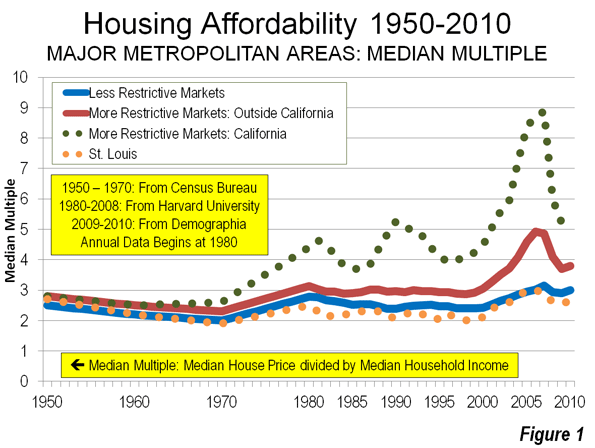
    Superior Housing Affordability: This is where St. Louis excels. As of the third quarter of 2011, the median house price was 2.6 times the median household income in St. Louis, according to the 8th Annual Demographia International Housing Affordability Survey, which covered seven nations (the United States, United Kingdom, Canada, Australia, Ireland, New Zealand and Hong Kong, in China). Dividing the median house price by the median household income gives St. Louis an affordability rating (Median Multiple) of 2.6. By comparison the Median Multiple was 4.2 in Portland (60 percent more expensive ), 4.5 in Seattle (75 percent more),  6.1 in San Diego (135 percent more) and 6.9 in San Jose (175 percent more. While other metropolitan areas were reeling from house price increases that still have not returned to normal, St. Louis (and other metropolitan areas, like Dallas-Fort Worth, Houston and Indianapolis) have continued to experience affordable and far more steady house prices (Figure 1).

    Lowest Cost of Living: Affordable house prices are associated with a lower cost of living. St. Louis does very well here. According to the latest data from the US Bureau of Economic Analysis regional price parity program, the cost of living in St. Louis is the lowest among major metropolitan areas (those with more than 1,000,000 population). In St. Louis, the cost of living is:

    • 29 percent less than in New York.
    • 31 percent less than in San Jose.
    • 23 percent less than in San Diego.
    • 19 percent less than in Seattle.
    • 12 percent less than in Portland.

    Things Could Get Better for St. Louis: Moreover, the gap could become larger, especially as governments in California try to outlaw new detached housing, under Senate Bill 375. None of this is good for young households or less affluent households who will have to leave to find housing that meets their desires. Many will need to leave to fulfill their dreams.

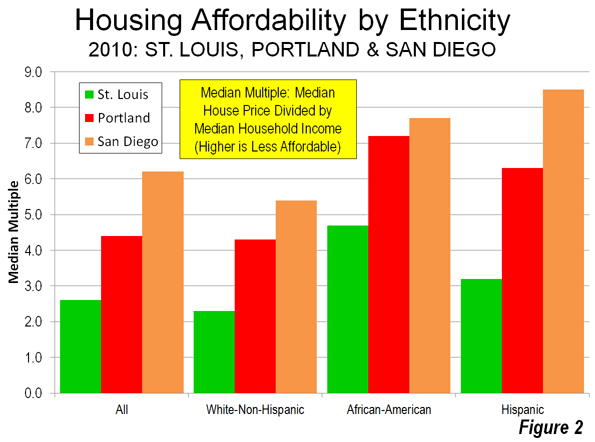
    Inevitably, the higher housing costs associated with these policies (called by various names, such as "livability," "smart growth" and "growth management") fall hardest on lower income households (often minorities), who have less to spend, are forced to move away or cannot afford to move in. The consequences were articulated by California’s Hispanic oriented Tomas Rivera Policy Institute (Figure 2):

    While there is little agreement on the magnitude of the effect of growth controls on home prices, an increase is always the result.

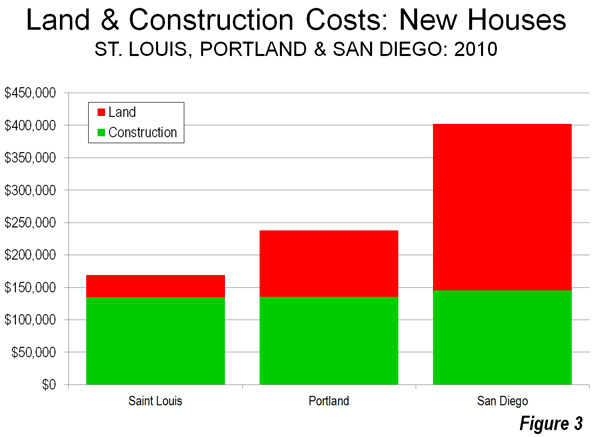
    The Secret: Just what did the St. Louis leadership do to improve its competitiveness so much? Nothing. They just stayed out of the way. Unlike their counterparts where house prices exploded, St. Louis officials did not prohibit people from living where they wanted on the urban fringe and they did not force new houses to be built on postage stamp lots. Nor did they adopt land use regulations that drive up the price of land (Figure 3) and, in consequence housing), just as an OPEC embargo would raise the price of gasoline. When the easy money came and lenders were begging households with insufficient resources to take mortgages, the planning embargoes drove up house prices and invited undue participation by speculators who know the difference between a competitive and a rigged market.

    There are positive signs as a result of this affordability advantage. St. Louis has been attracting more young residents. Recent data indicates that St. Louis ranked 15th in high tech job growth out of the 51 metropolitan areas with more than 1,000,000 over the past decade. It would be expected that St. Louis would trail fast growing Seattle, Raleigh and Charlotte and perennial tax consumer Washington. However, St. Louis can be placed better than perennial leaders San Jose, Boston, Portland, Austin and New York. Budding local efforts are aimed at encouraging entrepreneurship, even as California and New York search for new ways to say "no."

    Succeeding by Being St. Louis: The improving prospects of St. Louis are not the result of a taxpayer financed marketing campaign or a payoff from the usual "let’s copy Portland" strategies (or even Cleveland, as one analyst put it a couple of decades ago). St. Louis cannot compete with the weather in the Bay Area, does not have San Diego’s beaches, the mountains near Denver nor the natural beauty surrounding Seattle. But it does have an affordable life style.

    St. Louis can succeed only by being St. Louis. It is a metropolitan area with a great past, and many fine civic institutions, including great parks, sports teams and a world class orchestra. This long laggard Midwestern metropolitan area may face its best competitive prospects since Chicago passed it in population in 1870. Local and state leaders need to stay away from the policies that would dilute St. Louis’ principal competitive advantage, a low cost of living, due to a housing market left to operate without destructive distortion.

    Wendell Cox is a Visiting Professor, Conservatoire National des Arts et Metiers, Paris and the author of “War on the Dream: How Anti-Sprawl Policy Threatens the Quality of Life

    —-

    Photo: Cathedral Basilica of St. Louis (by author)

    Note: This is adapted from a policy study by the author for the Show Me Institute: Housing Affordability The St. Louis Competitive Advantage

  • Rethinking Urban Dynamics: Lessons from the Census

    Much has been made of the vaunted “back to the city” movement by “the young and restless,” young professionals, the creative class, empty nesters and others were voting with their feet in favor of cities over suburbs.  Although there were bright spots, the Census 2010 results show that the trend was very overblown, affecting mostly downtown and near downtown areas, while outlying ones bled population.  One culprit for this discrepancy seems to be that the intra-census estimates supplied by the Census Bureau were inflated – in some cases very inflated.

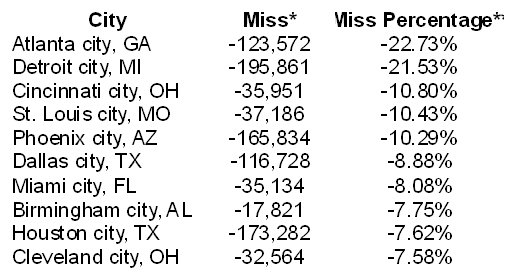
    Looking at selected core cities for major US metropolitan areas, many of them were materially over-estimated:


    One particularly egregious case relates to Atlanta. Its huge projected population increase in the 2000s led me to describe it as “one of America’s top urban success stories.”  The reality proved to be quite different. Rather than strong population growth in the city, the population growth turned out to be basically flat, quite a different story.  Other declines might be more predictable, such as Detroit, or those who had previously challenged estimates like Cincinnati and St. Louis.  Still, even urban cores in rapidly growing regions like Dallas and Houston were not immune from this trend.

    There were some exceptions. Cities like Indianapolis, Columbus, and Oklahoma City came in slightly ahead of expectations, but the number of cities with misses and the sizes of the positive and negative misses tilted towards the down direction.

    It seems clear now that the justification for much of the “back to the city” story reflected bad estimates. People can’t be faulted for relying on the official government numbers – I did. But the reality of the 2010 Census, as demonstrated by Wendell Cox and others, is that the 1990s were actually better for urban population growth in America than the 2000s in many respects.

    One legitimate bright spot for cities lay in the growth of downtown and near downtown areas.  Though often starting from low bases, these areas often showed impressive increases.  For example, St. Louis showed good growth downtown despite a very disappointing decline in total city population:

    The poster child for this phenomenon was Chicago, where a fairly expansive area in the greater core showed large population growth.  Areas that were formerly almost all commercial, such as the Loop, added significant residential population, while areas that were nearly derelict like the near South Side have blossomed into thriving upscale neighborhoods.


    The problem, from places ranging from Chicago to Cleveland, is that the gains in the “core of the core” have been more than offset by losses elsewhere, especially the flight of blacks and other minorities – many of them immigrants – to the increasingly diverse suburbs.

    Cities across America have invested enormous sums into downtown redevelopment and major projects in selected districts.  The good news: these investments have shown some ability to move the needle in terms of attracting young professionals downtown.  The bad news lies with the fact that these developments have been extremely costly, and have not transformed the overall demographic or economic climates of the cities that tried them.  This demonstrates the limits of the policies.  Those who aren’t in the young professional, empty nester, or creative class demographic have rightly figured out that they are no longer the target market of city leadership. No surprise then that many of them    have decided to vote with their feet.

    Given the resulting overall negative swings, cities may want to revisit their strategy of putting all their chips in the downtown redevelopment basket in favor of less glamorous improvements in basic neighborhood safety, services, schools and other critical elements.  A handful of elite enclaves and talent hubs may be able to thrive on a “favored demographic quarter” strategy, but for most places there just aren’t enough young professionals and artists to go around.

    Aaron M. Renn is an independent writer on urban affairs based in the Midwest. His writings appear at The Urbanophile.

    * Actual population minus projected population as of 4/1/2010 using a run rate projection based on the 2008-2009 estimated population growth.
    ** Base is the projected 4/1/2010 population above.

    Photo by Ian Freimuth

  • Devastated St. Louis Airport: Up to the Challenge

    St. Louis: April 23, 2011 (9 a.m.) The St. Louis (Missouri-Illinois) metropolitan area is just beginning to dig out of the devastating tornadoes that struck on the evening of Good Friday. Miraculously, there appear to have been few, if any life-threatening injuries.

    The St. Louis tornadoes, however, impacted interstate travel like no other tornadoes in history. St. Louis Lambert international Airport sustained major damage. The main terminal, lost one half of its windows and had major damage in the ticketing area. Concourse C, which is the busiest at the airport lost part of its roof, had damaged jet ways and is reported to have lost all of its windows on the north side. The main terminal would be readily recognized by movie-goers who have seen it featured in Planes, Trains and Automobiles (with an artificial snow cover in the middle of the summer) and Up in the Air. The main terminal was one of the most notable early modern terminal designs and was a precursor of the TWA terminal at JFK airport in New York.

    At this point, local officials have even mentioned the possibility that the structure may have been compromised by the storm. Many cars in the adjacent parking structure were damaged by flying debris, which broke windows and produced body damage. Debris filled one of the major roadways between the main terminal and the parking structure (photograph). Needless to say, the airport has been closed indefinitely.

    As disruptive as the tornado was to the airport and the traveling public, the closure is likely to be shorter in duration than if it had happened at about any other major airport in the nation. This is because St. Louis airport probably has the largest amount of unused capacity of any major airport in the western world.

    The past decade has been characterized by serious reversals for St. Louis airport. The fate of the airport was significantly tied to Trans World Airlines (TWA) which established a hub at St. Louis airport in the early 1980s, shortly after the expansion of the air travel that occurred due to airline deregulation. St. Louis was one of the most convenient metropolitan areas in the nation from which to travel, with frequent nonstop service to all major markets in the nation, daily service to London and seasonal service to Paris. However, TWA filed bankruptcy more than once and was finally purchased by American Airlines. After the 911 terrorist attacks, when airline volumes dropped temporarily in the United States, American Airlines began scaling back operations at St. Louis airport. Now, the TWA – American hub is gone and the airport’s largest airline is Southwest.

    Over the past decade, the passenger volumes at St. Louis airport have dropped by nearly two-thirds. This has left much of the airport empty. Concourse A continues to be used near capacity. Concourse C, which used to be home to the TWA hub is probably the busiest, but is only partially used. There are two other concourses that are virtually empty including Concourse D, built when volumes were the highest and the older Concourse B. The damage to concourses appears largely to be limited to Concourse C, but it is serious. There is also a Concourse E, which is dedicated principally to Southwest Airlines. This concourse appears to have also escaped major damage.

    All of this spare capacity gives St. Louis airport the potential for a quicker recovery than would be possible if the airport were running close to capacity, as was the case at the turn-of-the-century. It seems likely that this provides the opportunity to transfer operations to the nearly empty Concourses B and D, while longer-term repairs are made to Concourse C.

    There is still the difficulty, however, of the damage to the main terminal, principally because it contains the ticketing and baggage facilities for Concourse A and Concourse B, which appear to still be usable. Access to these concourses could be expedited by prioritizing the repairs toward the west side of the ticketing lobby, which serves the Concourse A and Concourse B airlines and is closest to those concourses.

    There still remains, however, the difficulty of handling the Concourse C flights. Even here however there may be opportunities for an expeditious recovery. Concourse E, the Southwest terminal, has direct access to Concourse D, though that access has not been permitted in recent years. There may be ways to relocate the ticket facilities for the Concourse C airlines temporarily to Concourse E, and to transfer the flights to Concourse D. Should the main terminal repairs proceed fast enough, a simpler solution would be the transfer of Concourse C traffic to Concourse D.

    No final plan has been announced. It is also possible that the early damage reports are more pessimistic than will be revealed in the days and hours to come. However, even with its reduced volumes, the nation needs to have this unprecedented removal of one of its principal facilities quickly restored.

  • The Protean Future Of American Cities

    The ongoing Census reveals the continuing evolution of America’s cities from small urban cores to dispersed, multi-polar regions that includes the city’s surrounding areas and suburbs. This is not exactly what most urban pundits, and journalists covering cities, would like to see, but the reality is there for anyone who reads the numbers.

    To date the Census shows that  growth in America’s large core cities has slowed, and in some cases even reversed. This has happened both in great urban centers such as Chicago and in the long-distressed inner cities of St. Louis, Baltimore, Wilmington, Del., and Birmingham, Ala.

    This would surely come as a surprise to many reporters infatuated with growth in downtown districts, notably in Chicago, Los Angeles, Denver and elsewhere. For them, good restaurants, bars and clubs trump everything. A recent Newsweek article, for example, recently acknowledged Chicago’s demographic and fiscal decline but then lavishly praised the city, and its inner city for becoming “finally hip.”

    Sure, being cool is nice, but the obsession with hipness often means missing a bigger story: the gradual diminution of the urban core as engines for job creation. For example, while Chicago’s Loop has doubled its population to 20,000, it has also experienced a large drop in private-sector employment, which now constitutes a considerably smaller share of regional employment than a decade ago. The same goes for the new urbanist mecca of Portland as well as the heavily hyped Los Angeles downtown area.

    None of this suggests, however, that the American urban core is in a state of permanent decline. The urban option will continue to appeal to small but growing segment of the population, and certain highly paid professionals, notably in finance, will continue to cluster there.

    But the bigger story — all but ignored by the mainstream media — is the continued evolution of urban regions toward a more dispersed, multi-centered form. Brookings’ Robert Lang has gone even further, using the term “edgeless cities” to describe what he calls an increasingly “elusive metropolis” with highly dispersed employment.

    Rather than a cause for alarm, this form of  development  simply reflects  the protean vitality of American urban forms.  Two regions, whose results were released last week, reveal these changing patterns. One is the Raleigh region, which has experienced a growth rate of 42%, likely the highest of the nation’s regions with a population over 1 million. This metropolitan area, anchored by universities and technology-oriented industries, is among the lowest-density regions in the country, with under 1,700 persons per square mile, slightly less than Charlotte, Nashville and Atlanta.

    Unlike the geographically constrained older urban areas, Raleigh’s historical core municipality experienced strong growth, from 288,000 to 404,000, a gain of 40%. This gain was aided by annexations that added nearly 30% to the area of the municipality (from 113 to 143 square miles). The annexations of recent decades have left the city of Raleigh with an overwhelmingly suburban urban form. In 1950, at the beginning of the post-World War II suburban boom, the city of Raleigh had a population of 66,000, living in a land area of only 11 square miles.

    Even here, however, the suburbs (the area outside the city of Raleigh) gained nearly two-thirds of the metropolitan area growth (65%) and now have 64% of the region’s population. Over the last ten years, the suburbs have grown 43%. It is here that much of the economic growth of the Research Triangle has taken place, as companies concentrate in predominately suburban communities such as Cary.

    Yet in most demographically healthy urban regions, the growth continues to be primarily in the suburban centers. One particularly relevant example is the Kansas City area, a dynamic region anchoring what we have identified as “the zone of sanity.” Like most American regions, the Kansas City area is growing, but in ways that often do not resemble the fantasies of urban density boosters.

    KC’s growth pattern is important and could be a harbinger of what’s to come in this decade. Along with Indianapolis, this resurgent Heartland region is expanding faster than the national average. It is also attracting many talented people, ranking in our top ten list of the country’s “brain magnets,” a performance better than such long-standing talent attractors as Seattle, Portland, San Francisco, and Boston. Between 2007 and 2009, the Kansas City region’s growth in college-educated residents was more than twice the rate of our putative intellectual meccas of New York, Chicago or Los Angeles.

    But despite the wishes of some  in Kansas City’s traditional establishment, this cannot be interpreted as meaning that  the “hip and cool” are being lured en masse to the city’s inner core. Over the past decade, as in most American regions, Kansas City has expanded far more outward than inward. Despite a modest increase in the city’s population of some 18,000 — much of it in the city’s furthest urban boundaries — the city’s population remains below its 1950 high. On the other hand, some 91% of its 200,000 population increase occurred in the suburban periphery.

    Critically, it is important to note that this expansion reflects not so much the growth of “bedroom” communities, but a dramatic shift of employment to the periphery. By far the most important center for this new suburban growth in jobs and people lies across the river in Johnson County, Kan.. Over the past decade, Johnson County has accounted for roughly half of the region’s total growth.

    Johnson County  – which boasts among the highest levels of educated people in the country — also has become the primary locale for many technology and business service firms, with more people commuting into the area than out. This reflects an increasingly suburbanized economic base. Over the past decade the urban core of Jackson County has lost 42,000 jobs, while the surrounding suburbs have grown by 20,000, with the biggest growth in largely exurban Platte County.

    So what does this tell us about the future of the American urban region?  Certainly the expansion of relatively low-density peripheral areas negates the notion of a  ”triumphant” urban core. Dispersion is continuing virtually everywhere, and with it, a movement of the economic center of gravity away from the city centers in most regions.

    But in another way these patterns augur a bright future for an expansive American metropolis that, while not hostile to the urban center, recognizes that most businesses and families continue to prefer lower-density, decentralized settings.  The sooner urbanists and planners can accommodate themselves to this fact, the sooner we can work on making these new dynamic patterns of residence and employment more sustainable and livable for the people and companies who will continue to gravitate there.

    This piece originally appeared at Forbes.com

    Joel Kotkin is executive editor of NewGeography.com and is a distinguished presidential fellow in urban futures at Chapman University, and an adjunct fellow of the Legatum Institute in London. He is author of The City: A Global History. His newest book is The Next Hundred Million: America in 2050, released in February, 2010.

    Kansas City skyline photo by Tim Samoff

  • City of St. Louis Suffers Huge Population Loss

    According to just-released 2010 Census results, the city of St. Louis experienced an unexpected loss in population from 348,000 in 2000 to 319,000 in 2010. This was surprising since the latest population estimate was 357,000 (2009). The new population figure however provided exoneration for the Census Bureau, which had been challenged six separate times during the decade on its city of St. Louis population estimates. The higher 2009 population estimate was the cumulative effect of those six successful challenges. In fact however, without the challenges the city of St. Louis population would have been 311,000, much closer to the final count of 319,000 people.

    Among the world’s municipalities that have ever achieved 500,000 population non-have lost so much as the city of St. Louis. The new figure of 319,000 people is 63 percent below the 1950 Census peak of 857,000 people. Indeed, the 2010 population is nearly as low as the population in the 1870 census.

    Even so, the population loss of the last decade belies the progress that has been made in converting warehouse buildings, office buildings and other disused structures into urban residential areas, especially along Washington Avenue. These developments, among the largest in the United States, however, fell far short of preventing the population loss.

    The St. Louis Metropolitan area did much better. In 2010, the metropolitan area had a population of 2,813,000, up from 2,699,000 in 2000, a gain of four percent. The loss in the city was eight percent, while the suburbs gained six percent.

  • Chicago Takes a Census Shellacking

    The Census results are out for Illinois, and it’s bad news for the city of Chicago, whose population plunged by over 200,000 people to 2,695,598, its lowest population since before 1920.  This fell far short of what would have been predicted given the 2009 estimate of 2,851,268. It’s a huge negative surprise of over 150,000, though perhaps one that should have been anticipated given the unexpectedly weak numbers for the state as a whole that were released in December.

    The American Community Survey data from last year show a clear improvement in items like college degree attainment (up 7.6 percentage points since the 2000 Census) and median household income (up 18%, which trailed the nation slightly, but beat Cook County and the state).  These data points show the very real improvements that have swept over a portion of the city, the visible gentrification that envelops the greater core area has now been shown to have been unable to power overall population growth, or to restrain the rampant exurbanization in the region.

    White and Black Flight

    The non-Hispanic White Only population of the city actually declined by 52,449, or 5.78%.  The “minority” population declined even further, -147,969 or 7.44%, meaning the city actually grew its white population share by 0.38 percentage points, perhaps indicating the early stages of the “Europeanization” of Chicago as the core gentrifies and disadvantaged groups and the white working class are pushed further to the fringe.

    Indeed, the Black Only population plunged by 177,401 as blacks increasingly moved to suburbs, especially southern ones  like Matteson, Lansing, Calumet City, Park Forest, and Richton Park, each of which added thousands of new black residents.  Some indications are that a significant number of black residents left the region altogether.  The traditional black magnet of Atlanta – which struggled through much of the decade – was a top five destination for people leaving Chicagoland over the past decade, and Chicago was the #2 source of in-migrants to Memphis, another black hub, according to IRS data.

    Hispanic population was the bright spot for Chicago, as the city added Hispanic residents to the tune of 25,218, or 3.35%.  Hispanics boosted their population share in the city by nearly 3 percentage points.  But even this growth isn’t that impressive.  The city of Indianapolis, at less than a third Chicago’s population, added over 45,000 Hispanics on a much smaller base.

    Demographic Reality: Massive Exurbanization

    Much has been made of Chicago’s legitimate and real urban core renaissance, but the cold reality remains that this is one of America’s most sprawling regions. Regional growth continued to be heavily focused not in the city or established inner suburbs, but the exurbs.  Kendall County more than doubled in population, and counties like Grundy, Boone, and Kane also made the top five in the state. Cook County, which is about half made up of the city of Chicago, as a whole actually lost population. And traditional suburban powerhouse DuPage has flattened, while Lake County, Illinois fell just short of the national average in growth. During the last decade, a net of over 25,000 people moved from metro Chicago to metro Rockford, making that city the #2 destination for those leaving Chicagoland. Given that Rockford is hardly an economic mecca, clearly exurbanization is spreading far beyond traditional metro boundaries. Sprawl of the most intense kind is alive and well in Chicagoland.

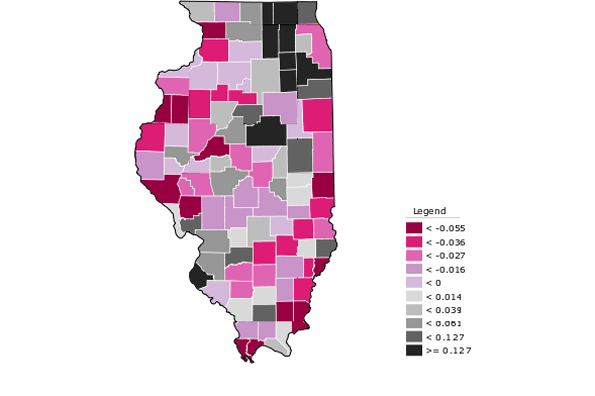
    The following map illustrates this, with a five bucket sort of 2000-2010 population percentage change, growing counties in black, shrinking in red:


    The raw data on regional growth speaks for itself:

    Core+Suburb vs. Exurb

    2000

    2010

    Total Change

    Pct Change

    Core + Established Suburb (Cook, DuPage, Lake Counties)

    6,925,258

    6,815,061

    -110,197

    -1.6%

    Exurb (Other IL Metro Chicago Counties)

    1,347,510

    1,771,548

    424,038

    31.5%

    This sprawl might be more understandable in rapidly growing cities like Atlanta and Houston that can both densify the core and grow outwards simultaneously.  But the Chicago-Joliet-Naperville-IL Metropolitan Division (the full MSA is not yet available since Wisconsin hasn’t been released yet) grew at less than half the national average. This means that the exurbanization trend in Chicagoland is almost entirely loss of population share by the core to the fringe.

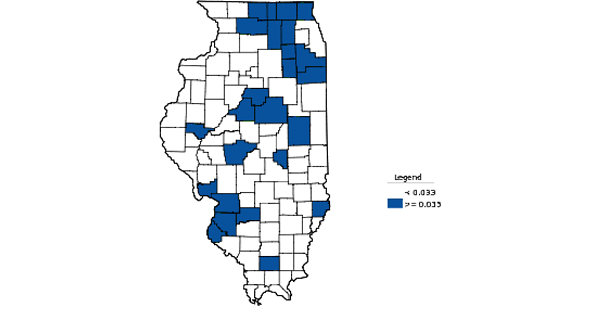
    To put an even starker view on the concentration of growth in Illinois as a whole, this map highlights only those counties that grew faster than the already anemic statewide average:


    Other than a handful of counties, the group of fastest growing counties in the state is dominated by suburban and especially exurban Chicago and St. Louis counties.

    For those of us who’ve chosen to plant our flag in the city, these results are most unwelcome news, no two ways about it. This is especially true as underfunded pensions and city budget gaps loom large, and where the per capita load only goes up as the population goes down.  This report should be a call to arms to the next mayor and the city as a whole to make the promise of revitalization a reality, and bring growth and prosperity to the city as a whole, not just a the upscale core. Cities like Chicago have to become more aspirational; places of upward mobility to broad sections of the middle and working classes. The city and Cook County can’t afford another decade like this one.

    Aaron M. Renn is an independent writer on urban affairs based in the Midwest. His writings appear at The Urbanophile.

    Photo by Gravitywave