Tag: St. Louis

  • Shrinking City, Flourishing Region: St. Louis Region

    Throughout the high income world, in this age of cities, many urban centers continue to shrink. This is particularly true in municipalities that have been unable either to expand their boundaries or to combine with another jurisdiction, subsequently running out of new developable land.

    For example, the city of Paris (as opposed to the metropolitan area or urban area, see Note) lost a quarter of its population between 1954 and 1999, while the loss in some core districts (arrondissements) was 75 percent. Copenhagen, which is often considered one of Europe’s most vibrant municipalities lost more than one-third of its population between 1950 and 2000. Other core municipalities have lost more than one-half million people, such as, London, Seoul, Glasgow, Berlin, Osaka, Chicago, Detroit, Philadelphia and St. Louis.

    City of St. Louis Population Loss: Yet no city which achieved the scale of a half million residents has lost a larger percentage of its population in peacetime than St. Louis. To some extent, this is a very old problem for a city that was once the largest in the Midwest but was passed in 1880 by Chicago.

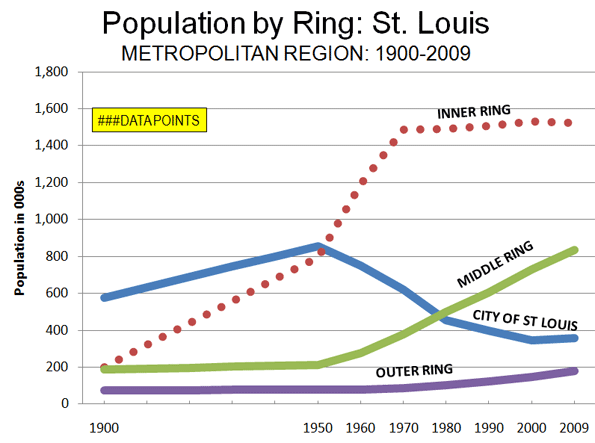
    In 1950 the city population peak at 857,000 people and ranked 8th among the nation’s municipalities. By 2009, the latest estimates, the population was 357,000 (ranked 48th in the nation), a decline of nearly 60 percent from the peak.

    Metropolitan Population Gain: But as is the case for many “shrinking cities,” the region outside the municipal boundaries has continued to grow. In1950, the population of the metropolitan region (as currently defined) was 1,940,000. By 2009, the metropolitan region had grown to 2,890,000, for a population increase of nearly 1,000,000 (more than a 50 percent increase). St. Louis is a bi-state metropolitan area, with three quarters of the population living in Missouri and the balance in Illinois, a ratio than has been largely unchanged since 1900.

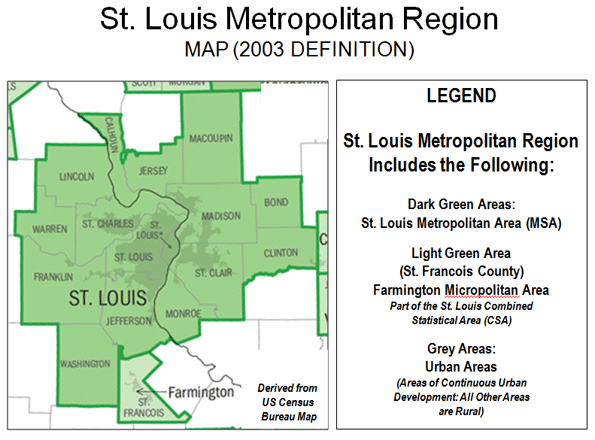
    The metropolitan region (or combined statistical area) includes the city of St. Louis, (a county equivalent jurisdiction), 8 counties in Missouri and 8 counties in Illinois. The St. Louis metropolitan region covers approximately 9,100 square miles (Figure 1), of which the principal urban area (area of continuous urbanization) covered 829 square miles (9 percent of the metropolitan region).
    As in the case of virtually all large high-income world metropolitan areas, population growth has principally occurred on the suburban fringe. For example, from 1965 to 2000, 110 percent of the growth in major metropolitan areas of Western Europe was in the suburbs, more than in the United States (90 percent since 1950).

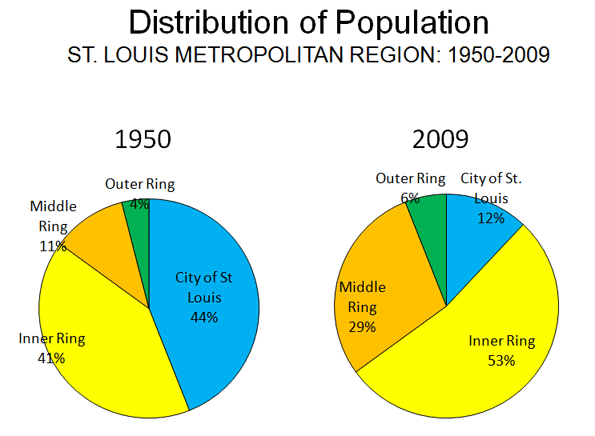
    Distribution of Population: Even by these standards, St. Louis may be an extreme case. In 1950, 44% of the region’s population was in the city of St. Louis. The inner ring the counties of St. Louis, St. Clair (Illinois) and Madison (Illinois), accounted for another 41% of the population. Thus 85% of the metropolitan region’s population lived in the city or the inner ring counties. The other 15% lived in middle ring and outer ring counties.

    By 2009 the population of the city and the inner ring counties had fallen to 65% of the region. The city and county of St. Louis (which were combined until 1876), reached a combined population peak in 1970 and has lost 225,000 people since that time, falling below the 1960 census total.

    The middle ring counties represented 29% of the population while the outer ring counties had 6% of the population (Figure 2) in 2009. During the 2000s, the middle ring counties added more than 130,000 residents, while the city added 10,000.
    Consistent with the trend since the late 1950s, nearly all of the metropolitan region growth occurred outside the city and the inner ring between 2000 and 2009. The city is estimated to have accounted for 7% of the region’s growth. The inner ring counties actually shrank while the middle ring counties accounted for 76% and the outer ring counties 22% of the growth (Table 1 and Figure 3) for the region.

    Table 1
    St. Louis Metropolitan Region: Population Trend
    1900-2009
    Sector
    1900
    1950
    2000
    2009
     METROPOLITAN REGION (CA) 
    1,039,543
    1,942,848
    2,757,377
    2,892,874
     HISTORIC CORE 
    575,238
    856,796
    346,904
    356,587
     City of St. Louis 
    575,238
    856,796
    346,904
    356,587
     INNER RING 
    201,419
    794,651
    1,531,692
    1,524,482
     St. Louis Co. 
    50,040
    406,349
    1,016,364
    992,408
     Madison Co. (IL) 
    64,694
    182,307
    259,120
    268,457
     St. Clair Co. (IL) 
    86,685
    205,995
    256,208
    263,617
     MIDDLE RING 
    187,384
    213,394
    730,563
    833,706
     Franklin Co. (MO) 
    30,581
    36,046
    94,059
    101,263
     Jefferson Co. (MO) 
    25,712
    38,007
    198,740
    219,046
     St. Charles Co. (MO) 
    24,474
    29,834
    286,171
    355,367
     Bond Co. (IL) 
    16,078
    14,157
    17,650
    18,103
     Clinton Co. (IL) 
    19,824
    22,594
    35,536
    36,368
     Jersey Co. (IL) 
    14,612
    15,264
    21,655
    22,549
     Macoupin Co. (IL) 
    42,256
    44,210
    48,989
    47,774
     Monroe Co. (IL) 
    13,847
    13,282
    27,763
    33,236
     OUTER RING 
    75,502
    78,007
    148,218
    178,099
     Lincoln Co. (MO) 
    18,352
    13,478
    39,254
    53,311
     St. Francois Co. (MO) 
    24,051
    35,276
    55,743
    63,884
     Warren Co. (MO) 
    9,919
    7,666
    24,721
    31,485
     Washington Co. (MO) 
    14,263
    14,689
    23,410
    24,400
     Calhoun Co. (IL) 
    8,917
    6,898
    5,090
    5,019
     Metropolitan Region: Combined Statistical Area (2009 Definition) 

    Despite often well-orchestrated impressions to the contrary, the continuing dominance of suburban population growth in the St. Louis metropolitan region mirrors the experience in other major metropolitan areas across the nation.. This growth has not been, as is often supposed, at the expense of the city. Over the past sixty years suburban growth was actually three times the total net loss suffered by the city. Increasingly when people move to St. Louis, they actually mean that they are coming to the suburban periphery.

    Domestic Migration: Overall in the past decade, the St. Louis metropolitan region experienced only a modest domestic migration loss – far less than many other regions . Approximately 1.3 percent of the 2000 population, or 35,000 people moved from St. Louis to other parts of the nation. By comparison, in similar sized and sunny San Diego, the domestic migration loss was 127,000, with a percentage loss more than three times that of St. Louis. Who could have imagined that in a decade, Los Angeles would lose 1.3 million more domestic migrants than St. Louis and New York 2 million more (granted, from much larger bases).

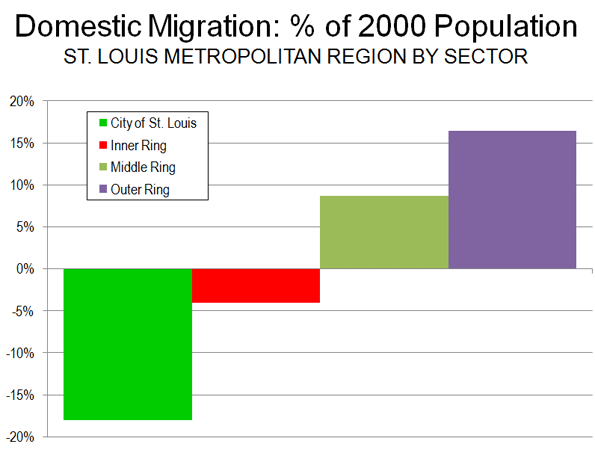
    During the 2000s, the domestic migration trends within the St. Louis metropolitan region reflected the national trend of migration from core areas to the suburbs. According to US Census Bureau estimates, the 2000 to 2009 in domestic migration loss in the St. Louis metropolitan region was distributed as follows (Figure 4):

    • The city of St. Louis has lost a net 63,000 domestic migrants (18.0 percent of its 2000 population)
    • The inner ring counties have lost a net 59,000 domestic migrants(4.0 percent of the 2000 population), 57,000 of which were lost in St. Louis County
    • The middle ring counties gained a net 64,000 domestic migrants with a gain of 45,000 in St. Charles County (8.7 percent of the 2000 population).
    • The outer ring counties gained a net 24,000 domestic migrants (16.4 percent of the 2000 population) with nearly one half of the gain (11,000) in Lincoln County.
    Net international in-migration was the one bright spot for the city and inner suburbs, which gained the bulk of the 30,000 immigrants who came to region over the past decade (Table 2). But this was not nearly enough to balance the losses from domestic migration.

    Ultimately the St. Louis story reflects the deeper reality seen across the high-income (and even in some low and lower income world metropolitan areas, as future installments will indicate), albeit somewhat more exaggerated. Many core cities continue to stagnate or even shrink, but their regions remain vibrant, expressing a form of urbanism that, while often unappreciated, remains vital and expansive.

    ——–

    Note: Metropolitan areas are composed (outside New England) of complete counties or county equivalent jurisdictions. They include substantial rural expanses, which are economically tied to the principal urban area (the largest urban area in the metropolitan area). An urban area is an expanse of continuous urbanization, and contains no rural territory.

    Photo: St. Louis skyline (by author)

    Wendell Cox is a Visiting Professor, Conservatoire National des Arts et Metiers, Paris and the author of “War on the Dream: How Anti-Sprawl Policy Threatens the Quality of Life
  • The Other Chambers of Commerce

    The recent political conflict between the Obama Administration and the U.S. Chamber of Commerce has thrown a new spotlight on an old communication problem. Local chambers of commerce, although they predate the U.S. Chamber by nearly a century and a half, often are assumed to be part of the U.S. Chamber, or otherwise under its direction. They aren’t. They are independent.

    During the pre-election controversy this year, it was clear that many people, including many chamber members, did not know this fact. They believe that U.S. Chamber President Tom Donohue and his colleagues on H Street directly or indirectly control all that local chambers do. But Donohue and his staff don’t exercise such control, nor do they want to.

    Few people think about what chambers do locally. For example, who knows that Elliot Tiber, president of the Bethel, N.Y., Chamber of Commerce, secured the permit for Woodstock?

    It was also a local chamber – the Business Men’s League of Atlantic City – that came up in 1920 with the idea of a festival to keep tourists in town after Labor Day. Pretty women in beachwear would turn out to be the centerpiece of the annual event. We have that business group (now called the Greater Atlantic City Chamber) to thank for the Miss America Contest.

    Was Charles Lindbergh’s plane called The Spirit of Enterprise (the U.S. Chamber’s tag line)? No, the flying bucket of bolts was, of course, The Spirit of St. Louis. The president of the St. Louis Chamber came up with the name in order to promote the great river city. And why should Lindbergh object? The chamber president also raised most of the money for the aircraft.

    And who sent out the promotional brochure that enticed the first movie producer to southern California in 1907? It was the Los Angeles Chamber of Commerce. In nearby Hollywood a chamber was later active as well, helping re-fashion the famous Hollywood sign out of a decaying advertisement for a real estate development called “Hollywoodland.”

    Moreover, there’s a guy in a suit present next to the glamorous celebrities who get their photos taken when their stars are set in the Hollywood sidewalk. Who is that business man? It’s Leron Gubler, president of the Hollywood Chamber of Commerce, which invented and maintains the Walk of Fame.

    Most of the thousands of things that local chambers have done and do are far removed from the big national issues that embroil the U.S. Chamber. Sure, most of the chambers in the country agree with and support the lion’s share of the U.S. Chamber’s positions. Although the goals are often the same, the priorities, issues, methods, leadership and, importantly, ownership are not.

    Local chambers have shown themselves perfectly able to get into fights of their own, without orders from a non-existent chamber of commerce command center.

    Was it the national chamber’s president who financed the Florida and Alabama, the ships that terrorized Union merchants during the Civil War? No, it was George Trenholm, one of the most active members of the Charleston (SC) Chamber of Commerce. As president of the chamber, Trenholm had asked for a thorough federal charting of the waterways around the Charleston harbor. The survey provided valuable navigation information that became critical when Trenholm emerged a decade later not only as privateer king of the Confederacy but also as chief sponsor of blockade runners. (Some believe he was a model for Rhett Butler in Gone with the Wind.)

    But it wasn’t as if all chambers were Confederates. It was the New York Chamber of Commerce that furnished a cash reward of $25,000 to the captain and crew of the Kearsarge, which finally sank the Alabama.

    There have been other times when local chambers have performed roles worthy of national headlines. During Prohibition, a liquor wholesaler named Al Capone was seen as bad for business by the president of the Chicago Association of Commerce, Colonel Robert Isham Randolph. In an act of some courage, Randolph personally warned Capone and created a chamber subcommittee, popularly called the “Secret Six,” that engineered Capone’s downfall. The Six hired a consultant named Alexander Jamie to gather information, especially financial information, on Capone. Jamie brought in his brother-in-law, Eliot Ness, to help. Capone later credited the Secret Six with taking him down.

    Of course the local chambers have made their share of mistakes over the years. The St. Louis Chamber of Commerce once tried to stop the first railroad bridge across the Mississippi, but was stymied in court by the common sense and careful research of a folksy lawyer named Abraham Lincoln. And the New Orleans Chamber of Commerce successfully pushed for easing the quarantine regulations on ships in its harbor, after which a yellow fever-laden ship travelled up the Mississippi and nearly wiped out Memphis in 1878.

    But if you take some water and add a chamber, the result can be a megalopolis. Starting in 1840, the Houston Chamber with single-minded determination pushed for the removal of snags and mud from the Buffalo Bayou, which trickled on a circuitous 50-mile path to the sea. In the late 1800s, rain melted the salt on a barge on the bayou, and the Galveston News cackled that Houston finally had a salt-water port. But the laughing stopped on September 8, 1900, when a hurricane flattened Galveston.

    Houston overnight became a critical port for Texas, just in time for the Spindletop oil bonanza of January 10, 1901. The chamber would continue to push for improvements on what became the Houston Ship Channel, guaranteeing decades of future growth. Today, the chamber, now called the Greater Houston Partnership, is anticipating the shipping/economic impact of the opening of the second Panama Canal.

    Some national change in the country’s economic model has sprung directly from the actions of chambers. The Chicago Board of Trade, a chamber founded in 1848, revolutionized how its members bought and sold farm commodities, becoming so successful that by 1859 it essentially left the traditional chamber business. Instead, the Board of Trade continued to plow the virgin soil of this new financial field, inventing futures contracts and modern commodities trading.

    And so it goes. The Birmingham (AL) Chamber of Commerce belatedly, but successfully, broke the power of segregationist Bull Connor and promoted integration of the downtown, while the Atlanta Chamber of Commerce president negotiated the accord that, in a celebrated speech, Martin Luther King defended by saying, “If anyone breaks this contract, let it be the white man.” Segregation, especially racial conflict and the resulting negative publicity, was bad for business, and chambers took the side of peaceful integration in many (although not all) cities throughout the South.

    So much of what we think of as America was facilitated or aided by those often forgotten, always resourceful groups known as local chambers of commerce. Whether it’s the Golden Gate Bridge, Great Smoky Mountains National Park, the statue of Vulcan over Birmingham, commission and city manager forms of government, United Way-style giving, Baltimore’s Inner Harbor, and so much more – it was local chambers that led the way. The U.S. Chamber was fighting for business and free enterprise principles in Washington, but it was local chambers working “on the ground” that helped plant so many of these seeds across the nation.

    Each of the local chambers is vastly smaller than the U.S. Chamber, but collectively they have had a large impact. As in so many things, it has been the local organizations, not merely the national ones, that have shaped this country’s enterprise culture.

    Chris Mead is senior vice president of the American Chamber of Commerce Executives. He is working on a history of local chambers of commerce in the United States.

    Photo by Rob Shenk

  • NGVideo: East St. Louis (Part III)

    Part III in the video series on East St. Louis explores ideas put forward for (re)development of the city, including cultural tourism based on the city’s African American heritage and use of vacant land for farming to create a local food source for the St. Louis metropolitan area.

    Part II gives views of downtown today, shows how its history can be seen in the city, and explains why the city could still be a good place for new development.

    Part I discusses the origins and development of East St. Louis as an industrial city.


    Michael R. Allen is an architectural historian currently serving as director of the Preservation Research Office, a technical assistance and preservation consulting firm. Allen also serves on the boards of the St. Louis Building Arts Foundation and Preservation Action.

    Alex Lotz is a graduate of the Film Production program of Chapman University’s Dodge College of Film and Media Arts.

  • The Week New Urbanism Died?

    It has been a bad media week for New Urbanism.

    The day that New Urbanism Died?” was the headline of the St. Louis Urban Workshop blog that detailed the Chapter 11 bankruptcy of Whittaker Builders, developer of the “New Town at St. Charles,” a premier New Urbanist community located in the St. Louis exurbs (beyond the suburbs).

    The author notes that “New Town will not disappear, plenty of people are happy to live there, but its promise is gone. It’s become just another suburban enclave and will face the same challenges as other suburban developments; lack of retail, long commutes, etc.” The blog’s headline is a play on a characterization by postmodern architect Charles Jenks, who referred to the demolition of the infamous Pruitt-Igoe public housing project as “The Day Modern Architecture Died.”

    The Northwest Indiana Times detailed the failure of a new urbanist community (Coffee Creek) in an October 23 article. The article noted that the planned 2,000 home mixed use development, located in the exurbs 45 miles from Chicago’s Loop had attracted only 12 homes and an apartment building. Much of the empty land has been purchased by another developer, who indicated an affection for the new urbanism concept, noting however that it probably would not work here. The article notes that a more modest New Urbanist development is doing better, in nearby Burns Harbor, with 75 homes occupied out of a planned 300.

    Perhaps the unkindest cut of all was a survey, reported by the Oregonian, to the effect that residents of Orenco Station travel by car to work nearly as much as people who live in the unremarkably conventional and sprawling suburbs of Portland.

    Despite these unhappy stories, the death of New Urbanism is not imminent. True, to the extent that New Urbanism requires subsidies it is likely to prove unsustainable in the longer term, like its Pruitt-Igoe type predecessors. On the other hand, to the extent that New Urbanism represents a genuine response of architects, builders and developers to actual, rather than imagined demand, New Urbanism could be with us for some time to come.

  • Go to Middle America, Young Men & Women

    A few weeks ago, Eamon Moynihan reviewed economic research on cost of living by state in a newgeography.com article. The results may seem surprising, given that some of the states with the highest median incomes rated far lower once prices were taken into consideration. The dynamic extends to the nation’s 51 metropolitan areas with more than 1,000,000 population (See Table).

    There is a general perception that the most affluent metropolitan areas are on the east coast and the west coast. Indeed, 8 of the 10 metropolitan areas with the highest nominal per capita income in 2006 were on the two coasts. These included San Francisco, San Jose and Seattle on the west coast and Washington, Boston, New York, Hartford and Philadelphia on the east coast. Middle-America is represented by Denver and Minneapolis-St. Paul. However, as anyone who has lived on the coasts and Middle America knows, a dollar in New York or San Francisco does not buy nearly as much as a dollar in Dallas-Fort Worth or Cincinnati.

    Per Capita Income: Purchasing Power Parity
    US Metropolitan Areas over 1,000,000 Population
        2006 Per Capita Income  
    Rank Metroplitan Area Purchasing Power Adjusted Nominal Nominal Rank
    1 San Francisco $46,287 $57,747 1
    2 Washington $45,178 $51,868 3
    3 Denver $44,798 $44,691 8
    4 Minneapolis-St. Paul $44,326 $44,237 9
    5 Houston $42,815 $43,174 11
    6 Boston $42,571 $50,542 4
    7 Pittsburgh $41,716 $38,550 20
    8 St. Louis $41,613 $37,652 27
    9 Milwaukee $41,572 $39,536 19
    10 Baltimore $41,451 $43,026 12
    11 Seattle $41,448 $45,369 6
    12 Kansas City $41,329 $37,566 28
    13 Hartford $41,104 $44,835 7
    14 New Orleans $40,935 $40,211 16
    15 Philadelphia $40,725 $43,364 10
    16 Dallas-Fort Worth $40,643 $39,924 17
    17 Cleveland $39,997 $37,406 30
    18 Indianapolis $39,843 $37,735 26
    19 Chicago $39,752 $41,591 14
    20 Richmond $39,282 $38,233 22
    21 New York $39,201 $49,789 5
    22 Birmingham $39,057 $37,331 31
    23 Cincinnati $38,691 $36,650 36
    24 Nashville $38,680 $37,758 25
    25 Detroit $38,670 $38,119 24
    26 Charlotte $38,632 $38,164 23
    27 Miami $38,555 $40,737 15
    28 San Jose $38,505 $55,020 2
    29 Jacksonville $38,413 $37,519 29
    30 Louisville $38,262 $36,000 41
    31 Oklahoma City $38,156 $35,637 42
    32 Las Vegas $37,691 $38,281 21
    33 Salt Lake City $37,381 $35,145 45
    34 San Diego $37,358 $42,801 13
    35 Rochester $37,066 $36,179 38
    36 Columbus $37,058 $36,110 39
    37 Atlanta $36,691 $36,060 40
    38 Memphis $36,501 $35,470 44
    39 Tampa-St. Petersburg $36,260 $35,541 43
    40 Portland $36,131 $36,845 35
    41 Buffalo $36,091 $33,803 48
    42 Norfolk (Virginia Beach metropolitan area) $35,418 $34,858 46
    43 Raleigh $35,087 $37,221 32
    44 San Antonio $34,913 $32,810 50
    45 Providence $34,690 $37,040 34
    46 Austin $33,832 $36,328 37
    47 Phoenix $33,809 $34,215 47
    48 Sacramento $32,750 $37,078 33
    49 Los Angeles $32,544 $39,880 18
    50 Orlando $32,095 $33,092 49
    51 Riverside-San Bernardino $25,840 $27,936 51
    Source:        
    http://www.bea.gov/scb/pdf/2008/11%20November/1108_spotlight_parities.pdf

    Purchasing Power Parity: Things change rather dramatically when purchasing power is factored in. Some years ago, international economic organizations, such as the Organization for Economic Cooperation and Development, the World Bank and the International Monetary Fund began using costs of living by nation to compare national economic performance, rather than currency exchange rate. This practice, called “purchasing power parity” is based upon the recognition that there may be substantial differences in the cost of living between nations.

    This can be illustrated by comparing Switzerland and the United States. For years, Switzerland has had a higher per capita GDP than the United States on an exchange rate basis. Switzerland’s gross domestic product per capita was $53,300 in 2006, nearly 30% above that of the United States ($42,000). However price levels in Switzerland are so high that incomes do not go nearly as far as the exchange rate would suggest. Once adjusted for purchasing power parity, the Swiss GDP per capita in 2006 drops to $39,000, well below that of the United States. Much of the difference has to do with regulation. The more liberal economy of the United States produces a lower cost economy than in Switzerland, or for that matter most of Western Europe. The US economic advantage would be even greater measured on a household basis, since US households include nearly 10% more members (generally children) than those in Western Europe.

    The same concept was applied by the Department of Commerce Bureau of Economic Analysis researchers in their review of purchasing power parities between US metropolitan areas in 2006. When purchasing power is factored in, five of the top metropolitan areas in nominal per capita income (not adjusted for purchasing power) drop out and are replaced by other metropolitan areas rarely thought of as among the nation’s most affluent.

    Among the three west coast nominal leaders, San Francisco remains as #1, in both nominal and purchasing power adjusted per capita income. Seattle dropped from 6th to 11th position. However, the real surprise is San Jose, which dropped from 2nd position to 28th.

    The east coast regions ranked among the top 10 metropolitan areas in nominal income also were decimated by their high costs, with only Washington (which rose from 3rd to 2nd) and Boston (which fell from 4th to 6th) remaining. New York fell from 5th to 21st, Hartford from 7th to 13th and Philadelphia from 10th to 16th.

    The two non-coastal metropolitan areas in the nominal top 10 remain, with Denver rising from to 3rd and Minneapolis-St. Paul rising from 9th to 4th.

    It can be argued that Middle-America replaced the five metropolitan areas dropping out of the top ten. Houston, long one of the most disparaged metropolitan areas among urbanists, occupies the 5th position (compared to its 11th ranking in the nominal list). Three of the new entrants are confirmed members of the Rust Belt: Pittsburgh (7th), St. Louis (8th) and Milwaukee (9th). Finally, there is a new east coast entrant, blue-collar Baltimore (10th).

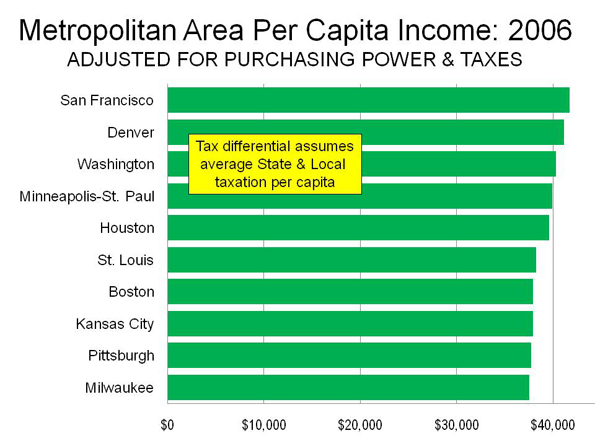
    The Impact of Taxes: But that is just the beginning. Taxes also diminish the purchasing power of households. Unfortunately, there is virtually no readily available information on state and local taxation by metropolitan area. There is, however state and local government taxation data at the state level. If it is assumed that this data is representative of metropolitan differences (weighted proportionately by state in multi-state metropolitan areas), there would be changes in rank among the top 10. Denver would displace Washington in the number two position, closing more than one-half the gap with San Francisco. Even more surprisingly, St. Louis would move ahead of both Boston and Pittsburgh to rank 6th. Kansas City would leap over #11 Seattle, Baltimore, Milwaukee and Pittsburgh to rank 8th, trailing #7 Boston by $25, not much more than the price of a Red Sox standing room ticket. Pittsburgh would occupy the #9 position and Milwaukee #10 (See Figure).

    More than Housing: The largest differences in purchasing power stem from housing, with east coast and west coast metropolitan areas having generally higher housing costs. As a result of the housing bust and the larger house price drops in those areas, purchasing power adjusted incomes could recover relative to those of Middle America. However, the high cost of living on the east and west coasts extend to more than housing prices. Generally, according to proprietary (and for sale) ACCRA cost of living data, the west coast and east coast metropolitan areas have higher costs of living even without housing. These differences are largely in grocery costs, which probably reflects the anti-big box store planning regulations and politics that exist in many of these areas. Grocery costs in the more affluent middle-American metropolitan areas tend to be lower.

    Other Surprises: Outside the top 10 most affluent metropolitan areas, there are other surprises. Urban planning favorite Portland ranks 40th, just above Buffalo. Rust Belt Cleveland ranks 17th, a few positions above New York. Kansas City, with its highly decentralized civic architecture, ranks 12th, just behind Seattle. Indianapolis (17th) is more affluent than Chicago (18th) and both are more affluent than New York.

    Five of the bottom 10 metropolitan areas are in the south, including Virginia Beach, Raleigh, Austin, San Antonio and Orlando. But perhaps the biggest surprise of all is that four of the five lowest ranking metropolitan areas are in the southwest: Phoenix (47th), Sacramento (48th), Los Angeles (49th) and Riverside-San Bernardino (51st).

    The Dominance of Middle America: But among the 10 most affluent metropolitan areas in the nation, six or seven may be counted as Middle-America (depending on how Baltimore is classified). Only three are from the original group that supplies 8 of the top metropolitan areas when purchasing power is not considered.


    Related articles:
    Gross Domestic Product per Capita, PPP: World Metropolitan Regions
    Gross Domestic Product per Capita, PPP: China Metropolitan Regions

    Photograph: Pittsburgh

    Wendell Cox is a Visiting Professor, Conservatoire National des Arts et Metiers, Paris. He was born in Los Angeles and was appointed to three terms on the Los Angeles County Transportation Commission by Mayor Tom Bradley. He is the author of “War on the Dream: How Anti-Sprawl Policy Threatens the Quality of Life.

  • Meet Me in St. Louis

    There is a bend in the river – and that’s where they put the city of St. Louis.

    St. Louis is fun – and here is a guide to finding your way around. Just remember the bend in the river.

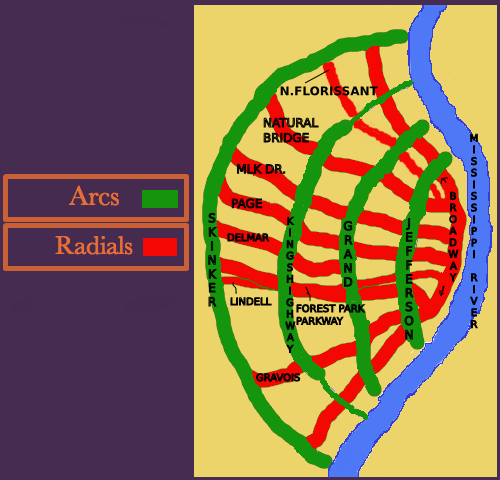
    Imagine a bow (as in bow and arrow) aimed to the east. The imaginary arrow slides right through the Gateway Arch overlooking the river. Just to the west, behind the levee, is the old downtown.

    The St. Louis westernmost city limit parallels Skinker Blvd. That boundary mirrors the river just as the string mirrors the bow. The city is almond-shaped, with the river on the east and Skinker Blvd. to the west. These two arcs meet at the northern and southern points of town. This is a simplification: Skinker Blvd. goes by that name for only a short part of the arc, roughly where the arrow’s feathers would be. To the north it becomes Goodfellow Blvd., and to the south it turns into McCausland Ave., along with other names. But those are details – the main point is this: following Skinker (or its renamed equivalents) to the north will eventually get you to the river, and likewise, following it to the south will also lead you to the river.

    And this is helpful: north-south streets in St. Louis form arcs parallel to Skinker that lead from river to river. Let’s call them arc streets. The inner-most such street is Parnell/Jefferson, followed by Grand Blvd. (that’s where St. Louis University is), Kingshighway Blvd., and then Skinker. To a first approximation, all of these streets parallel Skinker and intersect the river at points north and south of downtown.

    Superimposed on this are streets that radiate from downtown. Two important ones are North Florissant Ave., and South Broadway. These directly parallel the river, and (this is important) will intersect all of the arc streets. Thus North Grand Blvd. intersects North Florissant at approximately right angles – try something like that in Chicago. But in St. Louis it makes perfect sense – Grand is an arc that will intersect the river, and Florissant is a radial that parallels the river. (S. Grand Ave. should also intersect S. Broadway, but doesn’t because the very southern part of the city doesn’t follow the rules. I’ve never been there, so I don’t know why.)

    Starting with Florissant, the important radial streets are Natural Bridge, Martin Luther King, Page Blvd., Delmar, Olive/Lindell, Market/Forest Park, Chouteau, Gravois, and Broadway. These radiate fan-like from downtown, and all of them intersect the arc streets at approximately right angles. Of these, Lindell, Forest Park, and Chouteau are roughly east-west streets; the others head either northwest or southwest. (Quiz: which radial streets also intersect the river?)

    St. Louis University is at Grand & Lindell. Washington University is at Skinker & Forest Parkway. The justly famous Forest Park stretches along Forest Parkway from Kingshighway to Skinker. The Arch is at the foot of Market St. The cultural heart of the city is along Lindell Blvd. near Vandeventer Ave. (which, if it went through, would be an arc street west of Grand).

    Will you meet me in St. Louis? How about at a nice restaurant near the corner of Delmar and Skinker?

    You do know where that is, don’t you?

    Daniel Jelski is Dean of Science & Engineering State University of New York at New Paltz.

  • The Successful, the Stable, and the Struggling Midwest Cities

    The Midwest has a deserved reputation as a place that has largely failed to adapt to the globalized world. For example, no Midwestern city would qualify as a boomtown but still there remain a diversity of outcomes in how the region’s cities have dealt with their shared heritage and challenges. Some places are faring surprisingly well, outpacing even the national average in many measures, while others bring up the bottom of the league tables in multiple civics measures.

    Let us examine the health of various cities, using population growth as a heuristic proxy for overall civic health. Looking at population change from 2000 to 2008, we will classify a city as “successful” if its metro area population growth exceeded the national average growth rate of 8% during that period, as “stable” if it had a population growth rate between 3% and 8%, and as “struggling” if its growth was less than 3%. Let us also put Chicago into its own category of “global city”. It is simply one of a kind in the Midwest, a colossus of nearly 10 million people, and not easily measured against the other cities. Indeed, it is really three cities in one, a prosperous urban core, an archipelago of successful upscale suburbs and edge based growth to the west and north, with a sea of deteriorating city neighborhoods and stagnant to declining suburbs surrounding them. On our scale, Chicago would be “stable” – its inner core has grown but the city overall has lost population, while the outer ring has grown strongly. As a region, it has grown somewhat below the national average.

    Here are the results of our tiering, including all cities in the Midwest* with metro areas exceeding 500,000 in population:

    Global City
    Chicago (5.2%)

    Successful Cities
    Des Moines (15.6%)
    Indianapolis (12.5%)
    Madison (11.9%)
    Columbus (9.9%)
    Kansas City (9.0%)
    Minneapolis-St. Paul (8.8%)

    Stable Cities
    Cincinnati (7.2%)
    Grand Rapids (4.9%)
    St. Louis (4.4%)
    Milwaukee (3.2%)

    Struggling Cities
    Akron (0.5%)
    Detroit (-0.6%)
    Dayton (-1.4%)
    Toledo (-1.5%)
    Cleveland (-2.8%)
    Youngstown (-6.1%)

    These tiers, based only on a single criterion and arbitrary boundaries, nevertheless basically conform to how these cities are performing both economically and in terms of perceptions.

    A few interesting things emerge:

    1. There are a surprisingly large number of Midwestern cities that are growing faster than the US average population. This indicates pockets of strength, in its larger metros at least, seldom associated with the Midwest.
    2. The clear dominance of the successful list by state capitals. This is so pronounced that I have put forth what I call the “Urbanophile Conjecture”, which is that if you want to be a successful Midwestern city, it helps to be a state capital with a metro area population of over 500,000. The only successful city on the list that is not a state capital is Kansas City.
    3. The 500,000 barrier seems to be important as well. The state capitals below that threshold – Lansing, Springfield, and Jefferson City – would not qualify as successful on this list. Note too that the presence or absence of the major state university does not appear to be a decisive factor. Des Moines and Indianapolis are not home to their states’ flagship universities. The home of the academic powerhouse that is the University of Michigan is the Ann Arbor metro area, which was not included in this list because its population is only about 350,000. Notwithstanding, its growth rate would have put it into the stable category.
    4. In a region in which there is such divergence between the performance of cities, a diversity of city specific policies are required. There is no one size fits all for the Midwest. There may indeed be a base of pan-Midwest policies worth pursuing – improvements in education, attractiveness to migrants, better conditions for innovative entrepreneurship, etc – but successful approaches will be those most tailored to uniquely local conditions. For example, a state capital or University town may have different needs than a place that has neither.

    Some suggested areas to investigate by city tier are:

    • Chicago. How can it ease the gap between the thriving global city of Chicago – largely located around the Loop as well as the northern and western suburbs – and the parts of the region that are falling behind, largely the western city neighborhoods and southern edge of metropolis? How do you do this without sacrificing its overall competitiveness? Can the policies appropriate to each be reconciled?
    • Successful Cities. Their policy focus should be on maintaining favorable demographic and economic conditions, and dealing with decaying areas of their urban cores and the potential for decay in some inner ring suburbs. Should the civic aspiration be desirous of it, tuning the engine to attempt to shift the growth rate into high gear to target a profile closer to the Sunbelt boomtowns would be a further focus area. Each city would need to examine which specific policy levers it could pull to attempt to do this. Clearly modernizing and expanding infrastructure to keep up with growth in these places and maintain their high quality of life is a clear imperative.
    • Stable Cities. Their challenge is to bring growth rates up to average or above average levels. It would be worthwhile for them to study the successful areas, and ask what policies and approaches might be adopted. Kansas City offers the best encouragement here. It has managed to maintain a strong growth rate despite not being a state capital and being part of a bi-state metro region. Kansas City features lows costs, high quality of life, a relatively stable housing marketing, and a pro-business culture. It is clearly a standout and worthy of further study for that reason. It may hold the key for moving the stable cities up into the successful tier. Geographically, it is notable that Kansas City is a border state on the far edge of the Midwest, and could arguably be called a Great Plains city. Is that a factor? Some type of peer city comparison with the successful cities, and especially Kansas City, might be warranted here.
    • Struggling Cities. Unfortunately, there isn’t a magic bullet to solve the long festering problems in these places. All of them were heavily industrialized and have borne the brunt of globalization, particularly in manufacturing. This is especially the case in cities linked to the domestic automobile industry, which is clearly in a state of crisis. Until the automobile industry completes its restructuring, and out migration right sizes some of these areas, there does not seem to be a clear path to restart growth. Youngstown, which brings up the bottom of our league table, perhaps offers the best road forward. It is trying to right-size itself to a permanently smaller, but more sustainable, future population based on an aggressive controlled shrinkage plan that has received extensive national notice. This type of plan is likely something all of these cities need to be actively considering as the large fixed costs support a population base that no longer exists will become increasingly unaffordable as the population further shrinks. These cities likely also will need special state and federal help to back this shrinkage plan.

    * The Midwest is defined as Illinois, Indiana, Iowa, Michigan, Minnesota, Missouri, Ohio, and Wisconsin.

    Aaron M. Renn is an independent writer on urban affairs based in the Midwest. His writings appear at The Urbanophile.

  • NGVideo: East St. Louis (Part II)

    The second part in the series on East St. Louis gives views of downtown today, shows how its history can be seen in the city, and explains why the city could still be a good place for new development.

    Part I discusses the origins and development of East St. Louis as an industrial city.

    Part III will explore ideas put forward for (re)development of the city, including cultural tourism based on the city’s African American heritage and use of vacant land for farming to create a local food source for the St. Louis metropolitan area.

    Michael R. Allen is the Assistant Director at Landmarks Association of St. Louis. He edits the blog Ecology of Absence, “a voice for historic preservation and a chronicle of architectural change in St. Louis, Missouri and its region”.

    Alex Lotz is an undergraduate film student in his final year at Chapman University.

  • NGVideo: East St. Louis (Part I)

    The first in a series of videos about the economic, political, and cultural history and future of East St. Louis, Illinois.

    Part II gives views of downtown today, shows how its history can be seen in the city, and explains why the city could still be a good place for new development.

    Michael R. Allen is the Assistant Director at Landmarks Association of St. Louis. He edits the blog Ecology of Absence, “a voice for historic preservation and a chronicle of architectural change in St. Louis, Missouri and its region”.

    Alex Lotz is an undergraduate film student in his final year at Chapman University.

  • Hyde Park, St. Louis: Are We Almost There Yet?

    Among potential titles for this article about the Hyde Park neighborhood of St. Louis, I played with The Archaeology of Stasis. My husband suggested It’s Not Happening Here. But neither seemed right. Both were too depressing to describe a place where people are working hard for change. I wanted a title that suggested a lot of hard work, but hope nonetheless.

    I recently toured the neighborhood on a chilly Sunday morning with a former graduate student of mine, Dan Gaeng. Hyde Park is in north St. Louis, near downtown. Its roots extend to the 1830s and ‘40s, when large numbers of German Americans settled there. Today, it is predominantly African-American. Dan, whose dad grew up in Hyde Park, had written a paper about the neighborhood, and it captured much of what I feel about the city of St. Louis in general. All the ingredients are here for a city that can turn the corner and make urban living a reality for a wide swath of folks – a few solid industries, devoted locals, an ideal location for communication and transportation with the rest of the nation, beautiful old housing stock, at least the bones of a viable public transportation network, ongoing local traditions, and affordable living. Yet St. Louis never seems to get there.

    There are some neighborhoods that have done it, to be sure. And downtown looks a lot better than it did when it served as the post-apocalyptic setting for “Escape from New York.” But there’s still a sense that St. Louis is stalled, moving neither toward recovery nor toward total desolation.

    The negative tinge to my headline candidates no doubt owed something to Kenneth Jackson’s 1985 Crabgrass Frontier. The author traces the construction of interstates, federal housing programs, mortgage lending practices, and white flight to explain the abandonment of urban cores for increasingly distant suburbs. St. Louis is a poster child of the phenomenon. Jackson quotes former St. Louis mayor Raymond Tucker, who explained in frustration, “We just cannot build enough lanes of highways to move all of our people by private automobile, and create enough parking space to store the cars without completely paving over our cities and removing all of the economic, social, and cultural establishments that the people were trying to reach in the first place.”

    Excoriating a 1973 RAND study that suggested that St. Louis could become “one of many large suburban centers of economic and residential life,” Jackson suggests that “such advice is for those who study statistics rather than cities. Too late, municipal leaders will realize that a slavish duplication of suburbia destroys the urban fabric that makes cities interesting.”

    And he paints a grim picture of neighborhoods like Hyde Park, as he notes St. Louis’s declining population. “Many of its old neighborhoods have become dispiriting collections of burned-out buildings, eviscerated homes, and vacant lots. Although the drone of traffic on the nearby interstate highways is constant, there is an eerie remoteness to the pock-marked streets. The air is polluted, the sidewalks are filthy, the juvenile crime rate is horrendous, and the remaining industries are languishing. Grimy warehouses and aging loft factories are landscaped by weed-grown lots adjoining half-used rail yards. Like an elderly couple no longer sure of their purpose in life after their children have moved away, these neighborhoods face an undirected future.”

    Twenty-three years after Jackson’s words, Hyde Park’s perseverance suggests that his portrait, while apt, misses a remarkably resilient local pride. Indeed, one title I considered was On the One Hand, On the Other Hand. It’s not that Hyde Park hasn’t suffered from the very trends that Jackson describes. In the mid-1950s, I-70 split the residential side of the neighborhood from its industrial workplaces. Pedestrian traffic virtually stopped. The decline of industrial employment in the city and white flight followed. The neighborhood appeared to hit bottom in the late 1960s, when youths began stealing from elderly residents.

    Since then, a series of revitalization efforts have made their own mark. The result is a patchwork of hope and despair. Renovated nineteenth-century homes mix with recently constructed townhouses, shuttered and crumbling row houses, and piles of burnt-out bricks. Some owners clearly take pride in their houses and yards (many yards still proudly displayed Obama signs on my post-election tour), while other properties appear barely occupied. The traces of old business names are visible on the bricks. It’s just the kind of local color that proponents of gentrification are fond of preserving, but there are few local businesses in operation now. An artist has purchased a former library, which he hopes to turn into a gallery, but it’s not yet open, and there’s no public art in the neighborhood.

    There is a full grocery store on the northern edge, but it’s a hike from the most vibrant part of Hyde Park, the cluster of homes that surround the still-active Holy Trinity Catholic Church and parish school. The church has bought up some of the area’s property and encouraged resettlement, much of it in Section 8 housing, but three of the most recent homes are shuttered because no one has purchased them. Former locals and parish school graduates do return to church on Sundays, but the neighborhood is now mainly non-Catholic.

    A local developer, who calls his company Blue Shutters (to contrast with the ubiquitous red shutters that signal the city’s purchase of a desolate building), has renovated several houses. He also has plans for the Turnverein, a one-time German exercise hall, which could serve as a community center. Dan mentioned that his parents held their wedding reception there. Unfortunately, the Turnverein had a serious fire in 2006. As the St. Louis blog “Ecology of Absence” noted, the fire received hardly any attention in the St. Louis Post Dispatch. The neighborhood received historic district status in the 1970s, but when I mentioned to my co-workers, students and neighbors that I had toured Hyde Park, none of them knew where it was.

    And maybe that doesn’t matter. I see no way that Hyde Park could become the kind of gentrified neighborhood that lures hipsters and boutiques, and makes city council members salivate. Moreover, the folks who have committed themselves to the slow and steady efforts of revitalization don’t seem to want their home to be such a place. As one of the residents whom Dan interviewed said, “Other people have wondered why I haven’t left, and I say, ‘Why should I? I’m fine here’. The neighbors look out for each other, and I like the house and neighborhood. There is a nice mixture of people, from the poor to the college educated and well-off. That’s important to me. I don’t want to live in just a homogeneous upper-middle-class area.”

    A remarkably diverse selection of institutions and people are involved in Hyde Park’s revitalization: “Ecology of Absence” blogger Michael Allen (also the Assistant Director of the Landmarks Association of St. Louis), Holy Trinity Church, and the Friedens Neighborhood Association, which is training local high school drop-outs in construction trades and providing G.E.D. preparation. Of course, there are also the dedicated folks who patiently turn out for one redevelopment meeting after another to plot the painstaking steps – the creation of an entry monument, for example, or streetscape enhancements – that could turn Hyde Park into a place that feels fully inhabited.

    It’s possible that twenty-three years from now Hyde Park will make me think not about Crabgrass Frontier, but about another book I read with my graduate students: Charles Payne’s I’ve Got the Light of Freedom, a study of the grassroots efforts behind the Civil Rights movement in Mississippi. Activist Ella Baker called the day-to-day efforts behind the movement “spade work.” It’s not glamorous and it doesn’t get a lot of credit, but there’s no real movement without it. There’s a lot of spade work going on in Hyde Park. It just might build a place.

    For more on Hyde Park, see:
    Ecology of Absence Blogspot, Friedens Neighborhood Foundation, Landmarks Association of St.Louis, St.Louis Development Corp.

    Flannery Burke is an assistant professor in the Department of History at St. Louis University. Originally from Santa Fe, New Mexico, she writes about the American West, the environment, Los Angeles, and St. Louis.