Tag: state government

  • The President’s Unserious Proposal

    "Within 25 years, our goal is to give 80 percent of Americans access to high-speed rail." With this ringing statement in his State of the Union address, President Obama injected new hope into the flagging spirits of high speed rail advocates. Predictably, spokesmen for industry associations, progressive advocacy groups and other stakeholder interests praised the President’s goal as a symbol of his renewed commitment to support investment in infrastructure. But hardly any one we spoke to at the TRB meeting took the President’s ambitious goal seriously.

    "After listening to President Obama’s remarks on high-speed rail, I am left with more questions than answers," observed Rep. Bill Shuster, Chairman of the Subcommittee on Railroads of the House Transportation and Infrastructure Committee, who addressed the TRB Committee on Intercity Passenger Rail. "These promises mean little and the White House knows it," observed a railroad industry consultant attending the meeting, "it’s not within Obama’s power to commit future Administrations and Congresses to this pipe dream." "The President is out of touch with reality; where does he think the money will come from?" was a succinct reaction of a former senior U.S. DOT official.

    Lack of a Financial Plan

    There is good reason for these expressions of skepticism. Although some likened President Obama’s expansive vision to President Eisenhower’s historic call for a 42,000-mile Interstate Highway network, there is a vast difference between the two initiatives. The Interstate Highway proposal was backed by a reliable and steady revenue stream in the form of a federal gas tax. The high speed rail goal lacks a financial plan. It is not supported by a dedicated source of revenue that could maintain the program on a self-sustaining basis over a period of years. Nor can the Administration count on borrowed money or annual appropriations out of general revenue in the current political environment in which deficit reduction rather than new spending is the top congressional priority. Calling expenditures on high-speed rail "investment" does not obscure the reality that we would be spending money that we do not have. As if to underscore this point, the Congressional Budget Office announced on January 25 that this year’s federal budget deficit of $1.5 trillion will be the biggest one in history and the largest as a share of the economy since World War II. "Obama’s proposal is likely to land with a dead thud on Capitol Hill," opined National Journal’s transportation editor Fawn Johnson.

    States’ Ambivalence

    A second reason for skepticism is the ambivalent attitude of the states toward high speed rail. As Federal Railroad Administrator Joseph Szabo, speaking at the TRB meeting, correctly pointed out, the high-speed rail initiative is a state-driven program. Hence, support of governors and state legislatures will be essential if the Obama vision is to succeed. But, as we have seen, several fiscally-strapped states (Wisconsin, Ohio, Iowa) have declined to participate in the Administration’s HSR program while Florida’s Governor Scott still has to be heard from.

    Other governors and state legislatures may well follow their example should they conclude that high-speed rail projects will burden their constituents with massive annual operating subsidies and possibly open-ended risk of construction overruns. The protracted and still inconclusive track-sharing negotiations with the Class 1 railroads suggest that more than one state is having second thoughts about the wisdom of proceeding with these projects (at least on terms demanded by the Administration). About one-half of the dedicated HSR funds still remain unobligated according to the latest Federal Railroad Administration report.

    Fred W. Frailey, a respected writer and commentator on the railroad industry and author of Twilight of the Great Trains thinks that enthusiasm for high-speed trains has peaked and is on the wane. Writing in the current (March) issue of TRAINS, Frailey says the collapse of support is not merely a partisan event. Election results suggest that the public was never really won over. Nor will the Association of American Railroads or its member railroads fight for HSR. "So anyway you cut it, the high-speed show is over," Frailey concludes.

    A Fresh Congressional Posture

    This does not mean that fast trains will have no role to play in America’s future. There is a need to diversify travel alternatives in crowded travel corridors to accommodate future population increases. But, as a congressional hearing in New York City on January 27 made clear, federal efforts should be refocused on places where passenger rail investment is economically justified and where there exists a potential of sufficient ridership to attract private capital. As Congressmen Mica and Shuster correctly concluded, this means concentrating on the densely populated and heavily traveled Northeast Corridor with its serious air traffic congestion and well-developed urban transit distribution networks in major metropolitan areas.

    A majority of the witnesses testifying at the hearing seemed to agree with the two congressmen. They included such influential advocacy groups as Building America’s Future (Gov. Ed Rendell and Mayor Michael Bloomberg), America 2050 (Petra Todorovich) and U.S. High Speed Rail Association (Thomas Hart).

    Thus, the need to involve the private sector and to focus on the Northeast Corridor as a matter of first priority could well emerge as the core elements of a new congressional posture on high-speed rail. Instead of lavishing money on projects in numerous states in an unrealistic and fruitless attempt to make high-speed rail accessible to 80 percent of Americans, Congress would use targeted financial incentives to attract private investment and encourage private sector involvement in a few corridors where high-speed rail service makes economic and transportation sense. The inducements could include long-term operating concession agreements, loan guarantees, tax credits, availability payments and other creative financing arrangements. Whether additional federal funds to bolster such a policy will be forthcoming in the deficit-conscious 112th Congress, remains to be seen.

    Ken Orski is Editor and Publisher of Innovation NewsBriefs, a Washington-based transportation newsletter in its 22nd year of publication.
  • In the Hunt for a Red October

    California’s precarious budget situation appears to be driving the state closer to potential fiscal ruin. The state is now 28 days into a new fiscal year, operating without a budget, and the deadlocked legislature in Sacramento appears unable and/or unwilling to strike a deal on a new budget able to cover the state’s massive $19 billion deficit.

    With no fix on the immediate horizon, California faces a cash shortage. State Controller John Chiang claims that at current burn rates, the state will find itself out of cash by October if the budget impasse continues. In order to sustain the state’s remaining reserves for as long as possible, Chiang plans to start issuing IOUs to contractors “in August or September to preserve cash”.

    Today, in another effort to defer the date the state will run out of funds, Gov. Schwarzenegger issued an executive order requiring state employees to “take three unpaid days off per month.” This move comes in the wake of the Governor’s proposal to impose minimum wage pay on state workers to save money, currently stuck in the courts.

    If the state legislature is unable to find a solution to the deficit, and creditors prove unwilling to accept more IOU’s, California may be forced to effectively default on its debts. According to Newgeography contributor Bill Watkins, under such a scenario bond issues could fail, state operations grind to a halt, and the “mother of all financial crises” might be unleashed. Even if California is able to find ways to juggle debt load and convince creditors to accept IOU’s while the budget impasse drags on, such stop-gap actions may place its already shaky credit rating at risk of being slashed further towards junk status. The state, legally unable to declare bankruptcy, must find some solution to its budget dilemma or it will become the first state to default since the Great Depression.

  • Is Illinois ‘Bankrupt’?

    While California’s much publicized budget battles have made the dire financial straights faced in Sacramento a topic of regular media conversation, other states are also experiencing major fiscal woes. According to experts interviewed by Crain’s Chicago Business, Illinois currently finds itself in a state of de facto bankruptcy, with the state’s ledgers appearing “to meet classic definitions of insolvency: Its liabilities far exceed its assets, and it’s not generating enough cash to pay its bills.”

    According to Crain’s, “While California has an even bigger budget hole to fill, Illinois ranks dead last among the states in terms of negative net worth compared with total expenditures.” The state had a record $5.1 Billion in bills past due at year’s end, has failed to pay some vendors for months, and has seen the average time to pay a bill double to nearly 92 days. The state also faces rapidly mounting pension obligations, and has seen it’s ability to borrow restricted by its worsening credit rating. Facing piles of liabilities, and recession reduced receipts, the state is currently “living hand to mouth, paying bills as revenues come in each day, building up cash when special payments are coming due. Cash on hand varies from day to day, sometimes dipping below $1 million”.

    A business or municipality facing such financial challenges might be tempted (or forced) to seek the shelter of bankruptcy protection in order to place it’s books in order. States, however, do not have recourse to that option under existing federal law. As a result “rather than having a court restructure its finances as in a bankruptcy filing, a state [has]to reorganize its spending and debt on its own.” Lawmakers in Springfield, faced with a situation that is bankruptcy in all but name, will have to make difficult decisions regarding future taxes and services.

  • Local and State Tax Burden Maps

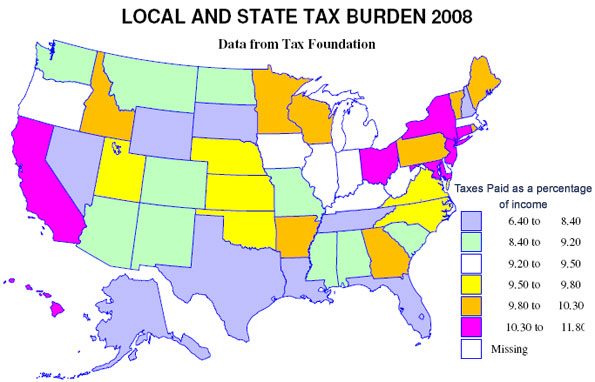
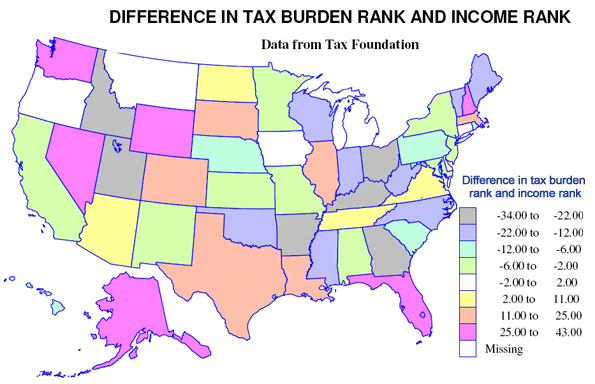
    The Tax Foundation calculates the taxes paid per capita, including what is spent by people on average in neighboring states, including state and local fees. The two maps show, first, the tax burden, taxes paid as a percent of income, the second, the difference in the ranks of states in tax burden and in income.

    The map for tax burden is colorful, so one might suppose there is a big difference in the local and state burden. There is variation, but the amazing story is how small the differences really are. The variation is from a maximum of 11.8 percent in New Jersey (note that Taxachusetts is in the middle of the pack) to a low of 6.4 percent in Alaska. But most states, 38, are in between 8.6 and 10.2 percent.

    The lowest tax burdens are not surprising – Alaska (6.4) and Nevada (6.6), but the next lowest, Wyoming (7) and Florida (7.4), may be a surprise. The highest tax burdens, as may be expected, are megalapolitan New Jersey, New York (11.7), Connecticut (11.1) and Maryland (10.8), but Hawaii (10.6) in this group may be a surprise. The states in the middle, besides Massachusetts, include a contiguous set centered in Chicago – Illinois, Indiana, Iowa, Michigan, Kentucky and West Virginia (all 9.3 to 9.5).

    The modest range of burdens implies that generally richer states have higher tax burdens and poorer states have lower burdens, but the second map shows that there are many exceptions. Richer states with higher tax burdens include (a small difference in tax and income ranks) District of Columbia, New Jersey, Connecticut, New York and Maryland, and poorer states with a moderately low tax burden are few – Alabama, New Mexico and Montana. Poorer states but with a high tax burden are Arkansas, Kentucky, Utah and Idaho, but this finding perhaps tells us the statistical problem or risk in using per capita rather than per household measures. Strongly Mormon Utah and Idaho, indeed all four states have high average household size, so are not as disadvantaged as the data suggest. For a similar reason, Florida may not be as good as it looks, since it has a quite low average household size.

    Most interesting may be the richer states with lower ranking tax burdens, notably Wyoming, New Hampshire, Washington and Nevada. Other states with a relatively low burden (lower tax rank than income rank) include Alaska, Colorado, Florida, Massachusetts, and Texas and other states with a relatively high burden (much higher tax rank than income rank) include Georgia, Kentucky, Ohio and West Virginia.

    Finally states with close to the same rank in income and tax burden include a set of contiguous Midwestern states, Iowa, Minnesota, Missouri, and Kansas, then Michigan, Oregon and California.

    But in sum, choosing a state based on its local and state tax burden could be worth the effort, but the effects by themselves could be more limited than commonly supposed.