Tag: states

  • North Dakota Leads Population Growth Again

    New US Census Bureau state level estimates have just been released. Repeating the pattern similar to that developing since 2010, North Dakota, the District of Columbia, Texas, Utah and Colorado have posted the strongest percentage gains.  North Dakota added 3.1 percent to its population between 2012 and 2013 and 7.6 percent since the 2010 Census. Close behind was the District of Columbia, which added 7.4 percent since 2010, though its growth over the past year has been at a lower 2.1 percent rate.

    Texas added the most residents of any other state over the last three years (1.3 million), a fifth more than 22nd ranked California, which is nearly 50 percent larger. Texas has added 5.2 percent to its population since 2010, while California has added 2.9 percent.

    Utah grew 5.0 percent, followed closely by Colorado, at 4.8 percent.

    Former perennial growth leader Florida continues to recover, placing 6th, with a three year growth rate of 4.0 percent. At its present growth rate, Florida should pass New York by 2014, to become the fourth largest state. South Dakota, Washington, Arizona and Alaska rounded out the top ten.

    The slowest growing states were Rhode Island (the only state to lose population since 2010), Maine, West Virginia, Michigan and Vermont. A table is attached with the data.

    States Ranked by 2010-2013 Population Change
    Rank   2010 Census 2012 2013 Pop. Change 2010-2013 % Change 2012-2013 % Change 2010-2013
    1  North Dakota           672,591        701,345        723,393         50,802 3.1% 7.6%
    2  District of Columbia           601,723        633,427        646,449         44,726 2.1% 7.4%
    3  Texas      25,145,561   26,060,796   26,448,193    1,302,632 1.5% 5.2%
    4  Utah        2,763,885     2,854,871     2,900,872       136,987 1.6% 5.0%
    5  Colorado        5,029,196     5,189,458     5,268,367       239,171 1.5% 4.8%
    6  Florida      18,801,310   19,320,749   19,552,860       751,550 1.2% 4.0%
    7  South Dakota           814,180        834,047        844,877         30,697 1.3% 3.8%
    8  Washington        6,724,540     6,895,318     6,971,406       246,866 1.1% 3.7%
    9  Arizona        6,392,017     6,551,149     6,626,624       234,607 1.2% 3.7%
    10  Alaska           710,231        730,307        735,132         24,901 0.7% 3.5%
    11  Wyoming           563,626        576,626        582,658         19,032 1.0% 3.4%
    12  Nevada        2,700,551     2,754,354     2,790,136         89,585 1.3% 3.3%
    13  North Carolina        9,535,483     9,748,364     9,848,060       312,577 1.0% 3.3%
    14  Virginia        8,001,024     8,186,628     8,260,405       259,381 0.9% 3.2%
    15  South Carolina        4,625,364     4,723,417     4,774,839       149,475 1.1% 3.2%
    16  Hawaii        1,360,301     1,390,090     1,404,054         43,753 1.0% 3.2%
    17  Georgia        9,687,653     9,915,646     9,992,167       304,514 0.8% 3.1%
    18  Delaware           897,934        917,053        925,749         27,815 0.9% 3.1%
    19  California      37,253,956   37,999,878   38,332,521    1,078,565 0.9% 2.9%
    20  Idaho        1,567,582     1,595,590     1,612,136         44,554 1.0% 2.8%
    21  Maryland        5,773,552     5,884,868     5,928,814       155,262 0.7% 2.7%
    22  Oklahoma        3,751,351     3,815,780     3,850,568         99,217 0.9% 2.6%
    23  Montana           989,415     1,005,494     1,015,165         25,750 1.0% 2.6%
    24  Oregon        3,831,074     3,899,801     3,930,065         98,991 0.8% 2.6%
    25  Tennessee        6,346,105     6,454,914     6,495,978       149,873 0.6% 2.4%
    26  Nebraska        1,826,341     1,855,350     1,868,516         42,175 0.7% 2.3%
    27  Massachusetts        6,547,629     6,645,303     6,692,824       145,195 0.7% 2.2%
    28  Minnesota        5,303,925     5,379,646     5,420,380       116,455 0.8% 2.2%
    29  Louisiana        4,533,372     4,602,134     4,625,470         92,098 0.5% 2.0%
    30  Arkansas        2,915,918     2,949,828     2,959,373         43,455 0.3% 1.5%
    31  Iowa        3,046,355     3,075,039     3,090,416         44,061 0.5% 1.4%
    32  Kansas        2,853,118     2,885,398     2,893,957         40,839 0.3% 1.4%
    33  New York      19,378,102   19,576,125   19,651,127       273,025 0.4% 1.4%
    34  Indiana        6,483,802     6,537,782     6,570,902         87,100 0.5% 1.3%
    35  Kentucky        4,339,367     4,379,730     4,395,295         55,928 0.4% 1.3%
    36  New Mexico        2,059,179     2,083,540     2,085,287         26,108 0.1% 1.3%
    37  New Jersey        8,791,894     8,867,749     8,899,339       107,445 0.4% 1.2%
    38  Alabama        4,779,736     4,817,528     4,833,722         53,986 0.3% 1.1%
    39  Wisconsin        5,686,986     5,724,554     5,742,713         55,727 0.3% 1.0%
    40  Missouri        5,988,927     6,024,522     6,044,171         55,244 0.3% 0.9%
    41  Mississippi        2,967,297     2,986,450     2,991,207         23,910 0.2% 0.8%
    42  Connecticut        3,574,097     3,591,765     3,596,080         21,983 0.1% 0.6%
    43  Pennsylvania      12,702,379   12,764,475   12,773,801         71,422 0.1% 0.6%
    44  New Hampshire        1,316,470     1,321,617     1,323,459           6,989 0.1% 0.5%
    45  Illinois      12,830,632   12,868,192   12,882,135         51,503 0.1% 0.4%
    46  Ohio      11,536,504   11,553,031   11,570,808         34,304 0.2% 0.3%
    47  Vermont           625,741        625,953        626,630              889 0.1% 0.1%
    48  Michigan        9,883,640     9,882,519     9,895,622         11,982 0.1% 0.1%
    49  West Virginia        1,852,994     1,856,680     1,854,304           1,310 -0.1% 0.1%
    50  Maine        1,328,361     1,328,501     1,328,302              (59) 0.0% 0.0%
    51  Rhode Island        1,052,567     1,050,304     1,051,511         (1,056) 0.1% -0.1%
     United States  308,745,538 313,873,685 316,128,839    7,383,301 0.7% 2.4%


  • Book Review: “The Fate of the States: The New Geography of American Prosperity” by Meredith Whitney

    In December 2010, Meredith Whitney, the financial analyst, appeared on 60 Minutes, where she predicted that the United States would see between 50 and 100 defaults of municipal bonds. Since she was one of the earliest analysts to predict the financial meltdown, publishing a research report in October 2007 that said that because of mortgage losses Citigroup might have to cut its dividend, it was not surprising that her statement attracted a great deal of attention, but also significant pushback from industry representatives, who insisted that municipal bonds were safe.  This book, "Fate of the States: The New Geography of American Prosperity" is her effort to elaborate on that call.    

    Whitney begins her analysis with a review of the housing bubble and banking crisis, which by now is well trod ground, but she does so in a highly informed and balanced way.  Where some commentators want to place most of the blame on government, others on Wall Street, and yet others on the Federal Reserve Bank for keeping interest rates too low for too long, she argues that everyone behaved badly.  The self-destructive behavior that she witnessed on the part of many banks and financial institutions during this period remains an enduring and puzzling part of the story.   

    Readers of New Geography will be familiar with two of the themes that she articulates.  One is the rise of a zone of prosperity from the Gulf Coast through the heartland and up to North Dakota that has been built on pro-active energy policy and strong global demand for agricultural commodities.  A second theme she articulates is the striking disparity in the cost of living between states like California and New Jersey compared with far more affordable states like Texas.  Low cost states, she says, will continue to attract new investment and jobs.

    In arguably the core section of the book, she explains how the housing bubble interacted with banking and government to create what she calls “The Negative Feedback Loop from Hell.”  By way of background, it should be noted that the underlying economics of banking are unusual.   As economist Joseph Stiglitz demonstrated in the 1980s, the price of money does not necessarily clear markets.  Instead, banks often employ credit rationing in order to control risk.  As she argues, this is exactly what happened in the states where the housing bubble inflated the most. These are the states where the subsequent economic decline was the greatest.    

    As Whitney shows, it was also these states, where government officials handed out the most generous pay packages, including large back loaded pensions. On top of that, these states often piled on the most government debt, which nearly doubled between 2000 and 2010.  The result has been significant retrenchment on core government services, from police and fire protection to public education. In her view, this is the negative feedback loop from hell, and the reason that she believes that fiscal stress will continue for a long period of time.

    As the fight for limited resources works itself out, she believes that besides government there will be three parties at the negotiating table. Two are straightforward enough: the bondholders, who expect to be paid back the money they lent, and the public sector employees, who expect to receive the pensions they were promised. But she also sees a third party. Writing shortly before the bankruptcy in Detroit, she presciently recognized that citizens will also have a claim on resources, arguing that they need and deserve the services that government is supposed to provide.

    Although the sub title of the book mentions geography, Whitney largely dismisses what a contemporary textbook on economics and geography calls the “who, why, and where of the location of economic activity.” This is not surprising. There are probably few people who are aware that this branch of economics even exists.  (Among professional economists, more attention has been paid in recent years with the advent of New Economic Geography as championed by Paul Krugman, although, ironically, empirical research indicates that key elements of  of Krugman’s theoretical work are almost certainly wrong.)

    While Whitney rightly focuses on the economic growth that distinguishes many of the states in the central corridor of the country, she cites data that shows that most economic activity continues to occur elsewhere.  She observes, “These so-called flyover states contributed 25 percent of U.S. GDP in 2011, up from 23 percent in 1999.” That is nearly a 10 percent increase, but obviously from a lower base. A current and highly visible example of the importance of geography is the huge growth in the number of warehouses along the New Jersey Turnpike, as engineering projects deepen New York harbor and expand the Panama Canal. Access to water will always be important.    

    Additionally, I would argue that the issues that Whitney addresses cannot be fully understood without taking into account the challenges that continue to face older industrial cities. All economies must constantly re-invent themselves. In the case of cities with a large industrial legacy, however, intrinsic market failures caused by asymmetric and imperfect information have made redevelopment significantly more difficult.  Theoretical and empirical work in recent years has also shown that joint and several liability under U.S. environmental law undermines efficient price discovery for properties that once had an industrial use.      

    These issues aside, Whitney has written a book that is both provocative and necessary. Clearly, certain states have instituted policies that are far more effective at attracting business and new residents. At the same time, other states appear unable to reform. Perhaps her central insight is that problems associated with debt can take on a life of their own. Therefore, her message is clear. States that properly manage their debt and pension obligations will enjoy a prosperous future. States that do not will encounter severe problems.  Investors and public sector employees take note.

    Eamon Moynihan is the Managing Director for Public Policy at EcoMax Holdings, a specialty finance company that focuses on the redevelopment of previously used properties.

  • 9-Year Run: CEOs Rank Texas #1, California #50

    Each year, chiefexecutive.net ranks states based upon their business competitiveness. The latest rankings have just been published in 2013: Best and Worst States for Business.

    Texas on Top: For the 9th Year in a Row

    For the ninth year in a row, chiefexecutive.net ranks Texas as the most business friendly state. Noting the Texas cost of living advantage, chiefexecutive.net points out that “Young programmers and engineers can actually afford to live well in Austin, where the housing cost index is 300 percent lower than in San Francisco.” 

    It is not surprising that Austin has emerged as the fastest growing metropolitan area in the United States adding 3.1 percent to its population annually since 2010. This is an astounding rate of growth — twice that of the San Jose IT behemoth, which at current rate of growth will fall behind Austin in population by 2015. Austin’s growth rate is faster than some of the fastest growing developing world cities, such as Mumbai, Dhaka and Manila.

    However there is much more to Texas Austin. Dallas-Fort Worth is the fastest growing metropolitan area with more than 5 million people in the high income world, though at an average annual growth rate since 2010 of 1.9234 percent retains only a narrow lead over similar sized Houston (1.9227 percent). Smaller San Antonio is growing marginally more quickly both Dallas-Fort Worth and Houston (though less than 2 percent).

    Texas was joined in the top five by the South’s Florida, North Carolina and Tennessee, as well as Indiana, from the Midwest. Three of the top five (Texas, Florida and Tennessee) do not have a state income tax and chiefexecutive.net notes that other states are looking at tax reform that would improve the business climate.

    California: Bringing Up the Rear for the 9th Year in a Row

    Just as predictably as Texas ranking first, California has secured the bottom position for the ninth year in a row. A California CEO told chiefexecutive.net“On any particular element, if New Jersey is an ‘8’ on the pain-in-the-ass scale, California is a ‘9 … It’s an ungovernable state, and there’s no movement that will change that, though there are people who want to…” 

    Nearly as predictably, California is joined in the bottom five by older northeastern states New York, New Jersey and Massachusetts as well as Illinois, from which, like California, hundreds of thousands, even millions of people have fled since 2000.

    The complete state rankings can be viewed at http://chiefexecutive.net/best-worst-states-for-business-2013.

  • Interactive Graphic: Ranking States By Competitiveness

    In a previous post we looked at which states have been most competitive in terms of job creation since the recession.

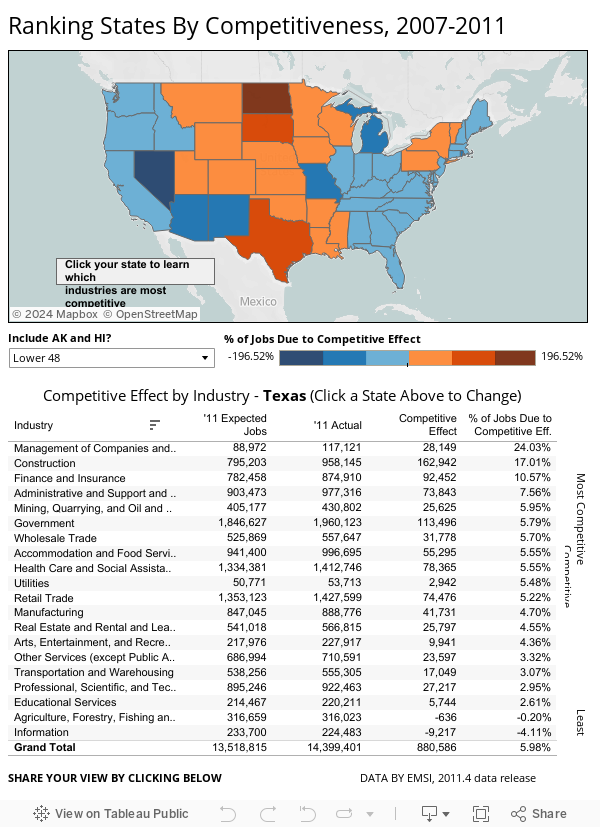
    In this post we teamed up with our friends at Tableau Software to produce the following interactive graphic, which details individual industries that are driving states to be more (or less) competitive. The graphic breaks down the performance of the 20 major sectors in every state in the contiguous US (plus Hawaii and Alaska) in terms of expected and actual job change from 2007-2011. Further explanation of the analysis is below.

    Rundown on the data

    We used shift share, a standard economic analysis method that reveals if overall job growth is explained primarily by national economic trends and industry growth or unique regional factors. Shift share analysis, which can also be referred to as “regional competitiveness analysis,” helps us distinguish between growth that is primarily based on big national forces (the proverbial “rising tide lifts all boats” analogy) vs. local competitive advantages.

    To generate our ranking, we summed the overall competitive effect for each broad 2-digit industry sector by state (e.g., agriculture, manufacturing, health care, construction, etc.) and added them together to yield a single statewide number that indicates the overall competitiveness of the economy as compared to total economy. We calculate the competitive effect by subtracting the expected jobs (the number of jobs expected for each state based on national economic trends) from the total jobs. The difference between the total and expected is the competitive effect. If the competitive effect is positive, then the industries within the state have exceeded expectations and created more jobs than national trends would have suggested. Those industries are therefore gaining a greater share of the total jobs being created. If the competitive effect is negative, then the industries are not gaining jobs as fast as what we would expect given national trends. In this case the state is losing a greater share of the total jobs being created.

    Observations On Most Competitive

    The big thing that stands out is that most of the competitive states tend to be in the middle of the country. This is tied to the growth in the oil and gas sector, yes, but in most cases better-than-expected performance in construction, government, and other miscellany sectors. In Alaska, North Dakota, and Nebraska, smaller states in terms of population and jobs, manufacturing, transportation, and construction are some of the most competitive industries. Louisiana also fares quite well in healthcare and accommodation & food services.

    Observations On Least Competitive

    For states that rank toward the bottom, the housing bust and subsequent construction downturn is the biggest culprit. For instance, in Nevada, which is last on the list, construction is nearly 50,000 jobs below what would be expected given national and industry trends. Florida, a much more populous state, is more than 130,000 jobs below what would be expected. For states like Michigan, Ohio, and Indiana, the poor performance in manufacturing and government weighed heavily in our ranking.

    Here is the original graphic that show the comparison between states.

    Please check out the graphic and let us know if you have any questions. Email Rob Sentz (rob@economicmodeling.com) or hit us via Twitter @DesktopEcon. Data and analysis comes from Analyst, EMSI’s web-based labor market analysis tool.

  • The Impact of Federal Cutbacks

    During my college days, I had the opportunity to interview a local government official tasked with conducting various disaster response programs. North Dakota had, at the time, been dealing with severe flood issues for nearly a decade, and the interviewee had vast experience dealing with the ins and outs of working within the system to find mitigation solutions. Asked about the challenges of having to deal with a multitude of state and federal agencies, he informed me that the most vital contacts he had were at the federal level. His reasoning?

    “That’s where the money is.”

    Given the current political winds blowing from D.C., the conditions that spurred that view might be about to change in substantial ways.

    With the recent failure of the “Super Committee” to find a deal on potential budget cuts and tax reforms, states may soon find themselves faced with a set of federal spending cuts to programs and services that undergird large parts of their economy. These automatic cuts, triggered in 2013 by the committee’s failure, will total nearly $1.2 Trillion and be between domestic and defense expenditures. While many may laud such cuts as a way to help bring the federal budget back towards a semblance of order, it is worth noting that the impact on state economies moving forward could be substantial.

    Federal spending, be it on defense, salaries for federal workers, infrastructure, or procurement makes up a sometimes major part of state economic activity. As outlined in a recent piece at stateline.com, some states have far greater exposure than others. In New Mexico, home to several major federal research institutions, over 12% of Gross State Product (GSP) is attributable to federal government spending. Virginia and Maryland, home to so many federal workers and contractors are even more economically dependent on federal spending, with 13.5% (MD) and 18.5% (VA) of their economies being due to federal activity. The spillover of cuts at the federal level can’t help but impact on the overall economic health of such states. The impact will likely be felt throughout the nation as federal agencies find themselves forced to tighten their belts.

    Scholars of federalism often refer to the period since the late 1970’s as the era of “New Federalism.” Beginning under President Carter, and embraced fully by the conservative movement during the 1980’s, New Federalism was marked by increasing devolution of powers and responsibility to state governments and calls for states to be given more control over the reins when spending allotted federal dollars.

    While states continue to play an important role in the system, actions taken over the past few years under the Bush and Obama administrations seemed to hearken back to the earlier, cooperative model of federalism, with the federal government taking on a more assertive role in working with and through state and local governments to provide stimulus, reform healthcare, and implement post 9/11 security initiatives. While state leaders might have chafed at the strings tied to certain lines of funding, the dollars provided offered states a way to backfill budget shortfalls during a time of economic stress.

    With the demise of the Super Committee, continued calls for deeper spending cuts and gridlock over raising revenues are setting the table for a changed federal-state relationship. As federal agencies strike their tents on various programs and initiatives, states will find themselves receiving less direct federal largess and facing lower economic activity as federal dollars working their way through the local economy are reduced. Budget austerity may lead the federal government to increasingly leave the states to their own means- devolution by force, instead of by choice.

  • Interactive Graphic: Job Growth by Sector for all Counties in the Nation

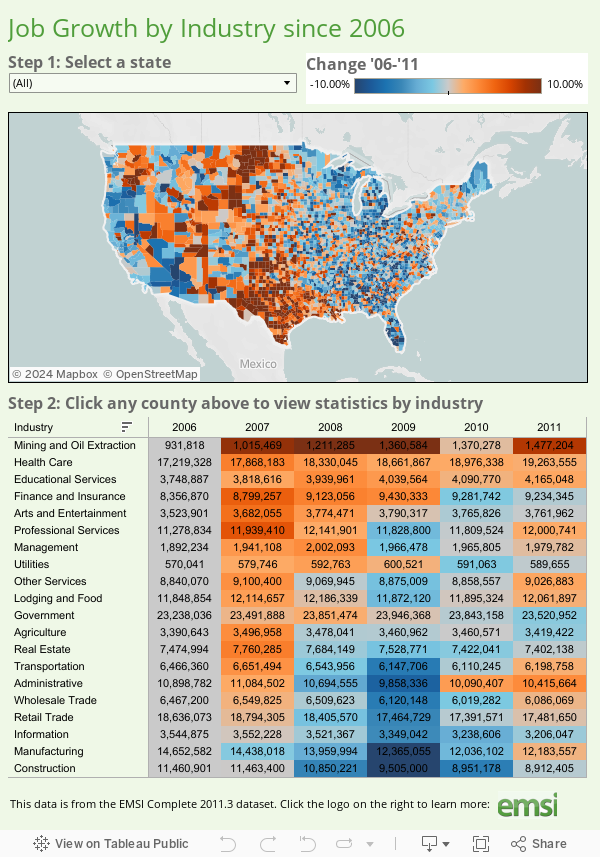
    The fully interactive map below indicates job growth and decline for all US counties from 2006 to 2011. These show up as hot or cold spots; red for growth, blue for decline. You can select a state to zoom in on and find a county that way, or simply click on a county to drill in. Once you’ve chosen a county, the table under the map will show you job numbers by industry category.

    The data for this graphic comes from EMSI’s Complete 2011.3 dataset, based on data from the Bureau of Labor Statistics and many other sources. Many thanks to Tableau for putting this together. If you have questions or comments about the graphic or the data behind it, please email EMSI’s Josh Stevenson.

  • “A Cloud of Contagion”: States, Cities, and Federal Default

    The Pew Center on the States has released a new report examining the impact a potential federal default would have on state and municipal governments. The picture isn’t pretty.

    According to Pew, “A federal default could have a serious impact on states and cities by constricting their borrowing and budgets while they are still feeling the aftershocks of the Great Recession.” Loss of faith in federal debt securities could have a knock-on effect on government debt at all levels, causing jittery ratings agencies to downgrade state and local credit ratings in turn. One ratings agency, Moody’s, has already warned that up to 7000 municipalities could see their bond ratings lowered in the wake of a federal default, and has placed five currently AAA rated states on a downgrade watch list. Ratings downgrades would lead to increased borrowing costs for state and local governments, restricting their long-term ability to finance desperately needed infrastructure upgrades.

    In addition to raising borrowing costs, a federal default could also directly impact federal program dollars currently allocated to state and local governments. According to Pew, such transfers amounted to “$478 billion in 2010 alone.” States and municipalities, already stressed by years of budget challenges, might suddenly find themselves even more cash strapped. In addition, the report points out that the suspension of federal payments to individuals, such as social security recipients and government contractors, could cause a drop in state and local tax receipts as individual incomes drop and commerce slows. While Pew feels states and local governments are “highly unlikely” to face a shutdown as a result of a federal default, they could be left scrambling to find alternative funding sources to cover already budgeted expenses they were expecting to meet with federal support.

  • Infographic: Which Industries Are Growing in Your State?

    EMSI teamed up with Tableau Software to create this industry data display. You can visualize every broad-level (2-digit NAICS) industry by state over the last decade. Also, click on the dot for each state to see the trends for each sector. The bigger the dot, the more jobs that state has in the selected industry. It may take a few seconds to load.

    A few observations:

    1. Right off the bat, you can see the explosive growth of the mining sector nationally over the past few years. If you scroll to mining and oil exploration in the dropdown or isolate it by clicking on the chart, you can see Texas has by far the largest number of jobs among all states. We covered this sector and specific oil and gas extraction occupations in depth recently.

    2. One of the cool things to do is scroll through each year to see the changing complexion of employment. There’s widespread growth projected for most states in 2011, with a few exceptions, but clicking back through the past few years shows a much different picture.

    3. Another intriguing sector is manufacturing. In the last decade, it hasn’t fared well. That much is clear. But notice the tide start to shift in 2010, with Indiana and Michigan showing slight growth. And in 2011, nearly three-quarters of the US is expected to see job expansion.

  • State GDP Performance

    Gross Domestic Product is the basic measure of economic output. The government released 2009 GDP data for US states recently, so it’s worth taking a look. Here’s a map of percent change in total real GDP from 2000 to 2009, with increases in blue, decreases in red:

    As you can see, Michigan actually experienced a decline in its total real output over the last decade. Given the restructuring of the auto industry, that’s not surprising.

    Here’s another view, this one a similar percent change view of real per capita GDP:

    Here you can see that Michigan is not alone. Some of the fast growing Sun Belt states added people at a faster rate than they grew economic output. Georgia in particular is worth noting, because even metro Atlanta has been showing declining real per capita GDP. In fact, Georgia actually declined by more than Michigan did on this metric, so obviously all is not well down there. Texas, despite its vaunted jobs engine, is expanding almost totally horizontally. It is 9th lowest in the US on real per capita GDP growth, with a nearly flat 2% performance over the last decade.

    North Dakota is also interesting. They are leading the charts, I presume driven by energy and high tech. (Thanks to Great Plains software, I believe Fargo is now Microsoft’s biggest software development center in the US outside Redmond).

    This post originally appeared at The Ubanophile.

  • Is Illinois ‘Bankrupt’?

    While California’s much publicized budget battles have made the dire financial straights faced in Sacramento a topic of regular media conversation, other states are also experiencing major fiscal woes. According to experts interviewed by Crain’s Chicago Business, Illinois currently finds itself in a state of de facto bankruptcy, with the state’s ledgers appearing “to meet classic definitions of insolvency: Its liabilities far exceed its assets, and it’s not generating enough cash to pay its bills.”

    According to Crain’s, “While California has an even bigger budget hole to fill, Illinois ranks dead last among the states in terms of negative net worth compared with total expenditures.” The state had a record $5.1 Billion in bills past due at year’s end, has failed to pay some vendors for months, and has seen the average time to pay a bill double to nearly 92 days. The state also faces rapidly mounting pension obligations, and has seen it’s ability to borrow restricted by its worsening credit rating. Facing piles of liabilities, and recession reduced receipts, the state is currently “living hand to mouth, paying bills as revenues come in each day, building up cash when special payments are coming due. Cash on hand varies from day to day, sometimes dipping below $1 million”.

    A business or municipality facing such financial challenges might be tempted (or forced) to seek the shelter of bankruptcy protection in order to place it’s books in order. States, however, do not have recourse to that option under existing federal law. As a result “rather than having a court restructure its finances as in a bankruptcy filing, a state [has]to reorganize its spending and debt on its own.” Lawmakers in Springfield, faced with a situation that is bankruptcy in all but name, will have to make difficult decisions regarding future taxes and services.