Tag: states

  • New Job Market Report from Jobbait Adds New Data

    Mark Hovind over at Jobbait.com released his monthly job market report, and this month he’s expanded it significantly with sector-level data by state and metropolitan area.

    Mark offers the numbers in an easily digestible format organized by state in color coded tables. It’s a great way to get a feel for what’s happening in your region or nationally.

    Mark hopes this will help identify sectors with job prospects, even in regions where overall employment is declining.

    Looking at total job growth, North Dakota is still the only state showing year-over-year employment growth, followed by Washington, DC.
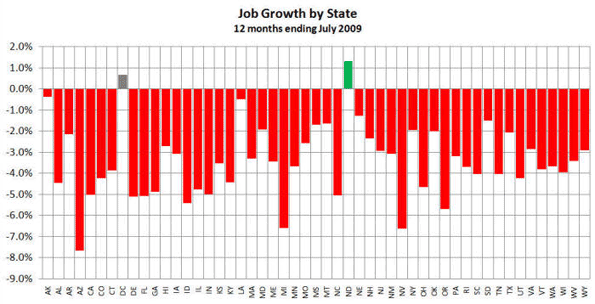
    Fastest declining states by growth rate are Arizona, Michigan, Nevada and Oregon.
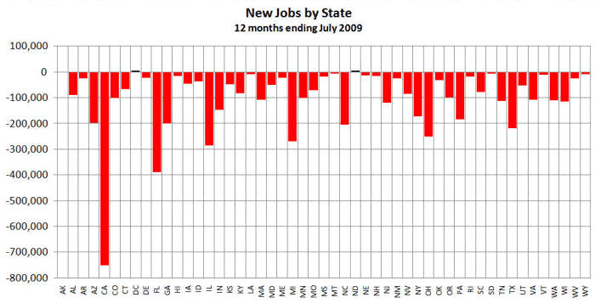
    Fastest declining states by sheer numbers are California, Florida, Illinois, Michigan, Ohio and Texas.

    See Jobbait.com for the full report.
  • Mapping Industry Employment Trends by State

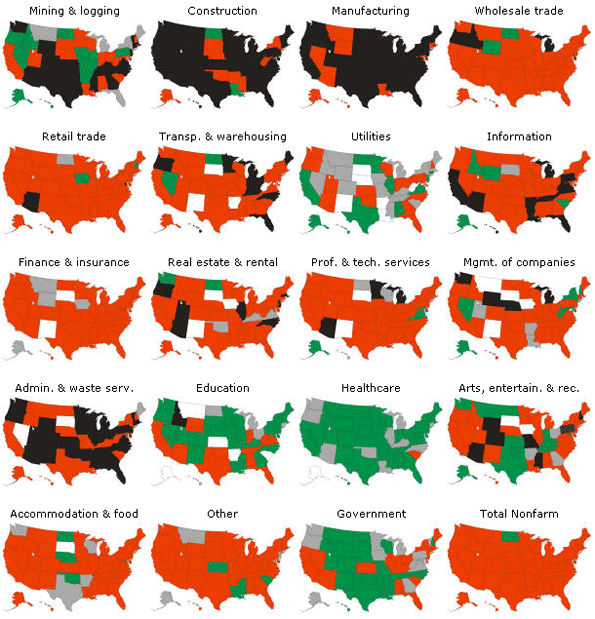
    Mark Hovind at Jobbait.com has released another fascinating set of maps and data on industry employment trends by state over the past few months. Here’s a taste:

    The maps below show the employment trends by state and industry sector for the 12 months ending June 2009 (July will be available August 21). Green is growing faster than the workforce. Grey is growing slower. Red is declining. Black is declining more than 8%. White is not available.

    Head over to Jobbait.com for the full analysis.

  • Nation Has $445 Billion in Unfunded Health Care Benefits, Nebraska Has None

    Nebraska was the 37th State to join the Union, is home to the “Cornhuskers,” and currently has a $3.5 billion budget and a $563 million cash reserve.

    In this time of economic hardship, the Cornhusker state has no debt, shunning all long-term financial commitments including retirement benefits.

    A recent USA Today survey of state financial reports found that the other 49 states combined “have an unfunded obligation of $445 billion” owed for the medical care of retired government workers.

    The formula accountants use to compute the financial health of a state government includes medical benefits, debt and pension liability. Medical benefits represent the Pandora’s Box of the three, with civil servants often retiring before Medicare benefits kick in at 65.

    In contrast, Nebraska is the “only state that doesn’t subsidize the medical care of retired government employees.”

    Other states and local governments have debts that range anywhere from New York City’s $60 billion obligation to Los Angeles’ $544 million sum.

    Some state and local governments have begun setting aside money to prepare to pay retiree medical costs. Some plan to pay nearly the entire cost, other will contribute a fixed amount, such as “$200 a month or 50% of the health insurance premium.”

    In defending Nebraska’s nonexistent retiree health care coverage, Senator Dave Pankonin distills his state’s approach simply: “Nebraska is a fiscally conservative, pay-as-you-go state, and that’s the biggest reason we don’t have this benefit.” Or, he might have added, deficit.

  • State Budget Woes

    A new report from the Center on Budget and Policy Priorities highlights the increasingly precarious fiscal situation faced by state governments confronting the ongoing economic downturn. According to CBPP, “at least 44 states faced or are facing shortfalls in their budgets for this and/or next year, and severe fiscal problems are highly likely to continue into the following year as well.”

    The scope of these emerging deficits varies greatly. Mississippi currently has a budget deficit of around $33 million, which “could reach as high as $70 million-$80 million by the end of the fiscal year.” On the high end of the spectrum, California faces the daunting prospect of a $15 Billion deficit for the fiscal year ending June 30, with the potential for “another $25-billion-plus for the next fiscal year,” if nothing is done to bring the shortfall under control.

    The process of bringing budgets into balance should be the source of much political turmoil over the next year. In Minnesota, which has a predicted two-year deficit of $6 Billion, legislators are beginning to spar over the potential tax increases and budget cuts. On Dec. 26, Gov. Tim Pawlenty announced $271 million in “emergency cuts,” with a large share coming from aid payments to local governments. Legally required to have a balanced budget, as are many states, legislative leaders in Minnesota face the prospect of a challenge “so ugly that a special summer session will be needed to finish the budget.” In New York, which faces the “largest deficit in state history,” Governor David Patterson recently presented an “austerity budget,” calling for cuts in state aid to local governments, education funding, and property tax rebate programs. Looking at all potential options to fill the gap, Patterson has also “appointed a commission to look into leasing state assets,” including bridges, roads, and parks. The privatization of state assets and infrastructure as a means to raise funds is also being considered in Minnesota and Massachusetts, which faces a FY2009 deficit of over $2 billion.

    With states potentially facing a combined deficit of $350 billion through FY2011, the pressure to make difficult policy decisions is sure to increase, as are requests for outside aid. Already, there are calls for the federal government to step into the fray, with governments across the nation “lining up to ask President-elect Barack Obama and the new Congress for hundreds of billions of dollars to plug holes in their budgets”. Gov. Ted Strickland of Ohio, facing a two-year deficit of $7.3 billion, is “preparing a pitch for three chunks of money,” to be delivered to the states to support education, infrastructure, and aid to the poor. CBPP also argues that there is a need for federal assistance, in order to “lessen the extent to which states take pro-cyclical actions that can further harm the economy.” Facing an increasingly challenging economic situation which may limit the options at their disposal, it appears that states will look to the incoming Obama administration to find ways to stop “the bleeding.”