Tag: stimulus package

  • McClatchy-Medill: Real $timulating News

    I saw this story in the Omaha World Herald last week: Benefits of stimulus bill spread unevenly over U.S. As I read through it, I became increasingly impressed. The journalists start off by laying out who said what about the benefits of stimulus spending. They provide quotes and facts from the White House, the Congressional Budget Office, and Joe Biden’s spokesperson. They include viewpoints and analysis from professors at Berkeley, Harvard, George Mason and the editor of the Journal of Economic Perspectives. They even talked it over with the National Association of State Auditors, Comptrollers and Treasurers – the people in charge of receiving and accounting for the billions of dollars represented by the American Recovery and Reinvestment Act. What impressed me most, though, was that they did their own research – not just reporting what the Administration or Congress told them was happening or was supposed to be happening.

    Spending the Stimulus” is a website put together by McClatchy Newspapers and the Medill News Service to track what was promised and what was done, how much was actually spent and where and on what the stimulus billions were spent. I was intrigued by their finding that “much of the stimulus money has yet to go out the door” eighteen months after the emergency, gotta-fix-it-now legislation was passed. After Congress approved $750 billion for the Wall Street Bailout in October 2008, I’m pretty sure all that money was out the door before December!

    Even more intriguing is the finding that the money was spread around rather unevenly. Beyond the infantile “Why Did North Dakota got More Than Me?” rhetoric going around among the states (by the way, the McClatchy-Medill per-capita graphic shows that most of New England got more than North Dakota), is the more interesting discussion of where would the spending be most stimulating. Transportation money was directed to the states under the “usual formula” despite the fact that the Great Recession didn’t follow a formula as it spread throughout the economy. The result: “researchers were unable to find any relationship between unemployment in a given area and the amount of stimulus dollars spent there.” If unemployment is lower in some areas than in others, it wasn’t because of the stimulus spending.

    Maybe this is a good thing. Instead of focusing on the political necessity of justifying billions of dollars to pull the country out of the Great Recession (unlike the complete lack of justification for bailing out Wall Street), the McClatchy-Medill report raises more interesting points. Is it “rewarding failure” to send more money to the states that most failed to develop diversified economies that are resilient to downturns? Would we be throwing good money after bad to provide more spending for states that didn’t manage the cash inflow from the rapid rise in property taxes that came with rapidly rising home prices? Finally, did we really want a central government to make every decision – county by county – about where and on what the money would be spent?

    If you missed this story last week, I highly recommend perusing the “Spending the Stimulus” website for more stimulating idea.
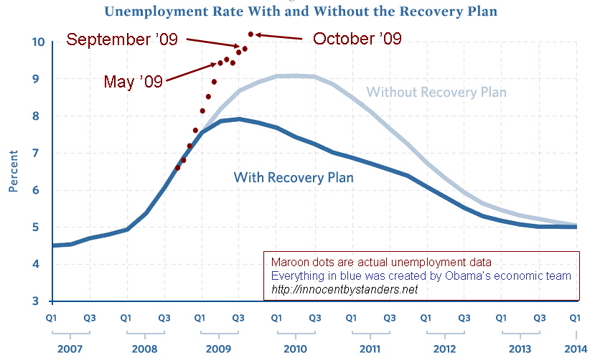
  • Unemployment Rate Nowhere Near White House Predictions

    Check out this chart from geoff at Innocent Bystanders plotting the actual recent unemployment rates against the predicted stimulus-reduced rate from Obama’s recovery team:

    Google’s chart interface is one of the easiest ways to explore unemployment data, allowing for easy comparisons for any state or county.

  • Fears of Stimulus Favoratism to Pro-Obama Counties is Overblown

    A recent USA Today analysis of government disclosure and accounting records has revealed that counties that supported Obama last year have reaped more of the benefits of the stimulus package than those counties that supported Senator John McCain.

    That federal aid, which amounts to around $17 billion, has been the first piece of the Obama administration’s stimulus package that can be tracked locally. The USA Today findings showed that Obama-counties received an average of $69 per person while McCain-counties received around $34.

    While the disparity between the two looks bad on paper, it is not all that uncommon. As USA Today writes, “much of [the aid] has followed a well-worn path to places that regularly collect a bigger share of federal grants and contracts, guided by formulas that…leave little room for manipulation.”

    The aid has gone to repairs for military bases, improvements in public housing and helping students to pay for college – all areas that eclipse political party lines. Additionally, about a third of the $17 billion allocated towards projects such as runway repaving and nuclear waste clean up has gone to counties that supported McCain.

    It is far too soon to be drawing conclusions about a stimulus effort that favors Obama’s constituents. While we can keep an eye out for “political favoritism,” ensuring that the stimulus aid lands where it’s most needed (regardless of county) should be our first priority.

  • Infrasystems Build 21st Century Economies

    Infrastructure investment has been a key driver of economic development throughout American history. In our country’s earliest days, the building of canals and turnpikes, followed by construction of railroads, greatly catalyzed expansion and development. Later, investment in electricity and telephone networks facilitated the development of vast expanses of the American landscape. More recently, the national interstate highway system and now the continuing build-out of broadband telecommunications networks have democratized the geography of business endeavors that were once confined to large metropolitan centers.

    Highways, airports, harbors, utility distribution systems, railways, water and sewer systems, and communications networks remain critical elements in economic development. But in today’s globally competitive, net-centric economy a great advantage will accrue to regions and industries that develop sophisticated “infrasystems” including such innovation infrastructure such as university and lab facilities, technology and training centers, export processing facilities, and research parks.

    These infrasystems – integrating facilities, technology and advanced socio-technical capabilities – have emerged as key drivers of innovation and the locus of future higher-value industries and higher-paying jobs.

    Infrasystems differ by region. For some communities they can be constructed around a key asset such as a local hospital, equipped with medical technology and operated by a highly skilled staff of health care professionals. For a place like Wenatchee, Washington where Internet giant Yahoo decided to locate a data center, the key infrasystems asset lay in a highly aggressive economic development community and low cost, clean energy.

    Wenatchee represents a classic success story for an infrasystems approach. They took many of the right steps including a $12 million investment by the Port of Chelan County and others in the Confluence Technology Center, a state‐of‐the art facility built specifically to attract information technology companies to the area. Another factor in this success is $50 million investment by the Chelan County Public Utility District (PUD) in laying fiber‐optic cable to homes and businesses.

    If our infrastructure policy and financing debate is going to center around miles of paved road, number of bridges or even the number of construction jobs – certainly all worthy objectives – we could still miss the key target of creating long-term employment and making our country, and regions, more competitive. Advanced infrasystems represent the cutting edge economic tool of the 21st Century.