Tag: Sydney

  • Sydney’s Long and Lengthening Commute Times

    The New South Wales Department of Transport Housing and Transportation Survey reports that the average one way work trip in the Sydney metropolitan area (statistical division) reached 34.3 minutes in 2010. As a result, Sydney now has the longest reported commute time in the New World (United States, Canada, Australia and New Zealand), except for the New York City metropolitan area (34.6 minutes).

    Longer Commutes than in Dallas-Fort Worth or Los Angeles: Sydney’s average work trip travel time has increased approximately 10 percent since 2002. The 34.3 minute one way travel time is approximately 30 percent higher than that of larger Dallas-Fort Worth, which about half as dense. Part of the reason for the longer commute time in Sydney is its far greater transit dependence. Approximately 24 percent of work trip travel is on transit (which is slower for most trips). This compares to approximately 2 percent of travel in Dallas-Fort Worth.

    Even Los Angeles, with its reputation for "gridlock" has a shorter average commute time, at 28.1 minutes. This is made possible by the extensive Los Angeles freeway system, greater use of automobiles and more dispersed employment patterns (despite the higher density of Los Angeles relative to Sydney). The average Sydney commuter spends nearly an hour longer traveling to work each week than the average Los Angeles commuter.

    Even Longer Commutes Ahead? Sydney’s densification policies (urban consolidation policies) seem likely to lengthen commute times even more in the future, given the association between higher densities and greater traffic congestion.

  • Adelaide Land Prices Top Sydney

    The median price of serviced (improved) lots for new houses in Adelaide is reported to have risen above that of far larger Sydney by the Housing Industry Association of South Australia. Housing Industry Association of South Australian Executive Director Robert Harding attributed the high price of land to government policies that have limited the supply of land available for building. Nearly all thousands of square miles of land around Adelaide are off-limits to house building due to state government restrictions.

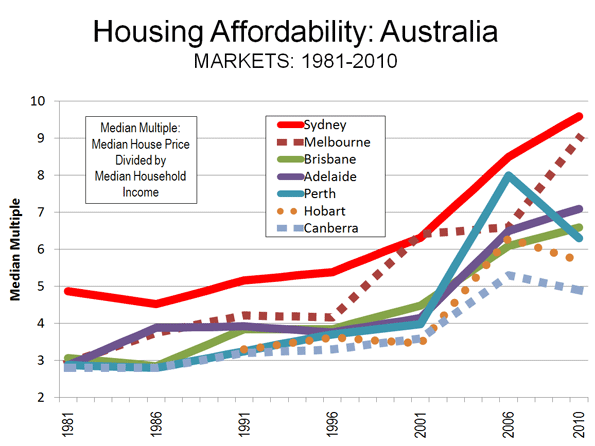
    Adelaide is the slowest growing major metropolitan area of Australia, yet has some of the worst housing affordability among larger metropolitan markets. The 7th Annual Demographia Housing Affordability Survey found median priced Adelaide housing to be 7.1 times median household incomes, ranking the metropolitan area eighth most unaffordable out of 82 with more than 1,000,000 population.

    Before the adoption of its strong smart growth (urban consolidation) land use restrictions, median house prices in Adelaide were one-half or less the present level (Figure). By comparison, new houses can be purchased in much of the United States for less than the median price of an empty lot in Adelaide ($180,000), though not in areas that have adopted smart growth restrictions.

  • Misunderstanding the Geography of Sydney, Paris, Mexico City, Etc.

    Sydney’s Daily Telegraph announced on April 20 that Sydney is more dense than Mexico City, London, Los Angeles and Paris. Of course, anyone who has been to Mexico City or London knows that this is untrue and it may surprise some that Sydney is not even as dense as Los Angeles.

    The article never indicates, quite for sure, what it means by Sydney, the Sydney city council area (the urban area’s core local government authority, or LGA) or the Sydney urban area. Nor does the article provide an overall density, instead only indicating that there are 8,800 persons per square kilometer in "Sydney’s east" and 7,900 per square kilometer in "Sydney City’s west."

    In fact, the figures are from the latest statistical local area estimates of the Australian Bureau of Statistics (ABS) for 2010, and dated March 31, 2011. A "statistical local area" is a part of an LGA (See map: Sydney Local Government Area). The statistical local areas cited by The Daily Telegraph are Sydney-East and Sydney-West, which have a combined density of 8,300 per square kilometer. The small size of the Sydney-East and Sydney-West statistical local areas is illustrated by the fact that each is about the same size as the Sydney Olympic Park.
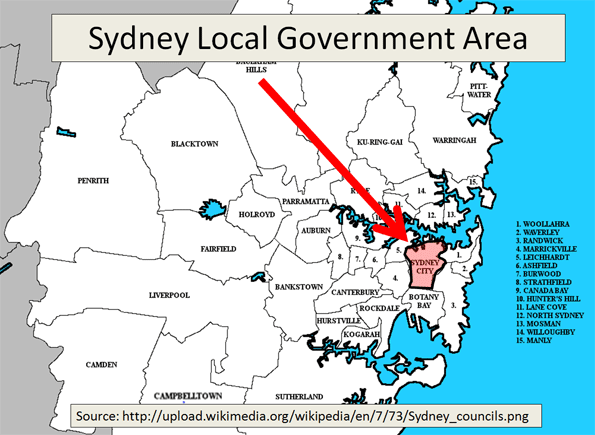
    Comparing Urban Area Densities: The Daily Telegraph’s contention results from a profound misunderstanding of urban geography. The result was a comparison of urban geographies that are not comparable.

    The Daily Telegraph compares the density of these two small areas of the Sydney LGA, with the urban area densities of Mexico City (which the Daily Telegraph places at 8,400), London (5,100), Los Angeles (2,750) and Paris (3,250). These figures were taken from an earlier edition of Demographia World Urban Area. (Our latest Demographia World Urban Area data, including estimated population densities for all urban areas in the world of more than 500,000 population is here). Urban areas are areas of continuous urban development.

    The appropriate Sydney geography for comparison to the urban area populations of Mexico City, London, Los Angeles and Paris is the urban area (the international term), which is called the urban centre by ABS (See map: Sydney Urban Area).
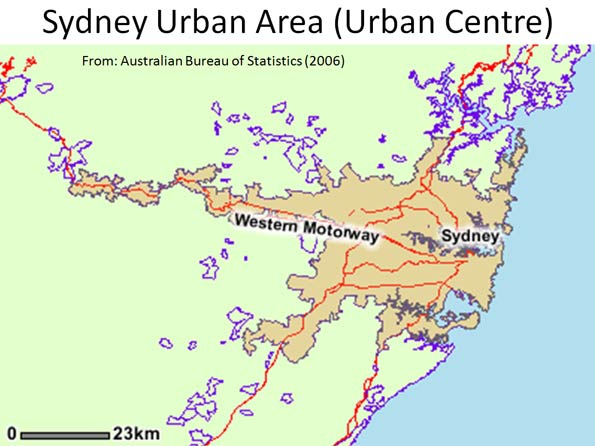
    The Sydney urban centre covers an area extending south to Campbelltown, north to Palm Beach and well into the Blue Mountains on the Great Western Highway. According to the ABS, the Sydney urban area (urban centre) had a population of 3.641 million in 2006 (latest available data), and covered a land area of 1,788 square kilometers. This means that the population density of the Sydney urban area was 2,037 in 2006. Thus, the Sydney urban area has a lower density than all four international urban areas used in The Daily Telegraph comparison (Figure 1).
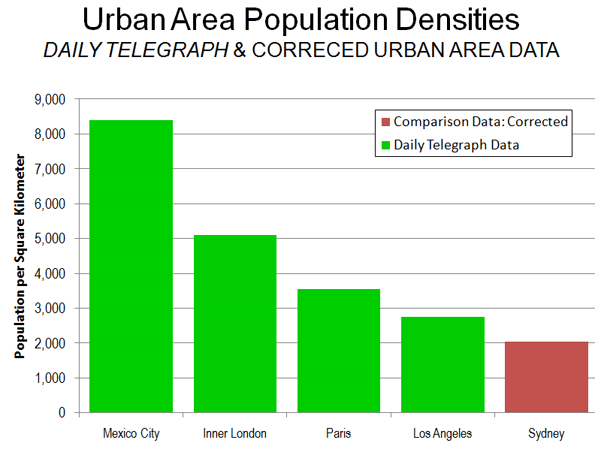
    If the Sydney urban center were as dense as the Los Angeles urban area, the population would be 5 million, instead of 3.6 million. If the Sydney urban centre were as dense as the Mexico City urban area, the population would be 15 million.

    Comparing Core Densities: The small area densities that The Daily Telegraph cites are also smaller than those that exist in the core areas of the cited international urban areas (Figure 2).
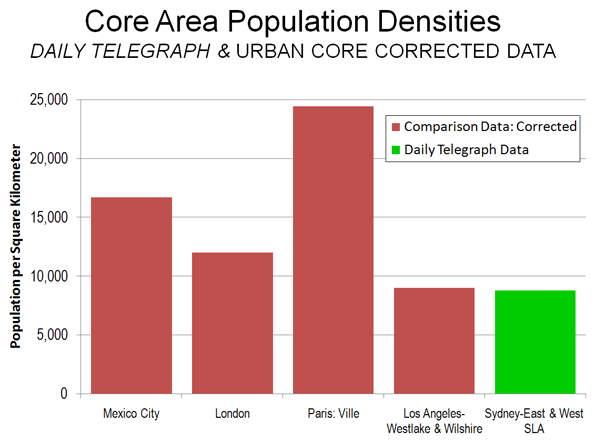
    • In Mexico City, the delegation (district) of Ixtacalco has a population density double that of the Sydney-East and Sydney West statistical local areas (approximately 17,000), in an area nearly twice as large.
    • The 2001 census placed the inner London borough of Kensington and Chelsea at 12,000 persons per square kilometer, in an area approximately the same size as Sydney-East and Sydney-West combined.
    • The ville de Paris has a population density of more than 24,000 per square kilometer, nearly three times that of the combined Sydney-East and Sydney-West statistical local areas. The ville de Paris covers approximately eight times as much land area and smaller area densities are even higher.
    • The 2000 census placed the adjacent Wilshire and Westlake Community Districts of Los Angeles at 9,000 per square kilometer. This is slightly higher than the density of the combined Sydney-East and Sydney-West statistical local areas, in an area nearly four times as large.

    The Sydney urban center and statistical local area data is summarized in the table.

    The Australian Population Debate: An important public policy debate is under way in Australia on the issue of population growth. As Ross Elliot indicated (Malthusian Delusions Grip Australia), some interests believe that the nation is running out of land. In fact, only 0.3 percent of Australia’s land area is urban, a figure one-tenth that of the United States. The starting point for these discussions needs to be valid data and an understanding of the terms involved.

    SYDNEY URBAN CENTER & DENSE STATISTICAL LOCAL AREAS
    Areas Cited by The Daily Telegraph
      2006 Population Land Area (Square Kilometers) Density 2010 Density
    Sydney-East Statistical Local Area         46,738                6.0       7,790          8,799
    Sydney-East Statistical Local Area         38,382                5.7       6,734          7,852
    Combined         85,120               11.7       7,275          8,338
    Share of Sydney Urban Area (Urban Centre) 2.3% 0.7%
    Balance of Urban Area (Urban Centre)     3,556,301          1,776.4       2,002 Not Available
    Total Sydney Urban Area (Urban Centre)     3,641,421          1,788.1       2,036 Not Available
    Notes: 
    Data from Australian Bureau of Statistics
    Urban centre data available only for census years
  • Sydney: Choking in its Own Density

    The Daily Telegraph reports that air pollution is getting worse in Sydney, with one in ten days rating “poor” in 2009. Critics of the ruling Labor state government claim that increasing air pollution and the lack of public transport are the cause. They are half right.

    Sydney’s Densification is Intensifying Traffic Congestion: Sydney’s intensifying traffic congestion contributes substantially to rising air pollution.

    The increasing traffic congestion is an inevitable consequence of the state government’ s “metropolitan strategy” which is “jamming” high rise residential buildings into suburban detached housing neighborhoods. The mathematics of traffic and densification is that unless each additional resident drives minus kilometers and minus hours, there will be more traffic, even before considering the impacts of intensifying commercial and heavy vehicle traffic.

    The road system was not built for higher densities and neither was other infrastructure such as sewers or the water system, as Tony Recsei has noted in his preface to the 6th Annual Demographia International Housing Survey.

    The fact is that higher densities are strongly associated with more traffic, which means greater traffic congestion. The additional stop and go traffic produces greater pollution on the roads adjacent to which people and their children live. It also means more greenhouse gas emissions, because fuel consumption increases as traffic congestion intensifies.

    The association between higher densities and greater traffic congestion is also indicated by the ICLEI-Local Governments for Sustainability Density-VMT Calculator, based upon Sierra Club research. According to the Calculator, under the urban consolidation (“smart growth”) scenario, residential housing would be 37 housing units per hectare, as opposed to its “business as usual” scenario at a density of 10 housing units per hectare. The density of traffic (vehicle kilometers per square kilometer) under the higher density “urban consolidation” strategy would be 2.5 times as high as under the “business as usual” scenario.

    According to federal Bureau of Transport and Regional Economics, Sydney’s total traffic volume is projected to increase nearly 20% over the next decade. Nearly half of the increase will come from commercial and heavy vehicles. With little or no expansion of the urban footprint, there will be nowhere for the new traffic to go except onto the existing already over-crowded roadways.

    Stuck in Sydney’s Traffic: Already, the average one-way trip to work in Sydney is longer than in all but one of the 52 metropolitan areas in the United States with more than 1,000,000 population. Only New York takes as long as Sydney, because so many people use public transport, which is inherently slower for nearly all trips.

    Of Blind Faith: Public Transport: Public transport serves as an article of faith to which officials cling in the innocent or cynical hope that it can reduce traffic congestion. There is no doubt of the good that public transport can do to get people to the central city (CBD), with its highly concentrated employment. However, Sydney’s CBD oriented system is over-crowded. A succession of state governments have been incapable of providing sufficient service to make the trip comfortable for the less than 20% of Sydney employees who work there. Proposals to centralize more of Sydney’s employment in the CBD could not be more wrong-headed.

    Transit is about the CBD, whether in Sydney, Toronto, Portland or Atlanta. The public transport system capable of attracting a significant number of commuters to the smaller concentrated centers like Chatswood, Parramatta, or Norwest (much less the dispersed employment throughout the rest of the metropolitan area) has never been conceived, much less seriously proposed or built.

    Why We Regulate Air Pollution: Public health was the very justification for regulating air pollution. Air pollution’s negative impacts are principally local. The consequences are measured reduce the quality of life of people intimately exposed to the more intense air pollution from nearby roads.

    Higher densities come with a price. Higher densities are producing greater traffic congestion, higher levels of air pollution and greater public health risks. This is just the beginning.

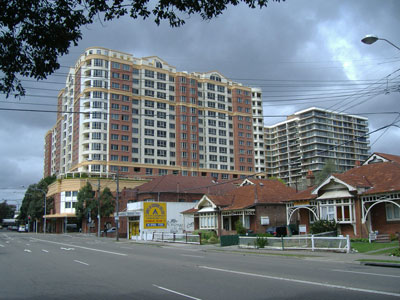
    Photograph: Strathfied, Sydney: Densification of detached housing neighborhood.