Tag: taxes

  • What’s the Matter With Kansas – and Connecticut?

    In 2012, the state of Kansas under Gov. Sam Brownback passed a large tax cut. Despite this massive fiscal stimulus, the state’s economy actually underperformed the nation during much of the subsequent period and the cuts blew a gigantic $900 million hole in the state’s budget.

    Finally the legislature cried uncle. It passed a $1.2 billion tax hike. Brownback vetoed it but the Republican dominated legislature overrode the veto.

    Not only did the tax cuts fail to grow the economy, one of the state’s major metro regions, Kansas City, received a gigantic free broadband investment in the form of Google Fiber. Spanning Kansas and Missouri, this investment also failed to produce significant tech growth.

    Meanwhile in Connecticut, the state twice raised taxes to address a budget deficit. Unfortunately, these tax hikes did not create long term revenue growth. What’s more, after the most recent rounds of tax hikes, the state experienced a corporate exodus highlighted by GE and Aetna. The state capital of Hartford is also flirting with bankruptcy. Gov. Dannel Malley now admits the state is tapped out on tax increases.

    There are a lot of claims one can make out of these situations. I’m only going to point out that both Kansas and Connecticut are out of favor in the marketplace right now. For example, while the suburban office park may not be extinct, it’s certainly facing challenges in high tax settings like New Jersey and Connecticut. Companies like GE are in fact increasingly looking to global city centers for their highest level executives. Connecticut doesn’t have that product on offer and can’t create it. Regarding Kansas, it was likely a low tax state even before the cuts, which did not materially improve its competitive position or instrinsic attractiveness.

    It’s simply very difficult to counter these macro forces. When cities were out of favor, even NYC was en route to oblivion. Trying to push on a string often only creates as many problems as solutions.

  • IRS to Continue Migration Data

    " The IRS should be applauded" — it is hard to imagine a public statement to this effect, other than from a government insider. But this was the Tax Foundation, improbably and correctly complimenting the Internal Revenue Service in announcing that its annual income tax migration data would continue to be produced. This apparently reverses a decision to discontinue the data. The Tax Foundation noted that there was:

    … outrage when the IRS announced that they were canceling the program. An IRS economist, informed of the decision by higher-ups, told the Daily Caller: "We were just told this morning that the program is indeed going to be discontinued.  It is not our decision at all and we are very disappointed." Jim Pettit, of the activist group Change Maryland, penned a National Review piece noting that the decision came soon after the data put Maryland Governor Martin O’Malley on the defensive (O’Malley has routinely asserted that Maryland has a great tax system and business climate, despite strong evidence to the contrary), and the Washington Examiner followed up with an editorial saying that the data is vital for ascertaining which "model" of states (high-tax, high-service vs. low-tax, low-service) Americans were preferring. Members of Congress also started calling, demanding an explanation.

    We join in the chorus. This data has been valuable for many uses and many will continue to use it in the years to come.

  • Infographic: State Property Tax Data

    Credit Sesame has created an interactive map showing property tax rates for all 50 states. Based on data from the Tax Foundation, the graphic also shows property tax rates as a share of home value and as a share of median income of homeowners. It’s important to note that property taxes can vary regionally within states, and property taxes are only one part of overall state and local tax burden.


    Mortgages – CreditSesame.com

    Here’s the Tax Foundation’s numbers on overall state and local tax burden. For more on overall state business climates, check out our Enterprising States report.

  • High Cost of Living Drives New York’s Fiscal Deficit with Washington

    Between now and the end of the year, a hot political topic here in New York will be whether to let the Bush tax cuts expire for people in the highest income bracket, as the Obama administration proposes, or whether to extend those cuts for everyone. Advocates taking the latter position will correctly argue that higher rates will be especially harmful to New York, because of the large number of wealthy people, who live here.

    What is not likely to be discussed, however, is that because of the exorbitant cost of living in New York and the surrounding suburbs, federal taxes take a supersized bite out of the incomes of all New Yorkers, who in the vast majority are not wealthy at all. The result is that here in New York City, which is arguably the poorest city in America when it comes to what people can actually afford, we end up subsidizing other states and localities, where people pay less to Uncle Sam, even as they enjoy a higher standard of living than we do.

    How could this be? The answer is that because New York and the surrounding suburbs are so expensive, businesses have to pay higher salaries to recruit people to work for them. According to the ERI Economic Research Institute, a leading data survey company that helps corporate clients set compensation packages and calculate the cost of doing business throughout the United States and elsewhere, these higher salary costs are substantial.

    They calculate, for example, that a typical registered nurse in metropolitan New York earns $82,712 versus a national average of $65,464. In the case of an accountant, they calculate a figure of $74,388 versus a national average of $58,712. In the case of an administrative assistant, as they define those job responsibilities, they calculate a figure of $59,243 versus $47,961 nationally. And finally, they also provide data for someone working as a janitor. Here the figure they calculate is $38,142 versus $31,220.

    Sounds great. Who doesn’t want a higher salary? But unfortunately, it’s not that simple. The problem is that the IRS doesn’t care how much you can actually buy with your hard earned dollars. They just want to see the number printed on your W-2. And as we all know, the more you make, the more you pay.

    For the average registered nurse in New York, filing as an individual, and assuming no special deductions or one-time credits, the tax bite amounts to $14,381 versus $10,219 for the average registered nurse in the rest of the country. An accountant here pays $12,444 versus $8,531 nationally. For an administrative assistant, the figure is $8,656 versus $5,844. And in the case of a janitor, the figure is $3,899 versus $2,864.

    But wait, it gets worse than that. Based on data from the federal Bureau of Economic Analysis, it turns out that the cost of living in the New York metropolitan area is significantly higher than the difference in salaries alone would indicate. According to their data, the cost of living here is 45 percent higher than in the rest of the country or approximately twice the difference in salaries.

    Yes, employers have to pay more to recruit people to work here in New York, but they don’t have to make up the whole difference. Economists refer to this as money illusion, which is their way of saying that people find it difficult to distinguish between the nominal value of money and the true purchasing power of that money in the marketplace.

    If we recalculate salaries to take into account the cost of living, it turns out that the federal tax premium that New Yorkers have to pay is even greater. Thus, if the tax bite were to reflect the actual standard of living for a registered nurse in New York, the real tax would be $8,106 instead of the actual tax of $14,381 or a difference of $6,275. For an accountant, the difference would be $5,775. For an administrative assistant, it would be $4,352, and for a janitor, $1,778.

    The lessons here are clear. In the short term, New York’s Congressional delegation needs to restrain efforts to raise taxes in Washington, D.C., because the impact here will be greater than elsewhere. And in the longer term, we need to determine why the cost of living in New York is so high and then implement the reforms necessary to fix the problem and give New Yorkers a standard of living that is competitive with rest of America.
  • A Threat To Home Owners Associations

    In the 1990s, just about the only site amenity that most suburban developments offered was a fancy entrance monument. Usually, there were no other additions beyond ordinance minimums and even those weren’t generally elaborate. Some of these monuments did cost millions, but once past the gilded gates, the seduction ended, and residents were greeted by familiar monotonous cookie cutter subdivisions.

    As neighborhood planners, we educate our developer clients regarding the virtues of building site amenities that improve Quality of Life (trails, gazebos, decorative ponds and fountains, etc). You would think these amenities were an easy sell to the cities approving the developments. After all, great developments create a great city, right? It’s not that simple, because all of these amenities require maintenance, and that places a burden on tax payers. No city wants to create a tax burden for all, when the likely benefit accrues to the few within the development.

    The solution to that problem was simple: The Home Owners Association. We are not talking about the type of Stepford-like association where lifestyles and flower plantings are strictly dictated, but the more limited type that adds a small monthly fee to service the common outdoor site amenities. In other words, only those extra amenities are cared for. Private yards still remain the financial burden of the individual homeowners. In the North, with snow removal, these neighborhood association fees are likely to be higher if the trails and walks are cleared. Since these Associations do not have to maintain private yards or address maintenance of buildings typical of townhome projects, the monthly fees are minimal. Some associations were formed in the North that did give options for snow removal on private driveways, at a very reasonable cost (after all, why not clear a few extra driveways while you are out clearing the trails?).

    The developer could now offer a much higher living standard and create more valuable lots that would be easier to sell. The majority of the neighborhoods we designed in the late 1990s through 2006 (the recession) offered the advantages that these minimal cost Associations could provide. We encouraged developers to spend less on elaborate entrance monuments and instead spread real value through the development where people lived.

    How HOAs May Be At Risk The recession has not just brought about massive foreclosures and reduced home prices. It has escalated real-estate taxes (the home value may be 40% less but the tax remains at pre-recession rates) and put the very idea of a Home Owners Association at risk. With failed development, there are often also failed Associations. With little or no maintenance of a development that was once cared for by private funding, cities may have to take over the burden until the economy recovers, and in some areas, if it recovers. Comprehensive associations that maintain all of the grounds (where there are no privately maintained yards),including the building exteriors and rooftops, as well as the streets, are at the greatest risk. The limited Associations that were typical of the neighborhoods we designed are not as much of a problem, but could easily be lumped into “all Associations are bad news” category in the minds of those approving future developments, after the economy returns.

    This affects all types of residential development.

    Developments that exceed minimum standards typically offer site amenities to make the development more enticing. Someone must maintain these extras. Fear of HOA failures will certainly be more on the minds of cities after the recession, but without HOAs, who will maintain the amenities? A two million dollar entrance monument does not make a neighborhood sustainable. Spreading value through the neighborhood with features that enhance quality of life, is a better investment. The Homeowners Association must not fall victim to the recession.

  • Balancing the California Budget

    The battle to find ways to close California’s gaping $24 billion budget shortfall continues, with Governor Schwarzenegger calling for deep cuts and reorganization throughout state government. Last week, making a “rare speech to a joint session of the Legislature,” Gov. Schwarzenegger argued that the state has “run out of time,” and faces a situation where “Our wallet is empty, our bank is closed, and our credit is dried up”.

    The challenges facing California’s policy makers in balancing the budget can be examined by checking out the Los Angeles Times’ “Interactive California Budget Balancer”. While the state has many different options available to it, making cuts to potentially popular programs will only serve to irritate interest groups which argue for the efficacy and essential nature of their favored programs. Couple this reluctance to make cuts with popular resistance to tax increases, recently seen when voters rejected a set of measures on May 19, and one can better understand the true magnitude of the budget impasse facing the state.

  • Local and State Tax Burden Maps

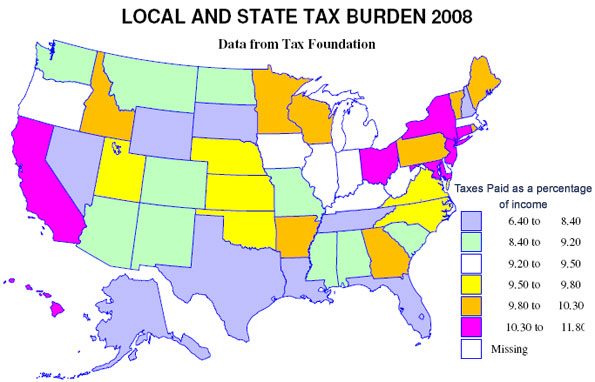
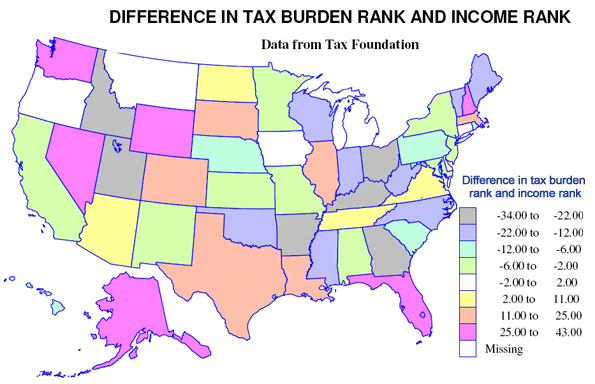
    The Tax Foundation calculates the taxes paid per capita, including what is spent by people on average in neighboring states, including state and local fees. The two maps show, first, the tax burden, taxes paid as a percent of income, the second, the difference in the ranks of states in tax burden and in income.

    The map for tax burden is colorful, so one might suppose there is a big difference in the local and state burden. There is variation, but the amazing story is how small the differences really are. The variation is from a maximum of 11.8 percent in New Jersey (note that Taxachusetts is in the middle of the pack) to a low of 6.4 percent in Alaska. But most states, 38, are in between 8.6 and 10.2 percent.

    The lowest tax burdens are not surprising – Alaska (6.4) and Nevada (6.6), but the next lowest, Wyoming (7) and Florida (7.4), may be a surprise. The highest tax burdens, as may be expected, are megalapolitan New Jersey, New York (11.7), Connecticut (11.1) and Maryland (10.8), but Hawaii (10.6) in this group may be a surprise. The states in the middle, besides Massachusetts, include a contiguous set centered in Chicago – Illinois, Indiana, Iowa, Michigan, Kentucky and West Virginia (all 9.3 to 9.5).

    The modest range of burdens implies that generally richer states have higher tax burdens and poorer states have lower burdens, but the second map shows that there are many exceptions. Richer states with higher tax burdens include (a small difference in tax and income ranks) District of Columbia, New Jersey, Connecticut, New York and Maryland, and poorer states with a moderately low tax burden are few – Alabama, New Mexico and Montana. Poorer states but with a high tax burden are Arkansas, Kentucky, Utah and Idaho, but this finding perhaps tells us the statistical problem or risk in using per capita rather than per household measures. Strongly Mormon Utah and Idaho, indeed all four states have high average household size, so are not as disadvantaged as the data suggest. For a similar reason, Florida may not be as good as it looks, since it has a quite low average household size.

    Most interesting may be the richer states with lower ranking tax burdens, notably Wyoming, New Hampshire, Washington and Nevada. Other states with a relatively low burden (lower tax rank than income rank) include Alaska, Colorado, Florida, Massachusetts, and Texas and other states with a relatively high burden (much higher tax rank than income rank) include Georgia, Kentucky, Ohio and West Virginia.

    Finally states with close to the same rank in income and tax burden include a set of contiguous Midwestern states, Iowa, Minnesota, Missouri, and Kansas, then Michigan, Oregon and California.

    But in sum, choosing a state based on its local and state tax burden could be worth the effort, but the effects by themselves could be more limited than commonly supposed.

  • LA Tax

    Residents in Los Angeles with home-based business received letters from the Office of Finance that said, “The following amounts are due and payable immediately: $4,363.81.”

    People who work as independent contractors and had failed to register their businesses with the city’s tax and permit division by Feb. 28 received the letters in March.

    The city calculated the number by estimating $200,000 in gross income for each business over the last three years – the annual average for city business taxes – added interest and late penalties and arrived at the $4,000-plus number.

    The letters arrived at a time when many laid-off employees are working as independent contractors themselves. To add fuel to the fire, many who received the letters might have generated income less than the total amount of the tax.

    Though the city has denied that the letters were any kind of “scare tactic,” the program stems from a 2002 push to identify unregistered businesses using records “disclosed to the city by the California Franchise Tax Board.” The program has added almost 100,000 businesses to the tax roll and generated $107 million in revenue.

    This issue has a particular sting at the moment, particularly given LA’s 10% plus unemployment rates.