Tag: the economy

  • Interactive Graphic: Ranking States By Competitiveness

    In a previous post we looked at which states have been most competitive in terms of job creation since the recession.

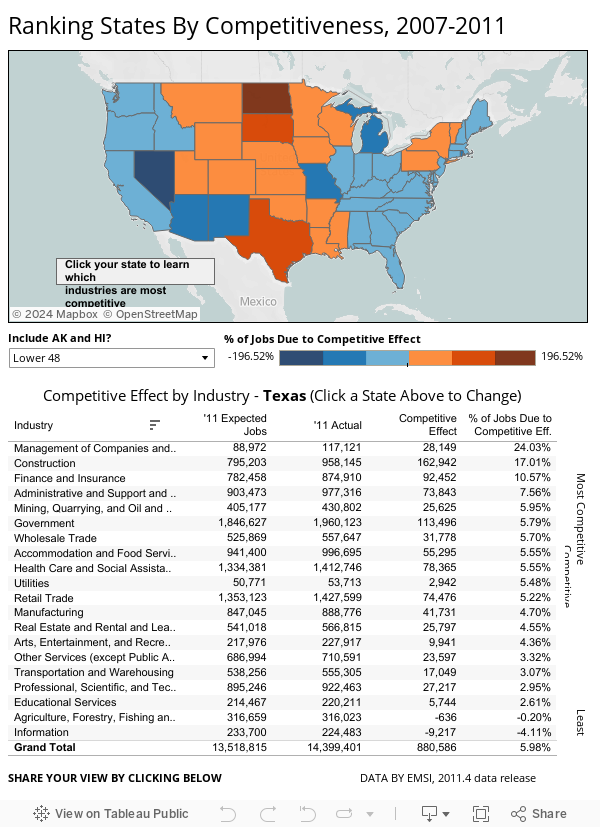
    In this post we teamed up with our friends at Tableau Software to produce the following interactive graphic, which details individual industries that are driving states to be more (or less) competitive. The graphic breaks down the performance of the 20 major sectors in every state in the contiguous US (plus Hawaii and Alaska) in terms of expected and actual job change from 2007-2011. Further explanation of the analysis is below.
    Rundown on the data

    We used shift share, a standard economic analysis method that reveals if overall job growth is explained primarily by national economic trends and industry growth or unique regional factors. Shift share analysis, which can also be referred to as “regional competitiveness analysis,” helps us distinguish between growth that is primarily based on big national forces (the proverbial “rising tide lifts all boats” analogy) vs. local competitive advantages.

    To generate our ranking, we summed the overall competitive effect for each broad 2-digit industry sector by state (e.g., agriculture, manufacturing, health care, construction, etc.) and added them together to yield a single statewide number that indicates the overall competitiveness of the economy as compared to total economy. We calculate the competitive effect by subtracting the expected jobs (the number of jobs expected for each state based on national economic trends) from the total jobs. The difference between the total and expected is the competitive effect. If the competitive effect is positive, then the industries within the state have exceeded expectations and created more jobs than national trends would have suggested. Those industries are therefore gaining a greater share of the total jobs being created. If the competitive effect is negative, then the industries are not gaining jobs as fast as what we would expect given national trends. In this case the state is losing a greater share of the total jobs being created.

    Observations On Most Competitive

    The big thing that stands out is that most of the competitive states tend to be in the middle of the country. This is tied to the growth in the oil and gas sector, yes, but in most cases better-than-expected performance in construction, government, and other miscellany sectors. In Alaska, North Dakota, and Nebraska, smaller states in terms of population and jobs, manufacturing, transportation, and construction are some of the most competitive industries. Louisiana also fares quite well in healthcare and accommodation & food services.

    Observations On Least Competitive

    For states that rank toward the bottom, the housing bust and subsequent construction downturn is the biggest culprit. For instance, in Nevada, which is last on the list, construction is nearly 50,000 jobs below what would be expected given national and industry trends. Florida, a much more populous state, is more than 130,000 jobs below what would be expected. For states like Michigan, Ohio, and Indiana, the poor performance in manufacturing and government weighed heavily in our ranking.

    Here is the original graphic that show the comparison between states.

    Please check out the graphic and let us know if you have any questions. Email Rob Sentz (rob@economicmodeling.com) or hit us via Twitter @DesktopEcon. Data and analysis comes from Analyst, EMSI’s web-based labor market analysis tool.

  • Why the Green Jobs Movement Failed

    "Federal and state efforts to stimulate creation of green jobs have largely failed," the New York Times reported last week, drawing similar conclusions to the ones we drew in our essay for The New Republic last October. Silicon Valley, home to the green jobs movement, actually saw the number of green jobs decline from 2003 – 2010.

    The signature green jobs program was retrofitting homes and buildings to become more energy efficient, which boosters thought would create "millions" of jobs in the inner-city. In 2009 the Center for American Progress claimed that $5 billion in stimulus funding for weatherization and a price on carbon would lead to the retrofitting of every building in America in ten years, generating 900,000 jobs. In reality, we noted in TNR, the weatherization program had created just 13,000 jobs. "Two years after it was awarded $186 million in federal stimulus money to weatherize drafty homes," the Times reported, "California has spent only a little over half that sum and has so far created the equivalent of just 538 full-time jobs in the last quarter… the program never really caught on as homeowners balked at the upfront costs."

    Most of the approximately $70 billion in green stimulus money went to retrofitting or stimulating the old economy and just one-third went to building a new one. Notably, even those modest investments in manufacturing and technology had a salutary effect, saving the American renewables industry, which was in free fall after the 2008 financial crisis, and giving a boost to U.S. manufacturers of electric car batteries. 

    Obama could have focused on winning a long-term commitment to public investment in green innovation and manufacturing. Instead, he threw his political capital behind cap-and-trade, a pollution control program that was never imagined by the economists who invented it to be a means for creating vibrant new industries.

  • The Spread of Proprietors/Independent Contractors In the US

    A few weeks ago EMSI looked at the states with the largest share of 1099 workers — that is, proprietors/independent contractors, farm workers, and others not covered by unemployment insurance. We found that since 2006 every state (as well as D.C.) has seen growth in noncovered workers.

    Simply put, the number of workers outside traditional employment rolls is on the rise.

    We have since mapped out job growth among 1099 workers in every U.S. county from 2006-2011 to see where this increase in nontraditional employment is most evident. And the data makes the trend even clearer: The majority of counties across the nation have seen at least a small increase in noncovered workers, and some have seen huge increases. This is especially the case in the western and southwestern portions of the U.S.

    It should be emphasized that not all 1099 workers captured in the EMSI Complete dataset are proprietors/independent contractors. However, if we use growth in the 1099 economy as a loose proxy for entrepreneurial behavior (i.e., a backbone for economic growth and business development), it’s very apparent which areas are progressing in that arena and which areas are falling behind.

    The counties with the most 1099 job growth are mostly in fairly isolated areas:

    1, Loving County, Texas, 114% (the least populous county in the US)
    2, Todd County, South Dakota, 81%
    3, Calhoun County, West Virginia, 63%
    4 (tie), Roane County, West Virginia, 57%
    4 (tie), Reagan County, Texas, 57%
    4 (tie), Union County, Florida, 57%
    7 (tie), Wayne County, Utah, 54%
    7 (tie), Shackleford County, Texas, 54%
    9, Ochiltree County, Texas, 53%
    10, Kenedy County, Texas, 52%

    Seven of the top 12 counties, in fact, are in Texas, including Midland County. Oil and gas extraction, the fastest-rising sector for 1099 workers in the US, is driving most of this growth in workers outside the unemployment insurance (UI) system.

    In contrast, the counties showing the biggest job loss in 1099 employment have a more diverse population base:

    1, Ziebach County, South Dakota, -23%
    2 (tie), St. Louis City, Missouri, -15%
    2 (tie), Roanoke County, Virginia, -15%
    4, Ohio County, West Virginia, -14%
    5, Sully County, West Virginia, -13%
    6, Oliver County, North Dakota, -12%
    7 (tie), Marshall County, South Dakota, -11%
    7 (tie), Forsyth County, Georgia, -11%
    9, Pennington County, South Dakota, -10%
    10, Decatur County, Iowa, -9%

  • Kalamazoo Leads Michigan’s Education System

    The city of Kalamazoo in southwestern Michigan may be a shining pinnacle in an otherwise economically withering state. The secret may lie within the city’s well-educated population and its incentives to support an enlightened oasis. For 25-year-olds and older in Kalamazoo, 84.2% have finished high school or higher; 32.7% have accomplished a bachelor’s degree or higher; and 14.4% can boast a graduate or professional degree.

    Compare this to Detroit’s much more bleak statistics: 69.9% of 25-year-olds have graduated high school; 11% have attained a bachelor’s degree; and a petty 4.2% have acquired a graduate or professional degree. The percentage of unemployed in Detroit is 13.8%, while 12.5% are unemployed in Kalamazoo.

    These numbers reflect a well-educated workforce that hasn’t had such an apparent impact from the declining industries in the area. It seems that the answer may be in Kalamazoo’s education services. The most common industries for men and women are educational services, where 13% of men and 17% of women are employed. The area also employs 4% of men and 4% of women in professional, scientific, and technical services, which may lend the city with a more developed economy. Universities such as Western Michigan University and Davenport University help diversify Kalamazoo’s employment base opposed to the historically more manufacturing dependent Michigan .

    Unsurprisingly, Detroit’s leading industry for males is transportation equipment (includeing auto manufacturing) at 15% of the workforce. The share in educational services is much lower than Kalamazoo with only 4% of males and 10% of females employed in the area. Figures for professional, scientific, and technical services were not listed.

    Kalamazoo also has incentive programs for students in the local school systems. The “Kalamazoo Promise” is a program funded by anonymous donors who provide scholarships for students who attend and finish high school in Kalamazoo. Scholarships can total up to 100% of the student’s college tuition. The program started in 2006 and has likely contributed to the area’s 3% growth in student enrollment. In 2008, Detroit began a similar program in hopes of replicating the small economic boom that the Kalamazoo Promise instigated.

    If the city can leverage its higher education institutions and its surging base of high school students entering college, it could ultimately become a prime example of a community improving itself through education. Incentives and opportunities provide citizens with a solid and encouraging way out of a weakening economy inthe state while still providing a standard that the rest of Michigan can attempt to replicate.

    For more Kalamazoo facts and figures, visit http://www.city-data.com/city/Kalamazoo-Michigan.html.

  • California Expenses Putting a Strain on Business

    Is it any wonder why California’s economy has been so sluggish during the recession? According to the 2010 Kosmont-Rose Institute Cost of Doing Business Survey, one-third of the nation’s forty most expensive cities are located in California, deterring businesses from setting up shop in the state. The increases in sales, income, and vehicle taxes in 2009 further depressed the business climate and exacerbated the problem of unemployment. Though local governments are trying to cut costs and boost local businesses, they have not been able to reverse the effects of outrageous taxes and fees.

    As one would predict, the ten most expensive cities in California in 2010 are located almost exclusively in the Bay Area or Los Angeles Area. Berkeley, Oakland, and San Francisco round out the Bay Area localities with San Francisco actually making the top ten national rankings as well. Beverly Hills, Culver City, Inglewood, Los Angeles, San Bernardino, and Santa Monica all represent Los Angeles County while Rancho Santa Margarita fills the final spot. However, none of these cities joined San Francisco on the national list.

    There is one thing missing from Kosmont’s national list of most expensive cities: the Great Plains states and Midwest. With the exception of Chicago, there are no cities on the list from the area between Arizona and Ohio. Even in the West, there are only three cities, San Francisco, Portland, and Phoenix, that made the top ten.

    Where do we find the least expensive cities? They are in the middle of the country, of course. Five of 2010’s least expensive cities are in Texas, one is in Nevada, and one is in Wyoming. Texas has fared surprisingly well during the recession, as have states like North Dakota. Low business costs and a bustling energy industry have made these states havens for new businesses and job seekers alike.

    Companies in California are now packing up and moving north and west to save money. Friendlier and more stimulating business climates in states such as Arizona, Washington, Oregon, and Colorado are luring companies like Google, Hilton, and Genentech. As Larry Kosmont, President and CEO of Kosmont Companies, commented, “Just being located in California, cities are at a ‘cost’ disadvantage right out of the gate.” If California wants to keep the companies that bolstered its success during the beginning of the decade, it must reconsider its recent tax hikes and have faith that improving the business climate will stimulate the economic growth that the state sorely needs.

  • What Jobs?

    According to the Bureau of Labor Statistics, there were 290,000 more jobs in the US this month than there were last month. Twenty percent of those jobs were added by the federal government. While the federal government added 69,000 new jobs last month, every other level of government – including the post office – cut an average of 2,250 jobs. State governments were hardest hit last month, cutting 5,000 jobs.

    Since April 2009, the federal government has added 119,000 jobs while state and local governments cut 215,000 jobs.

    Compared to April 2009, more than 500,000 jobs have been added in employment services. Another 329,000 jobs were added in the healthcare industry. These must be the “green shoots” that we were so looking forward to last summer because the overall economy lost 1,380,000 jobs in the last year.

    Eighty percent of the jobs increase last month was added in the private sector. Of the jobs created in the private sector, only 22 percent were in goods producing industries; about half of the goods producing jobs added in the last month can be attributed to the bailout of the auto industry. In the last 12 months, the U.S. civilian population increased by 2.1 million persons. The labor force has remained about constant at 154.7 million. The difference – explained in the details of today’s jobs report – is attributable to discouraged workers, involuntary part-time workers, and marginally attached workers.

  • “First” vs. “Worst”

    Taking on the Portland mystique is not easy – and likely I’ll find out again with my most recent piece: Picture-perfect Portland?

    But I’d also like to take a Midwest perspective that shows some surprising things. Let’s compare Portland to a similarly sized and less acclaimed Midwest city, Indianapolis. You can think of Portland as being in “first place” from a policy perspective by popular acclaim. It has an urban growth boundary, extensive transit, excellent urban density, a strong biking culture, a strong culture of civic engagement, the most microbreweries per capita, and on down the line. It is a place people want to live in so badly that they will move there with no job in hand and would be one of the cities that comes to mind among similar sized metros as a talent hub.

    If Portland is first, then you’d have to characterize Indianapolis as “worst”. Indianapolis is surrounded by expanding suburbia with very pro-sprawl policies on all four sides. It is one of the least dense cities in America. It has no rail transit and only the 99th largest bus system, along with one of the lowest transit market shares in the country. It is currently in the middle of a multi-billion program to widen about 60 miles of freeway. It just recently put in its very first bike lanes and scores near the bottom in green measures of sustainability. Its brand image also is hardly the best. You don’t hear too many people around the country going, “Man, I’ve gotta get me to Indianapolis.”

    But let’s look at how these cities compare on various quantitative measures of urban performance.


    Portland

    Indianapolis

    Population Growth (2000-2008)

    14.5%

    12.5%

    Domestic In-Migration (2000-2008)

    5.4%

    4.2%

    International In-Migration (2000-2008)

    3.7%

    1.4%

    Job Growth 2001-2009 (QCEW)

    10,300 (1.1%)

    17,100 (2.1%)

    Job Growth 2001-2009 (CES)

    23,800 (2.4%)

    31,000 (3.6%)

    Unemployment Rate (Nov 2009)

    10.8%

    8.2%

    Per Capita GMP (2008)

    47,811

    46,450

    Per Capital GMP Growth (2001-2008)

    22.4%

    1.7%

    Median Household Income (ACS 2008)

    $58,758

    $53,671

    Median Monthly Housing Cost (ACS 2008)

    $1,522

    $1,125

    College Degree Attainment (ACS 2008)

    33.3%

    31.8%

    Travel Time Index (Texas A&M)

    1.28

    1.21

    Now in most of these Portland does beat Indy, but not by a lot. In job growth and unemployment – two big factors in today’s economy – Indy actually does better. Portland’s higher incomes are offset by higher housing costs. There are only two stats – international migration and GMP per capita growth – where Portland has a big lead.

    Given the wide difference in their policies, it is striking to see these cities so close. By rights, it should be total world domination by Portland – but it isn’t.

    Now obviously these aren’t the only statistics to measure a city by. Portland residents would no doubt tout their many livability advantages. Yet at some point isn’t livability supposed to translate into superior demographic and economic performance? Isn’t it supposed to make a city attractive to the talent pool needed to thrive in the 21st century? And isn’t that talent supposed to power the economy? I was particularly struck by how close the cities were on college degree attainment. While I called Portland a talent hub, perhaps I spoke too soon. Contrast with Boston, which has 41.9% of its over 25 population with a bachelors degree or better.

    It may be that policy changes act with a lag. But Portland has been at this a long time. The UGB dates to 1973 and the light rail system started construction in the early 80s, for example. Perhaps other factors play a bigger role than many imagine. Land use and transportation policies might provide benefits to cities, but they do not, by themselves, create an economic dynamo.

  • Entrepreneurship on the Rise?

    The Kauffman Foundation, the “world’s largest foundation devoted to entrepreneurship,” recently released the 2008 edition of their “Index of Entrepreneurial Activity.”

    The index, which measures the rate of business creation at the individual owner level, reports that despite the recession, “new business formation increased in 2008.” This growth was not present in all sections of the nation, however. According to the Kauffman survey, the Midwest saw a slight decline in business start-ups in 2008. Unfortunately, while entrepreneurship was apparently on the rise, there was a drop in the formation of the “highest-income-potential types of businesses”.

    On a more local level, the states of Georgia, New Mexico, and Montana led the pack, each showing over 500 per 100,000 adults creating businesses each month. Bringing up the rear were West Virginia, Iowa, and Ohio, with the last showing a rate of creation of 190 per 100,000 adults per month.

    In general, 2008 rates of entrepreneurial activity as reported by the Kauffman survey are higher along the west coast and in the Rocky Mountain states, and lower in the midwest and mid-atlantic regions. These findings would seem to have some overlap with the patterns reported by Newgeography’s “2009 Best Cities for Job Growth” rankings, which, in general, showed stronger conditions in the west (outside of California) and pockets of weakness in the midwest and mid-atlantic regions.