Tag: Toronto

  • Toronto Election Highlights Failure of Amalgamation

    In my pre-election piece on the Toronto election, I discussed the city’s lingering malaise. It developed slowly but its roots can be traced to the 1998 amalgamation that swallowed up five suburban municipalities. This led to a six folds expansion of city boundaries and a tripling the population base. This amalgamation was initiated by the province of Ontario as a cost saving measure and faced major local opposition. Citizens and politicians were concerned that the benefits of the alleged efficiency saving would be outweighed by the negative impact of losing local decision making powers. The recent Toronto municipal election bore out this concern.

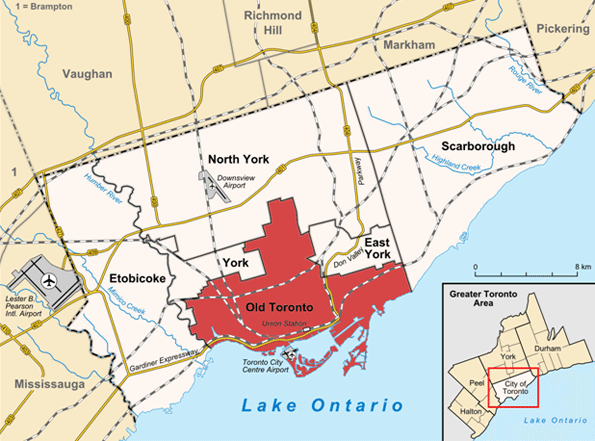
    In the October 25th election, Torontonians were presented with two dramatically different visions. The first vision was presented by former Liberal Ontario cabinet minister George Smitherman. A self-described progressive, Smitherman appealed mainly to voters in the downtown core of Old Toronto. He stood for issues such as improved bicycle lanes, renewal of the downtown waterfront, and improving social housing conditions. The second version was presented by maverick councilor Rob Ford, who represented a ward in the former City of Etobicoke. Ford’s message was simple: it’s time to stop the “gravy train” at City Hall. While he had elaborate platforms on many issues, cutting waste at City Hall was his ubiquitous message.
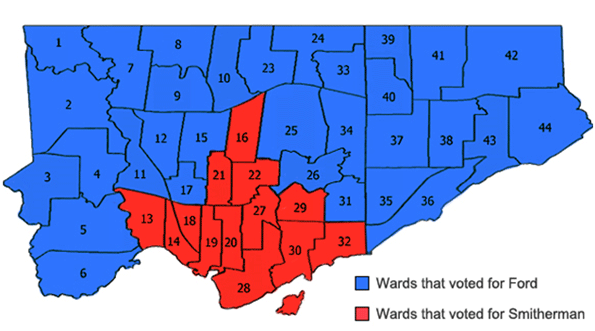
    Despite Toronto’s social democratic image, Rob Ford won a crushing victory. Ford earned 47% of the vote, while Smitherman ended up with 35%. Far left candidate Joe Pantalone (known primarily for attempting to stop businesses from opening in his own ward) managed to capture 12% of the vote.

    Aside from the shock that a partisan conservative won in Toronto, there are two other significant developments. Both front runners were significantly more fiscally conservative than the current administration. Ford and Smitherman represented constituencies desperately seeking change. Smitherman’s base was frustrated with the inability of the city to provide the services that they want efficiently. Ford’s base was angry that the city is providing many of these services in the first place.

    Not surprisingly the results broke down along specific geographic lines. Ford won an outright majority of votes in every single ward outside of Old Toronto. Within the old boundaries, Smitherman won 13 of the 16 wards. The three Old Toronto wards Ford won are all on the fringes of the Old City.
    In 1997, the newly amalgamated city went to the polls for the first time. Conservative former North York Mayor Mel Lastman narrowly defeated social democratic former Old Toronto Mayor Barbara Hall. Since then, downtown oriented social democrats have controlled the city ever since.

    Clearly this result shows that the concerns expressed by the opponents of amalgamation were largely valid. Amalgamation failed to create cost savings, and has created a dysfunctional megacity. Rather than having six municipalities where voters are focusing on solving local problems, we have one gigantic city with the core and the suburbs fighting for their share of the public purse. This leads to the schizophrenic policy decisions we see today.

    Before amalgamation, there were six different versions of Toronto life that one could choose from. If you didn’t like living in high tax Toronto, you could live in Etobicoke. If Etobicoke’s bylaws and business taxes were hurting your business, you could move to North York. Now all people in the Toronto area can do is vote the bums out on election day, or get out of the area altogether. This isn’t a viable long-term solution.

    The problems are systemic, and cannot be solved so long as the megacity exists. This extends beyond the fact of the impossibility of satisfying the core and the suburbs at the same time. The megacity allows public sector unions to literally hold 2.5 million people hostage whenever they feel like it. A notorious strike last summer lead to a month without garbage collection in the entire city. The 24,000 strikers also shut down parks and recreation services, daycare, provision of municipal licenses, health inspections, animal services, and forced a 25% reduction in ambulance services. In 2008, the transit union called a last minute strike at midnight on a Friday night, grinding the city to a halt. These are just two examples of how powerful Toronto public sector unions have become. The only reason strikes aren’t more frequent is that the city typically gives them whatever they want in order to avoid chaotic strikes. De-amalgamation would not only allow more local control over policy, but would help fray the noose that the unions have tied around the city’s neck.

    Downtown progressives gripe over how Rob Ford is going to destroy their city, but they should take a minute to think about what some of their policies have been doing to suburbanites for years. They have imposed high taxes, and burdensome regulations on the amalgamated cities, as well as a myriad of new bylaws. Some of these policies make sense in Old Toronto. For instance, dissuading automobile usage in the congested core makes sense. Doing so in the suburbs does not. It might make sense to regulate trees on private property in a crowded downtown neighborhood. Not so much in a new subdivision. One-size-fits-all policies don’t work across a city as large and diverse as Metropolitan Toronto.

    Now that the suburbs have wrought their revenge on the old city, progressives need to recognize that de-amalgamation is not just a fantasy of libertarians and angry suburbanites. It is a prerequisite to restoring sound public policy reflecting the preferences of individual communities. Railing against Rob Ford won’t fix the problem. Rob Ford is what the suburbs want. As long as the megacity lives, Toronto will elect a Rob Ford type every now and then.

    The only way to stop this pattern of alternating, divergent visions is by de-amalgamation. Critics will use metaphors such as ‘unscrambling an egg’ to illustrate the difficulties of de-amalgamation. No one should believe that de-amalgamation would be easy. But there will never be a better time than now to take the necessary step of de-amalgamation. A few years of chaotic governance would be worth the long run benefit of restoring local control.

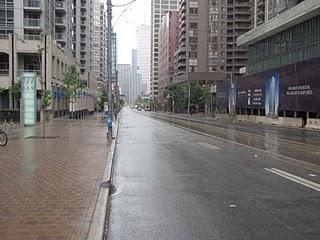
    Downtown Toronto photo by Astro Guy

    Steve Lafleur is a public policy analyst and political consultant based out of Calgary, Alberta. For more detail, see his blog.
  • Toronto’s Civic Malaise

    Despite Toronto’s international reputation for livability, all is not well in the city. Many politicians and pundits blame the outgoing city council, and Mayor David Miller. While they’ve done their share of damage, the city faces deeper, systemic problems. The source of the problem is more fundamental than stifling bureaucracy, or the stranglehold of the public sector unions. These are symptoms of the institutional sclerosis caused by the amalgamation of Toronto and surrounding areas into the new Toronto Megacity.

    The first taste of this malaise came in the form of a nasty garbage strike last summer. Torontonians waited weeks to have their garbage picked up as it rotted in their front yards. Those who dared to pick up trash for a fee were threatened with legal sanctions. This incident helped propel provincial cabinet minister George Smitherman into the political limelight. The prominent Liberal helped spearhead a volunteer effort to clean up the city. Smitherman was seen by many as the right man to fix what was wrong at city hall. The strike was eventually resolved, but the contract was widely seen as a union payoff. The blowback convinced Mayor Miller not to run for a third term. Smitherman was considered an early frontrunner to replace Miller. He has a reputation for being a maverick who could whip the city into shape. This optimism quickly faded, and it looks increasingly as though the Smitherman could lose.

    There are times when a simple photo shared on Twitter can outrage an entire population. This happened this summer, when a picture of a sleeping toll collector on the Toronto subway ignited months of anger at the city’s public transit system. In the wake of the garbage strike, Torontonians were incensed to see employees sleeping on the job. Frustrated downtown residents were looking for a change, which they assumed would be embodied by Mr. Smitherman. But few commentators seemed to realize what Jaideep Mukerji recently pointed out: while downtown residents are frustrated, suburbanites are downright angry. This has lead to a surge of support for Etobicoke’s hot-headed, penny pinching councilor Rob Ford. Unlike downtown residents, who primarily want to ensure that services such as transit are efficiently delivered, Ford’s supporters want to cut spending, and end the “war on drivers.”

    It turns out that service delivery was only the tip of the iceberg. The true source of the city’s malaise is the realization that amalgamation may have turned Toronto into an ungovernable city, serving neither the suburbs nor the downtown core. Because of this, the election is evolving into a culture war between downtown and the suburbs.

    The Toronto megacity dates back to 1995, when Progressive Conservative Premier Mike Harris attempted to unshackle an economy crippled by unsustainable tax and spend policies and burdensome regulations. In his quest to find efficiencies, Harris commissioned a KPMG study to determine how to make the provinces most populous city run more efficiently. The answer was amalgamation. The study claimed that if the six cities in Metro Toronto were to merge, they could save between $300-$645 million dollars in operating costs per year. These savings could be purchased for a mere $220 million in transition costs—or so the report went. The actual cost ended up being $275 million. More importantly, the operating cost savings were far lower, at $135 million per year. If this were the whole story, the merger would likely be considered a success.

    The theory of amalgamation revolves around saving money by reducing redundant bureaucracy. According to a study by York University economist Harvey Schwartz, the opposite happened. All of the efficiency savings created by amalgamation were dwarfed by a massive increase in city government employment. Between 1997-2008, the city added 4,741 employees. Over the same time period, the operating budget ballooned from $5 billion to $8.1 billion. The promised savings simply never materialized.

    Not only has amalgamation failed to save money, it has also lead to policies that have left neither downtown residents nor suburbanites happy. To a great extent, representatives from the newly annexed cities have felt consistently marginalized. Take, for example, a recent council motion to force all retail stores to have public washrooms. The motion was overwhelmingly popular with councilors from North York, Scarborough, and old Toronto, gaining 77% of their votes. Not so in Etobicoke, and East York, where only 22% of councilors from their old boundaries favored the motion.

    Though public urination or lack of toilets may be an issue in some parts of the megacity, it isn’t necessarily a problem everywhere. Forcing coffee shops in Toronto to have toilets may seem reasonable, though requiring a print shop in Etobicoke to pay for the installation and maintenance of a public washroom is an unjustifiable cost imposition. East York and Etobicoke councilors also overwhelmingly opposed the introduction of a garbage tax, this time with the help of their North York counterparts. Only 25% of their representatives voted for it, while 91% of Toronto and Scarborough councilors voted for it. The motion carried due to the greater population of the core.

    Arguably the most symbolic recent vote in terms of the city’s post amalgamation malaise could be seen in a recent vote on whether non-unionized employees should receive pay increases equivalent to their unionized counterparts. Two thirds of East York and Etobicoke councilors supported the motion, while two thirds of the rest of the megacity opposed it. This vote underscores a core problem with amalgamation: elimination of policy experimentation.

    Amalgamation into megacities is analogous to the decline of federalism in North America. Both the Canadian and American constitutions lay out a division of powers, which allows for varying degrees of policy experimentation. The virtue of this, as later articulated by public choice scholars, is that it lets people vote with their feet. If taxes are too high in Massachusetts, you can move to Maine. If you’re fed up with business regulations in California, you can set up shop in Nevada. On a more local level, you don’t like the regulatory regime in Los Angeles, you can move to Burbank or Calabasas.

    This competition between states and regions impels the more competitively minded jurisdictions to craft policies that will attract people and business. This was one reason for the massive suburban exodus during the 60s and 70s in both Canada and the US. People didn’t like how things were going in major cities, so they packed up and left.

    Amalgamation eliminates this competition. To escape the Toronto tax regime, you need to either move well outside of reasonable commuting distance, or leave the Toronto region all together. Rather than having small cities competing, we have one big city that won’t let you leave. This is the ultimate source of Toronto’s malaise.

    Amalgamation is slowly making its way into a campaign issue. Mr. Smitherman, to his credit, has proposed empowering community councils to decentralize decision making. He even went so far as to say he wants to adopt a “concept of de-amalgamation.” This would be a start, although it still wouldn’t allow for tax competition, or sufficient local control over land use planning, and other major policies.

    Hopefully the fact that amalgamation is becoming an issue in one of North America’s biggest megacities will lead to a rethinking of the concept. Many cities are continuing to move in this direction, largely due to annexation emerging from the core. While many big city politicians feel the need to continually expand, it is to the detriment of their cities. Urban cores have different needs from their suburbs. Amalgamation has left neither old Toronto nor the suburbs happy. Perhaps one day Toronto’s political elites will finally realize that de-amalgamation is necessarily. Unfortunately, the only thing more difficult than a bad marriage is a messy divorce.

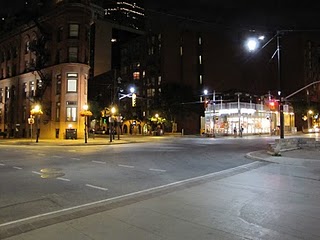
    Downtown Toronto photo by Small

    Steve Lafleur is a public policy analyst and political consultant based out of Calgary, Alberta. For more detail, see his blog.

  • Revisiting Toronto’s G20 Costs

    In the lead up to the G20 conference, the security costs were projected to approach a billion dollars. As high as this number sounds, sources are now speculating that the total bill could be closer to $2 billion. Shocking as that number is, the costs incurred by local businesses may have exceeded that total.

    In addition to the physical damage to the hundreds of shops that were smashed in, there were major productivity losses during, and in the week before the conference. The most visible opportunity cost was the sharp decline in retail sales. According to Monaris Solutions, businesses within the security barrier saw a 28.08% decline in sales, and a 40.87% decrease in transactions. Businesses outside of the barrier experienced a 10.78% decline in sales, and a 16.43% decrease in transactions. The total city decline in sales was 9.31%, with 14.96% less transactions. This may not seem like that much, until you consider that the city has $47 billion in annual retail sales. A crude calculation puts the total retail losses in the $386 million range for the 25-27th. Given that this is a summer weekend, it is probably a low estimate.

    The implicit costs to the financial sector would be difficult to tabulate. With 223,000 employees, even minor disruptions to the sector are extremely costly. Many of the large banks asked their employees to work from home for several days, which certainly caused some level of productivity costs. Many of them also had to temporarily move their trading floors outside of the downtown core. Moreover, each bank needed to prepare its employees for the inevitable disruptions during the conference. As the security boundaries shifted, and government policies to deal with the conference changed, banks were required to hold multiple meetings in preparation. Assuming each meeting lasted a half hour, and the average employee earns $20/hour (an understatement), the financial sector would have lost roughly over $2 million for every single preparatory meeting.

    Unfortunately, it is impossible to calculate the full cost of the summit to Toronto businesses. The banks have been fairly quiet about their own costs, likely because of the Harper government’s strong stand against implementing a global bank tax, a move that would have devastated the global financial sector. Though there have been no public statements from the banks, there are rumors circulating that the financial sector lost at least as much as retailers. Those same rumors have it that the overall economic losses exceeded the security costs (based on the original security estimates). With nearly $400 million in retail losses alone, this seems realistic. Let’s hope this G20 experience has finally put to death the myth that hosting controversial global political meetings in major cities brings economic benefits.

  • G20: The Siege of Toronto

    Excerpts from Steve Lafleur’s personal “View From The Wreckage” diary and photo log from this month’s G20 conference in Toronto:

    June 25th
    10:51 PM:
    I arrive in Toronto to a surprisingly vacant parking lot on the Esplanade, in the heart of Toronto’s bustling financial district. Quietest Friday night I’ve ever seen in Toronto. Barely a soul out in the usually packed financial district.

    2:12 AM: On the way back to my lodgings, I pass by the French delegation’s bus. The hotel workers had been on strike for the previous few days. The hotel is owned by a French company, so the workers decided to go on strike while the French delegation was there.
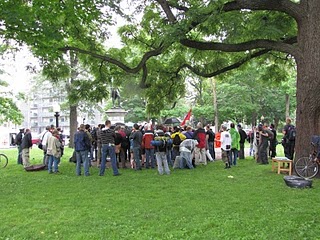
    2:14 AM: The Esplanade is conspicuously devoid of returning bar goers.

    June 26th
    10:39 AM:
    I arrive a few minutes after a scheduled keynote speaker at Allen Gardens that I heard about on Twitter. The tent town built by protesters has already been broken up, and its occupants have dispersed. The speaker goes on anyways, with a small crowd.

    10:56 AM: I head to Bay Street, the heart of Canada’s financial district. I figure if there are pre-rally disruptions, they would be here.
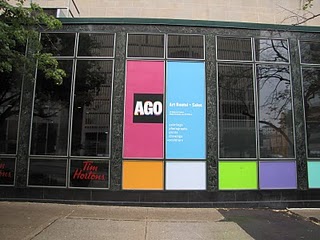
    11:11 AM: The Art Gallery of Ontario was one of the many high profile venues that closed for the conference. (Many shows, including the high profile musical, Rock of Ages, were canceled. The Blue Jays were also forced to move three home games to Philadelphia).
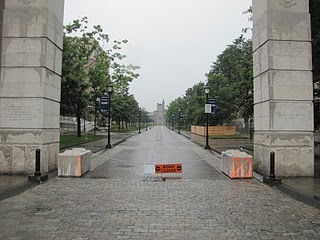
    11:29 AM: Arrival at the Security barrier. A few officers hanging around, but surprisingly quiet. The police decided to use tightly meshed chain link fences to make climbing the barriers extremely difficult.

    11:55 AM: The University of Toronto, which was also closed for the conference.
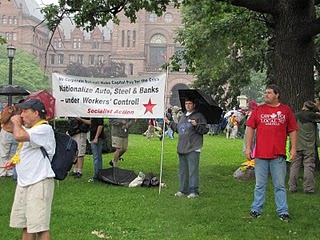
    12:10 PM: Queen’s Park begins to fill up with all of the usual suspects. Union activists, environmentalists, and anti-war protesters seem to be the bulk of the crowd.
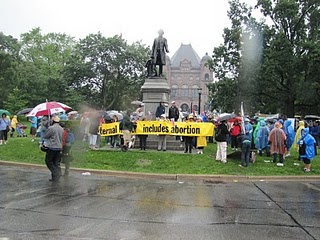
    12:34 PM: When I see Greepeace approaching, I know it won’t be quiet much longer… and then I see people in their midst who appear to be Black Bloc anarchists, notorious for their role in the Seattle WTO protests of 1999, where they caused major property destruction.

    12:43 PM: Things get pretty busy at Queen’s Park. Despite the rain, the crowd is estimated to be 5000.
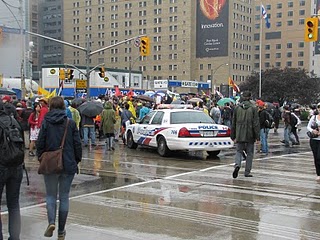
    12:48 PM: A crowd protesting the Ethiopian genocide fills the streets of Queen’s Park. I tell my photographer not to worry about them; that they have nothing to gain from being violent. Spoiler: I am right.

    1:41 PM: The demonstrators have now officially shut down University Avenue. The Queen’s Park subway station, and some other stops, are also closed. Frustrated motorists and streetcar passengers are stuck.
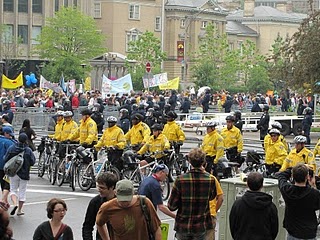
    2:26 PM: Rather than contain the crowds (which would lead to immediate confrontation), the police form a human funnel to shunt the protesters west on Queen Street.
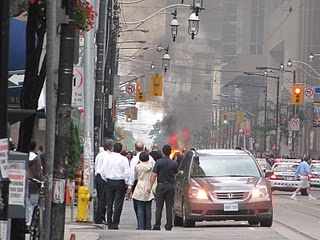
    2:55 PM: As I reach University, the police are once again blockading. Riot police one street south are putting on gas masks. There appear to be police officers fighting with protesters. Police tell us to head north immediately or risk becoming collateral damage. Rioters breaking every window in sight.

    3:48 PM: Smoke is coming from a burning car in the middle of the road. We later find out it was a police car set on fire by protesters with Molotov cocktails (one of at least 3).
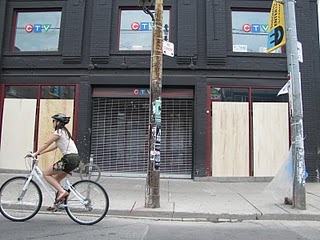
    11:46 PM: Stop for a quick drink at Duggan’s, a local microbrewery. Downtown is once again eerily quiet. Some business owners had the foresight to board up in anticipation of the riots.

    11:52 PM: We are greeted by hundreds of riot police outside of our lodgings and escorted across the street. There doesn’t appear to be anything amiss. From the roof, we are able to discover what the police are up to: resting.

    June 27th
    2:09 PM:
    Both the Bank of Montréal and The CIBC across the street from it are smashed in. It is surprising how quickly the vandalized establishments were boarded up. No remaining shattered glass visible from the road.

    2:11 PM: The Gap is one of the predictable targets for protesters, but dozens of less prominent shops are also vandalized. Starbucks, of course, the absolute favorite target of anti-corporate vandals; also the CTV news building, as well as several media vehicles.
    2:15 PM: As I continue along Queen Street, I hear a loud rumble. Yet another protest march coming. I quickly pull a U-turn, and exit the city.

    There are plenty of lessons that one might learn from this experience. This was my second G20; my first was last year’s meeting in Pittsburgh. The lesson that I want to impart is simple: Major political meetings should never be held in large cities. They are a magnet for violent protesters, and endanger local residents. The destruction, along with the billion dollar security tab, will hopefully make politicians think twice about foisting these events upon major cities. As I said before the meeting, it should have stayed in Huntsville, a small tourist town outside of the city, where it was initially supposed to take place.

    Photos by Andrew Lafleur.

    Steve Lafleur is a public policy analyst and political consultant based out of Calgary, Alberta. For more detail, see his blog.

  • Toronto’s G-20 Conference: Financial Boon or Boondoggle?

    Ever since the ill fated 1999 WTO meeting in Seattle, there has been some debate over the merits of hosting meetings of international organizations in major cities. Some argue that there are economic spin offs from the tourism generated by these conferences, but others argue that the security costs far outweigh the benefits. In the lead up to the G-20 meeting in Toronto, scheduled for June 26-27, there has been a flurry of controversy over the price tag for conference security. The combined security tab for the G-8 and G-20 could end up as high as $900 million dollars (Canadian). The tourism industry does have the potential to reap some gains from the G20.

    The best case scenario for the industry would see 50,000 rooms booked for the conference. Unsurprisingly, Greater Toronto Hotel Association’s Terry Mundell is excited. “It’s a good news story for us,” he claims. If we assume (optimistically) that each room goes for $300/night, the hotel industry could make $30 million out of the deal. On top of this, people will obviously be spending money while they’re in town. Let’s assume that these 50 thousand people consume 4 meals/day at $100/person. This would be a cool $40 million for the restaurant industry. Maybe these folks will have a few drinks. Let’s budget in $100/night. After all, these are affluent folks. That’s $10 million for the bars. Maybe a few souvenirs to bring back for the kids? Let’s say another $10 million. And what if they need some Tylenol? Toothbrushes? Toss in another $10 million. We’re up to about $100 million in direct economic benefits. But wait, people need to get to Toronto, and to get around the city. We’ll be generous and throw in $100 million for airfare, though the benefits of this are not entirely injected into the Canadian economy. Add to that $100/day in cabs, and we have another $10 million. This brings the grand total to $210 million. Far from negligible. Unfortunately, that’s about double the official estimate of $100 million. Like I said, this is a best case scenario.

    On the cost side of the ledger, it is important to note that the costs will be divided between the G-20 Conference in Toronto, and the G-8 conference in Huntsville, 2 ½ hours north of the city. Let’s be extremely generous and assume it is an even split. Of the $833 million already announced, we’ll say $400 million is going to the Toronto conference. This still leaves us with a shortfall of $190 million, even under an extremely optimistic scenario.

    Here’s the bad news: even under the optimistic scenario, we still haven’t factored in opportunity costs. So far it has been confirmed that three Blue Jays games will be moved to Philadelphia, and the University of Toronto will shut down during the conference. In anticipation of former Jays star pitcher Roy Halliday’s first return to Toronto, the team had budgeted for 90,000 fans to attend. At an average revenue of $39/fan, that’s a loss of $3.5 million dollars. It’s hard to say how many fans would have come into the city from out of town, but it wouldn’t be at all unrealistic to say that the city is going to lose at very least another $3.5 million in spin offs.

    Even without any similar cancellations, Seattle business managed to lose at least $10 million in revenue as a result of the WTO meeting in 1999 (not to mention the $2 million in property damage). Furthermore, if the G-20 wasn’t going to be in Toronto, we don’t know how many hotel rooms would have been rented out for other events, or whether the conference goers will crowd out other patrons from restaurants. This is the difficulty with these types of estimates. They take into account the benefits that we see, but not the unseen opportunity costs. It’s hard to count a family that decided not to to Toronto for recreation or a cultural event because they want to avioid crowds or inflated room rates.

    One might argue that the short term costs will be mitigated by long term benefits. After all, some people might like the city so much that they’ll want to visit again. Perhaps some number of people will even want to move to the city. I had a similar experience during the G-20 in Pittsburgh last year (though haven’t followed through). If we look at it this way, any shortfall could be seen as a tourism advertising expense. Will this pay off in the long run? Unfortunately it is impossible to tell.

    So let’s assume that the shortfall for the conference is $200 million dollars. That seems pretty reasonable at this point. Let’s further assume that there will be a non-trivial long term tourism benefit to the city. In fact, let’s assume they make it all back. I still don’t buy into the idea of holding major international political conferences in major cities.

    Here’s why. There is an enormous inconvenience to city residents, which will likely include many people being caught up in violent protests and police retaliation. No one should have to get tear gassed in the name of boosting tourism. I was in Pittsburgh during the last G-20 meeting when stores were being smashed in, and the police were gassing protesters. Given that I was wise enough to stay away from the protests, I didn’t personally witness the chaos. Having said that, there is plenty of footage showing the violent clashes between protesters and police. After Seattle, London, Pittsburgh, and many other cities have endured chaos during these conferences, politicians should have learned their lesson. Forget tourism dollars. These conferences are about solving major economic problems. The G-8 meeting is being held in tiny Huntsville, where the G-20 originally was supposed to be held. That’s how it should be.

    It’s easier to import police to a small town than evacuate the downtown of a major city. Unfortunately, governments have not learned from history They seem determined to let their citizens pay the price for their cherished few days in the sun.

    Steve Lafleur is a public policy analyst and political consultant based out of Calgary, Alberta.

    Photo by Sweet One

  • Reconnecting the In-between City

    The socio-spatial landscape of what we call the “in-between city,” includes that part of the urban region that is perceived as not quite traditional city and not quite traditional suburb (Sieverts, 2003). This landscape trepresents a the remarkable new urban form where a large part of metropolitan populations live, work and play. While much attention has been focused on the winning economic clusters of the world economy and the devastated industrial structures of the loser regions, little light has been shed on the urban zones in-between.

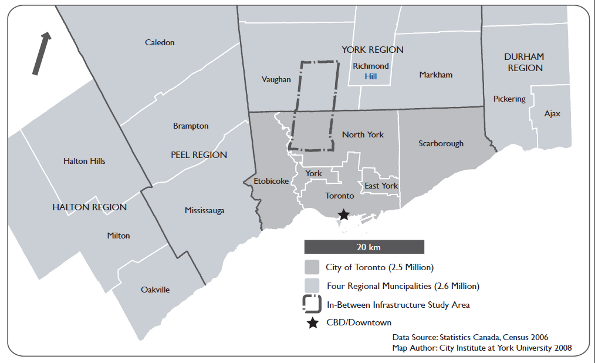
    We view this new landscape with a particular view towards urban Canada. Applying these concepts to a North American city, Toronto, Canada, we look specifically at the 85 square kilometers around York University, an area that straddles the line between the traditional suburb and the inner city.

    A politics of infrastructure
    When we speak of a “politics of infrastructure”, we refer to a growing awareness that involves political acts that produce the infrastructure policy for urban regions. We therefore follow Colin McFarlane and Jonathan Rutherford’s advice to open up “the ‘black box’ of urban infrastructure to explore the ways in which infrastructures, cities and nation states are produced and transformed together”. This “politicization of infrastructure” involves the understanding of how infrastructure policies and planning are linked to “the co-evolution of cities and technical networks in a global context” (McFarlane and Rutherford 2008: 365). The politics that produced the (public) modern infrastructural ideal for the centres and the (privatized) modern infrastructural ideals for the peripheries, largely marginalized the role of d the in-between cities of our metropolitan regions. They were left as residual spaces filled by thruways and bypasses.

    But the increased significance of these spaces today commands our attention in new and inevitable ways. In this sense, the politics of the in-between city suggests the need for a de-colonization from the forces that built the glamour zones at both ends of its existence: the urban core and the classical suburb or exurb.

    The newest – 2006 – census figures in Canada reveal that 70 percent of the population live in metropolitan areas (see note). However, within those urban areas they increasingly live outside of urban cores in a new kind of urban landscape. Interestingly, more Canadians also work in the suburban parts of metropolitan areas. The number of people working in central municipalities increased by 5.9 percent from 2001 to 2006 whereas the number of people who worked in suburban municipalities increased by 12.2 percent.

    Of course the growth of the traditional suburban kind continues, and while inner cities experience densification of office and condominium developments, much of the most dynamic growth areas are literally in-between. But the picture in the old suburbs and the enclaves is a distinctly mixed one. There are areas of aggressive expansion, for example around suburban York University in Toronto, where a New Urbanist-styled “Village at York” has added one thousand units of residential space. Yet just one block away, the Jane-Finch district continues to lose both in economic standing and demographically and remains one of the designated “priority neighbourhoods” where the City of Toronto sees much room for socio-economic improvement.

    Yet even as these in-between areas experience fast paced socio-spatial change, the realities of political and administrative power leave them marginalized. The Steeles Avenue corridor at the northern edge of the York University campus, for example, is a major east-west thoroughfare at the border of two municipalities – Toronto and Vaughan – that has enjoyed little attention from the cities’ investors and resident communities. Planners in the two municipalities have only recently begun to think about redevelopment possibilities in the corridor, but their policy-making is largely in isolation from each other. Just where the need for articulated urban infrastructure development is greatest, the capacity to act is least.

    At the same time, the linear nature of public transit and other networked infrastructure which favour either mass concentration of jobs or housing or wealthy suburban enclaves – leaves many places that lie between designated destinations in a fallow land of unsatisfactory access. This bias is corroborated by the political decision making processes.

    No politician, planner or bureaucrat will champion public expenditure in the in-between zone, particularly if they are inhabited by or provide jobs to socially less powerful groups. As a consequence, infrastructure built to connect centres actually disconnect those non-central spaces that lie in-between. While highways link smart centres and movieplexes around the urban region, blue collar workers in the widespread facilities of the sprawling suburban Toronto industrial districts rely on irregular buses or van service to get them to and from work.

    Empirically, our 85 sq km study area – partly in the City of Toronto and partly in the City of Vaughan – is home to about 150,000 people. It is a place that is rich in social and physical complexities and contradictions. Uneven access to different infrastructure is particularly visible in the poorly understood and under-recognized “in-between city.” Casting light on the infrastructure problems of the “in-between city” is a necessary precondition for creating more sustainable and socially just urban regions, and for designing a system of social and cultural infrastructure that meets community needs.

    How can renewal come to the politics of infrastructure in the in-between city? The question is how our respones to the global economic recession can effect these oft-neglected regions. Will they reinforce the ways in which the in-between areas and their dependent populations have been marginalized or will they participate in the renewal?


    Note: Census Metropolitan Areas are defined as having a population of at least 100,000.

    References
    McFarlane, Colin and Jonathan Rutherford (2008) Political Infrastructures: Governing and Experiencing the Fabric of the City, International Journal of Urban and Regional Research 32,2; 363-74.

    Sieverts, Tom (2003) Cities Without Cities. Between Place and World, Space and Time, Town and Country. London and New York: Routledge.

    Roger Keil (Dr.Phil, Frankfurt) is the Director of the City Institute at York University, the Director of the Canadian Centre for German and European Studies, and Professor at the Faculty of Environmental Studies at York University, Toronto. Keil’s current research is on the global suburbanism, infrastructure in the Zwischenstadt, on cities and infectious disease, and regional governance. Keil is the co-editor of the International Journal of Urban and Regional Research (IJURR) and a co-founder of the International Network for Urban Research and Action (INURA).

    Douglas Young is Assistant Professor of Social Science at York University where he teaches in the Urban Studies Program. He is a former architect, municipal planner and developer of non-profit housing cooperatives. He is co-author of a book about politics in Toronto, “Changing Toronto: Governing Urban Neoliberalism,” which was published in 2009 by University of Toronto Press, and co-editor of a forthcoming book, “In-between Infrastructure: Urban Connectivity in an Age of Vulnerability,” which will be published by Praxis (e) Press. His current research interests include infrastructure in the in-between city, suburban renewal, and urban legacies of socialism and modernism.

  • What Seneca Falls Can Learn from Toronto

    One of the most enduring myths in public policy is that local government consolidations save money. The idea seems to make sense, and most of the academic studies support the proposition. However, rarely, if ever, does the promised reduction in public expenditures or taxes actually take place.

    Residents will vote March 16 on a proposal that would merge the village government of Seneca Falls, New York into the more rural and adjacent town of Seneca Falls. Under state law, this can occur without the consent of the town into which the village would be merged.

    Paltry Savings and the Risks: A consultant report suggests savings that can only be characterized as pitiful. Out of a combined budget of $13 million, less than $400,000 would be saved, and even that figure is by no means sure, according to the consultant.

    Voters may want to consider the following specific risks that could make achievement of the expected savings and tax reductions impossible:

    Proponents expect to receive $500,000 annually in funding from a state program that seeks to encourage municipal consolidations. The state program is slated for cuts. Further, with New York’s serious budget difficulties, such a superfluous program could be a prime candidate for discontinuance. Thus, one of the principal factors expected to lower taxes might not survive in the longer run.

    Presently, the village has a police department, while the town does not. The new town government is not likely to be able to get away with providing a higher level of police protection in the former village than in the merged town. One of two outcomes seems likely: (1) The first is that the present police protection (and budget) would be spread throughout the merged town. This would dilute police protection in the former village area. (2) The second is that the higher level of police protection in the village would be spread throughout the merged town. This would mean larger expenditures that could easily erase the already minimal projected savings.

    The consultant proposes that a new town hall be built. The costs of this building could substantially erode the projected operating cost savings.

    A principal reason that municipal consolidations rarely save money is that the necessary “harmonization” of service levels and employee compensation costs inevitably migrate to the level of the more costly former jurisdiction. The police issue in Seneca Falls is a prime example of the service harmonization cost risk.

    Learning from Toronto: Seneca Falls does not have to look far to see how local government consolidation can lead to more spending and higher taxes. Less than 150 miles away as the crow flies, Toronto residents were glowingly told of the lower taxes and expenditures that would result from consolidating six jurisdictions into a “megacity” in the late 1990s. As we and others predicted at the time, things have not worked out. Toronto’s spending has risen strongly under the consolidated government. Despite its much smaller population, the risks are similar in Seneca Falls.

  • What is the Answer to the Suburban Question?

    We have recently assembled a special issue of the journal Cities with the title “The Suburban Question”, and we assume that many readers will assume the answer is “who cares”? The term ‘sub-urbs’ connotes a lesser form of urban life, and for decades it has been used dismissively to denote anything plastic, even hypocritical. Novelist Anthony Powell described one of his unsympathetic characters possessing a ‘‘face like Hampstead Garden Suburb”; the New York Times recently described architect Robert Stern as ‘‘a suede-loafered sultan of suburban retrotecture”. In the old days, record stores had ‘urban’ bins full of gangsta, but nothing marked ‘suburban’, although it is always easy to use the suburbs as a backdrop for duplicity, as in American Beauty, or the first series of Weeds (set in a gated community, a double score!).

    There has been some academic attention—Dick Walker, David Harvey, and of course Kenneth Jackson all wrote lasting pieces about the suburbs. But in these, they always appear as objects of inquiry, rather than subjects in their own right; and if academics live amongst the ‘little boxes of tickytacky’, they rarely write about them. This is more than unfortunate, for many reasons—the most obvious is that by most definitions, most of us are indeed suburbanites. But while there are endless dissertations on public housing, the decline of the inner city, and the much discussed revitalization of the inner city, there is precious little on their further-flung counterparts.

    It’s hardly the case, to answer the unspoken question, that there is nothing interesting to research ‘out there’. What about updating research on the ‘growth machine’? No one has really done any detailed work on the complexities of the home building industry, with its rigid design aspirations and complex financial connections. There is the gated community, which is still portrayed as ‘Fortress America’ even though there are significant proportions of Hispanic households living in gated communities, and many of these are rental properties and not the upscale compounds portrayed in textbooks. And there is the Home Owner Association. Despite the fact that millions of Americans live in them, relatively little research has been done on this important aspect of governance since the term ‘Privatopia’ was coined nearly two decades ago.

    A few authors have tried to push back against this indifference, arguing that suburbs appear to be ‘good places for most people’. Yet the reality that affordable homes-and-gardens are unquestionably popular does not seem to matter. In almost any manner imaginable, the suburban lifestyle has been savaged. Sprawl causes obesity; it destroys downtowns; it causes global warming. In Metroburbia, Paul Knox argues that the suburbs have turned us into monsters of capitalist consumerism, the sagging SUVs necessary to carry the wobbling masses from mall to McMansion.

    It is easy to argue that American suburbs are unsustainable, but to echo Peter Marcuse’s famous rhetorical question—‘sustainable for whom?’ Vibrant cities—New York, San Francisco, Boston—are expensive cities, and while that fabled creature, the Creative Worker (homo Floridian) is willing and, more importantly, able to pay large sums to live in very small spaces, most of us are not. Suburbs have attracted paying customers precisely because housing costs are low and conditions are attractive. Not many cool public spaces, but that’s less important to most people past their college years.

    This is the backdrop to the papers that we have collected in our special issue. Its aim is to present work that asks ‘what is happening in the suburbs, in terms of the built form, the economy and social relations’. They are not necessarily written ‘in defense of suburbs,’ but engage suburbs as if they matter. Nick Phelps leads off by emphasizing the contribution that suburbs make to our local and national economies. He reminds us of the transfers there of jobs and the growing importance of suburbs to the urban region and the economic health of our nations. He closes with an urgent reminder that the “economic centrality of suburbs within the contemporary economy should, perhaps more than anything else, signal the need for a re-balancing of urban studies to be more fully suburban in academic and policy focus.”

    A perfect example of this appears in a study of Phoenix by Carol Atkinson Palombo and Pat Gober. Their analysis of new housing construction in the prior two decades indicates trends that span different types of multi-family housing in suburban locations. They note, “densification no longer equates to urban infill but takes many forms and occurs all over the metropolitan region”. A complementary article by Roger Keil and Douglas Young focuses on their empirical work in Toronto, and especially what they have termed ‘the in-between city’. These places are “not quite traditional city and not quite traditional suburban”, forgotten geographies where many live and where their infrastructure reminds us that the placing of ‘urban versus suburban’ neglects the many shades of in-between urban places that require planning and policy attention.

    Toronto is the focus of another paper, in which Susan Moore explores the tenets of New Urbanism. In four case studies, she explores sub/urban forms, showing that the general edicts of the “densification-is-good” movement are contextualized in different settings, and reveals endless rounds of compromises between developers, planners, politicians and residents. In the end, this design imperative is unable to transcend the “urbanization of the suburbs or the suburbanization of the urban,” and once more we are challenged by the need to confront the assumed distinction between urban and suburban developments, or even cities and suburbs themselves.

    This theme is given additional attention in a further paper, by noted Turkish urbanist Feyzan Erkip, whose work explores, and contrasts, the new manifestations of Westernization in Ankara—malls and gated communities—with more traditional neighborhoods. She finds little difference between the views of the populations in the old and new, but the meanings that these new design features take on are very much conditioned by their context. For instance, the malls have a liberating veneer for Turkish women, who feel socially threatened in the streets but not in the private shopping districts. Conversely, gated communities adopt familiar design features but unlike their Western counterparts, these are essentially up-scale squatter settlements; this indeterminate legal status is attractive for some residents because it makes their homes less open to search by law enforcement or tax officials.

    We conclude our collection, and this piece, with a simple response: the answer to the suburban question is that they possess a rich history and a dynamic present and therefore demand more attention and a serious research agenda. We call for more academic attention to be given to places where a majority of Americans, many Europeans, and a growing number of Asians, Africans, and Latin Americans live. Urban studies should either become inclusive of all parts of the city—from edge to center—or the field of Suburban Studies, spearheaded by the New Suburbanism, is long overdue.

    Andrew Kirby is the editor of the interdisciplinary Elsevier journal “Cities.”This is his 20th year as a resident of Arizona. Ali Modarres is an urban geographer in Los Angeles and co-author of City and Environment.

    Photo: urbanfeel @ flickr

  • A Canadian Autobahn

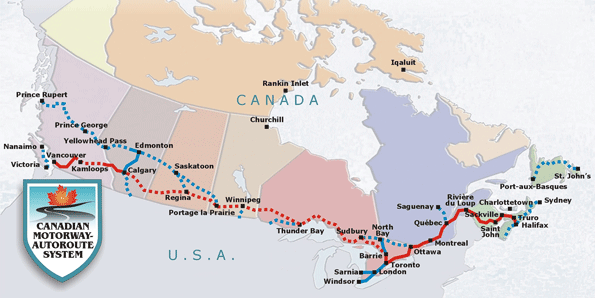
    Canada is the largest high-income nation in the world without a comprehensive national freeway (autobahn, expressway or autoroute) system. Motorways are entirely grade separated roadways (no cross traffic), with four or more lanes (two or more in each direction) allowing travel that is unimpeded by traffic signals or stop signs.

    The Economic Advantages of Motorways: Motorways have been associated with positive economic and safety impacts. For example, a synthesis of research by the American Association of State Highway and Transportation Officials (AASHTO) noted the positive impact of US motorway system:

    The Interstate Highway System represented an investment in a new, higher speed, safer, lower cost per mile technology which fundamentally altered relationships between time, cost, and space in a manner which allowed new economic opportunities to emerge that would never have emerged under previous technologies.

    In particular, the AASHTO synthesis indicated that motorway

    …investments have lowered production and distribution costs in virtually every industry sector.

    It is a well known fact that motorways are by far the safest roads. We estimated that 187,000 fatalities had been averted due to the transfer of traffic from other roads to motorways between 1956 and 1996.

    A World of Motorways: Truckers in Japan, Europe (the EU-15) and the United States can travel between virtually all major metropolitan areas on high quality motorways.

    Further, motorway systems have and are being built in developing nations. By far the most impressive is China, which now has approximately 65,000 kilometers of motorway, not including motorways administered at the municipal level (as in Shanghai and Beijing). Only the United States has more, at approximately 85,000 kilometers. China’s plans call for the US figure to be exceeded within a decade. These roads are being built not only throughout populous eastern and central China, but also to the Pamirs at the Kazakh border and to Lhasa, in Tibet, across some of the most desolate and sparsely populated territory in the world. Mexico, a partner with Canada and the United States in the North American Free Trade Agreement also has an extensive motorway system.

    Motorways in Canada: Canada, however, is an exception. Only a quarter of metropolitan areas are connected to one another by motorways. Edmonton and Calgary are among the few metropolitan areas in the developed world that are not connected to comprehensive motorway systems (Vancouver is connected to the US system, but not to the rest of Canada).

    For many trips between Canadian metropolitan areas, it takes less time to travel through the United States on its motorways than on the Canadian roads (such as between Winnipeg or Calgary and Toronto). The principal problem is the long, crowded, slow, two-lane stretch of roadway through the northern Great Lakes region between the Manitoba-Ontario border and between Sudbury and Parry Sound. There is also a long section of roadway in the British Columbia interior that a Calgary talk show host referred to as a “stagecoach” trail. Canada pays an economic price for this lack of a world-class highway system, both in terms of manufacturing and tourism.

    However, parts of Canada are well served by motorways. Much of central and eastern Canada is connected by motorways, with routes from Windsor, Ontario, through Toronto, Ottawa, Montreal, Quebec to Halifax. This route includes only a short segment that is not motorway standard in the province of Quebec as it approaches the New Brunswick border.

    Moreover, despite its reputation to the contrary, the largest Canadian urban areas have world class freeway systems. Few, if any, urban areas in the United States or the developed world have more kilometers of motorway or motorway lanes in relation to their urban area size as Toronto and Montreal.

    A Canadian Autobahn: In cooperation with the Frontier Centre for Public Policy, we proposed a world class highway system for Canada. In a report entitled “A Canadian Autobahn: Creating a World Class Highway System for the Nation” we proposed:

    1. Upgrading the entire transcontinental route from Halifax, through Toronto to Vancouver to motorway standards. These improvements should be completed within 10 years and would cost approximately $28 billion (2009$).
    2. Upgrading other principal routes to at least pre-motorway standard, which would require “twinning” (four-lanes) and minimizing the number of grade crossings. The longest of these additional highways is the Yellowhead route: Edmonton and Calgary to the Canada-U.S. border; Ottawa to Sudbury; and across the island of Newfoundland. These improvements should be completed within 15 years and would cost approximately $33.5 billion).

The transcontinental route would provide a long overdue economic stimulus to urban areas such as Thunder Bay and Sault Ste. Marie. The improved Yellowhead route would provide far better access to the new deepwater, superport at Prince Rupert (British Columbia), which is the closest North American port with connections to major Asian markets. This could materially improve Prince Rupert’s competitiveness relative to larger ports on the US West Coast, such as Los Angeles and Long Beach (which have become much less competitive themselves in the last decade). The improved roadway would make it possible to effectively serve the markets of the US Midwest, South and East through a connection to I-29 in North Dakota.

The report was unveiled at a Calgary event on October 29 and was covered by media across the nation.

What About Greenhouse Gas Emissions: A question was raised about the advisability of expanding highways at a time that the world is attempting to reduce greenhouse gas (GHG) emissions. Such a strategy would seem to be at odds with the popular perception that we shall all have to abandon our cars and move into flats in the central city. This perception presumes that people are prepared to return to the standards of living and lifestyles of 1980, 1950 or even 1750. In all of my presentations on similar issues I am yet to uncover any groundswell of support for the lifestyles of yesterday.

It needs to be recognized that the international commitment to reducing GHGs is based upon an assumption of minimal impact on the economy. GHG reductions will be achieved only if they are acceptable to people, which requires acceptable costs (research by the United Nations International Panel on Climate Change suggests an upper bound of $50 per ton). Cost effectiveness is necessary to not only prevent a huge increase in poverty, but also to allow continued progress toward poverty alleviation and upward mobility. In fact, as recent US research indicates, there is scant real world potential to reduce GHGs from reduced levels of driving.

Given the strong association between economic growth and personal mobility, there is a single realistic path to substantial GHG emission reduction: better technology. Fortunately, developments suggest that technology is, indeed, the answer.

The question, thus, comes down to whether jobs in the northern Great Lakes region (and elsewhere) are more important than strategies that are politically correct, but comparatively ineffectual with respect to materially reducing GHG emissions. It seems likely that people will place a priority on jobs.

Finance: Because of the importance of tying the nation together, it would be appropriate to spend federal and provincial funds on the Canadian Autobahn. User fees, such as a dedicated gasoline tax (as in the United States) or tolls (as in France, China and Mexico) could finance the expansions, using public-private partnerships or “arms-length” government corporations.

Wendell Cox is a Visiting Professor, Conservatoire National des Arts et Metiers, Paris. He was born in Los Angeles and was appointed to three terms on the Los Angeles County Transportation Commission by Mayor Tom Bradley. He is the author of “War on the Dream: How Anti-Sprawl Policy Threatens the Quality of Life.

  • Lost City

    We agreed, last time, to meet at the corner of Yonge & Bloor – Toronto’s busiest subway stop.

    Presumably you’ll arrive by subway. There are two main lines: one east-west along Bloor-Danforth, from Kipling Ave. in Etobicoke to Scarborough Town Centre. The intersecting north-south line is actually double. One branch runs almost the entire length of Yonge St., from Finch to Union Station. From there it doubles back, heading north again under University Ave and Avenue Road, finally ending near Downsview Airport. They intersect at three stations, all along Bloor Street: Bloor & Spadina, Bloor & Avenue Road (St. George), and Bloor & Yonge. The latter is where you want to get off.

    The Toronto subway is clean, quiet, convenient and runs on time. It is also very slow; I doubt top speed is much over 30 mph. You can get most places you need to go, but you won’t get there quickly.

    Another way to get close to Yonge & Bloor is by street car. Actually, the best you’ll do is Yonge and College, and then you’ve got a few blocks to walk. Tourists and Americans love the street cars – they are fun. For the commuter they are a pain. Mostly they share right-of-way with cars. This slows down the street car, and worse, slows vehicle traffic to the same pace (they’re almost impossible to pass). The result: traffic down Queen St. rolls by at a solid 15 mph. This is not an efficient mass transit method, but tourists love it.

    Metro Toronto consists of six boroughs: Toronto, Scarborough, North York, Etobicoke, York, and East York. The latter two are very small – I have never actually “been” to either; I’ve just driven through. I’ve stayed over night in all of the others. Metro Toronto resulted from city-county consolidation of York County in 1954. (Toronto was originally founded as York, but changed the name shortly after, presumably to avoid confusion with New York.)

    Skipping the two little ones (directly adjacent to Toronto proper), Toronto City is the original city. It is bounded by the lake to the south and very roughly Eglinton Ave. in the north, the Don Valley to the east, and the Humber River in the West. Scarborough is east of the Don Valley, Etobicoke is west of the Humber, and North York is north of Eglinton.

    So here we are at Yonge and Bloor Streets. Let’s go east. Bloor ends within a mile at Parliament St. and then becomes Danforth. Danforth crosses over the Don Valley in a most dramatic way. Given that Toronto cannot effectively use its lakefront, the most prominent natural landmark in the city is the Don Valley. This is a deep gorge cut by the Don River, which flows south to Lake Ontario, east of the city centre. The gorge is a park traversed by the Don Valley Parkway – an expressway that runs along the bottom of the gorge from the Gardiner Expwy to the northern city limit. The Don Valley also marks the approximate boundary between Toronto City and Scarborough (the actual boundary lies to the east at Victoria Park Ave.).

    Crossing the Don Valley, especially near the southern end where the gorge is deepest, requires a significant bridge. And this is what happens on Danforth – probably the most spectacular view in the whole city. It’s even nice on the subway, which crosses the same bridge on a lower level. Across the bridge (not yet in Scarborough) is Toronto’s vibrant Greek community. Once in Scarborough, Danforth veers northeast so as to parallel the lake. It will eventually take you to Scarborough Town Centre.

    My first impression of Scarborough was British. The place is full of typical Toronto bungalows that look very much like typical suburban London bungalows (think Keeping Up Appearances). But in the meantime appearances don’t mean much: Scarborough has become one gigantic Chinatown. The predominant language at the corner of Midland and Finch (where I have spent a lot of time) is Chinese. The primary commercial street, Kingston Road (the continuation of the Gardiner Expwy along the lake) is mostly Chinese. Now Chinese are likely a bigger share of commercial life than population, but without a doubt, Scarborough has a large Chinese community. It’s very vibrant, and it makes for good food.

    The main street of North York, on the other hand, is the 401 expressway. This is the longest expressway in Canada, going from Windsor to Montreal. In Toronto it runs from Pearson Airport in the west through Etobicoke, North York, Scarborough and points east, roughly along Lawrence Ave. On my most recent visits, North York struck me as at best lower middle class – it is definitely the poorest of the six boroughs (at least the bigger ones). Immigrants are from all over: Russia, India, Africa, Latin America, the Caribbean. It is not as lively as Scarborough, but it still has very good food.

    I haven’t been to Etobicoke since the early eighties. Then it was mostly Italian and solidly middle class. The eastern boundary of the borough is the Humber River, a much less dramatic counterpoint to the Don Valley.

    Starting at Bloor and heading north on Yonge, one comes first to St. Clair – about a mile away. Yonge & St. Clair is called Midtown, and is an elegant residential neighborhood. A mile north of St. Clair brings you to Eglinton, which (apart from the expressways) is the major E-W traffic thoroughfare. It is the first street north of Danforth to cross the Don Valley; it spans the entire city from Pearson Airport to eastern Scarborough.

    Continuing north puts one in North York – Wilson (which doesn’t go through), the 401, Lawrence (a shopping street in North York), Sheppard, Finch and Steeles (the northern city limit). The latter three cross the Don Valley, which is much smaller that far north. All of these are about a mile apart.

    Recall the history of Toronto: founded as the cultural capital of British North America, dedicated to British rule, Good Government & Good Order. When I first visited Toronto in the 1970s it lived up to that ideal. Since then the city has become one of immigrants, lots of good food, but not very British. What does that mean for British North America? Is Good Government & Good Order a sufficiently stirring rallying cry to create a civic life from all the ethnic groups? Where is the unum amidst all that pluribus? Canada is betting its future on multiculturalism. They really have no other choice, but will the city maintain its original soul throughout these changes?

    Daniel Jelski is Dean of Science & Engineering State University of New York at New Paltz.