Tag: transit

  • Atlanta Resoundingly Rejects Transit Tax

    Atlanta area voters said "no" to a proposed $7 billion transportation tax that was promoted as a solution to the metropolitan area’s legendary traffic congestion, despite a campaign in which supporters outspent opponents by more than 500 to one.

    With 99 percent of the precincts reporting, the Atlanta Journal Constitution reported that the measure lost 63% to 37%. This 26% margin of loss was nearly three times the margin shown in most recent poll by the Journal-Constitution. Proponents had claimed on the weekend that the measure was "dead even" three days before the election.

    Proponents spent heavily on the campaign, with reports ranging up to $8.5 million in campaign donations, indicating a cost to contributors of more than $30 per vote. Opponents raised less than $15,000.

    The tax issue failed in all 10 counties. The defeats were modest in Fulton County (the core county, which includes most of the city of Atlanta) and DeKalb County (which contains the rest of Atlanta). Huge "no" vote margins were recorded in the largest suburban counties. In Gwinnett County, the no votes prevailed by a margin of 71% to 29%. In adjacent Cobb County, the margin was 69% to 31%.

    On election morning, the Atlanta-Journal Constitution featured opposing commentaries by regional planning agency (Atlanta Regional Commission) Chairman Tad Leithead and me. Chairman Leithead stressed the view that the tax would lead to reduced traffic congestion, job creation and economic development. My column stressed the view that the disproportionate spending on transit (53 percent of the money for one percent of the travel market) would not reduce traffic congestion.

  • Sydney’s Long and Lengthening Commute Times

    The New South Wales Department of Transport Housing and Transportation Survey reports that the average one way work trip in the Sydney metropolitan area (statistical division) reached 34.3 minutes in 2010. As a result, Sydney now has the longest reported commute time in the New World (United States, Canada, Australia and New Zealand), except for the New York City metropolitan area (34.6 minutes).

    Longer Commutes than in Dallas-Fort Worth or Los Angeles: Sydney’s average work trip travel time has increased approximately 10 percent since 2002. The 34.3 minute one way travel time is approximately 30 percent higher than that of larger Dallas-Fort Worth, which about half as dense. Part of the reason for the longer commute time in Sydney is its far greater transit dependence. Approximately 24 percent of work trip travel is on transit (which is slower for most trips). This compares to approximately 2 percent of travel in Dallas-Fort Worth.

    Even Los Angeles, with its reputation for "gridlock" has a shorter average commute time, at 28.1 minutes. This is made possible by the extensive Los Angeles freeway system, greater use of automobiles and more dispersed employment patterns (despite the higher density of Los Angeles relative to Sydney). The average Sydney commuter spends nearly an hour longer traveling to work each week than the average Los Angeles commuter.

    Even Longer Commutes Ahead? Sydney’s densification policies (urban consolidation policies) seem likely to lengthen commute times even more in the future, given the association between higher densities and greater traffic congestion.

  • Federal Transit Administration Weighs In on Honolulu Mayor’s Race

    The Federal Transit Administration (FTA) has intervened in the Honolulu Mayor’s race against challenger and former Hawaii Governor Ben Cayetano. Governor Cayetano and Mayor Peter Carlisle are locked in a bitter contest that could determine whether the proposed $5.1 billion rail line is built. Mayor Carlisle is a strong supporter of the rail line. Challenger Cayetano has promised to "pull the plug" on the rail system. Recent polls show that the project’s former thin majority support among Honolulu residents has now turned to opposition.

    At a 1:30 p.m. press conference yesterday (March 13), Governor Cayetano released e-mails from the FTA indicating concerns about the rail project. According to Cayetano, "Not only it is apparent that FTA officials share some of our concerns, but it’s also apparent that they warned the city about pending litigation if certain things were not done."

    One of the FTA emails, obtained from the administrative record said “I do not think the FTA should be associated with their lousy practices of public manipulation and we should call them on it.”

    Reflecting a surprising ability to "turn on a dime," FTA quickly responded in an apparent attempt to diffuse Governor Cayetano’s point. According to KITV, "In response to the press conference, a spokesman for the Honolulu Authority for Rapid Transportation issued the following statement on behalf of the FTA:"

    There is no question that this project has overcome early obstacles because of a much improved Federal partnership with the City of Honolulu and State of Hawaii over the last several years. The Federal Transit Administration believes that this project will bring much needed relief from the suffocating congestion on the H-1 Freeway and provide a real transportation alternative for the people of Oahu as gas prices rise.

    Curiously, the FTA’s statement contradicted its own previous position on the traffic impact of the rail line. In its January 2011 "record of decision" for the project, FTA indicated:  "Many commenters [on the Draft EIS] reiterated their concern that the Project will not relieve highway congestion in Honolulu. FTA agrees…" Further, it is unusual for federal agencies to take part in local election campaigns.

    The Honolulu rail project was covered in more detail in a recent newgeography.com commentary, Honolulu’s Money Train.

    Clarification (March 15). The complete quotation above was not used because it was not necessary to the point, which was FTA agreed that highway congestion would not be relieved by rail in its record of decision, but in its statement on Tuesday appears to have reversed that view. We are unaware of any change in the technical documentation that would have justified such a change.

    The complete quotation was "Many commenters [on the Draft EIS] reiterated their concern that the Project will not relieve highway congestion in Honolulu. FTA agrees, but the purpose of the project is to provide an alternative to the use of congested highways for many travelers.” The "provide an alternative" clause was omitted because it was unrelated to the apparent change in position on traffic congestion by FTA.

    "FTA agrees." in the article above, has been changed to "FTA agrees…"

  • Major Texas Metro Areas Are Confirming Failures in Rail Transit

    Despite the success of the Main St. line, I’ve been concerned for a long time now that the next set of rail lines will essentially bankrupt Metro while providing minimal benefit (except for possibly the Universities line, which has moderate benefits, but may not get built anytime soon because of the money drain of the other lines being built first).  Now the Coalition On Sustainable Transportation (COST) has come out with the numbers from other cities (especially Dallas) that don’t bode well for Houston at all.  Some key excerpts (I know it’s a lot, but there are some really good points in here):

    —————

    For example: Dallas will pay increasing debt service for many years and has 30 plus year bonds and commercial paper for its almost $4 billion of debt. Their debt service is considered annual operating costs in the chart below, because: By the time current bonds are paid, the rail system will be at the end of its service life and will need replacement through the creation of a new round of bonds, continuing this high bond expense for as long as the system operates. While other Texas cities have not yet reached this Dallas level of bond debt and expense, Houston is rapidly moving in the same direction and Austin’s planning is pointing in this direction. Currently Dallas’s debt service is about 3 times Houston’s and almost 40 times Austin’s.

    One may look at the data in the table above in many ways, but, none of the conclusions seem to be positive for rail transit. Dallas, Houston, San Antonio and Austin are all among the top 20 fastest growing major cities in the nation. However, the three cities with various levels of rail transit, Dallas, Houston and Austin, all have declining transit ridership trends and have fewer absolute transit riders today than they had a dozen years ago. They have spent billions to implement and promote transit with a heavy focus on rail transit.

    These data highlight a number of broader Texas Metro Area negative transit trends:

    1. Metro areas with more rail transit have significantly higher costs and higher taxpayer subsidies per ride.
    2. Metro areas with more rail transit have fewer total transit boardings per capita.
    3. Metro areas with higher densities have fewer transit riders (boardings) per capita.
    4. Dallas has the largest population and greatest population density but the least cost effective transit system: Higher cost per ride (boarding) and fewer boardings per capita.
    5. Increasing the proportion of a region’s transit funds being spent on rail transit leads to less cost effective overall transit and degraded transit for the majority of transit riders who still ride busses.

    Some Major Texas City Metro Areas comparisons/observations regarding transit data:

    1. Dallas-Ft. Worth Metro’s population is more than 3 times San Antonio’s and Dallas’ annual transit operating expense is 4.4 times San Antonio’s but Dallas has only 1.6 times the transit ridership of San Antonio.
    2. Dallas-Ft. Worth Metro’s population is 3.8 times that of Austin and Dallas’ annual transit operating expense is 3.7 times the transit expense of Austin but Dallas-Ft. Worth has only 1.9 times Austin’s ridership.
    3. Dallas has the most invested, more than $4 billion, in light rail and it has the highest cost per transit ride at 2.8 times San Antonio’s costs and almost 2 times Austin’s. Dallas has the least boardings per capita, about one-half of San Antonio and Austin.
    4. San Antonio’s bus only transit system has 1.2 times Austin’s ridership but only 82% of Austin’s annual operating expense.
    5. San Antonio’s ‘cost per transit rider’ is about one-third of Dallas-Ft. Worth’s and San Antonio has 2 times as many transit riders per capita as Dallas-Ft Worth.
    6. Dallas’ 2011 net debt service (principal and interest) budget of $153 million is greater than San Antonio’s total 2011 budgeted operating costs of $141.3 million and almost as much as Austin’s $168.2 million.


    It is no surprise that Dallas has hit a transit financial wall causing it to pause and curtail, at least temporarily, further light rail expansion. It seems, the more light rail Dallas implements, the more inefficient and expensive its transit becomes. This is an often occurring trend when regions implement rail transit and is a serious problem trend now developing in Houston and Austin. The result is overall degradation of transit service as exorbitantly expensive rail transit and resulting debt absorb increasingly higher percentages of transit funds. This, in turn, results in increasing transit fares and reductions in bus service which have disproportionately negative quality-of-life impacts on lower income citizens. Almost everyone forgets that the majority of transit riders still ride busses even after such massive investments in rail transit such as in Dallas or in Portland, the Mecca of train transit, where well over one-half of the transit rides are on busses. More importantly, this wasteful spending on ineffective trains ‘bleeds dry’ taxpayer funds which could be used to make positive contributions in serving communities’ many, higher priority needs for all citizens. (like express commuter bus services from all neighborhoods to all job centers, as I’ve been advocating)

    Much experience has shown that once a cycle of high cost rail transit is implemented, the agency becomes heavily burdened with debt for a very long time. It is highly probable that the very high debt service (principle and interest) will become a permanent and major part of the transit agency’s annual operating costs. When one issue of bonds is paid down, it becomes time for another round of debt to replace aging equipment. This, in turn results in very poor cost effectiveness and degradation of the overall transit system as it serves fewer riders at higher costs. This high debt can never be paid-off without major increases in local taxes. Transit agencies cannot responsibly project and achieve enough ridership to make rail transit cost-effective. This has even less credibility in light of the national declining trend in the use of transit and the fact that the use of transit in Texas’ major metro areas has a declining trend over the past dozen years. As Dallas and other major cities have experienced, this results in a spiraling decline in transit performance and effectiveness, degradation of mobility for low income citizens and, often, cutbacks in other higher priority city services. This results in reducing overall quality-of-life.

    —————-

    Is this the future we really want for Houston?  Because it’s not too late to stop it now, but it will be too late very, very soon, and then we will be stuck with the same harsh reality as Dallas for decades to come…

    This post first appeared at Houston Strategies

  • Los Angeles Metro Bus System Compares Favorably With its Peer Group

    As the Los Angeles County Metropolitan Transportation Authority (Metro) prepared for its most recent round of major bus operations reductions, Metro CEO Art Leahy has been quoted:

    "(T)oo many bus lines with excessive service has led to regular budget deficits1."

    "How full are Metro buses today? Overall, Metro buses are running at an average of 42 percent capacity. Of course, that doesn’t mean that all Metro buses are less than half full. Another measure to gauge bus usage is called ‘load ratio’ — the ratio of passengers to bus seats at the most crowded part of a bus route. By that count Metro’s average load factor is an average of 1.2. (For example, 48 passengers on a 40 seat bus). Many other large transit agencies are running load factors of 1.5 to 1.72 ."

    The "42 percent" capacity is evidently the average passenger load (APL) divided by the number of seats – in other words, on average for the full year, each 40-seat MTA bus had about 17 passengers on board.

    Forty-two percent might appear to be a low value, particularly in comparison to other modes of transportation like scheduled airlines, where it is common to have a 100% load factor on some flights.  However, Lufthansa doesn’t stop at Wilshire/Vermont to pick up passengers between LAX and JFK – transit service is scheduled for peak load factor; that is, attempting to approach, but not exceed, a maximum load factor at the point on the line where the number of people on board is largest.

    In the second quote, we have a mixture of load factors terms and data.  Almost all transit operators have load factor standards, which they set for each mode of service (bus, light rail), time of day, day of week, and type of service (main line arterial bus service, long-haul commuter, neighborhood circulator).  For Metro, the peak load factor criterion had been 1.20 – the 48 passengers on a 40-seat bus – since this was imposed by the Consent Decree that settled Labor/Community Strategy Center v MTA in late 1996 until very recently.

    In that quote, Metro is comparing services standards to actual performance.  It is certainly true that, until the passage of the new policy a few months ago, Metro’s 1.20 service standard was one of the lowest in the industry for larger city operators.  However, Metro routinely failed to meet this standard, which was a major source of complaints by the plaintiffs in L/CSC v MTA – and MTA’s overall average passenger loads have among the highest in the industry for decades.

    Comparing actual results to actual results is far more meaningful than comparing service standards to service standards.  Is 42 percent low, high, or what?  The standard methodology for determining this is peer group comparison.  The Federal Government makes transit data available though its National Transit Database – which we used for the 2009 reporting year3.

    We then constructed our peer group, the twenty largest U.S. transit operators by annual unlinked passenger trips that operate both bus and rail service4 and developed the data for: 

    APL:  Average Passenger Load
    BHr:   Boardings/Hour
    FRR:   Farebox Recovery Ratio
    SP:       Subsidy/Passenger
    SPM:   Subsidy/Passenger Mile

    The results are:

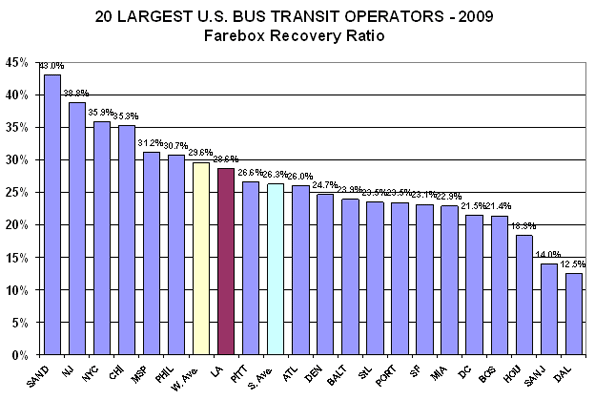
    1.         FRR: Higher is better – but, this statistic can often be misunderstood.  For example, a high cost operator with high fare can have a higher FRR than a low cost operator, but the low cost operator will be providing a better deal, financially, for both the riders and the taxpayers.
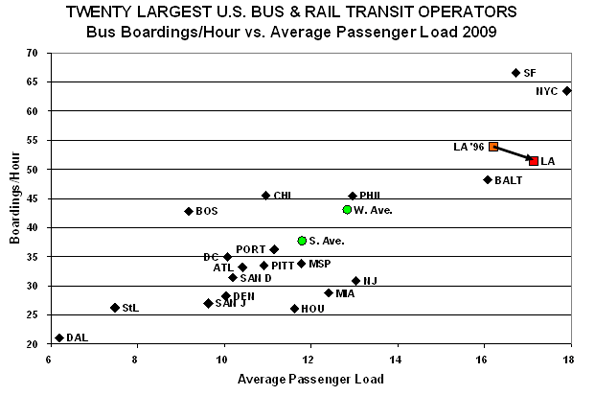
    2.  APL/BHr: Appearing and to the right on the next graph indicates higher load factors.  Higher is better; however, at some point, overcrowding impacts service quality and reliability.
    3.  SP/SPM: On this graph, lower is better, so down and the left is superior – except that, at some point, low cost can indicate concerns about quality of service and safety.
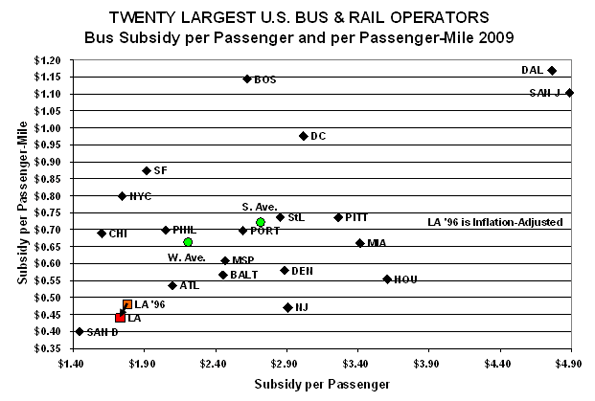
    While Metro is not among the highest in FRR, it has more than twice as many ranked below it (13) than above it (six).  Considered with the subsidy metrics, Metro bus service is a fair deal to the riders and a great deal for the taxpayers.

    On the service utilization graph, Metro is second highest in APL, beaten by NYC, and third on BHr, beaten by NYC and SF.  We added, "LA ’96," for 1996, the year before the Consent Decree went into effect part-way through Metro’s 1997 fiscal year.  BHr has decreased slightly (53.9 to 51.4, or ~4.6%), while APL has increased slightly (16.2 to 17.1, or ~5.6%).  The increase in APL is interesting because Metro’s on-going replacement of primarily 43-seat "hi-floor" with 40-seat "low-floor" buses means that Metro is carrying more people in smaller buses.

    Metro bus service again does well on cost-effectiveness.  San Diego beats Metro on both SP and SPM and Chicago beats Metro on SP.  Metro reduced both of these from 1996 to 2009 after adjusting for inflation5.

    Finally, we decided to do a combined performance index, based on Metro’s own "Route Performance Index" (RPI), which Metro utilizes to eliminate low performers6:

    We have adapted METRO’s RPI in three ways:

    1.  We use it for bus system performance, rather than route performance.

    2.  The "standard" is Metro’s performance on each individual indicator.  The overall score is set at 1.00 for Metro, broken into four components, each of which Metro scores .25.  Operators scoring better on an indicator receives a score higher than .25; performing poorer, lower than .25, with the specific score a direct ratio against Metro’s score (remember that, for subsidy, lower is better, while for route utilization, higher is better).

    3.  Metro utilizes three metrics in its RPI, SP, BHr, and APL.  We added SPM.
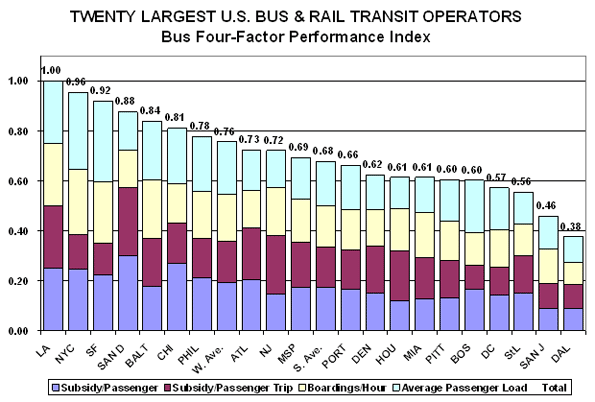
    What we see is Metro rated the highest overall among its peers.  Metro does not win on any single criterion, but its two seconds and two thirds put it ahead of the rest overall.

    Metro’s Transit Service Policy (page 32) states:

    "Lines with an RPI lower than 0.6 are defined as performing poorly and targeted for corrective action.  Lines that been subjected to correction actions and do not meet the 0.60 productivity index after six additional months of operations may be cancelled  …"

    If this .60 cut-off is applied to the 20 bus systems, several would be in major trouble.  Dallas (.38), San Jose (.46), Saint Louis (.56), and Washington, DC, (.57) are below the cut-off.  Boston and Pittsburgh (both at .60) are right on the line, and Miami (.61), Houston (.61), and Denver (.62) only slightly above.

    If one takes the Metro RPI and applies it to the nation’s Top 20, nine of the 20 are either below or very close to the cut-off point. This implies that a high portion of the individual lines, a majority in at several cases, are below the Metro route-by-route cutoff point.

    Circling back to Metro routes, this could mean that many of the routes that Metro would cut, using its RFI procedure, would be average or even above-average routes for many of the nation’s larger bus systems.  Failing to meet the Metro average is actually a very high cut-off point when compared to the national performance.

    This is not to say that no Metro service should ever be cut or eliminated.  What we are saying is, don’t make the cut-off point too high; there is a lot of well-utilized service, by national standards, that does not pass Metro’s methodology.  More important, where there are bus lines with service reduced, put that back on the many, many Metro bus lines that are underserved – which is the usual condition.

    From the above, we see Metro working very hard to cut to reduce the service operated by the most cost-effective and productive major city bus system in the nation – why?  Unlike most other U.S. transit operators, it is not due to lack of funding – but the explanation will have to wait for my next blog entry.
    1           Steve Hymon, "Metro Proposes Bus Service Changes in June, The Source (Metro’s blog), January 3, 2011, access July 9, 2011:
    http://thesource.metro.net/2011/01/03/metro-proposes-bus-service-changes-in-june/

    2               Ibid.

    3               National Transit Database, accessed July 7, 2011:
    http://www.ntdprogram.gov/ntdprogram/data.htm

    4           American Public Transportation Association, 2011 Public Transportation Fact Book, Table 3: 50 Largest Transit Agencies Ranked by Unlinked Passenger Trips and Passenger Miles, Report Year 2009 (Thousands), page 8, accessed July 7, 2011.
    http://www.apta.com/resources/statistics/Documents/FactBook/APTA_2011_Fact_Book.pdf

    5               U.S. Department of Labor, Bureau of Labor Statistics, CPI-U for LA/Riverside-Orange County, accessed July 7, 2011:
    http://data.bls.gov/pdq/SurveyOutputServlet?data_tool=dropmap&series_id=CUURA421SA0,CUUSA421SA0

    6           Metro, 2011 Metro Transit Service Policy, page 31 and Appendix F, accessed July 7, 2011
    http://www.metro.net/board/Items/2011/02_February/20110224RBMItem9.pdf

  • Federal Survey: Fewer Transit Commuters

    Results from the US Department of Transportation’s 2009 National Household Travel Survey indicate that transit’s work trip market share in the United States was only 3.7 percent in 2009. This is a full one quarter less than the 5.0 percent reported by the Bureau of the Census American Community Survey for 2009. Further, the NHTS data does not include people who work at home. If the work at home share of employment from the American Community Survey is assumed, the transit work trip  market share would be 3.5 percent.

    Much of the difference is due the differing questions asked in the two surveys. The American Community Survey asks how people "usually" got to work last week, while the National Household Travel Survey (NTHS) data is based upon actual diaries of travel kept by respondents. The NHTS reports that among people who respond that transit is their "usual mode" of travel to work, transit is used only 68 percent of the time. In contrast, the daily trip diaries report that commuters who drive alone are a larger share of the market than those who indicate driving alone as their usual mode of travel. People who report their usual mode as "car pool" actually use a car pool to get to work only 55 percent of the time, an even lower rate relative to "usual" mode than transit.

    The daily trip diaries from the NHTS also a large difference in travel times between automobile commuters (including car pools) and transit. The average automobile commute time was 22.9 minutes, while the average transit commute time was more than double, at 53.0 minutes.

  • This is Not the Way to Fix Toronto’s Transit

    Results and not ideology should guide transportation policy.

    Large city officials have been lobbying for a major program of federal transit subsidies for years. The push will likely intensify after the federal election.

    A principal resource in this campaign will likely be the Toronto Board of Trade’s third annual Scorecard on Prosperity, which finds Toronto’s transportation system to be among the worst in the world, ranking 19th out of 23 metropolitan areas. Other metropolitan areas also ranked poorly, such as Montreal at 12th, Calgary at 13th and Vancouver at 21st.

    However, a deeper look yields difficulties with the Board of Trade report.

    Automobiles dominate travel in all but two of the metropolitan areas (Hong Kong and Tokyo). Yet, only two of 11 indicators involve automobiles. Eight relate to non-automobile modes such as transit (one deals with freight). The Board of Trade comparisons are skewed because they give disproportionate weight to modes that are relatively minor in metropolitan mobility.

    However, the greatest difficulty with the Scorecard is the implied belief greater reliance on transit is preferable. In fact, transit is slower than cars for the majority of trips. Travel time needs to decrease to encourage metropolitan economic growth, as research at the University of Paris indicates. There is probably no more important transportation indicator regarding the economy.

    A Globe and Mail article rightly expresses particular concern that Toronto’s round-trip average work trip time ranks last at 80 minutes per day. However, at least two of the metropolitan areas had longer work trip travel times. The average work trip travel time in the Tokyo metropolitan area was 96 minutes in 2003 (the latest data available), according to the Japan Statistics Bureau. The Board of Trade failed to find a number for Hong Kong, which the government reported at 92 minutes in 2002. Yet, these travel time laggards rank first and second in the Board of Trade rankings.

    It should be a source of embarrassment that Dallas-Fort Worth, a bane of urban planners and with less than half the Toronto density, should have a work trip travel time one-third less and one-fifth less, respectively, than Calgary and Vancouver, the highest ranked Canadian metropolitan areas.

    It’s worse than that. Among all of the large American metropolitan areas, in or out of The Scorecard on Prosperity, all but New York have better work trip travel times.

    Except in the romantic minds of planners, little of the present car travel demand can be replaced by transit. Further, in virtually all of the metropolitan areas ranking above Toronto, the trajectory has been toward cars, so that the present figures are less favourable to transit than they would have been a decade or two ago.

    For transport to make the greatest possible contribution to economic growth and job creation, the transport system must provide quick mobility throughout the entire labour market (metropolitan area). Transit-favouring ideology will not do.

    The problem is evident. The $8 billion just committed by Mayor Rob Ford and Premier Dalton McGuinty to build an Eglinton subway should be used to reduce travel times as much as possible.

    A huge expenditure on a single street will not do that.

    So long as ideology trumps reality, Toronto’s calcified traffic will put it at a competitive disadvantage. The focus should be on results — the time it takes to get to work, rather than on means — whether the trip is by car or transit.

    Wendell Cox writes here as a Senior Fellow at the Frontier Centre for Public Policy in Winnipeg and is a regular contributor to NewGeography.com. This piece also appeared in the Toronto Sun.

  • The Transportation Politics of Envy: The United States & Europe

    The Department for Transport of the United Kingdom may be surprised to learn that the average round-trip commute in the nation is up to a quarter hour less than reflected in its reports. This revelation comes from an article in The Economist, ("Life in the Slow Lane") citing a survey indicating that the average commuter in the United Kingdom spends less than 40 minutes daily traveling to and from work in 2000. According to Regional Transport Statistics, published by the Department for Transport, the average commuter spent 50 minutes traveling to and from work in 2000. The UK government further indicates that the average commute time had risen to 56 minutes by 2009. The Economist relies on the much lower figure (and other similarly low estimates from other European nations) in fashioning an article criticizing transportation policy in the United States.

    Shorter US Commute Times: The Economist begins with the contention that the average work trip travel time in the United States is substantially greater than that of the number of European nations. The most reliable data says otherwise.

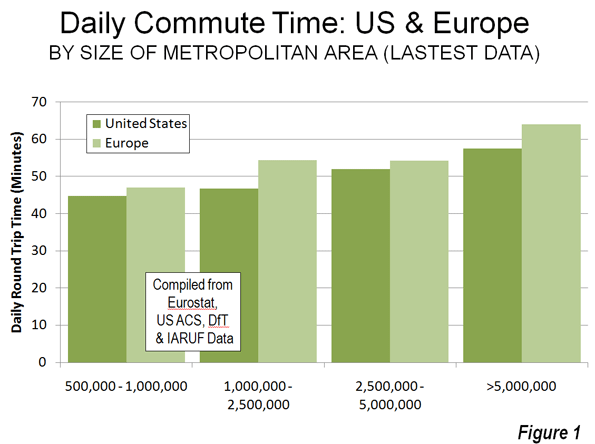
    The most comprehensive work trip data in Europe is maintained by Eurostat, the statistical agency of the European Commission. The Eurostat data indicates that average commute times in Europe are somewhat more than in the United States in metropolitan areas of similar size (Figure 1), when compared to the comprehensive data from the US Census Bureau. For example, among metropolitan areas of more than 5 million population, the daily round-trip average commute is under 58 minutes in the United States, less than the 64 minutes in Europe. European commute times are longer in all population categories (Note).

    Overall, the average round-trip travel time in the US metropolitan areas over 500,000 population is 23.6 minutes and 25.3 minutes in the European metropolitan areas.

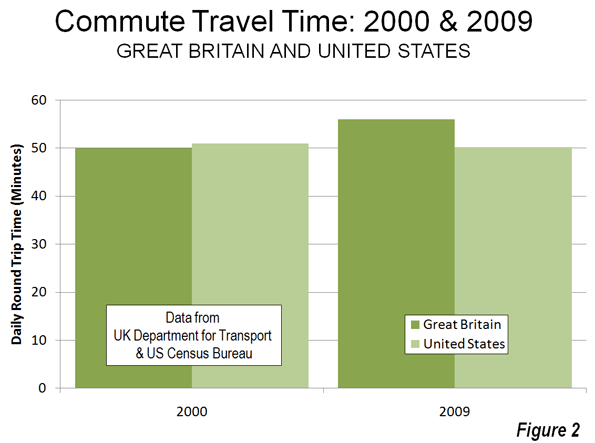
    Moreover, there are indications that the US trend is favorable, at least in comparison to the United Kingdom. Between 2000 and 2009, UK government data shows average round trip commute times to have increased six minutes, while US government data indicates a decline of nearly one minute (Figure 2).

    The US: Less Traffic Congestion:  The Economist then asserts that traffic congestion is worse in US metropolitan areas than in Europe. According to The Economist:

    …with few exceptions (London among them) American traffic congestion is worse than western Europe’s. Average delays in America’s largest cities exceed those in cities like Berlin and Copenhagen.

    The reality is the opposite, according to the INRIX Traffic Scorecard and a more correct rendering of the point above would have been:

    … with few exceptions (Los Angeles among them) western Europe’s traffic congestion is worse than America’s. Average delays in some of western Europe’s smallest cities exceed those in cities like Atlanta, Houston and Dallas-Fort Worth.

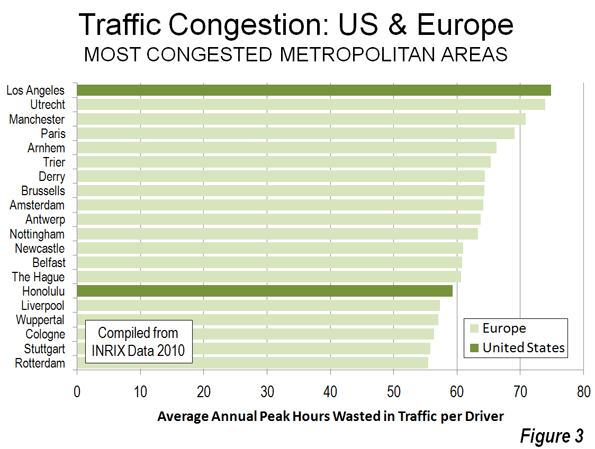
    INRIX compared 2010 peak period traffic delays in metropolitan areas of the United States and Europe. As with commuting time, the average travel delay per driver was greater in Europe than in the United States in every population classification. While Los Angeles has the worst congestion the approximately 200 metropolitan areas (one-half in the US and one-half in Europe), the next 13 worst were in Europe (Honolulu ranks 15th) and 18 of the worst 20 were in Europe (Figure 3). The third worst ranking US metropolitan area was San Francisco, at 28th, while Washington was 29th. Only seven of the 50 most congested metropolitan areas were in the United States. Of course, anyone who has driven extensively in the metropolitan areas of the US and western Europe knows that congestion is generally far worse in Europe, a fact confirmed by the INRIX data.

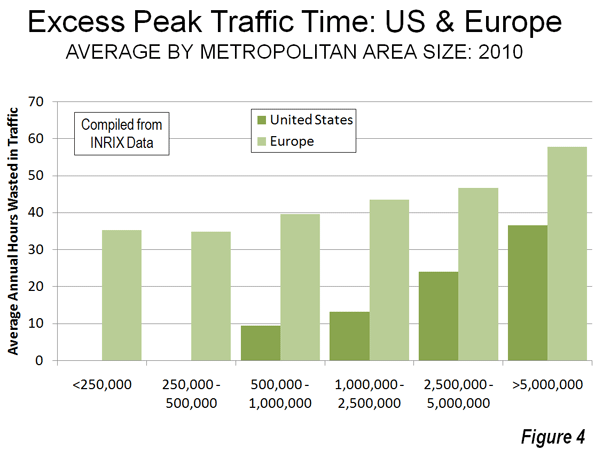
    Indeed, traffic congestion in the smallest European metropolitan areas (under 500,000) was worse than in the largest US metropolitan areas, those with over 5 million (There were no US metropolitan areas with less than 500,000 population in the INRIX data, see Figure 4). Those automobile-oriented, highly suburbanized banes of urban planning, Atlanta, Dallas-Fort Worth and Houston all ranked in the middle, between 90th and 110th. At least 75 European metropolitan areas had worse traffic congestion than all three.

    High-Speed Rail Envy: Finally, The Economist decries the lack of high-speed rail in the United States, noting that:

    The absence of true high-speed rail is a continuing embarrassment to the nation’s rail enthusiasts.

    It is hard to imagine a more pathetic standard for evaluating public policy than "satisfying rail enthusiasts."  It is well known that that governments from Washington to London, Athens and Lisbon are in serious financial difficulty. It is a time for limiting public expenditures to matters of genuine priority. That does not include high speed rail.

    The intercity road and airport systems are principally financed by users, in contrast to the operating subsidies and intense (100 percent) capital subsidies required by high-speed rail. This is evident in California with its now $65 billion first line that has more than doubled in real cost in a decade. It is also evident, closer to home for The Economist, where the controversial HS-2 high-speed rail proposal from London to Manchester and Leeds could easily double in cost (to £65 billion), based upon the best international research. Astoundingly, a doubling of cost would be a bargain for Britain’s taxpayers compared to two previous high-speed rail failures in the same corridor (See: The High Speed Rail Battle of Britain). The recurring environmental justifications ring hallow due to the high costs and the three generations or more it would require in California and the United Kingdom to eliminate the first gram of greenhouse gas.

    Transport policy could be improved in the United States, as well as in Europe. However, the starting point must be facts, not fancy, and certainly not envy.

    ——-

    Note: this analysis includes all data available for metropolitan areas in the United States (metropolitan statistical areas) and Europe (larger urban zones, the closest equivalent to US metropolitan areas). US data is complete, covering all 100 metropolitan areas with more than 500,000 population and is from the United States Census Bureau. European data is principally from Eurostat (94 larger urban zones and three from other sources). Paris data is from IAURIF (Institut d’aménagement et d’urbanisme de la région Île-de-France). Newcastle-upon-Tyne and Leeds data is from the UK Department for Transport.  Data is not available for a number of metropolitan areas with more than 500,000 population in Europe.

  • Bus Versus Train: A Dying Debate

    The Los Angeles Metropolitan Transportation Authority’s cutbacks on its bus line, eliminating about 12% bus service, illuminate the problems of mass transit in LA, specifically the relative inefficiency of trains in the city. This 12% is a further reduction after the 4% cutbacks six months ago, sparking anger from the Bus Riders Union. Metro Chief Executive Art Leahy says that his decision to decrease spending is a result of the low ridership, yet city trains, which are also underperforming, remain relatively untouched.

    Leahy argues that buses are easier to eliminate, re-route, and reschedule than rail lines are. However, he also says that the cutting back on lesser-used bus lines will free up the resources to enhance the ones in higher demand. Many bus riders feel that they are getting a raw deal seeing as bus lines, which transport 80% of the MTA’s passengers, only get 35% of the operating budget to begin with. This being true, how much is the other 65% really helping the rail lines then?

    The Bus Riders Union thinks that the MTA’s preference for trains over buses is an unfair reflection of class interests. Because rich people do not take the bus, there is no incentive to keep it running. As is becoming increasingly clear, especially with the current high-speed rail discussions, rich people don’t want to ride the train anymore either. This local debate, therefore, is not an argument of whether to cutback on buses or trains; it is an argument about how to deal with the general decline in mass transit.

  • Chicago, Portland: Employment Dispersion from Downtown Continues

    New data shows that the downtown areas of both Chicago and Portland (Oregon) are modestly dispersing and losing market share in relation to metropolitan area employment.

    Chicago: The Chicago Loop Alliance reports that private sector employment in the Loop, the core of the Chicago downtown area, fell from 338,000 to 275,000 between 2000 and 2010. An additional 30,000 government workers are employed in the Loop, however 2000 data was not provided for the government sector. As a result of the loss, the Loop private sector share of total Chicago metropolitan area employment fell 13 percent, from 7.7 percent in 2000 to 6.7 percent in 2010.

    The larger downtown area, including areas to the north (North Michigan Avenue area) and to the south had total private sector employment of 480,000. Chicago had the second largest downtown (central business district) in the nation in 2000, with an employment density of more than 160,000 per square mile and a transit work trip market share of 55 percent, trailing only the Manhattan business district (south of 59 Street) and the Brooklyn central business district).

    Portland: The Portland Business Alliance reported that downtown Portland employment had fallen from 86,800 in 2001 to 83,400 in 2009. This represents a four percent market share loss in comparison to the metropolitan area over the period. All of Portland’s growth over the period has been in suburban Clark and Skamania counties in Washington, which added 12,700 jobs, while the Oregon portion of the metropolitan area was losing 4,500 jobs.

    In 2000, Portland had the nation’s 22nd largest central business district, and the 12th highest transit work trip market share, at 30 percent (Brooklyn included).