Tag: transit

  • Maglev-Jitney Could Revolutionize Mass Transit

    Using EDS suspension developed in Germany with Halbach array magnets, mini-maglev jitneys are a new technology that could transform congested corridors of Orlando. The train car itself is small – only 8’ wide x 30’ long – and holds approximately 12 sitting people and 8 or 9 standing people. But the ability of the train to zip along the centerline of crowded arteries like 17-92 and 50, and future tracks along secondary strips within the region, could give people a new way to travel.

    Silent, with no moving parts, the electrodynamic maglev can ride along a guideway buried in the center of the road. Depressions for the jitney’s levitation magnets are shallow enough to drive over, making maglev tracks no more an obstacle than railroad crossings. Within cities like Portland, electric streetcars with clicking and buzzing pantographs are the norm, and drivers, pedestrians, bikers, and buses all coexist within a narrow public street. Here in Orlando, the pantograph, exposed to hurricanes, would be a liability, and the maglev instead presents a safer, more reliable transit system of the future.

    How does it work? The train rests on tires at each stop, but as it accelerates past walking speed, powerful permanent magnets in the chassis lift it up off the guideway. Solid magnets in the guideway present an opposing force (really, the same pole is offered to the jitney’s undercarriage, pushing it forward and away). Electric power is present only immediately underneath the vehicle’s footprint, making the guideway a benign, inert force within the busy roadways in the city.

    The car itself is a “smart” car, with no driver needed – a GPS-controlled computer stops and starts the car, with motion detectors delaying it briefly while passengers get on and off. As the car glides along, the photovoltaic roof powers the car’s air conditioners, lights, wi-fi system, and other devices. If the car breaks down, it simply comes to rest on its wheels, and it can be towed to safety within minutes.

    But maglev technology, already in use for decades in France, Germany, Japan, and China, is already outstripping older technology in safety and reliability. These older systems went for speed, making for very large, heavy trains travelling in excess of 300 mph.

    The mini-maglev, by contrast, will feature headways within minutes of each other – if you miss one, another will be along in 10 minutes or less in peak times. Bike racks in front and back allow you mobility once you reach your stop, and since they are designed for short trips, the cars are designed for standing as well as seated passengers. A full 360◦ glazed car will allow views in and out – making the trip pleasant, safe, and enjoyable.

    Whispering along at conventional traffic speeds, mini-maglevs offer the busy commuter an option that is convenient, reliable, and beautiful. These jitneys are life-enhancing features that will set Orlando apart from other cities in terms of sense-of-place. Neither a 19th century train nor a 20th century bus, the mini-maglev borrows a transportation concept from the islands – the jitney – and recognizes our region’s multipolar, fine-grained circulation system already in place. Instead of fighting this system with a heavy steel-wheel rail system on 19th century rails like Sunrail, it simply enhances existing corridors.

    Jitneys roam many Caribbean islands, gathering workers around the villages and transporting them into the resorts and the towns in packets of 10 or 15 passengers a vehicle. Frequent stops make them more like large-scale vanpools rather than small-scale buses, and they act as the connective tissue among the spread-out villages and settlements in which islanders dwell.

    The spirit of the jitney is transformed by 21st century technology into a transit system serving the needs of a spread-out, dense region like Orlando. Let’s face it: while driving, we are highly tempted to chat on the telephone, text, or do many other things other than drive. Waiting at red lights or stopped in traffic jams, the pleasure that once was driving has now receded all too frequently in favor of frustration, anger, and fatigue. We sense the lost time behind the wheel, seeking to make up for some of it with mobile communication, but this has an external price to pay: the driver ahead misses the green light because he is texting, making your trip longer as well.
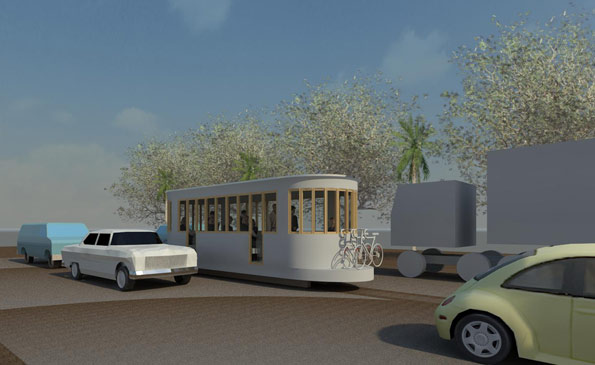
    In the mini-maglev future, the distance and time are unchanged; what has changed is your freedom while you travel. Getting there will be fun again, and arriving in a mini-maglev jitney will be the new way to make an entrance.

    Electronic Jitney farecards will make paying for the ride super-easy, and if you have any question about the route, timetable, or stops, fear not: your smart phone app will show you where you are going, where you want to get off closest to your stop, and map out how to get there from here. It will also helpfully show you what is coming up along your path: A library, your friend, a Starbucks…

    And, for frequent riders, a feature long desired by mass transit commuters worldwide: on-call jitneys. Frequent riders will be able to electronically request a jitney at their desired stops, making these computer-controlled cars come to you. Getting off work late no longer means a lengthy nighttime wait for a taxi, or the next bus not due for another hour. You can request the car, and the farecard will give you back a message instructing you when and where to show up. With computer-controlled routing, mass transit is now more individually customizable than ever.

    The mini-maglev jitney, combined with personal electronic systems, transforms mass transit from a Victorian burden on cities into a sexy, hip way to get where you need to go.

  • Giving the “New Houston Metro” Credit Where it’s Due

    Tuesday, the Houston Metropolitan Transit Authority (Metro) held a blogger luncheon with senior Metro people (Chairman, CEO, board members, managers) at the Rail Operations Center south of Reliant.  It was an informative event with a lot of good two-way Q&A.  And it included an impressive tour of the facility, which, btw, is not air conditioned in the main maintenance bay.  Let’s just say it was the right time of year for a tour and I’m really glad I don’t work there in the summer.  The facility is doing its job though: Metro claims to have the highest operational uptime for rail cars in the country.

    Sometimes in my push for increasing commuter bus services and cutting back rail, I fail to give credit to a lot of good work that is going on at the “New Metro”:
    a few issues for our collective consideration:

    • They really are a lot more open and transparent, and are really trying to do the right things.  
    • There’s been a lot to clean-up, and they’ve done a good job (although CEO Grenias says it will take another 2-3 years to completely turn around the organization).  
    • They’ve also done a good job continuing to reach out and create collaborative agreements to provide commuter bus services outside of their service area (like Baytown and Pearland).
    • They’ve fixed the poorly performing Airport Direct service, price and route-wise.
    • They shifted to a cash basis for the General Mobility Program instead of increasing debt.
    • They fixed their broken relationship with the FTA.

    There was a lot of good talk about improving express commuter bus services to TMC, Greenway, and, most importantly, Uptown.  I pitched them on expanded HOV/HOT lanes (like the 610 Loop) and laptop trays and wifi on the commuter buses, which are under consideration.  They have a very high percentage of downtown commuters – 30-40% – and claim a pretty high number for TMC – 20-30% – but that includes people who park in Smithlands and ride the rail, which I don’t consider a true commuter solution (it’s not doing anything to reduce freeway congestion).

    Ultimately, they’re trapped by the voter referendum and the federal money process to keep pursuing a rail plan (and line prioritization) that really doesn’t make a lot of sense given the new fiscal reality since the referendum was passed.  It will make even less sense if the Republican House guts rail funding.  But at least they’re taking steps to “firewall” the rail plan financially so it doesn’t end up stealing from critical local and commuter bus operations.  I may not agree with the overall strategic direction of the agency, but they do have good people doing good work within the constraints of the game they’re forced to play.

    This post originally appeared at houstonstrategies.com

  • Brookings Economist Decries Transit Subsidies, Calls For Privatization

    In his new book, Last Exit: Privatization and Deregulation of the U.S. Transportation System, Brookings Institution economist Clifford Winston contends that transit subsidies are largely the result of labor productivity losses, inefficient operations and counterproductive federal regulations.
    Winston finds that transit service is so underutilized, that load factors were at 18 percent for rail and 14 percent for buses in the 1990s, before the Federal transit administration stopped requiring transit agencies to report that information.

    Six Years Severance Pay: Winston cites the fact that dismissed transit employees may be eligible for up to six years severance pay, under requirements of federal law. For example, less costly services that could be provided under contract by private providers could result in the six-year severance payments if transit employees are laid off. No such benefit is available to other workers in the nation and an impediment that discourages cost-effective innovation.

    Costly Rail Systems: The nation’s urban rail systems, which have consumed so much of transit tax funding in recent decades, are the subject of considerable criticism.

    Winston reminds readers of the considerable literature that shows that "the cost of building rail systems are notorious for exceeding expectations, while ridership levels tend to be much lower than anticipated" and that "continuing capital investments are swelling the deficit." At the same time Winston questions transits high subsidy levels for rail transit, for example, noting that the average income of rail transit riders is approximately double that of bus transit riders.

    In particular, Winston criticizes the now under construction Dulles Airport rail line that will become a part of the Washington DC area transit system, noting that the route is not cost-effective. He characterizes cost overruns on the Dulles rail line and on the soon to be under construction Honolulu rail line as "inevitable." (This is despite the fact that both lines have already experienced substantial cost escalation.)

    Indeed, Winston notes that among all of the US rail systems, the subsidies exceed the benefits on all systems except for San Francisco’s BART.

    Public Sector Mismanagement: Winston offers an ominous conclusion. He says that "social desirability is hardly a demanding standard for a public enterprise to meet" and indicates that is that it is rare to find a public service not meeting that standard. However, of transit Winston concludes that "the fact that transit’s performance is questionable … Is indicative of the extent that transit and bus rail services have been mismanaged in the public sector and been compromised by public policy. It is notable that over the quarter century since transit began receiving income from the federal gasoline tax that its share of urban travel has dropped one third.

    Competition as an Answer: Last Exit indicates that transit can produce beneficial results, but makes a compelling case for reform. Winston suggests that transit could be improved by greater involvement of the private sector, following models such as the competitive tendering (competitive contracting) that now accounts for approximately one-half of Denver’s bus system.

    The international evidence, which Winston does not cite, is even more substantial. This includes the all of the world’s largest bus transit system, in London, the entire Copenhagen bus system, and the entire subway, commuter rail and bus systems of Stockholm. However the ultimate in privatization is Tokyo, the world’s largest urban area, where transit ridership is 1.5 times that of the entire United States. More than two-thirds of all transit ridership is carried by unsubsidized private rail and bus operators.

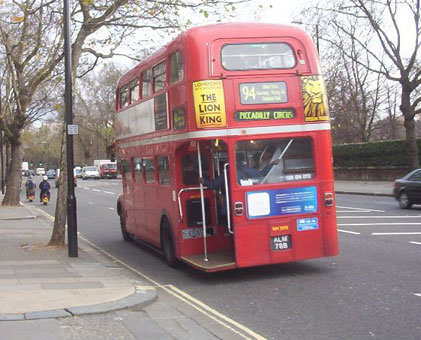
    Photo: Competitively tendered bus in London (photo by author)

  • Honolulu Rail Costs Balloon, Ridership Projections Called High

    Hawaii Governor Linda Lingle has released an independent analysis of the proposed Honolulu rail program to the public and to elected officials. The report was commissioned by the state Department of Transportation. Infrastructure Management Group, CBRE Richard Ellis and Thomas A Rubin performed the equivalent of a “due diligence” report on the project, and according to the Honolulu Star-Advertiser, indicated that the project would rise in cost by $1.7 billion to $7.0 billion for the 20 mile long line.

    In addition, the consultants indicated that operating subsidies could be substantially higher than forecast, and that the city of Honolulu could become saddled with heavy debt by the project. Further, the consultants noted the likelihood that ridership projections might not be met.

    Post-rail transit system usage and fare revenue are likely to be substantially lower than that projected in the current Financial Plan, since the Plan’s projection would require an unprecedented and unrealistic growth in transit utilization for a city that already has one of the highest transit utilization rates in the country.

    The findings of cost escalation and over-projection of ridership have been noted as a fairly routine occurrence in international infrastructure research.

    —–

    Note: Honolulu rail project planning documents indicated greenhouse gas emission reductions as a benefit of the project. Demographia published an analysis indicating that the impact on greenhouse gas emissions either a marginal increase or a marginal decrease depending upon performance. It was projected that any reduction would have been at costs per ton many times above international standards.

  • Rasputin’s Tunnel?

    First, New Jersey Governor Chris Christie cancelled the proposed intercity and suburban rail tunnel between New Jersey and Manhattan because of the financial obligations its out-of-control costs could impose on the state’s taxpayers. Then he delayed the final decision, under pressure from Secretary of Transportation Ray LaHood and other supporters of the tunnel. In the end, the proponents were unable to provide the financial guarantees necessary to keep New Jersey from having to pay more than it had committed and Christie cancelled the tunnel for good. Or so it appeared.

    Now, the tunnel may be back. Mayor Michael Bloomberg of New York City has studies underway that could lead to extending subway Line 7 from a station at 34th Street and 11th Avenue to New Jersey instead.

    Early press reports suggest the line can be built for $5.3 billion, which is approximately one-half the cost of the previous proposal. It is more likely that Governor Christie will buy the Brooklyn Bridge with tax money than this amount is in the “ball park.” The subway tunnel would be only four blocks (15 percent) shorter than the cancelled tunnel.

    The previous tunnel had the less than attractive name, “Access to the Regional Core.” Given the back and forth history of this project, a more appropriate name might be “Rasputin’s Tunnel,” after the Russian mystic whose enemies failed in multiple attempts to murder (though in the end, they succeeded).

  • Governor Christie Cancels Under-Construction Tunnel in Unprecedented Move

    New Jersey governor Chris Christie reaffirmed his decision to cancel the “access to the regional core” tunnel across the Hudson River from New Jersey to New York. Christie had suspended his previous decision pending discussion of alternatives with the US Department of Transportation.

    In the final analysis, according to Christie, none of the alternatives would have capped New Jersey’s liability at its present level, which assumed a project cost of $8.7 billion. Christie told the Moorestown Community House, “No more blank checks from the taxpayers of New Jersey, not on my watch.”

    Current estimates for the project have range from $9.8 billion to more than $12 billion, which would require New Jersey to pay an additional $1.1 billion to $3.3 billion, since under the funding agreement approved by former governor John Corzine, New Jersey was responsible for any cost overruns. In fact, based upon the experience with other projects (such as Boston’s Big Dig), New Jersey could have seen its bill run to another $10 billion or more.

    Christie’s decision is unprecedented. This may be the first time in decades that a major infrastructure project already under construction has been cancelled because its costs had spiraled out of control. Such cost performance has been the rule, rather than the exception. Major research by Oxford University professor Bent Flyvbjerg, Nils Bruzelius (a Swedish transport consultant) and Werner Rottenberg (University of Karlsruhe and former president of the World Conference on Transport Research) covering 80 years of infrastructure projects found routine under-estimation of costs and over-estimation of ridership and revenue (Megaprojects and Risk: An Anatomy of Ambition ).

  • New York Political Leadership Forces Another Fare Hike

    The New York Post editorialized (October 8) against what it called “Another TWU Fare Hike,” blaming the union for the fares that will now rise to $2.50 for a ride. The editorial writer goes on to say of MTA chief Jay Walder, “It’s not his fault that straphangers get whacked while the MTA’s unionized workers — whose blue collars come with fur trim — don’t have to make a single sacrifice to meet the MTA’s shortfall.”

    In response, I posted the following comment to the New York Post site:

    Not his fault? Well, perhaps not personally. But surely it is the responsibility of the MTA and those in Albany who have skewed law labor and regulation to create this untenable situation. It is about time that public officials, such as those who run the MTA, be held account for what they have given away to the unions. The unions could not have taken it without the agreement of the MTA and other local and state political officials.

    The way the Post tells it, you might think that the Transport Workers Union (TWU) had engineered a coup and had forcibly taken control of the Metropolitan Transit Authority. It fact, it was all quite legal. Interests such as the TWU have used their political influence to obtain the expensive contracts that place the riders a distant second, after the employees and the taxpayers an even more distant third. The MTA was not compelled to sign overly expensive labor contracts. Albany was not compelled to insulate transit unions from the economic reality faced by everyone else, including private sector union members. Washington was not compelled to give transit labor unions job protections that would be the envy of European public sector unions. These protections are a considerable factor in driving expenditures up 100% (inflation adjusted) over the past 25 years, while ridership has risen only 40%. The appointed and elected representatives did so willingly, and to the detriment of the people, whom they were supposed to represent.

    The Post rightly complains about this, but places the blame in the wrong place. If the MTA, state and federal officials who have so skewed transit economics in favor of unions, had instead served the riders and taxpayers first, then New York and the nation would have much more transit services, its fares would be lower and there would be much more ridership.

    The Post also errs in saying “Only in New York could such a perverse equation come to be.” In fact, the situation is no different in most metropolitan areas of the nation. Transit agencies have routinely avoided efficiency measures that would have increased transit ridership and reduced costs (such as competitive contracting or competitive tendering of services), raised fares and cut services.

    As the process has unfolded over decades, the TWU and other local transit unions simply responded to the incentives that were established by the elected and appointed officials. This has contributed, along with extravagant and in rail transit expansions, to rendering transit financially unsustainable. The problem is that the public interest in transit has been hijacked by special interests.

    A more appropriate headline for the editorial would have been “New York Political Leadership Forces Another Fare Hike.”

  • Missing the Point on Jobs: The “More Transit – More Jobs” Report

    The Transit Equity Network has just published a study called More Transit – More Jobs in which it suggests switching 50% of highway funding to transit in 20 metropolitan areas to create an additional 180,000 jobs over the next five years. Their basic thesis is that each kajillion in spending can produce more jobs in transit than in highways. We don’t comment on that, because, frankly, the purpose of transportation spending is neither to create transit jobs nor highway jobs.

    We spend on transit and highways because of benefits that extend beyond any direct employment. And, the extent of those benefits cannot be compared between the two modes. At current rates of spending each billion dollars spent on highways supports about 25 times as much personal mobility as one spent on transit. Beyond that, highway spending supports the movement of more than 1.25 billion ton miles of truck freight, which keeps product prices low and supports our affluent life style. Transit carries 0.0 ton miles of freight. Researchers such as Prud’homme & Chang-Wong and Hartgen & Fields have shown that the type of ubiquitous mobility provided by road systems produce greater economic growth. Moving money out of roads would increase traffic congestion, destroy jobs and increase product prices by slowing down trucks.

    Why, on earth, then would anyone make such a dubious proposal? To paraphrase Bill Clinton, “It’s the ideology, stupid.” As we wrote within the past week, much of transportation spending over the last 25 years has been solidly based in an anti-mobility ideology that has produced virtually nothing in return. Already, transit, which accounts for one percent of national travel and no freight movement, accounts for more than 20% of spending on highways and transit combined. Things would be better if that were raised to 60%?

    If the Transit Equity Network were right (which it is not), then why stop at 50% for transit? Why not take all of the transit and highway money and just employ people to dig holes with shovels and then fill them up again. The only costs would be wages, benefits, shovels and administration. We could save money by not buying concrete, rails, fancy trains or palatial administrative buildings. Another advantage is that the holes would require no longer term operating subsidies.

    So, we need to do more than dump the ideology. We need also to dump the stupidity. Government does not exist for the purpose of government services and transportation programs do not exist for the good of transportation employees or vendors. Each dollar of infrastructure expenditures should be used to facilitate the greatest economic benefit throughout society as a whole, not just among people employed in transit (or highways for that matter).

  • Strikes and Transit Alternatives in London

    The Wall Street Journal notes that the London Underground (metro or subway) is on strike and that transit riders are having to find alternate ways to get around. This is of course, not good news, and the transit strikes that happen often in places like Paris and periodically in places like Los Angeles and Philadelphia are a serious impediment to transit’s growth (along with spending on extravagant projects and excessive and rising operating costs).

    But London is actually well prepared for this emergency. Unlike Paris, Chicago and New York (where making transit strikes illegal did not prevent one), London’s buses and underground are organized in a manner that provides riders with an alternative.

    The key is competitive tendering (competitive contracting) of bus service. One of the Thatcher government’s most successful reforms was its reorganization of transit in London. It began in 1985, when a small part of the world’s largest public bus system was put out to competitive bid. London Transport retained control of the schedules, fares, logos and bus liveries, so that the now privately operated services were an integral part of the system. Riders did not know the difference between the public and private services, until a few years later when the privately operated services began achieving better service reliability than the public services.

    By 2000, the entire London bus system had been converted to competitive tendering, with multiple contractors providing the service. Costs per mile dropped by 50%, adjusted for inflation, while service was expanded and ridership rose. Regrettably, some of the efficiency gains were lost once Ken Livingstone assumed the mayorality of the new Greater London Council, while Transport for London (the successor to London Transport) failed to pay sufficient attention to retaining economic competitiveness between the contractors. Still, things are far better today than they were 25 years ago.

    This competitively tendered bus system makes it possible for underground riders to get to their destinations by bus, albeit somewhat more slowly.

    Having an alternative is crucial. I recall that in response to a Southern California Rapid Transit District (SCRTD) bus strike (Note), I asked the Torrance and Gardena bus operations to “open their doors” as they traveled through low-income south central Los Angeles on their way to downtown (regulatory restrictions required them to operate in “closed door more” so as not to compete with the services of the larger Southern California Rapid Transit District). It was not long before one of my fellow Los Angeles County Transportation Commission members complained to Mayor Bradley (who had appointed me), which resulted in my withdrawal of the request. My colleague had been more concerned about the good of already well compensated transit employees to a greater extent than south central Los Angeles residents who relied on the buses for their livelihood (granted, this geographic area was outside the electoral constituency of the member).

    It is well to remember the less than sage views of Herbert Morrison, Deputy Prime Minister to Clement Atlee in the United Kingdom in the late 1940s. Morrison, the founder of the publicly operated London Transport opined that conversion of privately operated services to publicly operated services would be more efficient and better serve the public because public employees would be driven by an ethic of public service. While Nobel Laureate James Buchanan and the public choice school of economics put an academic end to such muddled thinking, London Underground’s workers are in the process of providing even more tangible evidence.

    —-

    Note: SCRTD was the operating predecessor to the current Los Angeles County Metropolitan Transportation Association. The board on which I served, the Los Angeles County Transportation Commission was the policy predecessor.

    Photograph by the Author

  • Commuter Rail Brings Slower Transit in Austin

    Commuter rail is often sold to the public as a faster means of travel than buses. This can be true if the drive to the park and ride lot is short and your destination is within walking distance of a station. However, it is apparently not true in Austin.

    The Austin American-Statesman reports that bus riders showed up at a Capital Metro hearing this week to oppose cancellation of two express bus routes that parallel the new commuter rail line. Their complaint? Taking the train takes longer.

    As has become typical for new urban rail projects, Austin’s commuter rail line is carrying considerably fewer riders than projected. During its first month of service, daily ridership averaged 900 (450 each way), less than one-half the projected 2,000. This is less than 1/100th of Capital Metro’s daily bus ridership.