Tag: Transportation

  • The Argument for Less Infrastructure

    What would our neighborhoods look like if we voluntarily reduced the amount of infrastructure? This isn’t a purely academic question. As municipal, state, and federal budgets get squeezed there’s going to be a point at which we have no choice but to stop building new roads and even reduce the amount of maintenance on the roads we already have. We could approach this situation with dread and a sense of loss, or we could embrace it as an opportunity to get a better quality of life for a whole lot less money.

    I grew up in New Jersey. Like most states the New Jersey Highway Trust Fund is just about bankrupt this year. Unless the gas tax is raised all revenue will go exclusively to debt service. If revenue were to drop below a certain point, due to lower gas prices or lower demand for gas, there won’t be enough money to service the debt either. We’re likely to see triage one way or another.

    Screen Shot 2015-01-23 at 6.13.43 PM
    Google

    Screen Shot 2015-01-23 at 6.11.19 PM
    Google

     Screen Shot 2015-01-23 at 6.01.27 PM
    Google

    Screen Shot 2015-01-23 at 7.02.56 PM
    Google

     Screen Shot 2015-01-23 at 7.05.13 PM
    Google

    This is the historic Water Witch subdivision above Sandy Hook that was first built in 1895, not too far from New York City. Twenty five years ago I had friends who bought an old house here when the neighborhood was only beginning to come back after a long period of decline. Back then the houses were old and in varying states of disrepair. My friends saw the potential and started renovating their place and helped spearhead a revitalization of the neighborhood. These days it’s a posh address with rather expensive homes. But notice the narrow gravel roads.

    Screen Shot 2015-01-23 at 6.10.03 PM
    Google

     Screen Shot 2015-01-23 at 6.10.28 PM
    Google 

    Screen Shot 2015-01-23 at 5.59.30 PM
    Google

    Water Witch is a private community, although it isn’t “gated” in the contemporary sense. That means the HOA members pay to maintain the roads not the government. This is a really important distinction. When people believe their property tax money entitles them to certain things they often have high expectations. They tend to have a very different attitude when they know they’re going to be writing a check directly for the level of service they ask for. This difference in who pays for the roads leads to different outcomes. Back in the late 1980’s I was privy to HOA meeting debates where some members demanded that the roads be paved. They were tired of the ruts, mud puddles, and problems of snow removal. The dirt roads were one of the things that had kept property values depressed for decades. So a consulting engineer was brought in and explained exactly what it would cost to pave the roads. It would be many millions of dollars divided by the forty two homes in the community. That conversation came to a halt instantly. So much for paved roads at Water Witch. The compromise was to maintain the gravel roads to a slightly higher standard with annual adjustments that were far more cost effective. The resulting bucolic country lanes twist up the hill and provide a feeling of retreat from both the nearby city as well as the surrounding suburban sprawl. It also ensures that no one will ever be temped to speed since the roads won’t physically allow it. This keeps the neighborhood safe for pedestrians and cyclists. And it also happens to be more ecological as an extra bonus.

    156508764-M-1
    Justin Tinapay Photography 

    156522759-M-1
    Justin Tinapay Photography 

    RachChris-r075-1
    Justin Tinapay Photography

    Now, there were some people in the HOA that didn’t even want to pay for the annual gravel upgrades. These weren’t what you would call poor people, but no one wants to pay for anything if it isn’t absolutely necessary. It was suggested that the community clubhouse could be rented out for special events to generate the needed revenue to pay for road maintenance. Other people objected. Why live in a private community if an army of strangers would come marching in day and night? So the HOA found a sweet spot. The clubhouse would be rented for only twelve events per year between April and October. Valets would be hired at the expense of the renters to manage traffic. Those twelve days would bring in enough money to pay for the road work each summer. It was a reasonable compromise and a good financial deal for everyone. The fact that Water Witch was distinctive and countryfied compared to the unrelenting highways and strip malls of most of New Jersey made it that much more desirable for people looking for a unique event space. People pay extra for charm.

    Screen Shot 2015-01-23 at 7.03.20 PM
    Google 

    Screen Shot 2015-01-23 at 7.01.54 PM
    Google

    By the way, notice how some people have paved their private driveways with asphalt or stone while the HOA roads and the parking lot at the Clubhouse are gravel. It matters who’s responsible for paying for things and how those decisions are made.

    Screen Shot 2015-01-24 at 3.48.13 AM
    Google 

    Screen Shot 2015-01-24 at 3.47.51 AM
    Google

    Screen Shot 2015-01-24 at 3.45.56 AM
    Google 

    Screen Shot 2015-01-24 at 3.43.53 AM
    Google

    In contrast, here’s a newer upscale residential subdivision not far from Water Witch. Notice the massively wide paved roads and enormous cul-de-sac. I have to ask… What does all that paving really do for the neighborhood? You could land an Airbus A380 on this much tarmac. But what’s the point? You can be quite sure that when these roads become cracked and potholed the wealthy well-connected residents of these grand homes will mobilize and bang heads at the public works department. Somehow the government will be made to absorb the expense of repave things even if the (very high) property taxes from these specific homes doesn’t come close to covering the real cost of maintenance. Would these home owners accept a different standard if they were directly responsible for maintaining their own road?

    Screen Shot 1 2015-01-22 at 4.19.01 PM copy
    Google

     Screen Shot 2 2015-01-22 at 4.19.01 PM copy
    Google 

    Screen Shot 2015-01-24 at 7.09.20 AM
    Google 

    Screen Shot 2015-01-24 at 7.12.21 AM
    Google

    Now let’s look at a more reasonably priced home in a middle class neighborhood. This is my sister’s house in another part of the state. She and her family live in a respectable 1960’s tract house on a half acre lot. Look at the cul-de-sac in front of her place. It’s nearly a half acre as well. Look how tiny the parked cars are compared to the amount of pavement. Again, what exactly does the neighborhood get out of this arrangement other than a massive heat island effect in summer, a storm water runoff problem, and a lot of high speed traffic that puts children, pedestrians, and cyclists in danger? Think of all the ways that much land could be put to better use to add value to the neighborhood instead of just chipping away at the county budget.

    At a certain point hard choices are going to have to be made. The current political conversation involves questions about how to raise taxes while lowering levels of service. But there is another way. We could spend a whole lot less money both publicly and privately and still get a higher quality of life. I’m not sure we as a society are really ready to have that conversation.

    John Sanphillippo lives in San Francisco and blogs about urbanism, adaptation, and resilience at granolashotgun.com. He’s a member of the Congress for New Urbanism, films videos for faircompanies.com, and is a regular contributor to Strongtowns.org. He earns his living by buying, renovating, and renting undervalued properties in places that have good long term prospects. He is a graduate of Rutgers University.
  • Buses: Ride the Friendly Roads?

    Intercity bus companies have made some surprising moves to win a bigger slice of the business-travel market in the past year. City-to-city express operators like BoltBus, GO Buses, and Megabus are upping their game, and several new luxury services have entered the mix with amenities designed to attract disenchanted frequent flyers who wouldn’t have dreamed of taking an intercity coach a few years ago. Think refreshments, attendants, roomy seating, and even shoe shining services.

    A case in point is Vonlane, a new first-class service between Austin and Dallas that launched in May 2014 and plans to expand to Houston this March. A luxury operator, it seats only sixteen passengers, and an attendant serves snacks and drinks. It also offers a private six-seat “boardroom” for business meetings, and Wi-Fi and outlets, which are now almost standard on all bus lines. The service is also going after travelers that are willing to ride coaches to make connections to long-haul flights: Vonlane operates from the Hyatt Hotel at Dallas Love Field, where riders have access to a free airport shuttle. The fare isn’t cheap—around $100 each way—but it’s far less than flying. Southwest’s walk-up fare is $207.

    Equally noteworthy is Royal Sprinter, launched by D.C.-based restaurateur Andy Seligman about a year ago. First-class bus service isn’t new to the Northeast Corridor. It’s already available from Manhattan to Boston via LimoLiner, to Washington, D.C. on Vamoose Gold, and to northern New England via both C&J and Dartmouth Coach. What differentiates Royal Sprinter is its small coaches with only eight seats on board, and satellite TV that accesses pay movie and sports channels. The company currently operates two trips each day between New York and Washington, D.C., with fares running around $95.

    The powerhouse in express city-to-city service, Megabus, is also expanding from its traditional base of college students and urbanites. Taking aim at the business flyer, it introduced reserved seating in fifty-eight cities last year, with ten seats generally available at a cost of between one and nine dollars on each bus. Groups that reserve seating at a table can conduct business meetings during the trip.

    Bus companies are also growing more sophisticated in “selling flexibility,” to allow passengers to change their departure times at only a modest expense, in sharp contrast to restrictive (and costly) airline policies. BoltBus and Megabus, for example, now allow changes up to a day or two in advance for $5 or less, plus any fare difference—a far cry from the $200 charged by American, Delta, and United.

    Bus travel-booking websites, most notably Wanderu and Busbud, are also becoming more visible. Wanderu, in particular, offers convenient means of comparison-shopping Greyhound, BoltBus, Megabus, and others, much as Expedia, Orbitz, and Travelocity do for air travel.

    What does the resurgence of intercity bus travel mean for U.S. transportation? The growth reminds me of the mid-1980s, when new airline hubs were popping up everywhere. Airlines vied to gain a foothold in markets before their competitors did, fearing that there was enough business for only one carrier, but all the new service led to enormous increases in the number of people flying. Unfortunately, there is a void in official data on what is really happening in the bus business. Schedule information isn’t stored in any public data bases and vanishes from company websites the moment a bus departs, complicating growth analyses of this industry. Air and rail travel data is much more easily available.

    To help fill the void, for the past five years I’ve co-authored a year-in-review summary of what’s happening in this industry. Our study attempts to measure growth by recording schedule activity in published timetables and websites. We focus on branded carriers, including Megabus, Greyhound, and Trailways, because small carriers that intentionally stay below the radar, or only serve specialized niches (such as Chinatown operators and airport shuttles) are too hard to track.

    Last year, we observed a 2.1 percent increase in daily scheduled operations on the 107 carriers that met our criteria. While bus service grew, Amtrak train-miles held constant, and the number of airline flights diminished by 3.5 percent. Although bus companies aren’t expanding their schedules at the frenetic pace of past years, when growth often exceeded 5 percent, the sector is still growing much faster than other modes. Plus, ridership appears to be growing at an even faster rate. In October, Megabus reported that its sales were up 13.5 percent over the past year.

    How quickly senior corporate executives on expense accounts will embrace new luxury bus services remains to be seen. Regardless, travel markets of 350 miles or less are about more than college kids and bargain-hunters looking for the cheapest way to get from Point A to Point B.

    Joseph Schwieterman is professor of public service and director of the Chaddick Institute for Metropolitan Development at DePaul University.

    Photo by the author: Megabus double-decker at the Canal Street loading area in Chicago.

  • Governments’ Oil Windfall

    We are reading a lot about the windfall coming to consumers due to falling gas prices now that oil is under $50/barrel. But cheap energy also represents a windfall for governments, including governments who are hard pressed for cash.

    The US uses nearly 20% of the world’s energy consumption every year. That spending includes households, businesses, industries and governments. Households in the US spend nearly $450 billion on gasoline alone to fuel their 2.28 vehicles. Energy for transportation represents about 50% of US consumer spending on average and climbs to nearly 70% in the summer when there is more driving. Governments spend money on gasoline, too.

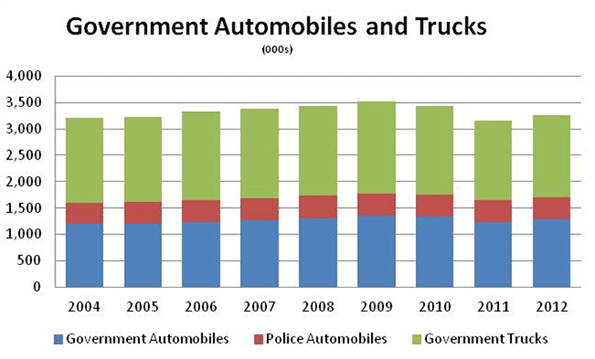
    Not just the federal government, but government at every level – federal, state, county, city – all of which have fleets of cars and trucks that use gasoline.  We could not locate data on fuel spending by state governments for either gasoline or heating/cooling. The Bureau of Economic Analysis tables lump spending at gas stations in with “Other retail” which includes furniture and appliance stores and places like home depot. We did locate the numbers of cars owned by governments and police. Governments in the United States own about 1.5% of all vehicles on the road. That includes military vehicles, cars and trucks owned by the federal, state, county and local government plus police vehicles.


    Data is from www.rita.dot.gov, sourced as www.automotive-fleet.com as of Nov 26, 2013.

    Whether we extrapolate from the number of vehicles and use the “per car” savings estimates or estimate the savings based on the governments’ share of vehicle ownership, we guess that governments across the US will be sharing in at least $1 billion this year. And that is just on gasoline alone.

    They could also be saving on heating bills for real property. The Federal government alone owns almost 400,000 buildings located throughout the country. According to the Consortium for Science, Policy and Outcomes at Arizona State University, the US Federal government spends up to $610 billion annually on energy consumption. Every 1% drop in the prices could mean a $6 billion windfall for Uncle Sam.

    Don’t be surprised if he expands spending instead of using the savings to reduce the national debt or to balance a budget.

  • Bicycles and Race in Portland

    The flashpoint for the gentrification conversation along Portland’s North Williams revolves around the bicycle. The cultural appetite for what the creative class likes and enjoys is in stark contrast to that of the African-American community. “North Williams Avenue wasn’t hip back in the late 1970s. There was no Tasty n Sons. No Ristretto Roasters. No 5th Quadrant. Back then, it was the heart of the African American community. It was wonderfully colorful and gritty.” As the black community saw their own businesses close down through economic disinvestment, they weren’t replaced with new businesses that they regarded as desirable. In the several hours I spent today at Ristretto I have seen roughly a hundred patrons come in and go out, plus others sitting outside on the patios of one of several nearby restaurants. Only three were African-American. As I mentioned earlier, the buildings that surround this coffee shop are home to many African-American families. And yet these new businesses do not appeal to their cultural tastes.

    This all came to a head over a road project to reconfigure North Williams and Vancouver Avenue. Both are one-way roads a block apart that carry a high volume of bicycle traffic. Vancouver’s southbound traffic flows carry cyclists towards the Lloyd Center and downtown Portland and so sees its heaviest usage in the mornings. Williams on the other hand carries northbound traffic away from the city center which means its highest use is in the afternoons and evenings when bicycle commuters are heading away from the city center. But the focal point of all of this controversy is specifically tied to North Williams Avenue because this is where most of the new businesses are coming in.

    A New York Times article featured this stretch of road including one of the business owners who opened up the beloved Hopworks BikeBar. “North Williams Avenue [is] one of the most-used commuter cycling corridors in a city already mad for all things two-wheeled. Some 3,000 riders a day pass by Mr. Ettinger’s new brewpub, which he calls the Hopworks BikeBar. It has racks for 75 bicycles and free locks, to-go entrees that fit in bicycle water bottle cages, and dozens of handmade bicycle frames suspended over the bar areas. Portland is nationally recognized as a leader in the movement to create bicycle-friendly cities.” Other national newspapers and magazines have also picked up on all of the buzz happening along North Williams. In Via Magazine, Liz Crain writes, “With 3,000 commuters pedaling it every day, North Williams Avenue is Portland’s premier bike corridor. Visitors, too, find plenty worth braking for on two blocks of this arterial, including two James Beard Award–nominated chef-owned restaurants and a slew of hip shops and cafés.” Sunset Magazine has several features on North Williams including: “Go green on Portland’s North Williams Avenue: Enjoy a low-key urban vibe thanks to yoga studios, indie shops, and cafes.”

    With images of happy (white) hipsters pedaling bicycles, doing yoga, and eating gourmet food, the nation is given a taste of inner N/NE Portland that is not reflective of the reality of the neighborhood nor the tension surrounding gentrification. These magazines showcase things to see, do, and eat along North Williams with helpful hints like, “Scene: A low-key urban vibe, courtesy of yoga studios and green indie shops and cafes … Dress code: waterproof jacket and jeans with right leg rolled up … Native chic: A waterproof Lemolo bike bag … The Waypost: Creative types come to this coffeehouse for locally produced wine and beer, as well as live music, lectures, and classic-movie screenings.”

    However, not all of the residents are necessarily in favor of these changes taking place. And there are certainly other national media outlets who have picked up on the “other side” of the North Williams story. “Located in a historic African-American community, the North Williams businesses are almost exclusively white-owned, and many residents see bicycles as a symbol of the gentrification taking place in the neighborhood.”

    The tensions of racism and gentrification have culminated in ongoing debates over North Williams’ status as a major bicycle thoroughfare. Sarah Goodyear of The Atlantic Cities (CityLab) writes, “Sharon Maxwell-Hendricks, a black business owner who grew up in the neighborhood, has been one of the most vocal opponents to the city’s plan for a wider, protected bike lane. She can’t help but feel that the city seems only to care about traffic safety now that white people are living in the area. ‘We as human beings deserved to have the same right to safer streets years ago,’ she says. ‘Why wasn’t there any concern about people living here then?’” This picks us on the tension surrounding the North Williams project in general, and in particular the controversy surrounding repainting the traffic lanes to incorporate new designs which cater to the growing number of bicyclists who use this corridor.

    Goodyear goes on to lay out both sides of the controversy:

    Jonathan Maus, who runs the Bike Portland blog and has reported extensively on the North Williams controversy, thinks the city should have stood its ground and gone forward with the project, but wasn’t willing to do so in part because of the political weakness of scandal-plagued Mayor Sam Adams, who has been a strong biking advocate and is closely identified with the biking community.

    “There’s been too much emphasis on consensus,” said Maus. “I’m all for public process, but I also want the smartest transportation engineers in the country on bicycling to have their ideas prevail.”

    Maus, who is white, says the history of North Williams shouldn’t be dictating current policy, and that safety issues for the many people who bike on the street are urgent. “At some point as a city, you have to start planning to serve the existing population,” he said. “The remaining black community is holding traffic justice hostage. It’s allowing injustice in the present because of injustice in the past.”

    In light of this, why is North Williams the flashpoint for controversy? The tension and angst is about more than simply repainting a roadway; it embodies the most visual representation of gentrification in inner N/NE Portland. For longtime African-American residents, as expressed above by Maxwell-Hendricks, she and others felt that they had simply been neglected for decades. This negligence took the form of economics, housing, and general concerns of safety. Their frustration is that it wasn’t until middle-class whites began moving into the neighborhood that these issues began to be addressed and rectified. This notion of systemic racism helped created this area and these same forces are at play in gentrifying this once predominantly black neighborhood.

    The African-American community feels it has been slighted once again. The initial citizen advisory committee revealed the imbalance: “Despite North Williams running through a historically African American neighborhood, the citizen advisory committee formed for the project included 18 white members and only 4 non-white members.” This is why the push for safety along the North Williams corridor has caused such an uproar. “The current debate about North Williams Avenue––once the heart of Albina’s business district––is only the latest chapter in a long story of development and redevelopment.”

    For many in the African-American community the current debate over bike lanes along North Williams is simply one more example in a long line of injustices that have been forced upon their neighborhood. Beginning in 1956, 450 African-American homes and business were torn down to make way for the Memorial Coliseum. “It was also the year federal officials approved highway construction funds that would pave Interstates 5 and 99 right through hundreds of homes and storefronts, destroying more than 1,100 housing units in South Albina.” Then came the clearance of even more houses to make way for Emanuel Hospital. For more than 60 years, racism has been imbedded in the storyline of what has taken place along North Williams.

    For many, the North Williams project is more than repainting lines. As Maus reported, “A meeting last night that was meant to discuss a new outreach campaign on N. Williams Avenue turned into a raw and emotional exchange between community members and project staff about racism and gentrification.” In his article, Maus noted the painful history of Albina as the primary catalyst for the tension today.

    Lower Albina—the area of Portland just north and across the river from downtown through—was a thriving African-American community in the 1950s. Williams Avenue was at the heart of booming jazz clubs and home to a thriving black middle class. But history has not been kind to this area and through decades of institutional racism (through unfair development and lending practices), combined with the forces of gentrification, have led to a dramatic shift in the demographics of the neighborhood. The history of the neighborhood surrounding Williams now looms large over this project.

    It was at this meeting that a comment from one of those in attendance changed the entire trajectory of the evening as the conversation quickly moved away from the proposed agenda. One woman said, “We have an issue of racism and of the history of this neighborhood. I think if we’re trying to skirt around that we’re not going to get very far. We really need to address some of the underlying, systemic issues that have happened over last 60 years. I’ve seen it happen from a front row seat in this neighborhood. It’s going to be very difficult to move forward and do a plan that suits all of these stakeholders until we address the history that has happened. Until we address that history and … the cultural differences we have in terms of respect, we are not going to move very far.”

    The crux of the conflict is not about bicycles nor bike lanes nor even new businesses and amenities. It is about racism. The push for creating a more bikeable and bike-friendly commuter corridor has raised the ire of longstanding residents who had felt neglected and voiceless for decades. “The North Williams case study is an example of the City inadequately identifying, engaging and communicating with stakeholders.”

    Now that more whites are moving in are changes taking place. “Some question why the city now has $370,000 to pour into a project they say favors the bike community while residents for decades asked for resources to improve safety in those same neighborhoods. To the community, the conversation has polarized the issue: white bicyclists versus the black community.” But is this issue completely race-related? Portland has been and continues to expand its bicycle infrastructure throughout the city, not just in N/NE Portland. There are also several other main bicycle corridors that receive a high volume of bicycle commuters, but since they do not go through any ethnic neighborhoods they have not created this much controversy. This does not minimize the tension and angst over the North Williams project; nor does it downplay the role that racism has played throughout the history of that community.

    Note: Footnotes in the original text have been removed. Some hyperlinks have been added.

    This is a condensed chapter excerpt from The Bohemian Guide to Urban Cycling.

    Coffee and bicycles define Sean’s urban existence who believes the best way for exploring cities is on the seat of a bicycle as well as hanging out in third wave coffee shops. Sean is an urban missiologist who works in a creative partnership between TEAM as the Developer of Urban Strategy and Training and the Upstream Collective leading the PDX Loft.

  • Don’t Boost Cities by Bashing the ‘Burbs

    There is nothing like a trip to Washington, D.C., to show how out of touch America’s ruling classes have become. I was in the nation’s capital to appear on a panel for a Politico event that – well after I agreed to come – was titled “Booming Cities, Busting Suburbs.”

    The notion of cities rising from the rotting carcass of suburbia is widely accepted today by much of our corporate, academic and media leadership. This notion has been repeatedly embraced as well by the Obama administration, whose own former secretary of Housing and Urban Development declared several years back that the suburbs were dying, and people were “moving back to the central cities.”

    Some on Wall Street also embrace this notion. Having played a pivotal role, along with regulators, in the housing crash of the late 2000s, some financiers have been buying up foreclosed homes for rental income and also back many high-density projects, which are built to house, in large part, those who cannot buy a home, particularly the younger generation.

    As the Economistrecently pointed out, the suburban house, or a house in less-crowded parts of cities, is an aspiration of upwardly mobile people in the United States and around the world. Surveys, including those conducted by Smart Growth America, demonstrate that the vast majority of Americans prefer single-family houses; most millennials seem to feel that way, too, according to both a Frank Magid Associates survey and a more recent one from Nielsen. As the economy improves, and the people in the millennial generation enter their thirties, it is likely that they – as did other generations – will start buying houses as they start families.

    At the very least, suburbia clearly predominates among Americans. Roughly 85 percent of people in our major metropolitan areas, notes demographer Wendell Cox, inhabit suburban neighborhoods, dominated by cars and single-family houses, even though they live within the boundaries of the largest cities. They are definitively not moving en masse into the urban core. In the most recent census, from 2010, the urban core, defined as territory within two miles of city hall, grew by 206,000 people. In contrast, areas 10 or more miles away from an urban center grew by some 15 million people.

    Nor has this appreciably changed over time. Since the housing bust, the growth rates of core cities and suburbs are now basically even, but the preponderance of suburban population means that the periphery is adding many more people. From 2010-13, the suburbs added 5.4 million people, while the core cities have added 1.5 million, accounting for less than 30 percent of all major metropolitan population growth.

    Other recent analyses, such as from the real estate website Trulia, confirm that this pattern continues. Meanwhile, demand for suburban office space, often seen as dying by urban boosters, now is recovering faster than that of the central core, according to the consultancy CoStar.

    The boom in U.S. energy production, and the resulting drop in energy prices, could accelerate the suburban recovery. For years, smart-growth advocates counted on pricey “peak oil” to turn suburbs into “remote slums.” Brookings has estimated that every 10 percent rise in oil prices lowers suburban housing prices by several thousand dollars while raising prices closer in. Not surprisingly, cheaper energy does not sit well with the progressive clerisy, as epitomized by a recent New Yorker article, which likens it to “an industrial form of crack.”

    No one buys the mindless embrace of higher housing density and expanding rail transit more than urban mayors. At the Politico event in Washington, Salt Lake City Mayor Ralph Becker insisted gamely that transit is “less expensive” than building and maintaining roads, which is not even remotely the case. Transit’s fully loaded capital and operating expenditures per passenger mile are more than four times that of the automobile and road system. Nor is the Salt Lake City area about to become a region of strap hangers: 3.2 percent of workers in the Salt Lake City region commute by transit, down slightly since 2000.

    The real Salt Lake City, Becker’s perception notwithstanding, is very much a sprawled one. The downtown may have been spiffed up a bit, largely due to a massive investment by the Mormon church, but, since 2010, the periphery has grown by 48,000 people, compared with 5,000 in the city. In 1950, Salt Lake City accounted for 66 percent of the region’s population; today that is a mere 17 percent.

    Another of my fellow panelists, Atlanta Mayor Kasim Reed, is fantastical in his embrace of transit and the future of metropolitan geography. Reed counts on millennials transforming his city, but, overall, the millennial population share in urban cores has dropped since 2010, with strong percentage declines registered in such varied core counties in New York, San Francisco, St. Louis and Washington, D.C., as well as Atlanta.

    Reed, something of a darling of the Davos crowd, presides over something around 8 percent of the Atlanta metro area’s population, down from half in 1950. The most recent estimates from the Census Bureau, suggest that Atlanta may have gained 28,000 people since 2010, compared with 209,000 gained in the suburbs. But even this must be taken with a grain of salt; in the most recent census, it turned out that estimates in many cities, including New York, Chicago and St. Louis, were greatly inflated – in metro Atlanta’s case, by over 100,000.

    Although poverty has seeped out of central Atlanta and into the periphery, in part due to the relatively small size of its urban core, the poverty rate in the city is close to twice that of the suburbs, which mirrors the national trend. Its crime rate ranks among the nation’s worst, up there with Detroit, Oakland and St. Louis. An Atlanta resident is roughly more than three times more likely than an average Georgian to become the victim of a violent crime. Although worse than most, Atlanta’s metropolitan core is not unusual; overall, the rate of violent crime in urban cores, although down from 2001, is almost four times higher than that of suburbs, where the rate has also declined.

    Nor is Atlanta about to turn into a Southern version of successful transit “legacy” cities like New York or even Washington. Despite a massive investment in rail transit, the regional share of transit commuting today, according to Census Bureau estimates, is a mere 3.1 percent, compared with 3.4 percent in 2000. In reality, transit ridership has risen mostly in a handful of “legacy” cities, notably New York, while overall the share of transit commuters nationally is almost a whole percentage point lower than in 1980. In most U.S. metropolitan areas, including Atlanta, more people telecommute than take transit.

    To be sure, Atlanta is, in certain spots, looking better. Upscale districts, like Midtown and Buckhead, have rebounded smartly from the real estate crash, but downtown Atlanta has among the highest vacancy rates in the country. The once-ballyhooed Underground Atlanta downtown shopping and entertainment district is widely seen as something of a disaster. Progressive rhetoric aside, Atlanta, according to the liberal Brookings Institution, has the greatest income inequality of any large city in America, even worse than luxury cities like San Francisco, New York or Boston.

    To be sure, one can still make a sounder case for Atlanta’s evolution. There is a sizeable youth demographic, particularly students and childless households, who are attracted to such places, and some companies find the central location better than that of the suburban periphery. It is still a liveable city with many nice, relatively low-density neighborhoods that could accommodate middle-class families. It possesses a canopy of trees – leading some to call it “a city in a forest.”

    Cities like Atlanta are important, and it’s great that they are doing better than they were three decades ago. But the urban turnaround, more tentative in places like Atlanta than in Manhattan, does not have to be predicated, as the Politico event seemed to suggest, on the projected ruin of suburban aspirations. Despite the hopes nurtured in places like Washington, D.C., and among parts of financial oligarchy, suburb-dwelling Americans are likely to dominate our housing market, economy and demography for generations to come.

    Rather than target suburbia for extinction, cities should focus on the hard work ahead of them. Even as pundits worry about the loss of artists in high-cost cities, the urban future really depends on holding onto middle-class families and millennials as they age. To keep them, mayors need to focus not just on the densest sections of the urban core and rail transit, but on improving the roads, reducing crime, improving both neighborhoods and the broad-based economy. And they must radically reform the schools, critical to luring middle-class families with children. Rather than celebrating the supposed demise of suburbia, city leaders like Mayor Reed should take heed of the biblical injunction: “Physician, heal thyself.”

    This piece first appeared at the Orange County Register.

    Joel Kotkin is executive editor of NewGeography.com and Roger Hobbs Distinguished Fellow in Urban Studies at Chapman University, and a member of the editorial board of the Orange County Register. His newest book, The New Class Conflict is now available at Amazon and Telos Press. He is author of The City: A Global History and The Next Hundred Million: America in 2050. His most recent study, The Rise of Postfamilialism, has been widely discussed and distributed internationally. He lives in Los Angeles, CA.

  • School Buses: America’s Largest Transit System

    Reminiscent of the late Rodney Dangerfield’s lament, America’s network of school buses get "no respect." The thousands "yellow buses" are buried without a mention in the most important tables of the US Department of Transportation’s National Transportation Statistics. Neither the terms "school" nor "school bus" appear in tables summarizing the number of vehicles (Table 1-11), vehicle travel (Table 1-35), passenger travel (Table 1-40) and others. At the same time, there is far more complete information on virtually every other transportation mode.

    School Buses: A Large Transportation System

    This would not be surprising if the school bus system was small or insignificant. It is anything but.  This point was made in a National Association for Pupil Transportation (NAPT) white paper:

    "School bus carriers operate the largest mass transportation fleet in the country. Each day, 480,000 yellow school buses travel the nation’s roads. Compare that to transit, with 140,000 total vehicles, 96,000 of which are buses; to the motor coach industry, with 35,000 buses; to commercial airlines, with 7,400 airplanes; and to rail, with 1,200 passenger cars. In fact, our school bus fleet is 2.5 times the size of all other forms of mass transportation combined."

    By at least that measure, the school bus system is the largest mass transportation system in the nation.

    Comparing School Bus and Transit

    The NAPT white paper (above) indicates that there are many more school buses than transit vehicles. School buses compare favorably to transit in other measures as well.

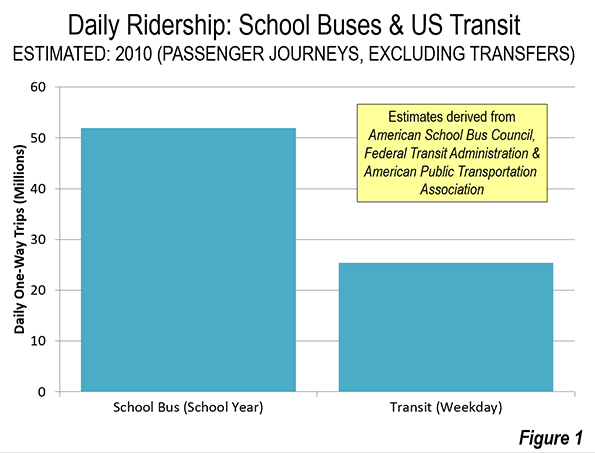
    According to the American School Bus Council (ASBC), school buses transported an average of 26 million elementary and secondary students daily in 2010 (see the ASBC summary of environmental benefits). This is 52 million one way trips. Approximately 55 percent of the nation’s enrollment travels to and from school on school buses.

    By comparison, our analysis of Federal Transit Administration data for 2010 indicates that all transit services (subway, commuter rail, light rail, bus, paratransit, etc.) carried approximately 25 million one-way trips on the average weekday in 2010 (adjusted to eliminate transfers between vehicles on the same passenger trip, using an American Public Transportation Association estimate). On school days, it turns out that school buses carry more than twice as many passengers as transit passengers (Figure 1).

    ASBC estimates the average one-way school bus trip at five miles. This means that every day, pupils travel approximately 260 million miles. The school bus advantage over transit is somewhat less in passenger miles than passengers, because transit trips are longer. School bus passengers travel approximately 50 percent more miles than transit weekday passengers travel (approximately 170 million miles).

    The annual differences in school bus and transit use are much less. This is because school bus service is provided only an average of 180 days annually, approximately one-half the 365 days that transit service operates. Based on the American School Bus Council estimate, the annual number of one-way school bus trips by students is estimated at 9.4 billion in 2010. By comparison, annual transit passenger journeys (excluding transfers) were an estimated at under eight billion in 2010.

    Transit, however, carries passengers farther than school buses each year. With its 365 day per year operation, transit carried 52 billion transit passenger miles in 2010, approximately 10 percent more than the 47 billion passenger miles traveled on school buses.

    School Bus Data

    Without a centralized digital data collection system, there is no readily available school bus data below the state level. Thus, unlike transit (with its National Transit Database), development of school bus information on a metropolitan area level would be time consuming and expensive and is not regularly done. Industry publications, such as School Bus Fleet and School Transportation Newsprovide detailed information but only at the state level.

    State and Local School Bus Ridership

    School bus services are provided nearly everywhere in the United States, in both urban and rural areas. Most school bus service is provided by local school authorities (school districts). According to NAPT, about two-thirds of the service is provided directly by school transportation departments, while the other one-third is provided by private contractors ("outsourced").

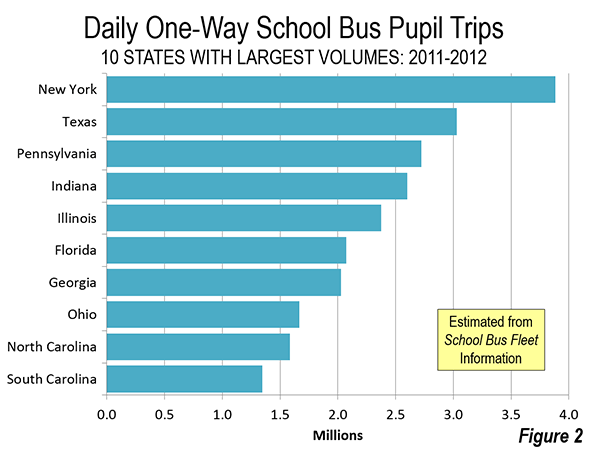
    Based on information in School Bus Fleet, all the top 10 states have school bus ridership of more than 1,000,000 one-way pupils every school day. New York has the highest ridership, at nearly 4,000,000. Texas has more than 3,000,000 daily riders, followed by Pennsylvania, Indiana, Illinois, Georgia and Florida, all with more than 2 million daily riders (Figure 2).

    The school districts with the highest pupil ridership are concentrated in the Northeast and South, which include nine of the 10 most patronized systems. The strong southern representation is largely due to the county level school districts, which are larger than the more local school districts typical in the rest of the nation.

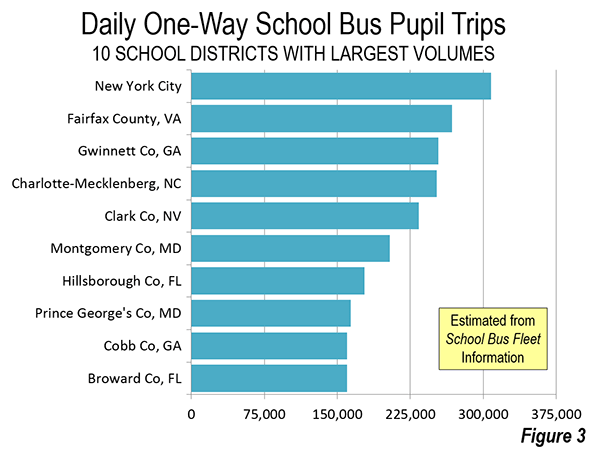
    Based on School Bus Fleet data, the New York City school district carries more passengers than any other, with nearly 310,000 daily trips. Fairfax County (Virginia), Gwinnett County (Georgia), Charlotte Mecklenburg (North Carolina), Clark County (Nevada) and Montgomery County (Maryland) also carry more than 200,000 daily passengers (Figure 3).

    The Largest Transit System

    With the national school bus fleet nearing 500,000 vehicles, the state of New York has the largest number, at nearly 45,000, according to School Bus Fleet. Texas ranks second with 40,000 school buses, while Illinois, California and Pennsylvania have between 20,000 and 30,000 buses. The combination of just a few states can exceed the national total of transit buses (60,000).

    On any given school day, school buses are the largest transit system in the nation.

    Wendell Cox is principal of Demographia, an international public policy and demographics firm. He is co-author of the "Demographia International Housing Affordability Survey" and author of "Demographia World Urban Areas" and "War on the Dream: How Anti-Sprawl Policy Threatens the Quality of Life." He was appointed to three terms on the Los Angeles County Transportation Commission, where he served with the leading city and county leadership as the only non-elected member. He was appointed to the Amtrak Reform Council to fill the unexpired term of Governor Christine Todd Whitman and has served as a visiting professor at the Conservatoire National des Arts et Metiers, a national university in Paris.

    Photo: School buses in suburban Atlanta (by author)

  • Raise the Gas Tax!

    Driving just got a lot cheaper in America. The timing is great not only for American consumers, but also for America’s infrastructure. The Highway Trust Fund simply can’t keep up current spending levels without more revenue. Significant declines in pump prices have presented an excellent opportunity to raise the federal gas tax, while keeping pump prices lower than initially anticipated. Though a gas tax hike may not be the ideal approach, it is infinitely preferable to bailing out the Trust Fund with general revenue, or to putting the brakes on much needed infrastructure spending. This is a rare opportunity to improve America’s infrastructure without putting an additional burden on American taxpayers. It would be a shame to miss it.

    No one enjoys paying taxes, though they are much easier to swallow when the revenue produces visible results. Since the gas tax is deposited into the Highway Trust Fund, it is somewhat like a user fee, albeit, an imperfect one. From the standpoint of fairness, it makes sense that drivers should pay for using the roads. Aside from fairness, the virtue of the ‘user pays’ principle is that it helps to ration roadway use. If movie theatres were paid for through tax revenue and tickets were free at the point of consumption, everyone would be stuck waiting in line. The same principle generally applies to roadways, although tolls have a more direct impact on traffic congestion than gas taxes. There is some legitimate debate over the optimal mix of revenue tools to fund roads, but if it comes down to raising the gas tax or using general government revenue, raising the gas tax is the obvious choice.

    Congress has allowed the Highway Trust Fund to gradually lurch towards insolvency. Expenditures have risen while gas tax rates haven’t. America’s aging infrastructure is in desperate need of repair, so holding out for the ideal solution no longer seems tenable. The Congressional Budget Office estimates that spending is poised to exceed revenue by $167 billion over the 2015-2024 period. The Trust Fund has already received $54 billion in transfers from the treasury since 2008.

    One of the proposed solutions to the shortfall is to restore the Highway Trust Fund’s original mandate: use gas taxes exclusively to pay for highways. In other words, get rid of what’s known as the Transit Account. That would go some way towards alleviating pressure on the Trust Fund, but it still wouldn’t bring the fund into balance. Regardless of whether or not the Trust Fund continues to pay for mass transit expansions, Congress will need to find more revenue.

    There has never been a better time to increase the gas tax. Consumers and firms have budgeted for much higher gas prices than they’re paying at the pumps. The bi-partisan proposal to increase the gas tax by 12 cents per gallon would leave gas prices below $3 per gallon, which is still a substantial overall decline. Indexing the gas tax to inflation would help to ensure that the Trust Fund doesn’t end up in this bind every few years.

    Given the state of the American economy, now is a particularly bad time to defer highway construction and maintenance. Public spending can’t be expected to fix all that ails it, but this is a good time to support the construction industry.

    While 30 cents per gallon might seem high, American drivers would still pay among the lowest gas taxes on earth, and less than Canadians pay. That America has managed thus far to maintain an enviable national highway system for a fraction of Canadian federal fuel taxes is a testament to the efficiency of the Highway Trust Fund model.

    Given the enormous windfall that drivers will receive from lower gas prices, clawing back some of it to ensure that American still have roads fit for driving is a reasonable proposition. Just because the federal government owns the national highway system doesn’t mean that it’s free. Someone has to pay to maintain the system. Drivers should be first in line to do so.

    Steve Lafleur is the Assistant Director of Research for the Frontier Centre for Public Policy– www.fcpp.org — a Canadian think tank based in Winnipeg, Manitoba.

    Flickr photo by Curtis Perry: Another perfect day for highway drivers in LA.

  • Sources for Our “Southern California Stuck in Drive” Story

    Joel Kotkin and I wrote in the Orange County Register that transit work trip market shares in the Los Angeles area had changed little, from 5.9 percent in 1980 to 5.8 percent in 2013. In a response, the Los Angeles Metropolitan Transportation Authority (LACTMTA) noted that we did not cite sources. Fair enough. Our source was the 1980 US Census and the 2013 American Community Survey, a product of the United States Census Bureau. This data shows Los Angeles to rank 10th in transit market share among the 52 major metropolitan areas (over 1,000,000 population), well below its population rank of 2nd.

    Then LACMTA goes on to note "the percentage of daily transit commuters in the Los Angeles region … has stayed steady over the last several decades." That is exactly our point — that transit is not growing as a percentage of travel in the Los Angeles metropolitan area. This, despite expenditures of $15 billion to build rail over the period in constant 2013 dollars (estimated from data on the Thoreau Institute website).

  • Evaluating Urban Rail

    For more than 40 years, US cities have rushed to build new rail systems (indeed I was part of such an effort, see Los Angeles: Rail for Others). This article examines the trend in transit and driving alone work trip market share in 23 cities (metropolitan areas) that have built new rail systems that have represented material expansions of regional transit systems. These new rail systems include Metros ("heavy rail"), light rail (not streetcars) and commuter rail (suburban rail). The capital costs of these systems have been at least $90 billion (2013$), based on Thoreau Institute website information.

    A Policy Perspective

    The perspective is that of a policy board member (which I was) and a belief that more transit (generally a good thing) is better than less. Thus, from the beginning of my career on the Los Angeles County Transportation Commission (LACTC), I was interested in obtaining the highest ridership possible within the constraints of available funding. As the LACTC considered building rail, a foremost objective was the hope for reduced traffic congestion, as we were assured by consultants that rail would attract drivers out of cars and reduce traffic congestion. To do this the rail system would need to reduce automobile travel.

    Methodology

    The work trip market shares of 2013 (from the American Community Survey) are compared to those of the US Census immediately preceding the opening of the rail system, except where otherwise noted. This latest data is compared to work trip market shares for the Censuses preceding rail system openings, using current (2013) metropolitan area boundaries. This method favors transit, since metropolitan areas have grown spatially, and the more recently added areas (counties) would have had lower transit market shares in earlier censuses. The method also favors transit because in a growing metropolitan area (which excludes only Buffalo among the 23 cities) merely retaining transit work trip market share will generally not reduce traffic congestion, because highway traffic volumes tend to rise with population.

    Transit Work Trip Market Shares

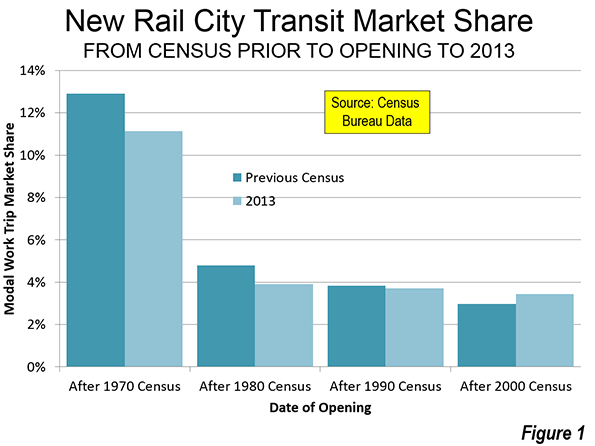
    Overall, the average transit work trip market share in the 23 cities declined from 5.0 percent to 4.6 percent from the Census year preceding opening to 2013 (Figure 1).

    • The cities with rail systems opening after the 2000 Census did by far the best. In 2000, these cities had an average transit work trip market share of 3.0 percent. By 2013, this had risen to an average of 3.4 percent. The cities in this category include Austin, Charlotte, Houston, Minneapolis-St. Paul, Nashville, Phoenix, and Seattle.
    • The cities with rail systems opening after the 1990 Census experienced a modest decline in transit work trip market share, from 3.8 percent in 1990 to 3.7 percent in 2013. The cities in this category include Baltimore, Denver, Dallas-Fort Worth, Los Angeles, Riverside-San Bernardino, Salt Lake City, and St. Louis.
    • The cities with rail systems opening after the 1980 census saw their transit work trip market shares decline more significantly, from 4.8 percent in 198to 3.9 percent in 2013. This category includes Buffalo, Miami, Portland, Sacramento, San Diego, and San Jose.
    • The largest average transit work trip market share losses occurred in the cities with new rail systems that opened following the 1970 census. These metropolitan areas experienced a decline from 12.9 percent in 1970 to 11.1 percent in 2013. The new rail systems in this category were San Francisco’s Bay Area Rapid Transit (BART), Washington’s Metrorail and Atlanta’s MARTA.

    Driving Alone Work Trip Market Shares

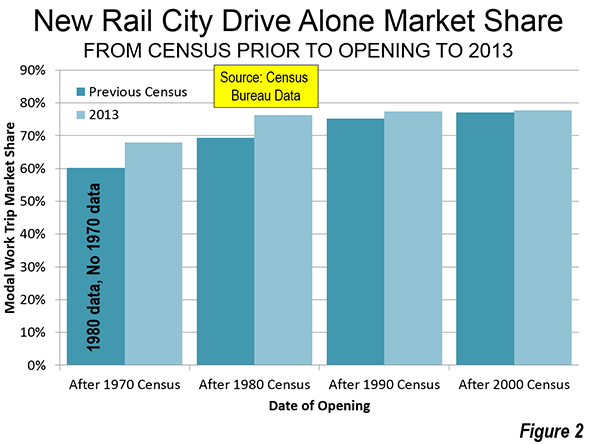
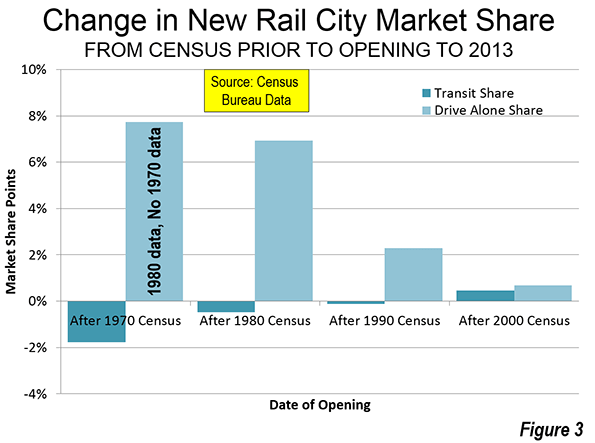
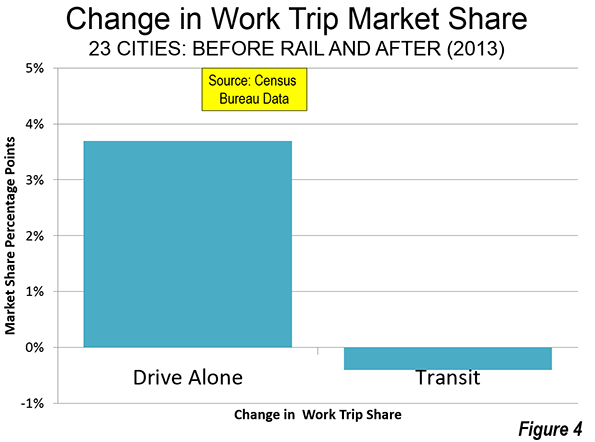
    Overall, the driving alone work trip market share rose from 72.3 percent to 76.0 percent (though complete data is not available for 1970), an increase of 3.7 percentage points (Figure 2). The driving alone work trip market share declined in only 4 of the 23 cities. In each of the decadal categories, the change in work trip market share was greater in driving alone than in transit (Figure 3).

    • The cities opening new rail systems after the 2000 census did the best in curbing the drive alone market share, but still experienced a loss. On average, the drive alone work trip market share increased the least in the cities, from 77.1 percent in 2000 to 77.7 percent in 2013, a rise of 0.6 percent.
    • The cities opening new rail systems after the 1990 census experienced an increase in the drive alone work trip market share from 75.2 percent in 1990 to 77.4 percent in 2013m for a loss of 2.2 percentage points.
    • The cities opening a new rail systems after the 1980 census experienced an increase in the drive alone work trip market share from 69.3 percent in 1980 76.3 percent in 2013, for a loss of 7.0 percentage points.
    • Comparable driving alone data was not obtained in the 1970 Census, which makes it impossible to directly compare the "before and after" Census work trip market share data for new rail systems opening during. However, each of the three new rail systems opened after the 1970 census added substantially to their ridership following the 1980 census (Note). Even so, the drive alone market share from 1980 was substantial, from 60.2 percent to 67.9 percent in 2013, an increase of 7.7 percentage points. The biggest drive alone gains were in Atlanta, which built MARTA and Washington, which built Metrorail. San Francisco, with its Bay Area Rapid Transit system (BART) experienced a smaller drive alone market share gain from 1980 to 2013 (Table).

    Transit & Drive Alone Work Trip Market Share: Before and After
    23 New Rail Cities
    City (Metropolitan Area) Last Census before Rail  Opening Last Census Transit Share 2013 Transit Work Trip Market Share Last Census Drive Alone Share 2013 Drive Alone Share
    Atlanta: Note 1970 7.3% 3.1% 68.3% 77.7%
    Austin 2000 2.5% 2.4% 76.5% 77.1%
    Baltimore 1990 7.7% 6.8% 70.9% 77.1%
    Buffalo 1980 6.6% 2.9% 66.6% 82.4%
    Charlotte 2000 1.2% 1.7% 80.9% 80.2%
    Denver 1990 4.3% 4.4% 75.4% 75.4%
    Dallas-Fort Worth 1990 2.3% 1.4% 78.6% 80.5%
    Houston 2000 3.2% 2.4% 77.0% 79.7%
    Los Angeles 1990 5.6% 5.8% 71.7% 74.1%
    Miami 1980 4.4% 4.1% 72.6% 77.8%
    Minneapolis-St. Paul 2000 4.2% 4.6% 78.3% 78.4%
    Nashville 2000 0.8% 1.0% 80.6% 82.8%
    Phoenix 2000 1.9% 2.6% 74.6% 76.5%
    Portland 1980 7.9% 6.4% 65.3% 70.7%
    Riverside-San Bernardino 1990 0.8% 1.5% 74.6% 76.8%
    Sacramento 1980 3.4% 2.6% 75.3% 75.1%
    San Diego 1980 3.3% 3.2% 63.8% 75.8%
    Seattle 2000 7.0% 9.3% 71.6% 69.7%
    San Francisco: Note 1970 15.9% 16.1% 57.9% 59.9%
    San Jose 1980 3.1% 4.2% 72.4% 75.9%
    Salt Lake City 1990 3.3% 3.2% 75.5% 75.0%
    St. Louis 1990 2.9% 2.9% 79.4% 83.2%
    Washington: Note 1970 15.5% 14.2% 54.2% 66.1%
    Average 5.0% 4.6% 72.3% 76.0%
    Derived from Census Bureau data
    Note: 1970 Census data not comparable for Drive Alone. 1980 data used  

    Transit Alone Metropolitan Area Gains and Losses

    Overall, the transit work trip market share declined in 13 of the 23 cities. Among the 10 cities with an increase, the change was less than one percentage point in all but two, Seattle and San Jose.

    The strongest transit market share gain was in Seattle, at 2.3 percentage points (from 7.0 percent to 9.3 percent). However, most of Seattle’s transit market share gain was related to bus and ferry service, which accounted 80 percent of the transit gain. San Jose had the second largest gain, at 1.1 percentage points (from 3.1 percent to 4.2 percent). Riverside-San Bernardino (0.8 percent to 1.5 percent) and Phoenix (1.9 percent to 2.6 percent) tied for third best transit market share increase, with 0.7 percentage point increases. Charlotte had the fifth strongest increase, rising 0.5 percentage points, from 1.2 percent to 1.7 percent.

    The largest transit market share loss was in Atlanta, which fell from 7.3 percent in 1970 to 3.1 percent in 2013, a loss of more than one-half. Buffalo suffered the second largest loss, from 6.6 percent to 2.9 percent, a decline of 3.7 percentage points. Highly touted Portland experienced the third greatest transit market share loss out of the 23 cities, falling from 7.9 percent to 6.4 percent, a 1.5 percentage point loss. Washington had the fourth largest decline, falling from a 15.5 percent transit work trip market share to 14.2 percent, a loss of 1.3 percentage points. In Washington, much of the Metrorail ridership was diverted from bus services and car pools.

    Baltimore (from 7.7 percent to 7.0 percent) and Dallas-Fort Worth (from 2.3 percent to 1.4 percent) tied for 5th largest decline, with a loss of 0.9 percentage points.

    Drive Alone Metropolitan Area Gains and Losses

    The largest drive alone gains were in Buffalo (15.3 percentage point gain from 1980) San Diego (12.0 percentage point gain from 1980), Washington (11.9 percentage point gain from 1980, due to the lack of 1970 data), Atlanta (9.4 percentage point gain  from 1980, due to the lack of 1970 data), and Baltimore (6.2 percentage point gain from 1990).

    The largest drive alone market share losses were in Seattle (1.9 percentage point loss), Charlotte (0.7 percentage point loss), Salt Lake City (0.5 percentage point loss), and Sacramento (0.2 percentage point loss) while Denver remained constant.

    New Rail Systems: Successful Simply in Being Built

    The overall transit work trip market shares in the 23 cities declined 0.4 percentage points. By comparison, in the same cities, driving alone increased by an average of 3.7 percentage points (Figure 4). These results are considerably more modest than the claims made by rail proponents. It is fair to say that the new rail systems have not changed how people travel in cities, despite costing at least $90 billion.

    It might be expected that this laggard performance would dampen the ardor for rail. Yet, many public officials and civic boosters consider virtually any system that opens a success. Tom Rubin, former Chief Financial Officer of the Southern California Rapid Transit District (a predecessor to the Los Angeles County Metropolitan Transportation Authority) wryly suggests that for many political interests, the success of urban rail is demonstrated by its getting built.

    Despite the unfortunate politics of transit, success requires carrying more passengers, as many as the available funding will permit. The test of urban rail is not how many people are on the trains, but how many drivers leave their cars at home to ride it.

    Note: BART’s ridership has more than tripled since 1980, while Washington Metrorail’s ridership is up approximately 40 percent. MARTA’s ridership has increased substantially since 1980, with the first line having opened only in mid 1979.

    This commentary is adapted from a presentation in November at an international transit conference in Shanghai.

    Wendell Cox is principal of Demographia, an international public policy and demographics firm. He is co-author of the “Demographia International Housing Affordability Survey” and author of “Demographia World Urban Areas” and “War on the Dream: How Anti-Sprawl Policy Threatens the Quality of Life.” He was appointed to three terms on the Los Angeles County Transportation Commission, where he served with the leading city and county leadership as the only non-elected member. He was appointed to the Amtrak Reform Council to fill the unexpired term of Governor Christine Todd Whitman and has served as a visiting professor at the Conservatoire National des Arts et Metiers, a national university in Paris.

    Photo: Atlanta MARTA train by RTABus (Own work) [CC-BY-SA-3.0], via Wikimedia Commons

  • Southern California Stuck in Drive

    Southern California has long been a nurturer of dreams that, while widely anticipated, often are never quite achieved. One particularly strong fantasy involves Los Angeles abandoning what one enthusiast calls its “car habit” and converting into an ever-denser, transit-oriented region.

    An analysis of transit ridership, however, shows that the region is essentially no better off than when the the modern period of transit funding began in 1980, with the passage of Proposition A, which authorized a half-cent sales tax for transit. In 1980, approximately 5.9 percent of workers in the metropolitan area (Los Angeles and Orange counties) used transit for their commute. The latest data, for 2013, indicates the ridership figure has fallen to 5.8 percent.

    Never ones to let facts get in the way of fantasy, some retrourbanists and media types continue to insist our mass-transit transition is well on its way. Liberal blogger Matt Yglesias, writing in Slate, declared that Los Angeles is destined to become America’s “next great transit city.”

    This view is echoed throughout retrourbanist circles. “The City of Angels is noticeably transforming. Our once car-centric town is becoming less car-dependent,” suggests the local LA Streetsblog, “Public transit is having a comeback. Pedestrian and bicycle infrastructures are improving.”

    Instead of rushing to rail, Angelenos continue to rely on their cars to get to work. From 1980-2013, the market share of drive-alone commuters has risen from 70 percent to 74.1 percent. There has been an increase in driving alone of approximately 1.4 million daily commuters. Driving alone accounted for d approximately 85 percent of the region’s increase in commuters.

    Why do people stick to their cars? For one thing, transit takes longer. The average drive-alone, one-way commute in Los Angeles was 27.0 minutes in 2013, compared with an average commute of 48.7 minutes for transit.

    The other big factor is accessibility to jobs. The University of Minnesota Accessibility Observatory produced an estimate for the percentage of jobs that the average L.A. resident could reach within 30 minutes by car. In Los Angeles, the average resident can reach 60 times as many jobs in that time by car as by transit.

    Transit needs downtowns

    Transit plays an important role in America, but mostly in the urban cores of a handful of “legacy” cities. These core metros (excluding their often-sprawling, low-density suburbs) – New York City, Boston, Chicago, Philadelphia, Washington and San Francisco – account for 55 percent of all transit-work trip destinations, just 6 percent of the country’s employment. Overall, the legacy cities’ transit ridership is nearly 10 times their proportionate combined share of jobs.

    To a large extent, this reflects history and urban form. Transit remains largely a matter of downtowns. The cities with transit legacies have an average of 15 percent of their jobs downtown, three times the average for other major metropolitan areas. In contrast, Downtown Los Angeles has 2 percent of the metropolitan area’s jobs. In Orange County, Riverside and San Bernardino counties, homes to much of the regional population, there are really no substantial downtown areas.

    In contrast, the many regions sharing L.A.’s multipolar form and large-scale transit investments – Atlanta, Dallas-Fort Worth, Denver, Minneapolis-St. Paul and Portland, Ore., – have seen their transit market shares stagnate or decline, despite having built expensive rail systems.

    One problem is, like virtually all U.S. metropolitan areas (including the suburbs of legacy cities), the Los Angeles area, which pioneered the multi-polar metropolis, has been becoming more so and is even moving beyond polycentricity. The vast majority of growth in the statistical area encompassing Los Angeles, Orange, Riverside, San Bernardino and Ventura counties has taken place in precisely those areas – the Inland Empire, South Orange County or the Santa Clarita and Antelope valleys in northern Los Angeles County – that also have the lowest transit ridership. In contrast, the core’s growth barely represents a blip. From 2000-10, the functional urban core, which has the strongest concentration of transit destinations, accounted for virtually none of the region’s growth.

    Dreaming of New York?

    For many L.A. planners and urban boosters, more transit – funded from Washington – often seems to constitute an exercise of social engineering on a grand scale. The hope is that, by pushing transit, particularly rail, we will recreate the metropolis with ever-greater density. “We are going to remake what the city looks like,” then-Mayor Antonio Villaraigosa told an approving New York Times two years ago.

    Despite the hoopla and the subsidization of downtown Los Angeles, however, relatively few people work in, or even visit Downtown, ecept for sporting or cultural events, although many pass by it on the freeways.

    For most Angelenos, Downtown is simply not part of their day-to-day experience the way, for example, Manhattan is for many New Yorkers, or the Loop is for many residents of the Chicago region.

    Transit Class Warfare

    Developers and their planning allies tend to focus on transit as something that will get middle-class Angelenos out of their cars. But it’s difficult to see this working as long as such an overwhelming majority of jobs (98 percent) are located outside Downtown. Since 1980, driving alone, which was increasing its market share, added 15 times as many new commuters as transit, with its slipping market share.

    At the same time, there seems to be a profound unawareness of the low incomes of Los Angeles transit commuters. The latest American Community Survey data (2013) indicates that the median earnings of transit commuters at the national level is more than 85 percent higher than in Los Angeles. In the metropolitan areas around transit legacy cities, the median incomes of transit commuters is 150 percent higher than in Los Angeles.

    To some extent, poorer Angelenos, in the government’s expensive shift from buses to trains, are being sacrificed to satisfy the Utopian vision of planners, pad the profits of big urban developers, and to build the campaign war chests of the political class. Indeed, from 2008-12, the bus lines, which carry more than three times as many passengers as trains, were cut 16 percent If L.A. is experiencing a transit revolution, its most dependent riders have been largely left behind.

    So What Should Greater LA do?

    As anyone who drives the freeways knows well, L.A. has a traffic problem. But Los Angeles also has the shortest average commute time of any high-income world megacity for which data is available, despite having the highest automobile usage, the least transit and, except for New York, the lowest urban density.

    The real question is, will more transit, at least in its current form, offer the solution? Certainly, expanding and improving roads – although politically incorrect – has helped make commuting easier for many working in Orange County. Other ways to entice people off the roads, such as telecommuting, should be encouraged. Since 1980, the number of Los Angeles residents working at home has increased by approximately 240,000. This increase – 2.5 times that of transit in total numbers – has come at virtually no cost to taxpayers.

    To be sure, many Angelenos, for one reason or another, need decent transit services. Our approach would be for government to find out who these people are, and look for ways to make transit work better for them. Rather than invest huge dollars in rail megaprojects, perhaps we could reduce bus fares, a strategy attributed to the legendary Los Angeles County Supervisor Kenneth Hahn that increased bus ridership dramatically from 1982-85.

    Unlike today’s “progressives,” Hahn’s prime interest was serving his largely working-class and poor constituents. Besides cutting bus fares and increasingly service, other solutions, such as more competitively contracted service provided by regional agencies, such as Foothill Transit and the Antelope Valley Transit Authority, could provide less-expensive, more efficient and expanded service.

    Los Angeles Mayor Eric Garcetti, has also expressed interest in promoting the use of rideshare services, like Uber or Lyft, and, more importantly, self-driving cars.

    Ultimately, rather than try to recreate New York, or undertake the expensive and virtually impossible task of rebuilding Los Angeles in the image of the latest urban planning fad, we should explore a host of innovative solutions that will help transit riders here and now by developing workable, and effective, ways to help them get to the services and jobs they need.

    This piece first appeared at the Orange County Register.

    Joel Kotkin is executive editor of NewGeography.com and Roger Hobbs Distinguished Fellow in Urban Studies at Chapman University, and a member of the editorial board of the Orange County Register. His newest book, The New Class Conflict is now available at Amazon and Telos Press. He is author of The City: A Global History and The Next Hundred Million: America in 2050. His most recent study, The Rise of Postfamilialism, has been widely discussed and distributed internationally. He lives in Los Angeles, CA.

    Wendell Cox is principal of Demographia, an international public policy and demographics firm. He is co-author of the “Demographia International Housing Affordability Survey” and author of “Demographia World Urban Areas” and “War on the Dream: How Anti-Sprawl Policy Threatens the Quality of Life.” He was appointed to three terms on the Los Angeles County Transportation Commission, where he served with the leading city and county leadership as the only non-elected member. He was appointed to the Amtrak Reform Council to fill the unexpired term of Governor Christine Todd Whitman and has served as a visiting professor at the Conservatoire National des Arts et Metiers, a national university in Paris.

    Photo: Downtown Los Angeles toward the Hollywood Hills and the San Fernando Valley (by Wendell Cox)