Tag: Transportation

  • London Mayor: High Speed Rail Cost £70 Billion Plus?

    In a Daily Telegraph commentary, London Mayor Boris Johnson expects the proposed high-speed rail line from London to Birmingham (HS2) to cost £70 billion (approximately $105 billion). This is two thirds more than the most recent estimate of £42 billion (approximately $63 billion), which includes a recent increase in costs from £32 billion (approximately $48 billion) for the 140 mile long first segment. Johnson wrote:

    “This thing isn’t going to cost £42 billion, my friends. The real cost is going to be way north of that (keep going till you reach £70 billion, and then keep going). 

    He concludes:

    “So there is one really critical question, and that is why on earth do these schemes cost so much?”

    A possible answer comes from Oxford University, 60 miles from London. Oxford professor Bent Flyvbjerg, along with Nils Bruzelius (a Swedish transport consultant) and Werner Rottenberg (University of Karlsruhe and former president of the World Conference on Transport Research) reviewed 80 years of infrastructure projects found and low-balling of cost estimates routine (Megaprojects and Risk: An Anatomy of Ambition). They characterize the process as "strategic misrepresentation," which they shorten to "lying," in unusually frank language.

    It is not just the apparent dishonesty of the process — it is that unreasonably low cost estimates entice governments into approving projects that have been marketed on false pretences. Once committed to such a project, public officials, find it nearly impossible to “jump off the train,” as it were. The loss of face could well be followed by a loss at the next election. Flyvbjerg, et al characterize “strategic misrepresentation” as “lying.”

    There could be other difficulties. The government claims that trains will peak at 225 miles per hour (360 kilometers per hour), considerably higher than the 199 mile per hour (320 kilometer per hour) maximum speed. High speed rail in China, Spain, France and Korea also promised faster operation, but not delivered. Safety may be a reason, as suggested in a Wall Street Journal article:

    “An executive at a non-Chinese high-speed train manufacturer said running trains above speeds of 330 kilometers an hour poses safety concerns and higher costs. At that speed threshold, wheels slip so much that you need bigger motors and significantly more electricity to operate. There is also so much wear on the tracks that costs for daily inspections, maintenance and repairs go up sharply. That’s why in Europe, Japan and Korea no operators run trains above 320 kilometers an hour, the executive said…”

    HS2 seems to be on track to follow California in its unprecedented high speed rail cost escalation. The last cost estimate for the 400 mile plus high-speed line from Los Angeles to San Francisco was three times the cost (inflation adjusted) projected in 1999 (midpoint, see the Reason Foundation’s California High Speed Rail: An Updated Due Diligence Report, by Joseph Vranich and Wendell Cox). Public outcry over the escalating costs forced approval of an alternative “blended” system that would use conventional tracks and non-high speed rail speeds at the northern and southern ends. Even so, the scaled back version is estimated to cost $60 billion, inflation adjusted (£40 billion), 150 percent more than the 1999 projection for a genuine high speed rail line.

    Mayor Johnson may be optimistic in his £70 billion prediction. Procurement expert Stephen Ashcroft, of Brian Farringdon, Ltd. says: “We confidently predict that the final project outturn actual cost will exceed £80 billion” (emphasis in original). There is, of course risk in such projections. Joseph Vranich and I found that out when our maximum cost escalation prediction in The California High Speed Rail Project: A Due Diligence Report, (2008) turned out to be way low. It was exceeded by more than one-half and in just four years.

    Also see: The High Speed Rail Battle of Britain

  • A Million New Housing Units: The Limits of Good Intentions

    In May 2013, the district of Husby in suburban Stockholm, Sweden was shaken by “angry young men” engaging in destructive behavior for about 72 hours,1 including the burning of automobiles and other properties and attacks on police officers (over 30 officers were injured). The violence spread to the nearby districts of Rinkeby and Tensta as well as to other parts of Sweden.

    Husby, Rinkeby, and Tensta are located within the corporate limits of Sweden’s capital city,2 but a considerable distance from the waterfront and medieval beauty of downtown Stockholm frequented by visitors and tourists. All three communities were planned in the 1960s and completed in the mid-1970s as part of the Swedish Million Programme.  According to official Stockholm municipal statistics, resident populations in 2012 were 12,203, 15,968, and 18,494 respectively.3

    This ambitious program was approved by Sweden’s Parliament in 1965 to remedy what was then considered an acute shortage of housing. Its goal was to rapidly produce a large number of affordable housing units for the Swedish middle class while preserving nearby open space, improving traffic safety and encouraging residents to walk, ride bicycles and use transit. Planners and architects felt that in order to achieve the desired suburban “new town” environment, development and densities were to be as concentrated as possible, and all units were to be within 500 meters of the transit station.4

    The first new homes in Tensta were delivered to their initial residents in 1967, only two years after the program was approved, but the subway line, so important to the design and development of these communities, was not to be opened to traffic until 1975.

    By the 1970s, the Swedish economy had slowed considerably from its 1960s boom, and as the economy cooled, some areas outside of Stockholm where new Million Programme communities had been built suddenly had a surplus of housing. In Stockholm, production of the Million Programme units continued well into the 1970s until all planned units were completed, even though the population of Stockholm was to decline from 787,182 in 1965 to a modern low of 647,115 in 1981.

    Yet in the end, most of the residents who ended up in these units were neither middle class or of Swedish descent. In part because the Million Programme had eliminated Sweden’s shortage of housing and many of its communities were considered unsightly and undesirable by Swedes, the newly constructed units became places where waves of new immigrants to the country found a place to live. Over time these communities have become suburban ghettos for newly-arrived families and individuals, with persons of an “immigrant background” (either immigrants or the child of immigrants making up between 85% and 90% of resident population in these districts according to official statistics for 2012).  

    These areas soon became isolated from the mainstream of Swedish society. The new communities were designed to make open space accessible to their residents (ordinarily a desirable goal), but this by design disconnected from nearby older (and lower-density) subdivisions. Planners and architects for the Million Programme apparently never anticipated that their creations would become segregated to such an extent that a member of Parliament and government minister would call for some of them to be razed. Sweden’s Minister of Integration, Nyamko Sabuni, did just that in a 2009 op-ed column, when she charged that they led to “exclusion” of their residents and since many of them are badly in need of thorough renovation, some should be torn down instead.5 Indeed some Million Programme complexes outside of Stockholm have met their demise with the use of a wrecking ball.6

    Swedish planners and elected officials did learn from these mistakes. The new high-tech employment center of Kista, located adjacent to Husby, has a base of employment that never developed in the Million Programme districts, and a significantly lower percentage of immigrants (though still higher than 50%). 

    Planners and elected officials in other nations (including North America) should take notice of the Million Programme – and more-recent Smart Growth proposals – as an example of what can go badly wrong.

    The aftermath of Million Programme demonstrates the inability of elected officials and the planners and architects on their staffs to anticipate the future needs and even the demographic makeup of their constituent populations, even in a democratic nation such as Sweden. Though it was approved with wide agreement by the Parliament in 1965, it is unlikely that members of that body anticipated that Swedish middle-class families would reject the densely-developed large-scale apartment developments that the effort produced, nor that much of the wave of immigration that was to arrive on Swedish shores starting in the late 1960s and continuing for many years would end up seemingly confined and segregated in the newly-constructed communities. The problems resulting from the cheap construction methods used and a resulting need for extensive and expensive renovations in order to bring the units up to contemporary standards will require large amounts of money. The source of that funding to make those repairs has not been identified.

    Finally, the role of rail transit in these projects deserves a mention. The construction of the Stockholm subway’s Blue Line (a radial line linking all three communities with downtown Stockholm) was significantly delayed, and did not open for traffic until 1975, well after most of the new homes were occupied, even though a transit station was always intended as an integral part of each of them (prior to 1975, residents had to take buses to get downtown, or get themselves to regional rail stations some distance away).  While the subway system in general (and the Blue Line in particular) are rightly called the “world’s longest art exhibit” because of the extraordinary and diverse beauty of its underground stations, it has not prevented the isolation and economic disadvantage that the minorities living along the line have always experienced. 

    C. P. Zilliacus is a transportation engineer residing in the eastern United States.

    Translations from Swedish by the author.

    Tensta housing photo by Wikimedia Commons user Holger.Ellgaard.

    ——————–

    1           Dagens Nyheter, 2013-05-22, ”Det har blivit värre I Husby de senaste åren” (translates to “It Has Gotten Worse in Husby in Recent Years”)  http://www.dn.se/sthlm/det-har-blivit-varre-i-husby-de-senaste-aren/
    Dagens Nyheter (“The Daily News”) is the largest daily newspaper in Sweden.

    2           Like some U.S. cities, including Houston and Los Angeles, Stockholm annexed significant areas of mostly vacant land during the 20th Century that are now generally considered suburban due to distance from downtown and land use characteristics. 

    3           Municipal statistics for Stockholm obtained online from http://www.statistikomstockholm.se.

    4           A Swedish-language overview of the Million Programme was written by Michael Lindqvist, 2000-05-15 “Miljonprogrammet – planeringen och uppförandet” (“Million Programme – Planning and Construction”), available online http://www.micral.se/miljonprogrammet/Miljonprogrammet.pdf

    5           Dagens Nyheter, 2009-03-20, "Riv i miljonprogrammen för integrationens skull" (translates to "Tear Down the Million Programme Units for the Sake of Integration") http://www.dn.se/debatt/riv-i-miljonprogrammen-for-integrationens-skull/

    6           For an example, see Jan Jörnmark’s photo essay of abandoned Million Programme apartment buildings in the municipality of Laxå, located about 240 kilometers (150 miles) by highway west of Husby: http://www.jornmark.se/places_photo.aspx?placeid=29&Photonumber=001&lang=

  • The Transit-Density Disconnect

    Around the world planners are seeking to increase urban densities, at least in part because of the belief that this will materially reduce automobile use and encourage people to give up their cars and switch to transit, or walk or cycle (Note 1). Yet research indicates only a marginal connection between higher densities and reduced car use. Never mind that the imperative for trying to force people out of their cars has rendered largely unnecessary by fuel economy improvements projected to radically reduce greenhouse gas emissions from cars (see Obama Fuel Economy Rules Trump Smart Growth).

    Transit Use and Density: A Tenuous Connection at Best

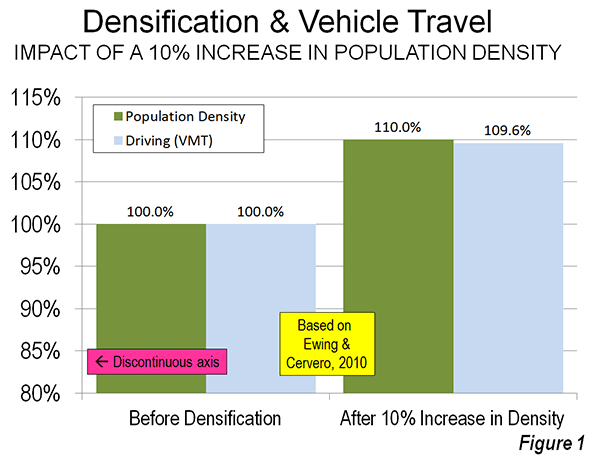
    In a widely cited study, Reid Ewing of the University of Utah, and UC Berkeley’s Robert Cervero reported only a minimal relationship between higher density and less driving per capita. In a meta-analysis of nine studies that examined the relationship between higher density and per household or per capita car travel, they found that for each 1 percent higher density, there is only 0.04 percent less vehicle travel per household (or per capita). This would mean that a 10 percent higher density should be associated with a reduction of 0.4 percent in per capita or household driving.

    More people in the same area driving a little less means overall driving is greater, as Peter Gordon reminds us. This is illustrated by the Ewing-Cervero finding — a 10 percent increase in population density is associated with  9.6 percent increase in overall driving, as is indicated in Figure 1 (the calculation is shown in the table). Ewing and Cervero placed this appropriate caution in their research: "we find population and job densities to be only weakly associated with travel behavior once these other variables are controlled."

    There is another limitation to the density-transit research. The comparison of travel behaviors between areas of differing density   provides no evidence that conversion of an area from lower to higher density would replicate the travel behavior of already existing (historic) areas of higher density.

    Transit is about Downtown, Not Density

    Ewing and Cervero also found that proximity to the central business district (downtown) is far more likely to reduce vehicle travel than higher densities. This mirrors the findings of others. The Ewing-Cervero conclusion is that, all things being equal, there is a 0.22 percent reduction in travel per capita for each one percent reduction in the distance to downtown.
    Table
    Density and Driving Example
      Base Density 1% Higher Density 10% Higher Density
    Households 100 101 110
       Change from Base Density 1.0% 10.0%
    Daily Driving per Household (Miles) 10 9.996 9.960
       Change from Base Density -0.04% -0.40%
    Total Daily Driving (Miles)        1,000       1,009.6           1,095.6
       Change from Base Density 0.96% 9.56%
    Based on Ewing & Cervero (2010)


    Transit commuting is strongly concentrated toward the largest downtown areas, which is the only place automobile-competitive mobility can be provided from large parts of the modern metropolitan area (whether in North America, Western Europe or Australasia).

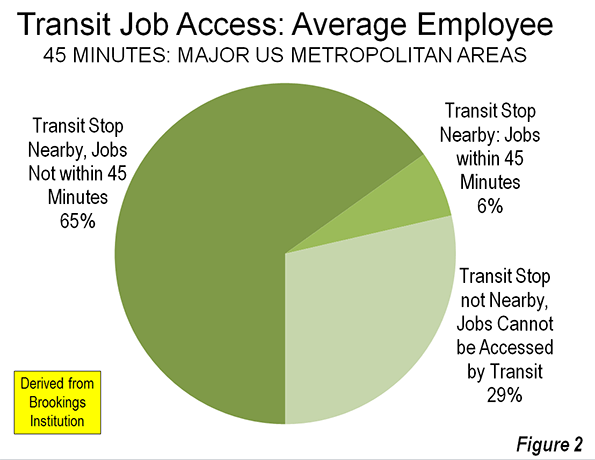
    This is, at least in part, why transit service provides such minimal employment access throughout major US metropolitan areas. Data from the Brookings Institution indicates that among the 51 metropolitan areas with more than 1,000,000 population, the average worker can reach only six percent of jobs in 45 minutes (see: Transit: The 4 Percent Solution). Nearly two-thirds of the jobs cannot be reached in 45 minutes, despite transit’s being nearby, while slightly less than one third of workers are not nearby transit at all (Figure 2). By comparison, the average driver reaches work in approximately 25 minutes.

    Of course, not everyone can (or would want to) live near downtown. Hong Kong comes closest to this urban containment ideal, with the highest population density of any major urban area in the high income world (67,600 per square mile or 26,100 per square kilometer).Yet despite these extraordinary densities,   one-way work trip travel times average 46 minutes, 20 minutes longer than in lower density, similar sized Dallas-Fort Worth.  
    High Density Commuting in the United States

    The centrality of downtown to transit ridership was a principal point of my “transit legacy city” research, which found that 55 percent of all transit commuting in the United States was to just six municipalities (not metropolitan areas). These include the municipalities of New York, Chicago, Philadelphia, San Francisco, Boston and Washington. Among the 55 percent of transit commuters in the nation who work in these six municipalities, 60 percent work in the downtown areas, which are the largest and most concentrated in the nation. This, combined with nearby high density neighborhoods, makes for transit Nirvana.

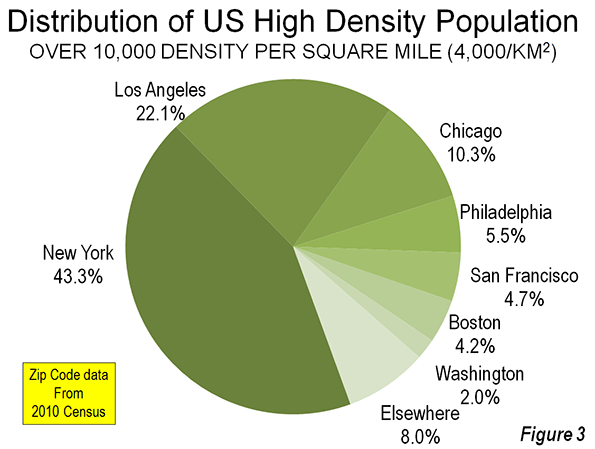
    The highest population densities are concentrated in just a few metropolitan areas (Note 2). Approximately 43 percent of the nation’s population living at or above 10,000 per square mile density (approximately 4000 per square kilometer) lives in the New York metropolitan area. Despite its low density reputation, Los Angeles has the second largest concentration of densities above 10,000 per square mile, at 22 percent. Chicago’s high density zip codes contain a much smaller 10 percent of the national high density population (Note 3), while nearly all of the balance is in Boston, San Francisco, Philadelphia, and Washington (Figure 3).
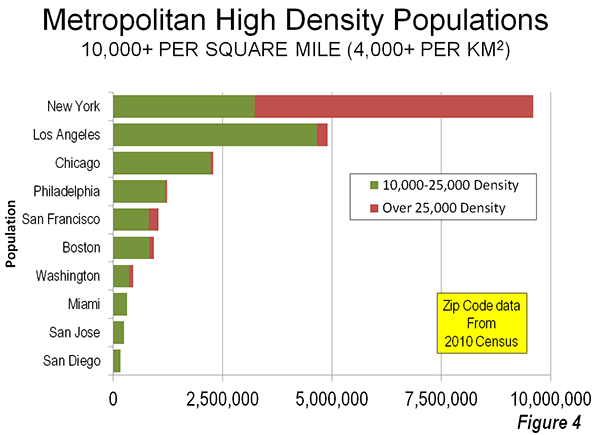
    The greatest concentration of the highest densities is in New York, which has 88 percent of the national population living at more than 25,000 per square mile (approximately 10,000 per square kilometer). Los Angeles ranked second at 3.5 percent and San Francisco ranks third at 3.2 percent (Figure 4). At this very high population density, nearly 60 percent of New York resident workers use transit to get to work. No one, however, rationally believes that densities approximating anything 25,000 per square mile or above will occur, no matter how radical urban plans become.
    An examination of transit work trip market shares in the density range of 10,000 per square mile to 25,000 per square mile illustrates the importance of proximity to downtown. There are nine metropolitan areas in the United States that have more than 200,000 residents living in zip codes with this density. These include the metropolitan areas with the six transit legacy cities, as well as Los Angeles, Miami and San Jose. These latter three experienced from two-thirds to 90 percent of their urban growth since World War II.

    San Jose’s large high density population is surprising, because it has a post-War suburban core city and, as a result, a comparatively weak downtown area. Moreover, San Jose has nearly 20 times as many people living at high densities as larger Portland, despite its more than three decades of densification policy (Note 4).

    Transit market shares are by far the highest in the high density zip codes of the metropolitan areas with the six transit legacy cities, at 30 percent. This ranges from 27 percent in Chicago to 33 percent in New York and Washington. At first glance, this would be evidence of a fairly consistent transit market share for high densities among the six metropolitan areas (Note 5).

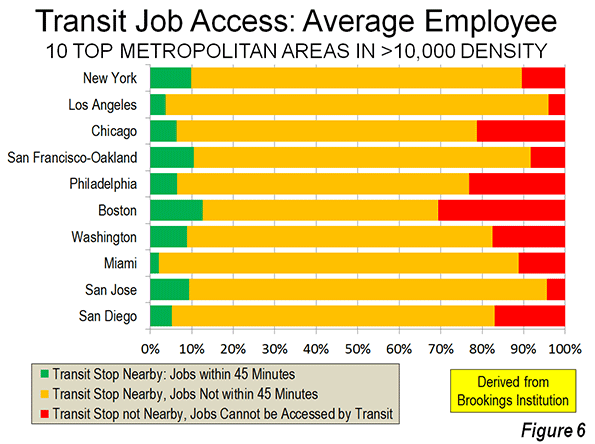
    However, metropolitan areas containing the transit legacy cities are unique. Their high density areas are located near their large downtown areas (which are the largest and most concentrated employment centers in the nation), as is to be expected from urban forms that date from the 19th and early 20th centuries. The more recent urban forms of the metropolitan areas rounding out the top ten in high density residents, Los Angeles, Miami, San Jose and San Diego, are very different. Not only do they have smaller downtowns but their high density areas are not concentrated to the same degree around downtown. As a result, their high density transit work trip market shares are much lower (Figure 5).
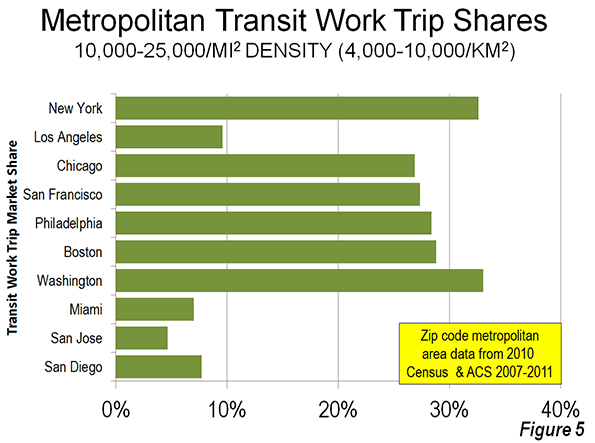
    This is best illustrated by Los Angeles, the metropolitan area with the largest number of people living at 10,000 to 25,000 residents per square mile in the nation. The transit work trip market share of these high density zip code residents is 9.6 percent, one-third that of similarly high densities in the metropolitan areas with transit legacy cities.

    In Miami, the transit work trip market share of high density residents is only 7.0 percent. In San Jose, the transit work trip market share for high density residents is only 4.6 percent, less than one-sixth that of the metropolitan areas with legacy cities. San Jose’s high density transit work trip market share is even below the national average for all densities (5.0 percent).  San Diego’s high density transit work trip market share is 7.7 percent.

    “A Negligible Impact”

    The transit-density disconnect may have been best summarized by Paul Shimik in 2007 research published in the Transportation Research Record: "The effect of density is so small that even a relatively large-scale shift to urban densities would have a negligible impact on total vehicle travel."
    Wendell Cox is a Visiting Professor, Conservatoire National des Arts et Metiers, Paris and the author of “War on the Dream: How Anti-Sprawl Policy Threatens the Quality of Life.

    —–

    Note 1: This article is limited to the potential for transferring automobile demand from cars to transit. Walking and cycling have only marginal potential for reducing vehicle travel, because these modes cannot provide access throughout today’s large metropolitan (labor) markets.

    Note 2: This analysis uses zip code level data from the 2010 Census and the American Community Survey for 2007-2011.

    Note 3: Los Angeles also has the second highest share of its population living at densities of 10,000 per square mile and above, at 38 percent. New York has 49 percent at this density, while in Chicago and San Francisco, 24 percent of residents live at these high densities.

    Note 4: Portland ranked 25th in high density (at or above 10,000 per square mile) out of the 51 metropolitan areas with more than 1,000,000 population in 2010. Portland’s high density share of its metropolitan population, at 0.7 percent, is well below that of the nation’s most market oriented development metropolitan area, Houston, at 2.0 percent and slightly below that of Dallas-Fort Worth.

    Note 5: Despite their much higher transit work trip market shares in high density areas, the jobs in suburban areas in the metropolitan areas with legacy cities can be as inaccessible by transit as in the metropolitan areas with post-War core municipalities. See Figure 6.

    Photo: San Diego (by author)
  • A Lasting Solution to the Transportation Funding Dilemma

    President Obama’s FY 2014 budget request includes $77 billion for the Department of Transportation and an additional $50 billion  "for immediate transportation investments." His next transportation bill to follow the current MAP-21, calls for a 25 percent increase in funding over current levels and assumes a transfer of $214 billion to the trust fund over six years "to maintain trust fund solvency and pay for increased outlays." To offset this spending, the Administration proposes using the "savings" or "peace dividend" from winding down the war in Afganistan. 

    House T&I Committee Chairman Bill Shuster (R-PA) was not impressed.  "The President’s budget," he said,  "repeats his call to increase spending without identifying a viable means to pay for it. …. You can’t just keep on spending money that you don’t have."  "A proposal we have seen three times before," observed Rep. Tom Latham (R-IA), House Transportation Appropriation Subcommittee chairman referring to the $50 billion request. With massive stimulus spending politically out of fashion, the Administration is repackaging it as "transportation investment." Bill Graves, president of the American Trucking Association, spoke for many stakeholders when he remarked, "For five years, we’ve waited for President Obama to clearly state how we should pay for these critical needs and, I’m sad to say, we continue to get lip service about the importance of roads and bridges with no real road map to real funding solutions." As for the "peace dividend," the idea has been dismissed as "budgetary gimmickry"  by congressional Democrats and  Republicans alike.

    In sum, a large segment of congressional and public opinion has pronounced the White House proposals variously as "vague", "repetitive," "unrealistic," "implausible" and "politically unachievable." Even the President’s most loyal supporters in the transportation community, the liberal advocacy groups, seemed disappointed and circumspect in their comments.  

    This said, no one disputes President Obama’s and the infrastructure advocates’ claim that some of America’s transportation facilities are reaching the limit of their useful life and need reconstruction. Nor does any one disagree about the need to expand infrastructure to meet the needs of a growing population. But fiscal conservatives among infrastructure advocates (and we count ourselves among them) contend that this does not rise to the level of a national crisis requiring a massive $50 billion federal crash program as proposed in the President’s budget message, or the expenditure of more than $100 billion per year as recommended by the American Society of Civil Engineers (ASCE) in its latest "Report Card."

    Instead, as we have argued in recent columns, the challenge can be met if each state did its part to progressively bring up its transportation facilities (including its Interstate highway segments) to a "state of good repair," using its own tax revenues and its formula allocation of the Highway Trust fund dollars (which are expected to total $38-41 billion per year over the next decade.)  As numerous news dispatches attest, that’s precisely what is happening (see below). A large number of states are not waiting for the federal government to come to the rescue. They are using their own resources and raising additional revenue to pay for reconstruction and modernization of their aging facilities and to maintain their transportation systems in good working condition. "Governors and state legislatures realize that the level of federal assistance beyond 2014 is highly uncertain and they are acting on a credible assumption that federal funding will remain at current levels or may even be cut back," an association executive who is familiar with the thinking of senior-level state officials, told us.

    What about large-scale reconstruction and system-expansion projects that require billions of dollars—transportation investments that are beyond the states’ fiscal capacity to fund on a pay-as-you-go basis out of annual cash flow? Those investments,  provided they are credit-worthy (i.e. are revenue producing or backed by dedicated tax revenue),  will be mostly financed through long-term credit instruments  and public-private partnerships. The future of capital-intensive infrastructure projects is intimately tied to the financial involvement of the private sector and to a wider use of  tolling, "availability payments,"  and innovative credit instruments such as TIFIA and private activity bonds (PABs), a veteran facilitator of public-private partnerships told us. We list below some of the transportation megaprojects that are being financed (or are planned to be financed) largely with public and private credit rather than with federal dollars out of congressional appropriations.

    ###    

    Lending credibility to the above funding scenario and hastening its adoption are the new realities underlying the federal role in transportation today. Those realities include: (1) a federal program that no longer has a clearly defined mission or purpose and many of whose functions are properly a state and local responsibility;  (2) a  Highway Trust Fund that has lost its capacity to support large-scale transportation investments and that has come to depend for its solvency on periodic injections of  general funds;  (3) a bipartisan absence of political will to raise the federal gas tax and (4) continued inability to identify another credible revenue source  to supplement or replace the gas tax.  

    In sum, having the states assume financial responsibility for fixing their aging transportation facilities and for preserving them in a state of good repair,  while employing public and private financing for major capital-intensive infrastructure investments, offers the best solution to the current  federal funding dilemma.

    NOTE: States that recently have undertaken to raise additional funds for transportation include: Virginia and  Maryland (broad transportation funding overhaul  that includes a dedicated sales tax applied to the wholesale price of gasoline.  A sales tax, it has been argued, is no less a "user fee" than the gas tax since every consumer who pays a sales tax also is served by or "uses"  the highway system for goods delivery );  Arkansas (one-half cent sales tax increase to back a $1.3 billion bond issue to fund highway construction over the next ten years);  Illinois (six-year $12.6 billion statewide construction program to improve roads and bridges);  Massachusetts ($13.7 billion bond-financed transportation plan); Maine ($100 million transportation bond proposal) Michigan ( $1.5 billion road plan funded with vehicle registration fees and a tax on fuel at the wholesale level); Missouri (proposal for a dedicated one-cent sales tax for transportation; the tax is expected to raise $7.9 billion over ten years); New Hampshire (12-cent hike in the gas tax over three years approved by the House; Senate approval uncertain);  Ohio (turnpike toll-backed $1.5 billion bond issue for highway and bridge improvements);  Pennsylvania ($2.5 billion Senate transportation funding plan; House approval uncertain); Texas (statewide tolling);  Wisconsin ($824-million boost to the state transportation fund);  Wyoming (10-cent fuel tax increase, the first in 15 years); and California, Oregon and Washington (exploring new mechanisms for project finance through the cooperative West Coast Infrastructure Exchange). In addition, several states which derive significant revenue from their tollroads have raised toll rates. See also, "State Transportation Funding Proposals,  AASHTO Center for Excellence in Project Finance, April 2013

    Recent major transportation infrastructure projects largely financed,or to be financed, with long-term credit instruments rather than federal dollars include: the I-495 Beltway HOT lanes project in Northern Virginia; New York’s Tappan Zee Bridge replacement; the San Francisco Bay Bridge Eastern Span replacement; the I-5 Columbia River Crossing;  the Highway 520 floating bridge and the Alaskan Way Viaduct in Seattle, the Midtown tunnel linking Norfolk and Portsmouth, VA; East End Crossing over the Ohio River near Louisville; and the PortMiami Tunnel. Please note that, except for the California High-Speed Rail venture, there are no transportation megaprojects currently being planned whose construction would depend primarily on federal appropriations.

  • Commuting in Australia

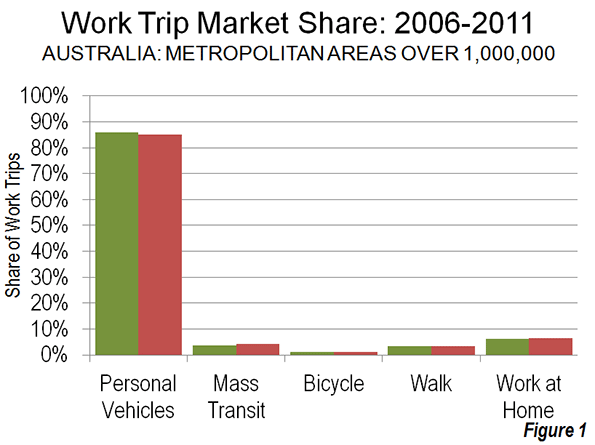
    Data from the 2011 censuses indicates that mass transit is gaining market share in all of but one of Australia’s major metropolitan areas. The greatest increase as in Perth, at 21% , aided by the new Mandurah rail line to the southern urban fringe. On average, mass transit’s market share increased by 10.8% in the five metropolitan areas with more than 1 million population. This increase seems likely to be in response to both mass transit service improvements (such as in Perth) and higher petrol (gasoline) prices. The highest mass transit market share is in Sydney, at 22%, approximately equal to that of Toronto and greater than all major US metropolitan areas except New York (31%). Adelaide has the smallest transit market share, at 9.5%, which is nonetheless 50% above that of Portland, to which Adelaide officials have often looked as a model (Figure 1).

    At the same time, there was a personal vehicle (automobiles, motorcycles, taxis and trucks) market share in all 5 metropolitan areas, averaging 2.2% (Table). However, the much larger base of personal vehicle use prevented mass transit from materially reducing the share of the automobile in any of the metropolitan areas.

    Work Trip Market Share 2006-2011
    Major Metropolitan Areas in Australia
    2000 Personal Vehicles Mass Transit Bicycle Walk (Only) Work at Home Other
    Adelaide 81.2% 9.6% 1.5% 3.1% 3.5% 1.2%
    Brisbane 76.5% 13.2% 1.1% 3.5% 4.5% 1.2%
    Melbourne 76.7% 13.3% 1.3% 3.4% 4.2% 1.1%
    Perth 80.8% 10.0% 1.1% 2.5% 4.1% 1.5%
    Sydney 69.0% 20.3% 0.6% 4.7% 4.4% 1.0%
    Average 76.8% 13.3% 1.1% 3.5% 4.1% 1.2%
    2010
    Adelaide 81.1% 9.5% 1.3% 2.8% 3.7% 1.6%
    Brisbane 75.1% 14.3% 1.2% 3.5% 4.6% 1.4%
    Melbourne 74.5% 15.4% 1.5% 3.3% 4.1% 1.2%
    Perth 78.1% 12.1% 1.2% 2.6% 3.9% 2.0%
    Sydney 66.9% 22.2% 0.8% 4.6% 4.4% 1.1%
    Average 75.2% 14.7% 1.2% 3.4% 4.1% 1.4%
    Change in Market Share
    Adelaide -0.1% -0.6% -12.2% -7.4% 4.6% 32.1%
    Brisbane -1.8% 8.3% 10.5% 0.3% 0.5% 14.4%
    Melbourne -2.9% 15.6% 17.2% -4.4% -1.0% 10.8%
    Perth -3.3% 21.0% 11.3% 4.0% -3.9% 30.2%
    Sydney -2.9% 9.4% 30.3% -3.6% -0.4% 11.1%
    Average -2.2% 10.8% 11.4% -2.2% 0.0% 19.7%
    Source: Calculated from Australian Bureau of Statistics data


    Unlike the United States, where working at home is the fastest growing method of work access (and likely to pass mass transit in this decade), Australia’s working at home share has stayed constant. Working at home is also increasing in Canada.  

    Mass Transit: About Downtown

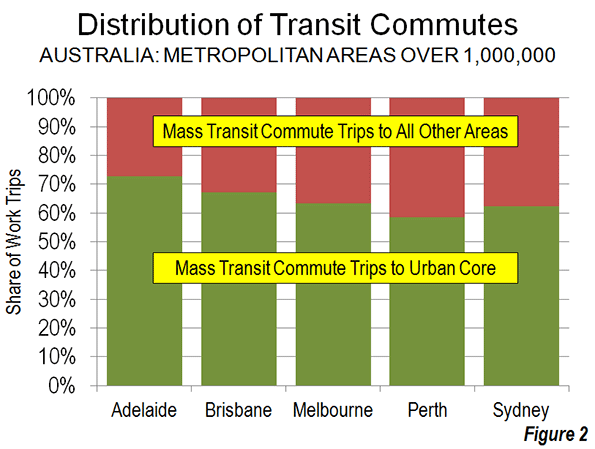
    In Australia, as in Canada and the United States, mass transit is dominated by commuting to the central business district (downtown). On average, 65% of mass transit commuters had a work trip destination in the urban core, which includes the central business district (downtown). This ranges from a low of 59% in Perth to a high of 73% in Adelaide (Figure 2). This concentration of mass transit destinations in the central business district is epitomized by Sydney, where there was a core share of all trips of nearly 60%. By contrast, in Parramatta, which includes one of the largest suburban business centers, is well served by not only the region’s rail system but also by an exclusive busway, the mass transit market share was 15%, one-fourth that of Sydney’s core.

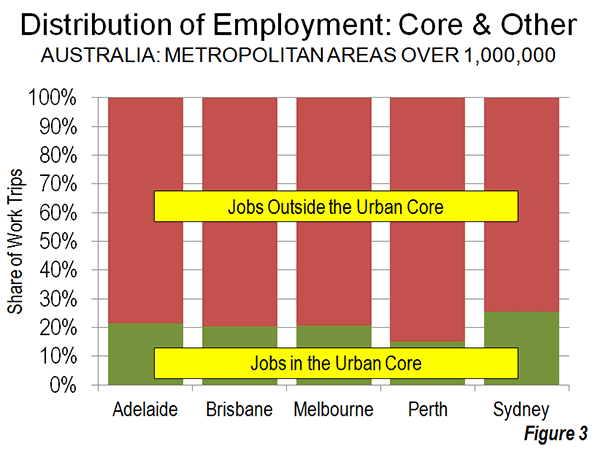
    In the five large Australian metropolitan areas, nearly 21% of jobs are located in these urban core areas that include the central business district (Figure 3). The difficulty for transit in serving the nearly 80% of work trip destinations outside the urban core lies with far lower employment densities and mass transit travel times not remotely competitive with the automobile (on the assumption that services even available). On average, mass transit carries 200 times as many commuter to each square kilometer of core land area for each commuter carried per square kilometer in the rest of the urban area (urban centre).

    It is not surprising that the central business districts dominate mass transit commuting. They are the only locations in virtually any urban area that have a sufficient employment densities and a comprehensive enough radial rapid transit system to provide no-transfer service to a large number of riders.

    Australia’s Long Work Trip Travel Times

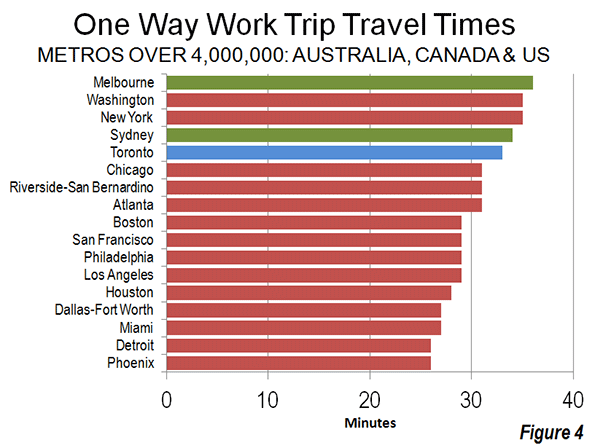
    The growth of transit has not reduced travel times but may have boosted it. In fact Australia’s workers already are traveling for longer times to work than in nearly all similar- or larger-sized metropolitan areas in Canada and the United States (Figure 4). For example, the average one-way work trip travel time in Melbourne is 36 minutes, which is longer than that of any major metropolitan area in the US or Canada.  Sydney’s one-way work trip travel time is 34 minutes. This exceeds that of all similarly sized or larger metropolitan areas in the three countries with the exceptions of New York and Washington, which are larger. In Improving the Competitiveness of Metropolitan Areas, I cited Statistics Canada data showing that mass transit work trip travel is much longer than by car and that transferring demand to transit would not improve average travel times.

    Both Melbourne and Sydney have slightly longer one-way travel times than larger Toronto, which is also larger, at 33 minutes. The Toronto Board of Trade, the Federation of Canadian Municipalities, and the Canadian Urban Transit Association have all expressed serious concern about Toronto’s long journey to work time, noting that it places is a competitive disadvantage relative to other metropolitan areas.

    Melbourne and Sydney also have longer one-way travel times than all of the other 12 US metropolitan areas with more than 4 million population. Perhaps the starkest comparison is with Los Angeles, often cited as having some of the worst traffic congestion in the high income world. Yet, despite having a urban population density higher than that of either Melbourne or Sydney and a far lower transit work trip market share, Los Angeles has a one-way work trip travel time of 28 minutes The secret in Los Angeles, is more dispersed work locations and a more comprehensive freeway system (though major parts of the planned freeway system were not built).

    Far starker is the comparison with Dallas-Fort Worth, which has a population density well below that of both Melbourne and Sydney and a much lower transit work trip market share (2%, compared to 22% in Sydney and 15% in Melbourne). Yet, in Dallas-Fort Worth, the average work trip travel time is 26 minutes, a full quarter less than in Melbourne and 8 minutes less than in Sydney.

    Where Should Planners "Put" People?

    A recent Infrastructure Australia report (The State of Australia’s Cities: 2012) cites "Marchetti’s Constant," which it characterizes as holding that "people will devote on average 90 minutes a day to travel and no more." (In fact, 90 minutes represents is a full 30 minutes greater than Marchetti indicates: See Note on Marchetti’s Constant).

    Infrastructure Australia continues "This suggests that improving the efficiency of urban transport systems by putting people in their economically optimal location within a total travel time of 90 minutes may be the key to improving the productivity of cities."

    "Putting people" where they have total travel time of 90 minutes seems a pessimistic goal; Sydney’s average daily travel time is now nearing 80 minutes. This justifies policy makers to further increase its already non-competitive work trip travel times. Economic research associates maximizing the number of jobs that can be reached by people in a metropolitan area in a specified time (such as 30 minutes) is critical to improving city productivity  (see The Need to Expand Personal Mobility.)

    The issue is not where to "put" people, but rather to facilitate more rapid access for commuters throughout the metropolitan area.

    Things are Likely to Get Worse

    In the end, there is only so much mass transit can do. Already the Australian metropolitan areas have high transit commute market shares to the cores, which leaves only modest room for improvement. At the same time there is little potential for material increases elsewhere in the metropolitan areas. Automobile competitive transit to these locations would be cost prohibitive, perhaps requiring annual expenditures rivaling the total income of the metropolitan area each year for operations, capital costs and debt service (see Megacities and Affluence: Transport and Land Use Considerations).

    Australian urban areas are generally underserved by freeways, despite their overwhelming reliance on personal vehicle travel. At the same time, urban consolidation, “smart growth” land use policies are increasing population densities without accommodating the inevitable associated additional personal vehicle demand (see Urban Travel and Urban Population Density). Things could get worse.

    Wendell Cox is a Visiting Professor, Conservatoire National des Arts et Metiers, Paris and the author of “War on the Dream: How Anti-Sprawl Policy Threatens the Quality of Life.

    —–

    Methodology: The analysis is based upon Australian Bureau of Statistics (ABS) data for capital city statistical divisions. The urban core was defined as the following local government areas: Sydney, North Sydney, Melbourne, Perth and Adelaide. In Brisbane, where the local government area is far larger, the inner Brisbane census division was used. Consistent data is limited to the central business district is not readily available. All trips which include transit as a mode are counted as transit. Workers who did not work on census day or who did not provide information were excluded from the analysis.

    Note on "Marchetti’s Constant:" Not only does Marchetti find a 60 minute, rather than a 90 minute average, but he also credits Zahavi of the World Bank with the concept, noting that with respect to travel:  "The empirical conclusion reached by Zahavi is that all over the world, the mean exposure time for man is around one hour per day.” While there are few references to Marchetti’s Constant in the academic literature, it might be more appropriately named "Zahavi’s Constant." In a further irony, Professor Peter Newman, a member of the board of Infrastructure Australia, cited 60 minutes (echoing Marchetti), rather than the 90 minute average in describing the "Zahavi/Marchetti Constant" in a Sydney Morning Herald commentary ("Why We’re in Reaching Our Limits as a One-Hour City" ).

    Photo: Downtown Brisbane (by author)

  • Wanted: A Reasoned Approach to Dealing with America’s Infrastructure Needs

    It seems like not a week goes by without fresh warnings about the nation’s”crumbling infrastructure" and renewed appeals to rebuild our aging highways and bridges.  President Obama reinvigorated the campaign with his State-of-the-Union proposal for a $50 billion program of infrastructure investments, $40 billion of which would be devoted to a "fix-it-first" program targeted at urgent improvements such as "structurally deficient" bridges. The following day, the House Committee on Transportation and Infrastructure held a hearing on "The Federal Role in America’s Infrastructure," focusing on the importance of infrastructure for the U.S. economy and the federal role in its preservation and expansion. The same day, the U.S. Chamber held a "Transportation Infrastructure Summit," a day-long gathering to explore "transportation infrastructure challenges and promising solutions" with prominent industry representatives. Yet another meeting, this one convened by Rep. Rosa DeLauro (D-NY), a longtime proponent of a National Infrastructure Bank, will explore innovative strategies for financing infrastructure in a March 18 forum on Capitol Hill.

    Two recent reports have added to a sense of urgency about America’s deteriorating infrastructure. The Building America’s Future coalition has published a report, Falling Apart and Falling Behind, urging development of a long-term national infrastructure strategy, establishing a National Infrastructure Bank and lifting restrictions on tolling. The American Society of Civil Engineers (ASCE) has released a report, Failure to Act: The Impact of Current Infrastructure Investment on America’s Future, warning that if the investment gap is not addressed, the economy is likely to suffer $1 trillion in lost business and a loss of 3.5 million jobs.  ASCE’s 2013 Report Card for America’s Infrastructure, a detailed analysis of the performance and condition of America’s infrastructure  to be  released on March 19, may be expected to reinforce this gloomy forecast (a previous  "report card," issued in 2009, gave the U.S. infrastructure an unflattering grade of D.)     

    What kind of impact this flood of warnings and advocacy efforts will have on public opinion and on congressional attitudes and fiscal decisions remains to be seen. They come at a time of severe budget pressures and intense Republican efforts to curb excessive discretionary spending. To be successful, the pro-infrastructure campaign must persuade fiscally conservative lawmakers that there are urgent reasons for a boost in spending on public works that override the imperative to reduce the deficit and get the nation’s fiscal house in order. 

    Further, infrastructure advocates must convince the nation’s  taxpayers— who see no visible signs of  "crumbling infrastructure"— that spending more  on transportation will not be wasted but will result in concrete benefits in the form of reduced congestion or shorter commutes. Infrastructure alarmists also must contend with a public that lately has grown skeptical about warnings of catastrophic consequences of minor cuts in spending.  

    Lastly, the advocacy campaign must overcome a cynical perception that pressures to increase funding for transportation are nothing more than special interest pleadings of interest groups that stand to profit from higher levels of public spending.  As one transportation advocate at a recent conference observed, "there is an enormous disconnect between us and the American public" — a disconnect that may not be easy to overcome.

    Significantly, improving the nation’s infrastructure was not a topic of discussion at the President’s meeting with Senate Republicans, according to Sens. Roger Wicker (R-MS) and Orrin Hatch (R-UT), as reported in POLITICO.  The President must have come to a conclusion that his $50 billion infrastructure plan stands no chance of winning a favorable Senate vote —not to mention being an anathema with the House Republicans.

    A Reasoned Approach

    No one disputes the infrastructure advocates’ claim that some of America’s transportation facilities are reaching the limit of their useful life and need replacing. Nor does anyone disagree about the need to expand infrastructure to meet the needs of a growing population. But fiscal conservatives among these advocates (and we count ourselves among them) contend that this does not rise to the level of a national crisis requiring a $50 billion crash program as proposed by the President, or a two trillion dollar infrastructure investment program over fifteen years as recommended  by ASCE . 

    The condition of infrastructure varies widely from state to state as studies by the transportation research group TRIP and by the Reason Foundation have shown. Most states maintain their transportation assets in a state of good repair and only a few need extensive modernization. "There are still plenty of problems to fix, but our roads and bridges aren’t cumbling," said David Hartgen, lead author of the Reason study. "The overall condition of the public road system is getting better and you can actually make the case that it has never been in better shape." Hartgen’s conclusion is backed by a detailed study of the condition of America’s roads and bridges. The study is based on a variety of sources, primarily from the states themselves as reported to the federal government from 1989 through 2008. ( "Are Highways Crumbling? State and U.S. Highway Performance Trends, 1989-2008, Reason Policy Study 407, February 2013).

    The generally acceptable condition of the nation’s transportation infrastructure in most places, argues for a more selective approach. Rather than launching a new massive national public works program in the name of "fix-it-first," state-level efforts should be targeted specifically at aging facilities that are in a demonstrable need of replacement or modernization.  "The nation simply cannot afford blindly to throw money at the problem," in the words of one senior congressional Republican. "We have learned from the Administration’s $8 billion high-speed rail fiasco that scattering resources in an unfocused manner in order to satisfy demands for geographic equity, leads to imprudent, irresponsible and often downright wasteful spending."     

    To the extent that large-scale multi-year megaprojects demanding billions of dollars still figure on the drawing boards of state DOTs,  they can—indeed, they will —be financed through public-private partnerships, tolling and credit instruments such as TIFIA and state infrastructure banks. They include the I-495 Beltway Hot lanes project in Virginia, New York’s Tappan Zee Bridge replacement, the San Francisco Bay Bridge Eastern Span replacement, the I-5 Columbia River Crossing, the Highway 520 floating bridge in Seattle, the Miami Port Tunnel, the Midtown Tunnel linking Norfolk and Portsmouth VA, and two Ohio River bridges in Louisville, a joint undertaking of the Indiana and Kentucky DOTs. All of the above projects will be financed with long-term obligations rather than funded on a pay-as-you-go basis through annual congressional appropriations.

    A transition from funding to financing of major transportation infrastructure projects was also the preferred approach of the financial practitioners and analysts assembled at the October 2012 conference on Public-Private Partnerships convened by the American Road and Transportation Builders Association (ARTBA). The most practical way to build future transportation megaprojects, these experts concluded, will be through project financing and public-private partnerships.

    In sum, the Highway Trust Fund no longer can serve as a source of capital for new infrastructure, and funding large capital-intensive projects with current user fee revenues on a pay-as-you-go basis is no longer feasible. Instead, look for the states to assume responsibility for remedial "fix-it-first" activities, and for a shift from funding to financing for multi-year construction megaprojects. This may turn out to be the only practical long-term solution to our transportation funding dilemma.

  • Nerdwallet.com Mixes Apples and Oranges on “Worst Cities for Drivers”

    The website nerdwallet.com mixes apples and oranges in producing a list of the 10 worst "cities" for car drivers in the United States. The ratings hardly matter, since the nerdwallet.com score is based on a mixture of urban area and municipality data.

    The Apples: Nerdrwallet.com uses the Texas Transportation Institute traveled the may delay measures for urban areas. These are areas of continuous urban development that always include far more population than is in the central city or municipality. There is no data for the traffic congestion measures at the central city level. These traffic congestion scores are nerdwallet.com’s "apples."

    The Oranges: The oranges of the population densities for the core municipalities. For example, the density shown for New York is that of the city, at 27,000 per square mile. The urban area has a density of approximately 5000 per square mile.

    The Comparison: The net effect is that nerdwallet.com uses the city of New York, with its 8 million people in approximately 300 square miles to the New York urban area with approximately 18 million people in 3,400 square miles. These are not the same things and any score derived from the mixing of these two definitions is inherently invalid.

    This is one of all too many examples of comparisons that are made in the press between "cities," with editors and fact checkers taking insufficient care to ensure that they are using comparable data.

  • Top GOP Budget Officials Call for Investigation of Xpress West High Speed Train from Victorville to Los Angeles

    Congressman Paul Ryan, chairman of the House of Representatives Budget Committee and Sen. Jeff Sessions, Ranking Member of the Senate Budget Committee have expressed serious reservations on the proposed taxpayer loan to the Xpress West high-speed rail line that would operate two thirds of the way between Los Angeles and Las Vegas (from Victorville).

    A joint letter dated March 7 to United States Secretary of Transportation Ray LaHood called the taxpayer risks untenable. They asked for a Government Accounting Office investigation of the project and asked Secretary LaHood to suspend final determination on the taxpayer loan until the GAO investigation is completed.

  • The Beauty of Urban Planning from the Ground

    In a piece called The Beauty of Urban Planning from Space, the Sustainable Cities Collective highlights views from space of uniquely designed street pattern designs in various cities around the world. There are ten examples that illustrate the zenith of urban planning.

    As attractive as the street patterns are, they highlight the inevitable inability of designers, or anyone else for that matter, to influence much more than small changes in the overall urban form.

    The Incomplete Street Patterns

    This point is evident in eight of the 10 urban areas illustrated, where the unique street pattern comprise only part of a much bigger city. The eight are Belo Horizonte, Brazil; Brasilia, Brazil, Washington, DC; New Haven, CT; La Plata, Argentina; Jaipur, India; Adelaide, Australia; and Canberra, Australia.

    The best known example may be Washington, DC, where L’Enfant’s street pattern served most of the city for more than a century, which is probably a world record for a growing urban area. Yet, today, L’Enfant’s design covers less than five percent of the urban area that today has more people than the nation at the time L’Enfant received his position.

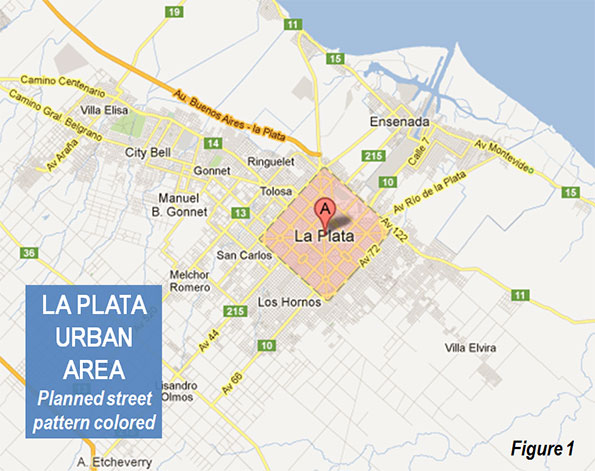
    In La Plata (See end note on La Plata) the street design comes the closest to covering the whole urban area (Figure 1, from Google Maps). Taking design a bit further, every street is numbered in this city that was planned to be the capital of Argentina’s largest province (Buenos Aires, which is separate from the provincial equivalent city of Buenos Aires). Three other of the examples were also new cities planned as capitals, including Brasilia, Canberra and, of course, Washington.

    Stagnant Cities

    The other two examples are a dying mining town (El Salvador, Chile), which has lost more than two thirds of its population and an Italian medieval fortress town, Palmanova. The latter is more a museum than a dynamic urban area. It is confined to its original area and its population could fit into London’s Royal Albert Hall (approximately 5,000).

    Belo Horizonte, Brazil

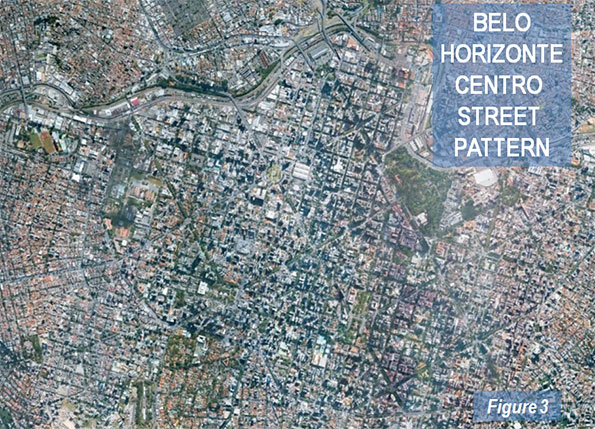
    The Belo Horizonte Centro (Note on Belo Horizonte) street pattern is unique. It was part of the inspiration for my Urban Tours by Rental Car website (rentalcartours.net) and a map of Centro was incorporated into the logo (Figure 2).


    Figure 2

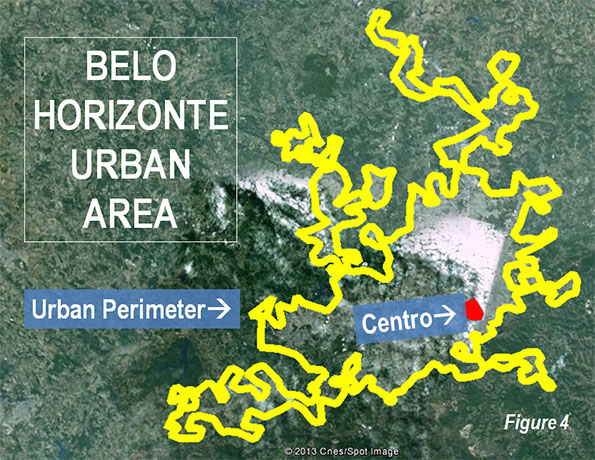
    In Centro, diagonals are superimposed on a conventional north-south/east-west street pattern (Figure 3, from Google Earth). However Centro’s street pattern covers less than one percent of the Belo Horizonte urban area, three square miles out of more than 400 (five square kilometers out of 650). Figure 4 shows Centro in red, engulfed by the much larger urban area, outlined in yellow.

    The first rental car tour described the Belo Horizonte Centro street pattern:

    Belo Horizonte represents both the best and worst in urban planning. The core has, at least from map inspection, a pleasing street layout. In a flair that outdid L’Enfant’s Washington diagonals, Belo Horizonte Centro has a grid of streets on which is superimposed a grid of diagonals. Of course, the resulting eight street intersections make traffic more of a difficulty than with the four that are usual or the grade separations of Brasilia. Centro has a number of wide boulevards, many with green, treed medians and, in the Brazilian style, some with four roadways — center express lanes and outside local lanes. These “three median” streets, give a pleasing feeling. The overall result is an impression similar to that of Barcelona, and a particularly attractive core that would do most European cities proud. 

    But, not far from Centro the randomness begins. To the north is the river, and clearly no attempt
    was made to continue the pattern beyond that. To the south are hills that would have precluded expansion of the plan. Nor does the pattern extend far to the less challenging east or west

    Unscrambling Means and Ends

    Street patterns from space provide no indication of urban planning’s effectiveness, nor of urban policy of which planning is a part. Planning is a means, not the end of cities.

    Over the past two centuries, billions of people have moved to cities. They did not move for the fountains, architecture, or museums (otherwise they would all live in the ville de Paris or Manhattan). In short, urban planning principles of any era have had little impact in the growth of cities.

    Urban planning’s current "top-down" genre is rather new. Until the British Town and Country Planning Act of 1947 and similar measures, planners contented themselves to design street networks (which the Sustainable Cities Coalition highlights so well) and other necessary infrastructure, such as water and sewer networks. Their handiwork is obvious in the 19th century designed street grid of Manhattan, the straight streets of Phoenix and the modified grid of the Toronto metropolitan area. These are the broad functions emphasized by New York University Professor Shlomo Angel in his Planet of Cities.

    Now, urban planning can work against the very justification of cities, the prosperity of its residents.

    Successful Cities

    The success of urban policy (and urban planning) can be judged by how well the purpose of the city is served – the reason people moved there in the first place. The purpose of the city was well articulated by former World Bank principal planner Alain Bertaud:  Large labor markets are the only raison d’être of large cities. Cities are much more about economics than aesthetics. (See end note on Sustainability).

    The successful city will facilitate greater affluence – higher discretionary incomes – among its residents.

    Regrettably, there are notable failures in this regard. For example, the urban containment policies of smart growth, which ration land and raise the price of housing relative to incomes, have been adopted in cities from Sydney to Toronto and Portland. As a result, residents have less money to spend after taxes and paying for necessities and are less affluent than they would be without such policies. In his introduction to the 9th Annual Demographia Housing Affordability Survey, New Zealand’s Deputy Prime Minister Bill English pointed out that higher house prices that occur when land is "made artificially scarce by regulation that locks up land for development."

    Another problem is evident in excessive traffic congestion and slower travel times. Getting around town quickly contributes to greater economic growth and discretionary incomes. Public policy must facilitate mobility throughout the urban area. The mode — the means — is not important, the access is. Transit services are appropriate where time competitive with the automobile, such as to the largest downtowns (See Transit Legacy Cities). However, because of its unparalleled ability to provide rapid mobility throughout the urban area, public policy must also ensure a minimum of traffic congestion and effective access by cars and commercial trucks. The evidence is clear that the higher densities preferred by modern urban planning impede rapid mobility throughout the urban area (see Urban Travel and Urban Population Density).

    Finally, by facilitating housing affordability and more free-flowing traffic, the important objective of alleviating poverty is served (an objective that cannot sustainably be served without economic growth)

    The Beauty of Urban Planning from the Ground

    The "beauty of urban planning" is reliably appreciated from the ground, not from space. The test is how well people live, not what the city looks like. The subject is people, not architecture or urban form (see Toward More Prosperous Cities: A Framing Essay on Urban Policy, Planning, Transport and the Dimensions of Sustainability).

    Wendell Cox is a Visiting Professor, Conservatoire National des Arts et Metiers, Paris and the author of “War on the Dream: How Anti-Sprawl Policy Threatens the Quality of Life.

    —–

    Note on La Plata: La Plata is in the Buenos Aires metropolitan area, approximately 35 miles (60 kilometers) south of Centro in Buenos Aires. However, it is a separate urban area because of a comparatively break in the continuous urbanization between La Plata and Buenos Aires. Buenos Aires province is by far the nation’s largest provincial level jurisdiction, with a population five times as great as the city of Buenos Aires. Much of the population is concentrated near the city of Buenos Aires, with which it forms one of the world’s megacities. The Buenos Aires also has the largest land area and would rank 6th if it were in the United States (nearly as large as New Mexico).

    Note on Belo Horizonte: Belo Horizonte is capital of the state of Minas Gerais. Belo Horizonte is Brazil’s third largest urban area, after Sao Paulo and Rio de Janeiro, with a population of more than 5 million — approximately the population of the Miami urban area (which stretches from southern Dade County to northern Palm Beach County)

    Note on Sustainability: Urban policies that would artificially constrain urban expansion (such as with urban growth boundaries) and discourage automobile travel have often been cited as principal strategies for reducing greenhouse gas emissions. However, important reports indicate little potential for greenhouse gas reductions from these policies, with the overwhelming share resulting from improved fuel economy. Moreover, recent research in England suggested that such policies should not "automatically be associated with the preferred growth strategy" (see Questioning the Messianic Conception of Smart Growth).

    Photo: Belo Horizonte Centro from Nova Lima (by author)

  • Transit Legacy Cities

    Transit’s greatest potential to attract drivers from cars is the work trip. But an analysis of US transit work trip destinations indicates that this applies in large part to   just a few destinations around the nation. This is much more obvious in looking at destinations than the more typical method of analysis, which looks at the residential locations of commuters. This column is adapted from my new Heritage Foundation Backgrounder "Transit Policy in an Era of the Shrinking Federal Dollar."

    Transit Legacy Cities

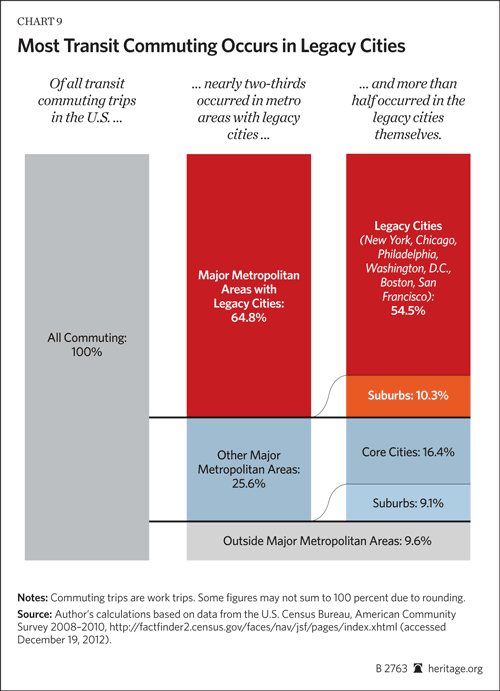
    Transit commuting is heavily concentrated to destinations in just the six core cities (historical core municipalities) of New York, Chicago, Philadelphia, San Francisco, Boston and Washington (Backgrounder Chart 9). I call them the "transit legacy cities," because their high transit market shares relate to their development before the automobile became dominant. Because there is such a lack of clarity in the use of terms that apply to cities, it is important to emphasize that the transit legacy cities are municipalities, not the surrounding metropolitan areas or urban areas, where the majority of residents live (Note 1). 


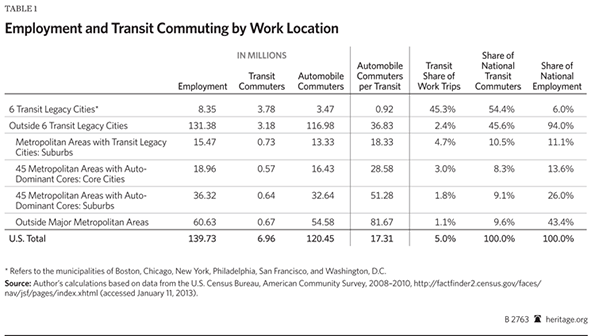
    The transit legacy cities account for nearly 55 percent of the nation’s transit commuters, by work trip destinations, according to the American Community Survey (2008-2010). By contrast, the transit legacy cities have an overall national employment market share barely one-tenth their national transit share (6 percent). Moreover, combined, the transit legacy cities cover a land area little larger than the core city (municipality) of Jacksonville, Florida.

    At the same time, the "other side of the coin" is that commuting to other destinations is dominated by the automobile, from the suburbs in metropolitan areas with transit legacy cities, and even more so in the other 45 major metropolitan areas (with more than 1,000,000 population) and the balance of the nation.

    Legacy Cities: Transit’s Strength

    The extent of the concentration in the six transit legacy cities is illustrated in Backgrounder Table 1. In some ways, transit is, first and foremost,  really a New York story. More than one-third of all transit work-trip commuting is to destinations in the core city of New York. The dominance is even greater for high-capacity subways/elevated services, a mode in which where New York represents two-thirds of national commuting.

    The Key: Large, Concentrated, Well Served Downtowns: The concentration of transit commuting in the six transit legacy cities reflects the factor that is probably more responsible than any other for attracting people from cars to transit. This is a highly concentrated downtown area (central business district, or "CBD") from which a dense network of rapid transit services radiates.

    The six transit legacy cities are also home to the six largest CBDs in the nation, where transit’s share of commuting is far higher than compared to the rest of the nation. Approximately three quarters of commuters to the sprawling Manhattan CBD in New York (south of 59th Street) commuted by transit in 2000. Less well known is that New York also contains the CBD with the second largest transit work trip destination, downtown Brooklyn (58 percent), which is followed by downtown Chicago (55 percent).

    In addition, between nearly 40 percent and more than 50 percent of commuters used transit to the CBDs of Boston, San Francisco, Philadelphia and Washington. While covering a land area less than one-half the size of Orlando’s Walt Disney World, these downtowns accounted for 35 percent of national transit commuting.

    Outside the Transit Legacy Cities: Automobile and Work at Home Country

    So what about the 94 percent of US commuters who work outside the transit legacy cities? The answer is that the automobile dominates, and transit has been overtaken by working at home. In the suburban areas of metropolitan areas with transit legacy cities, the car carries 18 times as many people to work locations as transit. In the core municipalities of the 45 major metropolitan areas without legacy cities, cars carry 29 times as many commuters as transit, and 51 times as many in the suburbs. Outside the nation’s major metropolitan areas, cars carry 82 times as many commuters as transit (Backgrounder Table 1)

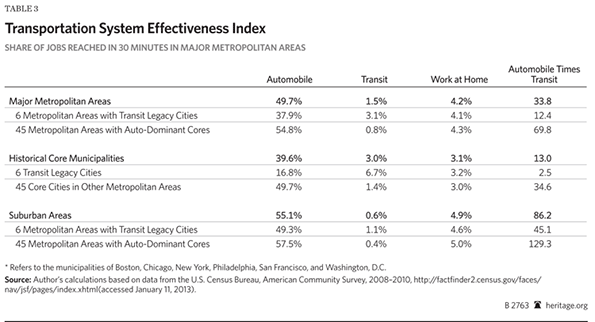
    Further, outside the transit legacy cities, working at home (including telecommuting) provides access to twenty percent more jobs than transit (Backgrounder Table 3).

    An American Love Affair with the Automobile?

    The enduring myth of the American love affair with automobile is countered by the huge transit market shares to city downtowns . For example, commuters to Manhattan are five times as likely to use transit as cars. On the other hand, commuters to the edge city of Parsippany, on the I-287 corridor in suburban New Jersey are 50 times as likely to use their cars as transit. Yet both employment centers serve the same labor market. The issue is not preferences, it is rather rational choice. It would be irrational for most people to commute to Manhattan by car, principally because of the traffic congestion and cost, particularly for parking. It would similarly be irrational for most people to commute to Parsippany by transit, because it either could not be done at all, or it would take too long.

    Transit’s work trip destination market share is an effective measure of its relevance to the market.

    And lest anyone should counter that the answer is more money, consider this.

    A Cost Not A Revenue Problem

    Portland (with a core city that is not a legacy city) has long been held out as a model for improving transit. Yet, after billions of dollars in federal and local tax subsidies, more than 50 times as many people travel to work to suburban locations by car as by transit. More than five times as many work at home as use transit, and working at home costs taxpayers virtually nothing. Yet, despite all these billions, Portland’s transit system is in crisis. Tri-Met’s  Executive Director Neil McFarlane has warned of 70 percent service cuts over 12 years without substantial changes to union contracts.

    Transit’s fundamental problem is not insufficient revenue but insufficient cost control. Since 1983, national transit expenditures have risen at an inflation-adjusted rate nine times that of its increase in commuters (Note 2). Even if costs were under control, it would be financially impossible to provide automobile-competitive transit throughout the modern urban area, as Professor Jean-Claude Ziv and I showed in our WCTRS paper (Megacities and Affluence: Transport and Land Use Considerations).

    Celebrating Transit

    Yet, beyond its inability to convert generous taxpayer subsidies into corresponding ridership increases, transit deserves credit for the large number of people it moves to jobs in the legacy cities. This success should be celebrated although it remains an impossible, prohibitively expensive, dream elsewhere.

    Wendell Cox is a Visiting Professor, Conservatoire National des Arts et Metiers, Paris and the author of “War on the Dream: How Anti-Sprawl Policy Threatens the Quality of Life.”

    —-

    Note 1: Each of the transit legacy cities has a lower population than the surrounding suburbs. This ranges from nearly 45 percent of the population in the suburbs of the New York metropolitan area to little more than 10 percent in Washington.

    Note 2: Within the first 30 days of my time on the Los Angeles County Transportation Commission, I became convinced that transit’s principal problem was cost control (see Toward More Prosperous Cities). This was then and today remains clear from the above-inflationary escalation of unit costs. Regrettably that trend continues today and has seriously impeded transit’s ability to increase ridership.

    —–

    Photo: Downtown Philadelphia (by author)