Tag: Transportation

  • By Chinatown Bus to New York

    I have long heard of the “Chinatown” buses that ply between Washington and New York. I recently planned a quick trip from Washington, both to try a Chinatown bus and to visit Manhattan. This would be my first intercity bus trip in decades, duplicating my first trip to New York (from Washington), just before college. That time, Trailways delivered me on an overnight schedule to the Port Authority Bus Terminal, just beyond the end of the Lincoln Tunnel. It was very exciting then, as now, just as any visit to Manhattan must be for anyone who enjoys cities.

    From Washington to New York

    Arranging the trip was very easy. An internet search quickly produced Chinatown-Bus.org, which provides links to operators (including non-Chinatown bus services). I chose Eastern Coach, which just a few days before departure had a fare of $22 one-way. Credit card booking was simple on the internet (as it has become for most travel).

    The bus was to leave at 4:00 pm from a point between 7th and 8th on H Street N.W. in Washington. Not knowing what to expect, I arrived more than an hour early, at the same time fearing that it would be necessary to stand outside on the curb for a long time in Washington’s notorious August heat. However, Eastern Coach had a station, or at least an air conditioned waiting room.

    Since I was so early I tried to get on the hour earlier schedule, but was advised that it was already full (I routinely try to get on earlier flights when possible at airports). The personnel were professional and very polite. At about 3:40 pm, we were advised that the bus was waiting for us, approximately 3 blocks away. Eastern Coach personnel directed us to it, where we put our larger luggage under the bus.

    One of the attractions of the service was the advertised electric plugs (for laptops with insufficiently powerful batteries) and free wifi internet service. I couldn’t find any plugs, since they were not at every seat. However, the Eastern Coach people quickly located me a seat with a plug.

    Getting out of Washington was not easy. There was stop and go traffic until Bladensburg Road, after which the driver continued out New York Avenue and entered U.S. 50 toward Annapolis and then Interstate 97 to the Baltimore area. This, of course, is not the conventional route, which would have been on the Baltimore-Washington Parkway (operated by the National Park Service), however that route had serious construction delays. We rejoined the normal route on Interstates 895 and 95 in Baltimore.

    The trip was uneventful, a good thing. The internet worked fine, as I alternated between work and watching the scenery. There are changes along the route that were not evident the last time I drove it. There are the extensive, two-way express toll lanes for a few miles north of Baltimore, which augment the existing free lanes. The Goethals Bridge reconstruction was visible from the New Jersey Turnpike in Elizabeth. In the distance, the deck of the Bayonne Bridge, which is being raised for better ocean port access, could be seen a few miles later. Next comes the historic Pulaski Skyway (photo below), the keystone to “America’s First Superhighway” (page 11), a 13 mile segment from the Holland Tunnel (which leads to Manhattan) opened nearly 90 years ago, reaching to Elizabeth (approximately where it was met by the Goethals Bridge approach).

    Even with the delay out of Washington and the Interstate 97 diversion, we reached the New York terminus by 8:15 p.m., 45 minutes ahead of the very conservative (9:00 p.m.) scheduled arrival. This was made possible by the somewhat unusual lack of delay entering the Lincoln Tunnel as we approached Manhattan. Drop off was on 7th Avenue, just south of 34th Street, in the area of Penn Station. The bus continued to its final stop in Chinatown. The bus cost was so low, that as we neared the end of the trip I decided that using a taxi or ride hailing service was likely to cost more for the final 2 miles of the trip than for the first 240. Thus, I dragged my roller bag and walked to my East 50’s hotel quite comfortably.

    From New York to Washington

    For the return trip, I wanted to use a conventional (non-Chinatown) service to compare the two. In US intercity buses, there is nothing more conventional than Greyhound. I walked to the Port Authority Bus Terminal, which I found to be every bit as uninviting as it was decades ago. The only advantage over flying is that there were no security lines, but the boarding process was similar to that of Southwest Airlines, standing in lines by boarding number. The difference was that the standing was longer, because of the shortage of waiting room seats, apparently designed with an exurban city bus stop in mind rather than the holding area for a bunch of 50-plus seat buses.

    Anyway, that was not Greyhound’s fault. I noticed that another non-Chinatown operator, Megabus, serves from its own location outside the Port Authority Bus Terminal, like the Chinatown buses. Seriously, any future trips of mine will involve carriers that do not use the Port Authority Bus Terminal.

    But Greyhound did just fine. We left mid-morning for a trip Greyhound indicated would take 4 hours and 20 minutes. Immediately outside the Port Authority Bus Terminal we sat in stuck traffic for about 10 minutes.

    Like Eastern Coach, there were not plugs at every seat (row), but it was not hard to find a seat with a plug. The internet, however, was another matter. It was much slower than on Eastern Coach and I stopped using it because it was too painful. I had a good book and there is always the scenery. There are few places more picturesque from a highway than the forests of northern Maryland and the view of the Susquehanna River from the Millard Tydings Bridge.

    As in the case of the northbound trip, detours were necessary. The bus driver wisely diverted to the Commodore Perry Bridge and Interstate 95 from New Jersey to Chester, PA due to serious traffic congestion as the New Jersey Turnpike approaches the Delaware Memorial Bridge. Again, the bus used the Interstate 97-U.S. 50 detour at the south end of the trip, to avoid the Parkway congestion.

    There was a single 15-minute rest/meal stop, which I would have been happy to skip. The bus reached Union Station in Washington about 30 minutes later than advertised. Anyone, however, who understands the traffic difficulties in the Northeast should not be surprised by a five hour trip. Greyhound’s fare of $23 competes nicely with the Chinatown buses.

    Other Alternatives

    There are a number of other alternatives for travel between Washington and New York. There is the private car and airlines. Just gasoline for the car is likely to be more than the bus fare. The train is far more expensive (and subsidized by taxpayers). The best fare I could find was four times that of the buses. Amtrak’s Northeast Direct service is scheduled at 3:20, between 1:00 and 1:40 faster than the bus. On-time performance over the past year has been about 75 percent, though dropped to 62 percent in June.

    Thus, the time advantage of the train may be illusory in many cases and certainly the bus has a considerable cost advantage (for both riders and taxpayers). Some might find the bus a bit too cramped compared to the train. There is now luxury bus service with three-across seating, rather than four and with plugs at every seat. One such operator is Vamoose, which provides service between New York and Washington (Rosslyn or Bethesda) in five hours. Both stations are near Washington Metro stations and are likely more convenient for people arriving by car than Union Station. The fare is higher, at $60 to $75, but there is no public subsidy.

    I look forward to my next New York trip, Chinatown bus one way and luxury bus the other.

    Wendell Cox is principal of Demographia, an international public policy and demographics firm. He is a Senior Fellow of the Center for Opportunity Urbanism (US), Senior Fellow for Housing Affordability and Municipal Policy for the Frontier Centre for Public Policy (Canada), and a member of the Board of Advisors of the Center for Demographics and Policy at Chapman University (California). He is co-author of the “Demographia International Housing Affordability Survey” and author of “Demographia World Urban Areas” and “War on the Dream: How Anti-Sprawl Policy Threatens the Quality of Life.” He was appointed to three terms on the Los Angeles County Transportation Commission, where he served with the leading city and county leadership as the only non-elected member. He served as a visiting professor at the Conservatoire National des Arts et Metiers, a national university in Paris.

    Top photo: Hudson Yards construction (Manhattan), by author
    Second photo: Pulaski Skyway, by Jack Boucher [Public domain], via Wikimedia Commons

  • Will Donald Trump Expose America’s Great Mass Transit Hoax?

    Whatever you think of President Trump, his claims about the lousy condition of America’s basic infrastructure are widely accepted—even by resisting Democrats grinding their teeth on a L.A. freeway or waiting for a New York or D.C. train to arrive. His call for a trillion-dollar infrastructure plan may be his last best bet for finding bipartisan support.

    The question is if he’s at all serious about the urgent need to fix the failing mass-transit systems we have, or if he’ll repeat what Washington’s done to get us in this mess, and offer funds that encourage cities to build shiny new systems few will actually ride even as the existing ones decay.

    As we’ve demonstrated in a new paper for Chapman University (PDF), nowhere is the infrastructure deficit more obvious than in urban transit, which last year lost over 3.1 percent of its ridership, according to the American Public Transit Association (PDF). Despite the vast sums spent by the federal government on light rail, subways, and trolleys since 1970, most mass transit systems fail to meet the needs of commuters.

    In many cases, as in New York and Washington, vast expenditures on new lines have occurred even as maintenance has been deferred, with overall service deteriorating. Many billions of dollars more have been spent in other cities on new rail systems that haven’t reduced the number of people driving to work.

    How the Feds Failed Legacy Cities

    Rail transit works best in what might be considered the “legacy cores.” Approximately 55 percent of America’s transit commuters have destinations in the urban cores (and many of those rides to the central business districts) of six older cities (not metropolitan areas)—New York, Washington, Boston, Philadelphia, Chicago, and San Francisco. New York, by itself, has a remarkable 56 percent of its jobs in its urban core.

    Between 2006 and 2015, those six metropolitan areas captured 77 percent of the national increase in transit work trip destinations.

    These cities were shaped when public transit held a virtual monopoly on both motorized and horse-drawn passenger transport within U.S. cities. Annual transit ridership peaked in the early 1920s, except for the period around the Second World War, the high-water mark for transit nationally. Between 1960 and 2015, transit’s work trip market share dropped more than 50 percent, from 12.1 percent to 5.2 percent. Until very recently, the demographic recovery of legacy cores, notably New York, drove a slight increase in transit share. But this progress is threatened by growing safety and reliability issues. Part of the problem stems from a decision by New York’s political elite, starting with Michael Bloomberg, to build a new, ultra-expensive line—the Second Avenue subway—while maintenance on other lines deteriorated. This decision reflects political realities including federal incentives for new systems, and the greater political rewards for building shiny new things.

    The result is that service delays in New York have skyrocketed as antiquated signals break down, with breakdowns now twice as frequently as they were just five years ago. After decades of increases, ridership has declined while the extensive commuter rail system serving Manhattan from the suburbs (the nation’s largest) is experiencing its own substantial difficulties.

    The picture is similar in Washington, D.C., where the U.S. secretary of Transportation went so far as to threaten a shutdown of the system due to fatal accidents, attributed to policies that prioritized system expansion over safety. D.C.’s transit ridership, growing for decades, has now declined as well.

    The Real Train Robbery

    Yet even as cities that depend on transit, such as New York, suffer from under-investment, Washington has poured billions into new rail system in cities created largely in the auto-dominated era. Among 19 metropolitan areas that have opened substantially new urban rail systems since 1980, the share of riders using mass transit remains below the national average while the share of those driving alone has increased.

    Nowhere is the power of ideology and entrenched interests over the common good more evident than in Los Angeles, the pioneer for the multi-polar and highly dispersed post-1950 metropolis.

    On the surface, L.A. provides the sunbelt’s best case for transit—it once had a robust transit system, is the densest urban area in the country, has a huge poverty population and ideal weather for waiting outside for the train. L.A. has been widely celebrated as “the next great transit city,” and The New York Times and others are continually celebrating its imminent conversion from a car culture to a train one. Some believers, like Los Angeles architectural critic Christopher Hawthorne, envision “a third Los Angeles” that will see the eclipse of the freeways, single family homes, and suburban neighborhoods.

    Yet despite this Manhattan envy among its elites, L.A. simply does not follow the “model” of urbanist paragons such as New York, Chicago or San Francisco. Downtown Los Angeles is a relative economic pygmy, accounting for barely 2 percent of regional employment, less than a tenth of lower Manhattan’s share. Transit works best when most commuters are headed to a dominant core destination. The more scattered the destinations, the less likely trains can muster a decent commuter share. The entire Los Angeles MTA system carries fewer riders than New York’s Lexington Avenue line.

    Money is not the issue. Since 1990, Los Angeles has opened seven new urban metro and light-rail lines and two exclusive busways at a cost of more than $15 billion. During this period, transit’s work trip market share has dropped from 5.6 percent from 5.1 percent in 2015. Ridership is at least 15 percent below 1985 levels, when there was only bus service and when Los Angeles County had about 20 percent fewer people. No surprise, then, that according to a recent USC study, the new lines have done little or nothing to lessen the area’s infamous congestion.

    Rather than hop on the rails, more residents are addressing traffic woes by simply staying home. By 2015, more Los Angeles-area residents were working at home than were taking transit. Since 1990, the number of people working at home increased eight times as rapidly as the number of people using the transit system. The number of people driving increased even more rapidly.

    This story is repeated in other sunbelt cities. In Houston, 3.2 of residents commuted to work in 2000, before the city’s $1.5 billion new light-rail system opened. In 2015, the share of commuters had dropped by a third, to 2.2 percent.

    It’s Atlanta, though, that most fully epitomizes the futility of conventional transit spending. With the opening of MARTA in 1979, Atlanta built the third largest new metro system (fully grade separated rail) in the U.S. Since then, transit share has plummeted—from 6.8 percent in 1980 to 3.1 percent in 2015, 40 percent below the average national transit market share. Traffic congestion more than doubled over the same time span.

    The most recent addition to Atlanta’s rail system is a central city streetcar line some locals have nicknamed it “a streetcar named undesirable” for its low ridership.

    Even urban planning model Portland, which opened its MAX light rail system in 1986, has seen its transit market share drop from 7.9 percent in 1980 to 6.9 percent in 2015, only modestly above the national transit-riding average. The percentage of people working at home rose from 2.3 to 6.4 percent, at virtually no cost to the public treasury, compared to the more than $3 billion to build urban rail.

    But the award for the country’s most absurd project should go to the Honolulu elevated rail line. In a metropolitan area of barely a million people, the attempt to build a 20-mile elevated train has increased in cost from $5 billion to an estimated $10 to $13 billion, with the feds chipping in $1.6 billion. The impact on state finances—for an estimated 1 percent drop in road traffic—so disturbed former Governor Ben Cayetano, a Democrat, that he’s publicly called on President Trump to cut future funding. The Honolulu Star-Advertiser recently referred to the elevated lines as an “epic fail on rail.”

    The Future of Transit

    Before President Trump or Congress tackle infrastructure, they should work to remove federal involvement in control of local transit spending. Some experts like David Levinson of the University of Minnesota, blame federal policy for distorting investment to new project that favor “ribbon-cuttings for politicians” while resulting in neglect for local operations.

    In most of the country, simply put, localities would be better off not investing in new rail schemes. Americans seem generally happy with their overwhelmingly suburban lifestyle and their ability to reach places of employment faster than most of those in the high-income world can. Today, over 75 percent of jobs are in the suburbs and exurbs combined. Between 2010 and 2015, 81 percent of job growth was in the suburbs and exurbs. Similarly 85 percent of major metropolitan area residents live outside the urban core, in the suburbs and exurbs, where transit service is sparse.

    This is not likely to change much in the near or even medium term. Rather than centralizing, the consulting firm Bain envisions evolution toward a “post-urban economy” that will be more localized and home-based. By 2025, it reports, more people could live “beyond the traditional commuting belt” than inside.

    These realities suggest that rather than the “one size fits all” model, metropolitan areas should better customize their transportation spending to local needs. To achieve this, we need to jettison the quasi-religious affection for rail transit and explore in most of the country technologically enabled solutions such as telework, which is growing faster than any form of commuting, as well as rideshare technology. This is particularly true in suburbs, such as Dublin, California, which eliminated their local bus system in exchange for providing vouchers for Uber-like services for those unable to afford or drive cars.

    Over the longer term, the autonomous car could make even more revolutionary impacts on both the urban form and transit. Automated car proponents claim that the cost of operations will be considerably below that of today’s cars. If that should be achieved, the autonomous car could be used to provide door-to-door mobility not only for the elderly and disabled, but also for people who currently cannot afford their own cars. Under any circumstances, this innovation seems certain to further weaken conventional transit outside the cities with legacy cores.

    Ultimately it will take common sense, even more than just money, to fix our transit problems. In dispersed places like southern California, Dallas-Fort Worth, and Houston, the emphasis may be on using new technologies as well as private express bus service to connect their widely dispersed communities. Monies that go into rail transit, suggest urban analyst Aaron Renn, should be focused on maintaining and improving current service in cities where they make sense. As Renn puts it succinctly: “The priority should be: repairs to existing mission critical rail lines, and helping distressed communities.”

    The current trend of wasting billions of dollars to serve a urban theology may be popular among planners, speculators and engineering firms. It hasn’t been particularly helpful to the people who need to get, in appropriate time and without too much stress, from one place to another.

    This piece originally appeared on the Daily Beast.

    Joel Kotkin is executive editor of NewGeography.com. He is the Roger Hobbs Distinguished Fellow in Urban Studies at Chapman University and executive director of the Houston-based Center for Opportunity Urbanism. His newest book is The Human City: Urbanism for the rest of us. He is also author of The New Class ConflictThe City: A Global History, and The Next Hundred Million: America in 2050. He lives in Orange County, CA.

    Wendell Cox is principal of Demographia, an international public policy and demographics firm. He is a Senior Fellow of the Center for Opportunity Urbanism (US), Senior Fellow for Housing Affordability and Municipal Policy for the Frontier Centre for Public Policy (Canada), and a member of the Board of Advisors of the Center for Demographics and Policy at Chapman University (California). He is co-author of the “Demographia International Housing Affordability Survey” and author of “Demographia World Urban Areas” and “War on the Dream: How Anti-Sprawl Policy Threatens the Quality of Life.” He was appointed to three terms on the Los Angeles County Transportation Commission, where he served with the leading city and county leadership as the only non-elected member. He served as a visiting professor at the Conservatoire National des Arts et Metiers, a national university in Paris.

    Photo by Gage Skidmore, via Flickr, using CC License.

  • First Mile-Last Mile, Intermodialism, and Making Public Transit More Attractive

    In the ever-trendy world of transportation planning people seem to be infatuated with discussions of first mile-last mile public transportation connections and intermodalism. Given all the attention, one would think that the traveling public is anxiously awaiting their next opportunity to transfer vehicles to complete their trip. Nothing can be further from the truth. People don’t aspire to transfer; they don’t aspire to experience an intermodal terminal. They almost always want to get door to door in the fastest, simplest, and most reliable fashion. Transferring between vehicles is a necessary inconvenience, not a virtue.

    The concept of using multiple means of travel to complete a given trip is an outgrowth of the reality that different services and technologies offer the optimal means of travel for different contexts, which can result in trips that require transfers for the overall optimal means of travel. The most obvious example is traveling from, say Chicago to New York. Air travel is the time and cost superior means of carrying out the line-haul component of the trip. U.S. airlines, for example, routinely extract less than $.20 per passenger mile from travelers to transport them between airports while also saving them time and perhaps lodging and meal expenses. But jet aircraft will not pick you up at the door or delivered you to the entrance to your destination. Thus, transferring between modes at airports is a necessary and logical interface between air and surface modes. The opportunity to take advantage of the premium performance of air travel more than offsets the onerousness of navigating through airports and transferring between access and egress modes.

    On other kinds of trips, the onerousness of transferring might not be as easily offset by the travel benefits of the line-haul or primary mode of travel. For many shorter urban trips, it becomes very challenging for the onerousness of a transfer to be offset by the benefits of using a combination of modes or vehicles to complete a trip. Travel modeling has long recognized the onerousness of transferring, thus quantitatively penalizing the need to transfer by calculating time spent transferring as two or more times more onerous than in-vehicle travel time. From a practical perspective, transferring introduces uncertainty into a trip. Your arrival at the transfer point is captive to the system schedules and you cannot necessarily minimize the transfer wait. The second vehicle introduces an additional chance to be impacted by unreliable service. For first-time trips, you need to figure out both the location of the destination and how to get to it. You may lose your seat or place and interrupt whatever you are doing during your travel. You might be exposed to weather or other risks, and you can’t use the time as productively as you might have had a transfer not been required.

    If you do have to transfer, you want it to be as quick and convenient as possible. While basic amenities such as restrooms and convenience retail might be appreciated, the local traveler is most often interested in getting quickly to their destination and not turning the transfer experience into a retail opportunity or recreational outing. For longer distance intercity trips where the traveler may be captive to more lengthy waits between travel segments, additional retail and personal service accommodations might be appreciated to the extent that they don’t disadvantage other passengers by excessively increasing walk distances or causing other delays.

    The vehicle travel to and from the transfer location should deviate from the optimal origin-destination travel path as little as possible. If one does have to suffer a transfer, they would much preferred that the point of transfer not dramatically impact the circuity of their travel.

    The growing motivation for providing first mile-last mile connections derives from the logical desire to increase the accessibility to public transportation for more homes and destinations. A multitude of efforts in recent years have been carried out to quantify accessibility of residents and activities to public transit. Early work carried out by CUTR indicated that about half the homes in the America were within a half a mile of a transit route. A slightly higher share of employment locations were similarly within a half a mile of transit. More recently, sophisticated software tools have been developed to evaluate accessibility via transit, such as initiatives by the Brookings Institute and the University of Minnesota Accessibility Observatory, as well as tools such as Transit Score. The collective message of these analyses indicate that, in general, access to transit both geographically and temporally is, on average, limited. Hence, folks are interested in improving first mile-last mile connections with the hopes of making transit more attractive and productive.

    Historically, line-haul premium transit services provided feeder bus, park-and-ride, and kiss and ride (drop off) opportunities so that travelers could access these premium modes, most typically for longer-distance commute travel. More recently, additional means of access, including bikeshare, carshare, and transportation network company (TNC) connections (i.e., Uber, Lyft, etc.), are being deployed. Automated shuttles are being evaluated as yet another means of enhancing the appeal of line-haul premium travel modes. These concepts make sense in contexts where the line-haul mode is sufficiently attractive by virtue of its speed or cost advantages that the traveler is willing to incur the inconvenience, time cost, trip circuity, or other potential negative characteristics of incurring one or more transfers to complete a trip.

    Better first mile-last mile connections work where they work. But where is that and what planning and service investments makes sense to enhance first mile-last mile connections? Individuals who use intermodal connections do it either because there is no viable alternative or because the disutility of transferring is more than made up for by being able to take advantage of the line-haul mode of travel. This is most possible in situations where the line-haul mode is superior to other travel options, typically meaning it is faster by virtue of fewer stops, exclusive guideway, signal priority, utilization of a higher performance travel path (freeway versus arterial), and that the transfer penalty is minimized most typically by having high-frequency service on the line-haul. Faster travel speed is typically only virtuous in instances where the distance of the trip is sufficient to accumulate enough marginal travel time advantage to offset the transfer induced delays. Thus, enhancing first mile-last mile connections has the greatest leverage for longer distance trips and premium services.

    Over 60% of person trips according to the last National Household Travel Survey, are less than 5 miles in length, over 75% less than 10 miles in length. Many of the shorter trips are unlikely to be appealing as trips requiring first mile-last mile connections to travelers who have choices. Absent extremely high quality first mile-last mile connections, the circuity and delays likely to be introduced by a first mile-last mile connection(s), as opposed to a direct door-to-door single vehicle trip, are unlikely to make this arrangement attractive for travelers with choices. Such services could incentivize more trips or increase convenience by shortening walk access for travelers without personal vehicle options.

    So what does this have to do with anything? Numerous communities are striving to leverage their transit investments and increase mobility for their populations by exploring additional first mile-last mile connections. Though well intentioned, first mile-last mile programs will be most successful if fully informed by an understanding of traveler behavior in general and market conditions in particular. Context has implications in terms of the magnitude of ridership response as a result of improved connections based on the geography of deployment and the trip pattern emanating to and from that geography. First mile-last mile connections are most likely to attract new travelers if they offer high-quality connections, support high performance modes, and serve sufficiently long trips such that the circuity and transfer disutility can be amortized over a longer line-haul premium service segments.

    In addition, equity considerations may become an issue. Additional investments in first mile-last mile connections will have to be evaluated in the context of alternative investments in service and facility improvements. Additionally, attention needs to be paid to the question of who will benefit, both geographically and demographically, from various first mile-last mile connections. How much should be spent to coax travelers with personal or private sector mobility options to use public transportation, or should resources be directed to basic service improvements for those dependent on transit?

    Experimentation and a learning curve are to be expected as new technologies, business models, and deployment strategies are deployed and experience accumulates. But it will be important to glean a well-informed sense of the public and user costs, travel impacts, and environmental, safety, and other impacts. The role of new technologies and service models in enhancing connections to public transportation is important, but like everything about public transit, it’s not so easy to make it work.

    This piece first appeared on Planetizen.

    Dr. Polzin is the director of mobility policy research at the Center for Urban Transportation Research at the University of South Florida and is responsible for coordinating the Center’s involvement in the University’s educational program. Dr. Polzin carries out research in mobility analysis, public transportation, travel behavior, planning process development, and transportation decision-making. Dr. Polzin is on the editorial board of the Journal of Public Transportation and serves on several Transportation Research Board and APTA Committees. He recently completed several years of service on the board of directors of the Hillsborough Area Regional Transit Authority (Tampa, Florida) and on the Hillsborough County Metropolitan Planning Organization board of directors. Dr. Polzin worked for transit agencies in Chicago (RTA), Cleveland (GCRTA), and Dallas (DART) before joining the University of South Florida in 1988. Dr. Polzin is a Civil Engineering with a BSCE from the University of Wisconsin-Madison, and master’s and Ph.D. degrees from Northwestern University.

    Photo by Jeremy Brooks, via Flickr, using CC License.

  • A Reporter Rode Denver’s Airport Light Rail–And You Won’t Believe What Happened Next

    Here’s a heartwarming story of a man who rode Denver’s airport light rail once, and it worked for him, so now he wants everyone in his Virginia city to pay higher taxes to build light rail to the local airport in case he might want to ride it again someday. How thoughtful and touching.

    Of course, there are a few problems with his story. First, what he rode wasn’t light rail, which averages about 20 miles per hour; instead, he rode a commuter train that averages 38 miles per hour. So if he manages to persuade people in Virginia to build light rail to his local airport, he will get something far inferior to what he rode in Denver.

    Second, the writer is guilty of survivorship bias, which is an assumption that because something worked for him, it will work for everyone else. But the Denver airport train doesn’t work for everyone else, partly because it is unreliable and partly because transit is slow for anyone who isn’t near an airport line station.

    In fact, it works for very few people. There are just 144 daily round trips between downtown Denver and the airport. Of course, people can get on the train in places other than downtown Denver, but the majority of people in the Denver area who want to go to the airport would have to first go downtown, presumably on a bus or another rail line.

    Unfortunately, the Virginia writer never bothered to ask what share of air travelers take the train and Denver’s Regional Transit District hasn’t released that information. But we know that, in 2016, an average of 104,000 air travelers a day went to or from Denver International Airport. RTD says that an average of 10,256 people get on or off the train at the airport station each weekday, which is slightly less than 10 percent of air travelers. Based on the experience in other cities, a significant number of those are from the more than 30,000 airport employees. So the train probably carries between 5 and 10 percent of air travelers.

    Third, the writer has no perspective on the huge cost of rail, especially since he only had to pay a tiny fraction of the cost of his ride. From downtown to the airport, Supershuttle costs $25 and Uber costs about $35. The airport train is $9, which sounds like a good deal. But Supershuttle and Uber drivers both pay gas taxes that covered virtually all of the costs of I-70 and the other highways to the airport, while train riders paid none of the $1.1 billion construction cost and only a fraction of the operating cost of the airport train.

    Contrary to the above headline, you probably will believe that the Virginia writer made the same mistake that many Americans make when they ride trains in Europe. They see other people riding them and assume they are seeing a cross-section of the city or country they are visiting. They fail to find out about all the people who aren’t riding the trains and why the trains don’t work for those people. Nor do they ask who is paying for and who really benefits from all the subsidies to passenger rail transportation.

    The reality is that the Denver airport line would have been a huge waste of money and should never have been built even if it hadn’t had an 89 percent cost overrun. With that overrun, Denver is basically bankrupting itself so a few people can take a train to the airport which the city nearly bankrupted itself building.

    This piece first appeared on The Antiplanner.

    Randal O’Toole is a senior fellow with the Cato Institute specializing in land use and transportation policy. He has written several books demonstrating the futility of government planning. Prior to working for Cato, he taught environmental economics at Yale, UC Berkeley, and Utah State University.

    Photo by Jeffrey Beall (Own work) [CC BY-SA 3.0 or GFDL], via Wikimedia Commons

  • Increase in Long Commutes Indicates More Residential Dispersion

    A recent New York Times story chronicled the experiences of “extreme commuters,” those who travel two hours or more each way to work. The article focuses on people who commute to New York and notes that there is little or no data on extreme commutes. The Census Bureau, through the American Community Survey (ACS) does not survey two hour commutes. Its maximum classification is 90 minutes or more, though The Times focuses on the 60 minutes and over data, 2013 ACS.

    Regrettably, The Times is not terribly clear in its portrayal of the ACS data, in noting that the 21 percent of residents spend more than 60 minutes getting to work, not mentioning whether it is the New York figure or the national figure. It is New York. The most recent 2015 data shows that only 9.0 percent of US workers spend 60 minutes or more getting to work. The New York metropolitan area figure was 21.4 percent.

    However, The Times picks up on what’s going on in commuting. People are driving farther to qualify to live the lifestyles they prefer. Urban growth continues to be overwhelmingly in the suburbs, approximately 90 percent since 2010.

    Distribution of 90 Minute and Over Commuting

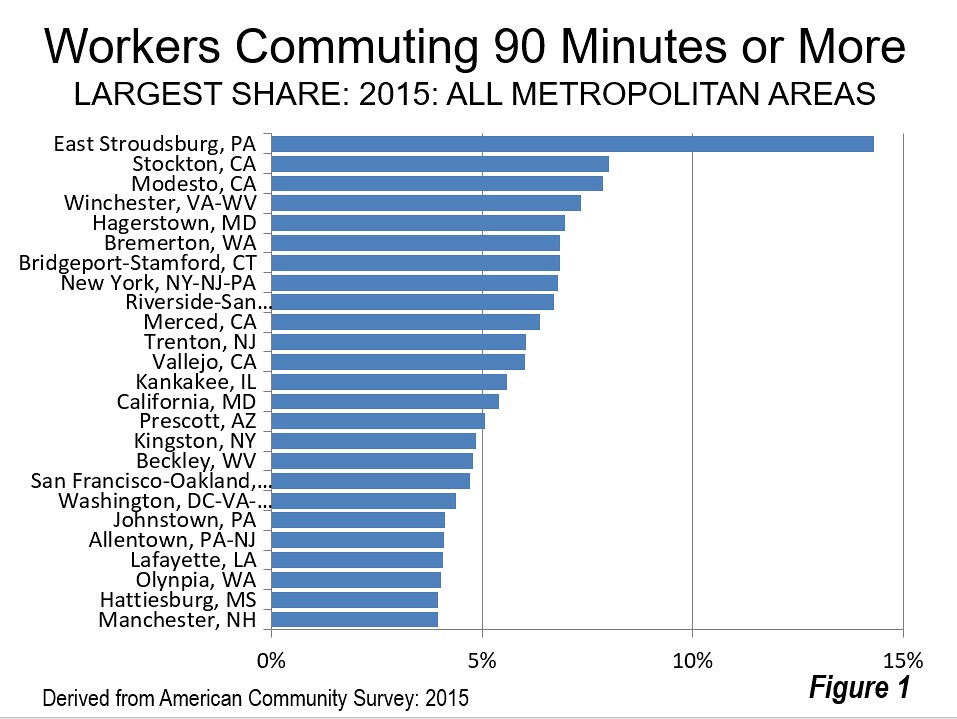
    Despite the frequent portrayal of long commuting as the norm, only 2.2 percent of the nation’s workers travel 90 minutes or more, one way to work. Moreover, that long commuting is concentrated in and near just a few combined statistical areas (CSAs), the larger the larger metropolitan area definition that combines adjacent metropolitan areas like Bridgeport-Stamford with New York, San Jose with San Francisco and Riverside-San Bernardino with Los Angeles. Figure 1 shows that 17 of the 25 metropolitan areas with the largest share of 90-plus minute commuters are in or adjacent to just four combined statistical areas (CSAs).

    Figure 1 shows that 17 of the 25 metropolitan areas with the largest share of 90-plus minute commuters are in or adjacent to just four combined statistical areas (CSAs), the larger metropolitan area region definition that connects places like New Haven County and Fairfield County with New York, San Jose with San Francisco and Riverside-San Bernardino with Los Angeles.

    Seven of the metropolitan areas are in the New York CSA, including New York (NY-NJ-PA), Bridgeport-Stamford (CT), Allentown (PA), Trenton (NJ), Kingston (NY) and East Stroudsburg (PA). The San Francisco CSA has three metropolitan areas among the longest commute metropolitan areas, San Francisco, San Jose and Stockton, as well as adjacent Modesto and Merced. The Washington CSA has four metropolitan areas in the longest 25 commutes, including Washington (DC-VA-MD-WV), California (MD), Hagerstown (MD) and Winchester (VA-WV). Seattle, by far the smallest CSA with more than one metropolitan area in the longest commute CSAs, has two, Bremerton (WA) and Olympia (WA).

    East Stroudsburg (New York CSA) has the largest share of 90 and more minute commuters, at 14.3 percent. Stockton (San Francisco CSA) has the second largest number, a much lower 8.0 percent. Nearby Modesto (adjacent to the San Francisco CSA and a candidate for inclusion after 2020) is at 7.8 percent. Winchester and Hagerstown (Washington CSA) are at 7.3 percent and 7.0 percent respectively.

    None of this is surprising, considering that each of these markets is plagued by urban containment land use policies that force up house prices. Harvard research indicates that domestic migration is being driven by the differential in house prices and people have been leaving the New York, Washington and San Francisco CSAs for other parts of the country. Seattle has done better, simply because its expensive housing is still a bargain compared to the much more onerous house costs in coastal California, from which migrants are being drawn. The trend in long commutes suggests another dimension to the domestic migration story, as households disperse more in the same general area.

    Long Commuting is Expanding

    Further, long commuting is expanding. Between 2005 and 2010, the increases were modest, with a market share rise of 3.0 percent among residents traveling 90 minutes or more to work and 0.3 percent among those traveling from 60 to 89 minutes to work. This is not surprising, given the Great Financial Crisis, which began during that period.

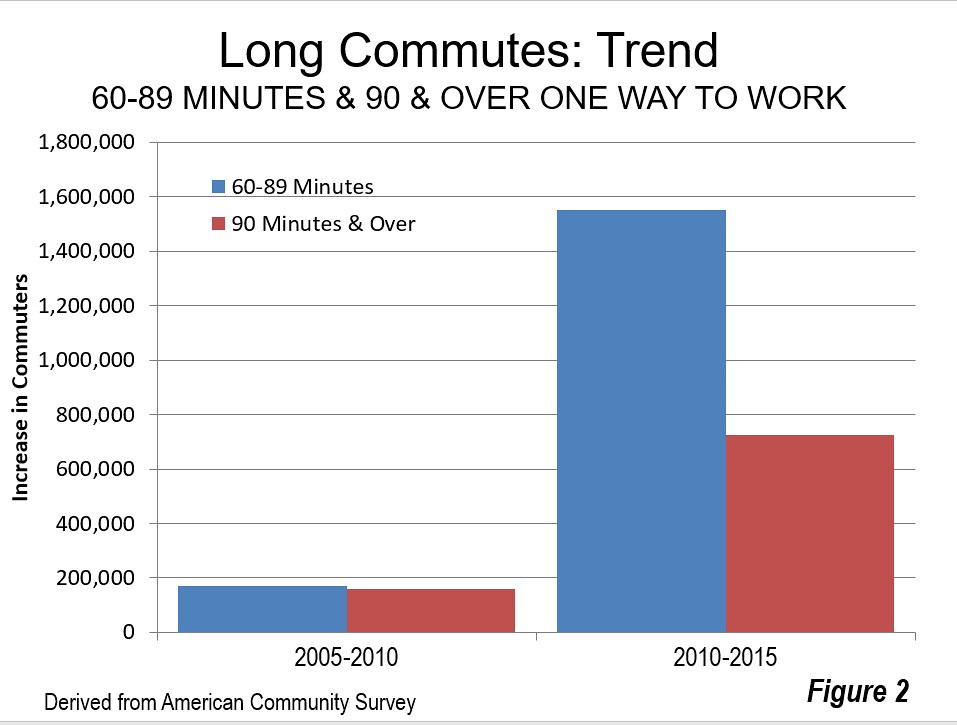
    However, there was a substantial increase in the trend after 2010. Between 2010 and 2015, the share of residents commuting 90 minutes or more increased 725,000, a market share increase of 13.6 percent. There was an increase of 1,550,000 among residents traveling from 60 minutes to 89 minutes, a market share increase of 12.5 percent (Figure 2). This combined increase of nearly 2.3 million 60 minutes plus commuters is substantial. It is more people that commute to work in the San Francisco metropolitan area (not counting those who work at home) and a larger number than the commuters in all but 10 of the nation’s metropolitan areas.

    This continuing dispersion is also indicated in data from the City Sector Model, which shows that suburban and exurban areas continued to attract 80 percent of the new jobs after 2010 (see “America’s Most Suburbanized Cities” and “Suburbs (Continue to) Dominate Jobs and Job Growth”).

    Comparisons by Mode of Travel

    Data by mode of travel is available only at the 60 minutes and over level, and for just 132 of the metropolitan areas. The percentage of those driving alone for 60 or more minutes is lower than the overall 9.0 percent average, at 7.0 percent. Car and van pool commuters are 60 plus commuters 10.7 percent of the time.

    Transit has a far higher level of 60 plus commuting, 38.3 percent at the national level. This is 5.5 times the rate of people driving alone (7.0 percent). While this may be surprising, it is consistent with what is obvious about transit commuting — that it takes about twice as long as commuting by car. And, transit provides scant job access compared to cars, even in the largest, best served metropolitan areas. On average, major metropolitan area resident can reach more than 40 times as many jobs in 30 minutes by car as by transit (the overall one-way work trip travel time is 26 minutes).

    Indeed, among the six metropolitan areas with the “legacy” cores that attract approximately 55 percent of the transit commute destinations in the nation, transit riders much more likely to travel 60 minutes or more to work than those who drive alone. In Philadelphia, the ratio is 3.8, while New York and Chicago transit commuters are 3.6 times as likely to travel 60 minutes or more than those who drive alone. In Boston the figure is 3.1 and San Francisco is 3.0. The smallest difference is in Washington, where transit commuters are only 2.4 times as likely to commute more than one hour than those who drive alone (Figure 3).

    In fact, transit commuters were more likely to travel 60 minutes or more to work than those who drive alone in all of the 53 major metropolitan areas (Table). New York has the largest share of residents commuting 60 minutes or more, at 21.4 percent. Washington is second, at 17.3 percent, San Francisco at 17.0 percent, Riverside-San Bernardino, which is adjacent to Los Angeles, at 16.9 percent and Boston at 14.8 percent. Buffalo, Salt Lake City, Oklahoma City, Kansas City and Milwaukee have the smallest share of their residents traveling 60 minutes or more to work, ranging from 2.5 percent to 2.7 percent.

    More Dispersion?

    The Times article that suggests that the increasing flexibility of companies toward full time working at home could permit people to disperse even more. Despite press reports that working at home is declining, its prospects look good. From 2014 to 2015, working at home experienced the largest increase of any work access mode except driving alone. The increase in work at home was 300,000, while the work at home share rose 5 percent in a single year according to ACS data. Moreover, Global Workplace Analytics reports a 115 percent increase in regular working at home among the non-self employed workforce since 2005, 10 times the increase in the workforce.

    These trends indicate that dispersion is continuing in US metropolitan areas as well as between metropolitan areas, as people seek better standards of living.

    Additional Data

    90 and Over Commute Shares by Metropolitan Area

    60 and Over Commute Shares by Mode by Metropolitan Area

    COMMUTE TIMES 60 & OVER MINUTES BY MODE
    US Major Metropolitan Areas: 2015
    Share by Mode
    All Workers Rank (Longest to Shortest) Drive Alone Transit Transit X Drive Alone
    UNITED STATES 9.0% 7.0% 38.3%          5.46
    Atlanta, GA 13.3%                    7 12.1% 40.5%          3.36
    Austin, TX 7.2%                  24 6.5% 27.9%          4.32
    Baltimore, MD 12.0%                    9 9.5% 46.2%          4.85
    Birmingham, AL 6.5%                  31 5.7% 30.0%          5.31
    Boston, MA-NH 14.8%                    5 11.8% 36.6%          3.11
    Buffalo, NY 3.4%                  53 2.5% 18.0%          7.21
    Charlotte, NC-SC 7.1%                  26 6.3% 33.7%          5.38
    Chicago, IL-IN-WI 14.4%                    6 11.0% 38.7%          3.50
    Cincinnati, OH-KY-IN 4.8%                  42 4.1% 31.7%          7.68
    Cleveland, OH 4.9%                  41 3.7% 33.0%          9.00
    Columbus, OH 4.2%                  46 3.7% 25.1%          6.80
    Dallas-Fort Worth, TX 8.7%                  16 7.7% 43.6%          5.65
    Denver, CO 7.8%                  21 6.2% 38.0%          6.18
    Detroit,  MI 6.8%                  30 6.1% 42.5%          6.95
    Grand Rapids, MI 4.3%                  45 3.6% 25.5%          7.04
    Hartford, CT 5.0%                  38 4.5% 23.0%          5.09
    Houston, TX 11.9%                  10 11.0% 39.0%          3.55
    Indianapolis. IN 5.0%                  39 4.6% 39.4%          8.64
    Jacksonville, FL 5.6%                  34 4.6% 39.6%          8.56
    Kansas City, MO-KS 3.6%                  50 3.2% 21.1%          6.51
    Las Vegas, NV 4.6%                  43 2.5% 45.9%        18.65
    Los Angeles, CA 12.5%                    8 10.8% 40.6%          3.77
    Louisville, KY-IN 4.4%                  44 3.6% 31.3%          8.60
    Memphis, TN-MS-AR 3.8%                  48 3.3% 37.1%        11.25
    Miami, FL 10.0%                  13 8.3% 43.1%          5.23
    Milwaukee,WI 3.8%                  49 2.7% 27.2%          9.89
    Minneapolis-St. Paul, MN-WI 5.5%                  37 4.5% 21.2%          4.68
    Nashville, TN 8.2%                  18 7.7% 29.6%          3.84
    New Orleans. LA 7.9%                  20 6.7% 37.9%          5.64
    New York, NY-NJ-PA 21.4%                    1 11.9% 42.1%          3.54
    Oklahoma City, OK 3.6%                  51 3.1% 7.5%          2.40
    Orlando, FL 6.9%                  28 5.6% 42.8%          7.66
    Philadelphia, PA-NJ-DE-MD 11.4%                  12 9.0% 33.8%          3.78
    Phoenix, AZ 6.8%                  29 5.3% 41.9%          7.95
    Pittsburgh, PA 8.0%                  19 7.3% 20.3%          2.77
    Portland, OR-WA 7.4%                  23 5.2% 28.9%          5.59
    Providence, RI-MA 9.1%                  15 7.3% 54.7%          7.47
    Raleigh, NC 6.0%                  32 5.0% 42.8%          8.61
    Richmond, VA 4.9%                  40 4.0% 33.1%          8.17
    Riverside-San Bernardino, CA 16.9%                    4 15.0% 48.5%          3.25
    Rochester, NY 4.0%                  47 3.1% 32.7%        10.43
    Sacramento, CA 7.6%                  22 6.5% 34.7%          5.37
    St. Louis,, MO-IL 5.8%                  33 4.6% 36.3%          7.85
    Salt Lake City, UT 3.5%                  52 2.1% 23.3%        11.34
    San Antonio, TX 6.9%                  27 5.8% 41.5%          7.17
    San Diego, CA 7.2%                  25 5.6% 37.5%          6.73
    San Francisco-Oakland, CA 17.0%                    3 12.5% 37.2%          2.97
    San Jose, CA 9.4%                  14 7.5% 48.1%          6.43
    Seattle, WA 11.8%                  11 8.9% 33.6%          3.78
    Tampa-St. Petersburg, FL 8.4%                  17 7.9% 33.2%          4.22
    Tucson, AZ 5.5%                  36 3.7% 29.5%          7.99
    Virginia Beach-Norfolk, VA-NC 5.6%                  35 4.8% 40.1%          8.35
    Washington, DC-VA-MD-WV 17.3%                    2 13.9% 35.7%          2.57
    Derived from American Community Survey, 2015

    Wendell Cox is principal of Demographia, an international public policy and demographics firm. He is a Senior Fellow of the Center for Opportunity Urbanism (US), Senior Fellow for Housing Affordability and Municipal Policy for the Frontier Centre for Public Policy (Canada), and a member of the Board of Advisors of the Center for Demographics and Policy at Chapman University (California). He is co-author of the “Demographia International Housing Affordability Survey” and author of “Demographia World Urban Areas” and “War on the Dream: How Anti-Sprawl Policy Threatens the Quality of Life.” He was appointed to three terms on the Los Angeles County Transportation Commission, where he served with the leading city and county leadership as the only non-elected member. He served as a visiting professor at the Conservatoire National des Arts et Metiers, a national university in Paris.

    Photograph: New Jersey Transit Commuter Train (by author)

  • The Great Train Robbery: Urban Transportation in the 21st Century

    Below is an excerpt from a new report published by the Chapman University Center for Demographics and Policy titled, “The Great Train Robbery: Urban Transportation in the 21st Century.” Read the full report (pdf) here.

    Productive cities could not exist without transportation. Economic performance and job creation in a city — by which we mean a metropolitan area — generally improve when people can reach more job destinations more rapidly. Over time, the ways in which people have reached their worksites has changed. In the distant past, nearly all people walked. Later, they relied on mass transit. Now, people in metropolitan areas rely primarily on cars for transportation to their jobs.

    However, in some cities, transit remains both critical and effective.
    These are metropolitan areas with strong historic — legacy — urban cores, which include large, downtown central business districts or CBDs. This is most notable in New York’s central business district, which accounts for a dominant 40 percent of all transit work trip destinations in the country, despite having only two percent of the nation’s jobs.

    Overall, barely 5.2 percent of all commuter trips nationally are on some form of mass transit. Among the nation’s 53 major metropolitan areas (places with over 1,000,000 population), only 11 exceed this 5.2 percent average.

    Read the full report here.

  • Transit’s Precipitous Decline

    Transit ridership in the first quarter of 2017 was 3.1 percent less than the same quarter in 2016, according the American Public Transportation Association’s latest ridership report. The association released the report without a press release, instead issuing a release complaining about the House Appropriations bill reducing funding for transit.

    The ridership report is devastating news for anyone who believes transit deserves more subsidies. Every heavy-rail system lost riders except the PATH trains between Newark and Manhattan and the Patco line between Camden and Philadelphia. Commuter rail did a little better, mainly because of the opening of Denver’s A line and trend-countering growth of riders on the Long Island Railroad. Most light-rail lines lost riders, though surprisingly many streetcar lines gained riders.

    In most cases where light-rail ridership grew, it did so at the expense of bus ridership. Los Angeles Metro gained 1.66 million light-rail riders but lost 8.73 million bus riders, or more than five for every new light-rail rider. Between the two modes, Phoenix’s Valley Metro lost 23,100 riders; Charlotte 20,200 lost riders; and Dallas Area Rapid Transit lost 193,100 riders. Similarly, Orlando’s commuter trains gained 22,700 riders but buses lost 98,500.

    Houston and Minneapolis-St. Paul lost bus riders but not quite as many as they gained in light-rail riders. Houston gained 192,100 light-rail riders but lost 154,200 bus riders. Minneapolis gained 337,000 light-rail riders but lost 270,000 bus riders. Only Seattle scored a large increase in light-rail riders (thanks to an expensive new line that opened March 16, 2016) without an offsetting decline in bus ridership.

    Many individual transit agencies suffered particularly catastrophic declines. Broward County (Fort Lauderdale), which wants to build a $200 million streetcar line, lost 12.8 percent of its transit riders. San Jose’s VTA, the agency I’ve sometimes called the worst-managed transit agency in the country, lost 11.9 percent. Birminghan lost 9.8 percent; Cleveland lost 7.9 percent; and San Diego lost 6.2 percent. In San Francisco, Muni lost 6.4 percent, BART lost 5.6 percent, SamTrans lost 8.9 percent, AC Transit (Oakland) lost 0.8 percent, and Central and Eastern Contra Costa County lost more than 7.0 percent.

    One factor contributing to the losses might be that 2016 was leap year, so its first quarter had 1.1 percent more days than 2017. But both quarters had exactly the same number of work days (62 or 64 depending on whether you count King’s Birthday and President’s Day as holidays or work days), so leap day counted for less than it might have.

    Many of these losses are just a continuation of trends that began in 2009 or earlier. As the Antiplanner noted last month, several major transit agencies lost 25 to 35 percent of their riders between 2009 and 2016, and most of these continued to lose in 2017. Moreover, none of the factors that led to these declines–low fuel prices, high auto ownership rates, rising costs, increasing competition from ride-hailing services–are going away, and some are only going to get worse.

    Since 1970s, the transit industry has received well over a trillion dollars in subsidies while seeing a 20 percent drop in the average number of rides urban resident take each year. All this should lead Congress and state legislatures to question why taxpayers ought to continue subsidizing this fast declining industry.

    This piece first appeared on The Antiplanner.

    Randal O’Toole is a senior fellow with the Cato Institute specializing in land use and transportation policy. He has written several books demonstrating the futility of government planning. Prior to working for Cato, he taught environmental economics at Yale, UC Berkeley, and Utah State University.

    Photo by METRO96 [CC BY-SA 3.0], via Wikimedia Commons

  • Should Transit Fares Cover Operating Costs?

    Maryland has long had a state law requiring transit systems to collect enough fares to cover at least 35 percent of their operating costs. While it is admirable to set a target, this particular target is disheartening for two reasons.

    First, 35 percent is a pretty low goal. The 2015 National Transit Database lists 48 transit operations that cover between 100 and 200 percent of their costs, including New York ferries, the Hampton Jitney, several other bus lines, and a bunch of van pooling systems. No rail lines cover 100 percent of their operating costs, but BART covers 80 percent, Caltrains covers 72 percent, New York and DC subways cover 64 percent, and New York commuter trains cover 60 percent. On average, commuter bus and commuter rail systems earn half their operating costs. So 35 percent lacks ambition.

    Even worse, most Maryland transit operations don’t come close to meeting the target. Maryland commuter trains cover 45 percent of their costs. But Baltimore’s light rail only covers 17 percent, and its heavy rail covers a pathetic 13 percent. Standard bus service also covers just 13 percent of its costs, though commuter buses come closer to the target, reaching 28 percent.

    Maryland lawmakers have figured out a solution to the second problem, if not the first. They simply passed a bill abolishing the target. Now, transit advocates hope, the state can spend even more money building obsolete transit systems that won’t be able to afford to maintain because they can’t even cover a third of their operating costs.

    Transit is “not profitable,” said one advocate, “but it’s essential for an economically competitive region.” Just how economically competitive has Baltimore been since it sunk billions of dollars into light- and heavy-rail lines that don’t cover even a fifth of their operating costs? Maryland certainly won’t make itself more economically competitive by increasing the tax burden still further so they can build more obsolete transit lines.

    Failing to cover costs isn’t a symptom that you are economically competitive. It is a symptom that you’ve failed to provide things that people need and want. The Antiplanner can understand why people think we need to subsidize food stamps or other aid to low-income people. I can’t understand why people think nothing of throwing huge amounts of money towards marketable operations like transit.

    C. Northcote Parkinson, the author of Parkinson’s Law, said that organizations that set goals low so they would be easy to meet were suffering from a disease he called injelititis. The transit industry has been suffering from this disease since the mid-1960s, when it discovered it could live off the public trough rather than actually have to provide services that people want. Once this disease reached its late stages, he said, the only cure required “a change of name, a change of site, and an entirely different staff.”

    There’s still a chance that Maryland’s governor may veto the bill. Let’s hope he does.

    This piece first appeared on The Antiplanner.

    Randal O’Toole is a senior fellow with the Cato Institute specializing in land use and transportation policy. He has written several books demonstrating the futility of government planning. Prior to working for Cato, he taught environmental economics at Yale, UC Berkeley, and Utah State University.

  • New Infrastructure in Sub-Saharan Africa

    This post will be continuously updated as we learn about new projects.

    On the three main vectors of wealth creation, African countries have lagged other developing nations for several decades. Sub-Saharan Africa is the poorest region of the world and suffers from poor infrastructure, uneven literacy, endemic corruption, political instability and war. While this is problematic for the present, improving conditions are pointing to a more promising future.

    In particular, sub-Saharan Africa could have a unique opportunity to realize a demographic dividend if its elevated fertility rate and dependency ratio decline in the same way as have those of other countries in the past.

    The experience of China shows that a significant dividend can be reaped if other conducive factors are also present. Most important among them are a growing workforce that is more literate and productive, and an institutional framework that is supportive of economic development.

    Innovation-based productivity gains as we understand them in the West can be scarce in the poorest developing countries. But productivity can be improved quickly through educational programs and through well targeted infrastructure projects.

    There is much to do given that Africa has a large infrastructure deficit. A World Bank Fact Sheet provides the following numbers:

      • Electricity: The 48 countries of Sub-Saharan Africa (with a combined population of 800 million) generate roughly the same amount of power as Spain (with a population of 45 million).

      • Roads: Only one-third of Africans living in rural areas are within two kilometers of an all-season road, compared with two-thirds of the population in other developing regions.

      • Water: Water storage capacity is currently 200 cubic meters per capita and needs to increase to at least 750 cubic meters per capita, a level currently found only in South Africa. Only six million hectares, concentrated in a handful of countries, are equipped for irrigation. Though less than five percent of Africa’s cultivated area, the irrigation-equipped area represents 20 percent of the value of agricultural production.

      • The cost of redressing Africa’s infrastructure deficit is estimated at US$38 billion of investment per year, and a further US$37 billion per year in operations and maintenance; an overall price tag of US$75 billion. The total required spending translates into some 12 percent of Africa’s GDP. There is currently a funding gap of US$35 billion per year.

      Below are some recently announced projects in sub-Saharan Africa that will likely have a large impact on nearby populations. (Some of the links are behind a paywall).

      Uganda-Tanzania pipeline

      Tanzania and Uganda signed on May 26 an intergovernmental agreement for the construction of the world’s longest electrically heated crude-oil export pipeline, which is being designed by Houston-based Gulf Interstate Engineering Co.


      The 1,445-kilometer East Africa Crude Oil Pipeline (EACOP) project, which is being developed by France’s Total SA, China’s CNOOC and UK’s Tullow Oil, would enable the commercialization of the estimated 6.5 billion barrels of crude-oil reserves in Uganda’s Albertine basin. (link)

      Tanzania rail project

      A joint venture of Portuguese and Turkish construction firms has been awarded a $1.2-billion contract for a new 202-kilometer, single-track, 1,435-millimeter-gauge railway line, in Tanzania. The segment is part of the 1631-km Dar es Salaam-Isaka-Kigali and Keza-Musongati railway project connecting the country to neighboring Burundi and Rwanda. (link)

      Landlocked Ethiopia seeking stake in Somali port

      Ethiopia is in talks to acquire shares in a joint venture involving DP World Ltd. that will manage a port in northern Somalia, a Somali official said, a move that could give the fast-growing yet landlocked Horn of Africa economy its first stake in foreign docks. (link)

      Mozambique suspension bridge

      Chinese crews, with the help of German supervisors, are building what will be Africa’s largest suspension bridge, in Mozambique. Slated for completion in the third quarter of this year, the 3,003-meter-long, $725-million Maputo Bridge and Link Roads project will strengthen north-south connections and provide a new road link to South Africa and Swaziland. (link)

      East African Power Plant

      Two foreign-led consortiums have been awarded contracts to build the East Africa-sited, 80-MW Rusumo hydropower project, which is intended to reduce electricity costs and promote renewable power in Tanzania, Rwanda and Burundi. (link)

      Rwanda Airport

      The South African subsidiary of a Portuguese civil construction company has won a two-phase, $818-million contract to construct Bugesera International Airport in Rwanda under a build-own-operate-transfer model, with a view to turning it into central Africa’s premier air transport hub by 2018. (link)

      Tallest Building in Africa

      Kenyan President Uhuru Kenyatta recently laid the foundation stone for what will be the tallest building in Africa in the Upper Hill neighborhood of Nairobi. Construction is underway at the development site, and slated for completion by December 2019.


      The ambitious project will see twin glass-facade towers rise above the city, the larger standing at 300 meters tall, far surpassing the continent’s current leader — Johannesburg’s 223-meter Carlton Centre. (link)

      Zimbabwe Road Expansion

      Zimbabwe has signed an agreement with a Chinese-Austrian consortium to resume the delayed $2.7-billion rehabilitation and expansion of the 971-kilometer Beitbridge-Harare-Chirundu highway, which links landlocked Zimbabwe and Zambia to the ports of Durban and Richards Bay in South Africa. (link)

      Dams in Ethiopia

      Italy’s Milan-based industrial group Salini Impregilo has been awarded a $2.8-billion hydropower project by the Ethiopian Electric Power Corp., a state-controlled company that produces, transmits, distributes and sells electricity in Ethiopia.


      The contract involves the construction, with financing from Italy’s credit agency Servizi Assicuative de Commerce Estero, of the 2,200-MW Koysha Dam on the Omo River in the southern part of the country.


      Salini currently is constructing Ethiopia’s 6,000-MW Grand Ethiopian Renaissance Dam, which, when commissioned in 2017, will be Africa’s largest and the world’s No. 11 largest hydropower project. The Italian construction firm last year completed the 1,870-MW Gibe III hydroelectric power project at a cost of $1.6 billion. (link)

      These are only a few examples of the new infrastructure in Africa. The need for new roads, power plants, rail connections, harbors, water and wastewater facilities, telecommunications etc. is very large and presents a significant opportunity for investors, under the proper governance preconditions.

      This piece originally appeared on Populyst.

      Sami Karam is the founder and editor of populyst.net and the creator of the populyst index™. populyst is about innovation, demography and society. Before populyst, he was the founder and manager of the Seven Global funds and a fund manager at leading asset managers in Boston and New York. In addition to a finance MBA from the Wharton School, he holds a Master’s in Civil Engineering from Cornell and a Bachelor of Architecture from UT Austin.

      Photo: Al Gesh Road, Sahara. (Photo by KaiAbuSir via Wikimedia Commons)

  • Want to be Green? Forget Mass Transit. Work at Home.

    Expanding mass-transit systems is a pillar of green and “new urbanist” thinking, but with few exceptions, the idea of ever-larger numbers of people commuting into an urban core ignores a major shift in the labor economy: More people are working from home.

    True, in a handful of large metropolitan regions — what we might call “legacy cities” — trains and buses remain essential. This is particularly true of New York, which accounts for a remarkable 43% of the nation’s mass-transit commuters, and of other venerable cities, such as San Francisco, Washington, Boston, Philadelphia and Chicago. Together, these metros account for 56% of all mass-transit commuting. But for most of the rest of the country, transit use — despite often-massive infrastructure investment — has either stagnated or declined. Among the 21 metropolitan areas that have opened substantially new urban-rail systems since 1970, mass transit’s share of work trips has declined, on average, from 5.3% to 5%. During the same period, the drive-alone share of work trips, notes demographer Wendell Cox, has gone up from 71.9% to 76.1%.

    Meantime, the proportion of the labor force working from home continues to grow. In 1980, 2.3% of workers performed their duties primarily at home; by 2015, this figure had doubled to 4.6%, only slightly behind the proportion of people who commute via mass transit. In legacy core-metropolitan statistical areas (MSAs), the number of people working from home is not quite half that of those commuting by transit. In the 47 MSAs without legacy cores, according to the American Community Survey, the number of people working from home was nearly 250% higher than people going to work on trains or buses.

    In the greater Los Angeles area, roughly 1.5% of people worked from home in 1980; today about 5% do. Meanwhile, despite significant expenditures, the share of people using mass transit went from slightly over 5% to slightly less than 5%.

    The areas with the thickest presence of telecommuters — including cities such as Austin, Raleigh-Durham, San Diego, Denver, and Seattle — tend to have the greatest concentration of tech-related industries, which function well with off-site workers. In San Jose, the epicenter of the nation’s tech industry, 4.6% of people work from home, exceeding the 3.4% who take mass transit. Other telecommuting hot spots include college towns like Boulder, where over 11.6% of workers work from home, and Berkeley, where the share is 10.6%.

    Leading telecommuting centers tend to be home to many well-educated, older and wealthy residents. Communities such as San Clemente, Newport Beach and Encinitas in Southern California, as well as Boca Raton in Florida, all have telecommuting shares over 10%. Perhaps older, well-connected people are more inclined to avoid miserable commutes, given the chance to do so. As the American population skews older, the economy will likely see more workers making such choices.

    Another important demographic force contributing to the work-from-home inclination is Americans’ continuing move to lower-density cities, which usually lack effective transit, and to the suburbs and exurbs — where 81% of job growth occurred between 2010 and 2014. While most metropolitan regions can be called “polycentric,” they are actually better described as “dispersed,” with central business districts (CBDs) and suburban centers (subcenters) now accounting for only a minority of employment. By 2000, more than three-quarters of all employment in metropolitan areas with populations higher than 1 million was outside CBDs and subcenters.

    Home-based work could be the logical extension of this dispersal — and modern technologies, from ride-sharing services to automated cars, will probably accelerate the trend. A recent report by the global consulting firm Bain suggested that greater decentralization is likely in the coming decades. A 2015 National League of Cities report observes that traditional nine-to-five jobs are on the decline and that many white-collar jobs will involve office-sharing and telecommuting in the future. The report also predicts that more workers will act as “contractors,” taking on multiple positions at once.

    Some see these developments as ominous, but greens and urbanists shouldn’t: Telecommuting will, among other things, reduce pollution. It may be that the shift to home-based work will prove the ultimate in mixed use — albeit for workers in their pajamas.

    This piece originally appeared on the Los Angeles Times.

    Joel Kotkin is executive editor of NewGeography.com. He is the Roger Hobbs Distinguished Fellow in Urban Studies at Chapman University and executive director of the Houston-based Center for Opportunity Urbanism. His newest book is The Human City: Urbanism for the rest of us. He is also author of The New Class ConflictThe City: A Global History, and The Next Hundred Million: America in 2050. He lives in Orange County, CA.

    Photo from Picjumbo.