Tag: Transportation

  • Fresh Winds Blowing on California High Speed Rail

    For California’s beleaguered high-speed rail project, last week brought plenty of  surprises and challenges.  Dominating the headlines were the resignations of several top officials of the High-Speed Rail Authority (CHSRA). Among them were board chairman Tom Umberg, CEO Roelof van Ark, board member Matthew Toledo, Deputy Director (Environment) Dan Leavitt and press secretary Rachel Wall. Dan Richard, a respected and trusted advisor of Gov. Jerry Brown, appointed to the Board last year, is expected to assume chairmanship of the Board (Umberg remains as a member of the board).

    The past week also saw the release of a fresh critique of CHSRA’s business plan and an avalanche of criticism by influential commentators and analysts. The critique, entitled Twelve Misleading Statements on Finance and Economic Issue in the CHSRA’s Draft 2012 Business Plan, received wide distribution among state legislators and senior officials in Gov. Brown’s administration. It was authored by a group of independent experts who have closely followed the project over the past two years — Alain C. Enthoven, William C. Grindley, William H. Warren, Michael G. Brownrigg and Alan H. Bushell. The report challenges methodically one by one the credibility of the business plan’s key assumptions concerning the project’s construction costs and financing; revenues, ridership and operational costs; and societal benefits. (http://www.cc-hsr.org)

    Last week’s press commentaries added to the climate of skepticism that is increasingly engulfing the project. In close succession, there appeared a January 8 column by the well known Sacramento Bee columnist, Dan Walters (It’s Time to Kill California’s Bullet Train Boondoggle); a January 9 op-ed in The Washington Post by the newspaper’s editorial writer Charles Lane (California’s High-Speed Rail to Nowhere); and a January 10 piece in The Wall Street Journal by Wendell Cox and Joseph Vranich (California’s High-Speed Rail Fibs).

    An Orange County Register editorial on January 12 further underscored the widespread opposition to the project by the state’s newspapers. The editorial sounded alarm about legislative attempts to fast-track the HSR project by exempting it from environmental review (Rep. Feuer’s Assembly Bill 1444) Waiving environmental regulations can speed project approval and undermine legal challenges, pointed the editorial. The HSR project already faces multiple court challenges on environmental grounds, with more suits likely.

    Even the Sierra Club has turned critical."The draft business plan does not leave us feeling optimistic about the viability of the current high-speed rail program," wrote Kathryn Phillips, Director of Sierra Club California in a January 13 letter to the Authority. "We urge the HSRA to reconsider its business plan."

    Departure of key personnel could mark a new beginning

    The unexpected departure of the Authority’s top officials has added to a series of reversals experienced by the project in recent days. Most damaging has been a scathing report by the independent Peer Review Group that pronounced the Authority’s plan "not financially feasible" and warned of "immense financial risk."  Adding to it has been a growing chorus of skeptical lawmakers and further news of declining public support (a SurveyUSA news poll showing only 33% of voters in favor of the bond sale).

    The abrupt mass resignations of senior management are seen as a bid by Governor Brown to assert a tighter control over a project that is facing a critical first test later this spring when the legislature will be asked to vote the first $2.7 billion in bonds to start the initial 130-mile stretch of the line in the Central Valley. Last week, Brown also announced that he intends to fold the Authority into a new state transportation agency, thus placing the project under more direct supervision of the Governor.

    So far, Gov. Brown has maintained steadfast support of the project, but his recent actions suggest that he is sensitive to public opinion and to the political winds blowing from the state capitol. Many lawmakers, some from the Governor’s own party, counsel against rushing ahead with construction and suggest taking the time to thoroughly rethink the business plan. They include Sen. Alan Lowenthal (D), chairman of the select committee on high-speed rail; Sen. Mark DeSaulnier (D), chairman of the transportation committee; and Sen. Joe Simitian (D), chairman of the budget subcommittee overseeing transportation. The dim prospects for any further federal funds or for private money to support the project beyond the "Initial Construction Section" must also weigh heavily in the Governor’s assessment of the project’s long-term viability.  

    In the meantime, changes may be expected in the Rail Authority’s management style. Those who know the incoming chairman well look forward to an agency that will be less confrontational, more respectful of its critics and more attentive to the legislators. They hope the Authority will be more willing to reach out and build bridges to citizen groups and will assert more control over its contractors.

    Only time will tell whether last week’s events represent a true turning point for this divisive initiative. However, multiple signs coming out of Sacramento give people reasons to hope that real changes in direction are indeed underway.

    Ken Orski has worked professionally in the field of transportation for over 30 years.

    CA route map by Wikipedia user CountZ.
  • A Devastating Verdict for California HSR

    Like many other observers, we have found the California High-Speed Rail Peer Review Group to have made a convincing case for a fresh look at the feasibility of the California high-speed rail project. The group’s report was issued as eleven House Democrats – eight from California – joined an earlier request from twelve Republican House members for an independent GAO investigation of the embattled project. 

    That is why we find Governor Brown’s reaction – that the peer reviewers’ report "does not appear to add any arguments that are new or compelling enough to suggest a change of course” – to be incomprehensible. Either the governor issued the statement without the benefit of having read the report, or else he is so ideologically committed to the project that he refuses to look the facts in the face.

    Precisely which conclusions of the report are not compelling enough, the governor’s spokesman has not made clear. Is it the statement that "the Funding Plan fails to identify any long term funding commitments" and therefore "the project as it is currently planned is not financially feasible"?

    Is it the reviewers’ assertion that "the [travel] forecasts have not been subject to external and public review" and, absent such an open examination, “they are simply unverifiable from our point of view"?

    Could it be their statement that "the ICS [Initial Construction Section] has no independent utility other than as a possible temporary re-routing of the Amtrak-operated San Joaquin service…before an IOS [Initial Operating Segment] is opened"?

    Or, is it the Panel’s conclusion that "…moving ahead on the HSR project without credible sources of funding, without a definitive business model, without a strategy to maximize the independent utility and value to the State, and without the appropriate management resources, represents an immense financial risk on the part of the State of California?"

    To us, the findings seem at least deserving of a respectful consideration.

    But the California High-Speed Rail Authority (CHSRA) is not ready to concede anything. Here is the opening paragraph of its response: 

    "While some of the recommendations in the Peer Review Group report merit consideration, by and large this report is deeply flawed, in some areas misleading and its conclusions are unfounded. …Although some high-speed rail experience exists among Peer Review Panel members, this report suffers from a lack of appreciation of how high-speed rail systems have been constructed throughout the world, makes unrealistic and unsubstantiated assumptions about private sector involvement in such systems and ignores or misconstrues the legal requirements that govern construction of the high speed rail program in California."

    It is not our intention to delve in detail into the Authority’s response and judge the soundness of its arguments. No doubt, the CHSRA response will come under a detailed examination by the Authority’s critics in the days ahead. Suffice it to say that, having carefully and with an open mind examined the Authority’s rambling nine-page response, we find that it did not satisfactorily rebut the peer group’s central point: that it is not prudent, nor "financially feasible," to proceed with the $6 billion dollar rail project in the Central Valley (including $2.7 billion in Proposition 1A bonds) in the absence of any identifiable source of funding with which to complete even the Initial Operating Segment. To do so, would be to expose the state to the risk of being stuck, perhaps for many years, with a rail segment unconnected to major urban areas and unable to generate sufficient ridership to operate without a significant state subsidy. 

    The Authority’s lashing out at the peer reviewers and the dismissive tone of its response suggest that it has already made up its mind to stay the course and circle the wagons. That is not a wise posture to assume in the face of an already skeptical state legislature. 

  • What Lies Ahead for Transportation in 2012?

    As befits this time of year, our thoughts turn to the events that await us in the days ahead. Putting aside the major imponderable — the outcome of the presidential and congressional elections that inevitably will impact the federal transportation program —what can the transportation community expect in 2012? Will Congress muster the will to enact a multi-year surface transportation reauthorization? Or will the legislation fall victim to election year paralysis? What other significant transportation-related developments lie ahead in the new year? Here are our speculations as we gaze into our somewhat clouded crystal ball.

    Will Congress enact a multi-year transportation bill?

    In 2011, the Senate Environment and Public Works (EPW) Committee passed a bipartisan two-year surface transportation bill (MAP-21) and the Senate Commerce Committee approved the measure’s safety, freight and research components. But at the end of the year, the bill’s titles dealing with public transportation, intercity passenger rail and financing were still tied up in their respective committees (Banking, Commerce and Finance). What’s more, the Senate bill ended up $12 billion short of meeting the $109 billion mark set by the EPW Committee as necessary to maintain the current level of funding plus inflation.

    Finance Committee Chairman Max Baucus (D-MT) has yet to publicly identify the offsets needed to cover the final $12 billion of the bill’s cost. Repeated assurances by EPW committee chairman Sen. Barbara Boxer (D-CA) that the necessary "pay fors" have been found, has met with widespread skepticism. "I’ll believe it when I see it" has been a typical reaction among congressional watchers. With the Republicans opposed to using "gimmicks" (Sen. Orrin Hatch’s words) to come up with the needed money, it’s not entirely clear that the bill, as approved on the Senate floor, will contain the full $109 billion in funding.

    On the House side, the fate of a multi-year bill remains equally clouded. In November, Speaker Boehner announced that he would soon unveil a combined transportation and energy bill, dubbed the "American Energy & Infrastructure Jobs Act" (HR 7). The bill would authorize expanded offshore gas and oil exploration and dedicate royalties from such exploration to "infrastructure repair and improvement" focused on roads and bridges.

    However, questions have been raised about this approach. Critics, including Sen. Barbara Boxer and Sen. James Inhofe (R-OK) EPW committee’s ranking member, judge the approach as problematical. They allege, along with many other critics, that the royalties the House is counting upon would fall billions of dollars short of filling the gap in the needed revenue (the gap is estimated at approximately $75-80 billion over five years). They further contend that the revenue stream from the royalties would not be available in time to fund the multi-year transportation program. What’s more, using oil royalties to pay for transportation would essentially destroy the principle of a trust fund supported by highway user fees. In sum, the House bill, if unveiled in its currently proposed form, will meet with a highly skeptical reception in the Senate.

    Assuming that both reauthorization bills in some form will gain approval in February, will the two Houses be able to reconcile their widely different versions by March 31 when the current program extension is set to expire? Or will the negotiations bog down in an impasse reminiscent of the current payroll tax stalemate? Given the importance that both sides attach to enacting transportation legislation and given the desire of both sides to avoid the blame of causing an impasse, we think the odds are in favor of reaching an accommodation — probably more along the lines of the Senate two-year bill than the still vague and unfunded House five-year version. If this simply kicks the can down the road a couple of years, that may be OK with Senate Republicans. As one senior Senate Republican confidently told us, by the bill’s expiration date the Senate will be in Republican hands and "the true long-term bill will be ours to shape."

    Will California lawmakers pull the plug on the high-speed train?

    In 2011 Congress effectively put an end to the Administration’s high-speed rail initiative by denying any funds to the program for a second year in a row. Does the same fate await the embattled $98 billion California high-speed rail project at the hands of the state legislature in 2012?

    At a December 15 congressional oversight hearing, witnesses cited a litany of reasons why the projects is a "disaster" (Rep. John Mica’s words). Among them: unrealistic assumptions concerning future funding; quixotic choice of location for the initial line section ("in a cow patch," as several lawmakers remarked); lack of evidence of any private investor interest in the project; eroding public support (nearly two-thirds of Californians would now oppose the project if given the chance, according to a recent poll); a "devastating" impact of the proposed line on local communities and farm land; unrealistic and out-of-date ridership forecasts; and lack of proper management oversight.

    More recently, the project came under additional criticism. The job estimates claimed by the project’s advocates ("over one million good-paying jobs" according to House Minority Leader Nancy Pelosi) have been challenged— and acknowledged by project officials— as grossly inflated. Four local governments in the Central Valley, including the City of Bakersfield, have formally voted to oppose the project, fearing harmful effect on their communities. And agricultural interests are gearing up for a major legal battle, according to the Los Angeles Times.

    But most unsettling for the project’s future is the inability of its sponsors to come up with the needed funding. To complete the "Initial Operating Segment" to San Jose (or the San Fernando Valley) would require an additional $24.7 billion. To finance this construction, the California Rail Authority’s business plan calls for $4.9 billion in Proposition 1A bonds and assumes $19.8 billion in federal contributions – $7.4 billion in federal grants and $12.4 billion in the so-called Qualified Tax Credit Bonds (QTCB). But the latter assumptions came in for sharp congressional criticism as so much wishful thinking, given the bipartisan congressional refusal to appropriate funds for high-speed rail two years in a row.

    Further challenges await the project early in 2012. A group of 12 congressmen led by House Majority Whip Kevin McCarthy (R-CA) has formally requested the Government Accountability Office (GAO) to review the project’s viability and "questionable ridership and cost projections." Also expected early in January are a critique of the Authority’s business plan by the Independent Peer Review Group and a follow-up report by the State Auditor.

    Meanwhile, the governor and state legislature, are being asked by the Rail Authority to approve a $2.7 billion bond issue authorized by Proposition 1A to fund and begin construction  of the initial Central Valley section of the rail line from Fresno to Bakersfield. Will they be swayed by the findings of the three respected reviewing bodies and by the increasingly negative editorial and public opinion? Or will they continue to hold on to the seductive vision of bullet trains zooming from northern to southern California in two and a half hours — however distant and uncertain that vision may be? At this point, we believe the decision could go either way. However, sharply critical reports by the Peer Review Group and the General Accountability Office could tip the scale against funding the Central Valley project.

    Will tolling join the gas tax as a mainstream source of highway revenue?

    With the possibility of a near-term gas tax increase "less than zero," attention has turned to alternative means of raising transportation revenue. The most prominent option appears to be tolling— and 2012 may be the year when tolling becomes accepted as a mainstream source of highway revenue.

    Recent toll increases on the nation’s highways attest to their growing use (if not popularity) as revenue enhancers. In New Jersey, tolls are set to rise by 53% on the New Jersey Turnpike and by 50% on the Garden State Parkway. The Port Authority of New York and New Jersey also has approved substantial toll increases on bridges linking the two states. These moves have provoked Sen. Frank Lautenberg (D-NJ) to sponsor a "commuter protection act" that would transfer toll setting powers to the U.S. Secretary of Transportation. But the Senator’s initiative does not appear to have obtained much support in Congress. IBTTA, the toll industry association, has lodged strong objections, arguing that federalizing toll rate setting would encroach on the states’ jurisdiction and interfere with their ability to use tolls as a tool of infrastructure financing, and Congress appears to be listening.

    A recent Reason Foundation poll has found that people are more willing to pay tolls than increased fuel taxes (by a margin of 58 to 28 percent.) Moreover, the formation of a new "U.S. Tolling Coalition" suggests a growing interest in tolling on the part of the states. Under a pilot program that allows up to three Interstate highways to be reconstructed with tolls, Virginia will add tolls along the I-95 corridor and Missouri will toll its stretch of I-70. Arizona and North Carolina have applied for the remaining slot in the pilot program. Other states are embracing tolling to finance new capacity. Washington State, for example, has begun tolling the SR-520 floating bridge over Lake Washington to help pay for its replacement. Nor is the practice of tolling confined just to a few states. All told, 35 states already depend on toll revenue to some extent.  

    The Tolling Coalition wants to expand the pilot program and give the states the flexibility to toll any portions of their Interstate and other federal highways, "whether for new capacity, system preservation, or reconstruction." So far, neither the Senate nor the House have agreed to relax existing prohibitions, but they are prepared to retain the current pilot program.

    However, the need to reconstruct and modernize the existing Interstates which are reaching the end of their 50-year design life, combined with the necessity to expand capacity of the Interstate highway system to meet the needs of an expanding population, may soften congressional opposition to relaxing the current Interstate tolling restrictions. With the gas tax no longer able to meet the nation’s transportation investment needs, and with the concept of a VMT (vehicle-miles travel) fee still a distant vision, the year 2012 could mark a turning point in the acceptance of tolling as a serious highway revenue enhancer.

    ###

    Note: the NewsBriefs can also be accessed at www.infrastructureUSA.org
    A listing of all recent NewsBriefs can be found at www.innobriefs.com

  • New Geography’s Most Popular Stories of 2011

    As our third full calendar year at New Geography comes to a close, here’s a look at the ten most popular stories in 2011. It’s been another year of steady growth in readership and reach for the site.  Thanks for reading and happy new year.

    10.  The Other China: Life on the Streets, A Photo Essay Argentinean architect and photographer Nicolas Marino offers a set of stunning photographs from the streets of Chengdu and Shanghai.

    9.  Six Adults and One Child in China Emma Chen and Wendell Cox outline the rising numbers of elderly and increasing age dependency ratios in China and across the globe.  Chen and Cox outline a number of solutions, including “extending work and careers into the 70s; means tested benefits; greater incentives for having children; and measures to keep housing more affordable and family friendly,” but conclude “the ultimate issue will be maintaining economic growth.”

    8.  The Texas Story is Real Aaron Renn takes a look at a number of broad-based economic measures of Texas over the past decade. He finds that “While every statistic isn’t a winner for Texas, most of them are, notably on the jobs front. And if nothing else, it does not appear that Texas purchased job growth at the expense of job quality, at least not at the aggregate level.”

    7.  Let’s Face it High Speed Rail is Dead and Obama’s High Speed Rail Obsession Aaron Renn and Joel Kotkin look at high speed rail in America from two angles, Renn from the practical and Kotkin from the political.  According to Renn: “In short, it’s time to stop pretending we are going to get a massive nationwide HSR rail network any time soon.  Advocates should instead focus on building a serious system in a demonstration corridor that can built credibility for American high speed rail, then built incrementally from there.” Kotkin’s piece also appeared at Forbes.com.

    6.  America’s Biggest Brain Magnets Joel Kotkin and Wendell Cox use American Community Survey data to estimate the biggest gainers of bachelor’s degree holders in U.S. regions.  The big winners:  New Orleans, Raleigh, Austin, Nashville, and Kansas City. This piece also appeared at Forbes.com.

    5.  The Next Boom Towns in the U.S. Joel Kotkin examines the U.S. regions most primed for future growth, based on my analysis of six forward-looking metrics.  “People create economies and they tend to vote with their feet when they choose to locate their families as well as their businesses.  This will prove   more decisive in shaping future growth than the hip imagery and big city-oriented PR flackery that dominate media coverage of America’s changing regions.” The piece also appeared at Forbes.com.

    4.  The Decline and Fall of the French Language Gary Girod wonders if the French language is declining in worldwide significance.

    3.  Census 2010 Offers a Portrait of America in Transition Aaron Renn’s summary of this spring’s new Census 2010 results includes eight county and metropolitan area level maps showing population change and shifts in racial group concentrations.

    2.  The Golden State is Crumbling In this piece, also appearing at The Daily Beast, Joel Kotkin blames California’s stagnancy on self-imposed policy decisions.  While the state has many assets and is rich in promise “the state will never return until the success of the current crop of puerile billionaires can be extended to enrich the wider citizenry. Until the current regime is toppled, California’s decline—in moral as well as economic terms—will continue, to the consternation of those of us who embraced it as our home for so many years.”

    1.  Best Cities for Jobs 2011 Our best cities rankings measure one thing: job growth.  This purposefully simple approach leaves out other less tangible measures of such as quality of life or other amenity indicators, leaving you with a tool to use creating policy for your region.

  • The Driving Decline: Not a “Sea Change”

    The latest figures from the United States Department of Transportation indicate that driving volumes remain depressed. In the 12 months ended in September 2011, driving was 1.1 percent below the same  period five years ago. Since 2006, the year that employment peaked, driving has remained fairly steady, rising in two years (the peak was 2007) and falling in three years. At the same time, the population has grown by approximately four percent. As a result, the driving per household has fallen by approximately five percent.

    There are likely a number of reasons for the driving decline, some of which are described below.

    Democratization of Mobility: The leveling off of driving is something analysts have expected for some time. More than ten years ago, Alan Pisarski noted that drivers licenses and automobility had saturated the market among the While-non-Hispanic population. For decades, driving had been increasing at a substantially faster rate than the population, as driving rates for women and minorities converged  upon the rate of White-non-Hispanic males.

    Clearly, the continued, extraordinary increase in driving of recent decades could not be expected to continue, since nearly all were already driving. Pisarski called this the "democratization of mobility" in a 1999 paper. At that time only African-Americans and Hispanics were still behind the curve. The recent economic difficulties have slowed the progress toward equal automobility for minorities. In 2009, American Community Survey data indicates that the share of Hispanic households without access to a car remained 40 percent above White-non-Hispanic Whites. The rate of African-American no-car households was 20 percent above that of White-non-Hispanics. The driving decline reflects in large part the failure of the economy to produce equal mobility opportunities for minority households.

    Higher Gasoline Prices and the Middle Class Squeeze: One of the most important factors has to be the unprecedented increase in gasoline prices. Over the past decade, gasoline prices have doubled (adjusted for inflation) and have remained persistently high. It has worsened in the last five years, with prices having risen more rapidly than in any period relative to the previous decade in the 80 years for which there are records. This has taken a huge toll on households. At average driving rates, budgets have increased by nearly $1,800 annually to pay for the higher gasoline prices. In a time (2000-2010) that median household incomes declined $3,700 (inflation adjusted), it is not surprising that people are driving less.

    Unemployment: Not Driving to Work: Today’s higher unemployment means that fewer people are driving to work. Employment peaked in 2006. Assuming average work trip travel distances, the smaller number of people working now would reduce travel per household by more than one percent (one-fifth of the household reduction).

    Shopping Less Frequently due to Higher Gasoline Prices: According to the Nationwide Household and Transportation Survey (2009), the average household makes 468 shopping trips annually. If shopping trips were reduced by one quarter in response to higher gasoline prices, the reduction in travel per household would be enough, along with the work trip reductions, to account for all of the decline over the past five years.

    Information Technology: Not Driving and Telecommuting Instead: Again, advances in information technology appear to have also added to the decline. Even while employment was falling, working at home (mainly telecommuting) increased almost 10 percent between 2006 and 2010 (latest data available) and telecommuting added six times as many commuters as transit. Working at home eliminates the work trip and is thus the most sustainable mode of access to employment. In just four years, in working at home removed as much automobile travel to work as occurs every day in the Salt Lake City metropolitan area.

    More Information Technology: Not Driving and Texting Instead? Adie Tomer at the Brookings Institution notes a decline in the share of people 19 years and under who have drivers licenses as potentially contributing to the trend. She cites University of Michigan research by Michael Sivak and Brandon Schoettle, who documented the decline. Sivak told The Michigan Daily that "a major reason for the trend is the shift toward electronic communication among America’s youth, reducing the need for ‘actual contact among young people.’"

    Still More Information Technology: Not Driving and Shopping On-Line Instead? And, as with electronic communication and telecommuting, there is also an information technology angle to shopping. The substantial increase in on-line shopping could be reducing shopping trips.

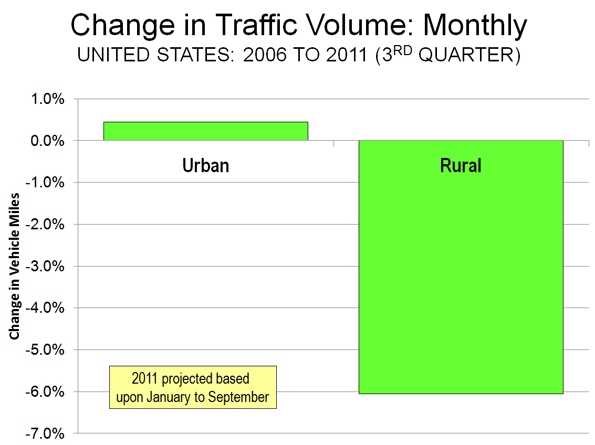
    Not Making Intercity Trips? All of the loss in driving has been in rural areas, rather than urban areas. Since the employment peak in 2006, urban driving has increased 0.4 percent (though driving per household has decreased). By comparison, rural driving has declined 6.0 percent (Note). This much larger rural driving decline could be an indication that people have reduced discretionary travel, such as longer trips that extend beyond the fringes of urban areas (Figure). As with transit, however, it would be a mistake to characterize Amtrak as having attracted much of the reduced rural travel (or for that matter from airlines, see If Wishes were Iron Horses: Amtrak Gaining Airline Riders?). Over the period, Amtrak’s gain (passenger mile) has been approximately one percent of the rural loss.

    Not Driving and not Transferring to Transit: Transit ridership trends have been generally positive over the past decade. Since 2006, transit ridership has risen 3.4 percent. This compares to the 1.1 percent decline in automobile use. However, it would be incorrect to assume attraction to transit as contributing materially to the decline in driving. Because transit has such a small market, even this healthy increase has budged its urban market share (now approximately 1.7 percent) up by barely 0.5 percentage points.

    Besides scale, there is another reason transit has not been the beneficiary of the driving reduction. Automobile competitive transit service is simply not accessible for most trips. For example, it is estimated that less than four percent of metropolitan jobs can be reached in 30 minutes by transit for the average metropolitan area resident. This compares to the more than 65 percent of automobile commuters who do reach their jobs in 30 minutes or less. In short, transit is not an alternative to the car for the vast majority of urban trips.

    It does no good to suggest this can be materially improved by increasing transit service. The most lucrative transit markets are already served, and new ones would be more expensive. This is illustrated by the exorbitant cost of adding ridership. Over the most recent decade, transit ridership increased 21 percent, which required an expenditure increase of 59 percent, nearly three times as much.

    Decentralization of Jobs and Residences: The 2010 census indicated that the American households continue to decentralize, increasingly choosing to live in single-family detached houses in the suburbs. The same trend has been occurring in employment locations, as Brookings Institution research indicates. Between 1998 and 2006, less than one percent of new employment was located within three miles of urban cores. Nearly 70 percent of the new jobs decentralized to outer suburban rings.

    The continuing dispersion of jobs and residences could dampen the increase rate of driving in the years to come, as households have greater opportunities to live in the suburban surroundings they prefer, while also commuting to the more proximate jobs that have moved to the suburbs.

    The Decline in Context: Among the potential causes, certainly the most important is the economic situation,with steeply declining household incomes and the worst economic situation since the 1930s. The longer term driving trends will be more apparent when (and if) prosperity restores healthy growth in employment. Moreover, with only a small part of travel being attracted to transit, a more significant shift could involve substitution of access by information technology (on-line). Even with the decline, however, there has been nothing like a "sea change" in how the nation travels.

    Note: The data on driving is estimated from Federal Highway Administration (FHWA) reports. FHWA produces monthly preliminary estimates, which are subsequently adjusted in annual reports.

    Wendell Cox is a Visiting Professor, Conservatoire National des Arts et Metiers, Paris and the author of “War on the Dream: How Anti-Sprawl Policy Threatens the Quality of Life

    Photograph: Harbor Freeway, Los Angeles

  • The Troubled Future of the California High-Speed Rail Project

    A congressional oversight hearing, focused on the concerns surrounding the troubled California high-speed rail project, cast new doubts on the likelihood of the project’s political survival.

    The December 15 hearing was the second of two hearings called by the House Transportation and Infrastructure Committee to examine the Administration’s "missteps" in handling the high-speed rail program. Before a largely skeptical groups of committee members — Reps Mica (R-FL), Shuster (R-PA), Denham (R-CA), Miller (R-CA), Napolitano (D-CA), and Harris (R-MD)— two panels of witnesses offered a mixture of support and criticism concerning the project’s impact, financial feasibility and prospects for the future. The first panel comprised six California congressmen — three testifying against the project (Reps. Nunes (R), McCarthy (R) and Rohrabacher (R)), three in support of it (Reps. Cardoza (D), Costa (D) and Sanchez (D).) The second panel consisted of FRA Administrator Joseph Szabo, California Rail Authority CEO, Roelof Van Ark, local elected officials and representatives of citizen groups.

    A Brief Project Overview

    The proposed high-speed line, from Sacramento and San Francisco to Los Angeles and San Diego, was originally estimated to cost $43 billion in 2008 when the state’s voters approved a $9.95 billion bond measure (Proposition 1A) to help finance the project.  Since then, the total cost estimate for the project has more than doubled to $98.5 billion and the completion date has been pushed back by 13 years to 2033.

    The "initial construction section" of 140 miles is proposed to be built in the sparsely populated Central Valley from south of Merced to north of Bakersfield. The $6 billion project is to be financed with a $3.3 billion federal contribution and $2.7 billion worth of state Proposition 1A bonds. Construction is to begin in 2012. However, to qualify as an "Initial Operating Segment" as required by the authorizing bond measure and capable of running high-speed trains, the line has to be extended by another 290 miles to San Jose (or 300 miles to the San Fernando Valley), at an additional cost of $24.7 billion.

    To finance the latter construction, the California Rail Authority’s business plan calls for $4.9 billion in Proposition 1A bonds and assumes a $19.8 billion federal contribution – $7.4 billion in federal grants and $12.4 billion in the yet to be created Qualified Tax Credit Bonds (QTCB). The latter assumption came in for sharp committee criticism as wishful thinking. The bill authorizing QTCB (or TRIP) bonds, proposed by Sen. Wyden (D-OR), is not given much chance of passing in the House. Even if passed, it would only offer $1 billion for the California HSR project rather than $12.4 billion as claimed in the Authority’s business plan. Further federal high-speed rail grants are equally uncertain given the bipartisan congressional refusal to appropriate funds for high-speed rail two years in a row. In other words, the funding for the Initial Operating Segment hinges on highly questionable assumptions as to continuing federal aid.

    Even more conjectural are the Authority’s funding assumptions for the subsequent phases of the project— a line extension from San Jose to the San Fernando Valley and a southern connection, to Los Angeles and Anaheim. That phase of construction according to the Authority’s business plan, would require a further federal contribution of $42.5 billion between 2021 and 2033 (plus $11 billion in private investment).

    Left unstated in the Authority’s business plan, one informed observer speculated, is the secretly entertained hope that by 2015 (when the additional federal funding will be needed), the economic circumstances — and perhaps political circumstances as well — will have changed, allowing a resumption of generous federal support.

    A "Boondoggle" or a "Compelling Opportunity for Our State"?

    Witnesses testifying before the committee aligned along predictable fault lines. Critics of the rail project (mostly, but not all, Republicans) tended to focus on the specific weaknesses of the project: its unrealistic assumptions concerning future funding; the quixotic choice of location for the initial line section ("in a cow patch," as several lawmakers remarked); a lack of evidence of any private investor interest in the project; the eroding public support for the project (nearly two-thirds of Californians would now oppose the project if given the chance, according to a recent poll); the "devastating" impact of the proposed line on local communities and farmers; and the unrealistic and out-of-date ridership forecasts (with more passengers in 2030 predicted to board trains in Merced, a small farming community in Central Valley, than in New York’s Penn Station). Other witnesses asserted that the current project is vastly different from the one Californian voters approved in 2008; and that it is lacking proper management oversight (it is a project "of the consultants, by the consultants and for the consultants" one witness remarked).

    Defenders of the project (mostly, but not all, Democrats) resorted largely to abstract arguments about the merits of building a high-speed rail system in California. They saw the project as a compelling long-term vision, as a travel alternative to congested highways and air lanes, as a way to reduce greenhouse gas emissions, and as a means of creating thousands of jobs. They argued about the difficulty and prohibitive costs of the alternative of building more highways and airports to accommodate future population growth.

    Federal officials are fond of reminding us that construction of the interstate highway system also began "in a cow patch " — in that particular case, a wheat field in the middle of Kansas. But they ignore a fundamental difference between the two decisions: the interstate highway system was backed from the very start by a dedicated source of funds, thus ensuring that construction of the system would continue beyond the initial highway segment "in the middle of nowhere." 

    The California project has no such financial assurance. Should money for the rest of the system never materialize— as is likely to happen— the state will be stuck with a rail segment unconnected to major urban areas and unable to generate sufficient ridership to operate without a significant state subsidy. The Central Valley rail line would literally become a "Train to Nowhere" — a white elephant and a monument to wasteful government spending.
     
    ~~~~~~~~~~~~~~~~~~~~

    Note: the NewsBriefs can also be accessed at www.infrastructureUSA.org

    A listing of all recent NewsBriefs can be found at www.innobriefs.com

  • The High-Speed Rail Program Under Congressional Scrutiny

    A combative and clearly agitated Transportation Secretary Ray LaHood defended the Administration’s high-speed rail program at a December 6 oversight hearing of the House Transportation and Infrastructure Committee to discuss congressional concerns with the program’s direction and focus. "We will not be dissuaded by the naysayers and the critics," LaHood said heatedly.

    But he convinced few skeptical committee members who believe that the Administration has bungled the program by spreading the money too thinly all over the country and on projects that are not truly high-speed. Average speeds after the $10 billion worth of improvements, the Committee was told, will range from 60 to 70 mph. In Europe and Japan, high speed trains maintain average speeds of 150 mph and higher (average speed is considered a more accurate measure of performance and service quality than top speed for it reflects trip duration.) "The President’s vision of providing 80 percent of Americans with access to high-speed rail service is unnecessary and isn’t going to happen," said Railroads Subcommittee Chairman Bill Shuster (R-PA).

    "We need one high-speed rail success, and our country‘s best opportunity to achieve high-speed rail is in the Northeast Corridor," Committee Chairman John Mica (R-FL) told the Secretary. This sentiment was echoed by a panel of experts who followed LaHood’s testimony. The panel consisted of Joan McDonald, N.Y. DOT Commissioner and Chairman of the NE Corridor Advisory Commission, Richard Geddes, associate professor at Cornell University, Ross Capon, President of the National Association of Railroad Passengers and NewsBriefs editor Ken Orski. "The Northeast is a compelling market for high-speed rail service," said McDonald. It is probably the only corridor that has all the attributes necessary for viable high-speed rail service, and where passenger trains do not have to share track — and thus are not slowed by— freight trains," added Orski. An abbreviated version of Ken Orski’s testimony follows below. 

    ###

    Let me state at the outset that I do not question the merits or the need for intercity passenger rail service. Railroads have been an integral part of the nation’s transportation system for a century and a half and they continue to play a vital role in the economy. Nor do I question the desirability of high-speed rail— a technology that I believe we ought to pursue in this country.
    What I do question is the manner in which the Administration has gone about implementing its ten billion dollar rail initiative— or what the White House expansively calls "President Obama’s bold vision for a national high-speed rail network."

    Misleading Representations
    The Administration’s first misstep, in my judgment, has been to misleadingly represent its program as "high-speed rail," thus, conjuring up an image of bullet trains cruising at 200 mph, just as they do in Western Europe and the Far East. It further raised false expectations by claiming that "within 25 years 80 percent of Americans will have access to high-speed rail." In reality the Administration’s high-speed rail program will do no such thing. A close examination of the grant announcements shows that, with one exception, the program consists of a collection of planning, engineering and construction grants that seek incremental improvements in the existing facilities of Class One freight railroads, in selected corridors used by Amtrak trains.

    While some of the projects funded with HSR dollars may result in modest increases in speed, frequency and reliability of Amtrak services, none of the awards, except for the California grant, will lead to construction of new rail beds in dedicated rights-of-way. As any railroad operator will tell you, dedicated track reserved exclusively for passenger trains is essential to the operation of true high-speed rail service— such as the service offered by the French TGV, the German ICE and the Japanese Shinkansen trains, that run at top speeds of 200 miles per hour and higher.

    Lately, the Administration has toned down its rhetoric. It no longer claims that high-speed rail is "just around the corner" (Sec. LaHood’s own words of some time ago) but rather that the HSR grants are "laying the foundation for high-speed rail corridors." But even that claim seems overblown. While track upgrades will allow Amtrak trains to reach top speeds of 110 mph in some cases, average speeds— which is a more accurate measure of performance and service quality, for it determines trip duration — will increase only moderately.

    For example, while a $1.1 billion program of track upgrades between Chicago and St. Louis will enable Amtrak trains to increase top speeds to 110 mph, average speeds between those two cities —slowed by frequent stops and the need of Amtrak trains to share track with freight traffic — will rise only 10 miles per hour, from 53 to 63 mph. Travel time will be cut by 48 minutes, to 4 hours 32 minutes (Illinois DOT announcement, December 22, 2010)

    In France, TGV trains between Paris and Lyon, cover approximately the same distance (290 miles) in a little under two hours, at an average speed of 150 mph. Yet, federal officials did not hesitate proclaiming the Chicago-St. Louis project as "historic" and hailing it as "one giant step closer to achieving high-speed passenger service."

    Had the Administration candidly represented its HSR initiative for what it really is — an effort to introduce useful but modest enhancements in existing intercity Amtrak services— it would have earned some plaudits for its good intentions to improve train travel. But by pretending to have launched a "high-speed renaissance," when all evidence points to only small incremental improvements in speed and trip duration, the Administration, I believe, has suffered a serious loss of credibility. Its pledge to "bring high-speed rail to 80 percent of Americans" is not taken seriously any more.

    Lack of a focus
    The Administration’s second mistake, in my opinion, has been to fail to pursue its objective in a focused manner. Instead of identifying a corridor that would offer the best chance of successfully deploying the technology of high-speed rail, and concentrating resources on that project, the Administration has scattered nine billion dollars on 145 projects in 32 states, and in all regions of the country. (A complete list can be found here). Only a few of these awards (CA, IL, NC, WA, NEC) are of a sufficient scale to produce any appreciable service improvements. The remaining grants will support minor facility upgrades, preliminary engineering, and planning and environmental studies. Indeed, the program bears more resemblance to an attempt at revenue sharing than to a focused effort to pioneer a new transportation technology.

    The Northeast Corridor
    Ironically, the Northeast corridor, where high-speed rail has the best chance of succeeding, has received scant attention. And yet, this corridor is probably the only one in the nation that has all the attributes necessary for effective and economical high-speed rail service. It also is the only rail corridor in the nation where passenger trains do not have to share track — and thus are not slowed by— freight trains.

    In sum, no other travel corridor in the nation offers better conditions for successful implementation of high-speed rail service, or a more compelling case for moving forward with an ambitious investment program.

    To its credit, the Administration has belatedly recognized the deployment potential of the Northeast Corridor and tried to make up for its past neglect by awarding two major grants for track and catenary improvements in the Corridor. These grants are a small beginning in what will hopefully become a redirected HSR program, with a focus on the Northeast corridor. Its goal should be to raise average speeds between city pairs to 150 mph—the generally accepted standard for high-speed rail service.

    The need to involve the private sector
    In view of the constraints on the federal budget, any such program will of necessity require substantial participation of the private sector. The density of travel in the NE Corridor and its continued growth should, in principle, generate a sufficient stream of revenue to attract private capital and create opportunities for public-private partnerships.

    However, this is still an untested hypothesis. We simply do not have enough experience with public-private partnerships in the passenger rail sector to make confident predictions about the response of the private investment community— its assessment of the risk, rewards and expected rate of return on investment in such an enterprise.

    Thus, I believe that an early step in the process should focus on thoroughly exploring the potential of private financing and ascertaining the private investors’ interest in this venture— both domestically and internationally. This should include an examination of the lessons learned from the Channel Tunnel project — the largest rail infrastructure project in the world totally financed by the private sector.

    ###

    While the Administration’s handling of the high-speed rail program has— understandably and justifiably— made Congress reluctant to support this initiative any further, I do hope that under the Committee’s leadership, and with the help of the NEC Advisory Commission, Amtrak and the several participating states, a reformulated high-speed rail initiative— focused on the NE Corridor and involving a public-private partnership— will soon begin taking shape.

    One often hears these days that we, as a nation, have lost the will to think big— that we no longer have the ambition and imagination to mount "bold new endeavors" that capture the public imagination— the kind of motivation that caused our parents’ and grandparents’ generation to build the Hoover Dam, the Golden Gate Bridge and the Interstate Highway System. Launching a multi-year public-private venture to usher in true high-speed rail service in the Northeast Corridor, a project of truly national significance, offers us an opportunity to prove the skeptics wrong.

    Ken Orski has worked professionally in the field of transportation for over 30 years.
     
    Photo courtesy of BigStockPhoto.com

    ~~~~~~~~~~~~~~~~~~~~

    Note: the NewsBriefs can also be accessed at www.infrastructureUSA.org

    A listing of all recent NewsBriefs can be found at www.innobriefs.com

  • Tilting at (Transit) Windmills in Nashville

    As in other major metropolitan areas in the United States, Nashville public officials are concerned about traffic congestion and the time it takes to get around. There is good reason for this, given the research that demonstrates the strong association between improved economic productivity and shorter travel times to work. As Prudhomme and Lee at the University of Paris and Hartgen and Fields at the University of North Carolina Charlotte have shown, metropolitan areas tend to produce more jobs where employees are able to access a larger share of the jobs in 30 minutes.

    Ahead in Identifying the Problem: Moreover, Nashville officials are somewhat "ahead of the curve," since traffic congestion is far less severe there than in many other metropolitan areas. Among the 100 largest metropolitan areas in the United States, Nashville ranks 39th in the intensity of its traffic congestion, according to data compiled by INRIX, a traffic information firm. Nashville’s traffic congestion is even better compared to large Western European metropolitan areas .

    This favorable traffic situation is despite the fact that Nashville has among the lowest overall transit market shares in the United States or Western Europe (less than 0.5 percent of travel in the metropolitan area). The key to this success, like that of other American metropolitan areas in relation to their international peers is low density and decentralization of employment and other commercial locations.

    Missing the Point on Solutions: Yet, it is clear from an editorial in the Nashville Ledger that officials are inclined to embark on an expensive program of transit expansion. Judging from past experience, this   offers virtually no hope for reducing traffic congestion or for improving economic productivity in the Nashville metropolitan area.

    There are significant misperceptions among local officials about the potential outcomes of proposed commuter rail and bus rapid transit lanes. Perhaps the most important is the assumption that commuter rail and bus rapid transit will reduce travel times. In fact, at the national level, commuting by transit takes approximately twice as long as commuting by single occupant automobile, according to the Census Bureau’s American Community Survey for 2008 to 2010. Rail systems, such as subways (metros) and light rail do little better than transit in general, taking 95% longer than driving alone and two thirds longer than travel by car pools. There is thus virtually no hope that building new transit lines will reduce travel times.

    As often happens when costly new transportation programs are proposed, boosters often resort to erroneous information. The Nashville Ledger cites sources that indicate, for example, that suburban Franklin (in Williamson County, to the south of the Nashville-Davidson County core) has one of the longest work trip travel times in the nation. The reality is quite different. Franklin has an average work trip travel time (23.2 minutes), which is less than national average (25.3 minutes) and little more than Nashville-Davidson County (23.0 minutes).

    Nashville officials need look no further than their own eastern suburbs for evidence of the inability of new rail systems to reduce work trip travel times. In 2006, Nashville began commuter rail service from Lebanon, in Wilson County to downtown Nashville (the Music City Star). Currently, the Music City Star is locked in an intensive (and successful, according to the latest data) competition for last place in the number of riders among the nation’s commuter rail systems, just edging out Austin’s new lightly used system. Despite being the only first ring county with commuter rail service, Wilson County work trip travel times are longer than in the other first ring counties. Door-to-door travel times, which are the only travel times that count, have not been reduced by the rail line.

    Transit is About Downtown: Transit cannot be a comprehensive metropolitan transportation solution remotely competitive with automobile travel times, except to downtown. This is because the quicker, direct transit services from throughout the metropolitan area that are necessary to attract automobile drivers must focus on the most dense and largest employment center, which is downtown. The radial routes that may be capable of serving downtown effectively simply cannot be afforded for other areas of employment. Our research has indicated, the annual cost to provide automobile competitive transit service throughout an urban area in the United States would consume a huge share of the gross domestic product of any such area.

    In Nashville, downtown represents little more than 10% of the metropolitan area employment. Moreover, downtown Nashville represents a declining share of private sector employment in the metropolitan area. According to the Census Bureau’s County Business Patterns, the core Nashville ZIP codes that are served by shuttle buses from the commuter rail station lost 11% of their private sector jobs between 2000 and 2009 (latest data available). At the same time, private sector employment grew 4% in the balance of the Nashville metropolitan area (Note 1).

    Transit to Suburban Destinations: A Non-Starter: There have been proposals to require new suburban office development to be near transit stops. This would accomplish little, because transit access in areas other than downtown is so sparse. Among major metropolitan areas, nearly 65% of major metropolitan area workers are within walking distance of a transit stop, according to research by the Brookings Institution. But being near a transit stop does not mean that transit provides practical mobility to anything like 65% of jobs. The reality, according to the Brookings Institution data,  is that only 6% of jobs in the average metropolitan area of more than 1 million population can be reached by transit  by the average resident  in 45 minutes, a travel time nearly double that of the average commuter in the Nashville metropolitan area (Note 2). It seems likely that 30 minute transit access for commuters would be as low as 3% at the national level. This demonstrates the so frequently repeated fallacy equating access to a transit stop with usable access to the metropolitan area.

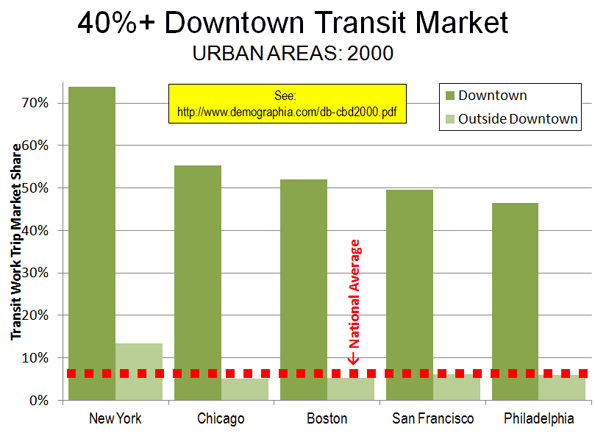
    Transit’s Large Downtown Niche Market: There is no question about the effectiveness (though not the cost efficiency) of transit in providing mobility along the most congested corridors to the nation’s largest downtown areas. This transit niche market accounts for nearly 75% of commuting to the Manhattan business core south of 59th Street, and more than 40% to the downtown areas of Brooklyn, Chicago, San Francisco, Boston and Philadelphia. Yet even in these metropolitan areas, where transit mobility is so important to downtown, transit work trip market shares to areas outside downtown are more akin to the national average of 5% (Figure), except in New York.

    Of course, Nashville’s downtown is not among these large transit-oriented cores. In 2000, census data indicated that 4% of employees commuted to downtown by transit. Even if all of the ridership on the Music City Star is made up of new downtown transit commuters, that figure would be little changed.

    The Need for Stewardship: Before Nashville commits hundreds of millions or billions of tax dollars to expensive transit projects transit in hopes of reducing traffic congestion or travel times, local officials should consider reality. Reducing traffic congestion and travel times are objectives generally beyond transit’s capability. Further, new lines can attract only a small share of commuters, because such a small share of jobs are downtown.

    —-

    Note 1: County Business Patterns provides employment information that largely excludes government employment. According to Bureau of Labor Statistics data, 53 percent of metropolitan Nashville’s increase in employment was government jobs between 2000 and 2009.

    Note 2: Calculated from Brookings Institution data.

    Photograph: Downtown Nashville from BigStockPhoto.com

    Wendell Cox is a Visiting Professor, Conservatoire National des Arts et Metiers, Paris and the author of “War on the Dream: How Anti-Sprawl Policy Threatens the Quality of Life

  • Is Suburbia Doomed? Not So Fast.

    This past weekend the New York Times devoted two big op-eds to the decline of the suburb. In one, new urban theorist Chris Leinberger said that Americans were increasingly abandoning “fringe suburbs” for dense, transit-oriented urban areas. In the other, UC Berkeley professor Louise Mozingo called for the demise of the “suburban office building” and the adoption of policies that will drive jobs away from the fringe and back to the urban core.

    Perhaps no theology more grips the nation’s mainstream media — and the planning community — more than the notion of inevitable suburban decline. The Obama administration’s housing secretary, Shaun Donavan, recently claimed, “We’ve reached the limits of suburban development: People are beginning to vote with their feet and come back to the central cities.”

    Yet repeating a mantra incessantly does not make it true. Indeed, any analysis of the 2010 U.S. Census would make perfectly clear that rather than heading for density, Americans are voting with their feet in the opposite direction: toward the outer sections of the metropolis and to smaller, less dense cities. During the 2000s, the Census shows, just 8.6% of the population growth in metropolitan areas with more than 1 million people took place in the core cities; the rest took place in the suburbs. That 8.6% represents a decline from the 1990s, when the figure was 15.4%.

    Nor are Americans abandoning their basic attraction for single-family dwellings or automobile commuting. Over the past decade, single-family houses grew far more than either multifamily or attached homes, accounting for nearly 80% of all the new households in the 51 largest cities. And — contrary to the image of suburban desolation — detached housing retains a significantly lower vacancy rate than the multi-unit sector, which has also suffered a higher growth in vacancies even the crash.

    Similarly, notes demographer Wendell Cox, despite a 45% boost in gas prices, the country gained almost 8 million lone auto commuters in the past 10 years. Transit ridership, while up slightly, is still stuck at the 1990 figure of 5%, while the number of home commuters grew roughly six times as quickly.

    In the past decade, suburbia extended its reach, even around the greatest, densest and most celebrated cities. New York grew faster than most older cities, with 29% of its growth taking place in five boroughs, but that’s still a lot lower than the 46% of growth they accounted for in the 1990s. In Chicago, the suburban trend was even greater. The outer suburbs and exurbs gained over a half million people while the inner suburbs stagnated and the urban core, the Windy City, lost some 200, 000 people.

    Rather than flee to density, the Census showed a population shift from more dense to less dense places. The top ten population gainers among metropolitan areas — growing by 20%, twice the national average, or more — are the low-density Las Vegas, Raleigh, Austin, Charlotte, Riverside–San Bernardino, Orlando, Phoenix, Houston, San Antonio and Atlanta. By contrast, many of the densest metropolitan areas — including San Francisco, Los Angeles, Philadelphia, Boston and New York — grew at rates half the national average or less.

    It turns out that while urban land owners, planners and pundits love density, people for the most part continue to prefer space, if they can afford it. No amount of spinmeistering can change that basic fact, at least according to trends of past decade.

    But what about the future? Some more reasoned new urbanists, like Leinberger, hope that the market will change the dynamic and spur the long-awaited shift into dense, more urban cores.

    Density fans point to the very real high foreclosure rates in some peripheral communities such as those that surround Los Angeles or Las Vegas. Yet these areas also have been hard-hit by recession — in large part they consist of aspiring, working class people who bought late in the cycle. Yet, after every recession in the past, often after being written off for dead, areas like Riverside-San Bernardino, Calif., have tended to recover with the economy.

    Less friendly to the meme of density’s manifest destiny has been a simultaneous meltdown in the urban condo market. Massive reductions in condo prices of as much as 50% or more have particularly hurt the areas around Miami, Portland, Chicago and Atlanta. There are open holes, empty storefronts, and abandoned projects in downtowns across the country that, if laid flat, would appear as desperate as the foreclosure ravaged fringe areas.

    In many other cases, the prices never dropped because the owners gave up selling condos and started renting them, often to a far lower demographic (such as students) than the much anticipated “down-shifting” boomers. Contrary to one of the most oft-cited urban legends by Leinberger and his cohorts, demographics do not necessarily favor density. Most empty-nesters and retirees, notes former Del Webb Vice President of Development Peter Verdoon, prefer not just outer suburbs but increasingly “small towns and rural areas” Dense cities, he notes, are a relatively rare choice for those seeking a new locale for their golden years.

    Verdoon’s assertion is borne out by our own analysis of the 2010 Census. Generally speaking, aging boomers tended to move out of dense urban cores, and to a lesser extent, even the suburbs. If they moved anywhere, they were headed further out in metropolis towards the more rural area. Among cities the biggest beneficiaries have been low-density cities in the Southwest and southern locales such as Charlotte, Raleigh and Austin.

    What about the other big demographic, the millennials? Like previous generations of urbanists, the current crop mistake a totally understandable interest in cities among post-adolescents. Yet when the research firm Frank Magid asked millennials what made up their “ideal” locale, a strong plurality opted for suburbs — far more than was the case in earlier generations.

    Generational analysts Morley Winograd and Mike Hais note that older millennials — those now entering their 30s — are as interested in homeownership as previous generations. This works strongly in favor of suburbs since they tend to be more affordable and, for the most part, offer safer streets, better parks and schools.

    In the short run, suburbia’s future, like that of much of real estate market, depends on the economy. But even here trends may be different than the density lobby suggests. As housing prices fall, the much ballyhooed trend toward a “rentership” society may weaken. Already in many markets such as Atlanta, Las Vegas and Minneapolis and Phoenix it is cheaper to own than rent, something that favors lower-density suburban neighborhoods.

    Longer term, of course, suburbs, even on the fringe, will change as growth restarts. Cities here and around the world tend to expand outward, and over time the definition of the fringe changes. To be sure, some fringe communities, particularly in highly regulated and economically regressive areas, could indeed disappear; but many others, particularly in the faster growing parts of the country, will reboot themselves.

    They will become, as the inner suburbs already have, more diverse with many working at home or taking shorter trips to their place of work They will become less bedrooms of the core city but more self-contained and “village like,” with shopping streets and cultural amenities near what will still be a landscape dominated primarily by single-family houses.

    In fact the media reports about the “death” of fringe suburbs seem to be more a matter of wishful thinking than fact. If the new urbanists want to do something useful, they might apply themselves by helping these peripheral places of aspiration evolve successfully. That’s far more constructive than endlessly insisting on — or trying to legislate — their inevitable demise.

    This piece first appeared at Forbes.com.

    Joel Kotkin is executive editor of NewGeography.com and is a distinguished presidential fellow in urban futures at Chapman University, and an adjunct fellow of the Legatum Institute in London. He is author of The City: A Global History. His newest book is The Next Hundred Million: America in 2050, released in February, 2010.

    Photo courtesy of BigStockPhoto.com.

  • Mass Transit: Could Raising Fares Increase Ridership?

    Conventional wisdom dictates that keeping transit fares as low as possible will promote high ridership levels. That isn’t entirely incorrect. Holding all else constant, raising fares would have a negative impact on ridership. But allowing the market to set transit fares, when coupled with a number of key reforms could actually increase transit ridership, even if prices increase. In order to implement these reforms, we would need to purge from our minds the idea that public transit is a welfare service that ought to be virtually free in order to accommodate the poor. Concern about poverty should drive welfare policy, not transit policy. Persistent efforts to keep public transit fares as low as possible are a big part of the reason that public transit ridership in North America has hit record lows. To increase ridership, transit agencies have to convince people who can afford to drive that transit is a better option. Convenience, and not lower prices, is the key.

    There are three basic reasons that private automobiles have virtually crowded out transit. First, private automobiles are inherently more convenient for a large segment of the population. Transit routes are naturally limited to well-traveled corridors, which are often slower because of wait and stop times. On the other hand, you can get into your car and immediately take the most efficient route to your destination.

    The second factor is free roads. While people do pay for roads, they don’t pay for using specific roads at specific times. Gas taxes go into general revenues, and road construction and repair isn’t directly connected to usage. As a result, a large percentage of roads are subsidized by travelers who use a small percentage of highly traveled routes. Similarly, drivers don’t pay more during peak times than non-peak times. They instead pay with their time, by waiting in traffic.

    The third factor is that the market dictates private automobile sales. This is important because automobile companies and dealerships have an incentive to keep prices competitive while selling a high quality product. It also ensures that there are a multitude of different types of automobiles, and differing finance schemes and secondary markets tailored to a range of needs. The private sector is great at marketing things to people; government isn’t.

    While public transit can never be as flexible as private automobiles, some of the automobile’s advantages can be reduced. Road tolls and congestion pricing ought to be implemented where practical. Ironically, offsetting these new fees by reducing the gas tax would actually also be beneficial for transit services. After all, the only reason many impractical roads are built is that they are financed out of general revenue. If roads were primarily financed by those who used them, more funding would go to highly traveled urban roads, and less would go toward subsidizing sprawl.

    Here’s the controversial aspect of the solution: Transit should operate on a for profit basis and its prices should closely reflect market forces — even if it means that transit fares increase.

    Mass transit has one major advantage: where there is sufficient demand, transit is inherently cheaper than private automobile usage because the costs are spread over many people, making the per person cost lower. That’s why most people fly with commercial airlines instead of chartering private jets, for example. But keeping the price too low reduces the ability of transit service to provide more routes. And this is important. While there is a segment of the population who are stuck with public transit no matter how inconvenient it is, most people won’t ditch their cars unless they can get to their destinations relatively quickly. And it may not be economical for a transit system to get them to many of those places for $2.25.

    A flat price structure subsidizes inefficient routes with efficient ones. But what if transit services charged the full cost for less efficient routes? While charging more for less popular routes may seem like it would reduce ridership, it wouldn’t. If people knew that there were many additional routes going to out-of-the-way locations that they don’t ordinarily frequent, they would still positively factor it into their calculation of whether or not they need a car. After all, paying $5 to get to an out of the way destination occasionally is still cheaper than getting a cab, and can often be cheaper than the cost of driving. Transit systems have higher ridership in major centres than in small centres, even when the fares are high. Transit is not only cheaper than driving in dense cities, it’s also equally or more convenient.

    But just allowing prices to fluctuate isn’t enough. For a price system to function properly there needs to be an incentive to keep prices as low as possible. Public monopolies don’t have this incentive. Furthermore, there needs to be competition to ensure high levels of service. The reason that air travel service is so high quality and cheap is because it is private, not public.

    The thought of privately delivered public transit will no doubt turn some people off, especially public sector employees. And simply removing government from the transit business isn’t necessarily the best solution. Instead, municipal transit services should be turned into transit commissions that coordinate and contract for transit from competing companies. Transit companies would bid on routes, and pay the city a fixed cost for the right to service each route based on a competitive auction.

    For less cost efficient routes, a city could even offer a small subsidy per rider, should no transit company enter a bid. Whichever company would be willing to service that route at the lowest subsidy level would win. This would maintain downward pressure on costs. But it would be important that the transit commission use this as a last resort. Otherwise it could undermine the competitive market process by creating the incentive for companies not to bid on many marginal routes until a subsidy was offered.

    Collecting variable rates for trains is simple, but it would be more difficult for buses. One method would be to have buses classified as local, express, or commuter, for instance. Each would charge a different rate. An automated payment system could be installed where riders swiped their cards on the way in and out, as they do on the Washington DC Metro, to calculate the rate.

    Changing the operating and pricing structure wouldn’t alter the way that people use transit services. Transit vehicles would still work on a coordinated schedule, and collect fees from riders as they always have. What would change is that the competing companies would have an incentive to keep operating costs lower, and to provide more routes. They also would have to meet performance guidelines monitored by the city, or face fines. What would change is the philosophy of transit companies. They would be out to make a profit.

    This may seem like a radical departure, but consider that London, England, contracts out its bus service. If one of the world’s busiest cities can co-ordinate a public-private partnership of this magnitude, there is no reason smaller cities couldn’t do the same. The key is to create the right incentives and institutions. The current model of treating transit as a welfare service has failed. It is time to make transit the first choice for commuters, not the last.

    Steve Lafleur is a Policy Analyst with the Frontier Centre for Public Policy.

    Image from BigStockPhoto.com: A metro bus in Madison, Wisconsin.