Tag: Transportation

  • Placing Amtrak Records in Context

    The state of Michigan recently announced record ridership on three routes supported by Michigan taxpayers. Records mean little when the numbers are insignificant.

    That, to say the least, is the situation with Amtrak in Michigan. For example, the additional passengers (this year versus last) on the Pere Marquette (between Chicago and Grand Rapids) was small enough to be carried in a once daily round trip by an airport shuttle van. The additional passengers on the Wolverine, which operates from Detroit to Chicago would not have filled a single intercity bus operating each way on a daily basis. The same is true of the Blue Water, which operates between Port Huron and Chicago.

    But there’s more. High quality bus service, featuring on-board high speed wireless internet (wi-fi), costs passengers less between Detroit and Chicago and takes about the same time. There is a big difference, however. Train riders are subsidized by taxpayers, while bus riders pay their full fare. Even so, the unsubsidized bus fares are lower than the subsidized train fares.

    In a nation that needs to cut spending, unnecessary transportation subsidies, such as for intercity rail services should be at the top of the list.

  • OECD Cites Shorter US Work Trip Travel Times

    Catherine Rampell of The New York Times describes a new Organization for Economic Cooperation and Development report concluding that Americans have among the shortest work trip travel times in the developed world (Link to chart in The New York Times).

    Out of 23 OECD nations, only three have shorter one way work trip travel times than in the United States. These are Sweden, Denmark and Ireland. These are nations without the larger metropolitan regions that characterize the United States and some other nations. For example, the largest metropolitan area in these three nations, Stockholm, with barely rate among the top 30 in the United States.

    The OECD report confirms similar earlier data, such as from Eurostat on the relative ease of commuting in the United States.

    The US average of 28 minutes to and from work was 10 minutes less than the OECD average and 9 minutes less than Canada. South Korea, with the highest urban densities in the high income world, had an average one-way commute time approximately double that of the United States.

    Among the nations in the survey, the United States has the lowest urban population densities. This reality is at odds with the contentions of some analysts who have associated longer travel times and greater traffic congestion with lower urban population densities.

    But shorter commute times are about more than density. This is illustrated by comparing the Los Angeles and Toronto urban areas. The two urban areas have almost identical population densities, at 7068 and 7040 persons per square mile respectively (2,729 and 2,718 per square kilometer). The density of the core areas is similar with proportions of land areas at above 10,000 persons per square mile (4,000 per square kilometer). The most important differences are that in Los Angeles, the transit commuting share is one third that of Toronto, and automobile commuting is more prevalent. Employment in Los Angeles is much more dispersed, with less than 5% of jobs being in the downtown area (central business district), compared to approximately 15% in Toronto.

    Each of these factors might be thought to contribute to longer commuter times for those in Los Angeles. However, one way commute times in Los Angeles are nearly one-third less than in Toronto. The latest data indicates that the work trip averages 28 minutes in Los Angeles and 40 minutes in Toronto.

    This illustrates important dynamics of commuting and mobility. The keys to shorter commutes in the US are adequate roads, personal mobility (the US has the highest share of travel by automobile) and decentralization (lower density) of both jobs and housing.

    ——
    Addendum:

    Commenting on the same report, the Washington Post’s Brad Plumer stumbled into fantasyland:

    The Department of Transportation found that, in 2009, commutes by private car took, on average, 23 minutes. Public transportation, by contrast, took an average of 53 minutes. You could read that as an argument that more people should drive so that their commutes are shorter or as an argument that we need to bolster public transportation.

    The idea of bolstering transit to equal car travel times is empty romanticism. Today, only 7 percent of metropolitan area workers can reach their jobs in 45 minutes by transit, according to the Brookings Institution (see Transit: The 4 Percent Solution). To cut transit travel times in half, and making it available to all of the metropolitan area is unrealistic.

  • Surprise: Higher Gas Prices, Data Shows More Solo Auto Commuting

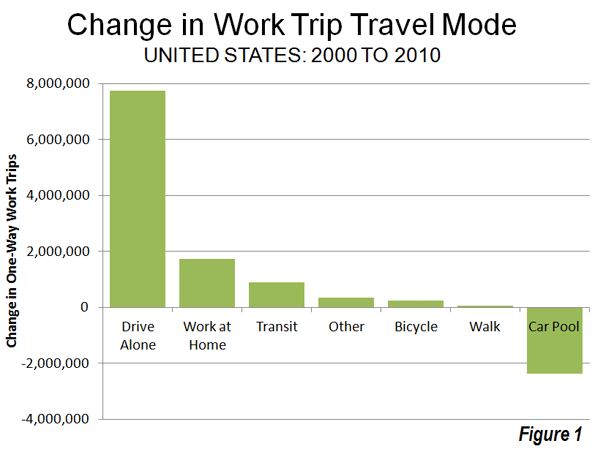
    Despite higher prices and huge media hype over shifts to public transit, the big surprise out of the 2010 American Community Survey has been the continued growth over the last decade in driving alone to work. Between 2000 and 2010, driving alone to work increased by 7.8 million out of a total of 8.7 million increase in total jobs. As a result, this use of this mode reached 76.5% of the nation’s workers, up from 75.6% in 2000. This is the largest decadal share of commuting ever achieved for this mode of transport.

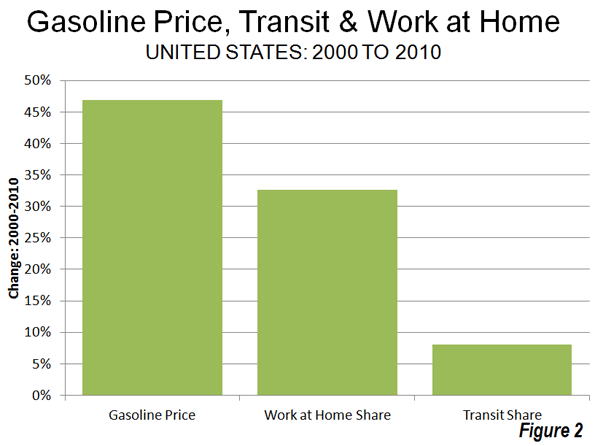
    In view of the much higher gasoline prices that prevailed in 2010, it might have been expected that driving alone would lose market share from 2000 (Figure 1). But this did not — despite many media and academic claims that would or was already taking place — occur.

    The Census Bureau began compiling data on commuting in the 1960 census. In each census through 2000, commuting data was obtained through the census "long form" questionnaire. During the last decade, however, the Census Bureau has begun an annual survey, the American Community Survey, which includes commuting data and a considerable amount of additional data, and the decennial census survey was discontinued.

    Cars Dominate: There have been substantial changes in how the nation travels since the first survey in 1960. In 1960, 64% of the nation’s workers traveled by car. Separate data was not obtained for driving alone and carpools until 1980. The 2010 data indicates that 86.2% of employees used cars for the work trip in 2010. This was a slight reduction from 87.9% in 2000. But the anti-automobile crowd should not celebrate; all of the loss was due to a substantial decline in carpooling. In 2000, 12.2% of workers traveled by car pool. This figure dropped to 9.7% in 2010. With the higher gas prices, it might have been expected that carpooling would have become more popular, because of the lower costs from sharing experiences with other workers. This simply did not occur.

    Working at Home: The big winner among the nation’s commuting modes was working at home, a large share of which is telecommuting. Working at home increased from 3.3% of the workforce in 2000 to 4.3% of the workforce in 2010, for a market share increase of 33%, Overall 1.7 million more people work at home in 2010 than in 2000. It seems likely that the high gas prices encouraged a more working at home as did the move by companies to offload work to freelancers to reduce their costs or boost efficiency. Over the decade, gas prices increased 46%, adjusted for inflation, while the work at home market share increased 33% (Figure 2).

    Further, working at home, as indicated in a previous article, is poised to become the third most popular method of accessing work before 2020, passing transit and trailing only driving alone and carpooling (see Decade of the Telecommute). Working at home might have been much more popular in 1960, when it accounted for 7.2% of employment. But as many home-based industries lost share to chains and malls,   this figure fell by more than one-half by 1970 and then fell to 2.2% in 1980. The doubling of the work at home market share since that time, on the other hand, is attributable to the advances in information technology.

    Transit: Transit experienced by far its best decade since the Census Bureau began tracking commuting. Transit’s long market share slide came to an end, rising from 4.6% in 2000 to 4.9% in 2010. Even so, it might have been expected that a more substantial increase in transit commuting would have occurred as a result of the high gasoline prices. However, only an 8% increase in the transit market share occurred at the same time as gasoline prices increased a real 46%, less in percentage terms than the shift to working at home (Figure 2).

    Part of the problem was revealed in a Brookings Institution report. The percentage of metropolitan area jobs that can be reached by transit for the average worker is very low, which seriously limits transit’s potential for commuting use. Brookings data indicates that less than 10% of the jobs in major metropolitan areas can be reached within 45 minutes by transit by the average worker in major metropolitan areas (see Transit: The 4 Percent Solution). This is not only because transit service is infrequent in many parts of metropolitan areas, but also because it operates so much more slowly, on average, than cars. By comparison, the median work trip travel time by people driving alone is 21 minutes.

    Transit carried 12.1% of the nation’s commuters in 1960 and had fallen to 5.3% by 1990. The results of the last three decades indicate that transit commuting may have stopped declining but has reached a plateau, with only small increase.

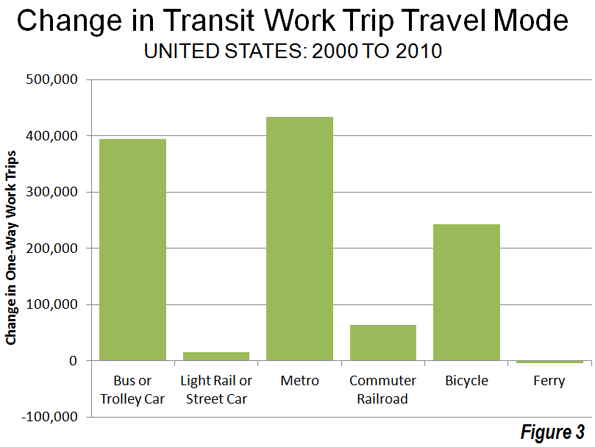
    Recent decades have seen establishment and substantial expansion of urban rail systems. A principal rationale for these systems has been reducing traffic congestion, especially during peak hours. The majority of commuting takes place during peak hour and is principally responsible for peak hour traffic congestion. Between 2000 and 2010, Metros (subways and elevated) accounted for 48% of the increase in transit commuting, while buses and a trolley buses accounted for 43%. Light rail (trolleys and streetcars) accounted for less than 2% of the additional transit commuting, despite the fact that light rail has been the dominant form of rail transit expansion (Figure 3).

    Bicycling: It was also a good decade for bicycle commuting. Bicycling added nearly 250,000 new commuters and rose from 0.4% of the market in 200 to 0.5% in 2010. The increase in bicycle commuting was 15 times that of light rail. Bicycling was first surveyed by the Census Bureau in the 1980s census, when its market share was also 0.5%.

    Walking: There was little change in walking as a form of commuting. In 2000, 2.9% of commuters walked to work, a figure that dropped to 2.8% in 2010. However, walking has suffered even greater losses than transit over the last 50 years. In 1960, 9.9% of commuters walked to work.

    The Future? One thing is clear from the data of the last decade. There has been no sea-change in commuting, even with the huge gasoline price increases. Few analysts would have predicted that single-occupant commuting would have increased at a time of both high gasoline prices and high joblessness. Further, as the shift to personal mobility continues, the largest percentage increases will like take place in telecommuting, arguably the most energy-efficient form of transport.

    Data from 1960: The table below summarizes work trip access market shares over the 50 years of data collection by the US Census Bureau.

    US Work Access by Mode: 1960-2010
    COMMUTERS 1960 1970 1980 1990 2000 2010
    Car, Truck or Van 41,368,062 59,722,550 81,258,496 99,592,932 112,736,101 118,123,873
    Drove Alone     62,193,449 84,215,298 97,102,050 104,857,517
    Car Pool     19,065,047 15,377,634 15,634,051 13,266,356
    Transit 7,806,932 6,514,012 6,007,728 5,890,155 5,867,559 6,768,661
    Bicycle     468,348 466,856 488,497 731,286
    Walk only 6,416,343 5,689,819 5,413,248 4,488,886 3,758,982 3,797,048
    Other or Unspecified 4401718 2240864 1289613 1225420 1243866 1,595,942
    Work at Home 4,662,750 2,685,144 2,179,863 3,406,025 4,184,223 5,924,200
    Total 64,655,805 76,852,389 96,617,296 115,070,274 128,279,228 136,941,010
               
    MARKET SHARE 1960 1970 1980 1990 2000 2010
    Car, Truck or Van 64.0% 77.7% 84.1% 86.5% 87.9% 86.3%
    Drove Alone     64.4% 73.2% 75.7% 76.6%
    Car Pool     19.7% 13.4% 12.2% 9.7%
    Transit 12.1% 8.5% 6.2% 5.1% 4.6% 4.9%
    Bicycle     0.5% 0.4% 0.4% 0.5%
    Walk only 9.9% 7.4% 5.6% 3.9% 2.9% 2.8%
    Other or Unspecified 6.8% 2.9% 1.3% 1.1% 1.0% 1.2%
    Work at Home 7.2% 3.5% 2.3% 3.0% 3.3% 4.3%
               
    Notes          
    Other includes taxicabs, motorcycles and other
    Blank cells indicate no data
    Taxicab included in transit in 1960
    Workers 14 and over, 1960 & 1970. Workers 16 & over, subsequent censuses
    US Census Bureau data


    Wendell Cox is a Visiting Professor, Conservatoire National des Arts et Metiers, Paris and the author of “War on the Dream: How Anti-Sprawl Policy Threatens the Quality of Life

    Photo: Junction of Interstates 110 (Harbor Freeway) and 105 (Glenn Anderson Freeway) in Los Angeles, which carry four varieties of passenger transport, cars, busway, high-occupancy vehicles and light rail (by author). 

  • For High-Speed Rail It Looks Like the End of the Line

    With its vote on September 21, the Senate Appropriations Committee ended the rail boosters’ hopes of getting a meaningful appropriation for high-speed rail in the new (FY 2012) fiscal year. It probably also dealt a decisive death blow to President Obama’s loopy goal of "giving 80 percent of Americans access to high-speed rail."

    By including only a token $100 million for high-speed rail as a "placeholder" in their FY 2012 budget recommendations (a sum that is likely to be further cut in the House-Senate negotiations on the FY 2012 appropriations), Senate appropriators have done more than merely declare a temporary slowdown in the high-speed rail program. They have effectively given a vote of "no confidence" to President Obama’s signature infrastructure initiative. Along with their House counterparts who had denied the program any new money, the Senate lawmakers have sent a bipartisan signal that Congress has no appetite for pouring more money into a venture that many lawmakers have come to view as a poster child for wasteful government spending.

    Their posture is understandable. After committing $8 billion in stimulus money and an additional $2.5 billion in regular appropriations, the Administration has little to show for in terms of concrete results or accomplishments. Aside from an ongoing project to upgrade track between Chicago and St. Louis (a $1.1 billion venture that promises to offer a mere 48 minute reduction in travel time between those two cities), no significant construction has begun on any of the authorized rail projects.

    In the meantime, the Department of Transportation has rushed to distribute the balance of the authorized HSR dollars, lest Congress decides to rescind any funds that remain unobligated. Continuing its practice of scattering money far and wide rather than focusing it on one or two worthwhile projects, the Federal Railroad Administration approved in September over $480 million worth of planning, engineering and construction grants "to improve high-speed and intercity passenger rail service" in 11 states. The beneficiaries are New York, Texas, New England (Maine, Vermont, Rhode Island, Connecticut), North Carolina, Virginia, Washington State, Oregon and Pennsylvania. The awards range from $149 million to New York State to as little as $13 million to the state of Oregon, and they average under $40 million per individual grant. It remains to be seen how quickly the recipient states will put these funds to work—and what kind of service improvements these grants will bring about.

    From an examination of the grant announcements it becomes clear that none of the grants will help to bring true "high-speed" rail service to America. At best, they will permit modest incremental improvements in speed and frequency of existing Amtrak services by helping to upgrade railway tracks of Class One railroads on which Amtrak runs its trains. The U.S. Department of Transportation (DOT) has implicitly acknowledged to have revised its program objective.  It has dropped its earlier rhetoric that high-speed rail "is just around the corner" (Secretary LaHood’s words) or that "80 percent of Americans will have access to high-speed rail" (repeated assertions by LaHood and DOT press releases).  

    Instead, the DOT (through its Federal Railroad Administration) is trying to lower the expectations by stating that "the true potential of high-speed rail will not be achieved or realized overnight." (FRA’s "vision statement") It’s a welcome sign that the Department has abandoned its quixotic goal of revolutionizing rail travel overnight. It may also signal the Administration’s realization that it cannot unilaterally force its vision upon a fiscally conservative Congress, a largely indifferent public and a skeptical, risk-averse investment community. If high-speed rail is eventually to find its place in America, it will be because market conditions will create a favorable climate for its development and acceptance – not because Washington in its wisdom has decided that the country needs it – and needs it now!    

    California’s Bullet Train beset by mounting political and financial problems

    Meanwhile, the one true U.S. high-speed rail project – California’s LA-to-San Francisco bullet train – is beset by mounting political and financial problems.  Nearly three years after the passage of the enabling Proposition 1A and less than a year before construction is scheduled to start on the first line segment in the Central Valley, construction costs have doubled the 2008 estimate. There is no evident source of where the additional funds to complete Phase One (LA-SF) system will come from since the prospect of both further federal money and private risk capital is remote. As one recent report put it, the project is being pursued "in the confident hope of a miracle."

    The systems’ first stage – a $10-14 billion 160-mile line segment in the Central Valley from Bakersfield to Merced – has run into determined opposition from local residents and farming interests during the ongoing environmental impact review. The possibility of lengthy court challenges could delay construction, thus increasing costs, eroding political support and putting federal money at risk.

    At the policy level, the project has been subject recently to several analyses. First came a critical report by California legislature’s fiscal watchdog, the non-partisan Legislative Analyst’s Office (LAO). It questioned the Rail Authority’s cost estimates and its decision to build the first segment in a sparsely populated region where travel demand is not expected to be sufficient to cover operating expenses. The LAO concluded that if the total cost of building the Phase One system were to grow as much as the revised Authority estimate for the Central Valley segment (an increase of 57%), the whole system would cost not $43 billion as originally estimated, but $67 billion. Concern about escalating costs and overly optimistic ridership forecasts were echoed by an independent Peer Review Group and numerous newspaper editorials. Even some of the state former legislative supporters, such as state Senators Joe Simitian, Alan Lowenthal and Mark DeSaulnier, have begun to express reservations and urge the Authority to rethink its direction. (See, "California’s Bullet Train – On the Road to Bankruptcy," InnoBriefs, May 31, 2011).

    A more recent challenge to the project’s financial credibility came from a team of respected independent experts, Alain Enthoven, William Grindley and William Warren, who cooperate with a citizen watchdog group, the Community Coalition on High Speed Rail. The team has concluded that without further federal aid (which almost certainly can no longer be counted upon) the project stands no chance of meeting its legislative requirements and the conditions of the enabling bond initiative (Proposition 1A). Nor is reliance on private financial participation a credible option.  In the authors’ judgment, private risk capital hasn’t to date and will not come in the future without revenue guarantees (aka public subsidy).

    The authors conclude: "With highly questionable prospects for federal grants or private ‘at risk’ construction funds, but the certainty that costs will continue to increase, the logic for continuing the largest project in California’s history is highly questionable."  (Alain Enthoven, William Grindley and William Warren, The Financial Risks of California’s Proposed High-Speed Rail Project, September 14, 2011, www.cc-hsr.org ). (Note: The report’s financial analyses and conclusions have been reviewed in detail and verified by high ranking California State officials, according to reliable sources.)

    But politically the most damaging blow to the project has come from a just released opinion survey. According to this poll, nearly two-thirds of California’s likely voters (62.4%) would stop the bullet train project from proceeding further. Virtually the same number said they are unlikely to ever travel on the train between Los Angeles and San Francisco, thus casting doubt on the Authority’s optimistic ridership forecasts. What is more, the project came in dead last (at 11%) in a list of voters’ spending priorities, according to the Irvine-based Probolsky Research polling outfit (as reported in The Sacramento Bee, September 29, 2011). With declining public support as evidenced by this poll, and with the State coming to a point where it will have to prioritize future public spending, enthusiasm for the project among politicians in Sacramento could evaporate.

    Given the possibility of the California bullet train’s demise, the attention and hopes of high-speed train advocates probably will (and should) turn to the Northeast Corridor – the nation’s most likely travel corridor where high-speed rail can eventually succeed and prosper.

    Ken Orski has worked professionally in the field of transportation for over 30 years.

    ~~~~~~~~~~~~~~~~~~~~
    Note: the NewsBriefs can also be accessed at www.infrastructureUSA.org
    A listing of all recent NewsBriefs can be found at www.innobriefs.com

  • Smart Growth (Livability), Air Pollution and Public Health

    In response to the outcry by job creators about proposed new Nitrogen Oxides emission regulations, the Obama Administration has suspended a planned expansion of these rules.

    The Public Health Risks of Densification

    The purpose of local air pollution regulation is to improve public health. For years, regional transportation plans, public officials, and urban planners have been seeking to densify urban areas, using strategies referred to as “smart growth” or “livability.” They have claimed that densifying urban areas would lead to lower levels of air pollution, principally because it is believed to reduce travel by car. In fact, however, EPA data show that higher population densities are strongly associated with higher levels of automobile travel and more intense air pollution emissions from cars and other highway vehicles. In short, higher emissions cause people to breathe more in air pollution, which can be unhealthful. To use a graphic example, a person is likely to encounter a greater chance of health risk by breathing intense smoke from a fire than if they are far enough from the fire to dilute the intensity of the smoke.

    Overall, more intense air pollution detracts from public health. To put in the economic terms that appear so often in planning literature on "urban sprawl," more intense traffic congestion and the consequent higher air pollution emissions are negative externalities of smart growth and densification.

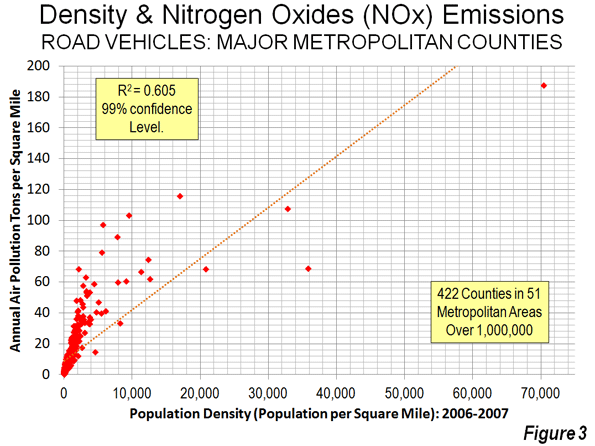
    This is illustrated by county-level data for nitrogen oxides (NOx) emissions, which is an important contributor to ozone formation. This analysis includes the more than 420 counties in the nation’s major metropolitan areas (those with more than 1 million in population).

    Seven of the 10 counties with the highest NOx emissions concentration (annual tons per square mile) in major metropolitan areas are also among the top 10 in population density (2008). The densest, New York County (Manhattan), has by far the most intense NOx emissions. Manhattan also has the highest concentration of emissions for the other criteria air pollutants, such as carbon monoxide, particulates, and volatile organic compounds (2002 data). New York City’s other three most urban counties (Bronx, Kings, and Queens) are more dense than any county in the nation outside Manhattan, and all land among the top 10 in NOx emission density (Table 1).

    Table 1
    Intensity of Nox Emissions (per Square Mile)
    NOx Emissions
    Rank County Compared to Average
    1 New York Co, NY           23.8
    2 San Francisco Co, CA           14.7
    3 Bronx Co, NY           13.7
    4 Washington city, DC           13.1
    5 St. Louis city, MO           12.4
    6 Arlington Co, VA           11.3
    7 Cook Co, IL           10.0
    8 Suffolk Co, MA             9.5
    9 Kings Co, NY             8.7
    10 Queens Co, NY             8.7
    Calculated from 2008 EPA Data


    NOx emission density data by county is provided in the document below, Annual Density of Highway Vehicle NOx Emissions by County: 2008. Overall, this data indicates that the average core county had a NOx density 3.9 times that of the average suburban county (Figure 1). By contrast, the average core county density is 4.5 times that of the average suburban county (Figure 2), indicating a strong relationship that is also shown in Figure 3.
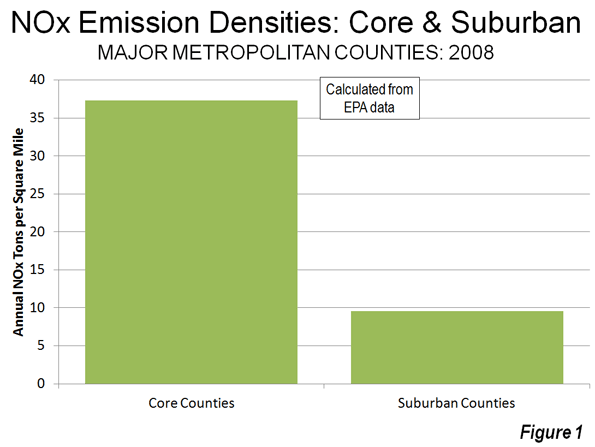
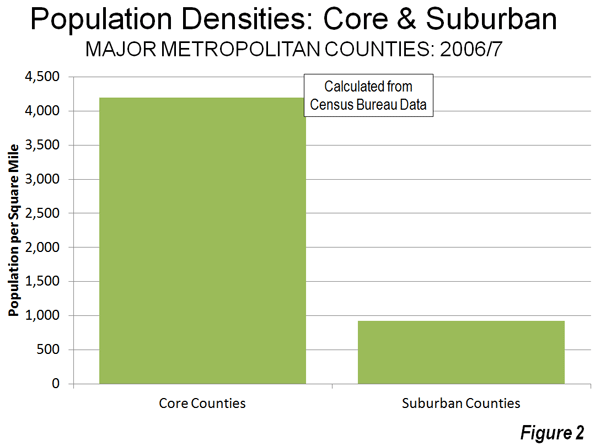
    For example, in the New York metropolitan area, core New York County has NOx emissions that are nearly 15 times as intense in a given volume of air as suburban Morris County. In the Cleveland metropolitan area, core Cuyahoga County has a NOx emissions intensity 12 times that of suburban Geauga County. Charlotte’s core Mecklenberg County has a NOx emissions intensity more than five times that of suburban Union County.

    Traffic and Air Pollution

    More concentrated traffic also leads to greater traffic congestion and more intense air pollution, according to data available from EPA. The data for traffic concentration is similar to population density. Manhattan – despite its huge transit complex – has by far the greatest miles of road travel per square mile of any county, while seven of the densest counties are among the top ten in traffic intensity. As in the case of NOx emissions, the four highly urbanized New York City counties are also among the top 10 in the density of motor vehicle travel (Table 1).

    Table 2
    Intensity of Traffic (per Square Mile)
    Motor Vehicle Travel
    Rank County Compared to Average
    1 New York Co, NY 37.8
    2 Bronx Co, NY 22.3
    3 Fredericksburg city, VA 19.9
    4 Alexandria city, VA 15.8
    5 San Francisco Co, CA 15.6
    6 Arlington Co, VA 15.1
    7 Suffolk Co, MA 14.4
    8 Queens Co, NY 14.3
    9 Kings Co, NY 13.8
    10 Washington city, DC 13.1
    Calculated from 2005 EPA Data


    Traffic density data by county is provided in the second document below, Daily Density of Road Vehicle Miles by County: 2005. Overall, this data indicates that the average core county had a traffic density 3.7 times that of the average suburban county (Figure 4), again a difference similar to the difference in density (Figure 5).
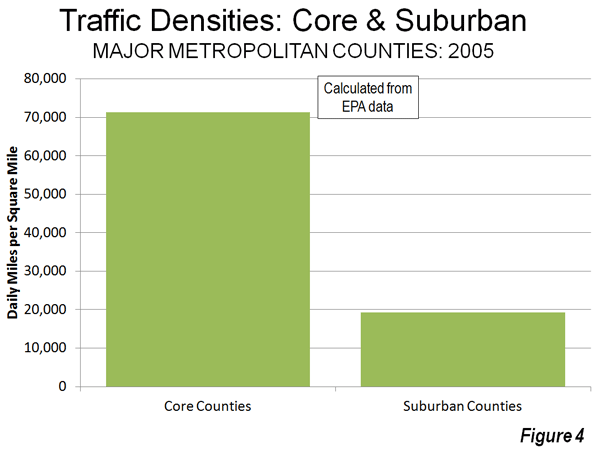
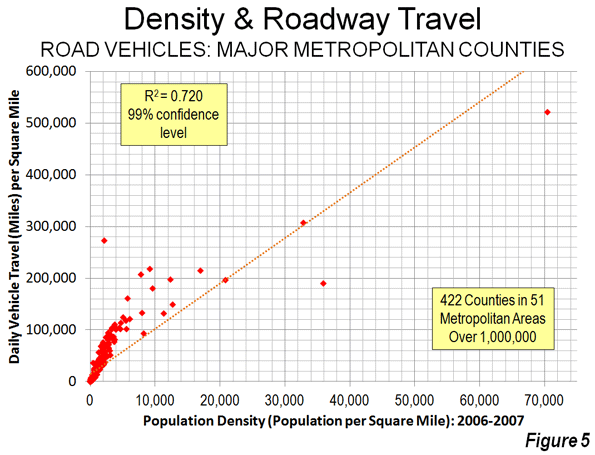
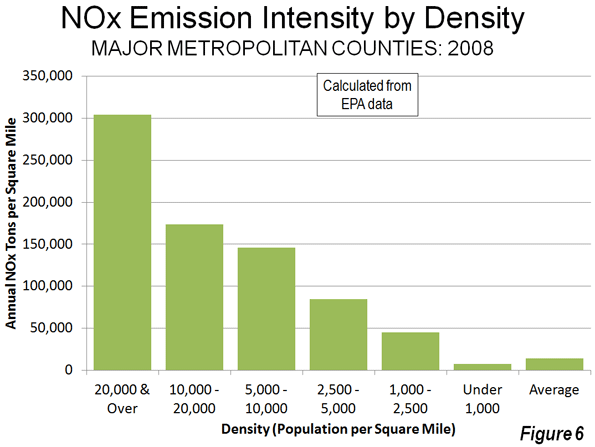
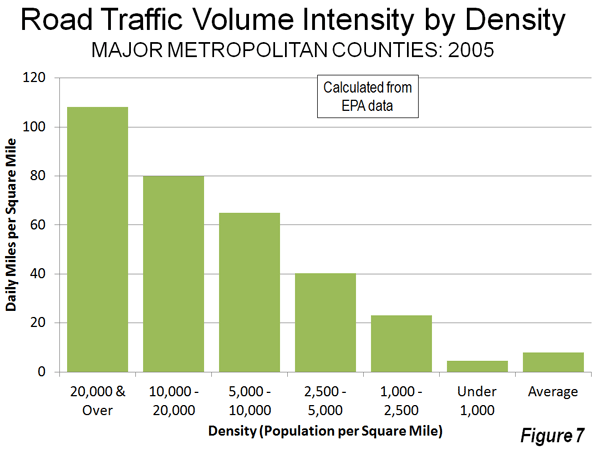
    The overall relationship between higher population densities and both NOx concentration and motor vehicle traffic intensity is illustrated in Figure 6 and Figure 7. There is a significant increase in the concentration of both NOx emissions and motor vehicle travel in each higher category of population density. For example, the counties with more than 20,000 people per square mile have NOx emission concentrations 14 times those of the average county in these metropolitan areas, and motor vehicle travel is 22 times the average. A smaller sample of the most urbanized counties (those with 90 percent or more of the land urbanized) showed a stronger association. This findings are consistent with research by the Sierra Club and a model derived from that research by ICLEI–Local Governments for Sustainability, both strong supporters of the livability and smart growth strategies of densification.
    A Caution: The air pollution data contained in this report is for emissions, not for air quality. Air quality is related to emissions and if there were no other intervening variables, it could be expected that emissions alone would predict air quality. However there are a number of intervening variables, from climate, wind, topography and other factors. Again, Los Angeles County makes the point. As the highest density large urban area in the nation   Los Angeles under any circumstances would have among the highest density of air pollution emissions. However, the situation in Los Angeles is exacerbated by the fact that the urban area is surrounded by mountains which tend to trap the air pollution that is blown eastward by the prevailing westerly winds.

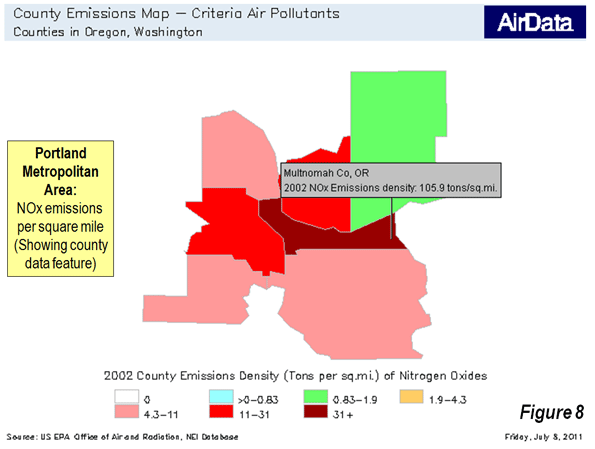
    The EPA data for 2002 can be used to create maps indicating criteria pollutant densities within metropolitan areas. An example is shown of  the Portland (OR-WA) metropolitan area (Figure 8), with the latter indicating the data illustration feature using Multnomah County (the central county of the metropolitan area), which is the most dense county and has the greatest intensity of NOx emissions and traffic congestion.
    The Goal: Improving Public Health

    These data strongly indicate that the densification strategies associated with smart growth and livability are likely to worsen the intensity of both NOx emissions and congestion of motor vehicle travel.

    But there is a more important impact. A principal reason for regulating air pollution from highway vehicles is to minimize public health risks. Any public policy that tends to increase air pollution intensities will work against the very purpose of air pollution regulation: public health. The American Heart Association found that air pollution levels vary significantly in urban areas and that people who live close to highly congested roadways are exposed to greater health risks. The EPA also notes that NOx emissions are higher near busy roadways. The bottom line is that all – things being equal – higher population density, more intense traffic congestion, and higher concentrations of air pollution go together.

    All of this could have serious consequences as the EPA seeks to expand its misguided regulations. For example, officials in the Tampa-St. Petersburg area have expressed concern that the metropolitan area will not meet the new standards, and they have proposed densification as a solution, consistent with the misleading conventional wisdom. The reality is that this is likely to make things worse, not better.  

    Less Livable

    There are myriad difficulties with smart growth and livability policies, not least their association with higher housing prices, a higher cost of living, muted economic growth, and decreased mobility and access to jobs in metropolitan areas. As the EPA data show, the densification policies of smart growth and livability also make air pollution worse for people at risk.

    Virtually all urban areas of Western Europe, North America and Oceania principally rely on cars for their mobility and there is no indicate that this will change. The air is less healthful for residents where traffic intensity is greater. As the air pollution intensity data shows, cars need space.

    Wendell Cox is a Visiting Professor, Conservatoire National des Arts et Metiers, Paris and the author of “War on the Dream: How Anti-Sprawl Policy Threatens the Quality of Life

    —–

    Note 1: The city (county level jurisdiction) of Fredericksburg, Virginia surprisingly ranks third in its concentration of motor vehicle travel yet ranks eighth much lower in population density. This reflects the high volumes of traffic through the  small municipality (and county-equivalent jurisdiction) carried on two of the East’s busiest roadways, Interstate 95 and US-1.

    Note 2: Additional analysis and information is available at Air Pollution, NOx Emissions, Traffic Congestion and Higher Population Density: The Association in Major Metropolitan Areas of the United States.

    Adapted from an article published by the Heritage Foundation.

    Photo of Manhattan traffic by carthesian.
  • Private Investors Shun Brazil High Speed Rail Bid

    In April of 2011 the California High Speed Rail Authority held a meeting of potential investors and vendors interested in participating in the proposed Los Angeles to San Francisco high-speed rail project. Project sponsors have insisted they could gain substantial private investment for the project. The Authority indicated that the meeting drew 2000 attendees at the Los Angeles Convention Center, which supporters indicated was proof of the interest of private investors in the project.

    Apparently believing the claims that high-speed rail is "profitable," the Brazilian government set about planning a line stipulating that private investors would build the infrastructure and operate a line, at their own risk.

    The federal government offered private investors the opportunity to bid on a concession for the proposed Rio de Janeiro to Sao Paulo and Campinas high-speed railroad (Trem de Alta Velocidade). None of the Los Angeles attendees or any others submitted a bid for the concession. It is also reported that two previous opportunities attracted no bidders.

    In reviewing the project documents for the high-speed rail line in Brazil, it is easy to understand why the 510 kilometer (310 mile) route drew no interest. In Brazil, investors would be required to put their own money at risk with no revenue guarantees. Rising capital costs could be a problem as well since California’s high speed rail costs have doubled in just three years, a line that virtually everyone understands will require heavy public subsidies, despite being far richer than Brazil.

    Capital Costs: The winning bidder in Brazil would have been granted a 40 year concession and would have been required to provide substantial funding toward the $20 billion (34 billion in Brazilian Reals) capital cost. If the international experience holds in Brazil, that cost could escalate to $40 billion (70 billion Reals) or more.

    The Rio de Janeiro to Campinas line would not be easy to construct. The mountains south of Rio will be challenging. Unlike California, little of the route is as flat as Kansas. The line would operate through two of the world’s megacities, Rio de Janeiro and São Paulo as well as two other large urban areas, Campinas and San Jose dos Campos. Unlike Los Angeles and San Francisco, Sao Paulo and Rio de Janeiro do not have well placed existing rail corridors that can (at least theoretically) be expanded to handle the fast trains. The urban densities are much higher in Brazil than in California, which means that the construction will be more disruptive. The Los Angeles and San Francisco urban areas have densities of from 6,000 to 7,000 per square mile (2,100 to 2,700 per square kilometer) while those in Sao Paulo and Rio de Janeiro range from 15,000 to 18,000 per square mile (6,000 to 7,000 per square kilometer).

    Protecting the Taxpayers: Interested in protecting Brazilian taxpayers, the government has required that any cost overrun be paid for by the winning bidder. This, combined with the requirement to support the capital costs and debt service out of passenger fares and other commercial revenues seems, likely to have discouraged bidders, who in other places – from France and the United Kingdom to Korea – can rely on taxpayers to cover the inevitable cost overruns.The lesson of Taiwan, where private investors have already lost most of their capital is likely fresh in the minds of potential bidders.

    Responsibility for Cost Overruns: Moreover, it is not realistic to expect a private concessionaire to have sufficient capital to pay for the extent of cost overruns. If there a concessionaire is ever selected for the Rio to Campinas line, it will likely be a limited liability firm, specifically designed to shield investors from the very kind of risk that the Brazilian government expects it to shoulder.

    Thus, as would likely have been the case in Florida if Governor Scott had not canceled the Tampa to St. Petersburg line, taxpayers can expect to pay for cost overruns, despite the best intentions and good faith of the Brazilian government. No private concessionaire has funds stashed away for losses like that.

    Ridership and Revenue: The ridership projections for the line appear to be aggressive. This is typical of the international experience in high-speed rail projects, where ridership projections average 65 percent higher than eventual ridership, according to investment grade research by Bengt Flyvbjerg of Oxford University, Nils Bruzelius of the University of Stockholm and Werner Rottengather of the University of Karlsruhe (Megaprojects and Risk: An Anatomy of Ambition). Ridership is forecast to be greater than the widely criticized California projections.

    Nonstop fares between Rio de Janeiro and São Paulo are projected at approximately US$100, similar to the fares that would be charged in California. The demand for travel at such a price is likely to be considerably less in Brazil, where the incomes are a fraction of those in California. Project documents indicate that large numbers of people will switch from other modes of transport.

    Two such modes, the car and bus, are used by people needing to travel as inexpensively as possible (whether in Brazil or the United States). The project assumes a unprecedented 50 percent of car travel would be diverted to the train. Reality is likely to be a small fraction of this. The potential for attracting bus riders was also exaggerated, projecting that 65 percent of this less affluent market would pay two to three times as much as current bus fares to ride the train.

    Next Steps: The government intends to restructure the bidding process and try again. Brazil had hoped that the high-speed line would be running in time for the 2014 FIFA World Cup (soccer) and then be available for the 2016 Olympics in Rio de Janeiro. Even 2016 may even prove an impossible challenge at this point.

    China Daily caught the reality of the situation in commenting on the missing bidders for the Rio to Campinas high speed rail line:

    ….the high-speed rail dream may be one area where the government will have to assume more of the risk … because of the long term investment and delay in making a profit.

    In a nation in which 11 of the 26 states have a gross domestic product less than the cost of the train, "investment" in high speed rail might not be the top priority. It is not surprising that no private investor is willing to take the risk for the potentially enormous losses, nor should taxpayers.

    —-

    Photograph: Avenida Paulista, Sao Paulo (by author)

    Wendell Cox served as a member of the Amtrak Reform Council. He authored high speed rail feasibility studies in Florida (The 1997 Evaluation of the FDOT-FOX Miami-Orlando-Tampa High Speed Rail Proposal for the James Madison Institute and the 2011 Reason Foundation report, The Tampa to Orlando High Speed Rail Project: A Taxpayer Risk Assessment) and North Carolina (Should North Carolina Add More Piedmont Trains, 2011,for the John Locke Foundation) and was co-author of the Reason Foundation’s The California High Speed Rail Proposal: A Due Diligence Report, with Joseph Vranich (2008).

  • The Economist: The Great High Speed Train Robbery

    The Economist magazine has called on the British government to cancel plans for the HS-2 high-speed rail line that would run from London to Birmingham and Manchester. The Economist said:

    …these days politicians across the developed world hope new rapid trains, which barrel along at over 250mph (400kph), can do the same. But high-speed rail rarely delivers the widespread economic benefits its boosters predict. The British government—the latest to be beguiled by this vision of modernity—should think again

    The government claims the line will cost £32 billion line, however the international experiences suggests a figure more on the order of  £32  and the experience in this corridor itself suggests costs could rise even more (see The High Speed Rail Battle of Britain).

    A principal purpose for the line is to bridge the economic gap between the economic dynamo of Southeast England (including London) and the Midlands and North of the country. This does not convince The Economist:

    China suspended new projects after a fatal collision of two high-speed trains in July; Brazil delayed plans for a rapid Rio de Janeiro-São Paulo link, after lack of interest from construction firms. Yet governments remain susceptible to the idea that such projects can help to diminish regional inequalities and promote growth.

    The Economist doubts this will happen:

    In fact, in most developed economies high-speed railways fail to bridge regional divides and sometimes exacerbate them. Better connections strengthen the advantages of a rich city at the network’s hub: firms in wealthy regions can reach a bigger area, harming the prospects of poorer places. Even in Japan, home to the most commercially successful line, Tokyo continues to grow faster than Osaka. New Spanish rail lines have swelled Madrid’s business population to Seville’s loss. The trend in France has been for headquarters to move up the line to Paris and for fewer overnight stays elsewhere.

    The Economist reminds the government that:

    Britain still has time to ditch this grand infrastructure project—and should. Other countries should also reconsider plans to expand or introduce such lines. A good infrastructure scheme has a long life. But a bad one can derail both the public finances and a country’s development ambitions.

    Finally, The Economist says that there is better use for the money.

    The £32 billion at its disposal might well yield a higher return if it were spent on less glitzy schemes, such as road improvements and intra-city transport initiatives. If the aim is to regenerate “the north”, the current plan might prove a high-speed route in the wrong direction.

  • Iowa Getting Off Bus Speed Rail?

    Iowa Governor Terry Branstad has refused to pay $15,000 in annual dues to the Midwest High-Speed Rail Association. This comes after the state legislature declined to fund intercity rail programs in the 2012 budget. Various public agencies had offered to pay the $15,000 on behalf of the state, however Branstad declined the money, with a spokesperson saying that the Legislature had "made their will crystal-clear" about funding membership in the organization.

    The Midwest High-Speed Rail Association has been promoting an intercity rail system that would serve Chicago from other major metropolitan areas, operating at substantially below international high-speed rail standards. In the case of the Iowa route, travel to Chicago would be slower than the present bus service, which does not require public subsidy and which provides free high-speed Internet. This issue is described in greater detail in an earlier article.

    The proposed national high-speed rail system has run into considerable difficulty at the state level. In addition to the reluctance of Iowa to participate, the states of Florida, Wisconsin and Ohio have refused federal funding. In the case of Florida, the genuine high-speed rail system was canceled by Governor Scott out of fear that the cost overruns, which have occurred in 90 percent of cases, would be the responsibility of state taxpayers. The California system could be nearly $60 billion short of its funding requirements for the first phase and is running into serious difficulties from citizens along the route. The Missouri legislature declined to include funding for part of the Midwest system earlier this year. Finally, the North Carolina legislature has placed requirements for its own review of any future federal grants for high-speed rail.

  • Megabus – King of the Road

    In recent years there’s been a resurgence in intercity bus travel, driven by the rise of low cost, non-stop service linking tier one cities like New York, Chicago, and Washington, DC with other regional hubs in their surrounding areas. This is a lively and diverse market, particularly on the east coast, with providers like Megabus, Bolt Bus, Greyhound, and a host of so-called “Chinatown” buses.

    These offer service for very low fare, ostensibly as low as a dollar, but more typically $20. Still, that’s far cheaper than even driving in most places, and certainly than flying. These services typically involve curb side loading (no stations) adjacent to a city’s main train station, making them almost a quasi-rail service or rail adjunct, while giving many of the same rail benefits as direct CBD-CBD service without requiring extensive, and expensive, ground transport on either end. With amenities like AC power outlets and free wi-fi – which many Amtrak and commuter trains don’t yet offer – it’s easy to see why they are popular. And this isn’t just with the stereotypical bus ride customer, but increasingly with everything from hip Millennials to the mothers of yuppies coming into the big city for a visit. Megabus and others are drawing an entirely new market who previously would have discounted intercity bus service – including Yours Truly.

    With a low cost service that gets people out of cars and planes and into what is basically a shared transit vehicle, you would think that Megabus would be extremely popular in the urbanist/sustainability community. But you’d be wrong. A large segment of them have indeed seen the virtues of this new school intercity bus service, but a surprisingly large number of them actually revile Megabus.

    Among the common complaints are that Megabus is “subsidized” because it uses valuable curb side real estate in cities for free, that they are implicitly subsidized by highway funding, that passengers waiting for the bus at the stop are a nuisance, that the buses clog the streets and pump fumes into the air in a way that harms the “neighborhood,” and that the service really isn’t that good because of congestion. Even the government of Washington, DC is getting in on the act, as reported they want to charge Megabus a fee for access to their loading zones.

    Every last one of these is bogus. The quickest way to illustrate this is to simply ask how urbanists would react if anti-transit forces made similar arguments against ordinary municipal bus service.

    First, municipal bus service is massively subsidized, both from a capital and operating perspective. Megabus pays for its own buses, drivers, and fuel and actually pays taxes to the government. As for subsidies from free use of curbside real estate and highway funding, large amounts of our city streets – including on pretty much every block on major streets in major cities – have permanently dedicated space to bus stops. The bus agency does not pay for these. City buses also runs on streets paid for with highway and general fund dollars. And in any case, this concrete investment in streets and highways is a sunk cost, with buses contributing little to general freeway congestion.

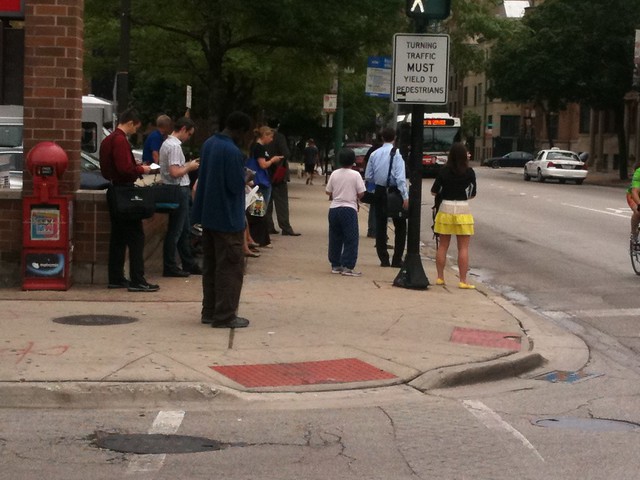
    As for passengers congregating at stops, that’s frequently the case with city buses as well, as this picture from Chicago shows:

    And to argue about crowds hurting city life seems a bit odd given that we’re told one of rail’s benefits is bringing all those people in to patronize businesses. I know I’ve made purchases at businesses near the Megabus stop that I wouldn’t have otherwise made. And in places like Midtown Manhattan, there are already vehicles of all types more or less continuously stopped or even double parked along the avenues. Megabus is barely a blip here. Plus don’t forget all the loading zones that already serve many private businesses all over our cities.

    Also, these bus stops are typically located in the CBD near a train station, which is already crowded and which itself can be a huge (and tax free) mega-structure in the city that poses disruption in its own right (e.g., Grand Central Terminal). What this also means that any fumes and such disproportionately are in the CBD, not really a neighborhood. Again, many train stations also feature diesel fume generating trains (Metra’s trains in Chicago were recently noted as having unsafe diesel fume concentrations). And also, city buses generally do pump out fumes as well, and truly in the neighborhoods. Anyone who’s spent time in a city knows the delight of having a poorly tuned bus pull away from the stop belching a huge black cloud. I frequently get to experience this while out jogging in my neighborhood.

    Again, if an anti-transit writer tried to disparage investment in city buses with the arguments raised against Megabus, they’d be laughed out of the house by the urbanist/sustainability crowd.

    So why the complaints? They can speak for themselves, but I suspect a couple of items. Firstly, some people just don’t like private sector solutions. That’s a view I can respect, but not agree with. But more importantly, I think that there’s fear that successful private sector intercity bus service undermines the case for high speed rail that is near and dear to the urbanist heart.

    Indeed, it is true that in many cases Megabus frankly does undermine the case, particularly for the “Amtrak on steroids” style HSR proposals on the table in places like the Midwest. Megabus already delivers basically the end to end journey times of the proposed Midwest “high speed rail” system with similar amenities but without the need for billions in government expenditures. Even on the east coast, NYC to Providence has a journey time not that much worse than the Acela – and at 20% of the ticket price. Congestion might be a real concern, but if so, customers would notice. But give Megabus some credit – they build this into their schedules. Generally the journey times are as advertised.

    I prefer to look at it differently though. What Megabus & Co. are proving is that there is a viable market for intercity transit-style travel at the right price. Thus they are helping to get people used to the idea of traveling that way and in a sense priming the pump for high speed rail at a later date as demand increases. The bus operators are doing the hard work of creating and proving out the market for this. Also, Megabus will hopefully force the backers of many of these HSR proposals to rethink their concept around 110MPH peak speeds in favor of true high speed rail. And even in the worst case, Megabus doesn’t say anything against such slam dunk investments as further upgrades to the NEC. Conceivably if and when HSR investments are made, these bus operators will service a different, lower end market and/or evolve into more of a rail complement. (For another perspective on this, see “Will Megabus Kill High Speed Rail?.”)

    In any event, I’m totally puzzled by the lack of enthusiasm or outright hostility against a service which is providing cost effective, green transport and getting people out of their cars today without tax expenditures. That’s not to say these services can’t be improved. Perhaps they should make some payment for curbside space. The wi-fi service is frequently inoperable. And their buses, particularly later in the day, can see schedule slippage as problems cascade. Perhaps some stops should be relocated to be less disruptive. But all of these are easily solvable problems. None of them vitiates the fact that these intercity bus services are one of the best transport innovations of our time.

    Aaron M. Renn is an independent writer on urban affairs based in the Midwest. His writings appear at The Urbanophile, where this piece originally appeared.

    Photo by Sidddd

  • Dulles Metrorail Silver Line Vs Bus Rapid Transit

    Long overdue rapid transit service from Washington DC to Dulles airport is now under construction. The Dulles Corridor Metrorail Project, known as the Silver Line, may seem like it was an obvious choice as a way to improve the region’s public transportation. Construction began in March 2009, and service is expected to begin by 2013. As those who have used bus service from the DC area to the airport can attest, the current system — a regular city bus equipped with luggage racks — is inadequate. The buses are low capacity, and are not designed for highway driving.

    While rail might seem like the most obvious solution, it is also by far the most expensive and slowest option. The price tag is staggering, and the rail extension will take years to construct. The better option would have been to make use of the existing roadways, and implement an expansive bus rapid transit system (BRT).

    The 23 mile extension of the Washington Metro rapid transit system is forecast to cost $6.8 billion dollars; roughly $296 million per mile. The constant scramble to finance the over-budget project has resulted in more than one construction setback.

    In contrast, consider how a BRT system could have worked, and what it would have cost. One lane in each direction on the Dulles Toll Road could have been designated as a high occupancy vehicle (HOV) lane, to ensure that buses could move relatively quickly. The average cost of implementing a BRT system running on an HOV lane is $8.97 million per mile (in 1999 dollars), which would have brought the cost to roughly $230 million. It should be noted that this average is heavily skewed by one costly project; two million to five million dollars per mile is more typical, which would make the final cost in DC between $52 million and $130 million.

    The buses themselves would have had to be fully articulating — the kind that bend in the middle, also known as accordion buses — with overhead luggage compartments, and a capacity of roughly 87 passengers. They would likely cost somewhere between $750,000 and $1.68 million.

    The overwhelming likelihood is that busses to Dulles would cost near the low end of the price range. The high end is based on the cost of buses used in Boston for their Silver Line BRT system to Logan Airport, where dual fuel electric/natural gas buses are used; these buses run underground, where they cannot burn gas, as well as on surface streets where there aren’t any overhead electric lines.

    The cost per passenger trip is likely to be lower for rail than for BRT, because of rail’s higher capacity per vehicle; the train will transport about 175 passengers per car. Despite this, the lower per passenger operating cost doesn’t come anywhere near making up for the massive capital cost. The interest alone on the $6.8 million dollar loan would equal $1,067,317 per day (amortized over 30 years at a 4% interest rate). This doesn’t factor in the cost of the principle, or the operating cost.

    Even after spending $6.8 billion, only about 10% of travelers to Dulles are likely to arrive by public transportation, according to projections by the Airport Authority. Compare that to 16% for Reagan , which is right in the city (Dulles is more than 25 miles outside of DC’s central business district. This highlights another advantage of BRT: modularity. Instead of all or nothing, BRT can be gradually introduced, and levels of service can be adjusted to meet demand.

    While access to Dulles isn’t the full justification for the Silver Line, it’s hard to imagine the rail extension ever paying for itself. At the end of the day, cost is the number one issue, and BRT wins hands down.

    Steve Lafleur is a Policy Analyst with the Frontier Centre for Public Policy.

    Photo: Metrorail Construction; truss erecting span at I-459 and Rte 123