Tag: Transportation

  • World High-Speed Cost Increase Record

    California’s high-speed rail project is setting speed records, not on tracks, but rather in cost escalation. Last week, the California High Speed Rail Authority (CHSRA) announced that the Bakersfield to Merced section, part of which will comprise the first part of the system to be built, will cost between $10.0 and $13.9 billion. This is an increase of approximately 40 percent to 100 percent over the previous estimate of $7.1 billion, an estimate itself less than two years old.

    This "flatter than Kansas" section should be the least expensive part of the system. It can only be imagined how much costs might rise where construction is more challenging, such as tunneling through the Tehachapi Mountains and for the route across the environmentally sensitive Pacheco Pass that leads to the Silicon Valley. CHSRA officials admit that the present $43 billion cost estimate to complete the Los Angeles (Anaheim) to San Francisco first phase will rise substantially. This estimate was also less than two years old.

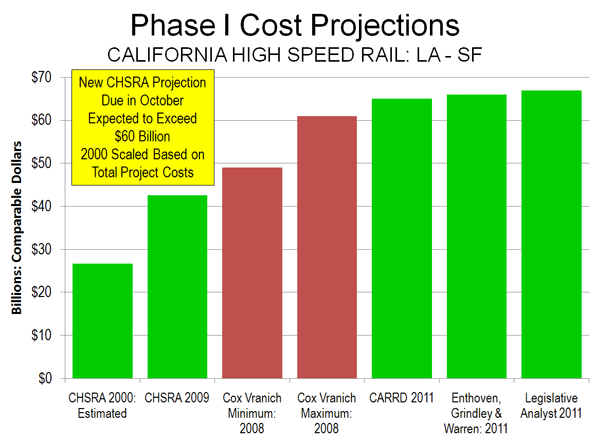
    Today only the most ardent supporters believed that initial estimate figure any longer. Early in the year, CARRD (Californians Advocating Responsible Rail Design) looked closely at CHSRA documentation and estimated that Phase I would instead cost $65 billion. In May, the California Legislative Analyst’s Office indicated that based upon the cost escalation already taking place, the cost of Phase I could reach $67 billion.   Alain Enthoven of Stanford University, William Grindley, formerly of the World Bank and William Warren, a former Silicon Valley CEO project a $66 billion figure (see Figure) and also estimate that costs for the complete project, with extensions to San Diego and Sacramento could be up to $116 billion (Note 1). This is triple the 2000 CHSRA projection (inflation adjusted).
    Megan McArdle of The Atlantic characterized the obsolete $43 billion estimate as "giddily optimistic," while Reihan Salam of National Review Online called the cost escalation "a national embarrassment." In fact, even the $43 billion represented substantial cost escalation. Over the previous decade, the project cost had escalated more than 50 percent after adjustment for inflation.

    Any one of the new cost projection figures would put the California High Speed Rail project on track for a world high speed record in cost escalation. Available data indicates that no transportation infrastructure project in the history of the world has experienced such a large cost increase in so little time.

    Cox/Vranich Projection Low: In 2008, Joseph Vranich and I authored the Reason Foundation’s The California High Speed Rail Proposal: A Due – Diligence Report. Based upon the cost escalation we predicted in that report, our cost escalation estimate for Phase I would have been between $49 billion and $61 billion (Note 2). Little did we expect that our maximum cost escalation figure would turn out to be too conservative and be exceeded even before the first shovel had been turned.

    Rippling to Florida: There has already been a ripple effect from California’s record cost escalation. My Reason Foundation report on the Florida high speed rail project (The Tampa to Orlando High Speed Rail Project: A Florida Taxpayer Assessment) used a comparison to the first segment of the California system to produce a maximum cost overrun estimate of $3 billion for the Florida system. Had the new cost estimates been available at the time, we would have projected even higher cost overruns. Of course, Governor Rick Scott canceled that project to shield the taxpayers of the state from obligations not only for cost overruns but also for operating subsidies.

    Citizen Opposition: Meanwhile, the California project has encountered other difficulties. Strong community opposition to the project has developed along the route through the generally Democratic voting peninsula cities between San Jose and San Francisco. CHSRA had intended to expand the existing commuter rail and freight rail right-of-way from 2 to 4 tracks either elevated or to put it in a trench. Residents fear that an elevated system would be a virtual "Berlin Wall" dividing their communities and that a trench would be little better. Vigorous opposition has also developed in the Central Valley (San Joaquin Valley), which is one of the world’s leading agricultural areas.

    There is also a dispute on routing, as CHSRA considers crossing the "Grapevine" parallel to Interstate 5 between Los Angeles and Bakersfield, rather than the adopted, longer route through the Antelope Valley (the Lancaster-Palmdale urban area, which is likely to have 500,000 people by 2020 when the train is supposed to begin operating).

    Slowing Down the Trains: The peninsula residents have been successful in obtaining strong political support in Sacramento and Washington. There are indications that a "blended" alternative might be developed instead of the elevated or trench alternatives. This would involve mixing high-speed trains on the same two tracks is the present Cal Train commuter service. Of course, this means that the high speed trains could not run very fast. This could add up to 50 minutes to the schedule between Los Angeles and San Francisco, which would make it impossible for the trains to reach the travel time mandated in state law of 2:40. Instead, the trains could take up to 3:30.

    Our Due Diligence Report expressed doubts about the ability of CHSRA to deliver on the legislatively mandated travel times. We predicted that the fastest non-stop trains would take 3:41 between Los Angeles and San Francisco, not much more than the 3:30 that could result from the "blended" alternative. Even that time might not be achievable should citizen opposition develop along other parts of the line. California would, as a result, get the look, but not the substance of high speed rail.

    A Shortage of Funding: Perhaps the final blow will come from financial reality, a commodity often in short supply in recent California history.   At this point, the project has received less than $4 billion in federal grants, which together with a matching $4 billion from the state bonds authorized by taxpayers could be spent. However, given the Republican control of the House of Representatives and the tight federal budget, the prospect for additional federal funding seems dim. High-speed rail was deleted from the federal budget in the agreement between Congress and the President in April. The 2012 budget passed by the House of Representatives does not contain money for high-speed rail.

    CHSRA is optimistic about receiving private investment to fund a major part of the construction. Although there is no shortage of companies looking to be paid to do work on the high-speed rail project, the room empties out when firms are asked to risk billions of their own capital on the project. CHSRA’s own documents indicate that investors are likely to require revenue guarantees, which would appear to violate provisions of the state law that placed the bond issue on the ballot in 2008.

    The Prospects:  At this point there seem to be three potential outcomes. The first, and least likely, is that CHSRA will obtain sufficient funding to build Phase I. Alternatively, CHSRA could build only some portion of the line in the Central Valley, and high speed rail would likely not operate in this far less densely traveled corridor. This would leave California with the most extravagant Amtrak segment in the nation. The third potential outcome is, of course, that the system will never be built.

    Bipartisan concerns are now being expressed in Sacramento, where some Democrats worry that high-speed rail could divert money from more critical, and politically influential, uses. Senator Alan Lowenthal (D-Long Beach), who chairs a committee overseeing the project may have spoken for many after the events of the week: "This is really very serious and needs to stop in its tracks. We can’t just be acting as if someone’s out there giving us wheelbarrows full of money, and it’s just coming. This is not the way we should be operating."

    —-

    Note 1: Enthoven, Grindley and Warren also note that if the California high speed rail project were to equal the worst level of cost escalation yet in California (the San Francisco Bay Bridge project, which is now underway), the costs would rise to as much as $213 billion (Cited in The Wall Street Journal editorial, "Runaway Trains").

    Note 2: Our estimates have been adjusted to "year-of-expenditure" dollars, the method currently used by CHSRA in its cost estimates.

    Photo: California’s Central Valley (where first segment is to be built)

    Wendell Cox is a Visiting Professor, Conservatoire National des Arts et Metiers, Paris and the author of “War on the Dream: How Anti-Sprawl Policy Threatens the Quality of Life
  • Report: China to Suspend High Speed Rail Development

    Railway Age reports that Premier Wen of China "has told the state media that the government will suspend approvals of new rail while it conducts safety checks to address concerns rising from the high speed train collision last month that killed 40 people."

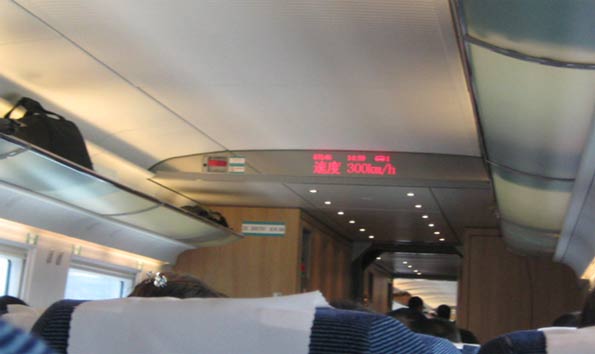
    The Premier also indicated that high speed rail trains should operate at slower speeds "at their earlier stage of operation." Earlier this year, the Ministry of Railways slowed all trains to a maximum speed of 300 kilometers per hour (186 miles per hour) and many trains that were to operate at that speed were slowed to 250 kilometers per hour (155 miles per hour). At the time, reports indicated that the slower speeds were to lower operating costs so that fares could be reduced. Concerns had been raised about the much higher fares on the new trains and the cancellation of many conventional trains, which had much lower fares. Railway Minister In addition, Sheng Guangzu told the press that the slower operating speeds would "offer more safety."

    Photo: Suzhou to Nanjing at 300 kph (by author)

  • Los Angeles Metro Bus System Compares Favorably With its Peer Group

    As the Los Angeles County Metropolitan Transportation Authority (Metro) prepared for its most recent round of major bus operations reductions, Metro CEO Art Leahy has been quoted:

    "(T)oo many bus lines with excessive service has led to regular budget deficits1."

    "How full are Metro buses today? Overall, Metro buses are running at an average of 42 percent capacity. Of course, that doesn’t mean that all Metro buses are less than half full. Another measure to gauge bus usage is called ‘load ratio’ — the ratio of passengers to bus seats at the most crowded part of a bus route. By that count Metro’s average load factor is an average of 1.2. (For example, 48 passengers on a 40 seat bus). Many other large transit agencies are running load factors of 1.5 to 1.72 ."

    The "42 percent" capacity is evidently the average passenger load (APL) divided by the number of seats – in other words, on average for the full year, each 40-seat MTA bus had about 17 passengers on board.

    Forty-two percent might appear to be a low value, particularly in comparison to other modes of transportation like scheduled airlines, where it is common to have a 100% load factor on some flights.  However, Lufthansa doesn’t stop at Wilshire/Vermont to pick up passengers between LAX and JFK – transit service is scheduled for peak load factor; that is, attempting to approach, but not exceed, a maximum load factor at the point on the line where the number of people on board is largest.

    In the second quote, we have a mixture of load factors terms and data.  Almost all transit operators have load factor standards, which they set for each mode of service (bus, light rail), time of day, day of week, and type of service (main line arterial bus service, long-haul commuter, neighborhood circulator).  For Metro, the peak load factor criterion had been 1.20 – the 48 passengers on a 40-seat bus – since this was imposed by the Consent Decree that settled Labor/Community Strategy Center v MTA in late 1996 until very recently.

    In that quote, Metro is comparing services standards to actual performance.  It is certainly true that, until the passage of the new policy a few months ago, Metro’s 1.20 service standard was one of the lowest in the industry for larger city operators.  However, Metro routinely failed to meet this standard, which was a major source of complaints by the plaintiffs in L/CSC v MTA – and MTA’s overall average passenger loads have among the highest in the industry for decades.

    Comparing actual results to actual results is far more meaningful than comparing service standards to service standards.  Is 42 percent low, high, or what?  The standard methodology for determining this is peer group comparison.  The Federal Government makes transit data available though its National Transit Database – which we used for the 2009 reporting year3.

    We then constructed our peer group, the twenty largest U.S. transit operators by annual unlinked passenger trips that operate both bus and rail service4 and developed the data for: 

    APL:  Average Passenger Load
    BHr:   Boardings/Hour
    FRR:   Farebox Recovery Ratio
    SP:       Subsidy/Passenger
    SPM:   Subsidy/Passenger Mile

    The results are:

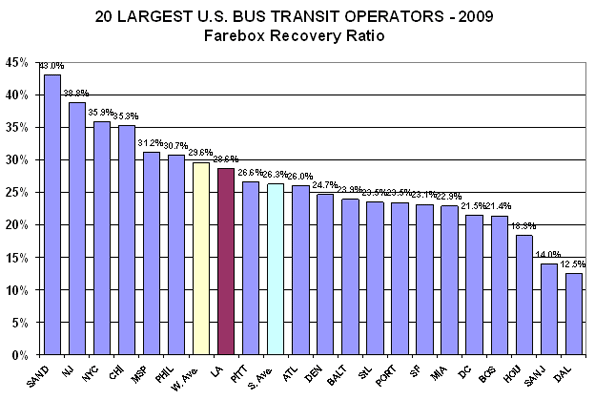
    1.         FRR: Higher is better – but, this statistic can often be misunderstood.  For example, a high cost operator with high fare can have a higher FRR than a low cost operator, but the low cost operator will be providing a better deal, financially, for both the riders and the taxpayers.

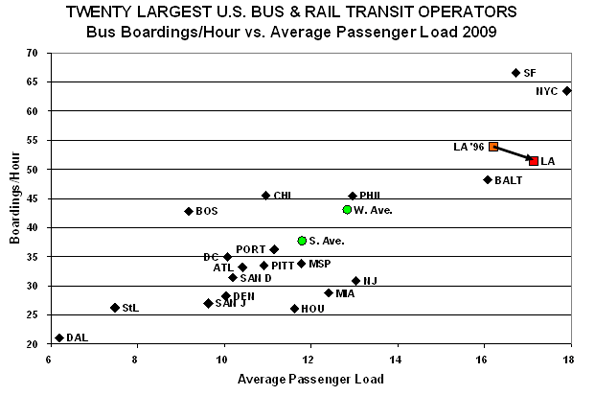
    2.  APL/BHr: Appearing and to the right on the next graph indicates higher load factors.  Higher is better; however, at some point, overcrowding impacts service quality and reliability.

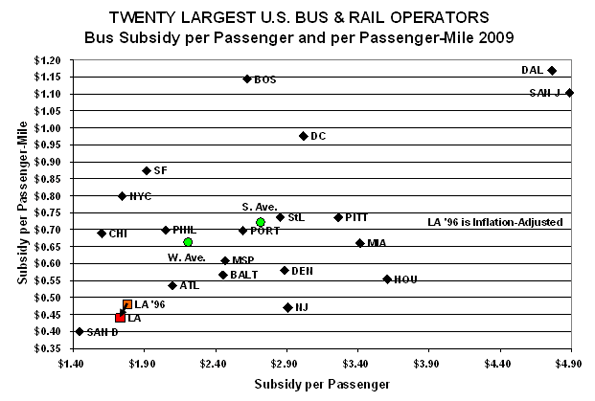
    3.  SP/SPM: On this graph, lower is better, so down and the left is superior – except that, at some point, low cost can indicate concerns about quality of service and safety.

    While Metro is not among the highest in FRR, it has more than twice as many ranked below it (13) than above it (six).  Considered with the subsidy metrics, Metro bus service is a fair deal to the riders and a great deal for the taxpayers.

    On the service utilization graph, Metro is second highest in APL, beaten by NYC, and third on BHr, beaten by NYC and SF.  We added, "LA ’96," for 1996, the year before the Consent Decree went into effect part-way through Metro’s 1997 fiscal year.  BHr has decreased slightly (53.9 to 51.4, or ~4.6%), while APL has increased slightly (16.2 to 17.1, or ~5.6%).  The increase in APL is interesting because Metro’s on-going replacement of primarily 43-seat "hi-floor" with 40-seat "low-floor" buses means that Metro is carrying more people in smaller buses.

    Metro bus service again does well on cost-effectiveness.  San Diego beats Metro on both SP and SPM and Chicago beats Metro on SP.  Metro reduced both of these from 1996 to 2009 after adjusting for inflation5.

    Finally, we decided to do a combined performance index, based on Metro’s own "Route Performance Index" (RPI), which Metro utilizes to eliminate low performers6:

    We have adapted METRO’s RPI in three ways:

    1.  We use it for bus system performance, rather than route performance.

    2.  The "standard" is Metro’s performance on each individual indicator.  The overall score is set at 1.00 for Metro, broken into four components, each of which Metro scores .25.  Operators scoring better on an indicator receives a score higher than .25; performing poorer, lower than .25, with the specific score a direct ratio against Metro’s score (remember that, for subsidy, lower is better, while for route utilization, higher is better).

    3.  Metro utilizes three metrics in its RPI, SP, BHr, and APL.  We added SPM.

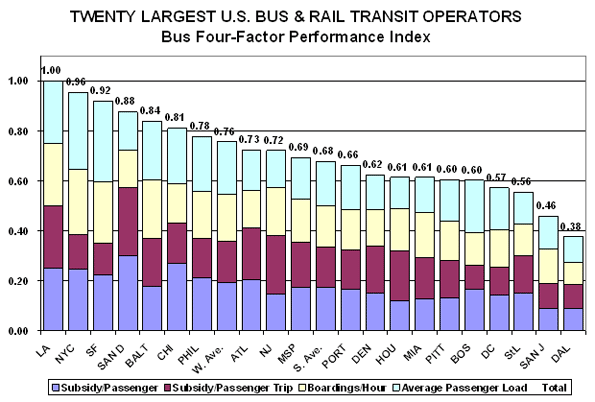
    What we see is Metro rated the highest overall among its peers.  Metro does not win on any single criterion, but its two seconds and two thirds put it ahead of the rest overall.

    Metro’s Transit Service Policy (page 32) states:

    "Lines with an RPI lower than 0.6 are defined as performing poorly and targeted for corrective action.  Lines that been subjected to correction actions and do not meet the 0.60 productivity index after six additional months of operations may be cancelled  …"

    If this .60 cut-off is applied to the 20 bus systems, several would be in major trouble.  Dallas (.38), San Jose (.46), Saint Louis (.56), and Washington, DC, (.57) are below the cut-off.  Boston and Pittsburgh (both at .60) are right on the line, and Miami (.61), Houston (.61), and Denver (.62) only slightly above.

    If one takes the Metro RPI and applies it to the nation’s Top 20, nine of the 20 are either below or very close to the cut-off point. This implies that a high portion of the individual lines, a majority in at several cases, are below the Metro route-by-route cutoff point.

    Circling back to Metro routes, this could mean that many of the routes that Metro would cut, using its RFI procedure, would be average or even above-average routes for many of the nation’s larger bus systems.  Failing to meet the Metro average is actually a very high cut-off point when compared to the national performance.

    This is not to say that no Metro service should ever be cut or eliminated.  What we are saying is, don’t make the cut-off point too high; there is a lot of well-utilized service, by national standards, that does not pass Metro’s methodology.  More important, where there are bus lines with service reduced, put that back on the many, many Metro bus lines that are underserved – which is the usual condition.

    From the above, we see Metro working very hard to cut to reduce the service operated by the most cost-effective and productive major city bus system in the nation – why?  Unlike most other U.S. transit operators, it is not due to lack of funding – but the explanation will have to wait for my next blog entry.

    1           Steve Hymon, "Metro Proposes Bus Service Changes in June, The Source (Metro’s blog), January 3, 2011, access July 9, 2011:
    http://thesource.metro.net/2011/01/03/metro-proposes-bus-service-changes-in-june/

    2               Ibid.

    3               National Transit Database, accessed July 7, 2011:
    http://www.ntdprogram.gov/ntdprogram/data.htm

    4           American Public Transportation Association, 2011 Public Transportation Fact Book, Table 3: 50 Largest Transit Agencies Ranked by Unlinked Passenger Trips and Passenger Miles, Report Year 2009 (Thousands), page 8, accessed July 7, 2011.
    http://www.apta.com/resources/statistics/Documents/FactBook/APTA_2011_Fact_Book.pdf

    5               U.S. Department of Labor, Bureau of Labor Statistics, CPI-U for LA/Riverside-Orange County, accessed July 7, 2011:
    http://data.bls.gov/pdq/SurveyOutputServlet?data_tool=dropmap&series_id=CUURA421SA0,CUUSA421SA0

    6           Metro, 2011 Metro Transit Service Policy, page 31 and Appendix F, accessed July 7, 2011
    http://www.metro.net/board/Items/2011/02_February/20110224RBMItem9.pdf

  • Cities Have Outgrown Their Role as Mere Creatures of the Provinces

    The Martin Prosperity Institute recently released the map below, which compares the GDP of several US metropolitan areas to the size of national economies. For instance, the Boston-Cambridge-Quincy metropolitan statistical area (MSA) has a GDP of $311.3 billion dollars. If it were a country, it would be the 40th biggest national economy on earth, ahead of countries such as Denmark ($310.1) and Greece ($303.4). The Houston-Sugar Land-Baytown MSA has a GDP of $378.9 billion, which would make it the 31st biggest national economy, bigger than Austria ($375.5) and Argentina ($368.9). New York-Long Island-Northern New Jersey ($1.28 trillion) isn’t all that far behind Canada ($1.57 trillion).


    While trotting out such comparisons is an interesting exercise, the comparison also gives us some important perspective.  Despite the fact that these cities, as well as many others, produce as much as large countries, they have nowhere near the same fiscal levers at their disposal. Further, they are subservient to higher levels of government. The same problem exists in Canada. The Greater Toronto Area’s economic output ($233.9) is nearly equivalent to Finland’s total GDP ($270.6). Note that this definition is far less expansive than the US metro areas listed above. If the definition were expanded to include the entire Golden Horseshoe, it would be closer to the Size of Norway ($414.3 billion).  Yet the City of Toronto can’t finance a public transit expansion without the two senior levels of government. Calgary ($62.5 billion), roughly the size of Lithuania, couldn’t decide to create a municipal sales tax. Vancouver ($85.5 billion), slightly bigger than Serbia, can’t even decide how to allocate gas tax dollars without a special deal with the federal government.

    The problem isn’t that we have too little government spending, but that revenue collection and spending decisions often happen at the wrong level. Revenue generation and spending should take place as close as possible to the point of delivery. There is no reason why someone in Moose Jaw should pay federal income taxes so that the Federal Government could partner with the province of New Brunswick to build a highway near Moncton. Similarly, there’s no reason why someone in Edmonton should send property tax dollars to the province so that it can pay for a transit expansion in Calgary. Not only is filtering money through multiple layers of bureaucracy inefficient, but it leads to bad decision making. Decisions both on the revenue, and expenditure side need to be made at the lowest level of government possible.

    In order to ensure that cities can meet their infrastructure requirements, provincial governments should gradually devolve spending responsibilities and revenue generating capacities to the municipalities, and the federal government should end the practice of intervening in infrastructure issues altogether. Some municipalities may choose to raise property taxes, others may increase user fees, and still others may experiment with municipal sales taxes. But regardless of how municipalities decide to raise revenue, they are better placed to determine how much revenue is required, and which projects are really essential. More importantly, devolution gives more direct control over decision making to the people that are actually impacted by the decisions. Devolution means more accountability, and more local input. And if tiny Iceland can fund it’s own infrastructure, there’s no reason why Winnipeg or Edmonton couldn’t do the same.

    This piece originally appeared at the Frontier Centre for Public Policy Blog.

    Steve Lafleur is a public policy analyst with the Frontier Center for Public Policy.

  • Zipcars: The Car Sharing Market Gets Zapped

    A growing sector of the urban populace is turning to “car sharing” — sharing vehicles through membership in nonprofit or for-profit organizations — for cost and convenience. Since 2006, membership in car sharing organizations has grown from about 100,000 to more than 500,000 people.

    Although the car sharing market is still tiny compared to the demand for privately owned vehicles, there is much to like about it, particularly when it is available in residential neighborhoods. Research by Susan Shaheen, professor at the University of California-Berkeley, shows that people who turn to car sharing drive less, use more fuel-efficient vehicles, and increase their use of “non motorized” transportation (walking and biking). Data is mixed about whether car sharing adds or subtracts from use of public transportation, but the overall impact appears to be negligible.

    The way car sharing works is simple: Members join an organization to gain access to a fleet of vehicles for use on a pay-as-you-go basis. The vehicle is picked-up and dropped-off at unattended location called a “pod”; the sites are generally located throughout a service area, rather than at a centralized location.

    Members typically pay annual or monthly fees on top of variable fees based on the number of hours, and sometimes the mileage, of each trip. The reservation and check in process is fully automated, as bookings are made online or via a smartphone, and vehicles are accessed using a smartcard.

    Car sharing often fills a missing link in a package of transportation options that can substitute for private vehicle ownership. Members often use transit service (or walk or bike) for daily commutes, use taxis for one-way trips or those that are short in distance but long in duration; rental cars, airlines or trains for long-distance trips; and car share vehicles for trips that might, for example, involve shopping, transporting heavy items, or visiting a suburb or nearby city.

    Zipcar, the nation’s largest car sharing provider, now offers its services in 11 major metropolitan areas and on over 150 college campuses. The Boston-based company issued its first publically traded stock in April 2011. Among nonprofits, City CarShare in the San Francisco Bay Area, I-GO in metropolitan Chicago, and PhillyCarShare in the Philadelphia area are the largest.

    Traditional car-rental companies are also getting in on the act. Enterprise Rent-A-Car operates WeCar, while Hertz Corporation has created Hertz on Demand, which has a foothold on 44 college campuses in 26 states and commands a significant presence in metropolitan New York. U-Haul’s U Car Share, primarily serves Salt Lake City, Utah, and ten college/corporate campuses in nine states.

    Of course, car sharing will likely account for only a small share of the travel market for the foreseeable future. The opportunity costs of time spent finding an available car, booking a reservation, and traveling to a pod can potentially be high, and prospective members accustomed to vehicle ownership may be hesitant to try a new transportation lifestyle. Car sharing is still rare in low-density areas. In addition, it’s been slow to show it can be profitable, although the sector’s rapid expansion may mask the profitability of mature markets.

    Also standing in the way are high taxes imposed by municipal governments. Many such taxes were created with the idea of extracting revenue from airport travelers visiting from out-of-town for business or tourism. As our research shows, however, these taxes increasingly fall on neighborhood folks who simply want to make do without owning a car.

    Scott Griffith, CEO of Zipcar, the nation’s largest car sharing provider, points to the “tax-related headwinds” slowing the growth of this sector.

    In many cities, consumers pay taxes of more than 40 percent for a one-hour trip to the grocery store. Three cities — Boston, Chicago, and Portland, Oregon — have re-defined car sharing to provide waivers from certain taxes. But most cities still levy the full spectrum of fees that apply to car rentals. Our study shows that these taxes average almost 18 percent on one-hour reservations, and about 16 percent on the average reservation, rates that are more than twice the prevailing sales tax, which averages only about 8 percent.

    The situation is at its worst where consumers must pay flat amounts per transaction, regardless of the duration of the trip. Car sharers in New Jersey pay a $5 per-transaction fee, plus sales taxes, each time they use a vehicle. When coupled with other fees, this generally results in a tax rate of around 60 per cent on one-hour car sharing reservations. Passionate appeals have laid the groundwork for a bill presently under consideration to exempt car sharing organizations from this tax, but the prospects for passage remain uncertain.

    Maricopa County (Phoenix), Arizona imposes surcharges of $2.50 or more, while Colorado, Connecticut, Florida, New Mexico, Pennsylvania, and Allegheny County (Pittsburgh), Pennsylvania, each levy $2 surcharges. Cities without such fees tax car sharing heavily, as well. Car share users in New York City and in Seattle pay a combined tax of more than 19 percent, a levy that’s akin to the “sin taxes” on alcoholic beverages.

    Most of these fees were created before car sharing became a popular alternative. When establishing fees, it seems unlikely that legislative bodies contemplated that large numbers of local residents would have “virtual” access to cars in their neighborhood and seek to use them for less than a day.

    So, if the high taxes are the product of misguided government policy that can and should be corrected, why isn’t it fixed? Predictably, efforts to lower the burden have been complicated by the severe budgetary shortfalls facing governments. Some policymakers are nervous that technological innovations will blur the distinction between car sharing and the traditional rental car business, creating a slippery slope. As the car-rental business shifts away from airports, it faces similar problems.

    Investment in car rental models which give customers access to cars in a few keystrokes, and which offer hourly rentals at neighborhood pick-up locations, suggest that more changes in how people use cars are on the horizon.

    Municipal government espousing to be green need to take a hard look at their fees. Market-based innovations such as car sharing can’t reach their potential with today’s punitive tax structure. Reducing taxes for neighborhood car sharing organizations to levels comparable to the general sales tax is a necessary step to ending the penalty for life without a private car.

    Joseph P. Schwieterman is director and Alice Bieszczat a research associate at the Chaddick Institute for Metropolitan Development at DePaul University in Chicago. They are the co-authors of a new study, Are Taxes on Car Sharing Too High: A Review of a Tax Burden Facing an Expanding Transportation Mode?.

    Photo by Romana Klee, #113 zipcar

  • Learning the right lessons from LA’s “Carmageddon”

    Carmageddon has come and gone, and the world didn’t end. The catalyst for the predicted disaster was the closure of Interstate 405 in Los Angeles for construction for the weekend of the 16th and 17th of July. Freeway closures aren’t all that unusual, but the 405 is not a regular freeway. It is both the busiest, and most congested road in America. The 405 carries an estimated half million vehicles per weekday. Had traffic been even close to normal volumes—even weekend volumes—the event would have earned the nickname. However, less people drove. Way less people. In fact, the roads were unusually empty.

    There are two lessons that one might be tempted to take home from this:

    1. Persuasion can cause people to drive less.
    2. America could do with less freeways.

    These are the wrong lessons to take away. Using moral suasion or fear to alter people’s behavior can work under certain circumstances, but it hasn’t helped alter people’s day to day commuting patterns. People drive more now than ever, even though the glamorization of automobiles has diminished, and the appeal of urban living has increased. There are plenty of people who choose urban, auto-free living, but that’s a choice that isn’t made by public interest campaigns. It may be the case that there are compelling arguments for stalling the growth of urban freeways, but using Carmageddon to make that point would be disingenuous.

    The two real lessons of Carmageddon are:

    1. Persuasion can convince people to drive less under unusual circumstances–temporarily.
    2. When faced with the right incentives, people will drive less.

    The fear stirred up about the closure for months obviously worked. Billboards went up; the media counted down; celebrities Tweeted warnings at the behest of the city; Mayor Villaraigosa advised people to “go on vacation,” and councilor Paul Koretz told people to “stay the Hell away.” But this only works in acute situations, where there is a credible threat. The fact that the apocalyptic term Carmageddon caught on certainly helped permeate the public consciousness. But everyone knows LA traffic is usually incredibly bad, yet they endure it on a daily basis. People in LA are grudgingly willing to tolerate the country’s worst traffic, but they’re not willing to venture into the city with Interstate 405 closed unless they have to. Since it was on a weekend, most of them didn’t. Many radio shows even pre-taped segments to keep their guests from getting stuck in traffic. Several film and television productions were shut down for the weekend. These types of deferrals can be arranged, but rarely, and with sufficient notice. Citing Carmageddon as an example of how we can do with less automobile traffic is like pointing to a blackout as an example of how we can reduce electricity consumption.

    The most important lesson, though, is that people respond to incentives. Since the city obviously doesn’t want people to “stay the Hell away” forever, they’re going to have to come up with another way to use incentives if they want to tackle gridlock. LA drivers spend over half a billion hours per year stuck in excess traffic delays, which costs the economy roughly $12 billion dollars. Adding more freeway lanes seems like an obvious solution, except for the fact that it doesn’t work. Studies have shown that every percentage increase in roads leads to an equal percentage increase in driving. In other words, more roads mean more driving. There are certainly exceptions to this, since the optimal level of roads isn’t zero, but it does illustrate the fact that we can’t just build our way out of traffic congestion. Instead, we need to introduce strong incentives other than fear to reduce congestion. That incentive is congestion pricing.

    While road tolls aren’t the most appealing thing to drivers, electronic tolls can reduce the amount of discretionary driving, and convince some number of people to take transit rather than driving. Some would describe this approach as a “War on Drivers,” but the reality is that the intention is precisely the opposite. It is an attempt to make sure that drivers can actually get where they need without soul crushing traffic. If that means they’ll have to pay $2 to drive to the store to get bread, maybe they’ll walk to the corner store instead. Incentives are important, and even small incentives can radically shift people’s behavior. Goading people into changing their behavior rarely works. Otherwise no one would drink cola, or eat trans-fats.  On ordinary days, people need to get places, and for most people, driving is more convenient. The number of people for which driving is the most convenient choice will decline if the urban renaissance being predicted does materialize, but we can’t count on the majority of existing drivers to abandon their cars and move to city cores. Acknowledging that cars will be the dominant mode of transportation for the foreseeable future, and that people drive more than they need to when it is free are key to addressing traffic congestion. Otherwise, everybody will continue to sit in traffic.

    This piece originally appeared at the Frontier Centre for Public Policy Blog.

    Steve Lafleur is a public policy analyst with the Frontier Center for Public Policy.

  • Another Congressional Cut for High Speed Rail

    July 15: Today there was another indication that the newly constituted House of Representatives understands the “litmus test” imperative of zeroing out high speed rail appropriations, in light of potentially required cuts in essential programs like Medicare, Social Security and others. $1 billion was switched to Midwest flood relief in an approval today of the Energy and Water Appropriations bill for the 2012 budget.

    The bill may or may not pass the Senate and lobbying is underway to “obligate” the money before the rescission becomes law. Either way, this action and the previous action to reduce high speed rail funding by $2.5 billion in a previous budget deal with the White House indicates a very tough road ahead for the Administration’s high speed rail program, most of which is not genuine high speed rail.

    The rescission would block funding that has been promised by the US Department of Transportation to a number of projects around the nation, such in California, North Carolina, Michigan, Missouri and Illinois.

  • Let’s Face It, High Speed Rail Is Dead

    Advocates were ecstatic when President Obama had $8 billion for high speed rail put into the stimulus bill. His administration planned to make HSR one of the cornerstones of its infrastructure investment program. Secretary of Transportation Ray LaHood visited Europe to check out HSR there in person and came back proclaiming, “High speed rail is coming to America.” The $8 billion, we were told, was a down payment, and that in little more than two decades, America’s largest cities would be linked by a web of high speed trains.

    But as it turns out, a series of snafus and reversals has left Obama’s HSR agenda on life support.

    First is the public perception of the failure of the stimulus bill. Unemployment never came down to projected levels. Spending largely went to keep state and local government workers already employed, not towards infrastructure or new jobs. Obama has since admitted he was mistaken to believe there were such things as “shovel ready” projects for even roads, much less a complex undertaking like high speed rail. But more importantly, rather than put that $8 billion towards focused projects that would really advance the ball of high speed rail in America, it was peanut butter spread across a large number of projects around the country, ultimately not driving significant improvements. This feeds the perception of $8 billion that just went “poof.”

    At the same time, the federal deficit ballooned to $1.5 trillion and the national debt to an astounding $14 trillion. Virtually all parties agree on the need to address our massive structural deficit. The Tea Party focused on a hodge podge of issues, but primarily on reducing government spending. The movement grew to prominence and fueled a Republican comeback in the 2010 elections. In this environment, getting anything done will be difficult, and especially funding items like HSR that are easy to characterize as frivolous and favoring just a few urban regions.

    The biggest impact may have been at the state level, however, as a wave of new Republican governors ripped up HSR plans and sent stimulus funds back to Washington.  This includes Scott Walker of Wisconsin, John Kasich in Ohio, and Rick Scott in Florida, all of whom said “thanks, but no thanks” to federal rail funds.

    But beyond those philosophically opposed to HSR, some  high speed rail advocates have done themselves no favors either. They’ve resolutely backed pretty much any and every rail project regardless of whether it is potentially useful or an outright boondoggle. They’ve engaged in false advertising by labeling 110 MPH peak speeds as “high speed rail” instead of what it really is:Amtrak on steroids. (One of the more serious HSR advocates is Richard Longworth, who labeled the Midwest 110 MPH rail plan the “Toonerville trolley”). Nevertheless, Illinois is pocketing well over $1 billion of the HSR stimulus funds for this “high speed” system that will offer end to end journey times that are at best only slightly better than what’s already being provided today by Megabus – and that for only a handful of trains a day on a line still subject to freight interference.

    Advocates have excoriated opponents to high speed rail, but have shown themselves largely utterly unserious about the enterprise as they have put no focus on overcoming major institutional barriers such as the steam road era thinking of the Federal Railroad Administration which is stuck in the 90s – the 1890s – or the mismanagement at Amtrak.  Getting to an HSR system that works is going to involve major reform (or replacement) of those agencies since all proven, international HSR systems are illegal in the US under current rules.  Witness here also the histrionics about a Republican proposal to privatize the Northeast Corridor rail operations rather than engage with it as a starting point.  Even in Europe and Japan, many HSR operations are private, so there’s no reason they can’t be in the US too.

    To be clear, though I myself have been ambivalent about the high speed rail enterprise, I do not consider myself anti-rail in the slightest. I agree that HSR could bring potentially significant benefits, particularly in the Northeast, although it’s a somewhat more speculative enterprise in most parts of the country.  This is one on which reasonable people can disagree.  But however one feels, getting to the benefits will require a properly designed and operated true high speed system, something few of the current proposals would provide.

    It’s time to take a major gut check on high speed rail in America and rethink the direction. Clearly, with the budgetary and political situation, significant future HSR investments are unlikely. Even if some billions materialize, the experience of the stimulus suggests that they will be frittered away as salami slices sent hither and fro.

    A better approach might be to take some time to think more clearly about what we want high speed rail to look like in America.  It starts with learning from best – and worst – practices abroad, while noting the important differences versus the US. We need to put a proper regulatory regime in place and reform the FRA; to set up a framework for a successful privatization of any system, probably with operations contracted to an international operator with high speed experience; and to jettison any thought of Amtrak as the ultimate HSR system operator.

    We can then prove these concepts out in the one corridor where high speed rail is clearly a slam dunk in America: the Northeast Corridor from DC to Boston.  Despite what the Acela brand might imply, this is far from high speed service today, and there’s clearly room for vast improvements. Studies can proceed in parallel in other regions, and one we’ve proven in the NEC that HSR can be for real in America, other regions might opt in.

    In short, it’s time to stop pretending we are going to get a massive nationwide HSR rail network any time soon.  Advocates should instead focus on building a serious system in a demonstration corridor that can built credibility for American high speed rail, then built incrementally from there.  That’s about the best hope for HSR left in America. Without a rethink of the current approach, high speed rail is well and truly dead.

    Aaron M. Renn is an independent writer on urban affairs based in the Midwest. His writings appear at The Urbanophile.

  • Honolulu: Mega Rail Project in a Micro City

    An exorbitantly costly rapid transit heavy rail project has been proposed for the small Hawaiian island of Oahu, where the leading metropolis, Honolulu, ranks 53rd in population among U.S. cities, with less than 500,000 people. If the project moves forward it will be the world’s only elevated heavy rail in a metro area with a population of under four million.

    Nothing about this 20-mile long rail project makes sense, except for its politics and its cronyism. It is projected to cost $5.3 billion according to the financial analysis of the city, or $7.2 billion, according to the state. For comparison, the Blue Line between Los Angeles and Long Beach that opened in 1990 has the same length and would cost roughly $1.5 billion to build now.

    Cities worldwide and in the U.S. have shown a clear preference for light rail. The only rapid transit (heavy rail) system built in the US since 1990 is the one in Los Angeles in 1993; another was constructed in San Juan, Puerto Rico in 2004. In the same period, 19 light rail systems were installed.

    Honolulu lost a case against the EPA concerning its sewage in 2008; the current bill for fixing its sewage treatment stands at between four and five billion. Note that project costs in Hawaii have a wide range. That’s part of being a remote island state with high transportation and inventory costs, and of crony politics that generate multiple change orders and inefficiencies which result in large cost overruns.

    Hawaii’s liabilities add up: a total of the sewer consent decree, the proposed rail, the necessary airports and harbors modernization, repairs to some of the worst road pavements in the nation, and one of the nation’s highest — and underfunded — public employee pension and medical benefit systems comes to $40 billion over the next 20 years, for a state of 1,360,000 people. That’s about $120,000 per family of four, of which 17% is for the proposed rail, which is the only discretionary project in the mix.

    The 2008 recession sensitized the previous governor, Linda Lingle, to the mounting liabilities. She ordered a financial analysis of the rail project by one of the nation’s leading financial assessment firms. They opined that it will cost $7.2 Billion. Current Governor Neil Abercrombie and the pro-rail mayor dismissed the report as an “anti-rail tirade.”

    The city’s advocacy forecasts for the rail project are seriously suspect. Bent Flybjerg, Chair and Professor of Major Program Management at Oxford University’s Saïd Business School, has revealed that forecast manipulation is the norm in rail proposals, internationally. For example, the Blue Line in Los Angeles was forecast to carry 35,000 trips in the opening year. It carried only 21,000. A more suitable comparison for Honolulu is Tren Urbano in San Juan, Puerto Rico, which opened in 2006. The similarities are eerie. Both are unique island cities with heavy rail projects under Federal Transit Administration (FTA) oversight, and have the same project planner, Parsons Brinkerhoff, who estimated 80,000 trips in the opening year for Tren Urbano, and a construction cost of $1.25 billion. FTA approved both. Tren got 25,000 trips, and was ultimately built for $2.25 billion, a nearly 100% cost overrun.

    After the first year of operation, bus fares were doubled to push people to use the Tren. It didn’t work. A new sales tax of 5.5% was eventually enacted, and San Juan added 1.5% on top of that. Tren Urbano was a catalyst for financial hardship.

    Another recent example is the Edinburgh trams, originally scheduled to open in July 2011 but rescheduled to 2014. The original cost was projected at $640 million, but estimates now are over one billion dollars. As of spring 2011, 72% of the construction work remains to be done, but only 38% of the budget is left.

    Past experience and hard evidence have never fazed politicians in Hawaii. In 2008, Honolulu’s mayor Hannemann used several million dollars of taxpayer and political contribution funds to convince voters that his fully elevated (heavy) rail is actually a light rail system that would cost under $4.5 billion, and would solve Honolulu’s congestion problems.

    Hannemann gave then-Minnesota Congressman and Transportation Committee Chair Jim Oberstar a helicopter ride along the route. He failed to indicate that three of the train route’s 20 miles would be on prime agricultural land, and that 12 of the 20 miles would be in low-density suburbia. Oberstar declared it a good project, and offered promises of federal funding.

    Then the city released the draft Environmental Impact Statement (EIS), just two days before elections which included a referendum or rail. The EIS was several thousand pages long. Many cried foul, but Senator Inouye advised the people to read the abstract. It was devoid of any quantitative information. The plan for passage barely worked: 50.6% of the voters voted in favor of rail.

    The 2010 final EIS revealed that congestion in 2030 with rail will be far worse that it is now. The project is not green, given that 96% of Honolulu’s electricity comes from oil and coal. The present marketing push has switched to jobs and development opportunities. But six billion dollars would produce many more jobs and benefits if spent on almost any other infrastructure endeavor.

    In late March, Transportation Secretary Ray LaHood, FTA Administrator Peter Rogoff, Senator Inouye and Hawaii Congresswoman Mazie Hirono descended on Honolulu to stage a pro-rail rally with the mayor, the unions and the cronies. However, anti rail sentiment is growing, and, following an earlier lawsuit, a second one was filed in May 2011.

    Honolulu is still completing the paperwork for its heavy rail, but preparatory construction has already started. This irrational project needs to be stopped. Stopping it will save the federal government $1.8 billion, save overtaxed Hawaii residents well over $5 billion, and save visitors to Hawaii about $700 million. It will save prime agricultural land, preserve island beauty and, importantly, save Honolulu from decades of added taxation, debilitating construction, and lack of funds for essential infrastructure projects.

    Panos D. Prevedouros, PhD, is a Professor of Civil Engineering at the University of Hawaii-Manoa.

    Photo by super-structure (Jason Coleman), “Honolulu Murals”.

  • Which Modes are “Multi-Modal” & Enhance Mobility?

    One thing that makes Smart Growth appealing is its language.  Terms like “livability” and “transit-oriented development” sound engaging, and “smart” growth is, frankly, self-flattering for its acolytes.  On transportation matters, advocates rarely declare their intent to reduce roadway capacity and divert money to transit projects (along with other auto unfriendly policies).  Instead, they say they are pursuing a “multi-modal” strategy to promote “transportation choice.”

    But what are acceptable modes in a multi-modal strategy?  And do all choices equal greater mobility?

    In Boston, some enterprising businesses have been renting out Segways – those futuristic, gyro-balanced transporters.  Tourists find them easy to ride and extremely convenient for scooting around the historic landmarks on the city’s wide sidewalks.  But residents see them as a nuisance, so the 13-member Boston City Council has voted unanimously to ban them from city sidewalks.

    The Segway is certainly another mode of travel.  Shouldn’t the Boston City Council, which promotes multi-modal transportation, embrace the Segway?

    Those favoring the ban don’t necessarily want the Segways to disappear from the city.  They want to move them onto roads where tourists unfamiliar with Boston’s road network can jostle with hurried commuters in 4,000 pound cars and even heavier buses and commuter rail cars.

    Like cars, Segways provide motorized transport for individuals, and its self-balancing upright design makes it more compact and maneuverable than a bicycle or moped and, thus, more suitable to mix with pedestrians on the sidewalk.  And like roads, sidewalks are inherently multi-modal and can accommodate more than just foot traffic.

    When planners and progressive politicians bark the virtues of “multi-modal” and “transportation choice,” they are usually just pushing taxes and subsidies for mass transit, especially rail transit.  Unfortunately, clever rhetoric too often trumps critical thinking.

    For example, light rail transit is considered by many to be the apogee of an urban transportation system, but replacing existing bus lines with rail lines does not necessarily enhance mobility but simply substitutes one form of collective transport for another.

    Furthermore, in most communities the only mobility choices people have are private transport (automobiles) or public mass transport (buses or rail).  Expanding transportation choices would mean introducing private competition for mass transit services and public support, such as mobility vouchers for low income people, for private transport (e.g., Zipcars or taxis).

    As cities continue to face bleak budget forecasts, the costs of different travel modes will remain an important consideration.  Because mobility is intricately tied to economic prosperity, it’s equally important to understand which modes enhance mobility and which ones merely give it lip service.

    Ed Braddy is the director of the American Dream Coalition, a non-profit organization promoting freedom, mobility and affordable homeownership.  He can be reached at 352-281-5817 or at ed@americandreamcoalition.org.