Tag: Transportation

  • Adjusting to Fiscal and Political Realities in Transportation Funding

    As this is written, we do not know the exact level of funding the House Transportation and Infrastructure Committee will propose in its draft legislation, to be unveiled in the first week of July and marked up the following week. Nor do we know what level of funding the Senate Finance Committee will come up with. But we do know that both Houses will be obliged to propose far less funding than is contained in the current (FY 2010) surface transportation budget of $52 billion ($41 billion for highways, $11 billion for transit). What will be the practical consequences of this belt tightening?

    The proposition that the Federal Government "must learn to live within its means" has become the fiscal conservatives’ article of faith and an elliptical way of stating the Republican opposition to deficit financing. This principle has found its way into the House T&I Committee’s "Views and Estimates for Fiscal Year 2012" report and it has been reaffirmed in countless statements and briefings by congressional sources.

    The practical implications of this policy for the federal-aid surface transportation program are unambiguous: federal budget authority in FY 2012 and beyond will be limited to the tax receipts flowing into the Highway Trust Fund. Those revenues (plus interest) will amount to an estimated $36.9 billion in 2011, according to the Congressional Budget Office (CBO)— $31.8 billion to be credited to the Highway Account and $5.1 billion to the Transit Account. Over the next ten years, CBO estimates these revenues will grow at an average rate of a little more than one percent per year, largely reflecting expected growth in motor fuel consumption. ("The Highway Trust Fund and Paying for Highways," testimony of Joseph Kile, Asst. Director of CBO, before the Senate Finance Committee, May 17, 2011).

    Thus, over a six-year period, 2012-2017, tax receipts credited to the Highway Trust Fund (plus interest) could be expected to amount to approximately $230 billion— about the same sum as was authorized in the 5-year SAFETEA-LU authorization ($238.5 billion).

    Limiting future budget authority to tax revenues flowing into the Highway Trust Fund will cause a significant drop from the current funding level. However, current spending has been inflated by a massive injection of stimulus funds from the American Recovery and Reinvestment Act of 2009— a total of $48 billion ($27.5 billion for highways, $6.8 billion for transit and $8 billion for high-speed rail). The stimulus almost doubled the annual amount of funding available  for transportation, making baseline comparisons misleading. A more accurate measure would be to compare the expected FY 2012 funding with pre-stimulus funding levels. In this comparison, the highway program would suffer a drop of 17% — from an average of $38.6 billion/year during SAFETEA-LU (FY 2005-2009) to $32 billion/year in FY 2012.  Adding the uncommitted HTF funds remaining in the Highway Account at the end of Fiscal Year 2011  ($14.8 billion, CBO estimate) would enable the annual highway allocation to be raised to about $34 billion/year — a drop of only 12 percent from the SAFETEA-LU level). (SAFETEA-LU data obtained from www.fhwa.dot.gov/safetealu/safetea-lu_authorizations.pdf,  4/6/2006),

    Such reductions, while not insignificant, would not be catastrophic. The cut in spending  authority could be absorbed by streamlining and narrowing the scope of the federal-aid program. Its primary mission would need to be refocused on traditional "core" highway and transit programs and on keeping existing transportation assets in a state of good repair. Discretionary awards such as the TIGER and high-speed rail grants would have to be eliminated. Proposals for major infrastructure spending (through the proposed Infrastructure Bank) would have to be dropped. So would programs that are deemed of little national significance or that do not serve the national need — such as various "transportation enhancements," set-asides, and "livability" projects that cater to narrow constituencies. Most of these Trust Fund "hitchikers," as Sen. James Inhofe calls them, will have to be handed off to state and local governments.

    Will states and local governments be willing and able to pick up the slack? Some will, others may not. Many states and localities have been willing to approve significant transportation improvement programs– provided the objectives are clearly spelled out. In fact, voters approved 77 percent of local transportation ballot measures in 2010, according to the Center for Transportation Excellence.

    While the above prospect may sound alarming when set against the current inflated spending levels, distorted by the stimulus spike, many fiscal conservatives view the new fiscal environment as an opportunity to return the federal-aid program to its original roots. Greater spending discipline, they hope, will refocus the federal mission on national interests and legitimate federal objectives, restore the program’s lost meaning and sense of purpose and give states and localities more voice and responsibility in managing their transportation future. With more constrained funding, certain hard-to-attain objectives such as greater emphasis on asset preservation, expanded use of highway pricing and tolling and higher levels of  private investment, will become a greater imperative and more achievable.

    Let us also not forget that the federal contribution constitutes only about 25% of the nation’s total surface transportation budget (40% of the capital budget). The rest is provided by state and local governments. The nation would still be spending more than $150 billion/year to preserve and improve our highways, bridges and transit systems— $50 billion short of the level recommended by the National Transportation Policy and Revenue Commission, but still a respectable level of funding.

    What about major new infrastructure investments? Undoubtedly, they will be necessary in the longer run because of the need to replace aging facilities and to accommodate future growth in population. But major capital expenditures can be, and will have to be, deferred until the recession has ended, the economy has started growing again and the federal budget deficit has been brought under control. At that more distant moment in time, perhaps toward the end of this decade, the nation might be able to resume investing in new infrastructure and embark on a new series of "bold endeavors" — major capital additions to the nation’s highways and rail systems. For now, prudence, good judgment and the compelling need to rein in the budget deficit, dictate that government should live within its means. And that means spending no more than what we pay into the Trust Fund.
  • Exaggerating in Orlando: Sunrail

    For decades taxpayers have paid billions to finance major transportation project cost overruns far exceeding the routinely low-ball forecasts available at approval time. This has been documented in a wide body of academic literature, the most important of which was conducted by Bent Flyvbjerg of Oxford University, Nils Bruzelius University of Stockholm and Werner Rothengatter of the University of Karlsruhe in Germany (Megaprojects and Risk: An Anatomy of Ambition).

    Major project advocacy, however, has descended to a new low of unprecedented and absurd exaggeration. This is evident in the current public policy debate about the Sunrail commuter rail project in Orlando. Two examples make the point

    Exaggeration #1: Job Creation: The Central Florida Partnership claims that Sunrail will create 10,000  jobs. "almost immediately." This would be quite an accomplishment. The Sunrail project is currently projected to cost approximately $850 million for just the first segment. Every cent of the likely cost overruns will be on a blank check drawn the account of Florida taxpayers.

    At Sunrail’s claimed rate of job creation,  the Obama Administration’s $800 million "shovel ready" stimulus program (enacted in 2009), would have "almost immediately" produced more than nine million jobs. By now, the unemployment rate would have been reduced to little above 2 percent, lower than at any point in the more than 60 years of available data. Of course, and predictably, the stimulus program did no such thing, not least because a job created by public spending is likely to destroy more than one sustainable job in the private sector.

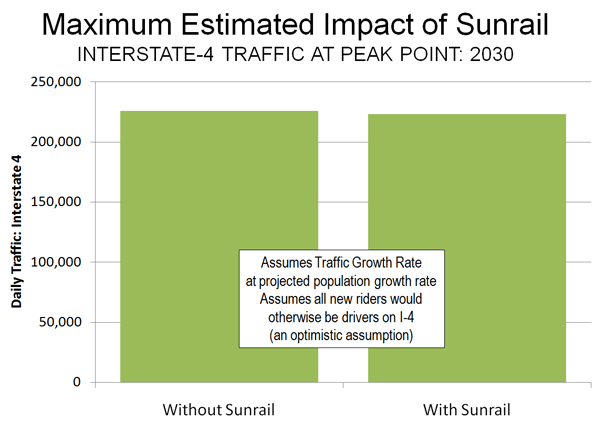
    Exaggeration #2: Sunrail Will Make a Difference: The proponents imply that Sunrail will carry a significant number of trips in the Orlando area, claiming that the line will carry one lane of freeway traffic and that it will give central Florida residents an alternative to high gasoline prices. In fact, even if Sun Rail reaches its ridership projections, it would take a full day of train travel to remove less than an hour’s peak hour freeway volume. Needless to say, no one will notice any fewer cars on the freeway (Figure).

    Further, Sunrail will not provide an alternative to the overwhelming majority of central Floridians, since it will attract only 1,850 new round-trip riders per day by 2030 (Sunrail’s number). Spending $850 million on Sunrail is the same as the taxpayers giving each new rider a gift of $450,000.

    The Need to Set Rational Priorities: All of this is occurring in the face of an national fiscal crisis so severe that even the AARP has expressed its willingness to consider cuts to Social Security. As an AARP spokesperson put it "You have to look at all the tradeoffs." Indeed.

  • High Speed Rail Subsidies in Iowa: Nothing for Something

    The Federal government is again offering money it does not have to entice a state (Iowa) to spend money that it does not have on something it does not need. The state of Iowa is being asked to provide funds to match federal funding for a so-called "high speed rail" line from Chicago to Iowa City. The new rail line would simply duplicate service that is already available. Luxury intercity bus service is provided between Iowa City and Chicago twice daily. The luxury buses are equipped with plugs for laptop computers and with free wireless high-speed internet service. Perhaps most surprisingly, the luxury buses make the trip faster than the so-called high speed rail line, at 3:50 hours. The trains would take more than an hour longer (5:00 hours). No one would be able to get to Chicago quicker than now. Only in America does anyone call a train that averages 45 miles per hour "high speed rail."

    The state would be required to provide $20 million in subsidies to buy trains and then more to operate the trains, making up the substantial difference between costs and passenger fares. This is despite a fare much higher than the bus fare, likely to be at least $50 (based upon current fares for similar distances). By contrast, the luxury bus service charges a fare of $18.00, and does not require a penny of taxpayer subsidy. Because the luxury bus is commercially viable (read "sustainable"), service can readily be added and funded by passengers. Adding rail service would require even more in subsidies from Iowa. The bus is also more environmentally friendly than the train.

    Further, this funding would be just the first step of a faux-high speed rail plan that envisions new intercity trains from Chicago across Iowa to Omaha. In the long run, this could cost the state hundreds of millions, if not billions of dollars. Already, a similar line from St. Louis to Chicago has escalated in cost nearly 10 times, after adjustment for inflation, from under $400 million to $4 billion.

    Unplanned cost overruns are the rule, rather than the exception in rail projects. European researchers Bent Flyvbjerg, Nils Bruzelius and Werner Rottengather (Megaprojects and Risk: An Anatomy of Ambition) and others have shown that new rail projects routinely cost more than planned (Note 1).

    Flyvbjerg et al found that the average rail project cost 45 percent more than projected and that 80 percent cost overruns were not unusual. Cost overruns were found to occur in 9 of 10 projects. Further, they found that ridership and passenger fares also often fell short of projections, increasing the need for operating subsidies.

    Iowa legislators may well identify ways to spend their scarce tax funding on services that are actually needed.

    ______

    Note: Flyvbjerg is a professor at Oxford University in the United Kingdom. Bruzelius is an associate professor at the University of Stockholm. Rothengatter is head of the Institute of Economic Policy and Research at the University of Karlsruhe in Germany and has served as president of the World Conference on Transport Research Society (WCTRS), which is perhaps the largest and most prestigious international association of transport academics and professionals.

  • Biking in Minneapolis

    The sustainable biking craze seems to keep rolling as more and more cities encourage commuters and wanderers to bike across town instead of drive. New programs, such as Nice Ride in Minneapolis, offer an innovative service where one can rent out a bike for a small fee and ride it across town to other stations, or continue to hold onto the bike and continue making payments.

    Other cities are turning their spokes with similar programs: B-Cycle in Denver, a program in D.C., and Bixi in Montreal all have enough riders to sustain the businesses. While profit from these bikes may be viable, the question of sustainability and more improved quality of life still remains.

    The way Nice Ride functions is endearingly simple: one signs up for a fixed subscription (with discounts for university students) and receives a special key that can be used at any Nice Ride station. The user slips in the key, and unlocks a bike. The bike can then be ridden across town to any station in the city, any time from April to November. In June 2010 when Nice Ride began, this simple plan garnered 10,000 trips in in its first month of use. So has this new model (and increased biking in general) for urban transportation provided any gains for the public other than fatigued legs?

    It seems that the program is a perfect fit for the city’s infrastructure. The city already has 46 miles of on-street bike lanes and 84 miles of bike trails to support such a project. On top of this, the city’s bicycle culture is one of the strongest in the nation, second only to Portland, whose more temperate climate has an edge for those cyclists hoping to commute regularly.

    Something that both cities have experienced is a drop in bicycle/motor vehicle crashes as more and more people decide to utilize biking as their main source of transportation. This “safety in numbers” concept has potentially attracted more and more cyclists each year leading to not only a wider understanding of the bicycle culture present, but safer roads as respect is paid to the cyclists braving the busy roads of Minneapolis and St. Paul as well.

    The biking craze in the Twin Cities has also lead to the area being one of the cleanest cities in the world according to an article featured in Forbes. The research examined many different facets of a city’s infrastructure, including the emphasis the city places upon transportation, including biking. The article cites the city’s extensive use of bike lanes (as well as its transit and bus systems) as the major reason the Minneapolis/St. Paul area is so clean. The Twin Cities ranked fifth on the list, behind the likes of Calgary, Honolulu, Helsinki, and Ottawa.

    So while other cities may stick to the classic emphasis on automobiles, Minneapolis has shown that biking is not only a safe mode of transportation, but one that can help to clean up the urban environment as well. Not to mention the cult cycling craze that many biking cities possess seemingly unifies an active demographic into a hopeful mode for future American transportation.

  • Orlando’s Sunrail: Blank Checks Induced by Washington

    We are supposedly living in an age of austerity, but many federal programs are leading many states into overspending and potential fiscal insolvency.  Transit spending is a case in point, as is indicated by the proposed Orlando Sunrail commuter rail project.

    How Washington Induces Higher State and Local Spending: For decades, the federal government has encouraged state and local governments to build expensive projects, as is the case in Orlando. Under the Federal Transit Administration (FTA) "New Starts" program, state and local governments can obtain federal funding for such projects, contingent on their taxpayers providing "matching funding." This can be in the form of higher taxes, budget increases or in unplanned subsequent expenditures that are higher than projected. The responsibility for cost overruns and operating subsidies belong exclusively to state or local taxpayers.

    Inaccurate Cost Forecasts: This can prove very expensive. European researchers Bent Flyvbjerg, Nils Bruzelius and Werner Rottengather (Megaprojects and Risk: An Anatomy of Ambition) and others have shown that new rail projects routinely cost more than planned (Note 1).

    Flyvbjerg et al found that the average rail project cost 45 more than projected and that 80 percent cost overruns were not unusual. Cost overruns were found to occur in 9 of 10 projects. Moreover, they found that despite increased attention to these cost blow-outs, final costs continue to be far above the projections presented to public officials and the taxpayers at approval time. Further, they found that ridership and passenger fares also often fell short of projections, increasing the need for operating subsidies.

    Moreover, urban rail systems are of questionable value. Transport economist Clifford Winston of the Brookings Institution has noted that "the cost of building rail systems are notorious for exceeding expectations, while ridership levels tend to be much lower than anticipated" and that "continuing capital investments are swelling the deficit." 

    Federal policies, however, often force state and local taxpayers to guarantee the accuracy of notoriously inaccurate cost projections. The standard FTA "full funding agreement," a prerequisite for federal funding, requires state or local taxpayers to pay for any cost overruns. Further, if the projects are not completed, state and local taxpayers are required to pay back the federal grants (more on Florida’s experience with that later).

    Sunrail: The "Sunrail" commuter rail project is planned to parallel Interstate 4 in the Orlando metropolitan area. From the perspective of Florida taxpayers, the tragedy is that the project has proceeded so far. Project forecasts say that in 2030, Sunrail will add only 1,850 new round trip riders daily to Orlando’s already sparse transit ridership (barely half a percent of travel). Even if all Sunrail trips were for employment, it would not even be a "drop in the bucket" in a metropolitan area likely to add more than 400,000 jobs by 2030. Further, despite inferences to the contrary, this will have less than negligible impact on traffic congestion. It is likely that traffic on Interstate 4 will increase by at least 100,000 cars daily by 2030 (Note 3), many times the cars that Sunrail could possibly remove, even under its probably exaggerated ridership projections.

    Sunrail also will do little to increase job access to jobs in a metropolitan area where less than two percent of employment can be reached by the average commuter in 45 minutes using transit, according to Brookings Institution research. By contrast, at least more than 80 percent of jobs in the Orlando metropolitan area are reached in 45 minutes by car, and more than 55 percent in 30 minutes. Despite the high costs of all this and Sunrail’s negligible effect on regional mobility, politics may preclude cancellation of the project.

    Sunrail’s first phase is projected to cost $350 million (after a half-billion dollar right-of-way purchase). The Federal Transit Administration intends to pay a maximum of $175 million for the project. State taxpayers (through the Florida Department of Transportation) will be required to match that funding with another $175 million, though that amount could grow.

    Florida Taxpayers Already Burnt Once: In addition in paying for likely Sunrail cost overruns, Florida taxpayers would be obligated to fund service levels that satisfy the Federal Transit Administration. Otherwise the federal government can demand that taxpayers send the money back. This is no idle threat. When the Miami commuter rail system (Tri-Rail) provided service levels deemed insufficient, FTA demanded a return of $250 million in federal grants. This repayment was averted only by a state bailout that provided up to $15 million in annual subsidies to increase the service levels (Note 2).

    Essentially then, to obtain federal funding for Sunrail, Florida taxpayers must write a blank check out to a rail construction industry that has repeatedly demonstrated an inability to build rail projects for promised amounts.

    Negotiating a Way Out? Florida taxpayers, however, may have some options to avoid writing the blank check. In March, the US Department of Transportation (USDOT) desperately sought to find governments in Florida willing to provide a blank check to fund the now cancelled Tampa to Orlando high-speed rail line, with costs that were so low that they had "big cost overruns" written all over them.

    In a February 27 letter USDOT told local officials the federal grant repayment provisions were negotiable. Based upon this policy latitude available to USDOT, Florida officials could seek less unreasonable terms with USDOT. For example, a revision might be negotiated to limit Florida’s cost overrun liability to amounts resulting from state actions. Further, Florida should seek agreement that it does not have to operate service levels that are greater than required by demand or can be afforded. This would prevent a repeat of the unhappy Tri-Rail experience.  

    Provisions such as these would provide important protections to Florida taxpayers, who could otherwise be forced to pay hundreds of millions in cost overruns and higher operating subsidies and potentially higher taxes.

    Lessons for Taxpayers: Projects like Orlando’s Sunrail provide important lessons for the nation. The stimulus, now winding down, boosted questionable spending policies well outside the Beltway. Washington needs to stop writing blank checks on taxpayer accounts. It’s time for the feds to stop inducing state and local governments to mimic its fiscal irresponsibility.

    —–

    Notes

    1. Flyvbjerg is a professor at Oxford University in the United Kingdom. Bruzelius is an associate professor at the University of Stockholm. Rothengatter is head of the Institute of Economic Policy and Research at the University of Karlsruhe in Germany and has served as president of the World Conference on Transport Research Society (WCTRS), which is perhaps the largest and most prestigious international association of transport academics and professionals.

    2. The Florida Department of Transportation has made agreements local governments to participate in funding of Sunrail cost overruns. However, in the event that local governments are unable to pay their share, it may be expected that the state will pay, as it did in bailing out Miami’s Tri-Rail (discussed above).  

    3. Assumes that automobile traffic would grow at the projected population growth rate (based upon University of Florida population projections). 

    —–

    Wendell Cox is a Visiting Professor, Conservatoire National des Arts et Metiers, Paris and the author of “War on the Dream: How Anti-Sprawl Policy Threatens the Quality of Life

    Photo: Downtown Orlando (by author)

  • Inside Sydney’s Central Business District: the Retail Core

    World famous for its beautiful harbour setting, Sydney’s Central Business District is undergoing a resurgence. As the hub of Australia’s finance sector, it stumbled during the global crisis. Office vacancies jumped from 5.7 per cent in early 2008 to 8.8 per cent in mid 2009, despite stable supply. Ultimately, though, Sydney was spared the worst, owing to its rise as a staging post for trade and investment in the Asia-Pacific region, which averted the havoc of Europe and North America. Recovery is now underway, if slowly. White-collar employment is picking up and the vacancy rate is down to 7.3 per cent. Landlords are again celebrating the prospect of rising rents.

    But there’s a bigger story. This revival is happening amid some notable trends. Post-crisis, the CBD’s functional map is being redrawn by a wave of Asian and other visitors and investors, prominently listed property trusts and pension funds looking for a safe haven, the spatial demands of a transformed white-collar workplace, intensive residential development on the CBD fringe and officials pushing flashy “green” projects. There’s no doubting the importance of these developments, or that they will be hyped by inner-city based media.

    In fact, central Sydney has been losing economic clout, in relative terms, to the periphery or suburban hinterland for some time, a polycentric trend observed in other countries. Between the 1981 to 2001 censuses, encompassing the most active period of economic liberalisation in Australia’s history, Sydney’s general population growth was 23 per cent, while outer areas in Greater Western Sydney grew by 38 per cent. The CBD’s share of Sydney’s jobs shrunk from around 30 per cent to 9 per cent during this period. Four of the five strongest growing Local Government Areas (LGAs) in the year to 30 June 2009 were still in the outer west: Blacktown, Parramatta, The Hills Shire and Liverpool.

    The latest wave of change will prove significant and long-lasting, but the CBD isn’t destined for a return to metropolitan supremacy.

    Sydney CBD
    Sydney CBD

    The retail core

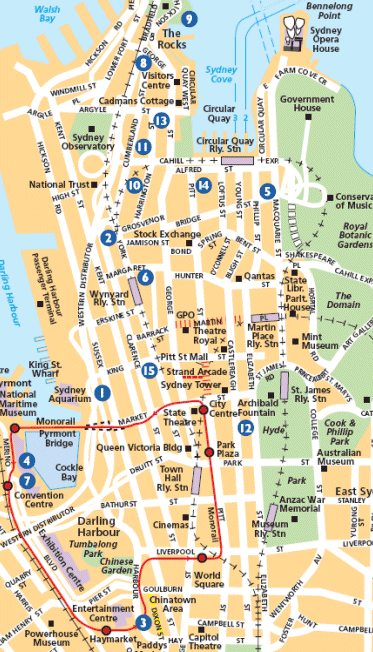
    For theorists of the CBD, peak land value intersection (PLVI) is a pivotal concept. This is the centrally-located point, usually at the intersection of two thoroughfares, where land values are highest. Without doubt, Sydney’s PLVI is the intersection of George and Market Streets. George Street is the CBD’s spine, traversing a north-south axis from Circular Quay to Central Station. Historically, Market Street was the critical entry route from the west, extending from the defunct Pyrmont Bridge (over Darling Harbour), and now from a branch of the Western Distributor. Blocks surrounding the PLVI are typically occupied by upscale department stores, absorbing peak land prices with high turnover of quality goods on multiple floors. Thus Myer and Gowings stores occupy the north-east and south-east corners respectively, and David Jones a site further east along Market Street (the Gowings site is earmarked for refurbishment as a boutique hotel). The iconic Queen Victoria Building arcade sits on the south-west corner.

    According to the “core-frame model”, another tool of CBD theory, activities competing for the highest rents, like upmarket retail and superior grade office towers, concentrate in core blocks, while marginal activities disperse to peripheral blocks. In terms of the theory, the latter are a “zone in transition”, at an intermediate stage between lower grade building stock and future redevelopment. Activities like low-end retail, fast-food, novelty shops, pawnbroking, wholesaling, storage, off-street parking, warehousing and light-manufacturing locate there.

    Traditionally, Sydney’s CBD had a retail core around the PLVI bounded by York, Park, Elizabeth and King Streets, south of an office core bounded by King, Clarence and Macquarie Streets and Circular Quay. Judging by the headlines, the retail core is Sydney’s biggest news. Long a feature of suburban life, the CBD is being transformed by the arrival of mall-style shopping, adding to the mix of department stores, arcades and stand-alone shops. In some ways, it’s catching up with the social evolution of shopping as a “complete experience” linked to identity formation.

    The catalyst is Westfield’s $1.2 billion development at the corner of Pitt Street Mall and Market Street, just a block east of the PLVI. A pedestrianised section of Pitt Street between King and Market Streets (not a regular mall), Pitt Street Mall is the retail core’s epicentre. Last year, global real estate firm CB Richard Ellis (CBRE) rated it the second most expensive street for retail rents in the world. The first was New York’s Fifth Avenue.

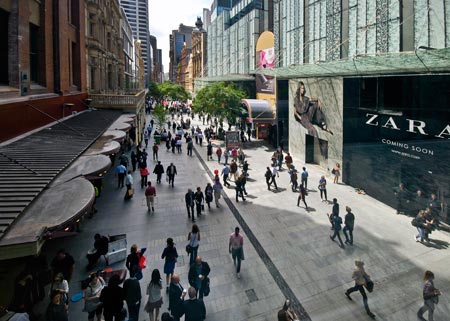
    With rents so high, investment dollars are pouring in. Fronting the eastern side of Pitt Street Mall, Westfield’s contemporary glazed-glass structure, box-like at street level but topped by Sydney Tower, converts four properties into 93,000 square metres of retail space, distributed over a six-storey shopping mall. The first stage opened last October. On completion, it will house 330 flagship and specialty fashion outlets, and lifestyle stores, most of them international brands, including Sydney firsts Versace, Gap, Zara and Miu Miu, together with several eateries. Two skybridges link the complex to nearby Myer and David Jones department stores.

    Westfield’s opening coincided with a general revamp of Pitt Street Mall, featuring landscaping, paving and tree-planting by Sydney City Council, and reconstruction of the mall-like Mid-City Centre, 52 shops on four-levels fronting the Mall’s western side, almost opposite Westfield, penetrating west to 420 George Street. One Mid-City store, jewellery retailer Diva, is reputedly paying the highest rent in the CBD, $13,500 per square metre a year.

    Pitt Street Mall’s face-lift set off a reshuffle of fashion and luxury goods retailers around the retail core, with knock-on effects all the way up George Street. Burberry is moving to refurbished premises at 343 George Street, Louis Vuitton to a new flagship store on the corner of King and George Streets, Dior to Castlereagh Street, and Zegna and Prada to Westfield, from Martin Place. This follows the 2008 opening of the world’s largest Apple store, at glass-clad 367 George Street (roughly opposite Mid-City at 420).

    Pitt Street Mall
    Pitt Street Mall

    A sign that the retail core may be busting out of its old confines, and creeping north of King Street, major retail developments are planned in the vicinity of Wynyard railway station, at 301, 333 and 383 George Street. Some of these anticipate the most striking proposal yet: a futuristic commercial and residential precinct on the foreshore of East Darling Harbour, or Barangaroo, seeing the retail core spill into the CBD’s rising “western corridor”, which was a "zone in transition" in the days when Darling Harbour and Walsh Bay were working ports. This $6 billion plan includes 30,000 square metres of retail space and a pedestrian walkway to nearby Wynyard, the CBD’s busiest underground station.

    It’s easy to explain such hyperactivity. Sydney is one of a handful of global cities in a developed country which wasn’t flattened by the financial crisis. There’s a clear international dimension to the CBD’s resurgence. According to Cushman & Wakefield’s International Investment Atlas 2011, the Asia-Pacific is dominating global property investment. Ranked eleventh, Sydney joins 6 other Asia-Pacific cities in the top 20. In the 18 months to June 2010, reports CBRE, Sydney ranked fourth in the world in terms of cross-border investment. Foreign investors accounted for 42 per cent of Australia’s property asset acquisitions in the third quarter of 2010, way above the typical level of 10 to 15 per cent. In these conditions, Sydney shot up to ninth out of 65 cities in AT Kearney‘s 2010 Global Cities Index. And a 2010 survey by real estate agents Jones Lang La Salle rated Tokyo and Sydney the most popular Asian cities for investment. At a time when many asset classes carry outsized risks, Australian commercial property is a safe option.

    Of course, there’s nothing new about Asian investment in the retail core. Three of its most fashionable shopping arcades belong to Ipoh Pty Ltd, which is owned by a Singaporean fund manager: the Queen Victoria Building, The Strand Arcade between Pitt Street Mall and 412-414 George Street, and The Galleries, on the corner of George and Park Streets, the core’s southern edge.

    But urban planners would be wrong to overestimate the impact of all this on the wider metropolitan region. Quite clearly, Westfield’s target market embraces a small minority of Sydney’s 4.5 million residents. Commenting on the mall’s opening, the Group’s managing director hoped it would be a “destination for the people of Sydney, and the 26.8 million domestic and international visitors who come to Sydney each year”. The Australian Financial Review, citing Westfield, reported that it will “service not only 240,000 workers in the [CBD], but 1.5 million in the primary trade area across the richest suburbs and the 26 million tourists who visit the city each year”. David Jones’ CEO expressed similar sentiments, saying “my hope is that Sydney’s CBD retail precinct becomes a world-class shopping destination on a par with the world’s best such as Oxford Street, London, and Rodeo Drive in LA”.

    Much of the investment surge is predicated on large numbers of visitors, and the growth of inner-suburbs ringing the CBD. If the travelling patterns of China’s newly cashed-up middle class are any guide, for instance, these hopes won’t be disappointed. The number of Chinese visitors to Australia is forecast to grow by 7.9 per cent a year, reaching 783,000 a year by 2019. Meanwhile, Sydney LGA’s population is ballooning (the CBD and environs). Between 2001 and 2009, it grew by 38 per cent, or 49,000 new residents. Eager to meet the former state government’s target of 55,000 new residential units over the next decade, Sydney Council is presiding over a number high-density projects on derelict industrial or recreational sites. Most of the newcomers will belong to the same demographic as current residents, younger, upper-income professionals with a taste for inner-city living. They are no cross-section of Sydney’s population. Below average in age, their median weekly income is $717, compared to $518 for the whole metropolitan region.

    To an extent, Sydney CBD is exhibiting features of the global city phenomenon, when highly-developed zones “secede” from their hinterland and develop stronger ties to distinct occupational classes and overseas markets. The revitalised retail core is unlikely to lure the vast majority of shoppers — who live and work far from the CBD — away from suburban megacentres like Chatswood Chase, Miranda Fair, Warringah Mall, Castle Towers, Minto Mall, Top Ryde City, Westfield’s other centres at Bondi Junction, Parramatta, Burwood, Hurstville, Hornsby and Penrith, local retail strips, or the growing number of Australians who shop online. Just as suburban malls attract customers from their surrounding feeder population, the same applies to the retail core, but with a higher proportion of domestic and foreign visitors.

    The CBD’s revival shouldn’t be misinterpreted. It doesn’t herald a return to regional primacy. Calls by green-tinged academics and newspaper editors and columnists for billions to be spent on CBD-centric rail networks are wrongheaded. Such plans can only have a distorting and negative effect on economic vitality across the metropolitan region, especially fast growing outer LGAs. Look at the CBD’s story. For all the contemporary rhetoric linking urban success to green amenity, it owes more to plain old capitalism.

    John Muscat is a co-editor of The New City, where this piece originally appeared. 

    Photo by Christopher Schoenbohm.

  • Fwd: California’s Bullet Train — On the Road to Bankruptcy

    For California’s high-speed rail boosters including their chief cheerleader, U.S. Transportation Secretary Ray LaHood, the month of May must have felt like a month from hell. First came a scathing report by California legislature’s fiscal watchdog, the non-partisan Legislative Analyst’s Office (LAO), questioning the rail authority’s unrealistic cost estimates and its decision to build the first $5.5 billion segment in the sparsely populated Central Valley between Borden and Corcoran. That segment, the LAO noted, has no chance of operating without a huge public subsidy, yet the terms of the voter-approved Proposition 1A, explicitly prohibit any operating subsidies.

    These concerns were echoed by an eight-member Independent Peer Review Group. “We believe the Authority is increasingly aware of the challenge of accurate cost estimating,” wrote its chairman Will Kempton in a letter to the California High-Speed Rail Authority’s CEO, Roelef van Ark. The Legislative Analyst‘s Office had concluded that if the cost of building the entire Phase I system were to grow as much as the revised HSRA estimate for the Central Valley segment (an increase of 57%), the Phase I system would end up costing not $43 billion as originally estimated, but $67 billion.

    The two reports unleashed a torrent of criticism from the press. In sharply critical editorials, The Wall Street Journal and the Los Angeles Times questioned the project’s fiscal viability and the Authority’s poor decisionmaking. The project is “a monument to the ways poor planning, management and political interference can screw up major public works,” opined the LA Times. (“California’s High Speed Train Wreck,” May 16). “If the state can’t come up with enough money to finish the route, a stand-alone segment in the Central Valley would literally be a train to nowhere and a big drain on taxpayers,” said the Wall Street Journal (“California’s Next Train Wreck,” May 18). “The legislature needs to kill the train now. Once this boondoggle gets out of the station, the state will be writing checks for decades,” added the Journal in its most recent editorial (“Off the California Rails,” May 30). The San Francisco Examiner and The Sacramento Bee also have been critical in their reporting. Governor Brown needs to “squarely address the issues raised by the legislative analyst’s report,” a Sacramento Bee editorial urged.

    Even some of the state’s former legislative supporters, such as state senators Joe Simitian, Alan Lowenthal, Anna Eshoo and Mark DeSaulnier have expressed reservations and urged the Authority to rethink its direction. “I don’t want to see an EIR (Environmental Impact Report) completed for a project that will never be built,” Senator Joe Simitian told Roelef van Ark at a Senate Budget Subcommittee hearing on financing the first rail segment in the Central Valley.

    At the urging of the Legislative Analyst’s Office, the rail authority asked the U.S. DOT for more flexibility about where and when to build the initial “operable” segment. The LAO went as far as recommending that “If the state can’t win a waiver from the federal government to loosen the rules and the timing for using high-speed rail grants, it should consider abandoning the project.” Not only would the Central Valley segment, by itself, have insufficient ridership and revenues to stand on its own, the Legislative Analyst wrote, but “the assumption that construction of the Central Valley segment could move quickly because of a lack of public opposition has already proved to be unfounded.” The LAO suggested several alternative segments that could be more financially viable and economically beneficial than the Central Valley segment. They included Los Angeles-Anaheim, San Francisco-San Jose and San Jose-Merced.

    But in a remarkable exercise of inflexibility and delusion, the U.S. Department of Transportation turned a deaf ear to the request. “Once major construction is underway…the private sector will have compelling reasons to invest in further construction,” the DOT letter stated in an assertion totally unsupported by any evidence.

    “California is a test case for whether high-speed trains can succeed in the U.S. — and so far, the state is failing the test,” the LA Times editorial concluded. The feds’ refusal to reconsider their position has substantially magnified and accelerated the likelihood of that failure.

    LATE-BREAKING NEWS 6/6/2011: In the wake of the LAO report, both houses of the California Legislature have passed legislation that, in effect, is a vote of no confidence in the California High Speed Rail Authority (CHSRA) and its Board. The bills place the Authority within the state’s Business, Transportation and Housing Agency, thus giving the Governor decisionmaking power over the project. The Senate bill would “vacate” the appointments of the current Board members and provide for the appointment of a new advisory Board with special expertise in construction management, infrastructure finance and operation of rail systems. The House bill would retain the current Board but only in an advisory capacity. The two bills will have to be reconciled before they are sent to the Governor for signature. However, with the bills sponsored by three Democrats, the Governor is expected to sign the final bill into law [SB 517 (A. Lowenthal), passed on June 1 by a vote of 26-12; AB 145 (Galgiani and B. Lowenthal) passed on June 3 by a vote of 50-16].

    There is a possibility that a change of leadership at the Authority, coupled with mounting grassroots opposition in the Central Valley, might delay the project past September 2012 — the federal deadline to start construction— and thus disqualify the project from federal grant assistance extended under the stimulus (ARRA) legislation. The deadline was reaffirmed in a letter from U.S. DOT’s Undersecretary for Policy, Roy Kienitz. “U.S. DOT has no administrative authority to change this deadline, and do not believe it is prudent to assume Congress will change it,” Kienitz wrote to Roelof van Ark.

  • Federal Survey: Fewer Transit Commuters

    Results from the US Department of Transportation’s 2009 National Household Travel Survey indicate that transit’s work trip market share in the United States was only 3.7 percent in 2009. This is a full one quarter less than the 5.0 percent reported by the Bureau of the Census American Community Survey for 2009. Further, the NHTS data does not include people who work at home. If the work at home share of employment from the American Community Survey is assumed, the transit work trip  market share would be 3.5 percent.

    Much of the difference is due the differing questions asked in the two surveys. The American Community Survey asks how people "usually" got to work last week, while the National Household Travel Survey (NTHS) data is based upon actual diaries of travel kept by respondents. The NHTS reports that among people who respond that transit is their "usual mode" of travel to work, transit is used only 68 percent of the time. In contrast, the daily trip diaries report that commuters who drive alone are a larger share of the market than those who indicate driving alone as their usual mode of travel. People who report their usual mode as "car pool" actually use a car pool to get to work only 55 percent of the time, an even lower rate relative to "usual" mode than transit.

    The daily trip diaries from the NHTS also a large difference in travel times between automobile commuters (including car pools) and transit. The average automobile commute time was 22.9 minutes, while the average transit commute time was more than double, at 53.0 minutes.

  • Transit: The 4 Percent Solution

    A new Brookings Institution report provides an unprecedented glimpse into the lack of potential for transit to make a more meaningful contribution to mobility in the nation’s metropolitan areas. The report, entitled Missed Opportunity: Transit and Jobs in Metropolitan America, provides estimates of the percentage of jobs that can be accessed by transit in 45, 60 or 90 minutes, one-way, by residents of the 100 largest US metropolitan areas. The report is unusual in not evaluating the performance of metropolitan transit systems, but rather, as co-author Alan Berube put it, "what they are capable of." Moreover, the Brookings access indicators go well beyond analyses that presume having a bus or rail stop nearby is enough, missing the point the availability of transit does not mean that it can take you where you need to go in a reasonable period of time.

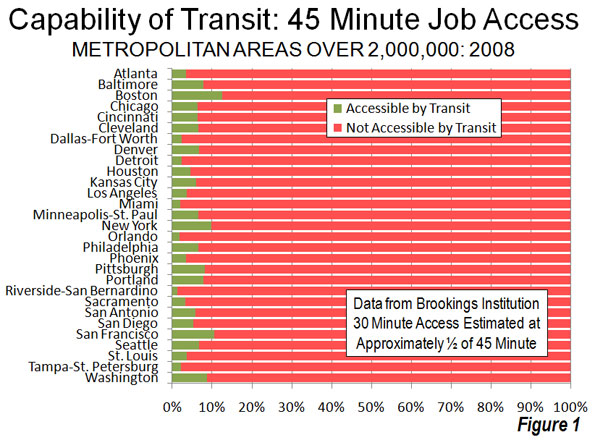
    Transit: Generally Not Accessible: It may come as a surprise that, according to Brookings, only seven percent of jobs in the nation’s largest metropolitan areas can be reached by residents in 45 minutes during the morning peak period (when transit service is the most intense). Among the 29 metropolitan areas with more than 2,000,000 population, the 45 minute job access average was 5.6 percent, ranging from 12.6 percent in Boston to 1.3 percent in Riverside-San Bernardino. The New York’s metropolitan area’s 45 minute job access figure was 9.8 percent (Figure 1).

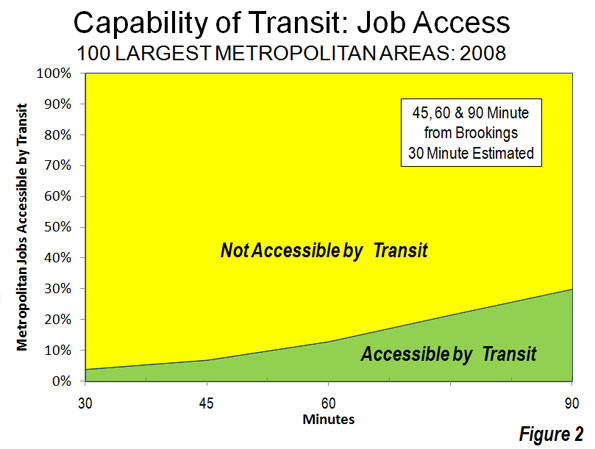
    Brookings did not examine a 30 minute transit work trip time. However, a bit of triangulation (Note 1) suggests that the 30 minute access figure would be in the range of 3 to 4 percent, at most about 4,000,000 jobs out of the more than 100 million in these metropolitan areas.   At least 96 percent of jobs in the largest metropolitan areas would be inaccessible by transit in 30 minutes for the average resident (Figure 2).

    The Brookings report also indicates that indicates that 13 percent of employment is accessible within 60 minutes by transit and 30 percent within 90 minutes (Note 2). Brookings focuses principally on the 90 minutes job accessibility data. However, the reality is that few people desire a 45 minute commute, much less one of 90 minutes.

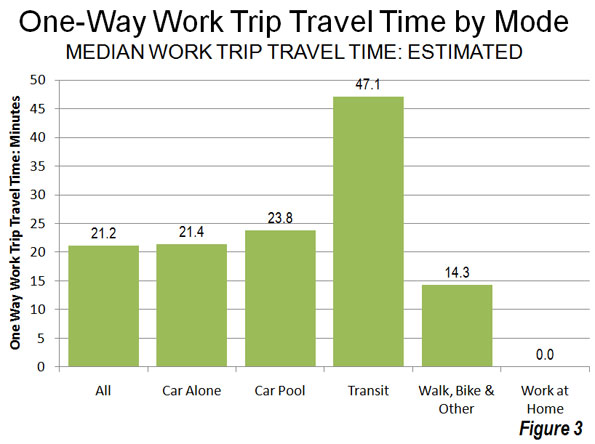
    In 2009, in fact, the median one way work trip travel time in the United States was 21 minutes (Note 3). Approximately 68 percent of non-transit commuters (principally driving alone, but also car pools, working at home, walking, bicycles, taxicabs and other modes) were able to reach work in less than 30 minutes. The overwhelming majority, 87 percent, were able to reach work in 45 minutes or less, many times transit’s seven percent. Transit’s overall median work trip travel time was more than double that of driving alone (Figure 3).

    A mode of transport incapable of accessing 96 percent of jobs within a normal commute period simply does not meet the needs of most people. This makes somewhat dubious claims that transit can materially reduce congestion or congestion costs throughout metropolitan areas. The Brookings estimates simply confirm the reality that has been evident in US Census Bureau and US Department of Transportation surveys for decades: that transit is generally not time-competitive with the automobile. It is no wonder that the vast majority of commuters in the United States (and even in Europe) travel to work by car.

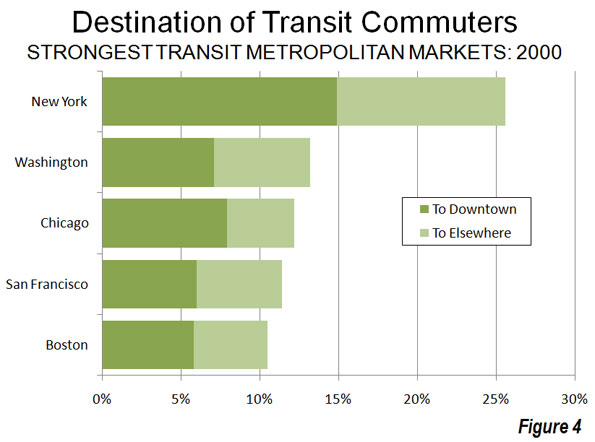
    Much of the reason for transit’s diminished effectiveness lies in the fact that downtowns — the usual destination for transit — represent a small share of overall employment. Downtown areas have only 10 percent of urban area employment, yet account for nearly 50 percent of transit commuting in the nation’s largest urban areas (Figure 4).

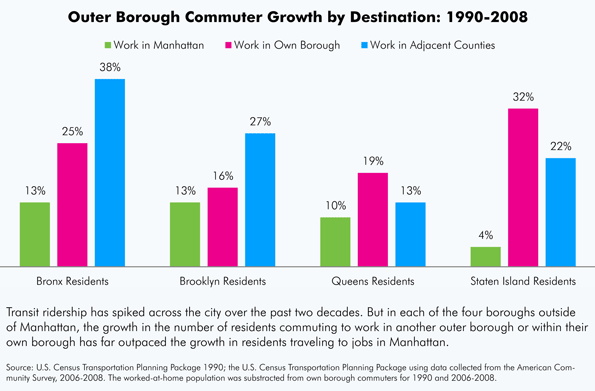
    Meanwhile, core areas, including downtown areas, represent a decreasing share of the employment market as employment dispersion has continued. Since 2001, metropolitan areas as different as Philadelphia, Portland, Dallas-Fort Worth, Salt Lake City, Denver and St. Louis, saw suburban areas gain employment share. Even in the city of New York, outer borough residents are commuting more to places other than the Manhattan central business district (link to chart).

    Transit: The Long Road Home: Transit problem stems largely from its relative inconvenience.    In 2009, 35 percent of transit commuters had work trips of more than 60 minutes. Only six percent of drivers had one way commutes of more than 60 minutes. For all of the media obsession about long commutes, more than twice as many drivers got to work in less than 10 minutes than the number who took more than an hour. In the case of transit, more than 25 times as many commuters took more than 60 minutes to get to work as those who took less than 10 minutes.

    Economists Peter Gordon and Harry W. Richardson have shown that the continuing dispersion of jobs (along with residences) has kept traffic congestion under control in the United States. Available data indicates that work trips in the United States generally take less time than in similar sized urban areas in Europe, Japan, Canada and Australia.

    Transit Access is Better for Low Income Citizens: The Brookings report also indicated that job accessibility was better for low income citizens than for the populace in general. Approximately 36 percent of jobs were accessible to low-income residents in 90 minutes, compared to the overall average of 30 minutes. This, of course, is because low income citizens are more concentrated in the central areas of metropolitan areas where transit service is better. But even this may be changing. For example, Portland’s aggressive gentrification and transit-oriented development programs are leading to lower income citizens, especially African-Americans, being forced out of better served areas in the core to more dispersed areas where there is less transit. Nikole Hannah Jones of The Oregonian noted:

    "And those who left didn’t move to nicer areas. Pushed out by gentrification, most settled on the city’s eastern edges, according to the census data, where the sidewalks, grocery stores and parks grow sparse, and access to public transit is limited." 

    Realistic Expectations: More money cannot significantly increase transit access to jobs. Since 1980, transit spending (inflation adjusted) has risen five times as fast as transit ridership. A modest goal of doubling 30 minute job access to between 6 and 8 percent would require much more than double the $50 billion being spent on transit today.

    Moreover, there is no point to pretending that traffic will get so bad that people will abandon their cars for transit (they haven’t anywhere) or that high gas prices will force people to switch to transit. No one switches to transit for trips to places transit doesn’t go or where it takes too long.

    Nonetheless, transit performs an important niche role for commuters to some of the nation’s largest downtown areas, such in New York, Chicago, Boston, San Francisco, and Philadelphia. Approximately half or more of commuters to these downtowns travel there by transit and they account for nearly 40 percent of all transit commuters in the 50 largest urban areas.   

    Yet for 90 percent of employment outside downtown areas, transit is generally not the answer, and it cannot be made to be for any conceivable amount of money. If it were otherwise, comprehensive visions would already have been advanced to make transit competitive with cars across most of, not just a small part of metropolitan areas.  

    All of this is particularly important in light of the connection between economic growth and minimizing the time required to travel  to jobs throughout the metropolitan area.

    The new transit job access is important information for a Congress, elected officials, and a political system seeking ways out of an unprecedented fiscal crisis.

    A four percent solution may solve 4 percent of the problem, but is incapable of solving the much larger 96 percent.

    Notes:

    1. For example at difference between transit commuters reaching work in less than 30 minutes and 45 minutes, Brookings employment access estimate of 7 percent at 45 minutes would become 3 percent at 30 minutes.

    2. The Brookings travel time assumptions appear to be generally consistent with data from the Census Bureau’s American Community Survey (ACS) and the US Department of Transportation’s National Household Transportation Survey (NHTS). Brookings, ACS includes the time spent walking to transit in work trip travel times (For example, the ACS questionnaire asks respondents how long it takes to get from home to work and thus includes the time necessary to walk to transit).

    3. Median travel times are estimated from American Community Survey data for 2009 and includes working at home. The "median" is the point at which one half of commuters take more time and one-half of commuters take less time to reach work and is different from the more frequently cited "average" travel time, which was 25.5 minutes in 2008.

    4. Is Transit Better in Smaller Metropolitan Areas? It is generally assumed that transit service is better in larger metropolitan areas than in smaller metropolitan areas. Yet, the Brookings data seems to indicate the opposite. Larger metropolitan areas tended to have less job access by transit than smaller metropolitan areas. In the largest 20 percent (quintile) of metropolitan areas, only 5.5 percent of employment was accessible within 45 minutes. This was the smallest quintile accessibility score, and well below the middle quintile at 9.2 percent and the bottom quintile at 8.3 percent. The top quintile included metropolitan areas with 2.6 million or more people, the middle quintile included metropolitan areas with 825,000 to 1,275,000 population and the bottom quintile included metropolitan areas between 500,000 and 640,000 (Figure 1). This stronger showing by smaller metropolitan areas probably occurs because it is far less expensive for transit to serve a smaller area. Further, smaller metropolitan areas can have more concentration in core employment.  Even so, smaller metropolitan areas tend to have considerably smaller transit market shares than larger metropolitan areas.

    Wendell Cox is a Visiting Professor, Conservatoire National des Arts et Metiers, Paris and the author of “War on the Dream: How Anti-Sprawl Policy Threatens the Quality of Life

    Photo: Suburban employment: St. Louis (by author)

  • Natural Gas Vehicles Floor It in Long Beach

    The Alternate Clean Transportation Expo held in Long Beach earlier this month was a spectacular display of engineering ingenuity by Natural Gas Vehicle providers. The event’s theme was that America’s self sufficiency in natural gas has decoupled our energy resources from petroleum prices. But the consensus among the gathered engineers and scientists was to look beyond the current prices of petroleum alone, and consider that domestic self sufficiency includes keeping jobs at home.

    The NGVs (Natural Gas Vehicles, which include Compressed Natural Gas—CNG, as well Liquefied Natural Gas—LNG) reduce greenhouse gas emissions almost 20 percent on medium and heavy duty models, and 30 percent on light duty vehicles.

    All fuels, including natural gas, release energy by burning. But cleanliness and renewability are probably the single most talked-about aspect of NGVs. From energy field to vehicle engine, natural gas needs very little processing to make it usable, compared to crude oil, which is processed into gasoline by complex and expensive refining techniques. A naturally occurring fuel, its chemical formulation is about 90% methane, with smaller amounts of ethane, propane, butane and carbon dioxide, a high octane rating of about 120 – 130, and clean burning characteristics.

    Biomethane gas is extracted from biomass, and is therefore renewable, and it can be produced economically in large quantities. Current estimates are that the US has proven reserves of over 1500 TCFs (trillion cubic feet) of natural gas which, by some estimates, should last for the next 100 years.

    Potentially, natural gas will create jobs not only through vehicle manufacturing, but through the construction of new CNG stations. A landfill processing plant near Dallas, Texas, owned by a pioneering company in CNG station installation, Clean Energy™, creates up to 9,000,000 GGEs (gasoline gallon equivalents)of biomethane gas for fueling stations. It has agreements with airports in Tampa, New York City, New Orleans and Philadelphia to build CNG filling stations that will support ground transport vehicles and off-airport parking shuttles.

    Of course, legitimate concerns have been expressed about the safety of natural gas vehicles. Notably, in a tragic 1998 accident a stopped bi-fueled Honda (a vehicle that can run on CNG or gasoline) was impacted by another vehicle moving at almost 100 mph. A fire started by the gasoline engine broke out.

    NGV supporters counter that the 50 liter CNG tank was intact and remained secure in its support bracket, that NGVs are subject to same federal standards as regular vehicles, and that natural gas cylinders are thicker and stronger than conventional gas tanks.

    The NVG safety record also includes a survey of more than 8,000 natural gas utility, school, municipal and business fleet vehicles that have traveled 178 million miles, in which the vehicle injury rate was 37% lower than in a gasoline fleet. Under federal and state regulations, fueling stations, indoor parking structures, repair garages and car dealerships must all meet high safety standards. Leaking gasoline forms puddles and creates a fire hazard; if the CNG engine leaks at all, the fuel will normally rise to the ceiling and disappear. Insurance companies nationwide have looked at the safety of natural gas buses and fleets and have no reservations about insuring them.

    Hybrids were also on display at the Expo, including a notable innovation by Parker Hannifin Company. Says Tom Decoster, business development manager of the Cleveland-based firm, “We are going to let California know there are alternatives to electric and CNG.” Parker’s alternative is the hydraulic hybrid, with regenerative braking energy stored as a pressurized gas in a vessel. These vessels are known to be accumulators, which Parker compares to batteries. While stored electricity from a battery drives a motor, energy from an accumulator powers a pump-motor to drive wheels. This assistance increases fuel efficiency and sometimes permits a smaller engine.

    Average fuel consumption for a conventional Class 8 vehicle is about 9,800 gallons per year. RunWise™, Parker’s vehicle, reduces the fuel consumption by 30 to 50 percent, depending on route density and operating conditions. “The more stops a vehicle makes during the day, the more efficient the system becomes relative to a conventional drive train,” Decoster says, adding that the NGV also reduces CO2 emissions, compared to a conventional vehicle, by 38 tons per year, the equivalent of about six midsize cars or planting 1,500 trees. It has reduced brake replacement cycles from every few months to almost 2 years. Parker’s technology is intended for refuse trucks and for fleets that need frequent stops, such as those run by FedEx and UPS.

    This highly technical conference and engineering-driven trade show was innovative in one other way, too. Expo organizer GNA designed events to reach out beyond the technorati to ordinary consumers who — it hopes — will one day be its loyal customers.

    Shashi Parulekar is a Los Angeles-based engineer. He holds an MBA, and served as Asia Pacific M.D. with Parker Hannifin Co in Michigan for over ten years.