Tag: Transportation

  • This is Not the Way to Fix Toronto’s Transit

    Results and not ideology should guide transportation policy.

    Large city officials have been lobbying for a major program of federal transit subsidies for years. The push will likely intensify after the federal election.

    A principal resource in this campaign will likely be the Toronto Board of Trade’s third annual Scorecard on Prosperity, which finds Toronto’s transportation system to be among the worst in the world, ranking 19th out of 23 metropolitan areas. Other metropolitan areas also ranked poorly, such as Montreal at 12th, Calgary at 13th and Vancouver at 21st.

    However, a deeper look yields difficulties with the Board of Trade report.

    Automobiles dominate travel in all but two of the metropolitan areas (Hong Kong and Tokyo). Yet, only two of 11 indicators involve automobiles. Eight relate to non-automobile modes such as transit (one deals with freight). The Board of Trade comparisons are skewed because they give disproportionate weight to modes that are relatively minor in metropolitan mobility.

    However, the greatest difficulty with the Scorecard is the implied belief greater reliance on transit is preferable. In fact, transit is slower than cars for the majority of trips. Travel time needs to decrease to encourage metropolitan economic growth, as research at the University of Paris indicates. There is probably no more important transportation indicator regarding the economy.

    A Globe and Mail article rightly expresses particular concern that Toronto’s round-trip average work trip time ranks last at 80 minutes per day. However, at least two of the metropolitan areas had longer work trip travel times. The average work trip travel time in the Tokyo metropolitan area was 96 minutes in 2003 (the latest data available), according to the Japan Statistics Bureau. The Board of Trade failed to find a number for Hong Kong, which the government reported at 92 minutes in 2002. Yet, these travel time laggards rank first and second in the Board of Trade rankings.

    It should be a source of embarrassment that Dallas-Fort Worth, a bane of urban planners and with less than half the Toronto density, should have a work trip travel time one-third less and one-fifth less, respectively, than Calgary and Vancouver, the highest ranked Canadian metropolitan areas.

    It’s worse than that. Among all of the large American metropolitan areas, in or out of The Scorecard on Prosperity, all but New York have better work trip travel times.

    Except in the romantic minds of planners, little of the present car travel demand can be replaced by transit. Further, in virtually all of the metropolitan areas ranking above Toronto, the trajectory has been toward cars, so that the present figures are less favourable to transit than they would have been a decade or two ago.

    For transport to make the greatest possible contribution to economic growth and job creation, the transport system must provide quick mobility throughout the entire labour market (metropolitan area). Transit-favouring ideology will not do.

    The problem is evident. The $8 billion just committed by Mayor Rob Ford and Premier Dalton McGuinty to build an Eglinton subway should be used to reduce travel times as much as possible.

    A huge expenditure on a single street will not do that.

    So long as ideology trumps reality, Toronto’s calcified traffic will put it at a competitive disadvantage. The focus should be on results — the time it takes to get to work, rather than on means — whether the trip is by car or transit.

    Wendell Cox writes here as a Senior Fellow at the Frontier Centre for Public Policy in Winnipeg and is a regular contributor to NewGeography.com. This piece also appeared in the Toronto Sun.

  • Skepticism Greets US DOT’s Draft Transportation Bill

    An undated— and possibly still unvetted by OMB—draft of US DOT’s legislative proposal for surface transportation reauthorization, the “Transportation Opportunities Act,” has been making the rounds in Washington for the past week. Its publication, however, has been largely ignored by the inside-the-Beltway transportation community. What would ordinarily be an eagerly awaited event and an occasion to compliment the Department , has passed virtually unnoticed. Even the usual cheering squad of Administration-supportive advocacy groups such as Transportation for America, the Building America’s Future coalition and US PIRG has been muted in their approval.

    The reason for this indifference is twofold. Partly, it’s because the DOT draft contains no surprises: it merely restates the proposals already revealed in the President’s FY 2012 Budget request. But more importantly, the draft has been ignored because it has been judged to lack political savvy and realism. Even the highly partisan liberal Streetsblog was obliged to pronounce the draft bill as irrelevant. Wrote Tanya Snyder, its Capitol Hill correspondent in a level-headed assessment, “…don’t expect it to be central to the debate in Congress. By refusing to adjust to a still-struggling economy, high gas prices, and a deficit-obsessed Congress, the president has rendered his own plan moot.”

    Snyder’s dismissive verdict is understandable. Consider the following:

    Item: Multiple congressional spokesmen have stated in recent months that future surface transportation funding will be limited to the tax revenues deposited into the Highway Trust Fund. There will be no further rescue or “bailout” of the Trust Fund using general funds; “deficit funding is out of the question”; “government must learn to live within its means.” The House Transportation and Infrastructure Committee reaffirmed this position as recently as March 15 in its “Views and Estimates for Fiscal Year 2012” report. Yet the US DOT chose to ignore these unambiguous congressional signals. Its legislative draft has reaffirmed the initial White House proposal for a six-year surface transportation program totaling $556 billion, with an up-front FY 2012 appropriation of $50 billion. Meanwhile, transportation-related tax revenues are expected to average only $38 billion/year, for a six-year total of $230 billion according to the latest Congressional Budget Office estimates. In recent appropriation hearings on the FY 2012 transportation budget, Transportation Department officials failed to explain how the resulting shortfall of over $300 billion would be funded.

    Item: In its draft bill, the US DOT has proposed to devote $53 billion over six-years to pursue a “high-speed” rail program that would eventually (in 25 years) give 80 percent of Americans access to high-speed rail service. Yet Congress has rescinded all of FY 2011 funding for the high-speed rail program and House Republican leadership has announced its intention to totally eliminate support for high-speed rail beginning next year. Even if a modest passenger rail program should survive, it is likely to be focused on the Northeast Corridor, as Rep. Mica has strongly suggested, and not pursue a quixotic multi-billion dollar national “high-speed” rail vision as conceived and advocated by the White House.

    Item: In its draft bill, the US DOT has proposed to expand the existing Highway Trust Fund into a successor “Transportation Trust Fund.” The expanded Fund would include four accounts – for Passenger Rail, Highways, Transit and an Infrastructure Fund. To fund the two new accounts plus the expanded Highway and Transit accounts, the Transportation Department has proposed an unspecified new “energy tax” to supplement the existing sources of revenue (i.e. transportation-related taxes on fuel, heavy trucks and tires). However, the initiative for any new tax measures must originate with the House Ways and Means Committee. With the House Republicans on record as opposed to any new taxes, and with bipartisan desire not to increase the consumers’ cost of energy, any proposed “energy tax” has virtually zero chance of success in the 112th Congress. (Note: it’s not even certain whether the energy tax proposal would survive OMB review).

    Item: The US DOT has proposed a three-part “Livability” program totaling $27.5 billion over six years. The program would subsume existing formula-based transportation enhancement activities and include a program of discretionary grants for bicycle, pedestrian and capacity building activities. However, the ill-defined “livability” concept has met with profound skepticism on the part of House Republicans. Congressional sources have made it known that a “livability” program is unlikely to be a part of any future surface transportation bill.

    Item: The US DOT has proposed a “National Infrastructure Innovation and Finance Fund” to finance transportation infrastructure projects of national and regional significance through grants, loans, loan guarantees and lines of credit. The Fund, administered by a heavily bureaucratized structure (executive director, nine-member Investment Council, Advisory Committee) would receive $30 billion over six years. This proposal, also know as the National Infrastructure Bank, faces considerable bipartisan skepticism and overt opposition by several influential House and Senate leaders. Its chances of passage are rated at less than 50-50.

    In sum, the unreality of its fiscal ambitions and the lack of political support for its key programmatic initiatives has rendered the DOT’s legislative proposal “dead on arrival” in the judgment of congressional observers. That is not to say that the proposal deserves to be totally ignored. Many of its programmatic provisions – for example, those dealing with accelerated project delivery, tolling, highway and motor vehicle safety, “state of good repair” policy, pursuit of VMT fees, performance management and freight policy—are worthy of consideration and will likely find their way into the final bill.

    However, the Washington policy establishment is largely ignoring what it considers a stubborn refusal by the drafters of the US DOT bill to face the facts and adjust to political realities. Instead, transportation stakeholders are awaiting the release (probably in late June) of the House Transportation and Infrastructure Committee bill that will more correctly reflect the mood of the Congress, the stakeholders and of the country. It is safe to conclude that what is likely to emerge from that committee — and eventually approved by the full House and the Senate— will bear little resemblance to the U.S. Transportation Department’s unrealistic draft legislative proposal.

    Ken Orski has worked professionally in the field of transportation for over 30 years.

    Flickr photo of Seattle’s I-90, I-5 Interchange, by Flickr user “rutlo”, available online at http://www.flickr.com/photos/rutlo/3197844879/

  • The Transportation Politics of Envy: The United States & Europe

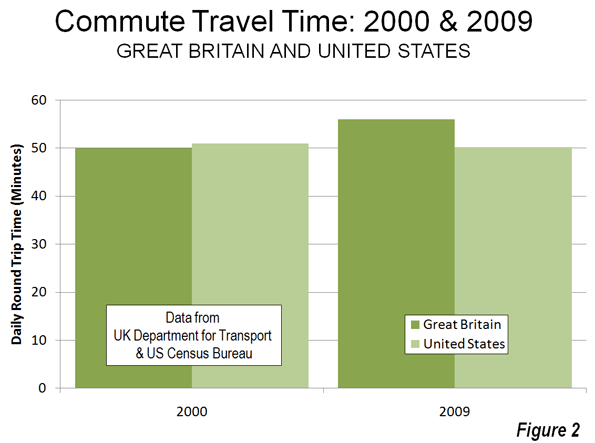
    The Department for Transport of the United Kingdom may be surprised to learn that the average round-trip commute in the nation is up to a quarter hour less than reflected in its reports. This revelation comes from an article in The Economist, ("Life in the Slow Lane") citing a survey indicating that the average commuter in the United Kingdom spends less than 40 minutes daily traveling to and from work in 2000. According to Regional Transport Statistics, published by the Department for Transport, the average commuter spent 50 minutes traveling to and from work in 2000. The UK government further indicates that the average commute time had risen to 56 minutes by 2009. The Economist relies on the much lower figure (and other similarly low estimates from other European nations) in fashioning an article criticizing transportation policy in the United States.

    Shorter US Commute Times: The Economist begins with the contention that the average work trip travel time in the United States is substantially greater than that of the number of European nations. The most reliable data says otherwise.

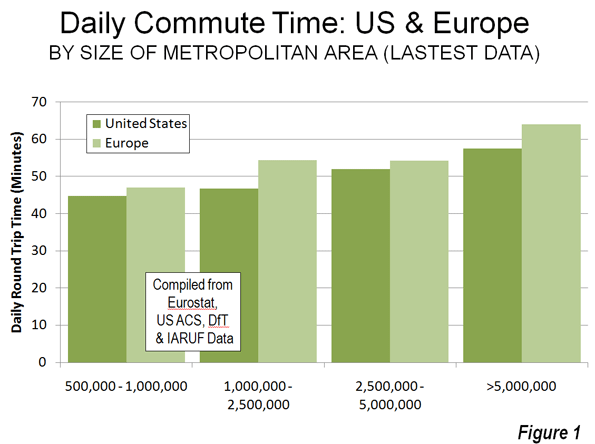
    The most comprehensive work trip data in Europe is maintained by Eurostat, the statistical agency of the European Commission. The Eurostat data indicates that average commute times in Europe are somewhat more than in the United States in metropolitan areas of similar size (Figure 1), when compared to the comprehensive data from the US Census Bureau. For example, among metropolitan areas of more than 5 million population, the daily round-trip average commute is under 58 minutes in the United States, less than the 64 minutes in Europe. European commute times are longer in all population categories (Note).

    Overall, the average round-trip travel time in the US metropolitan areas over 500,000 population is 23.6 minutes and 25.3 minutes in the European metropolitan areas.

    Moreover, there are indications that the US trend is favorable, at least in comparison to the United Kingdom. Between 2000 and 2009, UK government data shows average round trip commute times to have increased six minutes, while US government data indicates a decline of nearly one minute (Figure 2).

    The US: Less Traffic Congestion:  The Economist then asserts that traffic congestion is worse in US metropolitan areas than in Europe. According to The Economist:

    …with few exceptions (London among them) American traffic congestion is worse than western Europe’s. Average delays in America’s largest cities exceed those in cities like Berlin and Copenhagen.

    The reality is the opposite, according to the INRIX Traffic Scorecard and a more correct rendering of the point above would have been:

    … with few exceptions (Los Angeles among them) western Europe’s traffic congestion is worse than America’s. Average delays in some of western Europe’s smallest cities exceed those in cities like Atlanta, Houston and Dallas-Fort Worth.

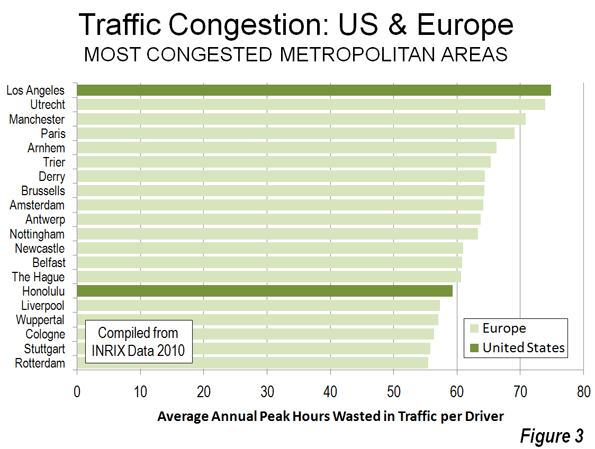
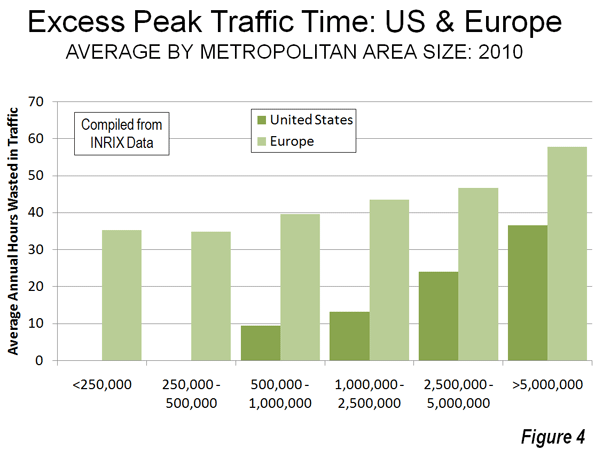
    INRIX compared 2010 peak period traffic delays in metropolitan areas of the United States and Europe. As with commuting time, the average travel delay per driver was greater in Europe than in the United States in every population classification. While Los Angeles has the worst congestion the approximately 200 metropolitan areas (one-half in the US and one-half in Europe), the next 13 worst were in Europe (Honolulu ranks 15th) and 18 of the worst 20 were in Europe (Figure 3). The third worst ranking US metropolitan area was San Francisco, at 28th, while Washington was 29th. Only seven of the 50 most congested metropolitan areas were in the United States. Of course, anyone who has driven extensively in the metropolitan areas of the US and western Europe knows that congestion is generally far worse in Europe, a fact confirmed by the INRIX data.

    Indeed, traffic congestion in the smallest European metropolitan areas (under 500,000) was worse than in the largest US metropolitan areas, those with over 5 million (There were no US metropolitan areas with less than 500,000 population in the INRIX data, see Figure 4). Those automobile-oriented, highly suburbanized banes of urban planning, Atlanta, Dallas-Fort Worth and Houston all ranked in the middle, between 90th and 110th. At least 75 European metropolitan areas had worse traffic congestion than all three.

    High-Speed Rail Envy: Finally, The Economist decries the lack of high-speed rail in the United States, noting that:

    The absence of true high-speed rail is a continuing embarrassment to the nation’s rail enthusiasts.

    It is hard to imagine a more pathetic standard for evaluating public policy than "satisfying rail enthusiasts."  It is well known that that governments from Washington to London, Athens and Lisbon are in serious financial difficulty. It is a time for limiting public expenditures to matters of genuine priority. That does not include high speed rail.

    The intercity road and airport systems are principally financed by users, in contrast to the operating subsidies and intense (100 percent) capital subsidies required by high-speed rail. This is evident in California with its now $65 billion first line that has more than doubled in real cost in a decade. It is also evident, closer to home for The Economist, where the controversial HS-2 high-speed rail proposal from London to Manchester and Leeds could easily double in cost (to £65 billion), based upon the best international research. Astoundingly, a doubling of cost would be a bargain for Britain’s taxpayers compared to two previous high-speed rail failures in the same corridor (See: The High Speed Rail Battle of Britain). The recurring environmental justifications ring hallow due to the high costs and the three generations or more it would require in California and the United Kingdom to eliminate the first gram of greenhouse gas.

    Transport policy could be improved in the United States, as well as in Europe. However, the starting point must be facts, not fancy, and certainly not envy.

    ——-

    Note: this analysis includes all data available for metropolitan areas in the United States (metropolitan statistical areas) and Europe (larger urban zones, the closest equivalent to US metropolitan areas). US data is complete, covering all 100 metropolitan areas with more than 500,000 population and is from the United States Census Bureau. European data is principally from Eurostat (94 larger urban zones and three from other sources). Paris data is from IAURIF (Institut d’aménagement et d’urbanisme de la région Île-de-France). Newcastle-upon-Tyne and Leeds data is from the UK Department for Transport.  Data is not available for a number of metropolitan areas with more than 500,000 population in Europe.

  • The Public Transport Revolution – Why does it never Arrive?

    Since the oil spike in the early seventies, enthusiasts for public transport have predicted that high prices for petrol would trigger a public transport revolution as people finally broke their “addiction” to the motor car and changed their travel mode to buses and trains.

    Since then, price bubbles have increased public transport use, and lowered car miles traveled. But these changes have proved to be short-lived. More drive more.

    Yet standard theory says that people respond to prices. Surely people should respond to increased petrol prices by changing their mode of travel.  But why hasn’t it happened in the past? More importantly, will it magically happen in the future?

    The answer is that most drivers do respond to increased oil prices but they have many choices as to how to respond..  You may switch to public transport provided it takes you where you want to go at a reasonable price. The problem is that part of the “reasonable price” includes the price of the increased time it takes to get to the final destination. Also, surveys reveal that when people climb into their car at the end of the day they feel they have actually arrived at “home.” Bus and train travel significantly defers their arrival in their own private space.

    So, given time, people change their behaviour in many ways, so as to maintain the comfort, convenience, and overall efficiency of the car. For example:

    1. They may decide to buy a smaller or more fuel-efficient car.
    2. They may relocate either their home or their job to reduce travel costs and times – provided the land market is flexible.
    3. If the local land-market is inflexible they may move to another town, or another country.
    4. They may modify all their travel behaviour by better trip planning, commuter car-pooling (with prioritized parking) and general ride and task sharing.
    5. They may choose to telecommute, car-pool, park-share, and ride-share.

    Fuel costs are only a small component of total motoring costs. Cars today are lasting longer, are more reliable, are cheaper to run, and are kept in use longer. When oil was cheaper total costs of motoring were higher. That’s one reason why we are driving more.

    Sudden spikes in petrol prices do affect the transportation modal split, but these spikes carry less significance than media reports would suggest, and tend to be of much shorter duration than the advocates of transportation revolution predict. People know how they want to live and they value their personal mobility.

    This is not a trivial issue because councils – and the Auckland Council for example – are demanding that Government funds massive investments in public transport because of the current oil spike, the upward blip in public transport use, and of course “Peak Oil.”

    The Peak Oil pessimists seem to believe no alternative to the petrol driven car exists. They also seem to ignore the increasing evidence of vast oil and gas reserves being discovered from everywhere the eastern Mediterranean to the shores off Brazil and the American Great Plains.

    A host of emerging technologies will more than compensate for any increase in the price of oil-based fuels – even for vehicles that continue to run on fossil fuels. Think of the hybrid car topping up the batteries from solar panels in the roof. Robot cars and electronically convoyed trucks hugely increase lane capacity. There are so many it would need another column to list them. The pessimists complain that it will take far too long to ring such changes in the vehicle fleet. In the next breath they talk about reshaping the urban-form, mainly by the densification of our major cities. Short of another Luftwaffe arriving on the scene, such urban renewal is hardly likely to happen overnight. Technology churns faster than cities. Try buying a Gestetner, a Telex machine, a slide rule, or a film for your camera.

    Urban economist, Anthony Downs, writing in “Still Stuck in Traffic?” reminds us:

    "….trying to decrease traffic congestion by raising residential densities is like trying to improve the position of a painting hung too high on the living room wall by jacking up the ceiling instead of moving the painting.”

    Yet the Auckland Council, like their counterparts throughout the affluent world, seems determined to raise the ceilings – with no regard for costs.

    One of the arguments used against building more roads – and especially against more motorways – is that as soon as they are built they become congested again because of “induced demand.” Such “induced demand” is surely the natural expression of suppressed demand. It seems unlikely that motorists will mindlessly drive between different destinations for no other reason than they can.

    However, let us accept for a moment that “induced demand” is real, and suggests that improving the road network is a fruitless exercise. Advocates of expensive rail networks claim they will reduce congestion on the roads and improve the lot of private vehicle users as a consequence.

    But surely, if the construction of an expensive rail network does reduce congestion on the roads then induced demand will rapidly restore the status quo. Maybe the theory is sound after all. It would explain why no retrofitted rail networks have anywhere resulted in reduced congestion.

    This is the time to invest in an enhanced roading network while making incremental investments in flexible public transport. Roads can be shared by buses, trucks, vans, cars, taxis, shuttle-buses, motor-cycles and cyclists – unless compulsive regulators say they are for buses only. Railway lines can be used only by trains and if we build them in the wrong place they soon run empty. The Romans built roads and we still use them.

    In a techno-novel published in 1992, Michael Crichton pauses in his narrative to explain what an email is. That’s not long ago.

    The one certainty is that the internet/computer world will have the same impact on transport as it has already had on communications. Transport deals with bits while communication deals with bytes.

    The end result will be a similar blurring of the line between public and private transport that has already happened between public and private communication. The outcomes are beyond our imagination.

    We should get used to it, and realise that making cities more expensive and harder to get around in does not make them more liveable.

    Owen McShane is Director of the Centre for Resource Management Studies, New Zealand.

    Photo by Mark Derricutt

  • How China’s Megacities Have Avoided Problems of Other Developing Cities

    Urbanist media can’t seem to get enough of the megacity these days. Much of the commentary surrounding this topic is disconcertingly celebratory about these leviathans despite such phenomena as overcrowding, high levels of congestion and sprawling slums.

    Yet absent from most of the commentary is any mention of cities in China. This is perhaps due in large part to the lack of serious social problems in comparison to its developing city counterparts in other countries. If a megacity is defined as a city with a population of more than 10 million, then China is home to 5 megacities: Shanghai, Beijing, Shenzhen, Guangzhou and Dongguan. As the country continues to urbanize, more Chinese cities are bound to join the ranks of these megacities.

    How has China been able to avoid the pitfalls facing other developing megacities? No one is denying that Chinese cities don’t have problems including unequal income distribution, pollution and growing traffic congestion. Yet China’s megacities seem to have largely avoided social dangers such as violent crime, disease and slum proliferation that plague urban areas of other developing countries.

    How have China’s cities avoided these issues?

    1. Construction of New Housing Units

    Western media continues to bawl over the amount of new residential construction in China, calling it the ”biggest bubble ever.” I have pointed out before how this might be an overestimation of the problem and that the housing market is actually more stable than many think. One thing is clear: the ample construction of new housing units in cities across China remains the essential component leading the way in the country’s development. The ability to provide modern accommodations for millions of aspiring urban dwellers has also directly prevented the proliferation of slums and large-scale shantytowns.

    2. Development of Public Transportation

    The ability to move efficiently through an urban area is paramount to opportunity and quality of life. When one thinks of megacities such as Jakarta or Mexico City, automobile gridlock often comes to mind. Beijing might have its traffic problems as well, but China’s development of public transportation, including extensive underground subway networks, ensures citizens will have other options to move around besides motor vehicles. The more connected by different forms of a transportation a city is, the more opportunity people have to live where they want and have access to a wider geographic range of job options.

    3. Land-Use and Zoning Flexibility

    The often-overlooked reality of zoning and land-use regulations plays a much greater role in the shaping the character of megacities then it is given credit for. Mumbai’s draconian 1.33 floor-to-area ratio (FAR) throughout most of the city means that it is limited to construction of low-rise buildings,leading to the growth of overcrowded sprawling slums. Chinese cities, in contrast, allow for high FAR, promoting construction of high-rise buildings that leave room for ample green space.

    Furthermore, Chinese cities are not limited by ”urban growth boundaries” and allow development to occur on newly annexed land outside of traditional urban cores. Even traditionally ”dense” cities like Shanghai and Hong Kong allow for new development outside of their traditional centers: the Pudong New Area in Shanghai and the New Territories in Hong Kong are huge areas that are still largely underdeveloped when compared to their respective downtown areas.

    Critically, these nominally suburban or even “exurban” expansions are not mere bedroom community; they are frequently attached to areas of intense commercial, industrial and technical development. In many cities, including Chengdu, where I reside, most of the new economic growth takes place in such communities.

    4. Providing Economic Incentives with Special Trade Zones

    As China enters its third decade of rapid development, competition is heating up between its cities for domestic and foreign investment. The winners will ultimately be cities that are most business friendly and offer incentives like tax breaks to companies looking to set up operations. Many of China’s cities have gone about this by establishing special ‘economic and trade zones’, usually outside of traditional urban cores. As a matter of fact, one of new China’s most economically successful cities, Shenzhen, largely started as a ‘Special Economic Zone’ (SEZ). Special economic and trade zones that are not actual cities, but part of a larger city, thrive because they usually built on more affordable land on urban peripheries, opening up more investment for construction of state-of-the-art manufacturing and R&D facilities.

    5. Willingness to Learn from Outside Experts

    When it comes to political issues at the Central Government level, it is clear that China does not want to be told how to run its country by outside diplomats and foreign policy experts. Yet at the municipal level, Chinese government and business leaders are earnestly open to listening to experts in planning and development from outside its borders. One only needs to take a look at the countless architecture and urban planning practices from the West, Singapore and even Taiwan who currently work in China. This open exchange of ideas taking place is what allows best practices to come to fruition.

    Adam Nathaniel Mayer is an American architectural design professional currently living in China. In addition to his job designing buildings he writes the China Urban Development Blog, where a version of this piece originally appeared.

    Photo by xiquinhosilva

  • Devastated St. Louis Airport: Up to the Challenge

    St. Louis: April 23, 2011 (9 a.m.) The St. Louis (Missouri-Illinois) metropolitan area is just beginning to dig out of the devastating tornadoes that struck on the evening of Good Friday. Miraculously, there appear to have been few, if any life-threatening injuries.

    The St. Louis tornadoes, however, impacted interstate travel like no other tornadoes in history. St. Louis Lambert international Airport sustained major damage. The main terminal, lost one half of its windows and had major damage in the ticketing area. Concourse C, which is the busiest at the airport lost part of its roof, had damaged jet ways and is reported to have lost all of its windows on the north side. The main terminal would be readily recognized by movie-goers who have seen it featured in Planes, Trains and Automobiles (with an artificial snow cover in the middle of the summer) and Up in the Air. The main terminal was one of the most notable early modern terminal designs and was a precursor of the TWA terminal at JFK airport in New York.

    At this point, local officials have even mentioned the possibility that the structure may have been compromised by the storm. Many cars in the adjacent parking structure were damaged by flying debris, which broke windows and produced body damage. Debris filled one of the major roadways between the main terminal and the parking structure (photograph). Needless to say, the airport has been closed indefinitely.

    As disruptive as the tornado was to the airport and the traveling public, the closure is likely to be shorter in duration than if it had happened at about any other major airport in the nation. This is because St. Louis airport probably has the largest amount of unused capacity of any major airport in the western world.

    The past decade has been characterized by serious reversals for St. Louis airport. The fate of the airport was significantly tied to Trans World Airlines (TWA) which established a hub at St. Louis airport in the early 1980s, shortly after the expansion of the air travel that occurred due to airline deregulation. St. Louis was one of the most convenient metropolitan areas in the nation from which to travel, with frequent nonstop service to all major markets in the nation, daily service to London and seasonal service to Paris. However, TWA filed bankruptcy more than once and was finally purchased by American Airlines. After the 911 terrorist attacks, when airline volumes dropped temporarily in the United States, American Airlines began scaling back operations at St. Louis airport. Now, the TWA – American hub is gone and the airport’s largest airline is Southwest.

    Over the past decade, the passenger volumes at St. Louis airport have dropped by nearly two-thirds. This has left much of the airport empty. Concourse A continues to be used near capacity. Concourse C, which used to be home to the TWA hub is probably the busiest, but is only partially used. There are two other concourses that are virtually empty including Concourse D, built when volumes were the highest and the older Concourse B. The damage to concourses appears largely to be limited to Concourse C, but it is serious. There is also a Concourse E, which is dedicated principally to Southwest Airlines. This concourse appears to have also escaped major damage.

    All of this spare capacity gives St. Louis airport the potential for a quicker recovery than would be possible if the airport were running close to capacity, as was the case at the turn-of-the-century. It seems likely that this provides the opportunity to transfer operations to the nearly empty Concourses B and D, while longer-term repairs are made to Concourse C.

    There is still the difficulty, however, of the damage to the main terminal, principally because it contains the ticketing and baggage facilities for Concourse A and Concourse B, which appear to still be usable. Access to these concourses could be expedited by prioritizing the repairs toward the west side of the ticketing lobby, which serves the Concourse A and Concourse B airlines and is closest to those concourses.

    There still remains, however, the difficulty of handling the Concourse C flights. Even here however there may be opportunities for an expeditious recovery. Concourse E, the Southwest terminal, has direct access to Concourse D, though that access has not been permitted in recent years. There may be ways to relocate the ticket facilities for the Concourse C airlines temporarily to Concourse E, and to transfer the flights to Concourse D. Should the main terminal repairs proceed fast enough, a simpler solution would be the transfer of Concourse C traffic to Concourse D.

    No final plan has been announced. It is also possible that the early damage reports are more pessimistic than will be revealed in the days and hours to come. However, even with its reduced volumes, the nation needs to have this unprecedented removal of one of its principal facilities quickly restored.

  • Here Comes the Bus: America’s Fastest Growing Form of Intercity Travel

    Travel by intercity bus is growing at an extraordinary pace: reflecting a rise in travel demand, escalating fuel prices, and investments in new routes. This confluence of factors has propelled scheduled bus service between cities to its highest level in years and has made the intercity bus the country’s fastest growing mode of transportation for the third year in the row.  “Curbside operators,” including BoltBus, DC2NY Bus, and Megabus.com, which eschew traditional stations in favor of curbside pickup and provide customers access to WiFi and other amenities, have enjoyed particular success.

    The comeback of the intercity bus is noteworthy for the fact that it is taking place without government subsidies or as a result of efforts by planning agencies to promote energy efficient forms of transportation.  Instead, it is a market-driven phenomenon that is gradually winning back demographic groups that would have scarcely contemplated setting foot on an intercity bus only a few years ago. Our DePaul University study estimates that curbside operators like Megabus expanded the number of daily departures by 23.9% last year.   In the Northeast and Mid-Atlantic states, service grew at an even faster rate. 

    As recently as a decade ago, traditional bus services were all but written off as a “mode of last resort.”  A painful and unrelenting decline had pushed intercity buses into the margins of travel.  The opening interstate highways, increased automobile ownership, and the deterioration of downtown business districts in major cities had weakened demand for intercity bus services starting in the 1960s.  Continued retrenchment took place throughout the 1980s and 1990s—a downturn that pushed Greyhound into bankruptcy and continued even after the terrorist acts of September 11, 2001, which dramatically affected the demand for air travel.    

    By 2006, the sector began a recovery.  “Curbside” bus companies had begun operating express service on relatively short-distance corridors linking major cities.   Attracting publicity for their steeply discounted fares—with a few seats sold for only $1—these operators sometimes entered service on routes already served by so-called “Chinatown Operators,” bus lines, typically operated by Asian businesses, between the Chinatown districts of major cities. 

    In other instances, curbside carriers infused new life into markets that hadn’t had seen new service in many years, including many routes through the Midwest’s Rust Belt.   

    The largest and best-known of the curbside operators, Megabus.com (“Megabus”), a subsidiary of Coach USA (owned by Stagecoach, Ltd., a British company) opened its Chicago hub in early 2006.  In 2008, DC2NY Bus began service between New York City and Washington, D.C., differentiating its product with wireless internet service and other amenities.  Megabus and BoltBus (a joint venture between Greyhound and Peter Pan Lines) soon followed suit and took the model one step further by building full-scale hubs based out of Manhattan.  On the West Coast, California Shuttle launched service between the San Francisco Bay Area and Los Angeles, albeit with limited schedule frequency. 

    All this early success made the brisk expansion of 2010—a time of economic difficulty for American transportation—all the more remarkable.  Curbside operators such as Boltbus and Megabus expanded their number of departures by 23.9%, accounting for more than 440 daily bus operations in the continental United States.  A significant share of the growth—68 daily departures—took place to and from Megabus’ new Philadelphia and Washington, D.C. hubs, both launched in the latter half of 2010.     

    For the first time, with the advent of its Philadelphia hub, Megabus operated a route that did not originate nor terminate in Chicago, Los Angeles, or New York.  This change marks an important shift in expansion strategies of curbside operators into somewhat smaller origin-destination combinations.  This trend continued with hubs created in Washington, D.C., resulting in new express service provided from the nation’s capital to eight cities, including Boston, Mass., Knoxville, Tenn., Raleigh, N.C., and Richmond, Va., with a new hub in Pittsburgh, Penn. announced earlier this month.  Only a few years ago, the idea of a private company publicizing new express bus service linking shrinking industrial cities like Pittsburgh to Detroit would have seemed unlikely, but it is happening today.    

    For the third year in a row, the intercity bus service was the fastest growing mode of intercity transportation, outpacing air and rail transportation.  The amount of bus service—the total number of daily departures, inclusive of both curbside and traditional carriers like Greyhound and Trailways—grew by 6.01%.   The number of airline departures rose by about 3% in 2010 while the number of train miles operated by Amtrak rose by a modest 0.5%. 

    Greyhound, now twenty years out of bankruptcy, is also showing signs of life.  Last December, the carrier introduced premium service on selected routes from Chicago offering passengers receive free WiFi internet, more spacious cabins, and guaranteed seating.    A year earlier Greyhound unveiled a similar product upgrade on certain East Coast routes that included new buses and an advertising campaign aimed at diversifying its ridership.  In the Southeast, a new luxury operator, Red Coach, launched last between South Florida and Central Florida as well as points as far north as Atlanta.   Red Coach offers extra-wide seats that decline to near-horizontal positions as well as a GPS satellite monitoring system.

    Curbside buses achieve more than 160 passenger-miles per gallon of fuel burned, making them several times more fuel efficient than commercial airplanes and private automobiles, as well as conventional diesel trains. Using the results of a survey we administered to 250 curbside-bus passengers in East Coast and Midwestern revealing how passengers would have traveled had curbside bus service not been available, we estimate that curbside bus service is reducing fuel consumption by about 11 million gallons annually and reducing carbon emission by an estimated 242 million pounds—the equivalent of removing about 23,818 vehicles from the road. 

    When making these estimates, we take into account the fact that curbside operators, in part due to their low fares, have a stimulating effect.  That is, they generate new travel.  We measure how some of the potential reduction in fuel consumption is offset by additional trips made by consumers. 

    The growing prevalence of portable electronic technology, such as laptops and cellphones, gives intercity bus a new competitive advantage over air service and driving.  At randomly selected points, we estimate in our analysis of traveler use of technology that more than 40% of passengers on curbside buses are equipped with portable devices, a percentage higher than on Amtrak (perhaps due to the free Wi Fi) and much higher than on commercial airplanes.  Customers who place a premium on their ability to access electronic devices apparently find curbside bus service a particularly attractive option.

    By all indications, we will see more intercity bus expansion over the next year.   We anticipate that new service will likely emerge over the next several years in places where little or no curbside service is available, such as in California, Florida, and Texas.  It appears only a matter of time before curbside operators make a significant presence throughout the United States, something remarkable considering that this mode entered the scene just a few years ago.

    Joseph Schwieterman, Ph.D., is a professor at DePaul University in Chicago and director of the school’s Chaddick Institute for Metropolitan Development.

    Photo by Sidddd

  • A Tough Week for High Speed Rail

    The week ended April 16 was particularly difficult for high speed rail, as the following events illustrate.

    1. High Speed Rail Zeroed Out of US Budget: The US federal budget deal, which cut $38 billion from spending ($76 billion annualized) zeroed out the $2.5 billion 2011 budget allocation for high speed rail and $400 million of prior spending authority from President Obama’s "stimulus" program, that had provided $8 billion for high speed rail in 2009. Approximately $2 billion of that authority remains and applications total $10 billion, mostly for conventional intercity rail services, rather than genuine high speed rail service.

    2.  Missouri Legislators Block High Speed Rail: Members of the Senate Transportation Committee in Missouri refused to place high speed rail in the annual state budget. Governor Jay Nixon is seeking more than $1 billion for intercity out of the remaining $2 billion from the original Obama Administration $8 billion program. Governor Nixon indicates that he will try to get the money placed in the budget should the US Department of Transportation award a grant. Missouri joins Florida, Wisconsin and Ohio in taking actions to block funding for high speed rail projects. This reluctance is principally the result of concerns that high speed rail will incur significant cost overruns and require operating subsidies, all of which would have to be paid for by the states, which generally face serious financial difficulties.

    3. China Slows Down Trains: Safety, energy conservation and fare equity issues led the Ministry of Railways to announce a slow-down of its fastest trains to a maximum speed of 300 kilometers per hour (186 miles per hour). This could add materially to travel times, especially in the longer corridors being developed, which traverse the greatest distance of any in the world (such as Shanghai-Kunming, Shanghai-Beijing and Beijing-Hong Kong).

    4. Opposition to Britain’s HS2 Line Intensifies: Opposition continues to mount against Britain’s HS2 line from London to Manchester and Leeds. Protesters showed up at a Department of Transport event at Northampton Station intended to obtain views on the government’s plans. Lizzy Williams, chair of "Stop HS2" expressed concern that the government’s "consultation" was not objective and told only one side of the story, ignoring the difficulties (A video of Ms. Williams at an anti-HS2 convention is here). Opposition groups also plan a rally on May 8. Finally, it was reported that projected time savings on the line have been exaggerated by the government.

  • China Slowing World’s Fastest High Speed Rail

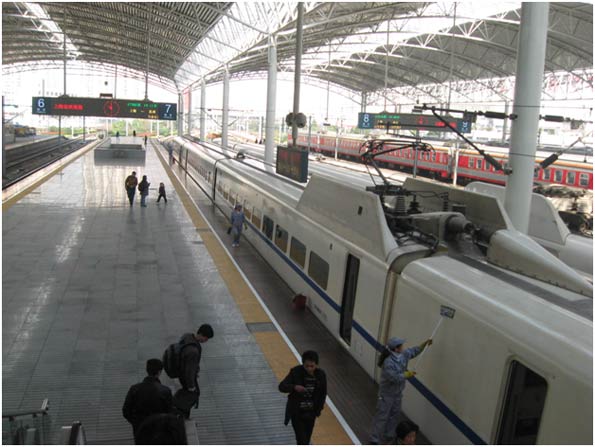
    The Wall Street Journal reports that China will slow down its world’s fastest high speed rail trains. According to the Journal, Sheng Guangzu, head of China’s Ministry of Railways, told the People’s Daily that the decision will make tickets more affordable and improve energy efficiency on the country’s high-speed railways. The maximum speed will be 300 kilometers per hour (186 miles per hour), which is also the top speed for most high speed rail trains in Japan, France, Korea and Taiwan. The United Press reported that the 300 kph service would be limited to the four north-south (Beijing to Harbin, Beijing to Shanghai, Beijing to Hong Kong and Shanghai to Shenzhen) and east-west lines (Qingdao to Taiyuan, Lanzhou to Xuzhou, Shanghai to Chengdu and Shanghai to Kunming). Both sources were unclear as to whether the new speed limit would apply to the proposed 380 kph Beijing to Shanghai line, however that line is one of the four north-south trunk routes, all of which will operate at the slower speed according to the Ministry of Railways.

    Currently, the world’s fastest high speed rail trains operate on the Guangzhou (South Station) to Wuhan route, which reaches 350 kilometers per hour on its fastest service (which stops in Changsha, the non-stop service having been cancelled), completing the run in 3:16. This lower speed could increase travel time on the route to between 3:30 and 3:45.

    The Journal cited a high-speed rail official (not Chinese) who indicated that there are safety concerns with trains running at above 320 kph. In contrast, the proposed California high speed rail line would operate at top speeds of 355 kph.

    Photo: Nanjing high speed rail train, Shanghai Station (by author)

  • Los Angeles: The MTA’s Bus Stop Strategy

    Those who run the Los Angeles Metropolitan Transportation Authority evidently believe that, since the Consent Decree that forced it to improve service to its bus riders has expired, they are free to rewrite history to justify Metro’s elimination of nine bus lines, its reductions in service on eleven more, and its overall elimination of four percent of its bus service hours by attempting to show that MTA bus service is little utilized and not cost-effective.

    The Consent Decree followed a decade of reductions in bus service and increases in fares while the majority of transit spending by the major LA transit agencies went to rail. As a result of a Federal Title IX (discrimination in utilization of Federal funding) legal action, Labor/Community Strategy Center v MTA, in 1996, Metro agreed to the CD. It was forced to eliminate the effective doubling of fares that it had imposed, to return to offering the monthly passes that had been highly utilized by low-income transit riders, and to commit to a relief of overcrowded bus service. Those of us who fought for the CD, and who fought Metro to make it live up to its commitments, believed the CD to be an incredible success.

    MTA has always felt otherwise.

    To see how MTA characterizes the CD as a failure, and thus justifies bus service reductions, go to the source… literally. The Source is MTA’s blog:

    “After the late 1990’s, Metro increased bus service by more than one million hours. Although overall Metro ridership has increased over time, bus ridership has fallen or been flat in the past two decades.”

    This is a wonderful example of the creative use of statistics.

    The latest National Transit Database data is for 2009, when there were 386 million bus boardings. In 1989, twenty years earlier, there had been 412 million. So, yes, Metro bus ridership fell over this two decade period.

    However, a more relevant way of looking at this is to compare 1996 – the year before the CD went into effect – to 2009. From 1996 to 2009, mostly as a result of the CD, bus vehicle revenue hours were up 20.2%, miles were up 14.6%, and bus boardings were up 14.5%.

    What the CD was intended to correct, more than anything, was Metro’s history of reducing overall ridership, bus and rail, by an average of 12 million a year in the eleven years that followed its start of major rail construction in ’85. The measure of the CD’s success was the turnaround: Once it went into effect, Metro ridership increased 12 million a year for the next eleven years until it expired.

    Metro did increase bus service substantially after the CD, and utilization of this service increased at right about the same level. Again, from The Source:

    “How full are Metro buses today? Overall, Metro buses are running at an average of 42% capacity.”

    The 42% figure is evidently derived by dividing Metro’s FY09 bus average passenger load – passengers-miles/vehicle revenue miles – by the average number of seats on Metro buses. The figure looks low, doesn’t it? Think about all those empty seats.

    However, unlike an airline flight from LAX to JFK, Metro buses make many stops along their routes to pick up and drop off passengers. Bus scheduling is developed around the maximum carrying capacity of a bus at the peak load point of the route during the peak ridership period. This means that, for much of the day, and for most of even the busiest bus trips, there are a lot of empty seats. That’s the nature of the transit business.

    And compare Metro bus service to its 20 largest peers. For 2009, Metro was had the second highest average passenger load of the group, at 17.1, beaten only by MTA-NYCT, at 17.9. The average of the results of the Top 20 was 11.3. That 42% starts looking pretty good . In fact, a ratio this high actually suggests that a lot of Metro bus lines should be examined for overcrowding.

    “At present, Metro subsidizes about 71 percent of the cost of each passenger’s bus ride, an amount higher than most other large transit agencies.”

    More commonly, this ratio is turned around, as in: Metro has a 29% farebox recovery ratio.

    How does Metro bus rank up against its Top 20 peers? Seventh, and the average of the Top 20 is 27%. However,farebox recovery ratio can be a very misleading metric. Direct subsidy ratios are a more significant indicator, particularly taxpayer subsidy per passenger and per passenger-mile. Metro’s subsidy/passenger was $1.74, third in the Top 20, against the average of its peers of $2.49; its subsidy/passenger mile of $.44 was second best, against the average of $.68.

    So, rather than the bus service financial performance being sub-standard, it is actually outstanding, providing good value for the riders and great value for the taxpayers.

    Instead of Metro telling the world what a great job it is doing, and taking pride in what it has accomplished, why is Metro leadership explaining how wasteful it is, and why service must be cut?

    “As to whether [these] will be the final bus service changes, Leahy said that he wasn’t sure. ‘But, if we don’t do these things, the capital program is not sustainable.’”

    For those not familiar with MetroSpeak, “capital program,” when applied to transit, primarily means building more rail.

    This is the central issue: Metro is in the business of construction of transportation infrastructure, and money wasted on actually moving people takes away from what is available to build new guideway transit corridors.

    As of this writing, Metro has Chatsworth Orange Line extension (BRT) and Expo Light Rail Phase I in construction, Expo Phase II approaching construction, and a design/build procurement for Phase 2A of the Pasadena Gold Line is underway.

    Metro is also in various stages of planning and obtaining funding commitments for East San Fernando Valley North-South BRT lines, Sepulveda Pass Transit Corridor, Westside Subway Extension, Downtown Regional Transit Connector, Crenshaw/LAX Transit Corridor, Eastside Transit Corridor, Green Line LAX Extension, South Bay Green Line Extension, and West Santa Ana Transit Corridor. Plus, it’s the majority partner for the seven Metrolink commuter rail lines.

    Clearly, Metro is so short of operating funds that it is cutting service on a bus system that is the best value to the taxpayers and riders in the nation. It cannot afford to operate its current bus system, and it is attempting to get Congress to front-load massive construction funding against the thirty-year half-cent sales tax passed in 2008. Given Metro’s less than stellar record of bringing in capital projects on budget, and considering its failure to provide for the very large capital renewal and replacement costs of the current rail lines as they age, exactly how does it expect to pay the operating costs of the expanded system it is rushing to construct?

    As Will Rogers said, “When you find yourself in a hole, stop digging.”

    Tom Rubin has over 35 years in government surface transportation, including founding the transit industry practice of what is now Deloitte & Touche, LLP, and growing it to the largest of its type. He has served well over 100 transit agencies, MPO’s, State DOT’s, the U.S. DOT, and transit industry suppliers and associations. He was the CFO of the Southern California Rapid Transit District, the third largest transit agency in the U.S. and the predecessor of Los Angeles County Metropolitan Transportation Authority.

    Photo by biofriendly, Metro Bus Campaign, Los Angeles