Tag: Transportation

  • California’s Global Warming High-Speed Train

    The California High-Speed Rail Authority promises to “achieve net zero greenhouse gas (GHG) emissions in construction” and is committed to operate the system on “100% renewable energy” by contracting for “400 to 600 megawatts of renewable power”. These promises may please environmentalists, but they cannot be kept.

    Construction Emissions

    The Authority has provided only limited information regarding GHG construction emissions. Its 2013 Emissions Report estimated 30,107 metric tons in GHG “direct emissions” for the first 29 miles of construction. “Indirect emissions” associated with the manufacture and transport of materials, primarily concrete, steel, and ballast were not reported because, according to the Authority, precise quantities, sources, and suppliers were not known. A more plausible reason is the their desire to hide from the public more than 90% of GHG emissions associated with their project. Regardless, recent testimony by the Authority’s CEO clearly indicates that indirect emissions can now be tallied.

    Speaking before the Assembly High-Speed Rail Oversight Committee on January 27, 2016, CEO Jeff Morales, spoke at length on how costs were estimated. He described the assemblage of 200,000 individual line items including concrete, steel, dirt, electrical, etc. and said each includes a unit cost which is multiplied by the units required to build the system.

    Total GHG construction emissions would still be unknown today were it not for the work of professors Mikhail V. Chester and Arpad Horvath working in UC Berkeley’s Department of Civil and Environmental Engineering. They studied this issue, published their findings in 2010, and estimated that 9.7 million metric tons of GHG would be emitted during the construction of the statewide system; primarily because of the production of massive amounts of concrete and steel. Using mid-level occupancy for the three competing modes of travel (high-speed train, auto, and airplane) the authors estimated it would take 71 years of train operation to mitigate the project’s construction emissions. California’s Legislative Analyst Office came to a similar conclusion in a 2012 report critical of using GHG reduction funds to pay for Phase 1 (Los Angeles to San Francisco) of the statewide system because “if the high-speed rail system met its ridership targets and renewable electricity commitments, construction and operation of the system would emit more GHG emissions than it would reduce for approximately the first 30 years”. Here, the LAO appears to be citing an updated Chester and Horvath study, published in July 2012, which focused on only Phase 1 of the high-speed rail project, as outlined in the Authority’s Revised 2012 Business Plan. They took into account additional highway infrastructure that could be avoided as well as claims that “a future CAHSR system will likely see improved train performance and an opportunity for increased renewable electricity usage”.

    However, the Authority promised “zero net greenhouse gas emissions in construction”. A reduction in California’s GHG emissions due to the trains’ operations was to help reduce the state’s future GHG emissions, not merely mitigate construction releases. The Authority’s zero construction emissions promise relies heavily on a tree planting program. More than 5 million trees, each more than 50 feet tall, would need to be grown and perpetually maintained to recapture the 9.7 million tons of GHG construction emission. However, one year into construction, the Authority’s CEO admitted that not a single tree had been planted. Worse, as part of their project, the Authority plans to cut down thousands of trees south of San Francisco to electrify Caltrain trackage.

    Emissions from Operation

    Chester and Horvath generously assumed the trains would run on a power mix relatively high in renewable sources. However, high-speed electric trains would replace fossil fueled propelled automobiles and airplanes. When Phase 1 is completed, the trains will place a new demand on the electric grid that must be met immediately by starting up an idle generator capacity. It may be a peaking unit in California powered by natural gas or a coal burning plant in Utah. The exact source is unknowable, but it will not be a wind or solar powered electric plant. These sources will already be generating all the power they can produce when the first trains require additional power.

    The Authority’s business plans are constantly changing as are their assumptions on energy consumption and energy cost. The 2012 Business Plan is cited, a plan that referred to paying 15.2 cents/kWh for electrical energy, inclusive of a 3 cent premium for renewable energy. Energy consumption was established at 63 kWh/mile. Train miles traveled between 2022 and 2030 was projected to be 99 million, resulting in an energy use of 6,300 million kWh. In order to make good on their claim that they will power the trains with 100% renewable energy the Authority needs to fund the construction of the necessary renewable power plants.

    California Valley Solar Ranch, a 250MW facility producing 650 million kWh/year recently built at a cost of a $1.6 billion ($1.2 billion financed at a 3.5% interest rate using a federal loan guarantee coupled with a check from the U.S. Treasury for $430 million), serves as a proxy for the needed capital. The Authority’s trains would consume 1,200 million kWh in 2030 and need the output of 1.85 Solar Ranches; 460MW of capacity costing $3.0 billion. A premium of 42 cent/kWh, fourteen times the Authority’s offer, would be needed to raise the necessary capital by 2030. More than 20% of this capacity, costing half a billion dollars, must be constructed before the first trains run. Otherwise, those trains will be totally powered by fossil fuels, meaning the GHG emissions per passenger mile will be no better than for two passengers traveling in an automobile which meets the federal fuel efficiency standards scheduled to be in place in 2022.

    The issue of global warming needs to be addressed. However, the planting of millions of trees and the spending of billions of dollars on a fossil fuel propelled train is not a practical or cost effective way to address the problem. From the climate point of view, the Authority’s project is detrimental because of its massive construction GHG emissions and because it diverts funds from other actions, such as providing financial incentives for ride-sharing and for the purchase of zero emission or low emission vehicles that could really help address the serious problem of global warming.

    Michael J. Brady has been a litigator and appellate lawyer for 50 years; he has worked on opposing California’s high speed rail for 10 years.

    Mark Powell has been assisting Mike Brady for seven years; he is a retired chemist for Union Oil Co.

    Photo by California High-Speed Rail Authority [Public domain], via Wikimedia Commons

  • Dispersed Cities: Starting the 3rd Decade

    Cities (urban areas or settlements) have been around for millennia. Over that time, cities have changed in form and function. But the way that people move around the city has materially changed only twice. Walking was predominant until less than 200 years ago, then came mass transit, the automobile and now autonomous cars and some substitution for driving by online technology.

    The Walking City

    When walking predominated, cities had to be very dense, because things had to be close enough for pedestrian access. Walking Paris reached approximately 250,000 persons per square mile and London over 100,000 in the 17th century. The US also had dense walking cities, but they were smaller , emerged much later and never reached the highest densities of old-world cities. By 1820, New York had an estimated 50,000 residents per square mile, but a population of less than 150,000.

    Indeed in 1820 urban travel was little different than in for the average resident than in the pre-urban temple center of Gobekli Tepe (Turkey) 11,000 years ago, the Caral (Peru) of 4,500 years ago or the Wangchenggang (China) of 4,000 years ago.

    The Transit City

    However, the second quarter of the 19th century saw the emergence of the mass transit revolution. The new the horse drawn omnibuses were affordable to many people, unlike individual horses and horse drawn carriages. Over nearly all of the next century, transit shaped the city. Services were expanded and improved. Electric streetcars and interurbans appeared. If the Census Bureau had asked a “journey to work” question in the 1900 census, the answers would have shown transit’s share of mechanized to be virtually 100 percent.

    During this period, transit shaped the dominant downtowns (central business districts or CBDs), as is chronicled by Robert Fogelson in Downtown: Its Rise and Fall: 1880-1950. Transit lines converged on the CBD, which was the key to its emergence as the central point of a monocentric city. Transit retained its primacy through much of the 1910s, as people who worked downtown were able to move further away.

    The Automobile City

    But, just as the transit city was peaking, the car began its ascent, with automobile ownership expanding rapidly in the 1920s. By 1929, 90 percent of the world’s car registrations were in the United States, according to Northwestern University economist Robert Gordon. All of this made it possible to travel farther in urban areas and to live even farther from the urban core.

    After the Great Depression and World War II, which slowed growth, automobile ownership expanded even more. By 1950, New York region’s urban density had dropped below 10,000 per square mile and the average density among the principal urban areas in today’s 53 major metropolitan areas (more than 1,000,000 population) was approximately 6,000 per square mile. By 2010, New York’s urban density had dropped to 5,300, and Los Angeles had become the densest at 7,000. The average of the principal urban areas to 3,100.

    Polycentricity’s Short Interlude

    The dominance of the automobile ended much of the need for a CBD. As people moved farther away (suburbanized), employment and commercial development also suburbanized. Large retail shopping centers appeared throughout the suburbs. Soon after, large employment centers developed outside the downtowns, such as Bellevue (Seattle), Uptown (Houston), Century City (Los Angeles) and Research Triangle (Raleigh-Durham). In 1991 Joel Garreau first brought centers like this to public attention, coining the term “edge city” in his book Edge Cities: Life on the New Frontier. It had become clear to those who were paying attention that the monocentric, CBD oriented US city was a thing of the past. There were still CBDs, of course, but most were shadows of their former selves in employment and shopping shares. American cities were increasingly referred to as “polycentric.”

    Dispersion: The New Urban Form

    But polycentricity did not last very long. In 1997, University of Southern California economists Peter Gordon and Harry W. Richardson noted the trend toward dispersion in Beyond Polycentricity: The Dispersed Metropolis, Los Angeles, 1970-1990. In a 1998 Brookings Institution paper, they highlighted one of the most important advantages of dispersion. Traffic “doomsday” forecasts, for example, have gone the way of most other dire predictions. Why? Because suburbanization has turned out to be the traffic safety valve. Increasingly footloose industry has followed workers into the suburbs and exurban areas and most commuting now takes place suburb-to-suburb on faster, less crowded roads.”

    Further evidence came in 2003 from University of Nevada Las Vegas Professor Robert Lang who documented the dispersion of office space outside the CBDs in Edgeless Cities: Exploring the Elusive Metropolis.

    Finally, Bumsoo Lee (now at the University of Illinois, Champaign-Urbana) and Peter Gordon published Urban Spatial Structure and Economic Growth in US Metropolitan Areas which looked at 2000 census tract data and classified employment based on job density into three categories, CBDs, subcenters and dispersed.

    Among metropolitan areas with more than 500,000 population, all had most of their employment outside CBDs and subcenters. In other words, all metropolitan areas were more dispersed than polycentric or monocentric. Further, in the largest metropolitan areas, more than twice as many jobs were in subcenters as the CBDs (Figure 1).

    • Among metropolitan areas with more than 3,000,000 residents, 77.9 percent of employment was dispersed, 15.0 percent in subcenters and 7.1 percent in CBDs.

    • Among metropolitan areas with from 1,000,000 to 3,000,000 residents, 82.2 percent of employment was dispersed, 7.0 percent in subcenters and 10.8 percent in CBDs.

    • Among metropolitan areas with from 500,000 to 1,000,000 residents, 82.6 percent of employment was dispersed, 5.6 percent in subcenters and 12.2 percent in CBDs.

    Unfortunately, this research has not been updated with the results of the 2010 census. But, there is every reason to believe that the dispersion continued. A City Sector Model (Figure 2) analysis of County Business Pattern data suggests that the dispersion has continued (Figure 3). Between 2000 and 2015, 90 percent of new jobs were in the suburbs and exurbs. The largest gains were in the Later Suburbs and Exurbs, while there were losses in the Urban Core Inner Ring and the Earlier Suburbs. While there was an increase in CBD employment, exurban job growth was nearly twice as great.

    This reality of the dispersed city, however, does not get in the way of media and others who talk as if the city remains monocentric. Yet in an era of new possibilities unleashed by technology — Uber, Lyft, autonomous vehicles — the likely trajectory is for more dispersion not less.

    Wendell Cox is principal of Demographia, an international public policy and demographics firm. He is a Senior Fellow of the Center for Opportunity Urbanism (US), Senior Fellow for Housing Affordability and Municipal Policy for the Frontier Centre for Public Policy (Canada), and a member of the Board of Advisors of the Center for Demographics and Policy at Chapman University (California). He is co-author of the “Demographia International Housing Affordability Survey” and author of “Demographia World Urban Areas” and “War on the Dream: How Anti-Sprawl Policy Threatens the Quality of Life.” He was appointed to three terms on the Los Angeles County Transportation Commission, where he served with the leading city and county leadership as the only non-elected member. He served as a visiting professor at the Conservatoire National des Arts et Metiers, a national university in Paris.

    Top photo: Los Angeles, CBD, polycentric (Wilshire district, Hollywood and Glendale) and dispersed (the rest), by author.

  • Is Your Transportation Project a Boondoggle?

    Tony Dutzik, writing for the progressive Frontier Group, offers a ten ways of recognizing whether a highway project is a boondoggle. A few of his ideas are valid: a highway widening project aimed simply at creating a continuous four-lane road even when there is no demand for four lanes seems silly. But most of his suggestions are wrong: for example, he thinks that, if environmentalists have delayed a project long enough, that proves it shouldn’t be built, when in fact all it proves is that our current planning process allows people to indefinitely delay projects for little or no reason.

    In response, I’d like to offer my own list of ten ways to determine whether a transportation project is a boondoggle. His list focused on highways, though some of his suggestions (“It is sold as needed for economic development”) are valid for transit. Although my list starts out with transit projects, it eventually applies to all types of transportation projects.

    1. It’s a streetcar. Streetcar technology is 130 years old and has since been replaced by less expensive, more flexible buses. Streetcars being built today are no faster and are far more expensive than the ones built 130 years ago. All new streetcar projects and rehabilitations of existing streetcar lines are boondoggles.

    2. It’s light rail. What we call light rail is a slight improvement on streetcars developed in the 1930s, meaning it is “only” 80 years old. Light-rail lines constructed today are no better, and far more expensive, than ones built in the 1930s. Buses can move more people faster and for far less money. All light-rail lines, new and rehabilitations, are boondoggles.

    3. It’s commuter rail outside of the New York metropolitan area. New York City is the only city in America with jobs and populations so dense that buses can’t substitute for rail. Elsewhere, new commuter rail lines in places such as Dallas-Ft. Worth, Nashville, Orlando, Salt Lake City, South Florida, and elsewhere are so ridiculously expensive and carry so few commuters that in many cases it would have been less expensive to give every daily round-trip commuter a new Toyota Prius every single year for the life of the train. This also includes what the FTA calls “hybrid rail“–Diesel-powered railcars operating on commuter-rail or light-rail schedules. The New York exception doesn’t mean it makes sense to start new commuter trains there, but maintenance and rehabilitation of existing trains may be worthwhile (though see #9 below). All new commuter trains, and rehabilitations of trains outside of New York, are boondoggles.

    4. It’s rapid transit, a.k.a. heavy rail, outside of New York City. Again with the exception of New York (though this time the city, not the metro area), electric-powered rapid transit–which was invented in the early 1890s by the same man who perfected the electric streetcar–has been rendered obsolete by buses. A dedicated busway can move more people at higher speeds and lower costs than the Chicago Transit Authority or Washington Metro. No new rapid-transit lines should be built anywhere–even New York–and as older rapid-transit lines wear out–except in New York (again, see #9 below)–they should be replaced by buses. All new rapid-transit lines, and rehabilitations of rapid transit outside of New York, are boondoggles.

    5. It’s a dedicated busway. I just wrote that dedicated busways can replace rapid transit, but very few places in America need dedicated busways. Instead, build high-occupancy/toll lanes, and as bus traffic increases, raise the tolls to insure the lanes never get congested. At some point, the tolls may get so high that they effectively become dedicated busways, but at that point the buses will be moving far more people than almost any rail line outside of, again, New York City. All dedicated busways are boondoggles.

    6. It’s an intercity passenger train. Conventional speed, higher speed, high speed, it doesn’t matter: intercity passenger trains were rendered obsolete by cars, buses, and planes. Their infrastructure and maintenance costs are much higher than any of the alternatives, and their operating costs will always be higher than at least some of the alternatives. Amtrak claims its Northeast Corridor is profitable, but that’s only by pretending maintenance and depreciation don’t count. Railroads make sense for freight; they no longer make sense for passengers. All intercity passenger trains are boondoggles.

    7. It’s a smart highway. Various electronics companies want the government to spend hundreds of billions of dollars building intelligent transportation systems into roads to prepare the way for self-driving cars. But this is dumb; it is much more cost-effective to put all the smarts in the cars and keep the infrastructure simple, especially since local governments can’t afford to maintain the infrastructure they have now, much less smart infrastructure. Since cars are replaced more often than infrastructure, this also enables more rapid updates in technology. All intelligent highway projects that require vehicle-to-infrastructure communications are boondoggles.

    8. It’s a bike lane project that reduces the number of lanes for automobiles. Many cities are attempting to encourage cycling while simultaneously discouraging driving by converting auto lanes to bike lanes, such as by changing a four-lane street to a two-lane street with a center left-turn lane and two bike lanes. This probably doesn’t increase bicycle safety, but it does increase traffic congestion. It is nearly alway possible to find parallel local streets that can be turned into bicycle boulevards without impeding through or local auto traffic. All bicycle projects that reduce the capacity of arterial or collector streets to move automobiles are boondoggles.

    9. It can’t be paid for out of user fees. The primary beneficiaries of all transportation projects are the transportation users. Paying for transportation out of user fees is equitable since it is only fair for users to pay for what they use. More important, user fees send signals to both users and transportation providers informing users of when and where travel is most cost effective and informing providers of where new transportation facilities might be needed. User fees also impose a discipline on both providers and users that prevents boondoggles from taking place. Any transportation facility that can’t be paid for out of user fees is a boondoggle.

    10. It doesn’t generate increased travel or shipping. Anti-highway groups complain that new roads “induce” more driving, and they think that is a bad thing. They advocate instead for transit projects whose users were former auto drivers. They have it backwards. Transportation projects that merely transfer users from one mode of travel to another more expensive mode are a drag on society. Projects that generate new travel create new economic opportunities. Only by generating new travel can projects stimulate economic development. Given a choice between projects that can be paid for out of user fees, the ones that generate the most new travel should be funded first.

    In truth, the last two points cover everything. But the first eight are important because there is so much pressure to do those things that are actually boondoggles.

    This piece first appeared on The Antiplanner.

    Randal O’Toole is a senior fellow with the Cato Institute specializing in land use and transportation policy. He has written several books demonstrating the futility of government planning. Prior to working for Cato, he taught environmental economics at Yale, UC Berkeley, and Utah State University.

    Photo by Josh Truelson (San Diego Trolley) [CC BY-SA 2.0], via Wikimedia Commons

  • Amtrak and Express Coach Lines: What’s Competition Have To Do With It?

    Express coach lines like BoltBus and Megabus have grown dramatically in recent years, providing millions of Americans with new mobility options. When the subject of competition between bus and train arises, however, many transportation wonks instantly become minimizers. Some cite growing rail traffic to make the case that this competition hardly matters. Others point to severe congestion on the Northeast Corridor (NEC)—Amtrak’s busiest route—to build the argument that attempting to lure passengers from buses to trains is a pointless exercise. Still, others note that trains are roomier and more comfortable than buses. This implies that the latter will forever be a last-resort option.

    There may be a grain of truth in some of these assertions, but the fact is that today’s travel market is increasingly cutthroat. Neither Amtrak nor bus lines can continue to expect robust growth of traffic merely by doing more of the same. The national average price of gasoline has, stubbornly, remained below $2.50 for more than two years, nullifying much of the advantage buses and trains had as relatively more fuel-efficient modes. The average round trip ticket price for airline trips fell to $361.20 in 2016, down almost $20 from 2015.

    In this tough environment, air and automobile travel has grown while bus and rail traffic has ebbed. After years of steady growth, Amtrak experienced a slight drop in passenger miles of traffic during its 2016 fiscal year, despite an improving economy. FirstGroup, owner of Greyhound, which operates the popular express coach line BoltBus, and Stagecoach Ltd., which owns Megabus, both experienced revenue drops from their North American operations during the 2016 fiscal year.

    That means the gloves are coming off in the fight for market share. Amtrak is experimenting with new pricing strategies and has added free Wi-Fi to most routes, matching the amenities of express coach lines. BoltBus and Megabus have also lowered fares and created apps allowing travelers to quickly change their reservations at only a nominal cost. Megabus has also rolled out reserved seating, allowing passengers to choose a specific seat – even one at a table – when booking to appeal to those wanting to work on their trip or who are concerned about a lack of comfort and privacy.

    Amtrak & Express Coaches – What’s Really Going On?

    Intrigued at the shifting contours of bus versus rail competition, I evaluated the competition between Amtrak and relatively new express coach lines. Five results stand out:

    1) On short- and medium-distance corridors with several daily trains, competition with Amtrak from express coach lines is fierce. Among the 4,854 miles of such corridors with more than one Amtrak train each day, almost three quarters (74%) have parallel express coach service, with Megabus easily the most pervasive. The entire NEC operation runs head-to-head against not only BoltBus and Megabus, but smaller lines like Go Buses as well. Every mile of the Pacific Northwest’s Cascade Corridor is traversed by BoltBus, while Amtrak’s busiest medium-distance corridors in the Carolinas and the Midwest are served by Megabus’ double-deckers.

    Click here for an enlarged map.

    By comparison, on long-distance routes and corridors having only one daily train, only about a third of mileage is subject to express coach competition. You will not find express coach lines paralleling any stretch of the Chicago – Los Angeles Southwest Chief route, yet every mile of the Crescent’s New York – New Orleans route is covered. Still, new bus lines are regularly popping up.

    2) The “sweet spot” for express bus lines are 125 – 300 mile routes, which allow for trips between 2.5 and 6 hours. Anything longer can seem insufferable in a bus, while shorter trips are often avoided due to many travelers’ desire to stay flexible. Plus, on short-hop routes, a large portion of the ride can be spent on traffic-clogged urban expressways, making travel times more unpredictable.

    This means than when trips are less than 125 miles, the train often wins. Both BoltBus and Megabus have withdrawn from the approximately 120 mile Los Angeles – San Diego route, and they provide scant competition on the Oakland – Sacramento “Capitol Corridor” and Chicago – Milwaukee “Hiawatha Corridor”, running no more than a pair of daily trips. Express coaches are more popular between New York – Philadelphia (90 miles) partially due to abnormally high train fares on this route, which often run four times the normal bus fare.

    3) Amtrak’s greatest advantage lies in serving intermediate stops. Another bright spot for Amtrak is that express coaches bypass many places generating extensive Amtrak business. Megabus, for example, runs express between Chicago and St. Louis (except for rest stops), while Amtrak calls on ten intermediate points, including Springfield, IL, the state capital. A similar pattern exists along other corridors.

    Express coach bus lines reach deeper in the NEC, serving not only Boston, New York, Philadelphia, Baltimore and Washington, D.C., but smaller points as well. Still, the railroad’s “string of pearls” network allows for direct trips between dozens of city combinations in a way not possible on express coaches, which tend to run direct to major hubs like New York.

    4) Express coach bus lines no longer operate predominately from Amtrak’s doorstep, which makes for a fairer fight. It may have once been true that express bus lines poached passengers eager to save a few bucks by leaving from curbs outside major train stations, but this is now rare. Almost two thirds of Megabus departures leave from points at least a half-mile away from the train. In New York, these buses now leave from about a mile away, on Manhattan’s west side. Only about a quarter of express coach departures operate from points a third-of-a-mile or less from Amtrak. This is the case in Boston and Washington, D.C., where dedicated bus terminals are connected to train stations.

    What’s more, development pressures and other urban issues are pushing the express coach lines to more remote spots. Earlier this year, for example, Megabus moved its loading zone to a location four blocks farther away from Chicago’s Union Station, where it had been located since its inception.

    Driving Up Demand

    Increasing demand over the next several years could take the sting out of the upsurge in competition. Oil prices are expected to inch up and the economy is improving. Moreover, working together could help give these modes a competitive edge in some circumstances. Buses can fill gaps in train schedules to provide better ground-travel options (while respecting federal rules limiting Amtrak’s involvement in the motor coach business). Intercity buses could more intensively feed Amtrak routes, as is done in California, who pioneered this approach, and Michigan, which has a similar strategy.

    But the bigger story is that bus-train competition has left the station and is speeding down the tracks. Expect bus lines to add new stops and continue to roll out amenities, while Amtrak works to boost frequency and speed, and grapple with its nemesis—delays—without the expectation of significant increases in federal funding over the short term. May the best mode win!

    Joseph Schwieterman, Ph.D., is professor of Public Services and director of the Chaddick Institute for Metropolitan Development at DePaul University in Chicago. He is the author of several books on railroads and a widely read annual report on the intercity bus industry.

    Photo by Chaddick Institute.

  • Rebuilding America’s Infrastructure

    President Trump promised a $1 trillion infrastructure plan during his campaign. Spending more money on infrastructure is something that has broad support among people of all political persuasions.

    But as the case of Louisville’s $2.4 billion bridge debacle shows, not all infrastructure spending is good spending.

    And as a judge’s ruling halting the Maryland Purple Line project to require more environmental study shows, many of our infrastructure problems have nothing to do with money.

    I tackle these problems and more in a major essay on the rebuilding America’s infrastructure in the new issue of American Affairs. Some key themes include:

    • America’s infrastructure needs are overwhelmingly for maintenance, not expansion.
    • Infrastructure means much more than surface transport (highways, transit), but includes underfunded items like dams and sewers.
    • There is a mismatch between funding structures and infrastructure needs that must be fixed.
    • Politics and regulatory barriers are often a greater problem than money, and until we improve this, progress on fixing infrastructure will be limited.
    • Private capital alone will not solve the funding challenge and comes with big problems of its own. There’s no such thing as free money.
    • An initial sketch of what an infrastructure program should look like.

    Here is an excerpt:

    Yet there clearly are major infrastructure repair needs in America. We have not been properly maintaining the assets we have built. Levee failures notoriously caused much of the flooding in New Orleans after Hurricane Katrina, but America has yet to address the neglect of its dam and levee systems. For example, the recent possibility of an overflow or collapse at the Oroville Dam in California forced 180,000 people to be evacuated. Many dams, levees, and locks on our inland waterway system are in need of repair, often at significant cost. Examples include Locks 52 and 53 on the Ohio River. Built in 1929, their replacement cost is $2.9 billion. As the New York Times reported, this replacement has been botched, and it was originally supposed to cost only $775 million—still a lot of money.

    Tens of billions of dollars are also needed simply to renovate America’s legacy transit infrastructure. The District of Columbia’s own Metro subway system has suffered several accidents that require emergency repairs to improve safety. It lost 14 percent of its riders last year, as they lost faith in the system. San Francisco’s BART rail system needs at least $10 billion in repairs. Boston’s transit system needs over $7 billion in repairs. New York’s subway signals still mostly rely on 1930s-era technology.

    Similar maintenance backlogs affect other infrastructure types. America’s older urban regions need to spend vast sums of money on sewer system environmental retrofit—$2.7 billion in Cleveland and $4.7 billion in Saint Louis. The state of Rhode Island had to pay $163 million to replace its Sakonnet River Bridge because it had failed to perform routine maintenance on the old one. This is just a sampling of America’s infrastructure gaps.

    But the poster child for American infrastructure problems is Flint, Michigan, where a water treatment error caused lead to leach into the water supply, rendering it unfit for human consumption. This caused then candidate Trump to say, “It used to be cars were made in Flint, and you couldn’t drink the water in Mexico. Now, the cars are made in Mexico and you can’t drink the water in Flint.” To be clear, Flint’s water crisis was caused by human error, but that was only possible because of the city’s old lead-pipe infrastructure. America’s water lines, in many cases, haven’t been touched since they were originally installed many decades ago. Some cities still have wooden water pipes in service. Syracuse mayor Stephanie Miner once said that if her city received the same $1 billion commitment from the state that Buffalo did, she would spend three quarters of it just to fix the city’s water lines.

    While things are not uniformly dire, it is clear that there is a need to repair and upgrade America’s existing infrastructure. It is this rebuilding, not building—making America’s infrastructure great again—that the Trump administration should focus on.

    Click through to read the whole thing.

    Aaron M. Renn is a senior fellow at the Manhattan Institute, a contributing editor of City Journal, and an economic development columnist for Governing magazine. He focuses on ways to help America’s cities thrive in an ever more complex, competitive, globalized, and diverse twenty-first century. During Renn’s 15-year career in management and technology consulting, he was a partner at Accenture and held several technology strategy roles and directed multimillion-dollar global technology implementations. He has contributed to The Guardian, Forbes.com, and numerous other publications. Renn holds a B.S. from Indiana University, where he coauthored an early social-networking platform in 1991.

    By Pi.1415926535 (Own work) [CC BY-SA 3.0], via Wikimedia Commons

  • Rail in Legacy Cities vs. Federal Funds to Poorer Markets

    Someone asked me to reconcile my recent paper on rail funding with my stance on Cal-Train electrification that the feds should prioritize funding towards poorer cities. Very good question because there is an apparent conflict there.

    My recent paper was positioned as a response to Trump’s plan to completely eliminate rail transit capital grants while retaining the basic structure of federal transport funding. I think these grants should be retained, but routed to repairs on the core legacy transit system which have a very strong rationale. (I might advocate a difference if we were talking about broader reform ideas like block grants to states or devolution).

    More broadly, my belief is that the creative class has gotten a lot of love over the last 15 years. That’s understandable since cities who don’t capture at least some high income earners to help pay the bills are in trouble. But a lot of cities are well past that point. It’s time to shift into harvest mode on that and refocus our efforts on lower income residents (and cities with significant poverty challenges).

    Hence I want to see federal infrastructure funding routed to items like sewer and water system repairs.

    For transit, I would like to see a federal focus on sustaining a high quality basic bus network in places like Detroit. So I do support prioritizing funds to these regions for plain old bus service.

    I do think wealthy regions like the Bay Area should pay for their own expansion projects because they generate significant value that can be captured to pay for it. Caltrain electrification makes sense to me as a project. This is one that you can make an argument about whether it’s really an updating of a legacy line vs an expansion. But in general, state of good service repairs should be prioritized, so this is not where I’d spend my federal money. (Though again, it’s not an objectively bad project).

    It’s the same in DC, NYC, etc. Federal funds should go to repairs rather than expansion. Some projects like the Second Ave. Subway make sense from a demand perspective, so it’s not ridiculous if the feds funded them. But my preference would be to use federal funding for maintenance, with expansion projects funded locally.

    The one expansion project of federal significance is the Gateway Tunnel, which service a major interstate regional rail corridor (although it also has local transit benefits).

    In short, to the extent that we keep the same basic federal system, send rail capital grants to legacy city repair (potentially including systems in older cities like Cleveland that have a line or two that might need repairs). Cities should pay for their own rail expansion projects (at least until we significantly reduce our critical repair backlog). The feds should look at bus funding to figure out how to create better basic bus networks, focused on cities with significant poverty and fiscal stress. At a minimum, make sure they’ve got decent quality buses, depots, etc. There may be a limit to what the feds can accomplish here, but that’s my general view of where the priority should be: repairs to existing mission critical rail lines and helping distressed communities.

    This article originally appeared on Urbanophile.

    Aaron M. Renn is a senior fellow at the Manhattan Institute, a contributing editor of City Journal, and an economic development columnist for Governing magazine. He focuses on ways to help America’s cities thrive in an ever more complex, competitive, globalized, and diverse twenty-first century. During Renn’s 15-year career in management and technology consulting, he was a partner at Accenture and held several technology strategy roles and directed multimillion-dollar global technology implementations. He has contributed to The Guardian, Forbes.com, and numerous other publications. Renn holds a B.S. from Indiana University, where he coauthored an early social-networking platform in 1991.

    Photo by Yuko Honda [CC BY-SA 2.0], via Wikimedia Commons

  • Cincinnati Streetcars’ “Catastrophic Failures”

    The Cincinnati streetcar–now known as the Cincinnati Bell Connector since Cincinnati Bell paid $3.4 million for naming rights–is barely six months old, and already is having problems. Four streetcars broke down in one day a few months ago.

    Now the company that is contracted to operate the streetcar has warned that poor quality control by the railcar maker has resulted in “catastrophic failures” of three different major systems that cause regular breakdowns of the vehicles. Cincinnati Bell is upset enough to demand possibly illegal secret meetings with the city council over the streetcar’s problems.

    Cincinnati once counted itself lucky that it didn’t order streetcars from United Streetcar, the short-lived company that made streetcars for Portland and Tucson, many of which suffered severe manufacturing defects. But it turns out the vehicles it ordered from a Spanish company named Construcciones y Auxiliar de Ferrocarriles (CAF), which were delivered 15 months late, weren’t much better.

    The streetcar is routed through, and is supposed to revitalize, Cincinnati’s Over-the-Rhine district, a former low-income neighborhood near downtown. But that neighborhood was already revitalizing long before the streetcar opened. No doubt someone will credit the revitalization to the streetcar, but in fact it was due to millions of dollars in taxpayer subsidies.

    Many of those subsidies come from tax-increment financing (TIF). Cincinnati has liberally created dozens of TIF districts (a state law limiting TIF districts to 300 acres forced the city to create two for Over-the-Rhine, which is districts 3 & 4). The city encourages developers to simply apply for funds, effectively allowing them to use the money they would have paid in property taxes to help finance their development.

    Naturally, developers love it. Just like the streetcar, however, TIF is a raw deal for taxpayers who end up having to pay higher taxes, or receive a lower level of urban services, in order to provide services to the TIF districts that should have been funded out of the taxes paid by property owners in that district.

    This piece first appeared on The Antiplanner.

    Randal O’Toole is a senior fellow with the Cato Institute specializing in land use and transportation policy. He has written several books demonstrating the futility of government planning. Prior to working for Cato, he taught environmental economics at Yale, UC Berkeley, and Utah State University.

    Photo by RickDikeman (Own work) [CC0], via Wikimedia Commons

  • MaX Lanes: A Next Generation Strategy for Affordable Proximity

    This is the introduction to a new report written by Tory Gattis of the Center for Opportunity Urbanism. Download the full report here.

    The core urban challenge of our time is ‘affordable proximity’: how can ever larger numbers of people live and interact economically with each other while keeping the cost of living – especially housing – affordable? In decentralized, post-WW2 Sunbelt cities built around the car, commuter rail solutions don’t work and an alternative is needed, especially as we see autonomous vehicles on the horizon.

    This briefing explores a next-generation mobility strategy for affordable proximity: MaX Lanes (Managed eXpress Lanes) moving the maximum number of people at maximum speed and allowing direct point-to-point single-seat high-speed trips by transit buses and other shared-ride vehicles today, and autonomous vehicles in the future. It includes a case study of Houston with a proposed network as well as profiles of similar lanes around the country.

    Download the full report here.

  • Subsidies Haven’t Increased Transit Ridership

    In 2015, the American Public Transportation Association issued a press release whose headline claimed that transit ridership in 2014 achieved a new record. However, the story revealed that 2014 ridership was the highest since 1956. That’s no more a record than if it was the highest since 2013.

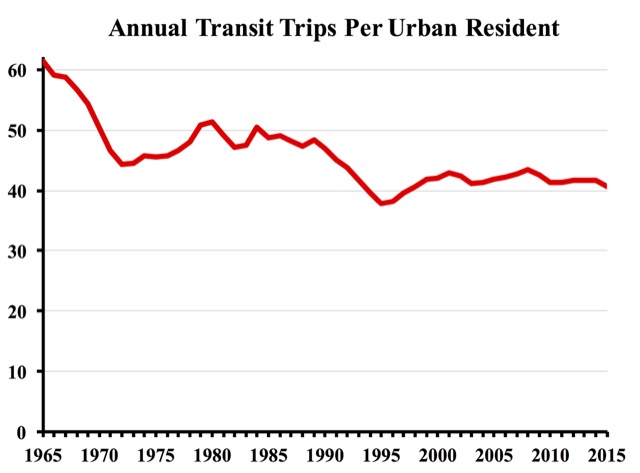
    The truth is that America’s urban population more than doubled between 1956 and 2014. Using the ridership number that really counts–trips per urban resident–2014’s number was a near-record low of 41 trips per person. The only time it was lower before 2014 was a few years in the mid-1990s, when ridership dropped to as low as 38 trips per person. The rate may fall to nearly that level in 2016.

    When Congress passed the Urban Mass Transportation Act of 1964, Americans took an average of 62 transit trips per person. At that time, 82 percent of all transit systems were privately owned. Within a decade, nearly every major transit system and all but a handful of minor ones were “municipalized” and the subsidies began to flow. At first, the federal government provided only capital subsidies, but in 1974 it also provided operating subsidies.

    By 1978, half of operating costs and, of course, all of the capital costs were subsidized. By the late 1980s, fares covered only a little more than a third of operating costs. With most money coming from taxpayers, transit agencies were more beholden to politicians than transit riders, and they became more interested in spending money to please political interests than in boosting transit ridership.

    Since 1965, transit operating subsidies (adjusted for inflation to today’s dollars) total close to $800 billion. We don’t have accurate capital cost data from before 1992, but since then we’ve spent close to $400 billion on capital programs (which in the transit industry include maintenance), most of it on rail transit.

    Thus, well over a trillion dollars in subsidies has resulted in transit ridership falling from 61 trips per urban resident in 1965 to 41 trips in 2015, and even less in 2016. The chart above shows that trips per urbanite have fluctuated since 1970, but those fluctuations are mainly in response to gasoline prices while the general trend is downward. To a large degree, this downward trend is because the subsidies have made transit agencies more responsive to politics than transit riders.

    Advocates of industrial policy argue that government should pick growth industries and nurture them along to help maintain American preeminence in new technologies. Skeptics suggest that government is more likely to pick losers than winners. Transit is clearly one of those losers.

    Most statistics in this post are from the American Public Transportation Association’s 2016 Public Transportation Fact Book data spreadsheet. Data for 2015 is from the National Transit Database. Urban population data are from the Census Bureau.

    This piece first appeared on The Antiplanner.

    Randal O’Toole is a senior fellow with the Cato Institute specializing in land use and transportation policy. He has written several books demonstrating the futility of government planning. Prior to working for Cato, he taught environmental economics at Yale, UC Berkeley, and Utah State University.

    Photo:

  • Reason #1 to End Transit Subsidies: It’s the Most Costly Transportation We Have

    Fifty-three years ago, the transit industry was mostly private and earned a net profit. Today, it’s almost entirely publicly owned, and subsidies have grown out of control. It’s time to take a stand and say all transportation subsidies are bad, but transit subsidies are the worst.

    The National Transit Database says agencies spent more than $64 billion in 2015 yet collected less than $16 billion in fares. They carried about 55 billion passenger miles, for an average cost of $1.15 per passenger mile, of which 87 cents was subsidized. No other major mode of passenger transportation is anywhere near this expensive.

    Americans spent about $1.1 trillion buying, operating, repairing, and insuring cars and light trucks in 2015, but they also drove their autos nearly 2.8 trillion miles. At average auto occupancies of 1.67 people (see table 16), that’s 4.6 trillion passenger miles by auto, for an average cost of about 24 cents per passenger mile. We don’t have 2015 data yet, but in 2014, government agencies spent about $72 billion subsidizing roads (add the $98 billion in “other taxes and fees” to the minus $10 billion in “less amount for nonhighway purposes” and the minus $16 billion for “less amount for mass transportation”).

    This is more than was spent subsidizing transit, but those roads not only produced 70 times as much passenger travel, they were used to ship more than a quarter of the freight moved in this country. Ignoring the freight, the subsidy was about 1.6 cents per passenger mile, meaning the total cost of transit was more than four times the cost of driving.

    Airfares are about 14 cents a passenger mile, making air travel a bargain. Airline subsidies are only a couple of cents a passenger mile (subtract government expenditures from government revenues and divide by passenger miles). Amtrak subsidies are comparatively horrendous at 22 cents a passenger mile but are still only a quarter of transit subsidies.

    Transit is expensive because it is subsidized. Lacking any need to keep costs within revenues, transit agencies spend way too much money accomplishing far too little. It is time to stop all transportation subsidies, but as the most-heavily subsidized form of transportation, transit should be the priority.

    This piece first appeared on The Antiplanner.

    Randal O’Toole is a senior fellow with the Cato Institute specializing in land use and transportation policy. He has written several books demonstrating the futility of government planning. Prior to working for Cato, he taught environmental economics at Yale, UC Berkeley, and Utah State University.

    Photo: Robert Dyess, CC License