Tag: Transportation

  • A Requiem for “High-Speed Rail”

    In the interest of maintaining some balance and perspective on what the Administration proudly calls "President Obama’s bold vision for a national high-speed rail network," at InnovationBriefs we have tried to offer our readers a range of different points of view. It is in this spirit that we present below two commentaries. The first contribution is by Matt Dellinger, author of the highly praised book, "Interstate 69: The Unfinished History of the Last Great American Highway" and a frequent contributor on transportation topics to the progressive website, Transportation Nation. The second contribution is by Ron Utt, Senior Research Fellow at the conservative Heritage Foundation, whose analyses of transportation policy have been a longstanding feature of that Foundation’s work.

    Along with our two commentators, we do not question the merits of intercity rail transportation— an integral and essential part of this nation’s economy, culture and history over the past century and a half. Readers of Steven Ambrose’s history of the transcontinental railroad, Nothing Like It In the World, can only marvel at the indomitable spirit and entrepreneurial energy that drove the creation of the continental rail network. Rail transportation has been intimately woven into the social and economic fabric of this nation ever since. Nor do we forget the huge contribution that private railroad companies have made, and continue to make, to maintaining and growing the nation’s rail network. By investing billions of private dollars, they have made the US freight rail system the envy of the world. Lastly, we believe that intercity passenger rail servic is essential in densely populated heavily traveled corridors, in particular the Northeast Corridor, where road and air traffic congestion will soon be reaching levels that will threaten its continued growth and productivity. In sum, we are not mindless opponents of rail transportation.

    Rather, along with Messrs. Dellinger and Utt, and many other responsible observers inside and outside the railroad community (including notably, Michael Ward, Chief Executive Officer of CSX, the nation’s third largest freight railroad), we take issue with the Obama Administration’s lofty but misleading rhetoric of "high-speed rail." Instead of representing its initiative for what it really is: a program of incremental improvements to the existing rail infrastructure, the Administration has tried to create the impression that it has embarked on a bold and revolutionary program of building a continent-wide high-speed rail network, a legacy reminiscent of President Eisenhower’s Interstate Highway Program.

    As Dellinger and Utt point out, the recently announced spate of awards funded out of the $2.4 billion rejected by Florida’s Gov. Rick Scott will hardly lead to bullet trains speeding from coast-to-coast at 250 mph. These grants, along with most of the earlier awards, will support engineering and planning studies, incremental upgrades in the facilities of freight railroads and modest improvements in existing passenger rail service. For example, the latest list includes a study to replace Amtrak’s Baltimore Tunnel; development of Missouri’s and West Virginia’s state rail plans; final design of the New Jersey Portal Bridge; and modest corridor improvements in Amtrak service in Connecticut, New York and Washington State.

    The above-mentioned $300 million worth of awards was announced on April 8, just a few hours before agreement was reached on a short-term continuing resolution that would cut $1.5 billion in unobligated HSR money. It also preceded by three days the release of a GAO report criticizing the lack of transparency in the Administration’s HSR grant selection process (GAO-11-283). Citing the GAO findings, Rep. John Mica, Chairman of the House Transportation and Infrastructure Committee blasted the Administration in a strongly worded press release. "In the name of high-speed rail, the Administration has squandered limited resources on dozens of slow-speed rail projects across the country," Mica said. "I cannot imagine a worse beginning to a U.S. high-speed rail effort. …It is critical that there be transparency for why these projects were selected in the first place and why any future projects will be selected."

    Had the objective and the selection criteria of the $10 billion program been stated candidly from the outset as an effort to modestly upgrade existing intercity passenger rail services, the White House would have spared itself this criticism and the attendant ridicule of "ObamaRail" and "the Railroad to Nowhere." As it is, the Administration dug itself into an even deeper hole with a quixotic and hardly credible pledge of "making high-speed rail accessible to 80 percent of Americans in 25 years." A promise that was made without any hint as to how this ambitious plan would be paid for and against a background of the House Republicans’ announced intention to totally eliminate federal support for high-speed rail beginning next year. Without further congressional appropriations, the President’s dogged pursuit of the $53 billion high-speed rail initiative will simply collapse.

    As Matt Dellinger pointedly concluded, "If High-Speed Rail ever happens, future Americans might not remember the President who circulated the maps and funded the studies. They’ll remember the President who figured out how to pay for it all."

    Matt Dellinger: "How Much High Speed Rail will $2.4 Billion Buy?" Transportation Nation

    Ronald Utt: "The Death of a High Speed Rail Program," National Review Online

    Ken Orski has worked professionally in the field of transportation for over 30 years.

    Photo by narent23

  • United States: Less Congestion than Europe per INRIX

    A new international report indicates that traffic congestion in the United States is far better than in Europe. The report was released by INRIX, an international provider of traffic information in 208 metropolitan areas in the United States and six European nations.

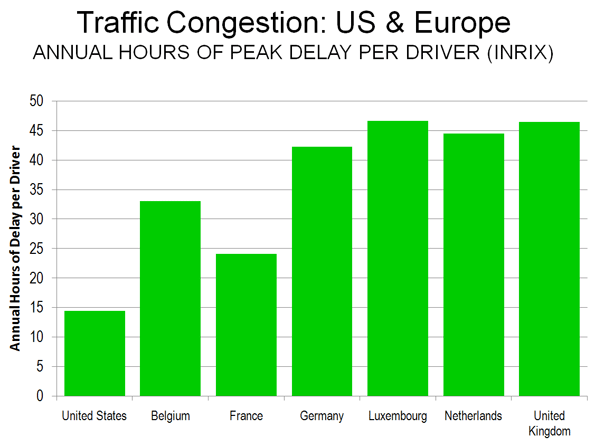
    The report shows that the added annual peak hour congestion delay in the United States is roughly one-third that of Europe. The rate of France was somewhat less than twice the rate of the US and rates in Luxembourg, the United Kingdom, Germany and the Netherlands were three times as high.

    In the United States, peak period traffic congestion adds 14.4 hours annually per driver. This compares to an average delay per year of 39.5 hours for the European nations. Luxembourg, the United Kingdom, the Netherlands and Germany had the greatest lost time, at from 42 to 47 hours. Again, France scored the best in Europe, at 24.1 hours of lost time in traffic per year (Figure).

    Among individual metropolitan areas. Los Angeles had the greatest peak hour delay, at 74.9 hours annually. Utrecht (Netherlands), Manchester (United Kingdom), Paris, Arhem (Netherlands) and Trier (Germany) second through sixth in the intensity of traffic congestion, all with 65 or more hours of delay per driver per year.

    These findings are consistent with international data indicating that traffic congestion tends to be more intense where there are higher urban population densities.

  • Bicycle Commuting: A US System and A World-Wide Guide

    To my pleasure, there is now a United States Bicycle Route System that goes more places than Amtrak and Greyhound do. Have a look at the proposed map of the national corridor plan.

    The goal is to create clearly marked north-south and east-west routes, as romantic as the Oregon Trail or as functional as the Erie Canal. The trail of Lewis and Clark is on one of the routes.

    I can only hope that the plan serves as an inspiration to would-be cyclists and every-day bike commuters. To be fair, it takes years to master the dark and often wet arts of cycling. My riding-to-work garb includes reflective gear from London, Alaskan socks, a headlight from San Diego, a lock from Amsterdam, and a rain jacket from Ohio. On my first commute, after a year of wondering of “whether I could do it,” I searched so hard to find a safe route that I got lost.

    Serious bike commuting requires owning two or three bikes, as one or two will always have flats or breakdowns, and, you need a rain bike. Plus, strategic wardrobe planning can take hours. But bike commuters get to have the satisfaction of passing cars stuck in traffic, and tired legs at the end of day leave you feeling more virtuous than Mother Teresa (if you want more inspiration, there’s a cycling jersey with her picture).

    Just to be clear: No one behind the car wheel likes a cyclist, because bicyclists run red lights, hop up on curbs, pound on hoods, drop F-bombs, and give drivers the middle finger salute. Politically, cyclists fall on the spectrum somewhere between Greens and Anarchists. In some 300 cities — it’s a global movement— to protest local (car-inspired) injustices, they have formed into Critical Masses that parade around like errant storm troopers.

    I am surprised that no one has articulated a bicycle foreign policy — in German it would be Fahrradweltanschauung — given that there are more bikes in the world than cars and they are used more often. Fifty million bikes are manufactured annually worldwide, versus twenty million cars. China’s market share is 400 million. But many American states and counties fight having a bicycle coordinator on their payroll.

    Here’s a highly personal comparison of where some cities and regions currently stand in relation to a world of bicycles:

    Geneva: My hometown, so I know the roads well. The city is trying to expand its bike lanes and trams. Whenever road construction is completed, a new bike lane emerges from the rubble. Biking works in Geneva, despite the hills, wind and rain, but many bike lanes are stopped by dead ends or traffic. I am forever lifting my bike over curbs, cobblestones, or rails, and searching for a better way around the medieval town.

    New York: I can thank former New York mayor Ed Koch for converting me into a bicycle romantic. In spring 1980, he decided to accept a strike from New York’s Transport Workers Union that, for eleven days, mothballed the city’s buses and subway. (Koch referred to the strikers as “wackos.”) The only way to get around New York was to walk or ride a bike. I dusted off my childhood Raleigh Grand Prix and rode off to work, never looking back on a life that did not involve bicycles.

    Although I no longer live in New York, I still like riding there. The West Side, Central Park, and the Brooklyn Bridge are bike friendly. If you want to understand why George Washington lost the battle of Harlem Heights (as I do), a bike is the only way to get there. But, as much as biking has improved in and around New York in the last thirty years, it remains a “car” city. Cyclists are an afterthought, and poorly represented by messengers flying down Seventh Avenue, no hands on their bars, talking on their cell phones, flipping off confused pedestrians.

    The administration of Mayor Michael Bloomberg has proposed a master plan of 900 miles of bike lanes around New York, up from 400 miles, bringing out pools of angry car drivers who hate sharing the road with cyclists and haunted pedestrians. A New York Magazine cover story called it “Bikelash.” But 100,000 riders mount a bike every day in Manhattan.

    Hanoi: In 1993, before the Politburo began importing waves of noisy scooters and small motorcycles, to bike around the old French quarter and West Lake (past General Giap’s house and Ho’s mausoleum) was a delight. Everyone rolled at slow speeds, and no one stopped at the intersections; the bike traffic just melded together, like DNA. In the Vietnam War, bikes beat B-52s.

    Berlin: It’s expansive, like Los Angeles, but flat as a dish and with many bike lanes, all of which go to places of historical interest: the Reichstag, the Holocaust Memorial, the remnants of the Berlin Wall, or Checkpoint Charlie. Each time I am there, I rent a bike, and it takes me everywhere. The only downside to Berlin biking is the weather, which has a lot of cold rain. Bikes make Berlin.

    Amsterdam: I find the biking to be hair-raising. The Dutch power through intersections or along bike paths as though they were in a bonus sprint on the cobblestones of Paris-Roubaix (the famous bike race). Yes, the lanes go everywhere, and bikes in Holland — at least those not stolen and thrown into the canals — are sacred objects. But think about wearing some body armor.

    Beijing: My favorite bicycle city. To be in the saddle enables you to go almost anywhere. Bike lanes are wider than many Western boulevards, and you can bike around Tiananman Square, to the Forbidden City, down to South Station, and out toward the Marco Polo Bridge (where World War II began in China). The way to see the hutong — ancient alleys — is on a bike. Beijing treats its citizens with more respect when they are cycling than it shows them at other times.

    London: Cyclists wear reflective vests, stretch rubber bands on their pants legs, and blow strange whistles at anything in their way. Coming out of the mist, they look prehistoric and think nothing of biking in rain, sleet or snow, doing battle with buses, cars, and pedestrians, or riding bikes that look like they survived the Blitz. The London mayor has introduced a fleet of shared bikes that can be used around town, based on annual membership. Because traffic is on the “wrong side,” I find biking in London scary, but it delivers the goods.

    Suburbia, USA: I have spent more time that I would have wished biking around suburbs, exurbs, malls, highways, and developments. It’s the least satisfying bicycle experience. I grew up in the suburbs, with baseball cards in my spokes. Suburban drivers hate cyclists. Integrating bicycles into suburban life, with its SUV panzer divisions, will be a national challenge.

    Toronto: Canada’s guerrilla team, the Urban Repair Squad, goes out at night to paint bike lanes onto city streets. (“They say the city is broke. We fix it. No charge.”) So effective is their painting that the city of Toronto maintained the counterfeit lanes for two years, thinking they were official.

    Southampton, New York: Southampton prohibits riding a bike through town. It’s fine to thunder through the Potemkin village of million dollar boutiques in a gas-guzzling, tinted-windowed pimp mobile, but God forbid that anyone should roll through on their own power. It gets my vote as the worse bicycle town in America.

    ***

    Like all bikevangelists, I dream of highways given over to cyclists, and see cycling as the way wean the U.S. from Middle Eastern oil and solve every problem from global warming to obese children. Consider this: Compared to the costs of high-speed rail and highway construction, the U.S. Bicycle Route System requires only maps, sign posts, imagination… and strong legs.

    Photo by the author: “My bike in Beijing. One gear. Heavy as bricks, but very smooth”.

    Matthew Stevenson is the author of Remembering the Twentieth Century Limited, a collection of historical essays. He is also editor of Rules of the Game: The Best Sports Writing from Harper’s Magazine. He lives and rides in Switzerland.

  • Bus Versus Train: A Dying Debate

    The Los Angeles Metropolitan Transportation Authority’s cutbacks on its bus line, eliminating about 12% bus service, illuminate the problems of mass transit in LA, specifically the relative inefficiency of trains in the city. This 12% is a further reduction after the 4% cutbacks six months ago, sparking anger from the Bus Riders Union. Metro Chief Executive Art Leahy says that his decision to decrease spending is a result of the low ridership, yet city trains, which are also underperforming, remain relatively untouched.

    Leahy argues that buses are easier to eliminate, re-route, and reschedule than rail lines are. However, he also says that the cutting back on lesser-used bus lines will free up the resources to enhance the ones in higher demand. Many bus riders feel that they are getting a raw deal seeing as bus lines, which transport 80% of the MTA’s passengers, only get 35% of the operating budget to begin with. This being true, how much is the other 65% really helping the rail lines then?

    The Bus Riders Union thinks that the MTA’s preference for trains over buses is an unfair reflection of class interests. Because rich people do not take the bus, there is no incentive to keep it running. As is becoming increasingly clear, especially with the current high-speed rail discussions, rich people don’t want to ride the train anymore either. This local debate, therefore, is not an argument of whether to cutback on buses or trains; it is an argument about how to deal with the general decline in mass transit.

  • The 30th Anniversary of the C-Train in Calgary

    I’ve spent a good chunk of the last few months working on a study of Calgary’s light rail transit (C-Train) system, which was released today by the Frontier Centre for Public Policy.  I’ve had a long standing interest in LRT systems, and spent the summer of 2009 working for the Cascade Policy Institute in Oregon, where we compiled massive amounts of data on their world renowned LRT system as part of an ongoing project.  The data (including actual field research, which proponents of the system haven’t done–they rely on survey data), indicates that ridership is lower, and costs are far higher than proponents believe.

    That firsthand experience (which included riding the train every day), coupled with the empirical literature from light rail systems across North America, shattered my previous conviction that light rail transit can be an economical method of transit.  For the record, I do believe that subways can be profitable in dense urban cores (even the badly managed TTC nearly breaks even), and buses already are profitable in many cases (especially inter-urban bus services, such as Greyhound and Megabus).  Many proponents of LRT believe that it is a happy medium between subways and buses.  If that were the case, it would be profitable.  However, LRT combines the disadvantages of the two: it is slow, inflexible, and expensive.  Numerous studies, in particular an authoritative study by the non-partisan United States Government Accountability Office, have demonstrated that on average, buses are a cheaper, faster, and more flexible than LRT for providing mass transit.

    While I use many different metrics to demonstrate that the costs and benefits of LRT are wildly exaggerated, my favorite is that Calgary spends both the most on transit and the most on roads per-capita.  Given that Calgary’s entire land use and transportation framework for the past several decades has been built around the C-Train, it is hard to call it anything but a failure. The City has cracked down on parking so aggressively to encourage people to ride the train that there are only 0.07 parking spaces per employee in the central business district.  Because of this, Calgary is tied with New York for the highest parking prices on the continent.  But many of those people who would otherwise have parked downtown instead park in the free parking spots provided at C-Train stations.  Not only is free parking horribly inefficient, but this also emphasizes one of the major contradictions of the C-Train: it isn’t getting people out of their cars, and it isn’t helping to curb urban sprawl–two of its primary goals.

    Unsurprisingly, those last two findings proved controversial, though not as controversial as my assertion that the C-Train fails to help the urban poor.  A columnist for the Calgary Herald wrote an angry response to my Herald article that accompanied the story (though doesn’t seem to have read the study).  She attempts to refute my arguments about urban sprawl, and the impact of the C-Train on the poor, while dismissing the study as “a cost-benefit analysis guaranteed to resonate with other right wingers who share the mantra of lower taxes above all else, including over the reality of everyday experience.” I’m not clear on when cost-benefit analysis became a right wing concept, but I’ll let that one go.  I will, however, address her two criticisms in short order.

    The idea that urban transit could worsen sprawl seems odd.  The reason why it does so in Calgary is because the C-Train network is built on a hub and spoke model.  What this means is that transit is concentrated on going from the outskirts, into the city center.  Since LRT is so expensive, and since people need to be ‘collected’ by buses to get to LRT stations, the city has less resources to provide transit circling the core, or travelling east-west.  And if you can’t provide good transit for people who aren’t living along LRT lines, and don’t work along one of the lines, people are just going to keep moving further out (hence the highest road costs in the nation).  Here’s what Calgary Transit’s current planning manager has to say about the C-Train’s impact on sprawl:

    “In one respect, it should allow Calgary to be a more compact city, but what it’s done is it’s actually allowed Calgary to continue to develop outward because it was so easy to get to the LRT and then get other places,” says Neil McKendrick, Calgary Transit’s current planning manager.”

    While that comment is true for those who can afford to live by LRT stations (or to drive to them), it doesn’t apply to the city’s poorest.  As it happens, LRT lines raise the cost of adjacent housing (though for proximate high end housing it lowers the value–hardly a concern for the poor)–by $1045 for every 100 feet closer to a rail station.  This isn’t a terribly complicated concept.  If you spend a massive amount of money on a form of transit that is considered to luxurious, the price of housing goes up. This is exacerbated by the fact that diverting transit resources to those areas makes transit there comparatively better, making it that much more desirable comparatively for people who intend to use transit at all–even as just an occasional amenity, say for going downtown on weekends.  LRT is great for people who can afford to live by the stations, but not so much for anyone else.

    Unfortunately, for many, light rail transit has become a sacred cow.  But if Calgary is ever going to have adequate rapid transit, the City will need to explore more cost effective options.  Buses may not be trendy, but expanding BRT in Calgary would dramatically improve people’s mobility at a reasonable cost. Fortunately, the current Mayor has acknowledged that BRT will have to be part of the solution for making Calgary a transit friendly city.  He also made the wise decision of de-prioritizing the southeast LRT extension (expected to cost $1.2-$1.8 billion). If the Mayor follows up on his promise to make BRT an integral part of Calgary Transit in the short term, the City will not only have far better transit, but it will have a chance to watch the LRT and BRT operating side by side so that the people can decide for themselves whether the billion plus required to build the Southeast LRT is worthwhile.  My bet is on BRT.

    This piece originally appeared at stevelafleur.com

  • The End of the Line: Ambitious High-speed Rail Program Hits the Buffer of Fiscal Reality

    A well-intentioned but quixotic presidential vision to make high-speed rail service available to 80 percent of Americans in 25 years is being buffeted by a string of reversals. And, like its British counterpart, the London-to-Birmingham high speed rail line (HS2), it is the subject of an impassioned debate. Called by congressional leaders “an absolute disaster,” and a “poor investment,” the President’s ambitious initiative is unraveling at the hands of a deficit-conscious Congress, fiscally-strapped states, reluctant private railroad companies and a skeptical public.

    The $53 billion initiative was seeded with an $8 billion “stimulus” grant and followed by an additional $2.1 billion appropriation out of the regular federal budget. But instead of focusing the money on improving rail service where it would have made the most sense— in the densely populated, heavily traveled Northeast Corridor between Boston and Washington— the Obama Administration sprinkled the money on 54 projects in 23 states.

    Some of the awards are engineering and construction grants but many more are simply planning funds intended to plant the seeds of future passenger rail service across the country. Only two of the projects could be called truly “high-speed rail” because they would involve construction of dedicated rail lines in their own rights-of-way where trains could attain speeds of 120 mph and higher. The remaining construction money will be used to upgrade existing freight rail facilities owned by private railroad companies (the so-called Class One railroads) to allow “higher speed” passenger trains to run on track shared with freight carriers.

    Many of the proposed improvements will result in only small increases in average speed and in marginal reductions in travel time. For example, a $1.1 billion program of track improvements on Union Pacific track between Chicago and St. Louis is expected to increase average speeds only by 10 miles per hour (from 53 to 63 mph) and to cut the present four-and-a-half hour trip time by 48 minutes. A $460 million program of improvements in North Carolina will cut travel time between Raleigh, NC and Charlotte, NC by only 13 minutes according to critics in the state legislature.

    Shared-track operation has raised many questions in the minds of the intended host freight railroad companies. Railroad executives are concerned about safety and operational difficulties of running higher speed passenger trains on a common track with slower freight trains and they are determined to protect track capacity for future expansion of freight operations. Their first obligation, they assert, is to protect the interests of their customers and stockholders. This has led to protracted negotiations with state rail authorities in which the private railroads are fighting Administration demands for financial penalties in case passenger train operations fail to achieve pre-determined on-time performance standards. In some cases, negotiations have hit an impasse causing the Administration’s implementation timetable to fall behind. In other cases, freight railroad companies have reluctantly given in, not wishing to alienate the White House or fearing its retaliation.

    A serious blow to the presidential initiative was delivered by a group of three determined, fiscally conservative governors who rejected billions of dollars in grant awards because they were concerned that the proposed passenger rail services could require large public subsidies to keep the passenger trains operating. In the U.S. federal system, the governors and state legislatures have the final say concerning construction and operation of public transportation services within state boundaries. The refusal of the governors of Wisconsin, Ohio and Florida to participate in the White House HSR program thus took much wind out of the sails of the Administration initiative.

    Perhaps the most serious blow was delivered by Governor Rick Scott whose state of Florida was supposed to host one of the Administration’s showcase projects: an 86-mile true high-speed rail line, built in its own right-of-way in the median of an interstate highway between the cities of Tampa and Orlando. A score of international rail industry giants converged on Florida in the expectation of participating in a rich bonanza of contract awards and a chance to bid on a future rail extension from Orlando to Miami.

    But they came to be disappointed. A study conducted by the libertarian think tank, the Reason Foundation, convinced Governor Scott that the project could involve serious cost overruns and the risk of continuing operating subsidies. This caused the Governor to decline the federal grant, thus putting an effective end to the project. A last-minute effort by rail supporters to challenge the Governor’s decision was stopped in its tracks when the state supreme court upheld unanimously his right to veto the project.

    This left the Administration with just one true high-speed rail project: California’s proposed 520-mile high-speed rail line connecting Los Angeles with Northern California’s San Francisco Bay area and Sacramento. The origin of this venture dates back to 2008 when voters approved a $9.95 billion bond measure as a down payment on the $43 billion system. Since then the project became mired in multiple controversies. One relates to a lack of a clear financial plan, another to what critics, including the state’s official “peer review” panel, claim to have been overly optimistic forecasts of construction costs, ridership and revenues. Then came a report raising questions about the escalating price tag for the project which now is estimated at $66 billion. This is occurring in a state that is staggering beneath a $26 billion deficit.

    In the face of fierce opposition that developed in the wealthy Bay Area communities lying in the proposed path of the rail line, the sponsoring agency, the California High-Speed Rail Authority, decided to start construction in the sparsely populated and economically depressed Central Valley, where land is relatively cheap, unemployment is high and community opposition was expected to be minimal. The decision was spurred by demands from the Obama Administration that its $3.6 billion grant result in a rail segment that has “operational independence.” The first 123-mile stretch, to be built between Fresno (pop. 909,000) and Bakersfield (pop. 339,000), was quickly derided by critics as a “railroad to nowhere.” Even in the low-density Central Valley, the expected disruption caused by the project to communities, farms and irrigation systems has stirred political opposition. Its future – as indeed the fate of the entire $43-66 billion (take your pick) venture – is shrouded at this point in uncertainty.

    The same can be said of President Obama’s high-speed rail initiative as a whole. Just as the proposed £32 billion high-speed rail link between London and Birmingham has been called an “expensive white elephant” and a “vanity project,” so the White House high-speed rail initiative is being criticized as a “boondoggle” and derided as a monument to President Obama’s ambition to leave behind a lasting legacy à la President Eisenhower’s Interstate Highway System. Editorial opinion of major national newspapers has turned critical as have many influential columnists and other opinion leaders. A number of senior congressional leaders – including the third-ranking Republican in the House, Majority Whip Kevin McCarthy, and the chairman of the influential House Transportation and Infrastructure Committee, John Mica, have likewise openly criticized the initiative as wasteful and poorly executed.

    Even elected representatives from states that would potentially benefit from the government’s largesse have been skeptical about plans for high-speed rail in their states. “Blindly committing huge sums of money to this project will not make it worthwhile, and to do so at this time would be premature and fiscally irresponsible,” wrote one member of the congressional delegation from the state of New York. Members of the North Carolina legislature have introduced a bill to bar the state department of transportation from accepting $460 million in federal high-speed rail funds, pointing to the meager trip time savings resulting from the proposed rail projects and the potential need for operating subsidies.

    As this is written, Capitol Hill observers give the high-speed rail program only a small chance of obtaining additional congressional appropriations in Fiscal Year 2012 and beyond. A March 15 report in which the congressional House Committee on Transportation and Infrastructure discusses its views of the forthcoming Fiscal Year 2012 transportation budget, the Obama Administration’s proposed $53 billion high-speed rail program is not even mentioned. Turning off the spigot of federal dollars next year would effectively starve out the Administration’s rail initiative.

    The President’s proposal came at a most inopportune time, when the nation is recovering from a serious recession and desperately trying to reduce the federal budget deficit and a mountain of debt. In time, however, the recession will end, the economy will start growing again, and the deficit will hopefully come under control. At that distant moment in time, perhaps toward the end of this decade, the nation might be able to resume its tradition of “bold endeavors” — launching ambitious programs of public infrastructure renewal.

    That could be an appropriate time to revive the idea of a high-speed rail network, at least in the densely populated Northeast Corridor where road and air traffic congestion will soon be reaching levels that threaten its continued growth and productivity. For now, however, prudence, good sense and the common welfare dictate that we, as a nation, learn to live within our means.

    Ken Orski has worked professionally in the field of transportation for over 30 years.

  • NY Borough to Borough Commute? Fuhgeddaboudit

    As the country’s largest and densest metropolis, New York City has been able to offer a level of public transit service that most other cities can only dream about. Commuting to Downtown or Midtown Manhattan has been—and still is to a large degree—a remarkably easy affair for hundreds of thousands of residents, whose travel options include commuter train, subway, ferry and bus. However, like a lot of older American cities, New York has changed dramatically since most of those services were put into place, and more and more residents, particularly among lower-income workers, no longer travel to Manhattan for work.

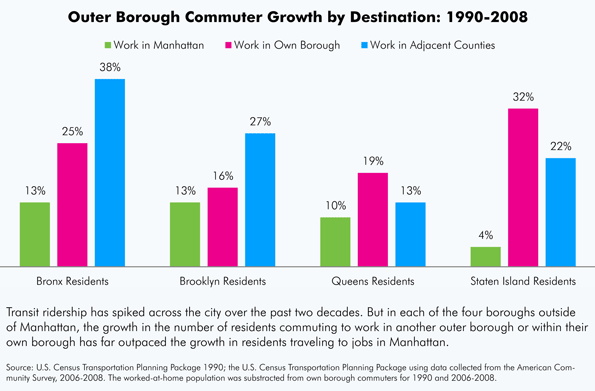
    Census data show that between 1990 and 2008 the number of residents who traveled to work in their own borough or a neighboring borough or county increased much faster than the number who made the more traditional commute to Manhattan. For instance, the number of Bronx residents who traveled to Queens or Westchester County for work increased by 38 percent, and the number who traveled inside the borough jumped by 25 percent, while the number commuting to Manhattan increased by only 13 percent in the same period.

    The discrepancies on Staten Island are even starker: During the same period, the number of Staten Island residents traveling to work inside their own borough increased by 32 percent, and those going to Brooklyn or New Jersey increased by 22 percent, while the number heading into Manhattan barely changed at all—a four percent increase in those 18 years. Although not as dramatic, Brooklyn and Queens both saw significant gains in non-traditional commutes as well. In fact, the number of Brooklyn residents traveling to Queens grew by 32 percent, compared to a 13 percent increase in the number going to Manhattan. In 2008 despite being a notoriously difficult trip for public transit riders, nearly 160,000 people crossed the Brooklyn/Queens border for work everyday.

    One big reason for this shift in commuter patterns is New York’s changing economic landscape. For decades Manhattan has been steadily losing its share of jobs to the other four boroughs, but over the last ten years that process has sped up considerably. From 2000 to 2009, New York City lost a net 41,833 jobs, but that was because of the huge concentration of losses in Manhattan during 2008 (over 100,000 in that single year). Every other borough saw a net increase in jobs during that period. Queens saw 2.4 percent growth, Staten Island 4.6 percent growth and the Bronx and Brooklyn 7.7 and 7.9 percent growth, respectively.

    It won’t come as surprise to those who have been paying close attention to the economy that robust job gains in the health care and education sectors are what lie behind sustained growth in the outer boroughs. Between 2000 and 2009, New York City gained nearly 120,000 jobs in those two sectors alone. And although Midtown Manhattan has several prominent hospitals and universities, collectively, the hundreds of hospitals, nursing homes, community health clinics, colleges and professional schools in the other four boroughs—from Montefiore Hospital in the Bronx and SUNY Downstate Medical Center in Brooklyn to Queensborough Community College in Bayside—accounted for the lion’s share of jobs in those sectors.

    New York City’s transit system wasn’t designed for commuter trips to jobs within and between boroughs outside of Manhattan, and as a result the city’s median commute times have been rising steadily for decades. According to American Community Survey data released last December, New York’s four outer boroughs all have median commute times that are north of 40 minutes, which puts them among the longest in the country. And among public transit riders they are significantly longer, ranging from 52 minutes each way in Brooklyn to a barely comprehensible 69 minutes each way in Staten Island.

    In our study, we interviewed a number of outer borough employers who felt that a lack of dependable rapid transit service has exacted a toll on their businesses. A lack of transit effectively shrinks their labor pool, they said, and causes more turnover as disgruntled employees decide to leave rather than suffer through two hour commutes every day. The chief operating officer at SUNY Downstate Medical Center in East Flatbush Brooklyn even said that it could cause the hospital to rethink its plans for expansion. “I’ve been here 24 years,” he said, “and I still haven’t seen any improvements in mass transit.”

    New York’s biggest investments in transit are still almost entirely focused on Manhattan commuters. Tens of billions of dollars are being invested in what amounts to an extension of the Q train along Second Avenue, a new Long Island Railroad tunnel to Grand Central, a one stop extension of the number 7 train on the west side, and a Santiago Calatrava-designed Fulton Street Station in lower Manhattan. A new Moynihan Station on 34th Street is apparently next on the agenda. These projects may spawn billions more in lucrative real estate deals, but they don’t reflect the city’s true economic geography.

    A lack of transit investments in the outer boroughs might be understandable if these new outer borough jobs were spread out evenly over a large territory, but a huge percentage are located in relatively dense clusters. Over 20,000 commuters descend on the SUNY Downstate and Kings County Medical Campuses — right across the street from each other —every morning, for example. But very little has been done to facilitate commutes to that area, and many employees and patients depend on a dizzying array of livery cabs and dollar vans to get them where they’re going. Similarly, JFK airport in Queens is home to over 55,000 jobs; Hunts Point in the Bronx 20,000; the Sunset Park waterfront in Brooklyn 32,000, and so on.

    Making much needed investments in service and upgrades to the bus system may not be as sexy as a new train terminal in Midtown. But if New York is going to sustain job growth and retain a truly world-class transit system, then it will have to start looking beyond Manhattan and invest in solutions that make commutes to job centers in the outer boroughs easier for residents.

    David Giles is a research associate at the Center for an Urban Future, a Manhattan-based think tank. He is the author of Behind the Curb, a Center for an Urban Future report about the gaps in transit service in the four boroughs of New York City outside of Manhattan, from which this article was adapted. For the whole report, please visit BehindtheCurb or www.nycfuture.org.

    Photo: The Brooklyn Bridge by S J Pinkey

  • The High Speed Rail Battle of Britain

    A high speed rail battle is brewing in Great Britain, not unlike the controversies that have lit up the political switchboard in the United States over the past six months.

    The Department for Transport has announced a plan to build a "Y" shaped high speed rail route that would connect Leeds and Manchester, to Birmingham, with a shared line on to London and London’s Heathrow Airport.

    The government places the construction cost at £32 billion and makes familiar claims that the economic benefits would be 2.6 times the cost.

    These apparently impressive benefits relative to costs are not convincing to George Monbiot, the well-known environmental columnist for The Guardian. He points out that much of the purported benefit is a mere conversion of time savings into currency, which hardly produces "investment grade" projections.

    Monbiot further observes that these monetized time savings benefits largely will not be returned to the taxpayers who pay for the system. This raises a fundamental question. If the time savings benefits are so great to the users, why shouldn’t they pay for the whole system instead of the projected (and perhaps unreliable) 60 percent? Why should taxpayers be required to pay 40 percent (or probably more)?

    As in the United States, the critics get little respect. The Financial Times refers to the Taxpayers Alliance, which opposes the high speed rail program as an "anti-public spending group." In fact, like taxpayers organizations around the world, the Taxpayers Alliance does not oppose public spending but rather opposes wasteful public spending. The Transport Secretary himself, Philip Hammond employs a form of populist character assassination, calling opponents of the high speed rail line "truck importers and climate change deniers," echoing similar sentiments from this side of the Atlantic where promoters would have you believe that anyone who questions high speed rail is best described as an enemy of the people. Demonization should not be used as a substitute for debate.

    In the above referenced article, the Financial Times notes that 69 business people signed a letter favoring the project. FT refers specifically to executives of three companies, including Seimens, without mentioning that the firm is among the world’s biggest builders and promoters of high speed trains.

    Meanwhile, as in the United States, the government and much of the British media have accepted cost, ridership and revenue projections as produced by the consultants as if they were holy writ. Given the experience of Britain on this very corridor, this makes "child-like faith" look like ultimate truth.

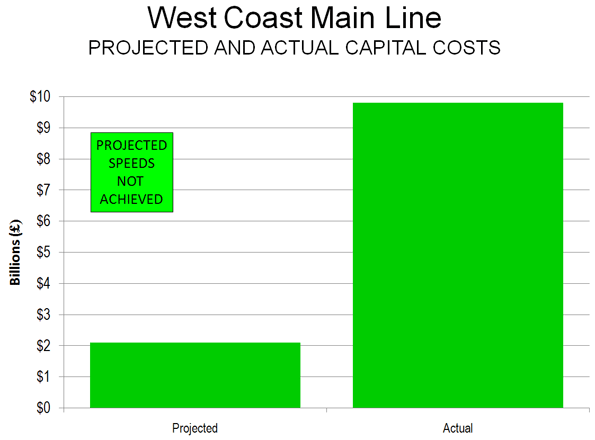
    Much of the proposed high speed rail line would be built parallel to the West Coast Main Line (which runs from London, through Birmingham and Manchester to Glasgow). Nothing short of a dog’s breakfast has been made of West Coast Main Line projects. In the 1980s, the tilting Advanced Passenger Train was developed to increase speeds to 155 miles per hour along the West Coast Main Line. The project was scrapped and all of the expenditure lost. Then there was the West Coast Main Line upgrade in the late 1990s and 2000s, to increase speeds to 140 miles per hour, which was to have cost £2 billion. The trains never exceeded 125 miles per hour, but the costs exceeded projections approached £10 billion instead, a world record cost blowout of Big Dig proportions (Figure).

    This should not be a surprise. The international record of high-speed rail projections is nothing short of horrific.Not only have costs proven far higher, but ridership and revenue have been less than projected. All of this means that taxpayers end up paying more.

    Again, Britain is a prime example. The Eurostar London to Brussels and Paris continues to attract at least 50 percent less ridership originally projected. High speed rail systems in Taiwan and Korea have had similar ridership shortfalls.

    As in Britain, costs have been higher as well. In Korea, the high speed rail line costs rose three times projections. Costs in California have increased 50 percent in two years and doubled over a decade even before the first shovel has been turned (inflation adjusted).  The cost escalation has already equaled the high end of the range predicted by Joe Vranich and me in our Reason Foundation Due Diligence Report on the California system in 2008.  

    If the proposed high speed rail project were simply to miss its cost and revenue targets by the international average (which is far better than the British experience), the benefits to users would fall below £1.00 for each £1.00 of cost. Both the strategic case and the business case for high speed rail would be blown apart. The spectre of cost overruns was a major factor in Governor Scott’s cancellation of the Florida high speed rail project.

    Not surprisingly, there is rising concern about high speed rail in Britain.A group of 21 officials, including former Chancellor of the Exchequer (minister of the treasury, finance and economics) Nigel Lawson, signed a letter to the Daily Telegraph calling the project "an extremely expensive white elephant isn’t what the economy needs. If the government wants to encourage growth there are better ways to get Britain growing and make us more competitive than getting each family to pay over £1,000 for a vanity project we cannot afford." The signatories also included Mark J. Littlewood, Director-General of the Institute of Economic Affairs, one of Great Britain’s leading free-market think tanks.

    Further, as in the United States there is also strong opposition from neighborhood groups concerned about the impact of trains operating at more than 200 miles per hour or faster through their neighborhoods. Eventually, up to 18 trains per hour are projected in each direction. This means that a 1,300 foot long train will pass houses and other adjacent development every one minute and forty seconds.

    There are the usual claims that the high speed rail line will reduce greenhouse gas emissions. However, as in California, the reality dissipates quickly, like steam into the air. Areport prepared for the Department for Transport by Booz Allen Hamilton concluded that the busiest section of the line, from London to Manchester would result in a net increase in greenhouse gas emissions when construction emissions are included (over a 60 year time analysis). Perhaps the intention is to begin reducing greenhouse gas emissions sometime after 2075?

    Monbiot further dismantles the environmental case, looking into the government reports to find that 92% of the passengers would switch to high-speed rail from alternatives that produce lower levels of greenhouse gas emissions (including conventional train, new travel and air).

    In Britain, as opposed to the United States, the proposed high speed rail system would relieve congestion on a passenger rail line. In contrast, US high speed rail lines would be built in corridors where there are few, if any rail passengers, much less passenger rail congestion.

    Even so, there are disagreements in Britain over whether high speed rail is the least costly way to address the problem, or indeed, whether there is a "problem" of sufficient magnitude to justify the public expenditure.

    The huge ridership increases projected may well be "over the top" given Britain’s less than population replacement fertility rate. As in the United States, some question the wisdom of high speed rail subsidies at a time that the government is (or in the case of the United States, should be) committed to an unprecedented austerity program that is falling heavily on middle income people who will not be the principal beneficiaries of high speed rail.

    In the final analysis, the questions will come down to who rides, how far and how fast. Will riders, in this third iteration, ride as fast as promised?  More likely it’s Britain’s beleaguered taxpayers who will be taken for a ride, with costs low-balled and ridership exaggerated as before.

    Revised on 3/22/2011. The original version had inappropritately refered to George Monbiot in the sentence about Transport Secretary Hammond. This was due to an editing error.

    Wendell Cox is a Visiting Professor, Conservatoire National des Arts et Metiers, Paris and the author of “War on the Dream: How Anti-Sprawl Policy Threatens the Quality of Life

    Photo by Jon Curnow

  • Actually, Cities are Part of the Economy

    “The prosperity of our economy and communities is dependent on the political structures and mechanisms used to manage and coordinate our economic systems.”

    No politician expecting to be taken seriously would say that today. State intervention was discredited long before it collapsed in the 1980s. Even our prime minister in Australia pays lip-service to “flexible markets with the right incentives and price signals to maximise the value of our people and capital resources.” But how does that square with her government’s quiet push for a more intrusive urban policy agenda?

    Over the last twelve months, Infrastructure Minister Anthony Albanese has been laying the ground work for a grand National Urban Policy, to be announced later in the year. To this end, he released three dense documents. Last March we got State of Australian Cities 2010 (“Cities 2010”), a compilation of statistics confirming, amongst other things, that cities account for 80 per cent of our Gross Domestic Product. Then in December came a discussion paper and a background paper, both called Our Cities.

    Their general drift can be gauged from a line in the latter’s final chapter. It’s the sentence quoted at the top of this article, with the words “cities” and “urban” replacing “economy” and “economic.”

    Embarrassed to champion intervention at the macro level, progressives resort to carving chunks out of the national economy and relabeling them “the environment”, “social capital” or “urban planning” before turning reality upside down. As he moves urban policy to the environment ledger, Mr. Albanese promises to transform the “productivity, sustainability and liveability” of our cities. Intervention is bad for the national economy, it seems, but good for the 80 per cent of GDP generated by cities.

    Urban Myths

    The authors of Mr. Albanese’s documents are anonymous, but aficionados will recognize the handiwork of Curtin University’s Sustainable Policy Institute, Griffith University’s Urban Research Program, the Faculty of the Built Environment at NSW University, and other focal-points of green orthodoxy. The reference lists are full of their output. Their technique of persuasion, recycled by Mr. Albanese’s Department, is to evoke plausible images while perpetuating three myths: suburban growth worsens carbon emissions and traffic congestion, people are being forced to live far from jobs concentrated in CBDs, and denser development will make housing cheaper.

    The discussion paper says: “Australian cities generate very high carbon emissions and air pollution from our heavy reliance on carbon fuels for energy and transport. Carbon emissions from transport are principally due to the lengths of trips necessitated by our dispersed cities and our extensive use of private motor vehicles.” Variations of this passage recur throughout the documents. It sounds plausible enough. So many vehicles cris-crossing our wide open cities must be spewing out heaps of carbon dioxide. But the documents ignore evidence painting a different picture.

    There is the Australian Conservation Foundation’s Consumption Atlas, which found that dense, affluent, inner-suburbs account for more carbon than the dispersed fringe, suggesting that, as a factor in emissions, general consumption trumps settlement patterns; there is a 2007 study by Randolph and Troy confirming earlier findings that energy consumption per capita in high-density developments, like high-rise apartments, is notably higher than in detached housing; there is a recent report by Allen Consulting for the Victorian Building Commission, noting the absence of conclusive evidence that vertical living is more ‘sustainable’ than conventional homes; and there is more.

    None of these rate a mention in the documents. Chapter 5 of the background paper does reference a couple of studies by Alford and Whteman (2009) and Trubka, Newman and Bisborough (2010), but these focus on “transport energy consumption” and “transport greenhouse gases.” They don’t investigate the impact of urban form on general consumption, the real determinant of emission levels. And a study by Perkins et al (2009), cited in Cities 2010, actually contradicts the approved message: “overall, it cannot be assumed that centralised, higher density living will deliver per capita emission reductions for residents … ”

    There is no reliable evidence that suburban growth is worse for emissions. Even Griffith’s Brendan Gleeson, a very green urbanist, had to concede that “the faith … in residential density as a simple lever that can be used to manipulate urban sustainability appears to be misplaced. New Australian scientific analysis points to the consumptive lifestyle, not the nature of one’s dwelling, as the root of environmental woes.”

    In any event, transport accounts for 14 per cent of Australia’s 1.4 per cent share of global emissions, or a minuscule 0.197 per cent of the world’s carbon. We should retain a sense of perspective, even if the documents obsess about our high per capita emissions. If the climate is being affected (a big if), it’s absolute volumes that matter.

    Allied to the myth of carbon-spewing suburbs is the myth of centrally-located jobs. We read in Cities 2010 that “the impacts of outward expansion and low density residential development have been a greater separation between residential areas and locations of employment …” The discussion paper asserts, more directly, that “the trend to inner-city living reflects changing preferences for dwellings and location – living closer to employment that is concentrated in central areas.” Again, similar statements crop up throughout the documents. People shouldn’t have to drive or commute long distances to a “centre” where the jobs are.

    Evidence to the contrary is easy to find. According to the NSW Department of Transport, only 12 per cent of Sydney’s jobs are in the CBD, and second tier centres like North Sydney, Chatswood, Parramatta, Hustville and Penrith have no more than 1.8 per cent each. The rest are distributed throughout the metropolitan region. In the case of Melbourne, McCloskey, Birrell and Yip (2009) say it’s absurd to concentrate housing near transit lines since only 19 per cent of jobs within the Melbourne Statistical Division (MSD – Greater Melbourne) were located in the Melbourne Local Government Area (the CBD), while 81 per cent “are scattered throughout the rest of the MSD”.

    In fact, the background paper points out that a majority of the employed in Sydney, Melbourne and Perth live within 10 kilometres of their workplace, while around 15 per cent live more than 20 kilometres away. This is hardly a disaster in the making. Consistently, Cities 2010 refers to “evidence that commuting distances have been stable or even declining since the 1990s in a number of capital cities.”

    For green urbanists, these myths are indispensible. Their agenda hasn’t a hope unless the public accepts that suburban growth will spoil the climate, and hike congestion and transport costs. As for housing affordability, the documents take a leave-pass (social housing is another story). They promote the term “living affordability”, adding petrol prices and mortgage rates to the equation.

    Evidence linking costly housing to supply restrictions on the fringe, like the annual Demographia survey, is too inconvenient. When the background paper does get around to the subject, it says “multiple factors [impede] the delivery of an efficient supply of suitable and affordable housing.”
    These include “land zoning and building code regulations and other standards related to building quality.” A few pages later, however, canvassing some solutions to the problem, the paper proposes “reforming planning systems to … position a variety of residential development in close proximity to centres and transport infrastructure”. Doesn’t this mean a lot more inefficient “land zoning”?

    This is just one instance of disjointed logic and economic illiteracy; many others are scattered throughout the documents.

    The Invisible Hand and Land

    Actually, cities are part of the economy, and are subject to the same principles. The operations of demand, supply and prices are equally applicable to land and structures. They can’t be erased by regulation, even if it’s called planning and zoning. The inflationary effect of coercive zoning on land values is the elephant in the room. Nowhere is it acknowledged in the documents.

    Consider two recent press items. Retail tenants in Pitt Street Mall, the heart of Sydney’s CBD, are paying rents as high as $13,000 a square meter, while industrial tenants on the north-west outskirts pay around $237. These rent differentials are, of course, a function of distance, and influence the viability, not just the location, of various types of activities.

    Restricting expansion and other forms of coercive zoning place an escalating floor under peripheral rents and values. Mr. Albanese’s authors fail to appreciate the implications of this, not least for “urban productivity.” There is little call to dwell on economic mechanisms if you believe, as the discussion paper puts it, “the private sector, through a myriad of individual decisions and investments, guided and constrained by government investments, regulations or charges, is a powerful shaper of cities [emphasis added]”.

    In the documents, lifting productivity boils down to cutting the costs of traffic congestion, estimated to reach $20 billion a year by 2020, principally by reducing “car dependency” (another loaded term, echoing drug dependency).

    Ignoring the reality of high job dispersal, the background paper says “a key challenge is to reduce dependence on motor vehicles while maintaining access between and within locations … the Australian Government recognises that it has a role … in investing in major mass transit systems, identifying and protecting new transport corridors and supporting means to shift from private vehicles to public transport”. But as McCloskey, Birrell and Yip explain, “the high level of job dispersal around Melbourne [and other cities] cannot be easily unwound.” In those conditions, Mr. Albanese’s strategy is doomed to failure.

    Alternatively, when diseconomies from congestion start to outweigh economies from centrality, firms and commuters will move to other, less congested sites, easing congestion all-round. This is the only effective, long-term solution to congestion. However by mandating concentration rather than enabling dispersion, evidenced by a dim view of road-building, green planning stymies this process. The documents want to end it altogether.

    According to the background paper, “connectivity within cities can also be achieved by placing people closer to the jobs, facilities, goods and services they desire – or putting these closer to where people live. This highlights the important role of integrated land-use and infrastructure planning in managing the need for physical travel”. But this notion, that firms and residences can be “placed” by a central authority, is logically flawed. It suffers from something akin to a “coordination problem” (a concept from game theory).

    Suppose household A has, in existing circumstances, chosen its optimal location relative to (1) affordable housing, (2) employment and (3) services. How can the government arrange things so that A ends up in a more optimal location? Moving A closer to work may push it further from affordable housing and services. Moved closer to services, A may end up further from other factors, and so on. It’s unlikely that the government can ever place A in a better location relative to all three factors.

    Then suppose household B has chosen its own optimal location relative to the three factors, some distance away from the point chosen by A. How does the government improve the outcome for both households? Action benefiting A may hurt B and vice versa.

    The same problem can be framed for businesses locating relative to (1) competitive rents, (2) transport routes, (3) suppliers, (4) suitable labour and (5) customers (market). Our cities host hundreds of thousands of households and businesses. There is no way that a planning hierarchy can engineer a more efficient outcome than the people themselves, interacting freely in the marketplace. Official meddling is more likely to induce problems than solve them.

    Instances of disjointed logic abound. One paper talks about “micro-reforms to reduce costs to businesses and consumers”, but another urges “access to a range of [more expensive and less efficient] high-quality renewable energy sources”; a paper commends “the principle of subsidiarity, ensuring that the most local level of government is used …”, but then calls for “improving alignment and integration of planning and investment across all three levels of government to support the nationally agreed … objective”; a paper demands action to “reduce red tape”, but all three documents offer heaps more instruments and regulations.

    Ultimately, Mr. Albanese’s documents are the pretext for a new wave of intrusion into economic life. As such, they represent a glaring case of bureaucratic overreach. However much he may spruik flats, smaller houses, public transport and higher utility bills as an enhancement of urban “liveability”, most Australians will disdain them as anything but liveable.

    John Muscat is a co-editor of The New City, where this piece originally appeared. 

    Photo by Joseph Younis.

  • USDOT Rail Grants to Obligate Taxpayers

    The US Department of Transportation has announced a competitive grant program to reallocate funding that was refused by Florida for a proposed high speed rail line from Tampa to Orlando. The line was cancelled by Governor Rick Scott because of the prospect for billions of dollars of unplanned obligations that could have become the responsibility of the state’s taxpayers.

    Eligibility: Eligible applicants are states, groups of states, Amtrak or other government agencies that authorized to "provide intercity or high-speed rail service on behalf of states or a group of states. The grant program requires recipients of grants (read "taxpayers") to provide financial support to intercity and high speed rail passenger rail programs in the event that cost and ridership projections are optimistic (a routine occurrence).

    Obligation to Pay for Cost Overruns: As in the program announced in 2009. the state, group of states, government agency will be required to demonstrate its financial capacity (that is, the capacity of their taxpayers) to pay for cost overruns (page 9). This open-ended liability led Governor Chris Christie of New Jersey to cancel a new transit-Hudson River rail tunnel, which had costs that were escalating out of control that would be the obligation of the state’s taxpayers. Governor Christie and Governor Scott were both aware of the disastrous record of major infrastructure cost overruns, such as in the Boston Big Dig project, the Korean high-speed rail program and the overwhelming majority of passenger rail projects in North America and Europe, according to a team led by Oxford University Professor Bent Flyvbjerg.

    Obligation to Pay Operating Costs: Moreover, inaccurate passenger and revenue forecasts have been pervasive in high-speed rail systems, as has been documented by Flybjerg, who found that cost overruns occurred in nine out of ten projects:

    … we conclude that the traffic estimates used in decision making for rail infrastructure development are highly, systematically and significantly misleading.

    This is illustrated by the fact that even a decade and one-half after the Eurostar London to Paris and London service was opened, ridership remains 60 percent below projection. Ridership on the Taiwan and Korea high speed rail systems has been one-half or more below projections. Our analysis of the Tampa to Orlando line revealed exceedingly high ridership projections, which were inexplicably raised even higher in a new report just released. Failure to achieve ridership projections increases the likelihood that a line will need operating subsidies, which would be the ultimate responsibility of taxpayers under the USDOT program.

    Federal Grant Repayment Obligation: Moreover, taxpayers of any grant recipient would be required to repay part or all of the federal grant if a sufficient level of service is not maintained for a period of 20 years (page 41). The operation of this provision is illustrated by recent Florida experience. Tri-Rail, the Miami area’s commuter rail service only narrowly escaped having to repay $250 million when its service level was deemed to not meet requirements of a federal grant by early in the Obama presidency. Tri-Rail was rescued by a state subsidy of nearly $15 million annually, which restored an artificially high level of service.

    Intercity and High Speed Rail Program: The federal intercity and high-speed rail program is largely limited to upgrades of Amtrak-type service. Before Governor Scott’s decision, only two of the programs (Florida and California) would have achieved international standard high speed rail speeds.