Tag: Transportation

  • High Speed Rail: The Dream Scheme Scenario

    Ever since Jay Gould, Leland Stanford, and Cornelius Vanderbilt acquired their first legislatures, railroads have been best understood as political networks, rather than as transportation lines. The Obama administration is hyping high-speed rail (HSR) with a $53 billion proposal not because the president is a trainspotter or because he collects back copies of the Official Guide of the Railways (like I do). Rather, it’s because politicians understand that the states blew their money on generous pension plans, pretentious sports stadiums, and bridges to nowhere, and now need billions to plug their budget deficits. It’s easier to funnel money into tapped–out state capitals under the smoke and mirrors of a feel-good rail project than it is to announce that the federal government stands behind states’ subprime debts. The Government Accounting Office estimates unfunded state liabilities at $405 billion, which is probably what HSR would, in the end, cost. Think of it as the Stimulus Express.

    The high-speed scheme is a dream of superfast trains, traveling at 150 m.p.h., linking Portland, Maine, and Charlotte, North Carolina; Chicago with St. Louis and Kansas City; the Orlando corridor in Florida (which the governor there has rejected); and express trains in Texas and California. Another way to look at the proposed HSR network is to imagine it connecting the cities and states that Obama needs to carry if he is to have a chance of winning the 2012 election.

    Along the high-speed tracks-to-be are stops in Michigan, Ohio, North Carolina, Florida and Pennsylvania, which are key 2012 electoral contests. Red states west of the Mississippi, by contrast, will have to wait for Amtrak’s Southwest Chief to arrive three hours late in Dodge City.

    Before the U.S. goes into hock over HSR, it might consider making a virtue of low-speed rail. Slow food has it followers. Why not the same for slow trains, since that’s the best that Amtrak can offer? Herewith are ten ideas that will get more (fare-paying) Americans back on the (less-than-perfect) rails. Implementing them wouldn’t cost anywhere near $53 billion. Done right, they would even make money.

    • Privatize the corridor services between Boston and Washington, Chicago and St. Louis, and San Diego and Los Angeles. But mandate that at least two competing companies operate passenger service on the lines. If American railroads are not interested in the job, French or German national rail companies would bid on the service.
    • Sell off the franchise rights to Amtrak passenger cars to mall stores, restaurants, and bars. A movie car could run between Philadelphia and Pittsburgh, and a discotheque (Pullman 54) could operate, for example, on the night train from New Orleans to Atlanta. I am sure the Outback restaurant chain would want some cars in the West. Who cares about speed if you are having fun or can use the time productively? I would happily ride the Barnes & Noble to Charlotte or the L.L. Bean to see my family in Maine. Why can’t Amtrak add a few FedEx Kinko cars?
    • Auction off Amtrak’s sleeping car services to Hyatt, Holiday Inn, Embassy Suites or Motel 6. They know more than Amtrak does about making beds.
    • Instead of catering to the gun lobby (Amtrak now allows passengers to pack heat), work with the car rental agencies to create a car-sharing alliance at Amtrak stations to solve the problem of getting anywhere from far-flung places like the Richmond station, which is located miles from downtown.
    • Spin off Amtrak Vacations to Outward Bound, the American Youth Hostel Association, Carnival Cruises, the Boy Scouts, or the Green Tortoise (a hippie bus tour company), and let them offer rail cruises to national parks, jazz festivals, fall foliage, major league stadiums, and jamborees.
    • Create Amtrak University, and outfit trains to take high school and college students to places like Gettysburg, Little Big Horn, Bunker Hill, the Grassy Knoll, Mark Twain’s museum in Hannibal, Missouri, and Marion, Ohio (where Warren Harding ran the local newspaper).
    • Invent a clean steam engine that runs on scrubbed American coal, and market passenger railroads as green travel, locally grown.
    • Retrofit some baggage cars to carry bicycles easily and cheaply, and develop a national network of “Rails and Trails,” so that passengers can have a seamless connection between the train and their bikes. At the moment, it’s easier to ship a gun on Amtrak than it is to take a bike.
    • Deregulate passenger service, to encourage the flourishing short-line rail industry to carry passengers on some of their freight lines, as the Housatonic R.R. Is proposing to Pittsfield, Massachusetts.
    • Invest surplus funds in commuter rail projects, including the proposed Hudson River tunnels that New Jersey Governor Chris Christie turned down. Commuter rail is a proven, if dreary commodity. High-speed rail dreams are the stuff of State of the Union addresses, but the top ten commuter systems together transport about 1.63 million passengers daily (Amtrak has 74,000 a day).

      Most commuter systems need nicer stations, easier links to other lines and buses, and to provide comfort zones with better coffee (not a federal budget concern), clean restrooms, and Wifi. I love the coming Long Island Rail Road link to Grand Central and the new BikePorts of the Massachusetts Bay Transportation Authority.

    Had the United States integrated high-speed rail into the Interstate Highway system — imagine tracks in the median strips — the idea might have worked. Imposed on a society addled with cars and planes, it has the risk of becoming a cost-overrun nightmare of $82 million a mile versus $2.4 million for traditional rails.

    Much of the infrastructure is already in place to develop a national revival of low-speed rail, at a fraction of the costs of subsidized HSR. The trains we have can be privatized, franchised, hot spotted, double-bedded, and showered, and no one will care about the engine speed. To save billions, if not to make money, why can’t the U.S. subscribe to the words of author Paul Theroux: “Better to go first class than to arrive.”

    Photo by Jeramey Jannene of train tracks right outside of Havenwoods State Forest in Milwaukee, Wisconsin.

    Matthew Stevenson is the author of Remembering the Twentieth Century Limited, a collection of historical essays. He is also editor of Rules of the Game: The Best Sports Writing from Harper’s Magazine.

  • High-Speed Rail vs. Modal Neutrality

    Isn’t it curious that an Administration devoted to the principle of multi-modalism is so obsessively determined to promote a single mode of its own preference — that of high-speed rail? All three governors who rejected the federal HSR grants — Govs. Walker, Kasich and Scott — told Sec. LaHood that their states could badly use that money for more urgent needs of fixing roads, bridges and transit systems and, in the case of Gov. Scott, rebuilding Florida’s ports in anticipation of the Panama Canal expansion.

    Yet Sec. LaHood turned a deaf ear to those requests, insisting that the stimulus money must be spent on high-speed rail — even though money spent on other modes could have been just as effective in creating jobs. After justly condemning “stove pipe” mentality and modal biases in federal decision making it is ironic to find the Administration ignoring its own principles of modal neutrality in such a blatant manner.

  • Can Common Sense, and maybe Mickey, Save Orlando’s Transit Mess?

    The week’s debate about high-speed rail has once again polarized our populace, inflamed irrationality, and sent everyone back to their familiar corners.  Little constructive debate is possible when major newspapers are flailing the governor for rejecting money and the seemingly global revolutionary fervor is gripping local citizens who rallied in protest Wednesday night around downtown Orlando’s Lake Eola.  None of this will do any good for the service workers trying to get to their jobs in the theme parks or for downtown cube dwellers streaming to scattered office parks. With or without light rail the city inches closer and closer to the traffic hell of Atlanta, or worse even, DC. After all, both cities already have large rail transit systems.

    What will do some good is a creative discussion of some real change that can occur to improve our commute.

    We must recognize that we are stuck with our cars.  They aren’t going away.  We can’t wish them away. We have to make them better fast, because with changes blowin’ in the wind and with oil jumping back up over $100 a barrel.

    The high-speed bullet train – a sort of latter-day interstate highway program – sounded like a great idea at first, a welcome alternative to the ardor of air travel and the gas-sucking monotony of driving.  It has shortcomings, however, it will likely prove obscenely expensive, and once one gets to the destination, one is typically relegated to more driving.

    Nor is this some form of effective industrial policy.  The things will be built overseas – Germany, Japan or most likely China –  a great jobs program for someone else.  And tourists, who vastly prefer the freedom of car rental and driving, aren’t likely to use it except as a novelty for one of their visits to our wonderful place.  Perhaps the bitterest part of the bullet train pill: it will indebt our children and grandchildren to pay off landowners giving up their land in eminent domain – which produces nothing – and the cost of complex machines made overseas. The bullet train ends up being a clumsy solution imposed from above, rather than a grassroots solution to our real problems. 

    Any frequent driver on Interstate 4 between Orlando and Tampa can tell you there are four basic kinds of traffic: tourists in buses or cars; freight, in the form of tractor-trailers: business travelers (who need the flexibility of a car on the other end): and personal travelers.  Instead of targeting an expensive solution at just the smallest form of traffic, personal travel, a 4-part solution is suggested, all of which would add up to far less than $2 billion that minimally the high-speed line would have cost.

    1.  Trains can be good – for freight.  There are already freight lines running between Tampa and Orlando.  Getting the freight off of tractor-trailers and onto these freight lines, where it is vastly cheaper to move goods, should be a no-brainer for the state.  Use some of the DOT money to modernize freight depots along the pathway, incentivize freight customers to move their goods onto trains, and this will vastly improve the situation.
    2. Tourists can drive – at a price.  Our state should be treat itself with higher regard and also encourage a culture of sustainability for those visiting us.  Higher taxes on rental cars should be charged, and the taxes placed in an environmental fund to remove some of the unsightly development that has defaced our region, and return it to the special place it once was.
    3. Give business travelers an alternative.  If there were an affordable air shuttle between Tampa and Orlando, at the right price it would be full.  Little Embraers (made in Melbourne, by the way) taking off from FBOs at Orlando Executive Airport, Sanford Airport, and Orlando International Airport and landing in Tampa airfields would be worth $100 a seat, if the time/cost tradeoff were analyzed.  Ybor City for lunch, anyone?
    4. Give personal drivers an alternative.  For the cost of less than 50 miles of new road, a totally independent alternative to I-4 is waiting out there.  The first link of this road would connect Tampa’s Crosstown Express to Lakeland’s Western Beltway.  The next link of this road would connect the Western Beltway to the Greenway at Celebration.   Drivers will be able to go from downtown Tampa to downtown Orlando without their wheels touching I-4 even once.  Nice.

    And now, for the big one.  Right smack in the middle of the white-hot I-4 corridor lays a large, private entity, Disney, has been operating a private, train-based mass transit system for the last 40 years.  High labor costs?  Yes.  Fossil fuel driven?  Yes.  This entity has been strangely silent over the entire debate.

    If this entity were to wake up and seize the opportunity before it, one might see a true train that works.  First of all, the monorail was planned with some sense: it connects dense areas together.   If Disney were to offer to build, as a private development, extensions of its monorail reaching out to Tampa on one side and Orlando on the other, the air rights for this system could be along government-owned I-4 (no imminent domain costs).  This entity is also highly encouraged to charge market rate and to make a profitable venture out of operating this system. And the taxpayers would not be stuck with the bill.

    A vision for transit between Tampa and Orlando needs to be truly holistic, taking into account all types of traffic connecting the two regions.  This vision also needs to be locally driven, taking advantage of local strengths and assets already in place.  The high speed bullet train does none of this.  Instead, a multi-faceted solution that provides flexibility at both ends, leverages our current strengths, and partners with the strongest player in the region has a chance of truly making a difference in the present tense and likely future budget climate  This is what sustainability is truly about, and is what our future generations deserve.

    Richard Reep is an Architect and artist living in Winter Park, Florida. His practice has centered around hospitality-driven mixed use, and has contributed in various capacities to urban mixed-use projects, both nationally and internationally, for the last 25 years.

    Photo by Joe Penniston

  • Dallas Charges Up for the Electric Chevy

    If they build it, will we come? Planners, utilities, auto industry execs, and retailers are hopeful that we will, as they get themselves ready for electric vehicles in the Dallas/Fort Worth Metroplex. This isn’t a pie-in-the-sky vision for the future. The reality is unfolding right now. In 2011, NRG Energy will install upwards of 70 car-charging stations across Dallas and Forth Worth. As the Nissan Leaf and the Chevy Volt begin to penetrate the D/FW market, NRG aims to capture the revenue stream from charging car batteries here, just it is doing in Houston. NRG’s news comes on the heels of electric utility TXU Energy’s announcement of its own installation of twelve public charging stations being allocated across Dallas and Fort Worth.

    I’ve been watching the wave for several years as part of my work with emerging companies. At numerous conferences on electric vehicles, I’ve observed stakeholders – many of them in competition with each other – come together to swap ideas, network, and hammer out standards. It’s been an education in the necessity of collaboration to foster sustainable development.

    Cooperation hasn’t been guided by idealism so much as by the urge to survive in a market that, until recently, was practically non-existent. Start-ups that have failed to collaborate have fallen by the wayside. As one conference speaker joked, “We’ve got to build up the market before we tear each other down.”

    Profit-making may be the motivation of electric-vehicle manufacturers, but others at the table have their own agendas for EV readiness. The city of Dallas, for example, is in Serious Nonattainment status for ozone pollution. The region risks losing funding if it doesn’t clean up its air. “Seventy percent of air pollution in Dallas comes from on-road/off-road vehicles, so EVs can play a substantial role in resolving this,” said Jennifer Cohen, Executive Director for the North Texas Clean Air Coalition. Cohen was an organizer of the Electric Vehicle North Texas Electric Vehicle Showcase last September at the State Fair of Texas.

    At the Electric Vehicle Showcase. Betsy del Monte, Director of Sustainability for Dallas-based construction giant BECK told a panel, “Mass transit alone cannot solve our problem. We also need to look at the broader picture in terms of development. Of the palette of materials that we have available, EVs are one of the tools we must come to rely on.”

    Tom Reddoch, Director of Energy Efficiency for Electric Power Research Institute, agreed: “This is a success story. EPRI is connecting two giants, the electric industry with the auto industry.” To assist stakeholders with the information they need to build communities that can sustain a transition to electric vehicles, EPRI sees three keys: regionally-driven consumer attitudes, the installation of charging infrastructure in order to ensure a positive response for the drivers’ first experiences, and utility readiness. “We have plenty of capacity to go around, especially if people charge at night,” said Reddoch, “but there could be localized effects where cars cluster. The construction community, developers, and architects need to address this together.”

    At a technical level, tools are emerging that can help integrate electric vehicles into the transportation landscape. “We’ve arrived at an interesting nexus between the power industry and the auto industry,” said Brad Gammons of IBM. “There is not going to be a dominant leader so we need standards across the value chain… Collaboration ensures that things happen efficiently.”

    Not all collaboration requires complex software. Some of it is happening on the ground, person to person. The installation of electric vehicle charging infrastructure in D/FW is giving two cities with a long (if friendly) rivalry a chance to mutually benefit by working together. “To get the mayor of Fort Worth to travel to Dallas to talk about EVs is huge,” said Jim Greer of Oncor electricity.

    Range anxiety continues to be a barrier to electric vehicle adoption, even though three-fourths of Americans commute less than 40 miles per day. “To handle range anxiety, we need to provide home-based charging capability,” said del Monte from BECK.

    At the same time, Half Price Books unveiled Dallas’ first public charging station. Granted, there’s not a line around the block for the EV charger yet. But just having it at one of Dallas’ most popular bookstores sends a tangible signal to drivers that the future is here and now.

    As the infrastructure falls into place, the question remains: Will drivers buy the cars? We’ll find out very soon. The Chevy Volt is scheduled to arrive on car dealers’ lots in Dallas-Fort Worth in March.

    Photo of the Chevy Volt, a plug-in electric vehicle by IFCAR

    Anna Clark is the author of Green, American Style and the president of EarthPeople. She lives in one of Dallas’ first residences to earn a Platinum-LEED certification from the U.S. Green Building Council.

  • Maglev-Jitney Could Revolutionize Mass Transit

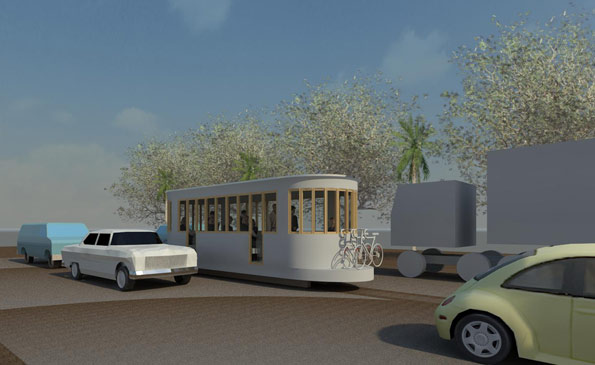
    Using EDS suspension developed in Germany with Halbach array magnets, mini-maglev jitneys are a new technology that could transform congested corridors of Orlando. The train car itself is small – only 8’ wide x 30’ long – and holds approximately 12 sitting people and 8 or 9 standing people. But the ability of the train to zip along the centerline of crowded arteries like 17-92 and 50, and future tracks along secondary strips within the region, could give people a new way to travel.

    Silent, with no moving parts, the electrodynamic maglev can ride along a guideway buried in the center of the road. Depressions for the jitney’s levitation magnets are shallow enough to drive over, making maglev tracks no more an obstacle than railroad crossings. Within cities like Portland, electric streetcars with clicking and buzzing pantographs are the norm, and drivers, pedestrians, bikers, and buses all coexist within a narrow public street. Here in Orlando, the pantograph, exposed to hurricanes, would be a liability, and the maglev instead presents a safer, more reliable transit system of the future.

    How does it work? The train rests on tires at each stop, but as it accelerates past walking speed, powerful permanent magnets in the chassis lift it up off the guideway. Solid magnets in the guideway present an opposing force (really, the same pole is offered to the jitney’s undercarriage, pushing it forward and away). Electric power is present only immediately underneath the vehicle’s footprint, making the guideway a benign, inert force within the busy roadways in the city.

    The car itself is a “smart” car, with no driver needed – a GPS-controlled computer stops and starts the car, with motion detectors delaying it briefly while passengers get on and off. As the car glides along, the photovoltaic roof powers the car’s air conditioners, lights, wi-fi system, and other devices. If the car breaks down, it simply comes to rest on its wheels, and it can be towed to safety within minutes.

    But maglev technology, already in use for decades in France, Germany, Japan, and China, is already outstripping older technology in safety and reliability. These older systems went for speed, making for very large, heavy trains travelling in excess of 300 mph.

    The mini-maglev, by contrast, will feature headways within minutes of each other – if you miss one, another will be along in 10 minutes or less in peak times. Bike racks in front and back allow you mobility once you reach your stop, and since they are designed for short trips, the cars are designed for standing as well as seated passengers. A full 360◦ glazed car will allow views in and out – making the trip pleasant, safe, and enjoyable.

    Whispering along at conventional traffic speeds, mini-maglevs offer the busy commuter an option that is convenient, reliable, and beautiful. These jitneys are life-enhancing features that will set Orlando apart from other cities in terms of sense-of-place. Neither a 19th century train nor a 20th century bus, the mini-maglev borrows a transportation concept from the islands – the jitney – and recognizes our region’s multipolar, fine-grained circulation system already in place. Instead of fighting this system with a heavy steel-wheel rail system on 19th century rails like Sunrail, it simply enhances existing corridors.

    Jitneys roam many Caribbean islands, gathering workers around the villages and transporting them into the resorts and the towns in packets of 10 or 15 passengers a vehicle. Frequent stops make them more like large-scale vanpools rather than small-scale buses, and they act as the connective tissue among the spread-out villages and settlements in which islanders dwell.

    The spirit of the jitney is transformed by 21st century technology into a transit system serving the needs of a spread-out, dense region like Orlando. Let’s face it: while driving, we are highly tempted to chat on the telephone, text, or do many other things other than drive. Waiting at red lights or stopped in traffic jams, the pleasure that once was driving has now receded all too frequently in favor of frustration, anger, and fatigue. We sense the lost time behind the wheel, seeking to make up for some of it with mobile communication, but this has an external price to pay: the driver ahead misses the green light because he is texting, making your trip longer as well.

    In the mini-maglev future, the distance and time are unchanged; what has changed is your freedom while you travel. Getting there will be fun again, and arriving in a mini-maglev jitney will be the new way to make an entrance.

    Electronic Jitney farecards will make paying for the ride super-easy, and if you have any question about the route, timetable, or stops, fear not: your smart phone app will show you where you are going, where you want to get off closest to your stop, and map out how to get there from here. It will also helpfully show you what is coming up along your path: A library, your friend, a Starbucks…

    And, for frequent riders, a feature long desired by mass transit commuters worldwide: on-call jitneys. Frequent riders will be able to electronically request a jitney at their desired stops, making these computer-controlled cars come to you. Getting off work late no longer means a lengthy nighttime wait for a taxi, or the next bus not due for another hour. You can request the car, and the farecard will give you back a message instructing you when and where to show up. With computer-controlled routing, mass transit is now more individually customizable than ever.

    The mini-maglev jitney, combined with personal electronic systems, transforms mass transit from a Victorian burden on cities into a sexy, hip way to get where you need to go.

  • Obama’s High-Speed Rail Obsession

    Perhaps nothing so illustrates President Obama’s occasional disconnect with reality than his fervent advocacy of high-speed rail. Amid mounting pressure for budget cuts that affect existing programs, including those for the inner city, the president has made his $53 billion proposal to create a national high-speed rail network as among his top priorities.

    Our President may be an intelligent and usually level-headed man, but this represents a serious case of  policy delusion. As Robert Samuelson pointed out in Newsweek, high-speed rail is not an appropriate fit for a country like the U.S. Except for a few areas, notably along the Northeast Corridor, the U.S. just lacks the density that would make such a system work. Samuelson calls the whole idea “a triumph of fancy over fact.”

    Arguably the biggest problem with high-speed rail is its extraordinary costs, which would require massive subsidies to keep operating. Unlike the Federal Highway Program, largely financed by the gas tax, high-speed rail lacks any credible source of funding besides taxpayer dollars.

    Part of the pitch for high-speed rail is nationalistic. To be a 21st century super power, we must emulate current No. 2 China. But this is a poor reason to indulge in a hugely expensive program when the U.S. already has the world’s most evolved highway, freight rail and airline system.

    Also, if the U.S. were to follow the Chinese model, as some have suggested, perhaps it should impose rule from a Washington version of a centralized authoritarian government. After all, dictatorships are often quite adept at “getting things done.”  But in a democracy “getting things done” means balancing interests and efficiencies, not following orders from above.

    In China high-speed rail is so costly that the trains are too expensive for the average citizen. Furthermore, construction costs are so high the Chinese Academy of Sciences has already warned that its debts may not be payable. This experience with ballooning costs and far lower fare revenues have raised taxpayer obligations in Taiwan and Korea and added to heavily to the national debt in Japan.

    The prospect of mounting and uncontrollable costs has led governors to abandon high-speed projects  in Ohio, Wisconsin and most recently Florida, where a battle to save the Tampa-Orlando line has begun . In times of budget stress, the idea of building something new, and historically difficult to contain by costs, becomes a hard sell.

    Oddly, the leaders of California, faced with one of the worst fiscal positions in the country, are determined to spend several billions on what Sacramento Bee columnist Dan Walters has dubbed a “train to nowhere” for 54 miles between Madera and Corcoran — two unremarkable and remote Central Valley towns. The proposal makes the former Alaska Sen. Ted Stevens’ notorious ”bridges to nowhere” project seem like frugal public policy.

    California’s train to nowhere has been justified as part of wider project to construct a statewide system. But the whole idea makes little financial sense: The University of California’s Institute for Transportation describes the high-speed proposal as based on an “inconsistent model” whose ridership projections are simply not “reliable.”

    Equally suspect are cost estimates, which have doubled (after adjustment for inflation) from 1999 to $42.6 billion last year and. A new study says that the project could currently cost close to $65 billion. Costs for a ticket from Los Angeles to San Francisco, originally pegged at $55 one way, had nearly doubled by 2009, and now some estimates place it at about to at least a $100 or perhaps much as $190 — considerably more than an advanced-purchase ticket on far faster Southwest Airlines.

    There’s growing political opposition to the system as well, and not just among penny-pinching right-wingers. Residents and local officials in the San Francisco Peninsula, a wealthy and reliably liberal portion of Silicon Valley, largely oppose plans to route the line through their communities. This includes some prominent liberal legislators, such as San Mateo’s Assembly Jerry Hill, who has threatened to put high-speed rail back on the ballot if costs start to surpass initial estimates. Another Democrat, California Treasurer Bill Lockyer has doubts that the rail authority will be able to sell the deal to potential bond-buyers   due in part to a lack of consistent estimates in ridership or cost.

    So why is Obama still so determined to push the high-speed boondoggle? Largely it’s a deadly combination of theology and money. Powerful rail construction interests, notably the German giant Siemens, are spreading cash like mustard on a bratwurst to promote the scheme. Add to that construction unions and the ever voracious investment banks who would love to pocket fees for arranging to sell the bonds and you have interests capable of influencing either party.

    Then there’s what might be called the “density lobby” — big city mayors, construction firms  and the urban land owners. These magnates, who frequently extort huge public subsidies for their projects, no doubt think it grand to spend billions of public funds on something that might also increase the value of their real estate.

    And finally there are the true believers, notably planners, academics, green activists and an army of rail fans. These are people who believe America should be more like Europe — denser, more concentrated in big cities and tied to the rails. “High speed rail is not really about efficient transport,” notes California transit expert and accountant Tom Rubin. “It’s all about shaping cities for a certain agenda.”

    Yet despite their power, these forces face mounting obstacles. As transportation expert Ken Orski points out, the balance of power in the House now lies with suburban and rural legislators, whose constituents would not benefit much from high-speed rail. And then there are governors, increasingly Republican and conservative, very anxious not to add potentially huge obligations to their already stressed budgets.

    The most decisive opposition, however, could come from those who favor transit spending but understand to the need to prioritize.  High-speed rail is far more expensive than such things as fixing current commuter rail and subways or expanding both public and private bus service. Indeed, the money that goes to urban rail often ends up being diverted from other, more cost-effective systems, notably buses.

    The choice between high-speed rail and more conventional, less expensive transit has already been presaged in the fight against expanding LA’s expensive rail system by organizations representing bus riders. These activists contend that rail swallows funds that could be spent on buses

    Much the same case is being made the San Francisco peninsula. The opponents of high-speed rail on the San Francisco Peninsula are outraged that the state would spend billions on a chancy potential boondoggle when the popular Caltrain commuter rail service is slated to be curtailed or even eliminated.

    One can of course expect that anti-spending conservatives will be the biggest cheerleaders for high-speed rail’s decline. But transit advocates may be forced to join the chorus of opposition, in order to steer   transit spending towards more basic priorities as buses in Los Angeles, subways in New York or commuter rail in the San Francisco Bay Area.

    In an era of tough budgets, and proposed cutbacks on basic services, setting sensible transportation priorities is crucial. Spending billions on a conveyance that will benefit a relative handful of people and places is not just illogical. It’s obscene.

    This piece originally appeared in Forbes.

    Joel Kotkin is executive editor of NewGeography.com and is a distinguished presidential fellow in urban futures at Chapman University, and an adjunct fellow of the Legatum Institute in London. He is author of The City: A Global History. His newest book is The Next Hundred Million: America in 2050, released in February, 2010.

    Photo: Center for Neighborhood Technology

  • Tampa to Orlando High Speed Rail: The Risk to Local Taxpayers

    No sooner had Florida Gov. Rick Scott rejected federal funding for the Tampa to Orlando high-speed rail line, than proponents both in Washington and Tallahassee set about to find ways to circumvent his decision. While an approach has not been finalized, a frequently suggested alternative is to grant the federal money to a local government, such as a city or county or even to a transit agency.

    Eliminating State Taxpayer Risks, Creating Local? In an announcing his decision, Governor Scott cited the substantial risks to Florida taxpayers from cost overruns, the ongoing obligation under the federal grant to subsidize operations and the fact that under certain circumstances Florida might even have to repay the $2.4 billion in federal grants. Any local government accepting the federal money would expose itself to the financial risks from which Florida taxpayers have been exempted by Governor Scott’s action.

    None of these risks is an idle threat.

    (1) Capital Cost Overruns: Based upon the international experience, the eventual construction cost overruns for the Tampa to Orlando high-speed rail line could easily run to $3 billion, more than doubling the price of the project (Note on Extent of Taxpayer Liability, below). In light of the recently reported 50 percent increase in California high-speed rail construction costs, even the $3 billion estimate could turn out to be conservative. The problem is that any local federal grant recipient (city, county or transit district) would be responsible for these cost overruns.

    (2) Ongoing Operating Subsidies: The ridership projections for the Tampa to Orlando high-speed rail line are exceedingly optimistic. This could well lead to a situation in which substantial subsidies are necessary to operate the trains, despite claims of proponents to the contrary. These subsidies would be the responsibility of any city, county or transit district that becomes a grant recipient.

    (3) Federal Pay-Back: If, for any reason, the eventual high-speed rail service levels are not sufficiently high because of lower than projected ridership or if service is canceled, any city, county or transit district could be required to return the $2.4 billion in federal grants. Florida is already paying millions annually for a similar "transgression." In 2009, service reductions on the Tri-Rail Commuter Rail System in the Miami area led the Obama Administration’s Department of Transportation to demand repayment of one quarter billion dollars in grants. Tri-Rail was saved from this obligation only by a multimillion dollar Tallahassee bailout. Proponents have claimed that this rail obligation could be negotiated away for high-speed rail. Why was the Tri-Rail obligation not negotiated away in 2009?

    By rejecting the federal funding, Gov. Scott has inoculated Florida taxpayers against these risks.

    However, there would be no inoculation for any local jurisdiction whose commissioners or city council accepted the expensive "gift" of federal funding for the high speed rail line. Their taxpayers would have to pay. The very financial viability of any such jurisdiction could be at risk.

    The Risk Could Revert to State Taxpayers: Eventually, the risk could be again be visited upon state taxpayers as a local government facing virtual bankruptcy would doubtless seek a bailout in Tallahassee, repeating the Tri-Rail experience, though much more expensively. Moreover, canceling a half built project, which might be tempting as costs escalate above projections, would simply not be viable. The political pressure to complete the project, at whatever cost, could prove to be overwhelming.

    Delusions About Private Responsibility for Cost Overruns: Some proponents claim that these huge obligations can be somehow transferred to the private builder/operator that is selected for the project. Nothing like this has ever happened in public-private partnerships around the world, and for good reason. Companies do not stash away billions of dollars for cost overruns.

    Further, the winning bidder will be a consortium of other companies, established with limited liability by larger companies. The consortium would abandon a project it could not afford sooner rather than later. Any bankruptcy of the builder/operator would be limited to the consortium and would not extend to the parent companies, leaving the local taxpayers to pay.

    There is no escaping the fact that the taxpayers of any city or county accepting the federal money would be providing financial guarantees to an international infrastructure industry that has left a "train" of huge and unanticipated financial obligations around the world in its wake (Note on Cost Escalation, below).

    Believing in Santa Claus? Public officials, and most recently Orlando Mayor Teresa Jacobs, have indicated support for high-speed rail if private and federal funds pay for it, and state and local taxpayers aren’t exposed to liability. This is a wise position, but untenable. Expect Santa Claus to arrive in the midst of a Florida summer before that, with a sleigh full of billions.

    —-

    Note on Extent of Taxpayer Liability: This $3 billion is in addition to the already committed $280 million of taxpayer funding. Proponents of the high-speed rail line have assumed that the $280 million would be the limit of taxpayer obligations. As this article shows, the $280 million could be a "drop in the bucket" compared to the likely eventual taxpayer liability.

    Note on Cost Escalation: An international team of researchers led by Oxford University Professor Bent Flyvbjerg has found in Megaprojects and Risks: An Anatomy of Ambitionthat similar projects routinely cost far more than taxpayers and other funders are told. They also attract fewer riders and generate less revenue (which can require operating subsidies). The Flyvbjerg team implies that these "lowball" (our term) projections are not accidental but all are the result of "strategic misrepresentation," (their term) which project promoters employ to increase the potential that projects will be approved. The researchers also refer to "strategic misrepresentation" as "lying," which is an exceedingly strong term for academic research and is reflective of the strength of the conclusions.

  • Giving the “New Houston Metro” Credit Where it’s Due

    Tuesday, the Houston Metropolitan Transit Authority (Metro) held a blogger luncheon with senior Metro people (Chairman, CEO, board members, managers) at the Rail Operations Center south of Reliant.  It was an informative event with a lot of good two-way Q&A.  And it included an impressive tour of the facility, which, btw, is not air conditioned in the main maintenance bay.  Let’s just say it was the right time of year for a tour and I’m really glad I don’t work there in the summer.  The facility is doing its job though: Metro claims to have the highest operational uptime for rail cars in the country.

    Sometimes in my push for increasing commuter bus services and cutting back rail, I fail to give credit to a lot of good work that is going on at the “New Metro”:
    a few issues for our collective consideration:

    • They really are a lot more open and transparent, and are really trying to do the right things.  
    • There’s been a lot to clean-up, and they’ve done a good job (although CEO Grenias says it will take another 2-3 years to completely turn around the organization).  
    • They’ve also done a good job continuing to reach out and create collaborative agreements to provide commuter bus services outside of their service area (like Baytown and Pearland).
    • They’ve fixed the poorly performing Airport Direct service, price and route-wise.
    • They shifted to a cash basis for the General Mobility Program instead of increasing debt.
    • They fixed their broken relationship with the FTA.

    There was a lot of good talk about improving express commuter bus services to TMC, Greenway, and, most importantly, Uptown.  I pitched them on expanded HOV/HOT lanes (like the 610 Loop) and laptop trays and wifi on the commuter buses, which are under consideration.  They have a very high percentage of downtown commuters – 30-40% – and claim a pretty high number for TMC – 20-30% – but that includes people who park in Smithlands and ride the rail, which I don’t consider a true commuter solution (it’s not doing anything to reduce freeway congestion).

    Ultimately, they’re trapped by the voter referendum and the federal money process to keep pursuing a rail plan (and line prioritization) that really doesn’t make a lot of sense given the new fiscal reality since the referendum was passed.  It will make even less sense if the Republican House guts rail funding.  But at least they’re taking steps to “firewall” the rail plan financially so it doesn’t end up stealing from critical local and commuter bus operations.  I may not agree with the overall strategic direction of the agency, but they do have good people doing good work within the constraints of the game they’re forced to play.

    This post originally appeared at houstonstrategies.com

  • “Patchwork” High Speed Rail System Unraveling?

    The widely dispersed opposition to proposals for high speed rail (genuine and faux) led Secretary of Transportation Ray LaHood to say that the Administration would press forward in a patchwork fashion if necessary.

    "Patchwork" may be an overstatement. House Appropriations Committee Chairman Hal Rogers (R., Ky.) has plans to eliminate high speed rail funding in the current fiscal year. Already, holes have appeared in the high-speed rail plans with the cancellation of the Milwaukee to Madison line by Gov. Scott Walker and the cancellation of the Cincinnati to Cleveland line by Gov. John Kasich.

    Should the Republican congressional high speed rail defunding proposal survive, it will could put an end to such proposals as the Miami to Orlando high-speed rail line, which has been advertised as an $8 billion project but which international experience suggests could easily reach $16 billion.

    Further, the proposed defunding could render California’s presently planned San Joaquin Valley "train to nowhere" (Corcoran to Borden, with stops in Hanford and Fresno) as less than patchwork. The California line was already on life support, with the newest estimates indicating a 50 percent cost increase over two years (to $65 billion), bringing overall per mile cost escalation since the initial 1999 estimate to approximately 100 percent (adjusted for inflation). As these difficulties were not enough, the Community Coalition on High Speed Rail reports that agricultural interests are now raising concerns about the impact of construct in the San Joaquin Valley. Strong citizen opposition has already developed on the San Francisco peninsula and in the Los Angeles area, which may have been part of the reason that the California High Speed Rail Authority chose the "train to nowhere" route as its first segment.

    This could also make it unlikely that there will be any new funding for the Chicago to St. Louis high-speed rail line, which requires at least another $2 billion to complete the trip in four hours (at an average speed of 75 miles per hour). In fact, four hour service was promised in the US Department of Transportation documentation that accompanied the previous $1 billion grant.

    It will probably also be the end of the $12 billion (more likely $25 billion) proposal to scrap the 75 mile per hour Chicago to St. Louis system after it is completed and replace it with a completely new, faster line that would travel twice as fast.

    A number of commentators (including this author) have suggested that zeroing out high-speed rail is a litmus test of the resolve of Congress to control spending. The first steps may have been taken.

  • Petrol a Green Fuel? The Volkswagen 261 Mile per Gallon Car

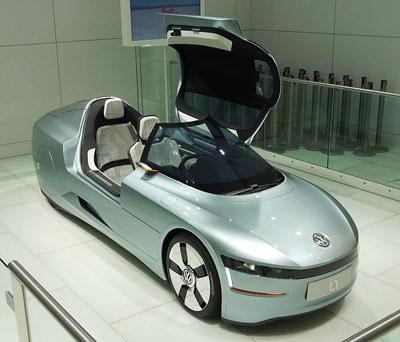
    There have been reports for some years about the Volkswagen 1-litre car, so called because it would travel 100 kilometers on one litre of fuel. That is the equivalent of 235 miles per gallon. Earlier reports were that the car would be marketed by now.

    Now Volkswagen indicates that the car will be produced "within the next few years." The car will be called the XL1. However, rather than being a 1 L car it will be a 0.9 L car, achieving 261 miles per gallon. The improvement is the result of adding an electric motor that will make the car a plug-in hybrid.

    This is just further indication of reality that technological improvements can materially reduce greenhouse gas emissions. Indeed, if the entire automobile fleet could obtain this fuel efficiency by 2050, greenhouse gas emissions from cars would be reduced more than 80 percent, despite substantial increases in driving. This development may mean that petroleum itself could emerge as a "green fuel."

    Moreover, this advance is consistent with finding by McKinsey & Company and the Conference Board, in a report sponsored by the Environmental Defense Fund, the Natural Resources Defense Council (NRDC), Shell, National Grid, DTE Energy and Honeywell that "….no change in thermostat settings or appliance use, no downsizing of vehicles, home or commercial space and traveling the same mileage” and no “shift to denser urban housing" would be necessary to achieve substantial greenhouse gas emission reductions in the United States.

    Volkswagen L1 (2009) photo by RudolfSimon