Tag: Transportation

  • A $53 Billion High-Speed Rail Program to Nowhere

    Vice President Joe Biden announced today a plan to spend $53 billion over the next six years on passenger high-speed rail projects that will help reach the goal of giving 80 percent of Americans access to high-speed rail within 25 years. According to the announcement, the proposal will place high-speed rail "on equal footing with other surface transportation programs." The initiative includes $8 billion in the President’s FY 2012 budget proposal, of which $4 billion will be focused on building new infrastructure and $4 billion will be dedicated to system preservation and renewal. The announcement makes no mention how the plan will be paid for.

    Congressional reaction to the announcement was immediate. House Transportation Committee Chairman John Mica (R-FL) and Railroads Subcommittee Chairman Bill Shuster (R-PA) issued a press release expressing "extreme reservations" regarding the Administration’s plan. Several congressional sources we reached for comment pronounced the Administration initiative "dead on arrival."

    "What the Administration touted as high-speed rail ended up as embarrassing snail-speed trains to nowhere," Mica said. "Rather than focusing on the Northeast Corridor, the most congested corridor in the nation…the Administration continues to squander limited taxpayer dollars on marginal projects," Mica added. "This is like giving Bernie Madoff another chance at handling your investment portfolio."

    Rep. Shuster was equally critical. "The Administration continues to fail in attracting private investment, capital and the experience to properly develop and cost-effectively operate true high-speed rail," he said. "Government won’t develop American high-speed rail. Private investment and a competitive market will." Shuster was also critical of the manner in which the Administration has administered the program. "Selecting routes behind closed doors runs counter to the Administration’s pledges of transparency. … High-speed rail funding could become another political grab bag for the President. …If the Obama Administration is serious about high-speed rail, they should stop throwing money at projects in the same failed manner."

    The strong condemnation by two leading congressional transportation spokesmen poses a serious obstacle for the Administration’s proposal on Capitol Hill. They are not alone. House leadership has called for cancelling the high-speed rail program as part of its deficit reduction plan.

    Opposition from governors and state legislatures adds another hurdle to the Administration’s plan. Without state support high-speed rail projects cannot go forward. But, as we have seen, the governors of Wisconsin and Ohio have declined to participate in the Administration’s HSR programs. Other governors, concerned about potential operating subsidies, open-ended risk of construction overruns or unable to raise the required matching funds, may do likewise.

    Florida’s Gov. Scott, in introducing his budget proposal on February 7, offered a hint about his thinking, that makes HSR boosters uneasy. "Over the last few years,’ the Governor said, "Florida accepted one-time hand-outs from th federal government. Those temporary resources allowed state and local governments to spend beyond their means. There was never any reason to think that Florida taxpayers could afford to continue that higher level of spending once the federal hand-outs are gone. The false expectations created by the federal hand-outs are the reason we hear about a multi-billion dollar deficit." The words "high-speed rail" and  "operating subsidies" were not mentioned, but the implication was clear.

    Several other high-speed rail projects are in danger of collapse because of stringent conditions demanded by the Federal Railroad Administration (FRA)— conditions that the host railroads find unacceptable. As reported by the respected railroad observer Fred Frailey, high-speed rail projects in Washington State, North Carolina and Virginia, totaling $1.4 billion in HSR grants, are in jeopardy because the service agreements negotiated by the states with Class 1 railroads have been rejected by the FRA as not strict enough. At the core in each case is the railroads’ insistence that passenger train operations must not interfere with freight operations and their refusal to accept penalties for potential delays suffered by passenger trains.

    If these projects fall through, there will be little to show for the $10.5 billion HSR program other than a 48-minute reduction in travel time between Chicago and St. Louis as a result of an ongoing project with Union Pacific (see, "The Uncertain Future of the High-Speed Rail Prgram," InnoBrief, January 5, 2001). It is revealing that the only example the White House announcement chose to highlight  was a $38 million program of track improvements between Portland and Brunswick, ME to permit a 30-mile extension of the five Downeaster round trips to and from Boston at slightly increased speeds, as Frailey pointed out.

    Given this meager progress, given more than ample evidence of congressional and state-level opposition, and with so many, much more deserving infrastructure needs awaiting federal support (incl. rail in the Northeast Corridor), one wonders why the Administration has chosen to doggedly pursue its unrealistic vision of a nationwide high-speed rail network. We hope Congressmen Mica and Shuster will try to get some answers.
  • China’s Empty Trains… & Other Unintended Consequences

    In a technical sense, the economy has been in recovery since June of 2009. A year and a half into the rebound though, a general cloud of economic malaise continues to cover the nation. Fears of a diminished America are perpetuated from our political and punditry classes. We are told that our collective lack of preparation, education, innovation, industry, and of infrastructure are all setting us up to fall further. Economic indicators may reflect a bounce-back, but structurally, America is waning. It is China that is increasingly emerging as the world’s bright spot in terms of development. With its 10% annual growth rate, an economy poised to become the world’s largest, and a strategic smart-growth development plan, resplendent in renewable energy splendor and high-speed rail, the nascent superpower is aimed ever upwards.

    This tidy narrative that the doom-chatterers both envy and fear is being dented by a number of recent stories concerning Chinese rail initiatives. As Tsinghua University’s Economics Professor Patrick Choavec writes, China’s high-speed rail is “expensive both to build and to operate, requiring high ticket prices to break even. The bulk of the long-distance passenger traffic, especially during the peak holiday periods, is migrant workers for whom the opportunity cost of time is relatively low. Even if they could afford a high-speed train ticket — which is doubtful given their limited incomes — they would probably prefer to conserve their cash and take a slower, cheaper train. If that proves true, the new high-speed lines will only incur losses while providing little or no relief to the existing transportation network.”

    Similarly, individual Chinese municipalities are eagerly developing subway systems, but as Chinese political scientist Zhang Ming wrote in China Daily, “geographical conditions in many cities are not conducive to building and/or maintaining subways. The landscape and hydrological conditions of a city determine whether it can have a subway… medium-sized cities may not have enough commuters to sustain a metro. Even in many large cities, which have enough commuters, subways are running at a loss because of the very high cost of operation and maintenance.” Historically, drive and a true demand have never run into a topographic problem it couldn’t solve, but these examples do raise questions about the efficacy of blanket government policies that ordain massive, heavily subsidized projects. Could such ventures produce results that are opposite of their intended outcome?

    China can find the answer right here in the States. The Italian sociologist Marco d’Eramo has related how the Home Owners’ Loan Corporation in 1933 and the Federal Housing Authority in 1934, created in part to stem the mass wave of Great Depression-related foreclosures, did “more than any other measure… to contribute to turning America into a nation of unconquerable homeowners.” To increase homeownership for all, both agencies devised classification systems that assigned values to neighborhoods and homes that they then sought to rehabilitate through loans to potential buyers. The resulting standardized divisions largely enforced segregation in the name of stability, only further depressing segments of the housing market.

    Recent lessons from the Great Recession’s continued housing fallout show us how government policy can produce the opposite effect of its initial intention, as well. The still-reeling property values of neighborhoods nationwide, and the huge tracts of unused housing at the periphery of metro edges were created with the encouragement of government bodies just like the HOLC and FHA’. These policies expanded the cause of homeownership without taking into consideration the actual demand and cost. Subsidizing trains that very few can ride is quite similar to encouraging the building of houses in which very few can live.

    At least initially, it is easy to see why such investments look good to government entities. They promote job growth, increase demand for supplies and resources, and contribute to overall GDP. Where something wasn’t, something now is. But they are unsustainable projects in the long run. Without continued government subsidies—or of higher wages for Chinese workers to afford train tickets, or of an endless supply of cheap credit to US potential homebuyers—they tend to eat off of themselves. The eventual decline in Chinese trade ridership and in US home purchases shows the peril when government policies create incentives for development without real, inherent demand .

    With this in mind it is important to view President Obama’s high-speed rail proposals in the context of each location. High-speed rail is an important, necessary step to upgrade America’s infrastructure in certain locales, but it is not an across-the-board panacea. Chicago, for example, the rail capital of the nation, beset with both passenger and freight rail congestion, is a logical beneficiary of dedicated high-speed rail funds to develop a system capable of handling its latent demand and to untangle its gridlock. With Chicago’s large economic presence over its neighbors, it makes little sense, then, that freshly minted Wisconsin Governor Scott Walker remains adamantly opposed to a project that would benefit Milwaukee and Madison.

    Other places, though, have valid qualms. Cost concerns in Florida, for example, are legitimate. The 90 mph top speed on the Southeast High Speed Rail Corridor between Charlotte and Raleigh doesn’t sound too, well, high-speed. Cities like Denver, which supports a dense enough population to represent a demographic demand for light rail, can encourage its development as its roads reach capacity. In states like South Dakota and Iowa, it may mean going back to dirt.

    The new head of the House Committee on Transportation and Infrastructure, Rep. John Mica (R-FL), made sense when he said, “I am a strong advocate of high-speed rail, but it has to be where it makes sense”. There is a difference between creating infrastructure for which there’s an inherent demand and nudging people to utilize it, and developing large-scale infrastructure projects for their own sake.

    Knowing the limitations of past attempts and failures, America has a chance to outgrow its mistakes and render the supposed competition with China irrelevant, as that aspiring nation fumbles in its own policy prescriptions. Harnessing the lasting lessons of the Great Recession means understanding that success isn’t measured in the size of a home, or in the length of a high-speed rail system. It’s measured in the effectiveness and efficiency of a place. If the U.S. holds this to heart, no one could be better primed to compete, as China’s empty trains swiftly rattle onwards.

    Photo by Ivan Walsh, High Speed Bullet Train, Beijing to Tianjing, China

    Ben Schulman is a Chicago-based writer on urban affairs. One of the proprietors behind independent record label Contraphonic, Inc., Schulman also heads the Contraphonic Chicago Sound Series.

  • The Real Answer to Houston’s Traffic Congestion

    The Houston Chronicle editorial board recently argued that light rail is key to combating Houston’s traffic congestion problems. But if you look at the three cities with worse traffic congestion than Houston – DC, Chicago, and LA – they have much more transit, including tons of light rail in LA. Transit clearly hasn’t solved the problem in these cities. These people aren’t stuck in that traffic because they like it – it’s because the transit doesn’t go where they need to go or isn’t timely. This is especially true with the rise of dispersed job centers in those cities where the trains don’t go or don’t provide good connectivity to the suburbs where people live.  Let’s see, in Houston we have downtown (<7% of jobs), uptown/Galleria, the med center, Greenway, Greenspoint, the Energy Corridor, Ship Channel, and NASA – among others.  If that’s not a dispersed set of job centers poorly suited to rail connectivity, then I don’t know what is.

    It’s absurd to argue a light rail network focused inside the 610 Loop is going to do anything to relieve congestion or provide relief to commuters from the vast suburbs outside the loop.  The solution is not doubling down on our multi-billion dollar LRT network, but instead scaling it back (University line only, IMHO) and instead spending the funds on a radical increase in express bus commuter services connecting all suburbs to all job centers with frequent nonstop 60+ mph transit using high-speed HOV/HOT lanes.  Imagine driving to your local suburban transit center (which might just be a mall parking lot) and finding regular, frequent express buses (of all sizes) serving every major job center in Houston.  These buses could have amenities like wifi and laptop trays.  They might even be run by private operators (with subsidized fares) competing on routes, schedule, reliability, service, and amenities.  And after they get to the job center, they can circulate to get you right to your building – no long walks in heat, cold, or rain.  Finally, all of this is a single-seat service without annoying and time-consuming transfers from bus-to-rail or rail-to-bus (or even rail-to-rail).

    It’s a much more practical solution for a city like Houston, but one that requires innovating ‘outside the box’ as a transit agency rather than parroting the “more rail” mantra that every other transit agency in the country repeats endlessly.

    For more details, see these two previous posts:

    This post originally appeared at Houston Strategies.

  • Confirming International Research: Hudson Tunnel Costs Explode

    Governor Chris Christie of New Jersey is looking like a prophet now. In late October, the Governor cancelled a new tunnel across the Hudson River between New Jersey and New York City, because of the potential for cost overruns, which would be the responsibility of New Jersey taxpayers. By that point, the cost of the tunnel had escalated at least $1 billion to $9.7 billion. The tunnel was to have doubled New Jersey Transit and Amtrak capacity into Penn Station from New Jersey.

    Now Amtrak proposes to build the tunnel itself, a scaled down version of the previous tunnel. The new tunnel would increase capacity for New Jersey Transit and Amtrak trains by 65 percent.

    However, the cost is not scaled down. For one-third less the capacity, initial estimates place the cost of the new tunnel at 40 percent more ($13.5 billion) than the already escalated cost of the cancelled tunnel.

    Of course, it is likely that if planning and construction proceed, the cost of the tunnel could increase substantially beyond initial estimate. This virtual inevitability is indicated in international research by Oxford University professor Bengt Flyvbjerg and others.

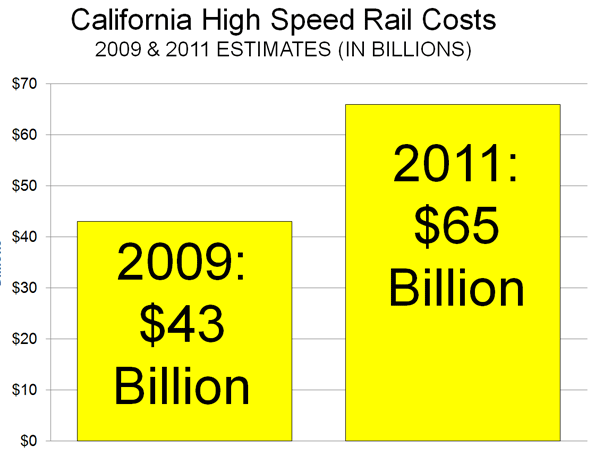
  • California High Speed Rail Costs Escalate 50 Percent in 2 Years

    The highly respected Californians for Responsible Rail Design (CARRD) has released a new cost estimate for the phase 1 Los Angeles to San Francisco high-speed rail line. Based upon an analysis of California high-speed rail Authority documentation, including stimulus grant applications and other internal sources, CARRD estimates that the line will now cost $65 billion, rather than the current estimate of $43 billion.

    The CARRD release indicated:

    Our analysis, based solely on official and publicly available Authority documents, determines the
    current project costs are approximately $65 billion. The $43 billion figure was inaccurate, even at the time it was made.

    CARRD also pointed out that there has been no recent update to the official cost estimates and that the planned October 1, 2011 update, required by state legislation, may not be released on time because of contract negotiation difficulties with Price Waterhouse Coopers.

    Even as environmental and planning work has advanced, no update to the official capital cost estimate has been made. This is true even when the only alternatives in most segments still being studied are significantly more expensive than those used to calculate the $43 billion number

    However, CARRD cautioned even this 50% increase in just two years may understate the eventual costs:

    …we have received some feedback that these numbers may actually be too conservative since there still is very little engineering information about some of the most technically challenging parts of the project (like the mountain passes).

    The new CARRD cost estimate is consistent with the perennial cost escalation that has been noted in such projects by Oxford University professor Bengt Flyvbjerg and others, who found that passenger rail systems typically have cost overruns of 45 percent.

  • Brookings Economist Decries Transit Subsidies, Calls For Privatization

    In his new book, Last Exit: Privatization and Deregulation of the U.S. Transportation System, Brookings Institution economist Clifford Winston contends that transit subsidies are largely the result of labor productivity losses, inefficient operations and counterproductive federal regulations.
    Winston finds that transit service is so underutilized, that load factors were at 18 percent for rail and 14 percent for buses in the 1990s, before the Federal transit administration stopped requiring transit agencies to report that information.

    Six Years Severance Pay: Winston cites the fact that dismissed transit employees may be eligible for up to six years severance pay, under requirements of federal law. For example, less costly services that could be provided under contract by private providers could result in the six-year severance payments if transit employees are laid off. No such benefit is available to other workers in the nation and an impediment that discourages cost-effective innovation.

    Costly Rail Systems: The nation’s urban rail systems, which have consumed so much of transit tax funding in recent decades, are the subject of considerable criticism.

    Winston reminds readers of the considerable literature that shows that "the cost of building rail systems are notorious for exceeding expectations, while ridership levels tend to be much lower than anticipated" and that "continuing capital investments are swelling the deficit." At the same time Winston questions transits high subsidy levels for rail transit, for example, noting that the average income of rail transit riders is approximately double that of bus transit riders.

    In particular, Winston criticizes the now under construction Dulles Airport rail line that will become a part of the Washington DC area transit system, noting that the route is not cost-effective. He characterizes cost overruns on the Dulles rail line and on the soon to be under construction Honolulu rail line as "inevitable." (This is despite the fact that both lines have already experienced substantial cost escalation.)

    Indeed, Winston notes that among all of the US rail systems, the subsidies exceed the benefits on all systems except for San Francisco’s BART.

    Public Sector Mismanagement: Winston offers an ominous conclusion. He says that "social desirability is hardly a demanding standard for a public enterprise to meet" and indicates that is that it is rare to find a public service not meeting that standard. However, of transit Winston concludes that "the fact that transit’s performance is questionable … Is indicative of the extent that transit and bus rail services have been mismanaged in the public sector and been compromised by public policy. It is notable that over the quarter century since transit began receiving income from the federal gasoline tax that its share of urban travel has dropped one third.

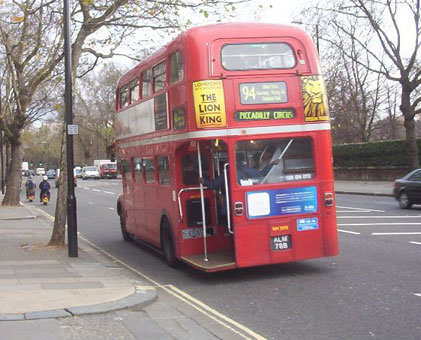
    Competition as an Answer: Last Exit indicates that transit can produce beneficial results, but makes a compelling case for reform. Winston suggests that transit could be improved by greater involvement of the private sector, following models such as the competitive tendering (competitive contracting) that now accounts for approximately one-half of Denver’s bus system.

    The international evidence, which Winston does not cite, is even more substantial. This includes the all of the world’s largest bus transit system, in London, the entire Copenhagen bus system, and the entire subway, commuter rail and bus systems of Stockholm. However the ultimate in privatization is Tokyo, the world’s largest urban area, where transit ridership is 1.5 times that of the entire United States. More than two-thirds of all transit ridership is carried by unsubsidized private rail and bus operators.

    Photo: Competitively tendered bus in London (photo by author)

  • Double Digit Ridership Increase Leaves London-Paris-Brussels High Speed Rail Behind Projections

    The Eurostar, the high speed rail service that links London with Paris and Brussels remains more than 60 percent below its ridership projections as of 2010, according to recently released ridership information. This is despite a double digit (12 percent increase in ridership between 2009 and 2010.

    According to a Parliamentary inquiry, consultants projected that Eurostar ridership would reach nearly 25 million passengers by 2006. As of 2010, ridership still languishes below 10 million, at 9.5 million. Rosy ridership and revenue estimates have often occurred with major infrastructure projects, especially rail projects, as has been documented in research by Flyvbjerg et al.

    In 2009, the government of the United Kingdom has assumed £5.2 billion in debts of the builder/operator of the high-speed rail Channel Tunnel link to St. Pancras Station. This is in addition to the £1.7 billion that had been granted by the government to the builder/operator to extend the line.

  • China Expressway System to Exceed US Interstates

    This should be the year that China’s intercity expressway system exceeds the length of the US interstate highway system. China’s expressways are fully grade separated, freeway standard roadways, but unlike most interstate highways, have tolls.

    The China Ministry of Transport indicates that, as of the end of 2010, China had 46,000 miles (74,000 kilometers) of expressways. Currently, the expressways of China have a total length about 1,000 miles (1,600 kilometers) less than that of the US interstate highway system. In the last year, 5,500 miles (9,000 kilometers) of new expressways were completed. If that construction rate continues, China’s expressway system would exceed the interstate system length late in the first quarter of 2011.

    By 2020, China expects to have 53,000 miles (85,000 kilometers) of expressways. This compares to the US total of approximately 57,000 miles (92,000 kilometers), including non-interstate freeways. However, the China expressway mileage does not include the expressways administered by provincial level governments, such as in Beijing (with its five expressway ring roads), the extensive system of Shanghai and the expressways of Hong Kong. No data is readily available for the lengths of these roads.

    Now it is possible to travel, uninterrupted (except for traffic jams in the vicinity of the largest urban areas), from north to south from near the Russian border, north of Harbin (in Heilongjiang or Manchuria) to near the resort island of Hainan, well south of Guangzhou, Hong Kong and the Pearl River Delta and not far from the border with Viet Nam. This is a total distance of 2,700 miles (4,400 kilometers).

    East to west travel without signals is now possible from Shanghai to near the Myanmar (Burma) border, beyond Kunming, a distance of 1,800 miles (3,000 kilometers). In the longer run, it will be possible to travel from the Russian border in Manchuria to the border of Kazakhstan in Xinjiang, a distance of 3,500 miles (5,700 kilometers).

    The expressway system is indicated in the map below. The blue the routes have been opened and the red routes are yet to be completed.

  • Tampa to Orlando High-Speed Rail: Keeping Promises to Taxpayers?

    Florida’s Tampa to Orlando high-speed rail project could be barreling down the tracks toward taxpayer obligations many times the $280 million currently advertised. That is the conclusion of my Reason Foundation report, The Tampa to Orlando High-Speed Rail Project: Florida Taxpayer Risk Assessment.

    The 84 mile, purportedly $2.7 billion project is administered by Florida Rail Enterprise (a part of the Florida Department of Transportation) and would be built by a private builder/operator selected through a competitive process. There are a number of reasons to believe that there is slim prospect of limiting the obligation of Florida taxpayer to the promised $280 million.

    Capital Cost Overruns: The International Experience

    The international experience indicates that Florida taxpayers will indeed be fortunate if the bill is only $280 million. A team led by Oxford University professor Bengt Flyvbjerg found that passenger rail systems typically have cost overruns of 45 percent. Such a cost overrun would increase the bill for Florida taxpayers to $1.5 billion.

    Capital Cost Comparison to California

    However, the capital cost overrun could be even greater. The Tampa to Orlando line cost per mile is less than half that of the first segment of the California high-speed rail line, despite factors that should make the Florida line more expensive..

    In California, there is a concern that the eventual $45 billion or more required to complete the 500 mile route may not be obtained. As a result, the first segment (Borden to Corcoran in the agricultural San Joaquin Valley) is being built so that it can be used by the existing Amtrak service should the high-speed rail line not be fully completed.

    Thus the shorter $4.2 billion California segment excludes various elements that will need to be upgraded later for high-speed rail trains to operate. The $4.2 billion does not include the funding for trains, electric power infrastructure, train yards, train maintenance facilities and administrative facilities. More of the construction will be in agricultural and rural areas than in Florida which will tend to make the California project less costly. There will be only two “Amtrak” quality stations, as opposed to the five far more expensive high-speed rail stations on the Tampa to Orlando line.

    For example, Florida Rail Enterprise characterizes the potential Tampa station as having the “potential to be one of the most visible, dominant and iconic architectural features of the city.” This hardly suggests a process driven by cost control.

    The Tampa to Orlando line does have two cost advantages relative to the California line, including that right-of-way has largely already been obtained and that there will be less construction on viaducts. These factors however, seem unlikely to compensate for the elements that are excluded from the California costs.

    The Tampa Orlando high-speed rail line would cost $3 billion more if its cost per mile equals that of the California segment. All of these additional costs would be the responsibility Florida taxpayers and would raise their bill to nearly $3.3 billion (Figure).

    International Research: Subsidizing Operating Losses

    There is reason to believe that the line will suffer day to day operating losses, despite claims of Florida Rail Enterprise to the contrary.

    Just as the international research indicates costs are often understated, ridership and revenue is often overstated. Flyvbjerg’s team found that projections were, on average, 65% higher than the eventual actual ridership. If the Tampa to Orlando line were to match this average, Florida taxpayers would have pay $300 million more just over the first 10 years of operation to make up for operating losses. This would raise the bill for Florida taxpayers to $3.6 billion ($3.3 billion plus $300 million) with more likely after 10 years.

    The Tampa to Orlando Market: Operating Losses

    The Tampa to Orlando high speed rail line may not achieve even the already discounted average ridership performance evident in the international research. This would mean an even greater revenue shortfall and more in bills for Florida taxpayers.

    The Tampa to Orlando line will provide virtually no intercity travel time advantage compared to the car. It will, in fact, cost more than driving. It will cost a lot more in the likely event that an expensive taxi ride or a car rental at is required the destination. Even so, the ridership projections can be characterized as stratospheric. Florida Rail Enterprise assumes two thirds of the ridership of Amtrak’s Acela Express on the Northeast Corridor, despite the fact that the Acela market has eight times the population of the Tampa to Orlando market.

    Moreover, the Tampa to Orlando line will operate at average speeds 34 to 70 percent below that of high-speed rail trains in China, Japan and France. This is because the train will operate as a local shuttle between the Orlando International Airport, International Drive and Walt Disney World.

    The Bottom Line

    These risks combine to threaten Florida taxpayers with many times the claimed $280 million cost, like Massachusetts taxpayers, who were forced to pay much of the $16 billion in cost overruns on the “Big Dig” highway project. The risk to Florida taxpayers would be in contrast to the billions Governor Christie is saving New Jersey taxpayers by cancelling the “Access to the Regional Core” Hudson River tunnel for which costs were spiraling, consistent with the international research.

    Choices

    This would seem to be no time to saddle already overburdened taxpayers with additional and predictable obligations. Obviously, Florida taxpayers could be spared these risks by canceling the project.

    However, the lure federal funding could prove to be irresistible. If so, the state should provide ironclad provisions to limit taxpayer subsidies to the promised $280 million. The builder/operator should assume all financial risks and there should be no state financial guarantees. Further, megaprojects like the Tampa to Orlando line can be “too big to fail,” and it could be nearly impossible to stop construction once it is started, even as costs balloon. Thus, only the independently operable Orlando tourist shuttle segment (Orlando International Airport to International Drive and Walt Disney World) should be initially built. The extension to Tampa could be built later in the unlikely event that there is enough left of the $2.7 billion.

    Keeping Promises

    These decisions will soon be made by newly elected Governor Rick Scott, whose has stated that his evaluation will be driven by the impact on Florida taxpayers.

    Doc Dockery, former chairman of the now-defunct Florida High Speed Rail Authority and financier of a now repealed constitutional amendment that required building high speed rail has “pooh-poohed” the risk of cost overruns, noting that the Florida Department of Transportation “has said repeatedly” that any bidder must “give a fixed price. This means no cost overruns.” He continues, “how can this be more plainly stated?” Regrettably, the experience reveals the rhetoric to fall far short of what is required to protect taxpayers.

    If construction proceeds, the Governor and state will be exposed to an over-whelming challenge to keep the $280 million promise to taxpayers. If they succeed, it will be a first. Chances are they won’t.

    Photo: Concept for “iconic” Tampa station. Available at floridahighspeedrail.org.

    Wendell Cox is a Visiting Professor, Conservatoire National des Arts et Metiers, Paris and the author of “War on the Dream: How Anti-Sprawl Policy Threatens the Quality of Life

  • Presidential Travel: Around the World in Eighteen Hours

    As a corrective for the struggles of American diplomacy, I am surprised that no one has proposed mothballing Air Force One. The jet of state is almost the perfect symbol of modern presidents, who fly around the world as if on a magic carpet, but come home with little more than passport stamps. In recent months, President Obama has flown to Indonesia, India, South Korea, Japan, Portugal, Iraq, and Hawaii, but, other than for his Christmas vacation, the reasons for any of these trips are a blur.

    The hope is that presidential frequent flyer miles can be redeemed for peace, prosperity, and global harmony. Instead, we seem to have traded the miles for undeclared wars, ballooning national debt, and diplomatic unease. Do the WikiLeaks sing songs of success?

    Not every president has felt the need to adopt the persona of an international courier. Until Teddy Roosevelt visited the Panama Canal, no sitting president ever left the country. (It just wasn’t “done.”) The designation “Air Force One” dates to the Eisenhower administration. In the last thirty years of his life, Thomas Jefferson never visited a northern city. When he traveled in Europe, it was with one servant and his notebooks. But some presidents were more eager to wander.

    During his entire lifetime Abraham Lincoln never left the United States, although twice as a young man he journeyed down the Ohio and Mississippi rivers, from Kentucky to New Orleans — the future president as Huckleberry Finn.

    To negotiate the Peace of Paris after World War I, Woodrow Wilson spent almost six months in France, where he was greeted by rapturous crowds. On location, he only muddled the disastrous peace at Versailles. (“Making the Hun pay…”) On his return to the U.S., however, he failed to persuade the Senate to ratify the treaty.

    Other presidents have traveled to escape the clouds of scandal. With his popularity ebbing, Warren Harding went on a tour of the Pacific Northwest (avoiding Teapot Dome, Wyoming), and Richard Nixon clogged the streets of Egypt and Romania during the depths of the Watergate scandal.

    John F. Kennedy, before his election, traveled like a foreign correspondent. In 1951 he journeyed, often by car, for twelve weeks, first from England to Yugoslavia, and later from Israel to Pakistan, India, Indochina, and Korea.

    Without a doubt, FDR was the most courageous presidential traveler. He spent countless days at sea, crossing the Atlantic during World War II, when there was the high chance of a U-boat attack. Unable to walk, Roosevelt was often winched from one rocking destroyer to another, in the middle of the rough ocean. He persevered to attend conferences in Casablanca, Argentina, Tehran, Malta, and Cairo.

    Although Harry Truman is remembered for giving entrenched interests “hell” off the rear platform of a private railroad car, what he liked most were road trips. Matthew Algeo’s Harry Truman’s Excellent Adventure is an account of how, after his presidency ended, Harry loaded Bess into the family Chrysler and drove her from Independence, Missouri, to New York and Washington, DC. They stayed in motels along the way, and he paid for his own gas.

    George W. Bush always looked like a reluctant traveler, only comfortable shuttling to Camp David or his ranch in Texas. By contrast, Teddy Roosevelt was not just a traveler, but an explorer. After his presidency he embarked on epic journeys across Africa and South America, nearly killing himself up the Amazon River.

    How does Barack Obama fare as a traveler? I read somewhere that he is gracious in his encounters with troops stationed abroad, and that speaks well for his compassion. On his diplomatic missions, though, he seems to travel in circles, and to be impatient with a world not always so adoring.

    In November 2010, he flew from Washington to India, and then to summit meetings in South Korea (which went nowhere). No sooner was he back in Washington than he flew to Lisbon for a NATO summit. A week later he went back to Asia, in the dead of night, this time to Afghanistan. He spent all of four hours there on the ground. Why fly thirteen hours to Afghanistan and miss seeing President Karzai, only to head directly back to Washington?

    Couldn’t his schedulers have doubled up on some of these excursions? After all, it costs $181,000 an hour to fly Air Force One, and millions more for the cavalcade.

    As an international traveler, Obama strikes me as being like many American executives who zip in and out of Europe as though it were St. Louis, and who always need to be back in Washington by Friday afternoon. Obama has made more foreign trips, for his time in office, than any other president. To what end?

    In 2009, Obama went twice to Copenhagen, in the space of about ninety days, first to lobby for Chicago’s chances at Olympic swag, and then to lecture the developing world about carbon emissions. (This from someone who travels with an entourage of about seven hundred, chaser jets, and a motorcade caravan worthy of a sheikh.)

    On his first trip to Copenhagen (for less than a day), the Olympic committee was indifferent to the presidential fly-by, which no doubt disappointed the Daley brothers, who were hoping for some Olympic-sized contracts in Chicago. Some weeks later at the climate change conference, an obviously jet-lagged Obama burst in on the Chinese, jawboned for a while (in the manner of Basil Fawlty), and went back to the airport with little to show for the carbon emitted.

    If global warming is such an important issue, maybe he could have stayed the weekend in Copenhagen? A week earlier he had flown in and out of Oslo. He was there for twenty-six hours, to collect the Nobel Prize, but in his rush he snubbed the Norwegian king.

    Last November, when the president went to India for three days, he took with him six armored cars and about forty planes, not to mention a naval fleet stationed off Mumbai. That’s along with the four chefs, food tasters, helicopter pilots, schedulers, stewards, generals, spin doctors, secret service officers, fifteen dogs, and Washington officials that numbered in the hundreds. The travel costs were estimated at $200 million. You tell me what was accomplished. Maybe he needed the miles to get to Hawaii?

    Photo by http2007 Thierry of Air Force One at the Prima Air & Space Museum in Tucson, Arizona.

    Matthew Stevenson is the author of Remembering the Twentieth Century Limited, a collection of historical essays. He is also editor of Rules of the Game: The Best Sports Writing from Harper’s Magazine. He lives in Switzerland and travels under the motto that, “A good hotel is never good enough, but a bad hotel is a joy forever.”