Tag: Transportation

  • A Train to Nowhere: Not A Train Through Nowhere

    In expressing its opposition to the California High Speed Rail line, Washington Post editorialists noted that critics of the now approved Borden to Corcoran segment have called the line a “train to nowhere” (“Hitting the breaks on California’s high speed rail experiment“). The Post call this:

    …a bit unfair, since some of the towns along the way have expensively redeveloped downtowns that may now suffer from the frequent noise and vibration of trains roaring through them.

    What the Post missed, however, is that a “train to nowhere” is not a “train through nowhere.” There is no doubt that the high viaducts and the noisy trains have potential to do great harm to the livability of the communities through which it passes. This is one of the reasons that the French have largely avoided operating their high speed rail trains through urban areas, except at relatively low speeds. Stations, except for in the largest urban areas, are generally beyond the urban fringe and towns are bypassed. Yet, one of the decisions not yet made in California, for example, is whether the town of Corcoran will be cut in half by the intrusive, noisy line.

    There would be nothing but grief for the towns through which the California high speed rail lines would pass, but not stop (this is not to discount the disruption the line will cause even where it would stop, such as in Fresno). It may be a train to nowhere, but it is a train through places that people care about.

  • Skepticism About High-Speed Rail Is Growing

    “Spend first, answer questions later.” So concludes a critical editorial in the January 12 edition of the Washington Post, commenting on California’s proposed $43 billion High-Speed Rail program. The Post editorial, along with a January 11 article in the New York Times (both of which we reprint below), are emblematic of the increasingly skeptical press and public opinion concerning the fiscal and economic soudness of the Obama Administration’s high-speed rail initiative. “It’s unclear that the public benefits attributed to high-speed rail…would outweigh the inevitable operating subsidies,” observes the Washington Post, confirming the conclusions already reached by the states of Wisconsin, Ohio and Iowa.

    Other states and their freight railroad partners seemingly are having similar second thoughts, judging from the parties’ lack of progress in reaching cooperative track-sharing agreements. Conspicuous among them is the state of Florida which has been promised a $2.4 billion federal grant to build an 84-mile “high-speed” line from Tampa to Orlando. That line, by all evidence, is too short to produce any meaningful time savings over car trips along a parallel interstate freeway. Moreover, as the New York Times article points out, the proposed line has scored among the lowest in terms of projected ridership in a study of the nation’s high-speed rail corridors recently published by America 2050, a national urban planning initiative (www.America2050.org). Its authors cited the low population and employment density of the cities at either end of the line (and a lack of internal transit distribution systems, we might add) as the reason for low ridership estimates and the line’s low score. The article notes that “the report represents another blow to the Florida high-speed rail network after a report from the Reason Foundation found the project could cost Florida taxpayers $3 billion.”

    As the Washington Post editorial observed, “The president has a vision of a national high-speed rail network almost as grand as the interstate highway system. We have our doubts about the ultimate feasibility of this vision, in part because in much of the country passenger rail can’t compete with car travel by interstate highways.” The editorial could also have noted one other fundamental difference. Pres. Eisenhower’s ambitious plan for the interstate highway system was placed on a sound fiscal basis by being backed by a user fee (aka the gas tax). Mr. Obama’s high-speed rail vision, on the other hand is funded by a one-time $8 billion federal stimulus grant with no visible source of continued support. Indeed, the high-speed rail initiative faces little prospect of sustained congressional funding, it has yet to show evidence of attracting private capital, and it exposes the taxpayers to continued operating subsidies,as Amtrak experience suggests.

    No wonder Pres. Obama’s vision is increasingly being questioned, even by the mainstream media.

  • Yes, We Do Need to Build More Roads

    Road are clearly out of fashion in urban planning circles. Conventional wisdom now decries roads in favor of public transit, walking or biking in developments designed to mimic traditional 19th century urbanism. Common refrains are “we can’t build our way out of congestion” or “widening roads to cure congestion is like loosening your belt to cure obesity.” Also frequently noted is the vehicle miles traveled has – at least until recently – outpaced population growth.

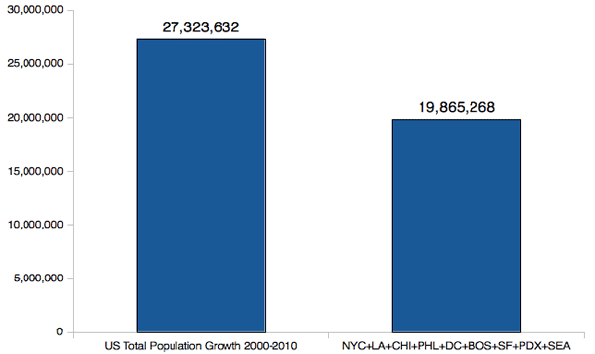
    But this piece of conventional wisdom is also deeply flawed. It obscures the bigger point that in a growing country we need to expand infrastructure to keep pace. The recent 2010 Census results put this in stark relief. The rate of growth from 2000 to 2010 slowed considerably from the previous decade, but still at a robust 9.7%, or 27.3 million new Americans. It would have been physically impossible to house all those people in traditional urban communities well-served by transit. The 27.3 million number is more than the combined 2009 population of the cities of New York, Los Angeles, Chicago, Philadelphia, Washington, Boston, San Francisco, Portland, and Seattle.

    In fact, this national growth is greater than the combined population of the 12 largest municipalities in the country.

    That’s just one decade’s worth of growth. America’s traditional urban areas couldn’t contain this, even if they were emptied of all their current residents. And the United States is projected to add an additional 90 million people by 2050. Where are all those people going to go? And how would they get to work even if they could live in these cities, given that much of America’s job growth has been suburban?

    Keep in mind also that much of this urban and transit infrastructure must be seen as more legacy than a reflection of modern choices. It was largely compete 50 or more years ago. Only Portland and Washington, DC have really managed to build new transit friendly urban core cities in the modern era. And despite their growing populations, these two places can only absorb a relatively small amount of new population every year. In Washington, it’s less population growth than gentrification – the replacement of largely poor African Americans with more affluent whites – that is the most outstanding demographic trend.

    That’s not to say America can’t invest more in transit or build more transit friendly cities. It can and it should. In particular, large, already dense urban areas like New York, Chicago, and Washington with large core area employment require major investment to upgrade their systems.

    Even smaller cities need better transit options and more urban neighborhoods. They are simply not well positioned to compete head on with newer suburban areas built from the ground up to support an auto-oriented lifestyle. But this will be difficult since they will have to build transit largely from scratch, and given anticipated cutbacks in new federal transit funding. this suggests they would be well-advised to avoid costly boondoggle mega-projects in favor of unglamorous but basic activities like running a quality urban bus system.

    But even if we achieve our potential in transit, America still needs to build more roads. We’ve got an interstate system originally designed for a 1960 population of 180 million and we are now well over 300 million and going up. By 2050 we’ll have more than double the 1960 population. This will require a major expansion of infrastructure, and that includes highway infrastructure.

    Just as one example, consider a moderate growth area like the Indianapolis-Carmel MSA. Its interstate system was mostly designed and completed circa 1970. The region had a population of a bit over 1.1 million then. Today it is over 1.7 million, an increase of 52%, or 596,000 people. A county the size of that increase would be the second largest county in the state of Indiana, well exceeding that of today’s #2, Lake County, a heavily urbanized county in Northwest Indiana.

    Yet until recently there had been almost no expansion of the Indianapolis freeway system. Fortunately, it was over-designed when built, but that is no longer the case. Thanks to a fortuitous lease of the Indiana Toll Road however, over 50 miles of freeway in the region are now being widened. Without this, the region would have faced decades of commuting misery.

    Unfortunately, that’s the bind where most cities now find themselves: managing growth with funding for roadway expansion and even maintenance running dry nationally.

    Keep in mind that tomorrow’s roads need not resemble yesterday’s monstrosities. The days of simplistically adding lanes while neglecting basics like enclosed drainage, sidewalks and paths, bus shelters, and aesthetics are likely over in many parts of the country. We need to provide room for the traffic we need to accommodate without excessive over-designs for a 15 minute peak of the peak, or dehumanizing roadway design approaches. Reform of our civil engineering educational system is eminently doable as plenty of great examples of suburban roadway design already exist. Federal standards need a revamp as well. We need to build not just more, but also better roads.

    With a botched stimulus, huge deficits at the federal and state level, and a public that has decisively turned against those deficits, a major construction program seems unlikely at this time. But in a couple years the economy should be back and a plan for fiscal recovery put in place and under execution. If not, we’ll have much bigger problems than roads.

    But assuming we get past this moment, we need to be laying the groundwork for a major continuation of the long history of American investment in infrastructure, from the Erie Canal to the interstate highway system. This includes not only a significant boost in urban transit spending where appropriate, but also a major program of both roadway repair and quality expansion, particularly in our growing metro regions. And as the Indiana example of a Toll Road lease shows, this doesn’t all have to come from tax dollars. Without this investment, our critical transport networks will ultimately seize up and America cannot hope to be competitive globally over the long haul.

    Aaron M. Renn is an independent writer on urban affairs based in the Midwest. His writings appear at The Urbanophile.

    Photo of a suburban road in Carmel, IN by author.

  • Trying to Keep Hope Alive: High-Speed Rail in Illinois

    Despite the rejection of high-speed rail in many states, Illinois is trying to revive it. The Illinois Department of Transportation recently made a cooperative agreement with Union Pacific and Amtrak to fund passenger rail improvements for its line from Chicago to St. Louis with a $1.1 billion federal high-speed rail grant. The project, to be completed in 2014, would make transit more efficient between the two cities, but as many other states have realized, the numbers indicate that this efficiency is not worth the cost or the trouble.

    The high-speed trains set to carry passengers 284 miles from Chicago to St. Louis would do very little to drastically change the commute experience. When the Illinois Department of Transportation first applied for this grant one year ago, they claimed that the trains would cut travel time between the cities from 5 hours 20 minutes down to 4 hours 10 minutes. However, current estimates now put the trip time at around 4 hours 32 minutes. As with every high-speed rail proposal, it seems, planners set the bar too high and end up either spending more than the public bargained for or overestimating the benefits of these billion dollar projects. How efficient will high-speed rail be if it costs more than people can afford and does relatively little to enhance the commute?

    Union Pacific’s terms in the agreement are not settling for riders either. According to CEO Jim Young, the company’s priority is “to protect Union Pacific’s ability to provide the exceptional freight service our customers need and expect,” and not necessarily passenger rail operations. Not only that, but there are no consequences stipulated in the agreement for if the railroad fails to meet on-time performance standards for passenger service, stipulations withdrawn from the initial agreement by the Federal Railroad Authority. High-speed rail was advertised to the public who would be paying for it with tax dollars and the divergence of their tax dollars from the state’s other pressing needs, but those developing the system do not seem as concerned with this large pool of customers.

    Local governments all over the country are recognizing the flaws with high-speed rail projects and are starting to act. The incoming governors in Wisconsin and Ohio have cancelled plans for a high-speed rail line while Florida governor Rick Scott doubts the cost effectiveness of what Michael Grunwald of TIME magazine calls a “glorified Disney shuttle.” Many inside and outside of California have also vehemently voiced their opposition to the “railroad to nowhere,” a line that would connect Corcoran and Bakersfield and would be the first costly step in its overall plan to connect San Francisco and Anaheim. Since projects are stalling in many other states as well, it might be worth it to take a second look at the necessity of high-speed rail at the present time.

    The influx of Republicans into Congress along with this local opposition may pressure the Obama administration to cut back funding for high-speed rail and work on fixing the deficit. However, this high-speed rail grant for Illinois shows that the federal government is not about to abandon the pipe dream yet.

  • Overselling Transit

    A recent op-ed in the Los Angeles Times eloquently illustrated the limits of mass transit in modern societies. This is not to imply that that transit does not have its place, nor that it does not provide a most useful service where it can. The problem has been the overselling of a mode that has very serious limitations. This has led to misallocations of financial resources that could be more efficiently used for the roadway expansions that would relieve traffic congestion and reduce both air pollution and greenhouse gas emissions while encouraging greater job creation and economic growth.

    The op-ed in question was by Karen Leonard, a professor at the University of California, Irvine and Sarah Hays, a Los Angeles architect. The article noted the neighborhood opposition to the “Expo” Line (Exposition Boulevard line) and efforts by the authors to gain support for the line. The neighborhood in question is Cheviot Hills, a tony neighborhood with a median house price of $850,000 in the city of Los Angeles and located between Beverly Hills and Culver City.

    What is significant about the op-ed, however, is not so much the neighborhood as the concluding line and the author credits.

    “So we continue to walk our neighborhoods talking with our neighbors, hoping that this time the quiet majority will finally prevail and we will all gain the choice of leaving our cars at home.

    Karen Leonard is an anthropology professor at UC Irvine. Sarah Hays is a Los Angeles architect. They are co-chairs of Light Rail for Cheviot Hills (lightrailforcheviot.org).

    UC Irvine? It is doubtful that the Expo line will make it possible for anyone in the foreseeable future who lives in Cheviot Hills to “leave their car at home.” The University of California, Irvine is located in the middle of Orange County, approximately 50 miles from Cheviot Hills.

    It is useful to consider what leaving the car at home in Cheviot Hills would mean for a mythical professor at the University of California, Irvine once the Expo line is fully operational.

    On Monday*, the professor needs to be in class at 8:00 am, which requires arrival on campus by 7:45 a.m. On the assumption that the mythical professor lives in the middle of Cheviot Hills, the trip would involve leaving the house at 3:45 a.m. and walking 20 minutes to the transit stop. The favored Expo light rail line would likely not be available that early, so the first leg of the trip would be on a bus. (If the Expo line is operating early enough for the trip, the professor could leave home approximately 25 minutes later).

    Three transfers later, the mythical professor arrives at the campus, at 7:20 a.m., in plenty of time to have coffee and get to the classroom before 8:00. While the professor requires four hours from leaving his or her car at home to the necessary arrival time at campus, a neighbor could have driven nearly all the way to Las Vegas for breakfast.

    If it is assumed that the mythical professor is able to get out of a staff meeting at 3:00 pm, the return trip would take more than 3 hours, part of it on the Expo line.

    Tuesday would be little better, assuming a 10:00 a.m. class start and that the professor gets away by 5:15 p.m. The trip to Irvine would have the advantage of starting on the Expo line, but would still take more than 3 hours, door to door. The return trip, including bus rides, a Green Line ride, a Harbor Freeway Busway ride and an Expo light rail ride would be about 4 hours and 30 minutes, with little wait in Irvine for service.

    These transit commutes would hardly be comfortable or productive, though they would include all conventional forms of transit available in Los Angeles (there are no trolley buses, inclined planes or ferries in Los Angeles). The total door-to-door time would be up to 7.5 hours for a work day of 7 hours. Needless to say, it is unlikely that with this schedule, any professor would ever leave his or her car at home.

    Finally, there is a myth people cannot leave their cars at home and walk or take transit to work. In fact, there are probably no work locations in urban America where people cannot choose to live close enough to work to walk or take transit. But choosing to leave the car at home is not as important as other choices, even for advocates for transit improvements. Otherwise they would live close enough to leave their cars at home. Of course, most people value other things more than leaving the car at home, such as a nice neighborhood, a nice car, a low crime rate and a host of other considerations. Otherwise no professor would live in Cheviot Hills and work at UC Irvine. Indeed, they would probably live in the faculty housing made available by UC Irvine.

    All of this illustrates what transit cannot do; provide automobile competitive service for most of the trips that are taken in the modern American (and even European) urban area.

    It is also worth recognizing that transit has been substantially improved in Los Angeles over the past 20 years (whether it has grown cost effectively is dealt with in another article). Spending aside, these improvements have made it possible to make any one-way trip in the Los Angeles urban area in less than four hours, at least during the middle of the day. This is to the credit of the Metrolink commuter rail system, the subway, rapid busways and the more rapid of the light rail lines. But this is hardly tempting to Angelenos whose median commute time by car is 24 minutes. As elsewhere in the nation (and as in Western Europe, Canada and Australia), transit can sometimes compete with the automobile to core (principally downtown) locations. The suburban to suburban trips, however, largely are simply beyond transit’s capability.

    Of course, some drivers commute much longer, as in the case of the mythical professor at UC Irvine, whose trip would be between one and one and one-half hours each way. In Los Angeles, 8 percent of people in cars have commutes that are more than one hour. And virtually all of them find this commute, however maddening, is far shorter and more comfortable than a similar trip taken by transit.

    —-

    *Correction: The Monday trip from Cheviot Hills to UC-Irvine has been corrected to reflect a subsequently identified better itinerary. The article has been revised to assume this trip.

    —-

    Photograph: Interstate 5 (on the way to Irvine) in Orange County

    Wendell Cox trained on the Exposition corridor between the University of Southern California (USC) and Culver City (near Cheviot Hills) as a member of the USC cross country team. He was appointed to three terms on the Los Angeles County Transportation Commission (one of two agencies merged later to form the MTA) and participated in decisions to authorize the Green Line light rail line, the Harbor Freeway Busway, the Red Line Subway and Interstate 105, all used by the mythical professor commuting to UC Irvine.

  • A Billion Dollar Federal Grant to Reduce Travel Time by 48 Minutes

    The Illinois Department of Transportation has reached a cooperative agreement with Union Pacific and Amtrak that will permit the release of a $1.1 billion federal high-speed rail grant to the state of Illinois to fund passenger rail improvements between Chicago and St. Louis. The agreement was proclaimed by state and federal officials as “historic” and hailed as “one giant step closer to achieving high-speed passenger service between Chicago and St. Louis.” But stripped of its rhetoric, the announcement only reveals how inadequate and cost-ineffective the Administration’s “high–speed” program is turning out to be.

    The billion dollar program of improvements to be completed under the Cooperative Agreement will enable “higher-speed” trains to travel between Chicago and St. Louis in 4 hours and 32 minutes, cutting present trip time by 48 minutes when the planned improvements are completed by 2014. As the Springfield Journal Register pointedly observed, that is 22 minutes longer than the trip time of 4 hours and 10 minutes promised in the original grant application. A four-hour trip time was also pledged in the White House press release announcing the project last January.

    Currently Amtrak operates passenger service between Chicago and St. Louis at an average speed of 53 mph. The announcement is silent about the expected improvement in the average speed when the project is completed but our calculations suggest that the planned improvements would increase average speeds only by 9mph, to 62 mph. Of the 284-mile Chicago-St. Louis route, a total of 210 miles of track will be ready for 110 mph operation under the present grant. Upgrading the remaining 74 miles of the line, between Dwight and Chicago, would have to await further federal aid. The State of Illinois originally requested $3 billion to complete the total project.

    From what we can read between the lines, Union Pacific drove a hard bargain as a condition of signing the cooperative agreement. “Our priority in working out this agreement,” the company’s CEO, Jim Young said in a prepared statement, “was to protect Union Pacific’s ability to provide the exceptional freight service our customers need and expect. … This agreement allows us to deliver on those customer commitments.” The message is clear: UP’s freight operations will take precedence over passenger rail operations. The route, we are told, is expected to accommodate as many as 22 freight trains a day ultimately.

    Union Pacific also seems to have won out on another contentious issue. The cooperative agreement is silent about any penalties the railroad might face if on-time performance standards for passenger service are not met – a condition that the Federal Railroad Administration had insisted upon in its initial (and later withdrawn) guidelines concerning the terms of the cooperative agreements.

    The announcement, released on December 23, barely two weeks before a new Congress takes office, was meant to give a boost to a program that is barely limping along. The record speak for itself. Two major high-speed rail projects — in Wisconsin and Ohio — have been cancelled by the incoming governors because of the cost burden the operation of the new rail services would impose on the state taxpayers. The Florida Tampa-to-Orlando high-speed line is still in doubt as Gov.-elect Rick Scott ponders its cost and economics. The California high-speed rail program, with its starter line in the sparsely populated Central Valley, has been ridiculed as “the railroad to nowhere.” And several HSR cooperative agreements remain stalled in contentious negotiations. It’s not surprising that the Administration would be anxious to show progress and refute the widely held impression that the program is on its last legs. This is not how it was all supposed to end.

    Whether the program will, indeed, come to an untimely end will depend on the next Congress. To the incoming Republican lawmakers, eager to make good on their promise to cut federal spending, any unspent HSR funds will present a tempting target for rescission. In addition, future appropriations for the program will have to compete with other urgent transportation priorities amid pressures to trim discretionary spending and Congressman Mica’s announced intent to revisit the program and refocus it in ways that, in his words, “makes sense.”

    It is not a scenario that offers high-speed rail advocates much cheer in the New Year.

    Ken Orski is a former senior U.S. Transportation Department official and publisher of Innovation NewsBriefs, a transportation newsletter now in its 21st year of publication.

  • Washington Opens The Virtual Office Door

    On December 9, President Obama signed into law the Telework Enhancement Act, a bill designed to increase telework among federal employees. Sponsored by Representatives John Sarbanes (D-MD), Frank Wolf (R-VA) and Gerry Connolly (D-VA), the legislation gives federal agencies six months to establish a telework policy, determine which employees are eligible to telework, and notify employees of their eligibility. Agency managers and employees are required to enter written telework agreements detailing their work arrangements and to receive telework training. Under the Act, teleworkers and non-teleworkers must be treated equally when it comes to performance appraisals, work requirements, promotions and other management issues. Each agency must designate a Telework Managing Officer, and must incorporate telework into its continuity of operations plan.

    Supporters of the measure, including the National Treasury Employees Union and the Telecommunications Industry Association, rightly tout its potential to improve the productivity of federal employees, reduce the government’s overhead expenses, decrease energy consumption and cut carbon emissions. Indeed, the Telework Research Network estimates that if the eligible federal workers who wanted to telecommute did so once a week, agencies would increase productivity “by over $4.6 billion each year” and save “$850 million in annual real estate, electricity, and related costs.” The country would save nearly six million barrels of foreign oil and reduce greenhouse gas emissions by one million tons per year. The bill would enable agencies to continue functioning during emergencies (federal telecommuters saved the government an estimated $30 million per day when D.C.-area snow storms shut down offices last winter), and it would decrease traffic congestion.

    Increasing the number of federal telecommuters is a good first step towards empowering the nation to tap telework’s many benefits. However, a diverse group of advocates would like to see telework become widely available for all workers. The Obama Administration endorses this goal. Proponents of broad access to telework include champions for small businesses and for energy independence, transportation alternatives, work/life balance, homeowners, environmental protection, disabled Americans, and rural economic development. To maximize telework’s promise — including its potential to open employment opportunities for 17.5 million people — Congress must enact comprehensive legislation offering employers, workers and other stakeholders in both the public and private sectors a wide array of cogent reasons to expand the practice.

    Comprehensive legislation would need to offer either carrots or sticks to constituencies that may resist telework’s growth: organizations with telework-shy managers; commercial landlords worried about telework-induced vacancies; and cities and states afraid that reducing the number of commuters will decrease their revenue. A few key elements:

    Remove Regulatory Barriers
    Perhaps the single greatest regulatory barrier to telework is the threat interstate, part-time telecommuters face of being taxed twice at the state level on the wages they earn at home: once by their home state and then again by their employer’s state. New York has been especially aggressive in taxing nonresidents on the wages they earn at home even though their home states can tax those wages, too. The double tax risk makes telework unaffordable for many Americans.

    Proposed federal legislation called the Telecommuter Tax Fairness Act would eliminate this roadblock to telework, prohibiting states from taxing the income nonresidents earn in their home states. This bill, introduced in the 111th Congress by Representatives Jim Himes (D-CT) and Frank Wolf, enjoys bi-partisan support from lawmakers representing states across the country. It must be included in any package intended to accelerate telework’s adoption.

    Simplify the Home Office Deduction
    The complexity of the current home office deduction discourages home-based workers from taking advantage of it. Potent telework legislation would give both home-based business owners and telecommuting employees the option to take a standard home office deduction.

    Offer Incentives To Employers
    Employers should be allowed to treat as nontaxable income the dollar savings they realize as a result of telework. Alternatively, they should receive a tax credit based either on the cost they incur for equipping employees to telecommute or on the percentage of workers who telecommute. They should receive a payroll tax break when they hire new teleworkers

    Because managerial resistance is a significant obstacle to telework’s growth, and because managers who telecommute themselves may have a more positive view of telework than their office-based colleagues, businesses should receive added incentives to allow managers to telecommute.

    Offer Incentives To Workers
    Workers should be allowed a tax credit based on the amount of time they spend telecommuting or on the cost they incur to purchase equipment and services necessary for telecommuting. They should have the option to treat the value of all equipment and services the employer provides to facilitate telework as a fringe benefit excludable from their taxable income, even when personal use of the tools is also permitted.

    Officer Incentives To Insurers
    Insurers covering losses that telework can minimize should be recruited to promote telework with tax advantages. Because experienced teleworkers enable their companies to continue operating even when emergencies render the main office unusable, business continuity insurers can limit their exposure by increasing the number of their policyholders that maintain strong, well-designed telework programs. They should receive incentives to do so.

    Automobile insurers should also be enlisted. The less frequently people drive, the fewer accidents occur and the less liability car insurers face. To motivate these insurers, Congress should offer them tax advantages based on 1) the proportion of their corporate policyholders that have both significant telework programs and aggressive policies to replace work-related driving with Web-based or telephone conferencing; and 2) the proportion of their individual policyholders who telecommute regularly.

    Offer Incentives To Commercial Property Owners
    Because businesses with dispersed workers need less office space, commercial landlords may wince at decentralization. However, the landlords able to fill their buildings with a greater number of tenants requiring less space – rather than fewer tenants requiring more – can thrive. In addition to operating greener and more cost-efficient sites, these landlords can reduce their risk of loss: Because each tenant represents a smaller proportion of a landlord’s total revenues, a single tenant’s default or decision to relocate is less likely to deal the landlord an insurmountable blow.

    To entice commercial property owners to encourage their tenants to adopt telework, Congress should offer the owners tax incentives based on the proportion of their tenants that have either vigorous telework programs or well-enforced policies requiring employees to replace business travel with remote conferencing.

    Make State and Local Efforts To Promote Telework A Condition Of Federal Transportation Funding
    By reducing the demand for roads and mass transit, telecommuting minimizes the cost of repair, maintenance and expansion of such infrastructure. Before the federal government subsidizes state and local transportation investments, the funding recipients should be compelled to mitigate costs by promoting telework.

    One step that states receiving federal aid should be required to take is to eliminate tax barriers to interstate telework. For example, they should be prohibited from subjecting a nonresident company to business activity taxes when the company’s sole connection to the state is its employment of a few in-state telecommuters. States could also allow car insurers to offer pay-as-you-drive policies.

    States and municipalities could require their agencies to develop telework programs for their own workers and to engage only those contractors that make the maximum possible use of telework. They could require agencies seeking funds to increase their car fleets or facilities to submit an assessment of whether telework could eliminate or reduce the need. They could compel their employees who seek approval for business travel to demonstrate that remote conferencing would not be an adequate substitute. They could authorize agencies to retain the funds the agencies save as a result of telework.

    States could create offices that promote telework and provide technical/legal support for both public and private employers developing telework programs; designate high traffic and pollution days as telework days and publicize them; and conduct public awareness campaigns to encourage telework, including campaigns specifically targeting businesses. Municipalities could eliminate telework-hostile zoning rules.

    All of these proposals would go a long way towards minimizing needless travel. Some would cost the federal government nothing or save it money. Others require a federal investment, but the investment would be made via business and individual tax breaks — welcome incentives for many members of the incoming Congress. Together, these suggestions would create jobs and strengthen the nation’s energy security. They would reduce traffic, carbon emissions and transportation costs; enable workers to meet conflicting job and family responsibilities; help businesses lower expenses, and drive profits. These are fundamentally important goals with bi-partisan support. Congress should act quickly and forcefully to unleash telework’s potential to meet them.

    Photo by By Rae Allen, “My portable home office on the back deck”

    Nicole Belson Goluboff is a lawyer in New York who writes extensively on the legal consequences of telework. She is the author of The Law of Telecommuting (ALI-ABA 2001 with 2004 Supplement), Telecommuting for Lawyers (ABA 1998) and numerous articles on telework. She is also an Advisory Board member of the Telework Coalition.
  • Pittsburgh’s Tunnel of LOV

    Before Pittsburgh’s light-rail “Tunnel to Nowhere” under the Allegheny River came along, my favorite Port Authority boondoggle was the Wabash Tunnel under Mt. Washington.

    Most Pittsburghers know all they need to know about the notorious “Tunnel to Nowhere.”

    Still under construction and still disrupting downtown Pittsburgh after three years, it’s the 1.2-mile, $528 million extension of “The T” (Pittsburgh’s light-rail line to the South Hills suburbs) from Gateway Center under the Allegheny River to the North Shore (where the Steelers’ and Pirates’ subsidized playpens are).

    The “Tunnel to Nowhere’s” humorless fathers and mothers at the Port Authority of Allegheny County, the local Big Transit franchise, prefer to call it “The North Shore Connector.”

    But whatever they call it, their baby is still probably going to cost upwards of $.7 billion by the time it’s done in 2012. That’s when it will begin providing desperately needed cheap public transportation to its key customer base — Steeler and Pirates fans too lazy to walk across one of four bridges that already connect downtown and the ballparks.

    As for the humble Wabash Tunnel, most Pittsburghers have never heard of it and it’s a statistical certainty that most of them have never passed through its innards since it quietly opened in early 2005.

    Originally part of the grandiose “Airport Busway” plan, the tunnel’s rebirth is a textbook case of the confluence of dumb federal regulations, “free” federal transportation money, and criminally stupid local transit officials. As a local historian nicely explains and illustrates in “Pittsburgh’s Money Pit,” the tunnel has a long, sad and bankrupt life.

    To turn it into the Wabash HOV and make it suitable for car traffic, the Port Authority had to pour about $40 million in federal, state and local tax money into it. The ramps from the tunnel portals on each side of the hill to the existing road levels were about $10 million.

    Even if it had connected to an underused $326 million busway as planned, the Wabash would have been a waste of everyone’s money. As a stand-alone tunnel for cars under Mt. Washington, the hill that separates Downtown Pittsburgh from the city’s southern suburbs, it was and still is worthless.

    Paul Skoutelas, in 2005 the Port Authority’s Chief Exaggerating Officer, tried to justify the 3,600-foot tunnel by saying the Wabash HOV would alleviate commuter congestion on the Fort Pitt and Liberty bridges, the two main arteries into downtown from the south.

    That claim was always an absurdity bordering on a lie, since 200,000 vehicles a day used the two bridges in 2005 and the Wabash was projected at its peak – in 2015 — to handle a whopping 4,500 vehicles a day.

    That 4,500-car projection – a typical example of the phony projections Big Transit monopolies make when they justify their future fiascos – will only materialize if an earthquake closes off every other route from the south to downtown.

    Five years after it opened, the Wabash is what everyone knew it would be – a $40 million low-occupancy joke that costs the Port Authority of Allegheny County hundreds of thousands of dollars a year to maintain.

    When I drove through the Wabash LOV Friday, Dec. 3, during rush hour, I found myself riding in the only car in the tunnel. It was so lonely in that yellow tube at 6 p.m. that I decided to stop midway, jump out and take the picture at the top of the page.

    Back in 2007, the number of cars using the Wabash LOV tunnel every day was about 150 – a cost per trip to taxpayers of about $12, according to a local think tank. In the upside-down world of Big Transit accounting, that’s probably a bargain.

    For some strange reason, the Port Authority doesn’t bother to keep track of the number of vehicles using the Wabash each day on its otherwise statistic-filled Web site. I’ve got a couple of calls into my friends who do the PR for the Port Authority.

    They’ll eventually call me back with the official figures. But even if they don’t, it’s safe to assume that the Port Authority’s tunnel of LOV is still a long way from hitting that phony 4,500 projection.

    Bill Steigerwald, a free-lance libertarian writer who recently retired from daily newspaper journalism, loves his native Pittsburgh but hates the political and corporate power brokers who’ve been damaging the city for 60 years. His columns are archived at the Pittsburgh Tribune-Review and his 2000 article for Reason magazine on the city’s abuse of eminent domain powers is here.

    Photo: Evening rush hour in the Wabash LOV Tunnel at 6 p.m. Dec. 3, by author.

  • Building the Train to Nowhere

    The California High Speed Rail Authority has approved building its first 54 miles in the San Joaquin Valley. A somewhat longer route, 65 miles, has been indicated in a number of press reports, but Authority documents indicate that only 54 miles of high speed rail track will be built. The route would start in Corcoran, and go through Fresno to Borden, a small, unincorporated community south of Madera. All of this would cost $4.15 billion. The route would include two stations, in Fresno and Hanford/Visalia.

    The segment was adopted under pressure by the United States Department of Transportation, which was interested in ensuring that the line would be usable (have “independent utility”) by Amtrak should the high speed rail project be cancelled due to lack of funds. The first section of the California high speed rail line would instead be a somewhat incongruously high-tech Corcoran to Borden spur, or perhaps more accurately stub to the region’s rather sparse conventional rail services.

    There are appear to have been concerns that growing opposition movements in the San Francisco and Los Angeles areas could have delayed construction, which could have put the federal money at risk. The Sacramento Bee’s Dan Walters, perhaps the leading political columnist in the state implied an ulterior motive:

    “You’d have to be terminally naive not to believe that the splashy announcement, made personally by an Obama administration official in Fresno, was to help an embattled local congressman, Democrat Jim Costa, stave off a very stiff Republican challenge.”

    Officials representing communities – many of them with high levels of unemployment – on the segment itself were elated, as any would be at the prospect of a rush of new construction jobs, regardless of what was being built. But, most everywhere else the reaction to the selection largely has been negative. Walters labeled it the “train to nowhere” in a November 29 commentary. State Senator Alan Lowenthal, who chairs the legislative committee overseeing the high speed rail project said that the Authority “could be creating an ‘orphan’ stretch of track, that will never be used by high-speed trains.”

    Richard Tolmach, president of the California Rail Foundation, an intercity rail advocacy organization, told Authority members ” It’s a crazy idea. He went on to say that “You guys are gonna be a laughingstock in Congress.”

    Already, problems are building in the now more decidedly more conservative Congress. California Republican Congressman Jerry Lewis and 27 colleagues have introduced the “American Recovery and Reinvestment Rescission Act,” which would apply unspent stimulus money to the deficit, including $2 billion that has been promised to the California high speed rail line.

    Batteries (and Trains) Not Included: Even after the $4.15 billion has been spent, the Corcoran to Borden rail stub will be incomplete. The Authority’s plan includes only the building of the rail bed and the necessary viaducts. There is no money for trains. There is no money for the electrical infrastructure necessary to power the trains. Trains and electricity infrastructure would add at least 15 percent to the bill, based upon previous California High Speed Rail reports. Thus, when and if completed, the trains and electrification would lift the cost of the Corcoran to Borden high speed rail stub to at least $4.8 billion.

    Bare Bones Stations: The plan calls for building only “basic” stations, with two tracks (one in each direction). That is fine if the line is serving Amtrak and there are only a few trains per day. But the high speed rail plan assumes frequent trains, including some that stop at all stations, some express trains that skip some stations and some express trains running non-stop from the Transbay Terminal in San Francisco to Union Station in Los Angeles. The only place that an express train can pass a slower train is at a station. That means that passing tracks must be built at virtually all stations. The passing tracks (two interior tracks in addition to the two tracks for stopped trains) required in stations are illustrated in this California High Speed Rail illustration (also above).

    The full system, or (perhaps the more likely outcome) a truncated San Jose to Palmdale line (with slower running lines over the commuter rail tracks into San Francisco and Los Angeles), would require passing tracks at the Fresno and Hanford/Visalia stations. Rebuilding these stations would increase the cost above the $4.8 billion, and that’s before the seemingly inevitable cost escalation.

    Indeed, the Corcoran to Borden stub entails a potentially large cost increase compared to previous California High Speed Rail Authority documents. After making all of the necessary adjustments to update the last available segment costs to the cost accounting method (“year of expenditure” dollars), the cost of the Corcoran to Borden stub could be at least 30 percent higher than would have been expected in the present $43 billion San Francisco to Anaheim cost.

    Applied to the entire line, a 30 percent cost escalation could take the price of the San Francisco to Anaheim line to more than $55 billion. Based upon cost ratios released by the Authority in 2008, the later extensions to Sacramento and San Diego would lift the bill to more than staggering $80 billion. Even that does not pay the entire bill, because promises have been made in state legislation for improvements across Altamont pass from Stockton to the East Bay and Oakland.

    Not that coming up with any of this money will be easy, particularly with a more deficit conscious Congress. Congressman John Mica of Florida, who will likely lead the House of Representatives Transportation and Infrastructure Committee has promised a review of all federal high speed rail grants. The Authority expects to obtain funding from local governments in California, a number of which are teetering toward financial insolvency.

    The Authority expects between $10 and $12 billion from private investors. These potential investors will all be aware of the fact that virtually every dollar of private investment in new high-speed rail lines has been lost or required a government bailout. They will not participate without subsidies, which are prohibited by California law. Finally, all these elements of the financing plan will be made even more problematic if the first phase of the project continues to rise from $43 billion to $55 billion.

    Washington analyst C. Kenneth Orski noted that the Corcoran to Borden stub could “become a huge embarrassment for the Administration” and that by its train to nowhere ”casts doubt on the soundness of the entire federal high-speed rail program and its decision-making process.”

    Then, even if California gets to keep the federal money, there are still formidable financial barriers. A likely result is high speed rail in Amtrak mode which probably won’t make much difference to passengers riding the infrequent San Joaquin service. After the Authority action, Bill Bronte, who heads the rail division of the California Department of Transportation said that “The improvements in performance might be less than one would expect.” But that might not bother contractors and consultants who can feast on what might prove to be the most expensive conventional intercity train project in history.

    Wendell Cox is a Visiting Professor, Conservatoire National des Arts et Metiers, Paris and the author of “War on the Dream: How Anti-Sprawl Policy Threatens the Quality of Life

  • Honolulu Rail Costs Balloon, Ridership Projections Called High

    Hawaii Governor Linda Lingle has released an independent analysis of the proposed Honolulu rail program to the public and to elected officials. The report was commissioned by the state Department of Transportation. Infrastructure Management Group, CBRE Richard Ellis and Thomas A Rubin performed the equivalent of a “due diligence” report on the project, and according to the Honolulu Star-Advertiser, indicated that the project would rise in cost by $1.7 billion to $7.0 billion for the 20 mile long line.

    In addition, the consultants indicated that operating subsidies could be substantially higher than forecast, and that the city of Honolulu could become saddled with heavy debt by the project. Further, the consultants noted the likelihood that ridership projections might not be met.

    Post-rail transit system usage and fare revenue are likely to be substantially lower than that projected in the current Financial Plan, since the Plan’s projection would require an unprecedented and unrealistic growth in transit utilization for a city that already has one of the highest transit utilization rates in the country.

    The findings of cost escalation and over-projection of ridership have been noted as a fairly routine occurrence in international infrastructure research.

    —–

    Note: Honolulu rail project planning documents indicated greenhouse gas emission reductions as a benefit of the project. Demographia published an analysis indicating that the impact on greenhouse gas emissions either a marginal increase or a marginal decrease depending upon performance. It was projected that any reduction would have been at costs per ton many times above international standards.