Tag: Transportation

  • Governor Christie Cancels Under-Construction Tunnel in Unprecedented Move

    New Jersey governor Chris Christie reaffirmed his decision to cancel the “access to the regional core” tunnel across the Hudson River from New Jersey to New York. Christie had suspended his previous decision pending discussion of alternatives with the US Department of Transportation.

    In the final analysis, according to Christie, none of the alternatives would have capped New Jersey’s liability at its present level, which assumed a project cost of $8.7 billion. Christie told the Moorestown Community House, “No more blank checks from the taxpayers of New Jersey, not on my watch.”

    Current estimates for the project have range from $9.8 billion to more than $12 billion, which would require New Jersey to pay an additional $1.1 billion to $3.3 billion, since under the funding agreement approved by former governor John Corzine, New Jersey was responsible for any cost overruns. In fact, based upon the experience with other projects (such as Boston’s Big Dig), New Jersey could have seen its bill run to another $10 billion or more.

    Christie’s decision is unprecedented. This may be the first time in decades that a major infrastructure project already under construction has been cancelled because its costs had spiraled out of control. Such cost performance has been the rule, rather than the exception. Major research by Oxford University professor Bent Flyvbjerg, Nils Bruzelius (a Swedish transport consultant) and Werner Rottenberg (University of Karlsruhe and former president of the World Conference on Transport Research) covering 80 years of infrastructure projects found routine under-estimation of costs and over-estimation of ridership and revenue (Megaprojects and Risk: An Anatomy of Ambition ).

  • Portland’s Runaway Debt Train

    Tri-Met, the operator of Portland’s (Oregon) bus and light rail system has been in the news lately, and in less than auspicious ways. For decades, the Portland area’s media – as well as much of the national press – has been filled with stories about the national model that Tri-Met has created, especially with its five light rail lines.

    The reality is less impressive. After spending an extra $5 billion over the past quarter century, public transit’s share of work trip travel in Portland is less than it was before. Moreover, the Portland has now become the 38th of the major metropolitan areas (over 1,000,000 population) in which more people work at home (such as telecommuting) than ride transit to work.

    Tri-Met’s more recent notoriety also reveals some serious concerns about financial management . Auditors recently finished their annual report, and it indicates that that Tri-Met has run up some rather large bills that it may be hard-pressed to pay.

    Unfunded Pension Liabilities: Unfunded liabilities on Tri-met’s employee pension funds have grown to more than $260 million. This deficit has developed because Tri-Met can not meet its obligation to pay into the pension funds on a current basis. Indeed, at the rate Tri-Met paid the pension funds for fiscal year 2010 (ended June 30), they would be more than eight years delinquent. Overall, the pension funds are nearly 50 percent under funded.

    Other Post-Employee Benefits: “Other Post-Employee Benefits” (OPEB), made up principally of retiree health care, pose a much bigger problem. As of the end of the fiscal year, the unfunded liability for these benefits was $817 million, up $185 million in just one year. Underfunding is an even greater problem. The retiree benefits are 100 percent under funded. Tri-Met has simply put no money aside for these benefits. Tri-Met has achieved world class status in underfunding its OPEB. The Los Angeles MTA, which carries nearly five times as much travel volume as Tri-Met had unfunded OPEB liabilities of only $730 million (still a huge figure) in 2009, which is the last data available.

    When challenged on the huge unfunded liability and its growth, Tri-Met General Manager Neil McFarlane responded to KATU-TV: “That’s adding apples, oranges and grapefruits together to get a completely unreasonable number.” One wonders what kind of complications the chief executive office of a publicly traded Fortune 500 company would face for similarly dismissing inconvenient data in its annual report (whether from the Securities and Exchange Commission, the board of directors or the stockholders).

    The auditor, Moss-Adams, LLP appended a standard opinion, to the effect that “… the financial statements … present fairly, in all material respects, the financial position of the District as of June 30, 2010…” At another point the auditors note their obligation to perform the audit to “obtain reasonable assurance about whether the financial statements are free of material misstatement.” As far as McFarlane is concerned, there may be some disagreement on whether the financial statements are “free of material misstatement, “given that they include a “completely unreasonable number.”

    A Train of Debt: Other Tri-Met woes come from its frequent bonds issues, which to date have been approved with little oppostion. The present bonded indebtedness is more than $250 million. The agency is asking the electorate for approval of another $125 million in bonds at the November 2 election. The Oregonian, which has been a friend to nearly everything Tri-Met has done, is recommending a “no” vote on the bonds, pointing out that they would not be necessary if Tri-Met had saved sufficiently for vehicle replacement. Further, Tri-Met is searching hard for more money to fund a deficit in its proposed light rail line to suburban Milwaukie in Clackamas County, which seems a questionable project given the agency’s inability to keep fares under control and maintain service levels.

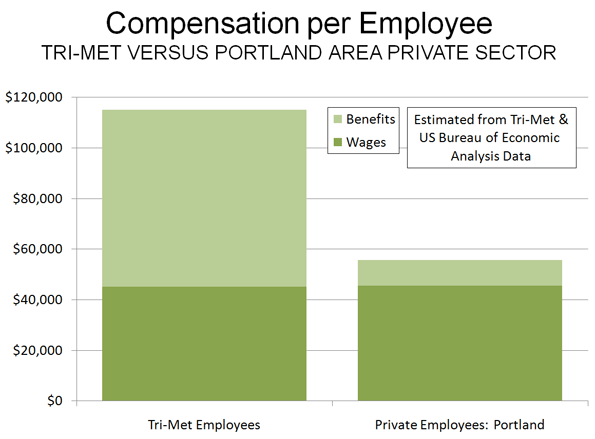
    Bloated Benefits: John Charles, President of the Cascade Policy Institute raised eyebrows when he noted that Tri-Met’s employee benefits expense is by far the highest in the nation. Charles looked at 20 large transit agencies and found that employee benefits were equal to 152 percent of the wage bill, approaching double that of the next highest, San Francisco’s Bay Area Rapid Transit District and Washington’s Metropolitan Transit Authority. With their above 80 percent employer-paid benefits ratios, albeit lower than Tri-Met’s 152 percent, these agencies have nothing to be proud of. In the private sector, employer-paid benefits tend to be less than 25 percent of wages. Tri-Met’s 152 percent is six times that.

    Bloated Compensation: With a benefits ratio of 152 percent, payroll expense per employee is a stratospheric $115,000 annually (assumes the 2008 staffing ratio, later data not identified). In contrast, the average private sector employee in the Portland metropolitan area is compensated at approximately $55,000 annually, which includes wages and a 22 percent extra for benefits (Figure 1).

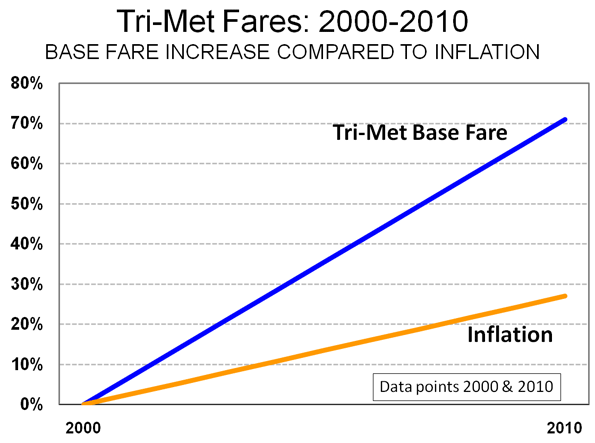
    Employees Ahead of Customers: Tri-Met implemented a fare increase in September and reduced bus service by 5.8 percent and light rail service by 3.5 percent. In the last 10 years, the basic bus fare has risen 71 percent, well above the 27 percent inflation rate (Figure 2). The fare increases and service cuts are imposing substantial hardship on many Tri-Met riders, who have limited incomes and no access to cars. The above inflationary fare increases represent a financial management failure of fundamental proportions.

    Yet while it was raising fares, Tri-Met also increased union employee compensation by three percent and covered increases of 7.5 percent to 22.5 percent on two employee health care programs. Tri-Met has admitted that these increases were not legal obligations (could this be a gift of public funds?). The cost of the non-obligatory wage increase was more than double the amount Tri-Met expects to raise from the September fare increase. Some discontinued service could have been financed with the rest of the wage increase money and the non-obligatory health care premium increases.

    Rising Costs: The question for Portland and Tri-Met remains whether this financial house of cards is sustainable. Operating and capital costs have, not surprisingly, skyrocketed. In fiscal year 2010, it is estimated that costs per passenger mile rose to more than $1.35. This is a full 40 percent above the the national transit average. This is more than five times the per passenger mile – full cost of cars and sport utility vehicles including all user costs and the portion of road expenditures (principally local streets) paid for by taxes – of less than $0.25.

    Fiscal Imprudence: Past and Future: There is some too-little, too-late good news for riders. Tri-Met has told the union that it will not cover health care benefits increases in 2011, nor will there be another non-obligatory wage increase. In its editorial opposing approval of the bond issue The Oregonian spoke of “past fiscal imprudence.” In appears that the mecca of transit is becoming less a role model and more a cautionary tale.

    Wendell Cox is a Visiting Professor, Conservatoire National des Arts et Metiers, Paris and the author of “War on the Dream: How Anti-Sprawl Policy Threatens the Quality of Life

    Photo: Mount Hood in exurban Portland (by author)

  • Living In Denial About Transportation Funding

    The reaction of various advocacy groups to President Obama’s recent call for a $50 billion stimulus spending plan for transportation infrastructure was predictable. They applauded the President’s initiative and thought that Congress should promptly approve the spending request. The benefits of investing in infrastructure are undisputable and the need for funds is urgent and compelling, they (or their press releases) proclaimed.

    But convincing the next Congress of the need to act, whether to fund the infrastructure “down payment” of $50 billion or to authorize a proposed $500 billion multi-year surface transportation program, will not be easy. Most congressional lawmakers do not perceive infrastructure as an urgent priority. They see no signs of a popular outcry about the stalled transportation reauthorization, nor do they perceive a groundswell of grassroots support for massive transportation investments.

    Indeed, what the lawmakers see is just the opposite. They witness New Jersey voters strongly approving Governor Chris Christie’s decision to cancel work on the long-planned rail tunnel under the Hudson River because, says the Governor, “the state simply doesn’t have the money” to pay for overruns in the potential $9-14 billion project. Mr. Christie, no doubt, has in mind the experience of Boston’s Big Dig which was projected in 1982 to cost $2.8 billion and ended up costing $15 billion.

    The lawmakers also see Republican candidates for governor in California (Meg Whitman), Florida (Rick Scott), Ohio (John Kasich) and Wisconsin (Scott Walker) pledging to cancel high-speed rail projects in their states if elected — and running ahead of their Democratic opponents who unanimously support President Obama’s $8 billion high-speed rail initiative. They see the public greeting with a yawn a bold and visionary Amtrak proposal to link Boston and Washington with a dedicated high-speed rail line. They read in a much noticed Sunday Times Magazine article “Education of a President,” (October 12) that the President himself thinks “there’s no such thing as ‘shovel-ready projects’ when it comes to public works.” And they hear an Administration unable to explain how the $50 billion infrastructure initiative will be paid for. When asked, a top administration official could only lamely reply “Stay tuned, we’ll let you know.”

    More evidence of public reluctance to spend on infrastructure comes from the findings of a new October 2010 survey by the Pew Center on the States and the Public Institute of California titled “Facing the Facts: Public Attitudes and Fiscal Realities in Five Stressed States.” By a large margin, respondents in five states (California, Arizona, Florida, Illinois and New York) showed a strong unwillingness to support additional transportation funding and offered to put transportation on the chopping block when asked which of their state’s biggest expenses they would least protect from budget cuts.

    It may be impolitic to suggest it, but dire warnings about the sorry state of the nation’s infrastructure seem to come largely from organized interests — stakeholders and advocacy groups. That is not to say that the nation’s transportation infrastructure has not been neglected or that America does not need better roads and transit systems. But rightly or wrongly, congressional lawmakers often discount cries about “crumbling infrastructure” as self-serving demands for more government money, often for projects that yield small economic return.

    Moreover, many lawmakers come from rural districts that experience little traffic congestion, whose roads are well maintained and which never hope to benefit from high-speed rail service. Their reluctance to spend more money on public works also has been fueled by what they see as disappointing results from the stimulus initiative. As Rep. John Mica (R-FL), ranking member of the House Transportation and Infrastructure Committee and potential future T&I Committee chairman in the 112th Congress likes to point out, more than 60 percent of the stimulus infrastructure dollars still remain unspent, while unemployment in the construction industries remains high. All this adds weight to the legislative reluctance to tackle an ambitious infrastructure spending bill any time soon.

    As one of our colleagues, a sincere and lifelong transportation advocate, put it, “the transportation community is mostly talking to itself and living in denial about the changing political mood.” That mood—in the nation at large as well as in the next Congress— is unmistakably becoming more conservative and skeptical of big government. An overwhelming 70 percent of Americans think the government does not spend taxpayers’ money wisely, according to a recent Rasmussen poll. Newly elected members of Congress will be marching to the drum of fiscal discipline and looking for ways to curb out-of-control spending, a GOP aide told us. Congress will be closely questioning costly new federal initiatives no matter how well intentioned, he added. The expansive federal-aid surface transportation program as we have known it in the past may no longer be thought politically acceptable or fiscally affordable.

    And who knows, the new mood of fiscal restraint may even infect the White House. As one senior White House adviser, quoted in the Sunday Times Magazine story, put it, “there’s going to be very little incentive for big things over the next two years unless there’s some sort of crisis.” And we doubt that by this he meant “infrastructure crisis.”

    Ken Orski has worked professionally in the field of transportation for over 30 years.

    Photo by woodleywonderworks

  • New York Political Leadership Forces Another Fare Hike

    The New York Post editorialized (October 8) against what it called “Another TWU Fare Hike,” blaming the union for the fares that will now rise to $2.50 for a ride. The editorial writer goes on to say of MTA chief Jay Walder, “It’s not his fault that straphangers get whacked while the MTA’s unionized workers — whose blue collars come with fur trim — don’t have to make a single sacrifice to meet the MTA’s shortfall.”

    In response, I posted the following comment to the New York Post site:

    Not his fault? Well, perhaps not personally. But surely it is the responsibility of the MTA and those in Albany who have skewed law labor and regulation to create this untenable situation. It is about time that public officials, such as those who run the MTA, be held account for what they have given away to the unions. The unions could not have taken it without the agreement of the MTA and other local and state political officials.

    The way the Post tells it, you might think that the Transport Workers Union (TWU) had engineered a coup and had forcibly taken control of the Metropolitan Transit Authority. It fact, it was all quite legal. Interests such as the TWU have used their political influence to obtain the expensive contracts that place the riders a distant second, after the employees and the taxpayers an even more distant third. The MTA was not compelled to sign overly expensive labor contracts. Albany was not compelled to insulate transit unions from the economic reality faced by everyone else, including private sector union members. Washington was not compelled to give transit labor unions job protections that would be the envy of European public sector unions. These protections are a considerable factor in driving expenditures up 100% (inflation adjusted) over the past 25 years, while ridership has risen only 40%. The appointed and elected representatives did so willingly, and to the detriment of the people, whom they were supposed to represent.

    The Post rightly complains about this, but places the blame in the wrong place. If the MTA, state and federal officials who have so skewed transit economics in favor of unions, had instead served the riders and taxpayers first, then New York and the nation would have much more transit services, its fares would be lower and there would be much more ridership.

    The Post also errs in saying “Only in New York could such a perverse equation come to be.” In fact, the situation is no different in most metropolitan areas of the nation. Transit agencies have routinely avoided efficiency measures that would have increased transit ridership and reduced costs (such as competitive contracting or competitive tendering of services), raised fares and cut services.

    As the process has unfolded over decades, the TWU and other local transit unions simply responded to the incentives that were established by the elected and appointed officials. This has contributed, along with extravagant and in rail transit expansions, to rendering transit financially unsustainable. The problem is that the public interest in transit has been hijacked by special interests.

    A more appropriate headline for the editorial would have been “New York Political Leadership Forces Another Fare Hike.”

  • Green Jobs for Janitors: How Neoliberals and Green Keynesians Wrecked Obama’s Promise of a Clean Energy Economy

    In August 2008, then-candidate Barack Obama traveled to Lansing, Michigan, to lay out an ambitious ten-year plan for revitalizing, and fundamentally altering, the American economy. His administration, he vowed, would midwife new clean-energy industries, reduce dependence on foreign oil, and create five million green jobs. “Will America watch as the clean-energy jobs and industries of the future flourish in countries like Spain, Japan, or Germany?” Obama asked. “Or will we create them here, in the greatest country on earth, with the most talented, productive workers in the world?”

    Two years later, the answer to that second question appears to be no. Obama’s environmental agenda is in tatters. His green jobs plan has done little to make a dent in unemployment, which persists at close to 10 percent. Obama’s signature environmental initiative, cap-and-trade, died in the Senate in July. And, during the first year of Obama’s tenure, China massively outspent the United States on clean-energy technology.

    The story of how Obama’s green agenda came up empty is more complicated than the one conventionally told by Democrats and greens, who imagine that cap-and-trade would have been transformational had Republicans and global-warming deniers not gotten in the way. In truth, the president’s strategy was flawed from the start. Cap-and-trade would not have birthed a domestic clean-energy economy — indeed, it wasn’t designed to. Meanwhile, the administration’s green stimulus spending was split between short-term, if worthy, investments in green technology, to which far too little money was allocated, and over-hyped public-works projects that would never have delivered the new industrial economy Obama promised as a candidate.

    Voodoo Economics

    Shortly before the House passed its version of cap-and-trade legislation last year, the Center for American Progress (CAP), headed by Obama transition director John Podesta, released a study claiming that the cap-and-trade bill and the stimulus combined would create 1.7 million new jobs. Democrats repeatedly pointed to the CAP report to support their jobs claims. Extrapolating from the report’s analysis, it seems that over half of the new jobs, almost 900,000, were supposed to come from building retrofits. The study’s authors apparently believed that a mere $5 billion in stimulus funding for weatherization, plus a price on carbon, would leverage $80 billion annually in private investment and lead to the retrofitting of every single commercial and residential building in America in just ten years.

    Alongside the CAP report, the Natural Resources Defense Council and the leading green jobs group, Green For All, released another study written by two of the same authors, claiming that roughly half of the jobs would benefit low-wage workers and would offer “decent opportunities for promotions and rising wages over time.” Indeed, environmentalists such as Van Jones — who had come to prominence calling upon young people to “put down those handguns and pick up some caulking guns” and briefly served as Obama’s green jobs czar — claimed that building retrofits and cap-and-trade legislation could save both the planet and the inner city.

    In reality, the stimulus’s $5 billion weatherization program, according to the Department of Energy, created or saved just 13,000 jobs during the last reported quarter. But, even if more of these jobs had been created, the idea that inner-city youth should see what are essentially janitorial jobs as a pathway out of poverty was always far-fetched. America’s black middle class emerged from the steel, ship, and automobile factories of the postwar industrial heyday. Those jobs were high-skill, high-wage, and long-term. They manufactured products that could be sold on domestic and foreign markets, and they provided the economic basis for a dramatic improvement in black America’s standard of living. Jobs retrofitting buildings and weatherizing homes are, by contrast, low-skill and short-term.

    To be fair, Democrats in Congress and White House officials always believed that while the stimulus expenditures represented a down payment on the clean energy economy, the real action would ultimately be driven by private investments in response to cap and trade, not sustained public investments in innovation and manufacturing.

    In this way the green Keynesianism that characterized the stimulus comfortably accommodated itself to the neoliberal policy predilections that have, over the last 20 years, become Democratic Party orthodoxy. Born of fashionable neoclassical economic theory and political expediency after the Reagan revolution, Democratic neoliberalism embraces the notion that private firms are better and more efficient at “picking winners,” technological and otherwise, than government. This cliche was never based on the real-world history of technological innovation or economic growth but rather upon the neoclassical assumption that governments must do a worse job than private actors since they are not motivated by profit and cannot act rationally.

    Even Jones, who spent recent years railing against neoliberal economic policies, accepts this neoliberal conceit. “The real solution to this whole thing is to put a price on carbon,” Jones told Pacifica’s Democracy Now in the fall of 2008. “The biggest economic stimulus I can imagine would be a carbon tax or a cap and trade… so that suddenly there is a market signal for private capital to start moving aggressively in a clean energy, low carbon direction.”

    But cap and trade could never deliver the millions of new jobs that Obama, Congressional Democrats, and greens promised. The primary obstacle to private sector investment in clean energy technologies is not the absence of modest carbon price signals such as those in the Congress’ cap and trade proposals and currently in place in Europe. Rather, it is the vast price gap between fossil fuels and clean energy technologies. While fossil fuels are energy dense, widely available, easy to consume, and supported by a well-developed infrastructure, the alternatives are costly, cumbersome, intermittent, or all of the above.

    Yet cap and trade enjoyed mainstream credibility for as long as it did in spite of these hard technological realities because economic models seemed to show that a rising carbon price would cause technological innovation and hence emissions reductions. Cap and traders used these models to argue that once we have a carbon price, the market would magically deliver technology innovation because private firms would have an incentive to invest to make those technologies better and cheaper.

    But the magic wasn’t in the market, it was in the models constructed by neoclassical economists, which simply assume substantial rates of technological change. Innovation — non-linear, unpredictable, and ephemeral — is understandably difficult to model. Perhaps more significantly, important innovations have as often as not been the result of public investments in technology which economists, following neoclassical doctrine, are loathe to acknowledge, much less include in their models.

    The real world gives us ample reason to be skeptical of carbon pricing claims. The European Union has had a cap-and-trade system in place since 2005, and Norway and Sweden have had carbon taxes since the early ’90s. None have spurred much innovation. On the contrary, much of Europe has been on a coal-plant-building binge over the last decade. Where European nations have advanced clean-energy technologies–whether wind in Denmark, nuclear in France, or solar in Germany–they did so through direct investments in those technologies that dwarfed the economic incentive provided by carbon pricing.

    The Ideology of Decline

    In late May, President Obama told employees at a solar panel factory in California, “I’m not prepared to cede American leadership” in clean energy. But that is in effect what his policies have done. While U.S. policymakers have fetishized carbon pricing and energy efficiency retrofitting, America’s competitors have been investing heavily to deepen their domination of solar, wind, nuclear, electric car, and high-speed rail technology and manufacturing.

    China, Japan and Korea have moved forward with aggressive plans to out-manufacture, out-innovate, and out-compete the United States in clean tech. China alone plans to spend more than $740 billion (5 trillion yuan) over the next 10 years. While neoclassical economists and their disciples in Washington have presided over the deindustrialization and financialization of the American economy, our economic competitors have used long-term investments to establish dominant positions in advanced, high value manufacturing sectors such as automobiles, electronics, information technology, and now clean tech.

    Obama too could have focused on winning a similarly long-term commitment to public investment in green innovation and manufacturing. Instead, he threw his political capital behind cap-and-trade. Despite the fact that the rising domination of key clean energy technologies by our economic rivals could in no way be attributed to a price on carbon — China, Japan, and Korea don’t even have one — Obama, his Congressional allies, and their cheerleaders in the media such as New York Times columnist Thomas Friedman, have continued to insist that cap and trade legislation was the key to reestablishing U.S. competitiveness in clean tech.

    In truth, cap and trade was conceived as a strategy to minimize the cost of reducing emissions, not to create domestic industries or jobs. Indeed, economists typically argue that government should not even concern itself with such issues. To the neoclassical mind, making microchips is no better than making potato chips, as innovation expert Rob Atkinson wryly observes. If China is better at making solar panels and we are better at making foam insulation, then we should just buy our solar panels from China. From this point of view, creating low-skill construction jobs installing compact fluorescent light bulbs in old buildings has the same economic utility as creating high-skill jobs manufacturing solar panels and nuclear reactors for export.

    Apply these assumptions to climate and energy policy, and what you get is the failed Democratic agenda. Governments should cap carbon emissions and auction the right to pollute. Doing so would establish a price on carbon pollution that will make fossil fuels increasingly expensive and thus drive private investment and consumption to efficiency and renewables. If all those solar panels and windmills get made in China — so be it. America will still lead the world in potato chips or something else.

    This is not a recipe for American economic competitiveness in clean energy technology and manufacturing. America’s nascent clean energy industries need sustained public investments to survive and prosper. While neoliberal greens and their allies were hyperventilating over the death of cap and trade, the stimulus investments in technology and manufacturing were hard at work laying the foundations for a competitive clean economy. Though overshadowed by the public works-style efficiency programs, stimulus-funded investments in clean technology arguably saved the American renewables industry, which was in free-fall after the 2008 financial crisis.

    In contrast to the green public works projects, stimulus investments in manufacturing and innovation have largely done what they were intended to do — support an embryonic domestic industry and help improve clean energy technologies so that they can become competitive with fossil fuels. Those investments helped put American clean energy manufacturing back on a competitive footing globally, and, ironically, created more jobs at less cost than the green public works investments that were supposed to put millions of Americans back to work. Already, Deutsche Bank estimates that the stimulus grew U.S. battery manufacturers production capacity from two percent of the global market to 20 percent by 2012, and the story is similar for other technologies.

    Those technologies still have a long way to go before they will be good enough and cheap enough to become the basis for a sustained American economic renewal. But the road map for getting there looks a lot more like what America began through the stimulus investments in technology and manufacturing than through the green public works programs and carbon market making that have distracted the Administration and Congress for the better part of the last two years.

    This should not particularly surprise us as the history of industrialization and technology innovation in America is the history of government investment in technology. In the postwar era, the federal government made investments in the development and commercialization of new technologies such as nuclear power, computers, the Internet, biomedical research, jet turbines, solar power, wind power and countless other technologies at a scale that private firms simply could not have replicated. Those investments “crowded in” rather than crowded out private investment and the result was high growth and prosperity that benefited virtually every American.

    Unfortunately, neither Obama nor his fellow Democrats still seem to get it. While White House officials, in the wake of the collapse of cap and trade, tout the impressive short-term accomplishments of the stimulus investments in technology and manufacturing, they have done little to date to prevent them from expiring next year.

    Change We Can Believe In

    Obama appears genuinely moved by the vision of a clean-energy economy. He seems to have convinced himself, however, that America’s energy economy can be transformed through carbon markets and efficiency retrofits.

    The president’s proposal to “make clean energy the profitable kind of energy” — which was always code for making fossil fuels more expensive — today needs to be replaced by a focused effort to make clean energy cheap through innovation. Doing so will require large, direct, and sustained federal investments in new energy technologies. This focus on innovation may seem like an indirect way to create jobs, but history shows it is also the one with the strongest record of producing whole new industries — industries that have driven America’s long-term economic expansion.

    There is a growing consensus in favor of such an effort, which includes some conservatives and Republicans who opposed cap-and-trade. Support for greater investment in energy innovation includes corporate chieftains, such as Bill Gates, GE’s Jeff Immelt, and Intel founder Andy Grove, as well as dozens of Nobel laureate scientists and energy policy experts across the ideological spectrum.

    The failure of cap-and-trade to make it through the Senate may thus turn out to be a blessing in disguise. It spares the country a program that would have done little to help either the economy or the environment. And it gives Obama and the Democrats an opportunity to reconsider how they might build the clean-energy economy they were elected to deliver. With the right policies, the answer to the question Obama posed two years ago in Lansing — will the United States lead the way in creating clean-energy jobs? — can still be yes.

    This piece originally appeared at Breakthrough Blog.

    Michael Shellenberger and Ted Nordhaus are co-founders of the Breakthrough Institute and authors of Break Through.

    Image by heatingoil
  • The Future of a Hub: Can Singapore Stay On Top of the Game?

    Viewed from a broad, historical perspective, Singapore’s position as a hub is far from inevitable or unassailable. History shows that hubs come and go. Malacca used to be the centre of the spice trade in Southeast Asia. Venice was the centre of East-West trade throughout the Middle Ages. Rangoon, now Yangon, was the aviation hub of Southeast Asia before 1962.

    Is Singapore in danger of also ceding its hub status as a result of forces beyond our control? The case of Malacca is instructive. By the 16th Century, the city on the Malay peninsula had become the most important port in Southeast Asia. It served as the bridge between the spice-producing islands of Southeast Asia and the markets in Europe and Asia. Malacca became so integral to East-West trade that a Portuguese traveller and writer, Tome Pires, proclaimed that “who is Lord of Malacca has his hand on the throat of Venice”.

    Malacca was a forerunner of the free port that Singapore was to become. It welcomed foreign merchants as well as their trade. But after the Portuguese conquest of the city in 1511, it declined as the spice hub of the region, as the Portuguese – and later the Dutch – sought to achieve monopolistic control of the spice trade. Fierce competition from neighbouring ports such as Johor meant that traders had other options. The city soon declined and today is best known as a tourist attraction.

    Half a world away from Malacca, Venice emerged as the European hub of the global trading network. For nine hundred years, Venice was a flourishing centre of trade between Europe and Asia, especially in silk, grain and spices. Geography played an important role in Venice’s rise. Its relative isolation from the mainland insulated it from the confusing and often deadly politics of the Italian states.

    Venice concentrated its resources and energies on advancing its commercial interests in distant regions. By the 13th century, Venice was the second largest city in Europe after Paris, and its most prosperous. It linked the main trade routes between Europe and Asia.

    But eventually Venice also declined. The fall of Constantinople to the Ottomans in 1453 disrupted the traditional overland trade route from Europe to Asia, forcing Europe to find alternative trade routes to the East. At the turn of the 16th century, Portugal’s discovery of a sea route to the East Indies undermined Venice’s monopoly. New ports emerged to become Europe’s main intermediaries in the trade with the East, striking at the very foundation of Venice’s wealth. With its centrality as a commercial hub broken, Venice declined and eventually fell to the Austrians in 1797.

    The Theory of Hubs

    Malacca and Venice are both examples of hubs in that first flourished and then declined as trade routes and technologies changed. Simply defined, hubs are the exceptionally well-linked nodes in a network. Malacca and Venice exploited their commanding positions in the main trade networks of their times. They consolidated their hub positions by astute diplomacy, openness to talent from elsewhere, and broadening the range of their activities beyond just trade.

    Throughout history, hubs have been the main engines of economic growth and development. Network theory provides us with insights to explain why hubs acquire wealth more easily than other nodes in a network. Today, as in the past, the world’s economic geography remains dominated by hubs which are the focal points of opportunity, growth and innovation. Firms locate where skills, capabilities and markets cluster.

    A recent study identified the existence of 40 mega-regions worldwide. They are defined as places that claim large populations, large markets, significant economic capacity, substantial innovative activity, and highly skilled talent. Many of these 40 mega-regions are formed by hub cities growing outward and into one another. Singapore is one of these hubs.

    Today, of course, air transport plays a critical role in establishing hubs. Air hubs make previously unlinked cities accessible to one another in just one or two links. Singapore is classified as a “connector” hub – it is a hub within the East Asian/Southeast Asian region, with a high number of links to cities in other regions. So in 2007, while Changi Airport was ranked 19th by the Airports Council International in terms of passenger numbers, it was ranked 6th if only international passengers are considered.

    If Singapore is a central node connecting different regions, what might undermine this position? Challenges could come from two directions. The first is competitors in the region, such as Kuala Lumpur, Bangkok and Hong Kong, as well as those from other regions, such as Dubai. Dubai is the largest aviation hub in the Middle East and is a fierce competitor for the Australia-Europe traffic. Another challenge is from long-haul flights. The same technology that allows Singapore Airlines to bypass Tokyo on flights to Los Angeles could one day allow Emirates to fly non-stop from Dubai to Sydney, and Qantas or British Airways to fly non-stop along the “kangaroo route” from London to Sydney.

    The more cities move away from the hub-and-spoke model of air transportation to point-to-point transportation, the more difficult it will be for Singapore to retain its status as an aviation hub. This is conceptually no different from Venice losing its hub status because alternative and more direct trade routes were found between markets in Europe and spice producers in the East.

    This threat underlines the importance of constantly re-inventing Singapore as a hub. It would be fatal to assume that the density of connections that we have today and the centrality that we enjoy in today’s networks – whether in air transportation, maritime, or other networks – are permanent. New technologies might create new networks with their own hubs and connectors. Whether we will continue to be a hub in the networks that emerge will depend on our capabilities, on our ability to seize early mover advantages, and on how quickly the new networks emerge.

    I think it is possible to distil five factors that determine the success and sustainability of hubs like Singapore.

    1. Establish your role early. Singapore built the first container port in the region. This gave us first-mover advantage. We exploited it, and Singapore was propelled to the front rank of global container ports.
    2. Ensure open access and maximum connectivity. Singapore under the British thrived because of its status as a free port. In contrast places like Jakarta languished under the Dutch policy of controlling and taxing trade. Being well-connected and plugged into dense networks confer far more advantage than efforts to monopolise production or to control access to resources.
    3. Capitalise on and exploit small initial advantages. The research on networks suggests that the economic development process is highly path-dependent: the choices we face today are largely shaped by the choices we made in the past and the capabilities that we have already built up. Singapore was able to become a leading petrochemicals hub because we were able to build on our early success in attracting oil refinery activities.
    4. Constantly re-invent and diversify the hub’s value proposition. In Singapore’s context, our status as a maritime hub gives us the opportunity to develop strengths in new areas that go beyond our traditional role as a port. These include ship financing, ship insurance and various ancillary activities that the shipping industry depends on. This diversification will also give us greater resilience in the face of uncertainties and rapid changes in the maritime industry.
    5. We need a strong sense of belonging. If people only see Singapore as “Hotel Singapore”, then when there is an economic downturn or other problems, they will move to where the opportunities are greater. The challenge is to maintain a core that will sustain the hub through economic cycles.

    Singapore’s continued success as a hub depends both on its connections to the world, as well as connections to its citizens wherever they may now live. Our strategic response to the limitations of our physical size must be to strengthen our hub position by boosting not only its physical connections to networks, but also in other domains – an R&D hub, an intellectual hub, and even a cultural and entertainment hub.

    To avoid the fate of Malacca or Venice, we must re-invent and re-position ourselves and stay ahead of the competition. This is the imperative that will determine our future as a city-state, as both a place and a nation.

    Peter Ho is Senior Advisor to Singapore’s Centre for Strategic Futures. Before retirement, he was the Head of Civil Service in the Singapore Government.

    Photo by Storm Crypt

  • London Special Report: The Making of the Hundred Mile City

    (Part I of II.) The writer Ford Madox Ford summarised the inventiveness of the early twentieth century in an essay The Future of London (1909) by lambasting what he called the “tyranny of the past.” “The future,” he argued on the other hand, wages a ceaseless war against the monuments of the past’.

    This debate is alive today in the battle between the emerging metropolitan reality and the nostalgia of the urban past. Ford’s dream was of a Great London ‘… not of seven, but of seventy-million imperially minded people’.

    Unlike urbanist romantics, Ford’s “Great London” presciently considered the capital in relation to its suburbs. He also refused to call them “suburbs”, which he thought derogatory, from the Latin sub urbe, meaning less than the town, and preferring instead the more ambitious fore town: “The fore town of my Great London would be on the one hand, say, Oxford, and on the other, say, Dover.”

    Ford, much like his contemporary H.G. Wells, imagined a London that extended from Winchester, the delightful country around Petersfield, Chichester, all of the coast down to Brighton, Hastings, Dover, all of Essex and round again by way of Cambridge and Oxford. “All south-eastern England,” he wrote, “is just London.”


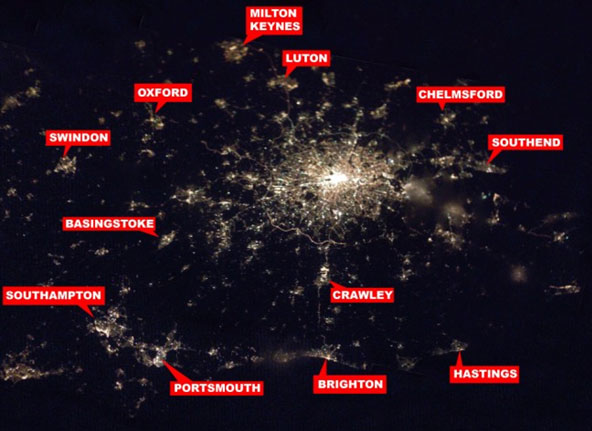
    London and the South East, seen from the night sky, shows the expansion into the South East

    Neither Utopian, nor Dystopian, Ford’s vision proved accurate. Sir Richard Rogers says as much himself, in his Cities for a Small Planet, describing London, some thirty miles wide in 1945, as a commuter belt 200 miles wide stretching from Cambridge to Southampton, and is the largest and most complex urban region in Europe. What delights Ford, appals Rogers.

    Ford was also correct that in failing to embrace change and embrace status of the fore town,. it reduced to the status of suburbs, and many opportunities were lost to create a healthier decentralized metropolis. The elements of Ford’s plan that never got off the drawing board were his proposals to “thin out” central London. Perhaps this had something to do with an eagerness to hang onto the Duke of Westminster’s slum tenements.

    It is tragic that Ford’s vision was ignored, and the real day-dream, that of a London contained, has continued to dominate policy. As a result, there is no London, as such. The city has lost all definition, as its outer edges have blurred into the dormitory towns around it. Having burst its bounds, there really is no recognisable unit called London that can be parcelled together under one name any more. The green belt cannot contain the sprawling suburbs. London has dissolved as its boundaries expand and become more porous.

    For more than a century, the London of the Londonostalgics has been a fraction of the administrative London. Victorian London outnumbers medieval London by more than six to one. Since 1965 Greater London has incorporated Essex boroughs like Walthamstow and other “railway suburbs”.

    The Londonostalgics jeer at the suburbs. ‘Barret Hutches … ‘Kennels’, ‘Lego Homes’, ‘They come in kits,’ according to Iain Sinclair. But for all that bitter condescension, London’s suburbs are where most of its population now lives. Put another way, they do not live in London at all, but Stevenage, Shepperton, or even Oxford and Brighton, commuting sometimes to work or play in the central heritage zone.

    How did London expand?

    From 1901 to 1950 the County of London’s population fell. In the 1930s the annual rate of decline was quite steady at around eight percent, but between 1938 and 1947 that climbed to 40%, reducing the County to a population of 3,245,000. By 1961 that number had reduced to 3,200,000.

    But these numbers obscure the demographic vitality of London, if viewed broadly. If one includes the many who live in the suburbs, the green belt or the outer country, the population of London has climbed to 10.6 million.

    London’s population changes continued to present a confusing picture. In 1965, Greater London incorporated parts of Essex and Middlesex to take account of the popular movement. But between 1961 and 1981 the population of this new, Greater London fell 15%, a loss of 1,186,000 people. Then in 1984, against everyone’s expectations, the direction of population movement changed again with the outer suburbs growing, and inner London once again growing, albeit modestly, between 1981 and today.

    Year

    Inner London Population

    Greater London Population

    1939

    4,364,457

    8,615,000

    1951

    3,679,390

    8,197,000

    1961

    3,492,879

    7,992,000

    1971

    3,031,935

    7,452,000

    1981

    2,550,100

    6,806,000

    1991

    2,559,300

    6,890,000

    2001

    2,859,400

    7,322,400

    2009

    3,061,000

    7,750,000

    Not only did London’s population change unexpectedly, in the opposite direction planned for in Patrick Abercrombie’s 1944 plan for the region: the outer boroughs expanded at the expense of the inner. The greater growth took place in the belt just beyond Greater London,adding another 2-3 million.

    Long before Lord Rogers sought to promote the city against sprawl, planners were trying to reverse the flow of people from London. Then why is London’s expansion so confusing?

    London’s growth combines two distinct trends. There is an underlying trend towards expansion and dispersion due to shifts in the locus of economic growth and better transport. But in the 1980s there was counter-trend of inward migration (much of it from Bangladesh) and later some gentrification in the inner city.

    The secular expansion and dispersal of London’s population can be seen in the fact that the thinning out of inner London’s population is roughly proportional to the expansion of outer London. From 1940, the same trend is expressed in the decline of Greater London’s population relative to the expansion of the outer suburbs of Surrey, Essex, Middlesex and Hertfordshire. “In each decade, the centres of growth moved a little farther out,” says Stephen Inwood, and this continues to be the pattern.


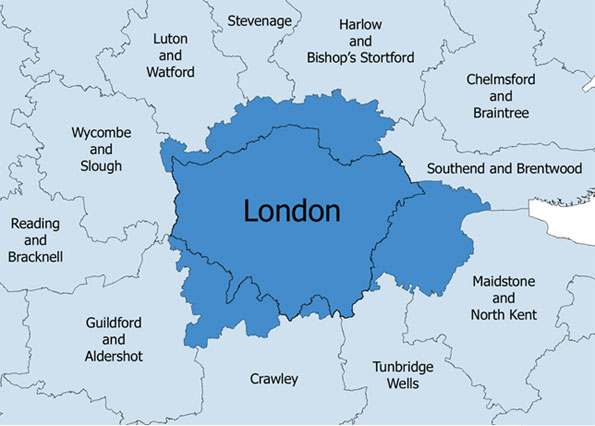
    London and its commuter belt (the ‘Travel to Work Area’, where three quarters of those working work in London) has a population of 9,294,800

    Transportation is the most important factor in dispersal. A.N. Wilson notes that even in the mid-nineteenth century the breakthrough of elliptic springs led to the “age of the carriage folk”, and that this was in turn spurring a movement out of the centre: even “the Marxes abandoned their cramped flat in Soho and moved to a variety of new-built family houses in Kentish Town on the edges of Hampstead Heath.” * So too did William Morris, in his Pre-Raphaelite phase, move from lodgings in the then run-down Red Lion Square, to Bexleyheath in Kent, where he built his celebrated Red House with Philip Webb in 1859. “He continued to curse the iniquities of railways,” writes his biographer Fiona MacCarthy, “but he was to make good use of Abbey Wood, his local station, only three miles away on the newly opened North Kent line.” * Edward Burne-Jones and Gabriel Dante Rossetti were just some of the medieval revivalists collected from the station in Morris’s specially built carriage.

    Later on, lower rail prices – “workmen tickets” – helped clerks establish themselves in Hackney, Wood Green, Hornsey, Hendon, Willesden, Balham and Camberwell. However, these same railway terminals were also adding to the overcrowding of inner London, as land was found for stations by knocking down working-class slums, or “rookeries” – with the surplus population generally moving to the adjacent neighbourhood. *

    In the early century it was electric trams and underground extensions. Historian Asa Briggs says that the slogan of the North Metropolitan Railway (extended from Baker Street to Harrow in 1880) Live in Metroland!, “showed that it was not so much satisfying existing needs as creating new residential districts.” *

    By the post-war period the South-East went through another expansion, one that was driven by the car, rather than the train, which was losing out to its more versatile rival. In 1951 the M1 to Birmingham opened just as car ownership spread among the middle classes. In 1970 the Westway took the M40 right into central London, and in 1986 the London orbital outer ring-road, the M25 was opened by the Prime Minister Margaret Thatcher.

    Greater car ownership was helping to accelerate the process of suburbanisation, coupled with the policies pursued in the 1980s of promoting home ownership (at the expense of public housing). Tories took pride in winning over “Essex Man” – the psychological construct of the aspirant working class voter. Though between 1981 and 1991 it was Cornwall, Cambridgeshire, Buckinghamshire whose population grew fastest, while those of London, Liverpool and Belfast were all stagnant or falling.

    Planners have tried again and again to restrict the growth of London, from the Abercrombie Plan of 1946 to the Urban Task Force of 1998. But just as they planned for a denser inner core and to limit outward sprawl, Londoners stubbornly have preferred the opposite. Even when they changed the boundary to include more of the suburbs and called it Greater London, the main thrust of growth had already moved further outwards into the commuter belt, and the rest of the South East. In reality, today, Oxford and Brighton, Southend and even Southampton are all part of a vast Southern conurbation. Political leaders have failed to catch up with these changes and even tried to stop them – but the change, as Ford explained, is happening with or without them.

    James Heartfield, of the development think-tank audacity.org spoke, at the Mayor’s ‘Story of London’ event on ‘Is London Growing Too Fast?’ on 5 October 2010.

    Photo: By J. A. Alcaide

  • Soccer Moms Against Rail Transit in Tampa

    On election day, the voters of Hillsborough County, Florida (Tampa) will vote on a one-cent sales tax that would fund transit (75%) and roads (25%). Part of the funding would be used to build a new light rail line, which is the focus of campaigns on both sides.

    The proponents are the usual well financed coalition of business, rail construction companies and consulting engineers, who could well profit from the program going forward.

    The opposition, however, is unusual. It is a direct outgrowth of the growing citizen involvement from the TEA Party and 912 Project. These groups have broken new ground in raising general issues of government waste and public expenditure policy. This could be an important step toward balancing the spending proclivities of special interest groups with taxpayer interests in spending no more than is necessary to provide essential public services.

    In Tampa, the rail opposition goes by multiple names, including “No Tax for Tracks” and Smartmoms. The more interesting of the terms is Smartmoms, or “Suburban Moms Against the Rail Tax.” They might have just as accurately called themselves “Soccer Moms Against the Rail Tax,” reflecting the demographic that has been so important in recent elections.

    I recall being told by a disappointed former federal official that one of his greatest disappointments was to learn that there was no constituency for economic efficiency. This may be changing, if the developments in Tampa are any indicator.

    I had the privilege of speaking at one of their rallies recently and wonder whether Tampa might represent a new birth of citizen questioning of large spending projects. Their revulsion at the “if we don’t take the federal money, Baltimore will” line of thinking was refreshing. One key to restoring a more prosperous America will be to minimize this mutual plunder, by which Washington seduces local areas to buy things they never would with their own money. A new day could be dawning.

    —-

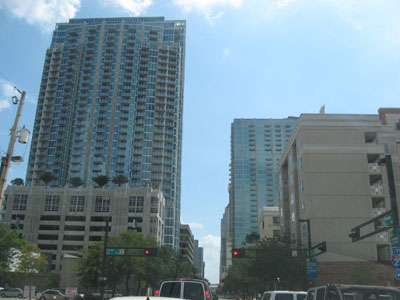
    Photo: Downtown Tampa (by the author)

  • The Hudson Tunnel: Issues for New Jersey

    New Jersey Governor Chris Christie sent shockwaves through the transportation industry on last Thursday when he cancelled the under-construction ARC (Access to the Regional Core) rail tunnel under the Hudson River from New Jersey to New York (Manhattan).

    The Governor accepted the Access the Regional Core (ARC) Executive Committee’s recommendation to “pull the plug” on the expensive project because of cost overruns. The project was to have cost $8.7 billion, but could escalate up to $14 billion according to the Governor’s office. All of any such cost overrun would have to be absorbed by the state of New Jersey, which like many other states is in dire financial straits.

    Christie said:

    “I have made a pledge to the people of New Jersey that on my watch I will not allow taxpayers to fund projects that run over budget with no clear way of how these costs will be paid for. Considering the unprecedented fiscal and economic climate our State is facing, it is completely unthinkable to borrow more money and leave taxpayers responsible for billions in cost overruns. The ARC project costs far more than New Jersey taxpayers can afford and the only prudent move is to end this project.”

    Governor Christie indicated that the project could become New Jersey’s “Big Dig,” referring to the Boston highway project that he said escalated in cost by 10 times (that is not a typo).
    Yet supporters of the tunnel were unanimous in their condemnation of Christie’s move, from Paul Krugman of The New York Times to the Regional Plan Association.

    New Jersey Senator Frank Lautenberg announced that Christie had backed down, noting his “reversal of yesterday’s decision to kill” the tunnel project. Referring to a meeting between US Secretary of Transportation Ray LaHood and Governor Christie, Lautenberg said “The Secretary was clear with Governor Christie: if this tunnel doesn’t get built, the three billion dollars will go to other states. We can’t allow that to happen.” Lautenberg listed a litany of benefits such as a reduction of greenhouse gas emissions by 70,000 tons annually. He also noted that New Jersey would have to reimburse the federal government the $300 million it had received for the tunnel. Senator Robert Menendez added that “New Jersey taxpayers don’t want to own a $600 million hole to nowhere.”

    However, under examination, it is unclear whether Christie had “reversed” his position. Christie agreed to consider “options to potentially salvage” a tunnel project based upon options (not made public) offered by LaHood. New Jersey and Federal officials will be meeting on the matter over the next two weeks. Christie, however, reaffirmed his concern about project finances, stating that” the ARC project is not financially viable “ and its expectation “to dramatically exceed its current budget remains unchanged. ” The Newark Star-Ledger cited state officials as saying that the decision does not represent a reversal of Christie’s original decision.

    Thus, everything may be up in the air. Given that, here are a few issues the state of New Jersey may like to consider as it finalizes its decision:

    1. Exaggerating the Need for the Project The new rail tunnel is to serve a purported increase in commuter rail ridership to Manhattan jobs in the future. The project’s Final Environmental Impact Statement says that Midtown Manhattan’s employment will grow from its present 2.6 million by another 500,000 by 2030. This is unlikely. Manhattan’s entire employment (not just Midtown) peaked at 2.4 million in 2008. One might expect the planners could have gotten something so simple correct. Manhattan employment remains below 2001 levels and never rose more than 35,000 even at the peak of the last boom (annual figure, from 2001). The consultants also are projecting a 1.6 million population increase west of the Hudson River (New Jersey suburbs along with the New York counties of Rockland and Orange) by 2030. However, the New Jersey and New York metropolitan counties to the west of the Hudson are more likely to grow only 1.1 million, based upon official state projections (Note). The questionable population and employment projections reveal that the “need” for the new tunnel may have been grossly overstated.

    2. Exporting New Jersey Jobs to New York Why should New Jersey pay to build more capacity so that its people can work across the state line? Why should they not work in New Jersey? New Jersey is often thought of an economic afterthought in Manhattan centric media and business interests (such as by The New York Times). In fact only a small share of New Jersey commuters travel to Manhattan for work. Even in the New Jersey counties that border New York, only 12% of commuters work in Manhattan. In the other New York metropolitan area counties in the metropolitan area, the figure drops to 5%.

    The trends here are also important. Since 1956, every new job in the New York metropolitan area has been created outside Manhattan (Manhattan’s employment is 400,000 lower now than back then). New Jersey depends on New Jersey far more than it does New York. New Jersey has developed successful new office complexes in Jersey City, New Brunswick, along the I-287 Belt Route and elsewhere. Perhaps New Jersey should seek to minimize work trip lengths and encourage the next 500,000 jobs to be created in the state rather than in New York. Downtown Newark, for example, has excellent transit access and could use substantial new employment investment. This might prove more beneficial for New Jersey and its taxpayers.

    3. Costs Could Rise Even Higher The tunnel could easily climb in cost beyond the now feared $14 billion. Big Dig cost escalation continued almost to the project’s opening. There is no reason to expect it will be different with the Hudson tunnel. It has been reported that one of LaHood’s options is simply to lower cost projections. New Jersey should buy that option only if the federal government underwrites all of the cost overruns. However, such a deviation from federal policy would bring stiff opposition from other parts of the country.

    4. The Cost of Reducing Greenhouse Gas Emissions Like so many transit projects, the reduction of greenhouse gas (GHG) emissions is raised as a benefit of the tunnel. But at what cost? Each of the 70,000 annual tons of greenhouse gas emissions removed would require a capital expenditure of $16,000. The present market price for greenhouse gases is $20 per ton. New Jersey could accomplish the same objective for just $1.4 million annually.

    The Decision Much rides on Governor Christie’s decision. It may be better for the state to have a $600 million tunnel to nowhere than a $14, $20 or $25 billion tunnel that may not really be needed. Moreover, frustration is building with Washington’s “plunder” philosophy that encourages wasting money at home, so that another state doesn’t get the chance. Digging the nation out of its present (and future) malaise seems likely to require fresher thinking than this.

    If Governor Christie musters the courage to stop this project now, it could be a shot across the bow of an international vendor and consulting engineering community that has routinely low-balled costs only to later jack them up, confident that no project would be canceled once started.

    ——–

    Note: This figure is derived using New York 2030 projections and New Jersey 2025 projections, increased by the 2020-2025 growth rate to project 2030 population.

    Wendell Cox is a Visiting Professor, Conservatoire National des Arts et Metiers, Paris and the author of “War on the Dream: How Anti-Sprawl Policy Threatens the Quality of Life

    Photo: Hudson River looking south between Lower Manhattan and Jersey City (photo by author)

  • Aussie Urban Myths

    Urban planning in Australia is lost in a dense fog of presumption and theory. What’s needed is to toss out the hype and to illuminate some of the common planning myths for what they really are: impediments to progress.

    An example of planning hype occurred not long ago when ten urban academics loudly criticised the Victorian government’s decision to develop about 40,000 hectares of new land on Melbourne’s fringe, calling the decision short-sighted and unsustainable.

    The best way to development Melbourne, they said, is to intensify redevelopment along tram and train lines and around existing activity centres, with such developments being more dense than the surrounding suburbs, but not necessarily high-rise. Their modelling suggests that the 600,000 new dwellings required by 2030 could be accommodated under four stories within the existing built-up area.

    They did confess that not everyone wants or needs to live in an activity centre or on a rail/tramline, but were adamant that a sustainable city is “one where you can get there without a car”. The future, according to them, will be “fitter rather than fatter”; where we will “live with more amenity” and have more “choice of housing type”.

    They concluded that this is a national issue because when we finally commit to a low-carbon economy, we will have these extra 40,000 undeveloped hectares which, one assumes, will act as some form of carbon sink.

    Under normal circumstances, one might be tempted to dismiss the more extreme machinations of latte-left academia, but unfortunately, some serious decision makers are starting to listen to this type of questionable commentary.

    Without doubt, a key challenge facing Australia’s major capitals is how to redevelop the middle-ring suburbs, but placing all of one’s development eggs in this basket is lunacy and is based on misguided presumptions and poor theory. In this light, it is pertinent to consider several urban myths.

    But before our myth busting, it is worth stating that infill development is more expensive than many realise, in terms of site acquisition, approval processes, infrastructure provision, and combating NIMBYism. This is reflected in the high end prices of infill stock which, in short, costs more than twice as much as broadhectare product.

    For example, the cost of a new infill dwelling (which is two bedroom/two bathroom and one car space) within five kilometres of the Brisbane CBD is $650,000. But a new detached house (around 20 kilometres from the GPO, comprises three bedrooms, study, two bathrooms, double garage and on a 500 sqm allotment) can cost $325,000. On a rate per square metre basis the infill product (including any land) is $8,000, the detached house (again including land) is around $2,000, sometimes less depending on who the builder is.

    Low affordability makes the sale of infill product often slow, even in stronger economic times. In addition, there is often a large mismatch between the product type (and size) offered in infill locations and household demographics and, importantly, the market’s aspirations.

    Our urban academics were somewhat correct on one point – not everyone wants to live in an infill development. Our experience is that demand for such product – and assuming the dwellings can be delivered at an economic price point – varies between 25% and 40% of overall demand, depending on the urban location in question. Under current conditions, the real demand, however, is around 15% at best. So from the get-go, delivering such an ambitious infill development target is extremely unlikely. In fact, it is impossible.

    Myth – higher densities will mean less traffic
    The theory is that higher densities around existing public transport networks will see a lift in public transport use and fewer cars on the road. Public transport accounts for about 10% of total trips in our major cities. Most urban metropolitan strategies aim to increase this to 20%. So, four-fifths of the trips will, at best, still be via private vehicle. Why? Because the car is much more convenient.

    Without serious infrastructure commitments to repair and upgrade the public transport networks in our cities, cars will continue to dominate. In fact, under current conditions, and somewhat ironically, infill development would lead to more traffic congestion.

    Most infill product built within Australian cities will not sell without a car space. The quality of our public infrastructure, especially outside of Melbourne, is not good enough for infill owners (or their tenants) to forgo the security of their cars. So, new infill development is increasing the number of cars on the road and often in areas which are already congested and are hard to improve from a traffic management perspective.

    One could argue that it would be better to further decentralise employment and settlement around the edges of the metropolitan area, and most obviously upgrade the existing road network.

    Academia, obviously, have never tried to sell a dwelling without a dedicated car parking space.

    Myth – urban consolidation is better for the environment
    This implicit assumption is now widespread among the media, the planning community, government agencies and in political circles. Yet the available evidence suggests the opposite.

    • Comparison between suburban houses and infill product often overlooks the number of persons per household, which is much higher in the traditional suburban detached house.
    • In traditional suburban detached homes, larger household numbers share various facilities – the refrigerator; television; washing machine; dishwasher etc., and even the lighting needed to light a room. The per capita energy, and even water consumption, is more efficient in suburbia than in more central urban locations. The “average” household size within an infill development across Australia is around 1.6 people, in detached housing it is 3.2. In most cases infill product have as many appliances as are in a detached house, yet the number of occupants living in infill product is about half that living in detached suburban homes.
    • The nature of infill housing is, in itself, prejudicial to positive environmental outcomes due to things like clothes driers (lack of outdoor drying areas), air conditioners, lifts and the need to service (lights and air-conditioning) common areas. Also, suburban development allows for wider footpaths and private yards, which in turn provide space for trees to grow. There is less opportunity for greenery – a key producer of carbon offsets – in higher density urban development.

    Not withstanding anything about the actual built form, the greatest correlation between energy and water use (and hence, environmental impact) is based on per capita income. Wealthy people consume more energy/water and thus have a bigger environmental impact. The better off are the only ones who can afford to live in infill housing.

    Research in 2007 by the Australian Conservation Foundation found that in almost all Australian cities, higher-density, infill housing produced higher per capita greenhouse emissions and had larger eco footprints than outer suburbs, notwithstanding the greater access to public transport.

    Myth – most jobs are downtown
    There is also a widespread presumption that central business districts and their immediate fringes contain the majority of jobs in a city’s economy, and are therefore the major generators of traffic. Developing housing further from the downtown area, the argument goes will only mean more congestion as commuters try to get into and out off the downtown area.

    It is easy to understand how this myth developed: the CBD/fringe holds the tallest buildings; the seat of government is often located there; so, too, are many cultural facilities; they are the hub of train/tram networks and the focus of much of our angst about traffic congestion.

    But downtown is home to around 20% of all jobs in a city’s metropolitan area (just 10%, when looking at the CBD alone. According to the latest Australian census (2006) the proportion of employment in our major CBDs (Sydney, Melbourne, Brisbane, Perth and Adelaide) ranges from 9% to 11% – thus 10% is pretty consistent). So 80% of our jobs are actually outside of the downtown area. The implications of this are profound. Our ten friends from academia are proposing a policy based on a myth: that urban dispersal of housing will mean longer commutes to work.

    The facts are that most commutes (over 90%) within a city are across suburbs and not downtown. Unfortunately, this type of travel (and the nature of the work involved) makes it impossible to service efficiently via public transport.

    So in truth, more housing on the urban fringe will not in itself lead to more inner-city congestion, but will produce more suburb-to-suburb work trips. Perhaps as a priority (and in concert with more decentralisation and suburban development), we should build better ring-road systems (and more river crossings in a city like Brisbane, for example), rather than advocating mostly infill redevelopment and heavy urban infrastructure spending.

    Michael Matusik is a qualified town planner and director of independent residential development advisory firm, Matusik Property Insights, based in the Brisbane region in Australia.

    Photo by Onlygoneanddoneit – Suziflooze & Stuart