Tag: Transportation

  • Santa Fe-ing of the World

    This is part one of a two-part piece. Read Part two.

    Human settlements are always shaped by whatever is the state of the art transportation device of the time. Shoe-leather and donkeys enabled the Jerusalem known by Jesus. Sixteen centuries later, when critical transportation has become horse-drawn wagons and ocean-going sail, you get places like Boston. Railroads yield Chicago – both the area around the “L” (intraurban rail) and the area that processed wealth from the hinterlands (the stockyards). The automobile results in places with multiple urban cores like Los Angeles. The jet passenger plane allows more places with such “edge cities” to rise in such hitherto inconvenient locations as Dallas, Houston, Seattle and Atlanta and now Sydney, Lagos, Cairo, Bangkok, Djakarta, and Kuala Lumpur.

    The dominant forms of transportation today are the automobile, the jet plane, and the networked computer. What does adding the networked computer get you? I think the answer is “the Santa-Fe-ing of the World.” This means the rise of places where the entire point of which is face-to-face contact. These places are concentrated and walkable, like villages. Some are embedded in the old downtowns – such as Adams Morgan in Washington, or The Left Bank of Paris, or the charming portions of what in London is referred to, somewhat narcissistically, as “The City.” Some are part of what have traditionally been regarded as suburbs or edge cities, such as Reston, Virginia, or Emeryville/Berkeley, California.

    Santa Fe, New Mexico, is a remarkable example of this trend. Home to a world-renowned opera, charming architecture, distinguished restaurants, great places to buy used boots, quirky bookstores, sensational desert and mountain vistas and major diversity, it is also little more than a village of 62,000, far from the nearest major metropolis.

    This “Santa-Fe-ing” means urbane well beyond the current definition of urban. It means aggregation and dispersal. As with all innovation, its impact is first seen among people with enough money to have choices.

    The logic of this hypothesis starts with the question: “In the 21st century, is there any future for cities of any kind?”

    After all, some would have us believe that with enough bandwidth, each of us can wind up on his or her own personal mountaintop in Montana, being lured down into the flatlands only to breed.

    That’s a preposterous view of human nature, of course. There’s a reason solitary confinement is a punishment. We are social animals. But still, many of the historic reasons for human concentration are gone. It’s been a century since you’ve had to live within walking distance of your factory. Today, you often don’t even need be within driving distance of your office – as anyone with a cell phone knows. You certainly don’t need a metropolis to acquire anything a dot-com is willing to sell – which is a very big deal now and growing exponentially.

    Absent a cataclysm of biblical proportions, I think this means the one and only reason for congregation in the near future is face-to-face contact. Period. Full stop. The places that are good at providing this will thrive – think Oxford, England. The ones that are not will die. Cities are not forever. You have not heard much lately from the Babylon chamber of commerce.

    There are nearly 100 classes of real estate out of which you build cities, according to William J. Mitchell, the former head of the architecture and planning department at MIT. They are all being transfigured. The classic example is bookstores. If all you want to do is exchange money for a commodity, the path with least friction is often Amazon. In backwaters where, just ten years ago, buying or even borrowing a non-best-seller was a chore that took weeks, hundreds of thousands of titles are now within one click. Does this mean bookstores have disappeared? Of course not. The half of them that have survived and even grown since the ‘90s, however, have morphed. The critical elements are no longer the shelves. They are the couches, cappuccino machines, and cafes. Bookstores have become places to loiter, face-to-face, among like-minded people.

    What about grocery stores? What happens when it becomes cheaper for the supermarket to deliver your toilet paper to you than it is to heat, light and pay rent and taxes on its store? Under what circumstances would you ever again get in your car to drive to market again? For me, the answer is that I want to have face-to-face contact with my tomatoes – or anything else you might find in a social setting like a farmers’ market. I’m not sure I’d trust the kid at the dot com to pick out my spare ribs. If the grocer wants to ship me my barbecue sauce, however, I won’t mind. Ninety-five percent of everything one finds in a supermarket is flash-frozen, shrink-wrapped, and nationally advertised. We are in the midst of a burgeoning freight revolution, in which the stuff is coming to us, rather than us going to the stuff – as anybody who has Christmas shopped lately may have noted. In fact, I can’t think of anything in an entire Wal-Mart that I would regret having delivered to me in a big brown van. Visiting a Wal-Mart doesn’t give me enough of a psychic boost to justify a drive now. Of course, if big-box retail migrates into the digital ether tomorrow, we’ll have an enormous challenge figuring out the adaptive re-use of their buildings. What will we make of them? Roller skating rinks? Greenhouses? Non-denominational evangelical churches? Artists lofts? Whatever the answer, I doubt their passing will be mourned.

    What about college campuses? Is there any future for those? After all, the University of Phoenix, the online learning establishment, became one of the hottest growth stocks of the early 21st century. Internet MBAs abound from some of the world’s most distinguished schools. Why bother ever getting out of your pajamas to learn?

    Again, the answer is face-to-face contact. After all, distance learning is nothing new. Benjamin Franklin engaged in correspondence classes. The United States military is awash in senior officers with advanced degrees from the University of Maryland, which has pioneered its outreach programs to people in remote locations.

    However, distance learning will always be everyone’s second choice. It works best for people who do not have the time or money for the conventional academic experience. First choice remains the traditional universities. Getting into them has become insanely competitive and expensive. Why are they so desirable? Because sitting in class absorbing information from a lecturer is only a tiny part of the college experience. College is where many people meet their first spouse. It’s where they develop a network of friends that they’ll likely maintain for life. It’s an entertainment center and an athletic center. Oh, and as for learning – most of the stuff that has stuck with me came out of dorm sessions at one in the morning, engaging in face-to-face contact with smart people.

    As we shall see, the impact of face-to-face on urban calculations includes office space, and even home locations. But why is this transformation occurring now?

    It all starts with Moore’s Law, first stated by Intel co-founder Gordon Moore As the core faith of the entire global computer industry, it has come to be stated this way: The power of a dollar’s worth of information technology will double every 18 months, for as far as the eye can see. Sure enough, in 2002, with a billion-transistor chip, the 27th doubling occurred right on schedule. The 30 consecutive doublings of anything man-made that we have achieved at this writing – an increase of well over 500 million times in so short a time — is unprecedented in human history. This is exponential change. It’s a curve that goes straight up.

    For sure, railroads also changed everything they touched. They transformed Europe. North America was converted from being a struggling, backward, rural civilization mostly hugging the East Coast into a continent-spanning, world-challenging, urban behemoth. New York went from a collection of villages to a world capital. Chicago went from a frontier outpost to a brawny goliath. The trip to San Francisco went from four months to six days. Distance was marked in minutes. Suddenly, every farm boy needed a pocket watch. For many of them, catching the train meant riding the crest of a new era that was mobile and national. A voyage to a new life cost 25 cents.

    Of course, as railroad expansion ran out of critical fuel – including money and demand for the services – things leveled off, and society tried to adjust to the astounding changes seen during the rise of this curve. The last transcontinental railroad completed in the United States was the Milwaukee Road in 1909. In part, that was because of the rise of a new transformative technology: The one millionth Model T rolled off the assembly line in 1915.

    In contrast, the curve predicted by Moore’s Law did not stop. The computer industry still regularly beats its clockwork-like 18-month schedule for price-performance doubling.

    The effect of Moore’s Law on the built environment is and will become ever more profound.

    For example, will we ever need offices outside our homes? After all, haven’t we all heard plenty about telecommuting?

    Sure, but how many of us have discovered with some chagrin that the most productive five minutes of our work day has occurred around the shared printer? Somebody asks what we’re working on. Conversations ensue. “Oh really? Did you know that Jane was working on something like that?” “There’s this guy you’ve got to talk to; I’ll send you his phone number as soon as I get back to my desk.” “I was just reading about that very subject; I’ll ship you the name of the book.”

    This kind of casual face-to-face contact is irreplaceable no matter how cheap or immersive video technology gets. Humans always default to the highest available bandwidth that does the job, and face-to-face is the gold standard. Some tasks require maximum connection to all senses. When you’re trying to build trust, or engage in high-stress, high-value negotiation, or determine intent, or fall in love, or even have fun, face-to-face is hard to beat.

    This would seem to argue that some old patterns endure, and that’s true. But think of the twists suggested by this new premium on human basics. Suppose you decided that you could get all the face-to-face you needed two days a week. Would that influence where you lived? Would the mountains or the shore start looking good to you? Suppose you decided that you could get all the face-to-face you needed three days a month. Would the Caribbean start looking good to you?

    Residential real estate is being transformed for these reasons. In the U.S., the explosive growth is in places far beyond any metropolitan area, like the Big Sky Country of Montana, the Gold Country of the California Sierras, the Piedmont of Virginia and the mountains and coasts of New England. For eons, when we’ve visited a nice place on vacation, we’ve asked ourselves, “Why am I going back?” Now, however, we have a new question: “Why am I going back?” Santa Fe is more than 800 miles from Los Angeles, yet it is only semi-jokingly referred to as L.A.’s easternmost suburb. To find out why, check out the nearest airport – in this case Albuquerque – any Monday morning.

    Joel Garreau is Lincoln Professor of Law, Culture and Values at the Sandra Day O’Connor College of Law and the Lincoln Center for Applied Ethics at Arizona State University. He is a fellow at The New America Foundation in Washington, D.C., and author of several best-selling books including Radical Evolution, Edge City and The Nine Nations of North America.

  • It’s the Jobs, Stupid: Infrastructure Matters

    It may surprise you to know that some policy makers and academics believe that “nothing matters” when it comes to infrastructure — the physical structures that make water, energy, broadband and transportation work — and economic prosperity. The thrust of the idea that infrastructure doesn’t matter may have started with Larry Summers, appointed by President Obama as Director of the National Economic Council in 2009. The New York Times says he is “the only top economic adviser with a West Wing office” – meaning he is very powerful in Washington terms.

    His most vocal critic in the matter of infrastructure is Representative Peter DeFazio (D-Oregon). DeFazio appeared on MSNBC’s Rachel Maddow, criticizing Summers, saying that Obama is “ill-advised by Larry Summers” in regards to using stimulus money to cut taxes for businesses. “Larry Summers hates infrastructure,” says DeFazio, who argues that more of the stimulus should have gone to infrastructure. Summers backed away from any earlier comments when he told the Financial Times last June that there may also be “a case for carefully designed support for infrastructure investment.”

    The question seems obvious. What good is it to stimulate business if they don’t have the tools they need to work with?

    Summers’s attitude could make it difficult to generate major new investments in things like roads, bridges, and the broadband communication access that businesses – small and large – need to get the job done. Companies choose to locate where infrastructure is better. Businesses will leave areas where infrastructure is missing or deteriorated – taking jobs with them.

    Certainly U.S. firms look for good infrastructure when they consider placing offices overseas, and foreign firms must do the same when they consider locating here. The idea that good infrastructure would enable economic specialization and lower costs – making U.S. businesses more efficient, more competitive, and therefore able to create more U.S. jobs – is clearly reflected in the way that businesses behave. Emerging market countries remain economically competitive, and are constantly building and rebuilding their infrastructure as their economies develop. Can the U.S. remain competitive if our infrastructure doesn’t keep up with them? It is becoming increasingly clear that deteriorating infrastructure in the United States may actually be contributing to increased costs (and decreased efficiency) of American businesses.

    Recently, the U. S. Chamber of Commerce initiated a project under the Let’s Rebuild America initiative to find a way to measure the performance of infrastructure and the role it plays in economic prosperity. Over the next year, a team of experts (of which I am a member) led by Michael Gallis & Associates will create an Infrastructure Index that can be used to explore the contribution infrastructure makes in keeping American businesses competitive in an increasingly global economy.

    What is innovative about the project team’s approach is that it measures the performance of infrastructure, and not just the size. Thirty years ago researchers on this subject limited their measurement of “infrastructure” to “government spending on public projects” to analyze the impact on economic growth and productivity. This approach is flawed for several reasons.

    First, not all money designated for infrastructure is spent the same way. Government inefficiencies and political corruption plus purchasing power in local economies contribute to inconsistency in quantity and quality of infrastructure based on money spent. Measuring infrastructure in terms of spending alone doesn’t cover the impact of growth on infrastructure. In other words, that a growing economy can afford more infrastructure is just as likely a cause of positive statistical results as the possibility that more infrastructure helps the economy grow. Further, where spending is used to measure infrastructure, the studies usually consider only public spending, ignoring the contribution of investments from private companies (e.g., the contribution of private satellites to communications infrastructure).

    Less than half of the statistical studies using expenditure-based infrastructure measures find that developing or maintaining infrastructure has significant positive effects on the economy. In contrast, over three-fourths of the studies using physical indicators – the number of phone lines, the miles of high-quality road — find a significant positive contribution from infrastructure to the economy.

    There is no dispute that economic growth is necessary as long as there is an increasing population, which will be the case over the next four decades in America as well as Canada and Australia. We need to address the question: is it possible for the economy to “hit a wall” because it runs out of usable infrastructure? In other words, the question is not if infrastructure helps the economy but rather can a lack of infrastructure impede the economy? Can the economy outgrow its infrastructure?

    As the economy changes, so will the demands for infrastructure. The four components of infrastructure – transportation, energy, water and broadband – need to be made relevant across decades, even as the role of one industry may change within the economy. For example, while it is obvious that information-workers, such as computer programmers and software developers who increasingly work from remote locations, require access to broadband infrastructure, they also alter the way that transportation infrastructure is used. Some knowledge-based activities relying on spatial agglomeration place greater importance on rail/subway and less importance on roads. Yet, that does not mean that a knowledge-based economy will need fewer roads – someone has to service those computers and that technician will likely travel to its customers on roads.

    We need to move away from the “one-size-fits-all” approach to infrastructure development toward better integration with the economic activity that uses it. Each region needs to assess its own needs and base their investment decisions on conditions that exist within their region.

    Susanne Trimbath, Ph.D. is CEO and Chief Economist of STP Advisory Services. She will be participating in an Infrastructure Index Project Workshop Series throughout 2010. Her training in finance and economics began with editing briefing documents for the Economic Research Department of the Federal Reserve Bank of San Francisco. She worked in operations at depository trust and clearing corporations in San Francisco and New York, including Depository Trust Company, a subsidiary of DTCC; formerly, she was a Senior Research Economist studying capital markets at the Milken Institute. Her PhD in economics is from New York University. In addition to teaching economics and finance at New York University and University of Southern California (Marshall School of Business), Trimbath is co-author of Beyond Junk Bonds: Expanding High Yield Markets.

  • Livable Communities and the DOT

    “Fostering livable communities…is a transformative policy shift for U.S. DOT,” announced grandiloquently the Draft U.S. DOT Strategic Plan released for public comment on April 15, 2010. But what exactly does the Administration mean by “livability” and how does it intend to translate this vague rhetorical abstraction into a practical reality?

    To get an understanding of the Administration’s intentions one must delve into the stilted language and bureaucratic jargon of its policy pronouncements, notably the “HUD-DOT-EPA Interagency Partnership for Sustainable Communities” and the above-mentioned Draft Strategic Plan. “Livable Communities,” says the latter, are “places where transportation, housing and commercial development investments have been coordinated so that people have access to adequate, affordable and environmentally sustainable travel options.” The Interagency Partnership Agreement speaks in similar vague generalities. It defines livability principles as including “more transportation choices,” “equitable, affordable housing” and “reliable access to employment centers, educational opportunities and services.” Give credit to Transportation Secretary Ray LaHood to reduce these abstract concepts to plain language. “Livability,” he said, “ means being able to take your kids to school, go to work, see a doctor, drop by the grocery or post office, go out to dinner and a movie, and play with your kids in a park, all without having to get in your car.” In other words, “livability” in the Secretary’s mind means living in a dense urban environment where walking, biking and transit are realistic alternatives to using the car.

    But this definition is too narrow for most Americans whose notion of “livability” may include living in suburban communities and enjoy such obvious amenities as a safe neighborhood, access to good schools, the privacy of one’s own backyard and the freedom, comfort, convenience and flexibility of personal transportation. If “livability” becomes a euphemism for a federal policy of favoring high density, transit-dependent living, then we are moving closely to “newspeak” when words mean whatever Big Brother intends them to mean.

    How does the Administration intend to promote its vision of “livable communities?” Again, we must turn to the dense prose of its official policy statements. “To achieve our Livable Communities agenda,” states the Draft DOT Strategic Plan, “DOT will (1) Establish an office…to promote coordination and sustainability in Federal infrastructure policy; (2) Give communities the tools and technical assistance they need so that they can develop the capacity to assess their transportation systems…; (3) Work through the Partnership for Sustainable Communities to develop broad, universal performance measures that can be used to track livability across the Nation…; and (4) Advocate for more robust state and local planning efforts and create incentives for investments that demonstrate the greatest enhancement of community livability…”

    Note that all the intended actions are process-oriented. Nowhere in the Strategic Plan can one find any indication of programmatic objectives or implementation strategies. And no wonder. The power to shape local communities (and thus enhance their livability) resides not in the hands of federal agencies but those of local citizens and their elected officials. To assume that the federal government, despite the growing concentration of power in Washington, could coerce or persuade people across this vast land to abandon their preference for suburban amenities and the convenience of personal transportation for the “livability” norms preferred by federal officials is a notion that even the most dedicated progressives of our acquaintance find unpalatable and politically unrealistic.

    A portent of the political winds affecting the future of the Administration’s “livability” initiative may be gleaned from the recent Senate appropriations committee hearing on the U.S. DOT’s Fiscal Year 2011 budget. The Administration’s request for $527 million to support the Livable Communities Program – of which $200 million is proposed to be funded from the Highway Account of the Highway Trust Fund– met with skepticism from committee members of both parties. Committee Chairman Patty Murray (D-WA) said in her opening statement that she has “serious concerns” with the $200 million coming out of the highway program. Her Republican counterpart, Sen. Kit Bond (R-MO) challenged Secretary LaHood on the Administration’s ability or propriety to influence local development patterns. “I am not confident that trusting federal decision-makers in Washington to lead the process, to tell the communities how they should grow, is the right way to go,” Bond said. He observed that livability means different things to different communities: some communities may benefit from improved transit service, while others would benefit from improved roads and increased highway capacity.

    More criticism came from the House side. Said Rep. Adrian Smith (R-NE) ranking member of the House Subcommittee on Technology and Innovation at a hearing to examine the Administration’s R&D program: “At a minimum “livability” represents a concept difficult to define and measure progress toward. More troubling, however, key aspects of the livability agenda appear to involve significant Federal government intrusion into the manner in which Americans travel and live in general.” Rep. Tom Latham (R-IO), ranking Republican on the House Transportation Appropriations Subcommittee, expressed concern over the Transportation Department’s proposal to “skim off highway dollars…and take those dollars from cities and states to fund a boutique program.”

    The transportation community has been equally critical. The American Association of State Highway and Transportation Officials (AASHTO) has gently pointed out in its new report, The Road to Livability that “While some would suggest ‘livability’ means a life without cars, this definition really doesn’t work for the millions of Americans who have chosen the lifestyles that an automobile affords. … Equating ‘livability’ only to riding transit, walking and biking, limits its relevance and excludes a wide range of improvements and community needs.”

    Blunter criticism came from the blogosphere. “At a time of unprecedented global competition, the United States DOT is overwhelmingly focused on the neighborhood level,” wrote one respected transportation professional in commenting on the Draft Strategic Plan. “This vague term [“livability”] has become the new code word for ‘smart growth’ and diverting highway funds to transit,” wrote another. “Local elected officials are best equipped to decide how best to enhance their communities’ livability. A federally-imposed standard of livability, colored by some officials’ bias against the automobile would not do justice to the diversity of our suburban nation,” wrote yet another blogger. “An astounding claim accompanied by zero evidence,” wrote Robert Poole in commenting on the Strategic Plan’s claim that a “livability” strategy that promotes reduced demand for auto travel will lower the long-run costs of transportation for the taxpayers.

    At a May 11 Brookings symposium on the “State of Metropolitan America,” Brookings researchers noted the wide and growing disparities in demographic, cultural, transportation and educational attainment characteristics of America’s metropolitan areas, disparities that defy one-size-fits-all solutions. Increasingly, policy responses will have to be tailored to the needs of individual urban areas, the researchers concluded. The Brookings report reinforced the conclusions of many other urban observers, including some on this site. The Administration’s desire to impose its own vision of how Americans should live and travel represents an anachronistic and in the end a futile gesture. The gesture is futile for, as generations of political appointees before them have discovered, policies that do not resonate with the majority of Americans seldom survive after their authors have left office.

    Flckr Photo of the US Department of Transportation after dark from
    takomabibelot: http://www.flickr.com/photos/takomabibelot/3916809758/in/set-72157622361478452/

    Ken Orski has worked professionally in the field of transportation for over 30 years.

  • Is It Game Over for Atlanta?

    With growth slowing, a lack of infrastructure investment catching up with it, and rising competition in the neighborhood, the Capital of the New South is looking vulnerable.

    Atlanta is arguably the greatest American urban growth story of the 20th century. In 1950, it was a sleepy state capital in a region of about a million people, not much different from Indianapolis or Columbus, Ohio. Today, it’s a teeming region of 5.5 million, the 9th largest in America, home to the world’s busiest airport, a major subway system, and numerous corporations. Critically, it also has established itself as the country’s premier African American hub at a time of black empowerment.

    Though famous for its sprawl, Atlanta has also quietly become one of America’s top urban success stories. The city of Atlanta has added nearly 120,000 new residents since 2000, a population increase of 28% representing fully 10% of the region’s growth during that period. None of America’s traditional premier urban centers can make that claim. As a Chicago city-dweller who did multiple consulting stints in Atlanta, I can tell you the city is much better than its reputation in urbanists circles suggests, and it is a place I could happily live.

    Yet the Great Recession has exposed some troubling cracks in the foundations of Atlanta’s success. Though perhaps it is too early to declare “game over” for Atlanta, converging trends point to a possible plateauing of Atlanta remarkable rise, and the end of its great growth phase.

    Growth Is Slowing

    As with many other boomtowns, in Atlanta growth itself has been among the biggest industries. Construction particularly played a big role in its economy. The housing crisis cut the legs from under Atlanta’s real estate machine. Though prices didn’t collapse, new home building did. From 2005 to 2009 Atlanta’s number of annual building permits fell by 66,352, the biggest decline of any metro area.

    Atlanta grew strongly in the 2000s, with growth of over 1.2 million people, a 29% rise that beat peer cities like Dallas and Houston. But look at the recent past and see a very different dynamic. Domestic in-migration has cratered, only reaching 17,479 last year, or 0.32%. While migration did slow nationally last year due to the economy, Dallas and Houston continued to power ahead. Dallas added 45,241 people (0.72%) and Houston added 49,662 (0.87%). Even Indianapolis added 7,034, but that’s 0.42% on a smaller base, meaning Atlanta is actually getting beat on net migration by a Midwest city; its in-migration rate is about on par with Columbus, Ohio, another healthy Midwest metropolis..

    The collapse in in-migration should be very worrying to Atlanta’s leadership. No new people, no new housing demand, thus no construction jobs. It should come as no surprise that Atlanta’s 10.8% unemployment rate is well ahead of the 9.7% national rate.

    The Infrastructure Brick Wall

    Last July, Judge Paul Magnuson ruled that Atlanta had been illegally taking water from Lake Lanier, the principal source of the region’s water supply. The ruling may not stick but it nevertheless has brought into focus the long term insufficiency of the water supply for Atlanta. Lake Lanier almost ran dry during a recent drought, but has since recovered in the recent wet years. The problem is more political than environmental. Atlanta has not appreciably expanded its water sources in 50 years despite all that growth.

    Atlanta has a myriad of infrastructure problems. It suffers some of the highest water and sewer rates in the nation, double those of New York City. And these are only going to get worse as the city embarks on a multi-billion dollar Clean Water Act Compliance program. This is an ominous sign for a city whose attractiveness is in large part due to its low costs. As Councilwoman Clair Muller put it, “I’m not sure being No. 1 in the country for water and sewer rates is a good selling feature for Atlanta.”

    But the biggest infrastructure issue for Atlanta is transportation. Atlanta is famous for its bad traffic and attendant pollution. Its freeways are among the world’s widest, but this disguises the extent to which the roadway infrastructure is woefully insufficient. Atlanta has a simple beltway and spoke system similar akin to Indianapolis and Columbus, much smaller cities. Other big cities like Houston, Dallas, Minneapolis, and Detroit have much more elaborate systems. In particular, rather than relying on a single ring road, these cities have webs of freeway with multiple “crosstown” routes.

    But Atlanta’s greatest road problem lies in the lack of arterial street capacity. Atlanta’s suburban arterial network is mostly former winding country roads, many of which have never been upgraded to handle the traffic demands on them. Most upgraded streets are radial routes, not crosstown ones, which forces even more traffic onto the overloaded freeway network.

    For those who prefer transit, Atlanta hasn’t invested there either. It built the MARTA heavy rail system as an extremely forward looking transportation investment, mostly in the 1970s and early 80s. This was built before Portland’s system and is far better than light rail to boot. But there has been almost no expansion of the network. The state of public transport has been largely frozen for some time. Meanwhile, Dallas, Houston, Phoenix, and others have invested billions.

    Competition Is Here

    Bad traffic congestion and other infrastructure ills didn’t matter much when Atlanta was the only game in town. For a long time, anyone who needed a presence in the Southeast found Atlanta the easy default answer. In many cases it was the only real possibility.

    That’s no longer true. Atlanta is now surrounded by upstart, much faster growing cities such as Charlotte and Raleigh-Durham in North Carolina, Nashville, Tennessee and Charleston, South Carolina – all in many ways now have the ambitions once characteristic of Atlanta.

    Atlanta’s problem lies in its insufficient differentiation from these other places. Other than the airport, a clear major asset to Atlanta, what do you actually lose by moving to Charlotte or Nashville? Your commute is likely to be less. Except for certain groups – African Americans or gays – the city seems to be losing allure.

    These other cities also have the talent to compete for a lot of the business Atlanta used to pick up without working for it. The new head of the Atlanta Regional Commission declared Atlanta’s love affair with the edge city high rises all but over. Planners always talk like this, but it is still a startling sentiment to hear in Atlanta, formerly the most boosterish of cities. That’s the sound of a city losing its mojo. Meanwhile, Charlotte chamber of commerce chief Bob Morgan says, “To understand Charlotte, you have to understand our ambition. We have a serious chip on our shoulder. We don’t want to be No. 2 to anybody.” That’s the way Atlanta used to talk.

    Caught in the Middle

    Atlanta does seem to realize it’s in a different competitive world. It must elevate its game and upgrade its product. Like Chicago and other growth stories before it, as Atlanta got big and rich, it decided it needed to get classier as well. To go for quality, not just quantity. And to embrace a more urban future for its core.

    But it might be too little, too late. Atlanta is urbanizing, but despite the huge influx of people into the city, it’s not there yet. Atlantic Station got built and attracted lots of press, but numerous other mixed use projects were killed by the poor economy. Ambitious projects like the Beltline park and transit project lack funding.

    Atlanta is left as a sort of “quarter way house” caught between its traditional sprawling self and a more upscale urban metropolis. It offers neither the low traffic quality of life of its upstart competition, nor the sophisticated urban living of a Chicago or Boston.

    Here too, Dallas and Houston continue to power ahead of Atlanta. Both are seeing significant urban infill and are also making major investments in cultural infrastructure that far outstrip those of Atlanta. For example, Dallas just opened a showplace performing arts complex, with buildings by the likes of Norman Foster and Rem Koolhaas. Houston has emerged as a dynamic multi-cultural city. Both have a long way to go, but are in a much stronger growth position to pull it off.

    Atlanta at Maturity

    Cities, like companies, go through a life cycle. There’s the youthful founding, the explosive growth phase, then maturity and, for some, decline. Chicago and Detroit were two of the huge growth stories of the industrial era, for example. Atlanta, Houston, and Dallas have been three of the boomtowns of the current age. Like other cities before them, that growth will come to an end one day. It is then that we’ll see if, like Chicago and New York, they will succeed as mature regions and truly take their place in the pantheon of great American cities, or, like Detroit or to a lesser extent Philadelphia, will decline or stagnate.

    Atlanta is far from dead, but it may be facing the beginning of the end of its growth cycle. If so, this will be the true test and measure of the greatness of that city. Will Atlanta make the grade? And how?

    Aaron M. Renn is an independent writer on urban affairs based in the Midwest. His writings appear at The Urbanophile.

    Photo by james.rintamaki

  • When Saving 90% is Not Enough: The Transit Savings Report

    The American Public Transportation Association (APTA) is publishing monthly Transit Savings Report to illustrate the purportedly great savings that can be achieved by giving up the car and traveling by transit instead. APTA compares the average cost of buying a monthly transit pass to replace a car, which is assumed to travel 15,000 miles annually.

    The latest edition was made public on April 6 and reveals astounding savings, as was reported by The Wall Street Journal and other press-release echoing press outlets. The APTA release indicates that households could save from $8,174 to $13,784 annually by giving up a car for transit in the 20 urban areas with the highest transit ridership. Overall, the APTA figures calculate to an average savings of $10,183. The APTA press release does not say how much the monthly bus pass would cost. However, our own quick survey of 17 major transit systems indicates that a monthly pass averages approximately $90 per month, or $1,080 per year. This means that getting rid of the car and riding transit instead saves approximately 90%, ($10,183 divided by [$1,080 + $10,183]) at least according to APTA (Note).

    With savings such as these, a visitor from Mars to APTA’s Fantasyland might expect that nearly all urban travel should logically be by transit rather than by cars. But, alas, no. Nothing could be further from the truth. In fact, cars, which APTA tells us cost nearly 10 times transit, account for more than 98% of motorized travel in US urban areas.

    Profligate Americans? What could possibly explain this paradox? Surely, there is plenty of evidence that Americans would much rather spend less than more on products of equal value. This has been painfully evident to “legacy” airlines that have had to lower their prices to compete with discount carriers like Southwest Airlines. Traditional supermarkets have lost hoards of customers stores like Wal-Mart or Costco over amounts that pale by comparison to the savings that APTA would have us believe are so readily available by rejecting our “love affair” with the automobile.

    Of course, the choice is not that simple. Americans no more have a love affair with the automobile than with flush toilets or refrigerators. The American (and Canadian, Australian, European and Asian) love affair is not with products, but rather with the better life style that the products make possible. People have refrigerators because they keep food fresh and prevent spoiling. Under certain circumstances, however, refrigerators are not practical, such as when one uses a cooler instead at a picnic. Transit is like that. It makes sense for some trips, but not a large share in the overall scheme of things.

    The Largest Downtowns: Where Transit Works Best: For the overwhelming majority of trips, the automobile provides much faster and generally more comfortable travel than can be made available by transit. There are times, however, when transit is superior. For example, the car is particularly impractical for commuting into crowded Manhattan, which is served by an enormous subway, commuter rail and bus system that extends to the further reaches of the metropolitan area.

    This is evident in data from the latest US Bureau of the Census American Community Survey, which indicates that transit accounts for 80% of the motorized commuter travel to Manhattan. Manhattan’s business district has nearly 2,000,000 jobs in a relatively small area, and riding transit and the average transit commute is only slightly longer than the average car commute. With Manhattan’s world class traffic, transit is a demonstrably superior competitor to the car.

    This, in reality, simply demonstrates that transit is “about downtown.” Consumer preferences demonstrate that commuting to some of the nation’s largest downtown areas is better by transit. The impressive skyscrapers can leave the impression that downtowns are dominant in metropolitan employment. However, downtowns represent only 10% of metropolitan employment. The largest downtowns are well situated for transit service, by virtue of their high employment densities and the fact that transit systems focus on them.

    These include central business districts, including New York’s Manhattan and Brooklyn, Chicago, Boston, Philadelphia and San Francisco. All of these downtown areas where transit is dominant were added together, they would cover barely one-third of the expanse Orlando’s Walt Disney World. But consumer preferences also show that the car provides superior mobility to virtually all other destinations. Our already heavily indebted public sector could not begin to provide a level of service to replicate transit’s downtown access throughout the urban area.

    Transit even has difficulty competing in the dense outer boroughs of New York City. While slightly more people commute to Brooklyn jobs by transit than by car, the reverse is true in the Bronx. Twice as many people commute to jobs in Queens by car than transit, despite the borough’s having a population density greater than that of San Francisco, the nation’s second most dense large municipality.

    Transit’s share falls off even more sharply in the suburbs of New York. Nine times as many people commuting to jobs in inner suburban Nassau County use cars as use transit. Commuters to outer suburban Suffolk County use cars 40 times as much as transit.

    Consumers make these choices not because cars are inherently superior to transit or vice versa. A commuter who lives in New Brunswick, New Jersey and works in Manhattan, usually takes a New Jersey Transit train or bus to work, because the car competes poorly for such a trip. The neighbor, however, who works in the suburban I-287 corridor takes the car, because transit cannot compete for that trip.

    It remains true that for the overwhelming majority of trips cars meet the needs of consumers far better than transit. Cars are faster and deliver people within walking distance of their destinations.

    Even the ultimate — making transit free — makes little difference. In 1990, Austin, Texas eliminated fares. Yet the share of travel in the Austin area by car declined about a quarter of one percent. For most urban travel, transit is so uncompetitive that you can’t even give it away.


    Note: None of the above should be interpreted to be an acceptance of the APTA figures. APTA assumes annual parking costs of $1,850, yet most parking outside downtowns. Some might object that there is a cost to this free parking, but to ignore its costs is quite appropriate, given that APTA’s figures do not include subsidies to transit, which would quadruple its cost. Further, APTA uses especially high costs for automobile use, which assume that everyone purchases a new car every five years. This substantially overstates the cost of cars relative to transit.

    Wendell Cox is a Visiting Professor, Conservatoire National des Arts et Metiers, Paris. He was born in Los Angeles and was appointed to three terms on the Los Angeles County Transportation Commission by Mayor Tom Bradley. He is the author of “War on the Dream: How Anti-Sprawl Policy Threatens the Quality of Life.

    Photo: New Jersey Turnpike

  • State Auditor Says Only Part of California High Speed Rail Line May be Built

    The California State Auditor’s report title says it all: High-Speed Rail Authority: It Risks Delays or an Incomplete System Because of Inadequate Planning, Weak Oversight, and Lax Contract Management.

    The report, which can fairly be characterized as “damning,” criticizes the California High Speed Rail Authority on a wide range of issues, some of which go to the very heart of the project itself.

    For example, the State Auditor says that without additional bond funding from the taxpayers, the state “may have to settle for a plan covering less than a complete corridor.” Given the financial and administrative disarray of the California High Speed Rail Authority, this is a distinct possibility, which was raised by the Reason Foundation California High Speed Rail Due Diligence Report, released in September of 2008 (co-authored by Joseph Vranich and me).

    This could produce a system that spectacularly fails to meet the promises of its promoters, while enriching the income statements mostly offshore firms that build trains and of firms that failed so spectacularly in managing the Big Dig in Boston. Martin Engel, who leads an organization of concerned citizens on the San Francisco peninsula frequently notes that the real driving force behind high speed rail is spending the money. In this regard, the California High Speed Rail Authority will deliver the goods. The vendors and consultants will get their money.

    The State Auditor also raises questions about the potential to attract the substantial private investment necessary to completing the project. This is a legitimate concern, since the California High Speed Rail Authority has raised the possibility of government revenue guarantees for private investors. This could lead to “back door” taxpayer payment of the “private” investment.

    The Authority continues to skirt legal requirements. The State Auditor notes that the “peer review” committee, ordered by state law in 2008, is still not fully constituted. This is not surprising for an agency that delayed its publication of a legally mandated business plan from two months before the 2008 bond election to days after it.

    In its response, the California High Speed Rail Authority was relegated to taking issue with the report’s title, characterizing it as “inflammatory” and “overly aggressive.” It hardly seems inflammatory and overly aggressive to point out that an ill-conceived plan is rushing headlong to failure. The State Auditor rightly dismissed the criticism saying: “We disagree. The title accurately characterizes the risks the Authority faces, given our findings.”

    This potential financial debacle could not have come at a worse time for California. California’s fiscal crisis is of Greek proportions. Economist Bill Watkins has raised the possibility of a default on debt. Former Mayor Richard Riordan has suggested bankruptcy for Los Angeles, the nation’s second largest municipality.

    Unlike many in California, Riverside’s Press-Enterprise in high-speed rail in the context of California’s bleak financial situation: The dearth of answers to basic fiscal questions suggests that taxpayers might end up paying for big financial deficiencies in the rail plans. Deficit-ridden California has better uses for public money; no list of state priorities includes dumping countless billions into faster trains.

  • The Muddled CNT Housing and Transportation Index

    The Center for Neighborhood Technology (CNT) has produced a housing and transportation index (the “H&T Index”), something that has been advocated by Secretary of Housing and Urban Development (HUD) Shaun Donovan and Secretary of Transportation Ray LaHood. The concept is certainly worth support. Affordable housing and mobility are crucial to the well-being of everyone, which translates into a better quality of life, more jobs and economic growth. Surely, much of the internationally comparatively high standard of living enjoyed by so many middle and lower income households in the United States has resulted from inexpensive housing (often on the urban fringe) and the ability to access virtually all of the urban area by quick and affordable personal transportation.

    CNT has developed an impressive website, with “tons” of data and maps that are both impressive and attractive. Maps can be adjusted to look at approximately 40 demographic indictors for “block groups” in the nation’s metropolitan areas. Block groups are neighborhoods (smaller than census tracts) defined by the Bureau of the Census and have an average population of approximately 1,500.

    CNT uses the HUD “housing burden” at 30% of household income as a maximum for affordability and further says that housing and transportation should not exceed 45%. The maps show neighborhoods that CNT finds to be affordable and not affordable by these criteria.

    But for all of its superficial impressiveness, the H&T Index is subject to serious misinterpretation and suffers from methodological flaws that neutralize the usefulness of its affordability indices.

    The H&T Index: Potential for Misinterpretation

    The H&T Index: Not a Neighborhood Index: The H&T Index is particularly susceptible to misinterpretation by ideological interests contemptuous of America’s suburban lifestyle, who would use public policy to force people to live in higher densities. While the H&T Index reports data at the neighborhood level, it is not a neighborhood index. However, the H&T Index does not compare neighborhood housing and transportation costs with neighborhood incomes. Rather, the H&T Index uses the metropolitan median household income.

    As a result, low income neighborhoods appear to be affordable, because their less costly housing is compared to the higher metropolitan area median income. Higher income neighborhoods appear unaffordable, because their higher housing costs are compared to the lower metropolitan area median income.

    Press reports, such as in the Washington Post have failed to clearly describe this issue. Without clear reporting, the H&T Index is could play into the popular fiction that suburbs are filled with households unable to cannot afford their housing and transportation. In fact, the vast majority of suburban homeowners can afford their transportation and housing and an appropriate portrayal of neighborhood data (with the corrections noted below) would illustrate this. The high level of recent foreclosures that have occurred in some suburbs are simply a reflection of the fact that “easy money” enticed some people to take on obligations that were beyond their means (just as central city developers built condominium towers that have been foreclosed upon or offered as rentals, with unit prices discounted 50% and more).

    The potential for misinterpretation is illustrated by examining three neighborhoods in Dallas County (Table 1), one low income, one middle income and one high income (2000 data).

    • The H&T Index indicates that housing costs are 8% of incomes in the low-income West Dallas neighborhood when compared to median metropolitan income. However, when the neighborhood income is used, the share of income required for housing is 57%, nearly twice the HUD maximum standard.

    It might be thought that people should move to West Dallas from the suburbs to take advantage of the low housing prices. However, any such migration would quickly escalate land prices up to eliminate any advantage (and to force the low income residents to move, as happens in “gentrifying” neighborhoods).

    • In the middle income (Garland) neighborhood, housing costs as a share of income are 24%, whether measured by the metropolitan or neighborhood income, both within the HUD 30% maximum
    • In the high income (University Park) neighborhood, CNT finds housing costs to be 102% of median metropolitan incomes. When neighborhood income is used instead, housing costs drop to 25% of incomes, well within the HUD 30% maximum.
    Metropolitan & Neighborhood Housing & Transportation Indices: 2000
    Factor Low Income Neighborhood: West Dallas Middle Income Neighborhood: Garland High Income Neighborhood: University Park
    Median Household Income: Metropolitan (PMSA) $48,364 $48,364 $48,364
    Housing Cost Share 8% 24% 102%
    Median Household Income: Neighborhood $6,989 $48,594 $200,001
    Housing Cost Share 57% 24% 25%
    Base data from H&T Index

    The H&T Index: Criticisms of the Methodology

    (1) Missing the Housing Bubble? CNT places more emphasis on transportation costs than on housing costs. This is evident in the H&T Index attention to rising transportation costs from 2000 to 2008. The housing bubble and its impact on household costs appears nowhere among the 40 indicators (Note).

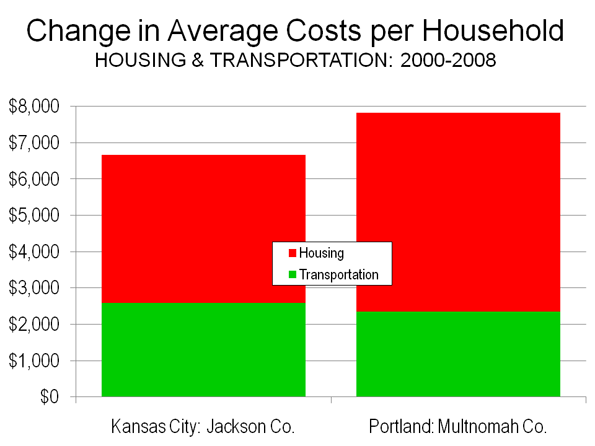
    Yet, there is every indication that housing costs have risen substantially more than transportation costs since 2000. For example, in Kansas City’s core Jackson County, the Census Bureau’s American Community Survey data indicates that the increase in average housing costs was nearly 60% greater than CNT’s transportation cost increase. In Portland’s core Multnomah County, the increase in average housing costs was more 125% greater than CNT’s estimated increase in transportation costs (Figure).

    (2) Exaggerating by Mixing Averages and Medians: The H&T Index compares average housing and transportation costs with the median household income. Averages and means are not the same things. Median income data is “middle” score, with one half of households having incomes above the median and one-half having incomes below the median. On the other hand, “average” housing costs and transportation costs are the total housing and transportation costs divided by the total number of households. High incomes and high priced housing skews averages up. Mixing medians and averages is inherently invalid. For example, in 2008, average housing costs were 19% higher than median housing costs. This means that, on average, where the H&T Index reports a 30% housing affordability figure, it is really substantially lower, at 25% (30% reduced by 19%).

    Thus, the net effect of comparing average housing costs to median incomes makes the housing element of the H&T Index worse than it really is.

    (3) Exaggerating by Leaving Some Households Out: The H&T Index excludes home owning households without a mortgage. The average housing expenditures of households without mortgages are smaller than those of households with mortgages. However, this is a material omission, since housing costs include utility payments. In Multnomah County, excluding households without mortgages raises average housing expenditures by nearly 10% (in 2008). Households without mortgages are households too. The net effect of excluding households without mortgages is to increase housing costs, making the housing portion of the index higher than it would otherwise be.

    (4) Exaggerating by Mixing Data from Different Years: The H&T Index provides 2008 estimates for neighborhood transportation costs, using modeled data. Transportation costs have surely increased since 2000, reaching their peak in 2008 due to the highest ever gasoline prices. CNT again compares these average costs to median household income, but not for 2008. CNT uses 2000 income data. In Jackson County and Multnomah counties, the use of 2000 instead of 2008 data exaggerates transportation’s share of household income between 20% and 25%.

    Each of the above methodological issues is sufficient to render H&T Index outputs to be unreliable.

    Housing’s Role in Housing & Transportation Affordability

    While both transportation and housing costs are important, housing costs have dented household budgets far more than the increase in transportation costs. Even after the house price declines of the last few years, house prices remain well above their historic ratio to household incomes. This will only get worse, if, as many expect, mortgage interest rates rise from their present lows and as rents rise to follow higher house prices.

    In contrast, transportation costs are more susceptible to reduction than housing costs. Once the mortgage is signed, the cost of the house will not be reduced. Once the lease is signed, there is little chance that the rent will be lowered. But transportation costs will be reduced in the future by the far more fuel efficient vehicles being required by Washington. Some people can work at home part of the time. People also change cars more frequently than they change houses. If costs become an issue, perhaps the next car is a compact rather than an SUV.

    CNT’s focus on trends in transportation costs rather than housing costs is consistent with its related study, Penny Wise Pound Fuelish, which advocates expansion of prescriptive land use (smart growth) policies to encourage core urban development and make much suburban development illegal. Yet, these very policies played a dominant role in driving house prices up three times as fast relative to incomes as in metropolitan areas that did not adopt them.

    Genuine advocacy for affordability requires addressing both transportation and housing costs. It also requires recognition of the significant damage done to affordability by prescriptive land use policies. An extra dollar that a household must pay for housing is just as valuable as one spent on transportation.

    All of which leaves us where we started. The nation could still use a reliable housing and transportation index.


    Note: CNT provides no 2008 data for housing costs. Such costs will not be available at the neighborhood level from the American Community Survey until 2012 or 2013. However, it would likely have been no more difficult for CNT to model updated housing data by neighborhood than it was to model 2008 data for transportation costs at the neighborhood level.

    Wendell Cox is a Visiting Professor, Conservatoire National des Arts et Metiers, Paris. He was born in Los Angeles and was appointed to three terms on the Los Angeles County Transportation Commission by Mayor Tom Bradley. He is the author of “War on the Dream: How Anti-Sprawl Policy Threatens the Quality of Life.

    Photograph: Hartford Suburbs

  • Telecommute Taxes On The Table

    The Obama Administration has recently been shining a spotlight on the need to eliminate barriers to telework and its growth. Now Congress has legislation before it that would abolish one of telework’s greatest obstacles, the risk of double taxation Americans face if they telecommute across state lines. The Telecommuter Tax Fairness Act (H.R. 2600)would remove the double tax risk.

    H.R. 2600 can and should be enacted as a stand-alone measure. However, Washington is also currently developing or considering a variety of other legislative packages, any one of which would be significantly strengthened if the provisions of H.R. 2600 were added to it. These packages include energy/climate legislation (expected to be unveiled later this month), transportation legislation and small business legislation. Each of these packages, we have been told, would double as a jobs bill.

    Telework is a critical component of any plan to create jobs, as well as any plan to improve our energy security, slow climate change, ease traffic congestion, reduce transportation infrastructure costs and boost small businesses. Congress must not miss the important opportunity that H.R. 2600 and these emerging packages provide to get rid of the tax barrier to telework.

    The Obama Administration’s Focus on Removing Obstacles
    On March 31, the White House hosted a first-of-its kind forum on workplace flexibility, bringing together businesses, employees, advocates, labor leaders and experts to talk about the importance of expanding the use of telework and other practices that enable workers to meet the competing demands of job and family. Obama identified workplace flexibility as an issue that affects “the success of our businesses [and] the strength of our economy – whether we’ll create the workplaces and jobs of the future we need to compete in today’s global economy.” Discussing a new effort within the federal government to increase the number of federal teleworkers, the President said,

    “…this isn’t just about providing a better work experience for our employees, it’s about providing better, more efficient service for the American people – even in the face of snowstorms and other crises that keep folks from getting to the office…. It’s about attracting and retaining top talent in the federal workforce and empowering them to do their jobs, and judging their success by the results that they get – not by how many meetings they attend, or how much face-time they log, or how many hours are spent on airplanes. It’s about creating a culture where, as [the Administrator of the General Services Administration] puts it, “Work is what you do, not where you are.”

    The Federal Communications Commission (FCC) is also urging greater reliance on telework. In the National Broadband Plan delivered to Congress on March 16, the FCC reported that “[m]aking telework a more widespread option would potentially open up opportunities for 17.5 million individuals.” For example, the FCC said, telework can spur job growth among Americans living in rural areas, disabled Americans and retirees. To make the telework option more available, the FCC recommended that Congress “consider eliminating tax and regulatory barriers to telework.”

    What regulatory barrier did the FCC target? The “convenience of the employer” rule – the state tax doctrine that subjects interstate telecommuters to the risk of double taxation. Specifically, a state with a “convenience of the employer” rule can tax nonresidents who telecommute part-time to an employer within that state on the wages they earn at home, even though their home states can tax the same income.

    For many people, the threat of owing taxes to two states can put a long-distance job out of reach. By making telework unaffordable for workers, the tax penalty also thwarts businesses and government agencies trying to tap the cost-saving and other economic benefits telework offers.

    The Telecommuter Tax Fairness Act would bar states from taxing the income nonresidents earn in their home states, and it would prohibit them from applying a “convenience of the employer” rule. Congress should follow the FCC’s counsel to “consider addressing this double taxation issue that is preventing telework from becoming more widespread.”

    Congressional Opportunities to Remove the Tax Barrier
    As noted above, H.R. 2600 can and should be passed as a stand-alone bill. However, Congress could also seize the opportunity to include the provisions of H.R. 2600 in the energy/climate package, the transportation package, or the small business package that lawmakers are working on, and, in the process, make that package more effective.

    How would telecommuter tax fairness strengthen energy and climate legislation? By substituting the use of broadband for the use of cars and mass transit, telecommuters conserve fuel and reduce greenhouse gas emissions. The National Broadband Plan reported that “[e]very additional teleworker reduces annual CO2 emissions by an estimated 2.6-3.6 metric tons per year. [Further, replacing] 10% of business air travel with videoconferencing would reduce carbon emissions by an estimated 36.3 million tons annually.” How can Congress enact an energy bill that does not include such savings?

    The same kind of fairness is a necessary addition to any transportation bill, because broader use of telework can slash transportation costs. By decreasing the demand for roads and rails, telework minimizes wear and tear on existing infrastructure and reduces the need to build more. As a result, telework limits the expense of repairs, maintenance and expansion. The new transportation funding bill should focus more on creating jobs laying broadband conduits and less on jobs laying asphalt. The transportation bill would also benefit from the addition of telecommuter tax fairness, because, by decreasing traffic congestion, telework decreases the hobbling cost of lost productivity.

    Small business legislation? Telework can help small firms hire new people at lower cost: Employers can increase staff without increasing real estate, energy and other overhead expenses. They can also select the most qualified applicants from the broadest geographic area while spending less on recruitment. Telework can increase company efficiency and, as President Obama noted at the workplace flexibility forum, help employers assure continuity of operations when emergencies arise. These are bottom line benefits Washington can offer small businesses without adding to the federal deficit.

    Finally, the success of any legislation designed to jumpstart hiring should include telecommuter tax fairness. It would enable the unemployed — especially those who cannot relocate because their homes are unsalable — to widen the area where they can look for work.

    The Telecommuter Tax Fairness Act was introduced by Representatives Jim Himes (D-CT) and Frank Wolf (R-VA). It has bi-partisan support from lawmakers all around the country. Stakeholders endorsing it include the Telework Coalition, the National Taxpayers Union, the American Homeowners Grassroots Alliance and the Small Business & Entrepreneurship Council, along with the Association for Commuter Transportation and Take Back Your Time. Workplace Flexibility 2010, a public policy initiative at Georgetown University Law Center, has also recommended the elimination of the telecommuter tax penalty.

    Telework is an important part of the solution to the nation’s most urgent problems, including unemployment, foreign oil dependence, climate change, clogged and crumbling travel arteries and the struggle workers face to meet their responsibilities as employees, family members and members of their communities. As federal lawmakers tackle these challenges, they should consider the Administration’s focus on getting rid of regulatory roadblocks to telework. They should heed the FCC’s call to take up the issue of the telework tax penalty, and they should finally enact the Himes-Wolf bill.

    Photo: Representative Jim Himes (D-CT)

    Nicole Belson Goluboff is a lawyer in New York who writes extensively on the legal consequences of telework. She is the author of The Law of Telecommuting (ALI-ABA 2001 with 2004 Supplement), Telecommuting for Lawyers (ABA 1998) and numerous articles on telework. She is also an Advisory Board member of the Telework Coalition.

  • Reconnecting the In-between City

    The socio-spatial landscape of what we call the “in-between city,” includes that part of the urban region that is perceived as not quite traditional city and not quite traditional suburb (Sieverts, 2003). This landscape trepresents a the remarkable new urban form where a large part of metropolitan populations live, work and play. While much attention has been focused on the winning economic clusters of the world economy and the devastated industrial structures of the loser regions, little light has been shed on the urban zones in-between.

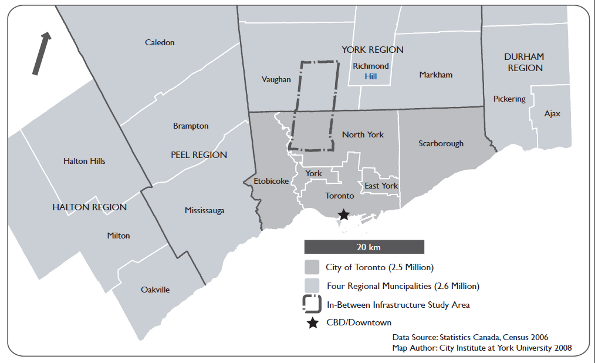
    We view this new landscape with a particular view towards urban Canada. Applying these concepts to a North American city, Toronto, Canada, we look specifically at the 85 square kilometers around York University, an area that straddles the line between the traditional suburb and the inner city.

    A politics of infrastructure
    When we speak of a “politics of infrastructure”, we refer to a growing awareness that involves political acts that produce the infrastructure policy for urban regions. We therefore follow Colin McFarlane and Jonathan Rutherford’s advice to open up “the ‘black box’ of urban infrastructure to explore the ways in which infrastructures, cities and nation states are produced and transformed together”. This “politicization of infrastructure” involves the understanding of how infrastructure policies and planning are linked to “the co-evolution of cities and technical networks in a global context” (McFarlane and Rutherford 2008: 365). The politics that produced the (public) modern infrastructural ideal for the centres and the (privatized) modern infrastructural ideals for the peripheries, largely marginalized the role of d the in-between cities of our metropolitan regions. They were left as residual spaces filled by thruways and bypasses.

    But the increased significance of these spaces today commands our attention in new and inevitable ways. In this sense, the politics of the in-between city suggests the need for a de-colonization from the forces that built the glamour zones at both ends of its existence: the urban core and the classical suburb or exurb.

    The newest – 2006 – census figures in Canada reveal that 70 percent of the population live in metropolitan areas (see note). However, within those urban areas they increasingly live outside of urban cores in a new kind of urban landscape. Interestingly, more Canadians also work in the suburban parts of metropolitan areas. The number of people working in central municipalities increased by 5.9 percent from 2001 to 2006 whereas the number of people who worked in suburban municipalities increased by 12.2 percent.

    Of course the growth of the traditional suburban kind continues, and while inner cities experience densification of office and condominium developments, much of the most dynamic growth areas are literally in-between. But the picture in the old suburbs and the enclaves is a distinctly mixed one. There are areas of aggressive expansion, for example around suburban York University in Toronto, where a New Urbanist-styled “Village at York” has added one thousand units of residential space. Yet just one block away, the Jane-Finch district continues to lose both in economic standing and demographically and remains one of the designated “priority neighbourhoods” where the City of Toronto sees much room for socio-economic improvement.

    Yet even as these in-between areas experience fast paced socio-spatial change, the realities of political and administrative power leave them marginalized. The Steeles Avenue corridor at the northern edge of the York University campus, for example, is a major east-west thoroughfare at the border of two municipalities – Toronto and Vaughan – that has enjoyed little attention from the cities’ investors and resident communities. Planners in the two municipalities have only recently begun to think about redevelopment possibilities in the corridor, but their policy-making is largely in isolation from each other. Just where the need for articulated urban infrastructure development is greatest, the capacity to act is least.

    At the same time, the linear nature of public transit and other networked infrastructure which favour either mass concentration of jobs or housing or wealthy suburban enclaves – leaves many places that lie between designated destinations in a fallow land of unsatisfactory access. This bias is corroborated by the political decision making processes.

    No politician, planner or bureaucrat will champion public expenditure in the in-between zone, particularly if they are inhabited by or provide jobs to socially less powerful groups. As a consequence, infrastructure built to connect centres actually disconnect those non-central spaces that lie in-between. While highways link smart centres and movieplexes around the urban region, blue collar workers in the widespread facilities of the sprawling suburban Toronto industrial districts rely on irregular buses or van service to get them to and from work.

    Empirically, our 85 sq km study area – partly in the City of Toronto and partly in the City of Vaughan – is home to about 150,000 people. It is a place that is rich in social and physical complexities and contradictions. Uneven access to different infrastructure is particularly visible in the poorly understood and under-recognized “in-between city.” Casting light on the infrastructure problems of the “in-between city” is a necessary precondition for creating more sustainable and socially just urban regions, and for designing a system of social and cultural infrastructure that meets community needs.

    How can renewal come to the politics of infrastructure in the in-between city? The question is how our respones to the global economic recession can effect these oft-neglected regions. Will they reinforce the ways in which the in-between areas and their dependent populations have been marginalized or will they participate in the renewal?


    Note: Census Metropolitan Areas are defined as having a population of at least 100,000.

    References
    McFarlane, Colin and Jonathan Rutherford (2008) Political Infrastructures: Governing and Experiencing the Fabric of the City, International Journal of Urban and Regional Research 32,2; 363-74.

    Sieverts, Tom (2003) Cities Without Cities. Between Place and World, Space and Time, Town and Country. London and New York: Routledge.

    Roger Keil (Dr.Phil, Frankfurt) is the Director of the City Institute at York University, the Director of the Canadian Centre for German and European Studies, and Professor at the Faculty of Environmental Studies at York University, Toronto. Keil’s current research is on the global suburbanism, infrastructure in the Zwischenstadt, on cities and infectious disease, and regional governance. Keil is the co-editor of the International Journal of Urban and Regional Research (IJURR) and a co-founder of the International Network for Urban Research and Action (INURA).

    Douglas Young is Assistant Professor of Social Science at York University where he teaches in the Urban Studies Program. He is a former architect, municipal planner and developer of non-profit housing cooperatives. He is co-author of a book about politics in Toronto, “Changing Toronto: Governing Urban Neoliberalism,” which was published in 2009 by University of Toronto Press, and co-editor of a forthcoming book, “In-between Infrastructure: Urban Connectivity in an Age of Vulnerability,” which will be published by Praxis (e) Press. His current research interests include infrastructure in the in-between city, suburban renewal, and urban legacies of socialism and modernism.

  • Transit in Los Angeles

    Los Angeles officials hope to convince Congress take the unprecedented step of having the US Treasury to front money for building the area’s planned 30 year transit expansions in 10 years instead. The money would be paid back from a one-half cent sales tax (Measure R), passed by the voters in 2008. That referendum required 35% of the new tax money to be spent on building 12 rail and exclusive busway transit lines.

    Measure R was not the first instance of Los Angeles officials committing to spend 35% of a new one-half cent sales tax on new transit lines.

    Proposition a: the Start of it All

    In 1980, County Supervisor and Los Angeles County Transportation Commission (LACTC) chairman Kenneth Hahn, whose district included low-income south Los Angeles, made a last-minute proposal (Note 1) to place a half-cent sales tax on the ballot to lower bus fares to $0.50. No funding would have been provided for rail.

    Chairman Hahn’s proposal was amended twice and adopted by LACTC (Note 2). The first amendment provided funding to municipalities to start or expand their own transit services. The second amendment (which I spontaneously introduced), dedicated 35% of the money to building a rail system (My seconder, Supervisor Baxter Ward, required excluding busways). A 10 corridor map was drawn during the meeting (see Rail Rapid Transit System above). LACTC (Note 2) approved the program, which was adopted by the voters as Proposition A in November of 1980.

    Results: The Proposition A programs met with varying levels of success (and failure):

    Bus Fare Reduction: The bus fare was reduced for three years. As a result, transit ridership at the Southern California Rapid Transit District (SCRTD), the principal bus operator, rose 40%, to its modern peak, in perhaps the largest major system ridership increase in modern history. The program was also cost effective, with a cost per new passenger of $0.56 (2008$), a small fraction of virtually any new rail system built in the United States in recent decades. Fares were raised in 1985 and one-third of the bus ridership disappeared.

    Municipal Transit Services: The more efficient municipal bus operators (such as Santa Monica, Long Beach, Gardena, Montebello and others) used the new money to expand their services and ridership. Other jurisdictions established new local services, usually provided more cost-effectively by private operators under competitive contracts (costs average 40% less per hour).

    Rail Program: As it turned out, LACTC grossly over-promised on the its rail system. By 1990, only four lines were either completed or under construction but there was no money for the rest. Another half cent tax was approved by the voters to finish the job. By 2008, six lines were completed or under construction, still short of the 1980 promise. During the interim, two new exclusive busways had also been added to the system. The 2008 referendum, Measure R, would finish the job, and more, by building 12 new rail or exclusive bus lines.

    Nonetheless, approximately 300,000 people ride the metro and light rail trains of the Los Angeles County Metropolitan Transit Authority (formerly the Southern California Rapid Transit District) every day. Some MTA officials have even suggested that this decade’s modest growth in Los Angeles traffic congestion has resulted from people giving up their cars to ride the rail lines.

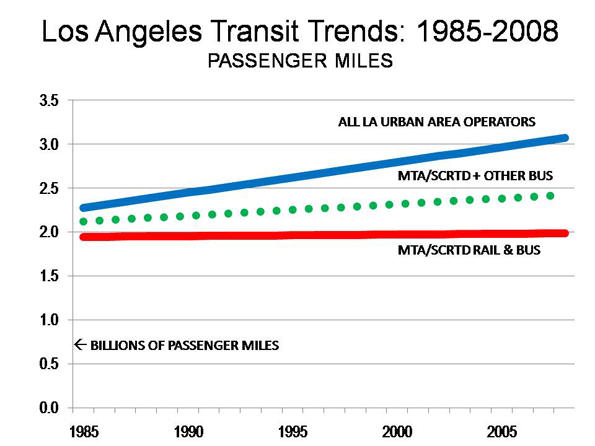
    The Results: The reality is quite different. Even when gasoline prices peaked at nearly $5.00 per gallon in 2008, total MTA bus and rail ridership was 5% below 1985 levels, indicating that for each new rail rider; at least one former bus rider had abandoned transit. Daily bus ridership dropped more than 300,000 (Table 1).

    Moreover, traffic congestion growth slowed during this decade Los Angeles not due to a shift to transit (there wasn’t one), but because of its anemic population growth, with Los Angeles County adding only one-quarter the number of new residents during the 2000s as had been forecast. The Los Angeles metropolitan area (including Orange County) also had the highest rate of domestic outmigration in the nation from 2000 to 2009, losing at a rate one-third greater than Detroit. Employment in Los Angeles County was at the same level in 2008 as in 2000.

    Table 1
    MTA/SCRTD Ridership, Costs and Fare Recovery: 1985-2008
      1985 2008 Change
    Unlinked Trips (Millions)             497          474 -5%
    Passenger Miles (Millions)          1,947      1,989 2%
    Operating & Annualized Capital Costs (Millions)  $      1,077  $  1,775 65%
    Cost per Passenger Mile  $        0.55  $    0.89 61%
       Bus: Cost per Passenger Mile  $        0.55  $    0.77 38%
       Light Rail: Cost per Passenger Mile  $    0.85
       Metro: Cost per Passenger Mile  $    1.81
    Fare Ratio 23% 19% -19%
       Bus: Fare Ratio 23% 25% 5%
       Light Rail: Fare Ratio 11%
       Metro: Fare Ratio 8%
    Bus capital costs estimated using national ratio from APTA Transit Fact Book
    Rail capital costs estimated from mid-year of project construction (discounted at 7% over 30 years)

    The Costs: Rail systems are often promoted for their “cost-effectiveness.” However, these claims always exclude the cost of capital (building the system and buying the vehicles). Capital costs are far higher for rail systems than for buses. Los Angeles is no exception. It is estimated that SCRTD/MTA annual capital and operating costs rose 65% from 1985 to 2008, adjusted for inflation, in large measure due to the rail services. Bus riders pay double or triple the fares in relation to costs as rail riders (Table 1).

    With Other Bus Operators: Ridership Up, Market Share Down:

    Los Angeles is somewhat unique as a metropolitan area in having a large number of transit operators. So, even as the MTA/SCRTD system grew, the other bus systems expanded more rapidly. This was made possible by their more cost-effective operation and, especially among the newer systems, the use of competitive contracting (contracts with private operators) to reduce costs even more. In 2008, for example, more than 35% of the county’s bus service was provided by operators other than MTA. Approximately 85% of the added transit usage (passenger miles) from 1985 to 2008 was from the bus services of these other operators.

    Overall transit ridership increased in the Los Angeles urban area, with the new five-county Metrolink commuter rail system contributing substantially to the increase as well. The neighboring Orange County Bus system doubled its ridership, while rejecting rail (Figure). Even so, transit’s market share in the Los Angeles urban area declined nearly 10% from 1985 to 2008 (Table 2).

    Table 2
    LOS ANGELES URBAN AREA ROADWAY & TRANSIT DATA
      1985 2008 Change
    Annual Roadway Passenger Miles    114,590   168,219 47%
    Annual Transit Passenger Miles         2,279       3,071 35%
    Roadway & Transt Passenger Miles    116,869   171,290 47%
    Transit Market Share 2.0% 1.8% -8%
     
    Freeway Lane Miles         5,310       6,992 32%
    Vehicle Miles per Freeway Lane Mile       13,487     15,037 11%
    Average Congestion Delay (Peak Period) 27% 49% 81%
    Los Angeles urban area includes Mission Viejo urban area.
    Metrolink commuter rail system: 75% of passenger miles estimated in Los Angeles urban area.
    Annual passenger miles in millions

    Prospects: The Next 30 Years

    Los Angeles has again committed to a major expansion of transit service, despite the fact that the Metro and light rail lines have done little more than siphon ridership from buses. There is little to suggest that the future will be any more successful than the past.

    • MTA, like LACTC before it appears to have over-promised on transit expansion. 35% of a half-cent sales tax is no more likely to finance a 12 line expansion today than a 35% share could fund an 11 line expansion in the 1980s and 1990s.
    • Nonetheless, new transit lines will be built. These Measure R expansions are likely, however, to be no more successful in reducing traffic congestion than the earlier rail expansions.

    Further, funding the Measure R rail system is likely to be more challenging. The original Proposition A was followed by decades of growth, which generated rising tax revenues. Now, however, both LA’s population and employment growth have ground to a standstill. The rosy revenue forecasts are not likely to be achieved, which should be a matter for concern among not only local officials, but to the federal taxpayers being asked for a hefty advance.


    Notes

    1. LACTC had held hearings on a proposed ballot initiative, but a consensus had developed that no referendum would be placed on the ballot in 1980. Chairman Hahn surprisingly called a special meeting of LACTC just before the deadline for submitting a measure to the ballot.

    2. LACTC was the principal transportation (transit and highways) policy body in Los Angeles County from 1977 to 1993. By state law, the commission included the mayor of Los Angeles, the five county supervisors (county commissioners), the major of Long Beach, two elected officials from smaller cities, and two additional appointments by the mayor of Los Angeles. Mayor Tom Bradley routinely appointed a city council member to LACTC and a private citizen (three times the author of this article). In 1992, LACTC and SCRTD merged into the Los Angeles County Metropolitan Transportation Authority (MTA), which has a similarly composed board of directors.

    Illustration: 1980 Proposition A Rail Map (Los Angeles County Transportation Commission)

    Wendell Cox is a Visiting Professor, Conservatoire National des Arts et Metiers, Paris. He was born in Los Angeles and was appointed to three terms on the Los Angeles County Transportation Commission by Mayor Tom Bradley. He is the author of “War on the Dream: How Anti-Sprawl Policy Threatens the Quality of Life.