Tag: Transportation

  • Former Hawaii Democratic Governor Urges Trump to Stop Funds for Honolulu Rail

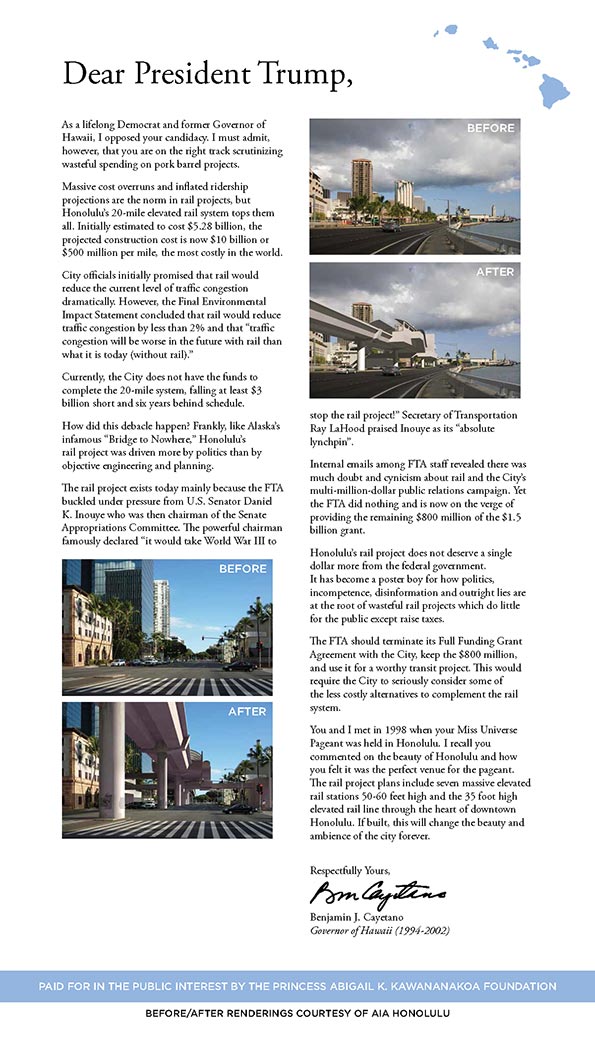
    A full page ad in today’s Washington Post (April 21, 2017) featured former Democratic Governor Benjamin J. Cayetano asking President Trump to stop further funding for the Honolulu rail project. The project has ballooned in cost from $5 billion to $10 billion, with most of the funding coming from local sources. There are serious concerns about the ability of Honolulu or Hawaii to afford completion of the project. Cayetano says that the line will be the most costly in the world. A proof of the ad is below and a pdf is available here.

    Several Newgeography.com articles have followed this issue:
    http://www.newgeography.com/content/005156-live-honolulu-hart-rail-a-megaproject-failure-making
    http://www.newgeography.com/content/002316-honolulu-mega-rail-project-a-micro-city
    http://www.newgeography.com/content/005410-honolulu-rail-from-46-b-86-b-eight-years-now-what
    http://www.newgeography.com/content/005257-honolulu-rail-it-just-keeps-getting-worse
    http://www.newgeography.com/content/002719-honolulu%E2%80%99s-money-train
    http://www.newgeography.com/content/001912-honolulu-rail-costs-balloon-ridership-projections-called-high

  • Should Transit Fares Cover Operating Costs?

    Maryland has long had a state law requiring transit systems to collect enough fares to cover at least 35 percent of their operating costs. While it is admirable to set a target, this particular target is disheartening for two reasons.

    First, 35 percent is a pretty low goal. The 2015 National Transit Database lists 48 transit operations that cover between 100 and 200 percent of their costs, including New York ferries, the Hampton Jitney, several other bus lines, and a bunch of van pooling systems. No rail lines cover 100 percent of their operating costs, but BART covers 80 percent, Caltrains covers 72 percent, New York and DC subways cover 64 percent, and New York commuter trains cover 60 percent. On average, commuter bus and commuter rail systems earn half their operating costs. So 35 percent lacks ambition.

    Even worse, most Maryland transit operations don’t come close to meeting the target. Maryland commuter trains cover 45 percent of their costs. But Baltimore’s light rail only covers 17 percent, and its heavy rail covers a pathetic 13 percent. Standard bus service also covers just 13 percent of its costs, though commuter buses come closer to the target, reaching 28 percent.

    Maryland lawmakers have figured out a solution to the second problem, if not the first. They simply passed a bill abolishing the target. Now, transit advocates hope, the state can spend even more money building obsolete transit systems that won’t be able to afford to maintain because they can’t even cover a third of their operating costs.

    Transit is “not profitable,” said one advocate, “but it’s essential for an economically competitive region.” Just how economically competitive has Baltimore been since it sunk billions of dollars into light- and heavy-rail lines that don’t cover even a fifth of their operating costs? Maryland certainly won’t make itself more economically competitive by increasing the tax burden still further so they can build more obsolete transit lines.

    Failing to cover costs isn’t a symptom that you are economically competitive. It is a symptom that you’ve failed to provide things that people need and want. The Antiplanner can understand why people think we need to subsidize food stamps or other aid to low-income people. I can’t understand why people think nothing of throwing huge amounts of money towards marketable operations like transit.

    C. Northcote Parkinson, the author of Parkinson’s Law, said that organizations that set goals low so they would be easy to meet were suffering from a disease he called injelititis. The transit industry has been suffering from this disease since the mid-1960s, when it discovered it could live off the public trough rather than actually have to provide services that people want. Once this disease reached its late stages, he said, the only cure required “a change of name, a change of site, and an entirely different staff.”

    There’s still a chance that Maryland’s governor may veto the bill. Let’s hope he does.

    Randal O’Toole is a senior fellow with the Cato Institute specializing in land use and transportation policy. He has written several books demonstrating the futility of government planning. Prior to working for Cato, he taught environmental economics at Yale, UC Berkeley, and Utah State University.

    Photo: By AndrewHorne (Own work) [Public domain], via Wikimedia Commons

  • Bay Area Residents (Rightly) Expect Traffic to Get Worse

    In a just released poll by the Bay Area Council a majority of respondents indicated an expectation that traffic congestion in the Bay Area (the San Jose-San Francisco combined statistical area) is likely to get worse.

    It is already bad enough. The Bay Area includes two major urban areas (over 1,000,000 population), with San Francisco ranked second worst in traffic congestion in the United States, closely following Los Angeles. In San Francisco, the average travel time during peak travel hours was reported to be 41 percent worse due to traffic congestion, according to the 2015 Annual Mobility Report from the Texas A&M Transportation Institute. That means a trip that would normally take 30 minutes without congestion stretches to 42 minutes. Los Angeles is only slightly worse, where the travel time congestion penalty is 43 percent. In the adjacent and smaller San Jose urban area, congestion adds 38 percent to travel times, tying with Seattle as third worst in the nation.

    According to a Mercury News article by George Avalos, “The Bay Area’s traffic woes are so severe that more than two-thirds of the region’s residents surveyed in a new poll are demanding a major investment to fix the mess — even if that means stomaching higher taxes.” Residents perceive the problem as an “emergency that requires drastic solutions,” and 70 percent of those asked support a “major regional investment” to improve traffic.

    Those who expect traffic congestion to get worse are probably right. Public policies in California and the Bay Area virtually require it. For example, the state has proposed a “road diet” program that would place significant barriers in the way of highway capacity expansion. Without capacity expansion, traffic is likely to only get worse.

    The regional transportation plan (Plan Bay Area), adopted by the Association of Bay Area Governments and the Metropolitan Transportation Commission, seeks significant densification (called “pack and stack” by critics). Should the plan succeed, you can bank on traffic congestion getting even worse. It is no coincidence that Los Angeles, San Francisco and San Jose have the worst traffic congestion in the nation. They are also the nation’s three densest urban areas. Indeed, higher densities are associated with greater traffic congestion.

    There are, of course, things that can be done. But no one in the Bay Area should suspect that California, with its present policies, is up to the job.

    Take, for example, the newly announced plan by Governor Brown and legislative leaders to spend $52 billion over the next 10 years on transportation, much of it on roads. The program would require the largest increase in the state’s gasoline tax and vehicle fees in history. It will all go to repairs and maintenance, which are necessary, and to transit, walking and bike infrastructure. Yet, according to press reports, it contains nothing for the highway capacity expansions required for serious congestion relief.

    It is a sad commentary that the state has been deferring maintenance on the roads that carry more than 98 percent of the state’s surface (non-airline) travel, while continuing to pursue a mixed conventional-high- speed rail proposal that, at the moment, is set to cost $64 billion. If ever finished, it will probably cost much more and will be lucky to carry even one percent of California travel (See note).

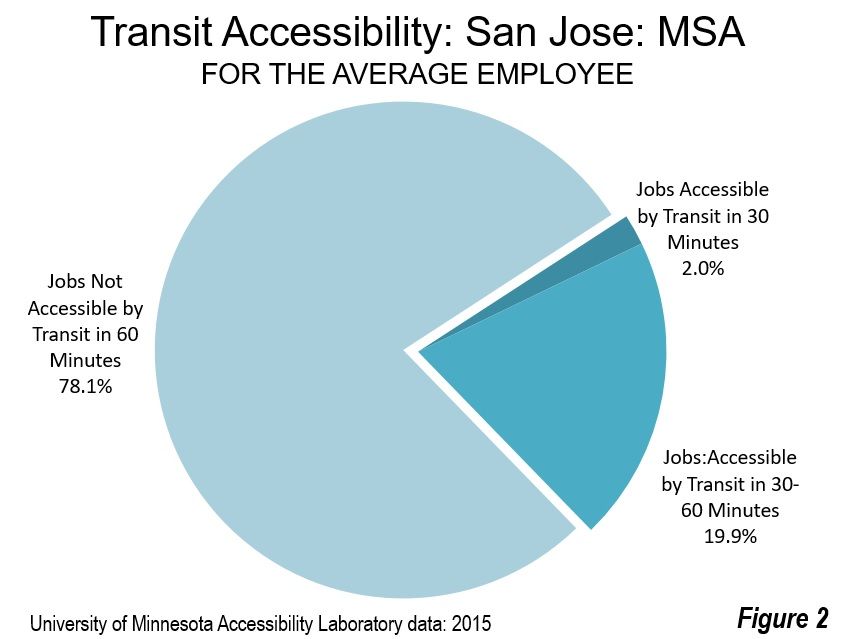
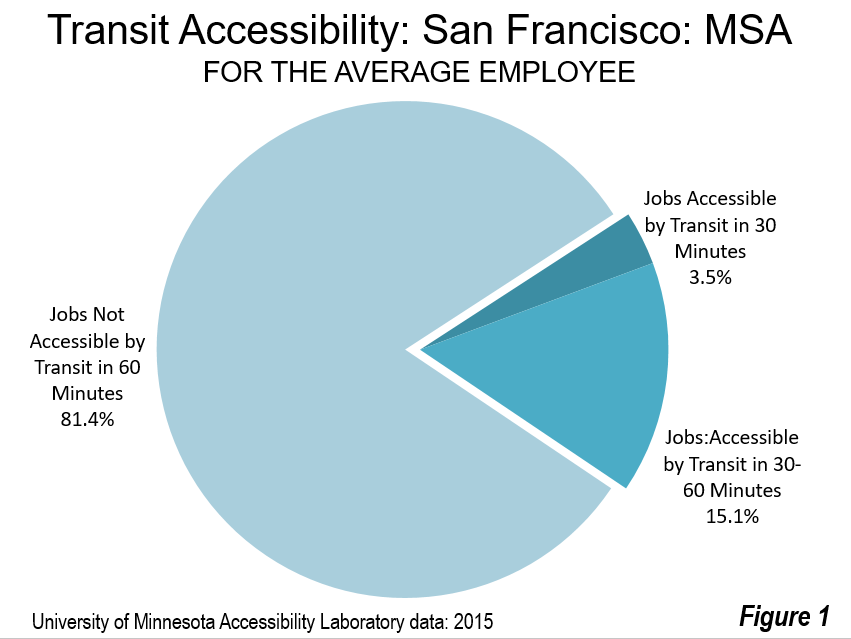
    Some may romantically anticipate that transit can substitute for the automobile and reduce traffic congestion. This is fantasy, as the US experience with urban rail proves. For the most part, transit cannot get you from here to there in the modern metropolitan area. In the Bay Area, the average commuter using transit can reach only 3.5 percent of the jobs in 30 minutes in the San Francisco metropolitan area and 2.0 percent of the jobs in the San Jose metropolitan area (according to the University of Minnesota Accessibility Laboratory). Even with a 60-minute commute, the share of jobs accessible in both areas is only about 20 percent. Even where transit is most intense in the San Francisco Bay Area, the average commuter can reach 16 times as many jobs in 30 minutes and eight times as many in 60 minutes (Figures 1 and 2). That is not to minimize the value of transit, which carries 50 percent of commuters to the nation’s six largest downtown areas (New York, Chicago, Philadelphia, San Francisco, Boston and Washington). But in each of these metropolitan areas the overwhelming percentage of jobs are outside downtowns, where the overwhelming share of commuting is by car.

    The hope of some planners that traffic will get so bad people will switch to transit requires service that takes people where they want to go. They must still be wondering why people persist in driving their cars that take them where they need to go instead of switching to transit that takes them where planners would like them to go. Of course, the reality is that transit provides little mobility beyond the urban core and cannot be made to do so at any reasonable cost.

    The bottom line is that traffic congestion can get considerably worse. In Bangkok and Mexico City, traffic congestion is at least 70 percent worse than in the Bay Area, according to the Tom Tom Traffic Index. This is despite much lower automobile ownership rates.

    The survey indicated another alternative for those who really cannot stand the Bay Area’s unbearable and worsening traffic congestion. Move. The Bay Area Council found that 40 percent of respondents and 46 percent of Millennials are considering moving from the area in the next few years.

    Indeed, that is beginning to happen. After a five-year respite in the Bay Area’s substantial net domestic out-migration, 26,000 more people left than arrived in 2016. The big loser was Santa Clara County (a net loss of 21,000), while San Francisco County (city) lost 7,000. Between 2000 and 2009, the Bay Area had lost more than 500,000 net domestic migrants.

    For the millions who will remain in the Bay Area, however, moving is not a solution. Of course, a dawn of reason could occur among the leadership of California and the Bay Area, in which ideologically preferred solutions are replaced by practical strategies that work. Things will probably have to get much worse for the public to demand that.

    Note: See my co-authored reports with Joseph Vranich, The California High Speed Rail Proposal: A Due Diligence Report (2008), and California High Speed Rail: An Updated Due Diligence Report (2012).

    Wendell Cox is principal of Demographia, an international public policy and demographics firm. He is a Senior Fellow of the Center for Opportunity Urbanism (US), Senior Fellow for Housing Affordability and Municipal Policy for the Frontier Centre for Public Policy (Canada), and a member of the Board of Advisors of the Center for Demographics and Policy at Chapman University (California). He is co-author of the “Demographia International Housing Affordability Survey” and author of “Demographia World Urban Areas” and “War on the Dream: How Anti-Sprawl Policy Threatens the Quality of Life.” He was appointed to three terms on the Los Angeles County Transportation Commission, where he served with the leading city and county leadership as the only non-elected member. He served as a visiting professor at the Conservatoire National des Arts et Metiers, a national university in Paris.

    Photo: City of San Francisco (by author)

  • Urban leaders should plan for the public transit of the future

    Self-driving, automated cars are coming. There will be teething pains in many forms: Some people will want highly automated vehicles while others will fear them. Some will be privately owned, and others will be taxis and shuttles for use by different people every day.

    What’s largely unappreciated yet important is that leaders in urban regions need to prepare for two separate, competitive streams of vehicle automation. One stream lets automation assist the driver. A second stream has no driver. Not recognizing the distinction can result in confused predictions and ineffective public policy.

    Stream 1, the advanced self-driving car that still has a human driver at the wheel, will be in auto dealerships around 2020. Early innovative versions in high end cars, such as Tesla with Autopilot, or Volvo with Pilot Assist, can be purchased now. In the early 2020s, driver assistance technology in all price ranges will be astonishing, making driving on limited-access highways safer, more comfortable, and safely supportive of a lower but still mindful focus of attention while operating a car. On urban streets with crossings, signals, left turns, driveways, double parking, bicycles, and pedestrians, automated driving will arrive later.

    Sophisticated assistance to drivers is mostly what vehicle automation represents for the next decade: cruise control on steroids. Automatic, radar-activated braking will reduce collisions with pedestrians, bicycles, and other motor vehicles. Making collisions impossible is today’s engineering goal as older cars are retired from the consumer fleet.

    The Highway Loss Data Institute (HLDI) has already found that today’s very early versions of front crash prevention systems lead to insurance claim rates that are 10 to 16 percent lower for vehicles equipped with both driver alerting and automated braking, and 7 to 22 percent lower for vehicles equipped with a warning system only.

    Stream 1 automation for many more years will still require that a human driver remain awake and responsible for the inevitable situations that automated control fails to handle, such as new roadway sinkholes that electronic maps and in-car sensors do not notice and behavior of other motorists that is unusual, sudden, and irrational.

    However, levels of driver distractions like those that now commonly occur –– looking away from the road for over two seconds, for example — will be more safely tolerated in future semi-automated cars. This level of distraction is so pervasive a human condition, indeed, that meeting zero fatality goals will be impossible without robotic autonomy that compensates for the error of insufficient driver attention. Rear-end collisions and drifting out of lane—commonplace with today’s smart phone distractions—are going to be snuffed out via automated driver assistance as older cars are retired from service.

    Stream 1 promotes continued vehicle ownership, and is not particularly disruptive to existing patterns of vehicle use. It’s merely a nicer version of your current car. Government oversight of motor vehicle safety should not constrain, but rather encourage the roll out of the new safety features.

    The current regulatory framework can be successfully managed within existing processes of government departments of transportation, vehicle and operator licensing authorities, and urban planners. In general, instead of new regulations, only fine-tuning of today’s rules is needed.

    Stream 2—the completely automated car—is not a consumer purchase now and may never be. Having no driver is its essence. The fully automated driverless vehicle will inevitably evolve toward these vehicles having commercial and other institutional owners for the purpose of providing on-demand ride service for any passengers, with or without a drivers’ license. Passengers would have no responsibility for operating the vehicle, like with a bus or taxi today, but now without a human driver.

    Stream 2 represents a widening path of disruption in automobility already begun by the likes of Uber and Lyft, Car2Go and ReachNow. This disruption will decisively arrive in the form of cars and mini-buses without a steering wheel and foot pedals.

    To get into service quickly and safely, the first street-legal Stream 2 versions will be traveling on limited, pre-defined routes on public streets and roads with government regulatory clearances following months of planning. In what’s called by the U.S. Federal Government a limited “operational design domain,” these vehicles will provide new opportunities for local mobility. Dozens of local officials throughout the first world’s urban regions have already begun to discuss with consultants and vendors where and how Stream 2 services would be usefully deployed.

    Government oversight should not discourage deployment of automated vehicles without drivers. Rather it should accelerate the potential for reducing the percentage of single occupant vehicles (SOVs) on streets in all kinds of low speed environments, from congested areas within the densest city centers to suburban residential areas where public transit is now impractical.

    Uber’s semi-robotic taxis in Pittsburgh and Arizona are still Stream 1 technologies, but are trying to make the jump to Stream 2. They are beginning with drivers in the usual position keeping watch on not-quite-ready automation systems, and who are always ready to take over control. So far, human driver intervention remains frequent, around once per mile on average.

    The future date for successful transition of early trial semi-robotic deployments to completely driver-less operation on even a small portion of a metropolitan street grid is uncertain –– although several manufacturers promise by the early 2020s. Operating a region-wide commercial service without drivers may take years of testing and safety certification. Slow-moving mini-bus shuttles staying under 25 mph in a curb lane are easiest to deploy first, and are being tested already in Asia and Europe. A limited version is just now being tested in Las Vegas ahead of passenger service said to be coming within months.

    Stream 2 requires a combination of impeccable up-to-date digital mapping, well-maintained lane markings and signage, all within bounded operating areas. There will be remote human oversight. Governments at all levels are most unlikely to allow autonomous vehicles to roam unmonitored. That’s sensible public policy.

    In contrast, because human driving remains available, vehicle owner-drivers in the less controversial and high-momentum Stream 1 of driver assistance will be able to travel on all types of roads, a practically unlimited operating domain. The auto industry is trying to enable drivers to gain swaths of time to do limited non-driving tasks on limited access highways. Less attentive driving has the potential to become safer, with crashes from driver error less common. The inevitable years ahead for roads that mix automated and non-automated vehicles will challenge and delay the full potential for mitigating distraction.

    Stream 1 drivers with automated assistance will more easily tolerate longer distance commutes that let them access lower-cost housing and closer proximity to outdoor recreation. The daily grind of congested commuting from suburbs to downtowns could be significantly eased for drivers of highly-automated vehicles, who can then focus on non-driving activities.

    By making car travel easier, Stream 1 will be a force of unknown magnitude for making urban areas spread outward. Traffic could increase but would move more smoothly because of automated control assistance. Many consumers will embrace Stream 1, so it will not initially reduce parking demands in our residential areas, employment centers, or shopping districts in the way the slower-arriving Stream 2 promises.

    Stream 1 automated driver assistance appeals to the sense of autonomy and control that comes with car ownership. The driverless Stream 2 supports the rising attraction of efficient ride hailing, ride sharing and taxis. Both are coming, with Stream 1 having the advantage now. But which path of innovation will dominate in the 2020s?

    Stream 1 automated driver assistance has no deployment barriers. It’s simply your next car purchase or the one after. It conforms to every purpose and role that your family vehicle now plays: habit, status, privacy, security, and the sense of assurance you get from owning a car as you and your parents long have.

    The full automation in Stream 2 faces a series of obstacles to everyday use, with gaps in technological capability an even bigger issue than regulatory barriers. For Stream 2 to be realized, drivers must become completely redundant in all circumstances within a geographic range of service. Even with machine learning in computer algorithms, that’s a tough goal. Reaching a near-error-free level of robotic motor vehicle operations over a broad geographic region at the human level of 100 million miles between fatal incidents may be inevitable, but the number of years to get Stream 2 cars to be this safe is still uncertain.

    Eventually, Stream 2 will become the taxicab, the Uber, the Lyft, the ReachNow, and the city bus of the future, reducing operating cost by eliminating drivers. Stream 2 will be battery-electric powered for operation that is quiet, non-polluting, and energy-efficient. Optimists for the automated vehicle’s future are enthusiastic about their potential for making car ownership unnecessary for many people.

    But wait. Consumers will shift away from car ownership only as new Stream 2 on-demand mobility services emerge as suitable for the wide range of personal desires and needs that exist within any typical family. That will require new levels of affordable vehicle availability, range, responsiveness, convenience, choice, comfort and personalization not currently available today, and also not easily reached in the early years of Stream 2 robo-cabs.

    Stream 1 is familiar and can be safely left to new car dealers and existing motor vehicle regulations policy. Stream 2 breaks with current practice, however, providing the biggest opportunity for congestion reduction in the long run. This is where regional and local governments need to focus now by encouraging, facilitating, and funding demonstration projects of the driverless vehicles available now.

    John Niles lives in Seattle. He is a principal with the automated vehicle consultancy Grush Niles Strategic, and is also the Research Director at Center for Advanced Transportation and Energy Solutions (CATES) and a Research Associate at Mineta Transportation Institute at San Jose State University. This essay builds upon a report that his Toronto colleague Bern Grush prepared for The Residential and Civil Construction Alliance of Ontario (RCCAO), issued October 2016,”Ontario Must Prepare for Vehicle Automation.”

    Photo: Flckr user jurvetson (Steve Jurvetson). Trimmed and retouched with PS9 by Mariordo [CC BY-SA 2.0], via Wikimedia Commons
  • Transit Ridership Down 2.3% in 2016

    With little fanfare, the American Public Transportation Association (APTA) released its fourth quarter 2016 ridership report last week. When ridership goes up, the lobby group usually issues a big press release ballyhooing the importance of transit (and transit subsidies). But 2016 ridership fell, so there was no press release.

    The report showed that light-rail ridership grew by 3.4 percent, probably because of the opening of new light-rail lines such as Seattle, where the opening of the University line increased ridership by 60 percent. In the past, light-rail ridership has grown with the addition of new lines, but the number of passengers per mile of light rail has fallen, indicating diminishing returns to new rail construction.

    Commuter-rail ridership grew by 1.6 percent, mostly due to growth in New York City. Trolley bus ridership grew by 1.8 percent, almost all of which was in San Francisco. Demand-response (paratransit) grew by 0.7 percent.

    The two most important modes, however, both declined: heavy rail fell by 1.6% and buses by 4.1 percent. Since these two modes together carry 86 percent of transit riders, their decline swamped the growth in other modes. “Other,” which includes ferries, monorails, and people movers, also fell by 0.2 percent.

    In some cases, the decline in bus ridership more than made up for increases in rail ridership. Phoenix light-rail ridership grew by 10.6 percent, but for every light-rail rider gained, Phoenix transit lost nearly four bus riders. Los Angeles light-rail ridership grew by 8.7 percent, but for every light-rail rider gained, Los Angeles lost nearly six bus riders. Ridership on Nashville’s Music City Star grew by 2.6 percent, but the city lost more than 30 bus riders for every new rail rider. Denver opened a new rail line to the airport but lost more than 1-1/2 bus riders for every rail rider gained. Charlotte lost more than 15 bus riders per new rail rider, while Portland lost nearly 2 bus riders per new light-rail rider.

    Other major rail systems couldn’t even record gains. Washington’s Metrorail fell by 10.4 percent; Atlanta fell by 4.7 percent; and the biggest shock of all, New York City subways fell by 0.8 percent. Heavy-rail ridership also feel in in Baltimore (-13.2%), Chicago (-1.3%), Miami (-3.8%), and Philadelphia (-4.5%), among other places.

    Ridership on Boston’s aging subway lines fell by 0.2 percent. As in Washington, the Boston subway is experiencing maintenance problems, including smoke in the tunnels. MBTA has ordered new rail cars, one of which was put on display this week. As columnist Teresa Hanafin noted on Tuesday in the Boston Globe,

    Governor Charlie Baker and state transpo and T officials tour the new Orange Line trains at noon in Medford. The new cars are terrific: They come equipped with sneakers that riders can borrow when the trains break down and they have to walk to the next station, paperbacks to read during the daily delays, hair dryers so riders can help T workers warm up the tracks during cold weather, tasers to ward off gropers, vomit bags, nose plugs, hand sanitizer, and cheese vending machines so riders can feed the rats. Isn’t technology great?

    Light-rail ridership declined in, among other places, Buffalo (-6.1%), Cleveland (-4.7%), Dallas (-1.7%), Minneapolis (-0.2%), Philadelphia (-6.0%), Pittsburgh (-4.3%), St. Louis (-4.6%), and Sacramento (-3.5%). Commuter-rail ridership fell in Albuquerque (-7.7%), Austin (-3.5%), Dallas-Ft. Worth (-6.1%), Los Angeles (-4.3%), Maryland (-1.9%), Miami (-1.6%), Orlando (-8.5%), and Philadelphia (-5.9%), among other places.

    Salt Lake City has been getting more federal transit funding per capita than any other urban area, but the region seems to be losing its bet on light rail and commuter rail. Except for paratransit, every mode of transit in the region declined. The same thing happened in Dallas-Ft. Worth, which has built more light rail than any region in the country. Transit in San Jose, home of one of the nation’s worst-managed transit agencies, took a real nosedive, losing 10.0 percent of light-rail riders and 8.5 percent of bus riders.

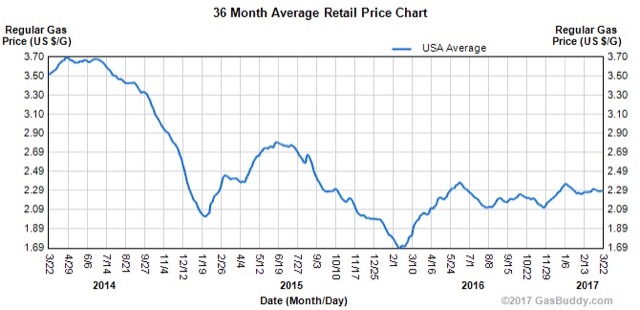
    APTA will no doubt blame these declines on low gasoline prices. Prices for regular gasoline in 2016 averaged $2.14, about 12 percent less than 2015’s $2.43. Prices in 2016 were also less variable, which might have given people more confidence in driving. Perhaps more important, per capita incomes grew by 3.5 percent, which probably contributed more to near-record auto sales than low gas prices (though the low fuel prices influenced people’s choices of what vehicles to buy).

    The transit industry bills itself as providing necessary transportation for low-income riders and alternative transportation for choice riders. Whether because of low gas prices, rising incomes, or growing shared-car services, low-income commuters are buying cars and higher-income travelers are making a choice not to use transit. In the face of these choices, transit agencies that want to spend hundreds of millions or billions on fixed-guideway transit, either rail or dedicated bus lanes, are wasting peoples’ money.

    Randal O’Toole is a senior fellow with the Cato Institute specializing in land use and transportation policy. He has written several books demonstrating the futility of government planning. Prior to working for Cato, he taught environmental economics at Yale, UC Berkeley, and Utah State University.

    Photo: Wade Rockett, CC License.

  • Taxpayers Need Protection from Dallas-Houston High Speed Rail Bailout? New Report

    The proposed privately financed high-speed rail line from Houston to Dallas is projected to have a revenue shortfall of $21.5 billion in its first 40 years of operation. This is the conclusion of a Reason Foundation report by Baruch Feigenbaum, the Foundation’s assistant director of transportation policy (Texas High Speed Rail: Caution Ahead). This and other concerns lead the Reason Foundation to indicate: “… we cannot support Texas Central’s proposed Dallas to Houston project.” This is an important development, since the Reason Foundation has been a strong supporter of privately financed transport infrastructure for decades.

    “Optimism Bias and Demand Exaggeration”

    Feigenbaum explains: “Our analysis indicates that Texas Central is exhibiting the same ‘optimism bias; and ‘demand exaggeration’ that have plagued many public infrastructure projects —and especially high-speed rail projects—for decades. Simply put, Texas Central has exaggerated its ridership projections while underestimating costs.” Feigenbaum adds: “…private sector involvement is not a panacea. A wildly unsuccessful project is not going to become feasible with private financing.”

    To any who follow infrastructure finance, these are familiar terms. The sorry record of major infrastructure forecasts has been documented by Oxford University professor Bent Flyvbjerg, along with Nils Bruzelius (a Swedish transport consultant) and Werner Rottenberg (University of Karlsruhe and former president of the prestigious World Conference on Transport Research). They reviewed 80 years of infrastructure projects and found initial cost estimates to routinely be low and demand (ridership) to have been routinely over-estimated (Megaprojects and Risk: An Anatomy of Ambition). They found passenger rail project cost overruns to be among the worst, averaging 45 percent. They also found ridership projections to be two-thirds too high in two-thirds of cases.

    Reason Foundation and State DOT Estimates

    The Reason Foundation report suggests that the Texas project might perform even more poorly. Feigenbaum estimates that the Dallas to Houston line would carry 1.4 million passengers by 2035. He also cites a Texas Department of Transportation analysis estimating annual riders at between 0.7 and 2.7 million trips, by 2035. The Texas Central estimates a considerably higher five million riders by 2025, 10 years earlier.

    But the difficulties do not stop there. The costs of construction projected by the Texas Central Railway, at a maximum of $12 billion, may be significantly underestimated. Feigenbaum conservatively estimates costs that are nearly 50 percent higher ($17.8 billion) and suggest that the cost could exceed $20 billion. This is similar to a State Department of Transportation estimate of $18.7 billion, according to the report.

    Either of these eventualities, both of which are fairly routine for such projects, would mean that the Texas Central Railway might not have enough money to operate the service, or even to finish construction, unless bailed out. Of course, it is hard to find investors for failed projects, and there would be strong political pressure for government grants and subsidies.

    The California Boondoggle

    California’s high speed rail project, well into the planning stage and about to lay some track, has already exceeded the Oxford research cost overruns with a vengeance. By 2012, construction costs had risen more than 60 percent compared to those publicized to obtain voter approval of bonds for the project in 2008. Worse, that’s after officials scaled back the system from high speed rail to a blend between conventional (commuter rail) and high speed rail.

    As if that were not enough, the first short segment, already under construction, according to a federal report   could have a cost overrun of up to $3.5 billion. The segment is approximately two-thirds the Dallas to Houston route length and is similarly flat, in the largely agricultural San Joaquin Valley. The Wall Street Journal referred specifically to the California high speed rail project in a recent editorial characterizing Sacramento as “America’s western swamp.”

    The International Experience

    Out of all of the high speed rail lines built in the world, only  two have avoided commercial losses (“broken even”) until recently (Tokyo to Osaka and Paris to Lyon). Both had very low construction costs, which made it possible to repay , unlike the highly escalated costs that have developed in subsequent projects. These have depended on taxpayer subsidies for their survival.

    More recently, the Shanghai to Beijing high speed line became profitable, though its superlatives are well beyond replication by any other project (at least of any planet discovered so far). The line is slightly shorter than the distance between New York and Atlanta, but directly serves a market larger than the population of the European Union (more than 520 million residents) and 60 percent more than the United States. The stations on the exclusively high speed rail line itself serve municipalities with more than 160 million people, more people than live in Japan and 2.5 times as many as residents as in France. Another 360 million residents are served by trains that directly access the Shanghai to Beijing line from outside the corridor for part of their journey.

    Whence the Bailout?

    Feigenbaum suggests the likely source of a bailout for the Dallas to Houston high speed rail line: “While Texas Central may not be intending to take any public funding, we believe that if construction starts, the project will inevitably have to be bailed out by the taxpayers of Texas, which is unacceptable” (our emphasis).

    He also notes that the Texas Central Railway plans to seek Railroad Rehabilitation and Improvement Financing (RRIF) program loan from the US Department of Transportation (USDOT). These below market rate loans are guaranteed by federal taxpayers. Of course, taxpayers already know how this works. Just a few years ago, Solyndra defaulted on a $0.5 billion federal loan, leaving taxpayers to “holding the bag.”

    A genuine privately funded project would raise sufficient funds from private investors and from non-subsidized commercial financing sources. It would also attract ridership large enough to produce sufficient to pay the loans and repay the investors. The Reason Foundation and the Texas Department of Transportation findings suggest otherwise

    All of this is disappointing to Feigenbaum, and also to me. After years of warning of taxpayer risks from such projects (Note ), I had hoped this one would be a genuinely commercial project, as this article from more than four years ago indicates (see: “Texas High Speed Rail: On the Right Track). It looks like it’s too good to be true.

    Making it Work?

    However, there may be a way to deliver the Texas Central project, while removing all potential taxpayer risk. According to the Dallas Business Journal Texas Central officials indicated that the Central Japan Railway would be the “primary investor”. There is also a report that Japan’s Government Pension Investment Fund may invest in US infrastructure, including the Texas high speed rail project. These organizations are more than financially capable of ensuring that there is no taxpayer risk.

    The Japanese know high speed rail. They are likely to invest only if they are confident they can recover their money, with a commercial profit. Moreover, any such investment needs to include financial guarantees that ensure there is no potential for either US or Texas taxpayers to be called upon for subsidies to cover cost overruns, operations or anything else. Any other approach could be foolhardy.

    Note: These publications include authoring or co-authoring a number of taxpayer risk reports on proposed high-speed rail lines, such as on Florida high-speed rail proposals between the 1990s and 2010s, the Xpress West Victorville to Las Vegas high-speed rail line, the first and second diligence reports on the California high-speed rail line, and a greenhouse gas emissions analysis of the California high-speed rail line. Sponsors included the Reason Foundation, the Howard Jarvis Taxpayers Association, Citizens Against Government Waste and the James Madison Institute.

    Wendell Cox is principal of Demographia, an international public policy and demographics firm. He is a Senior Fellow of the Center for Opportunity Urbanism (US), Senior Fellow for Housing Affordability and Municipal Policy for the Frontier Centre for Public Policy (Canada), and a member of the Board of Advisors of the Center for Demographics and Policy at Chapman University (California). He is co-author of the "Demographia International Housing Affordability Survey" and author of "Demographia World Urban Areas" and "War on the Dream: How Anti-Sprawl Policy Threatens the Quality of Life." He was appointed to three terms on the Los Angeles County Transportation Commission, where he served with the leading city and county leadership as the only non-elected member. He served as a visiting professor at the Conservatoire National des Arts et Metiers, a national university in Paris.

    Photograph: Texas flag

  • Los Angeles Traffic: Likely To Worsen with Higher Densities

    A few recent days driving the Los Angeles freeways impressed me with how different they are from in most other places in the country. The intensity of the traffic is astounding. Even on the weekend, travel over Sepulveda Pass on the San Diego Freeway (I-405) was highly congested. Traffic really never stopped, but frustratingly inched along for parts of the way and approached 60 miles per hour on other parts. A Saturday trip I feared might take an hour and a half was completed from Simi Valley in less than 60 minutes. Caltrans and the local officials do an admirable job of keeping the traffic moving, which was obvious from the only slight delay near Sherman Way caused by an incident that required a fire truck.

    Traffic Per Lane Mile

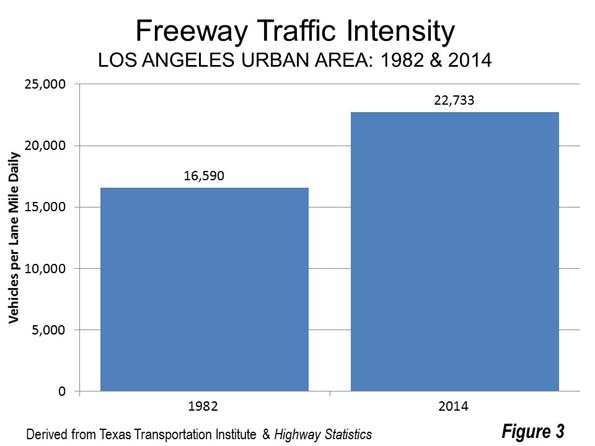
    The latest Federal Highway Administration data indicates that nearly 23,000 cars are handled by each freeway lane on the average day. Among the larger urban areas, only San Jose and close-by Riverside-San Bernardino have a volume of more than 20,000 daily.

    The freeway lane volume in Los Angeles is up from 16,500 cars per lane mile in the early 1980s,  a more 37 percent increase in traffic (Figure 1). This is not surprising, because the urban area, which stretches from the San Fernando Valley to Pomona and Orange County to San Clemente has added almost the same percentage of residents. The city of Los Angeles itself, which covers virtually the same area as it did more than three decades ago has become significantly more dense, also adding about one third to its population.

    At the same time, public policy in California is calling for significant urban densification that will put an even greater strain on the roadway network. Any assumption that a more dense Los Angeles will be anything less than an even more horrific traffic environment is simply folly.

    Billions Spent on Rail: Yet Traffic is Much Worse

    Some, including me while I was on the Los Angeles County Transportation Commission, believe (or in my case “believed”) that an expansion of transit — especially adding urban rail service, would relieve traffic congestion. Los Angeles has now had nearly three decades of experience with that strategy. Yet, traffic has only become more intense.

    Indeed, despite the addition of a substantial urban rail system in Los Angeles County has been accompanied by a general decline in transit ridership on the Metropolitan Transportation Authority services compared to predecessor services operated by the Southern California Rapid Transit District in 1985. In 2016, ridership was even lower than the year before, despite the extensions of rail service to Santa Monica on the Expo Line and to Azusa on the Gold Line.

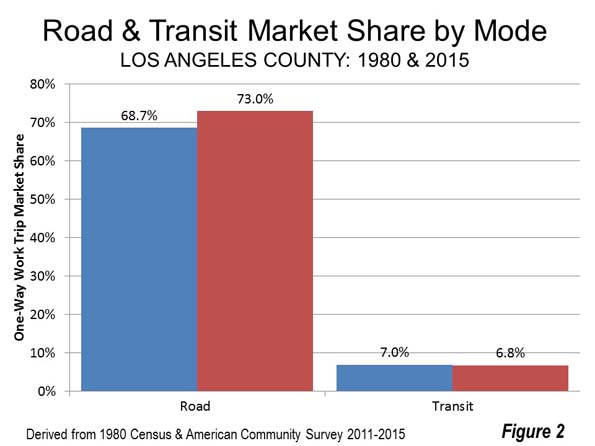
    Even work trip ridership, which transit serves best, is down. In 1980, transit’s market share was 7.0 percent in Los Angeles County. By 2015, transit’s market share had fallen slightly to 6.8 percent. Meanwhile, driving alone expanded significantly from 68.7 percent in 1980 to 73.0 percent in 2015. Working at home increased from 1.5 percent in 1980 to 5.1 percent in 2015 (Figure 2).

    Why Rail has Not Attracted Drivers

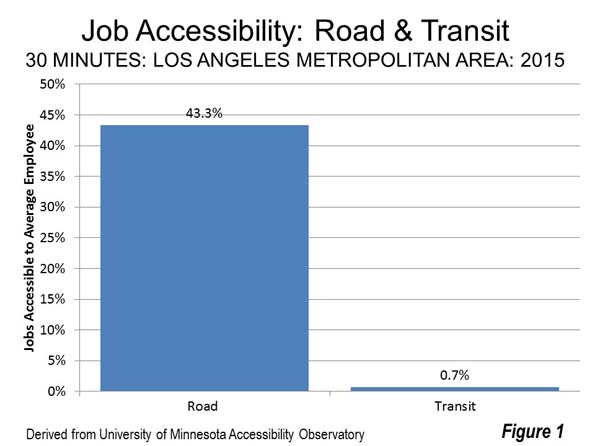
    There are two principal reasons the transit has not been able to attract drivers out of their cars and reduce freeway volumes. The first is that, for the most part, you cannot get from here to there on transit. That is, most jobs and places people are traveling cannot be conveniently accessed by transit. The University of Minnesota Accessibility Laboratory has found that 43.3 percent of jobs in the Los Angeles metropolitan area can be reached by car within 30 minutes. By contrast. Only 0.7 percent of jobs can be reached by transit within 30 minutes. In other words, the accessibility provided by cars is much greater than that of transit. For every job that can be reached by transit within 30 minutes, nearly 60 times as many jobs can be reached by car (Figure 3).

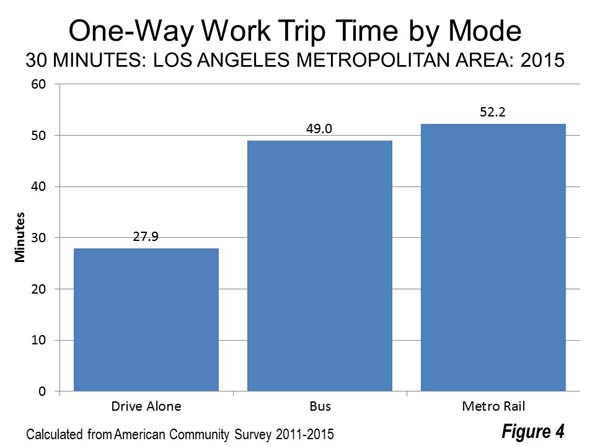
    Even where jobs can be reached by transit, it takes far longer. According to the latest American Community Survey data, the average one way work trip travel time for people driving alone in the Los Angeles metropolitan area is 27.9 minutes. By contrast, the average Metro Rail rider takes 52.2 minutes to reach work (Figure 4). It is not hard to imagine why people have not traded in their faster car travel times for slower trips on transit. Excess travel time, regardless of how traveled, takes away from other necessary activities and recreation.

    Further, with all the talk about “urban villages,” with the expected improved jobs housing balance, it is well to recognize such an achievement would be unprecedented. As former principal planner of the World Bank Alain Bertaud put it: “…the urban village "model does not exist in the real world because it contradicts the economic justification of large cities: the efficiency of large labor markets." The cold water of reality is that "… the urban village model exists only in the mind of urban planners."

    Of course, talk of people living near where they work is dubious, particularly in a metropolitan area where housing affordability  is challenging both for the vast majority of renters and potential buyers. When does anyone think this will happen? In “this life” or maybe in the “life to come?”

    The bottom line, unfortunate and politically incorrect as it is, is that transit simply cannot reduce traffic congestion. Some other strategy needs to be deployed.

    Prognosis: More Density, More Traffic

    Los Angeles traffic is likely to get much worse, especially if the development becomes substantially denser. All of the 12 world urban areas in the recent Tom Tom Congestion Index that have worse traffic than Los Angeles are denser. This is consistent with the international evidence that shows a strong association between higher densities, greater traffic congestion and lengthened work trip travel times. The experience in Los Angeles shows the same thing.

    Wendell Cox is principal of Demographia, an international public policy and demographics firm. He is a Senior Fellow of the Center for Opportunity Urbanism (US), Senior Fellow for Housing Affordability and Municipal Policy for the Frontier Centre for Public Policy (Canada), and a member of the Board of Advisors of the Center for Demographics and Policy at Chapman University (California). He is co-author of the "Demographia International Housing Affordability Survey" and author of "Demographia World Urban Areas" and "War on the Dream: How Anti-Sprawl Policy Threatens the Quality of Life." He was appointed to three terms on the Los Angeles County Transportation Commission, where he served with the leading city and county leadership as the only non-elected member. He served as a visiting professor at the Conservatoire National des Arts et Metiers, a national university in Paris.

    Photo: North on the 110 Toward Downtown, AM Peak (by author)

  • Dallas-Fort Worth & Dayton: World Large City Least Congestion: 2017 Tom Tom Traffic Index

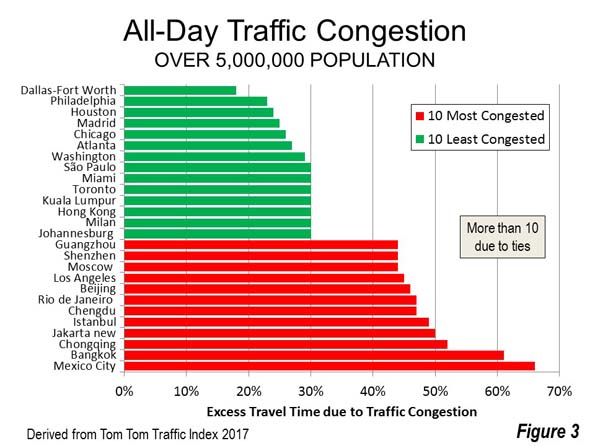
    Dallas-Fort Worth and Dayton Ohio have the least traffic congestion among larger cities (urban areas) in the world, according to the 2017 Tom Tom Traffic Index. Dallas-Fort Worth had the shortest average all day delay, at 18 percent of the 43 cities with more than 5 million population. Dallas-Fort Worth also had the least average peak period traffic delay. This is the second year in a row the Dallas Fort Worth has had the best all day traffic congestion. Dayton had the best all day and average peak hour congestion among the 146 cities with between 800,000 and 5,000,000 population and tied with three others for the best in among all cities the least all-day congestion.

    All City Rankings

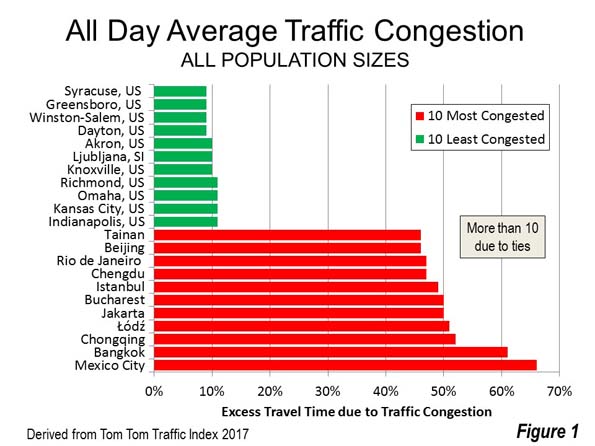
    Among all city sizes, Syracuse (NY), Greensboro (NC), Winston-Salem (NC) and Dayton had the best all day traffic, with a nine percent average delay. Cadiz, Spain had the best average peak hour congestion, with an 11.5 percent delay.

    Mexico City had the most intense all day congestion, at 66 percent, followed closely by Bangkok at 61 percent. Other cities with the most congestion include, not surprisingly, Chongqing, Jakarta, Istanbul and Beijing. All have large populations, high densities and millions of cars. A real surprise, however is Lodz, Poland, with a population of less than 750,000, which has the fourth worst congestion (Figure 1)

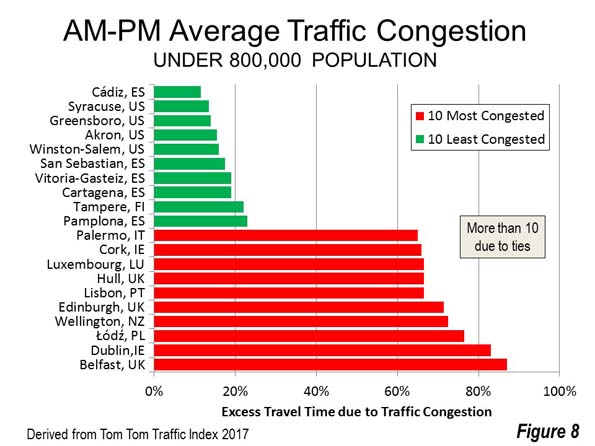
    Bangkok ranked the most congested city, in the AM and PM peak periods, with an average traffic delay of 104.5 percent. This means that it takes twice as long in Bangkok to make a trip as it would if traffic flowed freely. Mexico City had the second largest delay at 98.5 percent, followed by Bucharest (Romania) at 94.0 percent. Bucharest   heavy traffic congestion surprises, since it has, at best, only one-fifth the population of the largest seven most congested cities. Even more surprising is that much smaller Belfast is the sixth most congested, while Dublin, smaller than Bucharest, ranks seventh (Figure 2).

    Cities Over 5,000,000 Population

    Out of the 43 cities with more than 5 million population, three US cities (Philadelphia, Houston and Chicago) and Madrid join Dallas-Fort Worth in having the least all-day traffic congestion. The five cities with the most traffic congestion are Mexico City, Chongqing, Jakarta and Istanbul (Figure 3).

    Three of the cities with the least average peak congestion are in the United States, including Dallas-Fort Worth, second-ranked Philadelphia and fourth-ranked Chicago. Madrid, again makes the top five in third position, while Sao Paulo ranks fifth (Figure 4). The Chinese cities of Quangzhou and Suzhou rank surprisingly well, in view of the national traffic congestion level (Table), at 6th and 9th least congested.


    Cities with 800,000 to 5,000,000 Population

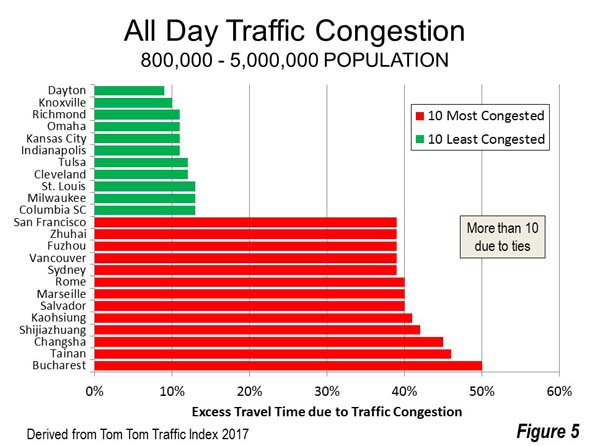
    All 10 of the least congested cities between 800,000 and 5 million population all day are in the United States. The least congested are Dayton, Knoxville, Richmond, Omaha and Indianapolis, in a fifth-place tie with Kansas City.

    Bucharest had the most all day congestion, followed by Tiainan, Changsha, Shijazhuang and Kaohsiung  (Figure 5).

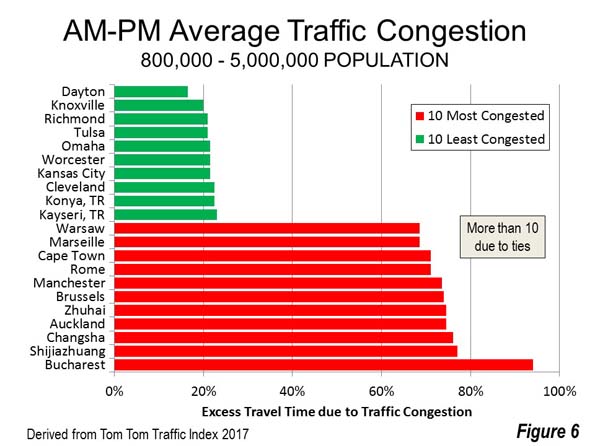
    The eight least congested cities between 800,000 and 5 million population during peak periods are located in the United States, led by Dayton, Knoxville, Richmond, Tulsa, Worcester and Kansas City.

    The greatest traffic congestion in this population category is in Bucharest, which is followed by Shijiazhuang, Changsha, Auckland and Zhuhai (Figure 6).

    Cities with Less than 800,000 Population

    The four cities with less than 800,000 population and the least all-day traffic congestion are in the United States, Winston-Salem (NC), Syracuse (NY), Greensboro (NC) and Akron (OH). The fifth best traffic congestion is in Ljubljiana, the capital of Slovenia.

    The worst all day traffic congestion in this category is in already cited Lodz and Dublin, as well as Palermo, Belfast, Lublin (Poland) and Edinburgh (Figure 7).

    Cadiz, Spain has the least peak period congestion in this population category, followed by four US cities, Syracuse, Greensboro, Akron and Winston-Salem.

    The greatest average peak period congestion in the below 800,000 population category was in Belfast, followed by Dublin, Lodz, Wellington (NZ) and Edinburgh.


    Traffic Congestion by Country and Geography

    Among the nations, the US has the overall least traffic congestion, with a delay rate of 19.3 percent in all day congestion, followed by the Netherlands and Spain. The US leads in two population categories, 800,000 to 5,000,000 and under 800,000. Spain has the least over 5,000,000 congestion, where Madrid exhibits the impacts of its strong motorway system.

    East Asian cities have the greatest all-day traffic congestion, at 41.1 percent, though among the largest cities Latin America has have most congestion.

    In average peak period congestion, Spain shows the best results, with a delay rate of 29.0 percent, followed by the United States and the Middle-East. Spain leads in the over 5,000,000 category, Turkey in the 800,000 to 5,000,000 category and the United States in the under 800,000 category.

    East Asian cities also have the greatest average peak period congestion, at  67.3 percent. Among the largest cities, congestion is greatest in the Eastern European cities outside Poland and Turkey (Table).

    The Importance of Traffic Indexes

    Cities are more productive if they facilitate greater access throughout their urbanization, especially for work trips, as Remy Prud’homme and Chang-Woon Lee at the University of Paris and David Hartgen and M. Gregory Fields of the University of North Carolina, Charlotte have shown. Traffic indexes provide important metrics to aid city officials in “keeping the traffic moving,” which is essential in the modern metropolitan area. Significantly, worldwide traffic indexes are covering more cities. This year’s Tom Tom Traffic Index added important cities like Jakarta, Hong Kong, Buenos Aires, Santiago de Chile, and Kuala Lumpur, bringing the total to 390. Today’s policy makers have far more information on which to evaluate transport investments than ever before.

    Table
    Summary of Traffic Congestion by Geography
    ALL DAY CONGESTION AVERAGE AM-PM CONGESTION  
    Country/Geography Over 5 Million 800,000-5 Million Under 800,000 All Over 5 Million 800,000-5 Million Under 800,000 All Count by Population Category
    ASIA                  
    China 39.7% 36.3%   38.5% 67.2% 66.6%   67.0% 15, 8, 0
    East Asia: Other 43.0% 38.8%   41.1% 75.5% 57.1%   67.3% 5, 4, 0
    Middle-East\   26.2%   26.2%   35.6%   35.6% 0, 5, 0
    EUROPE                  
    France 38.0% 30.3% 23.5% 24.9% 67.0% 57.0% 42.0% 44.8% 1, 3, 21
    Germany   28.3% 24.5% 25.6%   47.6% 39.9% 42.0% 0, 7, 18
    Italy 30.0% 32.7% 23.8% 25.1% 57.5% 56.5% 37.7% 40.8% 1, 3, 21
    Netherlands     19.5% 19.5%     37.2% 37.2% 0, 0, 16
    Spain 25.0% 27.0% 20.3% 21.0% 45.5% 41.5% 27.1% 29.0% 1, 2, 22
    United Kingdom 40.0% 30.2% 29.7% 30.2% 66.0% 55.7% 55.8% 56.2% 1, 6, 18
    Western Europe: Other   29.3% 24.2% 25.1%   52.8% 42.1% 44.1% 0, 9, 38
    Poland   27.0% 32.7% 31.8%   48.3% 53.0% 52.2% 0, 2, 10
    Turkey 49.0% 26.0%   28.3% 77.0% 34.0%   38.3% 1, 9, 0
    Eastern Europe: Other 42.5% 31.6% 21.1% 27.9% 80.0% 61.1% 43.9% 55.3% 2, 7, 8
    NORTH AMERICA                  
    Canada 30.0% 27.2% 21.3% 24.5% 56.0% 46.8% 38.1% 43.2% 1, 5, 6
    United States 28.6% 18.5% 15.0% 19.3% 52.7% 34.6% 24.2% 35.5% 9, 62, 9
    AUSTRALASIA                  
    Australia     24.2% 27.5%   50.7% 38.5% 44.6% 0, 5, 5
    New Zealand   38.0% 28.2% 29.8%   74.5% 47.9% 52.3% 0, 1, 5
    OTHER                  
    Latin America 44.6% 29.1%   35.6% 72.9% 51.1%   60.2% 5, 7, 0
    South Africa 30.0% 35.0% 23.8% 26.7% 61.0% 71.0% 44.9% 51.9% 1, 1, 4

    Wendell Cox is principal of Demographia, an international public policy and demographics firm. He is a Senior Fellow of the Center for Opportunity Urbanism (US), Senior Fellow for Housing Affordability and Municipal Policy for the Frontier Centre for Public Policy (Canada), and a member of the Board of Advisors of the Center for Demographics and Policy at Chapman University (California). He is co-author of the “Demographia International Housing Affordability Survey” and author of “Demographia World Urban Areas” and “War on the Dream: How Anti-Sprawl Policy Threatens the Quality of Life.” He was appointed to three terms on the Los Angeles County Transportation Commission, where he served with the leading city and county leadership as the only non-elected member. He served as a visiting professor at the Conservatoire National des Arts et Metiers, a national university in Paris.

    Photo: A Bangkok freeway, by author

  • Transportation Game-changers

    Here is the L.A. Times noting that LA Metro ridership is still falling — even though billions have been (mis)spent on extra capacity over the last 30+ years. By my count that’s the second time this year that the Times has broached this tender topic. As a member in good standing of the LA “good government” (googoo) establishment, the paper had for many years chosen to tip-toe around the bad news.

    Readers may know that some of us began flogging the dead horse in the mid-1970s. Go to the attached proceedings and read the contribution by the late UCLA Prof. George Hilton. He was among the first to write sensibly and clearly that LA is not NY — and trying to make it so would be a phenomenal waste. But even LA Times coverage will be for naught. Billions more will be spent. Pouring good money after bad is what the great and the good in city hall do for a living.

    We are in the the early years Uber/Lyft and all manner of ICT information sharing.  These are the game-changers. For the past two months, my wife and I have graduated from a two-car household to a one-car-plus-Uber-plus-walkable-neighborhood HH. The game-changers are here. Conventional transit was never a game-changer.

  • Focusing on Mobility Not Travel Mode for Better Economic Growth

    The last article outlined research on job access by cars, transit and walking by the University of Minnesota Accessibility Observatory that assesses mobility by car, transit and walking in 49 of the nation’s largest metropolitan areas. Of course, it is to be expected that the metropolitan areas will have the largest number of jobs accessible to the average employee simply by virtue of their larger labor markets.

    Indeed, smaller, but important major labor markets, from Grand Rapids and Buffalo to Philadelphia and Washington seem unlikely to ever rival the job numbers in metropolitan areas like New York and Los Angeles.

    Researchers such as Remy Prud’homme and Chang-Woon Lee of the University of Paris, David Hartgen and M. Gregory Fields of the University of North Carolina, Charlotte have shown that a city (metropolitan area( is likely to experience better economic results if its transportation system provides better mobility. This includes greater job creation, greater economic growth and poverty reduction.

    Virtually any metropolitan area will do well to focus on maximizing mobility. This article describes the percentage of jobs in each of the 49 metropolitan areas that can be reached by the average employee in 30 minutes, a time slightly longer than the US one-way work trip average travel time of 26.4 minutes.

    Accessibility by Auto

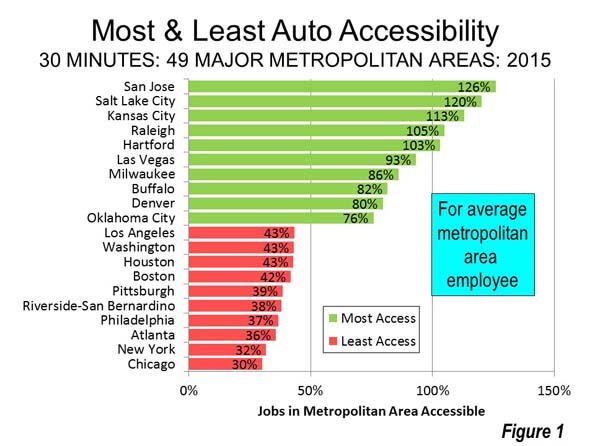
    The leading metropolitan area in auto accessibility include is San Jose . Despite its reputation as an ultra-green area, 90 percent of San Jose commuters who do not work at home use cars to get to work. San Jose does warrant accolades for its 4.7 percent work at home share, the most environmentally friendly mode of work access. Transit has a 4.1 percent share. More than 100 percent of the metropolitan area’s jobs can be reached in 30 minutes, largely because the San Francisco metropolitan area is virtually across the street, providing additional employment opportunities.

    The balance of the top 10 is smaller, metropolitan areas, Salt Lake City, Kansas City, Raleigh and Hartford, where the average employee can reach jobs equaling more than 100 percent of the metropolitan total in 30 minutes. The second five include Las Vegas, Milwaukee, Buffalo, Denver and Oklahoma City. All but three of the 10 cities with best access has urban densities that are lower than the major metropolitan average.

    The least automobile accessibility is in larger metropolitan areas, where there is generally much greater traffic congestion. New York and Chicago have the lowest levels of 30 minute accessibility, followed by Atlanta, higher than would be expected, in large measure because of its sub-standard arterial street system, which in other cities provides effective alternatives to freeways (Figure 1).

    Transit

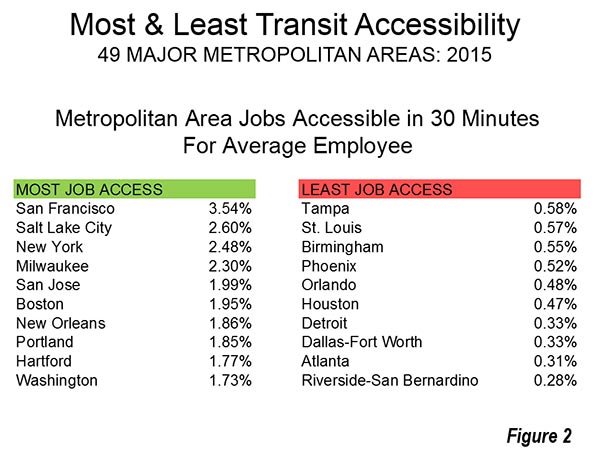
    Employees can reach the greatest share of metropolitan area jobs by transit in San Francisco (3.54 percent), Salt Lake City (2.60 percent), New York (2.48 percent), Milwaukee (2.30 percent) and San Jose (1.99 percent). The second five includes three cities with strong legacies of transit such as Boston, Portland and Washington, along with New Orleans and Hartford.

    The least transit access is in Orlando, Houston, Detroit, Dallas-Fort Worth, Atlanta and Riverside-San Bernardino, all below 0.50 percent (Figure 2).

    Walking

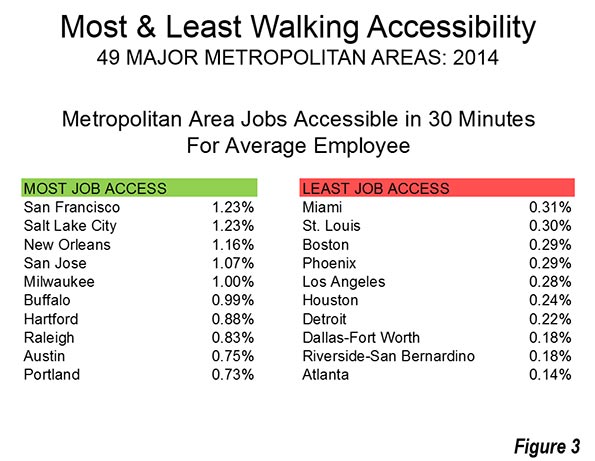
    Walking can get the average employee to the greatest share of metropolitan jobs in 30 minutes in San Francisco (1.23 percent), Salt Lake City (1.23 percent), New Orleans (1.16 percent), San Jose (1.07 percent) and Milwaukee (1.00 percent).

    Among the 10 cities with the least walking access, none reaches one-third of one-percent. These include one Northeastern city, Boston, St. Louis and Detroit in the Midwest and an expected array of western and southern cities, such as Los Angeles, Houston, Dallas-Fort Worth, Phoenix, Riverside-San Bernardino, Miami and ,in last place, Atlanta (Figure 3).

    The Automobile Access Advantage

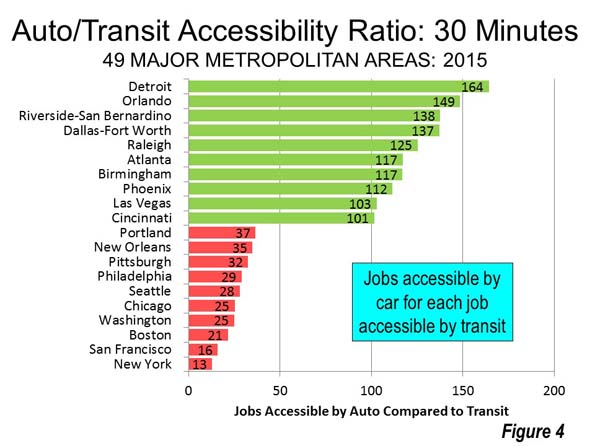
    The data indicates that automobiles have far superior access to employment in every major metropolitan area. The cities that have the smallest automobile advantage are generally credited with having the best transit systems. But there is relatively little practical opportunity for commuting by transit to metropolitan jobs.   In the worst case, the average New York auto commuter can reach 13 times as many jobs as by transit in 30 minutes, 16 times in San Francisco, 21 times in Boston, 25 times in Chicago and Washington. In Seattle, Philadelphia, Pittsburgh, New Orleans and Portland the average employee can reach from 28 to 37 times as many jobs by car as by transit.

    The auto advantage is much greater in other cities. In Detroit the average commuter can reach 164 times as many jobs by car is by transit, 149 times as many in Orlando, 138 times and Riverside San Bernardino, 137 times in Dallas-Fort Worth and 125 times in Raleigh. Atlanta, Birmingham, Phoenix, Las Vegas and Cincinnati commuters can reach more than 100 times as many jobs by car in 30 minutes as by transit (Figure 4).

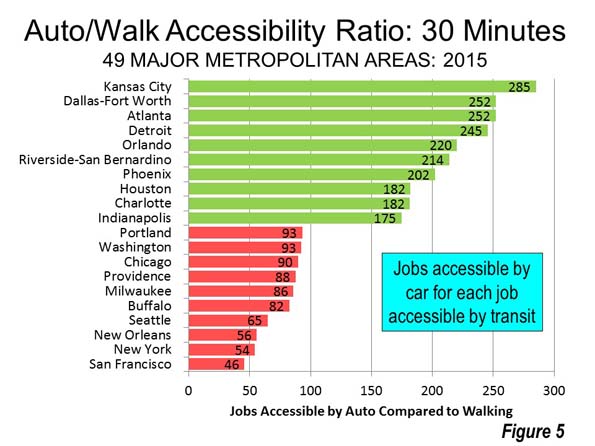
    Not surprisingly, the disparities are even greater between autos and walking. Walking does best compared to cars in San Francisco, where auto commuters can reach 46 times as many jobs by car as by walking. The least advantaged pedestrians are in Kansas City, where the average automobile commuter can reach 285 times as many jobs by car as by walking (Figure 5).

    New York in Context

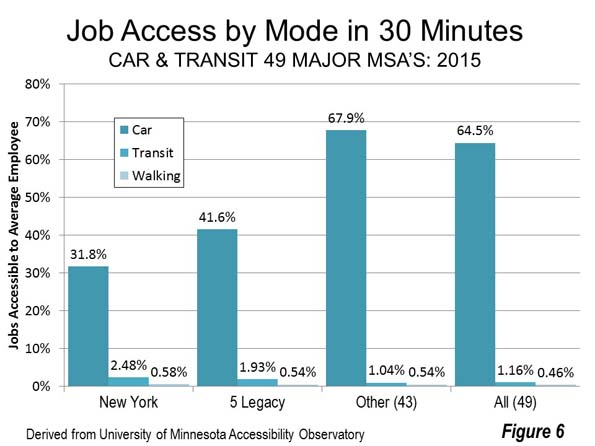
    A colleague pointed out that the domination of transit statistics by New York would justify looking at how the nation’s largest metropolitan area compares to others. New York commuter access in 30 minutes of 2.48 percent of jobs by transit is about 1/5 higher than the 1.93 percent in the other five metropolitan areas with transit legacy core cities. New York’s commuters can reach nearly 2.5 times the percentage of metropolitan jobs accessible within 30 minutes as in the other 43 metropolitan areas (Figure 6). Transit is a lot more comprehensive in the New York metropolitan area, but cannot compete with automobile access by a long shot.

    Improving Mobility and the Economy

    For decades there has been an assumption that transit is an alternative to the automobile throughout the metropolitan area. The University of Minnesota Accessibility Observatory shows any such conception to be at best an exaggeration. Indeed, transit and walking provide only a small fraction of the access available by automobile. This is not likely to change at any practical level of public funding. As Professor Jean-Claude Ziv and I estimated that it could take all of an urban area’s gross domestic product each year just to provide the point to point access available by cars.

    There are places that transit is competitive with the automobile, notably the nation’s largest downtown areas (central business districts or CBDs), which are in the six transit legacy cities. However, travel times are far slower than the national average, due to higher levels of traffic congestion and greater reliance on transit, which tends to be slower than cars overall. For example, commuters to Manhattan—by far the nation’s largest CBD — have transit travel times of 52 minutes, while the travel time by car is 51 minutes, according to the American Community Survey. Either way, the average one-way travel time is about twice the national average. However, even in New York, there are far more jobs outside the CBD, traffic congestion is far less and the speedier access by car makes transit generally uncompetitive to these dispersed locations.

    In the past, it was not unreasonable to believe that transit could materially improve mobility in metropolitan areas. The new research undermines any such conception. Maximizing metropolitan mobility — minimizing work trip travel times — is an important strategy for jump-starting the economy, creating jobs and restoring economic growth to historic levels. Urban transportations strategies need to be selected based upon the outcome of superior access, without regard to mode.

    Photograph: Interstate 10, Houston by Socrate76 (Own work) [CC BY-SA 3.0 or GFDL], via Wikimedia Commons
    Wendell Cox is principal of Demographia, an international public policy and demographics firm. He is a Senior Fellow of the Center for Opportunity Urbanism (US), Senior Fellow for Housing Affordability and Municipal Policy for the Frontier Centre for Public Policy (Canada), and a member of the Board of Advisors of the Center for Demographics and Policy at Chapman University (California). He is co-author of the “Demographia International Housing Affordability Survey” and author of “Demographia World Urban Areas” and “War on the Dream: How Anti-Sprawl Policy Threatens the Quality of Life.” He was appointed to three terms on the Los Angeles County Transportation Commission, where he served with the leading city and county leadership as the only non-elected member. He served as a visiting professor at the Conservatoire National des Arts et Metiers, a national university in Paris.