Tag: Transportation

  • Will New Urbanists Deliver A Home-Win With Miami 21?

    By Richard Reep

    “A walkable city, more like… Manhattan, Chicago, or San Francisco,” is how The Miami Herald characterizes the future of Miami under Miami 21, the new form-based code adopted on October 22nd by the Miami City Commission. This seems to be the hot new dream not just of Miami, but of all cities struggling under corruption and greed, codes and regulations, with an imagined underground urbanity, yearning to breathe free. Citizens may now expect to see Miami remodeled after cities that grew before the car came, but the lyrics to The Who’s “Won’t Get Fooled Again” echo in the minds of some: “Meet the new boss…same as the old boss.”

    Miami 21, controversial for nearly four years and over 500 public meetings, met a critical need for citizens who were tired of the corruption and greed that seemed to result in an increasingly ugly, congested quasi-urban nightmare. Planning and zoning regulations, which were originally designed to protect property values, could be reinvented when enough power and money was at stake, and the code enforcers allowed more and more bizarre juxtapositions of high rises among low-scale residential neighborhoods. During the recent condo boom, variances became business as usual for the Miami City Commission and the Mayor. Now that the condo boom is over, it appears that both are rushing in to make amends to voters by passing this new form-based code.

    The code places height limits on neighborhoods similar to the old, Euclidean code, ominously named 11000. But this time around, uses are not segregated; instead, a mix of retail and other uses is intended to encourage increased pedestrian activity and a taking back of some of the city from the car. For citizens, there has been much to like about the arguments in favor of this code. As a result of the change, the pleasant weather that drew so many to the city will now perhaps be enjoyed on the boulevard; fear of shadows from looming high-rises will, according to the plan, now recede a bit. And a more organized, easy-to-understand building pattern should replace the Rube Goldberg-like zoning code full of special exceptions, arcane “bonus” rules, and a process all too easily subverted by tax-hungry politicians.

    With private development comatose, it is a perfect time for many jurisdictions to perform a much-needed overhaul of their development regulations. In the boom-bust atmosphere of Florida, most of the development industry sees this cease-fire as simply a pause to reload, and the Department of Community Affairs – Tallahassee’s growth management gatekeeper – is busy helping developers get ready for the next boom by making the Rural Land Stewardship Areas, a regulation designed to protect rural areas from development, officially optional.

    The American Institute of Architects chapter in Miami proposed to reform the old code, rather than start from scratch, arguing that the new code is complicated, fussy, and inhibiting. Reform of the existing 11000 code never seemed to be an option, and instead the Miami 21 code, written by New Urbanist gurus Andres Duany and Elizabeth Plater-Zyberg of DPZ, replaces the old code. Citizens of Miami, when presented with this new code, seemed ready for a change.

    This was an important home-win for DPZ and for New Urbanism in general. Increasingly associated with greenfield prettyboys like Celebration and Seaside, New Urbanism seemed to be losing ground and losing relevance at solving real-city problems. With the support of a massive public relations campaign, New Urbanism has now been given a chance to deliver on its promises of a “a clear vision for the City that will be supported by specific guidelines and regulations so that future generations will reap the benefits of well-balanced neighborhoods and rich quality of life.”

    Arcane spreadsheets, full of formulae and footnotes, have been replaced by transects. These silhouettes of buildings and streets – a sort of cross-section through the city – begin with the way a natural, un-built environment might look, progress to how a rural road looks, and go all the way up to how high-rise canyons might look. Patterning a city on a consensual, pre-approved notion of order is what New Urbanism is all about. There are no surprises – no high-rises in your backyard – but, as some local architects worry, there’s no spontaneity either.

    Walkability is another promise of the new code. Ideas such as transforming blank walls, promoting urban infill development, and lining parking garages with retailers, are all illustrated with magical dissolve images that change ugly parking garages into charming shopping districts. If it were only that easy.

    Transit-oriented development is a strategic goal of the code, creating density clusters that get people out of their cars and into alternative forms of transportation. Buses, bicycles, vanpools, and Miami’s Metrorail are closely interlinked with Miami 21.

    The marketing website for Miami 21 makes it impossible to be against the code. Opposing Miami 21 would be like opposing lifesaving drugs or opposing the blue sky. New Urbanism won this victory because there weren’t any compelling counter-arguments to their basic argument for urban hygiene. And Miami 21 comes at a time when the city has been egregiously abused at the hands of the free market; its citizens disenfranchised and suffering from an environment of ugliness, traffic and congestion.

    As noble as Miami 21’s goals are, however, they are only as good as the politicians in whose hands they will be used. Making new laws, rather than enforcing the old laws, is a favorite activity of politicians who, backed against the wall by irate voters, seek a grand solution. Much harder work will come when developers try to seek waivers against Miami 21, and if the history of Florida is any guide, it is not likely things will change much. For Miami 21 has some inherent costs that will split the haves and the have-nots of Miami-Dade County even further apart than they are now.

    For the haves, the higher cost of development under Miami 21 is already a concerning factor. The code promises increased regulation, and the density transects favor already high-value districts. At the last minute, for example, City Commissioner Marc Sarnoff switched his support to be in favor of a 35-foot height limit in Miami’s MiMo historic district, to the chagrin of property owners seeking higher buildings. Whether he stays on one side of the fence, or switches back at the behest of a developer, remains to be seen.

    In Miami, the validity of New Urbanism’s principles of how cities are regulated will finally be put to the test. By spelling out the city’s form in detail, through technical images, watercolor perspectives, and mock-historical drawings, Miami 21 is illustrating a preordained vision of itself. The public’s trust in its elected officials has been so broken by the recent capitalistic building frenzy that, by consensus, an agreed-upon “ideal city” has been created on paper. Now it is up to the building officials to deliver this vision when the next building boom hits.

    Instead of exploring how to improve the planning process, as AIA Miami suggested, Miami 21 seems to have avoided confronting the planning and process issues that no one seems to know how to solve. Have our cities become so complex that we are unable to manage their growth through the traditional public planning process? An even bigger question is whether the village-planning model at the core of New Urbanism is a valid model? Will it achieve the lofty goals that have been promised?

    Miami 21 will be a fascinating experiment to watch during the coming years. Miami is already known for taking risks: it built an elevated rail system in a suburban, multipolar city and encouraged an international development binge that resulted in a dozen or two empty skyscrapers. Now it has added formal prototyping to its use regulations. As Miami 21 is implemented and tested, other cities like St. Petersburg, Denver, and Philadelphia are following suit, hoping that the increased regulations will be the quick fix needed to assure the public that the civic realm is being cared for.

    Richard Reep is an Architect and artist living in Winter Park, Florida. His practice has centered around hospitality-driven mixed use, and has contributed in various capacities to urban mixed-use projects, both nationally and internationally, for the last 25 years.

  • Capping Emissions, Trading On The Future

    Whatever the results of the Copenhagen conference on climate change, one thing is for sure: Draconian reductions on carbon emissions will be tacitly accepted by the most developed economies and sloughed off by many developing ones. In essence, emerging economies get to cut their “carbon” intensity–a natural product of their economic evolution–while we get to cut our throats.

    The logic behind this prediction goes something like this. Since the West created the industrial revolution and the greenhouse gases that supposedly caused this “crisis,” it’s our obligation to take much of the burden for cleaning them up.

    Plagued by self-doubt and even self-loathing, many in the West will no doubt consider this an appropriate mea culpa. Our leaders will dutifully accept cuts in our carbon emissions–up to 80% by 2050–while developing countries increase theirs, albeit at a lower rate. Oh, we also pledge to send billions in aid to help them achieve this goal.

    The media shills, scientists, bureaucrats and corporate rent-seekers gathered at Copenhagen won’t give much thought to what this means to the industrialized world’s middle and working class. For many of them the new carbon regime means a gradual decline in living standards. Huge increases in energy costs, taxes and a spate of regulatory mandates will restrict their access to everything from single-family housing and personal mobility to employment in carbon-intensive industries like construction, manufacturing, warehousing and agriculture.

    You can get a glimpse of this future in high-unemployment California. Here a burgeoning regulatory regime tied to global warming threatens to turn the state into a total “no go” economic development zone. Not only do companies have to deal with high taxes, cascading energy prices and regulations, they now face audits of their impact on global warming. Far easier to move your project to Texas–or if necessary, China.

    The notion that the hoi polloi must be sacrificed to save the earth is not a new one. Paul Ehrlich, who was the mentor of President Obama’s science advisor, John Holdren, laid out the defining logic in his 1968 best-seller, The Population Bomb. In this influential work, Ehrlich predicted mass starvation by the 1970s and “an age of scarcity” in key metals by the mid-1980s. Similar views were echoed by a 1972 “Limits to Growth” report issued by the Club of Rome, a global confab that enjoyed a cache similar to that of the United Nations’ Intergovernmental Panel on Climate Change.

    To deal with this looming crisis, Holdren in the 1977 book Ecoscience (co-authored with Anne and Paul Ehrlich) developed the notion of “de-development.” According to Holdren, poorer countries like India and China could not be expected to work their way out of poverty since they were “foredoomed by enormous if not insurmountable economic and environmental obstacles.” The only way to close “the prosperity gap” was to lower the living standards of what he labeled “over-developed” nations.

    These predictions were less than accurate. World-wide systemic mass starvation did not take place as population escalated. Rather those many millions wallowing in poverty in the developing world, particularly in Asia, lifted themselves into the global middle class. Far more efficient ways to use energy have been developed, and unexpected caches of new resources continue to be discovered all over the planet.

    Yet however wrong-headed, Holdren’s world view now has jumped from the dustbin of history into the craniums of presidents and prime ministers. President Obama’s pledge to “restore science to its rightful place” has morphed into state-sponsored scientific ideology.

    The blind acceptance of this agenda threatens the credibility of Obama and other Western leaders. For one, if the crisis is by its nature global why should we allow massive increases in carbon emissions in developing countries–China will soon surpass us in greenhouse gas emissions, if it hasn’t already–while we draconically cut ours? Does the planet really care if it’s turned to toast by American- vs. Chinese-made gas?

    Then there’s the specious historical narrative that insists we pay for creating the industrial revolution since it brought on global warming. Should the West pay for the sins of the British who brought electricity and railroads to India? Does America owe carbon penance for making the technology transfers critical to East Asia’s remarkable rise? Maybe we should start by making Wal-Mart cancel its China orders. That might help de-carbonize the planet a bit.

    There’s also growing skepticism about the whole warmist narrative. Climate change now ranks last among 20 top issues in a recent Pew report. There’s been a similar rise in skepticism in the U.K., once a hot bed of warmist sentiment.

    The reasons for the shift may vary. First, there’s a controversy over the temperatures of the past decade, with even some concerned about climate change admitting that there has not been the expected warming. Or perhaps a deep recession has made many “rich” countries feel a trifle less “overdeveloped.”

    And now we have Climate-gate–where leading warmist pedagogues are trying to suppress unsuitably conformist scientists and perhaps even cook the numbers a bit. Although you won’t see too much tough coverage in the mainstream press, the tawdry details have poured out over the Internet and diminished the aura of scientific objectivity of some leading global warming researchers. One recent poll shows that a large majority of Americans believe scientists may have indeed falsified their research data. By well over 4 to 1, they also believe stimulating the economy is a bigger priority than stopping global warming.

    Clearly the political risks of giving first priority to the carbon agenda are on the rise. Australia’s Senate just voted down that country’s proposed cap and trade scheme. The Western center-right, once intimidated by the well-financed greens and their media claque, has become bolder in challenging climate change alarmism.

    There’s also something of a rebellion brewing, at least toward emissions trading schemes, among some liberals from the South and Midwest, notably Wisconsin’s Russ Feingold and North Dakota’s Byron Dorgan. As analyst Aaron Renn has pointed out, these areas are most likely to be negatively affected by the current climate change legislation. Feingold recently stated that he was “not signing onto any bill that rips off Wisconsin.”

    So why do leaders like Barack Obama and British Prime Minister Gordon Brown continue identifying themselves with the climate change agenda and policies like cap and trade? Perhaps it’s best to see this as a clash of classes. Today’s environmental movement reflects the values of a large portion of the post-industrial upper class. The big money behind the warming industry includes many powerful corporate interests that would benefit from a super-regulated environment that would all but eliminate potential upstarts.

    These people generally also do not fear the loss of millions of factory, truck, construction and agriculture-related jobs slated to be “de-developed.” These tasks can shift to China, India or Vietnam–where the net emissions would no doubt be higher–at little immediate cost to tenured professors, nonprofit executives or investment bankers. The endowments and the investment funds can just as happily mint their profits in Chongqing as in Chicago.

    Global warming-driven land-use legislation possesses a similarly pro-gentry slant. Suburban single family homes need to be sacrificed in the name of climate change, but this will not threaten the large Park Avenue apartments and private retreats of media superstars, financial tycoons and the scions of former carbon-spewing fortunes. After all, you can always pay for your pleasure with “carbon offsets.”

    So who benefits from this collective ritual seppuku? Hegemony-seeking communist capitalists in China might fancy seeing America and the West decline to the point that they can no longer compete or fund their militaries. A weakened European Union or U.S. also won’t be able provide a model of a more democratic version of capitalism to counter China’s ultra-authoritarian version.

    The Chinese may win a victory in Copenhagen greater than anything accomplished so far in the marketplace–and our leaders will likely thank them for it. Forget bowing to the emperor in Tokyo; like vassal states at the height of the old Middle Kingdom, the new requisite diplomatic skill for Westerners will be kow-towing to Beijing.

    Yet most people in the developing world will not benefit from the suicide of the West. The warmists’ vision is not one of growing prosperity, but of capping wealth at a comparatively low level. De-industrialization means the West falls back while emerging economies grow a bit. The “prosperity gap” may close, but ultimately everyone is left with less prosperity.

    In the long run developing countries gain less from harvesting guilt than enjoying a bounty of customers, capital and expertise. The West’s experience and technology can assist developing nations in improving their far more greatly threatened environment. Turning the West into a spent force will leave the world poorer, dirtier and ultimately less hopeful.

    This article originally appeared at Forbes.com.

    Joel Kotkin is executive editor of NewGeography.com and is a distinguished presidential fellow in urban futures at Chapman University. He is author of The City: A Global History. His next book, The Next Hundred Million: America in 2050, will be published by Penguin Press early next year.

  • The Infrastructure Canard

    One of the principal arguments used against suburbanization is that its infrastructure is too expensive to provide. As a result, planners around the high income world have sought to draw boundaries around growing urban areas, claiming that this approach is less costly and that it allows current infrastructure to be more efficiently used.

    Like so many of the arguments (a more appropriate term would be “excuse”) used to frustrate the clear preferences about where people want to live and work, the infrastructure canard holds little water upon examination.

    Becoming Less Affordable as Demand Declines: Within the new world high-income nations, there was considerable urban growth between World War II and 1980. Nearly all of this growth was in the suburbs, where infrastructure was provided through borrowing, taxation and utility user fees. Yet, even as population growth has slowed, the diminished bill has been declared beyond the capability of governments which have often opted for what is seen as more affordable compact development (smart growth).

    Estimating the Cost of Suburban Infrastructure: The seminal volume Costs of Sprawl – 2000 projected a need for $225 billion more in costs from 2000 to 2025 for expanding suburban infrastructure than would be required for more compact development. This superficially large number melts down to $30 per capita on an annual basis. This is hardly the kind of expenditure increase that brings bankruptcy to local governments, even if it were not disputable.

    Higher Cost Infill Infrastructure: Costs of Sprawl – 2000 and other analyses generally rely upon a “build up” of infrastructure costs, which is then extrapolated to develop overall estimates. These estimates are rarely, if ever, calibrated for consistency with actual experience as reported in government financial sources. Moreover, they generally assume that the cost of building comparable lengths of sewer, water or roads are equal throughout the urban area. They are not. Generally, costs are far higher in infill areas, for a variety of reasons, especially higher labor costs.

    Public and Private Costs: Further, many of the infrastructure costs decried in Costs of Sprawl – 2000 and other sources, are not government costs at all but incurred by private companies. Virtually all local roads and some arterials are built and paid for by developers, with the costs passed on to homeowners. Sewer and water expenditures are usually financed by user fees, either paid to private companies or municipally owned utilities.

    Cost Differences are Minimal: Moreover, my analysis with Joshua Utt of municipal water and sewer user fees from all reporting jurisdictions in 2000 indicated a 1,000 increase in population per square mile is associated with a $10 reduction per capita, a figure that does not justify strong-armed land use regulation.

    The High Cost of Infill Infrastructure: Proponents fail to account for the fact that infill development also requires more infrastructure. The existing water and sewer systems in densifying areas are likely to require upgrades, now or later. In many older cities, these systems are older, even obsolete and may not have the capacity to meet the increased demand. Constructing these upgrades will generally be far more expensive in an already developed area than building new, state of the art facilities in greenfield areas.

    Building Gridlock: The proponents virtually never propose expansion of roads to deal with the increased traffic that occurs in densifying conditions. Yet, the national and international evidence is clear: higher densities produce more traffic. Without more capacity, this means slower speeds, more intense pollution and more greenhouse gas emissions.

    There is no point in imagining that it can be any different. For example, the most dense part of the nation is New York’s Manhattan. It is served by a rail system that is far more comprehensive than any other place in the nation. Yet, traffic volumes (total vehicle miles) per square mile in Manhattan are more than 3.5 times that of the nation’s most congested urban area, Los Angeles, and 12 times that of the nation’s least dense major urban area, Atlanta.

    Thus, any savings that might be obtained from not expanding roads to meet demand is achieved by retarding service levels. Further, the longer travel times would stunt economic growth.

    The Transit Infrastructure Canard in Australia: One of the more ludicrous features of the infrastructure canard in Australia is the fixation with rail transit, which planners frequently justify to ban or limit suburban expansion. This is a Neanderthal view that fails to recognize that only a small portion of urban fringe dwellers work in the downtown areas, which are the only employment centers effectively served by rail. The minute roads are opened, the infrastructure for transit is in place. Bus service can quickly and efficiently be established to downtown, local employment poles, or the nearest rail station for those few outer suburbanites who can get to work more conveniently by transit than by their cars. Overall, less than 20% of commuters work downtown in Australian urban areas, and the farther out they live, the less likely they are to commute downtown.

    Operating Costs are the Problem: Moreover, the focus on construction of new facilities is misplaced, because, construction costs are not the principal driver of public expenditures. Less than 20% of local government expenditures are for construction, while more than 80% covers day to day operations. New population, or the same population in a larger area will require similar government operating expenditures. It is likely that compact development will require just as many teachers and just as many public servants. Moreover, they will probably be paid more, since older, more dense communities have significantly higher government employee wages and salaries per capita than average.

    Cost Consequences of the Infrastructure Canard: More importantly, the infrastructure canard imposes far greater costs on society than any savings even its most ardent proponents can imagine. This is because compact development materially increases housing costs.

    Destroying Housing Affordability in Australia: There’s ample evidence of this down under. Planners have tied a noose around all Australian urban areas which virtually outlaws development on or beyond the urban fringe. As economics would predict, land for development has become scarce, which in turn has increased its price. Once known for its affordable housing, most Australian areas have seen the price of homes relative to incomes double or triple since the new policies were enacted. Nearly all of this increase has been in the price of the land, not in the house construction (inflation adjusted). Land for development is so scarce in this less than 0.5% developed nation that its urban areas are likely to be buried by blizzards before housing affordability returns.

    Destroying Housing Affordability in the United States: In the United States, compact development polices have also increased house prices. For example, even after hitting bottom earlier this year, house prices in compact development markets such as California, Seattle and Portland remained as much as twice as expensive related to income than in less strongly regulated markets. The annual US infrastructure savings suggested in the Costs of Sprawl – 2000 are so small that they would pay less than one-third of the excess higher annual mortgage payments in California attributable to compact development (Note).

    Fastest Growing Metropolitan Areas: Doing the Impossible: While planners in California, Portland, Seattle and elsewhere delude the public and elected officials into believing that suburban infrastructure is unaffordable, faster growing metropolitan areas found the opposite. Atlanta, Dallas-Fort Worth and Houston are the three fastest growing metropolitan areas with more than 5,000,000 population in the high income world. Rather than restraining suburbanization, these metropolitan areas allowed it to continue. Their reward was not only delightful communities (despite their being despised by the planners), but also the retention of housing affordability. None of this has slowed some positive inner-ring development, particularly in Houston, to meet that niche demand.

    A Matter of Will: The fast growing metropolitan areas demonstrate that suburban infrastructure can still be provided without a material financial burden to the community. Indeed, given the house price escalating effects of compact development, the cost of living will be lower where suburban expansion is allowed. It is not a matter of suburban infrastructure being too expensive but the resistance of planners and urban land autocrats to crafting policies that actually reflect the desires of the vast majority of people in most advanced countries.


    Note: Estimated based upon the approximate 50% house price premium compared to metropolitan areas without compact development, assuming the average house price, a mortgage of 90% of the house value, amortized over 30 years at 5% and applied to the approximately 75% of houses that are mortgaged.

    Wendell Cox is a Visiting Professor, Conservatoire National des Arts et Metiers, Paris. He was born in Los Angeles and was appointed to three terms on the Los Angeles County Transportation Commission by Mayor Tom Bradley. He is the author of “War on the Dream: How Anti-Sprawl Policy Threatens the Quality of Life.

  • Bangor or Bust: Navigating To Thanksgiving At Grandma’s

    Everything that is the matter with America’s transportation and energy policies can be understood by attempting to travel with a family from New York City to Bangor, Maine.

    I use Bangor for my example — although places like Louisville, Columbus, Lynchburg, and Wheeling would work just as well because — for better and for worse — I, (a New Yorker) married into a Maine family in the early 1980s. For the last twenty-five years I have devoted countless waking hours to plotting connections to family reunions, as I have once again done for this Thanksgiving.

    For a brief period in the 1980s, People Express flew from Newark to Portland, and for less than $50 my wife and I could fly there in an hour, and then cajole a relative to drive us the rest of the way. You paid for the ticket on board by handing the stewardess a wad of small bills.

    Since that happy interlude, Bangor has remained as inaccessible as parts of Albania, a place of stark beauty, served only by the automobile, a few buses, and expensive planes. From New York, the journey involves a nine-hour drive (without stops), a bus odyssey, or a bank-busting flight. With children in tow (and we have four), Bangor is best understood as a luxury destination, at least as far as the cost of admission is concerned.

    Herewith are the unhappy options to take a family of six from New York City to Bangor for five days during the Thanksgiving holiday:

    It’s Better On The Train (sort of): Not since Amtrak was conjured from bankrupt railways in 1971 has there been direct rail service from New York to Maine, a popular tourist destination. (It still has that super-sized statue of Paul Bunyon holding a huge axe, even though Bunyon was from Bear Lake, Michigan. I guess he couldn’t get home.)

    For most of Amtrak’s history, there were no trains at all in Maine. In 2001, thanks to state subsidies in Massachusetts and Maine, service was started between Boston’s North Station and what is called the Portland Transportation Center (read: “huge parking lot that is a long way from downtown”).

    To get from New York to Portland, however, means first a train to South Station in Boston, and then a cross-town taxi to North Station for the connection to Portland, which is, alas, 166 miles from Bangor. The one-way fare on the Wednesday before Thanksgiving, for a family of six, is $775. The trip starts at 8:30 AM and ends in Portland at 4:10 PM.

    The fare is the same for the return journey on the Sunday after Thanksgiving, and then the cost of renting a car, for five days in Maine, is about $80 a day. But here’s another catch: There are no car rental companies that I can find that have locations at the Transportation Center. So throw in a cab ride to Portland’s Jetport, add about an hour to the trip, and figure you will get to Bangor at 7:30 PM in time to miss dinner (which in Maine is earlier than in New York City).

    Total cost of the journey, without the tolls: $1,940. One reason Amtrak’s fares are so high is that the company fears being swamped with travelers if it encourages rail travel with family-friendly pricing. Its expensive fares are actually calculated to discourage travelers, as many routes lack sufficient rolling stock for more passengers.

    Go Greyhound, Or At Least Try To Take A Bus: For reasons my father attributes to the failure of Trailways some years ago and monopolistic bus practices (at 90 he worries about these things), there is no direct bus service between New York City and the state of Maine. All the bus trips involve a change at South Station in Boston.

    To get to Maine for Thanksgiving, it would be possible to load the family onto a Bolt Bus, the new low-cost carrier (owned by Greyhound) that connects West 34th Street in New York with Boston. The one-way fare is $22 per person or $132 for all, and Bolt has wifi. It’s a real bus and not the spiritual heir of the Gray Rabbit.

    From Boston, we would switch to Concord Coach Lines (one-way fare for six, $246) and take a 2:15 PM bus that gets to Bangor at 6:30 PM. Total bus fare for the round-trip adventure is $756, and each trip (safe, dependable, reliable, and very cramped) can be done in about ten hours.

    I am not even sure Clark Griswald would take his family to Maine on the bus, although I have done it many times, at least from Boston. Advantages? Concord has movies. Disadvantages? Most star Adam Sandler.

    Fly Me (remember the ad campaign of the racy Braniff Airlines?): There is direct air service from New York City to Bangor on U.S. Airways (well, okay, a turboprop operated by Piedmont Airlines), and it lumbers up the coast in two hours. But for a family of six, the roundtrip airfare is $1,998, although I am sure with advance booking, and changes in Cincinnati, that amount could be shaved to $1,700. Jet Blue ($1,488) does go to Portland, but then you need a $500 car. In winter months, if changing planes in Boston (to save money), expect delays and cancellations, and think about traveling with a sleeping bag.

    Try Less Hard And Rent A Car: Here we get to the essence of America’s mass transportation failures. By far the cheapest way to take a family from New York to Maine is to rent a car. Listings at Enterprise and Budget start around $270 a week for a full-size car. To be sure, there is insurance, those hidden travel taxes, tolls, and gas, so figure the cost of driving to Maine at about $500. Mapquest estimates the journey at 7 hours 33 minutes, as it never gets stuck on Interstate 495 going around Boston or stops at Denny’s.

    So the car is faster, door-to-door, than the train, the bus, and probably a plane (when airport strip searches are factored into the pleasures of traveling). But not calculated into the drive is the odd war in the Middle East, melting ice caps, road accidents, and the effects of listening to AM radio. And who wants to spend two Thanksgiving days “merging left” to “avoid congestion ahead?”

    How Do I Want To Get To Maine? In my mind, the journey should take place on a State of Maine Express (fine, call it the Paul Bunyon), which would miss Boston and track northeast through Hartford, Worcester, Portland, Brunswick, and get to Bangor in about six hours. (Average speed of 72 m.p.h.)

    For the trip, I would reserve, at a reasonable price, places in the restaurant observation car, and we would read and drink good coffee before sitting down for lunch. We would also talk, look out the window, play cards, and dally on our computers.

    Ideally the train would leave Grand Central at 9:40 AM, serve lunch after Worcester (where the fresh fish would be taken on board), and arrive in Bangor at 3:40 PM. Alternatively, we would watch a Broadway show, and then board a sleeper train that would leave Penn Station at 11:30 PM and arrive after the crew had served waffles, eggs, bacon, and coffee for breakfast.

    A Romantic Daydream? Perhaps, at least given America’s atrocious record with mass transportation in the last fifty years. It has killed off most passenger trains, subsidized air travel and then made it miserable, forced travelers into cars for all sorts of journeys, strip-mauled the suburbs, destroyed city neighborhoods with interstate highways, and even eviscerated bus service to many smaller towns. Other than that, it’s the greatest system in the world.

    But here is a list of countries where the journey that I am proposing — to a smaller regional city in an elegant dining car — would not be more complicated than buying tickets down at the station: England, France, Switzerland, Romania, Spain, China, Russia, Germany, Czech Republic, Italy, Hungary, Scotland, and Malaysia. Is not the United States at least as enlightened or wealthy as some of these nations? I know about these possibilities because in recent years I have taken excellent trains — and have eaten well en route — in each and every one of these countries.

    This does not mean that I only agree with Paul Theroux, author of The Great Railway Bazaar, who wrote that “it is better to go first class than to arrive.” But why have a public transportation system that costs a fortune…and goes nowhere?

    Matthew Stevenson was born in New York, but has lived in Switzerland since 1991. He is the author of, among other books, Letters of Transit: Essays on Travel, History, Politics, and Family Life Abroad. His most recent book is An April Across America. In addition to their availability on Amazon, they can be ordered at Odysseus Books, or located toll-free at 1-800-345-6665. He may be contacted at matthewstevenson@sunrise.ch
  • It’s A Mall World After All

    If Indian Prime Minister Manmohan Singh wants a taste of home during his visit to Washington this week, he might consider a trip to McLean, Va., home to the region’s largest indoor mall, Tysons Corner Center. After all, there are few groups more mall-crazy than India’s expanding affluent class.

    Back here in the U.S., urban boosters and planners like to predict that malls are “vanishing.” But while consumer-deflated America may suffer from mall fatigue and a hangover from overbuilding, much of the developing world has experienced no such malaise. In 2000, for example, India was virtually mall-less. Today it has several hundred, with scores of new ones on the drawing boards.

    Malls are particularly attractive to India’s “aspiring” middle class, including those who have returned from work, study or travel abroad, suggests Vatsala Pant, director of client solutions at AC Neilson in Mumbai. Indian novelist and Mumbai blogger Amit Varma suggests that these folks like malls “because they are relatively clean and sanitized” as opposed to the city’s pollution-choked, beggar-ridden and often foul-smelling streets.

    Malls such as those built by mall developer Inorbit in suburban Malad or the new Paladium closer to the center of Mumbai boast many brands familiar to the suburban malls of the West–from Pizza Hut and Reeboks to Marks & Spencer. But they also contain scores of swanky shops selling saris and other Indian-made merchandise as well as trendy restaurants like the vegetarian thali palace Rajdahni. All cater almost exclusively to locals.

    This mall mania extends well beyond India. Today Asia is the site of seven of the world’s 10 largest malls, mainly in places like Beijing, Dongguan, China, Dubai and Kuala Lumpur, Malaysia. By 2010, China alone may be home to seven of the biggest shopping arcades on the planet.

    The rapid growth of mall culture in Asia and elsewhere reflects the rising incomes and expectations taking place across the globe. So while many malls struggle in North America, they are thriving in Asia due in part to suburbanization and automobiles. In the first 10 months of 2009, Chinese consumers alone purchased more cars than their American counterparts. India is also going through an automotive revolution, with sales up 20% since April and local firms like Tata, developer of the $2,500 minicar, Nano, gearing up for long-term growth.

    It’s not just growing affluence, car culture and suburbanization that are driving people into malls in India and other developing nations. Many of these places–like the American south and southwest–suffer hot, inhospitable climates. In Dubai, where the temperatures even in November hover well into the 90s, malls provide both a diverse shopping experience and relief from the heat.

    These malls also play a surprisingly democratic function often under-appreciated by urban theorists, planners and purveyors of architectural nostalgia. While Mumbai’s malls may not host the city’s scores of beggars, they can not be described as the exclusive province of the rich. The affluent may be there, of course, but so would their drivers, the factory workers and others of India’s growing aspirational population.

    “You get to see a massive cross-section of people, there for different reasons, all breathing the same [air conditioning],” Varma observes. “And really, these people only come together in the malls.”

    This oddly democratic phenomenon is also evident in the nearly 6 million square foot Dubai Mall. Of course, there are the evidently wealthy local Arabs in their traditional white flowing robes, but you also can spot the Filipino maids, British bankers, American and Korean engineers and a diverse array of Indians all shopping, eating and conversing in the air-cooled commercial oasis.

    “It’s the one place where people share a common culture,” observes Tabitha Decker, a Yale Ph.D. candidate working at the Dubai School of Government. “In a place like this, these are the boulevards.”

    This mall-ization of the developing world predictably offends many American and European critics who wish that the Third World remain “authentic.” The widely read Mexico City-based blogger Daniel Hernandez thinks places like Mexico’s swank Centro Santa Fe, on la capital’s southern edge, represents “all that is wrong with the rapid commercialization and privatization of urban development.”

    I wonder if he has tried making that case to the shoppers who flock west to the Santa Fe mall or the more middle-income Centro Comercial Perisur. These commercialized Mexicans look, dress and act remarkably like, well, Texans at the Houston Galleria rather than denizens of the traditional marketplaces so beloved by tourists and writers.

    Mexico-born developer Jose de Jesus Legaspi suggests that Mexicans come to malls because they find them more appealing than the somewhat grimy, and sometimes crime-ridden, traditional downtowns. “Some second- and third-generation Latinos may feel Mexicans should be dressing in huaraches, but really these places are like the traditional zocolo, a place to gather on Sunday,” Legaspi says.

    This social role, Legaspi believes, may prove critical to the future of the malls in America as well. Like many things in post-crash America, shopping is changing. But even though they’ve cut their purchases, Americans are hardly deserting malls any more than they are traditional urban downtown shopping districts. Just look at the dismal condition of Chicago’s State Street.

    Yet despite their travails, most malls likely won’t be stripped down in favor of dense urban neighborhoods or green fantasy zones for vegetable hothouses or bio-fuel production. Instead their future will depend on evolving from a purely consumptive palace to a “gathering place” that is safe and friendly, particularly for working- and middle-class families. In this sense, India, China, Dubai and Mexico may be not imitators as much as harbingers.

    Not surprisingly, in America the ethnic market is setting the new tone. The Latino-oriented mall Plaza Mexico in Lynwood, Calif., a 400,000 sq. foot open-air commercial center, consciously recreates the old zocolo through historic architecture, music and family-oriented fun. Even more ambitious is the enormous 1.2 million square foot La Gran Plaza in Fort Worth, Texas, which features such family-friendly fare as mariachis, Mayan dance, horse shows and even a Sunday Mass presided over by a local bishop.

    Equally revealing, both these centers also accommodate smaller, independent businesses in an adjacent mercado, in La Gran Plaza’s case one that extends 120,000 sq. feet. And you don’t have to have an ethnic focus for this formula to work. The Grove, a highly successful Los Angeles Mall, has emphasized family entertainment and a nearby link to the Farmer’s Market, a long-standing bastion of small, independently run businesses.

    Rick Caruso, the developer of the Grove, which now ranks among Southern California’s top tourist destinations, sees future American malls focusing on their social role, with closer links to local cultural events and celebrations. This is one way, Caruso believes, malls can compete with both big-box stores–stand alone centers built around a Wal-Mart, Target or Costco–and the rising force of Internet marketing.

    “The discussion of retail in America is really about community,” Caruso notes. “Lots of communities want to preserve something of Main Street and to keep the organic retailers who grew up in the area and are one of a kind. I think it works best in the long run. The key for a developer is how to keep both that feeling and the newer developments. You want to be seen as part of the future of the community.”

    Despite the predictions of their demise, the mall, both at home and abroad, appears far from finished. Like all urban forms, they must adjust to changing conditions but will likely thrive well after most of their critics are enjoying their university pensions. It looks like our increasingly small, globalized world will also be a malled one.

    This article originally appeared at Forbes.com.

    Joel Kotkin is executive editor of NewGeography.com and is a distinguished presidential fellow in urban futures at Chapman University. He is author of The City: A Global History. His next book, The Next Hundred Million: America in 2050, will be published by Penguin Press early next year.

    Photo by Rohtak8

  • Contrived Sustainability

    The draft reauthorization of the federal surface transportation program (highway and transit) in the House of Representatives is filled with initiatives to reduce greenhouse gas emissions, often by seeking to encourage compact development (smart growth) policies. Dr. Ronald D. Utt of the Heritage Foundation discovered an interesting definition in the draft: “sustainable modes of transportation” means public transit, walking, and bicycling” (Section 333(P)7, page 219, accessed November 18, 2009).

    This definition would mean that a Toyota Prius that emits one-half as many grams of greenhouse gases per passenger mile as a transit system (not an unusual occurrence) is not sustainable transportation, while the transit system is. There will be more cases like this as time goes on, as vehicle fuel economy improves and the impact of alternative fuel technology is expanded. This is irrational and the worst kind of ideology.

    It is possible, of course, that this is simply sloppy legislative drafting. But given the persistence of the compact development lobby and its contribution to pending legislation in Washington in the face of respected research demonstrating its scant potential, something else may be operating. The wording may betray an agenda more concerned with forcing people to accept the favored (and anti-suburban) lifestyles that an urban elite has long sought to impose on others than it is to reduce greenhouse gases. Sustainability in greenhouse gas emissions is not about the hobby horses of one group of advocates or another, it is rather about reducing greenhouse gas emissions as efficiently as possible. The Transportation and Infrastructure Committee and the rest of Washington needs to focus on ends, not means.

    Provisions that pick particular strategies, without regard to their effectiveness, have no place in a crusade so much of the scientific community has characterized in apocalyptic terms. Moreover, such disingenuousness, in the longer run, could whittle away the already apparently declining support for reducing greenhouse gas emissions.

  • Long Beach Freeway Saga

    The Los Angeles Times reports progress toward completion of the Long Beach Freeway (I-710) gap between Valley Boulevard in East Los Angeles and Pasadena, with a geologic study finding a tunnel alignment to be feasible. Real progress is overdue. My great aunt and great uncle were forced out of their house in the early 1960s in South Pasadena by the California Highway Department, in anticipation of building the freeway. I suspect the house is still there.

    For nearly one-half century, South Pasadena residents have opposed building the “Meridian” route that would have dissected the city. They were not against the freeway per se, but rather preferred the “Westerly” route, which would have skirted the city. The state had selected the Meridian route. In the middle 1980s, while a member of the Los Angeles County Transportation Commission, I served on a special route selection committee chaired by former county supervisor Peter F. Schabarum. Under our legislative authority, we also selected the Meridian route. Nothing came of it.

    It is to be hoped that serious efforts to close the gap will be underway soon.

  • A Canadian Autobahn

    Canada is the largest high-income nation in the world without a comprehensive national freeway (autobahn, expressway or autoroute) system. Motorways are entirely grade separated roadways (no cross traffic), with four or more lanes (two or more in each direction) allowing travel that is unimpeded by traffic signals or stop signs.

    The Economic Advantages of Motorways: Motorways have been associated with positive economic and safety impacts. For example, a synthesis of research by the American Association of State Highway and Transportation Officials (AASHTO) noted the positive impact of US motorway system:

    The Interstate Highway System represented an investment in a new, higher speed, safer, lower cost per mile technology which fundamentally altered relationships between time, cost, and space in a manner which allowed new economic opportunities to emerge that would never have emerged under previous technologies.

    In particular, the AASHTO synthesis indicated that motorway

    …investments have lowered production and distribution costs in virtually every industry sector.

    It is a well known fact that motorways are by far the safest roads. We estimated that 187,000 fatalities had been averted due to the transfer of traffic from other roads to motorways between 1956 and 1996.

    A World of Motorways: Truckers in Japan, Europe (the EU-15) and the United States can travel between virtually all major metropolitan areas on high quality motorways.

    Further, motorway systems have and are being built in developing nations. By far the most impressive is China, which now has approximately 65,000 kilometers of motorway, not including motorways administered at the municipal level (as in Shanghai and Beijing). Only the United States has more, at approximately 85,000 kilometers. China’s plans call for the US figure to be exceeded within a decade. These roads are being built not only throughout populous eastern and central China, but also to the Pamirs at the Kazakh border and to Lhasa, in Tibet, across some of the most desolate and sparsely populated territory in the world. Mexico, a partner with Canada and the United States in the North American Free Trade Agreement also has an extensive motorway system.

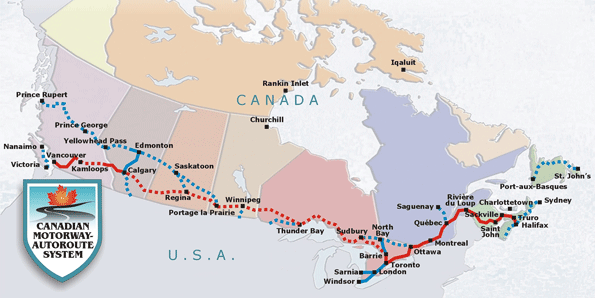
    Motorways in Canada: Canada, however, is an exception. Only a quarter of metropolitan areas are connected to one another by motorways. Edmonton and Calgary are among the few metropolitan areas in the developed world that are not connected to comprehensive motorway systems (Vancouver is connected to the US system, but not to the rest of Canada).

    For many trips between Canadian metropolitan areas, it takes less time to travel through the United States on its motorways than on the Canadian roads (such as between Winnipeg or Calgary and Toronto). The principal problem is the long, crowded, slow, two-lane stretch of roadway through the northern Great Lakes region between the Manitoba-Ontario border and between Sudbury and Parry Sound. There is also a long section of roadway in the British Columbia interior that a Calgary talk show host referred to as a “stagecoach” trail. Canada pays an economic price for this lack of a world-class highway system, both in terms of manufacturing and tourism.

    However, parts of Canada are well served by motorways. Much of central and eastern Canada is connected by motorways, with routes from Windsor, Ontario, through Toronto, Ottawa, Montreal, Quebec to Halifax. This route includes only a short segment that is not motorway standard in the province of Quebec as it approaches the New Brunswick border.

    Moreover, despite its reputation to the contrary, the largest Canadian urban areas have world class freeway systems. Few, if any, urban areas in the United States or the developed world have more kilometers of motorway or motorway lanes in relation to their urban area size as Toronto and Montreal.

    A Canadian Autobahn: In cooperation with the Frontier Centre for Public Policy, we proposed a world class highway system for Canada. In a report entitled “A Canadian Autobahn: Creating a World Class Highway System for the Nation” we proposed:

    1. Upgrading the entire transcontinental route from Halifax, through Toronto to Vancouver to motorway standards. These improvements should be completed within 10 years and would cost approximately $28 billion (2009$).
    2. Upgrading other principal routes to at least pre-motorway standard, which would require “twinning” (four-lanes) and minimizing the number of grade crossings. The longest of these additional highways is the Yellowhead route: Edmonton and Calgary to the Canada-U.S. border; Ottawa to Sudbury; and across the island of Newfoundland. These improvements should be completed within 15 years and would cost approximately $33.5 billion).

The transcontinental route would provide a long overdue economic stimulus to urban areas such as Thunder Bay and Sault Ste. Marie. The improved Yellowhead route would provide far better access to the new deepwater, superport at Prince Rupert (British Columbia), which is the closest North American port with connections to major Asian markets. This could materially improve Prince Rupert’s competitiveness relative to larger ports on the US West Coast, such as Los Angeles and Long Beach (which have become much less competitive themselves in the last decade). The improved roadway would make it possible to effectively serve the markets of the US Midwest, South and East through a connection to I-29 in North Dakota.

The report was unveiled at a Calgary event on October 29 and was covered by media across the nation.

What About Greenhouse Gas Emissions: A question was raised about the advisability of expanding highways at a time that the world is attempting to reduce greenhouse gas (GHG) emissions. Such a strategy would seem to be at odds with the popular perception that we shall all have to abandon our cars and move into flats in the central city. This perception presumes that people are prepared to return to the standards of living and lifestyles of 1980, 1950 or even 1750. In all of my presentations on similar issues I am yet to uncover any groundswell of support for the lifestyles of yesterday.

It needs to be recognized that the international commitment to reducing GHGs is based upon an assumption of minimal impact on the economy. GHG reductions will be achieved only if they are acceptable to people, which requires acceptable costs (research by the United Nations International Panel on Climate Change suggests an upper bound of $50 per ton). Cost effectiveness is necessary to not only prevent a huge increase in poverty, but also to allow continued progress toward poverty alleviation and upward mobility. In fact, as recent US research indicates, there is scant real world potential to reduce GHGs from reduced levels of driving.

Given the strong association between economic growth and personal mobility, there is a single realistic path to substantial GHG emission reduction: better technology. Fortunately, developments suggest that technology is, indeed, the answer.

The question, thus, comes down to whether jobs in the northern Great Lakes region (and elsewhere) are more important than strategies that are politically correct, but comparatively ineffectual with respect to materially reducing GHG emissions. It seems likely that people will place a priority on jobs.

Finance: Because of the importance of tying the nation together, it would be appropriate to spend federal and provincial funds on the Canadian Autobahn. User fees, such as a dedicated gasoline tax (as in the United States) or tolls (as in France, China and Mexico) could finance the expansions, using public-private partnerships or “arms-length” government corporations.

Wendell Cox is a Visiting Professor, Conservatoire National des Arts et Metiers, Paris. He was born in Los Angeles and was appointed to three terms on the Los Angeles County Transportation Commission by Mayor Tom Bradley. He is the author of “War on the Dream: How Anti-Sprawl Policy Threatens the Quality of Life.

  • China’s Love Affair with Mobility

    China Daily reports that car (light vehicle) sales reached 10.9 million units in the first 10 months of 2009, surpassing sales in the United States by 2.2 million. This was a 38% increase over the same period last year. Part of the increase is attributed to government programs to stimulate automobile sales.

    China’s leading manufacturer is General Motors (GM), which experienced a 60% increase in sales compared to last year. By contrast, GM’s sales in the United States fell 33% in the first 10 months of the year on an annual basis. GM sold nearly 1.5 million cars in China, somewhat less than its 1.7 million sales over the same period in the United States.

  • High Speed Rail: Not One Big Happy Family

    California High Speed Rail Commission member Rod Diridon is chafing at all of the competition that has been created by the billions committed by the federal government to high speed rail. According to a New York Times report, he called many of the proposed systems around the country “vultures” and told an American Public Transportation Association meeting “If I can borrow a term from our good friends in labor, they are a ‘Do not patronize… And I cannot say it any stronger”. Consistent with that view, Diridon urged that the federal government be asked to commit all of its current $8 billion in funds to the California project.

    There may be even more disturbing news for Diridon: new competition has appeared on the horizon. A report (page 23) by the David Suzuki Foundation and the Pembina Institute (both of Canada) suggests that:

    “Using the Edmonton – Calgary example as a template, judgmentally adjusted for distance, geography and relative land values, we estimate that a full high-speed link would cost about $4 billion. If the cost were shared equally between Canada and the United States, the Canadian total would be about $2 billion.”

    Why stop at that? How about getting a quarter each from Zimbabwe and the Honduras? It would certainly make it less expensive for Canadian taxpayers. Perhaps our friends to the North simply made a typographical error, but perhaps not. Stranger things have been proposed.