Tag: Transportation

  • Letter From Asia’s Co-Prosperity Sphere

    To visit banks in Hong Kong and Kuala Lumpur, I recently flew into Shanghai and out from Singapore. In two weeks, I rode a lot of trains and met a lot of bankers. When I got home to Europe, it felt like I had traversed a Greater Economic Co-Prosperity Sphere, although I was never sure if it was one that belonged to China, Japan, or the international banking system. Here’s a highly personal, thumbnail report on the region’s development and some of the local rail network:

    China: The complexities of its currency are less significant than the feeling that the renmimbi certainly feels undervalued, when you can buy dinner for $3. Shanghai is an Asian cross between New York and Las Vegas, a port city of grandeur and skyscrapers that, at night, pulse like slot machines. Behind and facing the French colonial façades on the Bund, modern capitalism’s famous boardwalk, Shanghai is awash in modernistic, high-rise towers, as if the Chinese miracle is to produce office cubicles.

    The underground metro lacks the efficiency of Moscow or the elegance of Paris, although the trains are clean and the signs are in English, and the ticket machines feel like off-track betting. Changing from one line to another was often a nightmare. Trips across the city frequently involved long subterranean walks through arcades, on Escher-like stairways, or what felt like the Great Patriotic Underground Long March. But I never tired of the metro signage, such as one billboard that implored: “No jumping off the platform and onto the track.”

    Hong Kong Night Train: On the overnight train from Shanghai, I had a Pullman-like berth in a first-class compartment, where my easy chair looked like it was borrowed from Mao’s office. In the dining car, what I hoped might be blackened tuna was four small, boney fish, more bait than a main course. I went to sleep around what looked like the steel belt of Wheeling, West Virginia, and woke up to a misty, terraced, landscape painting.

    Guangzhou: Housing for the Chinese revolution is a phalanx of high-rise apartment buildings, which can be seen in every village, town, and city, grimly marching their tenants into a brave new world that finds heaven in sixty stories. What will happen to China when the housing projects become slums? On the ride south, in the two hours between Guangzhou and Hong Kong I crossed territories with a population of more than one hundred million. Contemplated from the train, Mao looks less like a revolutionary and more like Robert Moses, New York’s superbuilder.

    Hong Kong: Shanghai may well represent the future working, but, when compared to Hong Kong as a financial center, it remains a second city. In the Special Administrative Region (Hong Kong’s married Chinese name), I talked with bankers who are convinced that the former British colony, still splendid and affluent, is playing the same role for Beijing communists that it once did for the Jardine family: that is, to serve its masters as an entrepôt, money changer, front company, merchant bank, fiduciary, gold vault, and deep-water port for the goods of empire.

    The pleasure of Hong Kong was to visit banks that are not at death’s door. In Europe and the United States, all I ever come across are banks that have lent $500 on the collateral of a toaster. In Hong Kong, not to mention Asia at large, I only encountered banks that had ample deposits, liquid collateral, and positive cash flow. The question I heard most often was what to do with excess deposits; the assumption all around was that the money markets in London and New York are variations on Macau dog tracks.

    Malaysia: The state railway charges about $30 for a night in a compartment, and has fish tanks on the platform in Alor Setar. George Town, the colonial capital of Penang, is Asia’s Jerusalem, a warren of shops owned by Chinese, Malays, Indonesians, Armenians, Indians, Thais, and Englishmen. Penang is the place to go if you want to change your money, faith or identity.

    Down Penang’s east coast, not far from a Chinese temple with ceremonial snakes, is an urban enterprise zone of out-sourced, offshore semiconductor companies, many American, which import chips parts and workers and export the internal combustion engines of the information super highway.

    Kuala Lumpur’s large banks straddle the disparate worlds of retail and Islamic finance. Much of the Asian economic miracle has been fueled with local currency bonds; in Malaysia, they are issued in ringget. But modern finance does not work for those Islamic clients for whom interest is not an article of faith. Hence, banks in Muslim countries like Malaysia and Indonesia often transmute deposits into assets that are veiled to look like interest-bearing bonds.

    Singapore reminds me of a shopping mall with a national flag. To get home to Europe, I flew on Air France as opposed to continuing the journey by train. I knew from a meeting with the Malaysia state railways that there is a gap in the international connections between Singapore and Europe.

    Before leaving, I met with a railroad man who is working to complete the network in Southeast Asia. With this finger on a map, he traced the missing track through the Thai jungle and Cambodian rice paddies, grimly pointing out that one way to tie in the overland service would be to complete the line that crosses the River Kwai.

    One day, tracks will connect Singapore to Kunming, in southern China. And from there, perhaps someday, I will begin my journey home, using an ATM machine to buy my ticket and then to pay for it in renmimbi.

    Matthew Stevenson was born in New York, but has lived in Switzerland since 1991. He is the author of, among other books, Letters of Transit: Essays on Travel, History, Politics, and Family Life Abroad. His most recent book is An April Across America. In addition to their availability on Amazon, they can be ordered at Odysseus Books, or located toll-free at 1-800-345-6665. He may be contacted at matthewstevenson@sunrise.ch.

  • America’s Energy Future: The Changing Landscape of America

    During the first ten days of October 2008, the Dow Jones dropped 2,399.47 points, losing 22.11% of its value and trillions of investor equity. The Federal Government pushed a $700 billion bail-out through Congress to rescue the beleaguered financial institutions. The collapse of the financial system in the fall of 2008 was likened to an earthquake. In reality, what happened was more like a shift of tectonic plates.

    History will record that the tectonic plates of our financial world began to drift apart in the fall of 2008. The scale of this change may be most visible in who controls the energy that powers our world.
    ***********************************

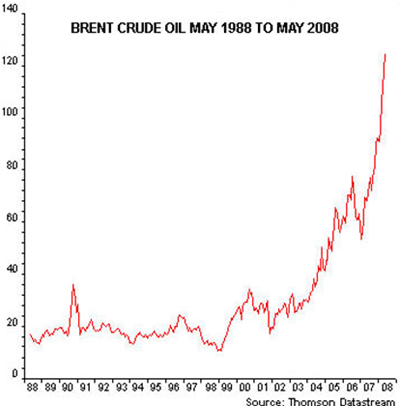
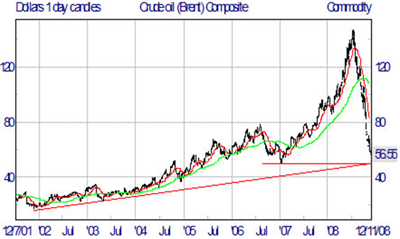
    May 2008 brought with it the highest price on record for Brent Crude Oil – $148 per barrel. At the pump that translated into prices in excess of $4.00 per gallon. A sixteen gallon fill-up of a Toyota Prius in Los Angeles cost its owner $72.00 and a fill-up of a twenty-five gallon Cadillac Escalade set its owner back more than $100.00. The largest transfer of wealth in the history of mankind was underway and consumers were feeling the pinch.

    The countries that border the Persian Gulf produce and export 20,000,000 barrels of oil per day. At its peak in May of 2008, the Persian Gulf producers (Saudi Arabia, Iran, Iraq, Kuwait, Qatar and the U.A.E) were receiving $3 billion per day, $90 billion per month and $1 trillion per year in revenues from the industrialized nations of the world, including the EU, North America and, most importantly, the rising powers of India and China.

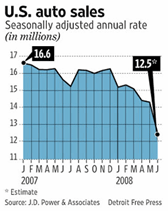
    These Persian Gulf nations are mostly monarchies controlled by individuals, royal families or at best a few power brokers. American consumers abandoned their love affair with the SUV and Detroit’s assembly lines began to grind to a halt. New car sales which peaked at 17 million units in 2007 plummeted to a rate of 9.2 million within six months. The inventory of unsold vehicles built up and led inexorably to the bankruptcies of Chrysler and General Motors.

    At the same time, the airlines began charging for checked bags and discontinued the ubiquitous bag of peanuts as they reeled under the cost of jet fuel. Bellicose despots in oil rich lands outside the Middle East used their new found wealth to rattle their sabers. Russia, the world’s second largest oil producer after Saudi Arabia, began flying their venerable Backfire bombers to the American coast. Hugo Chavez of Venezuela, the world’s ninth largest oil producer, used his oil wealth to turn himself into an icon of the anti-gringo sentiment always beneath the surface throughout Latin America.

    Politicians, who placed America’s coastline off limits for drilling, were forced to recant their precious moratorium under the growing chorus of “Drill here and drill now”. Environmentalists, who destroyed the nuclear power industry with fearmongering over its safety, were increasingly on the defensive. T. Boone Pickens invested millions of his own money to promote wind farms – and more importantly natural gas – across America’s heartland. Sales of little known Jatropha seeds, a plant indigenous to India that produces an oil clean enough to run a diesel engine, skyrocketed. By the fall of 2008, the financial markets were buckling under the strain.

    As the economies of the world contracted, demand for oil plummeted and the price of crude collapsed. Terrified by the apparent mismanagement of the economy by the Republicans, Americans elected an untested junior Senator to the most powerful position in the world. Predictably, plans for alternative energy withered as prices plummeted and gas dropped to $1.50 per gallon. Russia, whose cost to develop crude is $50 per barrel, lost its swagger as its currency and stock market collapsed with the price of crude. The collapse of oil to $35 per barrel even silenced Hugo Chavez, at least for a moment.

    Sadly, the America public lost interest in energy as they were distracted by a 40% loss in their 401ks, corporate bankruptcies and the growing numbers of lay-offs. Politicians quickly shifted their focus from drilling, nuclear energy and independence from imported oil and began espousing the Obama administration mantra of “green energy” and “green collar jobs”. Unfortunately, these words are just a chimera since they are likely, even with massive subsidy, to produce only a small fraction of the nation’s energy for at least decade or two.

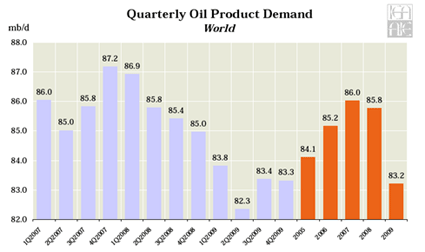
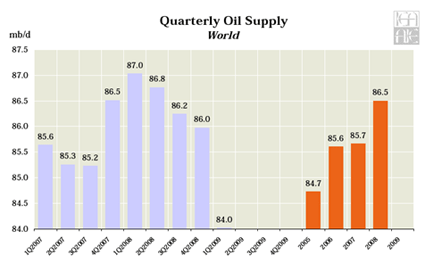
    These ephemeral goals only mask the real problem: America’s dependence on imported oil. The world demand for oil averages 85 mbd (million barrels per day). In the darkest days of the global financial crisis during the spring, when we stood at the abyss of The Great Depression, demand dropped to just 82.3 mbd. Conversely, world oil supply peaked at 87 mbd in 2007. This relative parity between supply and demand eliminates the elasticity that puts some control on prices. With literally no elasticity, speculators know that buyers will purchase every barrel of oil and prices rise. The proof of this market force is visible at the pump where gasoline has crested $3.00 per gallon in California and more than $2.66 per gallon nationwide. The United States consumes 20,000,000 barrels of oil per day or 24% of the world’s supply. In previous decades this was not a problem because the United States was a major producer of oil. But our peak production was reached in the 1970s when the US imported just 35% of its oil. Today we import more than 66% and no longer can influence the price of black gold. That price is now determined by despots in the Persian Gulf, Russia and Venezuela.

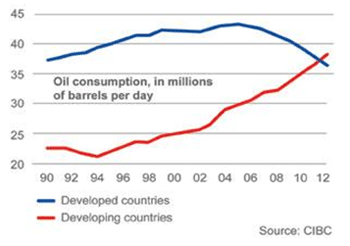
    This problem is not going away soon. According to the Energy Information Agency of the U.S. Government, the world demand for oil will require an additional 44 million barrels of oil every day to meet projected demand. The increase of demand is not going to come from the American or European markets. The developed nations through conservation, fuel standards, a reinvigorated nuclear power industry and, over time, the push for alternative fuels will actually reduce their consumption over the next twenty years. The push will come from India, Russia, Brazil, and of course China.

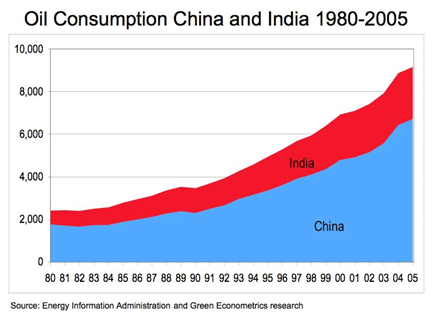
    India, with a population over one billion, has announced its version of the Interstate Highway System that opened America to its great Middle Class. After the acquisition of Jaguar and Land Rover, Tata Industries has begun production of the Nano, a car that sells for $2,000 in India. The demand for oil to power the cars for an educated and increasingly affluent Indian society will keep pressure on oil prices for years to come. India uses just 2.7 mbd today but expects that demand to grow to 4.5 mbd by 2030.

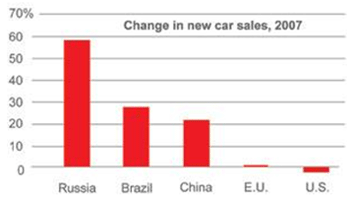
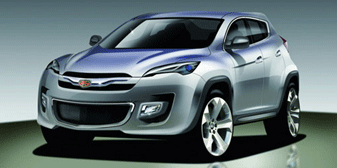
    There are now more than a billion Chinese. China consumed just 2 mbd of oil in 1990. Oil consumption jumped to 7.6 mbd in 2007 and is projected to grow to 15 mbd in 2030. The Chinese automobile industry grew at 21% last year while the US auto industry contracted by 40%. China displaced Germany as the third largest auto producer and will soon eclipse the damaged US auto industry which is contracting to a mere shadow of its former self. Chinese brands such as Chery and Geely, unknown to American consumers, may soon become as well known in America as Nissan or Hyundai.

    Demand will push oil over $100 barrels again. Vast capital will pour into the Persian Gulf, Russia and Venezuela once again. Into this tempest comes America with a thirst for 20,000,000 barrels each day. The major oil producers in the Middle East, Russia and Venezuela are not America’s friends. Russia will use its oil wealth to thwart the US and veto in the United Nations any effort to subdue the North Koreas and Irans of the world. China, with its surplus of US dollars, will continue to harvest natural resources around the world, and forge strategic alliances with the likes of Iran as it secures the flow of oil and natural resources to its industries for years to come.

    Meanwhile our politicians ignore our growing dependence on unfriendly nations and our weakening credit rating in the world to chase the chimera of green collar jobs and a green economy. Wind and solar will never power more than a minuscule fraction of America’s engines. America needs the equivalent of the Apollo moon project, a national challenge to move America off its dependence on foreign oil. We need simultaneous development of domestic oil and natural gas drilling, nuclear power, development of hydrogen fuel cells and clean coal technologies along with wind and solar power plants.

    A year from now the landscape of America will be forever changed. Five years from now, will American find the fortitude to grasp its energy independence? Or will our weak politicians in both parties keep their heads buried in the sand until China and India emerge to deny us what we are no longer in a financial position to demand?

    ***********************************

    This is the third in a series on The Changing Landscape of America. Future articles will discuss real estate, politics, healthcare and other aspects of our economy and our society. Robert J. Cristiano PhD is a successful real estate developer and the Real Estate Professional in Residence at Chapman University in Orange, CA.

    PART ONE – THE AUTOMOBILE INDUSTRY (May 2009)

    PART TWO – THE HOMEBUILDING INDUSTRY (June 2009)

  • How Can Cities with Unaffordable Housing be Ranked Among the Most Livable Cities in the World?

    The Economist magazine’s “Economic Intelligence Unit” (EIU) has published its most recent survey of the most livable cities in the world.

    Vancouver, Canada, ranks number one, Vienna, Austria number two, Perth, Australia number five, Geneva number 8, Zurich, number 9, (both in Switzerland) and Auckland, New Zealand, number twelve.

    The comments on the EIU web page are plentiful and outspoken, most of them from people living in the ‘top-ranked’ cities explaining why the survey has got things ‘so wrong’ – or ‘so absolutely right’. Many point out that Vancouver, like so many of the top-rated cities, has severely unaffordable housing.

    Many also have high taxes, and some, like Auckland, have low wages by world standards. For most people, high wages, low taxes and affordable housing make a major contribution to livability.

    Anyone familiar with Zurich and Geneva knows that one has to be very wealthy to live there. For most of us, such cities are quite ‘unlivable’.

    However, the EIU is probably providing its customers with the right answers (or as right as such surveys can be) because their experts are ranking these cities according to their attractiveness to expatriate executives.

    Executives posted from New York to Vancouver or Sydney are unlikely to be concerned with the cost of housing because their housing will be provided free of charge, or subsidized by accommodation allowances. These rankings are not established by interviewing a random sample of residents, but are generated by a team of experts trying to assess these cities through the eyes of transferred executives setting up homes in new countries.

    This introduces another set of biases because even expert visitors have different priorities and preferences to long-term residents.

    Visitors to cities use public transport – especially shuttles, taxis and trains – if only because they do not carry their cars in their suitcase. Again, the comments on the EIU web page demonstrate that the public transport that serves visitors well may not be so impressive to the long term residents.

    Similarly, the Mercer Consulting’s Quality of Living survey ranks Auckland fourth, equal with Vancouver. Vienna, Zurich and Geneva are their top three, with Vancouver and Auckland fourth equal. Again, the Mercer ranking is designed “to help governments and major companies place employees on international assignments”. So housing affordability is not an issue. These are the best cities for ‘top’ people – and for government officials in particular.

    So, when pondering the rankings of these cities, we should understand they have been ranked according to the preferences of a high income, highly mobile, urban elite. This probably reduces their utility as a guide to overall public policy.

    Once we understand this perspective the rankings make much more sense. Whether this makes sense to people starting a career, or trying to raise a family on a middle or even upper middle class income, is dubious at best.

    Of course some will no doubt hail such surveys because they emphasize such things as physical beauty or cultural offerings. Yet they have precious little to do with what matters most, notably affordability of decent housing. For most migrants to these cities, the prospects of upward mobility – something not discussed or even considered – are probably less optimal than in places like Houston, Atlanta, and even New York.

    After all, for most people, the cost of housing is important in making location decisions, whether within their own countries or when considering migration to other lands.

    The 5th Annual Demographia International Housing Affordability Survey (2009) surveyed the Metropolitan Housing Markets of Australia, Canada, the Republic of Ireland, New Zealand, the United Kingdom, and the United States, so does not include the housing markets the EIU ranked in Europe, and elsewhere in the world.

    Even so, the list below shows that six of the ‘top twelve’ most livable cities prove to be ‘severely unaffordable’ as measured by Demographia’s Median Multiple Index. (Median house price divided by median household income.) A further two of the twelve, Toronto, ranked 4th, and Calgary, ranked fifth equal with Perth, are both ‘seriously unaffordable’.

    Most of us would expect housing affordability to be a key ingredient of livability. The list below included the eight EIU ranked cities (from top ranking Vancouver to 12th ranking Auckland) which were also surveyed for housing affordability by Demographia.

    1. Vancouver – 4th least affordable of all the severely unaffordable markets with a Median Multiple Index (MMI) of 8.4.
    3. Melbourne – Severely unaffordable; MMI of 7.1
    4. Toronto – Seriously unaffordable; MMI of 4.8.
    5. Perth – Severely unaffordable; MMI of 6.4
    5. Calgary – Seriously unaffordable; MMI of 4.8
    9. Sydney – 5th least affordable of all severely unaffordable markets; MMI of 8.3
    11. Adelaide – Severely unaffordable; MMI of 7.1
    12. Auckland – Severely unaffordable; MMI of 6.4.

    A survey that included housing affordability, per capita income, tax rates (central and local), and average drive-time to work, would almost certainly generate quite different rankings. Perhaps what has been missing is this acknowledgement that different factors motivate different kinds of people. The urban elite is very different from the middle class in its concerns. Pundits and planners would be well-served to note these differences before using such surveys as the basis for sound public policy.

    Owen McShane is Director of the Centre for Resource Management Studies, New Zealand.

  • Debates on Airport Rail

    Running a little behind this week, so I just wanted to pass along this story from USA Today on domestic airports adding rail service. People love the service, of course, and many airports are doing it, but later in the article they get to the economic irrationality of it in America’s decentralized car-centric cities (as opposed to Europe and Asia).

    Still, airport-rail ridership in the USA is woefully low compared with other countries, says Andrew Sharp, director general of the U.K.-based International Air Rail Organisation. In many European and Asian airports, 20% to 30% of travelers get to and from the airport using rail. In the USA, ridership typically ranges from 2% to 5%, he says.

    Ongoing debates

    Like most large construction projects, airport rail proposals face stiff headwinds. Opponents challenge funding sources and new taxes and cite preferences for cars and buses. But the central argument in most debates has centered around ridership, specifically whether airports have enough demand to justify millions in cost.

    BART’s connection to SFO, completed in 2003, has yet to reach BART’s initial ridership forecast and is still not profitable. Prior to construction, BART projected there would be 17,800 average daily boardings to and from the airport by the year 2010. As of this month, SFO ridership was at about 11,000.

    Frank Sterling and Juliet Ellis, activists in the Bay Area, also questioned BART’s plans to spend $500 million for Oakland International’s people-mover and its decision to charge $6 for the service vs. $3 for the current shuttle bus.

    “The proposal to charge double that for the new connector might drive away customers, unless it delivers twice the value,” they wrote in a recent newspaper commentary, “Can East Bay residents afford this?”

    Then they use some of my favorite arguments from past posts:

    These are appropriate debates, Coogan says. Some cities are better off sticking to buses, he says. For example, LAX’s FlyAway Bus, which provides non-stop rides to various neighborhoods in Southern California, is more convenient for many travelers than the metro.

    For some cities, it’d be wiser to spend scarce funds for extending metro to public transportation-friendly suburbs before considering airports, Coogan adds.

    How often does a person go to work? And how often does a person go to Paris in a year?” he says.

    More on these arguments here, here, and here (near the bottom). As I said in one of those posts: I agree, and I’ve said before that the market here is a niche one plenty well served by buses: young singles who can’t get a ride to/from the airport. Business travelers will almost always rent a car or take a taxi. Families won’t schlep their luggage on transit. Most others will have friends or family pick them up or drop them off. And our off-site airport parking is dirt cheap. The ridership drivers just aren’t there.

  • New Mitsubishi Car: Climate Friendlier than New York Transit

    Further demonstrating the ability of technology to reduce greenhouse gas (GHG) emissions, Mitsubishi has announced development of a lithium battery driven car, to be sold within two years. The car, the “MIEV Plug-In Electric First Drive” would travel as much as 100 miles (160 kilometers) between charges.

    United States Data and Comparisons: GHG Emissions per Passenger Mile/Passenger KM are indicated below (From power plants – variation is due to mix of fuel sources used in producing electricity)

    Average United States: 61 grams/37 grams

    Lowest (Vermont): 1.4 grams/0,7 grams

    Highest (North Dakota): 102 grams/62 grams

    The average GHG reduction compared to the current US automobile and sport utility vehicle fleet average would be 83 percent. The car would emit approximately less than one-half the GHGs per passenger mile as transit in New York area (the best in the nation) and one-fourth the overall US transit average.

    European Union Comparison: The MIEV would be 40 percent less GHG intensive that is required by the newly adopted European Union fuel economy requirements for 2020 (the equivalent of 101 grams per passenger mile or 62 grams per passenger kilometer).

    The above calculations assume the US national vehicle occupancy rate of 1.6. The comparison to the present fleet includes upstream production and transport activities.

    Sources: Mitsubishi site, Edmunds Review

  • Federal Highway Trust Fund: Problem Solving, Government Style

    News Flash: The Federal Highway Trust Fund will go broke in August.

    It went broke last year, and Congress needed an emergency transfer of $8 billion to keep it solvent. There was very little concern last year, but this year we find ourselves in a post-modernist political environment where managing a crisis is good politics, although actually all we do is talk about it.

    According to Senator Barbara Boxer (D. CA), the fund will need $7 billion this year and another $10 billion next year to remain solvent through September 30, 2010. Even with this crisis verified and time running out, Congress seems reticent to pull the trigger on a solution anytime soon. It’s just too heavy a lift politically.

    It should not surprise anyone that the trust fund is broke. The federal tax on gasoline has not been increased since 1994, but this did not stop politicians from spinning the issue. State and federal data show that gas tax collections are way down. In Pennsylvania for example revenues are running about $100 million below budget. There is also the recession, price of gasoline and more fuel efficient cars contributing to the crisis. But one factor often overlooked is that with the passage of the last federal highway bill (SAFETEA-LU) spending simply outstripped revenues, and even without changes in driving habits and the economic downturn the fund was slated to be depleted.

    Now for the really tough part: Congress needs to find money, not simply print it. The trust fund has a dedicated source of funding that has lost about half its purchasing power to inflation over the past 15 years. During that period, politicians have avoided raising taxes for roads and bridges like the plague, so now a crisis looms and our political leaders are finding out that it is much easier to spend than adequately fund.

    An Associated Press report stated, “A study by the Transportation Research Board of the National Academies estimated that the annual gap between revenues and the investment needed to improve highway and transit systems was about $105 billion in 2007, and will increase to $134 billion in 2017 under current trends.”

    The usual bag of tricks used to obfuscate this issue is no longer available. Not one but two “blue ribbon” commissions have already reported that gas taxes need to be increased. In January, The National Commission on Surface Transportation Infrastructure Financing called for a ten cent per gallon increase. A two year study by National Surface Transportation Policy and Revenue Study Commission called for an increase of 40 cents per gallon. Both studies recommended that gas tax be indexed to inflation. The second recommendation had no chance since it would in effect take this issue out of the hands of politicians who would much rather do nothing about an issue than lose control over it.

    Meanwhile, Congress has been busy at work expanding mandates for biofuels and increasing CAFÉ standards to more than 35 miles per gallon. These two combined decimate gas tax and make it an almost unworkable solution to this crisis going forward.

    Problem solving often requires taking a long term view of things. It demands answering tough questions and a willingness to implement difficult solutions. Elected leaders find it very difficult to take a long term view, because they live in a two-year election cycle. It’s one reason why the founders wanted limited government. They knew the limits of government to make tough choices to solve difficult problems.

    The day after the Department of Transportation reported the trust fund is reaching depletion it issued another press release announcing the Vice President Biden and Secretary of Transportation Ray LaHood were “challenging governors to think boldly when designing high-speed rail plans…” The Obama Administration has committed $13 billion to high-speed trains to jump start a “world class passenger rail system” in America.

    The release states that “President Obama’s vision for high-speed rail mirrors that of President Eisenhower (who gave us the Interstate Highway System.)” High-speed rail was positioned as a solution to lower dependence on oil, provide for a cleaner environment, and drive economic growth. All may be true, but what about the $17 billion hole in the highway trust fund?

    There is a lesson and a caution here about putting matters into the hands of politicians. They know that they won’t get as much credit for fixing something that is broken as they will for giving the people something new.

    Maybe this explains why government budgets keep growing and so do the deficits for many of our legacy programs.

    Dennis M. Powell is president and CEO of Massey Powell an issues management consulting company located in Plymouth Meeting, PA.

  • Painting the Town White: Technology and Greenhouse Gas Emissions

    “Paint the world white to fight global warming” was the astonishing headline from The Times of London. The paper was referring to a presentation made by United States Secretary of Energy, Dr. Stephen Chu at the St. James Palace Nobel Laureate Symposium last week. Chu was reported as saying that that this approach could have a vast impact. By lightening paved surfaces and roofs to the color of cement, it would be possible to cut carbon emissions by as much as taking all the world’s cars off the roads for 11 years. That would be no small accomplishment.

    Chu makes considerable sense and his underlying approach is wise: emphasizing inexpensive, simple and unobtrusive ways to reduce greenhouse gas (GHG) emissions. This is at the same time that Secretary of Transportation Ray LaHood has suggested “coercing” people out of cars and a bill by Senators Jay Rockefeller and Frank Lautenberg would require annual reductions in per capita driving. Strategies such as these are not inexpensive, they are not simple and they are not unobtrusive. Indeed, given the close association between personal mobility, employment and economic growth, such policies could have serious negative effects.

    The biggest problem with coercive strategies is that they are simply unnecessary. As Secretary Chu has indicated, huge reductions can be achieved in GHG emissions, without interfering in people’s lives or threatening the economy. There’s more to this story than paint.

    The Cascade of Technology

    There is a virtual cascade of technological advances that have been spurred by the widely accepted public policy imperative to reduce GHG emissions. Here are just a few.

    Vehicle Technology

    Some of the most impressive advances are in vehicle technology. GHG emissions from cars are directly related to fuel consumption. Thus, as cars require less fuel, GHG emissions go down at the same rate.

    By now, everyone is aware that the Administration has advanced the 2020 vehicle fuel efficiency (CAFE) standards to 2016, matching the California requirements. These requirements apply to the overall fleet, both cars and light trucks (which are predominantly sport-utility vehicles). Recently published research by Robert Puentes of the Brookings Institution finds that per capita automobile use had fallen off even before gasoline prices exploded, so it seems reasonable to suggest that future vehicle travel will rise at approximately the population growth rate, rather than the robust growth rates previously forecast. At the new 35.5 miles per gallon, the nation could be on a course to reduce GHG emissions from cars and light trucks by more than 20 percent by 2030, despite the increase in driving as population increases.

    This is just the beginning. There are advances well beyond the 35.5 mile per gallon standard. The most efficient hybrid cars now achieve 50 miles per gallon. The European parliament has adopted a nearly 70 mile per gallon standard for 2020. The President has often spoke of his commitment for the nation to develop 150 mile per gallon cars, while Volkswagen has already developed a 235 mile per gallon car.

    A French company plans to market a car powered by compressed air at city traffic speeds, producing almost no GHG emissions, while at higher speeds it uses gasoline to get more than 100 miles per gallon.

    Fuel Technology

    Progress is also being made on alternative fuels and on making present fuels cleaner.

    Technologies are being developed to produce gasoline from carbon dioxide.

    There are even substantial advances in air travel emissions. Air New Zealand has announced tests that show the feasibility of using biofuels based upon the jatropha plant. The airline reports that, gallon for gallon, the biofuel reduced GHG emissions 60 to 65 percent relative to jet fuel. Jatropha is a non-food crop, and therefore its use would have little or no impact on food prices.

    Carbon Neutral Housing

    We have previously reported on the development of a carbon neutral, single story 2,150 square foot suburban house in Japan. The resulting 100 percent reduction in GHG emissions means that there is no reason that such housing cannot continue to be available to those who prefer it.

    Electricity Generation

    One of the most intractable challenges will be producing sufficient supplies of electricity while considerably reducing GHG emissions. Obviously, one approach with great potential is nuclear power, which the environmentally conscious French have successfully used to produce approximately three-quarters of their demand.

    Further, substantial advances are coming in solar power. For example a Massachusetts Institute of Technology team has developed a solar concentrator system that increases power production “by a factor of 40.” The process is now under commercial development.

    Even Buck Rogers seems to be getting into the game. California’s Pacific Gas and Electric Company is partnering with a startup firm to produce solar energy in space and to beam it to earth by microwaves. This process could produce as much as 10 times the energy as ground based solar connectors.

    Further, international efforts continue toward developing nuclear fusion power generation. This non-polluting technology, still largely theoretical, could revolutionize power production in decades to come.

    The Color of Paint

    Some of the technological advances above may not in fact make a substantial contribution to reducing GHG emissions in the longer run. However, these developments and others likely to come underscore the fact that technology, that is human ingenuity, can materially reduce GHG emissions, while permitting people and the economy to go about their business. Serious attempts to force behavior modification backwards to the past seem likely to fail.

    So, there is no reason to retreat to an idealized yesterday to meet the thinly disguised social engineering goals of the few while leaving the many worse off. Secretary Chu has caught the spirit of the right approach. We should be painting the town white with innovation and should reject the coercion that has been embraced by those who naively (or perhaps even purposefully) would paint the future a more somber color. As in the past, human ingenuity appears up to the challenge, if we give it the chance.

    Wendell Cox is a Visiting Professor, Conservatoire National des Arts et Metiers, Paris. He was born in Los Angeles and was appointed to three terms on the Los Angeles County Transportation Commission by Mayor Tom Bradley. He is the author of “War on the Dream: How Anti-Sprawl Policy Threatens the Quality of Life.

  • San Jose, California: Bustling Metropolis or Bedroom Community?

    Dionne Warwick posed the question more than 40 years ago, yet most Americans still don’t know ‘The way to San Jose’. Possessing neither the international cachet of San Francisco nor the notoriety of Oakland, San Jose continues to fly under the national radar in comparison to its Bay Area compatriots. Even with its self-proclaimed status as the ‘Heart of Silicon Valley’, many would be hard pressed to locate San Jose on a map of California.

    More well-known American cities may try to gain population by branding themselves as interesting places, but San Jose does not struggle to attract newcomers. Sprawling over 178 square miles, San Jose sits at the southern end of the San Francisco Bay. This year the city exceeded the 1 million population mark for the first time.

    So what makes this city, the 10th-largest in the United States, appealing? Unlike its precious neighbor 50 miles to the north, San Francisco, people move to San Jose primarily for jobs – especially those related to the coveted technology sector. Whereas San Francisco balances its role as playground for the independently wealthy and welfare state for the lumpenproletariat, San Jose remains favored among families and those looking for a safe environment in which to raise children – not to mention, the weather is better.

    San Jose does not stimulate a sense of urban exaltation. Aside from a commercial downtown core with a collection of mediocre high-rises (limited in height due to do downtown’s adjacency to the San Jose Airport), the city is unapologetically suburban in a character.

    San Jose’s pattern of development can be traced back to its origins as an agricultural community supporting early Spanish settlers who chose to settle in the fertile Santa Clara Valley. It remained a modest-size agrarian community until the end of World War II when it underwent a period of rapid expansion-not unlike that of Los Angeles to the south. During the 1950s, with the emergence of semiconductor technology derived from silicon, San Jose and the greater Santa Clara Valley exploded into a center for the evolution of computer technology.

    Today, San Jose can best be understood by its ambivalent relationship with neighboring Silicon Valley cities. Mid-size suburbs such as Cupertino, Sunnyvale, Mountain View and Palo Alto, all located west/northwest of San Jose as one travels up the peninsula towards San Francisco, are very distinct and separate entities. Home to some of Silicon Valley’s heaviest hitters (Cupertino has Apple, Sunnyvale has Yahoo!, Mountain View has Google, Palo Alto has Hewlett-Packard, Facebook and Stanford University), these cities largely define the technology-focused region. To be sure, San Jose’s has its share of big players, including eBay and Adobe as well as the ‘Innovation Triangle’, an industrial area of north San Jose, home to the headquarters of large companies like Cisco Systems and Cypress Semiconductor.

    Yet, despite the presence of these firms, San Jose has become ever more a residential community, with among the worst jobs to housing balances in the region. Furthermore, a whopping 59% of the city’s developed land constitutes residential use – 78% of that being single-family detached housing. In this sense, despite being the largest city, San Jose essentially serves as a ‘bedroom community’ for the rest of Silicon Valley.

    This has been a burden for the city, which, unlike its neighbors, lacks enough large information technology companies to help fill their tax coffers. In contrast job rich ‘green’ cities like Palo Alto have remained staunchly ‘anti-growth’ regarding residential development and consequently have very high housing prices.

    This pattern poses fiscal problems for San Jose. City officials have long been aware of the need to stimulate economic development instead of continuing to lose out to its neighbors but the city seems determined to increase further its role as dormitory for its neighbors. Indeed, amazingly the city’s development agenda has in recent years shifted to a relentless focus on high-density, multi-family residential in the downtown core and along transit corridors. In 2007, 79% of all new housing built in San Jose was multi-family – a staggering deviation from its history of low density development.

    Though well-intentioned, the slant towards densification has yielded a glut of empty condo units throughout the city. Those that have purchased units in new developments often find themselves with underwater mortgages. During a recent visit to one the flashy new downtown condo buildings, The 88, I entered a desolate sales office and was greeted by a skittish sales agent. When asked how sales were, my question was deferred without a direct answer in an act of not-so-quiet desperation.

    Although it’s clear most people in San Jose prefer lower density living, the city government continues hedging tax dollars against a future in which newcomers will want to live in a high-density setting. Outside of downtown, low to mid-rise multi-family housing has been built along the city’s light-rail lines in what are conceived to be ‘transit villages’. The popularity for such a lifestyle is questionable given the high price point and unreasonable HOA dues of these condo units, particularly when single-family detached houses can be purchased at comparable prices.

    Despite these issues, San Jose seems hell-bent on its path towards densification. The city has major plans to develop the area around its Diridon Train Station, just west of downtown, as California High-Speed Rail and BART are projected to make their way to San Jose. Furthermore, the city government is counting on the Oakland A’s baseball team making a move to San Jose.

    From the Champs-Élysées to Tiananmen Square, grand urban visions are what have defined cities historically. As a product of the Silicon Valley ethos as well as an observer of planning trends, I would argue that this is no longer valid – especially for any city with the hopes of a prosperous future. Rather, in democratic societies, it will be the idiosyncrasies of individual actors and the prospect of upward mobility that will define a sense of place.

    Obsessed with density and urban form, planners don’t seem to grasp the chicken and egg conundrum – the notion that lifestyle amenities follow on the heels of economic opportunity. San Jose needs to cast its future on nurturing its entrepreneurs instead of trying to become something it is not yet ready to become.

    Adam Nathaniel Mayer is a native of the San Francisco Bay Area. Raised in the town of Los Gatos, on the edge of Silicon Valley, Adam developed a keen interest in the importance of place within the framework of a highly globalized economy. He currently lives in San Francisco where he works in the architecture profession.

  • The Changing Landscape of America: The Fate of Detroit

    INTRODUCTION

    During the first ten days of October 2008, the Dow Jones dropped 2399.47 points, losing 22.11% of its value and trillions of investor equity. The Federal Government pushed a $700 billion bail-out through Congress to rescue the beleaguered financial institutions. The collapse of the financial system in the fall of 2008 was likened to an earthquake. In reality, what happened was more like a shift of tectonic plates.

    In 1912 a German scientist, Alfred Wegener, proposed that the continents were once joined together as one giant land mass called Pangea.

    About 200 million years ago the continents began to drift apart as the globe separated into eight distinct tectonic plates. History will record that the financial tectonic plates of our world began to drift apart in the fall of 2008. They have not stopped moving and the outcome of where they will end up remains uncertain.

    PART ONE – THE AUTOMOBILE INDUSTRY

    Edsel, Packer, Studebaker, Hudson, Nash, AMC – the demise of these brands may have seemed tragic at the time, but were actually a sign of industrial health. In contrast, for the last fifty years the American automobile industry has been static. Despite the proliferation of Japanese, Korean and German imports, General Motors, Ford and Chrysler managed to hold on to a majority of the domestic market, with a dizzying stable of makes and models that grew to near 17 million new car sales in 2007. That epoch is now over. The tectonic plates have shifted under the automotive business and a year from now, the industry will bear little resemblance to the static structure of the last fifty years.

    Fifty years ago General Motors owned more than 50% of the American market and automobile jobs made up one seventh of the US workforce. It was said that when GM sneezed the US economy caught a cold. GM shares now sell for less than a cup of coffee at Starbucks. Now GM is about to enter bankruptcy.

    The brands are dissolving, Oldsmobile was the first casualty. Pontiac and Hummer have been discontinued. When they reorganize, eleven hundred dealers will be terminated. General Motors will close all its plants for three months this summer. Many will never reopen. The New GM, to be known as Government Motors, will be owned by the UAW (20%) and the Federal Government (70%). Twenty billion of tax-payer loans will be converted to ownership to make the UAW pensions liquid. The debt holders will see their senior $27 billion investment converted into just 10% of stock. The shareholders will be wiped out.

    The New GM will become the platform for small fuel efficient cars, hybrids, electric vehicles and experimental technologies mandated by an ever demanding government. Its shareholders vanquished, The New GM will bear no resemblance to the car company that we have known for the last 50 years. Can the Chevy Volt rescue GM? The answer is no.

    GM will continue to shrink as their SAAB and Saturn franchises are sold off to the Chinese. China’s automobile sales are up 10% this year versus declines of 23% in the US and 15% in Europe. Chinese automobile manufacturers are grabbing market share, 30% this year versus 26% in 2008, while their competitors are distracted. Chinese companies unknown to Americans like Geely Motors, Chery Automobiles or BYD Co. will buy SAAB or Saturn for their dealer network. Warren Buffett invested $230 million into BYD, a firm that has been manufacturing cars for just six years. They already provide batteries to Ford and GM and soon will be building the world’s least expensive mass produced hybrid and electric vehicles. Geely plans to triple its domestic sales to 700,000 by 2015 and Chery plans to introduce 36 new models over the next two years.

    Chrysler is in far worse shape and will likely never recover. The Federal Government already forced it into bankruptcy. Seven hundred and eighty nine dealers have been told that their franchises are terminated. Its shotgun marriage to Fiat will look more like a surgical amputation of unnecessary body parts than a marriage. If Fiat remains in the game, they will do so for the Jeep brand and a portion of the dealer network. Like Oldsmobile and Pontiac, Plymouth and Dodge brands are doomed as well as most of the Chrysler line. No one will mourn the demise of the Crossfire, Pacifica, Sebring, or the PT Cruiser. Fiat should keep the new Chrysler 300, a beautiful design that deserves to be built. Chrysler has not produced many stars in the last few decades. The trail blazing design of the 300 brought the full size sedan back from the dead.

    Chrysler will jettison the weakest of its dealers in bankruptcy. Fiat will retain the big dealers in the network. They will bring the stunning and iconic Fiat 500 to America, a fuel efficient small car that will enjoy the same success as Volkswagen’s retro Beetle. Fiat will also use the dealer network to bring the Alfa-Romeo back to America. The Fiat-Jeep-Alfa dealer of the future will bear no resemblance to the staid Chrysler-Dodge-Plymouth dealer of today.

    The surprising winner among the American troika of manufacturers is the Ford Motor Company. Ford and Lincoln will survive because they took no government bail-out money. Mercury may not survive but Ford and Lincoln should make it through the transition. The new Ford-Lincoln will be the refuge for auto enthusiasts who want attractive fast and powerful cars. Ford will become the Apple of the auto business, doing its own thing and flaunting political correctness and conventional wisdom. Ford’s namesake CEO has been an environmentalist for many years so Ford was well into fuel economy and hybrids before the tectonic plates began to move last fall. At just $5.00 per share, Ford is a tantalizing buy for the long term.

    One can no longer call Mercedes, BMW, Toyota and Honda imports as many of their cars are made entirely in the U.S. The Japanese system is different than the American counterpart although we are drifting toward their model. The Japanese government plays a heavy hand in their industry, subsidizing the encroachment into new markets until the brands have stabilized market share. But they are not immune. Toyota lost $7.7 billion in the last quarter – even more than GM.

    True imports like Volkswagen will weather the storm because they were well positioned with small fuel efficient cars long before the tectonic plates began to shift. VW is making a huge bet that oil will top $100/barrel again soon and their fuel efficient and clean diesels will be accepted by American drivers.

    The biggest winner is obviously the UAW and their pensions which have been bailed out with tax payer money by an administration beholden to its labor supporters. Who will be the biggest loser? Clearly, it will be America’s small towns. Our small towns will lose their local dealer and their choice in automobiles. They will be forced to buy the brand that remains in town or drive scores of miles to the next closest dealer for service. Most small town auto dealers were also the most generous members of the community. Charitable giving and support will wither as will local sales tax revenues when the big ticket automobile sales tax revenues disappear. Ironically, as the plates continue to shift, America’s small towns could be decimated by the changes in the automobile industry as they were one hundred years ago when the automobile shifted millions from rural communities to the cities.

    A year from now the landscape of America will be forever changed but the plates will continue to shift. Five years from now, will American ingenuity bring about a renaissance of the American automobile industry? Or, will what is left of this industry be gobbled up by the Chinese and the Korean manufacturers as the Japanese did in the 70s and 80s? The key issue may be what role the government will play. Will Americans buy cars designed by government bureaucrats and built by the unions that own the factories? Will an administration devoted to “coercing” Americans out of their cars be able to simultaneously save the auto industry?

    ***********************************

    This is the first in a series on the Changing Landscape of America. Future articles will discuss real estate, politics, healthcare and other aspects of our economy and our society. Robert J. Cristiano PhD is a successful real estate developer and the Real Estate Professional in Residence at Chapman University in Orange, CA.

  • Portland: A Model for National Policy?

    United States Secretary of Transportation Ray LaHood and Washington Post columnist George Will have been locked in debate over transit. Will called LaHood the “Secretary of Behavior Modification” for his policies intended to reduce car use, citing Portland’s strong transit and land use planning measures as a model for the nation. In turn, the Secretary defended the policies in a National Press Club speech and “upped the ante” by suggesting the policies are “a way to coerce people out of their cars.”

    These are just the latest in a series of media accounts about Portland, usually claiming success for its policies that have favored transit over highway projects as well as its “progressive” land use policies. Portland has also become the poster child for those who advocate planning restrictions and subsidies favoring higher density development in parts of the urban core.

    Indeed if Secretary LaHood has his way, Portland could become The Model for federal transportation policy. So perhaps it is appropriate to review what it has accomplished.

    Portland’s Mediocre Results

    Portland’s record of transit emphasis began more than 30 years ago, when the area “traded in” federal money that was available to build an east side freeway to build its first light rail line. The east side light rail opened in 1986. Since that time, Portland has significantly increased its transit service, especially opening three more light rail lines (West Side, North Side and Airport) as well as a downtown “streetcar.”

    Portland’s Static Transit Market Share: With these new lines and expanded service, Portland has experienced a substantial increase in transit ridership. Passenger miles have increased more than 130 percent since 1985, the last year before the first light rail line was opened. This is an impressive figure.

    However, over the same period, automobile use increased just as impressively. In 1985, approximately 2.1 percent of motorized travel in the Portland urban area was on transit and it remained 2.1 percent in 2007, the latest year for which data is available.

    Portland’s Declining Transit Work Trip Market Share: One of transit’s two most important contributions to a community is providing an alternative to the automobile for the work trip (the other important contribution is mobility for low income citizens). Work trip rider attraction is important because much of this travel is during peak periods, when roadways are operating at or above full capacity. In 1980, the last year for which data is available before the first light rail line opened, United States Bureau of the Census data indicates that transit’s work trip market share was 9.5 percent in the Portland area counties of Clackamas, Multnomah and Washington covered by Portland’s strong land use policies. Yet despite this, and the transit improvements, the work trip market share has not grown. By 1990, transit’s market share had dropped a third, to 6.3 percent. It rose to 7.6 percent in 2000 and by 2007 had fallen back to 6.8, despite opening two new light rail lines since 2000 (Figure 1). Remarkably, transit’s 2007 work market share was 28 percent behind its 1980 share and had fallen 10 percent since 2000.

    Figure 1:
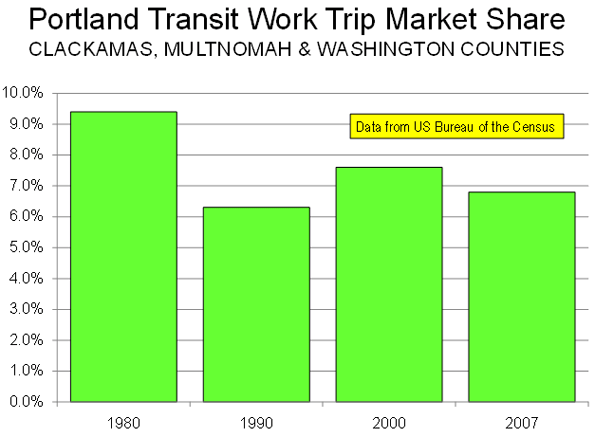
    Yes, Portland did increase its transit use, but failed to increase the share of travel on transit and the proportion of people riding transit to work declined.

    Driving the Portland Evangelism: GHG Emissions

    Secretary LaHood’s affection for Portland appears to principally be that its policies can materially assist in the objective of reducing greenhouse gas (GHG) emissions. The data is available to test that claim.

    We examined GHG emissions per capita by transit in Portland and the urban personal vehicle fleet, including cars and personal trucks (principally sport utility vehicles). Overall, including upstream emissions (such as refining and power production), transit in Portland is about 50 percent more GHG friendly per passenger mile than the 2007 vehicle fleet. If all of the increase in transit passenger miles from 1985 to 2007 replaced automobile passenger miles, then reduction of approximately 50,000 GHG tons can be said to have occurred as a result in 2007 (though as is indicated below, things are not that simple).

    That sounds like a large number, until you consider that Portland traffic produces more than 8,000,000 GHG tons per year. Transit’s expansion has reduced GHG emissions by approximately 0.6 percent annually over 22 years. This pales in comparison to the 83 percent national reduction over a 45 year period that would be required by the Waxman-Markey bill being considered by Congress.

    The Cost of GHG Emission Reduction

    Moreover, GHG emission reduction requires a context. Not all GHG emission reduction strategies make sense. Given the widely held principle that GHG emission removal must not hobble the economy, it is crucial that costs (per ton of GHG removed) be a principal criteria. If excessively costly strategies are employed, the result will be wasted financial resources, which will translate into diminished economic growth and higher levels of poverty. According to the United Nations Intergovernmental Panel on Climate Change (IPCC), between $20 and $50 per ton is the maximum amount necessary to accomplish deep reversal of CO2 concentrations between 2030 and 2050. It is fair to characterize any amount above $50 per ton as wasteful and likely to impose unnecessary economic disruption.

    Even that cost may be high. The current “market rate” is about $14 per ton, which appears to approximate the amount that figures such as former vice-president Al Gore, Speaker of the House Nancy Pelosi and California Governor Arnold Schwarzenegger pay to offset their GHG emissions from flying.

    Portland Costs of GHG Emission Reduction

    This $14 to $50 range provides the context for comparing the cost of GHG emission reduction through transit expansion in Portland. Annual transit costs in Portland more than tripled from 1985 to 2007 (including inflation adjusted operating costs and the annual capital costs of the light rail lines), an annual increase of more than $325 million. This figure is reduced to capture the consumer cost savings from reduced automobile gasoline and maintenance costs. The final result is a cost of approximately $5,500 per ton of GHG removed.

    This is 110 times the IPCC $50 maximum and nearly 400 times the Gore-Pelosi-Schwarzenegger standard. If the United States were to spend as much to remove each ton of the likely 83 percent national reduction target, the cost would be $30 trillion annually, more than double the gross domestic product. To call the Portland GHG cost reduction figure extravagant would be an understatement.

    Traffic Congestion Increases GHG Emissions

    There is not a one-to-one relationship between reduced driving levels and reduced GHG emissions. As traffic congestion increases, urban travel speeds decline and “stop-and-start” traffic increases, fuel consumption is reduced (miles per gallon declines). Some or even all of the supposed gain from reduced driving can be negated by the higher GHGs from traveling in greater traffic congestion.

    Portland’s traffic congestion has increased substantially since before light rail. Further, by 2007 Portland’s traffic congestion had become worse than average for a middle-sized urban area and worse than in much larger Dallas-Fort Worth, Atlanta, Philadelphia and Phoenix.

    Further, according to information in the Texas Transportation Institute’s Annual Mobility Report, the amount of gasoline wasted due to peak period traffic congestion in Portland rose 18,000,000 gallons from 1985 to 2005 (latest data available, adjusted for the population increase), simply due to greater traffic congestion. The increase in GHG emissions from this excess fuel consumption is estimated to be approximately 200,000 tons annually. This is four times the estimated reduction in GHG emissions that was assumed to have occurred from the increase in transit ridership.

    The bottom line: The Portland model inherently produces more congestion and increases GHG emissions. Failure to expand roadways to meet demand and forced densification increase traffic congestion.

    Better Models

    The ineffectiveness of Portland’s model strategies in GHG emission is in contrast to other strategies. Between 2000 and 2007, the share of people working at home in Portland rose more than one quarter. If transit and working at home should continue their 2000s rates, transit’s work trip share will be less than that of working at home by 2015. Working at home eliminates the work trip, resulting in substantial GHG emission reductions and does it at a cost of $0.00 per ton.

    Another approach is the Obama Administration’s automobile fuel efficiency strategy. About the same time as the LaHood-Will debate was heating up, the President announced that automobile manufacturers would be required to increase their corporate average fuel efficiency for cars and light trucks to 35.5 miles per gallon by 2016, a 75 percent performance improvement from that of the present fleet. If this fuel efficiency could be achieved in Portland today, the reduction in GHG emissions would be more than 40 percent. This new policy would eventually close 90 percent of the gap between personal vehicles and transit in Portland.

    President Obama indicated that this strategy is costless. The higher costs that consumers will pay for cars will be more than made up by the fuel cost savings. Thus, according to the President, this policy costs $0.00 per ton of GHG emissions removed, less than the IPCC’s $50 and less than Portland’s $5,500. Of course, it is not possible to achieve 35.5 miles per gallon now, but it will be (Figure 2).

    Figure 2:
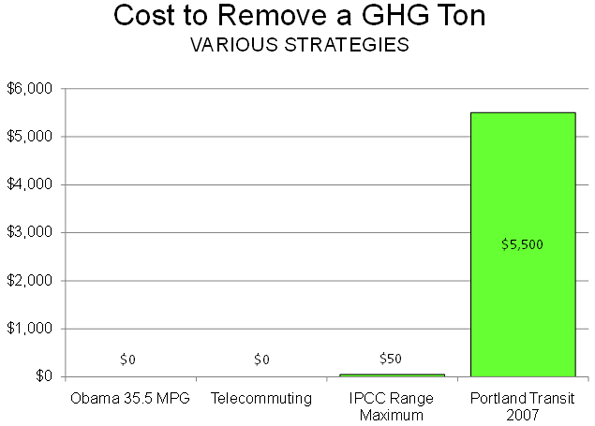
    The best hybrid cars now achieve 50 miles per gallon, which makes them less GHG intensive than transit in Portland. President Obama has gone further, indicating the potential for developing 150 mile per gallon cars. The curtain could be rising on a future of cars that emit less GHG emissions per passenger mile than transit. People and officials genuinely concerned about GHG emissions should applaud these advances. On the other hand, people and officials who value coercive behavior modification more than GHG emission reduction are likely to resist.

    The Consequences of Coercing People Out of Cars

    Moreover, Portland policies ignore a crucial factor: how automobiles facilitate economic growth and employment. Generally, the research indicates that the economic performance of metropolitan areas is enhanced by greater mobility. Moreover, no transit system provides the extensive mobility made possible by the automobile, not in America and not even in Europe. Coercing people out of cars coerces some out of employment and into poverty.

    Even where transit service is available, it generally takes longer than traveling by car. In 2007, travel to work by transit took 3:50 (three hours and 50 minutes) per week longer than driving in the nation’s largest metropolitan areas. With all of Portland’s transit improvements, it still takes approximately 3:15 longer per week to commute by transit than by driving. It appears that Secretary LaHood would add more than three hours (time many don’t have) to our work trip each week.

    The Land Use Cost

    The second plank of The Model is strong land use regulation (smart growth), which economic research shows to materially increase house costs, which would lead to a lower standard of living.

    Time to Turn Off the Ideological Autopilot

    The policies of The Model Portland have no serious potential for reducing GHG emissions and could even make it worse. On the other hand, the rapidly developing advances possible from improved vehicle technology, something the Administration espouses, show great promise. Behavior modification a la The Model turns out not only to be undesirable, but also unnecessary.

    Wendell Cox is a Visiting Professor, Conservatoire National des Arts et Metiers, Paris. He was born in Los Angeles and was appointed to three terms on the Los Angeles County Transportation Commission by Mayor Tom Bradley. He is the author of “War on the Dream: How Anti-Sprawl Policy Threatens the Quality of Life.