Tag: Transportation

  • Life After Sunrail

    With their tails between their legs, Central Florida’s leaders returned from Tallahassee in early May without funding from the Florida Senate for Sunrail, the region’s proposed commuter rail system. This failure to convince the state Senate to fund Sunrail is a major political defeat for the 1.8 million people who were said to be served by this train. This failure now gives Central Florida a chance to recreate its growth scenario from scratch, without relying on commuter rail to cure the region’s ills.

    Blame bad timing: In a low-tax state with a down economy, asking for that kind of money takes nerve. “The loss of Sunrail may…have implications for efforts to reconstruct Interstate 4,” stated Harold Barley, Executive Director of Metroplan Orlando, a publicly funded organization that studies and advocates transportation projects in the region. Barley’s understatement is almost droll, for the defeat signals a significant political loss, years of wasted effort, and a rejection (for the second time) of massive federal startup money. In short, the calculus of Central Florida’s growth must start again almost from zero.

    The leaders now will lick their wounds, but is it really time to ask “what comes next?” Many of the arguments in favor of Sunrail echo the arguments that Wendell Cox devastated earlier in The New Geography. After their first defeat in 1999, the leaders of the region spent ten years convincing themselves of the merits of commuter rail, but without selling the same goods to others in the state of Florida. This region’s population now waits, while the leaders decide whether to sink ten more years into trains, or abandon this dream and begin writing a new story for Orlando.

    It is time to find a growth vision that is viable, and can be implemented within the power of the region’s leadership. Commuter rail’s biggest claim was to take one lane off the region’s only north-south highway (Interstate 4), replacing this lane with trains on an existing track. The track runs like a twisty, bent stick right up through the center of the region, and the track’s original usage as a freight system has been largely passed by the region’s growth. Sunrail’s other claims included significant travel time savings, encouragement of transit-oriented development, and retainage of 20 percent of the region’s federal gas taxes (why aren’t we getting this money now?). These claims will never be tested against reality; meanwhile, many of the smaller towns served by the system are likely expressing quiet relief that commuter rail’s financial burden will not be turned over to them in 2017.

    No doubt, this loss is disappointing to those who envision Washington DC, Atlanta, New York, Boston, or other entrained cities as a model. Yet it constitutes a perfect signal to create a unique vision for Orlando. Unlike the regions mentioned above, Orlando’s economy is shockingly monocultural, devoted mostly to tourism and supporting industries. The most significant way Central Florida can better its future is to attract and retain other forms of employment, rather than build another rigid transportation spine of questionable sustainability.

    Of course, transportation choices can help, but the question of rail seems academic at this point. Diversification of transportation away from a single imagined commuter rail means, for one thing, that the regional bus system should become more effective than it currently is. Lynx currently operates one bus type (huge), and this “one size fits all” solution misses opportunities and makes for slow rides with multiple transfers. Lynx is referenced in commuter rail’s promotional literature, which vaguely promised “enhanced bus service” to feed commuter rail stops. If Lynx was indeed poised to enhance bus service, then that act is more important now than ever. What are we waiting for?

    Instead of a rigid stick up the center of a dispersed, multipolar city, the new wave of commuter transportation might look more like an octopus, which has no backbone and multiple wiggly arms. No backbone means the system may resemble a network, rather than a trunk with branches. Wiggly might mean that smaller vehicles service localized neighborhood routes, and it also might mean that the routes could change depending on development and growth patterns. If either of these sounds questionable from a cost point of view, weigh them against the cost of commuter rail and they will look like amazing bargains. Whether a bureaucratic government agency like Lynx can handle this assignment may also be questionable. Perhaps the solution could involve private services, much like the commuter systems that were born in earlier times – the streetcars in San Francisco, for example – which operated for profit.

    Some will argue that trains are sexy compared to buses, but it is time to look at what really is sexy: having a real choice to commute while saving money. The form of this new transportation system may be electric jitneys, rubber-tired trolleys, or lake-hopping hovercraft; what is more important than form is their functional qualities. The transportation planners, from the federal level down to the local level, need to truly understand the needs of people and respond to them in a more fine-grained way. Diversification may mean trying different ideas until one is found that works.

    Diversification could also mean less transportation. If the goal of a commuter rail system was to take cars off the interstate, then perhaps the leadership could meet this goal by promoting employment-based growth, rather than growth for its own sake. Neighborhoods that support an employment center are what built the region – think Lake Eola around downtown, or Winter Park around Rollins College. Getting back to that will allow density clusters that have sustainable value, rather than be form-based simulacra of antique small towns.

    Density clusters can be positive parts of a city, where residential and employment bases are intertwined, and need not drive affordability up out of reach. Orlando, as an aspirational city, is currently more affordable than most, and the multiple-center model of Orlando never seemed to quite fit the single-spine commuter rail model. Cluster spacing allows for lower-density infill regions which can appeal to both middle class and affluent families. True commuter rail serviced the late 19th century single-center city quite well, but it would be hard to effectively service the late 20th century multiple-center, edge-city conditions of Orlando. With no natural boundaries, the region will continue to grow in all directions, and continue to regenerate itself within the urban centers that collapse and renew themselves through generations.

    Losing a battle could mean winning a war. The Orlando region has for too long been thought of as an ephemeral city composed of theme parks. Losing its commuter rail system will reinforce this perception, but it can also shock the region’s leadership into more profound thinking and action. By taking advantage of this loss, and shaking off the distraction of trains, the region can truly concentrate on diversification of its population and creating a flexible, cost-sustainable, multi-centered transportation system that could ably serve Central Florida’s needs for the future.

    Richard Reep is an Architect and artist living in Winter Park, Florida. His practice has centered around hospitality-driven mixed use, and has contributed in various capacities to urban mixed-use projects, both nationally and internationally, for the last 25 years.

  • Smart Growth? Or Not So Bright Idea?

    Smart Growth and New Urbanism have increasingly merged into a loosely aligned set of ideas. The benefits of this high-density housing viewpoint are fast becoming a ‘given’ to planners and city governments, but studies that promote the advantages often omit the obvious disadvantages. Here are some downsides that show a much different story:

    Smart Growth or Dumb Idea?

    One goal of Smart Growth is to move our society away from dependence on cars, and many Smart Growth plans intentionally make it difficult to drive through the neighborhood, making walking more inviting. Smart Growth planners advocate short blocks in a grid pattern to distribute traffic (vehicular and pedestrian) evenly within a development. These short blocks produce a multitude of 4-way intersections, and add a multitude of those trendy “turnabouts,” to make a bland site plan look more interesting.

    But all of this together destroys “flow”. On the other hand, in a grid planned neighborhood you might drive a straight line with an occasional turn, giving the impression of a much shorter drive than a curved subdivision. But with short blocks, a driver must stop completely, pause, then when safe accelerate through the intersection onto the next intersection, then repeat… multiple times. This scenario uses a tremendous amount of energy; the car eats gas.

    To understand this point clearly, go out and try to push a modern car. All the safety and convenience features, even in the most basic car sold today, add weight. Even a Toyota Prius is just under 3,000 lbs. While a given model may get great mileage the bulk of energy consumed is in getting the thing moving from a full stop. Should a vehicle maintain a constant flow (at any speed), the energy usage plummets, compared to stop-and-go traffic patterns that intentionally force conflicts.

    To make matters worse, the majority of vehicular vs. pedestrian accidents occur at intersections. Smart Growth designs have many more intersections than conventional suburban plans . Even more dangerous, Smart Growth walkways are placed close to the where the cars turns. Check out Traffic by Vanderbilt for an understanding of the psychology of driving.

    One may argue that cars will become more efficient. So what? This stop and go scenario also consumes time.

    Rooting Out Tree Issues

    Nobody can argue against the character of a tree-lined street… no one, that is, except the city Public Works department that must maintain structures being destroyed by trees growing in close confines to concrete walks and curbs. Smart Growth/New Urbanist compact front yard spaces are typically 10 feet or less. This simply cannot provide for enough room for tree growth when there is a 4’ wide walk typically a few feet away from the curb, the area where street trees grow. Without trees to define the street, these solutions have very little organic life to offset the vast volume of paving in front of each porch.

    Now and in the near future there will be a new era of solar heat and power, most of which will be mounted on the roofs of homes. Guess what blocks the sun’s energy? Yep – street trees! High density means that the proximity of trees to roofs will deter the sun’s energy from reaching those solar panels.

    Get Real About Presentations, Porches and People

    Typically, when a high-density development is proposed, the renderings show large green common areas bounded by homes with grand porches. The presentations usually show only a few cars parked along the street, and plenty of residents enjoying the spaces lined by mature trees that have had about 20 years of growth. This misrepresentation helps to win over councils, planning commissions and concerned neighbors. What is not shown in the presentations for approvals are claustrophobic, intense areas, such as the typical street most residents will live on, or perhaps the views down the alleys.

    There may be some neighborhoods that are built as represented, but architectural and land planning consultants are likely to stretch the truth more than a wee bit to gain approvals. Where can we see the original presentation images compared to what actually gets built?

    Those inviting large porches where neighbors sit and gossip in the presentation: Do they ultimately end up as stoops hardly large enough to fit a standing person? Those large mature trees: Are they actually just seedlings? Does the real streetscape have people walking on the typically narrow 4 foot wide walkways? How many people are walking along the roadway instead? Are the streets lined with just a few cars, as the renderings show, or are they packed with unsightly vehicles, while the nice cars are likely stored in the rear garage?

    The Evolution of Pavement

    Suburbs have changed during the last few decades. For example, in Minnesota thirty years ago an average suburban lot would have been 15,000 square feet and 90 to 100 feet wide. Today, 8,000 square feet and 70 feet wide would be more typical. In a conventional suburban plan, there weren’t any alleys, and the front loaded driveways were appropriately tapered. There were few side streets. The lots might have been 20% larger than in a Smart Growth high density plan, but the street layout might have had about 30% less linear feet of street compared to a Smart Growth grid layout. In the south, where the typical suburban lot is about the same size as that high density lot, the numbers favor the conventional layout even more; the total paved surface area could be 50% or more lower. So, the Smart Growth/New Urban plans place a greater burden on the tax payers to municipally maintain (more) paved surfaces.

    A Final Consolation…

    In reality, fire and police departments, as well as traffic engineers, review suburban development plans. And often the original high-density narrow street proposal doesn’t make it all the way to approvals. With or without the popularity of Smart Growth and New Urbanism, a much wider paved section or a compromised width is often the ultimate result.

    Rick Harrison is President of Rick Harrison Site Design Studio and author of Prefurbia: Reinventing The Suburbs From Disdainable To Sustainable. His websites are rhsdplanning and prefurbia.com.

  • Unsustainable Transit: New York City

    When it comes to transit, as like many things in the United States, there is no place like New York City. The subways and buses of the New York City Transit Authority (NYCTA) carry more than 40 percent of the nation’s transit rides (unlinked trips). To account for 40 percent of the nation’s ridership is quite an accomplishment inasmuch as the city represents less than 3 percent of the nation’s population.

    Of course, New York City’s ridership domination stems from the evolution of an ideal environment for transit. Most of the ridership comes from the heavily urban boroughs of Manhattan, Brooklyn, Queens and the Bronx, with a much smaller ridership in Staten Island, most of which looks like the second ring adjacent New Jersey suburbs. The four highly urban boroughs have exceedingly high population densities, averaging above 30,000 per square mile. The city of San Francisco, with its reputation for density, is little more than one-half as dense. The four boroughs are nearly as dense as city (23 ku area) of Tokyo, denser than most European core cities and nearly three times as crowded as Amsterdam.

    The most important factor, however, is the concentration of destinations in the central business district, south of 59th Street in Manhattan. This is the world’s second largest central business district and the home of approximately 2,000,000 jobs. Only the geographically larger business district inside Tokyo’s Yamanote Loop has more jobs. The Manhattan business district (really two, Uptown and Lower Manhattan and the area between) has at least four times as many jobs as Chicago’s Loop, the second largest central business district in the nation.

    The share of people commuting to work by transit is far higher than anywhere else in the nation. Approximately 75 percent of the people commuting to jobs in Manhattan get there by transit. Approximately 55 percent of the city’s working population commutes by transit, double the percentage of automobiles. By comparison, other highly urbanized central cities have far smaller transit work trip market shares, with Boston at 34 percent, San Francisco at 33 percent and Chicago at 26 percent. In each of these cities, considerably more people commute by car than by transit.

    Suffice it to say that New York is the penultimate transit city. If transit is the answer anywhere, it is the answer in New York.

    Yet the history of New York City Transit Authority has been one of financial crisis. From the NYCTA’s founding in 1953, transit riders of New York City have been faced by recurring threats of service reductions and fare increases. Over the years, transit fares have risen sharply despite increased subsidies. The financial downturn has generated yet another financial crisis at NYCTA, as well as at many other transit agencies around the country. There may be a financial bail-out from Albany, or there could be significant fare increases or service reductions. But the present financial crisis is by no means the first and it is unlikely to be the last. The problem is that transit is characterized by perverse incentives that keep if from focusing on its principal mission.

    Transit’s mission, as my late Los Angeles County Transportation Commission colleague (and Santa Monica city councilwoman) Christine Reed so eloquently put it, is to serve both riders and taxpayers. Regrettably, however, the riders and taxpayers routinely take a back seat to other more concentrated and powerful groups with a strong interest in getting themselves more money and scant interest in cost efficiency.

    As a result, the story is always the same in New York and elsewhere. Financial crises are characterized as funding crises and the answer to every question is more money. Little or no serious attention is paid to the cost side of the equation. In the present environment, the riders and the taxpayers are unlikely to ever be able to provide enough money to make transit financially sustainable.

    Both labor and management operate in an environment of perverse incentives. Labor unions understandably seek to improve the wages and working conditions of their members. In a competitive environment, there are some limits. But transit remains immune to competitive pressures; it is rather a political environment. Transit board members are appointed by elected officials, many of whom rely heavily on political contributions from labor unions and their often sophisticated get out the vote operations.

    Transit managers must live with this reality and any who become too courageous in their dealings with transit labor can expect to be shown the door. At the same time, transit labor negotiations are often not really conducted between parties across the table from one-another. Indeed, often the table is shoved up against the wall, since the gains that are won by the labor unions are largely duplicated in the pay and benefits packages of transit managers. Thus, costs are higher in transit – whether at NYCTA or at other agencies – than they would be for similar work in the private sector.

    One might expect transit to face frequent crises in Eugene, Madison or even Los Angeles or Seattle. But New York City? Perverse incentives are the problem, but other cities have managed to have successful transit systems without such incentives. In some of the world’s largest cores, such as Tokyo and Hong Kong, transit obtains virtually all of its funds from commercial revenues, principally fares. Without access to the deep pockets of taxpayers, transit is required to live within their means. Serious attention is paid both to funding and costs. It may be too much to ask for transit in New York City to be converted from its heavy subsidies to a profitable operation. But improvements can be made.

    In transit operations, one answer is competitive contracting (competitive tendering), whereby the transit agency seeks competitive bids on bus and rail routes for private operation. The competitive market reduces costs, while the transit agency specifies all aspects of the service. The best example of competitive contracting in the world is the London Transport bus system, which is the largest city bus system in the developed world. Buses are operated by multiple private contractors, under the control of Transport for London, which determines fare levels, routes, schedules and transfer arrangements. To the public, London Transport’s buses look and act like a single system. There is, however, a big difference. Competitive contracting has reduced costs per mile by nearly 40 percent after adjustment for inflation over the past 25 years. The savings have been plowed back into substantial service increases, which have led to strong ridership increases. Subway operating costs have also been reduced through competitive contracting, such as in Stockholm.

    But so long as the focus is on revenues and costs are largely ignored, the only thing sustainable about transit in New York City will be its fiscal crises. Even if there is an eventual financial bailout of NYCTA this time, expect the clock to start ticking towards the next inevitable crisis.

    Wendell Cox is a Visiting Professor, Conservatoire National des Arts et Metiers, Paris. He was born in Los Angeles and was appointed to three terms on the Los Angeles County Transportation Commission by Mayor Tom Bradley. He is the author of “War on the Dream: How Anti-Sprawl Policy Threatens the Quality of Life.

  • Playing With Trains

    The Obama administration appears to have established the development of high speed rail (HSR) as the most important plank of its transportation strategy. The effort may be popular with the media and planners, but it’s being promoted largely on the basis of overstatement and even misinformation.

    I have had considerable experience evaluating high speed rail projects. Most recently, Joe Vranich (a former colleague on the Amtrak Reform Council) and I teamed to produce an extensive report on the subject, California High Speed Rail: A Due Diligence Report. The findings, based on information provided by the HSR promoters reveal the claims of the Administration to be highly questionable.

    Financing: It begins with understanding transportation financing in the United States. The Administration notes that far more money has been spent on highways and airports than on intercity rail. This is not in question. However, virtually all of the money spent to build the nation’s highway system and its major airports has been paid for by users of the system. Highway users have paid for intercity highways with their state and federal fuel taxes. Airport users have paid for the airports and the air traffic control system with taxes on their tickets. Put directly, if you don’t use the highway or airport system, you don’t pay. Indeed, not only do highway users pay for highways, but at the federal level, their funds provide 8 times as much revenue to transit per passenger mile as to highways.

    Passenger rail finance is another matter. Generally, users pay less than one-half the total costs of passenger rail. The rest comes from taxpayers. If passenger rail were financed the same way as highways and airports, it would be largely paid for – both capital and operating costs – by fares and by taxes on tickets. Of course that would not work, because passenger rail is far more costly than the highway and airport competition. Today, Amtrak fares per passenger mile are more than double that of the airlines per passenger mile, and that is before the heavy subsidies received by Amtrak.

    Indeed, the most recent data provided by the Department of Transportation indicates that the federal government made a profit of $1.00 per 1,000 passenger miles on the highway program while subsidizing passenger rail $210 and transit $159 per 1,000 passenger miles.

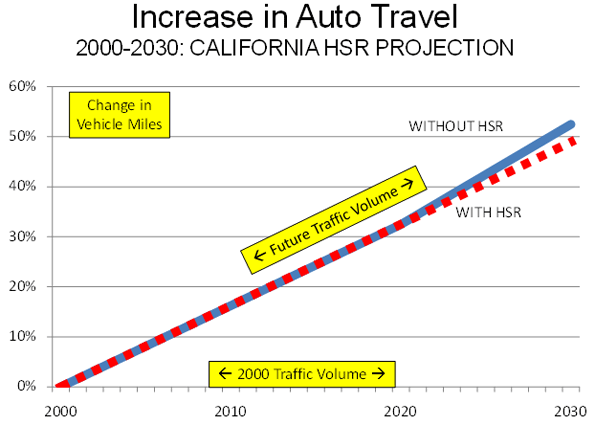
    Ridership and Relieving Congestion: High Speed Rail is also promoted by the Administration, which claims it will reduce traffic congestion. This claim is fraught with difficulty. First, highway traffic congestion is almost exclusively within urban areas, not between the urban areas that HSR would serve. Data from the California promoters indicates that traffic levels would rise nearly as much with HSR as without it. HSR is projected to reduce traffic by less than 3 percent once the system is complete. Without high speed rail, traffic volumes would increase 52 percent and without high speed rail, traffic volumes would increase 49 percent above 2000 levels (See Figure). In either case, things would be far worse in the future than they are today. And if HSR can make so little difference in congested California, it will surely do less in other parts of the country.

    Similarly, HSR will have little or no impact on the need to expand airports. For example, the Bay Area’s regional airport plan noted that high speed rail “would not divert enough passengers to make up for the shortfall in runway capacity.”

    In France and Japan, where travel is far more concentrated due to the linear location of major urban areas and the smaller number of large metropolitan centers, markets that are well served by HSR still have significant airline traffic (Tokyo to Osaka and Paris to Marseille). Also worth noting, both nations boasted pre-existing rail ridership levels that account for much of the HSR volumes. There is no such foundation in the United States. The ridership issue is particularly important, because of the miserable record of transportation ridership projections both in the United States and around the world. A most recent example is the Taiwan high speed rail system, which according to the early projections of promoters was to carry 180,000 passengers per day in its early operations. Yet in its second year of operation (2008), the average daily ridership was less than one-half that projection (84,000, calculated from Taiwan government data). This is telling in a country with notoriously congested traffic and very few major urban centers,

    This strategy of exaggerating ridership claims (and grossly under-estimating costs) is widespread in rail projects and has been extensively documented in Megaprojects and Risks: An Analysis of Ambition, by international scholars Bent Flyvbjerg, Nils Bruzelius and Werner Rothengatter (available from booksellers). The Taiwan and other international experiences suggest a major HSR investment would cost the taxpayers many additional billions and could bankrupt any private investors.
    Greenhouse Gas Emissions: But perhaps the most misleading claims are related to greenhouse gas (GHG) emissions. It starts with the marketing. The Administration’s press release indicates that building all of its routes would reduce GHG emissions by “six billion pounds” annually. This sounds like a big number. It is akin to my characterizing my weight as nearly 100,000 grams, instead of the pounds (200 in my case) that is customary in talking about weight. In GHG emissions, we do not talk about pounds, we talk about metric tons. Six billion pounds is only 2.7 million metric tons (2,205 pounds), which is an infinitesimal share of the GHG emissions from the nation’s passenger transportation. Indeed, given the propensity of the consultants to produce ridership projections less accurate than “Vietnam body counts,” the figure is probably less.

    The Administration falls into the usual trap of assuming that theoretical differences in GHG emissions can be turned into radical changes in travel patterns and behavior. The GHG emissions per passenger mile may be less (at least before the coming improvements in vehicle technology) but that does not mean that enough passenger miles can be moved from cars (and planes) to make a material difference. Our experience in high cost urban rail projects should have taught us this.

    Moreover, a mere reduction in GHG emissions is not sufficient to justify adoption of a strategy. Strategies must be prioritized based upon their effectiveness, and that is measured by cost. On this score, the California HSR system fails to a degree that is incomprehensible. The Intergovernmental Panel on Climate Change (IPCC) has indicated that the cost of GHG emission reduction should be no more than from $20 to $50 per ton. Even that may be too high. For example, Al Gore, Governor Schwarzenegger and Speaker of the House of Representatives Nancy Pelosi studiously buy carbon offsets for the tons of GHG that they produce flying around the country. The current market rate for such offsets is under $15.

    The California High Speed Rail Authority, whose leadership touts its GHG emissions reduction potential constantly, did not even bother to look at the cost of GHG emission removal in its thousands of pages of expensive, taxpayer financed reports. We looked at the issue, using California High Speed Rail Authority and California Air Resources Board assumptions and found that the cost per ton of GHG emission removal would be nearly $2,000, or 40 times the maximum figure used by the IPCC. To illustrate how extravagant a figure that is, if the nation were to reduce its GHG emissions by 80 percent (as proposed by the Administration) at the same rate, the annual cost would be more than 75 percent of the gross domestic product.

    But that assumes all of the rosy cost and ridership projections. The figure could be as high as $10,000 per GHG ton, if the consultants have exaggerated as much in California as elsewhere.

    Conclusion: It is likely that the same arguments can be made even more strongly in other proposed high speed rail markets. Yet, as costly as it is, HSR would be no more objectionable than building a new hardware store if it were paid for by its users. However, when taxpayers are asked to foot the bill, objective analysis of the claims, costs and benefits should at least have some priority. These are issues that an Administration committed to reducing GHG emissions by 80 percent has an interest in addressing. Relying on folklore rather than reality, as seems to be the present case, reflect an abject naivety at the least and incredible foolhardiness at the worst.

    Wendell Cox is a Visiting Professor, Conservatoire National des Arts et Metiers, Paris. He was born in Los Angeles and was appointed to three terms on the Los Angeles County Transportation Commission by Mayor Tom Bradley. He is the author of “War on the Dream: How Anti-Sprawl Policy Threatens the Quality of Life.

  • Sydney: From World City to “Sick Man” of Australia

    Americans have their “American Dream” of home ownership. Australians go one step further. They have a “Great Australian Dream” of home ownership. This was all part of a culture that celebrated its egalitarian ethos. Yet, to an even greater degree than in the United States, the “Dream” is in the process of being extinguished. It all started and is the worst in Sydney.

    Sydney is Australia’s largest urban area, having passed Melbourne in the last half of the 19th century. With an urban area population of approximately 3.6 million, Sydney leads Melbourne by nearly 300,000.

    The “Great Australian Dream” in Sydney: Sydney incubated and perfected the Great Australian Dream. New housing was built in all directions from the central business district. The most expensive was built to the east and north, while the least expensive – the bungalows and other modest detached houses – rose principally to the west and the south. Western Sydney is the culmination of the Great Australian Dream for perhaps more middle and lower middle income households than any other place in the nation.

    Of course, Western Sydney was not planned in the radical sense of the word currently used by contemporary urbanists. In fact, most have little more regard for Western Sydney than for the shantytowns of Jakarta or Manila. Yet, the people of Western Sydney, like the people of countless modest suburban areas around the world, are proud of their communities and of their homes.

    Rationing Land, Blowing Out Land Prices: About three decades ago, Sydney embarked upon what was to become one of the world’s strongest “smart growth” programs (called “urban consolidation” in Australia). Aimed at concentrating population closer to the core, urban consolidation sought to restrict and even prohibit new housing on the urban fringe. Sydney developed its own equivalent of the famous Portland urban growth boundary. The result is that every land owner knows whether or not their property can be developed, and the favored understandably take advantage by charging whatever price the highly constrained market will bear.

    Reserve Bank of Australia research indicates that the price of raw land – Sydney urban fringe land for building a house that has not yet been fitted with infrastructure (sewers, water, streets, etc.) has now risen to a price of about $190,000 for a one-eighth acre lot. In the days before smart growth, the land would cost about $1,000. Needless to say, adding an unnecessary nearly $190,000 plus margins to the price of a house makes housing less affordable.

    But even where development is nominally allowed, government restrictions make building almost impossible. For years the state government has promised to “release” land for new housing on the western fringe. Yet despite announcement and re-announcement, there have been interminable delays.

    Destroying Housing Affordability: As a result, Sydney is now the second most expensive major housing market in the six nations in our Demographia International Housing Affordability Survey, trailing only Vancouver. Sydney’s Median Multiple (the median house price divided by the median household income) is now 8.3. It should be close to the historic norm of 3.0 or less. Indeed, if land prices had risen with inflation from before urban consolidation, Sydney’s Median Multiple would be less than 3.0. As a result, households entering the housing market can expect to pay nearly three times as much for their houses than was the case before. This will lead to an inevitably lower standard of living compared to what would have otherwise been.

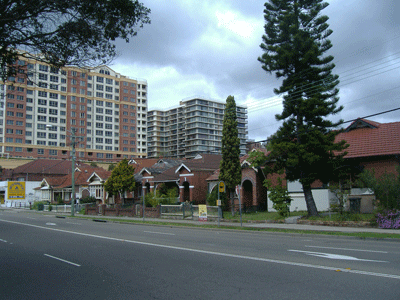
    Forcing Density: Urban consolidation is destroying not only housing affordability, but also the character of Sydney itself. Sydney is an urban area of low density suburbs. It is also an urban area of high rise living. These two housing forms have combined with one of the world’s most attractive geographical settings to create an attractive and livable urban area.
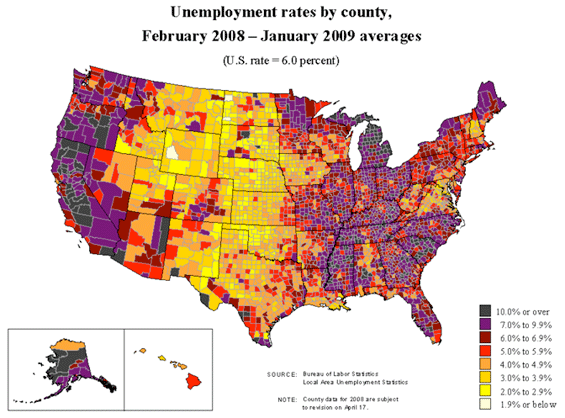
    The planners, empowered by the state of New South Wales government, are changing all of that. From the suburbs of Western Sydney to the attractive and more affluent North Shore suburbs, high-rise residential buildings are being thrust upon detached housing neighborhoods. One of Sydney’s great strengths is that the urban area has many local government areas (municipalities), empowering local democracy. These local governments have done their best to resist the state government densification mandates, in response to opposition from their citizens.

    Raw Exercise of Power: One of Sydney’s greatest weaknesses is that the state government exercises undue control over the municipalities and is using its power to “shoe-horn” high density into places where it makes no sense. High density is fine in the Toney Eastern suburbs, but has no place where detached housing is the rule. Unfortunately, the planners seem to presume communities with detached housing have no character worth salvaging.

    Urban Consolidation: Infrastructure Costs: Further, there is an inherent assumption that densification has no costs. The planners routinely exaggerate the cost of providing infrastructure on the urban fringes (failing, for example, to understand that much infrastructure is included in the price of the house, without government involvement). However, the infrastructure built for lower density detached housing is not sufficient for higher densities. As a result, there have been sewer overflows in densifying areas. Huge expenditures have been made for sewer upgrades. Tony Recsei, president of Save Our Suburbs, a community organization seeking to limit inappropriate densification, blamed recent power failures on an electricity infrastructure that was not built for high density in an April 7 Daily Telegraph letter, noting that “Cram in more people and overloading must result. That should not be too hard for people to understand.”

    Greater Traffic Congestion: And, of course, insufficient road expansion has been undertaken to accommodate the inevitable intensification of traffic congestion. The planners like to say that higher densities mean less traffic. In fact virtually all of the evidence, throughout the first world, indicates that more intense traffic congestion is associated with higher densities.

    Sydney is no exception. The average one-way work trip now takes 34 minutes, which equals that of America’s largest urban area, New York, which has more than five times the population and the land area as well as the longest travel time of any major urban area in the nation. Sydney’s planners delight in comparisons with Los Angeles, frequently suggesting that their regulations are necessary to ensure that Sydney does not “sprawl” as much as Los Angeles. Actually Sydney sprawls considerably more in relation to its population. The Los Angeles urban area is a full one-third more dense than the Sydney urban area. And despite the fact that nearly half of the planned Los Angeles freeway system was not built, Angelinos spend one hour less each week getting to work each than Sydneysiders. Even in Atlanta, with a pathetic freeway system little better than Sydney’s and one-third Sydney’s density, people spend an hour less commuting to and from work every two weeks and spend less total time traveling than in Sydney.

    The Economic Cost: There may also be an economic cost. Bernard Salt – perhaps Australia’s leading demographer – has predicted that Melbourne will overtake Sydney in population by 2028. Moreover, there has been substantial domestic migration from New South Wales to Queensland. At current growth rates this could lead the Brisbane-Gold Coast region being larger than Sydney by mid-century. Salt blames Sydney’s declining fortunes on its overly expensive housing.

    Sydney: World-Class City Status Threatened? Research in the United States has associated restrictive land use regulation with lower levels of employment growth in US metropolitan areas. In a more colorful finding, Australia’s Access Economics characterized the economy of New South as “so sick that it is at risk of adoption by Angelina Jolie.” A few decades ago, the English economy was referred to as the “sick man of Europe.” Sydney may well be on its way to becoming the “sick man of Australia.”

    Wendell Cox is a Visiting Professor, Conservatoire National des Arts et Metiers, Paris. He was born in Los Angeles and was appointed to three terms on the Los Angeles County Transportation Commission by Mayor Tom Bradley. He is the author of “War on the Dream: How Anti-Sprawl Policy Threatens the Quality of Life.

  • Kansas City and the Great Plains is a Zone of Sanity

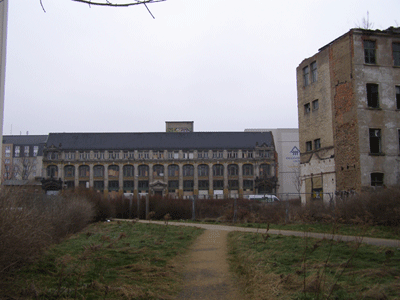
    Over the past year, coverage of the economy appears like a soap opera written by a manic-depressive. Yet once you get away from the coasts – where unemployment is skyrocketing and economies collapsing – you enter what may be best to call the zone of sanity.

    The zone starts somewhere in Texas and goes through much of the Great Plains all the way to the Mexican border. It covers a vast region where unemployment is relatively low, foreclosures still rare and much of the economy centers on the production of basic goods like foodstuffs, specialized equipment and energy.

    People and companies in the zone feel the recession, but they are not, to date, in anything like the tailspin seen in places like the upper Great Lakes auto-manufacturing zone, the Sunbelt boom towns or, increasingly, the finance-dependent Northeast. Last month, for example, New York City’s unemployment experienced the largest jump on record.

    “That whole swath from Texas and North Dakota did not see either the bump or the decline,” notes Dan Whitney, a principal at Landmarketing.com, a real estate research company based in Kansas City, Kan. “People have a more conservative nature here. It’s just saner.”

    The housing market is one indicator of greater sanity. Kansas City housing prices dropped 7% between 2006 and 2008, compared with 10% in Chicago, 15% in San Francisco, 20% in Washington, D.C., and over 30% in Los Angeles. Houston and Dallas, the Southern anchors of the zone, have seen little movement either way in prices.

    One key measurement is affordability. The median multiple for Kansas City housing – that is the number of years of income compared with a median-priced house – has remained remarkably stable at under 3.0. In contrast, notes demographer Wendell Cox, the ratio approached up to 10 in places like Los Angeles and San Francisco, as well as something close to 7 in New York and Miami.

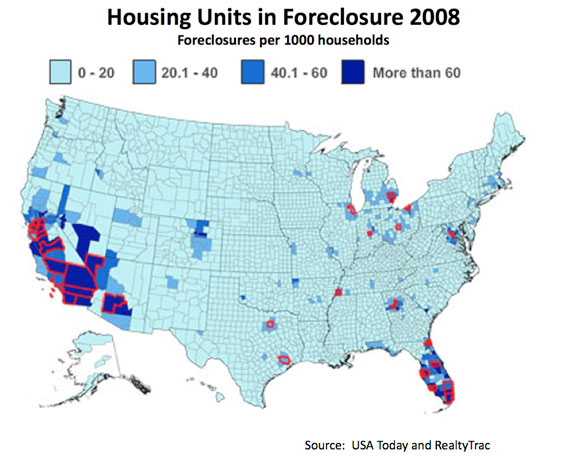
    The result has been that foreclosures – the key driver of many regional economic collapses – have been relatively scarce throughout the zone. This USA Today map reveals how the foreclosures are heavily concentrated in Florida, California, Arizona and Nevada, as well as parts of the old Industrial Belt of the Great Lakes.

    housing_foreclosure_565.jpg

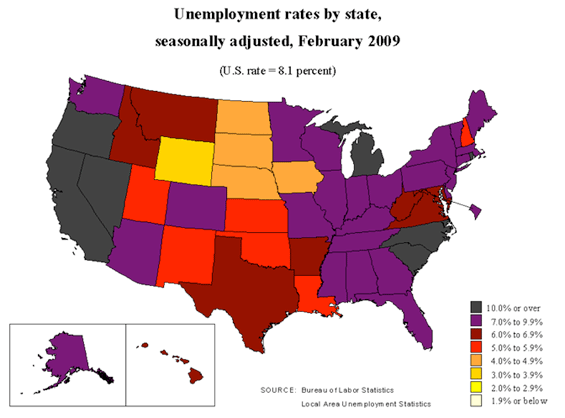
    Analysis by my colleagues at Praxis Strategy Group of the job market’s condition also reveals the divergence between the zone and the rest of the country. Regions from the Northeast, the Great Lakes and the Southeast all have seen significant job losses, and the damage is spreading to the Pacific Northwest, New York and New Jersey. In contrast, the Kansas City area and much of the zone of sanity has experienced only a ratcheting down of its generally steady growth rate. Things are not bustling, but there seem to be few signs of a basic economic collapse.

    unemployment_state_565.gif

    unemployment_country_565.gif

    Sanity, as Whitney put it, may constitute a critical part of the equation. If you discuss why people live in a place like Kansas City, people tend to speak about stability, family-friendliness and the basic ease of everyday life. Many executives, notes Phil DeNicola, who runs Strong Suit Relocation, initially resist a transfer to the region but quickly see the advantages.

    “It is attractive to be here,” notes DeNicola. “You don’t get a lot of highs and lows for years. There is stability instead, particularly for families. It all reduces your stress.”

    Of course, not everyone is satisfied with the status quo. As in many second-tier urban centers, many in Kansas City’s leadership crave being something other than pleasant, affordable and stable. Leaders in the city – home to roughly one in four of the region’s 2 million residents – have been particularly exercised to show that KC can be as hip and cool as New York, L.A. or, at the very least, Chicago.

    “There’s a real kind of self-loathing here,” notes Mary Cyr, a Harvard-trained architect, who works on projects throughout the region. “We feel less than what we are. We do not know what we are as a city. We don’t even realize what we have.”

    Hundreds of millions have been poured and continue to pour into the usual monuments favored by urban policymakers and subsidy-hungry developers – a sparkling new arena, plans for an expanded convention center and a massive entertainment complex called the Power and Light District. Yet at the same time, the city’s budget, like many others, is severely strapped, so much so that City Hall is considering not turning on the city’s iconic fountains this spring.

    Even worse, city and regional issues seem to result in plenty of money for new expressions of wannabe grandiosity. One notable example: plans to build a $700 million-plus light-rail line, the kind of thing that has become the sine qua non for the “monkey see, monkey do” school of urban policymakers across the country.

    This project makes little sense in a region with a well-below-average percentage of jobs in its downtown core – roughly around 7% – with one of the lowest shares of transit-riding residents in the nation. The relative lack of traffic makes a rail system less sensible than could be argued for higher-density urban corridors, where it at least can be imagined that many would give up their cars.

    Ultimately, none of this taxpayer largesse is likely to do much more than replicate the same kind of development that can be found in scores of cities – from St. Louis to Dallas – that have tried it. At best, you get a few blocks of activity but very little in terms of urban dynamism.

    “The growth of downtown is not at all organic – it’s kind of forced,” notes architect Cyr. “They build all those projects in there, and you end up with the huge monumental buildings and the Gap.”

    The problem for the downtown crowd is that Kansas City has remained a quintessential American city, most dynamic in places where private initiative leads the way. Typically the bulk of new growth has taken place in the suburban fringes, but there are several successful nodes within the city, particularly around the lovely, 1920s vintage, privately developed Country Club Plaza area, famous for being the world’s first modern shopping center.

    Similarly, the artist-inspired Crossroads district has also evolved – largely without government help – into a genuine bastion of bohemians, with small companies and locally owned restaurants. With its low-cost commercial and residential space, as opposed to government subsidies, many see the area as precisely the kind of grass-roots urban life with a future in a place like Kansas City.

    Such developments in the city, as well as outside, make it possible to project a very bright future for Kansas City – and across the zone of sanity. Unless there is a massive shift in conditions, the zone should see a return to prosperity earlier than places bogged down with excess foreclosures, shuttering industries, soaring taxes and ever-tightening regulation. Dan Whitney, for example, expects the local housing supply to run out soon – with “tremendous pent-up demand” by the end of the year. If credit conditions improve, new construction should resume within the next 18 months.

    This all reflects the essential attractiveness of cites like Kansas City. Overall, in fact, its rate of domestic in-migration has been higher than much-celebrated Seattle and only slightly below that of Denver. Indeed, since 2000, Kansas City’s regional population has grown 8.6%, more than twice as much as New York, Boston, San Francisco or Los Angeles.

    Unlike the national media, which rarely focus on mundane things that drive most people’s lives, some seem to get the appeal of lower prices, affordable housing options and a generally calm environment. Although never a beacon for newcomers, like Phoenix, Atlanta or Dallas, Kansas City has not suffered the massive out-migration seen in such big metropolitan regions as Los Angeles, San Francisco, Chicago or New York.

    In fact, Kansas City has enjoyed a slow but steady in-migration through the past decade. These newcomers could provide the energy, talent and initiative that a region, known for stability, needs to get to the next level. Attracting more of them – not new prestige projects or subsidized developments – remains the key to the region’s future.

    Instead of trying to duplicate growth patterns that are foundering on the coasts and in countless Rust Belt cities, the denizens of the zone of sanity need to learn how to build on their virtues of stability and affordability. Particularly in hard times, such things count for much more than many – both inside and outside the region – might imagine.

    This article originally appeared at Forbes.

    Joel Kotkin is executive editor of NewGeography.com and is a presidential fellow in urban futures at Chapman University. He is author of The City: A Global History and is finishing a book on the American future.
  • Enough “Cowboy” Greenhouse Gas Reduction Policies

    The world has embarked upon a campaign to reduce greenhouse gas (GHG) emissions. This is a serious challenge that will require focused policies rooted in reality. Regrettably, the political process sometimes falls far short of that objective. This is particularly so in the states of California and Washington, where ideology has crowded out rational analysis and the adoption of what can only be seen as reckless “cowboy” policies.

    Last year, California enacted Senate Bill 375, which seeks to reduce future GHG emissions by encouraging higher urban population densities and forcing more development to be near transit stations. Yet there is no objective analysis to suggest that such an approach will work. Of course, there are the usual slogans about people giving up their cars for transit and walking to work, but this occurs only in the minds of the ideologues. The forecasting models have been unable to predict any substantial reduction in automobile use, and, more importantly, such policies have never produced such a result.

    In fact, higher densities are likely to worsen the quality of life in California, while doing little, if anything to reduce GHG emissions. California already has the densest urban areas (which includes core cities and surrounding suburbs) in the United States. The Los Angeles urban area is 30 percent more dense than the New York urban area. The San Francisco and San Jose urban areas are also denser than the New York urban area. Sacramento stands as the 10th most dense among the 38 urban areas over 1,000,000 population, while Riverside-San Bernardino ranks 12th and San Diego ranks 13th.

    This high density creates the worst traffic congestion in the nation. The slower stop and go operation of cars in traffic congestion materially intensifies local air pollution and increases health hazards. It also consumes more gasoline, which increases GHG emissions. Finally, California’s prescriptive land use regulations have destroyed housing affordability. By the early 1990s, land use regulation had driven prices up well beyond national levels relative to incomes, according to Dartmouth’s William Fischell. Over the next decade the rationing effect of California’s excessive land use restrictions tripled house prices relative to incomes, setting up the mortgage meltdown and all that has followed in its wake.

    The implementation of Senate Bill 375’s provisions seems likely to make things worse. California’s urban areas already have plenty of dense “luxury” housing, much of which is now empty or is now converted from condos to rentals. Wherever they are clustered, particularly outside traditional urban centers like San Francisco, such areas experience intense traffic congestion, with all the resultant negative impact on both people and the environment.

    Yet despite the problems seen in California, the ideological plague has spread to Washington state. Last year the Washington legislature enacted a measure (House Bill 2815) that requires reductions in driving per capita, for the purpose of GHG emission reduction. By 2050, driving per capita is supposed to be halved. This year there was a legislative proposal, House Bill 1490, that would have mandated planning for 50 housing units to the acre within one-half mile of light rail stations. This would have amounted to a density of nearly 50,000 per square mile, 3 times the city of San Francisco, 7 times the density of the city of Seattle and more than that of any of more than 700 census tracts (small districts) in the three-county Seattle area. Areas around stations would be two-thirds as dense as Hong Kong, the world’s most dense urban area.
    The density requirement has since been amended out of the bill, but the fact that it made it so far in the legislature indicates how far the density mania has gone. The bill appears unlikely to pass this year.

    Extending the density planning regime is not likely to help the people on the ground, much less reduce GHGs. Seattle already has a housing affordability problem, which is not surprising given its prescriptive planning policies (called growth management or smart growth). Theo Eicher of the University of Washington has documented the close connection between Seattle’s regulatory structures and its house price increases.

    As in California, Seattle house prices rose dramatically during the housing bubble, nearly doubling relative to incomes. At the same time, much of the debate on House Bill 1490 has been over affordable housing. Yet there has been virtually no recognition of connection between Seattle’s low level of housing affordability and its destructive land use regulations. House Bill 1490 would have only made things worse, and still could. Proponents have indicated that they have not given up.

    The theory behind House Bill 1490 parallels that of California’s SB 375. It assumes high densities would significantly reduce driving and attract people to transit. As in California, however, this is based upon wishful thinking, and has no basis in reality. No urban area in the developed world has produced a material decline in automobile use through such policies.

    Regrettably, the special interest groups behind the California and Washington initiatives appear more interested in forcing people to change their lifestyles than in reducing GHG emissions. This is demonstrated by the Washington driving reduction requirement.

    A good faith attempt to reduce GHG emissions from cars would have targeted GHG emissions from cars, not the use of cars. The issue is GHG emission reduction, not behavior modification, and the more the special interests target people’s behavior, the clearer it becomes how facetious they are about reducing GHG emissions.

    Technology offers the most promise. Already the technology is available to substantially reduce GHG emissions by cars, without requiring people to change their lifestyles. Hybrids currently being sold obtain nearly three times the miles per gallon of the average personal vehicle (cars, personal trucks and sport utility vehicles) fleet. And that is before the promising developments in decades to come in alternative fuels and improved vehicle technology. In addition, the rapid increase in people working at home – a number on track to pass that of transit users by 2015 – would also represent a clear way to reduce GHG emissions.

    Finally it is not certain that suburban housing produces higher GHG emissions per capita than high rise urban development. The only comprehensive research on the subject was conducted in Australia and found that, generally, when all GHG emissions are considered, suburban areas emitted less per capita than higher density areas. This is partially because dense urbanites tend to live a high consumption lifestyle, by eating out at restaurants serving exotic foods, having summer homes and extensive travel. It is also because high density living requires energy consumption that does not occur in lower density suburbs, such as electricity for elevators, common area lighting, and highly consumptive central air conditioning, heating, water heating and ventilation, as Energy Australia research indicates.

    Further, tomorrow’s housing will be more carbon friendly than today’s. Japan has already developed a prototype 2,150 square foot, single story suburban carbon neutral house.

    Much of the anti-suburban and anti-car sloganeering ignores these developments and generally assumes a static world. If the world were static, we would still be living in caves.

    The California and Washington initiatives were not based upon any comprehensive research. There were no reports estimating the tons of GHG emissions that were to be reduced. There was no cost analysis of how much each ton removed would cost. United Nations Intergovernmental Panel on Climate Change (IPCC) has said that the maximum amount necessary to accomplish deep reversal of GHG concentrations is between $20 and $50 per ton. Responsible policy making would have evaluated these issues. (It seems highly improbable that Seattle’s currently under-construction University light rail extension remotely matches this standard, with is capital and operating costs per annual patron of more than $10,000.)

    The price that society can afford to pay for GHG emission reduction is considerably less today than it was just six months ago. The history of the now departed communist world demonstrates that poorer societies simply do not place a high priority on environmental protection. That is not surprising, since people address their basic human needs before broader objectives, such as a better environment. That may not comport with the doctrines of political correctness, but it is reality.

    In such times, communities should be careful not to undertake policies based on assumptions or the preferences of those planners, architects and ideologues who seem to hold suburbs and personal mobility in such contempt that they would not be satisfied even if they emitted no GHGs. These radical motives are inappropriate. “Cowboy” policies enacted ad hoc at the bequest of ideologues openly disdainful of our basic lifestyles threaten not only the future prosperity of a society but our most reasonable path to long-term environmental improvement including reducing GHG emissions.

    Wendell Cox is a Visiting Professor, Conservatoire National des Arts et Metiers, Paris. He was born in Los Angeles and was appointed to three terms on the Los Angeles County Transportation Commission by Mayor Tom Bradley. He is the author of “War on the Dream: How Anti-Sprawl Policy Threatens the Quality of Life.

  • Different Shades of Green

    Last month marked the 15th anniversary of the settlement of Plotkin vs. General Electric, the landmark “greenwashing” lawsuit I filed in 1993. At the time, GE was misleading consumers by selling phony lookalike energy efficient light bulbs that were in fact just old fashioned incandescent wolves in green packaging.

    I took no money from the case. But I required G.E. to make labeling changes and to pony up $3.25 million dollars in consumer refunds and donations to environmental and public service groups. The labeling changes made it easier for the manufacturers of real energy efficient light bulbs, which were just then entering the marketplace, to distinguish their products on the shelves. Plotkin vs. GE also more firmly established the ability of environmental activists to turn to the courts when state and federal government agencies fail to punish greenwashing. The settlement we achieved created a powerful deterrent that continues to produce benefits to this day.

    In the meantime, though, greenwashing has become a virtual industry in the political and policy worlds. Take, for example, the growing push for economically regressive and environmentally problematic HOT (high occupancy toll) lanes. HOT lanes are toll lanes on public highways. Prices are set dynamically so that HOT lanes keep moving even if all the other lanes are stuck. Governor Schwarzenegger and many leading Democrats favor the idea and use it to paint themselves green. HOT lanes are also popular with many affluent motorists who love the idea of driving their SUVs in the carpool lane for what amounts to pocket change. It’s an odd alliance.

    Unfortunately, support for HOT lanes is also becoming a litmus test issue for some environmental groups when they evaluate political candidates, apparently without much thought about the economic consequences, particularly for the poor.

    HOT lane backers push their plan by claiming that only a limited number of lanes will be involved, typically just one to start. But in Europe, where many of these experiments began, “congestion management” programs have since morphed into systems that essentially allow rich drivers to hog public roads. Give the upper crust the fast lane and, it turns out, pretty soon they want the whole road.

    HOT lanes are an example of one of the worst forms of regressive taxation imaginable. Like all regressive taxes, they exact a higher percentage of income from the poor. But in this case, they also tax the very mobility of the poor, making it harder for them to commute, including to work and school, which can effectively lock people into low end jobs and poverty that they might otherwise escape.

    What little thought the proponents of HOT lanes have given to their impact on the poor appears to be in the category of “let them eat cake.” One widely-cited report recommending HOT lanes even dismissed concerns they were unfair to the poor by noting that service workers can use the lanes to get to their clients’ houses more quickly:

    “… studies of Orange County’s SR-91 show that the variable-priced toll lanes are not used exclusively by the wealthy. The ability to save time and reduce uncertainty confers substantial benefits to all drivers, including service professionals who can make more service calls…”

    In the San Francisco Bay Area, Caltrans and the Metropolitan Transportation Commission are fast-tracking a HOT lane implementation plan that could be devastating for students at area community colleges. At De Anza College in Cupertino, California, for example, more than 10,000 students commute to school each day. For many, this is the only reasonable path towards upward mobility. I know. Thirty years ago, I was one of those students, only to return more recently to serve on the college district’s board of trustees.

    A proposed fee of $5 a day per trip on Highway 85 during peak rush hour, as envisioned, would boost a typical De Anza College commuter student’s expenses by as much as $100 a month. That burden is sure to grow over time. Escaping poverty is often a game of inches. Our surveys indicate that thousands of our students live at or near the poverty level. Each additional expense imposed by our government makes a high quality college education less accessible.

    HOT lane proponents say that over the long run the impact on the poor will be positive because the tolls will be used to improve public transit, which will benefit less affluent citizens and increase use of public transportation.

    But this is out of touch with the realities of life in places like Silicon Valley, where the automobile is still the most practical way for many people to get to work. What may work for investment bankers taking transit to downtown San Francisco doesn’t work for a student who lives in Mountain View and needs to get to Cupertino and then to a job in Redwood City each day.

    What’s more, the promised transportation improvements may take decades to implement and may never meet the real world transit needs of working students, not to mention those who also have to stop to pick up their children, get groceries or complete errands on the same trip.

    But one thing is for sure. While we wait for those HOT lane financed transit improvements to kick in, a generation, maybe more, will find it harder to attend school or get to their jobs.

    Global warming is a very real problem. But it can and must be addressed in far better and more equitable ways. Those less regressive ideas include higher taxes on gas guzzlers, road electrification, remote sensing (“by wire”) vehicles, increased subsidies and public support infrastructure for carpools, home-based work and or possibly even a boost in industrial levies based on employee commute profiles. All of these advances will require government action and a communal effort. But each of these more significant steps are far less likely to occur if rich divers can easily get wherever they want to go quickly at the expense of everyone else. That’s the road the current elitist HOT lanes proposal takes us down.

    It also raises the question of what comes next. Will this same crowd of economic elitists also want to make public parks and beaches off limits to all but the affluent, too? After all, those are also getting pretty crowded. Or we will defend a more traditional American value: public spaces, including roads, are created, maintained, protected and improved by the public to benefit the public.

    When General Electric put phony energy efficient light bulbs on stores shelves two decades ago, taking the company to court was the smart way to fight back. Unfortunately, there is no court we can petition to ensure that regressive tax policies aren’t greenwashed in ways that trample the rights of the poor, community college students and working people. But there is at least one place we can fight for the smarter, more effective and more equitable environmental policies we need: the state legislature.

    Hal Plotkin is a veteran Silicon Valley journalist and commentator, a founding editor of Marketplace on public radio, and the founder of the Center for Media Change, Inc., a Palo Alto-based 501(c)3 non-profit that enables crowd-funding of high-quality journalism.

  • Transit Captures Little of Driving Decline

    Over the past year, transit ridership has risen and that is a good thing. At the same time, driving has declined, due to both higher gasoline prices and the economic downturn. Some analysts have implied that people are giving up driving and using transit instead. An analysis of just released transit and urban roadway usage indicates no such thing. During the fourth quarter, the transit increase from a year earlier represented just 0.7 percent of the driving decline. This is even lower than the 2 to 3 percent figures registered in the first through third quarters. Of course, the principal reason why people do not substitute transit for driving is that it is not available for the overwhelming majority of urban trips.

    The latest data is available at: http://www.demographia.com/ut-hwytr2008f.pdf.

  • The Former East Germany: Is It Time for Red Nostalgia?

    2009 marks the 20th anniversary of the reunification of East and West Germany into one country. Germany was divided into two separate nations with competing economic and political ideologies. Now it’s time to reassess the results of this melding of two very different systems and the impact on the urban environment.

    Emerging from the ashes as one of the world’s most powerful economies, Germany may be the quintessential example of the triumph of capitalism over communism. Yet now with Frankfurt’s powerful banking sector reeling from the global economic meltdown, reticent Marxists may well be coming out of the woods to proclaim the death of capitalism.

    The sentiment for a bygone communist dream still exists for a small minority of those living in the former German Democratic Republic (GDR), where the unemployment rate has hovered around 18% since reunification. After a recent trip, it seems clear economic growth has stagnated. Job opportunities remain very limited. Rather than attract people with its lower costs and new opportunities, the region continues to see a strong outflow, particularly among the young.

    Yet all is not hopeless in the area comprising the former GDR. The crumbling of the wall and subsequent mass exodus of East Berliners to the west may remain the most vivid symbol of reunification, but the story remains decidedly mixed in Leipzig – the second largest city in the former GDR after Berlin.

    Leipzig can be considered the birthplace of the anti-communist revolution. On October 9th, 1989, in what is known as the “Monday Demonstrations”, protests in Leipzig (pronounced lipe-tsig) came to a head. In what some feared at the time would become another Tiananmen Square nightmare, 70,000 demonstrators peacefully took to the streets chanting, “We are the people”. The Monday Demonstrations served as a turning point in the quest towards reunification. Having witnessed the courage of the citizens of Leipzig, others trapped in the GDR came out and made their voices heard. One month after the Monday Demonstrations, the Berlin Wall came down.
    With just over 500,000 residents, Leipzig is the largest city in the German state of Saxony. Roughly 90 miles south of Berlin, the city lives in the shadow of the much more “sexy” and culturally apt German capital.

    The city has a considerable history, even prior to the events following World War II. Leipzig residents included such notable individuals as the mathematician Gottfried Leibniz and composers Johann Sebastian Bach, Richard Wagner, and Felix Mendelssohn. The playwright Goethe attended the University of Leipzig and referred to the city as ‘little Paris’ in his seminal work Faust. In 1813, Napoleon Bonaparte and his troops were dealt a strategic defeat there in what became known as ‘The Battle of Nations’. More recently, Carl Friedrich Goerdeler, the Mayor of Leipzig from 1930 to 1937, is remembered as being one of the staunchest opponents of the Nazi regime.

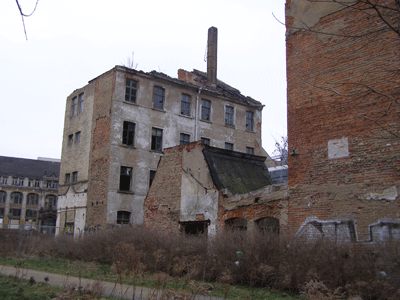
    It is difficult to imagine the breadth of this history while traversing the streets of Leipzig today. The city still certainly has its share of old and beautiful architecture, but much of this is now abandoned, with many structures adjacent to the central core covered in graffiti. In this regard, Leipzig looks like the German equivalent of a decaying American rust-belt city.

    The derelict atmosphere that a new visitor may sense upon arriving in Leipzig is at least partly due to the fact that many long-time residents still live in Soviet-style communist housing blocks at the peripheral edges of the city. Known as Plattenbau, or “plate buildings”, these ubiquitous and dehumanizing structures were communism’s answer to the issue of quickly re-housing East German citizens displaced by the ravages of war. Building these massive housing structures far outside the center also had the advantage of locating workers closer to places of industry.
    Taking into account Leipzig’s urban planning policies under communism, it is no wonder that neighborhoods near the city center appear neglected. Yet, stepping into the pedestrian-only heart of the city also tells a much more encouraging story. Unlike the often failed policies of many American cities to spur a “downtown renaissance”, Leipzig has had considerably more success at revitalizing its once thriving core.

    This is apparent by the number of construction sites around Leipzig’s central core. The city still has the advantage of possessing a significant stock of aesthetically appealing buildings, ranging in style from Baroque to Neoclassical. Furthermore, the University of Leipzig, one of Germany’s oldest, has taken the lead in making the city center a destination by consolidating its operations there. Currently, the University is constructing a new main building off of the city’s main square, Augustusplatz (formerly known as Karl-Marx-platz during the GDR).

    Public transportation is also a bright spot for Leipzig. Modern streetcars ride above ground to the outer limits of this concentrically laid out city. The efficiency of the streetcar system would turn any American public-transportation proponent green with envy. Moreover, the construction of an ambitious underground metro system is slated to be completed next year, further easing mobility for Leipzigers.

    Leipzig’s location in the central-north portion of continental Europe also has its advantages. As a node for the transport of goods and people through central Europe, the city serves as a bridge between Germany and the once burgeoning but now suffering Eastern European nations. Even so, over time it would be in the city’s best interest to further capitalize on this asset.

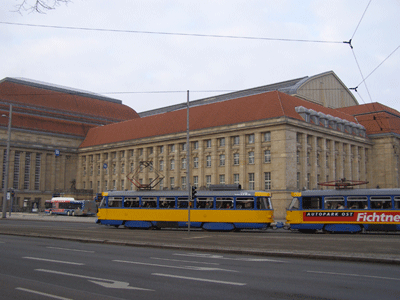
    Adding clout to Leipzig’s location as a transportation hub is the city’s central train station – one of Europe’s largest and most historically significant. Grand in scale, Leipzig’s Hauptbahnhof not only sees a great deal of rail traffic from all over Germany, the station doubles as a shopping center for those living in the city. Practically a second “downtown”, the central station boasts everything from a constantly busy grocery store to clothing boutiques, numerous cafes and even two McDonald’s franchises.

    Despite its inspiring history, famous university and state-of-the-art transportation, Leipzig still faces tremendous challenges ahead. The city is not only struggling to attract newcomers but to retain a new generation of Germans born to parents who still remember what it was like to live in the GDR. Economically speaking, Leipzig stands little chance competing with other German cities in the west such as Frankfurt, Cologne or Munich where there are many more job opportunities. Aside from a plant that assembles Porsche’s struggling Cayenne line of SUVs – itself now threatened for both economic and environmental reason – industrial activity in Leipzig is limited. And with the Bohemian behemoth of Berlin not far away, Leipzig would be hard pressed to realize a full renaissance of its status as a prime destination for arts and culture.

    What does this mean for the future? In a sense, Leipzig’s problem is the same problem facing the entire region that comprises the former German Democratic Republic. The issues have been hotly debated in Germany since reunification. Some in the western parts of the country regard cities in the east as a lost cause. Contributing to the contentiousness of the debate is the ‘Solidarity Tax’ instituted to aid in the reunification process. At a rate of 5.5% of annual income tax, many Germans feel their tax dollars are being squandered on frivolous projects in the former GDR – projects that will have little to no impact on those living in the west.

    The renovation of the city center and the construction of the new Leipzig underground metro are examples of projects that benefit from funding from the Solidarity Tax. The key issue now is to see if the eastern cities themselves can use the generous government support and newfound infrastructure to stimulate economic activity and create jobs that will keep people from leaving for good. If this is not addressed immediately, the future of the former GDR looks bleak. The last thing Germany needs, especially in these times of global economic turmoil, is for those living in the east to become nostalgic for the days before the fall of the Iron Curtain.

    Adam Nathaniel Mayer is a native of the San Francisco Bay Area. Raised in the town of Los Gatos, on the edge of Silicon Valley, Adam developed a keen interest in the importance of place within the framework of a highly globalized economy. He currently lives in San Francisco where he works in the architecture profession.