Tag: Transportation

  • A Better Way

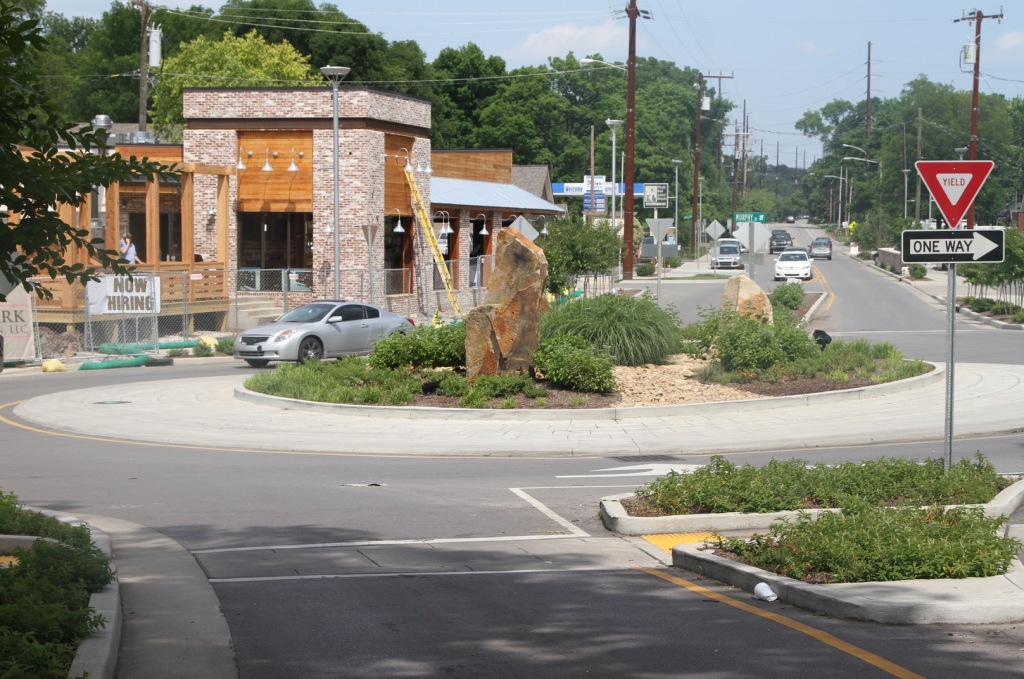
    My recent post at Granola Shotgun described how a town in Georgia spent an enormous amount of public money on a new civic center and road expansions, but somehow managed to devalue nearby private property in the process. Here’s an example of a neighborhood in Nashville, Tennessee that took a different approach that cost a lot less and achieved a radically better set of outcomes.


    Screen Shot 2016-08-25 at 6.01.50 PM

    Screen Shot 2016-08-25 at 5.49.18 PM

    The McCabe Park Community Center was designed by a local firm rather than an international starchitect. Municipal funds were recirculated right in town and used to foster native talent and professional employment. And while the facilities are available to everyone in Nashville this center is scaled and programmed primarily to serve the immediate neighborhood.

    Screen Shot 2016-08-25 at 9.25.20 PMGoogle

    Screen Shot 2016-08-25 at 6.41.04 PM

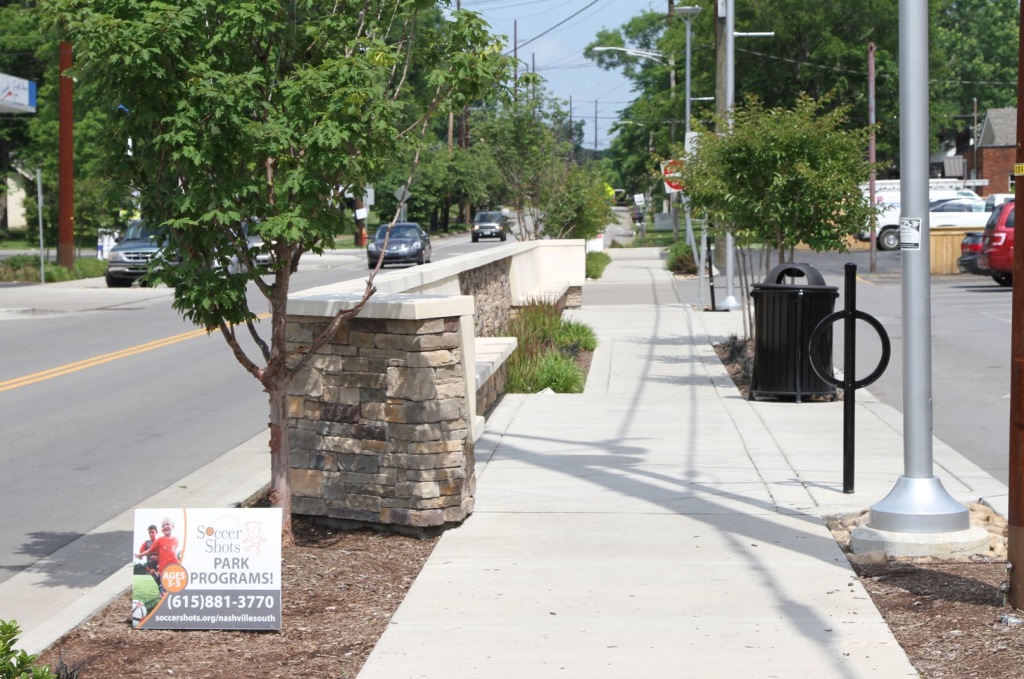
    A conscious decision was made to accommodate pedestrians rather than provide the usual endless automobile infrastructure. There are the required handicap accessible parking spaces close to the entrance at the rear. There are a few dozen off street parking spots along the baseball diamond. But that’s it. It’s absolutely possible to arrive by motor vehicle, but the cars don’t dominate the landscape.

    Screen Shot 2016-08-25 at 11.08.02 PM

    Screen Shot 2016-08-25 at 5.48.42 PM

    Screen Shot 2016-08-25 at 6.01.06 PM

    Bicycle and pedestrian infrastructure make it clear that it’s safe, pleasant, convenient, and dignified to arrive without a car. One of the goals of this community center is to facilitate a more active and healthy lifestyle.

    Screen Shot 2016-08-25 at 11.40.11 PMGoogle from 2009

    Screen Shot 2016-08-26 at 1.07.16 AMGoogle Street View from 2009

    Screen Shot 2016-08-26 at 1.05.07 AMGoogle Street View from 2009

    Screen Shot 2016-08-26 at 1.06.32 AMGoogle Street View form 2009

    Screen Shot 2016-08-26 at 1.48.03 AMGoogle Street View form 2009

    The road out front was a standard suburban affair of wide lanes, fast moving vehicles, no distinction between the road surface and adjacent parking lots, and no sidewalks. This landscape made it very clear that if you weren’t in a car you just weren’t important. It was also brutally ugly and lined with aging low value buildings and struggling businesses.

    Screen Shot 2016-08-26 at 1.29.53 AM


    Screen Shot 2016-08-25 at 5.46.54 PM

    Screen Shot 2016-08-25 at 6.00.19 PM

    Screen Shot 2016-08-25 at 5.49.32 PM

    Screen Shot 2016-08-25 at 5.59.23 PM

    Screen Shot 2016-08-26 at 2.04.37 AM

    The new traffic roundabout has transformed the intersection in several crucial ways. First, instead of stopping at a light cars now slow down a bit, but continue on. This means more cars move through the space in less time so traffic congestion has actually been reduced.

    Screen Shot 2016-08-26 at 1.35.08 AM

    Screen Shot 2016-08-26 at 1.35.18 AM

    Screen Shot 2016-08-26 at 1.35.55 AM

    Second, there are significantly fewer accidents because cars are moving at slower speeds and drivers are made to pay more attention to their surroundings as the street narrows. Cars are still welcomed here, but they’ve been disciplined to share the space with humans.

    Screen Shot 2016-08-26 at 1.36.39 AM

    Screen Shot 2016-08-26 at 2.04.12 AM

    Screen Shot 2016-08-26 at 1.39.18 AM

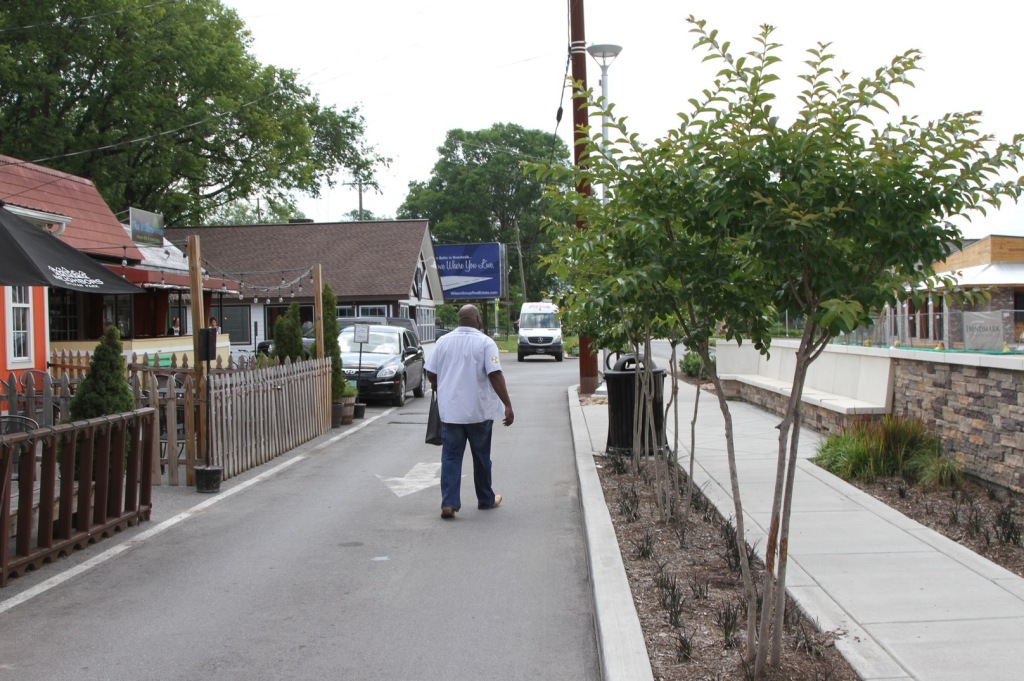
    Third, pedestrians and cyclists can now traverse the area safely so more people are willing to arrive without a car. With more foot traffic shops are able to repurpose some of the asphalt in front for outdoor seating. That translates to more sales, more employment, more profit, and more tax revenue.

    Screen Shot 2016-08-26 at 1.53.49 AM

    Screen Shot 2016-08-26 at 1.52.05 AM

    Screen Shot 2016-08-26 at 2.01.46 AM

    Screen Shot 2016-08-26 at 2.02.54 AM

    Screen Shot 2016-08-26 at 1.52.51 AM

    Screen Shot 2016-08-26 at 1.59.23 AM

    Screen Shot 2016-08-26 at 2.00.44 AM

    Fourth, land values have improved and older buildings are now seeing major improvements that also boost employment and generate new tax revenue. People don’t like paying taxes, but that money is what funds everything people expect the city to provide. The alternative is the slow death of deferred maintenance, budget cuts, and even higher fees and stealth charges on existing low value properties.

    Screen Shot 2016-08-26 at 2.58.33 AM

    Screen Shot 2016-08-25 at 11.07.40 PM

    Parking hasn’t been eliminated as much as redistributed. As sidewalks were installed on-street parking was added. The parked cars create a physical as well as emotional buffer between pedestrians and moving vehicles.

    Screen Shot 2016-08-25 at 5.50.59 PM

    Screen Shot 2016-08-25 at 5.51.14 PM

    Screen Shot 2016-08-25 at 5.52.40 PM

    Screen Shot 2016-08-25 at 5.52.56 PM

    Screen Shot 2016-08-25 at 5.51.36 PM

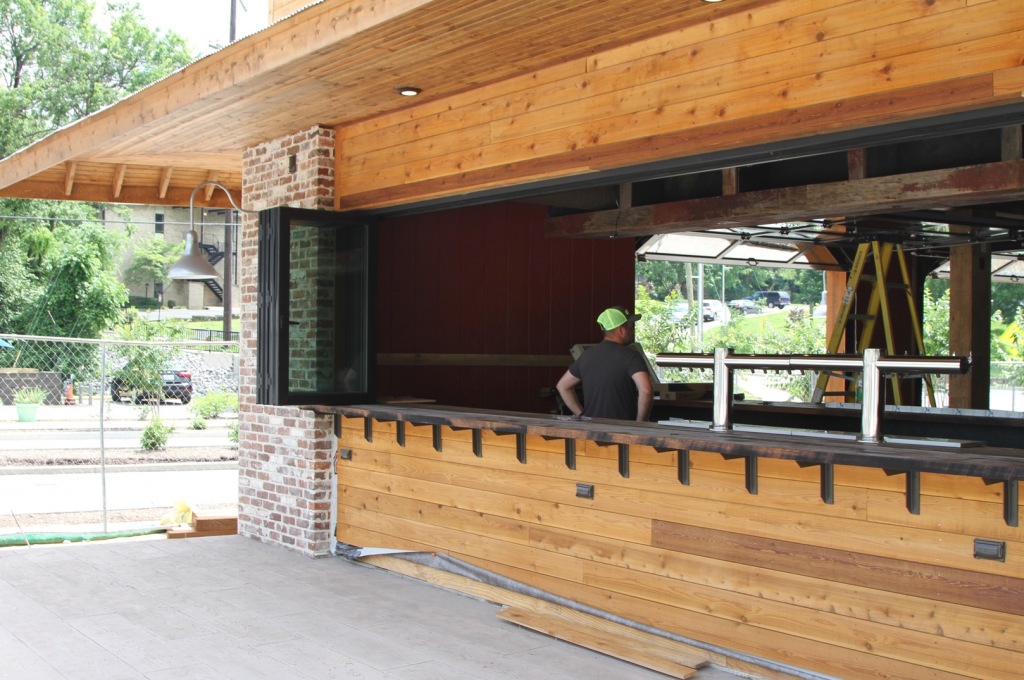
    The reorganized street supports smaller locally owned shops that keep money circulating in the community. This is the opposite of typical road widening projects that devalue small businesses in older neighborhoods while subsidizing big box corporate chains way out on the edge of town.

    Screen Shot 2016-08-26 at 3.16.43 AM

    Screen Shot 2016-08-26 at 3.17.03 AM

    Screen Shot 2016-08-26 at 3.16.12 AM

    Screen Shot 2016-08-26 at 3.16.26 AM

    Screen Shot 2016-08-26 at 3.15.58 AM

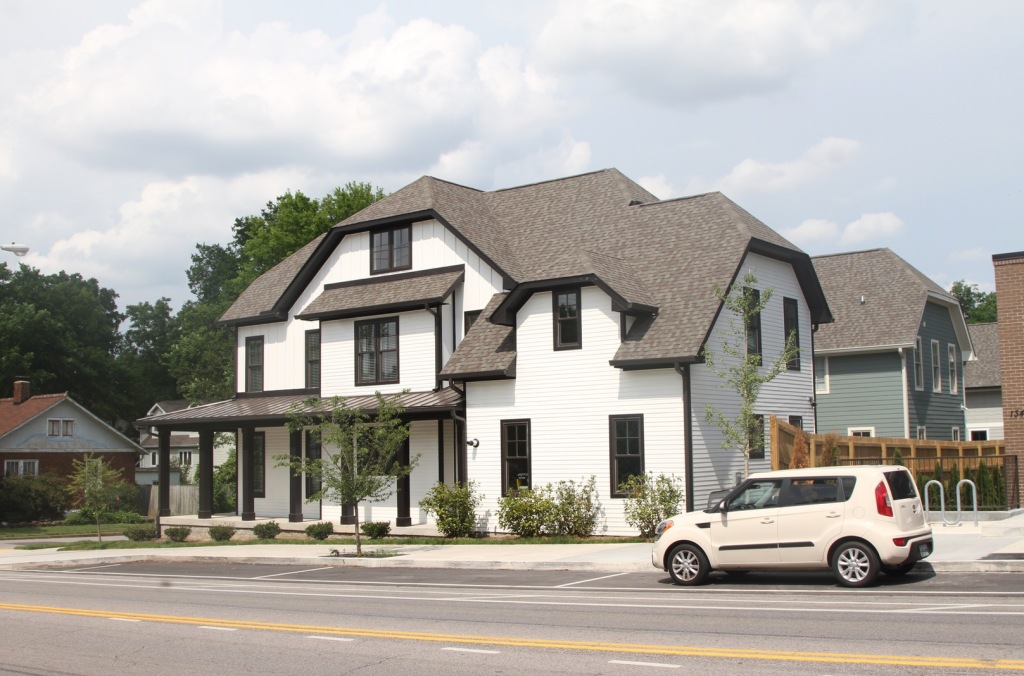
    Here’s something that breaks all the rules of suburban development. It’s supposed to be the kiss of death to have a business situated right next to a fully detached single family home. Yet in this location the shops and the properly designed street actually make these houses more desirable. The usual amenity of residential isolation has been exchanged for the amenity of good walkable urbanism. This kind of arrangement is so incredibly rare in America today that people are willing to pay a premium for such properties.

    Screen Shot 2016-08-25 at 6.02.46 PM

    Screen Shot 2016-08-25 at 6.03.00 PM

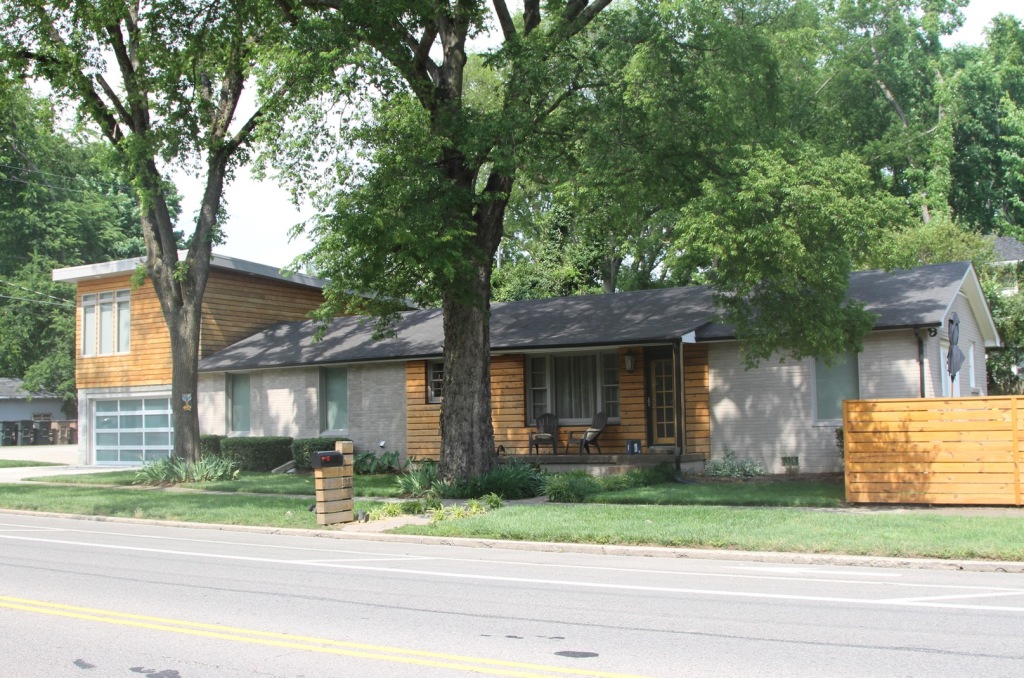
    Finally, we have the 1950’s tract homes that could have started the long slide into low rent crappiness as is so often the case when suburban roads are widened in a hopeless attempt to ease traffic congestion. Here, the road diet and nearby improved commercial district  have inspired property owners to invest in substantial renovations and improvements to otherwise outdated homes.

    The future of most suburbs is to change from what they are now to something else. That “something” could be relentless decline or steady incremental rejuvenation. I don’t believe most places understand how to reinvent themselves in a cost effective yet culturally acceptable manner. The politics of inertia, fear, and vested interests are awfully powerful. That means the few places that can successfully pull it off will be miles ahead of the competition. Look around wherever you live. Then think long and hard about how your town will manage in the years ahead.

    John Sanphillippo lives in San Francisco and blogs about urbanism, adaptation, and resilience at granolashotgun.com. He’s a member of the Congress for New Urbanism, films videos for faircompanies.com, and is a regular contributor to Strongtowns.org. He earns his living by buying, renovating, and renting undervalued properties in places that have good long term prospects. He is a graduate of Rutgers University.

  • Honolulu Rail: From $4.6 B to $8.6 B in Eight Years. Now What?

    With its official cost now having risen to $8.6 billion and a funding gap of $1.8 billion, both of which are certain to rise, Honolulu’s rail project will run out of money before construction reaches the downtown area, perhaps even before it reaches Middle Street.

    The Federal Transit Administration says it will demand a return of all federal money if rail does not reach Ala Moana Center, which is possible only if the state Legislature or Honolulu City Council increase taxes dramatically:  An average family of five would have to pay more than $1,000 per year just to complete rail, according to the Tax Foundation of Hawaii. Once completed, the annual cost of operating and maintaining a safe and reliable rail system would require comparable tax payments each year for the lifetime of the rail system.

    State and city lawmakers are reluctant to raise taxes so dramatically, but abandoning the project at this late date would make those who had been supporting it look like idiots.  They must be asking themselves, “How did we get ourselves into this mess?”

    Almost immediately after being elected in 2004, Mayor Mufi Hannemann announced that he wanted a steel-on-steel rail system rather than the bus rapid transit (BRT) that his predecessor had proposed. Hannemann envisioned a 34-mile route that would cost $2.7 billion. By the time it was put to a vote in 2008, the route had shrunk to 20 miles and the projected cost was up to $4.28 billion.

    Some of the 50.6% of voters in that election who authorized the city to build a steel-on-steel system might have been influenced by claims that two-thirds of the $4.28 billion construction budget would be paid by tourists and the federal government; that rail construction would create 10,000 new jobs for local residents; and that traffic congestion would be significantly reduced once rail was operational.

    Though HART’s latest official cost estimate is “only” $8.6 billion, construction costs are expected to skyrocket to upward of $10.8 billion; local residents will end up paying more than two-thirds of total construction costs; the actual number of good jobs for local residents was a tin percentage of the promised number; and that the impact of rail on traffic congestion will be similarly miniscule.

    Had it not been for the media, the public would still be in the dark about the massive cost overruns. According to the Honolulu Authority for Rapid Transportation website, the cost overrun is a myth:

    “It’s important to understand that HART’s existing contracts are on budget and we continue to have a healthy contingency fund of more than $500 million. So far, about 60% of HART’s contracts have been awarded. The construction of the first 10 miles of guideway is underway, the Rail Operations Center is about 70% complete, and HART’s fleet of 80 rail cars is under production and the first cars are expected to arrive here in early 2016.”

    The kindest word we can think of for that explanation is propaganda.

    That so much money has already been spent is reason enough to keep going, according to HART and other rail supporters: If construction stopped now, all that money would have been wasted! 

    They think the funding problem can be solved quickly and easily by the Legislature extending the 0.5% rail surcharge one more time. That would cost island residents a mere “half a penny on each dollar spent,” according to HART.

    This kind of thinking is muddled, at best.

    The Honest Way to Approach Rail

    The rational way to approach the rail question begins with three simple questions:

    • How much more money would local taxpayers have to pay to construct and maintain a safe and reliable rail system?
    • What would be the benefit of having such a system?
    • What alternatives could be pursued if we were to stop rail now, and what would be the benefit of those alternatives?

    Honesty should be presumed only if the factual inquiry and decision-making processes are transparent so the public can see how the answers were reached.

    The $3.5 billion spent thus far is gone under any circumstance. If construction is continued, the total construction cost could reach $10.8 billion, according to the Federal Transit Administration. Although no one knows what the total actual cost would be, there is no rational basis for starting the decision-making process with an optimistic projection.

    If rail is completed, the annual operating cost will exceed $100 million. A comparable amount would also need to be set aside each year to ensure that the system remains safe and reliable. Based on the average life of system components elsewhere, the combined amount would be at least $200 million per year.

    Even if that kind of money were readily available, one wonders exactly what the benefit of rail would be. City and HART officials now acknowledge that traffic congestion would be “worse in the future with rail than what it is today without rail.” That quote comes from the Final Environmental Impact Statement and a letter from the city’s transportation director.

    City and HART officials will quickly add that traffic in the future with rail would be better than traffic in the future without rail, which is necessarily true only if one assumes, as they do, that the alternative to building rail is do nothing (the so-called no-build option). That is a false choice, intended to obfuscate rather than illuminate.

    There are ways to reduce today’s level of traffic congestion, such as by aggressively adding new traffic lanes to existing roads, as has already been done successfully on each side of the central part of H-1 freeway. Installing flyovers and bypasses in chokepoint areas like the Middle Street merge and adding new contra-flow and bus-on-shoulder options would also make a major difference.

    Each of these is a proven strategy that, unlike rail, would directly benefit all commuters.

    Major improvements could also be made to Honolulu’s award-winning bus system. This includes increasing the number of express buses that go where commuters want to go, rather than eliminating most of them, as is part of the rail plan.

    All of these strategies could be accomplished for less than half the money saved by terminating rail now. Rail supporters point out that the above strategies could be pursued along with rail, but that assumes a tax base that never goes dry. The cost of living in Hawaii is already exceptionally high and there’s a limit to how hard island taxpayers can be squeezed.

    Rail Surcharge Burdens Island Residents

    Hawaii’s general excise tax is a tax on sellers of just about everything in this state, including groceries, services, and business-to-business transactions. Consumers are generally aware of only the portion that is shifted to them at the point of sale. A much larger portion is invisible to consumers but is borne by them anyway because it gets up embedded in the price of things consumers have to buy in Hawaii.

    This hidden portion of the excise tax burden is surprisingly large for several reasons, including that taxes paid on business-to-business transactions pyramid. A national expert wrote in the first Price of Paradise book that it would take a sales tax rate of up to 16% to replace the revenue generated by the 4% excise tax at that time.

    Because of subsequent changes in the taxation of business-to-business transactions, the current equivalent rate is roughly 11%. The point is that Hawaii’s general excise tax is quite different from conventional sales tax systems, which is why the above-mentioned expert cautioned that comparing a conventional sales tax to Hawaii’s general excise tax is like comparing a firecracker to a hand grenade.

    The point that needs highlighting is that the burden of Hawaii’s general excise tax is largely hidden from view.  Consumers pay it in the form of higher prices on virtually everything they have to buy in Hawaii.

    The 0.5% rail surcharge currently raises about $250 million each year. According to data from the tourist agency, slightly less than 15% of that amount is being paid directly by tourists. The remaining 85% averages out to $212 per man, woman and child on Oahu, which is slightly more than $1,000 each year from an average family of five.

    HART calls this number a “myth.” It contends that the average cost to each local resident is much less, but does so on the unspoken assumption that consumers bear the burden of the rail surcharge only when it is identified at the point of a purchase, and that the rest of the rail surcharge is never borne by consumers. This approach is intellectually dishonest.

    Any form of rail tax that extracts a quarter-billion dollars from our local community each year (as does the current rail surcharge) creates a quarter-billion-dollar burden. In this case it would be a quarter-billion dollars each year to build the rail, and then nearly that much each year — forever — to operate and maintain a safe and reliable system, including the cost of major rehabilitation every decade.

    In addition to being borne by consumers, the general excise tax is notoriously regressive — that is, disproportionately burdensome to people with relatively low incomes. The concept of regressivity is not simple, but anyone who contends that Hawaii’s general excise tax is not regressive, or that a regressive tax is not disproportionately burdensome to people with relatively low incomes, is either ill-informed or dishonest.

    Pro-rail supporters have argued that a general excise tax surcharge is the best way to fund rail despite being regressive, because a third of it is borne by tourists. Studies differ on the exact percentage of excise taxes ultimately borne by tourists (including by purchasing things made more expensive because of unstated excise taxes), but they generally agree that the share of the burden borne by tourists would be roughly the same, perhaps even greater, if the property tax were used to fund rail, rather than the excise tax. They also show that the property tax is significantly less regressive than is the general excise tax.

    Our elected officials should be honest about this:  General excise taxes rather than property taxes are being used to fund rail simply because they are less noticeable. It would take a 29% increase in everyone’s property taxes to replace the revenue generated by the 0.5% rail surcharge. The political fallout from such an increase would be dramatic.

    We doubt that an average family of five would quietly continue paying $1,000 per year for the rest of their lives for a non-solution to an obvious traffic-congestion problem.

    Members of the state Legislature could stop the madness by repealing the 0.5% rail surcharge, which would put members of the City Council to the test: Do they want rail badly enough to take the political heat for imposing an immediate and permanent 29% increase in property taxes?

    Because candidates for the Legislature and Honolulu City Council are currently seeking political support, now is a perfect time to ask them these questions:

    • Will a particular candidate for the Legislature vote to end the rail surcharge?
    • Will a particular candidate for the City Council vote to replace any such lost revenue by raising property taxes by 29%?

    There’s one additional question for the media: Why not publish every candidate’s position on the funding of rail? After all, rail was by far the largest public works project in the state’s history even before the costs skyrocketed.

    A version of this story originally appeared at Civil Beat.

    About the Authors
    Cliff Slater  Cliff Slater is a businessman who founded Maui Divers. He was a plaintiff in a federal lawsuit challenging the process by which the city selected elevated heavy rail.
    Randall Roth  Randall Roth is a professor at the William S. Richardson School of Law whose areas of expertise include taxation and professional responsibility.  He co-authored Broken Trust and was a plaintiff in above-mentioned lawsuit.
    Panos Prevedouros  Panos Prevedouros is a University of Hawaii professor and chairman of the department of civil and environmental engineering. He has twice run for Honolulu mayor.

    Photo by Musashi1600 (Own work) [CC BY 3.0 us], via Wikimedia Commons

  • Transit: About Downtown and the Core

    Transit best serves commuting destinations that have high concentrations of employment. For the most part, this means downtowns, or central business districts (CBDs). This is where transit lives up to its “mass transit" name, carrying many people concurrently and efficiently to concentrated destinations. When the same people return home, the “mass” is at the origin, and destinations are dispersed throughout the metropolitan area outside of downtowns, much of transit service is anything but mass, as residents of suburban and other communities frequently note “all the empty buses.”

    According to the City Sector Model, high density downtowns have an average of more than 23,000 jobs per square mile, 30 times the major metropolitan area average. CBD densities rise above 100,000 per square mile in New York and Chicago.  

    This article analyzes transit commuting destinations in the 53 major metropolitan areas (1,000,000 or more residents in 2014). The data is all taken from the 2006-2010, which has been developed by the ASHTO Census Transportation Planning Package from the ACS data and is the latest available for detailed employment locations. We used this data to develop Demographia United States Central Business Districts, which is described in this previous post.

    Summary of Transit Commuting

    CBD’s typically have the most important concentration of tall buildings in metropolitan areas, and typically the tallest buildings. The strongest CBDs were established before the automobile became dominant, and mechanized transport, in the form of transit, was radially oriented toward downtown. To this day, many people, including some in the press and urban planning perceive downtown to be where most of the jobs are.  Yet, the high density CBD’s (over 20,000 jobs per square mile) account for only eight percent of the employment in the 53 major metropolitan areas, and far less in many.

    As an example, the Chicago CBD, including the Chicago Loop (photo at the top of the article) includes some of the tallest buildings in the United States and 500,000 jobs, yet accounts for only 11 percent of the metropolitan area employment. These jobs are concentrated in an area of only 3.4 square miles (8.8 square kilometers). By contrast, the built up urban area is 2,700 square miles (7,000 square miles) and the metropolitan area covers 7,200 square miles (18,500 square kilometers). This concentration of so many jobs in such a small area contributes to some the nation’s worst traffic congestion, even with a high transit market share.

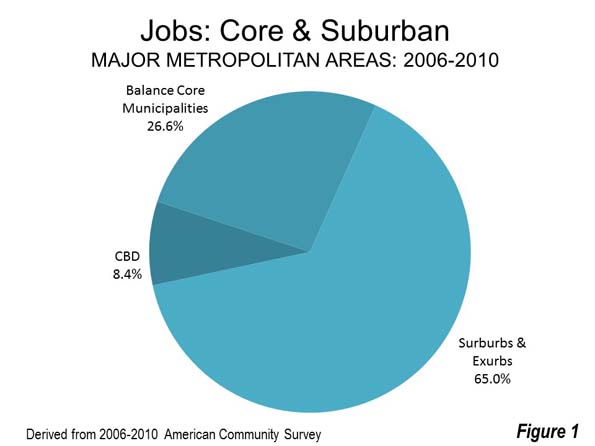
    The suburbs and exurbs dominate metropolitan employment, containing 65 percent of the jobs in the major metropolitan areas. The balance of the jobs (27 percent) are in the historical core municipalities, but outside the CBD (Figure 1)

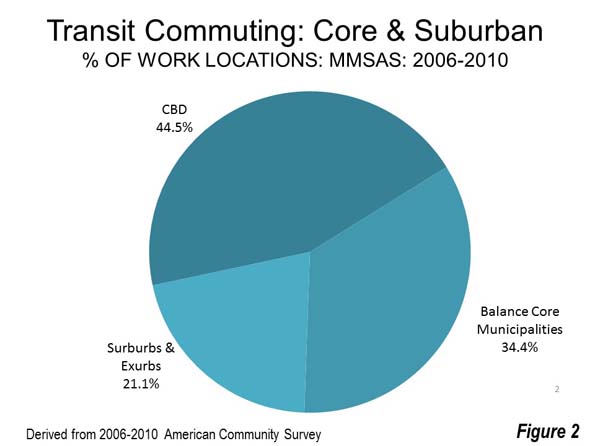
    These highest CBD densities can attract very high levels of transit usage. Despite their small share of metropolitan employment, the CBDs dominate transit commuting. Approximately 45 percent of transit commuters work in the CBDs. Another 34 percent work in the balance of the core municipalities. Finally, only 21 percent were in the suburbs and exurbs, where the 65 percent employment market share is more than triple (Figure 2).

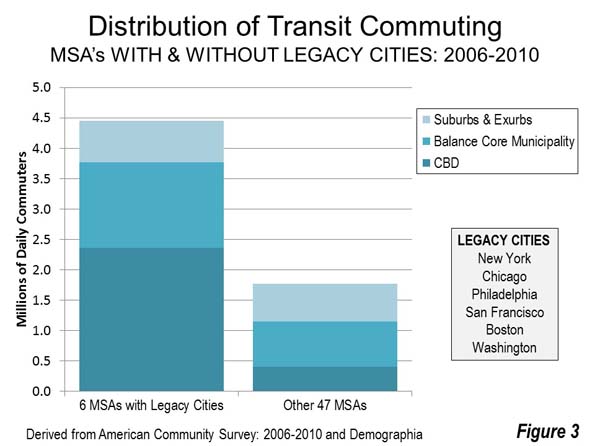
    Six transit legacy cities (historical core municipalities, including New York, Chicago, Philadelphia, San Francisco, Boston and Washington) within metropolitan areas dominate transit commuting, accounting for 72 percent of work trip destinations in the major metropolitan areas and 55 percent in the nation as a whole. These municipalities are also home to the six largest CBDs. New York dominates the legacy cities, with 60 percent of the transit commuting. This is to be expected, since New York is far more dense and has by far the largest CBD.

    By contrast the six legacy cities have only about 10 percent of the jobs in the major metropolitan areas, and only six percent of the jobs in the nation. Indeed, downtown commuting in the legacy cities exceeds all commuting in the 47 other metropolitan areas (Figure 3). This is despite the fact that the population of the 47 other metropolitan areas is nearly 2.5 times of the metropolitan areas with legacy cities.

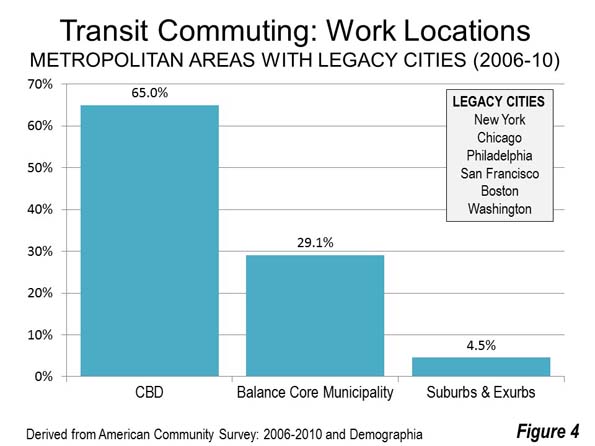
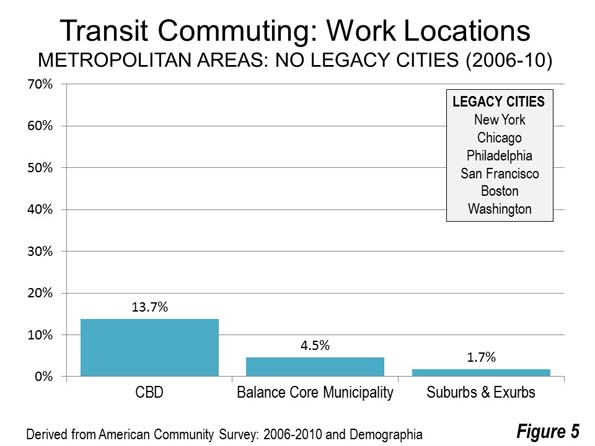
    Transit commuting is heavily skewed toward CBDs in the metropolitan areas with legacy cities, and are also the highest in other metropolitan areas. However, transit market shares to work locations in the suburbs are small, even in legacy cities (Figures 4 and 5).


    Central Business District

    Overall 41.4 percent of major metropolitan CBD commuters accessed work by transit.

    In the legacy cities, 64 percent of work access is by transit and 13 percent in the other 47 metropolitan areas.

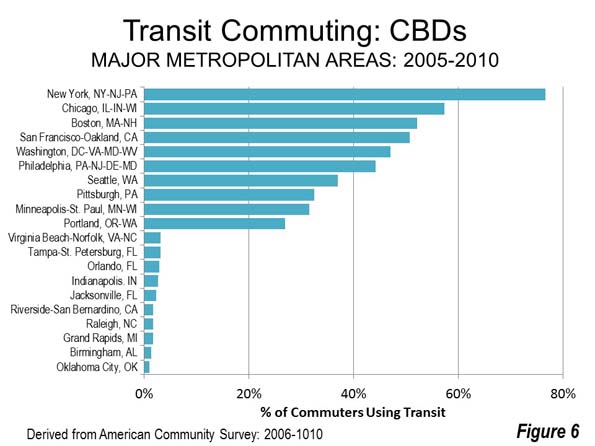
    The nation’s six largest CBDs, not surprisingly, had the largest transit market shares. In New York, south of 59th Street, transit’s market share is approximately 77 percent. In Chicago, transit share to the CBD is 57 percent, in Boston 52 percent, in San Francisco 51 percent and between 40 percent and 50 percent in Philadelphia and Washington. Seattle, Pittsburgh and Minneapolis-St. Paul followed at between 30 percent and 40 percent. Portland ranked 10th at 27 percent.

    At the other end of the scale, the numbers are very modest. The bottom 10 in CBD market share all have three percent or fewer of their commuters using transit. The lowest figures are in Oklahoma City, at 0.9 percent, and Birmingham, at 1.3 percent (Figure 6).

    Outside the CBD in the Core Municipalities

    In the core municipalities and outside the CBDs, the overall transit market share was 10.5 percent. This was a much higher 29.5 percent in the metropolitan areas with legacy cities and a very small 4.5 percent in the other 47 metropolitan areas.

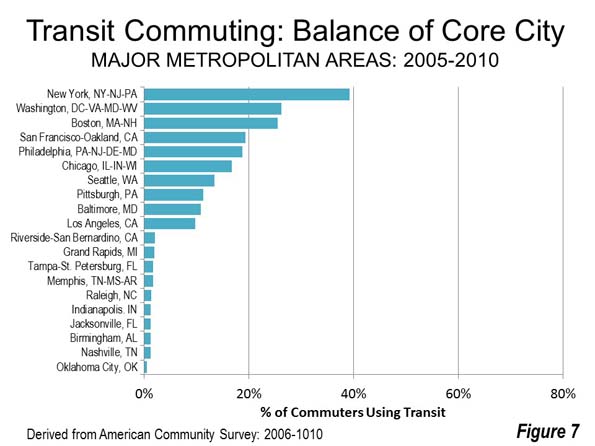
    Some legacy cities have relatively high transit market shares outside the CBDs. As in its CBD transit market share, New York stands well above the others, at 39 percent. New York is joined by the other five legacy city metropolitan areas, with Washington and Boston having 25 to 30 percent transit market shares in the core municipalities outside the CBDs.

    The bottom 10 in the core municipality outside the CBD category all have two percent or smaller transit shares. Again, Oklahoma City ranks last, at 0.6 percent (Figure 7).

    In addition, there are secondary central business districts with large transit market shares in some metropolitan areas. In New York, Brooklyn, which had a transit work trip market share of 60 percent, higher than second ranking Chicago and second only to New York’s principal central business district in Manhattan. Another New York secondary central business district, the Jersey City Waterfront, across the Hudson River from Lower Manhattan, has a 51 percent transit commuting share, while 26 percent of downtown Newark’s commuters used transit. In Washington, Rosslyn attracts 23 percent of its commuters by transit.

    Suburbs and Exurbs

    Perhaps the most surprising finding is the very low transit work location market shares in the suburbs and exurbs (the metropolitan area outside the core municipalities), even in the metropolitan areas with legacy cities. Only 4.5 percent of commuters used transit even in the metropolitan areas with legacy cities. In the other 47 metropolitan areas, the figure was 1.7 percent. Overall the suburban and exurban transit work at market share was 2.5 percent. Employment in the suburbs of even the legacy city metropolitan areas is more similar to the post-World War II automobile urban form than the core cities in the same metropolitan areas.

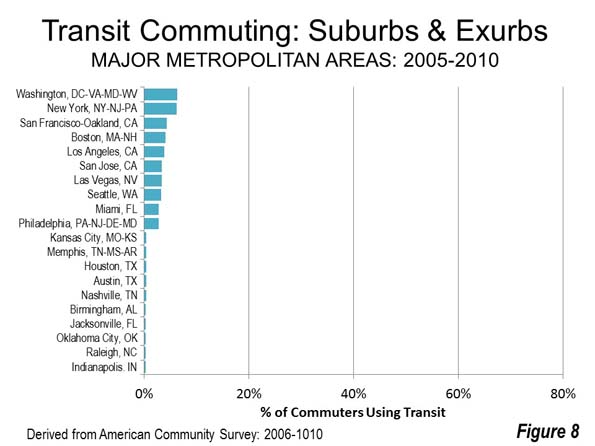
    The highest suburban and exurban transit market shares were in Washington, at 6.3 percent and New York, in a near statistical tie. Legacy city metropolitan areas San Francisco and Philadelphia ranked third and 10th. Legacy city metropolitan area Chicago did not make the top 10.

    The 10 lowest suburban and exurban market shares were all 0.4 percent or less. Four metropolitan areas congregated at the bottom at near three percent, including Jacksonville, Oklahoma City, Raleigh and last-place Indianapolis (Figure 8).


    The table below contains market share for each of the 53 metropolitan areas, including CBDs, the balance of core municipalities, the suburbs and exurbs and totals.

    Transit is About Downtown and the Core

    The concentration of transit commuting destinations in the legacy cities and in the historical core municipalities that surround them illustrates where transit can play a significant role in mobility and access. At the same time, the small transit share elsewhere shows transit’s very limited potential (both in metropolitan areas outside the legacy cities and the 47 other metropolitan areas). This reality is confirmed by the losses and small gains in transit market share from the nation’s newer rail transit systems, which have largely been constructed outside the legacy cities. Transit is fundamentally about downtown and the core.

    Transit Work Trip Market Share by Work Location
    2006-2010
    Metropolitan Area CBD Balance: Core Municipality Suburbs & Exurbs Total
    Atlanta, GA 14.18% 7.35% 1.76% 3.31%
    Austin, TX 5.12% 3.42% 0.41% 2.56%
    Baltimore, MD 17.72% 10.79% 2.34% 5.26%
    Birmingham, AL 1.32% 1.26% 0.35% 0.69%
    Boston, MA-NH 52.18% 25.52% 4.13% 11.66%
    Buffalo, NY 11.52% 7.13% 1.74% 3.60%
    Charlotte, NC-SC 8.77% 2.22% 0.47% 1.93%
    Chicago, IL-IN-WI 57.40% 16.76% 2.13% 11.32%
    Cincinnati, OH-KY-IN 13.25% 4.76% 0.95% 2.43%
    Cleveland, OH 15.09% 6.20% 1.74% 3.70%
    Columbus, OH 4.89% 2.15% 0.55% 1.59%
    Dallas-Fort Worth, TX 14.04% 3.00% 0.66% 1.54%
    Denver, CO 19.79% 5.22% 2.19% 4.68%
    Detroit,  MI 7.48% 4.79% 0.74% 1.45%
    Grand Rapids, MI 1.72% 1.95% 0.67% 1.06%
    Hartford, CT 8.13% 5.71% 1.61% 2.57%
    Houston, TX 13.15% 3.00% 0.41% 2.56%
    Indianapolis. IN 2.64% 1.29% 0.26% 1.00%
    Jacksonville, FL 2.33% 1.27% 0.30% 1.09%
    Kansas City, MO-KS 7.00% 2.45% 0.44% 1.23%
    Las Vegas, NV 5.61% 3.78% 3.37% 3.56%
    Los Angeles, CA 22.48% 9.74% 3.85% 6.01%
    Louisville, KY-IN 6.47% 2.71% 0.78% 2.19%
    Memphis, TN-MS-AR 3.52% 1.69% 0.43% 1.32%
    Miami, FL 9.35% 7.37% 2.82% 3.59%
    Milwaukee,WI 11.05% 5.97% 1.43% 3.43%
    Minneapolis-St. Paul, MN-WI 31.54% 7.75% 1.35% 4.52%
    Nashville, TN 3.58% 1.20% 0.36% 0.95%
    New Orleans. LA 6.69% 4.93% 0.81% 2.44%
    New York, NY-NJ-PA 76.60% 39.22% 6.25% 30.40%
    Oklahoma City, OK 0.95% 0.57% 0.30% 0.48%
    Orlando, FL 2.91% 3.06% 1.10% 1.65%
    Philadelphia, PA-NJ-DE-MD 44.18% 18.72% 2.76% 9.14%
    Phoenix, AZ 11.82% 2.95% 1.37% 2.19%
    Pittsburgh, PA 32.52% 11.33% 1.37% 5.75%
    Portland, OR-WA 26.96% 7.95% 2.38% 6.12%
    Providence, RI-MA 10.47% 4.00% 1.04% 1.74%
    Raleigh, NC 1.75% 1.42% 0.27% 0.88%
    Richmond, VA 4.93% 4.26% 0.80% 1.77%
    Riverside-San Bernardino, CA 1.75% 2.04% 1.14% 1.19%
    Rochester, NY 6.55% 2.04% 1.22% 2.00%
    Sacramento, CA 12.97% 2.87% 1.34% 2.66%
    St. Louis,, MO-IL 11.24% 6.51% 1.32% 2.53%
    Salt Lake City, UT 12.18% 5.26% 1.67% 3.64%
    San Antonio, TX 6.44% 2.49% 0.66% 2.27%
    San Diego, CA 10.22% 3.44% 2.16% 3.19%
    San Francisco-Oakland, CA 50.68% 19.32% 4.35% 14.22%
    San Jose, CA 8.39% 2.88% 3.38% 3.36%
    Seattle, WA 36.99% 13.46% 3.22% 8.37%
    Tampa-St. Petersburg, FL 3.10% 1.76% 1.18% 1.36%
    Tucson, AZ 6.05% 2.88% 1.30% 2.48%
    Virginia Beach-Norfolk, VA-NC 3.17% 2.34% 1.45% 1.67%
    Washington, DC-VA-MD-WV 47.07% 26.26% 6.30% 13.85%
    Sources: 2006-2010 ACS & Demographia Central Business Districts

    Wendell Cox is principal of Demographia, an international pubilc policy and demographics firm. He is a Senior Fellow of the Center for Opportunity Urbanism (US), Senior Fellow for Housing Affordability and Municipal Policy for the Frontier Centre for Public Policy (Canada), and a member of the Board of Advisors of the Center for Demographics and Policy at Chapman University (California). He is co-author of the “Demographia International Housing Affordability Survey” and author of “Demographia World Urban Areas” and “War on the Dream: How Anti-Sprawl Policy Threatens the Quality of Life.” He was appointed to three terms on the Los Angeles County Transportation Commission, where he served with the leading city and county leadership as the only non-elected member. He served as a visiting professor at the Conservatoire National des Arts et Metiers, a national university in Paris.

    Photo: Chicago CBD, with 11 percent of metropolitan employment, with the balance of the city of Chicago and the expansive suburbs beyond (by author).

  • Is it Time for MagLev?

    Maryland officials have announced that a proposal to build a maglev line from Washington to Baltimore has received a commitment for the feasibility study of $2 million from Japanese government. This is in addition to a much larger involvement by the Japanese government, which would include a $5 billion commitment from the government Japan Bank for International Cooperation. The private Central Japan Railway Company has also agreed to waive any licensing fees for using its maglev technology.

    The loan would finance one-half of the “somewhat north of “$10 billion cost, as characterized by Northeast Maglev, the developer of the proposed system.

    Surely that is a far better alternative than digging deeper into U.S. taxpayer pockets if combined with sufficient private investment. Otherwise any such system could require huge federal grants, or low interest loans through the Federal Railroad Administration Railroad Rehabilitation and Improvement (RRIF) loan guarantee program.  An RRIF loan could potentially expose taxpayers to a 100% loss, should the maglev system fail to pay for its capital and operating costs, as occurred with what the Washington Post characterized as the “Solyndra Scandal,” which cost taxpayers more than half a billion dollars due to a federal loan guarantee.

    The history of private investment in high speed rail around the world is considerably less than encouraging in this regard.

    What is Maglev?

    Maglev is magnetic levitation, a process by which magnetic forces are used to elevate and propel trains, without friction, at very high speed. The technology has long been favored by futurists and some transport professionals, but there is only one high-speed system in operation (Shanghai). That line has only been partially completed and the rest of the line has been suspended.

    “North of” Cost Estimates

    The evidence seems to be that the costs of maglev are “north of” high speed rail costs. This is of particular concern for taxpayers, since only two high speed rail lines of the many built in the world have “broken even.” There are recent reports that a third, Shanghai to Beijing is now making a profit Generally large rail project costs have been notoriously underestimated, as the Oxford University work led by Professor Bent Flyvbjerg has shown.

    As a result, there is always the risk that a venture proposed as commercial could run out of money during the construction phase, or generate insufficient revenues to its operating and capital costs. In either case, government subsidies would likely be sought by the operator.

     “North of” cost projections, such as suggested by Northeast Maglev, seem to be the rule in high speed rail, given that original cost projections for similar projects have been so routinely unreliable.

    The current $10 billion estimate for the Washington to Baltimore line is already well north of an earlier $8 billion estimate.

    The currently under construction Tokyo to Nagoya and later Osaka (Chuo Shinkansen maglev) has a construction cost in excess of ¥9 trillion (approximately $90 million). With 90 percent of the Tokyo to Nagoya section underground or in tunnels, cost escalation seems likely.

    Similarly, the cost of the California high-speed rail line, in its original full he high-speed configuration from Los Angeles San Francisco tripled (inflation adjusted)  to well “north of” its 1999 cost projection made. Officials cut the system back from full high-speed rail operation in the Los Angeles and San Francisco areas to reduce costs to a more politically acceptable level.

    High Speed Maglev: The One Partial Line

    Currently, the only partial high-speed maglev line in the world takes passengers only two-thirds of the way from its Pudong International Airport terminus to central Shanghai.

    It was planned to extend the Shanghai maglev line to the center and eventually to Hangzhou, an urban area of 7.6 million residents approximately 180 kilometers (110 miles) to the southwest. However, those extensions have been suspended and high-speed rail service is now available to Hangzhou.

    The developers of the Shanghai maglev hoped that China would adopt the technology for its high-speed intercity rail system. China, however, opted for conventional high-speed rail technology and will soon be operating at speeds of up to 350 kilometers per hour (220 miles per hour), the fastest in the world. The train sets are already operating in Manchuria.

    A Real Head Scratcher

    Significantly, the long and disappointing startup pains of maglev may be coming to an end.

    The Central Japan Railway has begun building the Tokyo to Nagoya and eventually Osaka Chuo Shinkansen maglev line. The currently planned completion date for the Nagoya section is 2027, with a package of financial incentives worth and a ¥3 trillion loan from the Japanese government intended to advance the completion date for the new going to Osaka section from 2045 to 2037. Thus, Japanese taxpayers are already potentially “on the hook” financially.

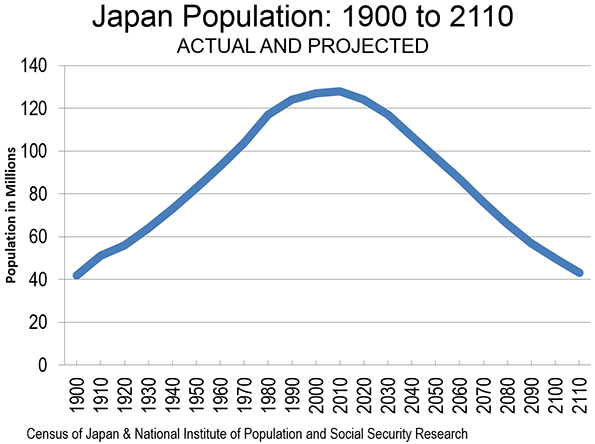
    There’s an element of the bizarre here.  How much additional transport infrastructure is required in the nation that is losing population at a faster rate than anywhere else in the world? By the earliest date the Osaka extension opens (2037), Japan’s population will have fallen 14 million (more than 10 percent) from today, according to projections of the National Institute for Population and Social Security Research. A quarter of a century later (2062), the population will have dropped another 27 million, to 85 million. That is 10 million fewer people than the 95 million who lived in Japan when the first high speed rail line opened just before the 1964 Olympics. In 2089, Japan is projected to have only 58 million people, fewer than almost 170 years (Figure).

    One economic development report noted that the line would “help alleviate the population overcrowding concentration in the Tokyo metropolitan area. Yet, by 2110, the entire country is projected to have not many more people than the Tokyo metropolitan region today.  

    The Chuo Shinkansen maglev is a part of Prime Minister Abe’s financial stimulus program, which has both supporters and critics. The government talks of the economic development the line will induce. Others, such as Edwin Merner of Atlantis Investment Research called the maglev line a misallocation of resources and that passenger demand will be limited.

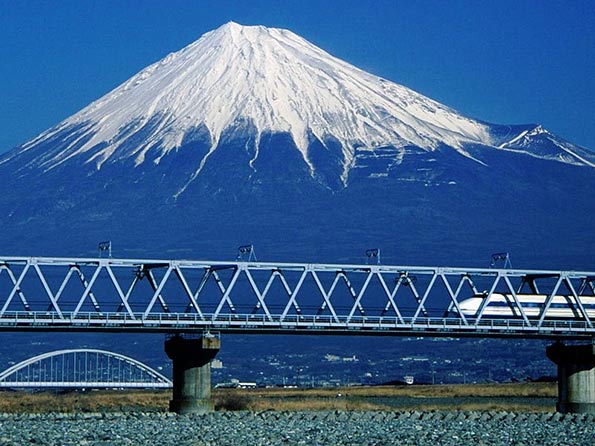
    The line has also been justified as a means to promote tourism. Yet, the average tourist may find the scenery — much of it very appealing — from the above ground 1 hour 40 minute ride to Nagoya or the 2 hour 30 minute to Osaka on the conventional high speed rail line more satisfying  (such as Mount Fuji) than the hundreds of miles of tunnel on the faster maglev line (Photo).


    By Alpsdake (Own work) [CC BY-SA 3.0], via Wikimedia Commons

    Protecting US and Northeastern Taxpayers

    But, back to the Washington to Baltimore maglev line. A privately financed and commercially viable maglev line would improve transportation in both the Washington to Baltimore corridor and the extension to New York. However, taxpayers need guarantees to ensure that they are not left “holding the bag.”

    For example, before any permits for proceeding are issued, the investors should be required to post a bond to ensure that the private funding will be sufficient to complete the system, thus avoiding public subsidy. Further, a performance bond should guarantee that no operating subsidies are required for at least a minimum number of years (perhaps 10 or 25).

    A Chance for Success?

    With sufficient taxpayer safeguards, there may be a chance for it to succeed. And surely, we wish Japan, the Japan Bank for International Development, the Central of Japan Railway and Northeast Maglev the best, hoping that they can provide a fully commercial venture. On the other hand, like Ford’s “Nucleon” nuclear powered automobile (proposed in the 1950s), the time for maglev may never come.

    Wendell Cox is principal of Demographia, an international public policy and demographics firm. He is a Senior Fellow of the Center for Opportunity Urbanism (US), Senior Fellow for Housing Affordability and Municipal Policy for the Frontier Centre for Public Policy (Canada), and a member of the Board of Advisors of the Center for Demographics and Policy at Chapman University (California). He is co-author of the "Demographia International Housing Affordability Survey" and author of "Demographia World Urban Areas" and "War on the Dream: How Anti-Sprawl Policy Threatens the Quality of Life." He was appointed to three terms on the Los Angeles County Transportation Commission, where he served with the leading city and county leadership as the only non-elected member. He served as a visiting professor at the Conservatoire National des Arts et Metiers, a national university in Paris.

    Lead photo: Chuo Shinkansen maglev by Saruno HirobanoOwn work, CC BY-SA 3.0, https://commons.wikimedia.org/w/index.php?curid=30917648

  • The Future of Mobility

    I was walking home from downtown San Francisco and passed through the South of Market neighborhood. The area is full of tech company offices like Twitter, Uber, and Airbnb. I saw this minivan advertising, “Low Cost Commuting” and “Ride Share” with the Enterprise Rent-A-Car logo and thought hmmmmm.


    Screen Shot 2016-08-10 at 12.04.43 PM

    Screen Shot 2016-08-10 at 12.03.43 PM

    As I got closer to home in the Mission District I saw this guy signing people up with coupons for free introductory rides. Evidently Enterprise is diversifying its business model. I asked Jim Kumon of the Incremental Development Alliance  about ride share programs and he had this to say.

    “Enterprise has neighborhood locations. Because those locations are not in airports, they don’t get hit with all the extra fees that go with ports, so its dirt cheap. Since they have the room to store extra vehicles and they are geographically dispersed in the right places a shared driver carpool can work. Definitely a major tool to make good-enough-urbanism work for post 1970s neighborhoods or hyper dense places where you can functionally have a pickup game in a car every day.”

    Screen Shot 2016-08-13 at 6.49.32 PMScreen Shot 2016-08-13 at 6.48.12 PM

    Back in June I was in Detroit at a strongtowns.org event where I was asked to debate the impact of autonomous vehicles. I predicted that rather than each driver being chauffeured around in a private computer controlled car this new technology would be pressed into service as a form of hybrid mass transit similar to UberPool. Here’s a more complete explanation from a previous blog post.

    unnamed-17UTA

    I started asking around and was informed by transportation engineer Jon Larsen in Salt Lake City that the Utah Transit Authority has been providing precisely this kind of commuter service for the past fifteen years as part of UTA’s Vanpool program. “[The vans] are owned by UTA, who pays for fuel, maintenance, repairs, etc, and the riders split a per-mile cost. The driver keeps the van at their house. I’ve got a neighbor with a long commute who’s a driver, and he loves it.” There is no central authority that determines the routes or times. The UTA simply provides the equipment and lets riders form their own agendas.
    .

    Salt Lake is a predominantly suburban city where traditional rail and bus transit simply doesn’t work well in many peripheral locations. Self organizing commuter vans achieve all the goals of transit (reduction of highway traffic, cost savings for passengers, minimized fuel consumption, environmental benefits, etc,) in a way that works in a suburban region. The graph above shows that Salt Lake is gradually evolving into a city of resurgent urban neighborhoods that enjoy an excellent light rail system while suburban areas are increasingly accommodated by shared commuter vans. In contrast, city buses are losing market share on both fronts.
    .

    Tech companies may eventually refine this kind of operation with all sorts of bells and whistles, but the folks in Utah demonstrate that nothing more complex than a fleet of existing vehicles, plain vanilla drivers, and a bit of pragmatic self selecting bottom up organization can do all the heavy lifting.

    Over the last sixty years we’ve built so much dispersed horizontal development that we’re going to have to continue inhabiting it for a very long time – come what may. Expensive and unwieldy mass transit systems have never worked outside of well established urban centers and their nearby satellite towns. Decentralized, flexible, low tech, and affordable work-arounds just make more sense even if they aren’t as sexy as an Elon Musk electric autonomous vehicle or a bullet train.

    Screen Shot 2016-08-14 at 3.06.48 AM

    Screen Shot 2016-08-14 at 3.04.56 AM

    Screen Shot 2016-08-14 at 3.07.52 AM

    Screen Shot 2016-08-14 at 3.04.41 AM

    Screen Shot 2016-08-14 at 3.05.15 AM

    Screen Shot 2016-08-14 at 3.09.40 AM

    Screen Shot 2016-08-14 at 3.06.37 AM

    Screen Shot 2016-08-14 at 3.07.24 AM

    One more thing… You will recall that I walked from downtown back home on my journey that uncovered the Enterprise Ride Share plan. My route was just over three miles. In a place like San Francisco it’s actually a pleasure to be on foot and get around with no more advanced technology than shoe leather. We could just build more places like this. Just sayin’.

    John Sanphillippo lives in San Francisco and blogs about urbanism, adaptation, and resilience at granolashotgun.com. He’s a member of the Congress for New Urbanism, films videos for faircompanies.com, and is a regular contributor to Strongtowns.org. He earns his living by buying, renovating, and renting undervalued properties in places that have good long term prospects. He is a graduate of Rutgers University.

  • Asia Dominates Largest World Seaports

    The Port of Shanghai is by far the largest seaport in the world, according to the authoritative 2014 figures published by the American Association of Port Authorities. AAPA is an "alliance of the ports of Canada, the Caribbean, Latin America and the United States."

    Ranking seaports is no simple matter. There are two fundamental rankings, Cargo tonnage and containers. Containers are measured in "20 foot equivalent units," or TEU’s. Cargo tonnage, for example, includes bulk commodities, such as copper or oil. Cargo tonnage is unloaded at ship side and transferred to another mode of transport (such as freight rail or truck) to continue toward its destination. Containers are intermodal, meaning that they can be directly transferred from the ship to other modes of transport without being emptied.

    Shanghai leads the world in both cargo tonnage and container volume. This supremacy was achieved only recently. Singapore had been the premier world port in both tonnage and containers during the much of the 2000s. Shanghai became dominant in cargo in the middle 2000’s and overtook Singapore in containers by 2010.

    Container Volumes

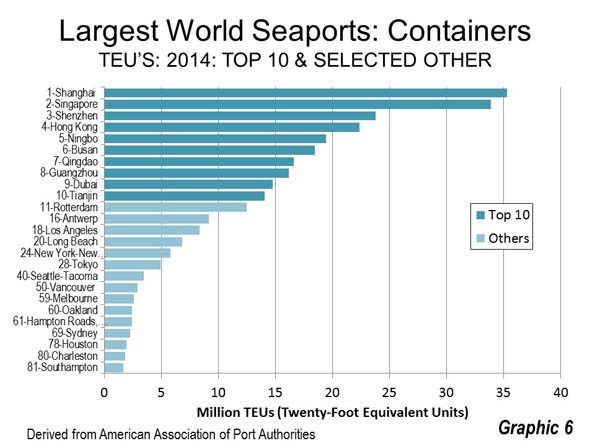
    All of the largest container ports are in Asia with Rotterdam being the largest non-Asian port at number 11. Seven of the top 10 are in China.

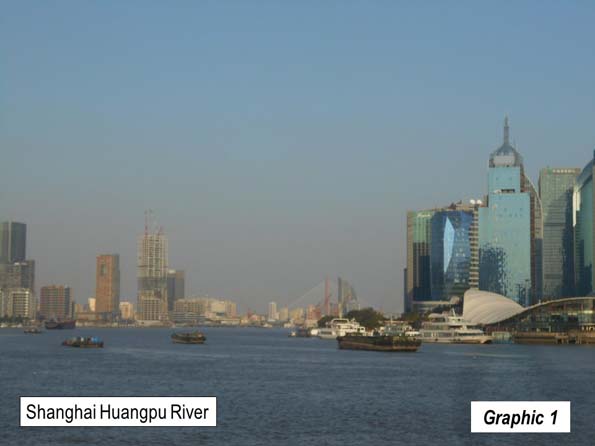
    Top ranking Shanghai handles more than 36 million TEUs annually. The port of Shanghai includes facilities on the Huangpu River (Graphic 1), which flows through the city and the Bund, the Yangtze River and the new offshore Yangshan Deepwater port in the mouth of Hangzhou Bay (Photo above). This facility was opened in the middle 2000’s for container traffic and is connected to the mainland by the 33 kilometer (20 mile) long Donghai bridge.

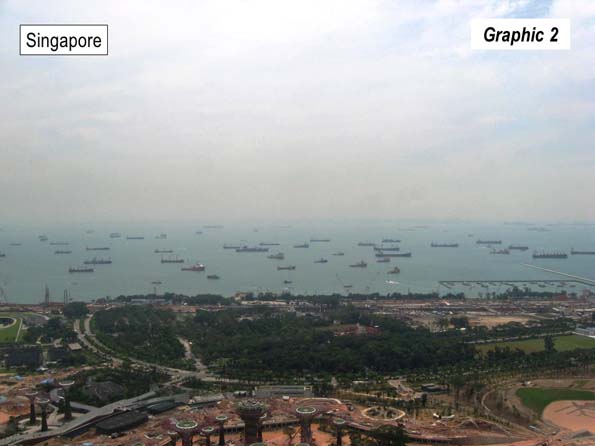
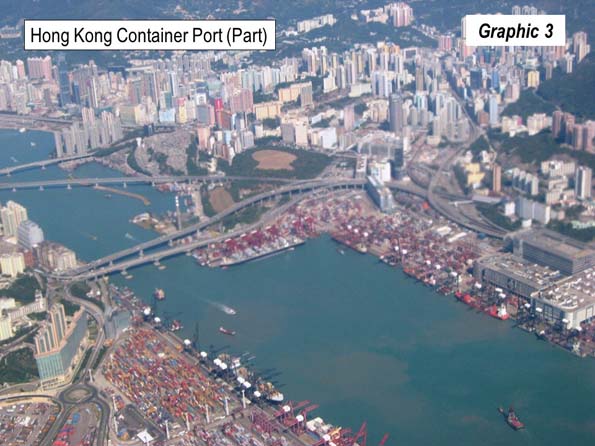
    Singapore is the second largest container port, handling nearly 34 million TEUs (Graphic 2). Shenzhen, just across the border from Hong Kong is the world’s third largest port, well behind Singapore, with 24 million TEUs. Hong Kong ranks fifth, and was the largest in the container port in the world until displaced by Singapore in the early 2000’s (Graphic 3).

    Ningbo, less than 80 kilometers (50 miles ) across Hangzhou Bay from the port of Shanghai is the world’s fifth largest container port.

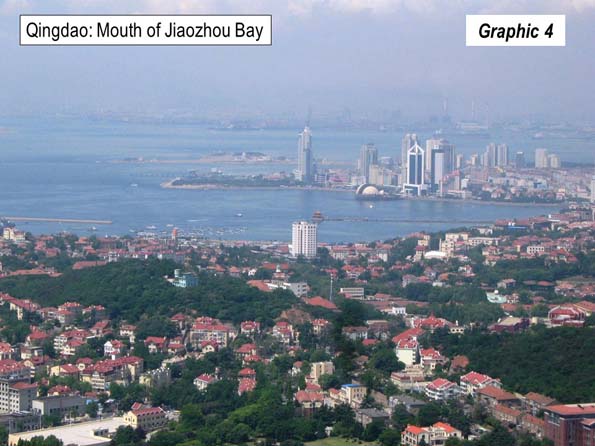
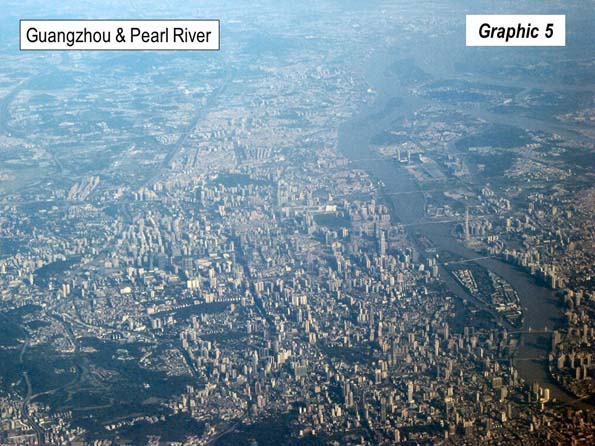
    Busan, in South Korea ranks sixth. Qingdao, on China’s Shandong peninsula is the seventh largest (Graphic 4). Guangzhou ranks 8th (Graphic 5) and Dubai ranks 9th. Tianjin, located in China’s fourth largest urban area, is approximately 160 kilometers (100 miles) from Beijing.

    Graphic 6 shows the 10 largest container points in the world and selected additional ports.


    Cargo Volumes

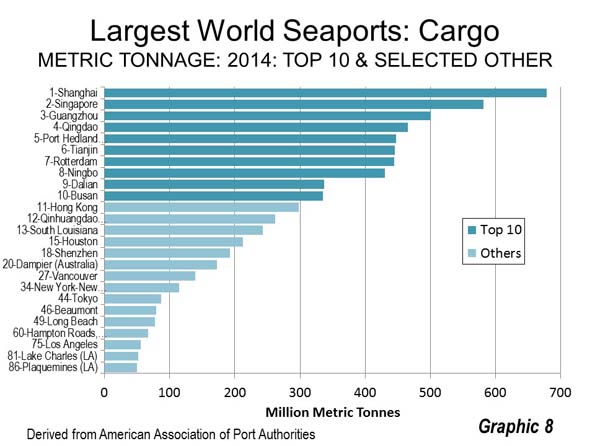
    Twelve of the largest cargo ports in the world are in Asia, with the exception of Port Hedland, in the state of Western Australia’s resource-rich Pilbara region. This is the  largest non-Asian port (#5). Eight of the top 12 ports are in China.

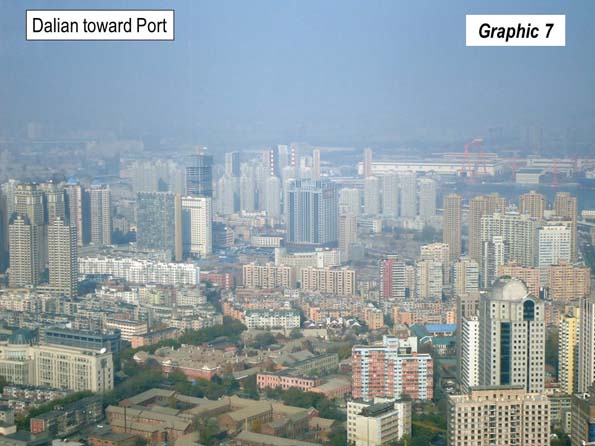
    In 2014, the port of Shanghai handled approximately 680 million tons of cargo (Note). Singapore was ranked second with approximately 580 million tons. Guangzhou and Qingdao were the third and fourth largest cargo ports. Port Hedland, was the fifth largest cargo port. Three of the second five were located in China, including #6 Tianjin, #8 Ningbo and #9 Dalian (Graphic 7), Manchuria’s largest cargo port.

    Rotterdam was the seventh largest cargo port and the largest port in Europe, though had dropped from being the largest in the early 2000’s, before it was overtaken by Singapore. Busan was the 10th largest cargo port.

    Graphic 8  shows the 10 largest cargo points in the world and selected additional ports.


    Large Port Regions

    China, with most of the world’s largest ports has considerable regional port concentrations. The two Yangtze Delta ports (Shanghai and Ningbo) had approximately 1.1 billion tons of cargo and 52 million TEU’s. The Pearl River Delta ports (Guangzhou, Hong Kong and Shenzhen) handle nearly 1.0 million tons of cargo and 57 million TEU’s. The Bohai Bay ports (Tianjin and Qinhuangdao), to the east of Beijing account for more than 700 million annual tons of cargo and a much more modest 14 million TEUs.

    The adjacent Los Angeles and Long Beach ports also handled 14 million TEU’s in 2014. The Tokyo Bay ports (Tokyo, Yokohama and Chiba) processed 7 million TEU’s while the port of New York and New Jersey handled 6 million.

    Other large regional cargo port concentrations lie along Louisiana’s lower Mississippi River (the ports of South Louisiana, New Orleans, Baton Rouge and Plaquemines), with cargo tonnage of 430 million, The Tokyo Bay ports handle 370 million tons annually. The adjacent ports of Los Angeles and Long Beach process 130 million tons of cargo annually. Historically prominent ports, such as New York and London have smaller volumes (115 million and 45 million respectively).

    The Ascendance of Asia

    The big story in port statistics is the ascendance of Asia, especially China. It was not a long time ago that European ports were the largest. Recently published research indicates that Asian container shipments between China and Europe/North America  in 2012 were five times their 1990 rate. This compares to an approximate doubling between Europe and North America over the period. The result is that European and North American ports no longer dominate the statistics.

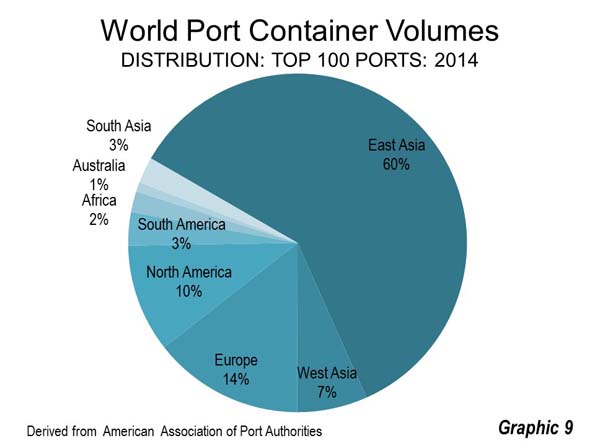
    In 2014, East Asia accounted for 60 percent of the container volume among the 100 largest ports. This is four times the volume of European ports (14 percent) and six times that of North American ports. All of the rest of the world accounts for only 16 percent of the total (Graphic 9).

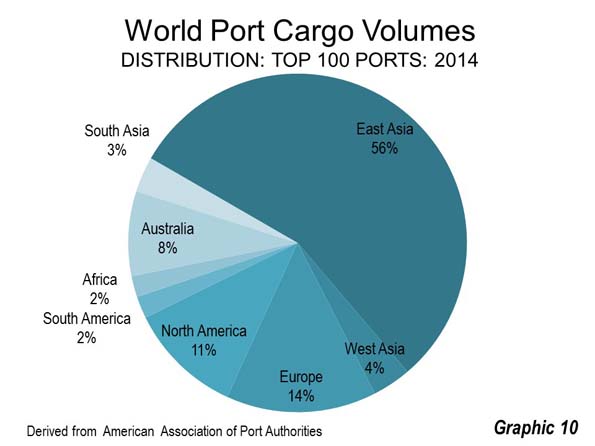
    The distribution of cargo traffic is similar. East Asia accounts for 56 percent of the top 100 port volume, four times the volume of Europe (14 percent) and five times that of North America (11 percent). Australia accounts for 8 percent, 60 percent of which is attributable to the Western Australian terminals of Port Hedland and Dampier, with their substantial commodity shipments to China. The rest of the world accounts for 11 percent of volumes (Graphic 10).


    The world of ports is by no means static. With the expanded Panama Canal now in operation, the maximum capacity of container ships has been nearly tripled. This means that US Gulf of Mexico and Atlantic ports are more competitively positioned by being able to berth the larger ships originating from Asia. This permits substitution, for example, of longer and less costly ocean voyages for intermodal truck and rail shipment across the United States,

    According to China DailyMaersk, the largest container ship company in the world, is routing its Asia to US East Coast traffic through the Panama Canal. A Maersk press release said ”Using the new Panama Canal locks, Maersk Line is able to significantly reduce the transit days from Asian to North American ports. The transit times from Shanghai and Ningbo to Newark, Norfolk and Baltimore are now five to 10 days faster,." James Newsome of the South Carolina Ports Authority described to China Daily the economics that now favor Atlantic ports: "…if Asian cargo bound for Charlotte, North Carolina, landed in Los Angeles, it would cost $2,000 to send it across the US by rail. If it landed in Charleston, it would cost only $600 by truck."

    Gulf of Mexico ports as US shippers become more competitive from lower costs. A natural gas shipment from the Gulf Coast would save 5,000 nautical miles (5,750 miles) and nine days using the canal, according to Martin Houston of Tellurian Investments.

    A number of Gulf and Atlantic ports are investing in improved infrastructure to accommodate the new traffic and larger ships. This includes ports like Houston, Savannah, Charleston (South Carolina), Miami and others. Perhaps the most impressive investment is raising the historic Bayonne Bridge so that the Port of New York and New Jersey can accommodate the larger ships.

    Of course the winners in this changing world will be consumers, who can expect lower prices as shipping becomes less expensive.

    Note: AAPA urges caution in interpreting cargo tonnage figures, because of differing tonnage definitions.

    Wendell Cox is principal of Demographia, an international pubilc policy and demographics firm. He is a Senior Fellow of the Center for Opportunity Urbanism (US), Senior Fellow for Housing Affordability and Municipal Policy for the Frontier Centre for Public Policy (Canada), and a member of the Board of Advisors of the Center for Demographics and Policy at Chapman University (California). He is co-author of the "Demographia International Housing Affordability Survey" and author of "Demographia World Urban Areas" and "War on the Dream: How Anti-Sprawl Policy Threatens the Quality of Life." He was appointed to three terms on the Los Angeles County Transportation Commission, where he served with the leading city and county leadership as the only non-elected member. He served as a visiting professor at the Conservatoire National des Arts et Metiers, a national university in Paris.

    Photo: Yanghsan Intermodal Port, Shanghai (All photos by author)

  • The Perils of Public Capital

    Most discussions of our slow economic growth includes a seemingly compulsory demand for increased public capital spending, so-called infrastructure spending or simply “roads and bridges.”  Both Donald Trump and Hillary Clinton promise increased public capital spending on their websites.   Larry Summers made perhaps the best case for public spending when he claimed that our failure to invest in public capital creates the “worst and most toxic debts.”

    I’m not buying it.

    Interest rates are low as is investment, by all types of entities.  This implies that the return on investments is low.  Why should government investments be any different?

    There are many reasons to believe that government investment provides a low return in the best of times.  Government investment decisions are the outcome of a political process.  One result of the political process is that one senator’s low-return project is funded in order to obtain concurrence for funding another senator’s high-return project. 

    The Bridge to Nowhere is an excellent example of the political process forcing low-return investments.  Fortunately, that project was abandoned due to widespread ridicule, but just as worthless projects are funded.  I just Googled “wasteful government projects” and had 538,000 results in 0.45 seconds.  You find things like spending hundreds of thousands of dollars on running shrimp and mountain lions on treadmills, $387,000 for Swedish massages for rabbits, and $18 million to renovate the airport for Sun Valley Ski Resort’s airport, and $800,000 to develop a food-fight video game.  These are hardly our most pressing issues.    

    The existence of low-return projects leads to a higher required return on the profitable projects in order for the average project to be profitable.

    Then, there is the problem of fads.  Governments tend to make popular investments and popular doesn’t mean profitable.  After the success of the Erie Canal in 1825, other states started building canals.  Eventually eight states defaulted on their debt because of those canals.

    More recently, Californians voted in 2004 to provide $3 billion they didn’t have to support stem cell research that private industry was already pursuing. 

    Government investment may be appropriate for projects where the return can’t be realized by the investor, or for investments that private firms won’t make because they lack information.  Neither condition applied to the stem cell research.  Stem cell research’s potential was a well-discussed topic in 2004.  The many private firms that are investing in stem cell research will have no problem capturing the returns.

    Any project well known enough to carry an election fails to meet the second condition for government investment.  If it’s well known enough to carry an election, private firms know all about it.

    Government projects have other costs because of the approval process.  These include the costs of lobbying, selling the project to the public, and sometimes elections.  These costs, and the uncertainty associated with them, increase the required return for profitability.  It may be that costs of approval are so high that a net-positive return is impossible.

    Consider harbor expansion.  California’s ports are major import-export facilities.  Huge amounts of goods are imported through these ports, with final destinations throughout the United States.  Large amounts of goods from throughout the United States are exported through these ports.

    Because of a lack of investment, California’s ports are destined to become increasingly less important.  It’s been consensus for years that these ports need larger and more efficient breakdown and distribution centers, but serious hurdles may prevent any significant improvement.  

    More importantly, California’s ports cannot accept the largest tankers or container ships, and there is no will to expand the ports to accept these very large vessels.  Canadian and Mexican Pacific port expansions and a widened Panama Canal will handle traffic that traditionally would go through California’s ports, if the ports could accommodate the ships.

    At this point, I believe that the political costs of significant harbor expansion, and in fact any large infrastructure project in California, are so high that profitable investments are impossible.  

    There is also the question of government competency.  Can government still build things efficiently?  There are lots of examples that suggest maybe not: 

    • The American Recovery and Reinvestment Act of 2009 was to fund almost a Trillion dollars of “shovel ready” projects.  Some roads were repaved, but nothing of real significance was built.
    • In August 2015, the EPA released three million gallons of toxic waste into the Animus River while trying to clean the site of the Gold King Mine near Silverton Colorado.
    • The eastern span of California’s San Francisco-Oakland Bay Bridge was damaged in the 1989 Loma Prieta earthquake.  Reconstruction was originally expected to cost $250 million and be completed by 2007.  It finally opened in September 2013 at a cost of $6.5 billion, and it’s still plagued with very serious problems.
    • Solyndra received a $535 million federal loan in September 2009.  It filed bankruptcy in August 2011.

    There was the I35 Bridge collapse in Minneapolis.  California’s High Speed Train is an ongoing disaster.  Americas publicly run, once very successful, manned space program has been abandoned because of accidents.  We built an airport security system after 9/11 that is ineffective, hugely disruptive, and very expensive.  The list could go on and on.  Even public capital’s most prominent proponent, Larry Summers, has come to see this as a challenge to public capital.

    Even if government was efficient and competent at building capital, it’s not clear what to build.  Proponents of more government capital look longingly back to the 1930s.  They talk about bridges, roads and dams.

    Good luck building a major dam today.  Environmentally motivated resistance makes it impossible, which is good.  Dams are not an appropriate investment today.  Dam building in the 1930s was critical in bringing electricity to millions of Americans and reducing the frequency of major floods, but those gains have mostly been realized.  The return on future dams is far less. 

    Most of the gains from new roads have also been exploited.  Slowing population growth implies that fewer new lane miles will be needed, while drone technology and autonomous vehicles may increase efficiency of existing roads.

    Dams and roads are the technology of the 20th Century.  We don’t know what the technology will drive the 21st Century, but it appears that private industry will provide it.  There have been attempts to make wireless internet service a government-supplied good, but markets seem to be providing it just fine.  Is there a coffee shop in America that doesn’t provide free wireless?

    Perhaps worse, governments are essentially prohibited, because of political pressures, from some potentially very profitable projects.  Call them taboo projects.  Taboo projects cannot be built no matter how profitable they may be.  These include nuclear facilities, coal or oil based energy projects, and canals.

    So.  Governments are self-prohibited from some profitable projects.  The political process requires the funding of worthless projects.  And when they have a good project, governments appear incompetent at actually building it.  I’d ask why more government projects are in the platforms of the two major presidential candidates, but I’m still trying to figure out why the two major parties selected such flawed presidential candidates.  Still, those candidates provide an excellent example of how our political process leads to far-from-optimal decisions.

    Bill Watkins is a professor at California Lutheran University and runs the Center for Economic Research and Forecasting, which can be found at clucerf.org.

  • Resurrecting the New York Subway

    The subway is crucial to mobility in the city of New York. Over the last 10 years, ridership increases on the subway have been more than that of all other transit services in the United States combined. It was not always this way.

    In  New York Post article entitled "How Bratton’s NYPD Saved the Subway System,"the Manhattan Institute’s Nicole Gelinas describes the depths of the problem in 1990, when there were 26 homicides on the subway. Of course, there is nothing more important to civil society than order, and the threat to life and limb on the subway led to a significant ridership loss after 1980.

    Gelinas notes that the murder of a Utah youth that year "would help propel Rudy Giuliani into the mayor’s office three years later, as Democratic voters turned to a Republican prosecutor to get a seemingly ungovernable city under control." Gelinas tells the story of how new transit police chief William Bratton brought the subway under control and helped to make possible the highest ridership levels since World War II. Gelninas notes that " Policing played a huge role in making Gotham’s subways safe, as it did in reducing crime throughout the city. In fact, the New York crime turnaround began in the subways, and what the police discovered about violence underground would prove essential to the broader battle for the city’s streets."

    Bratton played an important role in this city-wide progress, after he was appointed as New York City’s police commissioner by Mayor Rudy Giuliani. His success and is widely considered to have been influencial in the more effective policing strategies that have been, at least in part, credited with much lower urban crime rates in the last century. Indeed, the urban core (downtown) residential renaissance evident in many cities would not have been possible otherwise.

  • Shanghai to Manchuria and Central China by Train

    There is no better way to see China than by train. This is especially true because foreigners are not allowed to drive rental cars without first obtaining a Chinese drivers license. China has developed the world’s largest high-speed rail system, which includes one of only three profitable routes in the world, along with Tokyo to Osaka and Paris to Lyon.

    Travel by train in China is now more convenient for people who do not speak Mandarin. Tickets may now be purchased over the internet. Details of the trains and ticketing are provided at the end of the article.

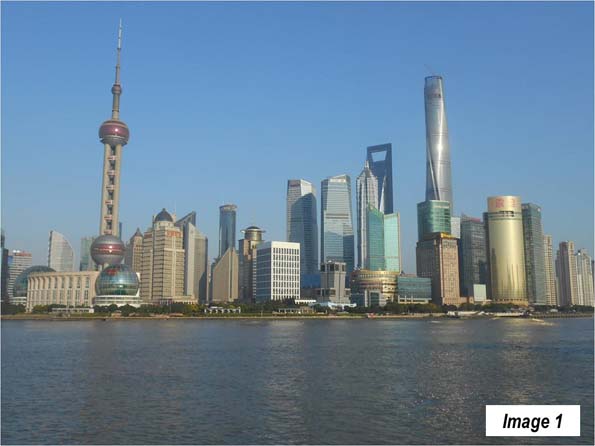
    Last month I traveled from Shanghai (Image 1 from a previous trip) to Changchun and Jilin, in Manchuria’s Jilin Province (Manchuria includes the northeastern provinces of Liaoning, Jilin and Heliongjiang, and is called the "Dong Bei" or the "east north") and then to Beijing and on to Nanchang, in Jiangxi Province, finally returning to Shanghai.

    Shanghai is China’s largest urban area, with 22.7 million residents (Note). I started out from Shanghai’s Hongqiao Railway Station, which is one of the most important rail hubs in the country. It is located across the runways from Hongqiao International Airport, from which most domestic flights operate. Most international flights operate from Pudong International Airport, which is 34 miles (55 kilometers) to the east.

    The train used the main Shanghai to Beijing line as far as Tianjin, where the train continues along Bohai Bay toward Manchuria, while the main line turns left toward Beijing.

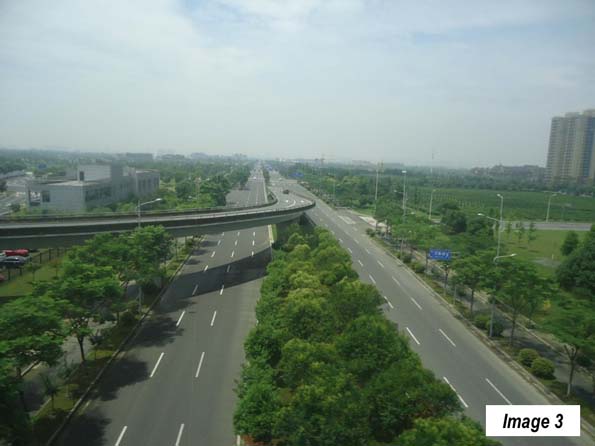
    It is not long before the train reaches speeds above 300 kilometers per hour (186 miles per hour). For at least the first 135 miles (220 kilometers), to the far edge of Changzhou, there is a mix of primarily urban development with some rural development. There are also many high-rise residential developments and "peri-urban" developments, with rural areas transitioning to urbanization.

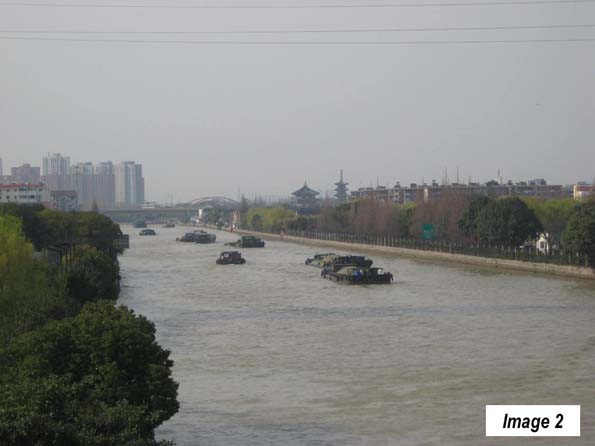
    The train travels west through Kunshan, an urban area of 1.9 million residents, part of Suzhou municipality, which also contains the Suzhou urban area (5.4 million). There are particularly good views of the Grand Canal in Suzhou (Image 2, from a previous visit). The Grand Canal was completed approximately 1,400 years ago and for centuries has provided a means for water transport between Hangzhou, to the south of Shanghai, across the Yangtze River and to Tianjin, near Beijing. It is the longest canal in the world, at 1,100 miles (1,800 kilometers).

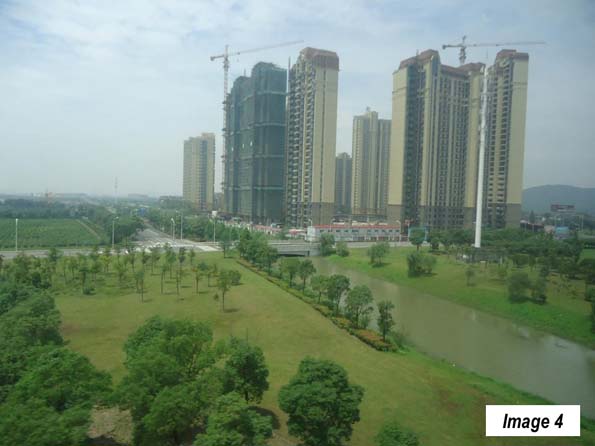
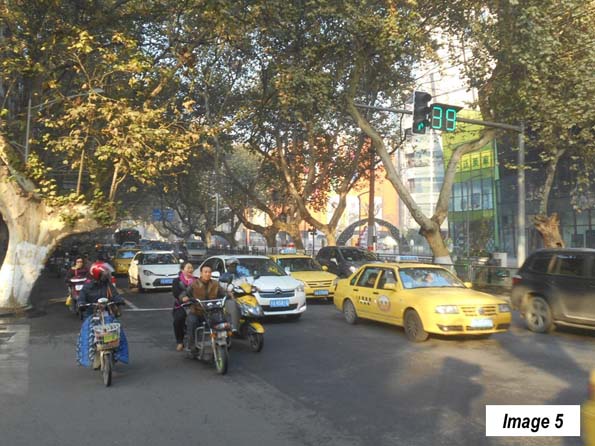
    From Suzhou, the train continues into Wuxi, an urban area of 3.7 million population (Images 3 and 4). The route continues into Changzhou (urban area population 3.7 million). Finally, is some open country, as the main route travels through a valley to the south of Zhenjiang to Nanjing, an urban area of 6.4 million population, which serves as the capital of Jiangsu. Nanjing was the former capital of China and its streets are lined and cooled in the summer by its "French trees" (Image 5, from a previous visit).
    Leaving Nanjing, the train crosses the Yangtze River and travel through largely agricultural country. It passes through the smaller Suzhou (Anhui province) of Nobel Literature Prize winner Pearl S. Buck, and then through Xuzhou, Jiangsu (1.3 million). In Xuzhou, I noted the elevated connections for the new rail line to Zhengzhou (and also saw them in Zhengzhou). Service will begin in September, cutting three hours off the Shanghai to Zhengzhou travel time, and placing historic tourist attraction Xi’an, with its Terracotta Army, within seven hours of Shanghai.

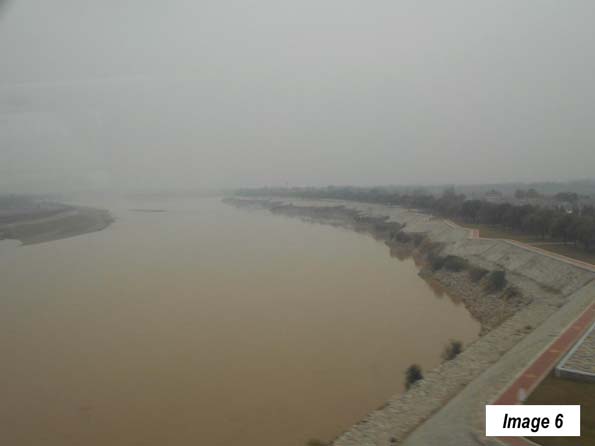
    The farmland continues to Jinan (3.9 million), the capital of Shandong province, which largely consists of the peninsula of the same name that forms the southern boundary of Bohai Bay. Just north of Jinan, the train crosses the second of China’s great rivers, the Yellow River (Image 6), which is again crossed north of Zhengzhou (below).

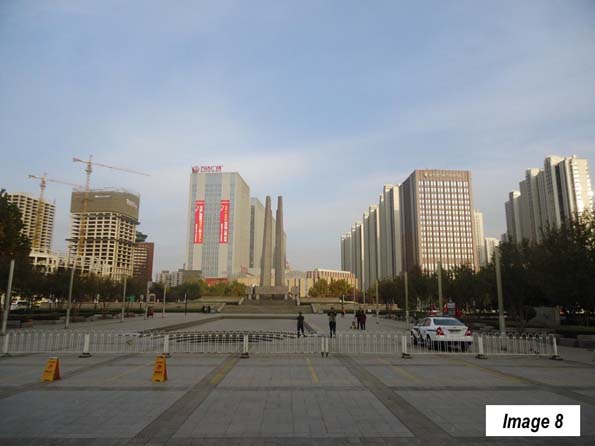
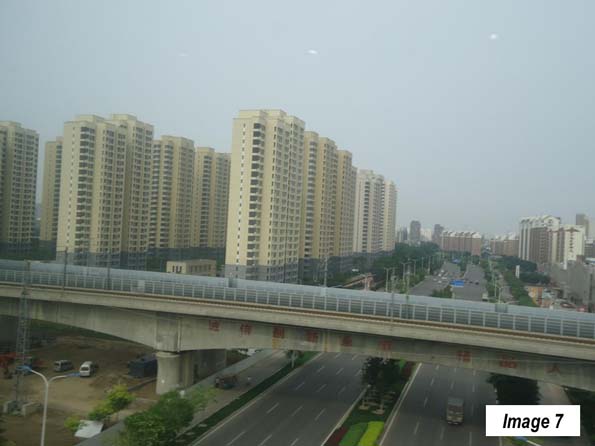
    Then there follows the longest stretch of agriculture between Shanghai and Beijing, most of the way to Tianjin (Image 7), an urban area of 11.3 million residents and is now the fastest growing large municipality in China, at more than four percent per year. Soon, we passed through Tangshan (2.4 million) which suffered a disastrous earthquake in 1976 but has been rebuilt (Image 8).

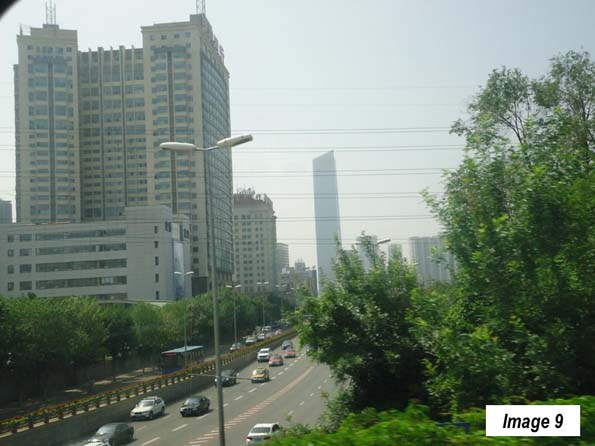
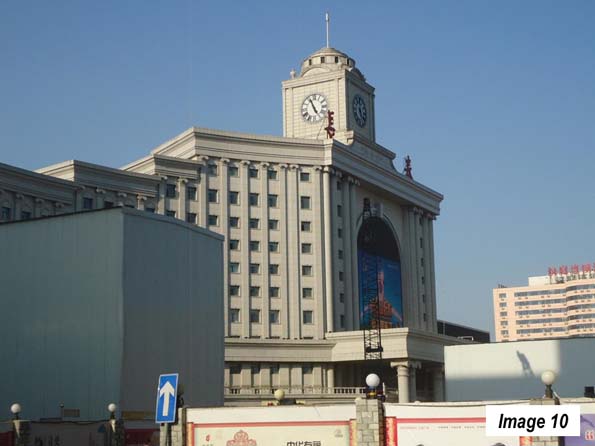
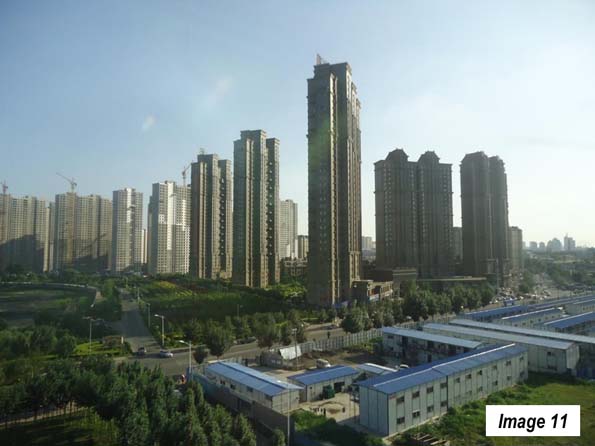
    The train continued northward to Shenyang (3.4 million), the capital of Liaoning (Image 9). Finally, the train reached the destination of Changchun Railway Station (Image 10), 1,500 miles (2,400 kilometers) and 11 hours from Shanghai. Changchun (Image 11) is the capital of Jilin province and has 3.4 million residents.
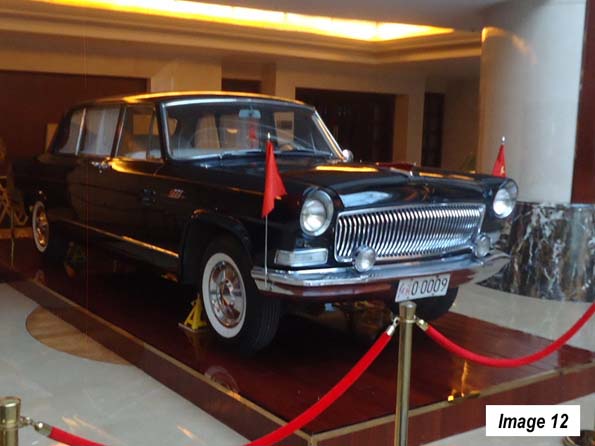
    Changchun is called the "automobile city," because the government placed the first automobile manufacturing plant here in the late 1950s. This was where the Red Flag limousine was built, favorite of government ministers and which carried President Richard Nixon around Beijing in his 1972 visit. My hotel in Ordos had a classic Red Flag on exhibition (Image 12). Now, automobile manufacturing is spread around the country and includes virtually all of the world’s leading brands. Last year, Chinese bought 21.1 million cars, compared to 17.5 million in the United States, both records.

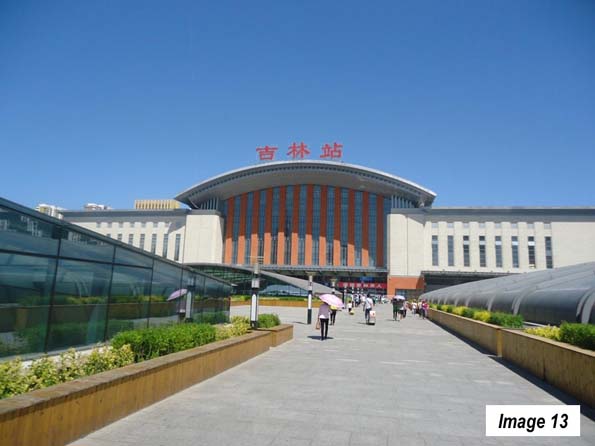
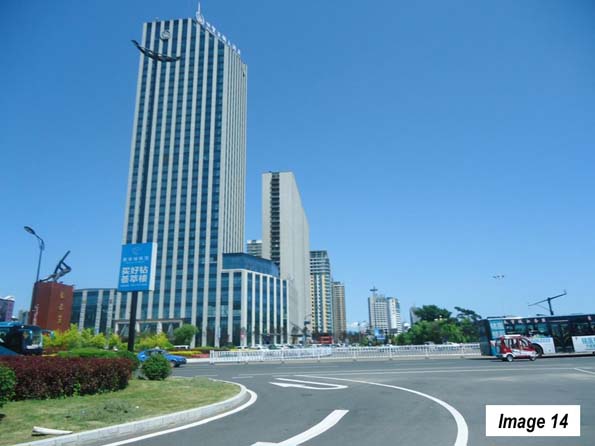
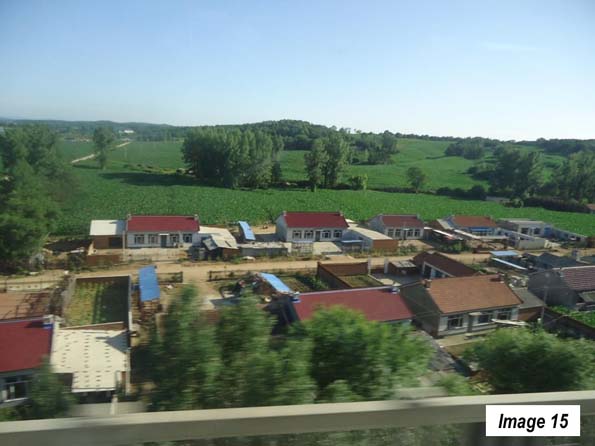
    Jilin, an urban area with 1.7 million residents,(Images 13, Jilin Railway Station & 14) is only 45 minutes away by train, separated by picturesque rolling agricultural country from Changchun (Images 15 & 16). The corn looks at least as good in Jilin as it does now in Illinois.
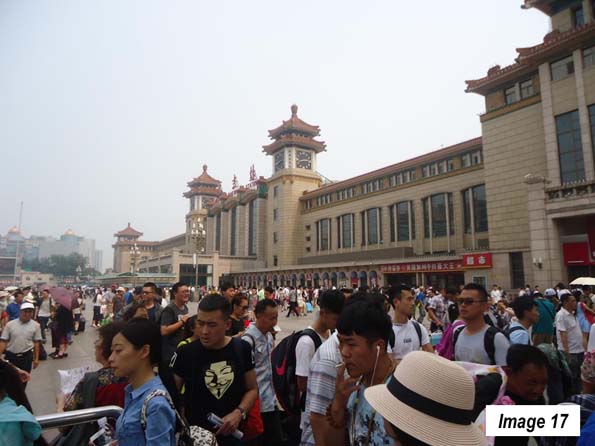
    A few days later I took the train from Changchun to Beijing South Railway Station (Image 17) to connect for the flight to Ordos, Inner Mongolia (See: Surprising Ordos: The Evolving Urban Form). Beijing is the nation’s second largest urban area, with 20.4 million residents.

    Flying back from Ordos, my next train trip was from Beijing West Railway Station. I could have traveled by subway, but since the view underground is not as good, traveled by taxi. Early Sunday morning, the traffic on the Third Ring Road from my hotel near the CCTV Tower (across town) was horrific.

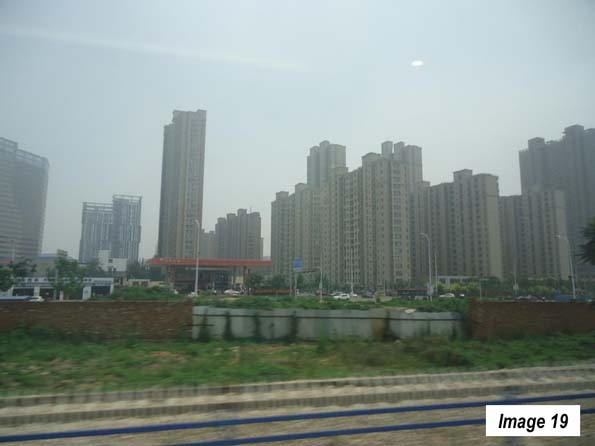
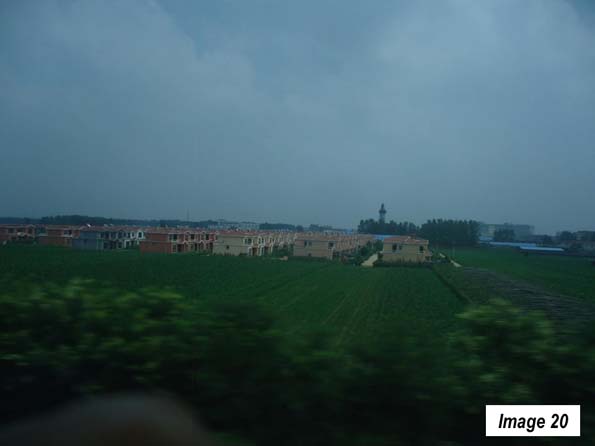
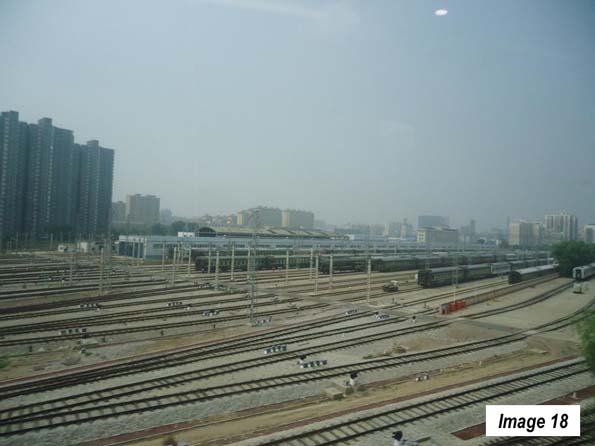
    The next train ride was to Nanchang, along the Beijing to Guangzhou line. This is the other principal north-south route though its traffic appears to be light compared to the Shanghai to Being route. The train traveled (Image 18) toward, Shijiazhuang, an urban area of 3.5 million residents and the capital of Hebei province (Images 19 and 20).
    Parts of these first three trips coursed through the planned Jin-Jing-Ji megacity, which will better integrate the urban areas between Beijing, Tangshan, Tianjin and Shijiazhuang.

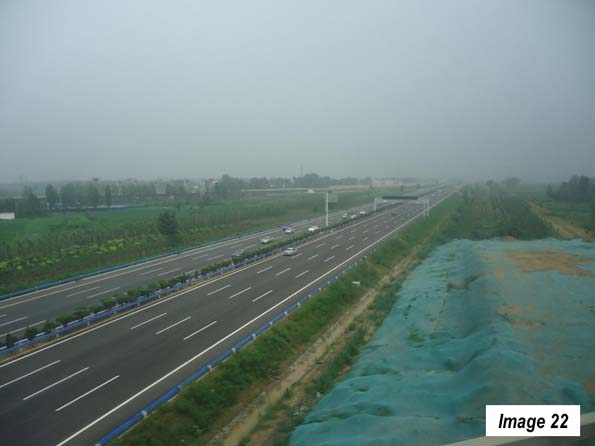
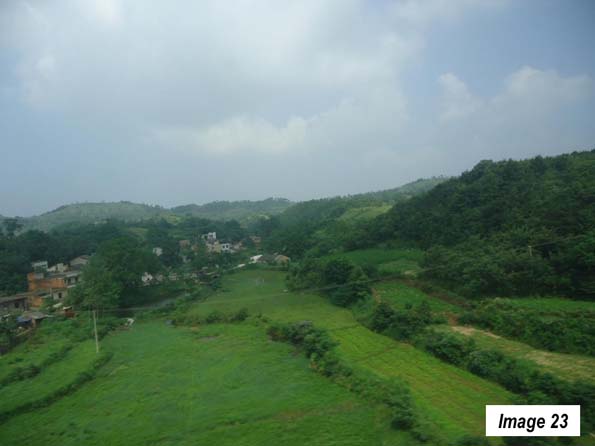
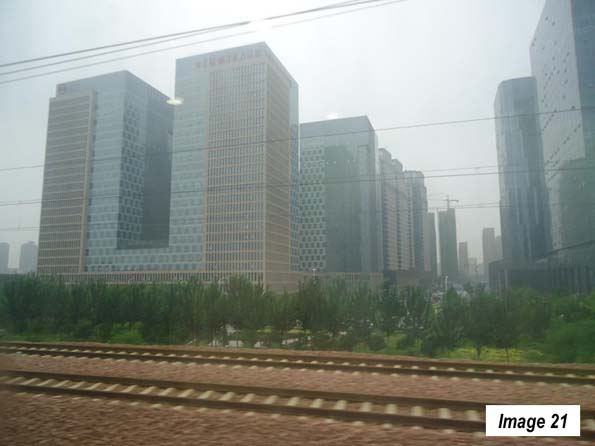
    Continuing south, the train stopped at Zhengzhou, the capital of Henan (5.8 million), with its impressive extension of the Zhengzhou new area and the new railway station (Images 21 & 22). The train then headed south toward Wuhan, (7.6 million residents), the capital of Hubei and  a heavy industrial area that is been called the "Chicago" of China. Before reaching Wuhan, there was attractive rolling scenery in northern Hubei (Image 23), then the Yangtze River crossing in Wuhan (Image 24). Just a few miles upriver (the direction of the camera shot), Chairman Mao, at 72 years old, is reputed to have swam across the Yangtze in 1966.

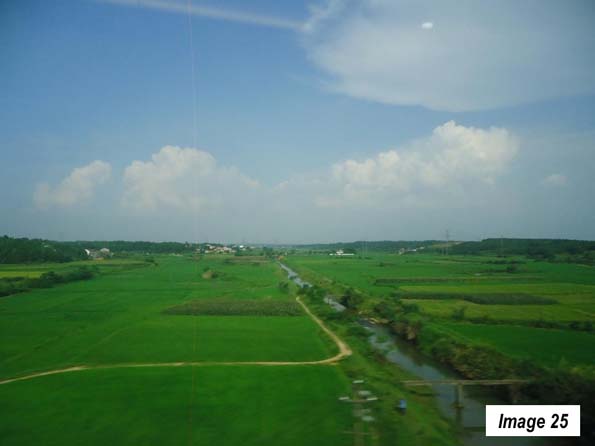
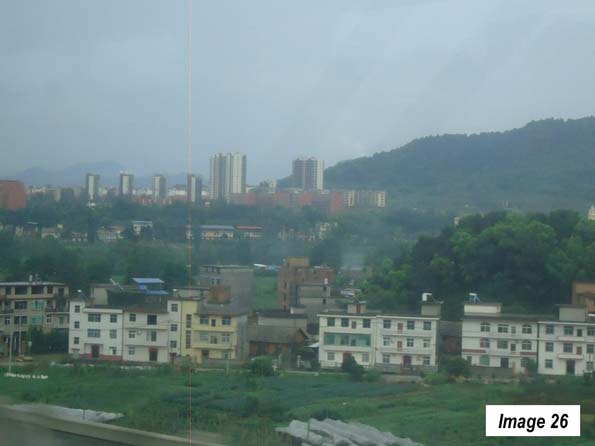
    The July greenery of central China was impressive. It continued into northern Hunan province (Image 25) and its capital of Changsha, an urban area of 3.8 million. In Changsha, the train diverted from the Beijing to Guangzhou line and turned eastward toward Nanchang. Along the way, the "peri-urban" development seemed to get more intense (Image 26). 
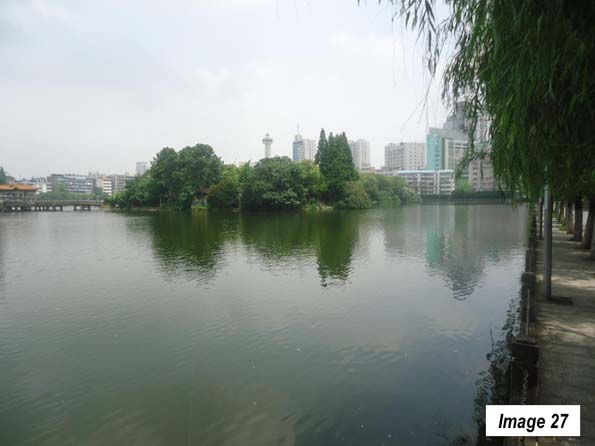
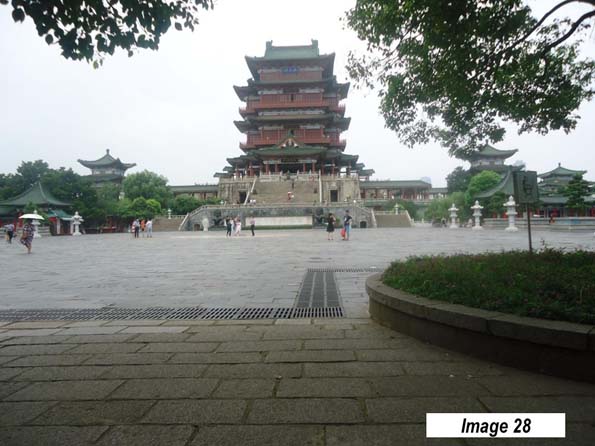
    The Nanchang urban area (Image 27) has a population of 2.8 million and sits on the Gan River, which eventually flows into the Yangtze, to the north. It is home of the Pavilion of Prince Teng, on the older east bank city, across from the newer development on the west bank (Image 28).

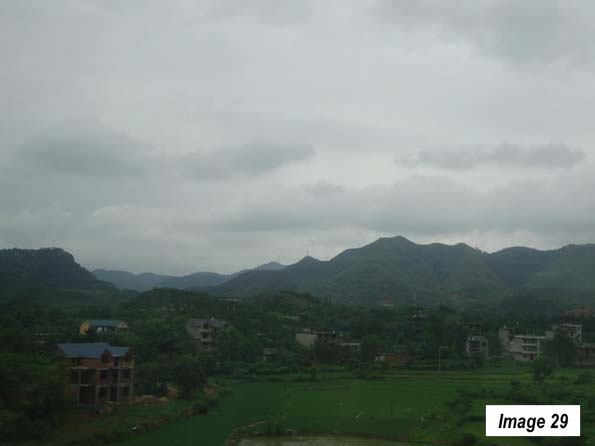
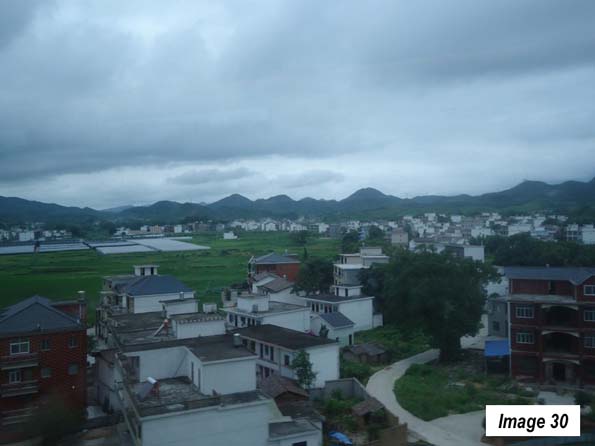
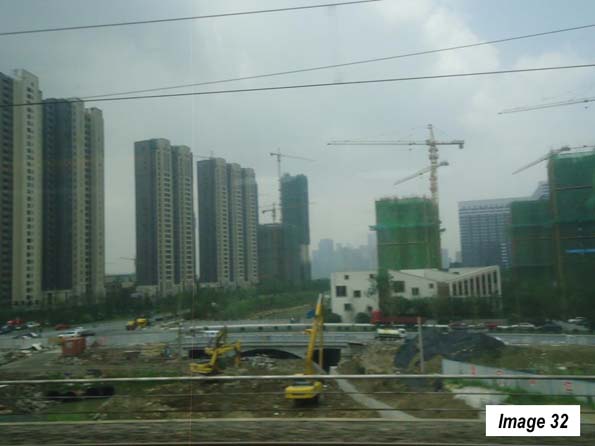
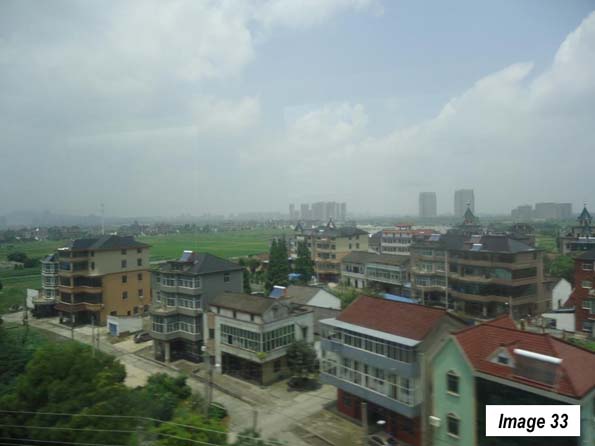
    A few days later, the last leg of the trip from Nanchang to Shanghai Hongqiao took less than four hours. Between Nanchang and Hangzhou, (7.6 million), the capital of Zhejiang, there was more greenery, rolling and mountain country and intense peri-urban development (Images 29-31). Hangzhou has been undergoing a huge construction boom (Image 32). It was less than one hour to Shanghai, and the peri-urban development continued to intensify (Image 33).

    All in all, the five train trips had covered more than 3,700 miles (6,000 kilometers) and passed through 14 provincial level jurisdictions.
    Trains

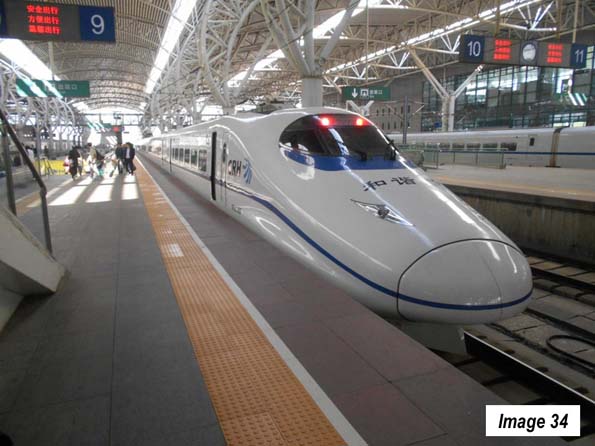
    The best trains in China are the "G" trains, the "D" trains, and the "C" trains, all of which are of European high-speed rail quality. The "G" trains have a top speed of more than 300 kilometers per hour. The "D" trains have a top speed of 250 kilometers per hour, while the "C" trains are shuttles, such as those operating between Tianjin and Beijing or Changchun and Jilin and tend to operate at 250 kilometers per hour or more.

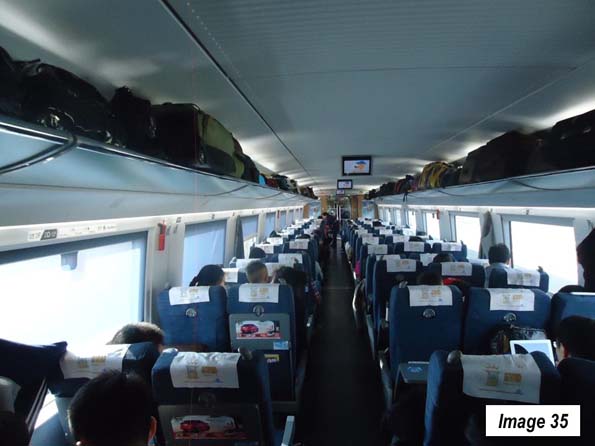
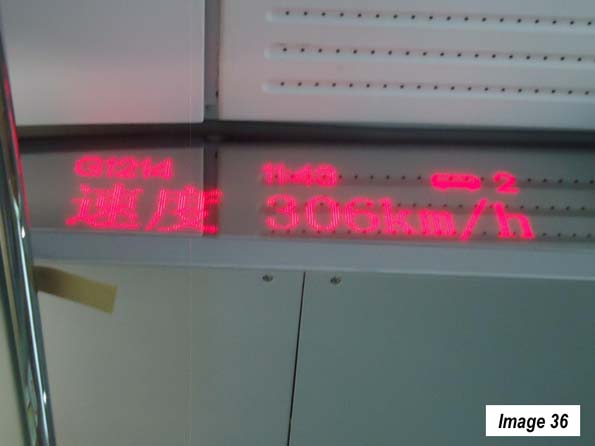
    All of these trains use similar equipment (Image 34). Image 35 is the inside of a 2nd class coach, which have with reclining seats and snack service. All of the trains have information displays in each car indicating train speed, time, etc. (Image 36). Stations may be central as in Tianjin or near-airport distances from the urban core, as in Jilin and Wuhan.

    Tickets

    Ticket purchase has become simple. Tickets can now be booked from virtually anywhere and paid for by credit card. US residents will pay a service fee of up to $6 per ticket. Confirmation documents are provided over the internet and can be presented at any station in China to receive the tickets all at once. My ticket pickup took no more than 10 minutes at the downtown Shanghai Railway Station.

    I would recommend using a travel agency that is located in China, has a toll-free 24 hour number from one’s home country, has agents with good English skills, and a local China number for use when there. I was very happy with travelchinaguide (https://www.travelchinaguide.com/), which meets this description. Train schedules can be accessed at https://www.travelchinaguide.com/china-trains/.
    Note: The urban area populations are as estimated in 2016, taken from Demographia World Urban Areas: 12th Annual Edition (2016).

    Wendell Cox is principal of Demographia, an international pubilc policy and demographics firm. He is a Senior Fellow of the Center for Opportunity Urbanism (US), Senior Fellow for Housing Affordability and Municipal Policy for the Frontier Centre for Public Policy (Canada), and a member of the Board of Advisors of the Center for Demographics and Policy at Chapman University (California). He is co-author of the "Demographia International Housing Affordability Survey" and author of "Demographia World Urban Areas" and "War on the Dream: How Anti-Sprawl Policy Threatens the Quality of Life." He was appointed to three terms on the Los Angeles County Transportation Commission, where he served with the leading city and county leadership as the only non-elected member. He served as a visiting professor at the Conservatoire National des Arts et Metiers, a national university in Paris.

    Photo: Changchun, Jilin, China: urban core (by author)

  • Portland Columnist Calls for Abandonment of the WES Commuter Rail Line

    Portland Tribune columnist (see "My View: WES is a Mess: Time to Pull the Plug") Bill MacKenzie took the occasion of a Tri-Met (transit agency for the Oregon side of the Portland, OR-WA metropolitan area) approval to purchase two used Budd Rail Diesel Cars (RDC) for the Wilsonville to Beaverton commuter rail line to call for its abandonment.Fconcl In addition to the $1.5 million purchase cost, $550,000 will be required for refurbishment. When then are ready for service, they will surely older than most Tri-Met employees, since the last Budd RDC’s were built in the early 1960s.

    He mocks the agency’s general manager, Neil MacFarlane, who justified the purchase as necessary to accomodate future passenger growth: "Oh sure, plan for massive ridership growth,"MacKenzie scoffs. He continues, In early 2009, TriMet predicted WES would have 2,400 daily riders its first year of operations and 3,000 by 2020." In 2015, the line carried fewer than 1,900 riders each weekday, and its cost per boarding was more than four times that of buses (not counting capital costs).

    He concluded that: "Even if WES reaches 3,000 average daily boardings, operating costs per boarding ride will remain much higher than for buses and MAX. The fact is, WES is a train wreck. It’s time to shut it down."