Tag: Transportation

  • Honolulu Rail: It Just Keeps Getting Worse

    There seems to be no end to the difficulties facing Honolulu’s urban rail project. In an editorial, Honolulu’s Civil Beat noted that federal officials fear the project cost may reach $8.1 billion, which is more than 50 percent above the “original estimate” of $5.2 billion. The cost blowout of nearly $3 billion would be far more than state consultants suggested in a 2010 report. That report, by the Infrastructure Management Group (IMG) in conjunction with the Land Use and Economic Management Group of CB Richard Ellis and Thomas A. Rubin estimated a “most likely scenario” in which the rail cost overrun would have been $909 million (Note).

    This is, however, a particular concern to local citizens, since it has been suggested that no rail project has cost more in relation to its population base in US history. If the the project costs $8.1 billion, the IMG et al report estimate will have turned out to be far too conservative, less than one-third the overrun. At $2.9 billion this extra cost is nearly $3,000 for every man, woman and child in Honolulu. It is more than $8,500 per household.

    The Civil Beat editorial is here.

    Note: Thomas A. Rubin’s more recent analysis of rail and transit ridership in Los Angeles is here.

  • New York’s Incredible Subway

    The New York subway is unlike any other transit system in the United States. This system extends for 230 miles (375 kilometers) with approximately 420 stations. It serves the four highly  dense boroughs of the city (Manhattan, Brooklyn, Queens and the Bronx), each of which is 20 percent or more denser than any municipality large municipality in the United States or Canada. Much of the fifth borough, Staten Island, looks very much like suburban New Jersey and has no subway service, though has a more modest system, the Staten Island Railway.

    Overall, the older Metros (Note 1), New York’s subway, along with London’s Underground and the Paris Metro dominated the world’s urban rail systems for decades. Until the recent emergence of Chinese urban areas (Beijing and Shanghai), London had the longest extent of track in the world, followed by New York.

    As one of the original Metros in the world, it might be thought that the New York City Subway’s best days are over. That would be a mistake. It is true that ridership reached a peak in the late 1940s and dropped by more than half between the late 1970s and the early 1990s. However, since that time ridership has more than doubled, according to American Public Transportation Association data. And it is not inconceivable that new records may be set in the years to come.

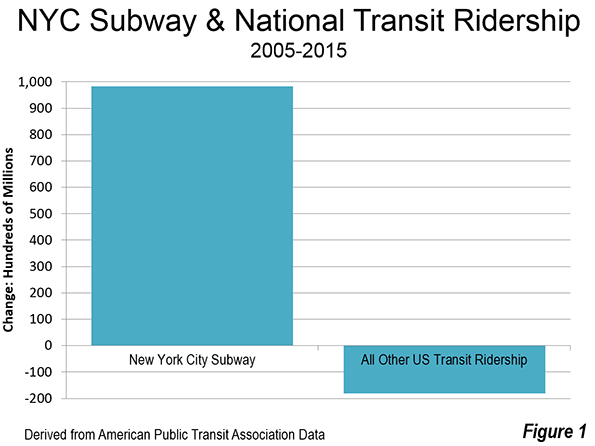
    Perhaps the most incredible thing about the New York City Subway has been its utter dominance of the well-publicized national transit ridership increases of the last decade. According to annual data published by the American Public Transportation Association (APTA), ridership on the New York City Subway accounts for all of the transit increase since 2005. Between 2005 and 2015, ridership on the New York City Subway increased nearly 1 billion trips. By contrast, all of the transit services in the United States, including the New York City Subway, increased only 800 million over the same period. On services outside the New York City subway, three was a loss of nearly 200 million riders between 2005 and 2015 (Figure 1).

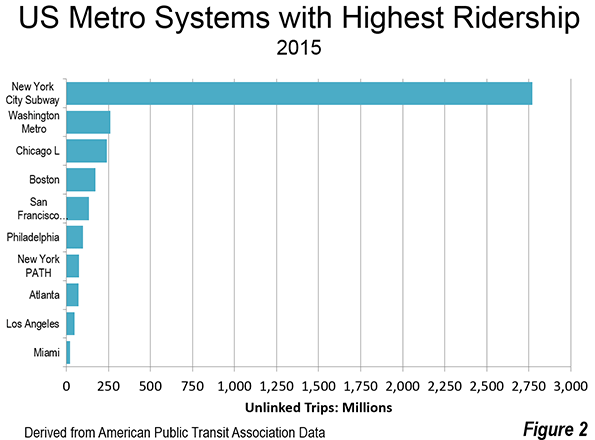
    The New York City subway accounts carries nearly 2.5 times the annual ridership of the other nine largest metro systems in the nation combined (Figure 2). This is 10 times that of Washington’s Metro, which is losing ridership despite strong population growth , probably partly due to safety concerns (see America’s Subway: America’s Embarrassment?). Things have gotten so bad in Washington that the federal government has threatened to close the system (See: Feds Forced to Set Priorities for Washington Subway).

    The New York City subway carries more than 11 times the ridership of the Chicago “L”, though like in New York, the ridership trend on the “L” has increased impressively in recent years. The New York City subway carries and more than 50 times the Los Angeles subway ridership, where MTA (and SCRTD) bus and rail ridership has declined over the past 30 years despite an aggressive rail program (See: Just How Much has Los Angeles Transit Ridership Fallen?).

    With these gains, the New York City Subway’s share of national transit ridership has risen from less than one of each five riders (18 percent) in 2005 to more than one in four (26 percent) in 2015. This drove the New York City metropolitan areas share of all national transit ridership from 30 percent in 2005 to over 37 percent in 2015.

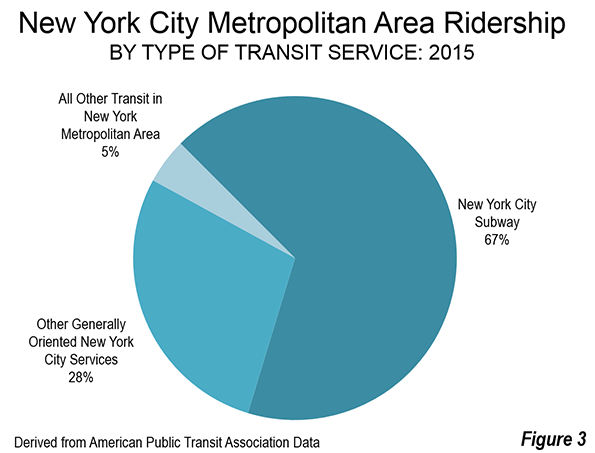
    Subway ridership dominates transit in the New York City metropolitan area as well, at 67 percent. Other New York City oriented transit services, including services that operate within the city exclusively and those that principally carry commuters in and out of the city account for 28 percent of the ridership. This includes the commuter rail systems (Long Island Railroad, Metro-North Railroad and New Jersey Transit) and the Metro from New Jersey (PATH) have experienced ridership increases of approximately 15 percent over last decade (Note 2).

    Other transit services, those not oriented to New York City, account for five percent of the metropolitan area’s transit ridership (Figure 3). By comparison, approximately 58 percent of the population lives outside the city of New York. The small transit ridership share not oriented to New York City illustrates a very strong automobile component in suburban mobility even in the most well-served transit market in the country.

    Last year (2014), APTA announced that the nation’s transit ridership had reached the highest in modern history, having not been higher since 1957. In fact, the ridership boom that produced the record can be attributed wholly to the New York City Subway. If New York City Subway ridership had remained at its 2005 level, overall transit ridership would have decreased from 9.8 billion in 2005 to 9.6 billion in 2015. The modern record of 10.7 billion rides would never have been approached.

    Thus, transit in the United States is not only a "New York Story," but it has also been strongly dependent on the New York Subway in recent years. After decades of decline, the revival of the New York subway is a welcome development.

    Note 1: “Metro” is the international generic term for grade separated rapid transit systems. In the United States, the Federal Transit Administration refers to this transit mode as "heavy rail."

    Note 2: Separate data is not available in the APTA reports on the for-profit commuter bus operators serving the city of New York from New Jersey.

    Wendell Cox is principal of Demographia, an international pubilc policy and demographics firm. He is a Senior Fellow of the Center for Opportunity Urbanism (US), Senior Fellow for Housing Affordability and Municipal Policy for the Frontier Centre for Public Policy (Canada), and a member of the Board of Advisors of the Center for Demographics and Policy at Chapman University (California). He is co-author of the “Demographia International Housing Affordability Survey” and author of “Demographia World Urban Areas” and “War on the Dream: How Anti-Sprawl Policy Threatens the Quality of Life.” He was appointed to three terms on the Los Angeles County Transportation Commission, where he served with the leading city and county leadership as the only non-elected member. He served as a visiting professor at the Conservatoire National des Arts et Metiers, a national university in Paris.

    Photo: New York City Subway diagram by CountZ at English Wikipedia, CC BY-SA 3.0

  • Feds Forced to Set Priorities for Washington Subway

    The Washington Metro passenger safety fiasco (see: America’s Subway: America’s Embarrassment?) has only gotten worse. On May 10 the Washington Post  reported the federal government has twice threatened to close the system if the Washington Area Metropolitan Transportation Authority (WMATA) failed to “take actions to keep passengers safe.” U.S. Secretary Anthony Foxx.

    According to the Post, “The most recent incident to illicit that threat came last Thursday after an arcing insulator exploded near a platform at Federal Center SW. The explosion, a fireball followed by a shower of sparks, was captured by Metro’s security cameras. On Tuesday, at a sit down with reporters, Transportation Secretary Anthony Foxx described his reaction to the video. ‘It was scary.’”

    But Foxx went on to say that “even more worrisome was Metro’s conduct following the incident.” Foxx indicated that Metro’s response had not been sufficient in view of the seriousness of the incident.”

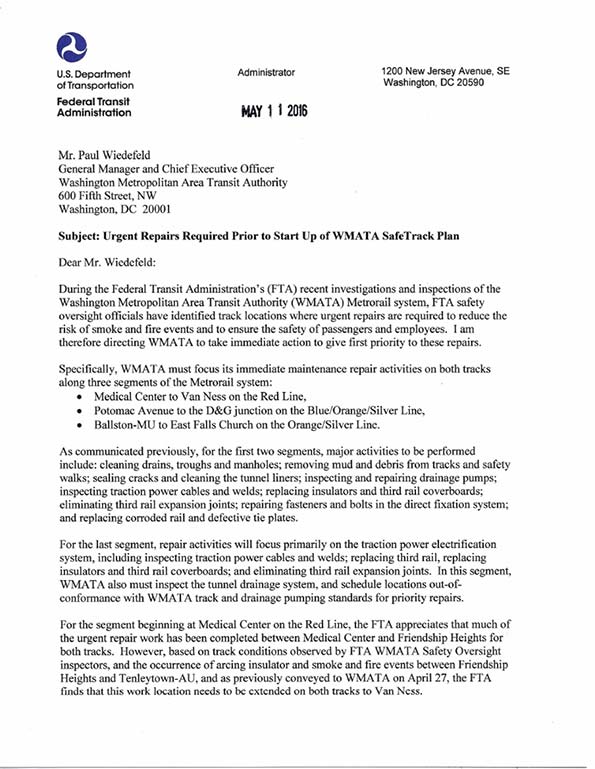
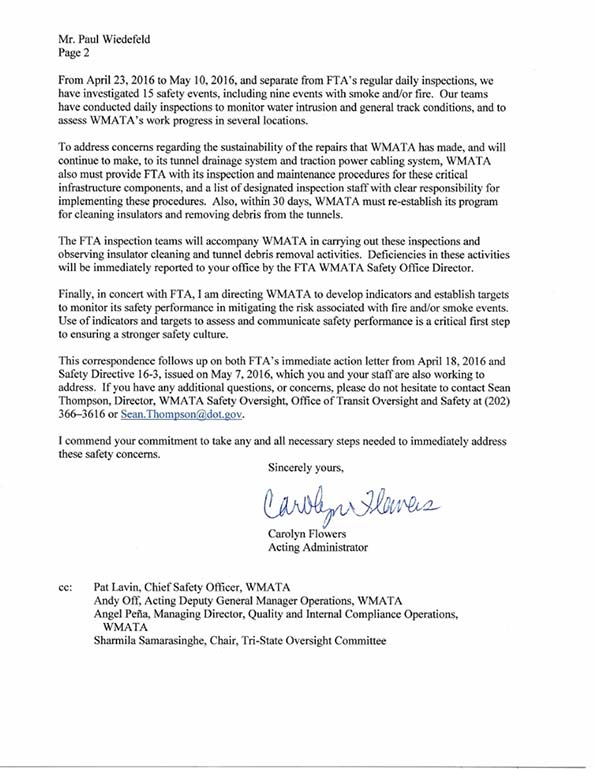
    On the next day (May 11), Federal Transit Administration Acting Administrator Carolyn Flowers took the unusual action of a letter to WMATA General Manager Paul Wiedefeld, itemizing and prioritizing the necessary repairs: “I am therefore directing WMATA to take immediate action to give first priority to these repairs.” The letter is reproduced below.

    On the same day, the Post editorialized (“Metro’s Dangerous Complicity”): “An overhaul in Metro’s culture is what is needed; that begins with accountability.

    Not only is this an embarrassment for America’s Subway (as a previous Washington Post article suggested, see “Metro sank into crisis despite decades of warnings”), but the necessity for the nation’s second most patronized subway, in perhaps the nation’s most sophisticated metropolitan area, having to be directed (appropriately) by a federal agency is even more astounding.

    At the same time, it is important to note the extraordinary nature of this case. There are many Metro (heavy rail) systems in the nation, as well as many light rail and commuter rail systems. Nor should it be assumed that Metro’s burden is anything more than a result of its own failures. Somehow, for example, New York’s subway manages to safety carry more than 10 times as many riders. None of the many systems has ever required such intervention by the federal government on passenger safety, which is perhaps the most basic requirement of transportation systems. This is not “business as usual.”

  • California’s High-Speed Rail Authority Wins Dishonor of the California Golden Fleece Award

    The California High-Speed Rail Authority (CHSRA) has won the Independent Institute’s first California Golden Fleece Award for its lack of transparency and history of misleading the public about key details of the state’s “bullet-train” project, which no longer reflect what voters approved in 2008.

    The agency’s “bait-and-switch” strategy justifies a statewide vote on whether or not to proceed with the train system. Californians should reject this unnecessary and expensive boondoggle.

    Background

    In November 2008, California voters approvedProposition 1A, a $9.95 billion bond measure authorizing construction of a high-speed “bullet train” between downtown San Francisco and the greater Los Angeles area. The vote was 53 percent in favor and 47 percent opposed. The ballot measure contained key details regarding the project’s cost, dedicated tracks, trip time, and financing plan. Many of these details have been changed repeatedly since 2008.

    The Cost: A Moving Target

    Before the 2008 vote on the bond measure, the California High-Speed Rail Authority said: “The total cost to develop and construct the entire high-speed train system would be about $45 billion.” Proposition 1A also promised voters that the train system would operate without taxpayer subsidies: “The planned passenger service by the authority in the corridor or usable segment thereof will not require a local, state, or federal operating subsidy.” Soon after voters approved the project, however, cost projections escalated.

    In its original 2012 Business Plan, the CHSRA set the price tag at a staggering $98 billion. Public and political outcry caused rail officials to quickly backtrack. Just five months later, the revised 2012 Business Planlowered the cost by $30 billion by moving to a “blended” route: one that would share existing rail tracks in urban areas with other train systems, rather than building new dedicated tracks.

    Based on this radical redesign, CHSRA said the entire 520-mile system would be completed in 2029 at a cost of $68 billion, but only by eliminating high-speed service between Los Angeles and Anaheim and between San Jose and San Francisco.

    Then in 2016, the CHSRA Business Plan lowered the cost by roughly $4 billion net, to $64 billion, through a combination of vaguely specified “design refinements,” “system optimization,” “value engineering,” and “lessons learned from bids.”

    At this point, the ever-changing cost estimates defy belief. As noted by Dan Walters, Sacramento Beecolumnist and longtime observer of state government: “Those charged with building California’s north-south bullet train system have been more or less making it up as they go along.” But regardless of whether the final cost is $64 billion, $68 billion, $98 billion, or even higher, the reality should be clear: The cost far exceeds the $45 billion approved by voters in 2008, and now with substantial track redesigns.

    Tracks and Trip Time: From Bullet Train to Choo Choo Train

    Public outrage over the $98 billion price tag prompted train officials to abandon the original plan of building dedicated tracks in urban areas. Instead, officials shifted to blended tracks in urban areas: the bullet train would share tracks with the existing Metrolink commuter network in Southern California and the Caltrain system in Northern California. But the blended approach increases trip time considerably from what was promised to voters.

    Voters in 2008 were told the high-speed train would whisk travelers from San Francisco to Los Angeles in a “maximum nonstop service travel time” that “shall not exceed” 2 hours and 40 minutes. This specific trip time was often mentioned by supporters to sell the bond measure to voters. (See for example, here andhere.) But with the blended approach, the fastest time between these cities is now estimated by the CHSRA to be 3 hours and 8 minutes, with zero nonstop trips planned—another violation of Proposition 1A. But more realistic trip times are expected to be 3 hours and 50 minutes, or more, under real-world travel conditions.

    The original 2:40 trip time assumed that trains would operate at peak speeds of 220 mph, and “sustained revenue operating speeds of at least 200 miles per hour.” But under the blended approach, high-speed trains must share tracks with commuter trains and freight trains, forcing them to slow down at the urban “bookends.” And today’s older urban tracks can typically handle maximum speeds of only 125 mph.

    In February 2016, officials announced that the first operating leg of the high-speed train system would be built for $21 billion from downtown San Jose to an agricultural field in Shafter, north of Bakersfield, which would begin operating by 2025. The previous plan called for trains to operate first from Merced to Burbank by 2022, three years earlier. This change in the initial route might appear innocent, but by moving the first leg of construction further north, officials can delay construction on a tunnel through the Tehachapi and San Gabriel Mountains, which is likely to bust the current $64 billion budget.

    According to a Los Angeles Times special report:

    The monumental task of building California’s bullet train will require punching 36 miles of tunnels through the geologically complex mountains north of Los Angeles.

    Crews will have to cross the tectonic boundary that separates the North American and Pacific plates, boring through a jumble of fractured rock formations and a maze of earthquake faults, some of which are not mapped.

    It will be the most ambitious tunneling project in the nation’s history. . . .

    However, a Times analysis of project documents, as well as interviews with scientists, engineers, and construction experts, indicates that the deadline and budget targets will almost certainly be missed—and that the state has underestimated the challenges ahead, particularly completing the tunneling on time.

    “It doesn’t strike me as realistic,” said James Monsees, one of the world’s top tunneling experts and an author of the federal manual on highway tunneling. “Faults are notorious for causing trouble.”

    Serious questions remain about whether sufficient funding will ever materialize to complete the newly proposed first leg from San Jose to Shafter, and then to eventually extend the line north to San Francisco and south through the mountains to Los Angeles as originally promised.

    The Financing Plan: Smoke and Mirrors

    Supporters of the high-speed rail project envisioned financing coming from multiple partners. Under Proposition 1A, California voters approved a $9.95 billion bond in 2008 to help finance construction of the rail network (interest costs will be an additional $9.5 billion). Voters were told that if they approved the bond, the federal government and the private sector would pay for the rest.

    Supporters were counting on private investors kicking in as much as $36 billion. The federal government was also expected to contribute up to $18 billion. Another source of funding that arose in 2014 consisted of earmarking 25 percent of the proceeds from auctioning credits to emit greenhouse gases under California’s “cap-and-trade” program, which is estimated to yield the rail project about $500 million a year. (Under the plan, the rail authority would use the annual “cap-and-trade” revenues through 2024, and then seek to borrow $5.2 billion against future carbon fees from 2025 to 2050.) To date, much of the promised financing has never materialized and largely amounts to wishful thinking.

    Congress has pledged an initial grant of $3.3 billion, mostly through President Obama’s economic stimulus package. But the state has received only $503 million of that money as of 2015. And Congress has balked at additional funding. “Congress is never going to allocate more money to a project that lacks the ridership numbers, speeds, private funding, and voter support once promised,” said Rep. Jeff Denham (R-Turlock), chairman of the House rail subcommittee.

    The legal authorization to impose the state “cap-and-trade” fees expires in 2020, making the future availability of this money questionable. And a lawsuit seeks to block use of the cap-and-trade fees for the high-speed rail project. According to Jessica Peters, principal fiscal and policy analyst with California’s nonpartisan Legislative Analyst’s Office (LAO): “About half of the [San Jose to Shafter] funds would come from cap-and-trade beyond 2020,” when the fees are set to expire. A LAO review of the CHSRA’s 2016 Business Plan also questioned the logic of choosing a field in Shafter as the initial southern terminus:

    Even with a temporary station or platform, ending the IOS [initial operating segment] in an unpopulated agricultural area does not appear to be an effective approach. This is because this location would not have the types of facilities and nearby businesses, such as transit connections, rental car facilities, and shops necessary to meet the needs of train passengers.

    Finally, the private sector has not invested in the project, which is unlikely to ever be profitable. Summarizing, the LAO said that the CHSRA’s current funding plan is “significantly short of the level needed to complete [the entire San Francisco to Los Angeles system] and does not identify how this shortfall [of $43 billion] would be met.”

    Moreover, the pledge to voters in 2008 that the high-speed train would operate without taxpayer subsidies was based on ridership estimates that are quickly evaporating. In 2008, the CHSRA forecasted a base annual ridership of 65.5 million intercity riders and a high projection of 96.5 million intercity riders by 2030.

    But independent analysis concluded:

    The CHSRA ridership projections are considerably higher than independent figures developed for comparable California systems in Federal Railroad Administration and University of California Transportation Center at Berkeley studies. Using generous assumptions, this Due Diligence Report projects a 2030 base of 23.4 million intercity riders, 64 percent below the CHSRA’s base of 65.5 million intercity riders, and a 2030 high of 31.1 million intercity riders, nearly 60 percent below the CHSRA’s high of 96.5 million. It is likely that the HSR will fall far short of its revenue projections, leading to a need for substantial additional infusions of taxpayer subsidies.

    The blended 2012 redesign will increase trip times substantially, making air travel, driving, Skype, or phone calls more attractive relative to a slower train ride:

    [A]ssuming the optimistic travel time projection of 3:50, the 2035 interregional ridership would be approximately two-thirds (67 percent) below CHSRA projected levels [of 21 million] at 6.9 million annually. Assuming realistic automobile costs and more-plausible outside-the-corridor ridership, the 2035 interregional ridership would be 77 percent below the CHRSA forecast, at 4.8 million annually. Even if the number of automobile drivers switching to rail equals the European experience, ridership would still fall nearly 65 percent short of the CHSRA projection.

    Thus, the CHSRA’s downgraded ridership estimate of 21 million people is still likely to be wildly exaggerated. The promise to operate the high-speed trains without subsidies, therefore, is fantasy using realistic ridership numbers: calculations by Joseph Vranich and Wendell Cox concluded that day-to-day operating losses will generate annual deficits totaling between $124 million and $373 million at the operating-cost midpoint projected by CHSRA for 2035. Subsidies would be needed to backfill these deep deficits.

    The money secured to date is far less than needed to complete the project. With no clear path to obtaining the funds needed for completion, many Californians now decry “the train to nowhere.” And realistic ridership projections show that annual subsidies will likely be needed to keep the trains rolling, if the project is built at all.

    The Pathologies of Government: A Lesson in Perverse Political Incentives

    California’s high-speed rail project highlights that governments do a poor job of assessing the costs and benefits of capital-investment projects since politicians do not personally bear the costs and benefits of the projects or of their calculation errors. In fact, politicians have an incentive to exaggerate the benefits and hide true costs, as was done with the bullet train, to build support for these projects. In contrast, private investors and private operators generally have an incentive to develop accurate projections of capital projects because, if they are wrong, they will typically bear the costs, and, if they are right, they can reap any profits from the wise stewardship of resources.

    Train officials and supporters have repeatedly told the public that the train will cover operating costs, will not require any operating subsidies, and “generate sufficient cash flow to attract private capital” for future construction—even the first leg from San Jose to Shafter will feature “non-subsidized operations,” according to CHSRA officials. If the project is as good of an investment as supporters claim, then taxpayer/government involvement to bankroll the construction and operation is unnecessary. Private investors and private operators can, and should, provide this transportation service.

    But the evidence indicates that the high-speed rail project will not be self-sustaining. As it will waste scare resources, the bullet train qualifies as a boondoggle and should not be undertaken.

    The Recommendation

    The serious discrepancies between the original plan for the high-speed rail project and current promises warrant a statewide ballot referendum on whether to proceed with the project and, if so, how. There is growing opposition to the project now that more information is known about the true cost, slower routes, and financing uncertainties.

    In February 2015, Gavin Newsom (D), California Lieutenant Governor and former mayor of San Francisco,said:

    We’re not even close to the timeline (for the project), we’re not close to the total cost estimates, and the private-sector money and the federal dollars are questionable. . . . I am not the only Democrat that feels this way. I am one of the few that just said it publicly. Most are now saying it privately.

    Following Newsom’s candid remarks, Assemblywoman Patty Lopez (D-San Fernando) said that she now opposes the project, and that five other legislative Democrats are also considering a switch to opposing it. Lopez supports a re-vote on the issue.

    A January 2016 poll found that 53 percent of Californians support killing the high-speed rail project and using the unspent money on water projects; only 31 percent do not. Dan Walters of the Sacramento Beeechoes this sentiment: “We should put at least as much effort into protecting our vital water supply as we are wasting on a bullet train that we neither want nor need.”

    A March 2016 survey found that only 26 percent of likely voters in California consider the high-speed train as “very important” for the future of California. More Californians, 27 percent, view it as “not at all important.” A majority of likely voters, 54 percent, now oppose building the high-speed rail system.

    Californians deserve a re-vote on the high-speed rail project. Voters should use the opportunity to kill this unnecessary and expensive boondoggle sold to the public using tricks and deceit.

    ******

    This piece was originally published by the Independent Institute.

    Written by Lawrence J. McQuillan, PhD, and Hayeon Carol Park, MA.
  • Focus on Cost-Effective GHG Emissions: Report

    The Reason Foundation has published my new research reviewing the potential for urban containment (or other restrictive policies that are sometimes called “smart growth”) to reduce greenhouse gas (GHG) emissions. Principal reports cited by advocates of urban containment are reviewed. The conclusion is that only minimal reductions if the gains from improved automobile fuel economy are excluded. Of course, fuel economy improvements have nothing to do with urban containment policy, but are unrelated policy options that allow people to avoid draconian lifestyle changes that probably are impossible anyway.

    The report, "Urban Containment: The Social and Economic Consequences of Limiting Housing and Travel Options" expresses concern that the use of costly GHG reduction strategies, such as urban containment, has the potential to create significant economic disruption and unemployment. The report concludes that sufficient GHG emission reductions can be achieved without urban containment policy and its attendant economic problems: "The key is focusing on the most cost-effective strategy, without unnecessarily interfering with the dynamics that have produced the nation’s affluence."

    Read more and download the full report at Reason.com

    Photograph: BMW i3. 124 miles per gallon equivalent electric car (currently available)
    by TTTNISOwn work, CC0, https://commons.wikimedia.org/w/index.php?curid=34818839

  • More Californian’s Continue to Drive Despite Policies to Discourage

    “California Commuters Continue to Choose Single Occupant Vehicles,” according to a report by the California Center for Jobs and the Economy. The Center indicated:

    “The recent release of the 2014 American Community Survey data provides an opportunity to gauge how California commuters have responded to this shifting policy. The data clearly reflects that even with the well-documented and rapidly rising costs of the state’s traffic congestion and costs associated with the deteriorating condition of the state’s roads, California workers continue to rely on single occupant vehicles for the primary mode of commuting.  Moreover, their reliance on this mode of travel continues to grow both in absolute and relative terms (emphasis in original).

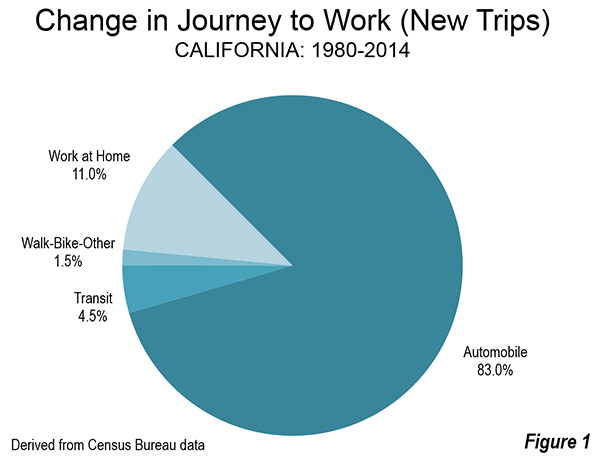
    California has experienced substantial growth since 1980. There are approximately 7,000,000 more workers today than 35 years ago. The Census Bureau data shows that 83 percent of the new commuting has been by single-occupant automobile. Working at home accounted for 11 percent of the new commuting, while transit accounted for less than one half that figure, at 4.5 percent (Figure). In 1980, transit accounted for more than three times the volume as working at home. By 2014, the number of people working at home exceeded that of transit commuters.

    The Center noted that state policies to discourage single-occupant commuting had been of little effect:

    “The substantial investments in public transit, bike lanes, and other alternative modes have not produced major gains in commuter use.  Instead, these investments appear to have simply shifted the choices made by commuters who already are committed to getting to work through modes other than single occupant vehicles.   From 1980 to 2000, public transit use grew by 116,000 while “other” modes dropped by the same amount.  From 1980 to 2005, public transit use grew by 121,000 while “other” modes dropped by 113,000.  In the following years, 1/3 of the growth in public transit and “other” modes was offset by reductions in carpool use.”

    The report credited impressive public transit gains in the San Francisco Bay Area, but went on to say that:

    “even in the Bay Area, growth of public transit and the “other modes” has come largely from the shrinking relative use of carpooling.” 

    While improving transit ridership is a good thing, to the extent that it removes passengers from car pools, there is no gain in traffic, because the car and driver are still on the road.

    The report laid considerable blame on the cost of houses in California:

    “California, the growing body of land use, energy, CEQA, and other regulations affecting housing cost and supply has put both the cost of housing ownership and rents within traditional employment centers out of the reach of many households.” 

    California’s housing affordability is legendarily desperate. Since the imposition of strong land use regulations began in the early 1970s, the median house price has risen from three times (or less) times median household incomes in of the state’s metropolitan areas to over nine times today in the San Jose and San Francisco metropolitan areas, over eight times in the Los Angeles and San Diego areas and over five times in the Riverside-San Bernardino area (Inland Empire).

    Perhaps the most important “take-away” from the report was that: “The current de facto policy of trying to reduce commuting by increasing congestion and its associated costs to commuters has to date not shown itself to be successful.” Simply stated, the vast majority of jobs and destinations in all of California’s urban areas are not accessible by transit in a reasonable time. The question for most California commuters is, for example, not whether to drive or take transit to work, but whether to go to work at all, since most jobs are not readily accessible except by car.

  • Public Transportation Ridership: Three Steps Forward, Two Steps Back?

    The Bureau of Transportation Statistics recently released preliminary data summarizing public transportation ridership in the United States for the calendar year 2015. The preliminary data from the National Transit Data program showed transit ridership in 2015 of 10.4 billion annual riders approximately 2.5% below the 2014 count and also smaller than the 2013 count. The American Public Transit Association using a slightly different methodology released data showing 10.6 billion annual riders versus 10.7 billion in calendar year 2014, a 1.26% year-over-year decline. Such differences between sources are common, resulting from differences in methodology and definitions, and unsurprising, given that data is preliminary and national data is dependent upon reporting from hundreds of different agencies. 

    It is important to recognize that it’s extraordinarily difficult to consistently grow transit ridership. We have had growing population, a rebounding economy, growing total employment, and an aggressively argued hypothesis that the millennial generation is meaningfully different than their forefathers—with urban centric aspirations and indifference toward auto ownership and use. Yet, transit ridership has remained stubbornly modest. 

    Indicator

    2015 versus 2014

    Source

    U.S. Population

    +0.8%

    Census

    Total Employment

    +1.7%

    BLS

    Real GDP

    +2.4%

    BEA (third estimate)

    Gas Price

    -28%

    EIA

    VMT

    +3.5%

    FHWA

    Public Transit Ridership

    -1.3% to -2.5%

    APTA and NTD

    Amtrak Ridership (FY)

    -0.1%

    Amtrak

    Airline Passengers

    +5.0%

    USDOT, BTS

    The rebound in national vehicle miles traveled totals in 2015 (+3.5%) grabbed attention, as many had anticipated continued moderation. Couple that with modest declines in transit and Amtrak use and strong airline traffic growth, and one could argue the new normal for travel trends is looking more like the old normal. 

    When I entered full-time employment with a transit agency in 1980, industry leaders were touting the growth opportunities for public transit in light of the energy shortages in the late ’70s. Throughout the intervening time, there have been myriad seemingly logical events that led to expectations of strong transit growth. Growing congestion, a growing appreciation of the role of transportation in influencing land-use, growing federal support, increasing gasoline prices, expansion of rail systems, sensitivity to the safety benefits of transit travel, potential economic benefits for passengers who reduce auto ownership and use costs, air quality concerns and, subsequently, climate impact concerns, and, more have collectively created almost perpetual expectations of a more promising future for public transportation. Indeed, transit ridership has grown some since its low point in the early ’70s and subsequent dip in the mid-’90s, but the often-expected, sustained, or robust growth has never materialized. 

    More recently, demographic conditions, such as growing urbanization, declining driver’s-license-holding and auto-ownership rates for young people, and evidence that the love affair with the automobile has waned, have renewed expectations. Sprinkle in technology enhancements that enable real-time information, robust trip planning, automated and more convenient fare collection, and integrated first-mile last-mile opportunities; add a dash of heightened concerns about climate change; and there remains a credible argument that transit has a bright future. 

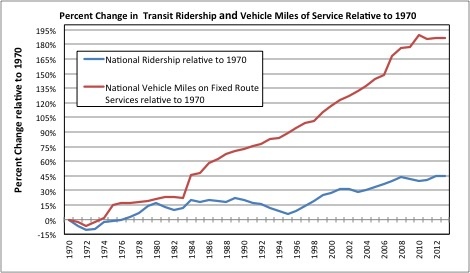
    An often-cited constraint on the growth of public transit has been the assertion of resource constraints for providing the quality of service that would be attractive to more travelers who have other options. While transit supply remains well below the aspirational levels of many transit users and transit advocates, the data in the graph below indicates that supply has grown far more rapidly than demand for the past several decades. This is a report card on productivity that mom and dad would hardly be proud of. And a larger share of the ridership has moved to more capital intensive (and larger vehicle capacity) rail systems.


    Source: 2015 APTA Public Transportation Fact Book, Appendix A, Historical Tables 2 and 8.

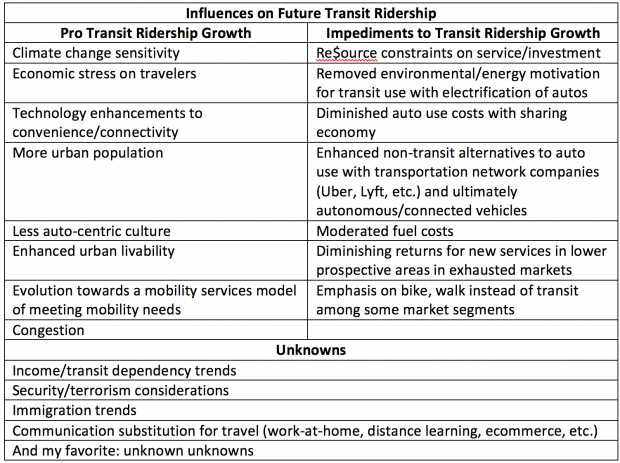
    Gas prices have certainly been a factor in recent trends, but they can’t explain the fact that growing transit ridership seems as tough as getting bipartisan harmony in the nation’s legislative bodies. Some cities are moving headlong into a more transit intensive future with aspirations of big ridership growth, like Seattle, where aggressive, multi-decade plans with big local funding commitment requests promise more transit supply. Other areas like Washington, D.C. are digesting the reality that more resources are required to sustain existing services, maintain infrastructure and meet underfunded pension obligations. The factors supporting or opposing ridership growth are numerous, with uncertainties dominating the lists. 


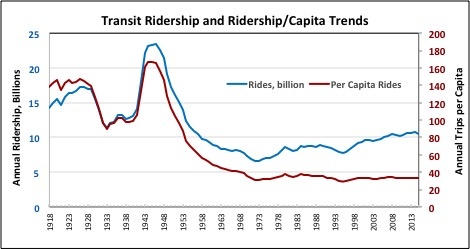
    I generally like to have a theoretically robust basis for speculating on the future, but in light of the complexity of factors involved and the uncertainty in their trends, transit ridership forecasts are speculative. The per capita transit ridership trend in the graph below (red line) is a pretty straight horizontal line since about 1970 and just might be pointing to the future. History tells us to be careful in presuming we understand causal factors governing complex behaviors; if anything the degree of uncertainty is greater than ever. 

    Transit remains very important to each trip maker but how many trips are made in the future remains a guess, one that should be informed by a keen understanding of travel behavior and history and not just aspirations.


    Source: APTA Public Transportation Fact Book, various years, Census.

    This piece first appeared at Planetizen.

    Dr. Polzin is the director of mobility policy research at the Center for Urban Transportation Research at the University of South Florida and is responsible for coordinating the Center’s involvement in the University’s educational program. Dr. Polzin carries out research in mobility analysis, public transportation, travel behavior, planning process development, and transportation decision-making. Dr. Polzin is on the editorial board of the Journal of Public Transportation and serves on several Transportation Research Board and APTA Committees. The opinions are those of the author—or maybe not—but are intended to provoke reflection and do not reflect the policy positions of any associated entities or clients.

  • America’s Subway: America’s Embarrassment?

    Washington’s Metro (subway), often called "America’s subway," may well be America’s embarrassment. As a feature article by Robert McCartney and Paul Duggan in the Washington Post put it: “’America’s subway,’ which opened in 1976 to great acclaim — promoted as a marvel of modern transit technology and design — has been reduced to an embarrassment, scorned and ridiculed from station platforms to the halls of Congress. Balky and unreliable on its best days, and hazardous, even deadly, on its worst, Metrorail is in crisis, losing riders and revenue and exhausting public confidence." (emphasis by author.)

    The Post article started out by saying: "Metro’s failure-prone subway — once considered a transportation jewel — is mired in disrepair because the transit agency neglected to heed warnings that its aging equipment and poor safety culture would someday lead to chronic breakdowns and calamities." Moreover, according to the Post, there had been plenty of warnings over the nearly half-century the trains have been operated that maintenance and safety were not receiving sufficient attention. The article notes that the transit agency has lacked a robust safety culture and "it is maintenance regime was close to negligent."

    Indeed, things have gotten so bad that the new general manager Paul J. Wiedefeld ordered a one day system shutdown to make emergency repairs out of fear that a fault that killed one passenger a year ago might have recurred. The problem was considered so serious by Mr. Weidefeld that little more than 12 hours notice was provided: "Scores of passengers were sickened, one fatally, in a smoke-filled tunnel; a fire in a Metro power plant slowed and canceled trains for weeks; major stretches of the system were paralyzed for hours by a derailment stemming from a track defect that should have been fixed long before; and, on March 16, in an unprecedented workday aggravation for every Metro straphanger, the entire subway was shut down for 24 hours for urgent safety repairs."

    Things are so bad that Metro officials have warned it may be necessary to shut entire subway lines for up to six months to perform necessary maintenance.

    The feature length article, at nearly 5000 words, could well add to the Washington Post’s impressive list of Pulitzer Prizes.

    If there were an anti-Pulitzer Prize, it might well go to James Surowiecki of The New Yorkerwho opined: "Today, the Metro is in such a state that fixing it may require shutting whole lines for months at a time. It’s yet again an example for the nation, but now it’s an example of how underinvestment and political dysfunction have left America with infrastructure that’s failing and often downright dangerous."

    It is hard to imagine a more inappropriate characterization. Metro’s problem has nothing to do with any national infrastructure crisis. It is a crisis of competence — the failure of its governance system to competently manage the system.

    When is the last time that the entire New York subway was closed with 12 hours notice to make repairs critical to the safety of the system? Or when was the last such shutdown of the London Underground, the Paris Metro, or for that matter the Kolkata Metro or the Caracas Metro, much less the threat of closing lines for months at a time?

    How many of America’s many light rail systems have shut down as a result of their having failed to sufficiently maintain their safety? There is plenty to criticize about the many new urban rail systems in the United States. They may not carry the number of passengers projected, and often have cost far more than taxpayers were told and they may not have reduced traffic congestion. But they have managed to provide safe transportation to their riders. Only one of America’s rail systems has failed so abjectly in the most fundamental of its responsibilities: America’s subway in Washington.

    My one criticism of the Washington Post story is its preoccupation with finding new sources of funding. Funding levels do not excuse this failure. No one was forcing the powers that be in the Washington area to continue to expand a subway well into the hinterlands while the core was deteriorating. It was the responsibility of the governance structure of the Washington Metropolitan Area Transportation Authority (WMATA), which owns and operates Metro to put the safety of its customers first. If the priorities had been right and the system had not been built out faster than the funding would have prudently permitted, we would not be having this discussion.

    Perhaps the most important lesson to be learned from the Washington Metro failure is that we need to learn the lessons. As the Post article indicates, there are multiple reasons that have contributed to Metro’s failure over decades and a number of WMATA administrations. Certainly no single board of directors or manager bears principal responsibility. It is important to learn exactly what went wrong, and examinations by organizations such as the Government Accountability Office, the Congressional Research Service, the Department of Transportation Inspector General and others would be appropriate. It is important to recognize that Metro is not the typical transit agency that has fallen into financial difficulties. This is a very special case and needs to be treated as the serious governance and management failure that it is. Answers are needed before any new money should be allowed to flow for Metro. For its part, WMATA needs to figure out what it can competently do with the money that is available.

    Wendell Cox is principal of Demographia, an international pubilc policy and demographics firm. He is a Senior Fellow of the Center for Opportunity Urbanism (US), Senior Fellow for Housing Affordability and Municipal Policy for the Frontier Centre for Public Policy (Canada), and a member of the Board of Advisors of the Center for Demographics and Policy at Chapman University (California). He is co-author of the “Demographia International Housing Affordability Survey” and author of “Demographia World Urban Areas” and “War on the Dream: How Anti-Sprawl Policy Threatens the Quality of Life.” He was appointed to three terms on the Los Angeles County Transportation Commission, where he served with the leading city and county leadership as the only non-elected member. He served as a visiting professor at the Conservatoire National des Arts et Metiers, a national university in Paris.

    Washington Metro photo by Ben Schumin. SchuminWeb assumed (based on copyright claims). Own work assumed (based on copyright claims)., April 28, 2016

  • A Commentary on the Notion of Extreme Commutes

    A recent piece by Joe Cortright in the City Observatory touched on the often discussed issue of extreme commutes, a favored topic among reporters complaining about sprawl and traffic congestion. The notion of extreme commutes is obviously a fun topic. But it is one that is ripe for analysis based on  travel time data that has been available through the Census since 1980 .

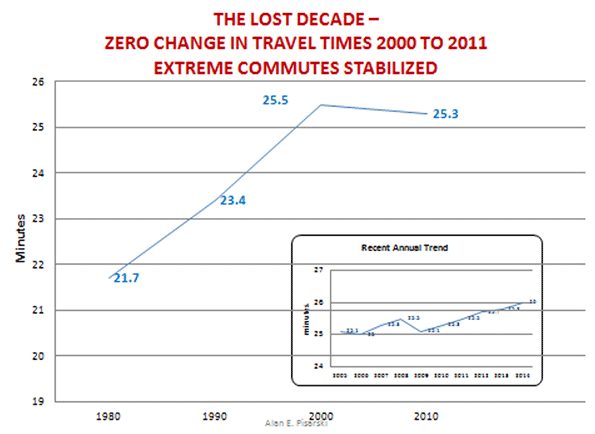
    Reporters like to focus on the longest commutes, generally anything more than an hour.  In early census data many of the travel time tabulations presented an upper limit category of “45 minutes or more”.   The 1980 census showed an average travel time of 21.7 minutes, rising to 22.4 minutes in 1990, a rather trivial increase of about 40 seconds in a decade in which we added 22 million commuters driving alone.  Not surprisingly such consumption of our road capacity couldn’t continue and in 2000 average travel times rose by more than three minutes despite an increase on the order of only 13 million solo drivers.  

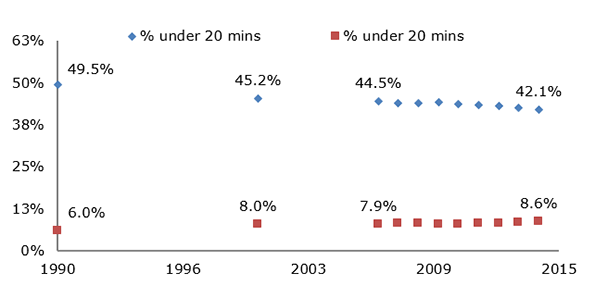
    In my early work in Commuting in America I realized that averages are dangerous things, especially when the subject is speeds and travel times, so I began tracking the percentage of commuters who got to work in under 20 minutes and more than 60 minutes.  Twenty minutes is used because if you got to work in under 20 minutes you had absolutely nothing to complain about; and if you were over an hour then maybe some sympathy was in order.  As the data got better and the travel times got worse the Census Bureau introduced the notion of a 90 minute or greater commute which they labeled an “extreme commute”. 

    What’s behind it all? Is it as catastrophic as the average reporter will try to make it?  (They always manage to find someone who gets up at 4 am and travels three hours on a bus from Pennsylvania to Manhattan).  Examining the current trends reintroduced the substantial concern that all analysts must recognize – you have to keep asking: “is this a new trend I am seeing or just another part of the long, slow recovery from an extreme economic event?”  The passage of time suggests the latter, often to the disappointment of those who saw a new dawn of the behaviors they tend to endorse. The figure below shows that between 2000 and 2012 travel times were effectively constant at 25.5 minutes. After that, as employment began to improve travel times inched forward to 26 minutes in the 2014 ACS data. 

    Looking at the longer term patterns, back in 1990 just about half of the workers in America got to work in under 20 minutes.  That dropped to 45% in 2000 and now is trending further down to about 43% in 2014.   Much of the Midwest is still in that range, and if you add in the dramatic increases in those who work at home then we are still in the 50% range in much of America. 

    In comparaison the over 60 minutes category  is remarkably small. In 1990 we were at about 6% and at 8% in 2000. It has been rising slowly and at the present rate of change we still won’t reach 9% in this decade.  Having said that, we must recognize that we are now talking about over 11 million workers in the 60 minute plus category.

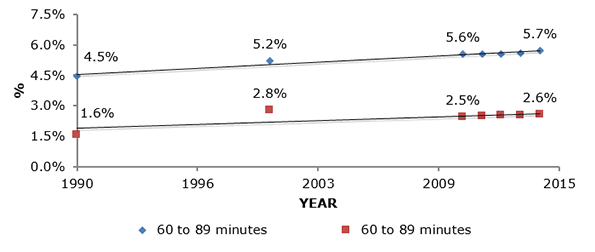
    Looking in greater detail at the disaggregate patterns we see that the trend in 60 to 89 minutes continued to rise, while the over 90 minute element dropped off.  What happened is that both categories rose through 2008 or so and then with the recession dropped off and now have gone through a slow resumption of expansion in the new decade.  

    Some of the trends that define travel

    One would expect that when jobs are scarce, as during the recent recession and long limited recovery, the average distance people would be willing to travel to find work would increase.   Not finding a  job in a preferred 30 minute travel time labor market shed around one’s home makes expansion to 45 minutes or an hour more feasible after being unemployed for months.  I am sure much of that happened, but the broad statistics tell a varying story.  The share of commuters over 90 minutes dropped; two important factors were in play that overwhelmed the statistics:

    #1 there’s nothing like 10% unemployment to improve congestion. When the number of workers declined road speeds improved, or at least didn’t continue to get worse.  So a previous 90+ minute trip might have improved to 85 minutes.   When your travel mate lost his job your solo commute got to be shorter.

    #2  The more important factor was that the kinds of jobs lost in the recession were exactly those that tended to be long distance.  A large share of the job losses were in construction and factory work.  Home construction, of course, mostly occurs at the edges of the region where workers often arrive by carpool.  And large factories today are often located in rural areas for logistical purposes – with workers traveling immense distances – for example  the car plants and refineries of the south. Note also that there were parallel very severe declines in carpooling in the period.  This was at least one of the many factors in that decline.  As the economy slowly improved we have seen the return to greater travel times as construction, manufacturing and other activities return and roads congest again. 

    The significant long term factors we need to recognize in our assessments of future prospects are these:

    The key driver of future commuting will be the need to find replacements for the retiring baby-boomers, particularly skilled workers.  In general that suggests large metro areas where the access to a variety of workers will be greatest. The larger areas have the best answer to the question “how many people with the skills I need can I reach in a half hour’s travel commuter shed from this location?” 

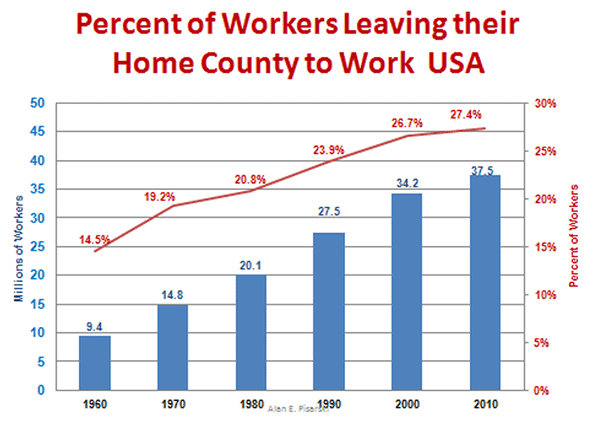
    One of the fundamental patterns of American commuting today is massive flows between counties.   In 1960 a bit more than nine million workers left their residence county to work, today it is over 37 million and the share of work travel is over 27% almost double the 60’s percentage.

    Planners have a dream of better “balance” in jobs and workers in communities that will promote walking/biking to work.  Some of that will happen as both suburban and central city Job/Worker ratios approach 1.0  from opposite directions. But  the realities of work travel are sharply different.  First of all about two-thirds of workers live in a household with other workers – whose job will they live near?  Workers, particularly the young, change jobs often. Will they move, incurring costs and further disruption in their lives every time they change jobs?  Not likely! 

    My own county of Fairfax County, Virginia illustrates the national pattern.  In 1980 it was a standard bedroom suburb with roughly 400,000 workers and 300,000 jobs for those workers, a J/W ratio of .73, the very definition of a suburb .  Flash forward to 2010 and the J/W ratio was at balance, .99, so that if all the workers who could, stayed in the county to work only 8,000 would have to leave to reach available jobs. But, in fact the county exported 280,000 workers and imported 272,000 with an overall flow of over 550,000 crossing its borders every day rather than 8,000. That’s what commuting is really all about.  Today, Fairfax County fits the definition of a central city with more jobs than workers yet still  the border crossings have reached over 570,000 every day.  The key point is that having a numeric balance in jobs and workers has little value, it is the match in the skills needed by employers and the skills possessed by resident workers that is crucial.

    Some closing thoughts

    These changes in a long term trend of people traveling significant distances to work with an interruption brought on by national employment trends.  The current penchant of rail transit proposals to reach farther and farther into the hinterlands to support the central city does not address the dynamic of ever more dispersed employment.  Transit has its highest share in trips over 60 minute and are a very significant part of intercounty and interstate travel.  The fact that they are a great deal slower than alternatives adds to the shares over 60 minutes. Many of our “metro” systems are closer to being commuter rail lines than city subways, BART, for example, the new Silver line in DC, for another, are excellent example.  Think if the entire subway investment in the Washington area had occurred inside the District borders, or at least inside the Beltway, there would have been a very real difference in being inside or not. 

    We can expect to see longer distance travel as more specialized skills are demanded by employers.  I recall in the eighties in China where the workers at the number one bicycle factory lived in apartments across the road and walked across the street every day to work.  Even where the government owned the factories, the housing, and the people that still didn’t work. When we are hiring systems engineers or any other highly skilled workforce element it will be even more impossible.     

    The dominant flow today is circumferential from suburb to suburb from far lower density housing to smaller work places than the number one plant in Shanghai. We don’t live outside the factory gate anymore. About 5% of those who move are seeking a better commute.  Most moving focuses on a better place with the amenities the household’s prefer and their commute is often the residual. As hard as we might try, minimizing the commute will not define people’s housing or job patterns in the future. Did I hear someone say autonomous vehicles.

    Alan E. Pisarski is the author of the long running Commuting in America series. A consultant in travel behavior issues and public policy, he frequently testifies before the Houses of the Congress and advises States on their investment and policy requirements.

    Photo by Nathan Harper, Bottleleaf

  • Evolving California High Speed Rail Now Degraded To Only A Commuter Train

    When voters passed in the November 2008 election, Prop 1A, they approved partially funding a 800 mile High Speed Rail project, that was to run from San Francisco to San Diego. The project was to be constructed quickly and be up and running by 2020.

    Approved Business plans in 2012 and 2014, then projected construction to start from the Central Valley, near Fresno, and proceeding south through the Tehachapi Mountains to Los Angeles Union Station.

    Now we see the High Speed Rail Authority is promoting a draft 2016 Business plan that abandons building south and instead promotes building north from near Bakersfield, but only to San Jose. The reason for this dramatic shift is lack of funding to complete the previously proposed segment to Southern California.

    The Authority claims they have the funding to complete an Initial Operating Segment (IOS), which would run from about 20 miles north of Bakersfield to San Jose Diridon Station.  From Diridon Station, riders could use Caltrain to proceed further north to other destinations. The IOS segment is expected to be completed and usable around 2025.

    The projected funding for this IOS, would come from Prop 1A bonds, Cap and Trade projected  pay as you go revenues as well as bonded revenues (thru 2050), and Federal funds that have been already allocated.  Constructing this segment would consume all currently available funds.

    The key foundation for promoting this new plan, is that ridership will be greatly enhanced with commuters using this High Speed Rail section to commute from the Central Valley to Silicon Valley. The Authority and others are promoting this projection as a major improvement to the jobs / housing imbalance that currently prevails in Silicon Valley. The claim is cheap housing in Fresno or Bakersfield will induce workers from Silicon Valley to buy or rent in the Central Valley.  They promote a quite reasonable trip time of only 40 minutes on the train, making such a commute attractive.

    But further scrutiny belies these assertions. The trip time on HSR will indeed be around 40 minutes, but that takes the commuter only to San Jose Diridon Station.  Diridon station is not where these commuters will work.  Indeed they will have to then transfer to another service at least once to get to their employers.  Analysis of the true trip time doubles the real commute time to around 80 minutes.  This was amplified by Palo Alto Mayor, Pat Burt at the recent Local Policy Makers group meeting March 24th.

    The premise that workers will be enticed to move to the Central Valley because the cost of housing is much lower also needs examination.  Here one has to consider in this equation, the cost of commuting.

    HSR transportation is a premium service.  By law the HSR trains must operate without a subsidy, a restriction which BART or Caltrain do not have to meet.  The projected HSR fare from Fresno or Bakersfield is $68 each way. For a daily commuter that is $136 per day, or about $34000 per year to pay for the HSR train ride. This does not include other charges like parking or transportation from Diridon to a final working destination.

    Also working against the myth that the bottom line is cheaper for a commuter to live in the Central Valley, yet work in Silicon Valley, is the treatment of expenses on ones tax return. Home mortgage interest is a tax deductible expense on ones tax return.  Commuting train fares, are not a tax deductible item on a tax return.

    All and all it just doesn’t add up that it is cheaper for a commuter to live in the Central Valley, and take HSR to Silicon Valley. There will be, despite Authority claims otherwise, very few commuters living in the Central Valley and commuting to Silicon Valley.

    Finally, residents in Southern California are really being excluded by this new plan.  They will be paying in taxes to service the Prop 1A bond service.  They will be paying in higher gasoline costs to support Cap and Trade revenues. For Southern California residents, there is no benefit. They are simply being left out.

    There is a shortfall in funding to later complete Phase I of the HSR project, that is the corridor from San Francisco to Anaheim; this short fall in funding is over $40 billion.  Such funding is nowhere to be found.  The un-certainty in even funding this new IOS is huge.  View the input from the Legislative Analyst’s report just presented at an oversight hearing on March 28th.

    https://youtu.be/lEzkSGTkQgs

    Let’s quit fooling ourselves. Former State Senator Joe Simitian in 2012 had it right when he stated on the Senate floor:

    “This is the wrong plan in the wrong place in the wrong time,”.

    Now is the right time to stop the project.

    This piece first appeared at Fox and Hounds Daily.