Tag: Transportation

  • “Rising Rail Chaos” in Honolulu

    That’s what the Honolulu Star Advertiser calls it in an April 8 editorial entitled "Rising Rail Chaos Bodes Ill for Us All." Honolulu’s urban rail project has experienced a host of problems, which were described by University of Hawaii professor Panos Prevedoros in January, who called the project “the nation’s largest infrastructure fiasco by far” on a per capita basis.

    Things continue to deteriorate, as the Star-Advertiser editorial indicates. The Star Advertiser reported that city Council chairman Ernie Martin called for both Honolulu Authority for Rapid Transportation (HART) Board Chairman Don Horner and chief executive officer Dan Grabauskas.

    In a letter, Martin expressed concern that: “With mounting evidence of mismanagement and out of control costs … it is clear that we need a leadership team capable of moving this multibillion (dollar) project forward.”

    In its editorial, the Star Advertiser noted: “HART officials acknowledged new misgivings that the recently approved extension of the funding mechanism — Oahu’s 0.5 percent general excise tax surcharge — would cover the bills.”

    Martin called it a “stunning about face” that Horner could not promise Council members that there would be enough cash to finish the project. Previously, according to Martin, Horner had said that the tax extension would be sufficient to finish the 20 mile line.

    Martin went on to say that “we need to go in a different direction” to help “stop the bleeding.” He added: “We’re at the tourniquet stage right now,”  “If we don’t apply more intense scrutiny, then we’re likely to lose limbs.”

    Meanwhile, Honolulu is not alone. There has been plenty of bleeding with respect to expensive urban rail projects. In Los Angeles, $16 billion has been spent to build a massive new urban rail system and yet, transit ridership languishes below the levels of three decades ago, despite population growth. In Toronto, the new airport express train has been such a failure in ridership that it is routinely called a “fiasco” by the media.

    Of course, all of this is predictable. Often, urban rail costs more and carries fewer riders than projected. are higher than projected ridership lower than projected, and virtually never high enough to reduce traffic congestion can be characterized as routine, as the international research led by Oxford professor Bent Flyvbjerg has indicated.

    But Honolulu is a special case as well. There may have never been so intense a volunteer campaign to stop what was perceived as a boondoggle is in Honolulu. The Star-Advertiser, usually a cheerleader for the project, concluded by saying: “Reports of this dysfunction just adds to the strain taxpayers feel right now, and it’s the last thing they need. The price tag on the state’s largest public works project is past the $6 billion mark and rising, with the most complicated part of the work still looming.”

  • In Praise of Plain Old Bus Service

    My recent post on counting the long term costs of building rail transit got a lot of hits – and as expected a lot of pushback.

    There are a lot of people out there that are simply committed to the idea of rail transit, no matter how unwarranted a particular line or system might be.

    I find it interesting that the place with the most people applying serious skepticism to transit projects seems to be New York – the place with the biggest slam dunk of a case for it of any city.

    Lots of people, for example, have critiqued the proposed Brooklyn-Queens light rail line. In a city where there’s a desperate need for more transit, advocates are very focused on making sure the limited capital we have gets spent on useful projects. Not everyone agrees with each other, but there’s a robust debate, focused on the actual merits.

    In cities without much experience of transit, there appears to be a huge bias in favor of very expensive rail projects regardless of their merits.

    Some have asked me whether I support Bus Rapid Transit. I can, in some circumstances. Though Alon Levy has convinced me that the economics of South American style BRT don’t necessarily transfer to high income countries.

    What I do very much support is significantly improved Plain Old Bus Service (POBS).

    Most cities in America have pretty awful bus service, with meandering, radial routes that run infrequently and are basically deployed as a social service.

    Contrast that with Chicago or LA (or even New York, despite its subway dominance), where we see bus grid networks that run with reasonable frequency.

    I define “reasonable frequency” as meaning I can show up at the stop without consulting a schedule or tracker app, confident that my max burn on wait time is at least semi-humane. Ten minute or less headways would be best, but I can live with 15.

    Jarrett Walker has highlighted the role of Portland’s high frequency bus grid, launched in 1982, as changing the game there and making the city’s subsequent light rail system actually functional.

    Thirty years ago next week, on Labor Day Weekend 1982, the role of public transit in Portland was utterly transformed in ways that everyone today takes for granted.  It was an epic struggle, one worth remembering and honoring.

    I’m not talking about the MAX light rail (LRT) system, whose first line opened in 1986. I’m talking about the grid of frequent bus lines, without which MAX would have been inaccessible, and without which you would still be going into downtown Portland to travel between two points on the eastside.

    Pretty much any city could benefit from a better POBS network and higher frequencies.  This is where there is vast opportunity to invest in American transit without breaking the bank.

    Yes, buses cost money. I’m not saying its free. This is where I say we should spend more. A solid POBS system is just the basics to be in the game for any city looking to retrofit transit culture.

    Even Portland, the city held up as the exemplar for light rail investment, started by getting its bus system right.

    Aaron M. Renn is a senior fellow at the Manhattan Institute, a contributing editor of City Journal, and an economic development columnist for Governing magazine. He focuses on ways to help America’s cities thrive in an ever more complex, competitive, globalized, and diverse twenty-first century. During Renn’s 15-year career in management and technology consulting, he was a partner at Accenture and held several technology strategy roles and directed multimillion-dollar global technology implementations. He has contributed to The Guardian, Forbes.com, and numerous other publications. Renn holds a B.S. from Indiana University, where he coauthored an early social-networking platform in 1991.

    Portland Bus Grid. Image via Human Transit

  • Why You Should Think Twice Before Building a Rail Transit System

    The Washington Metro system was shut down completely for a day recently to allow crews to inspect all of the power cables in the system. They found 26 cables and connectors in need of immediate repair.

    This is just the latest in a series of safety problems and breakdowns that have plagued the system.

    Metro has a large unfunded maintenance liability. This doesn’t surprise us because we expect American transit systems to have a backlog.

    The difference is that unlike NYC, Chicago, Boston, etc., which have systems a century old, the Washington Metro system is actually new.

    The oldest part of the Metro opened in 1976. That means Metro is 40 years old – max. Much of it is actually newer than that.

    Forty years after opening, Metro already faces a maintenance crisis.

    This should give other regions pause when it comes to building a rail transit system. My colleague Alex Armlovich points out that NYC has more or less been on a 40 year refresh cycle, with two rounds of major system investment since the subways opened. This doesn’t seem out of line as a capital life heuristic to me.

    So cities need to keep in mind that if they build a rail system, they not only have to pay to build it, they pretty much have to pay to rebuild it every 40 years. This is a challenge because as we see it’s easier to muster the will to build something new than to maintain something you already have.

    Given the huge permanent capital outlays implied by rail transit, you only want to build it where there’s sufficient value to justify it. Washington unquestionably achieves this. It simply hasn’t been able to capture the value into a maintenance revenue stream, plus Metro (like many systems) has been badly mismanaged.

    The problem comes in for cities that aren’t NYC, Chicago, Boston, Philly, DC, and San Francisco. Once you get below that group, the value starts becoming more debatable.

    Exhibit A is Los Angeles, which has spent untold billions on a huge rail system as ridership actually declined.  LA is continuing to build more and more rail.

    But what happens when this system is old?

    LA’s Red Line opened in 1993, so is 23 years old.  By the time LA finishes its current rail build out, it’s likely that the original parts of the system will be coming into the zone for a major capital refresh.

    Thus shortly LA will find itself in a perpetual capital catchup cycle starting in only a couple decades. This possibly may not happen, but it has happened everywhere else, so why should LA be different?

    Given the ridership levels we’ve seen so far, will the value added from rail vs. the old bus approach be there? It’s not looking good. And if the case in LA is looking weak, certainly smaller and less dense places are even more speculative.

    All these smaller cities investing billions into rail had better hope their projections of massive benefits come true, because all too soon the rebuild bill will start coming due.

    If you don’t believe me, just ask Washington.

    Aaron M. Renn is a senior fellow at the Manhattan Institute, a contributing editor of City Journal, and an economic development columnist for Governing magazine. He focuses on ways to help America’s cities thrive in an ever more complex, competitive, globalized, and diverse twenty-first century. During Renn’s 15-year career in management and technology consulting, he was a partner at Accenture and held several technology strategy roles and directed multimillion-dollar global technology implementations. He has contributed to The Guardian, Forbes.com, and numerous other publications. Renn holds a B.S. from Indiana University, where he coauthored an early social-networking platform in 1991.

    Photo Credit: Ben Schumin – CC BY-SA 3.0

  • Mass Transit Expansion Goes Off The Rails In Many U.S. Cities

    Journalists in older cities like New York, Boston or San Francisco may see the role of rail transit as critical to a functioning modern city. In reality, rail transit has been a financial and policy failure outside of a handful of cities.

    In 23 metropolitan areas that have built new rail systems since 1970, transit’s share of commuting — including all forms, such as buses and ferries — has actually slipped a bit, from an average of 5.0 percent before the rail systems opened to 4.6 percent in 2013. The ranks of those driving alone continue to grow, having increased 14.4 million daily one-way trips since 2000, nearly double transit’s overall daily total of 7.6 million, according to Census Bureau data.

    Virtually all the actual increase in rail commuting has occurred in the “legacy cities”: New York, Boston, San Francisco, Washington, Chicago and Philadelphia. These are older cities built around well-defined cores that were developed mostly before the automobile. Together the core cities of these metro areas, excluding the suburbs, accounted for 55% of all transit work trips in the nation in 2014, according to the latest American Community Survey data. Overall, transit’s work trip market share in these six metropolitan areas rose from 17 percent to 20 percent between 2000 and 2014. In the entire balance of the country, where most of the new rail systems have been built, transit’s market share is only 2.2 percent, up a scant 0.2 percentage points since 2000, according to Census Bureau data.

    Manhattan alone, in fact, accounts for more than 40 percent of all rail commuters in the nation. New York is the only U.S. city where more than 20 percent of workers labor in the central business district (downtown). In most cities, the percentage is less than half of that, and in many others, even smaller. In Los Angeles, less than 3 percent of employment is downtown. In Dallas only 2 percent of metropolitan employment is downtown. In Houston, where numerous large companies maintain headquarters, it’s still only 6.4 percent.

    For transit to work effectively, employment needs to be concentrated. This explains why between 2013 and 2014, New York accounted for a remarkable 88 percent of the total increase in train commuting. But what works for Brooklynites headed to Union Square does not generally work so well for people living in our increasingly dispersed metropolitan areas. Indeed in most cities — Dallas-Fort Worth, Houston, San Diego, and even the new urbanist mecca of Portland, according to 2015 American Community Survey data, where new transit lines have been put in, it has failed to increase the share of commuters who take public transportation, and in some cases the actual ridership has dropped.

    It has even failed where cities are booming and their downtowns flourishing. Houston’s light rail system opened in 2004, but has done little to change the car-dominated commuting pattern of America’s energy capital. Between 2003 and 2014, Harris County’s population grew 23 percent, but transit ridership decreased 12%, according to American Public Transportation Association data. This means that the average Houstonian took 30 percent fewer trips on the combined bus and light rail system in 2014 than on the bus-only system in 2003.

    The Next Great Transit City

    Nowhere is the transit mania more profound than in Los Angeles, a city progressive blogger Matt Yglesias describes as “the next great transit city.”

    There seems to be a conscious strategy of making auto commuting in Los Angeles and the rest of California so unpleasant as to force people into transit. Mayor Eric Garcetti has made bold predictions that commuting times will drop in half, largely by people moving from cars to trains. Of course this is folly, since transit commuting generally takes considerably longer than commuting by car. The Governor’s Office of Planning and Research has called for putting all California on “a road diet,” meaning that traffic will simply continue to worsen. This in a state which has among the worst roads in the country – 68 percent of which are in poor or mediocre condition.

    Can rail solve or mitigate congestion? L.A. has already spent over $15 billion on rail yet this has proven less than effective in either boosting transit ridership or lessening congestion.

    Since 1980 before the rail expansion the percentage of Los Angeles County commuters who take transit has actually dropped from 7.0 to 6.9 percent while the transit share of the combined statistical area has dropped from 5.1 to 4.7 percent. Even the total numbers of riders is heading down. Recently the transit booster Los Angeles Times published statistics that showed that there were now 10 percent fewer boardings on the Los Angeles MTA system than in 2006, and that the decline was accelerating.

    One reason for the poor performance is that much of the train ridership turns out to have been former bus travelers in the first place, which limits actual gains there. Taxpayers, however, should be screaming about this switchero; the subsidy for new L.A. new bus riders, who tend to be the poorest of the poor, cost taxpayers $1.40 while the cost for a new rail rider was $25.82 over the period of 1994 to 2007. If you believe in transit as public good, clearly building more trains makes less sense than expanding bus operations.

    But it’s not just a cost issue. Los Angeles is a vast and dispersed metropolis in which only one in five residents even lives within the city limits, and even much of the city — notably the San Fernando Valley — is essentially suburban in form. Transit travel takes much more time to get to work than the car, even on the region’s miserable roads and overcrowded freeways. With downtown only a minor employment center, people increasingly travel there for cultural events, sports or even a restaurant, not for work.

    Other factors also seem to be contributing to the decline. One is the trend toward working at home; in 2014, the number of Angelinos working at home surpassed the number taking transit. Although this saves more energy, and produces less carbon than transit ridership, there is virtually no government support for this innovative approach to traffic reduction from the climate-obsessed state government.

    Finally, there are now other options such as Uber and Lyft, which provide reasonably priced door to service, always available, often on short notice. Down the road, the path for transit looks even bleaker with the development of self-driving cars, which will make even long suburban commutes easier. Looked at objectively, the drive for a traditional transit dominated Los Angeles is on a collision course with reality.

     Taking Stock and Changing our Approach

    In the alternative world that dominates our transit planners and retro-urbanists, nothing succeeds like failure. Some urban experts still predict that the Sun Belt cities are ripe for a huge infusion of rail transit, despite all evidence to the contrary.

    Given what we know about the share of commuters using transit in most cities, pumping money into this form of transportation seems doubly wrong while other needs such as roads, schools, sewers and parks are neglected. Rather than try to fit all cities, and all parts of metropolitan areas, into a 19thcentury technology, maybe we should look to encourage 21st century innovation.

    Clearly some of this is already with us, notably in the rise of services like Uber and Lyft which, for many, seems a far more effective way of getting around with your own car. Ride-sharing and services like Zipcar also provide new alternatives. And other innovations could be developed, with expanding shuttle and dial-a-ride services. In many big cities dedicated commuter buses, connecting the dispersed employment centers, would make great sense in cities such as Houston, which has many large employment centers, notes my Center for Opportunity Urbanism fellow, Tory Gattis.

    But it’s changing work patterns that may provide the most promising opportunities to reduce traffic and reduce greenhouse gases. In the U.S., working at home, not transit, was the principal commuting alternative to the automobile in 39 of the 53 major metropolitan areas with populations over 1 million as of 2014, according to Census Bureau data. The share of work access accounted for by home workers rose by more than a third between 2000 and 2014, from 3.3 percent to 4.5 percent

    Many of the most striking work at home share gains are taking place in the country’s leading technology regions, including Austin, Raleigh, the San Francisco Bay Area, Denver, Portland and San Diego. Millennials in particular, notes a recent Ernst and Young study, embrace telecommuting and flexible schedules more than previous generations did, in large part due to concerns about finding balance between work and family life.

    All this suggests we need to revamp our ideas of transit, particularly in the newer, fast-growing cities. Trains may elicit a nostalgic smile about the good old days, but most Americans, and the vast majority of our cities, need to live not in the past but in an increasingly dispersed, and choice-filled reality. Time to embrace that future.

    Joel Kotkin is executive editor of NewGeography.com. He is the Roger Hobbs Distinguished Fellow in Urban Studies at Chapman University and executive director of the Houston-based Center for Opportunity Urbanism. His newest book, The Human City: Urbanism for the rest of us, will be published in April by Agate. He is also author of The New Class ConflictThe City: A Global History, and The Next Hundred Million: America in 2050. He lives in Orange County, CA.

    Photo: Atlanta MARTA train by RTABus (Own work) [CC-BY-SA-3.0], via Wikimedia Commons

  • What Price Urban Density?

    We regularly hear the argument that living in a compact city is more affordable than living in one that is more spread out. But what does the data actually show about the cost of housing in compact cities, and the cost of transport in these dense places? The relationship between those two expenses and the compactness of a city could tell us much about which kinds of places are most affordable, since those two costs together dominate household budgets.

    Advocates of denser urban environments have developed an index to measure the effects of a range of aspects of city living, such as vehicle miles traveled, traffic safety, congestion, the cost of housing, the cost of transportation, and health outcomes, among many other issues. The index takes into account several metrics, such as density, street accessibility and the mix of land uses.

    The index was conceived with the intent to study presumed negatives of city growth, and to make such growth “smarter.” Since the impulse to create it was advocacy-driven, it may lack objectivity. Notwithstanding this potential bias, and lacking alternative data, we used it as the default measure for our analyses, and consider our work a chance to test the validity and reliability of the index.

    First, we looked at housing costs. Casual and investigative observers seem to agree that housing costs do rise with city compactness. A recent report on the effects of compactness determined that housing costs increased by 1.1% for every 10-point increase in the compactness index. Other researchers have come to similar conclusions, using only population density as an indicator.

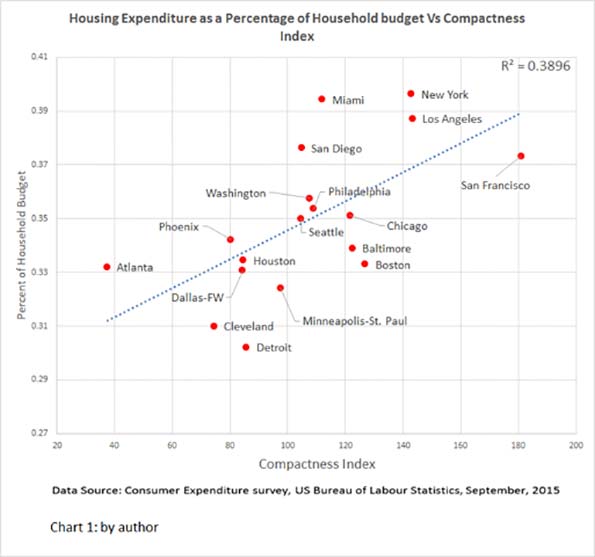
    Chart 1, which plots data from the 2015 Consumer Expenditure Survey, confirms this general agreement on the correlation between compactness and housing costs. But questions arise from the sharp differences between pairs of cities.

    For example, Boston and Atlanta residents use the same percentage of their budgets — 33% — for housing. Yet Boston’s compactness index is at least 90 points higher: 37.4 for Atlanta, vs 126.9 for Boston. According to Smart Growth theory, that difference should bring housing expenditures for Bostonians to 43%, about the same level that is experienced by New Yorkers.

    In another comparison, Boston and Miami differ little in compactness: 126.9 vs 112. Yet these two cities differ substantially in the percentage of household budget residents devote to housing costs – 33% vs 39%.

    Clearly, in both these examples and in the chart above, compactness is but one of many factors and, perhaps, not the dominant one in the relationship between a city’s housing costs and its compactness. Others need to be identified, quantified and incorporated. The trend, however, is indisputable: Greater compactness increases housing costs.

    Do transportation costs follow the same trend?

    According to theory, cities that are more compact offer more transport options, particularly public transit systems, some of which, like subways, outperform all other modes for time — especially work commute time — and provide travel options that are more affordable. Walking and biking may also be alternate means of mobility that help hold down household transport expenditures in compact cities. The association between density and high non-auto share of trips has already been demonstrated.

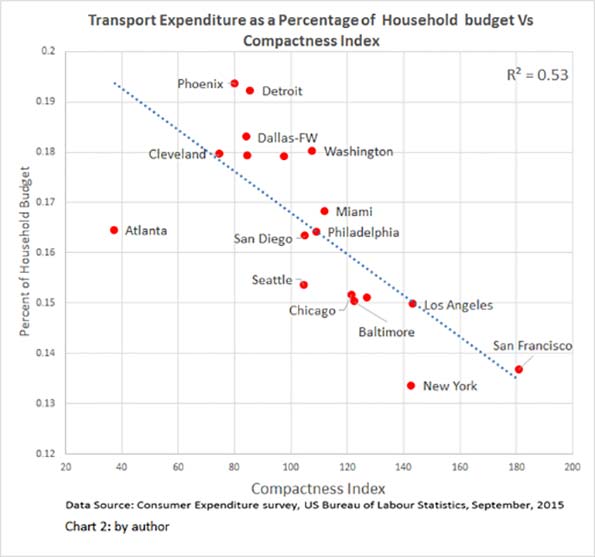
    Consumer Expenditure Survey data from 2015, when plotted, confirms this assumption. Chart 2 shows a decreasing proportion of the household budget being used for transportation as a city’s compactness index increases.

    However, as with housing costs, a close look at the differences between paired cities raises questions. Atlanta and Philadelphia share the same percentage of household budget expenditure on transport, 16%. Yet they differ by 70 points on the compactness index, 37.4 vs 109.05. Meanwhile, Washington and Seattle register an almost identical compactness index — 107.6 vs 104.6 — but the latter, contradicting theory, has transportation costs that are 3 percentage points lower, even though it lacks a subway. Both these cases demonstrate that the current model for measuring the impact of compactness needs fundamental refinements to improve its predictive value.

    So far, the data show two countervailing trends: Housing costs rise with compactness, while transportation costs fall. This finding leaves the question of whether more compact cities are more affordable to live in, at least with respect to these two expenditures that consume about half of a household’s budget.

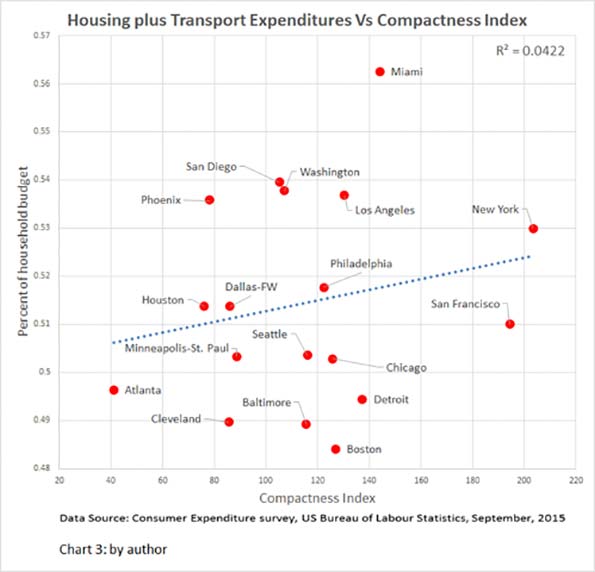
    Using the same data from the CES for the 18 cities, we plotted the results of combining the two expenditures, as a percentage of the household budget.

    Chart 3 shows an inverse, albeit weak, association of compactness with combined household expenditures of housing and transportation. It clearly does not indicate that more compact cities are more affordable for the average household. Upon a closer look the chart reveals some instructive surprises.

    First, Atlanta appears among a group of five most affordable cities, even though it has by far the lowest compactness index (40.9) of all eighteen cities in the CES survey. According to traded wisdom, its transport costs, being almost entirely based on automobile travel, should overwhelm its housing expenditures.

    Contradicting theory, Atlanta posts next to lowest average housing cost ($16,316/year), and also one but lowest transportation costs ($8,086/year). When considering that average income in Atlanta is on a par with that in Los Angeles ($69,821 vs $69,118), and that its compactness index is 80 points lower than LA’s, its comparative affordability challenges current thinking about compactness and its effects.

    Second, four cities hover around the same point of the index (#110), yet they cover almost the entire gamut of budget percentage expenditure (49% to 54%) for combined housing-plus-transport costs. The same is true for five cities aligning around the #130 of the index.

    It’s apparent that current theory falls short of adequately explaining field data. A city planner would find little comfort in knowing that a fourfold range of compactness can be equated with the same level of affordability, or that the same level of compactness can be associated with a wide range of combined transportation and housing expenditures. If anything, these results suggest that, because average housing expenses are double those of transportation, a yet-to-be-determined density ceiling might be an effective means of increasing a city’s affordability.

    The CES data is only a snapshot in time that may reflect transient conditions, such as gasoline prices, local inflated real estate markets, congestion levels that affect gas consumption, effectiveness and reach of public transit and so on. Variability in these factors will always affect the average transport and housing expenditures. A predictive model should be robust enough to handle such fluctuations, if it is to have practical value.

    Yes, greater compactness is associated with higher housing costs and lower transportation costs. But, contrary to unsubstantiated assertions, when these are combined, the result is less — not more — overall affordability.

    Fanis Grammenos heads Urban Pattern Associates (UPA), a planning consultancy. UPA researches and promotes sustainable planning practices including the implementation of the Fused Grid, a new urban network model. He is a regular columnist for the Canadian Home Builder magazine, and author of Remaking the City Street Grid: A model for urban and suburban development. Reach him at fanis.grammenos at gmail.com.

    Flickr photo by Tim Bartel of a San Francisco neighborhood

  • Just How Much has Los Angeles Transit Ridership Fallen?

    Los Angeles transit ridership has fallen even more than a recent Los Angeles Times front page story indicated, according to Thomas A. Rubin, who served as Chief Financial Officer (auditor/controller) of the Southern California Rapid Transit District (SCRTD) from 1989 until 1993, SCRTD merged with the Los Angeles County Transportation Commission (LACTC) after the first new rail line was opened in the early 1990s (I served as a city of Los Angeles appointee to the board of LACTC).

    It is not that the Times misreported the story, but rather that the official data it used does not fully account for important underlying ridership data.

    Rubin’s analysis, (available here), responds to a commentary by Ethan Elkind who criticized the Los Angeles Times article for providing a misleadingly pessimistic ridership picture. Rubin shows that, in fact, a closer look at the data suggests things are even worse that suggested by the Times.

    Rubin provides compelling evidence refuting the Elkind commentary (discussed below), as well as more detailed ridership issues that require deeper analysis. Tom Rubin is among the nation’s most knowledgeable transit advocates) and his commentary provides far more information than is summarized in this article. Rubin’s commentary is necessary reading for anyone seriously interested in the history of transit in the new rail era (since 1980).

    Passenger Journeys v. Linked Trips

    Transit ridership statistics in the United States nearly exclusively rely on the concept of unlinked trips. An unlinked trip occurs every time a passenger enters a transit vehicle. Thus, if a rider takes one bus and then transfers to another bus to complete a trip, this single passenger journey counts as two unlink trips. Or, if a passenger starts the journey on the bus, transfers to a rail line, then transfers to another rail line and finally to a bus, this single passenger journey will count as four unlinked trips. So, when comparing transit ridership in the United States, it is important to keep in mind that unlinked trips, rather than passenger journeys are being counted.

    It is worth noting, that in some other countries, officials have found it relatively easy to count passenger journeys. For example, most large European transit systems count passenger journeys and thus do not report the inflated ridership figures that occur as a result of countingtransfers on a single trip.

    As Rubin points out, transfer ratios vary significantly between systems. Further, transfer ratios tend to increase as transit agencies open rail systems. As new rail lines are opened, bus routes are often truncated as agencies attempt to force more ridership on to the rail system. This means that the number of transfers increases. Data that Rubin provides indicates that the linked trip to passenger journey ratio on the former SCRTD/MTA transit system has risen from 1.66 linked trips per passenger journey in the early 1990s to 2.25 in the most recent surveys . Rubin also notes that some surveys have shown even higher transfer ratios in recent years. He uses the 2.25 transfer ratio to obtain the most conservative possible estimate of 2015 passenger journeys.

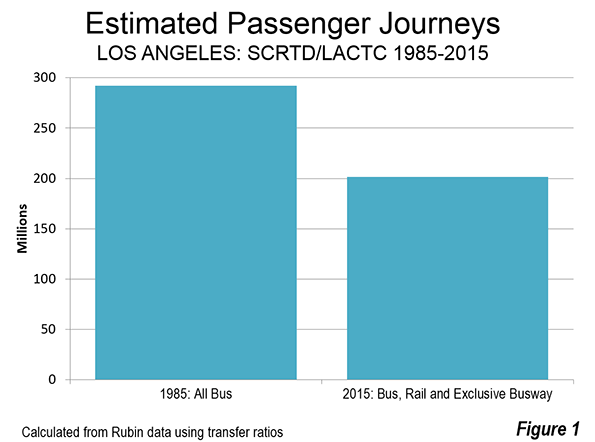
    According to the unlinked trips data reported by the Los Angeles Times, transit ridership on the SCRTD/MTA transit system declined nearly 10 percent from 1985 to 2015, despite the addition of billions of dollars worth of new rail lines. Taking Rubin’s estimate of passenger journeys based on the change in transfer rate (from 1.66 to 2.25 unlinked trips per passenger journey), the drop would be even greater, at a loss of more than 30 percent. Passenger journeys, using these ratios, would have been approximately 290 million in 1985 and 200 million in 2015 (Figure 1).

    Billions for What?
    Rubin has provided important research in his analysis of rail construction costs. Over the past 30 years. Rubin estimates that approximately $16.4 billion dollars (2016$) has been spent to build the routes that are already in service (including the Orange Line busway, but not the Silver Line busway, which he does not include) Elkind implies that this is not enough to see a “true return” on investment.

    With all the huzzahs about the rail system having made transit “the next great mass-transit city,” and the near universal praise for the rail system among the “powers that be” in Los Angeles, the Times is to be commended for courageously revealing the billions that have been spent while millions have abandoned transit, as SCRTD/MTA have placed a priority on expanding the rail services. Rubin also shows that another $9.0 billion is expected to be spent on new lines that will be opened by 2023.

    How Much is a Rail Rider Worth?

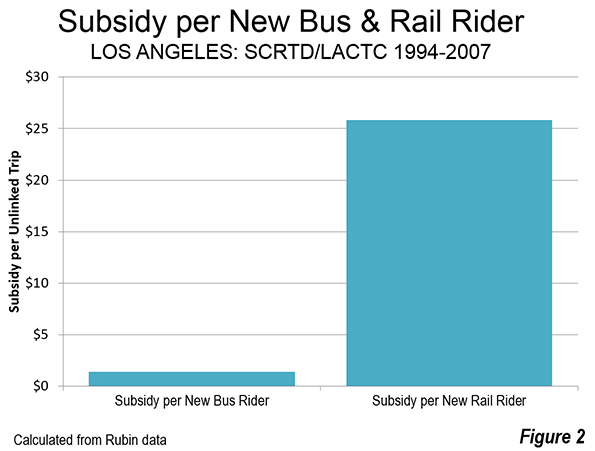
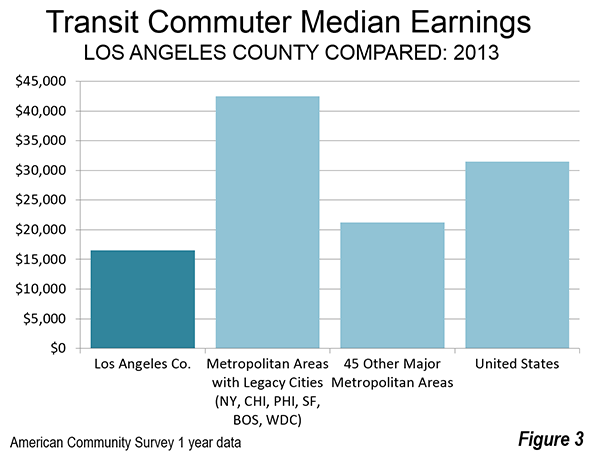
    Rubin was a principal actor in a civil rights lawsuit that forced MTA to reduce its rail spending and increase in spending on buses and lower fares after ridership had fallen about 120 million from its 1985 peak. During the period that the court oversaw MTA, was forced to add more bus service and lower bus pass prices. Rubin shows that during the period of rising ridership, from 1994 to 2007, unlinked trips nearly recovered to the 1985 peak. The ridership increase required a subsidy of $1.40 to add each new bus rider and $25.82 for each new rail rider (Figure 2). This suggests that a new rail rider is valued at nearly 20 times that of a new bus rider. This illustrates that it is far less expensive to increase ridership in Los Angeles with lower bus fares than with rail lines. It is also far more helpful to, Los Angeles transit riders, whose median income is well below that of transit riders nationally, and who need better access to jobs for the higher standard of living they seek (Figure 3).

    What About the Base Year

    Elkind suggests that the Los Angeles Times was unfair in comparing 2015 ridership to the peak year of 1985. Rubin does not accept this argument and for good reason. The principal purpose of the rail system was to increase ridership and any other outcome was, frankly, beyond the pale. The opening of 10 new rail and busway corridors is more than sufficient to have a significant increased ridership, which, as both Rubin and the Times shows, they have not (Note).

    As author of the rail funding amendment to Proposition A in 1980 that provided virtually all of the local funding for the rail system for a decade, these results fall far short of expectations. If I had doubted the ability of a large rail system to significantly increase transit ridership, I would not have offered the amendment (the only other similar amendment offered that day had already been rejected).

    Further, never in my succeeding five years on LACTC including the two years I served on the Rail Transit Committee did I ever hear another member of the Commission or a member of staff imply that there was any possibility that lower ridership could be the result. Had such a view become dominant, the “plug would probably have been pulled,” and the bus system maintained and improved. If so,  transit would be carrying many more people today, while delivering value for taxpayers.

    Photograph: John Ferraro Building, which hosted LACTC board meetings during my tenure. Los Angeles City Council President John Ferraro was the first chair of LACTC.

    Note: Each downtown oriented corridor counts as one (so that, for example, the Gold Line, which enters downtown from two directions is counted as two). Lines that do not reach downtown are counted as one.

    Wendell Cox was appointed to three terms on the Los Angeles County Transportation Commission by Los Angeles Mayor Tom Bradley. The LACTC board consisted of the Mayors of Los Angeles and Long Beach, two smaller city majors, the five county supervisors (county commissioners) and two other appointees of the Mayor of Los Angeles. Mayor Bradley routinely appointed the City Council President to fill one of these two seats as well as a private citizen (Wendell Cox). Wendell Cox chaired the Service Coordination Committee and also served on the Rail Transit and Finance Review Committees.

  • Intercity Buses: 2015 Was A Smooth Ride

    As a former airline pricing analyst who once viewed the intercity bus as an inconsequential player in major markets, I am perhaps an unlikely champion of this mode’s potential. But since Megabus made its US debut just blocks from my Chicago office in 2006, I have become intrigued with this increasingly popular mode of intercity transportation. I now collect data and write a year-in-review report that summarizes the notable happenings in the sector.

    Ever since I began this research, there have been remarkable developments. In 2015, the trend was for fast-growing brands such as BoltBus, Greyhound Express, and megabus.com to pivot from investing in new routes to investing in conveniences for quality-minded travelers, in a bid to woo them from cars and planes. Another major surprise has been the resurgence of Chinatown lines, some of which had been written off as dead after federal safety crackdowns several years ago.

    The intercity bus industry’s shift from added routes to investments that improve passenger experience stems from three factors.

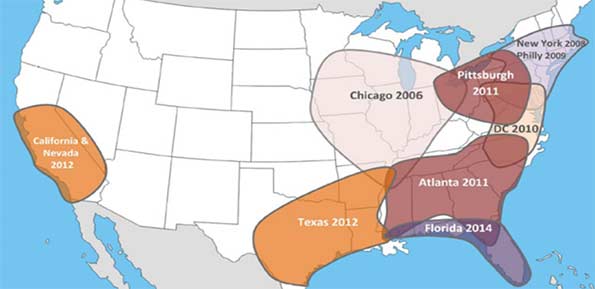
    First, major lines need to allow consumer markets to catch up with previous expansion, which has pushed bus service to regions in which product awareness is relatively low (it often takes three to five years for new service to achieve financial self-sufficiency). The map below illustrates the expansion of hubs by Megabus since it began its US service in 2006 and continued with Florida additions in 2014.


    Development of hubs by Megabus with approximate geographic range of service. Chaddick Institute

    Secondly, as the map shows, many of the most lucrative markets have already been tapped, giving carriers little choice but to focus their efforts on broadening their appeal among the large segment of the public that has been reluctant to give bus travel a try.

    Third, plummeting fuel prices have greatly intensified competition from private vehicles. Average gasoline prices across the US fell from $3.68 a gallon in July 2014 to just over $2 last month, negating some advantages of fuel-efficient modes. Double-decker buses with heavy loads can easily achieve 200 passenger miles per gallon. On a 250 mile round-trip, these falling prices have reduced the relative cost of driving by about $25 per passenger. That’s a big change to overcome!

    Carriers retained momentum by working to make coach travel more appealing. Greyhound introduced OnTouch©, allowing passengers to surf for information about tourist attractions, theatrical events, and ridesharing services at their destination using the bus’ Wi-Fi system. The carrier also launched BusTracker, which provides updates every one to four minutes on a bus’s location and expected arrival time.

    Megabus created a reserved seating program that allows passengers to select particular seats — including table spots — when buying tickets, generally for $5 or less. As recently as a decade ago, almost all US bus passengers were denied even having a guaranteed seat, much less a particular seat, on a selected departure. This uncertainty compelled many to arrive at the station at least an hour ahead to stand in line. Now, passengers can arrive at the last moment with their preferred seat awaiting them.

    New business-class services, meanwhile, popped up, linking New York City to Ithaca (on both Chaddick Institute for Metropolitan Development and Professor of Public Service at DePaul University in Chicago.

    Flickr Photo by Richard Masoner / Cyclelicious

  • Discount Airlines: The Cheap Seats Challenge

    Market forces in the airline business are, for the moment, a battle between state-owned carriers like Alitalia and Aeroflot, and start-up discounters like Ryanair and AirAsia. The conflict between state monopolies and under-capitalized start-ups is a perfect metaphor for the economic debates over subsidies and competition that divide much of the industrial world in America, Europe, and Asia. When my dreams come true, carriers like these will encircle the globe with two-hour, $49 short-hop flights.

    With the Internet marketing sky-high seats in real time, travel pricing has become an endless bazaar. Airborne seats are one futures market that everyone understands. For the moment, there’s no clear winner in these fare/service battles, although many state airline companies are functionally bankrupt. The monopolists fly the latest jets and check bags without ransom payments, while the discounters, going nearly everywhere (Pristina, Erbil, Kochi, and Perth are among their many stops), find leg room, hungry passengers, and reclining seats annoying.

    For now, don’t expect the large airlines to cave in to the budget carriers. Competitive round-the-world tickets, using established airlines, can be found for about $1500-2000, although only for about $3000 can you visit all the places that may interest you and still move around the world.

    Is it possible to travel around the world using only one-way, discount airlines? To try, I would start by heading east — from my home in Switzerland — to Dubai or its suburb, Sharjah, a hub of low-cost carriers. Wizz Airlines, an Eastern European carrier, can get me there for less than $100, although it means a connection in Cluj-Napoca, the capital of Transylvania.

    For a little more money, I could trade my Romania stopover for Istanbul’s Sabiha Gökçen International Airport (way out of town), and get to the Persian Gulf on Pegasus, a Turkish low-cost airline that links Europe to the Middle East; use it to get to Baku, Tehran or Turkish Cyprus.

    From Dubai, the trick is to find a Middle Eastern budget airline — Air Arabia and flydubai are two of my preferred magic carpets — that overlaps with the vast network of Asian low-cost carriers, which include, among many others, Air Asia, Cebu Pacific, and Jetstar.

    India and Sri Lanka offer a few of the “crossover airports,” where I could change, say, from flydubai ($120 to Colombo) and enter Air Asia’s low-cost paradise ($80 to go on to Kuala Lumpur).

    Fortunately, nearly every Asian country — especially India, Malaysia, Singapore, Hong Kong, South Korea, Australia, and the Philippines — is a discount hub. For less than $300 it is easy to go from Delhi to Japan on lines such as Tiger, Vanilla, IndiGo, and Lion. You will have to change somewhere, but that provides a chance to stretch cramped legs or visit Chittagong.

    It is somewhere way east of Suez that my round-the-world discount dreams start to blur.

    The Pacific Ocean does not lend itself to puddle-jumping airlines. The only ‘local’ among the long-haul trans-Pacific flights is United Airlines #155, which in leisurely fashion connects Guam (get there on Cebu Pacific for pocket change) to Honolulu, with stops in Truk, Pohnpei, Kosrae, Kwajalein, and Majuro, atolls that the Marines liberated in World War II.

    Air Micronesia (affectionately “Air Mike”) used to fly this mail run across the central Pacific, but that carrier became Continental and now is part of United, which no one will ever confuse with a low-cost carrier. As best as I can determine, just to fly from Guam to Honolulu on the island hopper would cost about $1500, which is a lesson in monopoly pricing.

    Without a discount airline to get across the Pacific, the only option is to search for one-way tickets on established airlines, which sometimes offer fares for about $400 to $500.

    Technically, these airlines are not discounters and many of the cheap trans-Pacific fares involve cumbersome changes en route; low-fare-paying customers are routed on emptier flights. Some Pacific layovers are for about nineteen hours in places like Wuhan or Incheon.

    Once you are in Los Angeles or San Francisco (LAX is the cheaper option), it’s easy to embrace the discount networks of JetBlue ($159 in mid-January) or Southwest ($147) to hop across the United States.

    One-way trans-Atlantic plane tickets are expensive. Generally, on the big carriers they cost the same as a round-trip tickets, sometimes more. To get home to Europe on a budget, my two best choices involve Scandinavia and Iceland.

    Norwegian is a low-cost airline that has one-way flights for about $300 from New York to London Gatwick, Oslo and Copenhagen, and then connections into a wide European network.

    The cheaper option is WOW, an Icelandic discounter that flies from Boston to the continent with a stop in Reykjavik (okay, you purists, Keflavik).

    In mid-winter, WOW can take me across the Atlantic, although not back home to Geneva, for less than $200. To get home I would then be at the mercy of EasyJet, which is technically a low-cost airline but, to my mind, a full-cost baggage hauler, which charges crazy prices for checked luggage, with its rudeness toward paying customers thrown in for free.

    On a direct line north of the equator, this trip might have cost me $1500, and would have taken me, depending on a few choices, through Romania (Cluj-Napoca), Dubai, Colombo (Sri Lanka), Malaysia (Kuala Lumpur), Seoul, Wuhan (China), Los Angeles, New York, Boston, Reykjavik, and Copenhagen. The total time in the air would have been about fifty hours.

    For most of us it would be the trip of a lifetime, and it can be done for less than $1500, provided you are not checking a bag.

    What could go wrong? The exposed flank in my travel plans is the Pacific Ocean. Only by plugging and playing with a lot of combinations of cities and dates can I find those one-way $400-500 fares. They only show up briefly on carriers such as Evergreen, Korean, or Air China, and just as quickly vanish.

    Try as hard as I have, I cannot find a discount Russian airline, not even the alluring S7 or Yakutia, to make the land bridge from Siberia across the Bering Strait to Alaska. Even if I did get to Anchorage I would be out of luck finding a cheap airline to the lower forty-eight, except to Minnesota in mid-summer, on something called Sun Country.

    Nor have I been able to find local airlines to take me across the South Pacific on, say, the path Ahab took in Moby-Dick. Fiji Airlines has some promise, but gouges whenever the opportunity arises. Jetstar, owned by Qantas, does make it possible to fly for relatively low cost between Cambodia and New Zealand. So, for now, the trans-Pacific discount trail grows cold after Fiji. Although I can think of worse places, including Cluj-Napoca, to run out of gas.

    Matthew Stevenson, a contributing editor of Harper’s Magazine, is the author most recently of Remembering the Twentieth Century Limited, a collection of historical travel essays, and Whistle-Stopping America. His next book, Reading the Rails, will be published in 2016. He lives in Switzerland.

    Flickr Photo by dreamcatcher-68: Wizz Air HA-LWF Airbus Z320-232.
  • Live from Honolulu: HART Rail, a Megaproject Failure in the Making

    Typically very few people pay attention to the goings on in the small state of Hawaii. How bad can possibly things get there? Well, a lot of people recall Boston’s Big Dig, the nation’s largest infrastructure fiasco with a final price tag of about $15 billion. What if I tell you that tiny Honolulu is building a rail system that’s expected to cost at least one-half the cost of the Big Dig? On a per-capita basis it would be the nation’s largest infrastructure fiasco by far.

    Honolulu rail, managed by Honolulu Area Rapid Transit (HART), is a 1970s style 20 mile, all-elevated heavy-rail guideway with third rail power delivery and light rail-sized cars limited to about 650 passengers per two-car combination; it has an ability to run only up to four cars for peak period service. It is the worst design possible because it combines an intrusive and expensive infrastructure including 21 elevated stations, and a low passenger carrying capacity with over 60% of it as standing passengers.

    Despite the preponderance of evidence that Honolulu’s rail will do little to mitigate the severe congestion on the island of Oahu, the project did garner marginal (50.6%) public support on a 2008 referendum. Despite a couple major lawsuits, it completed the Federal Full Funding Grant Agreement process in 2012.  Local political preference (e.g., why build a $1 Billion taxpayer project when you can get away with a $5 Billion project? … also known as “the gravy train”) stands among the major causes of this megaproject failure in progress.

    What’s a megaproject failure? An infrastructure project that exhibits at least two out of three bad outcomes: 1) Large cost overruns, 2) Long project delivery delays, and 3) Much lower usage than forecast.  Well known megaproject failures include the Chunnel Tunnel/Eurotunnel that suffered all three failures, and Boston’s Big Dig that suffered failures 1 and 2 in a big way. Tren Urbano in San Juan, Puerto Rico is a peer project that HART rail will likely match in failure-to-meet-targets. Tren Urbano’s actual construction cost was 80% over the planned estimate, and its ridership has been only one quarter of what was projected! HART rail and Tren Urbano were planned by the same consultant (PB) and had the same oversight (FTA.)

    At the end of 2015, five miles of the HART guideway, and the rail yard appear to be substantially complete. HART, the voter approved “independent authority” that runs the project with many of its budget strings controlled by the city council, claimed a 25% project completion in December 2015, although 15% is a more realistic estimate based on what has been physically constructed so far. Several segments and columns have suffered large cracks, concrete delamination and segment misalignment [1], and safety lapses were alleged at the Ansaldo rail yard [2]. In less than two years, the guideway construction company (Kiewit) submitted 40 work change orders and recently demanded a $20 million price adjustment. But this is nothing compared to the total escalation of cost figures.

    First, let’s review some highlights of the project’s development between 2004 and 2015.

    • 2004: Newly elected mayor Hannemann asserts that 34 miles of rail will cost $2.7 Billion.
    • Mid-2006: Hannemann switches to the Minimum Operating Segment: 20 miles will cost about $3 B.
    • Late-2006: Alternatives Analysis sets the cost at $4.6 B (this figure and all figures below include FTA-mandated contingency funds).
    • Spring 2008: Hawaii legislature approves a 0.5% tack-on to Hawaii’s GET tax that applies to every transaction. Against expectations, Republican Governor Linda Lingle opted to save her political career and let the tax stand without a veto. The rail tax is expected to generate about $2 B. The gravy train has thus been established.
    • Summer 2008: Mayor Hannemann up for reelection gives a helicopter ride to Senator Oberstar who then says that the Feds will give Honolulu $900 M. Hannemann declares that “the train has left the station.”
    • 2009: President pro tempore Senator Inouye of Hawaii joins the rail party. FTA is strong-armed to pay $1.55 B.
    • 2010: The cost is up to $5.4 Billion not counting the error of locating an insufficient distance from an airport runway. A $150 M realignment is necessary to reroute the guideway one block over.
    • 2010: Outgoing Governor Linda Lingle releases an independent financial analysis of the project by IMG and Thomas Rubin which concluded that construction cost will likely be more than the $5.4 B projection, ridership projections were both very high and would require passenger loads significantly higher than that of any U.S. transit operator, future rail renewal and replacement costs were ignored, operating subsidies were significantly understated, and many projected revenues were significantly overstated.  Mayor Carlisle dismissed the report as “a product of rail opponents.”
    • 2011: Mayor Carlisle performs a “ceremonial groundbreaking” but only utility relocation occurs afterwards. The project still aims for a 2019 completion.
    • 2012: Both a National Environmental Policy Act (NEPA) and a Hawaiian burial ground desecration lawsuit are filed, the former in federal court the latter in state court. Only the second lawsuit causes minor construction restrictions in areas where archeological surveys had not been done.
    • 2012: Construction accelerates at the casting yard and the first piers appear in the middle of prime agricultural land. The first four miles of the project are on agricultural land. Carlisle loses in the primary. Two Democrats, Kirk Caldwell (pro rail) wins the mayor race over past governor Ben Cayetano (anti rail.) Although some frame it as another victory for the rail project, Cayetano’s battles with unions during his eight years in the governor’s office were a major cause of his loss.
    • Mid-2014: 9th Circuit court appeal ends unsuccessfully for the plaintiffs of a NEPA-based suit.
    • December 2014: HART reveals a $910 projected deficit and asks for more tax monies.
    • December 2015: HART proposes to open 10 miles of service in 2018.

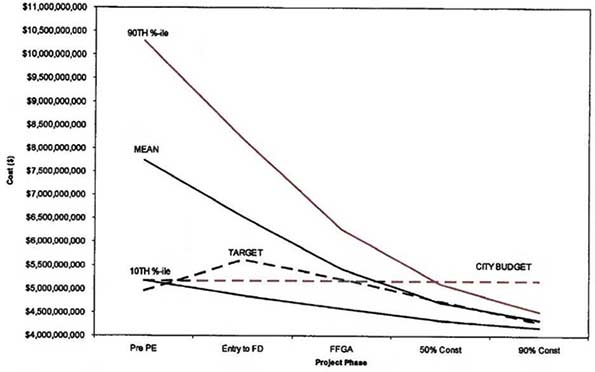
    One of the flaws in megaproject development is strategic misrepresentation, or cleverly worded lying to the public and decision makers such as the HART board members and the Honolulu city council members, none of whom have any expertise in large infrastructure projects and rail in particular. Project advocates such as the FTA turned a blind eye to facts and in 2009 they presented to the people of Hawaii Figure 1, a gem of strategic misrepresentation [4] which simply fit the political line that the proposed 20-mile rail will cost $4.6 billion as applicable during the 2008 rail referendum.  Notice that the FTA cost development in Figure 1, line labeled MEAN, goes against decades of real world evidence of a project’s cost escalation as it moves from planning to construction (e.g., Dr. Bent Flybjerg’s summaries of infrastructure megaprojects [3]). This FTA-sponsored report contains one point of truth: There is a 10% chance that HART rail will cost about $10 B.


    Figure 1. HART expected cost over time.

    One would think that only three years into construction, with only about 15% of the project completed and only about half of the project gone to bid, HART would be sitting comfortably on a pile of money generated by a general excise tax surcharge being collected since 2007 (about $140 M per year) plus $1.55 B from the full funding grant agreement. Nothing could be further from the truth. In late 2014 HART announced a $910 M expected shortfall and successfully lobbied the Hawaii legislature to extend the 0.5% surcharge from end of 2022 to end of 2027.

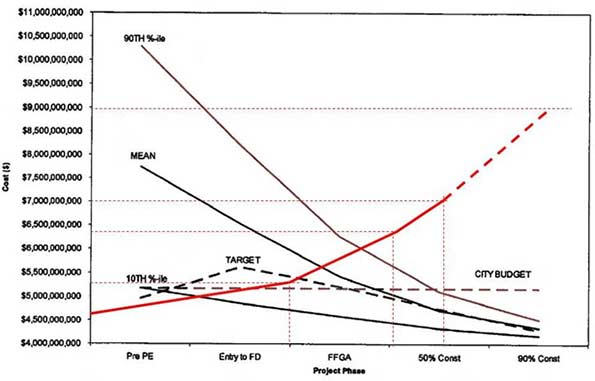
    In another move of strategic misrepresentation, rail planners pretended that the rail is like an electric car, e.g., one buys an EV, then goes homes and plugs it in. Likewise, HART builds rail, which plugs into the city grid for free.  However, rail’s 30 MW to 50 MW power draw is a major requirement. The utility’s reaction was unpleasant for HART [5] which is now negotiating another expensive arrangement. The combined cost of substations, power generation and the (still in limbo) airport utility relocation tasks are likely to cost about $500 M bringing the known total to approximately $7 B with none of the 21 stations constructed nor the second half of the project gone to bid.

    HART rail’s cost development is plotted in Figure 2. The second half of the project includes the challenging construction through urban Honolulu which is one of the densest US cities. There are now peripheral discussions to terminate the project at a large transit bus and handicapped van terminal at Middle Street, which is approximately at the 16th mile of the rail route. This is a welcome possibility because Honolulu will be spared of the heavy construction and debilitating lane and road closures at its downtown and near Waikiki which will be deleterious to general economic activity and tourism.


    Figure 2. Actual and expected cost plot.

    As the project cost creeps above $7 B (for a city of just one million people), with an expected payoff of about 1% in congestion reduction [6], and the dramatic re-arrangement of TheBus as a feeder to the rail [7], one can begin to outline some of the major consequences such as:

    • Minimal ridership like Tren Urbano in San Juan, PR. Furthermore, San Juan’s average income and auto ownership are much lower to those of Honolulu (i.e., Honolulu has far fewer transit dependent commuters than San Juan.)
    • Destruction of prime agricultural land on Oahu. After years in legal battles, the state Supreme Court approved B.R. Horton’s proposed 12,000 suburban Ho’opili development which includes two rail stations. Although HART makes a big deal out of Transit Oriented Development, Horton’s own EIS reveals that each station will generate the equivalent of only two busloads of passengers for the rail in the peak hour. This approval is proof that development that does not pass traffic congestion standards simply gets … a rail pass.
    • The huge opportunity cost. With $7 B and counting, Honolulu could have actually reduced traffic congestion by more than 25% and reduced its dependency on oil by over 40%. Honolulu burns oil to produce electric power and as a result its electricity cost is 300% above US average. Instead of switching power generation and fleet fueling to natural gas, island policies emphasize oil-generated electric cars and electric trains!

    Finally, looking at the bigger picture for Honolulu which includes a $5 B consent decree with the EPA for secondary sewer treatment, increasing dependency on imports, including 90% of food, with prices escalated by the Jones Act requirements, and the nation’s fifth worst unfunded pension liability according to The Economist [8], the future is worrisome: At best Honolulu will experience large increases in taxes and congestion, at worst those plus bankruptcy.  One thing is certain.  This textbook megaproject failure orchestrated by business interests and unions, supported by misguided environmentalism and enabled by enterprising politicians got Honolulu railroaded [9].

    Panos D. Prevedouros is Professor and Chair, Department of Civil and Environmental Engineering, University of Hawaii at Manoa.

    Photo by super-structure (Jason Coleman), “Honolulu Murals”.

    REFERENCES AND CLARIFICATIONS
    [1] HawaiiNewsNow, Large Cracks Develop along Rail Line, http://www.hawaiinewsnow.com/story/28827333/large-cracks-develop-along-rail-line, 2015.
    [2] HawaiiNewsNow, Rail Whistleblower Suit Filed, http://www.hawaiinewsnow.com/story/30203942/exclusive-rail-whistleblower-suit-filed, 2015.
    [3] Bent Flyvbjerg, et al. Delusion and Deception in Large Infrastructure Projects: Two Models for Explaining and Preventing Executive Disaster, California Management Review Vol. 51, No. 2 Winter 2009.
    [4] FTA, Project Management Oversight Program, Honolulu High-Capacity Transit Corridor Project, July 2009 (Final)
    [5] KHON2, Tension Escalates over Rail’s Power Supply and Who Will Pay for It, http://khon2.com/2015/11/11/tension-escalates-over-rails-power-supply-and-who-will-pay-for-it-2/, 2015.
    [6] Past mayors and HART have been eager to misuse the EIS statistic that rail is projected to remove 40,000 cars from the streets.  The actual statistic says that rail may reduce car trips by 40,000. Total car trips on Oahu when rail is completed are projected to be four million.  HART rail may provide a 1% reduction.
    [7] TheBus is one of America’s best bus transit systems and has a 6% commuting trip share in Honolulu. Many of its routes will be eliminated or terminated at HART stations. According to the EIS, the subject routes are: B, C, E, 3, 9, 11, 20, 43, 53, 73, 81, 90, 91, 92, 93, 94, 96, 97, 98A, 101, 102, 103, 201 and 202 many of them are popular peak hour express routes.
    [8] The Economist, Pensioners Are Pushing Many Cities and States towards Financial Crisis, http://www.economist.com/news/united-states/21582282-pensioners-are-pushing-many-cities-and-states-towards-financial-crisis-who-pays-bill, 2013.
    [9] Randy T. Simmons, et al., Bootleggers, Baptists, and Political Entrepreneurs: Key Players in the Rational Game and Morality Play of Regulatory Politics, The Independent Review, v. 15, n. 3, Winter 2011.

  • Urban Residents Aren’t Abandoning Buses; Buses Are Abandoning Them

    “Pity the poor city bus,” writes Jacob Anbinder in an interesting essay at The Century Foundation’s website. Anbinder brings some of his own data to a finding that’s been bouncing around the web for a while: that even as American subways and light rail systems experience a renaissance across the country, bus ridership has been falling nationally since the start of the Great Recession.

    But it’s not buses that are being abandoned. It’s bus riders.

    The drop in bus ridership over the last several years has been mirrored by a decline in bus service, even as transit agencies have managed to resume increasing frequency and hours on all types of rail lines – heavy, light, and commuter.* (In this post, “service” means vehicle revenue miles – literally, multiplying a city’s bus or rail vehicles by the number of miles they run on their routes.) After a post-recession low in 2011, by 2013 rail service had increased by over 4% nationally in urban areas of at least one million people. Light rail in particular has continued its decade-plus boom, with a service increase of more than 12% in just two years. By contrast, bus service – which already took a heavier hit in the first years of the recession – was cut an additional 5.8%.


    And it turns out that when you disaggregate the national data by urban area, there’s a very tight relationship between places that cut bus service between 2000 and 2013 and those that saw the largest drops in ridership. If you live in a city where bus service has been increased, it’s likely that your city has actually grown its bus ridership, despite the national trends. In other words, the problem doesn’t seem to be that bus riders are deciding they’d rather just walk, bike, or take their city’s new light rail line. It’s that too many cities are cutting bus service to the point that people are giving up on it.


    Admittedly, this is a crude way to demonstrate a very complicated relationship. To rigorously test the impact of bus service on ridership, you’d want to take into account all sorts of other things: the presence of other transit services; population density; gas prices; demographics; and so on.

    Fortunately, we don’t have to do that, because researchers at San Jose State University’s Mineta Transportation Institute just did it for us. And they found that even if you control for those other factors, service levels are still the number one predictor of bus ridership.

    Still, I can imagine two big objections to the idea that cuts to bus operations are behind ridership declines. First, a lot of cities have opened new rail lines since 2000 – many of which, if not most, replaced heavily-trafficked bus routes. In those cases, cities are adding rail service and reducing bus service, but it obviously wouldn’t be right to say that those bus riders are being abandoned.

    But while that has surely happened in some places, it just doesn’t match the overall data. Rail service, including new lines, has been booming since long before the recession – but up until about 2009, bus service was growing, too, or at least holding steady. If rail expansions were driving bus cuts, you’d expect to see those cuts all the way back to the beginning of the data. But you don’t. Instead, cuts to bus routes appear right as transit funding was hit hard by the recession.

    Second, you might argue that service and ridership are linked, but the other way around: as ridership declines, agencies cut back on hours and frequency to match demand. Teasing out which way the causation runs would be difficult – and the answer would almost certainly include at least some examples in both directions. One quick-and-dirty way to get an idea, though, is to compare ridership changes from one year to service changes in the next year. If agencies cut service because of earlier ridership declines, then you’d expect to see that places with larger drops in ridership in “Year One” tend to be the places with larger cuts to service in “Year Two.”


    But, again, they don’t. In fact, just 3% of the variation in service cuts is explained by ridership changes from the year before.

    So while that’s hardly ironclad – and I look forward to further research that sheds more light on this problem – it does appear that a major part of the divergence in bus and rail ridership is a result of a divergence in bus and rail service: since the recession, transit agencies have cut bus service year after year, while returning service to rail relatively quickly.

    Why did they do that? I don’t know. But I can speculate that it has something to do with the fact that bus transit supporters are not always the same kinds of people as rail transit supporters. Even though more people take buses than trains in nearly every metropolitan area in the country, train riders, on average, tend to bewealthier and whiter. Not only that, but many civic and business leaders who don’t use transit at all are heavily invested in rail service as an economic development catalyst for central city neighborhoods. In other words, rail tends to have a more politically powerful constituency behind it than buses.

    As a result, when the recession blew a hole in transit budgets around the country, it may have been politically easier for local governments to fill those holes by sustaining cuts to bus lines, rather than rail.

    To be clear, the problem here has nothing to do with whether transit agencies are running more services that are rubber-on-asphalt or steel-on-tracks. As Jarrett Walker has eloquently argued, the technology used by a particular line matters far less than the quality of service: how often it runs, how quickly, for how much of the day.

    But there are at least two problems here. First, because of the spread-out nature of even relatively dense American cities, it will be a very, very long time before rail transit can connect truly large numbers of people to large numbers of jobs and amenities. When Minneapolis opened the 12-mile Blue Line light rail in 2004, for example, it was a major step forward for Twin Cities transit – but still, only 2% of the region’s population lived close enough to walk to one of the stations. For everyone else, transit still meant taking the bus, even if they were taking the bus to a train station.

    And even in places with well-developed rail networks, those systems are usually oriented to serve downtown commuters. Especially in outer neighborhoods, crosstown trips in places like Chicago, Boston, or DC are heavily reliant on buses. Abandoning buses means abandoning those trips, and the people who depend on them.


    Boston's T reaches both Dorchester and Jamaica Plain, but a bus is by far the easiest way to get from one to the other on transit. Credit: Google Maps
    Boston’s T reaches both Dorchester and Jamaica Plain, but a bus is by far the easiest way to get from one to the other on transit. Credit: Google Maps


    Second, there are serious equity issues with shifting resources from bus to rail – again, not because of anything inherent to those technologies, but simply because of who happens to use them in modern American cities. In most cases, shifting funding from bus to rail means shifting funding from services disproportionately used by lower-income people to ones with with a stronger middle- and upper-middle-class constituency. And while transit ought to be viewed as much more than just a service for the poor, we can’t ignore the equity impacts of transit policy.

    In light of all this, we have to stop talking about America’s bus woes as a ridership problem. All the evidence suggests that when service is strong, and buses are a reliable way to get to work, school, or the grocery store, people will take them. Instead, the problem is that fewer and fewer people have access to that kind of strong bus line. If we care about ridership, we need to restore and enhance the kind of transit services that people can rely on.

    * “Heavy rail” includes traditional subways and elevated trains found in cities like New York, Washington, and Chicago. “Light rail” includes many newer systems, with smaller train sets that are sometimes designed to run on streets as well as in their own right of way. Rail lines in Seattle, the Twin Cities, and Dallas are typical of light rail. “Commuter rail” services generally reach from central business districts far out into the suburbs, and are meant almost exclusively for peak-hour workers.

    This piece was first published by City Observatory on its CityCommentary blog.

    Daniel Kay Hertz is completing his graduate studies at the University of Chicago Harris School of Public Policy. He has written about urban demographics, neighborhood change, housing policy, and public transit for the Washington Post, CityLab, Next City, and other publications, as well as on his personal blog.

    Image from BigStockPhoto.com: A metro bus in Madison, Wisconsin.