Tag: unemployment

  • The 2012 Year in Unemployment

    I recently looked at the changes in jobs in metro areas for 2012. Here’s a follow-on look at unemployment. First a look at the national unemployment rate picture, which has improved remarkably.
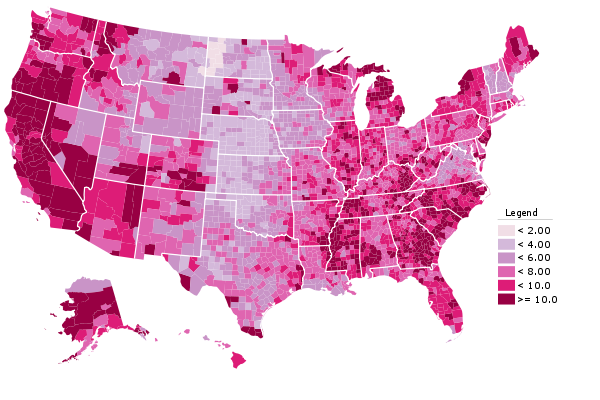


    2012 Unemployment Rate by County

    To put this in perspective, here’s the corresponding map for 2009:
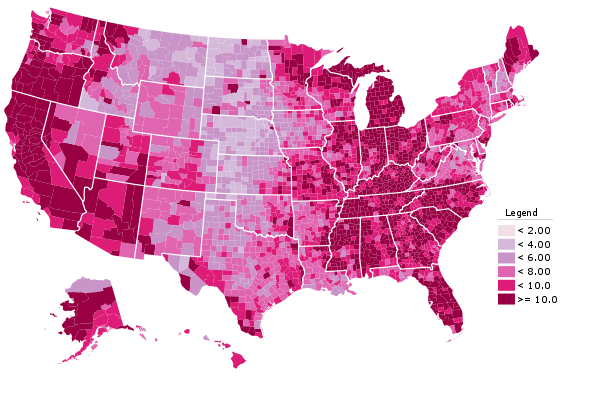


    2009 Unemployment Rate by County

    It’s interesting to see where there has been improvement versus where there hasn’t, though I stop thresholding at 10% so that if people we well above it but dropped to just merely above it, my maps wouldn’t show that improvement.

    Here’s a look at the large metro areas, ranked by total decline in unemployment rate.

    Rank by Total Improvement Metro Area 2011 2012 Total Change
    1 Las Vegas-Paradise, NV 13.5 11.2 -2.3
    2 Orlando-Kissimmee-Sanford, FL 10.2 8.4 -1.8
    3 Tampa-St. Petersburg-Clearwater, FL 10.6 8.8 -1.8
    4 Miami-Fort Lauderdale-Pompano Beach, FL 10.2 8.5 -1.7
    5 Jacksonville, FL 9.9 8.3 -1.6
    6 Sacramento–Arden-Arcade–Roseville, CA 11.9 10.4 -1.5
    7 Birmingham-Hoover, AL 7.9 6.4 -1.5
    8 Cincinnati-Middletown, OH-KY-IN 8.6 7.1 -1.5
    9 Riverside-San Bernardino-Ontario, CA 13.6 12.1 -1.5
    10 Nashville-Davidson–Murfreesboro–Franklin, TN 8.1 6.6 -1.5
    11 Louisville/Jefferson County, KY-IN 9.7 8.3 -1.4
    12 San Jose-Sunnyvale-Santa Clara, CA 10.0 8.6 -1.4
    13 Columbus, OH 7.5 6.1 -1.4
    14 Kansas City, MO-KS 8.0 6.6 -1.4
    15 Houston-Sugar Land-Baytown, TX 8.1 6.8 -1.3
    16 Charlotte-Gastonia-Rock Hill, NC-SC 10.8 9.5 -1.3
    17 Seattle-Tacoma-Bellevue, WA 8.7 7.4 -1.3
    18 San Francisco-Oakland-Fremont, CA 9.4 8.1 -1.3
    19 Los Angeles-Long Beach-Santa Ana, CA 11.4 10.1 -1.3
    20 Salt Lake City, UT 6.7 5.5 -1.2
    21 Phoenix-Mesa-Glendale, AZ 8.5 7.3 -1.2
    22 St. Louis, MO-IL 8.8 7.6 -1.2
    23 Dallas-Fort Worth-Arlington, TX 7.8 6.7 -1.1
    24 San Diego-Carlsbad-San Marcos, CA 10.0 8.9 -1.1
    25 Detroit-Warren-Livonia, MI 11.6 10.5 -1.1
    26 Portland-Vancouver-Hillsboro, OR-WA 9.3 8.2 -1.1
    27 Atlanta-Sandy Springs-Marietta, GA 9.8 8.8 -1.0
    28 Austin-Round Rock-San Marcos, TX 6.8 5.8 -1.0
    29 San Antonio-New Braunfels, TX 7.5 6.5 -1.0
    30 Memphis, TN-MS-AR 10.0 9.0 -1.0
    31 Chicago-Joliet-Naperville, IL-IN-WI 9.8 8.9 -0.9
    32 Minneapolis-St. Paul-Bloomington, MN-WI 6.3 5.5 -0.8
    33 Raleigh-Cary, NC 8.5 7.7 -0.8
    34 Providence-Fall River-Warwick, RI-MA – Metro 11.1 10.3 -0.8
    35 Richmond, VA 7.1 6.4 -0.7
    36 New Orleans-Metairie-Kenner, LA 7.2 6.5 -0.7
    37 Cleveland-Elyria-Mentor, OH 7.8 7.1 -0.7
    38 Oklahoma City, OK 5.5 4.8 -0.7
    39 Denver-Aurora-Broomfield, CO 8.6 7.9 -0.7
    40 Hartford-West Hartford-East Hartford, CT – Metro 9.0 8.4 -0.6
    41 Milwaukee-Waukesha-West Allis, WI 8.0 7.4 -0.6
    42 Indianapolis-Carmel, IN 8.4 7.8 -0.6
    43 Baltimore-Towson, MD 7.7 7.2 -0.5
    44 Virginia Beach-Norfolk-Newport News, VA-NC 7.1 6.6 -0.5
    45 Boston-Cambridge-Quincy, MA-NH – Metro 6.6 6.1 -0.5
    46 Washington-Arlington-Alexandria, DC-VA-MD-WV 6.0 5.6 -0.4
    47 Philadelphia-Camden-Wilmington, PA-NJ-DE-MD 8.6 8.6 0.0
    48 Pittsburgh, PA 7.2 7.2 0.0
    49 New York-Northern New Jersey-Long Island, NY-NJ-PA 8.6 8.8 0.2
    50 Rochester, NY 7.8 8.1 0.3
    51 Buffalo-Niagara Falls, NY 8.1 8.5 0.4
  • Last of the Bohemians

    When I moved to Los Angeles 30 years ago, Ocean Front Walk in Venice Beach looked like a hippie parody.  It had a counter-cultural veneer, but didn’t rate as an authentic bohemian hot spot.

    Contrast, for example, with New York’s East Village with its revolutionaries, junkies, artists and various iconoclasts living side-by-side.

    The weekend spectacle at Venice – vendors, performers and “street people” showing off to crowds of tourists – struck me as self-conscious and phony. Plus, I could never call Ocean Front Walk a “board walk” because (unlike Brighton Beach and Coney Island) there was No Board.

    Since then, of course, New York has been “cleaned up.” Now Tompkins Square is family-friendly and the old walk-ups are inhabited by urban professionals worried about layoffs and declining property values.

    Times have changed.  The gulf between haves and have-nots is widening.  Living on the edge is not just a life-style choice.  “Drop-outs” need somewhere to go.

    These days I see Ocean Front Walk in Venice as more a refuge than a counter-cultural carnival.  With overnighters climbing out of their sleeping bags each morning, it’s a pretty good location for people without money.

    Where else should they live?

    I understand why local residents are advocating that something be done to make Ocean Front Walk safer and more sanitary.  With some calling for a police “crack down.”

    But now that the “tune-in, turn-on, drop-out” sub-culture is a history text book sidebar, I’m glad there is, at least, someplace warm for the dispossessed to hang out.

    Here at Venice Beach, where the continental U.S. ends, could be the last stop for these new bohemians.

  • The Hardest Job To Fill In 2012? A Look At The Supply of Web Developers

    Keith Cline at Inc.com has a fresh look at one of the enduring, and perplexing, stories of 2011 — the skills shortage. Even with 13.3 million Americans unemployed, and millions more underemployed, there are industries severely lacking in skilled talent.

    Cline provided five loose job titles/duties that employers will have a hard time filling as 2012 starts. Chief among them: software engineers and web developers.

    Writes Cline, “The demand for top-tier engineering talent sharply outweighs the supply in almost every market especially in San Francisco, New York, and Boston.  This is a major, major pain point and problem that almost every company is facing, regardless of the technology ‘stack’ their engineers are working on.”

    Exacerbating the apparent problem is that the four other job areas that Cline mentions are often related to high-tech industries and web development — creative design/user experience, product management (particularly of the consumer web/e-commerce/mobile variety), web-savvy marketing, and analytics.

    But is there really a skill shortage in these areas across the US, or is it a matter of firms not wanting to budge on wages? As Brian Kelsey recently pointed out, “A talent shortage, and a talent shortage at the wages you are willing to pay, are usually two separate issues.”

    Let’s focus on web developers, and see what job and wage trends show. Working with EMSI’s occupation data, which is based on classifications from the Bureau of Labor Statistics, there are three primary job codes for developers: 1) computer programmers; 2) software developers, applications; and 3) software developers, systems software.

    According to EMSI’s most recent figures, software developers have performed better in the job market than computer programmers. Software developer jobs have been steadily growing nationally in recent years — after a dip in 2008 — while computer programmer jobs (the blue line in the chart below) have been stagnant or in decline since the economic downturn.

    On average nationally, these jobs pay between $33 per hour (for programmers) and $44 per hour (for systems software developers). The top 10 percent of workers in these fields make on average $51 to $64 per hour. Among the largest 100 metro areas in the US, San Jose ($55.48), Bridgeport, Conn. ($49.48), and Boston ($46.58) pay the highest median earnings for developers.

    These are solid baseline figures. But what about the supply issue?

    One way to determine labor shortages is by analyzing historic wages, coupled with employment trends, for an occupation; if wages are increasing over time, that’s a good sign of unmet demand in the market and hence, a shortage. The reason: demand from employers for additional workers would be so great that it would push up wages.

    We looked at median earnings for programmers and computer software engineers from 2000-2010 using the BLS’ Current Population Survey (CPS) dataset, a monthly survey of US households. Adjusted for inflation, CPS data* shows programmers’ wages have essentially been flat (2% growth) since 2000. It’s a different story for software engineers; their wages increased 13% from 2000 to 2010.

    But for both programmers and software engineers, real wages have declined since 2004. This make sense given the stagnant employment picture for programmers. Yet for software engineers, employment has increased more than 6% since 2009 while wages have held steady in recent years.

    If there is indeed the major undersupply that Cline and others have argued, wages would not be stagnant but continuing to rise (and probably rising sharply). That appeared to happen in the early 2000s — but not recently.

    * Note: Current Population Survey wage estimates are different than the above-mentioned hourly earnings that EMSI reports in its complete employment dataset. EMSI’s figures, which include proprietors, come from the BLS’ Occupational Employment Statistics dataset and the Census’ American Community Survey.

  • The Great Plains: An Old Frontier May Hold The Secret to Recovery

    Could the next zone of opportunity exist in the middle of the country? Census unemployment figures seem to signify this notion, especially in the Great Plains.

    State-wise, November 2010 unemployment rates were lowest in North Dakota at 3.6%; South Dakota at 4.6%; Nebraska at 4.9%; Kansas at 6.5%; and Iowa at 6.8%. Compare these numbers to the ever-growing Sunbelt states where unemployment is at its most dismal with Arizona at 9.6%, California at 12.4%, and Nevada at a depressing 14%.

    The top ten cities with the lowest unemployment rates are all found in the Midwest and the Great Plains, with the exception of Burlington, VT and Portsmouth, NH. The strength of the growing, younger manufacturing industry that escaped the huge manufacturing employment declines in the 80s and 90s may be fueling the prosperity in the plains.

    Upon closer inspection of the economies of these cities, a few common denominators are revealed. Health care is a prevailing industry recurrent across many of the cities. Unsurprisingly, agribusiness and manufacturing also dominate, along with insurance services, food processing, and, in some cases, higher education.

    Metromonitor prepared this interesting piece using data from the Bureau of Labor Statistics allowing one to see unemployement rates throughout the Midwest and the Rust Belt that appear to be on the rebound. The bottom map is of particular interest: One year’s growth has shown a decrease in unemployment throughout much of the Rust Belt, while cities in California and Florida consistently flounder. As far as overall performance, many cities in the Midwest – and much of the Great Plains – remain strong out of the recession and are comparable to the sturdy Texan cities that possess surging economies.

    Perhaps these urban centers across the Midwest, and especially the Great Plains, should be viewed as models for effective economic development. Large cities throughout the Great Plains offer integral services not found for miles and serve as regional havens for essential activities such as health care, education, business services, and food processing. Meanwhile, cities with declining industries, exploding real estate prices, and a surplus of workers suffer. Areas such as the Sun Belt, California, Florida, and some Northeastern cities bare the weight of this dilemma. Our focus should rest on the well-grounded economies of the often-ignored flyover states, instead of those on the crumbling coasts.

  • Recessions Destroy Lives

    Thursday a man flew an airplane into the Austin, Texas, IRS Building. The Left claimed he was a “Tea bagger,” their vulgar term for Tea Partiers, apparently because he was anti-government. The Right claimed he was a whacky leftist, apparently because he was critical of Bush. A Muslim group claimed he was a terrorist, apparently because he wasn’t a Muslim.

    They all miss the point, and quite frankly, the attempt to make political points out of personal tragedy is pretty disgusting.

    Today, there is a report of a Moscow, Ohio, man who bulldozed his home before it was foreclosed. No doubt someone somewhere will try to make political hay out of this man’s misfortune. That will be as misguided as the response to the Texas man’s misfortune.

    What these events really do is highlight the human costs of recessions, costs that increase in recession severity and duration. These are the more extreme examples, but the fact is, people’s lives are ruined in recessions. Some working families will suffer a permanent decrease in income. Some of our young people will never recover from a bad start to their working lives. Some families will be destroyed because of financial stress. Some individuals will commit suicide. A few will do things like bulldoze their home or fly into a building.

    To ask how big a problem we have is to ask how many are unemployed and how long have they been unemployed. Here are the numbers as of January 2010:

    • 14.8 million Americans were out of work and looking for a job.
    • 6.3 million Americans had been out of work over six months.
    • 9.3 million Americans were underemployed
    • Over half of unemployed Americans had been out of work for over 19 weeks.
    • The unemployed American’s average unemployment duration was 30 weeks.
    • 4.5 million Americans had left the labor force.

    All of these people deserve our sympathy. They also deserve more from our society and our leaders. Most of them are in their current circumstances through no fault of their own. Even worse, our political class appears to be far more interested in election, reelection, rewarding supporters, partisanship, and political purity than they are in providing the environment for job creation. They have also failed to provide a humane safety net, one that provides at least a minimum standard of living, maintains dignity, and provides appropriate incentives.

  • Riding Out the Recession in the Forty Strongest Metropolitan Economies

    A few days ago BusinessWeek released a list of the top 40 metropolitan economies based on data compiled at the Brookings Institution’s Metromonitor project. But, as many old media sites tend to do, they’ve locked the list behind a slow-loading slide show in a cheap attempt to drum up page views. Many of the commenters to the original article couldn’t even find the list.

    So, in the interest of usability, here’s the top 40 in boring list format:

    1 San Antonio, TX
    2 Austin-Round Rock, TX
    3 Oklahoma City, OK
    4 Little Rock-North Little Rock-Conway, AR
    5 Dallas-Fort Worth-Arlington, TX
    6 Baton Rouge, LA
    7 Tulsa, OK
    8 Omaha-Council Bluffs, NE-IA
    9 Houston-Sugar Land-Baytown, TX
    10 El Paso, TX
    11 Jackson, MS
    12 McAllen-Edinburg-Mission, TX
    13 Washington-Arlington-Alexandria, DC-VA-MD-WV
    14 Columbia, SC
    15 Pittsburgh, PA
    16 Harrisburg-Carlisle, PA
    17 Des Moines-West Des Moines, IA
    18 Virginia Beach-Norfolk-Newport News, VA-NC
    19 Honolulu, HI
    20 Rochester, NY
    21 Buffalo-Niagara Falls, NY
    22 Scranton-Wilkes-Barre, PA
    23 Augusta-Richmond County, GA-SC
    24 Colorado Springs, CO
    25 Madison, WI
    26 Albuquerque, NM
    27 Syracuse, NY
    28 Albany-Schenectady-Troy, NY
    29 Kansas City, MO-KS
    30 Raleigh-Cary, NC
    31 Ogden-Clearfield, UT
    32 Boston-Cambridge-Quincy, MA-NH (tied)
    32 New Haven-Milford, CT (tied)
    33 Bridgeport-Stamford-Norwalk, CT
    34 Denver-Aurora-Broomfield, CO (tied)
    34 Baltimore-Towson, MD (tied)
    35 Poughkeepsie-Newburgh-Middletown, NY
    36 Hartford-West Hartford-East Hartford, CT
    37 Indianapolis-Carmel, IN
    38 Memphis, TN-MS-AR

    Trends? Looks like energy economies, state capitals, university-heavy towns, generally affordable regions that avoided the housing boom, and a few old industrial centers that suffered the brunt of decline 25 years ago and now may be positioned for an up-swing.

    Here’s an explanation of the list methodology:

    The Brookings Institution ranked the 100 largest metros by averaging the ranks for four key indicators: employment change, unemployment change, gross metropolitan product, and home price change. Employment was measured by the change from the peak quarter for each metro to the second quarter of 2009. The peak was the quarter in which the metro had the most jobs during the past five years. Unemployment was ranked by measuring the percentage-point change from the first quarter of 2009 to the second quarter of 2009. Gross metropolitan product was measured from the peak quarter to the second quarter of 2009. And the ranking of home prices compared the second quarter of 2009 to the previous quarter. The employment data were provided by Moody’s Economy.com, the unemployment data were collected from the U.S. Bureau of Labor Statistics, and the home price index came from the Federal Housing Finance Agency.

    Source: The Brookings Institution’s MetroMonitor

  • Don’t Go Looking for Work in California

    The current economic recession has tarnished the Golden State’s employment opportunities in a major way.

    A report released on Sunday by the California Budget Project says that two of five working-age Californians do not have a job.

    The level of unemployment has not been this high since February 1977. In fact, the study found that “California now has the same amount of jobs as it did nine years ago.” The only difference? In 2000, the state was home to 3.3 million fewer working age people than today.

    The nation is not faring much better, as the U.S. Labor Department reported last Friday that the nation’s jobless rate had climbed to 9.7 percent, the highest since 1983. California’s unemployment stands at over 11 percent.

  • Decline in Construction and its Effect on Gender

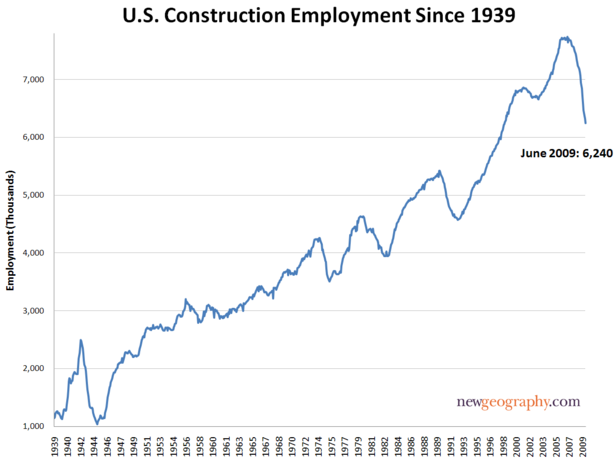
    Unemployment in the construction sector increased by 79,000 in June, according to a report The Associated General Contractors of America released earlier this month. Over the past year, that number has grown to 992,000.

    Even more alarming is the disparity between the construction worker unemployment rate, over 17.4 percent, and the national average for all sectors, around 9.7. Construction employment is crumbling before our eyes.

    The current economic climate has not proven friendly to construction on the whole as state and local revenue continues to decline and little demand for commercial or retail facilities, as well as shrinking orders for new facilities, puts construction in a perilous zone.

    Though as recent as last November, President-elect Obama had conjured up a program to rebuild the nation’s infrastructure.

    The $787 billion American Recovery and Reinvestment Act would modernize roads, bridges, schools, and public transportation – among other things – and reinvigorate the floundering construction and manufacturing industries.

    However, this “shovel ready” stimulus plan did not sit well with women’s groups who wanted nothing to do with a stimulus package that only created jobs for “burly men.”

    These women’s groups seemed to misjudge the president-elects original plan designed to “stop the hemorrhaging in construction and manufacturing while investing in physical infrastructure that is indispensable for long-term economic growth” and instead turned the stimulus into an issue of gender politics. But from the first complaint, onward, the construction and manufacturing industries stood no chance.

    Obama changed his plan, adding health, education, and “other human infrastructure components” to his proposal.

    A report entitled “The Job Impact of the American Recovery and Reinvestment Plan” released on January 10, estimated that the number of jobs created that were likely to go to women was around 42%, a non-too disheartening figure when women “held only 20 percent of the jobs lost in the recession.” The report concluded that the stimulus package would now “skew job creation somewhat towards women.”

    The act was signed into law on February 17 and over the past four and a half months some unfortunate figures have appeared. As noted previously, the construction industry is in a downfall, while there is a growing discrepancy between female unemployment rate (8 percent) and male unemployment rate (10.5 percent) – the highest male-female jobless rate gap in the history of the BLS [Labor Department] data back to 1948.

    All this data, however, has pushed the issue of gender-politics above the issue of human need. Now which group of people should make their voices heard? Let’s hear from women in the construction industry.

  • It’s Not the Economy Stupid: Crime Still Dropping in L.A.

    Unemployment may be at 11.4% in LA County, pundits may mock the dysfunctional state budget system, but crime is still dropping from already historic lows in the City of Los Angeles.

    According to statistics released by the LAPD yesterday, homicides are down a third compared to the first half of last year with violent crime down 6% and assaults down 8%.

    It seems to be received wisdom – I’ll call it pop criminology – that a spike in criminal activity always accompanies an economic crisis and a drop in employment. The recent movie “Public Enemies” milks this association most explicitly, and it may have been more true in the Depression. Overall, however, this is not the case in the U.S. these days and the numbers for property crime in LA also show a decrease: auto thefts fell 17% and property crime 7% overall compared to Jan. 1-June 30, 2008.

    Obviously, the relationship between crime and economic hardship is more complex and requires critical thinking about a host of sociological factors to attempt to explain the causality of crime. But these numbers, and similar findings in other cities, should debunk the common assertion that economic downturns correlate with criminal resurgence.

    The forthcoming book, “When Brute Force Fails” by UCLA Professor Mark Kleiman is an important contribution to the subject which I look forward to reading. It should be read by pop criminologists and criminologists alike.

    For those of you who have incredible interest in the subject, the LA Times Homicide Blog is an interesting resource. Increasingly, strapped papers like the L.A. Times (which recently discontinued its California section, merging it into the main section) are putting content like this on-line.

  • Unemployment Rising in Washington, DC

    In the past month, Washington D.C. has experienced both an increase in number of jobs as well as an increase in unemployment, according to the Washington Post.

    The city’s unemployment rate rose from 9.9 in April to 10.7 percent in May – far surpassing the national average of 9.4 percent – despite gaining about 1,400 jobs primarily with the federal government.

    The District is often considered to be immune to such job market fluctuations because of steady government employment. But as Alice Rivlin, senior fellow at the Brookings Institution, points out, “[D.C.] has plenty of jobs, mostly high-skill jobs that require education beyond high school.”

    The high-paid, higher-skill jobs created within the government are often times given to those not living in the city – Virginia’s unemployment rate: 7.1 percent, Maryland’s: 7.2 percent.

    Job loss has also disproportionately affected the city’s African American population. The predominately white and affluent Ward 3 had an unemployment rate of 2.5 percent in April, far better than the largely poor and black Ward 8, where the rate was 23.3 percent.