Tag: unemployment

  • Mapping US Metropolitan Unemployment Rates, May 2009

    Here’s a quick map of the newly released May 2009 metropolitan area unemployment numbers. On this map, color signifies the rate in May 2009 and size of bubble indicates the rate point change since May of last year. Green dots are below the national unemployment level of 9.1 in May, and red dots are above the national number.
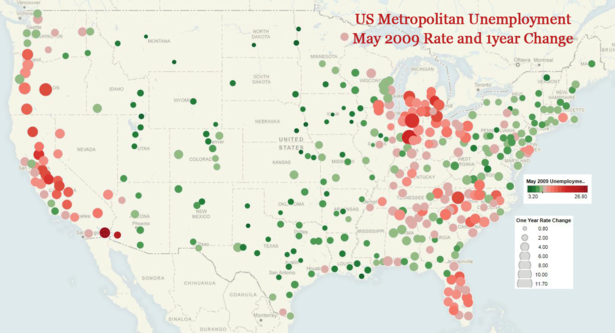
    We can see that highest unemployment is concentrated on the west coast and California, manufacturing dependend Michigan, Indiana, and Ohio, parts of Appalachia, the Carolinas, and Florida.

    Unemployment is increasing the fastest in Kokomo and Elkhart-Goshen, IN; Bend, Eugene, Medford, and Portland, OR; Hickory-Lenoir-Morganton, NC; and Muskegon and Monroe, MI.

    While every metropolitan area of the country saw increased unemployment over May 2008, the Great Plains from Texas to North Dakota, the Mountain West, and parts of New England are still holding employment better than the rest of the nation.

  • Manhattan’s Declining Share of New York City Jobs

    The amount of private sector jobs in Manhattan has been declining since 1958, according to the Center for an Urban Future. An increase in job-spread among the other four boroughs – Queens, Brooklyn, the Bronx, and Staten Island – has led to a shift in the New York City job market.

    Still, Manhattan has the largest slice of the Big Apple job pie with a share of 61.59 % in 2008. This number has fallen about 6 percentage points over the past 5 decades. In 1958 Manhattan had a hefty 67.59% share of private sector jobs.

    Needless to say, as Manhattan’s shares have declined, the other borough’s collective shares have increased overall. However, Queens has grown to eclipse Brooklyn with the second largest share in 1978 and has yet to rescind the title. Queens share of private sector jobs sits at 15.07%, while Brooklyn has a 14.09% share. From 1958 to 2008, the Bronx’s share has increased from 5.36% to 6.50% while Staten Island’s share has grown from a minute 0.75% to 2.76%.

    This shift away from the city’s traditional financial sector of Manhattan can seem alarming to those not living in the Outer Boroughs. However, Manhattan-ites can take comfort in the fact that the city’s unemployment rate remains slightly lower than the national average.

  • Report on the Jobless Recovery: 18.7% Effective Unemployment Rate in May

    Is the recent talk of “green shoots” coming out of this recession realistic? A recent report from the New America Foundation outlines the strong likelihood of a jobless recession that “could perpetuate the crises in the housing and banking sectors and prevent a sustainable and healthy economic recovery.” A jobless recovery will prevent the wage growth necessary to stimulate business investment, maintain consumption, and pay down debt.

    The report outlines a constructed measure of effective employment: BLS’s measurement of unemployed, 2.2 million marginally attached workers, and 9.1 million workers employed part time only because they can’t find full time work plus another 4.4 million Americans who want to work but gave up the search over a year ago. This results in an 18.68% effective unemployment rate.

    Other highlights from the report:

    • The US economy must add 125,000 jobs per month just to keep pace with population growth.
    • Employment growth is further hindered by continued productivity gains through this recession.
    • As of Q1 2009, only 27% of employers experiencing mass layoffs anticipate rehiring some of the displaced workers.
    • The most severe unemployement and job losses are occurring in sectors comprising the productive economy, precisely the sectors that must grow to shift from the debt-financed growth of the recent past to growth driven by production and consumption made possible by rising incomes.
    • Mass unemployment is now fueling home foreclosures on prime mortgages: 5.7% of prime fixed-rate loans were overdue or in foreclosure last quarter, up from 3.2% a year earlier.

    Read the full report at New American Contract and check out the NAC’s Value Added blog.