Tag: United Kingdom

  • Why Socialism Is Back

    Even as Venezuela falls deeper into crisis, and the former Soviet bloc nations groan under its legacy, socialism is coming back, and in a big way. Its key supporters are not grizzled pensioners yearning for Marxist security, but a whole new generation, most of whom have little memory of socialist failure.

    Although the trend is a-historic, it’s not happening in a vacuum. The primary driver is the global ascendency of neo-liberal capitalism, which in virtually all countries has accelerated inequality. This is particularly true in the United States and the United Kingdom, where the gaps between rich and poor are greatest among developed, democratic countries. In these nations, socialist politicians such as Sen. Bernie Sanders and British Labor leader Jeremy Corbyn (pictured) are now political rock stars among young people.

    In the 2016 presidential primaries, Sanders outpolled Donald Trump and Hillary Clinton put together among younger voters, and is now the nation’s most popular politician. His supporters are gradually taking over much of the Democratic Party, state by state. Corbyn, widely portrayed in the media as a walking time electoral bomb, secured for his party 61 percent of the vote among those under 40 in the recent parliamentary elections. It is increasingly possible that this once-marginal figure could someday occupy 10 Downing St. If the 75-year-old Sanders were a decade younger, he would also have an excellent chance of ascending to the White House.

    A Different Kind of Leftism

    Although neither Sanders nor Corbyn can be labeled classic Stalinists, they do represent a radical departure for their respective parties. Both adopt what are generally seen as far left positions, with Corbyn even suggesting that people displaced by London’s Grenfell fire occupy expensive, but unoccupied units, in the city’s rich precincts. Sanders has called for national health care, massive tax increases for the top income earners — with rates upward of 90 percent — and a ban on new fossil fuel development on federal lands.

    This marks a major departure from past progressive politics in both countries. Democrats and Labour have done best by adhering to the center, and calibrating reforms with the demands of the capital markets. Even President Obama, although revered by progressives, was hardly a radical on economic issues. He did little to stop the consolidation of tech industries — which were also key supporters — as his Justice Department failed to press the anti-trust button. He also supported the expansion of free trade codified as Democratic Party orthodoxy during Bill Clinton’s presidency and which are favored by corporate and commercial interests. Tony Blair and his successor, Gordon Brown, also consistently embraced neo-liberal ideologies and courted support among London’s financial elite.

    In contrast, Sanders, a Senate “independent” for most of his career, is a committed socialist who took his honeymoon in, of all places, the communist Soviet Union. He has adopted positions on trade and special visas for tech workers that are closer to those of Donald Trump than Clinton’s. Corbyn’s leftism is even more extreme than Sanders’, embracing long discarded notions of nationalization of industries, massive re-distribution of income as well as a distinctly pro-Palestinian, pro-Third World view common among European leftists.

    The ‘Precariat’ — the Modern Proletariat

    The “Bernie Bros” who made Sanders such a sudden and unlikely political force in 2016 were disproportionately young white voters who swelled the ranks of the precariat — part-time, conditional workers. The numbers of such people is destined to grow with the emerging “gig economy” and the digitization of retail, which could cost millions of working-class jobs. Even university lecturers in Britain, notes the Guardian, fear that their jobs will be “Uber-ised,” a phenomena also seen at American universities.

    For most Americans, the once promising “New Economy” has meant a descent, as one MIT economist  recently put it, towards a precarious position usually associated with Third World countries. Even Silicon Valley has gone from one of the most egalitarian locales in the country to a highly unequal place where the working and middle class have, if anything, done worse (in terms of income) than before the tech boom.

    For its part, the precariat has rational reasons to embrace socialism, particularly if capitalism seems unlikely to meet their needs. The notion of getting a steady, well-paid, full-time job has vanished for an increasing number of young people. Most millennials are not doing as well as their parents did at the same age. The idea of buying a house — once a sure sign of upward mobility — has declined in much of the U.S. for the current generation, particularly on the coasts, and even more so in the U.K., where house prices are higher and incomes lower. The Grenfell fire was not just something that happens to the poor; it could be the future for many young people who may never live in anything much better.

    How Capitalism Is Failing

    “Capitalism,” Lenin noted, “begins in the village marketplace.” Yet Americans are increasingly loath to start a business. There are now more businesses failing than being born, very different than the pattern of the 1980s and 1990s. The dream of starting a business has often been the way out for people with modest educations and means. Without the societal steam valve of entrepreneurship, the alternative for many millennials is in blue-collar or service jobs, where wages have been falling over the past decade.

    Even in the tech world, which represents the largest opportunity for younger people, start-ups have become increasingly rare. This reflects the growing consolidation of the technology sector, which reduces opportunity even in new fields. As one recent research paper demonstrates, “super platforms” such as Facebook, Google, Amazon, and Apple depress competition, squeeze suppliers and drive down salaries, much as the monopolists of the late 19th century did.

    These tech behemoths assert that their success is based utterly on merit, but they have also exploited their structural advantages, as the most ruthless of moguls did. Companies like Amazon have been able to attract investors even with scant profits, an advantage not enjoyed by their competitors, as investors await the rewards of a near-monopoly. Apple and other tech companies have also become adept at avoiding taxes in a way almost impossible for a business on Main Street. As occurs in corrupted systems, insiders usually do best, almost no matter how well they perform; Yahoo’s Marissa Mayer earned $239 million over five years — almost a million a week —  despite failing to revive one of the net’s earliest stars.

    Intersectionality: The Problem Facing Neo-Socialism

    On the surface, the analytics look good for a socialist revival, particularly in the wake of the almost certain failings of Trump’s ersatz populism. A large number of young people, in both Britain and America, have a more favorable view of socialism than capitalism. They never witnessed the failures of the past and they are reeling under present conditions. And given that many older people feel their children face a diminished future, building a majority for socialism is not inconceivable.

    Yet the neo-socialists face a challenge because their potential coalition is fraught. On numerous policy issues, modern progressivism’s interests diverge starkly from those of potential adherents. Corbyn’s multiculturalism and desire to allow more refugees into Britain may win praise on campuses and in left-wing media, but how attractive is this prospect to British working-class voters, many of whom supported Brexit to help cut back on immigration.

    Similar dynamics exists in the U.S. For example, in discussing politics at the Utah AFL-CIO (where I recently spoke), the local president, Dale Cox, suggested that many parts of the progressive agenda — he specifically mentioned opposition to fossil fuel and mineral development — directly threaten the livelihoods of union laborers. Similarly, police unions also feel alienated from progressives who embrace the agenda of groups like Black Lives Matter. Far better, Cox suggested, would be for progressives to focus on improving the lives of working people in ways that really matter, such as expanding opportunities for business and home ownership, health care, and tax reform.

    These economic positions could gain a majority, but not if the progressives maintain their   polarizing embrace of the most radical aspects of social identity and environmental policy. This in particular threatens to undermine working-class support, particularly in the interior states. The leftists’ thinly disguised distaste for how most Americans live in small towns and suburbs does not help make their case. Until the left decides to focus on the everyday issues that matter to people outside their bubble, the dream of the socialist revival will remain a fantasy.

    This piece originally appeared on Real Clear Politics.

    Joel Kotkin is executive editor of NewGeography.com. He is the Roger Hobbs Distinguished Fellow in Urban Studies at Chapman University and executive director of the Houston-based Center for Opportunity Urbanism. His newest book is The Human City: Urbanism for the rest of us. He is also author of The New Class ConflictThe City: A Global History, and The Next Hundred Million: America in 2050. He lives in Orange County, CA.

    Photo by paulnew (https://www.flickr.com/photos/paulnew/28243001503) [CC BY 2.0], via Wikimedia Commons
  • Erasing Anglo cultural heritage risks what makes our republic diverse

    It’s increasingly unfashionable to celebrate those who made this republic and established its core values. On college campuses, the media and, increasingly, in corporate circles, the embrace of “diversity” extends to demeaning the founding designers who arose from a white population that was 80 percent British.

    In this American version of Mao’s “Cultural Revolution,” which tried to eviscerate traces of China’s past, venerable buildings are being renamed, athletes refuse to stand for the national anthem and, on some campuses, waving the American flag is now considered a “microaggression,” while English students at Yale want to avoid reading the likes of Milton, Shakespeare and Chaucer.

    Of course, some changes are justified. Asking anyone, particularly African Americans, to revere the Confederate flag or attend schools named after the founder of the Ku Klux Klan is, indeed, offensive. But in our zeal to address old wrongs, we may also be sacrificing the very things that have made this republic so attractive to millions from distinctly different backgrounds for the last two centuries.

    Why we come here

    Just to clear the air, I have not a single drop of British blood in me. The closest ties I have to what I consider my cultural and political home country come from my great uncle Simon, who served in Gen. Allenby’s Jewish brigade in World War I, and that my wife, born in Montreal, came into the world a subject of Her Majesty, Queen Elizabeth. Career wise, I did work for a think tank in London for several years.

    But what ties most Americans to the founders is not race, but our embrace of a political and legal culture based on distinctly Anglo-Saxon ideas about due process, representative government, property rights and free speech. These proved infinitely superior to the divine right of czars, kaisers, emperors and other hereditary autocrats for generations of non-Anglo-Americans.

    This system, always capable of amendment, has allowed waves of traditional outsider groups — African Americans, Latinos, women, Mormons, Jews and Muslims — to join the economic, political and cultural mainstream. In some cases, as in the case of President Obama, they have also secured the highest reaches in the national firmament.

    Read the entire piece at the Orange County Register.

    Joel Kotkin is executive editor of NewGeography.com. He is the Roger Hobbs Distinguished Fellow in Urban Studies at Chapman University and executive director of the Houston-based Center for Opportunity Urbanism. His newest book, The Human City: Urbanism for the rest of us, will be published in April by Agate. He is also author of The New Class ConflictThe City: A Global History, and The Next Hundred Million: America in 2050. He lives in Orange County, CA.

    Photo: William Robert Shepherd [Public domain], via Wikimedia Commons

  • Solidarity, not Division: Understanding London’s East End

    The East End of London has a long history of working-class community. It has been a place of industry, where the river Thames and the river Lea have provided work for many people. The area attracted many immigrants, including workers from Africa since Tudor times, sailors from China, former slaves from America, French Protestants facing religious persecution in the 1600s and Irish weavers working in the textile industries. There have been Jewish communities in the East End for centuries, too. The twentieth century saw an increase in immigrants from the former British colonies, including South Asia, particularly Bangladesh. Not only has it been a place to seek a livelihood, but it has also been a place of refuge.

    One side of my family hails from the East End and North East London, so I have a strong personal connection to this part of London. My ancestors worked in the local industries and on the river. We might not technically be ‘Cockneys’ (in that we weren’t all born within earshot of Bow Bells), but we are Cockney by nature. Family gatherings would include a raucous ‘knees-up’ (dancing and singing) and traditional local fare of jellied eels. We’re a working-class family who have lived in East London for generations.

    So I was interested when I came across a recent short BBC documentary called Last Whites of the East End. I was disturbed by the title, which suggested that white people in the area are somehow endangered – an odd idea and potentially a racist one. This racism was confirmed when I watched the show. The documentary focused on residents of Newham, one of the poorest working-class boroughs in England. The filmmakers interviewed a number of working-class residents about their experiences of living in the East End and the decisions of some of them to leave the area. The majority of the subjects were white, though they also included one man of Bangladeshi background and one man of white and Afro-Caribbean heritage.

    The narration of the documentary presented a racist agenda, describing the neighbourhood as at ‘tipping point’ with the ‘lowest white population in the UK’. It also noted a ‘dwindling cockney community’ who were in danger of disappearing in the face of increased immigration. Some of those interviewed were moving outside of London, to places like Essex, so they could live in areas with larger white populations. Some described themselves as ‘traditional East Enders’ and lamented the loss of the old community. They spoke of local services being shut down and the closure of the local pub. The film presented the interviewees as embodying white racism and a fear of the other, highlighting their reluctance to build bridges due to perceived differences. As one young white woman explained, they wanted to ‘stay with their own’.

    But there were many contradictions in the documentary, too. It included an elderly white woman, who was preparing to leave her home and move out of London, not due to her fear of her Muslim neighbours (as implied by the narration, despite the fact that she was obviously upset to say goodbye to her Somali neighbour), but because she was elderly and alone and wanted to move closer to her daughter. Like many of her neighbours, she had once been a new arrival to the neighbourhood, moving there from the north of England. The two people of colour in the film both spoke of their connections to the local area and their identification as East Enders. Like their white neighbours, they pointed to the changing environment, but I’d suggest that the changes they were criticising were not tied to the latest influx of new immigrants.

    Instead, they are matters of class. Gentrification and austerity are disrupting the lives of the working-class residents of the East End, not immigration. Housing has become too expensive, and government funding cuts are squeezing local schools and health services. Interviewees complained about the closure of a club which wasn’t just a local pub but also a community centre that elderly residents relied on for social events and to reduce isolation. Some white people are leaving, but, as I’ve seen with some friends and family members, that’s for financial reasons. They can purchase bigger properties if they sell their London homes, or they can pay less rent by moving to areas outside of London with smaller populations and less pressure on local services. And of course, not all of those leaving London are white.

    The documentary downplays this part of the story. It also downplays the working-class solidarity that connects residents despite their differences. Residents of the East End share the experience of hardship and struggle, and this shared struggle has a very long history. The East End has a tradition of political radicalism and collective action. East Enders have looked after each other during tough times and shown a united front against hostile external forces. Famously, in 1936, the local community stood up against a group of anti-Semitic fascists who wanted to march through a Jewish area. The confrontation, known as the Battle of Cable Street, was won because the community put their bodies on the line to keep the fascists out. The same community rallied during the Second World War and looked after each other during the bombing raids of the Blitz. More recently, local people have been supporting each other and engaging in collective action in the face of forced evictions as local public housing is sold and redeveloped for private profit.

    If the ‘traditional East End’ is disappearing, that isn’t because some working-class white are moving out of London. Working-class communities are not made up of just white people, and I’ve certainly never known a London that was mono-cultural. Yes, there are racist white working-class people. But the East End of London is a diverse and dynamic place, and always has been. It has also been a place of solidarity and struggle. The filmmakers chose to emphasize division instead of showing how East Enders act collectively, and it cast immigrants as a threat, when the real threats facing this community are austerity and gentrification.

    This piece first appeared at Working-Class Perspectives.

    Photo Credit: Daryl Hutchison, @daryldactyl

  • Urban Future: The Revolt Against Central Planning

    In Milton Keynes, perhaps the most radical of Britain’s post-Second World War “New Towns,” the battle over Brexit and the culture war that it represents is raging hard. There, the consequences of EU immigration policy, of planning instituted by national authority, and of the grassroots yearning to preserve local character have clashed together to shape a platform that may set a precedent for whether central planners or local residents will determine the urban future.

    Milton Keynes is unusual for planned cities. Founded in 1967 and having matured in the last few decades, it defies virtually every tenet of contemporary planning orthodoxy. In its day it was a product of Britain’s national planners; despite that, today Milton Keynes drives the country’s national planners crazy. Instead of a mixed-use, dense, transit-oriented bastion of urbanism – the predictable and commonly reiterated goals of many British town planning leaders today – Milton Keynes is exactly the opposite, intentionally.

    A modernist experiment, Milton Keynes was planned to be low-density. It was also planned to be auto-oriented, and suburban. Its houses are large, its buildings do not front streets, and its transportation modes are separated by grade: that is, they are at different heights, with different means of transport often moving at different speeds. This is the antithesis of the now-favored idea of “complete” streets. The town’s downtown shopping enclave is an inward-facing mall – the largest in Britain – with downtown as a whole designed as a business and commercial center rather than a mixed-use playground. Mixed-use development is clustered in the city’s low-density neighborhoods and villages, all on a grid, rather than scattered with the UK’s more favored randomness.

    Milton Keynes was designed to be livable and functional, family-friendly, job-friendly and conducive to convenient mobility. The daily grind, by design, was to bear a closer resemblance to a rural experience than to an urban one. Original advertisements promoted a healthy, carefree lifestyle sheathed in nature, away from the nuisances of the big city. Even the logic of its location, equidistant from Britain’s other large cities, sought convenience over traditional planning rationales.

    To those with a one-track view of what a city should be, Milton Keynes is unrecognizable. To these people, the city is bland, sterile, and without the day-to-day vibrancy that defines cities. In many planning texts it has been written off as a failure, and to many residents of Britain, Milton Keynes is not a preferred destination.

    But in many of the most important metrics that define urban success, Milton Keynes shines. It has virtually no traffic, it attracts lots of families, and it has the highest job growth in the country. Its population has swelled over 20 percent since 2001, over twice the national average, to 255,000 , and its residents ardently defend it. It has built out nearly identically to the original vision, with its millions of trees and lush, anti-urban character earning it the affectionate moniker “Urban Eden”.

    Today, however, Milton Keynes faces ever-mounting threats to the integrity of its original character. Thanks to the consequences of EU immigration policy, which spurred population growth in the UK to a level that exceeded housing construction to the tune of 70,000 units a year, or roughly 50 percent, cities like Milton Keynes are under fire to take up their “fair share” of the difference. Although Milton Keynes was originally developed independently through a long-range loan to the Milton Keynes Development Corporation, the nation’s housing issue led Britain’s deputy prime minister to effectively lift the city’s self-rule in 2004 in a sweeping authoritarian central takeover.

    That move transferred planning authority from local government to a national regeneration authority. The authority promptly set a housing quota for the city based on national targets, and began the task of systematically increasing density, narrowing roads, reducing unit sizes, instilling a transit-oriented ethos, discontinuing the grid, and concocting plans to build new development that directly fronted the street, all at odds with the city’s original masterplan.

    The new ideas reflect tenets frequently promoted by the Royal Town Planning Institute, Britain’s central planning body. The moves reflect what has become a familiar narrative of planner as a high-minded savior and opposition as selfish NIMBY (“not in my backyard”) residents, who lack regard for the broader picture. That Milton Keynes’ defenders are arguing on behalf of a thoughtful vision – one shaped decades ago and misaligned with contemporary planners’ aspirations – is a complicating wrinkle. In contrast to the narrative that the suburbs were an unfortunate accident that have destroyed communities, Milton Keynes’ defenders are trying to save a city that was planned to be suburban and that is successful today, and are defending it by citing affection for its character and sense of community.

    Because of Milton Keynes’ unusual design, traditional NIMBY dynamics have been inverted. In a rare twist on the oft-repeated Jane Jacobs narrative of residents against the planners, Milton Keynes’ defenders are fighting for the planned suburban character of their town: a primary complaint is that the central planners promoting density and mixed-use development lack creativity or an understanding of the bigger picture vision that shapes their sense of place, even though the tactics the planners are employing are often advocated using the same argument in reverse. Far from being ad-hoc selfish obstructionists, the Milton Keynes defenders are well-organized and thoughtful: a group called “Urban Eden” offers a well-composed six-point vision as the baseline for alternatives to the central plans.

    Milton Keynes belies the narrative of a lack of intentionality as a disqualifier for suburbia. More importantly, its future will tell us much about whether creativity and self-determination can continue to exist in Britain at the local scale, and whether the forces that induced Brexit can topple an internal bureaucracy, in addition to an external one.

    While local freedoms may ultimately help cities like Milton Keynes preserve their unique character, additional bureaucracy in the UK must be lifted to solve the larger national issue of housing affordability. In particular, Britain should free the private land development market, which has been effectively nationalized since 1947. Britain’s self-imposed shortage of developable land is the primary reason British housing production is well under half what it was when Milton Keyes was originally conceived. In an ironic twist, if it maintains such strict centralized planning strategies, Britain may continue to choke the character of its cities over the issue of housing production, wielding a national-scale bully pulpit to try to solve a crisis that could perhaps best be solved by eliminating the nationalization of property development altogether.

    Brexit offers a lesson to planners world-wide, with Milton Keynes a creative case study of an alternative to the hegemony of contemporary urban planning. While many planners loathe Milton Keynes, many residents like it, and its demonstrable successes suggest it should be a worthy case study. So many planning bodies are dominated by a singular ideology. Instead, a new era of open-mindedness to local creativity should be embraced… lest Britain and the world rise up to circumvent the planners behind a movement with a nickname as catchy as Brexit.

    Roger Weber is a city planner specializing in global urban and industrial strategy, urban design, zoning, and real estate. He holds a Master’s degree from the Harvard Graduate School of Design. Research interests include fiscal policy, demographics, architecture, housing, and land use.

    Flickr photo by Sarah Joy: Double Rainbow, Milton Keynes

  • Brits Opt Out

    The famous shot heard “’round the world” this time came from the other side of the Atlantic, but its longtime impact could be equally profound. By voting to leave the European Union and its intrusive bureaucracy, the British people have also risen up against a regime of crony capitalism that has encumbered and perverted democracy across the entire Western world.

    The implications, of course, are greatest for Britain and Europe, but they will affect politics here in North America. The Brexit raises to first priority the more general debate about the trajectory of global capitalism which, for all its many accomplishments, has grown to resemble, in its haughtiness and inbreeding, the very statist despotisms that it was supposed to overturn.

    Brexit also represents a shot across the bow to all the elites, not only in Brussels, but also in Westminster, both left and right, much as the Sen. Bernie Sanders and Donald Trump campaigns have been here in the U.S. The EU pushed policies aimed at the mundane pleasures of the middle class, such as affordable electricity, cheap air travel, cars and single-family housing. Those who opposed the edicts were often excoriated as unenlightened and even racist. The “betters” behind the “Remain” campaign waged a kind of class struggle against the British grassroots – and lost in shocking fashion.

    The Revolt of the Masses

    As the American author Fred Siegel has suggested, at the root of this rebellion lie the attitudes of our cognitive betters. Over the past half-century, he argues in his book “Revolt Against the Masses,” progressivism has become increasingly haughty and dictatorial, reaching its apex in the Obama administration and its penchant for ruling by decree.

    James Heartfield, a powerful thinker on Britain’s old left, described the vote as “a popular reaction against the elite.” The EU did not help its cause by failing to bring a long-promised prosperity to Europe. The recovery that did emerge somewhat in Britain largely benefited the asset-owning property and financial classes, the political base of David Cameron and his high-minded, politically correct brand of Toryism.

    Read the entire piece at The Orange County Register.

    Joel Kotkin is executive editor of NewGeography.com. He is the Roger Hobbs Distinguished Fellow in Urban Studies at Chapman University and executive director of the Houston-based Center for Opportunity Urbanism. His newest book, The Human City: Urbanism for the rest of us, will be published in April by Agate. He is also author of The New Class ConflictThe City: A Global History, and The Next Hundred Million: America in 2050. He lives in Orange County, CA.

    Map by Mirrorme22Nilfanion: English and Scottish council areas TUBS: Welsh council areas Sting: Gibraltar [CC BY-SA 3.0], via Wikimedia Commons

  • A Working-Class Brexit

    I woke up Friday morning to the news that my country decided that it no longer wants to be part of the European Union. With a large turnout of 72% of the eligible electorate, the vote went 51.9% in favour of leaving against 48.1% for remaining – 17.4 million against 16.1 million, in case you wondered. As a result, the clock has begun to tick down on 43 years of British EU membership, creating huge levels of uncertainty. This morning the pound sterling lost 10% of its value against the dollar – the biggest one day decline since 1985 – and a massive £200 billion was wiped off the stock market.

    But what was behind this result, which seemed until the eve of poll to be heading towards remaining in the EU? Class was one of the biggest factors. Let me explain. Early analysis of the results shows that if you had a college degree or were young, you were more likely to vote to remain. Geographically, England and Wales voted for Brexit, except for London. Scotland, however, voted overwhelmingly to remain, opening up a very real prospect of another independence referendum and the disintegration of the UK. Many places in England and Wales outside London, often but not exclusively Labour Party traditional heartlands, were amongst the strongest supporters of leaving. This seems to have resulted from a cocktail of resentments against ‘them’, the ‘elite’, the ‘establishment’ or simply the ‘experts’. This resentment has been simmering in these Labour heartlands for decades and predates the banking crash of 2008. Resignation, despair, and political apathy have been present in many former industrial regions since the wholesale deindustrialisation of the British economy in the 1980s and 1990. The election of the Blair -led Labour administration of 1997 masked the anger felt in these areas as traditional labour supporters and their needs were often ignored, while traditional Labour supporters were used as voting fodder. Over the thirteen years of Labour power, that support ebbed away, first as a simple decline in votes, but gradually turning into active hostility to the Labour party. Many embraced the UK Independence Party (UKIP).

    This opposition, so skillfully drawn on by the leave campaign, is in part a working class reaction not only to six years of austerity but also to a long and deep seated sense of injustice and marginalisation. Most of the remain side, which was a cross party grouping, didn’t seem to understand this before the referendum and, even more depressingly, doesn’t seem to understand it fully now. A stock characterisation of working-class people who intended to vote leave was to label them as unable understanding the issues, easily manipulated, or worse, racist ‘little Englanders’.

    A number of commentators have understood the class resentment underlying the referendum. In his thoughtful video blogs preceding the vote, Guardian journalist John Harris travelled away from the ‘Westminster village’ to the more marginal, often over looked parts of the UK. What he observed was precisely this class demographic of voting intentions, people who were in effect members of what sociologist Guy Standing has called the precariat. Fellow Guardian columnist Ian Jack wrote a similarly powerfully reflective piece linking the working-class vote with deindustrialisation. Both Harris and Jack emphasize the point that for unskilled workers with only a secondary school education, three decades or more of neo-liberalism has left deep scars socially, politically, and culturally, with little hope or expectation that anything would change for the better. In avox pop radio interview the day before the referendum, a person stopped for their views simply said, ‘The working class is going to get screwed whether we stay or leave, so we might as well leave’.

    This sense of ‘them’ versus ‘us’ was heightened by the long line of establishment figures from the world of politics, business, and finance who were trotted out to warn the voters that Brexit would mean Armageddon. Far from helping the remain side, these interventions from the likes of Christine Lagarde, managing director of the International Monetary Fund, Bank of England Governor Mark Carney, and even President Obama merely exaggerated the distance between working-class voters and those who wanted them to vote to remain. Speaking after the official result was announced, UKIP leader Nigel Farage explicitly used the language of class in his celebratory speech, saying that this was a vote of ‘Real people, ordinary people, decent people against the big merchant banks, big business and big politics’.

    Many on the progressive left have seen this Brexit result coming and have linked it to a far wider set of issues than those of the immediate problems of the EU. In a video blog two days before polling, Owen Jones linked the marginalisation and alienation felt by many working-class voters and support for populists like Donald Trump, Bernie Sanders, and other non-mainstream political movements in Europe. What this all points to is a real rejection of the hegemony of what veteran left-winger Tariq Ali has called the ‘extreme centre’ that has promoted globalisation and neo-liberalism. In the narrative of the extreme centre, there is no place for those left behind, damaged by the collapse of industries and forced to face the brunt of never ending austerity. Faced with what are viewed as out of touch elites telling an angry electorate that they must vote to remain, there is little wonder that many working-class people opted to vote out. It’s hard to predict what will happen next, over the short, medium, and long term. But one thing is clear: class will play a big role.

    This piece first appeared at Working Class Perspectives.

  • Vote For Brexit Explodes the Myth of the Global City-State

    The UK has voted to leave the European Union.

    The Brexit campaign was revealing because it was based on the exact opposite of the urban triumphalist vision that so often dominates the discourse.

    Globalization doesn’t respect borders we’re told. Cities, not provinces or nation-states, are the real actors in the global economy.  Some have fantasized about the Singapore model of the city-state as ideal.  Virtually all mayors express great dissatisfaction about their national governance arrangements. Benjamin Barber even wrote that mayors should rule the world.

    The ultimate vision of this would be an independent, polyglot London, arguably the world’s most truly global city, bestriding the global economy like a colossus.

    Yet most of the London establishment – and 60% of Londoners themselves in the vote – strongly supported the Remain option. They warned of disaster for London if it lost access to the EU single market.

    This more or less demolishes the arguments for the city-state. If London, the world’s ultimate global city, can’t thrive without access to a continental scale de facto state in the EU, there’s little prospect anyone else can either.

    It’s telling that so many city leaders hate their state or national governments, but love supra-national governments like the EU.  The shows that their real desire isn’t to go it alone in the marketplace, but to create replacement governance structures that are more amenable to their way of thinking, that constitutionally enshrine their preferences, and are insulated from democratic accountability.

    What’s more, if London suffers because it loses access to the single market, it shows that borders to matter to globalization, and that states and quasi-states like the EU very much can exert control on global flows. They are not simply helpless in the face of the global marketplace.

    Of course when I say these arguments are destroyed, I only mean that the people advancing them don’t really believe them themselves. We will find out in a real life test to what extent those ideas are actually valid. Will London’s unparalleled global orientation, talent concentrations, unique and specialized functions enable it to thrive outside the EU? Or will it take a permanent hit? (This assumes, of course, that Brexit actually does happen).

    If London does actually continue thriving in the long term, then that would actually back up the city-state idea to some extent, as London will have gone from being part of a gigantic state to a much smaller one. That might suggest that a further devolution to a greater London city-state might be viable after all, if highly unlikely.

    But if London can’t recover from the inevitable turbulence around Brexit, this would show that not only do cities need to be part of states, they need to be part of very large and powerful ones.

    If you think about it, history suggests that is the case to some extent. London is London because it was the capital of the British Empire. Dittos for Paris and Moscow, both imperial capitals. New York isn’t New York just because of its own characteristics – though those do play a role – but because it is the most important city in the world’s most important country. Shanghai and Beijing are coming on strong because they are in China.

    In any event, the city-state theory is going to get something of a trial run, if an imperfect one. Ironically, that real life trial will come over the objections of the city itself, and much of the urbanist class who otherwise preach urban independence.

    Aaron M. Renn is a senior fellow at the Manhattan Institute, a contributing editor of City Journal, and an economic development columnist for Governing magazine. He focuses on ways to help America’s cities thrive in an ever more complex, competitive, globalized, and diverse twenty-first century. During Renn’s 15-year career in management and technology consulting, he was a partner at Accenture and held several technology strategy roles and directed multimillion-dollar global technology implementations. He has contributed to The Guardian, Forbes.com, and numerous other publications. Renn holds a B.S. from Indiana University, where he coauthored an early social-networking platform in 1991.

    Image via Shutterstock

  • Breaking News: End of the World Avoided (Brexit)

    June 24, 2016 14:30 CDT

    Thanks to modern technology, I have had the pleasure of spending nearly all of the last 18 hours with the United Kingdom’s cable news network, Sky News, watching the election returns and aftermath [of the successful British European Union referendum (Brexit). Four weeks, the "Remain" campaign has been explaining that leaving the EU would result in huge economic and market disruption.

    When, contrary to expectation, it became clear fairly early in the evening that Brexit would pass, there were frequent reminders of these predictions. The value of the pound sterling dropped from $1.50 to $1.32 as the votes continue to be counted and there was never the slightest indication of a turnaround.

    When the markets opened, there were indeed losses. And, a number of the financial experts, political consultants and members of Parliament interviewed were quick to point out that the predictions were correct. For most of the day following the election, watching Sky News gave the impression that there had been a disastrous financial meltdown. However, now, more than 12 hours after the final declaration at Manchester City Hall, Sky News is beginning to suggest that the financial losses may have been modest.

    The leading stock market index in London, the FTSE 100 experienced an 8.7 percent drop in early trading. However by the close of trading, the decline had fallen to only 3.15 percent, the largest drop in five months. Five months? Perhaps most amazingly, today’s close was higher  by two percent than Monday’s opening. The day’s loss would have needed to be 75 percent higher to have been among the 10 worst in history. Yes, this was a big loss, but must have surely been disappointing to the analysts who were basking in their own exaggerations earlier in the day. By the end of the day, the pound had recovered to $1.37.

    Nor did the London stocks do worse than those on the continent. French and German stock prices were down more than twice as much as the FTSE 100, as well as in Tokyo. Stocks in Spain and Italy were down four times as much.

    Of course it is far too early to predict the economic impact of Brexit. But it was humorous watching the "spin doctors" whose narrative seemed to be "we told you so." I think there is much more to this than that SW1 is out of touch with the people, "SW1" is the postal code prefix for Parliament in Westminster and has the same connotation of separation from the people as "inside the beltway," as applied to Washington.

    It may be that the insiders have lost credibility with too many voters. One former Labor consultant, who was as effective in missing the point as any other, poignantly suggested that perhaps too many of the voters had not participated in the post-recession recovery. Hear! Hear!

  • Working Class British Voters Led the European Union Rejection

    On Thursday night the first results from Britain’s referendum on pulling out of the European Union came in.

    A small clue to the way things were going last night was the vote in the North East.

    People in Newcastle are known locally as ‘takems’ (said with a short a, like tack um); those in Sunderland are called ‘makems’. It means that people in Sunderland make things and people in Newcastle take them. Sunderland is solidly industrial, while Newcastle, also a big industrial centre, is a market town. Newcastle voted to remain, but by the tiniest of margins. Sunderland voted to leave, 60-40. That was when we began to think that – not for the first time – the polls had got it wrong.

    As the night wore on the results came in, defying the pollster’s determination that the people would reject the referendum question and stick with the European Union.

    Of London Boroughs, Barking voted to leave, too. It was historically a ‘white flight’ borough, but today it is thronging with Poles and Africans. It is very working class. Islington, by contrast, was overwhelmingly for stay. Islington has working class wards, though these are mostly demoralised, and the borough deserves its reputation for being dominated by a precociously radical middle class.

    Most of all the vote is a popular reaction against the elite. Their view that the European Union is not for them is right. I have taken students to the Brussels Parliament, which is a bit like visiting the offices of the IMF. The only people that you see hanging around outside and waiting to see someone, are themselves very haut bourgeois. By contrast, if you go to the Palace of Westminster, you will see large crowds of school children, nurses, veterans, and ethnic minorities. Parliament is often very bad in its decisions and its cliquishness, but the people do look to it in a way that they will never look on Brussels. That law making should have passed so silently and sneakily off to the European Commission is not something that ordinary British people approve of, and they are right.

    The British Labour movement protested against the Maastricht Treaty back in 1991 that created the EU, and had already been committed to a position of withdrawing from the preceding EEC. Labour’s heartlands were in agreement. Over time, though, the temptation of the ‘European Social Chapter’, and the trade union leaders’ resentment at the Tories opt-out of that did tempt some labour leaders (though not their members) to support the EU. That in itself is a symptom of the unions’ loss of influence in their own right; they hoped that their European friends would offer them what their own campaigning could not.

    As the Labour Party became more distant, metropolitan and elitist, it sought to re-write the party’s policy to mirror its own concerns, and also to diminish working people’s aspirations for social democratic reform in their favour. They got rid of the socialist clause in the party’s constitution, Clause 4, diminished union leaders’ say so in making party policy, and, symbolically, they changed the party’s position on Europe from withdrawal to positive support. For younger graduates in London who were the party’s activists, that all seemed to make sense, but a chasm was opening up between the party and its working class redoubts in the Midlands and the North of England.

    There are many facets to this disaffection. People are angry about the NHS. Some of the mood of hostility towards Blair’s government was attached to the Iraq War.

    Latterly, the question of immigration became one that the labour voters came to distrust the Labour leadership on. In private the Cabinet did indeed talk about encouraging wide scale immigration, with the ambition of making the Conservative Party unelectable, by creating a ‘multicultural’ country. In a telling moment in the 2010 election Gordon Brown was caught by a radio mike complaining about a voter whom he had been introduced to. ‘That bigoted woman’, he called her. Suddenly everyone could hear the snobbery in his prissy voice. ‘Bigoted’ here was code for common, uneducated, or perhaps even ‘unwashed’.

    The EU issue was initially raised by the United Kingdom Independence Party (UKIP), which is to say the grassroots of the Conservative Party, peeling away from David Cameron’s leadership. UKIP in that way are a mirror image of the disaffection of the Labour vote. In time, UKIP candidates got some support in Labour constituencies. That was a clue that the disaffection of the Labour vote was about to form itself up around the referendum.

    Asked by pollsters why they had voted to leave the EU, some said it was immigration. But more said that it was the question of democracy. This is a word that seems to mean very little to the academics, government officials, constitutional lawyers and politicians, and yet, strangely, means a great deal to those whose access to it is most limited – the greater mass of the British public.

    Depressingly, the sulking metropolitans and ‘opinion formers’ (Ha!) dismissed this revolt of the lower orders as nothing more than race prejudice. But that says more about those that say it than those that it is said of. To them almost every expression of popular sentiment feels like fascism. They see fascism in the support for the English football team, and lurking in the bad tempered rants of ‘white van man’ as he makes his deliveries. An old drunk on a bus says something mean about immigrants and he is pilloried on YouTube and Facebook as the latest sign of incipient fascism.

    What they usually mean is that the common people have spoken, and spoken clumsily, without the tortuous manners of the intersectional left. But by and large the exiters were not angry with migrants so much as they were angry with the established order.

    A tipping point was the publication of a letter on the front page of the Times, signed by leading businessmen demanding ‘remain’. This came hot on the heels of the claims that all economists (the same ones who had told us that there was no danger of an economic meltdown in 2008) were for remain. Before that the leaders of all the major parties lined up to say that remain was the only viable result.

    Elsewhere in Europe we have seen this kind of consensus form up. The last time was around the proposed EU Constitution in 2004/5. As every respectable voice made it plain that the Constitution effectively making the EU into a superstate was needed, the ordinary people revolted. In referenda in France and Denmark it was rejected. The project was in tatters. The very solidity of the establishment behind the EU Constitution was the thing that sunk it. If this shower are for it, thought the mass of the people, then it must be rubbish. So it was with the EU referendum in Britain on 23 June. The solidity of the establishment case for staying was probably what decided the majority to leave.

    The ‘out’ decision leaves many questions. The traders have attacked the pound – well, they had made it clear that they did not like exit, so we can expect them to try to punish the voters. We will weather it, and the economy’s underlying strength will make them come back for sterling later on.  Shame on them.

    It is by no means clear that the vote to leave will lead to an actual ‘exit’. The prolonged process of leaving set out in the EU Treaty is effectively a ‘cooling off’ period, and a confident political leader – perhaps Boris Johnson, the star of the exit campaign – might well be tempted by some reforms. The EU itself will be shaken by the vote, and there are already signs that its leaders are moving away from the Federal structure of the Union in favour of a looser, intergovernmental agreement, that would allow greater sovereignty for its member states. That much is just an obvious attempt to accommodate what is already a groundswell of opposition to the Union that is much wider than Britain, taking in France, Spain, Greece and Portugal.

    One thing is for sure:  the vote shows that very few of the experts, the academics, the media, lawyers and politicians have any insight into the will of the people, or even understand the meaning of the words sovereignty and democracy.

    James Heartfield is author of The European Union and the End of Politics and an historian and political scientist based in London.

    Photo by flickr user Diamond Geezer licensed under Creative Commons.

  • Urban Renewal Needs More than ‘Garden City’ Stamp to Take Root

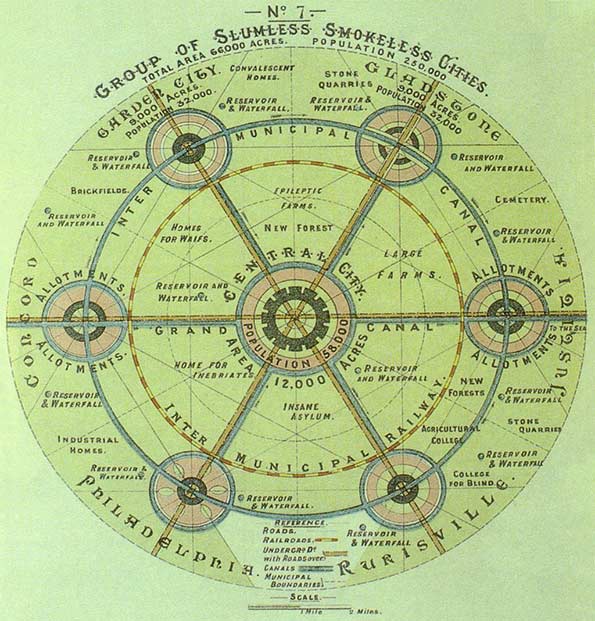
    Every few years the ideals of Ebenezer Howard’s garden city utopia are resurrected in an attempt by the UK government to create new communities, and address the country’s housing crisis. Sometimes this takes the form of new towns or eco-towns, and sometimes proposals for an actual garden city are put forward – as in the last budget.

    Rather than just rolling out this romantic terminology, we should take a closer look at garden city ideals and how they can be adopted to make the proposed Ebbsfleet development a success.

    Several years ago my colleague Michael Edwards presciently forecast the current problems in the Thames Gateway where Ebbsfleet falls, with a dominance of private development that does little to provide for local employment and walkable communities.


    Ebenezer Howard’s utopian vision

    He outlined the need to return to funding principles similar to the garden city model, where development trusts retain freeholds on the land. This model, based on investment in infrastructure and services, is a fundamental principle that shifts from short-term returns to a long-term relationship created between the collective or public landowner and local inhabitants.

    Lessons From History

    Despite the fact that the garden city was a highly influential model throughout the first half of the 20th century, ultimately leading to the establishment of some key settlements in the UK, US and elsewhere in the world, it has had few genuine successes. After World War II, similar utopian dreams of creating model communities, with decent housing surrounding a well-designed centre, met with the reality. British reformer William Beveridge famously summed them up for having “no gardens, few roads, no shops and a sea of mud”.

    You’d be forgiven for thinking that past lessons would be applied to the next generation of housing. But, even the post-war housing plans – though inspired by the garden city movement of the interwar periods – failed to plan the new housing in relation to transport, employment and public services such as shops and schools. While UK government reports have tried to draw lessons from both their positive and negative aspects, they have also been criticised in more recent reports, for lacking a sense of community – although it should also be said that “community” takes time to develop and cannot be “designed” as such.

    Many of the challenges of creating new communities are bound up in the spatial separation between newcomers and older inhabitants, a lack of social infrastructure, such as doctor’s surgeries and schools, and difficulties that stem from long commutes, such as lower net income and the strain this has on families. Ruth Durant found this in her 1939 study of Burnt Oak on the outskirts of London.

    Early post-war new towns were similarly criticised for their very slow build-up of health services, higher schooling, cultural facilities and decent shopping facilities, although some did better with the provision of local employment, due to many people moving to the towns with a local job linked to their housing. With shifts in the industrial economy, such beneficial connections between home and work (one of the tenets of the garden city) reduced over time.

    Modern Twist

    The challenges today are slightly different, however. People live more mobile and fragmented lives and are arguably less likely to be tied to place as was the case for the primarily working-class (and manual labouring) communities of the past. This poses the risk that community will be lost because of how transient people can be.

    But increased mobility and social interaction don’t have to be mutually exclusive. Indeed, a lack of mobility is the worst problem that can be imposed on a community: both work and leisure must be accessible to people. Plus, with the advent of the internet and grass-roots activism, connections can traverse space more easily. This has allowed movements such as the Transition Network, which brings communities together around sustainable issues, to blossom.

    Adapting to Change

    UCL’s EPSRC funded Adaptable Suburbs project has studied the evolution of London’s outer suburban towns over the past 150 years, providing some clues on what has made for the relative success of the original garden cities over other planned settlements. It is clear that their success has been dependent on excellent transport connections, coupled with the provision of local employment and access to employment at a commutable distance.

    Also important is the provision of a mixed-use town centre, giving a destination for a wide variety of activities in addition to retail: community activities, schools, leisure and cultural uses. Centres work well when connected to the street network, accessible by foot, bicycle, public and private transport. This multi-functional design has helped even the smallest of centres to sustain themselves through the most recent economic recession.

    A recent government report, “Understanding High Street Performance”, also found that successful town centres are “characterised by considerable diversity and complexity, in terms of scale, geography and catchment, function and form … [as] a result, the way in which they are affected by and respond to change is diverse and varied”.

    It is almost impossible to predict how society will change in the future, particularly as new technologies have the power to change how people connect and build community. But what is evident is that here lies another essential aspect of building successful communities: in allowing for places to adapt to change.

    This needs to be a foundational aspect of the government’s new cities – simply invoking the phrase “garden city” is not enough. By building places with sufficient flexibility of buildings, infrastructure and uses, coupled with links that allow for local and wider-scale trips to take place, with the necessary long-term financial investment, we can start to create places that will successfully weather the future.

    This article was originally published on The Conversation.

    Dr Laura Vaughan is Professor of Urban Form and Society at the Bartlett, University College London. She has been researching poverty and prosperity in cities, suburbs and the space between them for the past dozen years using space syntax – a mathematical method for modelling social and economic outcomes. Her edited book ‘Suburban Urbanities’ is due to come out in UCL Press in 2015.

    Photo: Which way are the flower beds? Matt BuckCC BY-SA