Tag: United Kingdom

  • Britain’s Planning Laws: Of Houses, Chickens and Poverty

    Perhaps for the first time in nearly seven decades a serious debate on housing affordability appears to be developing in the United Kingdom. There is no more appropriate location for such an exchange, given that it was the urban containment policies of the Town and Country Planning Act of 1947 that helped drive Britain’s prices through the roof. Further, massive damage has been done in countries where these polices were adopted, such as in Australia and New Zealand (now scurrying to reverse things) as well as metropolitan areas from Vancouver to San Francisco, Dublin, and Seoul.

    A healthy competition has developed between the Conservative-Liberal Democrat coalition and the Labour Party to finally address the problem of the resulting land and housing shortage that has driven prices up so much relative to incomes.

    It probably helps that public opinion seems to be changing. A recent MORI poll found that 57 percent of respondents considered rising house prices to be a bad thing for Britain, compared to only 20 percent who though it a good thing.

    It has been more than a decade since Kate Barker, then a member of the Monetary Policy Committee of the Bank of England (the central bank) was commissioned by the Blair Labor government to examine the issues. Her conclusions were clear. Britain has a serious housing affordability problem and its restrictive land use policies were the cause. These higher housing costs, the largest element or household expenditure have reduced the standard of living and increased poverty beyond what would have occurred if urban containment regulation had not destabilized house prices. The Economist notes that home ownership is falling and that the number of couples with children who are renting has tripled since the late 1990s.

    Planning and Chickens

    This week, The Economist weighed into the debate (Britain’s planning laws: An Englishman’s home):

    "Now that the economy is at last growing again, the burning issue in Britain is the cost of living. Prices have outstripped wages for the past six years. Politicians have duly harried energy companies to cut their bills, and flirted with raising the minimum wage. But the thing that is really out of control is the cost of housing. In the past year wages have risen by 1%; property prices are up by 8.4%. This is merely the latest in a long surge. If since 1971 the price of groceries had risen as steeply as the cost of housing, a chicken would cost £51 ($83)."

    For those of us unfamiliar with the cost of chicken in British hypermarkets, The Daily Mail says it is about £2 ($3). Indeed, even the chicken industry suffers, as planning restrictions  are getting in the way of adding the chicken farms Britain requires.

    Moreover, the high costs cited by The Economist are after the house prices increases that had already occurred by 1970. Even then, before such inflationary pressures were seen elsewhere, Sir Peter Hall characterized soaring land and house prices as the biggest failure of the 1947 Act. Hall had led a major research effort on the subject, which produced a two-volume work, The  Containment of Urban England (See The Costs of Smart Growth Revisited: A 40 Year Perspective).

    From Affordable to Unaffordable

    While the historic relationship between household incomes and house prices (the "median multiple") was under 3.0 across the United Kingdom as late as the 1990s, it has now deteriorated to more than 7.0 inside the London Greenbelt. Unbelievably it has risen to elevated levels even in the less prosperous the north of England. For example, depressed Liverpool has a median multiple over 5.0, which is 60 percent above the maximum historic range and making the metropolitan area "severely unaffordable." Liverpool is probably best compared to Cleveland in the United States for its economic distress.

    The shortage of housing in Britain has become acute. There are additional concerns that the globalization of housing markets has hit London particularly hard and is driving households out of the housing market.

    More Money, Less House

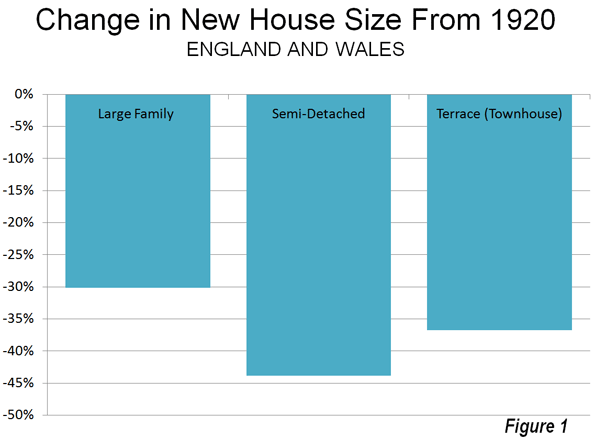
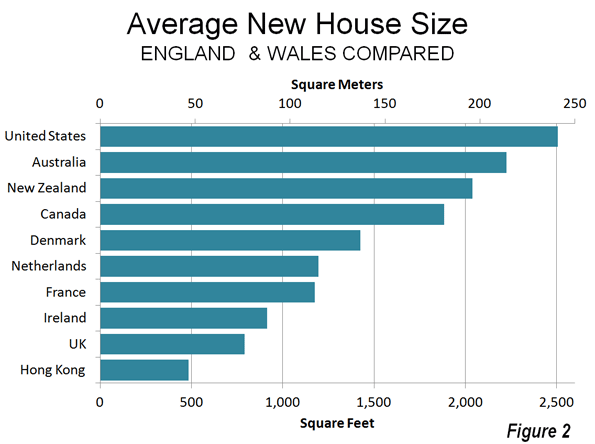
    Through all of this, Briton’s are getting less for their money. Since 1920, the average size of a new large family house has been reduced 30 percent. Semi-detached houses are 44 percent smaller and townhouses (terrace housing) is 37 percent smaller (Figure 1). Britain now has some of the smallest new housing in the world. The average new house in continental Europe is 50% or more larger than in England and Wales. New houses are two to three times as large in Canada, New Zealand, Australia and the United States (Note 1). In some US cities, residents can build "granny flats" which are larger than new houses in Britain. For example, San Diego’s limit for granny flats of 850 square feet exceeds Britain’s average new house size of 818 square feet.
    Paving Over Ohio?

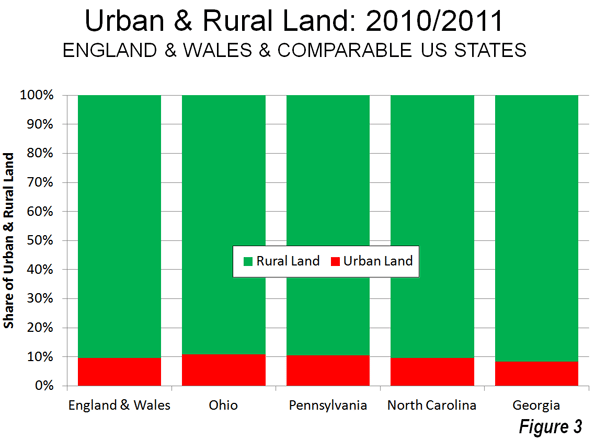
    Of course, those who see urban expansion (the theological term is "sprawl") as ultimate evil imagine an England and Wales being literally paved over by allowing people to live as they prefer. They need not worry.

    For example, England and Wales is less crowded than spacious Ohio, with its rolling hills and extensive farmland. According to the 2011 census, only 9.6% of the land in England and Wales is urban, the other 90.4% is rural. In Ohio, on the other hand, 10.8% of the land is urban and only 89.2% of the land is rural. Even the state of Georgia, with the least dense large urban area in the world, Atlanta, has roughly as much rural land (91.7 percent) as England and Wales (Figure 3).
    Every Gram is Sacred?

    Originally, urban containment was justified on social and aesthetic grounds. However, curbing greenhouse gases is now used as the raison d’etre for highly restrictive housing policies. Urban policy in England and Wales and elsewhere has been hijacked by a philosophy that any gram of greenhouse gas that can be reduced must be, regardless of its impact on society, the economy, the standard of living or poverty.

    One of the worst conceivable strategies for reducing greenhouse gas emissions is to waste money on costly and ineffective measures. The Intergovernmental Panel on Climate Change (IPCC) has indicated that sufficient reductions in greenhouse gas emissions can be achieved for a range of from $20 to $50 per ton. Urban containment policy cannot deliver for this price. In contrast, improving automobile fuel efficiency is forecast improve greenhouse gas emissions, even as driving continues to rise with a growing population (see Urban Planning for People). In addition, the higher house prices associated with urban containment policy are well beyond the IPCC range.

    No program can produce substantial greenhouse gas emission reductions that does not focus on higher value strategies. Urban containment has no high value strategies.

    Planning, People and Poverty

    Britain’s land policy competition between the political parties is long overdue. Coalition Communities Secretary Eric Pickles, decries "the way families are trapped in ‘rabbit hutch homes’." The Labour Party opposition has promised that, if elected in 2015, steps will be taken to increase land supply and housing affordability, so that "working people and their children" have the "decent homes they deserve."

    The Economist states the issue squarely:

    "Building on fields in a country that is as crowded as England will always rile some people, however well-designed the system. But the alternative is worse: a nation of renters and rentiers, where only the rich own houses."

    —————–

    Note 1: As Figure 2 indicates, Hong Kong housing is considerably smaller than that of England and Wales. Hong Kong really is the ultimate smart growth or urban containment city. It has the highest urban population density in the high income world. It has the highest share of its commuters using mass transit to get to work. Its traffic congestion is intense. And, predictably, it has the highest house prices relative to incomes yet documented in the high income world.

    We need to be spared the "sun rises in the west" economic studies claiming that somehow the laws of economics, that work so relentlessly to drive up prices where supplies are constrained in other industries (such as petroleum, corn, etc.) have no effect on land and housing.

    Wendell Cox is a Visiting Professor, Conservatoire National des Arts et Metiers, Paris and the author of “War on the Dream: How Anti-Sprawl Policy Threatens the Quality of Life.

    Photo: St. Pancras Station (London), by author

  • Why British Prosperity is Hobbled by a Rigged Land Market

    The British have the least living space per head, the most expensive office rents and the most congested infrastructure of any EU-15 country. Thanks to a rapidly growing population –  the result of a healthy birth-rate and immigration – these trends are worsening steadily. At the same time, the British economy is languishing in a prolonged slump brought on by a collapse of demand. The answer is obvious: Britain needs to build more. Unfortunately, the obstacles to development are formidable. Britain’s supply-side problems are of a different character to those holding back other struggling European economies, but arguably no less serious.

    Britain is generally considered a flexible, economically liberal economy, in which insiders have few opportunities to rig the system for their own benefit. To the extent that supply-side problems are considered a significant obstacle to economic growth, attention generally centres on the country’s patchy skills base. A high drop-out rate from secondary school and weak vocational training are no doubt real constraints on the UK economy, but there is an equally, if not more, serious one. Housing, commercial property and infrastructure are central to a country’s economic and social well-being. The UK’s essentially rigged market for land and its restrictive planning system are as big an obstacle to economic growth as restrictive labour markets and protected professions are in Southern Europe.

    The number of new homes built each year in Britain has lagged far behind demand from a growing population for 30 years. Despite faster population growth, house construction is currently running at half the level of the 1960s. At the same time the average size of homes built in Britain is now the smallest in the EU. The result of these two trends has been a steady fall in the amount of living space per head. Property prices relative to average household incomes have come down a bit since 2007, but remain very high. Moreover, the problem is not just restricted to the residential sector: Britain has the highest office rents in the EU. Firms in cities such as Manchester pay more than in Frankfurt or Milan. And transport infrastructure is very expensive to build in Britain, which is one reason why there is too little of it.

    Britain is small and densely-populated, but does not suffer from particularly acute land scarcity. Around 13 per cent of the UK is built on, a lower proportion than in countries with a similar population density such as Germany, Belgium or the Netherlands. Britain’s problem is that the supply of new housing and commercial space is uniquely unresponsive to increases in property prices. Alone among the countries that experienced a house price boom in the run up to the financial crisis, Britain had no construction boom. The number of houses being built picked up only slightly, despite UK house prices rising by more than in any other developed countries except Ireland.

    This situation has far-reaching economic and social consequences for the UK. Massive house price inflation has aggravated the UK’s already high levels of inequality by shifting wealth from the young (and property-less) to the old (and propertied). The poor availability of affordable housing undermines labour mobility – people are unable to move to where jobs are available because they cannot afford accommodation. Those on welfare are discouraged from working (as they then lose access to subsidised housing).  Congested, expensive infrastructure combined with pricey commercial property pushes up the cost of business, depresses investment and holds back economic growth.

    The two reasons for Britain’s land-use woes – a complex planning system and insufficient land for development – are inter-related. A major constraint on the supply of land is the existence of a protected ‘greenbelt’: land around cities on which development is very tightly controlled. There are also strict controls over building on other so-called green-field sites. The market for land is essentially rigged in favour of landowners, who pay no tax on their land holdings and hence pay no penalty for sitting on it, waiting for the artificially-created scarcity to push prices up further. With no revenue from land taxes, local authorities are unable to capture any increase in the value of land that takes place when planning permission is granted. As a result, they have little incentive to open up land for development. 

    The UK should, of course, redevelop so-called ‘brownfield’ sites – vacant or derelict buildings and land. But this will only ever comprise part of the solution to its land use crisis. By its very nature, brownfield land is concentrated in parts of the country where people do not want to live. And it is often very expensive to redevelop, not least because the government has stipulated that 60 per cent of new homes must be built on brownfield sites. There is no alternative to building on the green-belt, much of which is neither beautiful nor green. The greenbelt was originally established to combat urban sprawl, but is now an obstacle to sensible development. For example, allowing London to expand by between two and three miles in each direction would easily solve the city’s land-use problems. Increasing that proportion of the UK’s surface area under development by between 1 and 2 percentage points would address the country’s  land constraints  and would not involve concreting over England’s ‘green and pleasant land’. Urban sprawl could easily be prevented by good quality town planning.

    The sanctity of the greenbelt, and green-field land more generally, has much to do with vested interests perpetuating a system which rewards speculation. Many Britons have profited from land scarcity (and the tax-free property price gains it has led to), and are determined to defend those gains. They may complain about their children being unable to buy a house, but at the same time will staunchly oppose new development. For their part, landowners are a powerful and politically well-connected lobby; many of the biggest sit in the House of Lords (the country’s upper house). They have a big stake in inflated land prices and are well-placed to resist the taxation of land.

    A land tax would involve property owners paying a percentage of the value of their land in tax each year. If the value of their property rose, so would the amount of tax paid on it. This would achieve a number of things. First, local authorities would have a financial incentive to change land from agricultural to residential (and commercial) use as they would profit from the increased value of the land this would cause. Second, it would make it more expensive to speculate on future rises in land values, and some of those gains would be captured by the government. Third, construction companies would not be able to sit on large amounts of land (so-called land banks), and drip feed the market, maintaining prices at artificially high levels. Instead, land would have to be developed or sold, which together with the increased availability resulting from the freeing up of greenbelt land, would bring down the price of developing land and with it the cost of housing, commercial property and infrastructure. Lower land costs would also increase competition by reducing barriers to entry to the construction sector: for example, at present housing building is dominated by a small number of big players.

    Supply-side measures are rarely a quick solution to a demand-side crisis. That is certainly the challenge facing other struggling European economies. Spain and France suffer from inflexible labour markets, Germany from over-regulated product and services markets, Italy from both. Academic research shows that addressing such problems improves economic performance in the longer term, but it provides no immediate boost to demand. However, the UK is almost certainly an exception. Addressing Britain’s biggest supply-side problem (its rigged market for land) could provide a more immediate economic stimulus by releasing massive pent-up demand, as well as lift growth potential.

    Britain should turn its weaknesses into strengths. Other struggling European countries have a surfeit of housing and infrastructure and poor demographics. For example, boosting construction in Spain would do no good – Spain has far too many unsold houses and it is now suffering from net emigration (more people are leaving the country than arriving). In Italy and Germany, populations are stagnant, although there is more scope to boost spending on infrastructure than in Spain. France’s population is growing, but as a result of persistently strong public investment, it already has very good physical infrastructure. And thanks to a rational planning system and plenty of land, it does not suffer from a housing shortage. Unlike Britain, these countries have few low-hanging fruit.

    Far-reaching reform of the greenbelt and the introduction of land taxes could open the way for a boom in housing and commercial development. Local authorities and the national government could agree to set aside a proportion of the funds raised through land taxes to fund investment in infrastructure. Moreover, land taxes would make the tax system fairer by taxing unearned income. And by redistributing money from the wealthy (who save a high proportion of their income) to construction sector workers (who save little of it), it would provide a further boost to economic activity. The current Conservative-Liberal government has pushed through modest reforms of the planning system, but has shied away from opening up the greenbelt and has no intention of introducing a land tax. 

    An economy in which speculation is rewarded and wealth is increasingly concentrated in the hands of those with property risks stagnation. It faces an uphill battle to hold on to its young or attract skilled immigrants. Britain needs to strike a better balance between the interests of existing property-owners and the rest of the country. This includes acknowledging that the value of land is determined by the activities of society as a whole and not the landowner, and hence needs to be taxed accordingly.

    Simon Tilford is chief economist at the Centre for European Reform, where this piece originally appeared.

  • Britain’s Housing Crisis: The Places People Live

    For twenty years British house building has fallen behind demand, forcing up prices and rents. Here’s a series of photos showing some of the things people have had to do to live.

    Victoria Campbell was living in a shed in her parents’ garden in Havant, while she and her fiance saved up for a deposit, but the Council has told her that she has to move out.


    This family in Plashet Park have been living in a shed for some time.


    In East London, council officers are going checking out garden sheds to make sure that they are not being rented out, as they check too to see if houses are over-occupied.

    In Caledonian Road, super-exploiting landlord Andrew Panayi converted unprofitable shops into money-making flats, and decided to convert their cellars into more flats.


    This is the flats’ skylight, outside.


    This is the passage and stairway down to the flats.


    This is the underground landing with the flats’ front doors.


    And this is the interior.

    These garden sheds in Southall have been turned into homes, and ones like them are rented out to labourers.

    Carl Bond and Stacey Drinkwater converted a double-decker bus for somewhere to live.

    In Crystal Palace Laura Park lives in this converted public toilet.

    Many people have tried to evade the planning laws that stop people from building, but disguising homes as sheds or barns.

    Alan and Sarah Beesely built their home inside a barn, as you can see from the skylights. They were told by the council to knock it down.

    Carl Jones built this garage, but building inspectors decided it was really a house, and told him to take it down.

    So too this toolshed in a garden centre in Stroud was found to be a home, and ordered was ordered to come down.

    In the Pembrokshire National Park Brithdir Moor, Janet and Tony Wrench built the Roundhouse, which was also ordered taken down.

    For years now housebuilders in Britain have failed to build enough homes for people to live in.

    We were told that more homes would encroach on the ‘green belt’ and the countryside. Foolish commentators like Simon Jenkins and Tristram Hunt warned – laughably – of a ‘Tsunami of concrete’ threatening the countryside. Powerful lobbies like the Campaign to Protect Rural England, the Urban Taskforce and the Green Party did all they could to stop new building. But it turns out that less than one tenth of Britain is developed.

    Instead of developing the land we need government and municipal authorities said that they would ‘build up, not out’, and that they could get more people, into less space, by more compact, smart growth. At the time the development advocacy Audacity told them that this could only lead to overcrowding, and that their ‘smart growth’ would take us back to Victorian social problems.

    Today, more people are willing to acknowledge that there is a problem with a shortage of affordable housing – but too few are willing to grasp the nettle and say we need to build many, many more houses to meet housing need.

    Some commentators have made the point that there should be council housebuilding to meet the need. Others that the planning laws should be liberalised so that private developers can build. Both of those would be a good idea, but neither should be turned into a dogma that must be observed before new homes are built. The issue is that however it is done, Britain needs to build the houses that people need to live in.

    James Heartfield’s book Let’s Build! Why We Need Five Million New Homes in the next 10 Years is available from Amazon.

  • The Drive-It-Yourself Taxi: A Smooth Ride?

    Despite a corporate sponsor that paid handsomely for the naming rights, Londoners stubbornly refer to our bikesharing system as ‘Boris Bikes’, in a nod to our colourful Mayor, Boris Johnson. But what will we call our new drive-it-yourself taxis? My suggestion: ‘Boris Cabs’ – and they are now a reality here, thanks to Daimler’s car2go service, if you happen to live in one of three small and separate sections of town. But why did a one-way carsharing system have to limp into London, when more than a dozen other cities have welcomed these arrangements with open arms? In the US, car2go first appeared in Austin, Texas, and since then has moved into Washington, D.C, Miami, Portland Oregon, San Francisco, San Diego, and Seattle. It operates in Canada and, on the Continent, in Paris and Amsterdam, among other locations. So why no splashy launch across England’s Capital, and no images of a smiling Boris cutting a ribbon?

    First, roads in London are balkanised. Our regional transport agency (Transport for London) runs the main arteries, and they provide little on-street parking, the mother’s milk of one-way carsharing. That leaves the local streets in the the domain of the 33 boroughs that are each independent municipalities. Car2go is making a brave attempt to get off the ground here by starting with hundreds of cars (the press release reports 500; in practice,170 are in operation two weeks after the launch) in disconnected sections of town, something it has not resorted to anywhere else. Its standard practice is to strike a city-wide deal with whoever’s in charge of on-street parking, and no single agency fits that bill here. What’s the rush? Well, BMW is hot on their heels with its competing DriveNow system, with staff in London well into the advanced stages of planning.

    Second, there is genuine uncertainty about the impacts”. Will we take drive-it-yourself cabs to work, and avoid the crush on the Tube? It would be a very different experience than traditional carsharing — London is said to be Zipcar’s second-biggest market after NYC — which doesn’t work for the daily commute. In the Zipcar model (soon to be the ‘Zipcar by Avis’ model?) you take a car on a round-trip basis and pay by the hour, like filling a parking meter. The novelty of this new generation of drive-yourself cabs lies in their flexibility: as with a taxi meter, you pay by the minute for just the time it takes you to get from ‘A’ to ‘B’, then drop the car off and forget about it.

    What does this mean for traffic congestion? CO2 emissions? What about the cute blue-and-white Smart Fortwo-model cars now parked in your neighbourhood – will they mean less parking for private car owners? Not bloody likely. The expectation is that, in time, enough private car owners will switch to using the fleet’s cars, meaning that on balance fewer cars will need to be parked. But try explaining this to car2go’s new neighbours who are not familiar with the subtleties and will be the ones dealing with the growing pains as we feel our way forward.

    Transport is a long game, so it will be years until we properly understand the impacts of drive-yourself cabs. My research suggests that likely impacts are:

    1) A much larger market than traditional carsharing (about four times as many subscribers)
    2) A roughly 4% reduction in personal car ownership
    3) About a 1% decrease in car driving vehicle miles travelled (including personal cars, traditional carsharing, and drive-yourself cabs)
    4) About a 1% decrease in the number of public transport journeys

    We can be reasonably certain that some surprising impacts will be revealed during field trials, and if at some future point London’s authorities are not happy with the knock-on effects there’s nothing to stop us from regulating the industry like any other. But for the moment we don’t understand it well enough to do anything other than let the operators experiment and keep tabs on what’s happening.

    We just don’t know what the impacts on traffic levels and CO2 will turn out to be, and, frankly, it’s unfair to – as some suggest – hold the industry to a no-net-traffic/CO2 standard. We don’t do that to Black Cabs or [advance-booking-only] minicabs, or indeed to the automotive or urban transport sectors more broadly. A fairer standard, admittedly more complex to administer, would be to assess whether net value is created after accounting for effects on traffic levels, emissions and more. In other words: get the prices right, just like the economics textbooks say.

    The question that needs thinking through is what would transport in London look like if drive-yourself taxi systems went viral and we came to depend on them. What happens, for instance, when instead of 500 of these cabs there are 50,000, and the necessary communication links go down? How would the transport system work if on-road congestion became replaced by virtual queuing to get access to a car? And what about times when the system is under stress, like when a hurricane is approaching, for instance. Is it OK to just flip the switch off on the whole fleet? Who would make this decision, and what guidelines would they follow?

    If the history of the car in cities has taught us anything, it is that we need to be humble about our ability to forecast the future. So what is the way forward for Boris Cabs in London? Start with a small fleet and short-duration contracts. Be clear on the objectives and flexible on the implementation. Keep our options open. It will be an interesting ride.

    Scott Le Vine, AICP is a research associate in transport systems at Imperial College London and a trustee of the shared-mobility NGO Carplus, which serves as the UK’s carsharing trade body. He authored the recent study Car Rental 2.0: Car club [carsharing] innovations and why they matter.

    Flickr photo: Car 2 Go in the 1700 block of Q Street, NW, Washington DC on Easter Sunday, 8 April 2012 by Elvert Barnes Photography

  • Postwar Prefabs: Britain’s Factory-Made Palaces

    After the financial crisis of 2008, much of Great Britain’s construction industry capacity was wiped out. Now, in 2012, there is much fear that the “traditional” construction industry is too weak to rapidly increase the rate of housing production, even if the administrative planning system wanted it to. Which it doesn’t. Yet there is also no suggestion by Local Authorities or the national government that the present lack of construction capacity could be addressed by the manufacture of housing by new businesses in other industrial sectors — the creation of factory made homes — as was done post-World War II.

    Between 1944 and 1949 the British Government organised the production and installation of two bedroom prefabricated bungalows as emergency housing. The Prefabs were a popular success, but have never been repeated.

    As the Second World War was concluding, Clement Attlee, the Labour Party’s Deputy Prime Minister in Winston Churchill’s wartime coalition Government, told the House of Commons,
    ‘The Government have reviewed the potential building capacity of the country, and have come to the conclusion that it will not be possible, for some years, to build enough permanent houses to meet the urgent demands for separate homes. We shall therefore need, in addition, emergency factory-made houses.’

    A budget of £150,000,000 was sanctioned in the Housing (Temporary Accommodation) Act, 1944, and increased to £220,000,000 by 1947. By the time the financial account was closed in 1957 a total of 156,623 prefabricated bungalows of a few types were built on Local Authority Land for £207,309,000. They were all rented out by 1949, popular as suburban “prefabs”.

    Many of of the Prefabs were manufactured by the aircraft industry using aluminium as the production of war-planes wound down. Others were constructed with steel and timber. The aluminium bungalows were road-delivered as sectional buildings. All the Prefabs were built round a central core of a kitchen, toilet and bathroom. The fitted kitchen had a fridge and cooker, running hot water, and a wash (laundry) boiler There was built-in storage, electric lighting, and sockets. For many residents the Prefabs offered a huge advance in their quality of life.

    They were supposed to last 10 to 15 years, but many were so popular that their residents successfully campaigned to save them from demolition. They proved as permanent as any other housing.

    A few of the Prefabs still exist today, but they are gradually being cleared by Local Authorities keen to arrange the redevelopment of the often well-located land that can now be occupied with far denser housing, mostly for a lucrative sale. In today’s model, space inside and outside the home are both sacrificed. Buyers hope that expensive mortage payments might result in equity in an inflating housing market, where rents have also become unaffordable.

    Of course, new housing is needed, but it begs the question of who can afford it. Not the residents of the homes that are being demolished, that is certain. The Prefabs were built during a time when the aim was to keep rents low, while producing spacious homes with gardens for working class people.

    The best example of this Prefab demolition is to be seen at the Excalibur Estate in Catford, South East London, which is Britain’s largest and last surviving post-war prefab estate. It consists of 186 homes built by Italian and German prisoners of war in 1945 and ’46 to house returning servicemen and their families. For many years, a long and bitter battle between the residents and Lewisham Council has continued. The Council plans to develop the site with up to 400 new homes. Some residents continue to fight against the plan. Six Prefabs are listed by English Heritage and saved from demolition; 180 are to be pulled down in phases within the next few years, starting this month.

    Photographer Elisabeth Blanchet has long studied the way these surviving “Palaces for the People” have been lived in by residents. She was struck by the way the Prefabs did not look like British brick, semi-detatched or terraced houses, but more like American homes, with a garden and more space and privacy. “Prefab estates around the country were designed with a sense of community,” says Blanchet, “… sometimes around a green and connected by footpaths, giving them the feel of holiday villages.”

    Speaking of the way the Excalibur Estate has been lived in over the many decades after it was supposed to be demolished, she says, “Apart from slight modifications, the Catford Estate remains virtually unchanged. Some residents have added new doors and windows, painted walls… Some have even given their home mock-Tudor makeovers, or added fake beams to the outside. The sense of community, a rare thing in today’s society, is in danger… I met wonderful people, mainly in their 60s, 70s, 80s and even 90s.” One resident, Eddy, who had been living there since 1946 told Blanchet, “I wouldn’t swap the place for Buckingham Palace, even if it included the Queen!”

    Over more than a decade Blanchet collaborated with Greg Stevenson on a book, Palaces for the People, that includes her unique archive of photographs and interviews with residents. She is now recording stories from people who once lived in the Prefabs, and planning a documentary film, all aiming to answer a simple question: Why do people love these homes so much?

    It is almost impossible to imagine any British Government initiating such an ambitious and popular manufacturing effort today. Even while the rate of “traditional” house building is at an historic low, there appears little willingness by the planning system to increase construction industry capacity. No one is arguing for it in Parliament, but Prefabs 2014-2019 would be great for the public, and a boost to the construction and manufacturing industries.

    Photos by Elisabeth Blanchet

    Ian Abley is a Project Manager for audacity, an experienced site Architect, and is co-author of Why Is Construction So Backward?, as well as co-editor of Manmade Modular Megastructures. He is planning 250 new British towns. Elisabeth Blanchet’s current project, “The Prefabs Tour of the UK”, will show how the homes produced in an emergency turned out to be enduring and well liked. You can get involved here.
  • Housing: How Capitalism and Planning Can Co-Habit

    Did Britain’s New Labour party conspire against land development? Is it responsible for outdated, “socialist” land planning policies?

    The British Conservative Party’s favourite think tank, Policy Exchange, would have us think so. Its latest report aims to demonstrate that the British planning system is socialist rather than capitalist. Why Aren’t We Building Enough Attractive Homes? – Myths, misunderstandings and solutions, by Alex Morton takes on the British planning system that dates from the 1947 Town and Country Planning Act.

    That law was enacted in 1948, when farmers gave up their right to build on their own land in exchange for a continuation of guaranteed food prices. In a genuine legal innovation, government cancelled the right of landowners to build freely on their own property, without nationalising the property itself. By 1954, Prime Minister Winston Churchill had made sure that the owners of land given permission to build by the State, through the agency of a Local Planning Authority, would be able to profit from the “betterment” or planning gain in land value. While land limited to agricultural uses was of low value, the artificial scarcity of land that was granted permission for development was then worth many times that value. Local Planning Authorities negotiated a share of that gain.

    It is significant that this post-war measure survives today. The negotiation over planning gain between landowner, developer, and Local Planning Authority is big business still. Farmland in proximity to urban areas can be turned from £4,047 an acre (£10,000 a hectare) to be worth 100 times that in a development deal. Much land within the planning-approved area of Britain is worth over 1000 times the value of land without any planning approval prospect.

    Nevertheless, for Alex Morton, the Senior Research Fellow for Housing and Planning at Policy Exchange, ‘… the 1940s system is “socialist” as it requires councils create a “socially optimal” plan then impose it on everyone. But we know in reality such changes impose clear costs and benefits on specific individual existing residents.’ Seeing this as a misunderstanding of Churchill’s creation of an artificial scarcity of land that could be selectively inflated in value for profitable development after a negiotiation over the share of the gain, I wrote to Morton and suggested the obvious: that the existing planning system was capitalist rather than socialist. He wrote back, a bit huffed:

    ‘The current system is nothing to do with capitalism. Possibly corporatism (the use of state power to enrich a small business elite through involuntary confiscation of property rights), definitely socialism (at least in original intent given how land uplift was originally to be taken by the state).’

    “Nothing to do with capitalism” … This is a myth from the self-proclaimed “myth-buster” think-tank. The 1947 Act made an entirely new beginning for post-war capitalism by repealing all previous town planning legislation, re-enacting some important provisions salvaged from previous law, and innovating significant legal principles.

    His is a propagandist’s mistake, made before in his 2011 report, Cities for Growth – Solutions to our Planning Problems. At no point does Morton on behalf of Policy Exchange call for the repeal of the 1947 planning law. He knows that no British Planning Minister in any government will argue for repeal of the 1947 law. The Treasury could never allow it, and the members of the Council of Mortgage Lenders would probably have such a Minister hung over the Thames under Westminster Bridge for even thinking about it. To repeal the Churchillian planning law would mean financial disturbance on a scale far more disturbing than events in 2008.

    Fresh-faced Nicholas Edward Coleridge Boles was appointed Planning Minister on September 6th, 2012, and was expected to tear up the planning law. Nick Boles knows the planning system through his time with and close links to Policy Exchange, but he will no doubt conclude that the 1947 planning law must be sustained. He has the Planning Minister’s job now. In contrast, Morton’s inspiration and predecessor, Oliver Marc Hartwich, has imagined a New Labour conspiracy against development:

    ‘The planning system in the UK has been intended to restrict physical development, reducing economic growth as a result. In particular, Labour have made it a matter of policy that 60% of any new housing should be built on so-called “brown field sites”. This policy depends on, and results in, both high house prices and higher land prices.’

    New Labour did not conspire against development. Yes they rejected “sprawl” and planned to contain development. Urban compaction reinforces the effect of the planning law. However, it is the law that planning relies upon that is having unintended consequences since it was innovated in 1947.

    Planning facilitated the New Labour expansion of the fund of mortgage lending up to 2008, so that even in 2012 there is £1,200,000,000,000 of live mortgage debt generating interest. This is a volume of lending made possible by, rather than causing, house price inflation. Inflation caused by the fact that the planning system explicitly prevents people from buying a field cheaply and building a house on it, with a rate of planned new house building lower than at any time since the First World War, not the Second. The effect, by Morton’s own measure, is that in England a median priced home now costs seven times the median salary. Averages conceal other realities, but the general trend is clear. House price inflation, highest in the South and deflating unevenly in parts of the North, is inextricably linked to the planning law. Planning equals mortgage security in housing equity. For that £1.2 trillion of debt there is at least £2.4 trillion of equity variously distributed among households.

    Rather than question how the planning system intersects with the contemporary character of the desperate attempt to augment low household income, or look closely at the capitalist activities of a development sector consolidated around Local Planning Authorities, Morton sees only “socialism”. In our view, the British predicament is a triangulation, characterised as:

    A) Social dependence on substantial house price inflation in Britain’s political economy
    B) Securitisation of mortgage lending by government through the planning system
    C) Public acceptance of the low quality of an ageing and dilapidated housing stock

    Capitalism in Britain depends on this being a stable triangulation, what we have called the Housing Trilemma. It is not a socialist conspiracy, as Policy Exchange imagines. It is a predicament for British capitalism that is having serious consequences for the population.

    Ian Abley is a Project Manager for audacity, an experienced site Architect. He has produced a discussion paper for the 250 New Towns Club to argue the obvious: that planning is capitalist. It can be downloaded from www.audacity.org/IA-20-09-12.htm. He is also co-author of Why is construction so backward? (2004) and co-editor of Manmade Modular Megastructures (2006). He is planning 250 new British towns.

    Flickr Photo by Green Alliance: Nick Boles, Conservative Party MP and brand new Planning Minister

  • Gentrification? Brixton’s Angell Town Story

    In the US, urban planners talk about the ‘redevelopment’ of a neighborhood. In the UK, ‘regeneration’ is heard more often. What is the difference, from both the planner and the resident perspective? Are they both synonyms for ‘gentrification’? Angell Town , a UK ‘estate’ in Brixton — it would be called a ‘public housing project’ by Americans — provides a good example of how these questions are answered in practice.

    In theory, meanwhile, the answers are… yes, and no. They overlap quite a bit, but the terms are not the same. In its simplest form, to redevelop is to develop again, which implies doing it over completely. Regeneration most directly means “rebirth or renewal”, implying that the entity remains throughout the process.

    The American Planning Association (APA) defines redevelopment as “public actions that are undertaken to stimulate activity when the private market is not providing sufficient capital and economic activity to achieve the desired level of improvement…. such as direct public investment, capital improvements, enhanced public services, technical assistance, promotion, tax benefits, and other stimuli including planning initiatives such as rezoning.”

    The Royal Town Planning Institute (RTPI) defines regeneration as “a holistic process which aims to reverse the economic, social and physical decline of places where market forces alone will not suffice… balancing community, business, environmental and individual needs… as well as changes to the physical environment.”

    So — redevelopment focuses on monetary investment and physical changes. Regeneration focuses on the existing community and the “social decline” of a place, as well as economic and physical factors. Even further, it aims to “holistically,” address “individual needs.” Of course many redevelopment projects address the community, but because the APA distinctly says that “the private sector may initiate redevelopment projects without any active public involvement beyond the government’s traditional regulatory role,” I would argue that it involves less social investment than regeneration.

    Perhaps the distinct difference between the responsibility to act directly on behalf of existing residents versus the responsibility to investors stems from a large English planning system that is more politicized (and therefore receives more federal funding.)

    While in America, gentrification might be seen as an inevitable side effect of redevelopment, in England it is seen as a sometimes inevitable and therefore tragic side effect of regeneration.

    To illustrate this point, look at a true regeneration project: Angell Town, Brixton, London

    Problem (courtesy of Rudi):

    • Lack of public space for social interaction – derelict communal areas were unused.
    • The garages provided were dark and un-surveyed, and therefore, never used.
    • The estate was perceived as crime ridden, as the multiplicity of bridges and walkways provided ideal escape routes for criminals, often from outside the estate itself.
    • Litter accumulation resulted from removing the bridges (which gave access to the waste removal pick-up points), in an attempt to reduce crime
    • The estate came to epitomize neglect and decline
    • The estate became stigmatized a sink estate.

    Solution – A summary of simple urban design changes:

    • The first main part of the scheme involved re-orientating the existing deck-access housing into a more “normal” street format, based on terraced dwellings which related to the street through individual entrances.
    • Each dwelling was given an individual, recognized identity — surveillance on the street was improved, as windows now faced directly out
    • Terraced housing replaced the monotonous, unsafe corridors of entrances.
    • The pedways, which were perceived as unsafe, were removed so that the houses could be extended to face on to the street.
    • New central grassed areas were defined as focal points for the houses. These areas were separated from the new vehicular perimeter roads by railings, enabling children to play, away from the danger of traffic and dogs.
    • The unused garages on the ground floors were replaced with shops and community facilities, such as a bar, cafe, workshops, and even a recording studio in one area, to provide the previously, much lacked social amenities. This design measure also helped transform dark and bleak spots into animated facades of street level activity.

    Instead of only seeing Angell Town’s problems, the urban designer, planners, and architects looked at them as opportunities to build on the strong community that had lived there for decades. The project improvements didn’t eradicate every trace of the place that had become their home, but committed a large investment to renovate the buildings they could, and design the new ones to compliment the existing ones so well that you had to look hard to tell the difference between the two.

    Members of the community could still see where they came from. In other words, it still felt like home. Most importantly they could look again a little harder and see their bright futures. This might sound like I’m laying it on a little thick, but the success of this regeneration stunned so many, both nationwide and on the European continent, that it provoked intense project documentation. Residents who were interviewed realized what planners so often don’t: they looked to their physical environment to define their identity. With the existing bones of the original Angell Town Estate still in existence, they easily identified the physical improvements to be improvements in themselves.

    This outstanding result came from an intense and time-consuming community consultation process, a term that is distinctly different than public involvement. The lead urban designer was so involved with the community that he actually lived there on the weekends in a flat. While this is rare in any country, it certainly is to be commended.

    Perhaps the most powerful items in Angell Town now are the benches that, poetically, are made from the rubble of demolished parts of the old buildings, caged, with stone seats on top. People can actually sit on the physical representation of what was destroying their community. This was recited by residents often as what made the biggest difference to them. Don’t ever underestimate the power of poeticism!

    I would love you to share you comments on this story. I’ll also suggest: Consider the many similar public housing projects in America that have been completely razed and rebuilt to look like another place. How does it make people feel to have their homes be deemed so worthless that they are torn down and completely replaced, often with architectural rubbish?

    So, what will it be — redevelopment or regeneration?

    Photo: UK Government Web Archive: Angell Town – “Many residents also have private outdoor space.” Building for Life is run by CABE and the Home Builders Federation with Design for Homes.© Commission for Architecture and the Built Environment (CABE)

    A different version of this post appeared on Erin Chantry’s blog, At the Helm of the Public Realm. Chantry is an Urban Designer in the Urban Design and Community Planning Service Team with Tindale-Oliver & Associates

  • London’s Social Cleansing

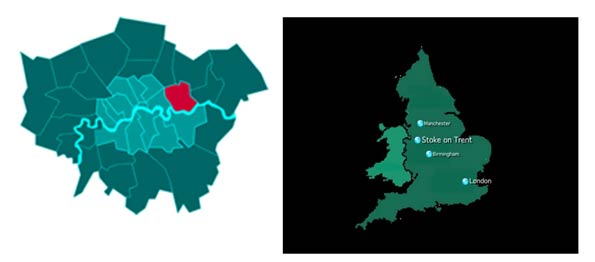
    Unscrupulous landlords are forcing poorer tenants out of their London homes, freeing them up to rent out to visitors to the Olympics this summer, according to the housing charity Shelter. At the same time, the government’s cap on rent subsidies (Housing Benefits) for those out of work or on low incomes threaten to force less well-off tenants out of the capital. Newham Mayor Sir Robin Wales says that they will have to move people as far afield as Stoke-on-Trent if they are to meet their obligations to house the homeless. Fears of ‘social cleansing’ featured in the Mayoral election where Tory incumbent Boris Johnson made sure to distance himself from his own government’s policy to beat off the challenge from veteran left-winger Ken Livingstone.


    Inner London, outer London (Newham in red); London, Stoke-on-Trent

    Critics of London’s ‘Social Cleansing’ have fixed on the changes to the law regarding housing benefits and the Olympics, but failed to notice that working class Londoners have been being forced out of the nation’s capital for some time now – thanks to the ceaseless rise in house prices. On the London Programme in 2003, I said that without opening up more land to building in the green belt, house prices would spiral out of control, pricing ordinary Londoners out of the capital. Mayor Ken Livingstone slapped me down saying that he would never sanction building on the green belt.

    Today Eva Wiseman, a commissioning editor on the upmarket broadsheet, the Observer, says that she cannot afford to rent in London’s once poorest borough, Tower Hamlets, let alone buy a house. She cites Shelter’s estimate that you would need an income of £67,669 to rent there (average income is £26,244).1

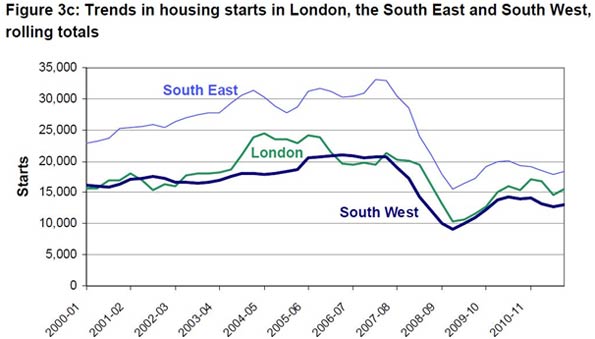
    It is not hard to understand why prices are so steep. Housebuilding in the UK has failed to keep pace with demand. New housing starts are slightly up after the crash, but overall they are woefully short of actual need. The reason is that Britain has among the most stringent laws on building – the ‘planning laws’ – which stop building on the ever-growing ‘green belts’ that surround our cities.

    Given that the working class are the Labour Party’s natural constituency, you might have thought that its years in government (1997-2010) would have seen more homes built for working people. But Labour turned its back on the working classes a long time ago, while keeping its neurotic interest in regulating the economy. The outcome was a re-vamped planning system that put the brakes on home building. This time this was done in the name of the environment, not to protect the Tory Shires from ‘bungaloid sprawl’, as it was originally intended. Housebuilding fell below the bare minimum of 250,000 you would need just to replace the increasingly dilapidated stock.

    When David Cameron’s Conservative-Liberal coalition came to power in 2010, his Communities Minister Eric Pickles and Housing Minister Grant Shapps had promised a large scale liberalisation of the planning laws – and even blamed their predecessors for doing more damage than the Luftwaffe to Britain’s housing stock. But the fine print on Shapps’ new planning law proved as prohibitive as what went before. Even those champions of the Green Belt at the Guardian were moved to editorialise that ‘these convoluted and qualified planning laws will become another aid to the big-money lawyers’. 2

    The Conservative government’s commitment to liberalisation is like its Labour predecessor’s commitment to the working class, theoretical. Home building remains stalled, and prices have not seriously fallen despite the shortage of credit). Governments of all stripes are most committed to orderly regulation of change, and dread the unsupervised activity of their citizens – a prejudice which has only led to chaos.

    The short supply/rising price dilemma is particularly intense in London. A metropolis of nine million creates a fierce competition for prime sites. Even putting aside the super-rich boroughs, like Kensington and Chelsea, where average prices are £1.3 million (roughly $2 million US), the overall London average is £406,000 ($770,000 US) .

    Besides being the most logical place for real estate speculation from around the world, London also has been in the grip of the planning system. It was in London that the Labour mayor took on architect Richard Rogers as an advisor, and committed the capital to a programme of building only on brownfield (already developed) land, ‘building up, not out’. The result is not much building at all, except to pack more four and five storey blocks into what few pockets of green space can be grabbed. His successor Boris Johnson has avoided challenging the Livingstone system, preferring a quiet life to any hint of controversy.

    Rather than face the problem of the absolute shortfall in new homes, most critics have fixated on peripheral issues, such as the number of empty homes (which, despite the attention they receive, are, because of high prices, at an all-time low). Easy credit, too, has been blamed for high prices, which is true, but the shortage of credit has not led to a great fall in prices, because the underlying problem was the absolute shortage of homes. Others have argued that the British are too wedded to the idea that they should own their own homes, and could rent, like the Germans, failing to understand that the availability of homes to rent depends on their being built, and rents tend to move in the same direction as prices, as The Observer’s Eva Wiseman has discovered. London’s Mayors have dedicated much attention to schemes to build ‘affordable homes’ – sometimes reserved for occupations like teachers and firefighters – though these are too few in number to have much impact on prices overall.

    Over time, this means working people are being priced out of central London. Tim Butler, Chris Hamnett and Mark Ramsden’s analysis of London’s employment in the 2001 census shows that outer London and the South East is more working class than inner London. Inner London had more large employers, professionals and managers than outer London and the South East. Outer London had more routine, semi-routine and technical or lower supervisory workers. Inner London did have more unemployed than outer London, and outer London had more self-employed than inner London. This employment profile was new, following changes that took place after fifteen years of economic growth, say Butler and his colleagues, though many have noted the sharper contrasts between wealthy enclaves and impoverished housing estates dogged by underemployment. 3

    These social changes show inner London’s parallel embourgeoisment and deepening social poverty. Of course, those who live in the outer suburbs scoff at the protests from well-heeled social commentators about the prices in inner London as ‘Zone Six snobbery’. Still the changes go some way to explaining why Ken Livingstone was unable to sustain the traditional City Hall machine he built consolidating constituencies among inner London’s poor immigrant and residual working class   communities while Tory Boris Johnson won  over the more working and middle class outer suburbs.

    In his last term Livingstone concentrated on winning over London’s bloated financial service sector more than he did on popular support – but the City of London switched its allegiances to the Tory Johnson, who champions it as an engine of growth. Neither candidate has understood that the skew towards the overheated financial service sector creates a weakness in the London economy, with manufacturing having moved out to the surrounding South East and a growing lack of upwardly mobile jobs for all but the most skilled or privileged.

    The housing benefit cap clearly is a problem for welfare-dependent families who are caught in the poverty trap and cannot earn enough to pay the rent. But the problem of the less well-off being priced out of London began long before the changes in housing benefit rules, or London’s winning the Olympic bid. The city the world will visit this summer increasingly resembles not the social democracy imagined after the Second World War, but increasingly a social bifurcated place increasingly resembling that of Victorian times.

    James Heartfield is the author of Let’s Build: Why we need five million new homes, a director of Audacity.org, and a member of the 250 New Towns Club.

    ————————————–

    A Mile High Tower for London

    One imaginative solution to London’s housing problem was proposed by Ian Abley and Jonathan Schwinge of the 250 New Towns Club. Abley and his colleagues have been pressing for new building in Britain’s green spaces to meet housing need.

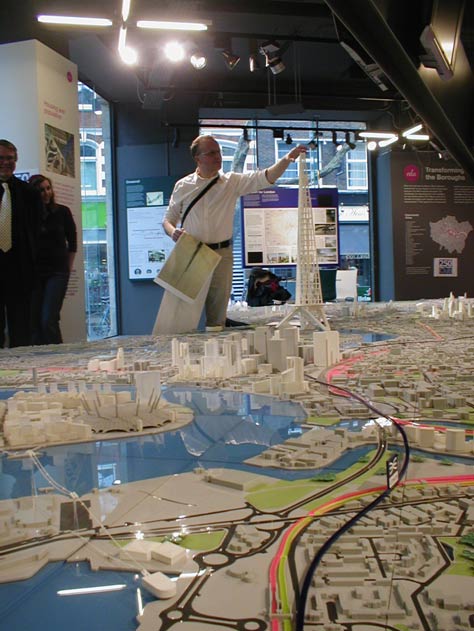
    Taking on the challenge of building up as well as out, Ian unveiled a plan for a tower one mile high for London at the Building Centre, which could house 90,000 people.


    ‘Locked out of the Property Market’, Observer,  6 May 2012

    27 March 2012, http://www.guardian.co.uk/commentisfree/2012/mar/27/planning-builders-charter-lawyers-delight-editorial, and see ‘Coalition of the Unwilling’, New Geography, 1 July 2011, http://www.newgeography.com/content/001966-coalition-unwilling

    Inward and Upward: Marking Out Social Class Change in London, 1981–2001, Urban Studies 45(1) 67–88, January 2008, 72

    London photo by Bigstockphoto.com.

  • World Urban Areas Population and Density: A 2012 Update

    The latest edition of Demographia World Urban Areas has just been released. The publication includes population estimates, urban land area estimates and urban densities for all nearly 850 identified urban areas in the world with a population of 500,000 or more. These urban areas account for approximately 48% of the world’s urban population. Overall, data is provided for approximately 1500 urban areas, comprising approximately 1.9 billion people, or 52% of the world’s urban population.

    Urban areas (or urban agglomerations) are areas of continuous urban development within a metropolitan area (labor market area), and are the physical form of that constitutes the essence a city. Generally, urban areas can be identified by the lights one would see from an airplane at night or in a satellite photograph. Urban areas are not metropolitan areas, which represent the economic or functional form of a city. Urban areas are a component of metropolitan areas, the other component of which is non-urban or rural territory. A metropolitan area is the combination of the urban area(s) and rural areas, which together comprise the economic region or labor market (commute shed).

    Over the last year, new census reports have become available in such nations as India, Indonesia, China, Canada, Bangladesh, the United States and South Korea. The new data has resulted in a number of ranking changes from before.

    The Megacities: In 2012, 26 urban areas qualify as megacities (Rental Car Tours for 24 of the megacities are available), with populations of greater than 10 million people (Table). As has been the case for nearly six decades, Tokyo remains the largest urban area in the world, with approximately 37 million. New York, which Tokyo displaced in 1955, has fallen to seventh largest and has the lowest population density of any megacity, at 4600 per square mile or 1800 per square kilometer (Note 2). London, which New York displaced in the 1920s never became a megacity due to the imposition of its greenbelt. Instead urbanization leapfrogged into the exurbs of southeast England, where all of the London area’s net population growth has occurred since World War II (London ranked third as late as 1960).  

    Table 1          
    LARGEST URBAN AREAS IN THE WORLD (MEGACITIES): Estimated 2012
    (Over 10,000,000 Population)          
             
    Rank Geography Urban Area Population Estimate Land Area: Square Miles Density Land Area: Km2 Density
    1 Japan Tokyo-Yokohama 37,126,000 3,300 11,300 8,547 4,300
    2 Indonesia Jakarta 26,063,000 1,075 24,200 2,784 9,400
    3 South Korea Seoul-Incheon 22,547,000 835 27,000 2,163 10,400
    4 India Delhi, DL-HR-UP 22,242,000 750 29,700 1,943 11,500
    5 Philippines Manila 21,951,000 550 39,900 1,425 15,400
    6 China Shanghai, SHG 20,860,000 1,350 15,500 3,497 6,000
    7 United States New York, NY-NJ-CT 20,464,000 4,495 4,600 11,642 1,800
    8 Brazil Sao Paulo 20,186,000 1,225 16,500 3,173 6,400
    9 Mexico Mexico City 19,463,000 790 24,600 2,046 9,500
    10 Egypt Cairo 17,816,000 660 27,000 1,709 10,400
    11 China Beijing, BJ 17,311,000 1,350 12,800 3,497 5,000
    12 Japan Osaka-Kobe-Kyoto 17,011,000 1,240 13,700 3,212 5,300
    13 India Mumbai, MAH 16,910,000 211 80,100 546 30,900
    14 China Guangzhou-Foshan, GD 16,827,000 1,225 13,700 3,173 5,300
    15 Russia Moscow 15,512,000 1,700 9,100 4,403 3,500
    16 Bangladesh Dhaka 15,414,000 134 115,000 347 44,400
    17 United States Los Angeles, CA 14,900,000 2,432 6,100 6,299 2,400
    18 India Kolkota, WB 14,374,000 465 30,900 1,204 11,900
    19 Pakistan Karachi 14,198,000 300 47,300 777 18,300
    20 Argentina Buenos Aires 13,639,000 1,020 13,400 2,642 5,200
    21 Turkey Istanbul 13,576,000 540 25,100 1,399 9,700
    22 Brazil Rio de Janeiro 12,043,000 780 15,400 2,020 6,000
    23 China Shenzhen, GD 11,885,000 675 17,600 1,748 6,800
    24 Nigeria Lagos 11,547,000 350 33,000 907 12,700
    25 France Paris 10,755,000 1,098 9,800 2,844 3,800
    26 Japan Nagoya 10,027,000 1,475 6,800 3,820 2,600


    Jakarta (Jabotabek) has emerged as the world’s second largest urban area, with a population of 26 million. This is a larger population than reported by the United Nations, since its estimates include little more than DKI Jakarta, the national capital district and beyond which urbanization stretches for a considerable distance. Continuing suburban growth in Seoul-Incheon secured that urban area a ranking of third, with approximately 22.5 million people. As was reported last year, new estimates indicate that Delhi has emerged as India’s largest urban area, with a population of 22.2 million and a growth rate that should result in its passing Seoul-Inchon in a matter of a few years. Mumbai, which like Mexico City in the 1980s has often been promoted as being destined to become the largest urban area in the world, was passed by Delhi over the past decade and has become the second largest urban area in India.

    Manila is ranked as the fifth largest urban area in the world, with 22.0 million people. In Manila, as in Jakarta, the population reported to the United Nations is far below that of the genuine urban area. The reported population is for the National Capital Region (popularly and misleadingly called "Metro Manila), which represents approximately one-half of the population of the urban area, which stretches into four additional provinces (Cavite, Laguna, Rizal and Batangas). If the population of the Washington urban area were reported in the same manner, it would be 600,000 – the population of the District of Columbia – rather than the 4.6 million indicated in the 2010 census for the entire urban area.

    Los Angeles, until recent years one of the fastest growing urban areas in the world, has dropped to 17th largest in the world and seems destined to drop out of the top 20 in the next decade or two. Fast growing Karachi, Istanbul, Lagos and others could become larger than Los Angeles. Los Angeles reached its peak ranking of 6th largest in the world from 1965 through 1980 and entered the top ten by 1950.

    Over the past decade, Paris became a megacity, reaching a population of 10.7 million. Paris has been Western Europe’s fastest growing large urban area since World War II. All of its growth since 1921 has been in the suburbs, which stretch over more than 1,000 miles (2,600 square kilometers).  This is more land area than Houston’s suburbs, but more densely populated. Since 1921, the historical core municipality (the ville de Paris) has dropped in population from 2.9 million to 2.2 million.

    By world standards, the Paris urban area has grown slowly, having fallen from being the world’s third largest in 1965 to its current ranking of 23rd. However, over the past census period, Paris added 600,000 residents, compared to less than 200,000 in the previous period, indicating a decline in out-migration and a higher natural population rate increase.

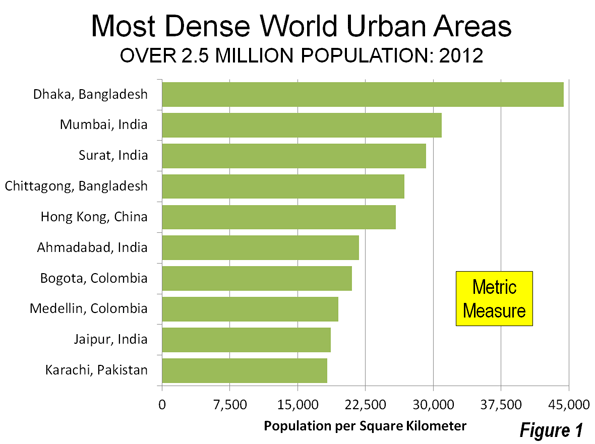
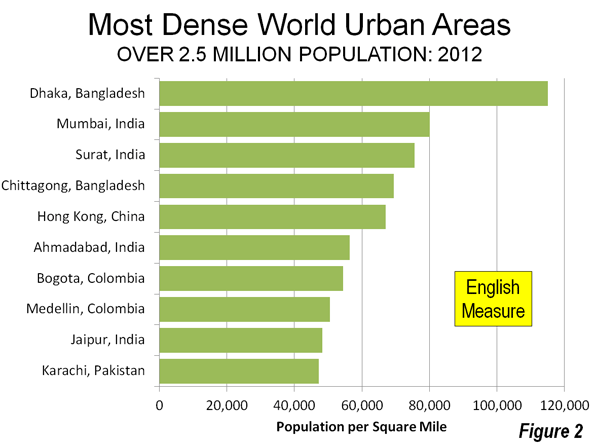
    Urban Area Densities: Dhaka, the capital of Bangladesh grew strongly between 2001 and 2011 and is by far the most densely populated urban area in the world. Dhaka’s density is estimated at 115,000 per square mile or 44,000 per square kilometer, with slum (informal dwelling) densities reported report up 4,210 per acre, or 2.7 million per square mile (1 million per square kilometer). At this density, all of the world’s 3.7 billion urban residents could be accommodated in an area approximately equal to that of the Washington (DC-MD-VA) urban area. All of Dhaka’s urban population of 15.4 million fits into a land area equal to that of the city (municipality) of Portland (population less than 600,000). Nonetheless, analysts have referred to this example of the ultimate of urban density to be "sprawling."

    Among the urban areas with more than 2.5 million population, the second-most dense is Mumbai, at 80,100 per square mile or 30,900 per square kilometer. The most dense high income world urban area is Hong Kong, at 67,000 persons per square mile or 25,900 per square kilometer. Of course, Hong Kong’s density is the result of an accident of history, which resulted in huge migration to the former British colony following World War II. Hong Kong is more than twice as dense as the second most dense high income world urban area, Busan, Korea. The smaller nearby, yet historically similar enclave of Macau (560,000) has an even higher density than Hong Kong, at 70,000 per square mile (27,000 per square kilometer).

    Seven of the densest urban areas with more than 2.5 million population are on the Asian subcontinent. These include Dhaka and Chittagong in Bangladesh, Mumbai, Ahmedabad, Surat and Jaipur in India and Karachi, in Pakistan. Colombia has two of the densest, Bogota and Medellin. Hong Kong is the only high income nation urban area among the 10 densest (Figures 1 & 2).


    The least dense urban areas with more than 2.5 million population are all in the United States. The least dense is Atlanta, with 1800 people per square mile or 700 per square kilometer. The second least dense is, perhaps surprisingly, Boston, despite its reputation for high density. Boston’s population density is 2200 per square mile or 800 per square kilometer. Also, perhaps surprisingly, Philadelphia is the least dense urban area in the world with more than 5 million population, while Chicago is the least dense urban area of more than 7.5 million. The lower density of US urban areas is illustrated by the fact that Portland, with its reputation for higher density and densification planning, would have ranked 11th least dense, if it had reached the 2.5 million threshold used in this ranking.

    Most Extensive Urban Areas: New York covers the most land area of any urban area at nearly 4500 square miles or 11,000 square kilometers. Tokyo covers 3300 square miles or 8500 kilometers. Chicago is the third most expansive urban area, at 2,600 square miles (6,900 square kilometers). Los Angeles, which has long been perceived as the most sprawling of world urban areas, ranks fifth, covering 2400 square miles or 6,300 square kilometers. Atlanta and Boston, the world’s least dense major urban areas, rank 4th and 6th, covering 2,600 and 2,100 square miles respectively (6,900 square kilometers and 5,400 square kilometers).

    The Continuing Exodus from Rural Areas: Around the world, people continue to seek the promise of better economic outcomes in urban areas. United Nations forecasts indicate that another 2.5 billion people will be added to urban areas by 2050, while rural areas (which contain all population not urban) will be reduced in population by 300 million. The world’s urban population is expected to rise from today’s nearly 53 percent to 67 percent. More than 90 percent of the urban growth is expected to be in less developed nations.

    Wendell Cox is a Visiting Professor, Conservatoire National des Arts et Metiers, Paris and the author of “War on the Dream: How Anti-Sprawl Policy Threatens the Quality of Life”.

    ——

    Note 1: Demographia World Urban Areas uses national census authority urban area population and land area data in the few nations designating urban areas on a basis generally consistent with that of the United States Census Bureau. Elsewhere, land area estimates are determined using satellite photography (Google Earth). Population estimates are also obtained from a variety of sources, such as United Nations data, where it is reflective of the urban area population (some data reported to the United Nations is for jurisdictions that are only a part of the urban area and in other cases, metropolitan area data is reported), estimates relying on a "build-up" of local authority data from national census authorities and other sources. Demographia combines some adjacent urban areas when they are contained within the same metropolitan area or consolidated area, such as in New York and Los Angeles (for a complete list see Demographia World Urban Areas). Also see: Urban Terms Defined.

    Note 2: Exceptions: In some cases, continuous urbanization does not constitute a single urban area because they are not within a single labor market (metropolitan area). This can be the case within a nation, such as in the Pearl River Delta of China, where Shenzhen, Dongguan, Zhongshan, Jiangmen, Huizhou, Zhuhai, Guangzhou-Foshan and Hong Kong, which are separate labor markets. International borders (and the Hong Kong-Shenzhen border) also define separate urban areas if free movement of labor is not permitted. Thus Detroit and Windsor or San Diego and Tijuana are separate urban areas because free movement of labor is not permitted. On the other hand, treaties permit virtual free movement of labor between the French and Belgian sides of the Lille urban area and between the Swiss and French components of the Geneva urban area.

    —-

    Photo: Recent migrants to Dhaka slum in NGO school (photo by author)

  • Welcome Back, Britain! Why The U.K. Doesn’t Need The E.U.

    To some, British Prime Minister David Cameron’s decision to demur from the new euro rescue plan has made the U.K. irrelevant on the world scene. Yet by moving away from the euro zone, Cameron did something more than reaffirm Britain’s opposition to a German-led Europe: He asserted Britain’s greater, historically grounded legacy as the center of the Anglophone world.

    This obstinacy could end up maintaining the U.K.’s global importance by shifting its focus away from “the declining and irritable nations of the old world” and toward its legacy as the center of the English-speaking world.

    Over time cultural ties generally prove more enduring than ideological or geographic ones. The 14th century Arab historian Ibn Khaldun once observed, “Only tribes held together by a group feeling can survive in a desert.” Throughout history, the most powerful, far-reaching cultures — namely the Greek, Roman, Arab, Chinese, Mongol and British empires — shared this intense kinship.

    Like the world’s two other primary global tribes, the Chinese and Indians, Anglo share ancient and deep-seated affiliations. In contrast to the profoundly insular Japanese or the Germans, global tribes are transnational and transcend mere geography. They share not only economic ties but “group feelings” shaped by commonalities of food, language, history, spiritual and political ideals .

    The British are “cousins” to Americans, Canadians, Australians and New Zealanders in ways the French, Germans and Italians are not. When young and educated British emigrate they generally head not to Germany or China but to other English-speaking countries. Retirees might seek out the Spanish or French Rivera, but those building careers go overwhelmingly to Anglophone countries.

    Equally important may be the British connection to other former colonies like India, South Africa and Nigeria that, although not racially Caucasian, function largely in English and retain close ties to the mother country. Any close look at British interests and personal ties reflect the enduring nature of its tribal essence. London’s status as the world’s financial center — the critical reason for Cameron’s break with the E.U. — lies not primarily with Europe, but with its scattered former colonies. Britain is the world’s fourth largest investor and the top investor in the United States, which in turn serves as the U.K.’s biggest export market. The U.K. also plays an outsized role in South Africa, Singapore and India, where it is by far the largest European investor.

    In this sense, the Anglosphere — including places like India — constitutes a kind of transnational family. Usually ignored or scoffed at by globe-trotting pundits and politicians who define the world by geographic proximity, these global linkages are more important than ever.

    Consider the fate of the insular Japanese, who, without a large diaspora, have no recourse but to fall back into the relative obscurity of their home islands. Similarly, the E.U., particularly in its post-Christian,phase has no common tribal essence. Instead the continent seems to be breaking into at least three tribes: an austere neo-Hanseatic Nordic core, a spendthrift and effectively bankrupt Mediterranean south, and a troubled, rapidly depopulating eastern rim.

    The drive to create a powerful European superstate lacks the girding of a common ideology and social norms that give the English-speaking world coherence. Whatever her ambitions, Germany’s Angela Merkel, Chancellor of a prosperous but rapidly aging and militarily weak country, seems more like a wily schoolmarm than an inspirational European leader. She’s no Caesar, Charlemagne or Napoleon who’s capable of uniting the continent by force of ideology, personality and power.

    Given these fundamental flaws, Britain’s best course would be to focus on linkages to her offspring. Taken together the Anglosphere represent more than a quarter of world GDP, and the Queen’s tongue remains the dominant language of international business, science and diplomacy, utterly supplanting French, Russian and German even on the continent. The E.U. may have been constructed largely by French visionaries, but English is spoken by 41% of Europeans, while only 19% speak French.

    More important still, the developing world is turning Anglophone. French schools have been closing even in former colonies such as Algeria, Rwanda and Vietnam, where students have protested against learning the old colonial tongue. English is being widely adopted in China, and it dominates the Gulf economy, where it serves as the dominant language of business in hubs such as Dubai. It is also, of course, the dominant language of India’s burgeoning middle class.

    The linguistic dominance propels the Anglosphere’s dominion over such critical growth industries as technology and culture. Britain may no longer be an industrial superpower, but its media, research institutions, investment banks, courts and culture remain globally relevant. Nearly half the world’s sales of audio-visual products, for example, come from the English speaking world, with Britain constituting the second-largest exporter behind the U.S.

    Technology follows a similar pattern. Three-fifths of global pharmaceutical-research spending comes from Britain and the U.S.; more than 450 of the top 500 software companies in the world are based in the Anglosphere. Out of the ten fastest-growing software companies, six are American and one is British.

    This brain power is backed up by a treasure trove of natural resources. The U.K. itself may lack sufficient raw materials — after all that was what the empire was all about — but its diaspora countries, notably in North America and Oceania, account for much of the world’s food exports and, increasing, its supply of fossil fuel energy.

    How about the thorny issue of politics? In the end, when there’s a crisis the Anglosphere countries can most rely on one another. Time and again, the British, Canadians and Australians have been the peoples who send troops and ships in concert with America. What country is a more American solid ally in Asia than the remarkable English-speaking enclave of Singapore?

    Conversely, when Argentina seized the Falklands, Prime Minister Margaret Thatcher could count on logistical help, first and foremost, from the United States. And as the Australians contemplate an expanding Chinese military presence in their backyard, they look to the Americans to send in the maritime cavalry.

    Sadly the critical nature of these linkages is not fully appreciated by the current U.S. administration. President Obama, the grandson of a Kenyan victimized by the brutal colonial regime, has dissed Britain repeatedly. Opposition to colonialism, of course, resonates with American tradition, but he perhaps went too far when he famously returned the bust of Winston Churchill sent by Tony Blair to President George W. Bush back to Britain.

    More recently Obama has even poisoned the well against Canada, our greatest trade partner and continental soul mate, by rejecting the Keystone XL project. It’s as if he were urging Canada to align itself with China. What’s next a move to ban the import of Australian uranium or Uggs?

    Yet the great strength of tribes, or families, lies in their ability to endure despite the most egregious family foolishness. Even a wayward president, or two, cannot tear asunder what has been hundreds of years in the making.

    This piece originally appeared at Forbes.com.

    Joel Kotkin is executive editor of NewGeography.com and is a distinguished presidential fellow in urban futures at Chapman University, and contributing editor to the City Journal in New York. He is author of The City: A Global History. His newest book is The Next Hundred Million: America in 2050, released in February, 2010.

    Creative Commons photo by Flickr User “angies”.