Tag: United Kingdom

  • It’s Not the 1980s in Britain Anymore

    Britain’s public sector workers came out on a one day strike last week over government plans to raid their pension funds. Government ministers did the rounds of television studios denouncing the strikers as mindless militants. Both sides are echoing the class struggles of the Thatcher-era, but the truth is that it’s not the 1980s.

    My children were off school, and like many children, glad of it. Schools are among the more solid parts of the public sector action today, and in London were struck out, though in the country the teachers’ unions have not achieved the 90 per cent shut down they were aiming for. Unlike the last great wave of union opposition to Conservative spending cuts, back in the 1980s, the teachers’ unions were supported by the National Association of Head Teachers.

    At the college where I teach, the lecturers in my department were solidly behind the strike, and boldly leafleted and informed students of their decisions in lectures and circulars. Administrative staff, by contrast, crossed the picket lines.

    Overall the strike is well-supported, but not quite the quantum leap of opposition to the Conservative-Liberal coalition that seemed to be in the air. Those joining the marches were 30,000 in London, and a few thousand in the other major cities, which is many more people than the deracinated petit bourgeois mobilised by the #Occupy camps, but does not compare to the bigger union mobilisations of the 1980s.

    Union activists have tried to paint the coalition (which they call the ‘Con-Dem’ government) as Margaret Thatcher’s Conservative government of the 1980s reborn.  As they see it, some ‘anti-Thatcher’ spirit would give the rank and file more fire in their bellies.

    Prime Minister Cameron and his ministers have been trying to spark up a Thatcherite spirit, too. It is their only blueprint for handling the challenge of the public sector union revolt. They have been going around the studios denouncing mindless trade union militants in the same way that Thatcher’s ministers Cecil Parkinson and Norman Fowler did back then. But they have not done it very convincingly. Most of all they have failed to get the public to blame the state sector for the budget deficit, as Mrs Thatcher by and large did. The public is just not in the mood to turn on any group of workers with that much anger. It is people in power that are distrusted, newspaper editors and politicians. The specific plan to cut pensions and raise the pension age is not accepted, but widely seen as the chancellor robbing from people’s rightfully earned savings. Chancellor Osborne has failed to persuade many people that they need to take his harsh medicine.

    It is perhaps typical of the strident Mrs Thatcher that her ghost is haunting the country even though she is still with us, if a little frail. It is a generational thing – anyone over forty either hated or loved Thatcher and by and large it is the ones who hated her who went on to be opinion formers, whether in TV studios, newspapers or teaching in colleges and schools. The under thirties take their idea of the Thatcher era from those teachers, or from the novels of Jonathan Coe, or most recently from the Meryl Streep film. There is a touch of nostalgia for an age that was a bit more black and white, where the choices were starker.

    Today’s class struggle is by no means as clear. As much as the unions talk up the coalition as a return to Thatcherism there is nothing like the determination to lead an offensive against trade union power in Cameron’s cabinet, which, remember, is a coalition with some sceptical Liberal Democratic partners. What is more, the party he leads got elected on the express promise that it had left the ‘nasty party’ image of the Thatcherite 1980s behind. This was the nice Tory party.

    Cameron’s one distinctive policy, the Big Society, if it were to work, would surely be carried along by the kind of people who are on strike today – who struck me as people with a social conscience, and an interest in their communities. It cannot be comfortable for him that this is the very constituency that he most offends.

    Mrs Thatcher was not so bothered about the Social Workers and Community Activists, generally painting them as a big nuisance. What she was good at was rallying the establishment – the newspaper editors, City financiers, industry managers, senior police chiefs and judges were a formidable establishment ready to face down any rebellious mood among the scruff trade unionists or rioting youth. Mr Cameron, though, does not have any such united establishment on his side. They have all been attacking each other for some time now. Right now, Lord Leveson is enquiring into the scurrilous phone tapping done by Rupert Murdoch’s News International. It is a ghoulish picture of the newspaper magnate that emerges, and not the kind of thing that is likely to persuade him to get behind the Cameron government in the way he was behind Mrs Thatcher’s.

    The left, too, is in a weaker state than it looks. There is a kind of trajectory to events, from the student demonstrations of a year ago, through the summer riots and this autumn’s version of #Occupy Wall Street – a tent city in the gardens of St Paul’s cathedral. The rhythm of these protests – and protest is legitimated emotionally by the events in the Middle East, however different those protests are – give the impression of a rising crescendo. But that is deceptive. The anti-capitalist mood is not deeply rooted. Last week they had an opportunity to make their organisation a bit stronger. But without a concerted assault from the government, the opposition is also a little tentative.

    Overall the country is much more exercised by the throwaway line from TV presenter Jeremy Clarkson, that the strikers ought to be shot – for which he has been roundly condemned – than it has been by the strikes.

    On the night Cameron went around the television studios saying that the strikes proved to be a bit of a damp squib. It is a smart spin to put on things. It conveys that he is not rattled, and that it is all a bit of a fuss about nothing. But it is not true enough for him to get away with it. The unions did not land a big punch, but they had a respectable day. Worse still for Cameron is that it sounds like his own strategy is a bit of a damp squib so far.

    James Heartfield’s latest book The Aborigines’ Protection Society: Humanitarian Imperialism in Australia, New Zealand, Fiji, Canada, South Africa, and the Congo, 1836-1909 is published by Columbia University Press, and Hurst Books in the UK.

    Photo by Flickr user Ben Sutherland
  • UK Moves to Reform Planning Disaster

    This piece originally appeared at Macrobusiness.

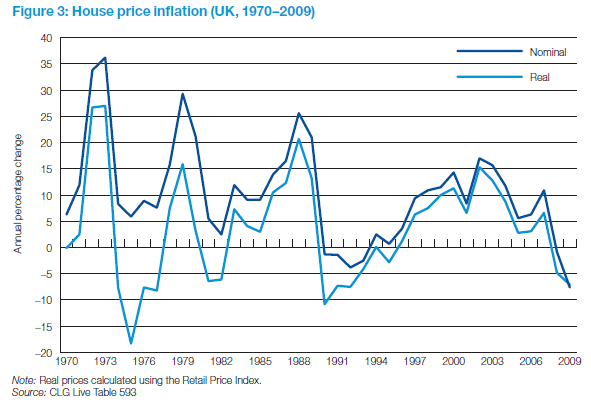
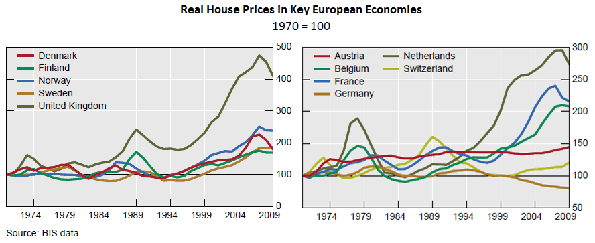
    The United Kingdom (UK) housing system is arguably the worst in the world because of a myriad of policies that work to severely restrict supply, pump demand, and make renting a highly undesirable substitute for home ownership. These policies have led to the UK housing market experiencing:

    1) a higher level of house price inflation than most other European nations:


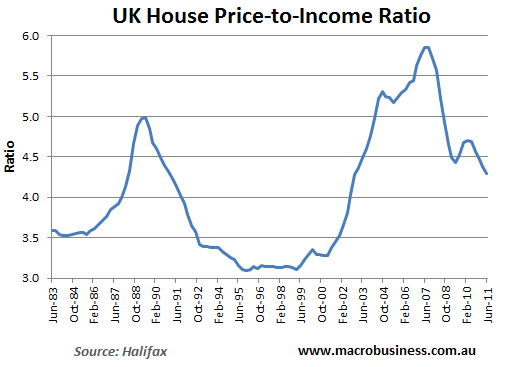
    2) Relatively expensive housing on a price-to-earnings basis:


    3) Extreme house price volatility:


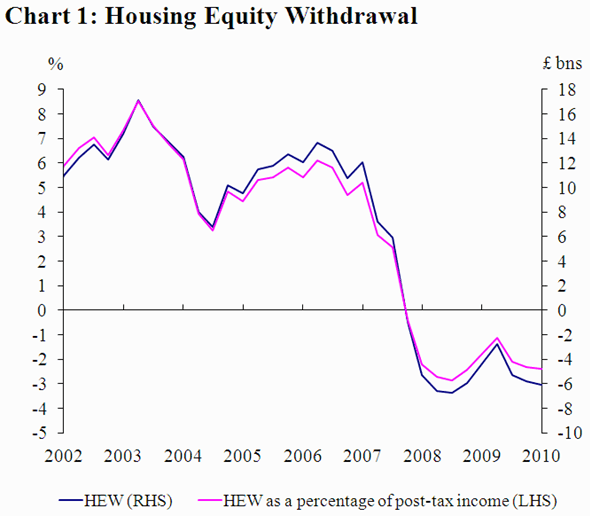
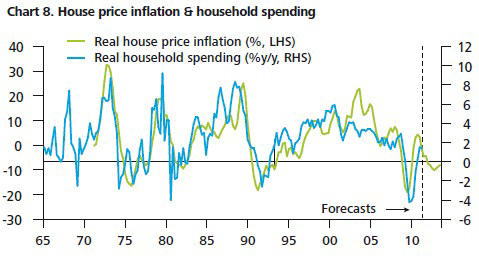
    4) Which has also increased the volatility of the economic cycle due to the positive effects on consumer spending of equity withdrawals from rising home values and heightened austerity in the bust phase:


    At the core of the UK’s housing problems is the straightjacket that was placed on housing supply following the passage of the Town and Country Planning Act in 1947, which nationalised development rights. Essentially, the pre-existing right of landowners to build-on or re-develop their land was removed and handed to the state, thereby requiring land owners to seek planning permission before anything other than minor renovation work was undertaken.

    UK housing supply effectively became a centrally planned system whereby government bureacrats would attempt to predict some years ahead the required numbers of dwellings that ought to be built in an area to meet demand. However, as explained brilliantly in a detailed paper by the Policy Exchange, the key outcome from the UK planning system has been a housing market that has delivered some of the oldest, smallest and most expensive homes in Europe of a type that are least preferred by households. Put simply, UK households are paying more for housing than their European counterparts and receiving less in return:

    Central planning attempts to ensure that what is thought best for the people by the central planners is what is produced. So, as we showed earlier, the system currently attempts to produce exactly the number of dwellings which are estimated to be required from calculations of need, calculations involving assessments of demographic change, household formation, household splits, migration, deaths, births, etc. Built into the system is a pressure at all levels to provide the minimum. Using green field sites is politically problematic. The cry goes up that the countryside is being buried under tarmac. And anyway, as we have shown, the system adjusts. If too little housing is provided, house prices rise and housing becomes expensive. When it is more expensive, people can afford less and so buy smaller homes. With smaller homes, more dwellings can be provided on less land because homes can be built at higher densities, namely flats or houses with tiny gardens.

    But is this really what people want? In March 2005, a widely reported survey carried out by MORI on behalf of the Commission for Architecture and the Built Environment found that over 50 per cent of those questioned wanted a detached house and 22 per cent preferred a bungalow. Only 2 per cent per cent expressed a preference for a low rise flat and less than 1 per cent a flat in a high rise block. But since detached houses and bungalows use more land than other kinds of house, fewer and fewer are built each year. And many are also demolished to make way for terraced houses or blocks of flats. So while as recently as 1990 only about an eighth of newly built dwellings were apartments, by 2004 the proportion had increased to just under a half…

    So whilst people may not want to live in them or want them built where they live,more and more blocks of flats of just this type are being built because the central planners think that they should have them, and because the production norms are filled more easily in this way than by building houses or bungalows…

    The British planning system means that the most important thing the developer has to do is to obtain planning permission. Once this has been obtained, given the demand for housing, whatever is built can be sold. So the way to make the greatest profit, having obtained permission, is to produce the permitted dwellings at the lowest possible cost. Adding good design is an unnecessary expense because whatever is built will sell. So the constraints imposed by the planning system work against the achievement of a better architectural environment, something which might be achieved with less pressure to build at the lowest possible cost. Competition between developers on design becomes largely unnecessary because they know that they will be able to sell whatever they produce.

    So the current position is that what people want, when asked, is lower density housing. What they get, what the planning system now insists upon, is high density development, much of it in the least desired form – blocks of flats…

    British housing tends to be older than elsewhere in Western Europe. Because they are older their efficiency, in terms of heating for example, tends to be less. The houses [also] tend to be smaller… New houses tend to be even smaller on average than existing houses. In addition, house prices rise faster in the UK so that, year on year, housing in Britain has been getting more expensive relative to that in the rest Europe…

    If fifty years of planning has achieved one thing… Britain [now] has the oldest, pokiest, housing in Europe.

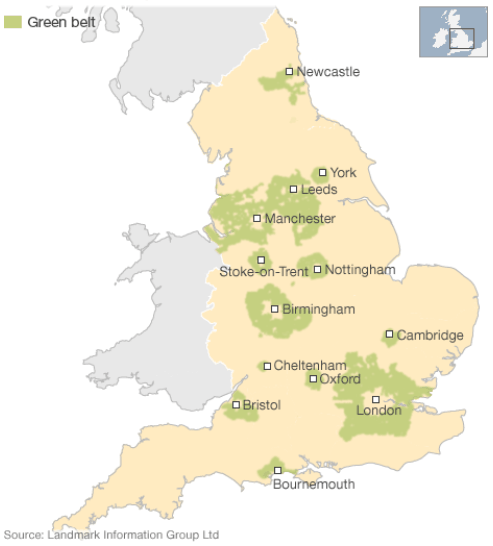
    Compounding the above regulatory constraints on land/housing supply are the greenbelts that have been errected around all of the UK’s major housing markets, which have excluded large swathes of agricultural land from urban development and helped to push-up land prices. A map of the UK’s greenbelts is provided below:


    In addition, the overriding planning objective in the UK has increasingly become one of ‘urban containment and ‘densification’. In the 1990s, the Central Government explicitly required that 60% of all new land for housing must be brownfield land – i.e. land which has already been developed for some other purpose.

    This 60% in-fill requirement necessarily meant the restriction of land supply and higher land prices. It has also produced some perverse outcomes owing to the fact that many brownfield sites that come onto the market for redevelopment are not necessarily located where there is demand for housing. Key amongst these perverse outcomes are the construction of high density developments in poorly located areas as well as ‘leapfrog’ developments far away from the existing urban fringe:

    In southern England, where demand is great, the brown fields norm is complied with by constructing high-density developments whenever and wherever the land has become available, whether centrally, in the inner suburbs, in the outer suburbs, or in the middle of the country miles away from public transport. So the site of a house or hotel in the middle of the London Green Belt may be redeveloped to provide more houses or a larger hotel. The development is on a brown field site so that fulfils the production norm, to be sure. But the development neither preserves the countryside, nor does it reduce the use of private transport. Indeed, it actually increases it above what might have been achieved on a green field site bordering the town.

    A final related roadblock to housing supply in the UK is its centralised fiscal system, whereby local authorities – which are the primary decision makers on development and have statutory obligations to provide services for new houses – receive very little revenue from increased population and housing. As such, these local authorities tend to be biased against development.

    Combined, these regulatory constraints on new housing construction have meant that housing supply in the UK has been incapable of responding quickly and efficiently to changes in demand, thus placing upward pressure on prices and creating expectations of future capital growth.

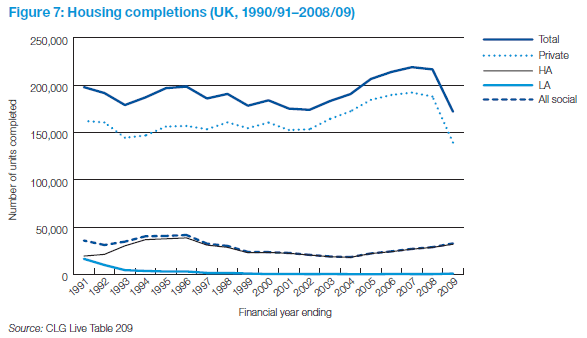
    According to the Joseph Rowntree Foundation’s (JRF) Housing Market Taskforce report on reducing volatility in the UK housing market, only an average of around 180,000 homes per annum were completed in the UK over the past two decades – only slightly above construction volumes in Australia, despite the UK having nearly triple the population (around 62 million).

    And as shown below, despite the massive run-up in prices between 2000 and 2007, there was only a minimal supply response towards the end of the latest housing bubble, confirming that UK housing supply is highly unresponsive (‘inelastic’) to changes in demand.


    More worryingly still, new home construction has reportedly fallen to its lowest level since the 1920s, with just 105,000 new homes completed in 2010.

    The supply constraints present in the UK housing market ensured that the extra demand arising from the UK’s deregulated mortgage market – where lenders were offering 100% plus LVR (i.e. no deposit) mortgages to first-time buyers at the height of the most recent housing bubble – manifested into escalating prices rather than new home construction. By contrast, in the wake of the global financial crisis, UK lenders rationed credit and demanded higher deposits (reduced LVRs), which contributed to the falling prices.

    In a similar vein, the UK’s deregulated rental market and lack of security of tenure (whereby six month leases are the norm) has ensured that renting is a second rate option, thereby encouraging residents to strive (and borrow big) for owner occupancy. With this extra demand for owner-occupied housing not met by increased supply, the inevitable result has been ’panic buying’ from first-time buyers when house prices are rising and the opposite when prices are expected to stagnate or fall.

    Change in the air?

    The concerns about the UK housing situation appear to have come to a head, with the Central Government moving to reform the planning system by:

    1. streamlining the development process by reducing more than 1,000 pages of regulations and red tape to just 52 pages; and
    2. implementing a “presumption in favour of sustainable development”, which has the potential to open up the greenbelts to new housing development.

    The UK Prime Minister, David Cameron, has described the planning system as “slow and bureaucratic” and argues that reform is essential. He also laments the fact that the average first-time buyer without parental help in the UK is 37 years of age.

    However, conservationists and NIMBY groups have rallied against the changes arguing that the reforms risk concreting over the UK’s precious country side and robbing the nation of productive farmland – a ridiculous claim when you consider that:

    1. only around 8% of UK land is urbanised, which is lower than the Netherlands (15%), Belgium (15%), Germany (13%), and Denmark (9%); and
    2. the proportion of UK land used for agriculture is among the highest in the old European Economic Community: 78% compared with an average of 64%.

    According to Dr Oliver Marc Hartwich, an economist and planning expert at Sydney’s Centre for Independent Studies, concerns that the UK will concrete over the country side if the proposed planning reforms are implemented are misguided:

    Dr Oliver Hartwich, an economist with the Centre for Independent Studies, who has studied the British system, believes that without the postwar planning system, the UK would only “look slightly different, but not much”.

    Instead, he suggests the real impact of the green belt has been to fuel house price inflation and push development further into the “real” countryside beyond the green belt, leading to more commuting, fuel use and stress.

    “No-one wants to concrete over the countryside,” he adds. But British cities are overcrowded.

    “What this sort of planning does is encourage a system where bubbles are likely. The idea that you need to get into the property market in your early 20s is very harmful but it’s something that this planning system promotes.”

    Dr Hartwich is particularly well placed to comment on the UK planning system given that he was born and educated in Germany – a country regarded as having one of the best planning systems in the world – before residing in England in the 2000s. He has also written detailed studies of planning systems from around the world (for example, see Why Some Countries Plan Better than others).

    Whether the UK Central Government will ultimately succeed in reforming the UK planning system remains to be seen. Nevertheless, it is heartening to see it taking on vested interests and fighting the good fight.

    Photograph: New, smaller exurban housing in the London area (by Wendell Cox).

    Leith van Onselen writes daily as the Unconventional Economist at MacroBusiness Australia. He has held positions at the Australian Treasury, Victorian Treasury and currently works at a leading financial services company. Follow him @leithVO.

  • Are 20th Century Models Relevant to 21st Century Urbanization?

    Analysis of the state of the world’s cities 2010/2011 by UN-Habitat focused on the narrowing urban divide, with 227 million people moving out of slum conditions over the preceding decade.  While acknowledging uncertainty over cause and effect, the report notes that:

    urbanization … is associated in some places with numerous, positive outcomes such as technological innovation, forms of creativity, economic progress, higher standards of living, enhanced democratic accountability and women’s empowerment. … the report calls for policy-makers and planners to understand that urbanization can be a positive force for economic development, leading to desirable social and political outcomes.

    The North Atlantic solution

    The report acknowledges the diversity of urbanisation[1], making its authors’ somewhat singular approach to managing it (more density) incongruous.  Their prescription is based on resisting urban sprawl, reflecting the experience of North America.  They also suggest that sprawl is a sign of “divided cities”, translating into

    an increase in the cost of transport, public infrastructure and of residential and commercial development. Moreover, sprawling metropolitan areas require more energy, metal, concrete and asphalt than do compact cities because homes, offices and utilities are set farther apart.

    The report denounces sprawl in suburban zones of high and middle income groups and in extensive slums on the city edge.  On the latter, they invoke issues of governance, saying it occurs because

    authorities pay little attention to slums, land, services and transport. Authorities lack the ability to predict urban growth and, as a result, fail to provide land for the urbanizing poor.

    Can one size fit all?

    It is difficult to accept prescription predisposed to a particular view. Urbanisation is not a single condition. Differences in the stage of urbanisation, vastly different physical, cultural and economic settings of “urban” settlement, and different institutional arrangements belie the idea of a universal response or that any particular form is best for all cities. 

    Apart from anything else, “western” cities [2] don’t really feature in 21st century urbanism.  Consider the figures.  In 1950 western cities accounted for 43% of the world’s urban population.  This was down to 23% in 1990 and 18% in 2010. UN projections have the figure down to 15% in 2030, accounting for between just 3% and 4% of all urban growth between now and then.

    What Size City?

    This post looks at some more numbers that help illustrate the diversity of urbanisation – the size of urban settlements. 

    According to UN figures,  8% of the world’s population lives in 53 cities housing over 5 million people; 12% in 388 cities of between 1 and 5 million; and 31% in cities of under 1 million. Any prescriptions for urban governance and urban form need to reflect quite extreme divergence between the few megacities and the many smaller settlements where the majority of urbanites live.

    The Urban Growth Trajectory

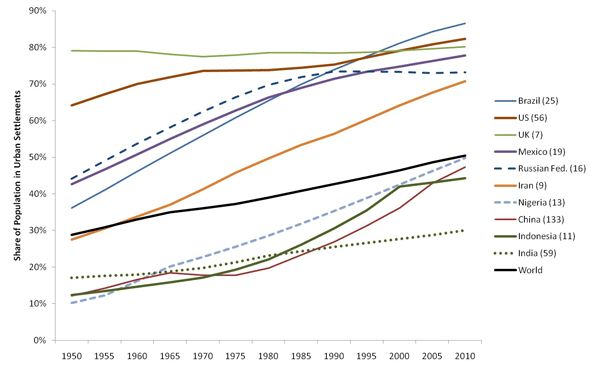
    Urbanisation experiences vary, also.  The different national experiences of the past 60 years can be illustrated using ten quite different countries (Chart 1).  By 2010, Brazil, US, UK, Mexico, and Iran were all heavily urbanised.  But the level of urbanisation changed little for the US and the UK over thelate 20th century, while it grew rapidly in the others.

    In yet another trajectory, erstwhile rapid urbanisation in Russia stalled after the mid 1980s. 


    Chart 1: Urbanisation Trends, Selected Nations, 1950-2010

    Urbanisation is accelerating in China, but has flattened off in Indonesia.  It has been increasing steadily in Nigeria and slowly but still steadily in India.

    Most people moving into smaller cities

    Chart 2 shows shares of growth by city size groups over the last twenty years. (Russia is omitted because urbanisation actually declined by 5.5%.) 

    Cities of under 1 million residents dominate gains, strongly favouring developing countries.  They accounted for 90% of urban growth in Indonesia, 71% in Nigeria and 66% in Iran. 

    US experienced growth more or less across all size categories, although Chicago went from the 7m-8m to the 8m plus category, reducing down the former.

    Chart 2: Where Populations Grew – Cities by Size Category, 1990-2010

    Brazil, China, and Indonesia saw significant growth across the most size groups.  There appears to be a contrast within these countries between the centralising influence of few large cities and dispersed urbanisation in many much smaller settlements.

    (The picture for the UK reflects a gain of around 1 million people in London — to 8.6m — shifting it between categories.  Smaller cities actually accounted for 82% of the net UK gain in urban population, suggesting a duality between the growth of the capital and decentralisation through growth in smaller settlement). 

    So where are the big cities?

    The US has five urban agglomerations with a population of more than 5m, centred on New York, Los Angeles, Chicago, Philadelphia and Detroit (Chart 3).  Compare this with China, with twelve cities of over 5m, and five cities of more than 8 million people (Shanghai, Beijing, Chongqing, Shenzhen, and Guangzhou); or India, with eight over 5m and three over 8m (Mumbai, Kolkata, and Chennai).

    At the same time, China has 90 cities of between 750,000 and 2m, India 44 and the US 66.  Mexico has 15, Russia 14 and Brazil 13. 

    Chart 3: Number of Cities by Size Category, Ten Nations 2010

    Primacy – a mixed picture

    Single centres that dominate national populations are termed “primate”.  Their rise and fall may be symptomatic of national economic fortunes.  Excessive primacy may increase economic volatility because the contrast between a rich centre and poor periphery is politically destabilising. One centre dominating financial, human, and intellectual resources may also increase national vulnerability to structural decline.

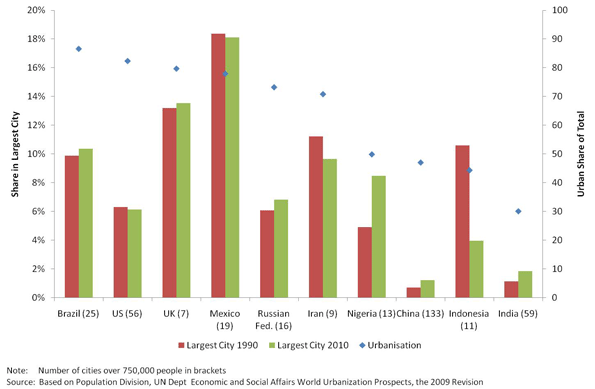
    The picture is mixed across our sample (Chart 4).  Mexico City and London stand out.  High levels of primacy are also evident in Iran and Indonesia, but have been easing, contrasting with Nigeria where it is increasing.  It is least pronounced in the countries with the largest urban populations – China and India — suggesting a strong population pull from a number of state or provincial capitals, as well as a host of much smaller cities.

    Chart 4: Population Share of Largest City, Ten Nations, 1990 and 2010

    So what does all this mean?

    The data confirms huge diversity in the sizes of cities people live in across and within nations.  It generates more questions than answers, though, the main one being whether it is relevant simply to transfer urban governance, management, or planning models from one place to another.  Apart from contrasts within and between nations, it is clear that the west is no longer the focus of urbanisation and is unlikely to hold many of the answers to today’s urban growth challenges.

    The evidence also indicates a tendency for urbanisation to take place in small, dispersed settlements rather than mega-cities.  More modest scale makes different demands on infrastructure and institutions.  It may also help manage urbanisation and ensure that benefits can be better accessed by larger numbers of people.  Small cities, sub-centres in large cities, and districts of modest scale may be better suited to adaptable and innovative planning and management than large scale, extensive cities with their more centralised, remote, and inevitably bureaucratic political and administrative systems. 

    Very large agglomerations do exist, even if they are not as dominant in the wider urban picture as their size and profiles might suggest.  The question they raise is whether they should continue to dominate national and international agenda for urban growth and management.  Dispersed urbanisation may better reflect the resources and capacities needed to support an exploding urban population in the 21st century.

    Phil McDermott is a Director of CityScope Consultants in Auckland, New Zealand, and Adjunct Professor of Regional and Urban Development at Auckland University of Technology.  He works in urban, economic and transport development throughout New Zealand and in Australia, Asia, and the Pacific.  He was formerly Head of the School of Resource and Environmental Planning at Massey University and General Manager of the Centre for Asia Pacific Aviation in Sydney. This piece originally appeared at is blog: Cities Matter.


    [1]  The lowest level of urbanisation incorporated by the UN depends on the conventions of individual nations but may refer to settlements with as few as 2,000 people.

    [2] Treated here as North America, Northern Western and Southern Europe, and Australasia

    Photo by NASA’s Marshall Space Flight Center.

  • Applying Lessons from the UK Riots to Australia

    Many commentators correctly attribute the UK rioting to decades of misgoverning and miseducating youth. Contributing to this has been the breakdown of family discipline, the replacement of working fathers as role models and the creation of a culture of entitlement. Tony Blair has talked about a breakdown in public morality. Less convincingly, many on the left have attributed the cause to the social expenditure cuts of the Cameron Government, cuts that have actually made barely a dent in the proceeding Blair/Brown years of tumescent expenditure growth.

    Adding poison to the brew are government appointments and procedures that deflect police forces away from law enforcement into institutions that “reach out” rather than prevent wrong-doing, seek to understand miscreants rather than enforce the law, and try to contain disturbances rather than prevent them. The soft sociological and managerial ethos that has undermined policing in Britain is all too familiar here in Australia.

    But there are other factors at work. This is especially evident given the nature of those arrested. Many turn out not to be part of some jobless underclass but relatively affluent working people, some in their late twenties and early thirties.

    And the rioters are black and white – though hardly any Indians or other Asians. One reason for this is Asian family background, bringing values based on self-improvement by work rather than theft, reinforced by religious teachings, especially in the case of Muslims, the only group where a large majority are religious practitioners.

    While the complexion of the rioters will be subject to considerable analysis over future months, we can be confident about one hypothesis: few if any of the rioters own their own homes. This is because nothing engenders respect for property and others’ possessions more than people having a personal stake in property themselves. Property ownership – for most of us this means home ownership – is the key to creating a law abiding society. Where riots in England take place outside of areas other than those hosting electrical and sporting goods, they take place on council estates, in areas where people rent. If in owner-occupied housing areas, the rioters are outsiders.

    British families owning their own homes rose steadily up to the early 1980s, reaching 75 per cent. The figure has since fallen back to 70 per cent. More critically, the ability to get on the house ownership ladder has become increasingly difficult for large numbers of young people. Demographia reports that the average house in England now costs over five times the average family’s income. That’s up from three times the average family’s income 25 years ago. In London and other major cities the cost is much higher than this.

    Countless reports in England, Australia and the US demonstrate planning restraints over land use are the cause of houses becoming expensive. Governments do their level best to impose additional costs on house builders, especially through energy saving requirements, but the building industry is highly competitive and finds ways of largely offsetting these costs. However, when government regulations constrain the amount of land that can be built upon this engenders unavoidable costs.

    Ironically, after decades of acquiescing in creating shortages for new home building, the UK Government last month finally expressed a determination to do something about freeing up more land for building. That was met by the usual howls of protest from incumbent home owners wanting to avoid having “riff raff” moving close to them, barking on about preservation of villages and anxious to see a continued shortage of available properties in order to boost their own house values. But these self-centred blockages of new housing stock are contributing to an alienation of many people from mainstream values.

    British Labour Party leader, David Miliband, is arguing that a gulf between rich and poor is a cause of the rioting. He may well have home ownership in mind in offering as his solution, “we need to give people a stake in this society”. But “giving” is not a policy that will work. It morphs into an entitlement regime, which reinforces divisions within society and weakens the self-improvement ethos. Applied to housing, it is reminiscent of the US policy which required banks to make housing loans to those who were not credit-worthy, a policy still unraveling in mortgage defaults and collapsed price bubbles. Removing regulatory restraints that have driven housing prices into unaffordable ranges is the better approach.

    Not being a participant in a home owning democracy provides no excuse for trashing and thieving. But it is clear that there is a vast number of young people who have decided they are excluded and have become eager participants in hooliganism. Policies of tolerating misdemeanors and acquiescing in slack educational supervision will clearly be re-thought in the UK. But so also must be the policies creating barriers that shut people out of home ownership.

    There are lessons in the UK developments for Australia. Not the least concerns home ownership. A fundamental cause of the present economic malaise has been over-investment in US housing as a result misguided attempts to foster home ownership through forcing financial institutions to lend to people who were not creditworthy. This was motivated by the hope that the subsequent property stake would lead to an improvement in civil society on the part of those who found themselves excluded.

    These measures failed because they created a housing price bubble. However, removal of cost enhancing planning restraints would not be likely to bring the same housing inflation outcomes (indeed in states like Texas where the artificial price boosting caused by planning restraints is absent, home price inflation and busts has been modest).

    Planning restraints in Australia have created home costs that are six times family incomes (nine times family incomes in Sydney). House prices in Australia are therefore even higher than in England and urgent steps need to be taken to reform the planning policies that have caused this. If this means a society closer to the ideal of a property owning democracy, so much the better.

    Alan Moran is the Director, Deregulation at the Institute of Public Affairs.

    Photo by bobaliciouslondon.

  • The U.K. Riots And The Coming Global Class War

    The riots that hit London and other English cities last week have the potential to spread beyond the British Isles. Class rage isn’t unique to England; in fact, it represents part of a growing global class chasm that threatens to undermine capitalism itself.

    The hardening of class divisions    has been building for a generation, first in the West but increasingly in fast-developing countries such as China. The growing chasm between the classes has its roots in globalization, which has taken jobs from blue-collar and now even white-collar employees; technology, which has allowed the fleetest and richest companies and individuals to shift operations at rapid speed to any locale; and the secularization of society, which has undermined the traditional values about work and family that have underpinned grassroots capitalism from its very origins.

    All these factors can be seen in the British riots. Race and police relations played a role, but the rioters included far more than minorities or gangsters. As British historian James Heartfield has suggested, the rioters reflected a broader breakdown in “the British social system,” particularly in “the system of work and reward.”

    In the earlier decades of the 20th century working class youths could look forward to jobs in Britain’s vibrant industrial economy and, later, in the growing public sector largely financed by both the earnings of the City of London and credit. Today the industrial sector has shrunk beyond recognition. The global financial crisis has undermined credit and the government’s ability to pay for the welfare state.

    With meaningful and worthwhile work harder to come by — particularly in the private sector — the prospects for success among Britain working classes have been reduced to largely fantastical careers in entertainment, sport or all too often crime. Meanwhile, Prime Minister David Cameron’s supporters in the City of London may have benefited from financial bailouts arranged by the Bank of England, but opportunities for even modest social uplift for most other people have faded.

    The great British notion of idea of working hard and succeeding through sheer pluck — an idea also embedded in the U.K.’s former colonies, such as the U.S. — has been largely devalued.  Dick Hobbs, a scholar at the London School of Economics, says this demoralization  has particularly affected white Londoners. Many immigrants have thrived doing engineering and construction work as well as in trades providing service to the capital’s affluent elites.

    A native of east London himself, Hobbs  maintains that the industrial ethos, despite its failings, had great advantages. It centered first on production and rewarded both the accumulation of skills. In contrast, by some estimates, the pub and club industry has been post-industrial London’s largest source of private-sector employment growth, a phenomena even more marked in less prosperous regions. “There are parts of London where the pubs are the only economy,” he notes.

    Hobbs claims that the current “pub and club,” with its “violent potential and instrumental physicality,” simply celebrates consumption often to the point of excess. Perhaps it’s no surprise that looting drove the unrest.

    What’s the lesson to be drawn?  The ideologues don’t seem to have the answers. A crackdown on criminals — the favored response of the British right — is necessary but does not address the fundamental problems of joblessness and devalued work. Similarly the left’s favorite panacea, a revival of the welfare state, fails to address the central problem of shrinking opportunities for social advancement.  There are now at least 1 million unemployed young people in the U.K., more than at any time in a generation, while child poverty in inner London, even during the regime of former Mayor “red Ken” Livingstone last decade, stood at 50% and may well be worse now.

    This fundamental class issue is not only present in Britain. There have been numerous outbreaks of street violence across Europe, including in France and Greece. One can expect more in countries like Italy, Spain and Portugal, which will now have to impose the same sort of austerity measures applied by the Cameron government in London.

    And how about the United States? Many of the same forces are at play here. Teen unemployment currently exceeds 20%; in the nation’s capital it stands at over 50%. Particularly vulnerable are expensive cities such as Los Angeles and New York, which have become increasingly bifurcated between rich and poor. Cutbacks in social programs, however necessary, could make things worse, both for the middle class minorities who run such efforts as well as their poor charges.

    A possible harbinger of this dislocation, observes author Walter Russell Mead, may be the recent rise of  random criminality, often racially tinged, taking place in American cities such as Chicago, Milwaukee and Philadelphia.

    Still, with over 14 million unemployed nationwide, prospects are not necessarily great for white working- and middle-class Americans. This pain is broadly felt, particularly by younger workers. According to a Pew Research survey,  almost 2 in 5 Americans aged 18 to 19 are unemployed or out the workforce, the highest percentage in three decades.

    Diminished prospects — what many pundits praise as the “new normal” — now confront a vast proportion of the population. One indication: The expectation of earning more money next year has fallen to the lowest level in 25 years. Wages have been falling not only for non-college graduates but  for those with four-year degree as well.   Over 43% of non-college-educated whites complain they are downwardly mobile.

    Given this, it’s hard to see how class resentment in this country can do anything but grow in the years. Federal Reserve Chairman Ben Bernanke claimed as early as 2007 that he was worried about growing inequality in this country, but his Wall Street and corporate-friendly policies have failed to improve the grassroots economy.

    The prospects for a widening class conflict are clear even in China, where social inequality is now among the world’s worse . Not surprisingly, one survey conducted  the Zhejiang Academy of Social Sciences   found that 96% of respondents “resent the rich.”  While Tea Partiers and leftists in the U.S. decry the colluding capitalism of the Bush-Obama-Bernanke regime, Chinese working and middle classes confront a hegemonic ruling class consisting of public officials and wealthy capitalists. That this takes place under the aegis of a supposedly “Marxist-Leninist regime” is both ironic and obscene.

    This expanding class war creates more intense political conflicts. On the right the Tea Party — as well as rising grassroots European protest parties in such unlikely locales as Finland, Sweden and the Netherlands — grows in large part out of the conviction that the power structure, corporate and government, work together to screw the broad middle class. Left-wing militancy also has a class twist, with progressives increasingly alienated by the gentry politics of the Obama Administration.

    Many conservatives here, as well as abroad, reject the huge role of class.  To them, wealth and poverty still reflect levels of virtue — and societal barriers to upward mobility, just a mild inhibitor. But modern society cannot run according to the individualist credo of Ayn Rand; economic systems, to be credible and socially sustainable, must deliver results to the vast majority of citizens. If capitalism cannot do that expect more outbreaks of violence and greater levels of political alienation — not only in Britain but across most of the world’s leading countries, including the U.S.

    This piece originally appeared at Forbes.com.

    Joel Kotkin is executive editor of NewGeography.com and is a distinguished presidential fellow in urban futures at Chapman University, and an adjunct fellow of the Legatum Institute in London. He is author of The City: A Global History. His newest book is The Next Hundred Million: America in 2050, released in February, 2010.

    Photo by Beacon Radio.

  • Britain Needs a Better Way to Get Rich Than Looting

    Mark Duggan, father of four, was armed with a Bruni BBM semi-automatic pistol when he was shot dead by armed police on 4 August. Despite initial reports Duggan did not fire on the officers from the Trident Police Unit, an armed force dedicated to dealing with “gun related murders within London’s black communities”.

    Duggan’s family were not told by police that he had died from his injuries but learned it from the news, in a report designed to deflect blame for the killing onto the victim. The vigil that Duggan’s friends and family held outside the Tottenham police station was a spark that set off rioting across Britain for the last week, and at the time of writing is still not under control.

    Any political character to the initial rioting – as a protest against police brutality – quickly gave way to looting.

    Looting broke out in urban centres, mostly those with a large black community – Tottenham, Enfield, Dalston and Croydon in London. The looters were for the most part young, and of all races, and they sought out popular clothing stores, like foot locker, jewellers and department stores. Some people were attacked in their homes. The “Gay’s the Word” bookshop in Marchmont Street was attacked on 8 August.

    Later, looting spread to Leeds, Birmingham, Manchester and Nottingham – where a police station was firebombed.

    One feature of the looting was the use of mobile phones, blackberries and Twitter accounts to rally looters to sites where, they rightly predicted, the police could be outmanoeuvred.

    Still, it is worth pointing out that as rioting goes this recent outbreak, though widespread, has not been all that violent. Instead it has been more of a Feast of Fools, with the mob enjoying the humiliation of the authorities, as it raids the supermarkets for booze and clothes.

    The Prime Minister, David Cameron has cut short his holiday in Tuscany to recall Parliament, and the London Mayor has come back too. The Drama Queen Cameron, sensing his big moment, promises tough measures to stop the rioting, issuing rubber bullets and water cannon to the police.  London courts processed 167 prisoners in unprecedented overnight sittings on 9-10 of August.

    The cause of the riots has been identified by the Prime Minister and the London Mayor as a breakdown in authority – and they have a point. It is the British social system as a whole that has lost its way, with a collapse in authority in every level, from the police, the political system, school and parental authority but most severely in the system of work and reward.

    Britain’s police force has most decidedly lost authority in recent times. The force used to have an authoritarian culture that was thuggish and racist under reactionary Chief Constables like Sir James Anderton in Manchester and Sir Kenneth Newman in London. But investigations into the police’s “institutional racism” have opened the way to a newer layer of technocratic leaders who were more interested in process than upholding a particular vision of public order.

    Nobody would want to see the return of the old authoritarian policing, but the cadre that replaced them have lacked a guiding esprit de corps. The police have been seen as being corrupted by payments from News International’s investigators for personal information and designed to sideline an investigation into phone hacking.

    Nor has the force’s new face stopped the problem of police brutality. Uncertain of how to deal with the public order challenges of middle class protest (environmental, or more recently student-based), the police have swung irrationally from a hands-off approach that only encouraged greater disorder to excessive force when that failed. The fear of Islamic terrorism has also led to police overreaction.

    The killings of Jean Charles De Menezes (in a terrorism panic), Ian Tomlinson (at a G20 protest) and the vicious assault on Alfie Meadows at a student demonstration have all undermined respect for the police.

    Political leaders have pointedly failed to engage with younger and less well-off groups in society, too. After more than a decade in power the Labour Party is a shell of its former self, but the coalition that replaced it is a bodged compromise whose most attractive radical figure, mould-breaking Liberal Democrat Nick Clegg, managed to turn himself overnight into the most hated man in Britain by joining the government and voting for an increase in student fees (the very thing he had campaigned against). All in all, the political class are stiff, besuited, and incapable of talking in ordinary English, preferring a weird gabble of municipal-speak.

    Lower down the scale teachers, parents and youth leaders have seen their authority undermined by a culture that disparages discipline, and sees “abuse” everywhere. Teachers’ unions have pointed out that changes in the law mean that a substantial minority are being investigated for allegations of abuse made by students at any time, meaning that they are reluctant to uphold discipline in the classroom. At the same time, teachers and social workers challenge parental discipline at every opportunity.

    Perhaps most disturbingly British society has broken the link between hard work and success. Once the “workshop of the world” Britain has a shrinking manufacturing base (around ten percent of all employment). As the analyst Andrew Smithers pointed out, the City of London’s specialisation in financial intermediation took up the slack left by her shrinking industrial sector, but now that is looking like having all your eggs in the wrong basket.

    For a decade or more booming markets and a credit-fuelled economy covered up the weaknesses. Trainers, clothes and electronic devices shipped in from China and paid for on credit kept Britons happy, while a growth in government jobs and the educational maintenance allowance to keep 16-19 year olds in school kept unemployment down.

    The British system of rewards is far from being straightforward. How do you get rich in Britain in 2011?

    • Sir Paul Stephenson, the disgraced chief of the Metropolitan Police retired this July with full pension and benefits on a final salary of £250,000 – having been exposed for taking favours from journalists under investigation for hacking phones.
    • Susan Boyle grabbed the public’s affection on a TV talent show and made £10 million.
    • Beresfords Law firm skimmed £30 million from the Miners Industrial Injury Compensation scheme.
    • Geordie singer turned X-factor judge Cheryl Cole became Britain’s highest paid TV star.
    • Independent consultants raided the National Health Service’s budget of £4.3 billion to build a national database which still does not work.
    • City chiefs like Barclays Bob Diamond and HSBC’s Bob Duggan were awarded bonuses of £6.5 and £9 million last year, from funds boosted by the government’s £200 billion quantitative easing policy.

    The link between work and reward is not easy to fathom. Young people dream unrealistically of success in the world of entertainment, as the most compelling example to them. The more astute know that law and the other professions have done better at securing their incomes – and for them higher education is the route.

    Now the British system of rewards is threatened by the pressure on credit and on government spending. Nervous teenagers and parents see a much higher cost for higher education threatened (though the small print, surprisingly, is more generous than the headline fees). The consumer goods sector has been the one point of connection between younger people and wider society that worked – but recent financial difficulties make many fear that it will soon be out of reach.

    Britain’s radical leaders have in recent times failed to speak to the material aspirations of the greater mass of people. Trade union wage claims are not the fighting point they once were. Left wingers are more likely to be hostile to consumerism than supportive. On the other side, conservatives have abandoned their narrative of hard work to earn well, thinking it too judgmental and mean-spirited.

    Anxiety about the route to material betterment, along with a failure of political answers to that problem and a falling respect for authority have led to disorder. Earlier this year the middle classes rioted on student protests over rising fees. Now some amongst the inner city poor are rioting and looting, in search of a less deferred gratification.

    The looters have taken advantage of the crisis of public authority to make their own short-cut to material success, but it is a self-defeating one. A looted Debenhams or Footlocker will think twice about re-stocking – or at least until they have improved security. Worse still, many family firms and communities have been wrecked by rioters.

    Mark Duggan’s family needs a good answer to why he was shot, and why they had to learn that he had died through the media. Britain needs a less crazed answer to the question of how to meet people’s wants, and it needs a stronger restatement of the value of social solidarity.

    James Heartfield’s latest book The Aborigines’ Protection Society: Humanitarian Imperialism in Australia, New Zealand, Fiji, Canada, South Africa, and the Congo, 1836-1909 is published by Columbia University Press, and Hurst Books in the UK.

    Photo “Tottenham riots” by Nico Hogg

  • Britain’s Housing Crisis: Causes and Solutions

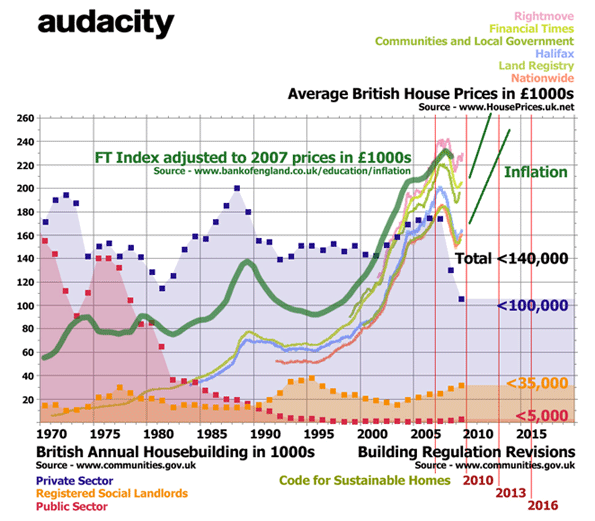
    British house construction has remained at a low level for a decade.   Total new house and flat completions for all tenures last year were 113,670 for England, 17,470 for Scotland, and 6,170 for Wales. Excluding Northern Ireland that is 137,310 for Britain. Under 140,000 homes a year is low for a nation of 60 million.

    We are nearly at the lowest level of housing production since reliable records began in the 1920s. (Note 1)  

    Anyone expecting British house building to pick up soon will be disappointed, even as the housing market inflates into another bubble. Grant Shapps,  the Coalition government’s Housing and Local Government Minister, is also hoping that house price inflation will not return to make the present housing predicament worse.  

    He will be disappointed, too. Shapps wants modest deflation and more houses to be built. However, he is powerless to make that happen while his government sustains the national denial of Freehold development rights that in Britain defines the planning system. By denying landowners the right to build on any land they own, the system works against significant levels of housing production.

    The renewal of house price inflation

    The low level of production all but guarantees renewed house price inflation. According to estate agency Savills, inflation-adjusted house prices grew by 68 per cent in the decade up to 2010, even after the British housing market finished wobbling during the sub-prime mortgage finance crisis. Savills told readers of The Telegraph that house prices will inflate by 40 per cent in real terms over the next decade.  

    Britain’s vast majority of home owners will be relieved. Most people have felt uneasy with financial dependency on the debt and equity in their home. For most British households wages and pensions are insufficient.

    At the root of the problem lies the peculiar nature of Freehold in Britain. The government enjoys an effective national instrument in their effort to protect the housing market. An old innovation of the post-war planning system, this ensures cheap farm land can never come onto the market to allow the building of low cost homes in great volume, sufficient to precipitate a housing market crash worth having. Planning as a denial of development rights works very well to protect the members of the Council of Mortgage Lenders.

    This keeps house building volume low.   Britain’s former volume house builders have begun to make the painful adjustment to work within the Coalition’s planning system. It will not be easy for them.

    The national denial of development rights is sustained, and in many ways the problem is worse under the Conservative-led coalition than under New Labour.

    The house builders have been stripped of New Labour’s national target of 240,000 net additional homes a year, but that was an unmet and inadequate target.   Even more troubled are plans to develop 50 proposed “eco towns” also proposed by Labour, itself a small, even deluded, enterprise that is pathetic compared to development elsewhere in the world.

    Urban expansion and new settlements – whether in Britain or elsewhere – require land. And Britain, contrary to popular belief has land aplenty. The restraints placed on builders can best to described in the words of Sir Peter Hall, as a “Land Fetish”.   

    The planning system also is host to an eco-fetish that the Coalition appears willing to sustain regardless of housing need.

    Inevitably some house builders will have subscribed to the idea that the environment is too precious to allow much land to be developed, but not all.  This leaves no centralised attempt to satisfy the demand for new household formation following from population growth, the needs of immigrants, or to encourage the replacement of the worst housing stock. For greens of the more misanthropic persuasion, opposition to both population and production makes sense. They don’t want humanity to reproduce either biologically or industrially. They don’t want a world that is always about advancing human interests through industry.

    Yet the need for new homes won’t so easily go away.

    A three sided predicament

    This contemporary British housing trilemma will not be easily resolved. The country seems to accept expensive, inadequate housing and mortgage debt as a fact of life.  

    Yet this leaves us with no solution for future needs.

    Something needs to change.  Hugh Pavletich and Wendell Cox publish as Demographia have found – for the seventh year running – increasing unaffordability of British housing.  

    The Solution: 250 New Towns

    The only reasonable solution is to tear down the current planning structure. What we need is an audacious move to build some 250 new towns.

    This movement would try to replicate past successes. In the brief inter-war period, 1918 to 1938, popular owner occupation flourished, with economically struggling farmers keen to sell their Freehold land to house builders.  

    How long will Britain live with low levels of construction, increasingly higher prices and consistently low levels of affordability? The increasing drag of house price inflation on household incomes and the acceptance of poor quality British housing in short supply cannot be sustained indefinitely.  

    How long will Britain sustain housing unaffordability as a financial opportunity, protected by a weak government?  

    The British collective obsession with inflating house prices must end sometime, unless we are to lose all sense of housing primarily as somewhere useful to live.  

    The freedom to build on your own land will deflate the housing market, dramatically in some locations.  Giving all landowners their Freehold right to build will liberate the commercial construction industry from the burden of inflated land prices, allowing disruptive advances in industrial production.  

    If Britain faces the house price inflation projected by Savills in the next 10 years there are many home owners dependent on housing equity who will not object. Neither will the house builders object too much as they build a low number of luxury eco-homes, to the undoubted applause of the architectural press. They may enjoy the praise for their greenness. Farmers might subsist as environmentalists. Greens will be sufficiently deluded to imagine there was some point to all this. The City will make a healthy return.

    The green zealots are conspicuous, and need to be confronted by industrialists with a sense of humanity. Now is no time to let them get away with their anti-humanism.

    Britain certainly is capable of more than is currently being discussed. National housing output had peaked in 1968 at 413,714, more than twice the current rate.

    We have to answer the question: Who will organise to better explain and end the housing predicament in low wage industrial Britain? We are hoping the 250 new towns club can start the ball rolling.

    —-

    Note 1 – Marian Bowley, ‘Table 2, Numbers of Houses Built in England and Wales between January 1, 1919 and March 31, 1939’, in Housing and the State 1919-1944, London, George Allen & Unwin, 1945, p 271

    Ian Abley, Project Manager for audacity, an experienced site Architect, and a Research Engineer at the Centre for Innovative and Collaborative Engineering, Loughborough University. He is co-author of Why is construction so backward? (2004) and co-editor of Manmade Modular Megastructures. (2006) He is planning 250 new British towns.

  • Coalition of the Unwilling

    This week the UK government announced an ”end to anti-car policies” reversing the guidance to local authorities to dissuade citizens from using their cars in favour of public transport. Charges for parking will be reined in, they promise.

    It should be good news. The comically-named ”traffic calming” schemes put in place by the outgoing government were deeply unpopular. Still, we are getting used to taking our announcements from the new coalition government with a pinch of salt.

    Before the election Housing Minister Grant Shapps backed demands from the Housebuilders’ Federation for a ‘right to build’. That might seem unnecessary, but in Britain the planning laws are so prohibitive that owning land extends no right to build upon it. Instead planning authorities extend permission to build where it meets the terms of the local plan.

    The impact of Britain’s planning laws has always been a problem, but for the last thirteen years the ‘local plan’ has been hi-jacked by anti-growth campaigners from the Campaign to Protect Rural England, the Urban Taskforce and the massed ‘NIMBY’ campaigners of the Tory Shires.

    The new local government minister Eric Pickles explained that the net effect of the planning system’s strangle hold on house building was that ”we’re at rock bottom”: ”1924 was the last time we built this little number of houses”. His Labour predecessor Nick Raynsford had ”done more damage than the Luftwaffe”, said Pickles, exaggerating a little, but making his point (Sunday Times, 12 September 2010).

    So what about the changes? Grant Shapps’s published policy does include the words ”right to build” – but they are heavily hedged about:

    ”provided that [the new homes and buildings] conform to national environmental, architectural, economic and social standards, conform with the local plan, and pay a tariff that compensates the community for loss of amenity and costs of additional infrastructure’ (Open Source Planning, Page 3).

    All of which sounds pretty much as bad as it was before. What right to build, you might ask? Indeed the words ‘right to build’ feature just once in the document, as quoted above, in the executive summary. There is a question mark, too, over who it is that has the right to build. ”Communities”, according to Shapps, and the government have the right, but just how these ”communities” are defined is not clear. More likely they will be the same planning authorities as before. In that case the only developers that get a look in will be the powerful and well-connected like Tesco or Barratt Homes – those who are in a position to meet the municipal fathers’ demands for baksheesh… or ”planning gain” as it is known in the UK.

    Coalitions are new to Britain (apart from one shaky Liberal-Labour government in the seventies). But with neither David Cameron’s Conservative Party, nor the deeply demoralised Labour Party of Gordon Brown winning enough votes to command a majority in the House of Commons, Cameron had to turn to Nick Clegg’s minority Liberal Democrats.

    This arrangement seems to suit Cameron. Cameron became leader on a pledge to lose the ”nasty party” image the Conservatives had after years of office in the 1980s. His method is a mirror image of Tony Blair’s repositioning of the Labour Party as a centre party by distancing it from its socialist roots. First we had a Labour government that was against socialism. Now we have a Conservative-led government that is shy about capitalism.

    Sidelining the old-school Thatcherite, free market Tories in favour of his friends in the public relations, media and volunteer sector, Cameron seems obsessed with changing the party brand.Although this did not work in the election, the advantage of an alliance with the Liberal Democrats means that he can ditch whatever fundamentalist free market doctrines whenever convenient on the grounds that ”coalition government is compromise”.

    The net effect is a government that keeps sounding as if it is going to do something decisive, but then doesn’t.

    The greatest challenge has been the state of the public finances. Britain’s government debts are astonishing: one trillion pounds sterling, or 68.2 per cent of GDP. Since most of the debt was contracted under Labour’s watch, the coalition government has the moral high ground. The Labour coalition says that the cuts announced in the public sector put the recovery in danger because they are too far, too fast. They stand by ”counter-cyclical” spending, but Labour has little mainstream credibility in terms of the country’s finances.

    For the left, though, balancing the capitalists’ books is hardly the issue. They are looking forward to a re-run of the campaign against the Thatcher public spending cuts of the 1980s. The protests and banners all seem to reinforce the idea that the government is indeed planning to rein in public spending, but it is not. As former Tory Minister John Redwood has pointed out, the planned cuts are not even cuts at all, but a limit on spending growth.

    Cameron’s government had to sound tough on public spending, because the bond traders were in fear of Britain’s debt rating being marked down, and the wider impact of a loss of confidence. With both Greece and Ireland’s finances in trouble, the British government needed to promise stability.

    But the same city traders are just as determined that the spending party should carry on, even if the volume is turned down to avoid scaring the neighbours. For years Britain’s ”private sector” has been dependent on extraordinary boosts of government cash. Under the outgoing government’s Private Finance Initiative, public institutions like hospitals and schools were allowed to raise funds by issuing their own bonds, debt that was not reckoned in the official accounts. Then Gordon Brown’s banking bailout found government buying up failing banks like Royal Bank of Scotland.

    Despite their fawning support for austerity Britain’s City traders still expect to be looked after. The Bank of England’s emergency policy to meet the shortage of credit in the economy is called ”quantitative easing”. In practice it means that the government trades government bonds for the banks’ own toxic debts, while bond traders make money on the commission.

    Even the one controversial cut in public spending turns out to be something more like a gift to the banks. The government says that they will let universities charge fees approaching the market rate, and that students will no longer be subsidised. Since those who made the decision all got to go to university for free, the backlash was understandable – the kind of rioting Saturnalia that Britons indulge in from time to time (“off with their heads!“ shouted student rioters when they chanced upon the Prince of Wales’s limousine and mobbed it, while running from the police).

    To moderate the impact of the fees, though, the government has promised to expand the student loans scheme, where the State lends the money, and then recovers it later, through the tax system. For the banks, what could be more perfect? Here is a tranche of debt created overnight, guaranteed by a government that undertakes to recover it on their behalf: More of a subsidy to the City of London than a cut in government spending.

    Though the Conservatives are thought of as ”Thatcher’s Children”, they behave much more like their ”New Labour” predecessors. The tough talk is for show.

    Nowhere is this proto-New Labour approach clearer than on energy policy. Although Energy Minister Chris Huhne has acknowledged that Britain faces severe electricity shortages – he fails to ascribe the problem to its proximate cause, the failure to build enough coal-powered power stations.

    Huhne’s solution, though, will make things worse. Not more coal-powered stations, but a government imposed increase on tariffs for fossil-fuel generated power, and a special allowance for renewable energy. Of course, renewable energy on any normal pricing system would be uneconomic. Britain’s latest windmills even had to be heated up to stop them freezing solid this winter. The net effect of Huhne’s proposal: no fix for the energy shortage, and more expensive electricity.

    These policies have had disastrous, even lethal, results. According to the latest figures, excess winter deaths in the UK are in the region of 25 000, most of them the elderly, often hastened along by fuel poverty. With Huhne’s proposals, those numbers are set to increase, as electricity becomes something of a luxury to the poor.

    At least in this area, the Tories are “conservative”. The tradition of the poor freezing to death in wintertime is being restored, and so too may be the old class system that allows the City to enrich itself as the expense of everyone else, including the taxpayers.

    James Heartfield is the author of Let’s Build: Why we need five million new homes, a director of Audacity.org, and a member of the 250 New Towns Club.

    Photo by Chris Devers

  • The Overdue Debate: Smart Growth Versus Housing Affordability

    American households face daunting financial challenges. Even those lucky enough not to have suffered huge savings and retirement fund losses in the Great Recession seem likely to pay more of their incomes in taxes in the years to come, as governments attempt pay bills beyond their reasonable financial ability. Beyond that, America’s declining international competitiveness and the easy money policies of the Federal Reserve Board could well set off inflation that could discount further the wealth of households.

    In this environment, the last thing governments need do is to raise the cost of anything. It is bad enough that taxes may have to rise and that a dollar will probably buy less. America’s standard of living could stagnate or it could even decline.

    The Choice: Smart Growth or Affordability

    The Washington Examiner, however, succinctly put the choices that face the nation, states and localities with respect to the largest element of household expenditure — housing. In an editorial entitled “Take Your Pick: Smart Growth or Affordable Housing,” the Examiner noted:

    “No matter how much local politicians yammer about how much they support affordable housing, they are the principal cause of the problem via their land use restrictions, such as the urban growth boundary in Montgomery County and large-lot zoning in Loudoun County.”

    The editorial was in response to our Demographia Residential Land & Regulation Cost Index, which estimated the extent to which the land to construction ratio had risen in metropolitan regions. The principal finding was that the share of land and regulatory costs to new house prices had risen only with the impostion of more restrictive land use policies. This is principally because strategies such as urban growth boundaries, suburban large lot zoning and geographical growth steering (such as allowing state financial assistance only in areas meeting smart growth criteria) makes land for housing unnecessarily scarce, raising its price just as surely as OPEC’s oil rationing raises the price of gasoline.

    Urban planner and mayor of Ventura, California Bill Fulton objected to our attributing these increases to land and regulation, instead suggesting that smart growth increases homes prices much less than we claimed although, he admits, “at least a little“ . The pro-smart growth study Costs of Sprawl — 2000 concedes that a number of smart growth strategies can increase house prices (See Table 15-4). Thus, the debate is not about whether more restrictive land use policies raise the price of housing, but rather by how much.

    More often, however, proponents of more restrictive land use regulations have avoided and even denied that the inconvenient truth linking their policies with higher housing costs. Rarely, if ever, have proponents of such policies fully disclosed to elected or appointed officials that more restrictive land use policies would lead to higher house prices. It is doubtful that any urban planning department ever sent representatives to an NAACP chapter to explain how fewer African-Americans would be able to own their own homes, despite already having a one-third lower home ownership rate than non-Hispanic whites. Similarly, the planners probably never told La Raza chapters that Hispanic households, also with a one third less home ownership rate, would find home ownership more costly. Nor was the message delivered to the religious organizations concerned with improving the standard of living for lower income households.

    Pervasive Evidence

    Yet the evidence that smart growth boost prices substantially seems incontrovertible. An early 1970s research effort led by renowned urbanologist Peter Hall quantified the impacts of the restrictive Town and Country Planning Act of 1947, which brought smart growth measures to England. The result, The Containment of Urban England revealed how strict regulations on development had driven the price of land for development from five to ten times the value of comparable on which development was not permitted, but might be permitted in the future. More recently, Bank of England Monetary Policy Committee member Kate Barker, was commissioned by the Blair Labour government to review housing affordability and land regulation. She attributed England’s more steeply rising house prices relative to continental Europe to its more restrictive land use regulations.

    The same effect is evident in the United States. Dartmouth’s William Fischel noted that California house prices were similar to those in the rest of the nation as late as 1970. By 1990, however, California house prices had escalated well ahead of the nation. Fischel found that the higher prices could not be explained by higher construction cost increases, demand, the quality of life, amenities, the property tax reform initiative (Proposition 13), land supply or water issues. His conclusion was that the expansion of land use restrictions were the culprit.

    Let Them Eat Cake?

    The disregard at least some smart growth proponents show about house prices may be characterized, for example, in a comment on the Planetizen website:

    “… smart growth can lead to more expensive housing. So what? At least it’s REAL value, generated by a higher quality of life, easier commutes, more transit options, walkability and a more enriched cultural experience…” (emphasis in original)

    Perhaps it never occurred to the proponents of more restrictive land use policies that not all households have the benefit of incomes typical of urban planners or new urbanist architects. One has to question the “REAL values” of smart growth since most housing consumers place their highest emphasis on things like privacy, security and good schools, not always available at a decent price in urban areas.

    In fact, higher priced housing reduces the discretionary income that is crucial to an acceptable standard of living to many households. Millions of households will not be in the market for “a more enriched cultural experience” until they can afford the housing they desire.

    Housing Affordability and the Cost of Living

    It is not accidental that the cost of living is higher (both in nominal terms and relative to incomes) in metropolitan regions where land use regulation is the strongest, such as San Diego, Washington-Baltimore, Seattle or Boston. Nor is it accidental that house prices have escalated to 40 percent above historic norms in Portland, Oregon, where planners have skimped on geographical urban growth boundary expansions, choosing instead to look skyward, seeking higher densities. California’s aspiration under Senate Bill 375 for new housing at 20 units to the acre offers a more than Jakarta level of density (residential densities above 30,000 per square mile) that could escalate the unprecedented exodus of people and businesses.

    Higher Housing Costs: The Poverty Connection

    The acknowledged relationship between more restrictive land use regulation and higher house prices also applies to standards of living, which are sent lower, and poverty rates, which must inevitably be pushed higher. This constitutes a second inconvenient truth: as discretionary income drops, more households fall into poverty. This creates a difficulty for proponents of more restrictive land use regulation, because there is no constituency for increasing poverty. It is no wonder they have generally discounted, ignored or even denied the nexus between smart growth and higher housing costs.

    Considering the financial uncertainty American households face, it is long past time that the choice between smart growth and housing affordability be seriously debated.

    —-

    Photograph: “Low density” smart growth development adjacent to the urban growth boundary (Hillsboro) in suburban Portland (by author)

    Wendell Cox is a Visiting Professor, Conservatoire National des Arts et Metiers, Paris and the author of “War on the Dream: How Anti-Sprawl Policy Threatens the Quality of Life

  • Who’s Racist Now? Europe’s Increasing Intolerance

    With the rising tide of terrorist threats across Europe, one can somewhat understandably expect a   surge in Islamophobia across the West. Yet in a contest to see which can be more racist, one would be safer to bet on Europe than on the traditional bogeyman, the United States.

    One clear indicator of how flummoxed Europeans have become about diversity were the remarks last week by German Chancellor Angela Merkel saying that multi-culturalism has “totally failed” in her country, the richest and theoretically  most capable of absorbing immigrants. “We feel tied to Christian values,” the Chancellor said. “Those who don’t accept them don’t have a place here.”

    One can appreciate Merkel’s candor but it does say something the limitations about the continent’s ability, and even willingness, to absorb immigrants. It’s quite a change from the generations-old tendency among Europeans, particularly on the left, to denigrate America as a kind of hot bed for racism.  Yet even before the latest report of potential terrorist attacks in several western European cities, the center of Islamophobia – and related ethnic hatreds – has been shifting inexorably to the European continent.

    Of course, America has always had its bigots, and still does. And of course, Islamists who threaten or commit violence need to be arrested and thrown behind bars. But, to date, neither major political party has been able to make openly white-supremacist politics a successful leading platform. After all, what was the last time anyone took Pat Buchanan , who has made comments similar to those of Merkel, seriously? Despite the brouhaha over the Arizona anti-illegal alien law, only 5% of Americans consider immigration the nation’s most pressing issue, according to a September Gallup poll.

    The situation in Europe is quite different. Openly racist, anti-immigrant and Islamophobic groupings are on the rise, and they are wreaking havoc on once subdued European politics. Traditional mainstream parties are declining, and the new racist parties can be seen in broad daylight in Austria, Switzerland, Denmark, Sweden and the Netherlands, where populist firebrand Geert Wilders has suggested banning the Koran. In Italy the anti-immigrant Northern League is already hugely powerful.

    It is true that as many Europeans as Americans–about half–think immigration is bad for their countries.  The big difference is what Europeans are willing to do about it. Just consider French President Nicholas Sarkozy’s farcical effort this fall to expel the hapless Roma.

    Yet for most Europeans the big issue is not purse-snatching gypsies but fear and loathing toward the expanding presence of Muslims–who are at least three times as numerous in the E.U. as in the U.S.  Over half of Spaniards and Germans, according to Pew, hold negative views of Muslims. So do roughly 40% of the French. In contrast, only 23% of Americans share this sentiment.

    More disturbing, Europe is actually putting these ethnic hostilities into law. An early sign came this winter, when the usually phlegmatic  Swiss voted to prohibit the building of new minarets. More recently a ban on burqas – the admittedly unattractive female body suits favored by some orthodox Muslims – passed in France, home to Europe’s largest Muslim community. The same measure is now being considered in Spain.

    These actions reflect a broad, and deepening, stream of European public opinion. A recent Pew survey found that over 80% of the French support banning the burqa, as do over 70% of Germans and a large majority of Spaniards and British.

    In contrast, nearly two-thirds of Americans find the burqa ban distasteful. Burqas don’t exactly stir admiring glances in the shopping mall, but few Amercians think we need to ban them. The basic ideal of “don’t tread on me” means “don’t tread on them” as well – at least until they start blowing themselves up at Wal-mart.

    This nuance escapes some of our own knee-jerk racial obsessives, like the Atlanta Journal Constitution’s Cynthia Tucker, who equates opposition to a mosque at Ground Zero as proof of a “new McCarthyism”  aimed against Muslims. But you don’t have to be a bigot to have second thoughts about erecting a mosque at the very spot where innocents were slaughtered by radical Islamists.

    Critical here are profound differences between the U.S. and Europe  in  the role played by ethnicity, race and religion. On the continent national culture is precisely that — the product of a long history of a particular ethnic group. Small minorities, such as Jews in Holland or Armenians in France, are tolerated but expected to submerge their ethnic identities. France has many artists and writers who may be Jewish, but you don’t see many French Woody Allens or Larry Davids who exploit their otherness to help define the national culture.

    Muslim attitudes in Europe are not exactly helpful either.  European Muslims often seem more interested in breaking the national mold than adding to its contours.  More than 80% of British Muslims, for example, identify themselves as Muslims first before being British. This is true of nearly 70% of Muslims in Spain or Germany. Similarly, up to 40% of Britain’s Islamic population believe that terrorist attacks on both Americans and their fellow Britons are justified.

    This alienation also reflects an appalling social and economic reality. In European countries immigrants can receive welfare more easily than join the workforce, and their job prospects are confined by education levels that lag those of immigrants in the United States, Canada and Australia. In France unemployment among immigrants–particularly those from Muslim countries–is often at least twice that of the native born; in Britain Muslims are far more likely to be out of the workforce than either Christians or Hindus.

    Partly due to a less generous welfare state, American immigrant workers with lower educations have, for the most part, been more economically active than their nonimmigrant counterparts.  The contrast is even more telling among Muslim immigrants. In America most Muslims are comfortably middle class, with income and education levels above the national average. They are more likely to be satisfied with the state of the country, their own community and their prospects for success than are other Americans—even in the face of the reaction to 9-ll.

    More important still, more than half of Muslims identify themselves as Americans first, a far higher percentage than in the various countries of Western Europe.   More than four in five are registered to vote, a sure sign of civic involvement. Almost three-quarters, according to a Pew study, say they have never been discriminated against–something that is definitely not the case in Europe where a majority, according to Pew, complain of discrimination.

    Over time, these differences between Europe and America may become even more pronounced. America is becoming increasingly diverse, but it is also growing demographically, and Muslims make up a very small part of that. There’s little fear in Anerica of the kind  of  Muslim envelopment that appears to threaten a  rapidly aging, and soon to be depopulating, Europe.

    Of course the U.S. still has its bigoted Islamophobes, just as it has its own small cadre of vicious Islamists. One law of history appears to be that morons will be morons.   But America’s culture seems strong enough to resist the anti-immigrant hysteria emerging throughout Europe. This is one case where  la difference between America and Europe may prove  a very good thing indeed.

    This article originally appeared at Forbes.com.

    Joel Kotkin is executive editor of NewGeography.com and is a distinguished presidential fellow in urban futures at Chapman University. He is author of The City: A Global History. His newest book is The Next Hundred Million: America in 2050, released in February, 2010.

    Photo by World Economic Forum