Tag: United Kingdom

  • Has America Caught the British Disease?

    As the economy stalls, analysts are worrying that the United States might repeat the experience of Japan’s “lost decade” (actually, two lost decades). Is America turning Japanese? We should be more worried about the prospect that America is turning British.

    The United Kingdom went from creating the first industrial economy and establishing a global empire to lagging Italy by the 1970s. The neoliberal reforms of Thatcher and Blair, intended to modernize the economy, merely replaced a rotting manufacturing economy with an unstable rentier economy centered in the City of London. With a zombie economy characterized by industrial wastelands, off-limits aristocratic landholdings, tourist kitsch and a financial sector that choked on its own excesses, Tony Blair’s “Cool Britannia” looks more like “Ghoul Britannia.”

    The decline of Britain was generations in the making, as Corelli Barnett has argued in his “The Pride and the Fall Books,” a series of polemics that include “The Audit of War” and “The Collapse of British Power.” The industrial strength that made the island nation the pioneer of the modern era was the result of unfashionable people – middle-class manufacturers – in the unfashionable industrial towns of the British midlands.

    Unfortunately, Britain’s industrial revolution was not accompanied by a revolution in values that emphasized making things over inheriting things. The old elite of aristocratic parasites, Church of England drones, and their snobbish retainers like elite lawyers and professors despised upwardly mobile arrivistes, although their children and grand-children might become socially acceptable if they abandoned “trade” for the lifestyle of genteel rentiers and were laundered through public schools like Eton and Oxbridge. The equivalent of Germany’s technical high schools and polytechnics and America’s agricultural and mechanical colleges were (and are) sneered at in Britain as vulgar “redbrick” universities.

    The failure to change Britain’s elite attitudes was accompanied by a failure to change Britain’s temporarily-successful free trade policies when they became anachronistic. From the Tudor era until the nineteenth century, the British state used mercantilist policies of the kind nowadays associated with the “East Asian model” – selective protectionism, subsidies to exporters, procurement, taxes on resource material exports to keep prices low. The American colonies, forbidden to manufacture anything and forced to supply the metropole with food and raw materials in return for high-value-added British manufactures, were part of the mercantilist system, like Scotland, Ireland and India.

    By the 1840s, Britain’s technological supremacy allowed it to take off the protectionist training wheels and practice and preach free trade, confident that its manufactured exports would kill off infant industries in other countries. Beginning in the 1870s, however, the newly-united Germany and post-Civil War America adopted their own high-tariff policies of industry-supporting mercantilism. Despite the warnings of trade reformers like Joseph Chamberlain in the 1880s and 1890s, the British continued to practice one-way free trade, allowing German and American corporations based in their own giant, protected domestic markets to increase their shares of the market in Britain, its dominions and its colonies.

    As British industry shrank under American and German competition, the City of London became even more important. Finance was a clean business, untainted by the grime and odor of the factory, and could be practiced by gentlemen. The British discovered too late that finance follows industry, as the epicenter of global banking migrated from London to New York during World War I.

    Today the U.S. is repeating Britain’s mistakes. First the Japanese and now the Chinese have used a variety of methods, from nontariff barriers (Japan) to currency manipulation (both) to keep U.S. products out of their markets while enjoying unimpeded access to America’s consumer market, the biggest in the world. As in Britain, the center of gravity in the business world has shifted from manufacturing to finance. The catastrophic deregulation of the U.S. financial industry was based on the argument that unless the U.S. scrapped the New Deal era regulations that provided decades of financial stability and steady growth, Wall Street might lose out to the City of London or Hong Kong or Shanghai. For America’s bipartisan oligarchy, Wall Street is more important than Detroit.

    Not content to re-enact the British cycle of deindustrialization and decline, the U.S. imports British pundits to lecture Americans on nineteenth-century free market ideology. Asking dogmatic British free marketers how to organize a successful economy in the twenty-first century is the equivalent of asking unreconstructed Japanese militarists how to run a successful foreign policy or asking Iranian mullahs how to create a world-class R&D sector.

    Innovation without production is not the answer, as Britain’s sad history shows. Britain continued to have a world-class science and technology sector, inventing the jet engine and radar, among other things. But the British were unable to commercialize the products of British R&D because they lacked adequate mass production industries. Similarly, innovation will enrich few Americans other than technologists and venture capitalists if the new products that result are then licensed to be produced in industrial Asia or industrial Europe.

    The irony is that, while the American colonists were right to rebel against their role of hewers of wood and drawers of water in the British Empire, the British mercantile system of the fifteenth through the nineteenth centuries was a great success story, producing not only temporary British supremacy but also modern technological civilization. The Germans, Japanese and Chinese have always practiced subtle and not-so-subtle versions of the technonationalism that Britain pursued before its misplaced confidence led it to adopt the free market ideology that accelerated its downfall. Modern America has more to learn from the pre-liberal, industrializing Britain of the seventeenth and eighteenth centuries that Adam Smith denounced than from the post-1840s Britain that sat nobly on its laurels as it sank beneath the waves it briefly ruled.

    Michael Lind is Policy Director of the Economic Growth Program at the New America Foundation and author of The Next American Nation.

    Photo by **Maurice**

  • G-20 Summit: There is No One Size Fits All

    There is one thing you need to remember as you listen to the debate about economic and fiscal policy at the G-20 Summit this weekend in Toronto: There is No One-Size-Fits All. There is not even a “One-Size-Fits Twenty.”

    Back in 2001, I summarized the few things about finance and economics that most scholars agree will support a growing economy and healthy capital markets:

    “Four strategies can be shown to generally promote stable national financial systems: 1) having independent rating agencies; 2) having some safety net; 3) minimizing government ownership and control of national financial assets; and 4) allowing capital market participants to offer a wide-range of services.”

    As of today:

    1) Our rating agencies are independent of government, but not from the financial institutions who buy the ratings (who also buy the government, but I’ll leave that story to Matt Taibbi over at Rolling Stone …); 2) we bankrupted the Federal Deposit Insurance Corporation in late 2009, before the end of the recession (and that doesn’t even count all the bailouts of Wall Street and Main Street); and 3) the government took ownership positions in all US major financial institutions during the bailout.

    I’ll come back to #4 to another time – Congress has vowed to ruin even that one before the 4th of July recess by passing the Wall Street Reform Act.

    The United States delegation to the G20 Summit consists of President Obama, his economic advisor Larry Summers and (your friend and mine) Treasury Secretary Tim Geithner. At least one of them should know better than to go around insisting that every nation at the meeting should have the same policy as the United States: damn the torpedoes, full speed ahead! In other words, just as Federal Reserve Chairman Ben Bernanke is firing up the helicopters, keep dropping dollar bills on the economy until something starts growing. In a letter sent to the G-20 leaders in advance of the Summit in Toronto, they made it clear that the rest of the G-20 countries should do the same. While President Obama writes in the letter that the G-20 should “commit to restore sustainable public finances in the medium term” the underlying context is that there should be more fiscal stimulus in the short term.

    I’m not the only economist to have said this before: When it comes to developing robust capital markets and a vibrant economy, there is no “one size fits all”. This lesson should be familiar to the US delegation. To make it clear, let’s look at the numbers.


    2000

    2001

    2002

    2007

    2008

    2009

    Consumer Inflation Rate

    Canada

    2.7%

    2.5%

    2.3%

    2.1%

    2.4%

    0.2%

    France

    1.7%

    1.7%

    1.9%

    1.5%

    2.8%

    0.4%

    Germany

    1.5%

    2.0%

    1.4%

    2.3%

    2.6%

    0.0%

    United Kingdom

    2.9%

    1.8%

    1.6%

    4.3%

    4.0%

    2.2%

    United States

    3.4%

    2.8%

    1.6%

    2.9%

    3.8%

    -0.4%


    Economic Growth Rate

    Canada

    5.2%

    1.8%

    2.9%

    2.7%

    0.4%

    -2.5%

    France

    3.9%

    1.9%

    1.0%

    2.3%

    0.4%

    -2.2%

    Germany

    3.2%

    1.2%

    0.0%

    2.5%

    1.3%

    -5.0%

    United Kingdom

    3.9%

    2.5%

    2.1%

    3.0%

    0.7%

    -4.8%

    United States

    3.7%

    0.8%

    1.6%

    2.0%

    0.4%

    -2.4%

    The numbers in question are 2007 through 2009, those associated with the current recession. I include 2000-2002 in the table to show what happened in the last recession, for a little perspective. The players in question are US, UK, France and Germany – I include Canada as a courtesy because they are the host country for the summit,. The first thing you’ll notice is that the US is the only one among the group that did not see positive prices increases last year – hence, their continued willingness to employ the cash-dropping helicopters.

    French Finance Minister Christine Lagarde is outspoken this week on the subject of getting the federal budget under control in France instead of expanding economic stimulus programs: she believes what’s best for France is to get the deficits under control, which means reducing the budget and not more spending. On this one, I’m with Minister Lagarde: Vive La Différence!

    There’s one more thing you need to know about economic growth and that is this: It takes more than a 2.4% increase to make up for a 2.4% decrease. Think of this way: if you start at 1,000 and reduce by 50%, you are left with 500. Now, at 500 if you get a 50% increase, you are only back to 750. To get from 500 back to 1,000, you need a 100% increase. As I wrote back in January: “At this rate, it will take 11 quarters (nearly 3 years) to catch up.” More government spending, however, will not provide a healthy long-term solution.

    Susanne Trimbath, Ph.D. is CEO and Chief Economist of STP Advisory Services. She will be participating in an Infrastructure Index Project Workshop Series throughout 2010. Her training in finance and economics began with editing briefing documents for the Economic Research Department of the Federal Reserve Bank of San Francisco. She worked in operations at depository trust and clearing corporations in San Francisco and New York, including Depository Trust Company, a subsidiary of DTCC; formerly, she was a Senior Research Economist studying capital markets at the Milken Institute. Her PhD in economics is from New York University. In addition to teaching economics and finance at New York University and University of Southern California (Marshall School of Business), Trimbath is co-author of Beyond Junk Bonds: Expanding High Yield Markets.

    Photo by carlossg

  • The Downside of Brit-Bashing

    Obama may be spanking BP’s brass today. But the other crisis—Europe’s economic mess—reminds us why it’s important that the U.S. and U.K. stick together.

    The controversy over the BP spill threatens to drive US-UK relations to a historic low point. When recently in London, several people worried that the President may be engaging in “Brit-bashing” at the expense of our historically close ties. This theme has been widely picked up in the UK press.

    “It’s the gushing geyser of Obama’s anti-British rhetoric,” screams Melanie Phillips this week in the Daily Mail,” that now urgently needs to be capped.” Indeed, however much President Obama wants to beat up the Tony Hayward, who certainly deserves to be both tarred and feathered, he might want to consider how “Brit-bashing” may not be in our long-term interest. This is particularly true at a time hat the world’s other big crisis—the collapse of the euro—offers a unique opportunity to shore up our now beleaguered “special relationship.”

    The British Empire may be little more than a historical relic, but the current euro crash could make those old ties between mother country and her scattered former colonies, including America, more alluring. After a decade marked by sputtering movement towards greater integration with Europe, the United Kingdom, particularly its beating heart—London—might be ready to drift away from the continent and back towards America and Canada and the rest of the world beyond.

    This process will be accentuated by the fact that while Europe’s population and economy, particularly on its southern and eastern tiers, seems set to decline even further, the future of North America—largely due to mass immigration and its large resource base—continues to appeal to British investors and companies. In addition, the rise of other parts of the world, notably Russia, India and China, suggests that Britain’s future, like that of North America, rests increasingly outside of Europe.

    Social forces in Britain today will accentuate these trends. In London today you do hear many European languages, but the big money you see around posh places in Mayfair more often speaks not Italian or French, or even German, but Hindi, Arabic , Russian and, increasingly, Chinese. London today is not so much a British city as a global one, with a percentage of foreign-born residents—roughly one-third—equivalent to that of such prominent American multi-racial capitals as New York or Los Angeles.

    Just take a look at the over 200,000 people who became UK citizens last year, up from barely 50,000 annually a decade earlier. The EU accounted for barely three percent of the total; all of Europe, including the former Soviet bloc, represented eight percent. In contrast the biggest source of new subjects was from the Indian subcontinent—roughly 30%—and Africa, which provided another 27 percent.

    This ethnic transformation—much like the one taking place and widely celebrated by Obamanians in the United States—helps tie Britain, despite its proximity to the continent, more to the rest of the world. The UK may not be ready for its own version of Barack Obama, but a post-European future seems increasingly likely through ties of both blood and money. To be sure, in the coming year the level of immigration may decline under the Tories, whose party competes for voters with nativist groups. But economics—and the disastrous state of the Euro—may prove an even larger factor in the country’s transformation.

    Already there is growing concern that the sovereign debt issues of places like Greece, Spain, Italy and Portugal—the so-called swilling PIGS—could force Britain, with its already weak economy, to raise interest rates and cut its budgets more than might be advisable. Last month London’s FTSE 100 has lost fifteen percent of its value as a result of the euro crisis, a steep fall made only marginally tolerable by the even worse results on the continent. Future euro-moves could prove even more threatening. Wide ranging attacks on financial speculation, so popular in an increasingly hegemonic Germany, are like a gun aimed at Britain’s economic core. After all, the UK’s exports are built not around cars, steel or fashions but its role as the world’s banker, consultant and business media center. “The euro zone,” complains one columnist in the right-leading Daily Telegraph, “may be leading us into a double-dip recession.”

    But declining euro-enthusiasm is not limited to those considered conservative “nutters” by Britain’s continentally-minded sophisticates. You don’t have to be an unreconstructed Thatcherite to resist tying the country to the future feeding of widely irresponsible “Club Med” countries or kowtowing to Berlin. Rather than the Germans and their PIGS, Britain may be better off linking with both the BRIC countries—Brazil, Italy, India and China—as well as a rebounding North America.

    As the ultimate capitalist entrepot, Britain’s trump lies in being hugely attractive to Americans. In this respect, beating up BP, however justified, may also be squandering an opportunity to solidify a relationship that is needed on so many fronts from battling Islamic extremism—the Brits and the Canadians are our only strong reliable allies—to preventing German-style controls over the global entrepreneurial economy.

    Herein lies our opportunity. Although not “anti-European,” Britons tend to be “deeply skeptical about the institutions of the European Union,” notes Steve Norris, a former MP, onetime chairman of the ruling Conservative party and two times that party’s candidate for Mayor of London. As he puts it: “The British do not want a federal Europe in which significant powers pass from sovereign parliaments to Brussels.”

    Although Labour also resisted rapid integration into Europe, the current government under the new Prime Minister David Cameron, Norris notes, has made it clear that it is even more resistant to this trend. This may prove an embarrassment to Cameron’s historically Europhile deputy prime minister, the Liberal Independent’s Nick Clegg, but the movement away from Europe seems increasingly inevitable.

    For one thing, the future of the euro may depend on expanding Brussels’ control of member nation’s budgets, something few British MPs of any party are likely to embrace. Attempts by France and Germany to expand the power of Brussels to save the Euro are likely to chase away even the most devoted Europhiles in Britain.

    All this is good news for a strengthened US-UK alliance—something that should not be threatened by excessive “Brit bashing.” For all its many shortcomings, Great Britain remains one of the globe’s great outposts of both civilization and dynamic market capitalism. Its economic power may be a shadow of what it once was, but its cultural, political and role as a transactional center keep the place globally relevant.

    A Britain both more Atlanticist and global also can play a more positive role by adding its weight to ours in slowing a shift to protectionism, battling terrorism and in resisting the now ballyhooed trend towards state-based capitalism. And that would bode well for Britain itself, allowing the country to play to fundamental strengths that derive from its unique historical legacy.

    This article originally appeared in The Daily Beast.

    Joel Kotkin is executive editor of NewGeography.com and is a distinguished presidential fellow in urban futures at Chapman University. He is author of The City: A Global History. His newest book is The Next Hundred Million: America in 2050, released in Febuary, 2010.

    Photo by Public Citizen

  • The Future Of America’s Working Class

    Watford, England, sits at the end of a spur on the London tube’s Metropolitan line, a somewhat dreary city of some 80,000 rising amid the pleasant green Hertfordshire countryside. Although not utterly destitute like parts of south or east London, its shabby High Street reflects a now-diminished British dream of class mobility. It also stands as a potential warning to the U.S., where working-class, blue-collar white Americans have been among the biggest losers in the country’s deep, persistent recession.

    As you walk through Watford, midday drinkers linger outside the One Bell pub near the center of town. Many of these might be considered “yobs,” a term applied to youthful, largely white, working-class youths, many of whom work only occasionally or not at all. In the British press yobs are frequently linked to petty crime and violent behavior–including a recent stabbing outside another Watford pub, and soccer-related hooliganism.

    In Britain alcoholism among the disaffected youth has reached epidemic proportions. Britain now suffers among the highest rates of alcohol consumption in the advanced industrial world, and unlike in most countries, boozing is on the upswing.

    Some in the media, particularly on the left, decry unflattering descriptions of Britain’s young white working class as “demonizing a whole generation.” But many others see yobism as the natural product of decades of neglect from the country’s three main political parties.

    In Britain today white, working-class children now seem to do worse in school than immigrants. A 2003 Home Office study found white men more likely to admit breaking the law than racial minorities; they are also more likely to take dangerous drugs. London School of Economics scholar Dick Hobbs, who grew in a hardscabble section of east London, traces yobism in large part to the decline of blue-collar opportunities throughout Britain. “The social capital that was there went [away],” he suggests. “And so did the power of the labor force. People lost their confidence and never got it back.”

    Over the past decade, job gains in Britain, like those in the United States, have been concentrated at the top and bottom of the wage profile. The growth in real earnings for blue-collar professions–industry, warehousing and construction–have generally lagged those of white-collar workers.

    Tony Blair’s “cool Britannia,”epitomized by hedge fund managers, Russian oligarchs and media stars, offered little to the working and middle classes. Despite its proletarian roots, New Labour, as London Mayor Boris Johnson acidly notes, has presided over that which has become the most socially immobile society in Europe.

    This occurred despite a huge expansion of Britain’s welfare state, which now accounts for nearly one-third of government spending. For one thing the expansion of the welfare state apparatus may have done more for high-skilled professionals, who ended up nearly twice as likely to benefit from public employment than the average worker. Nearly one-fifth of young people ages 16 to 24 were out of education, work or training in 1997; after a decade of economic growth that proportion remained the same.

    Some people, such as The Times’ Camilla Cavendish, even blame the expanding welfare state for helping to create an overlooked generation of “useless, jobless men–the social blight of our age.” These males generally do not include immigrants, who by some estimates took more than 70% of the jobs created between 1997 and 2007 in the U.K.

    Immigrants, notes Steve Norris, a former member of Parliament from northeastern London and onetime chairman of the Conservative Party, tend to be more economically active than working-class white Britons, who often fear employment might cut into their benefits. “It is mainly U.K. citizens who sit at home watching daytime television complaining about immigrants doing their jobs,” asserts Norris, a native of Liverpool.

    The results can be seen in places like Watford and throughout large, unfashionable swaths of Essex, south and east London, as well as in perpetually depressed Scotland, the Midlands and north country. Rising housing prices, driven in part by “green” restrictions on new suburban developments, have further depressed the prospects for upward mobility. The gap between the average London house and the ability of a Londoner to afford it now stands among the highest in the advanced world.

    Indeed, according to the most recent survey by demographia.com, it takes nearly 7.1 years at the median income to afford a median family home in greater London. Prices in the inner-ring communities often are even higher. According to estimates by the Centre for Social Justice, unaffordability for first-time London home buyers doubled between 1997 and 2007. This has led to a surge in waiting lists for “social housing”; soon there are expected by to be some 2 million households–5 million people–on the waiting list for such housing.

    With better-paid jobs disappearing and the prospects for home ownership diminished, the traditional culture of hard work has been replaced increasingly by what Dick Hobbs describes as the “violent potential and instrumental physicality.” Urban progress, he notes, has been confused with the apparent vitality of a rollicking night scene: “There are parts of London where the pubs are the only economy.”

    London, notes the LSE’s Tony Travers, is becoming “a First World core surrounded by what seems to be going from a second to a Third World population.” This bifurcation appears to be a reversion back to the class conflicts that initially drove so many to traditionally more mobile societies, such as the U.S., Australia and Canada.

    Over the past decade, according to a survey by IPSOS Mori, the percentage of people who identify with a particular class has grown from 31% to 38%. Looking into the future, IPSOS Mori concludes, “social class may become more rather than less salient to people’s future.”

    Britain’s present situation should represent a warning about America’s future as well. Of course there have always been pockets of white poverty in the U.S., particularly in places like Appalachia, but generally the country has been shaped by a belief in class mobility.

    But the current recession, and the lack of effective political response addressing the working class’ needs, threatens to reverse this trend.

    More recently middle- and working-class family incomes, stagnant since the 1970s, have been further depressed by a downturn that has been particularly brutal to the warehousing, construction and manufacturing economies. White unemployment has now edged to 9%, higher among those with less than a college education. And poverty is actually rising among whites more rapidly than among blacks, according to the left-leaning Economic Policy Institute.

    You can see the repeat here of some of the factors paralleling the development of British yobism: longer-term unemployment; the growing threat of meth labs in hard-hit cities and small towns; and, most particularly, a 20% unemployment rate for workers under age 25. Amazingly barely one in three white teenagers, according to a recent Hamilton College poll, thinks his standard of living will be better than his parents’.

    It’s no surprise then that Democrats are losing support among working-class whites, much like the now-destitute British Labour Party. But the potential yobization of the American working class represents far more than a political issue. It threatens the very essence of what has made the U.S. unique and different from its mother country.

    This article originally appeared in Forbes.com.

    Joel Kotkin is executive editor of NewGeography.com and is a distinguished presidential fellow in urban futures at Chapman University. He is author of The City: A Global History. His newest book is The Next Hundred Million: America in 2050, released in Febuary, 2010.

    Photo by MonkeyBoy69

  • The Broken Ladder: The Threat to Upward Mobility in the Global City

    Since the beginnings of civilization, cities have been the crucibles of progress both for societies and individuals. A great city, wrote Rene Descartes in the 17th Century, represented “an inventory of the possible”, a place where people could create their own futures and lift up their families.

    In the 21st Century – the first in which the majority of people will live in cities – this unique link between urbanism and upward mobility will become ever more critical. Cities have become much larger. In 1900 London was the world’s largest urban center with seven million people. Today there are three dozen cities with larger populations.

    No longer do a handful of western cities represent the only, or even the most critical, front in the battle for social progress. Mexico City and Mumbai, two cities we have studied, have three times London’s 1900 population. Indeed, of the world’s twenty most populous regions, the preponderance are located in third world or developing countries. The urban drama will play out on a truly global stage, with the most decisive developments taking place in the growing mega-cities of the developing world.

    It is first and foremost in these great cities of the human future that upward mobility must be most accelerated. Urban agglomerations such as Beijing, Shanghai, New Delhi, Sao Paulo, Mumbai, and Mexico City daily stand witness to one of the most rapid expansions of prosperity in history, as well as to wrenching examples of deep seated misery.

    Urbanity in the advanced industrial world is an increasingly interdependent system. The established centers of the global urban culture – New York, Los Angeles, London, Paris, Tokyo, Berlin – provide the critical markets, capital, and technological assistance that drive economic growth in the developing countries, whose growth in turn provides new opportunities for the citizens of the advanced cities.

    These established centers are often seen as occupying the Leninist “commanding heights” of the global economy. Is the kind of centralization we see in these cities, and in other mega-cities around the world, truly inevitable? And is their growth universally desirable? The answers to these questions are vital, notably because it is particularly in these locations that upward mobility now appears to be increasingly stalled. The stasis is reflected in both income trends and popular opinion in the leading centers of advanced world, including the United States, Japan and the United Kingdom.

    Optimists like historian Peter Hall believe that “neither western civilization, nor the western city, shows any sign of decay”. A recent World Bank report insists that large urban concentrations – the more dense the better – are the harbingers of opportunity and wealth creation. “To spread out economic growth”, it argues, is to discourage it. And it is certainly true that as countries modernize, they also urbanize, often quite rapidly. As a result, cities in the developing world – which also receive a great deal of international investment and aid – tend to be growing far more quickly than peripheral regions.

    Yet, in the longer term, the impacts of dense urbanization may not be universally useful at promoting either poverty alleviation or upward mobility. In advanced countries, this is already evident in large urban areas. Indeed, even the strongly pro-urbanist World Bank report acknowledges that as societies reach certain affluence levels, they begin to deconcentrate, with the middle classes in particular moving to the periphery.

    This process reflects a shift in economic and social realities over the past few decades. After nearly a half century of sustained social progress in most advanced countries, income growth for the middle class, even among the best-educated, has slowed considerably, and by some measurements has even turned negative. As we will see, the effects have been particularly tough on the urban middle and working classes in cities as diverse as Toronto, Los Angeles, Tokyo and London.

    Such concerns have been heightened by the current deep recession, which has caused wages to fall in both developing and developed countries. Yet concern over upward mobility was developing even in the relative “boom” times of the recent past, particularly in the advanced western countries, but also in the developing ones. Since 1973, for example, the rate of growth of the “typical family’s income” in the United States has slowed dramatically, and for males has actually gone backwards when adjusted for inflation. This diminishment has been particularly marked in major urban centers such as New York, Chicago, San Francisco and Los Angeles.

    Similar developments can be seen in a host of European cities, including London and Berlin, and even in Tokyo, which long has been seen as distinctly middle class. In all these cities, the middle class appears to be diminishing, while the population living in poverty has increased.

    The reasons for this trend include the impact of technology, aging demographics, globalization, and greater government indebtedness. A critical factor may also be opposition to the very idea of economic growth, something first seen in the 1970s and now increasingly persuasive, at least within large portions of academia, the media, and even parts of the financial community. This attitude is vividly and forcefully expressed, for example, within sectors of the ecology movement.

    Polls of popular opinion in the United States and the United Kingdom find ecological concerns well down the list, behind such issues as the economy, immigration, crime, unemployment and even the state of morality. Yet the agenda to address anthropogenic global warming promotes policies that seem likely to depress economic growth, particularly in cities, through further declines of productive industry, unaffordable housing prices and high levels of taxation.

    As recently seen at the global climate change conference in Copenhagen, few governments in the developing world are anxious to adopt any policy that weakens their ability to spark income and job growth in the near future. The pressing concerns of these cities remain focused on basic issues: sanitation, alleviation of poverty, industrial growth, infrastructure development and employment.

    Policies that prolong poverty and depress mobility seem likely to delay the necessary social consensus needed to enact long-term environmental improvements. When concern for the sustenance of families grows, focus on environmental issues tends to decline, as is already clear in recent surveys in the advanced countries. The much overworked term “sustainability” needs to include both economic and social components, as opposed to strictly ecological ones.

    Within the developing world, as the focus remains on basic economic issues, middle class residents of noted megacities appear to be more optimistic about personal advancement than their counterparts in the advanced countries. This may reflect the fact that countries such as India, China and Brazil have experienced rapid economic growth over the past decade, and expect more of the same in the decades ahead.

    Yet this does not suggest that the rising cities of the Second and Third World are growing in ways that do not deepen inequality. With rapid economic growth, these locations have seen considerable expansion of gaps between rich and poor, particularly with the decline of socialist institutions. Similarly, in some developing cities – Mumbai, Bogota and Sao Paulo, for example – there may be a widening gap between economic success and population density, as growth shifts to places with better infrastructure, less congestion, and less crime.

    In order to look in depth at differing attitudes among urban dwellers, we have focused our research on three megacities that represent different stages of economic development. We start with London, arguably the world’s most important global city, and explore the prospects for upward mobility there.

    Then we look at Mexico City, a city that represents the broad “Second World” of urban centers that have enjoyed some rapid growth but now face increased competition from China and other ascendant locations. Mexico City represents some of the realities that emerging urban centers in the Third World will face as they achieve higher levels of economic development.

    Third, we focus on Mumbai, India’s premier commercial city and financial center. Mumbai reflects the dichotomy of a rapidly growing city in the developing world: increasing wealth and rising expectations among its expanding middle class, with the continued creation of huge populations of destitute slum-dwellers.
    Yet for all the differences between these three great cities, we also find some commonalities. First, their future vitality depends largely on the future of their middle classes. Second, the critical issue for all these places remains how to sustain economic growth to meet the needs and aspirations of their citizens.

    Finally, they share the challenges of the current great economic revolution – what has been called the “post-industrial” era by Daniel Bell or the “third wave” by Alvin Toffler – on the nature of class. The increasing primacy of technology and education, once seen as liberating, could make widespread class mobility far more difficult than in the past.

    As occurred in the early stages of the industrial revolution, the current economic transformation threatens massive displacement of existing classes. Just as the machine age undermined the status of weavers, artisans and small farmers, the current technological epoch could well have similar impacts on not only industrial workers, particularly in the West, but on the supposedly ascendant educated middle class as well.

    This leads us to suggest a primary focus by all great cities on basic economic issues. Current concerns among the dominant cognitive classes in the media, the academic world, and the policy elites, particularly in the First World, have tended to center on aesthetics and “green” issues, as well as on who can draw ‘the best and the brightest”, rather than on how to employ the vast middle or working classes.

    We will explore some of the common challenges that will face all mega-cities as they evolve. Increasingly, they may find that their scale, long seen as an advantage, also produces inherent problems. In a globally interconnected urban environment, they must successfully compete not only with each other, but with smaller scale, and often more efficiently organized, urban areas throughout both the advanced and developing world.

  • Bungled Parliament:: The Price of Pursuing Safe Society Over Growth and Opportunity

    On May 6 British voters handed themselves a hung Parliament for the first time since 1974. No political party has a governing majority. This has surprised most pundits who have assumed for several years that the Conservatives would reclaim government in Britain by 2010, ending 13 years of Labour rule and the tenure of Gordon Brown, the prime minister everyone loves to hate.

    The reasons for the conservative’s disappointing performance are complex. Certainly the surprisingly adroit performance in the first-ever prime ministerial debates by Nick Clegg, the even-more-telegenic-than-David Cameron leader of the Liberal Democrat party, did not help. But Clegg’s lustre – which became known as “Cleggmania” – eventually wore off by election day, and the Lib Dems ended up losing five seats.

    The real reason for the Conservatives disappointing performance lay elsewhere. To many, it seemed that David Cameron, the Conservatives’ young and telegenic leader, represented a new type of Tory politician – one concerned with social justice and the environment while remaining true to core beliefs about smaller government and enterprise.

    Yet the bigger issue may well be this: the Conservatives, like their rivals, failed to make a compelling case how to restore an environment of growth and opportunity capable of bringing Britain out of its profound economic doldrums.

    Given Britain’s fiscal situation and a widely spread sense of economic malaise, the overall paucity of good policy ideas and public messages about opportunity and economic recovery is difficult to fathom. The fact that the Conservatives – erstwhile harbingers of enterprise and growth – managed to remain vague on economic fundamentals is particularly astounding.

    Days before the election, only 29 percent of voters said they trusted the Conservatives to do the best job dealing with unemployment, compared to 28 percent who preferred Labour. On the economy overall, 37 percent believed Conservatives were the best party compared to 36 percent who preferred Labour’s approach, an amazing result given the fact that Labour has controlled the government for thirteen years. Only on taxes did the British public clearly prefer the Tories to Labour, 31 to 24 percent, which is likely owing to the fact that the Conservatives very publicly opposed Labour’s promise to raise the National Insurance tax (similar to the payroll tax in the U.S.). This ended up as the only economic issue for which Tories showed any public passion in the weeks leading up to the election, and the opinion polls suggest their message got through. But they didn’t capitalize on the lesson.

    The roots of the problem run deep. British politicians have grown too accustomed to thinking about safety and security rather than policies that would require taking some risks for growth. Each party admitted in one way or another that public spending cuts would be necessary to deal with Britain’s deficit, but none – including, shockingly, the Conservatives – laid out an aggressive vision of how these cuts could be combined with the types of policies needed to increase entrepreneurship, create more jobs, attract investment, and promote greater overall opportunity in the economy.

    Consider the third and final televised party leader debate, which focused on the economy. Cameron, to his credit, was the only one to use the word “entrepreneur” or one of its derivatives. He did so three times. The three candidates together only spoke of “growth” six times, and no one ever said anything about creating opportunity. They spoke a lot about the importance of jobs but talked about what is required to create them less than a half dozen times. Meanwhile, Clegg used the word “fair” or one of its derivatives 19 times, and Brown did the same 12 times – addressing everything from the need to make tax increases fair to making compensation for bankers fair. Cameron never engaged in fairness drivel, but he also never countered by laying out a strong growth oriented agenda. In a fundamental way, he punted away his best issue.

    Months earlier, the Conservatives launched an ad campaign with Cameron’s face plastered all over England with the less-than-comprehensible slogan: “We can’t go on like this. I’ll cut the deficit, not the NHS.” With a budget deficit of 11.1 percent of GDP and a national debt of nearly £1 trillion (the interest on which costs the government more than it spends on education), you don’t have to be a financial wizard to know you can’t cut the deficit without touching the NHS.

    Then, at the end of the campaign, Cameron’s team began using the expression “Big Society” as its unifying theme. No one really knew what to make of it. Was it the same as a Fat Society? Was Big better than Effective or Strong? In other words, total tripe. The Conservatives seemed to be promoting social rotundity while saying little about the future of growth, enterprise, education reform (for which the party has a very forward-looking plan) and anything that would create opportunity in this increasingly fragmented, class-bound society.

    All of this is somewhat surprising, given that the Conservative manifesto has important things to say about creating an environment favorable to investment, lower taxes, and progress through important growth sectors such as high-tech exports. It certainly compares well with Labour’s manifesto, which talks blithely about tax hikes and a growing public sector with no sensible formula to restore long-term growth. That the Tories did not exploit this difference seems inexplicable but as a result, they did not look different enough from their competitors to earn the solid majority that was once seen as all but inevitable.

    Ryan Streeter is a Senior Fellow at the London-based Legatum Institute.

    Photo by bixentro

  • Can David Cameron Close the Deal?

    With the Labour Government exhausted and its supporters dismayed, why isn’t the Conservative Party leader David Cameron sailing home to victory?

    Under the leadership of Prime Minister Gordon Brown, all the weaknesses of the Labour Party have been painfully exposed. British Prime Ministers are elected by the House of Commons, and the Members of that Parliament by the people; so when Brown’s predecessor Tony Blair resigned, his replacement as Labour Party leader became Prime Minister without a general election. In the country, Brown had been a popular figure – if only because he seemed to be the more trustworthy next to the mercurial Blair. But once he took office, Brown’s weaknesses were on view.

    Just as much as Blair, Brown was the architect of the ‘New Labour’ project that shed the party’s welfare state socialist image for a ‘Third Way’. Modelled on Bill Clinton’s revamp of the Democratic Party, the programme demanded that Labour stop using government to provide for its urban poor and trade union constituencies – supporters who would frighten away more aspiring middle class voters.

    But clearing the old-school socialists out of Labour’s policy-making bodies left an ideological vacuum that was filled by environmentalists, the culturati and NGO-enthusiasts for action over the third world. New Labour had freed itself of its traditional socialism only to become beholden to the enthusiasms of the educated political classes. Attention-grabbing ‘humanitarian interventions’ into third world countries were avowedly not in Britain’s national interests, but in pursuit of an ethical foreign policy. Money was directed into subsidising arts centres and other cultural projects.

    Government took on policies that protected the environment, but damaged industry: ‘traffic-calming’ measures – bus and cycle lanes, speed restrictions, congestion charge zones – were put in place with the express purpose of dissuading people from using the roads. Meanwhile road building was put on hold; licenses for new power stations were withheld, so that the country is facing blackouts in six years’ time; bans were put in place on use of GM crops.

    Labour did listen to the City of London’s financial lobby – Goldman Sachs’ Gavyn Davies was a close advisor, as was ‘Shrieky’ Shriti Vadera of UBS Warburg. Labour kept the Conservatives’ banking deregulation but retained Britain’s extraordinary legal controls on land development, so that credit to buy homes was readily available, but very few were built. Anyone sentient could have predicted the result: prices went sky-high putting home ownership beyond the reach of working class people.

    Given his subservience to the City, it was not surprising that when British banks over-extended position led to collapse in late 2008, Brown bailed them pushing public debt into the trillions. Labour’s traditional working class supporters were asking why their party was subsidising million pound bailouts to banks, while their own jobs were disappearing. Most Britons are proud of their armed services, but they had to ask why they were losing their lives in Afghanistan and Iraq. And they wondered how it was that the income gap between rich and poor was getting so much worse under Labour.

    Public disaffection with the political class reached fever pitch when newspapers published details of the Members of Parliament’s own expense claims. MPs were seen to have lied about their addresses to get the taxpayer to pay the mortgage, just as they put their relatives down as researchers and assistants.

    David Cameron ought to have been in the best possible place to take advantage of the government’s difficulties. But Cameron has proven for too much in the same mould as Gordon Brown, and Tony Blair.

    Cameron got to be Tory Party leader after three successive general election defeats. The lesson that the party drew from its experiences in 1997, 2001 and 2005 was that it was the Tory Party’s core brand that was at fault. Cameron was chosen largely by saying that the party should imitate Blair’s ideology-lite, environmentally-conscious, caring, dash for the ‘middle ground’. The Conservatives had to get over their ‘nasty party’ image.

    Cameron dropped a lot of the party’s traditional MPs, and invited people who were not mainstream Tories on board. Cameron’s remodelling of the Conservative Party followed the Brown-Blair model of pushing the core constituency aside to let in new faces. But the new faces that rushed in had the same gentry-liberal preoccupations as those that had taken over the Labour Party in 1997.

    Here’s an example of the new Conservative. As well as running an organic hobby farm, Zac Goldsmith is Cameron’s dashing prospective Tory Party candidate for Richmond Upon Thames. For the last ten years he has been proprietor and editor of The Ecologist magazine, Britain’s foremost green media voice. Zac inherited £300 million from his father, asset-stripping financier Sir James Goldsmith, using the proceeds to finance his pet causes through his own grant-making bodies, the JMG Foundation and the Isvara Foundation. He gives money to his own small-farmers groups FARM, which is committed to stopping private housing developments, has underwritten the Ecologist’s debts of £864,675. He has financed his own web-site SpinWatch to ‘expose’ corporate lobbying – though as Private Eye pointed out, its attack on the nuclear industry was curiously selective, mentioning no Tories, only Labour-backing investors (26 May 2006).

    Well-heeled voters in Richmond might not be too bothered that Zac has written a book The Constant Economy saying we need an end to growth, because they are already enjoying theirs.

    Another key Cameron supporter is advisor Philip Blond whose manifesto Red Tory bemoans the loss of England’s traditional charm under the twin evils of state socialism and the free market ideologies he blames upon the (conveniently foreign-sounding) Milton Friedman. Blond’s traditionalist fantasy of Merrie England is drawn from the backward-looking dreams of G.K. Chesterton and Hilaire Belloc, who railed against modernity back in the early twentieth century.

    Blond’s call for people to rely less on the state is well-made, but his anti-capitalism must have alarmed the party’s core supporters: ‘economic liberalism has often been a cover for monopoly capitalism and is therefore just as socially damaging as left-wing statism.’ Blond’s solution, though, is some state-enforced localism, with legal controls to redirect investment into municipal authorities – what he calls a ‘distributist state’. If this is David Cameron’s big idea, redistributing wealth through local government, it is not surprising that he has not made a great deal of headway in the polls given that everyone understands the real issue is the penurious state of the country’s finances.

    Throughout the election, Cameron has led in the opinion polls, but not by enough to guarantee a majority in parliament. When the country held its first ever televised leaders debate, something that the Tory leader had demanded, he was up-staged by Nick Clegg, leader of Britain’s third party, the Liberal Democrats. In truth Clegg’s appeal is not programmatic – he is pretty much more of the same as the other two. But what he did very effectively was to position himself as the outsider, not a part of the old two party system, a kind of younger, more attractive Ross Perot.

    Clegg’s appeal to the politically disaffected ought to have worked for David Cameron. But Cameron’s failing lies in the fact that he simply has replicated the New Labour project, just as the public were falling out of love with it. Environmentalism, stopping urban sprawl, and ‘restoring communities’ are the preoccupations of a narrow strand of British society: the kind of people who occupy the lower rungs of government service. It is not that most Britons want to trash the environment, or concrete over the countryide, nor indeed support community breakdown. It is just that they do not understand why their own self-betterment always has to give way to those concerns.

    Tragically, the only party that has made an issue of Britain’s chronic housing shortage is the far-right British National Party. Neither the Tories, nor Labour, less still the Liberal Democrats, have the courage to face down the NIMBY opponents of new building. The Tories’ own supporters (like the Lib Dems) have made it to the suburbs and do not want to share or expand them. Labour cannot give up its grip on government planning laws. With no-one willing to free up land for development, the BNP’s call to drive immigrants out is the loathsome conclusion of anti-growth sentiment.

    When they look at the Eton-educated front bench team that Cameron is putting up, voters see the kind of people who have made (or inherited) their stash, and now are pulling up a drawbridge behind them. All of the pious talk about looking after the poor sounds like parish charity, not giving people a chance to help themselves.

    David Cameron’s Conservatives are still the favourite to win the General Election, the only puzzle is why are they finding it so hard to close the deal – a puzzle until you look at their policies, that is.

    James Heartfield works for the Audacity.org think tank, and most recently wrote Green Capitalism: Manufacturing Scarcity in an Age of Abundance (Mute, 2009). His website is at www.heartfield.org

    Photo by: conservativeparty

  • America’s European Dream

    The evolving Greek fiscal tragedy represents more than an isolated case of a particularly poorly run government. It reflects a deeper and potentially irreversible malaise that threatens the entire European continent.

    The issues at the heart of the Greek crisis – huge public debt, slow population growth, expansive welfare system and weakening economic fundamentals – extend to a wider range of European countries, most notably in weaker fringe nations like Portugal, Italy, Ireland, Greece and Spain (the so-called PIIGS). These problems also pervade many E.U. countries still outside the Eurozone in both the Baltic and the Balkans.

    But things are also dicey in some of the core European powers, notably Great Britain, which has soaring debt, high unemployment and very slow growth. Even solvent economies like France, the Netherlands and the continental superpower, Germany, have fallen short of expectations and are expected to experience meager growth for the rest of the year.

    Europe’s poor performance undermines the widespread view held by left-leaning American pundits, policy wonks and academics about Europe’s supposedly superior model. This Euro-philia has a long history, going back at least to the Tories during the Revolution. In better times America usually moves beyond European norms instead of retreating to its cultural mother.

    When the U.S. hits a rough spot, however, there’s a ready chorus urging us to emulate the old continent. During the psychological meltdown that accompanied the Vietnam War, some pundits looked longingly at the relatively peaceful and increasingly affluent Europe as a role model. “There is much to be said for being a Denmark or Sweden, even a Great Britain, France or Italy,” Andrew Hacker said in 1971.

    In the 1980s, as the country struggled to recover its historic competitiveness, numerous pundits suggested adopting European models, notably French and German, to restore our economic standing – a notion widely echoed by Euro-nationalists such as former French President Francois Mitterand’s eminence grise, Jacques Attali.

    Two decades later, with the U.S. reeling from the Great Recession, there’s been a rebirth of euro-mania. Author Parag Khanna, for his part, envisions a “shrunken” America that is lucky to eke out a meager existence between a “triumphant China” and a “retooled Europe.” And Jeremy Rifkin, in his The European Dream, promotes the continent as a morally preferable model – more egalitarian, open and environmentally sensitive – a sentiment recently echoed in my old New America colleague Steven Hill’s Europe’s Promise: Why the European Way Is the Best Hope in an Insecure Age.

    Yet over the past four decades Europe’s core economies – the E.U. 15 – have lagged behind the U.S. in terms of both gross domestic product and job growth. Overall, the E.U. 15’s share of the global GDP has declined to 26% from 35% while the U.S. has held on to its share, now roughly equal to that of its European counterparts. The big winners, of course, have been in East and South Asia.

    Some of this has to do with the difficulties of maintaining an elaborate welfare state. In a productive, efficient and still largely homogeneous country such as the Netherlands or Sweden, an expansive system of social insurance and a vast public sector remains an affordable luxury.

    In contrast, countries like Portugal, Greece and to some extent Spain have tried to create a Scandinavian-style welfare state based on Banana Republic economies. In addition, over-reliance on tourism and real estate speculation has proved no more viable there than in places like Las Vegas or Phoenix.

    Europe’s problems may prove even more profound in the long term. For example, Europe has some of the lowest birthrates in the world. Among 228 countries ranked in terms of birthrate, Europe accounts for 20 of the bottom 28. These include relatively prosperous Germany (No. 226) and Sweden as well as a range of the shaky fringe including Greece, Bosnia, Hungary, Latvia, Italy, Portugal and Spain.

    The shrinking population problem is complicated by the fact that the one growing source of new Europeans consists of Muslim immigrants who generally have not integrated well into continental society. Many European countries – Denmark, the Netherlands and Switzerland, for example – are taking steps to shut their doors, something that may promote harmony and security but could exacerbate the long-term demographic decline.

    With their state-driven economies pledged largely to support a growing population of aging boomers, it’s hard to see what new sources of growth will propel the continent in the coming decades. Overall, according to the European Central Bank, the Eurozone’s growth potential is now roughly half that of the United States.

    Meager economic growth may also be affecting one of Europe’s greatest achievements: its relative egalitarianism. The trend toward greater inequality, earlier evident in the U.S., has now spread to Europe, including such famously “egalitarian” countries as Finland, Norway and Germany, which was the only E.U. country to see wages fall between 2000 and 2008.

    In Berlin, Germany’s largest city, unemployment has remained far higher than the national average, with rates at around 15%. One quarter of the workforce earns less than 900 euros a month. In Berlin, 36% of children are poor, many of them the children of immigrants. “Red Berlin,” with its egalitarian ethos, notes one left-wing activist, has emerged as “the capital of poverty and the working poor in Germany.” [i]

    As in the U.S., the burden of recession has fallen most heavily on younger people. An OECD analysis found that older European workers enjoyed the best gains during the past 30 years, while children and young people fared worse. For E.U. workers under 25 the unemployment rate is well over 20%, slightly higher than that of the U.S. but a remarkable statistic given the far less rapid expansion of the European workforce.

    The situation is particularly dire in Europe’s exposed southern tier. Young people who rioted in Athens in 2008 suffer unemployment rates in excess of 25%. By the end of 2009 unemployment for those under 25 stood at 44% in Spain and 31% in Ireland. Even in Sweden the youth unemployment rate has reached 27%.

    If the pattern of the last decade holds, many of Europe’s most talented young people will end up in the U.S., particularly once the recession comes to an end. By 2004 some 400,000 European Union science and technology graduates were residing in the U.S. Barely one in seven, according to a recent European Commission poll, intends to return. “The U.S. is a sponge that’s happy to soak up talent from across the globe,” observes one Irish scientist.

    Of course, there is still much we can learn from Europe. Besides a sometimes enviable lifestyle, Europeans offer some intriguing health care models and have led the way in efficient fuel economy standards. But overall, profound differences in demographics and cultural traditions suggest that America cannot easily follow a European approach to social organization and planning.

    Indeed as the U.S. and Europe confront the challenge of the rising Asian powers, their approaches likely will have to diverge. To maintain its economy and pay its debts, America will have to focus on creating jobs and opportunities for a growing population. Europeans will struggle with declining workforces, radically skewed demographics and an increasingly burdensome welfare state.

    In the 21st century we will witness not so much a clash of civilizations, but a more subtle parting of the ways. Americans need to choose a path that makes sense for us, not one drawn from an aging society whose future seems unlikely to match its past achievements.


    [i] “Income inequality and poverty rising in most OECD countries,” OECD, Oct. 21, 2008; Nicholas Kulish, “In German Hearts, a Pirate Spreads the Plunger Again,” New York Times, Nov. 6, 2008; Sally McGrane, “Berlin’s Poverty Protect It From Downturn,” Spiegel on line, March 4, 2009; Emma Bode, “Unemployment and poverty on the rise in Berlin,” World Socialist Web Site, Aug. 30, 2008

    This article originally appeared at Forbes.com.

    Joel Kotkin is executive editor of NewGeography.com and is a distinguished presidential fellow in urban futures at Chapman University. He is author of The City: A Global History. His newest book is The Next Hundred Million: America in 2050, released in Febuary, 2010.

    Photo: leucippus @Flickr

  • There is no “Free Market” Housing Solution

    The common line used by advocates of housing affordability has been that the solution lies in “free markets”. Yet this “free market” solution does not address the fundamental problem which is really a political one.

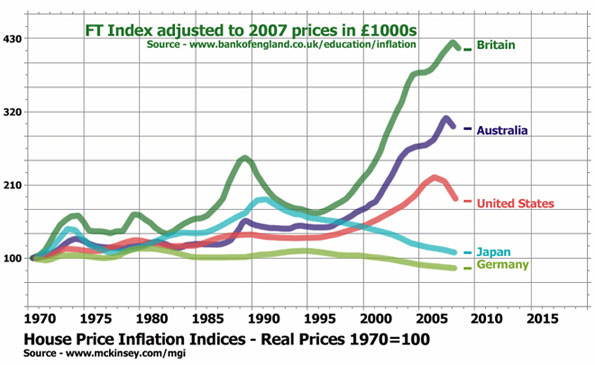
    This true fundamental problem is particularly evident here in Britain, the leader in house price inflation and housing financial bubbles since the 1970s. In their recent report Global capital markets, the McKinsey Global Institute has confirmed what has been shown in recent Demographia surveys.

    The root of this problem lies with an elite agenda that is highly ideological. The ideology at work is environmentalism, making a moral virtue of the retreat of political and commercial elites from the industrial production of housing.

    The preference is for interest payments on a fund of mortgage debt rather than the effort of turning a profit from development, let alone construction. Professionals like estate agents, planners, architects, and bankers are certainly in collusion with that elite ideology.

    That is not to say there is a conspiracy to plan a housing bubble. That is too crude. There is clearly regulation and legislation. On 24 November 2009 the Housing Minister John Healey confirmed that Britain will be the first country in the world to require zero carbon homes as a matter of law from 2016. Britain is the world leader in green ideology.

    John Healey
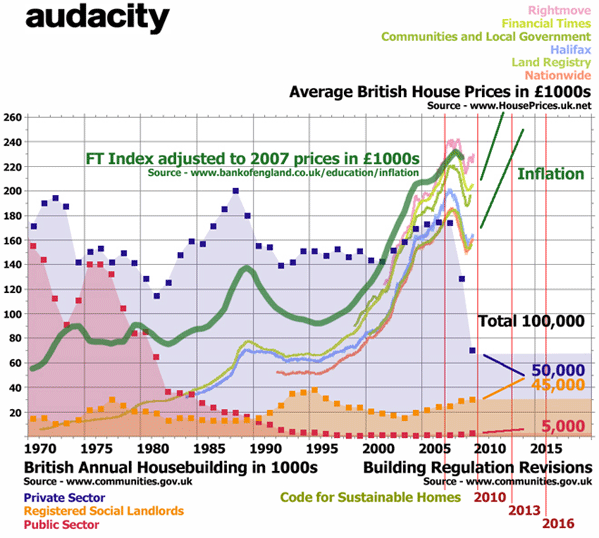
    All of the newly built British housing will have much better insulated walls, windows, roofs and floors. The clear aim of the government is to keep reducing the energy consumption of all new homes to be measured in kilowatt-hours per square metre of floor area per year. New Labour hope to make it law that total energy consumption is no more than 46 kWh/m2/year for semi-detached and detached homes, and then no more than 39 kWh/m2/year for all other homes. The energy efficiency standards will be applied from 2016, subject to yet another consultation on the Code for Sustainable Homes, announced at the end of 2006, and technically published for use on a voluntary basis in 2007. The building regulations get revised in 2010, 2013, and 2016 leading to this legal requirement for maximum energy consumption in all new homes.

    Healey says that “zero carbon” is a concept that will apply to a new home at the “point of build”. ‘We are not going to regulate through this policy how occupants live in them,’ he says. However the Code for Sustainable Homes assumes patterns of behaviour. Environmentalists within and without government will argue that behaviour needs to change. They will be suggesting all sorts of intrusions into daily life.

    British environmentalism couldn’t be more ideological, and more of a barrier to the production of affordable housing. The planning system has been “greened”. The mood is against development, and planning approvals for new land for new housing are hard to obtain. The zero carbon requirement will only apply to around the 100,000 new homes that will be built annually, while the existing stock is around 26 million homes. Healey is also going to regulate existing housing, and is not just looking at the residential sector.

    I am sure politicians like Healey don’t want their pursuit of “zero carbon” buildings to mean that fewer buildings are built. I am sure there are some environmentalists who will be pleased that building activity is in decline. The logic of green thinking entails that the most energy efficient thing to do is not to build more buildings at all.

    It is green not to build new homes to meet demographic demand. Let people modify their behaviour, say the environmentalists, and live together in as much of the existing stock as can be refurbished. It also happens that the existing stock is highly mortgaged, and the vast majority doesn’t want their homes to fall in value. An indefinite policy of green refurbishment of the homes that already exist and a future of house price inflation are highly compatible. That suits the mortgage lenders and the government. The commitment to “zero carbon” allows government to appear virtuous in its legislation for the new build sector.

    This suits the financial markets as well, since it guarantees house price inflation by making it difficult to meet the demographic demand for homes. Environmentalism offers more and more reasons not to build. Green thinking ensures that house price inflation can be sustained through a bubble, and projected beyond the bursting of that period of financialisation into the next.

    As capitalism ”greens” itself, capitalists continue to profit, while not meeting the fundamental demands of the people for housing. But simply restoring “the free market” will not solve the problem. In an old industrial country like Britain, there are ever more people who don’t earn enough to buy a home even at the “affordable” price of two and a half times their gross annual household income, which is the Demographia measure of affordability.

    This reality has a great appeal to what Robert Bruegmann refers to as “the incumbents club” – established homeowners, increasingly older, and those with inherited money. That majority want homes to be an appreciating asset, not a depreciating utility, like a pair of trousers, or a car. They want their home to appreciate in value, and they want to be green. Most people want to be greener and better off.

    Being anti-development for green reasons allows the incumbents to preserve their wealth, while making mundane opposition to new house building, or the attempt to constrain “sprawl”, seem virtuous. People don’t wake up thinking that they will inflate the value of their home by resisting sprawl in principle. Instead they oppose new development in the mistaken belief that Climate Change is caused by sprawling development. It is common for people to think that sprawl is bad for the planet, even while living, mostly with a mistaken sense of guilt, in the sprawl.

    By hoping for a “free market” solution to the problem of unaffordability, Hugh Pavletich of Demographia assumes that it is politicians, businessmen, and professionals who have distorted the market for reasons of narrow and immediate self-interest. Yet that is not how people think: they believe their environmentalism is morally above self-interest. They are saving the planet in their minds by blocking new building, and by their opposition to sprawl. The incumbents’ club members can feel virtuous at little cost to themselves and don’t worry too much about house price inflation. Of course there is no actual Club. There is no conspiracy. Homeowners simply share a self-interest in raising the value of their home, and tend to also want to show how selflessly green they are.

    This all has had the effect of making the lending of mortgages on inflated land values a much larger business than the construction of homes. No-one planned to cause a sequence of bubbles, but Britain’s desperate social dependence on sustained house price inflation can’t be brought to an end easily.

    The only way to stop national or regional housing bubbles recurring is the establishment of the freedom for everyone to build a home on cheap agricultural land without any government or professional hindrance except in matters of technical building regulations. Fire should not spread, and buildings should not fall down. But even building regulations can become ideological rather than technical. The British building regulations, as Healey has made clear, will also push energy efficiency standards to illogical extremes of peak performance in an attempt to address Climate Change. Even while the supply of new homes reduces

    The political freedom to build wouldn’t be a “free market” because not everyone is able to raise the finance to buy cheap land and pay for construction. The idea of a “free market” is a long running ideological myth. But the universal freedom to build would mean people are free to attempt to raise the finance to buy land and build.

    More importantly, the freedom to build would undermine the financialisation of the housing market. If everyone was free to build on cheap land the incumbents’ club would have to compare the value of their existing home to the cost of building a new one. Mortgage lenders would not be able to lend over the cost of construction unless they felt secure in doing so. The security of the 1947 Town and Country Planning Act would be removed for financiers. Government, the finance system, planners, or the incumbents’ club will be ideologically opposed to that for a host of environmental reasons. Britains mostly want to be greener but with renewed house price inflation, while no-one wants to make an argument explicitly for un-affordability. This may be confused and deluded, but it is an ideology promoted by the British government.

    However, ideas can be challenged and changed. One step is to understand that there is no “free market” housing solution. Getting rid of the 1947 denial of the freedom to build doesn’t mean an end to planning. Homes will still need to be planned, just as they were before 1947. But planners will not have the power to stop people from building. There is a need to politically end the environmentalist denial of the freedom to build in an industrial democracy. With a population free to build the finance system would be more interested in cheapening new construction on lower cost land, and not preoccupied with securing the financialisation of periodic but persistent house price inflation. A freedom to build is very much not a right to a home. It is a freedom from the obstructions of planners, with the weight of government legislation behind them. A freedom that is denied to protect the environment, a denial that sustains house price inflation.

    The market is not capable of being a “free market”. Capitalism is a system of control by political and commercial elites, and their professional employees. British capitalists tend to be less interested in industry, which is held to have caused Climate Change, and more interested in finance these days. What is precisely missing in the face of the morally selfless capitalist ideology of environmentalism is an ideology in favour of raising the productive capacity of the construction industry based on a universal sense of immediate and material self-interest. Getting rid of the 1947 planning legislation is a limited attempt to reconnect house building with the cost of construction and household incomes by removing the means by which house price inflation is sustained. Homes would be more of a utility than an investment in Britain, and we would cease to be world leaders in housing based financial bubbles.

    To do that requires us to oppose those who would be world leaders in the environmental ideology that industrial production is a problem for the planet. In Britain we need to set people free to build housing to the best of their abilities within a capitalist planning system stripped of the legal powers it gained in 1947. Innovative in their day, British planning now only sustains housing bubbles and restricts people’s opportunity for decent housing.

    Ian Abley, Project Manager for audacity, an experienced site Architect, and a Research Engineer at the Centre for Innovative and Collaborative Engineering, Loughborough University. He is co-author of Why is construction so backward? (2004) and co-editor of Manmade Modular Megastructures. (2006) He is planning 250 new British towns.

  • Predicting the Future of British House Building

    People are expecting British house building to pick up. Sadly they will be disappointed, even as the housing market inflates into another bubble.

    There have been declines and recoveries in British house building before the 2007 collapse in construction activity. Data is in abundance. The total number of homes built annually has more than halved since the late 1960s, as successive governments withdrew from publicly funding the post-war welfare programme of council house building. There have been ups and downs in the volume of private housing built. After building 175,000 private homes in 2007 many expected that the market for new private housing would eventually recover from the financial crisis. The pent up demographic demand for new private housing would surely lead to a recovery of building if financing were made available. It seems irrational to suggest that the supply of housing will not recover to meet demand.

    In July 2008 audacity argued that British house builders would be collectively reduced in the planning regulated market to building 100,000 homes in 2009. They would shift from aspiring to build in “volume” to making their money from planning approved “eco-homes” for a luxury market. This has already occurred and there will be no necessary recovery of volume in a few years. Production may even decline from that level of inactivity.

    There seems little demand for new housing from the Public. Instead, we seem to be most concerned that housing continues to inflate in value as an asset. Most see obvious advantages in housing asset inflation, while complaining of the unaffordability of better housing. Britain is experiencing house price inflation again, but home owners know that the worsening gap between household income and the cost of buying a home, even on very low rates of interest, is frustrating new buyers, and the young in particular.

    Gordon Brown knows that playing the housing market is a mainstream activity for the electoral majority. New Labour is doing what is necessary to revive housing asset inflation. Some had hoped that the bursting of the bubble in 2007 would reconnect house prices with household income. Young people were understandably most hopeful of that prospect. Now prices are drifting upwards again to unaffordable highs. This is happening nationally, but is particularly true in greater London, where average house prices have recovered to nearly £270,000, which is where they were before the collapse of Lehman Brothers in September 2008. This makes an average house “affordable” to those earning more than £90,000 a year. That is a very small percentage of the region’s home buying public.

    Here’s what the restoration of higher prices means nationally, and in London in particular. There will be greater social immobility, expressed in more commuting, an extension of families, and several households living in the same home. Overcrowding will be more likely. Homelessness may slightly increase, but most housing difficulty will be accommodated within the existing stock.

    The mainstream majority of the electorate – those already owning homes – is likely to be grateful that the burst bubble did not turn into a crash. New Labour will try to take the credit for averting any further financial disaster. What will be ignored is that house price inflation suits Britain’s politicians, and the lending institutions in The City. The British economy is too weak to pay higher wages, and the mainstream majority are too politically weak to challenge that predicament. What other future is there for Britain except another asset inflation bubble?

    The problem then with restoring the Brown bubble is it solves none of our fundamental problems: notably a weak economy, low wages and lack of decent housing. David Cameron’s Conservative opposition will not make any difference to that predicament. They want to get rid of regional tiers of planners and to return control to local authorities, as was the intention of the 1947 Town and Country Planning Act. That is the legislation that stops the British public from building housing on cheap farmland.

    But it’s doubtful they will try to break the back of housing inflation and our country’s dependence on it. The British economy depends greatly on The City, which needs to expand the £1.2 trillion of mortgage lending in a secure way for lenders in the global financial system. This only happens when existing house prices are maintained well above the cost of constructing new ones, and best in a period of asset inflation. The trickle of new homes onto the market could reduce, and while any demographic demands of a growing population for the utility of housing would not be met, the political and economic demand for asset inflation and loan security will be satisfied.

    The way in which existing homes are made more expensive than the cost of building new ones is to inflate the price of land and keep it inflated. It is the high price of land approved for development within the 1947 legislation that is unaffordable. That is why government and house builders recognise there is “planning gain” to be negotiated over, as the uplift in land value that follows an approval to develop.

    Yet this stands in the way of a clear public interest. Government housing experts argue we need at least 240,000 new homes a year to meet demographic demand. Our inability, or even unwillingness, to tackle this issue would have shocked either the Conservatives or the Socialists of the last Century.

    What matters is to make materialist sense of the future. Society can’t live off asset inflation and debt. We must build new housing.

    We face a serious predicament today. Small quantities of highly subsidised and high density “eco-homes” are to be built by socially motivated architects, some working with the former “volume” house builders. How can building an insufficient number of homes be called “sustainable”? Instead of building new replacement homes Britain is also looking to finance a greener and endlessly refurbished housing stock, while producing too few “eco-homes” even to accommodate yearly household growth.

    The finance obsessed Green Capitalists of today are worse than their counterparts from a century ago. At least the Capitalists of the past were materialists, who believed in building more, and developing a construction industry based on materials manufacture and the skills of the workers they exploited. Those Capitalists were progressive materialists.

    The new capitalists in housing are not even interested in meeting the needs of the working and middle classes, but in pleasing environmentalists. Unsurprisingly, they also will not have to hire too many workers to build their meagre product. Today Capitalists are abandoning industrial production in favour of finance, and this is nowhere more evident than in housing. Hiding behind the moral claims of environmentalism the Capitalists of twenty-first century Britain have clearly abandoned any idea of social progress, when once they could claim to be materialists. What is noticeable is that they have so many moralistic Greens cheering them on.

    Sadly, there is no political association today to oppose Green Capitalists operating a nationalised planning system, in their effort to realise asset inflation in the form of a housing market. New Labour under Gordon Brown will not change this – indeed he clearly favours housing inflation and the City over the needs of aspiring families. So do the Conservatives under David Cameron. At the same time, they can play to a green constituency, which now dominates the media.

    Given the current planning regime and the moral imperative for building “eco-homes”, British house builders will be reduced to building around 100,000 homes for a very long time. They will aspire not to build in “volume” but instead take pride that their homes are “sustainable”.

    Only a political challenge will improve the situation. Gordon Brown faces no political challenge from David Cameron. He never will. Under New Labour or the Conservatives the only future for house builders will be to offer highly differentiated luxury “eco-homes” for the equity rich, or the top quintile of earners, supported with high subsidies in some form to build affordable “eco-homes”. Architects will particularly benefit from this shift in the market.

    New Labour will build a few council homes more as a publicity stunt to keep their middle class Old Labour supporters amused. Conservatives will not bother about such nonsense. They will both insist on “zero carbon” new housing by 2016. Both will focus on refurbishment of the existing stock, not replacement. Both will exclude more land from the planning system.

    The only people who will challenge this predicament, this retreat of Capitalism from population growth and industrial productivity, will be the working mainstream middle. Brown thinks he has bought off the majority of home owners with asset inflation, and temporarily he might have relieved many. Cameron thinks he can further mobilise established local residents attempting to extract more “gain” from the planning system. He imagines local opposition to development aggregating to a general protection of house price inflation nationally.

    These Red/Green and Blue/Green political leaders might be proved wrong. The construction industry matters, and with argumentative organisation materialists might push for house building against the greens of Britain. Most of all there is the new generation of British people – those entering their 20s and 30s – who will demand something other than over-priced, undersized and often miserably maintained housing for themselves and their families.

    A longer version of this article originally appeared at www.audacity.org/IA-07-11-09.htm

    Ian Abley, Project Manager for audacity, an experienced site Architect, and a Research Engineer at the Centre for Innovative and Collaborative Engineering, Loughborough University. He is co-author of Why is construction so backward? (2004) and co-editor of Manmade Modular Megastructures. (2006) He is planning 250 new British towns.