Tag: United Kingdom

  • Our Euro President

    Barack Obama’s seemingly inexplicable winning of the Nobel Peace Prize says less about him than about the current mentality of Europe’s leadership class. Lacking any strong, compelling voices of their own, the Europeans are now trying to hijack our president as their spokesman.

    There’s a catch, of course. In their mind, Obama deserves the award because he seems to think, and sound, like a European. In everything from global warming to anti-suburbanism to pacifism, Obama reflects the basic agenda of the continent’s leading citizens–in sharp contrast to former President George W. Bush.

    Indeed it’s likely that if Obama wanted to run for presidency of the E.U., he could mail it in. Unfortunately for him, he presides over a country that faces a very different future from that of Europe.

    This is not to say we cannot learn from Europe in certain areas–namely fuel economy and health care. Republicans dropped the ball on both of these issues, and as a result both our health care system and automobile efficiency pale next to those of the continent.

    Still, the reality is that America and Europe are very different, which would necessitate disparate policy approaches. Our growing divergence with Europe spans everything from demographics to economic needs and basic values. In all these areas, the gap is likely to increase over time.

    This is why the Obama Administration’s Europhilia, now likely to become more pronounced, represents a dangerous temptation. For one thing, Europe’s generally ultra low birth rates–compared with those in the U.S.–imposes structural limits on how their economies can grow and even if they even need growth.

    If our core problems come from over-consumption and irrational financial-sector exuberance, Europe’s sluggishness stems from the lack of an expanding workforce and consumer base. This means Germany–by far the most important E.U. country in terms of population and gross domestic product–must rely on exports to maintain its generally slow growth rate. More important, as the current generation in their 50s retire, the workforce is likely to shrink dramatically in almost all European countries, making even modest growth difficult.

    In a rapidly aging society like Germany’s and those of other E.U. countries you can make a case for slow growth, limited work hours, early retirement and a strict regulatory regime. But for America, with its growing workforce and population, slow economic growth simply is not socially sustainable.

    More broadly, we are talking about two different mindsets. As one writer puts it, Europeans “emphasize quality of life over accumulation” and “play over unrelenting toil.” In contrast, most Americans seem ill-disposed to relax their work ethic, which has been central to the national character from its earliest days.

    Of course, the European approach is celebrated by some Americans, particularly those who already have achieved a high level of affluence. It plays very well in “little Europes” of America, cities like San Francisco, Portland and Boston, places with relatively few children and generally slow-growing populations.

    But most Americans do not seem ready for a lifestyle buffeted by regulations and limitations. Still attached to their aspirations, they seem no less satisfied with their way of life than do Europeans. Even amid the recession, 70% of Americans still embrace the idea that they can get ahead through hard work.

    There are other critical differences. Americans remain more religiously minded. One analyst, David Hart, has spoken of Europe’s “metaphysical boredom.” Half or more of Europeans never attend church, compared with barely 20% in the U.S.

    Among younger Europeans, the loss of traditional Christian identity–with its focus on long-term commitments, sacrifice and responsibility–is virtually complete: According to one Belgian demographer, barely one in 10 young adults in the E.U. maintains any link to an organized religion. In contrast roughly 60% of Americans, according to a Pew Global Attitudes survey, believe religion is “very important,” twice the rate of Canadians, Britons, Koreans or Italians and six times the rate of French or Japanese.

    Some observers, both in America and abroad, see this spiritualism, particularly among evangelical Christians, as reflecting a kind of social retardation. Yet belief in America is remarkably varied, extending beyond groups that are easily classified as liberal or conservative. In America, a broad “spiritual” focus–dating from the earliest founders and continuing through the transcendentalists and Walt Whitman–persists as a vital force. Even President Obama, whose base tends to be secular, has made much of his religious ties.

    In Europe, the only truly rising faith appears to be the secular religion of the environmental zealots. Often almost theocratic in its passion, the green movement tends to be hostile to even modest population growth and economic progress. It’s no coincidence that the last American to win the Nobel Prize was the climate change high priest himself, former Vice President Al Gore.

    To be sure, Americans also care about the planet, but they seem more disposed to see technological innovation, not abstinence, as the best way to confront ecological problems. The kind of highly restrictive regulatory environment common in Europe–and sadly in such places as California—simply is not well-suited for a country that must produce much more wealth and millions more jobs in order to sustain itself.

    Even though they may espouse secular ideals, this more growth oriented mentality also attracts a sizable number of talented and ambitious young Europeans to the U.S., as well as Australia and Canada. Although influential social commentator Richard Florida has claimed that the bright lights and “tolerance” of Europe are luring large numbers of skilled Americans, actual migration trends tell quite the opposite story. By 2004 some 400,000 E.U. science and technology graduates were residing in the U.S. Barely one in seven, according to a recent European Commission poll, intends to return.

    Perhaps the president should speak to these young Europeans. They still buy the notion of America as a country open to innovation and striving for upward mobility. Europe, in contrast, perhaps as the result of two debilitating wars in the last century, understandably craves peacefulness and social stability over all else.

    When he goes to Oslo next month, Obama should remember that America’s future is not to become a bigger version of Norway, a tiny country fat with fossil fuels that can afford its air of moral superiority. We are also not latter day versions of Britain, France, Germany or Russia–all of them worn empires exhausted by history.

    Ultimately America is about hope and aspiration. It is, if you will, a country based on an ideal, not a race or cultural legacy. As the British writer G. K. Chesterton once put it, the U.S. is “the only nation…that is founded on a creed.” That creed is not so much religious as aspirational, and it will become more important as we attempt to cope with our own growing diversity as well as the rising powers from the developing world.

    So even as he enjoys his popularity on the continent, Obama must be careful not to succumb to those who urge him to reshape America in Europe ‘s image. Take this prize, Mr. President, and then shelve it.

    This article originally appeared at Forbes.com.

    Joel Kotkin is executive editor of NewGeography.com and is a distinguished presidential fellow in urban futures at Chapman University. He is author of The City: A Global History. His next book, The Next Hundred Million: America in 2050, will be published by Penguin Press early next year.

    Official White House photo by Pete Souza
  • Nice Houses for Ducks

    During the long hot summer of the expenses scandal in British politics, one of the most bizarre stories concerned a Conservative MP who claimed from the public purse for a second home: a place for his ducks. It wasn’t any old duck house, however, but a ‘Stockholm’ floating model, valued at over £1,500. It is over 5 feet high.

    If only two ducks lived in the duck house, with its prime waterside location and spectacular views of the gardens beyond, their living space would be on a more generous specification – measured by their weight – than the hundreds of thousands of new homes that have been built in Britain in recent years. For one of the lesser-commented upon hypocrisies of the expenses scandal has been the chasm between those with two or more houses, and the many thousands who have just bought a home to find they couldn’t swing a duck around in it, let alone a cat.

    The BBC recently reported some of the new homes are so small that they have been rejected by the housing associations: these are the agencies that have taken over a great deal of the rented housing in Britain since the Conservatives abolished council house building in 1980. Housing associations are empowered to purchase some homes from the private market for rent to their tenants, or for shared ownership schemes.

    Good housing for those who cannot afford private ownership should be welcomed, and the housing associations congratulated for dismissing the smallest new dwellings. But the key question is: why should so much of the new housing seem to be built for birds, not people?

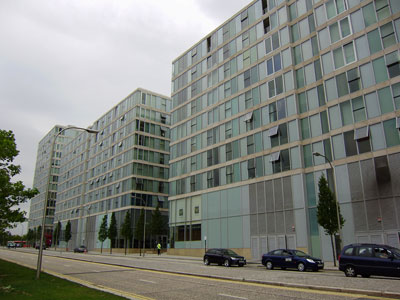
    British new housing today is rapidly becoming a scandal, at least for those who have to live in it. The BBC report found that in some new dwellings valued at over £200,000 ($326,000), rooms were tiny, and many basic construction faults were to be found. And Britain is now building the smallest new homes in the developed world: in Holland the average size of a new build home is 115 square metres, and in Japan it is 92.5 square metres. In Britain a paltry 76 square metres is common. (BBC News, New Homes Rejected for Social Housing (16 May 2009))

    The causes of this cramped and unhappy state of affairs cannot completely be laid at the door of New Labour. During the 1980s the Conservative government of Margaret Thatcher terminated the obligation of private builders to construct new homes according to the Parker Morris standards set out in the report of the same name in 1961. The Toryism of Thatcher may have been more stridently in favour of the aspirational home owner than the more ‘one-nation’ Conservatism of Harold Macmillan, who legislated them, but these guidelines should not have been revoked. Whatever their faults, those standards laid down decent room sizes, and allowed for more generous interpretations of internal uses of space. Council tenants and private home owners benefited from both.

    Now, following the abolition of Parker Morris, it was possible to build new dwellings with a double bedroom that was marginally bigger than a double bed. This tendency to cram became commonplace, however, under Labour, whose housing policies mindlessly follow the idea that, when it comes to housing, tiniest is next to godliness.

    This brilliant approach arose in the 1990s as part the notion that creating higher densities in British cities would stimulate urban renewal. The formula was simple, or rather simplistic, and was best articulated by the leading architect Lord Rogers of Riverside. ‘Let’s cram our city centres’ he wrote provocatively. Of course, this was not for his usual clients for whom he designed spacious office blocks and sizeable swanky houses.

    Rogers was appointed as Head of the Urban Task Force, commissioned by the New Labour government. Its report entitled Towards an Urban Renaissance (1999), called for flats to populate the city centres at high densities. And as for those sprawling suburbs around the outskirts of town, so popular with English home owners, they were to be retro-fitted to utilise existing green spaces for housing.

    So much for verdant England. Even little parks and large private gardens are now vulnerable to development. Interestingly, the first illustration in Towards an Urban Renaissance is a photograph of the then Deputy Prime Minister John Prescott, who, of course, has two homes and more than one car. Needless to say, he welcomed the recommendations in the report since he likely never saw it applying to him or his friends.

    Environmentalism has further accelerated the trend for the shrinking of the British home. The emphasis upon the Rogers-style compact city has been trumpeted by the Green Party and other environmental lobby groups because higher densities and small build theoretically cause less carbon emissions and use up less non-renewable sources of energy.
    Yet let the obstreperous commoner be a bit put off by the high priests of cramming. Some of the most outspoken advocates of environmentalism come from wealthy patrician backgrounds, for example Jonathan Porrit and Prince Charles. Buckingham Palace and High grove House are hardly exercises in low-density living.

    All this leads to some doubts about the democratic future under the influence of our feudalist betters. A recent article in Regeneration and Renewal magazine by Sir Peter Hall draws attention to research led by Marcial Echenique at Cambridge University. Echenique and his team compared the ‘Richard Rogers-style compact city’ with ‘market-led dispersal, US fashion’. Their findings raise some profound questions in an urban democracy:

    The compact city cut carbon emissions by just 1 percent; but there were higher economic costs in outer areas where people still want to live, and where demand was greatest. Also, any social aspects of the compact city were to some extent undermined by crowding, exposure to noise and the crush on facilities.

    American style sprawl by contrast raised energy use and CO2 emissions by almost 2 percent, but engendered lower house prices, less crowding and less road congestion. (Hall, Sir Peter ‘Planners may be wasting their time’, Regeneration and Renewal, 6 July, 2009)

    None of this has yet created the momentum for a radical push back on housing policies, but it should. Conservative, Liberal and Labour MPs are now guiltily paying back their sums for using their expenses to buy their own often lavish second homes. It is striking how they have enjoyed a privileged access to accommodation which they, through legislation, would make all but unaffordable to millions outside the wealthiest classes.

    Once upon a time our political class understood that they ignored the hopes of less-well-off owner occupiers at their peril. Labour’s spectacular victories in 1997 and 2001 owed much to the votes of those who wanted to get on the housing ladder, or who had just clambered onto it, and naturally wanted the best home for their money. Before then, under Thatcher, the Conservatives successfully garnered the support of the same class.

    Now lamentably all the parties display little interest in the aspirations of working-class, lower middle-class and immigrant wannabe homeowners for a decent space. Instead they are to be treated like water fowl by those who generally have access to one or more homes. Some may do it in the name of being “green” but there’s a better term for what they are doing: hypocrisy and class privilege.

    Mark Clapson is a social historian, with interests in suburbanisation and social change, new communities in England and the USA, and war and the built environment.

  • Rating World Metropolitan Areas: When Money is an Object

    American metropolitan areas have been the subject of considerable derision. Often characterized as inferior to those of Australia, Canada, Europe and even of Japan by planners and politicians who travel abroad, there has long been a desire to reshape American cities along the lines of foreign models. Yet, despite this, American metropolitan areas generally provide a standard of living to their residents unmatched anywhere in the world. This is based upon the latest comparative economic data for the world’s most affluent metropolitan areas.

    International Rankings: American metropolitan areas never seem to place near the top of “quality of living” or “livability” indexes, such as those published by The Economist and the Mercer consulting group. On the other hand European, Australian and Canadian metropolitan areas usually grab the honors, frequently led by the likes of Vancouver, Melbourne, Zurich or Vienna.

    The media routinely reports these rankings without serious analytical analysis, which can lead to misunderstanding or even misrepresentation in comparing metropolitan areas on issues of living standards (Note 1). As Owen McShane pointed out on this site before, these ratings serve their purpose, which is to rank metropolitan areas based upon their “attractiveness to expatriate executives”. Not only do these lists fail to consider housing affordability, as McShane indicates, they also do not consider the overall economic performance of metropolitan areas in regard to their residents, which is not an insignificant matter. These highly publicized international listings might be thought of as “money is no object” ratings.

    When Money is an Object: The problem here: money is an object for the great majority of people living in the world’s metropolitan areas. This is true in Kinshasa, Seattle, Vancouver or Vienna.

    When the available measures of affluence or the standard of living are considered, the picture for US cities drastically improves. Here the US metropolitan areas dominate the list. The best available data is gross domestic product (GDP) per capita, adjusted for national level purchasing power (Note 2). Metropolitan area GDP data is now produced by the Bureau of the Census in the United States and regional data generally conforming to most metropolitan areas is available for the European Union by Eurostat (Note 3). Data for other metropolitan areas can be estimated from other national and regional sources.

    In 2005 (the latest available data), The Economist top ten averaged 57th in GDP per capita in the world. Mercer’s top ten did even worse, averaging 62nd. None of The Economist or Mercer top 10 ranked was among the 25 metropolitan areas with the highest GDP per capita. Vienna ranked best, at 27th. Perennial favorites Vancouver and Melbourne ranked 71st and 72nd (Table 1). Zurich, another rating champion, ranks 74th, just ahead of Oklahoma City. In contrast, only 5 of the 51 large metropolitan areas in the United States ranked behind Vancouver, Melbourne and Zurich.

    Table 1
    Top 10 Economist & Mercer "Cities"
    Ranked by Affluence
    (GDP per Capita, Purchasing Power Parity)
    Metropolitan Areas over 1,000,000 Population
    City or Metropolitan Area GDP per Capita: Rank among Top 100 World Metropolitan Areas The Economist Mercer
    Vienna 27 2 1
    Perth 28 5
    Munich 40 7
    Calgary 46 6
    Frankfurt 51 8
    Sydney 62 9 10
    Toronto 67 4
    Vancouver 71 1 4
    Melbourne 72 3
    Zurich 74 10 2
    Helsinki 84 7
    Auckland 84 5
    Dusseldorf 99 6

    100 Most Affluent World Metropolitan Areas: GDP per capita estimates for 2005 are provided for the 100 most affluent metropolitan areas in the world with more than 1,000,000 residents (Table 2).

    Dominance of the United States: It is perhaps not surprising that San Jose, California ranks as the richest major metropolitan area in the world, with a 2005 GDP per capita of $78,700. Number 2, however, is a surprise: Charlotte, NC-SC, which not only pirated away San Francisco’s largest bank some years ago and has now displaced the tony city by the Bay in the runner-up position. San Francisco and Washington, DC rank third and fourth most affluent in the world. Brussels, grown fat on the largesse of its European Union taxpayers, ranks 5th.

    The dominance of the United States is illustrated below.

    • The US has 8 of the 10 richest metropolitan areas in the world. Only Stockholm, at number 9, joins Brussels in the top 10 from outside the United States.
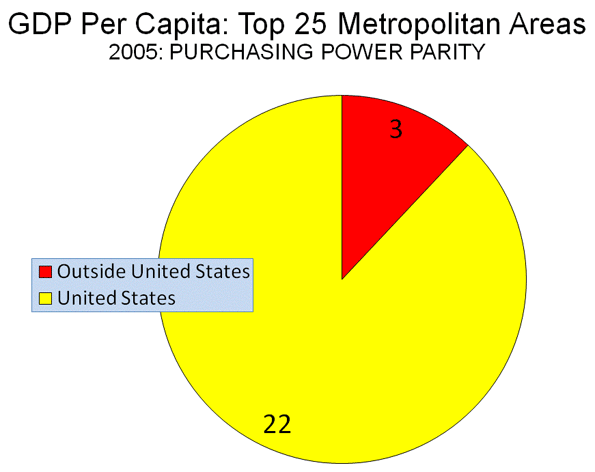
    • The US has 22 of the top 25 metropolitan areas (Figure)
    • 37 of the most affluent 50 metropolitan areas are in the United States. By contrast, Mercer ranks only seven US “cities” in the top 50.
    • 46 of the 70 richest metropolitan areas are in the United States

    Only one of the 51 US metropolitan areas with more than 1,000,000 fails to make the top 100 in the world, Riverside-San Bernardino ($25,800), which could just as easily be considered a part of the Los Angeles metropolitan area, just as San Jose could be considered a part of the San Francisco metropolitan area.

    Outside the United States: Outside the United States, the metropolitan areas of Australia and Canada perform best relative to their size. All five of Australia’s largest metropolitan areas placed in the top 100, with one in the top 50. Five of Canada’s six top metropolitan areas made the top 100, with one in the top 50. Europe placed 33 of its metropolitan areas in the top 100, with 11 in the top 50 and 22 in the second 50.

    The top 100 list provides some surprises.

    • One eastern European metropolitan area has already entered the top 100. Prague ranks 48th, with a GDP per capita of $42,400, which is more than Frankfurt or Phoenix.
    • London, arguably the world’s financial capital, ranks 44th, at $42,700. Some listings show London much higher, however such rankings exclude the outer portion of the metropolitan area, which these estimates include.
    • Tokyo-Yokohama ranks 79th, at $35,700. This ranking is lower than others, which either ignore purchasing power or exclude most of the metropolitan area by focusing only on the high income core (the prefecture of Tokyo).
    • The world’s two large “city-states,” Singapore and Hong Kong also make the list. Singapore ties Louisville and Sacramento at 53rd, with a GDP per capita of $41,500. Hong Kong ranks 79th, at $35,700. Moreover, it would not be surprising if other Chinese metropolitan areas begin to break into the top 100 over the next decade.

    Ranking Metropolitan Areas for People: American metropolitan areas provide their residents a superior standard of living. True enough, the mountains and water features of Vancouver or Zurich are superior to those of Oklahoma City or Charlotte. However, the average resident does not have enough money to spend much time boating in Vancouver or Zurich or taking in what may be a better cultural life. The standard of living may well be better for those with money in Vancouver, Vienna, Melbourne or Zurich than it is in an American metropolitan area. However, most people cannot afford to live like financiers and other “jet-setters.” For everyday people, the American metropolitan area remains the best place in the world to live.

    Table 2
    Top 100 World Metropolitan Regions 
    Gross Domestic Product per Capita: 2005 Estimates
    Purchasing Power Parity
    Metropolitan Areas over 1,000,000 Population
           
    Rank Nation Metropolitan Area GDP per Capita
    1 United States San Jose $78,700
    2 United States Charlotte $67,900
    3 United States San Francisco $65,400
    4 United States Washington $65,300
    5 Belgium Brussels $63,700
    6 United States Boston $59,000
    7 United States Seattle $57,600
    8 United States New York $56,200
    9 Sweden Stockholm $55,100
    10 United States Hartford $55,000
    11 United States Denver $54,700
    12 United States Minneapolis-St. Paul $54,600
    13 Germany Hamburg $53,500
    14 United States Dallas-Fort Worth $53,000
    15 United States Houston $51,900
    16 United States Indianapolis $51,800
    17 United States Philadelphia $50,100
    18 United States San Diego $50,000
    19 United States Atlanta $49,600
    20 United States Los Angeles $49,100
    21 United States Chicago $48,400
    22 United States Salt Lake City $48,200
    23 United States Milwaukee $47,800
    24 United States Nashville $47,700
    24 United States Columbus (Ohio) $47,700
    26 United States Las Vegas $47,400
    27 Austria Vienna $47,000
    28 Australia Perth $46,700
    29 United States Portland (Oregon) $46,600
    30 United States Kansas City $46,400
    31 United States Richmond $46,200
    32 United States Orlando $45,900
    32 United States Cleveland $45,900
    34 France Paris $45,700
    35 United States Memphis $45,500
    35 United States Detroit $45,500
    37 United States Austin $45,300
    37 United States Raleigh $45,300
    39 Ireland Dublin $44,300
    40 Germany Munich $43,800
    40 United States Baltimore $43,800
    42 United States Birmingham $43,500
    43 United States Miami $42,900
    44 United Kingdom London $42,700
    44 Denmark Copenhagen $42,700
    46 Canada Calgary $42,600
    46 United States Cincinnati $42,600
    48 Czech Republic Prague $42,400
    48 United States Phoenix $42,400
    50 Netherlands Utrecht $41,900
    51 Germany Frankfurt $41,800
    52 United States New Orleans $41,600
    53 United States Sacramento $41,500
    53 United States Louisville $41,500
    53 Singapore Singapore $41,500
    56 United States Pittsburgh $41,400
    57 Canada Ottawa $41,200
    57 United States Jacksonville $41,200
    59 Netherlands Amsterdam $41,000
    60 United States St. Louis $40,900
    61 France Lyon $40,400
    62 Australia Sydney $40,100
    63 Norway Oslo $40,000
    64 United States Rochester $39,900
    65 Italy Milan  $39,100
    66 United States Virginia Beach $39,000
    67 Canada Toronto $38,200
    68 Belgium Antwerp $37,900
    68 United States Tampa-St. Petersburg $37,900
    68 Australia Brisbane $37,900
    71 Canada Vancouver $37,600
    72 Australia Melbourne $37,100
    73 Japan Nagoya $37,000
    74 Switzerland Zurich $36,900
    75 United States Oklahoma City $36,800
    76 Germany Stuttgart $36,700
    77 United States Providence $36,100
    78 Germany Nuremburg $35,900
    79 Japan Tokyo-Yokohama $35,700
    79 China Hong Kong $35,700
    81 Netherlands Rotterdam-Hague $35,600
    82 Spain Madrid $35,500
    83 Italy Rome $35,400
    84 New Zealand Auckland $35,300
    84 Finland Helsinki $35,300
    86 Canada Edmonton $35,200
    87 Greece Athens $34,700
    88 Spain Bilbao $34,600
    89 France Toulouse $34,500
    90 Italy Turin $34,200
    90 United States San Antonio $34,200
    92 Australia Adelaide $33,500
    93 United States Buffalo $33,400
    94 Japan Shizuoka-Hamamatsu $32,500
    95 Spain Barcelona $32,300
    96 Japan Fukuoka-Kitakyushu $31,300
    97 Germany Cologne $31,000
    98 France Marseille $30,400
    99 Germany Essen-Dusseldorf $30,200
    100 Germany Hannover $29,900
    (1) Purchasing power parity. Metropolitan areas over 1,000,000 population for which data is available. Based upon data from Eurostat, US Bureau of Economic Analysis and Japan Statistics Bureau. 
    (2) US data for metropolitan areas from Bureau of Economic Analysis. Scaled to World Bank 2005 GDP PPP figure.
    (3) European data for metropolitan regions from Eurostat regional data. There is no generally accepted metropolitan area definition in Europe. Scaled to World Bank 2005 GDP PPP figure.
    (4) Japan data from Japan Statistics Bureau Scaled to World Bank 2005 GDP PPP figure.
    (5) London metropolitan area is Greater London plus the historic counties of Berkshire, Buckinghamshire, Essex, Herfordshire, Kent and Sussex (including unitary authorities), which are adjacent to the London green belt. Some London metropolitan region GDP estimates exclude suburban areas outside the Greater London Authority. This analysis includes these suburban areas, using GVA scaling from UK National Statistics to estimate non-metropolitan contribution included in Eurostat data (Bedfordshire, Oxfordshire, East Sussex and West Sussex).
    (6) Estimates for the following metropolitan areas scaled to 2005 from 2002 estimates using the closest available change estimate (metropolitan, state/provincial or nation) of the change in GDP per capita (http://www.demographia.com/db-gdp-metro.pdf): Metropolitan areas in Australia and Italy as well as Essen-Dusseldorf, Lyon, Marseille, Dublin, Auckland, Oslo, Zurich, Vancouver, Toronto and Ottawa.
    (7) Metropolitan area data for Calgary and Edmonton estimated from local sources.

    Note 1: Another problem with these kinds of rankings is that can be misleadingly unrepresentative. For example, Mercer ranks more than 200 “cities,” which sounds like a significant number. By cities, Mercer appears to mean municipalities (the website is unclear and Mercer has not responded to our request for clarification of what they mean by “city”), of which there are many in all first world metropolitan areas. Some have as few as 50,000 to 100,000 residents. Mercer ranks White Plains, New York (population: 57,000), in the New York metropolitan area, but has no ranking for the many larger cities in the metropolitan area, except for New York itself. Considering that the United States alone has nearly 275 municipalities of more than 100,000 population, the Mercer list appears to be far from comprehensive.

    Note 2: The national purchasing power parity conversion factor does not permit comparison of standards of living within nations. For example, anecdotal data would indicate that the cost of living is considerably higher in the San Jose, San Francisco and New York metropolitan areas than in the rest of the country. While not generally available, a purchasing power parity analysis within the United States could show metropolitan areas with lower GDPs per capita to have superior standards of living.

    Note 3: The European Union does not formally delineate metropolitan areas, however provides regional data that in most cases is a rough approximation of metropolitan areas.


    Wendell Cox is a Visiting Professor, Conservatoire National des Arts et Metiers, Paris. He was born in Los Angeles and was appointed to three terms on the Los Angeles County Transportation Commission by Mayor Tom Bradley. He is the author of “War on the Dream: How Anti-Sprawl Policy Threatens the Quality of Life.

  • UK Green Path leads to Deindustrialization and Worsening Housing Shortage

    The First Secretary of State, Secretary of State for Business, Innovation and Skills, and Lord President of the Council, Peter Mandelson, together with Ed Miliband, the Secretary of State for Energy and Climate Change, have published The UK Low Carbon Industrial Strategy. They are claiming it promises an “economic revolution” but is in fact an environmentalist retreat from industrial production It is a disastrous strategy that will result in further de-industrialisation, supposedly with the aim of addressing a rather vague threat of climate change.

    Mandelson and Miliband insist The UK Low Carbon Industrial Strategy “can ensure that our economy emerges from the global downturn at the forefront of the technological and social shift that will define the next century.” Yet this is typical establishment “greenwash”, which many institutional and corporate leaders of the construction industry will sadly rush to endorse. It will shift us towards the laborious construction of new eco-homes, and the laborious refurbishment of the stock of mostly draughty, poorly insulated, and badly serviced housing. All this is aimed to achieve, at least on paper, a contribution to a national carbon reduction target by 2020.

    Government thinks that it will be building 240,000 “zero carbon” homes every year by 2106. In fact at least 500,000 homes are needed every year to meet household growth and replace the oldest of the stock at a rate of 1% a year. Yet in reality this year new house building is down to 100,000 a year, and there is no reason why that level of production will increase even when, as is starting to happen, house price inflation returns. Instead of promoting mass production, most house builders are quite likely to follow The UK Low Carbon Industrial Strategy to become luxury eco-home builders. They will be content to build around 100,000 “green” homes a year to get through the planning system. They will build homes that show their environmental credentials by the thickness of walls and roofs – full of sheep’s wool or hemp, packed with straw bales, or made from low-fired clay blocks.

    This, of course, is the approach to new house building promoted by Prince Charles and the other would be green gentry. He advocates “the use of local materials to create local identity which, when combined with cutting-edge developments in building technology, can enhance a sense of place and real community.” Just as Mandelson and Miliband claim theirs is an industrial strategy, Charles promotes green building technology.

    Charles talks of building walls and roofs thickly in “volume”, but what does his royal greenness know of the market? Government also imagines it can use renewable insulation materials to produce “affordable” housing. Walls and roofs will get thicker, but housing will not be built in sufficient quantity for a growing population, and will not be affordable on most British household incomes.

    The green tendency will be to use greater thicknesses of less processed, more laborious-to-install insulation materials, cut-to-fit on site. This will make the walls and roofs on new eco-homes around half a metre thick, but that might be fashionable. Having more material in the walls and roof will show how little energy is used in the new and expensive eco-home.

    Thick insulation is an immediate problem in the refurbishment of the stock of 26 million existing houses and flats. It is not always possible to cover the outside with great thicknesses of natural materials that, contrary to the Prince’s claim, have a low capacity to insulate. Even industrially produced fibres and foams, which green purists think are too processed, must be used thickly. It is less possible to apply thicknesses of insulation inside the existing home, when most British homes are so small. A lot of filling of masonry cavity walls has been carried out under energy efficiency schemes, with little regard for why the drained air cavity was there in the first place. But no existing housing has walls with cavities of up to the 300mm that would be required for insulants that satisfy greens.

    The architectural fact is that only made-to-fit insulation, prefabricated as an industrially processed product, can achieve the thermal performance being discussed with a minimal thickness.

    Sheep’s wool and hemp, straw bales, and low-fired clay blocks are positioned increasingly off the scale to the right on thickness. Foam glass as an industrial product is poor as an insulant, as is cellulose fibre. The sorts of glass and mineral fibre insulation that can be bought in any builder’s merchant require substantial thicknesses. Foams have better performance, and are familiar as cut-to-fit insulation. However only the use of processed vacuum insulation, as a made-to-fit industrial product reduces insulation thicknesses to the architectural dimensions required.

    On behalf of New Labour Miliband boasts that Britain has produced a carbon reduction plan to 2020 that should inspire other industrial and industrialising nations. “Having been the first country in the world to set legally binding carbon budgets, we are now the first country in the world to assign every department a carbon budget alongside its financial budget,” he told the House of Commons. We seem to be the first country in the world to ignore the space- and time-saving potential of construction technologies that require energy in their production processes, but save energy in the long term operation of well serviced buildings.

    Britain is retreating from industry and makes an environmental fetish out of bulky “natural” materials that don’t work well. Why favour materials that are lightly processed as agricultural crops, or are low-fired but need rendering? Why not accept processing, as all timber is processed, and welcome the durability of fully fired bricks? This carbon obsessed idiocy in construction works against other great materials like concrete, glass, steel and aluminium.

    For their part government is insisting that insulation must be renewable and crop-based rather than an industrially processed product. This means that small British houses and flats will be thickly walled and roofed and will be built in too few numbers to accommodate British household growth. Every existing home must be refurbished indefinitely. That is truly pitiful for an old industrial democracy like Britain.

    Government abuses the words Industrial and Strategy, sharing the Prince’s low aspirations for twenty-first century construction and architecture. An industrial strategy worthy of the name would promote the development of highly processed vacuum insulation, and would expect skills in design, manufacture, installation, and maintenance.

    An attempt to make “green jobs” rather than raise productivity and wages, The UK Low Carbon Industrial Strategy should be seen and criticised as an environmentalist strategy of de-industrialisation, because that is precisely what it is.

    Ian Abley, Project Manager for audacity, an experienced site Architect, and a Research Engineer at the Centre for Innovative and Collaborative Engineering, Loughborough University. He is co-author of Why is construction so backward? (2004) and co-editor of Manmade Modular Megastructures. (2006) He is planning 250 new British towns.

  • Prince Charles is Britain’s Master-eco-fraudster

    Thomas Paine was born in Thetford, Norfolk, in 1737. He understood that history is made. Aged 39, writing his Common Sense, he noted that Britain is constituted of ‘…the base remains of two ancient tyrannies, compounded with some new republican materials.’ These were:

    ‘First. – The remains of monarchical tyranny in the person of the king

    Secondly. – The remains of aristocratical tyranny in the persons of the peers.

    Thirdly. – The new republican materials, in the persons of the commons, on whose virtue depends the freedom of England.’ (1)

    Since Britain’s reformist politicians in the House of Commons have shown no republican virtue, in 2009 we now also suffer the “aristocratical tyranny” of the House of Lords being augmented with life peers. These political appointees must give their allegiance to the monarchy, even if they imagine they serve the majority. In contrast to reformists today, the revolutionary republican Paine had the “common sense” to ask:

    ‘How came the king by a power which the people are afraid to trust, and always obliged to check? Such a power could not be a gift of a wise people, neither can any power, which needs checking, be from God.’ (2)

    The king in waiting, Prince Charles, certainly believes in God, and entertains the myths of many Gods, but his claim to the throne in 2009 is that he understands and represents “the natural order”. He has been arguing like this for 30 years. He reiterated his claim in the 2009 Richard Dimbleby Lecture. His is the 33rd lecture held in honour of the veteran broadcaster who died in 1965. Charles had warned in March 2009 that there were only 100 months in which to avoid disaster. (3) He reminded the BBC audience on 8 July that there were 96 months left. The imagined catastrophe he hopes to avoid is otherwise due in July 2017. (4)

    The full lecture is available to see on BBC iPlayer.

    It does not matter if Charles Windsor is “well meaning”. As Paine understood in the Rights of Man, ‘…a casual discontinuance of the practice of despotism, is not a discontinuance of its principles; the former depends on the virtue of the individual who is immediate possession of the power; the latter, on the virtue and fortitude of the nation.’ (5) Prince Charles conveniently imagines himself to be the “steward” of “natural capital”. He has an urgent “duty” in his mind to use his monarchical authority to sustain not only Britain, but the entire planet, in some undefined “natural balance and harmony”. This is his eco-myth, and no matter how benign, how little he uses his power, along with the military command that entails, he cannot be tolerated by a self-interested people.

    We are weak if we allow his eco-mysticism to go unchecked, and to reinvigorate the monarchy in Britain. Those promoting Charles as the spokesman for “natural capitalism” are worse than weak.

    Charles talks of not taking too much “income” from the Earth, which makes him sound modest in his monarchy. He does not seem like a feudal monarch. Yet Paine could see through this in 1792:

    ‘As time obliterated the history of their beginning, their successors assumed new appearances, to cut off the entail of their disgrace, but the principles and objects remained the same. What at first was plunder, assumed the softer name of revenue; the power originally usurped they affected to inherit.’ (6)

    The Windsors have been adept at assuming new appearances since the Second World War. Where his grandmother walked through Blitzed streets, and his mother managed to appear “ordinary”, the now 60 year old Charles makes an effort to appear “green”. He is an environmentalist promoting the stasis of sustainability, and the political deception works to the point where in drawing his revenue from “natural capital” he seems to be doing not only the British people but the whole of humanity a favour. ‘If we fail the Earth, we fail humanity,’ he says. (7)

    Even if he lived as a monarch as poorly as the majority of the world does, he would still be a focus for every anti-democratic interest in twenty-first century capitalism. Of course, even before he inherits the British throne from his aging mother, he does not live poorly.

    With a Parliament of worse than weak representatives checked by a house of new gentry and old aristocrats, all in deference to a feudal monarchy in charge of an interventionist military, Britain is a mostly low paid industrial democracy of debt-laden professional and amateur residential property speculators using a planning system that makes a political and economic nonsense of freehold land ownership. We must find a way to break free of this social containment, (8) focused in Britain on the impending coronation of a “green” king.

    ‘Hereditary succession is a burlesque upon monarchy. It puts it in the most ridiculous light, by presenting it as an office which any child or idiot may fill. It requires some talents to be a common mechanic; but, to be a king, requires only the animal figure of man – a sort of breathing automation. This sort of superstition may last a few years more, but it cannot long resist the awakened reason and interest of man.’ (9)

    In the second part of Rights of Man, Paine was over-optimistic. He thought that kings would make themselves sufficiently ridiculous. While Charles is worthy of ridicule on many occasions, he still commands loyalty from “greens”, even when they are embarrassed by his fantasy of the Earth as “Gaia”, as a conscious entity.

    It is not enough to point out his self-deceptive eco-hypocrisy, or its popularity. The pervasive idea that capitalism is in any way “natural” must be broken. That requires the promotion of industrial production based on an appreciation of the social division of labour. It is necessary to see that in moaning about the effect of “mechanisation” on the environment, for which the contemporary capitalist will even accept moral and legal responsibility, they will abandon industry and make a virtue out of a life of laborious effort, sustained as a “duty”.

    In 2009, 200 years after Thomas Paine died, ‘…environmentalism is the ideology of capitalism in retreat from production.’ (10) That is what we understand at audacity. What people lack is social control of the vast industrial surplus that is produced by all of us. At present the aggregated value of our social production is taken as privately owned capital, partially taxed and redistributed through government, while mystified and made acceptable by the likes of the Prince of Wales as “natural capital”.

    Charles says:

    ‘It seems to me a self-evident truth that we cannot have any form of capitalism without capital. But we must remember that the ultimate source of all economic capital is Nature’s capital.’ (4)

    Wrong. Nature just exists. Only human labour turns nature into product, using machines to enable less labour to produce more. Capitalism has succeeded so far in developing industry so that sufficient surplus is produced beyond the needs of subsistence. That has allowed employers to live off their employees. Paine did not understand the parasitical relationship of the employer on employees. The workforce is paid less than the value it produces. However Paine could see institutionalised fraud that we tend to ignore:

    ‘Monarchy would not have continued so many ages in the world, had it not been for the abuses it protects. It is the master-fraud, which shelters all others. By admitting a participation of the spoil, it makes itself friends.’ (11)

    Democratic society depends on raising the productivity of labour. He may fool himself, and some of his fellow “greens”, but we must not let Charles fool us. He and his backward, stasis-loving supporters must be denied the appearance of being “natural” leaders, as they attempt to promote an anti-machine age of capitalist “sustainable development”:

    ‘Our current model of progress was not designed, of course, to create all this destruction. It made good sense to the politicians and economists who set it in train because the whole point was to improve the well-being of as many people as possible. However, given the overwhelming evidence from so many quarters, we have to ask ourselves if it any longer makes sense – or whether it is actually fit for purpose under the circumstances in which we now find ourselves?’ (4)

    What “model of progress” and what “destruction” is he talking about? In his pre-recorded Richard Dimbleby Lecture, broadcast on BBC One on 8 July 2009, Charles insisted that Facing The Future meant a new system that is more ‘…balanced and integrated with nature’s complexity.’ (7)

    This is complete nonsense, but popular “sustainababble”. The majority needs complete control of industrial advance. That requires a plan to rescue society from “greens”. Prince Charles knows much “…depends on how you define both ‘growth’ and ‘prosperity’.” (4) Much certainly depends on whether most people accept his redefinitions, anticipating his imagined “catastrophe”, or whether we are no longer willing to be subject to his retreat from industrial production. We don’t need to accept his prediction for 2017. We need not be his duped “commoners”.

    “As to the word ‘Commons,’ applied as it is in England, it is a term of degradation and reproach, and ought to be abolished. It is a term unknown in free countries.” (12)

    There is much to abolish in Britain, fraudulent monarchy included, and much to build with “republican materials” in pursuit of democracy.

    Ian Abley, Project Manager for audacity, an experienced site Architect, and a Research Engineer at the Centre for Innovative and Collaborative Engineering, Loughborough University. He is co-author of Why is construction so backward? (2004) and co-editor of Manmade Modular Megastructures. (2006) He is planning 250 new British towns.

    References:

    1. Thomas Paine, Common Sense: Addressed to the Inhabitants of America, 14 February 1776, Philadelphia, reprinted in Mark Philp, editor, Thomas Paine: Rights of Man, Common Sense, and Other Political Writings, Oxford, Oxford University Press, 1998, p 8

    2. Ibid, p 9

    3. ‘Prince Charles: ‘We have less than 100 months to stop climate change disaster” ‘, 8 March 2009, posted on www.dailymail.co.uk

    4. Prince Charles, ‘Facing the Future’, The Richard Dimbleby Lecture as delivered by HRH The Prince of Wales, St James’s Palace State Apartments, London, 8 July 2009. For transcript see here as directed on the Press Release, ‘Richard Dimbleby Lecture 2009: The Prince of Wales’, 9 July 2009, BBC, posted on www.bbc.co.uk

    5. Thomas Paine, Rights of Man: Being an Answer to Mr Burke’s Attack on the French Revolution, to George Washington, President of the United States of America, 1791, reprinted in Mark Philp, editor, Thomas Paine: Rights of Man, Common Sense, and Other Political Writings, Oxford, Oxford University Press, 1998, p 98

    6. Thomas Paine, Rights of Man: Part the Second, Combining Principle and Practice, 9 February 1792, London, reprinted in Mark Philp, editor, Thomas Paine: Rights of Man, Common Sense, and Other Political Writings, Oxford, Oxford University Press, 1998, p 221

    7. ‘Prince fears Earth “catastrophe” ‘, 8 July 2009, posted on http://news.bbc.co.uk

    8. Ian Abley, We are witnessing a British built “housing crisis” that Government is powerless to resolve, 23 July 2008, posted on this website here

    9. Ibid, p 226

    10. James Heartfield, Green Capitalism – Manufacturing scarcity in an age of abundance, www.heartfield.org, 2008, p 91, with details of how to buy posted here

    11. Ibid, p 257

    12. Ibid, p 351

  • View from the UK: The Progressive’s Dilemma

    American progressives long have looked upon Britain’s Labour Party as an exemplar of how to prioritize social welfare without entirely alienating business. Unlike their European counterparts, whose overly suspicious view of wealth and overly generous view of social welfare spending make poor role models for America, the British Labour Party has brokered a “partnership” between wealth and welfare over the years more suitable to the American psyche.

    Yet today that partnership is nearing collapse. For over a decade Britain’s supercharged financial sector fuelled the growth of an expansive state. But as the financial sector has cooled, Britain’s Labour party is now faced with the stark reality of burgeoning social welfare commitments, unprecedented public debt, and dubious upward mobility prospects for the ordinary citizen. The government has seemed more competent at creating upward mobility for civil servants who service the growing social welfare state than doing the same for the larger population who have to pay for it.

    Now the question for Labour – and the UK – is how to maintain an expansive social insurance program by somehow creating the kind of growth needed to pay for it. Once its “wealth creation strategy” of relying on a fecund banking sector fell apart, its project of providing income security rather than fostering income growth for ordinary people appears to be on the verge of failure.

    In order to maintain social welfare goals amidst a floundering economy, the UK has financed its shortfall through massive debt – something the average British household knows something about. Between 1997 and 2007 average household debt grew from 105 to 177 percent of disposable income. The US, of course, also experienced an explosion of household debt during the same period but not nearly to the same extent. At the end of 2007 America’s average household debt reached 106 percent of disposable income – essentially where the UK started 10 years earlier.

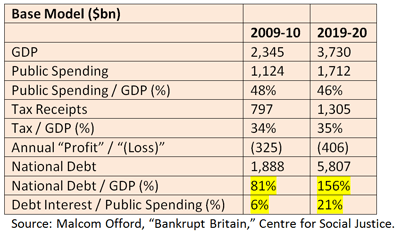
    The UK’s comfort with personal debt has now extended to the public realm. Even before the recession, Britain had $1.2 trillion of public debt, and by next year it will rise to $1.8 trillion, or 81 percent of GDP. If debt payment were a government agency, it would be the fourth largest in Britain. According to the London-based think tank the Centre for Social Justice, 21 percent of total public spending will be devoted to debt service in 2020, compared to 6 percent today. Public debt in the US, by comparison, will reach 60 percent of GDP by next year, and interest on the debt will rise from 4.6 percent to nearly 14 percent ten years from now. Labour’s legacy will be the Mount Everest of indebtedness it has left the current and subsequent generation.

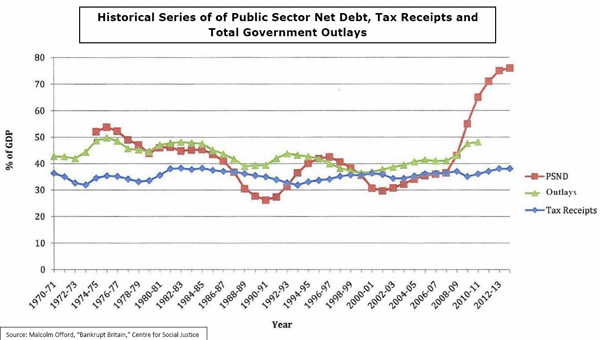
    To put this in perspective, we need look no further than historic trends over the past 30 years. Public debt has tracked fairly proportionately with public spending in the UK during this period. During the economic stagnation of the late 1970s, public debt rose to nearly 50 percent of GDP. It hit its nadir at around 25 percent in 1990 after the Thatcher era, and then rose to around 35 percent, where it has remained ever since – until last year. Suddenly, debt has skyrocketed to more than 75 percent of GDP in the past year – an unprecedented level – and will rise to 100 percent by 2012 before swelling to 150 percent by 2020. In order to reduce debt to its 45 percent level of just a few years ago, public spending would need to be cut by a third. Given that one-fifth of all public spending will go to debt service in 10 years, cutting spending will prove politically impossible for a government – and perhaps an entire nation – that identifies ever expanding government-funded services as essential.

    Even more disquieting, tax receipts have mainly hovered around 35 percent of GDP regardless of the tax rate during the past 30 years. This means that raising tax rates – such as Labour’s proposal to lift the top tax bracket to 50 percent– have little effect as high earners move away or find other ways to protect their assets. Logically, if it hopes to cope with its debt obligations, Britain should therefore keep taxes as low as possible and cut public spending. But instead the UK drives full-speed ahead into the fog of debt without having any notion of how to service its future obligations.

    The UK is therefore faced with a thorny dilemma: on the one hand, it has spent decades creating a social welfare system that reduces risk and promises citizens protection from life’s vagaries, and on the other, it needs people to take risks in order to revitalize the economy. Government spending fostered risk avoidance precisely when Britain most needs an entrepreneurial class that can help diversify the economy away from finance and, to a lesser extent, tourism.

    The people most hurt by social welfare are young working class people – the very group Labour purports to represent. In the UK there’s much talk about the NEETs – young people in their late teens who are Not in Employment, Education, or Training. In 2000 there were 630,000 young people between the ages of 16 and 19 in this group. Today, that number totals 860,000, a 36 percent increase in less than a decade. This would be the equivalent of 4.5 million young people in the United States. If NEETs were a city, they would be the third largest metropolitan area in the UK.

    Increasing numbers of able-bodied young people dropping out of society altogether reflects a growing sense of hopelessness. According to the Gallup World Poll, only 20 percent of 25-34 year olds, and 25 percent of 35-49 year olds, thought the economic conditions in the UK were good before the current economic crisis. The UK’s NEET problem and economic pessimism were rampant when the going was good – something that can only be worse now.

    This is not merely the result of a profligate welfare state. The NEET problem has its origins in complex cultural phenomena. However, it is difficult to argue with the conclusion that an increasing economic resignation among Britain’s younger population is ill-timed for a government betting on future workers to pay the public mortgage.

    The US has a more diversified economy than the UK and likely suffers from less economic resignation, but it is beset with a similar dilemma. Despite historically unprecedented levels of public debt, albeit less extreme than Britain’s, the Obama administration appears to be pursuing an economic program that bears similarities to the Labour preoccupation with creating prophylactics against risk and hardship. In a matter of months, the US deficit has risen from 3.2 to 13.1 percent of GDP, according to the Congressional Budget Office.

    Even with President Obama’s widely doubted promises to cut the deficit in half, the CBO estimates a yearly shortfall of more than $1 trillion ten years from now. Even worse, there is precious little in the administration’s plans – including its grandiose claims about “green jobs” – that will create the growth necessary to carry such debt in the future. In fact many of the administration’s proposals – from its healthcare program to its auto company ownership and a more heavily regulated financial sector – could serve more to curb growth than encourage it. In addition, increased taxes on “the rich” will hit small businesses most grievously, the most plausible engine for growth.

    It appears the administration seems intent on following Labour’s folly of mortgaging the future. Without addressing the issue of how to unleash the entrepreneurial energies of the young generation, it’s hard to see how America will avoid falling into the morass in which its British cousins are now so perilously trapped.

    Ryan Streeter is Senior Fellow at the London-based Legatum Institute.

  • On Our Knees: Prince Charles vs. Lord Rogers

    It is no wonder that architect Richard Rogers is feeling a bit peeved at Prince Charles. This month, the heir to the British throne scuppered plans for a £1 billion development putting 552 apartments on the 12.8-acre site of the old Chelsea Barracks. Rogers was most offended that the Prince used his Royalty to by-pass the usual planning law consultation, by speaking direct to the Qatari royalty who owned the site.

    This is not the first time the heir to the throne has acted as Lord High Planner. Twenty five years ago, he threw a hissy fit about a modernist, hi-tech tower development planned on the national gallery. It was created by the firm Ahrends, Burton and Koralek – but inspired by a Rogers’ design. His sub-majesty called it a ‘monstrous carbuncle’ on the face of a much loved and elegant friend (his ancestor predecessor William IV had a lower opinion of William Wilkins late classical design – ‘a nasty pokey little hole’). He got his way, then, and a pseudo-classical outgrowth was manufactured by Robert Venturi.

    Just a month ago, Charles was asked back to the Royal Institute of British Architects, where he first made the ‘carbuncle’ attack, and even apologised, half-jokingly, promising not to set off another debate about modernist versus traditional architecture. But word had already got out that he was going to sabotage the Chelsea Barracks development.

    Charles’ has been dogged, or perhaps the word is better dogmatic, in his interest in architecture and planning. Out in Dorchester, on land owned by the Duchy of Lancaster (that’s Prince Charles, to you and me) he constructed a weird dreamscape of a village called Poundbury, wholly built according to the Prince’s own ideals, of tradition, community and high density dwellings, designed by the new urbanist Leon Krier. It is full of desperately traditional motifs, like a film set, and it is supposed to be built to dissuade car use (though according to a recent survey, resident are above average car users).

    Richard Rogers has dared break ranks with the Prince publicly over his busy bodying. Rogers makes some excellent points. The Prince is but a man, amongst many: why should he have more say so than anyone else? The Prince will not debate his views, so why should he be allowed this influence on political choices? Even moderate constitutionalists agree that the Royalty enjoys its formal position as head of state (which Charles will become, if his mother Queen Elizabeth dies) on the condition that they keep out of day-to-day politics.

    One person who put some real flesh on the bones of Rogers’ complaints has been Vicky Richardson, the editor of the architecture magazine Blueprint. When Charles stood to address the Royal Institute of British Architects, she shouted out ‘abolish the monarchy’, a cry that was perhaps a bit too plebeian for Richard Rogers.

    Rogers is the last person to be telling us that we should not fawn to established authority. Let me spell it out for you. This is no plebe; it’s Sir Richard Rogers, Baron Rogers of Riverside, a peer of the realm. In 1991, Rogers, in an act of fealty, bent down on one knee before the Queen, to be made a knight. In 1996, he was made a Baron, and sits in the unelected House of Lords (on the Labour benches). Quite why Rogers thinks he is free of the oaths he made to protect the Queen – and consequently her progeny – is not clear.

    Richard Rogers’ leaning on the Royal brand when it suits him is not the end of his fixation with authority over the common people. Though he pressed a few demotic buttons when he turned on Prince Charles, there was a weird undercurrent of superiority in his complaints. Prince Charles is not an expert he was keen to say. Charles has no expertise in architecture … unlike Richard Rogers. It was quite a snooty put down to place on a soon-to-be King.

    Rogers went further, asking whether things ought to be changed, so that the unspoken rule that the monarchy stay out of everyday politics might be shored up. Indeed, Richard Rogers called for a panel of constitutional experts to re-examine the Prince’s powers. ‘A panel of constitutional experts’? Who are these ‘experts’ that know better than the rest of us how the United Kingdom ought to be run? A committee of the House of Lords, perhaps?

    At the heart of Richard Rogers case against the monarchy is not an argument for the people against entrenched authority. Rather, it is an argument for a new elite to take over – ‘experts’ (so-called), technocrats, people like Rogers himself, who know better than the rest of us how we should live.

    In real fact, Rogers may be even more a throwback to medievalism than the Prince. Rogers’s Chelsea Barracks development has been attacked for being too ‘modern’. But the row is cast in terms of traditional versus modern, because in many ways, Rogers plans are more backward looking that Charles’s.

    One feature that lies behind the many complaints that preceded Charles’ intervention is the density of the development. Originally planned for 638 flats, the developers were persuaded to reduce the number and increase the open space from two to 6.2 acres.

    Local people resent more bodies being crammed into an already overcrowded, teeming and increasingly dehumanized London. In this process, Rogers is far more a villain than the unlikable Prince. In 1998 his government appointed Urban Task Force saddled planning authorities with the principle that most new development would take place on ‘brownfield’, that is previously built-upon land, not newer greenfield sites out in the country.

    This is almost something out of apartheid or the 19th Century enclosure acts. The policy is to keep Londoners kettled up behind the Green Belt, telling local authorities to keep filling in every patch of land that becomes available with extra housing, densifying the city. Ironically, the Prince entirely agrees with Rogers on the need for densification – but at least he prefers something more humane, like a nice cottagey feel, and some old stonework.

    The ‘urban nimbys’ who objected to the Chelsea barrack development are a new thing. In north London, residents protested against an apartment block squeezed into a space that used to be garages at Pilgrims Way. Under the regional plan, drawn up on rules laid out by Baron Rogers, local objections have no purchase, because the overriding goal is cramming: forcing ever more people in a fixed amount of space. That is why Rogers is so angry with the Prince. Rogers has the planning approval all sewn up. Because his development offers the highest density, it ticks all the right boxes as far as the planners are concerned. But for residents, looking at results of cramming on their already limited space, 500 new flats squeezed in does not look so good. They have a right to object, but the plan – blessed by the experts, knighted and not – trumps their objections.

    Rogers objects that the Prince is using his hereditary power. But what makes Rogers so cross is that he is accustomed to exercising unchecked and undemocratic power to get his own way. He cannot quite believe that there might be a greater unelected power in the land than his own.

    The fact is the so-called great are only great because we are on our knees, said the Irish rebel James Connolly. It is time the British stood up and kicked both of these unelected overlords out, whether to the manor born or entitled by their “expertise”.

    James Heartfield is author of Let’s Build! Why we need five million homes in the next ten years, and a director of www.Audacity.org.

    Image courtesy of Henry Bloomfield

  • Sustaining Localism in the English Suburban Context

    Localism, a longstanding agenda of the Green Party in the context of the UK economy, is gaining ground in the current economic crisis. In a recent edition of the London-based Daily Telegraph, a striking contrast is made between Chester in north-west England – which is suffering from the decline of its relatively narrow economic base and Totnes in south-west England, which with its longstanding interest in alternative living, and more localised economy, seems to be weathering the situation much better. The underlying message from the article is that small is good – particularly for businesses not overextended in their borrowing, and familiar enough with their immediate context to be able to adapt to a changing economy.

    The New Economics Foundation think-tank, has been for several years campaigning against Clone Town Britain (namely, the over preponderance of chain stores at the expense of small chains and independent stores). Past criticism of the foundation for having an overly romantic notion of what constitutes a successful town centre may still continue, but there may also be some economic logic to a more locally oriented town centre strategy.

    Perhaps the best approach is to avoid either free-market efficiency ideology, on the one hand, or a strict local-only approach. It seems clear from other recent research into successful suburban town centres that a combination of national chains and good quality independents makes for the best mix to ensure long-term economic sustainability.

    This issue, like perhaps too much else in Britain, is currently subject to government action. The new Sustainable Communities Act now makes it mandatory for the UK government to assist local councils and community ‘stakeholders’ in drawing up local sustainability strategies for enabling independent businesses to survive in the increasingly cut-throat high street (the equivalent of the US ‘main street’).

    Yet as usual the government seems to overlook where most people live: the word suburb or suburban is nowhere in the Act. Possibly this is not surprising as the main focus is on large scale, infrastructure projects, but the continuing lack of attention in policy terms to the suburbs should be a matter of concern to those who believe a diffuse network of connections is essential to the continuing sustainability of the economy.

    It is equally worrying to see that the influential group set up by London’s Mayor Boris Johnson to focus on the outer London suburbs (which are cited as being his main source of political support in the mayoral elections) continues the pattern of focusing on the larger metropolitan centres at the expense of the smaller suburban centres in the capital. At an ‘Outer London Summit’ held on 11th June, Mayor Johnson made it clear that the policy focus continues to be on strengthening a constellation of “growth hubs” of economic activity, such as the metropolitan centre of Croydon in south London, despite the clear evidence demonstrating how smaller centres have an important role in making suburbs more sustainable.

    Within the next 20 years, most housing growth in England and Wales is predicted to occur in suburban settlements. This development is expected to be sustainable economically and environmentally, which means that suburbs will increasingly be required to provide local economic activities in order to minimise travel and to support cohesive and vibrant communities.

    The Towards Successful Suburban Town Centres research project at University College London has investigated the strategic contribution of Greater London’s smaller and district centres to the sustainability of the metropolitan region. ‘Sustainability’ in interpreted by the project team as referring to conditions favourable to local concentrations of long-lasting socio-economic and cultural activity.

    The research also has found that the widespread perception of suburbia as synonymous with social and architectural homogeneity belies its spatial, social, ethnic and economic diversity. With pressure to build large numbers of new homes increasing, there is a real danger that such perceptions become self-fulfilling.

    Initial findings suggest the success of local centres depends on the ability of their built environments to adapt to social and economic change by allowing pedestrian movement around an extended central area, balanced with accessibility to vehicular and public transport at larger scales of movement. Centres that support a wide range of locally generated activity are likely to be more resilient in the face of change than retail or purely residential monocultures. The results show that spatial variety and economic adaptability are both crucial to economic sustainability.

    This adaptability inherent to the suburban built environment needs to be more widely understood and promoted. The Towards Successful Suburban Town Centres project has found that where the town centre supports a diverse range of activities it benefits from increased by-product movement, where people do more than what they deliberately came to do during their visit to the centre. People visiting local town centres such as Surbiton (made famous by the 1970s BBC sitcom The Good Life), are not like shoppers at a ‘power centre’ dominated by a Wal-Mart. They don’t just shop for a specific item; they linger, eat lunch, drink coffee, research local cultural activities and indeed might be there for a business meeting. Surbiton, like many of London’s smaller town centres, has close links to larger centres such as Kingston, which alongside retail, offices and a university, boasts the new Rose Theatre led by Sir Peter Hall.

    The benefits here go well beyond the strictly economic. More time spent locally leads to a more vibrant mix of people on the streets and helps enliven the town centre throughout the day. This street network potential provides a critical element for sustaining the vitality of suburban and small town centres. The extensive and varied activity in lively areas enables complex routine daily and weekly movement patterns to emerge, thereby furthering the engagement of individuals with their locality.

    With the closure of chains such as Woolworths, however tragic for long-time customers and employers, the economic downturn also opens up opportunities for alternative high street activities. In one example, Art Space + Nature, an avant-garde Scottish art collective, have produced plans to bring new activities to empty shop fronts by putting on art exhibitions. The Institute of Community Cohesion is working on plans to create new indoor markets for local communities in closed business units.

    These and many other grassroots initiatives are localist at heart. The key may be in making sure that these attempts remain grassroots, and not too impacted by either large governmental units or major non-profits. To succeed, localism must be properly bedded in the community. Economic trends, as well as history, demonstrate that a bottom-up approach to creating lasting viable communities works not only in cities, but in suburbs as well.

    Laura Vaughan is a Senior Lecturer in Urban and Suburban Settlement Patterns and the Director of the MSc in Advanced Architectural Studies at the Bartlett, University College London and a member of UCL’s Space research group.

  • Europe: No Longer A Role Model For America

    For decades many in the American political and policy establishment–including close supporters of President Obama–have looked enviously at the bureaucratic powerhouse of the European Union. In everything from climate change to civil liberties to land use regulation, Europe long has charmed those visionaries, particularly on the left, who wish to remake America in its image.

    “There is much to be said for being a Denmark or Sweden, even a Great Britain, France or Italy,” wrote political scientist Andrew Hacker in his 1971 book The End of the American Era .This refrain has been picked up again more recently by the likes of Washington Post reporter T.R. Reid and economist Jeremy Rifkin. Just last year, international relations scholar Parag Khanna shared his vision of a “shrunken” America lucky to eke out a meager existence between a “triumphant China” and a “retooled Europe.”

    But the tendency to borrow from the European toolbox may be somewhat questionable, particularly given that a growing number of Europeans are either uninterested–barely 40% bothered to vote in E.U. Parliament elections last week–or in open revolt against their own system of government. In the elections, for example, parties generally opposed to expanding E.U. power gained ground in countries as diverse as Hungary, Slovakia and the Netherlands. In Britain, the relatively small U.K. Independence Party, which even opposed membership in the U.N., out-polled the Labour Party and trailed only the Conservatives, who announced their own shift toward a more euro-skeptic point of view.

    Although the E.U.’s current top-down bureaucratic approach is clearly losing support, these recent events don’t necessarily mean the E.U. is doomed. It’s just that people who might be happy to accept a customs union and perhaps even a common currency are simply proving loath to hand over land use controls and environmental standards, much less foreign policy, to Brussels-based bureaucrats. At its root this move represents both a cry against control and a cry for greater autonomy.

    For the Obama administration, there may be some significant lessons here. Compared with Europeans, Americans are disposed to dislike too much central control. Turning Washington into a new Brussels, with regulations to cover virtually any human activity, could backfire both on the president and his party.

    But it’s also critical not to see Europe’s new tilt as affirming Reaganite cowboy capitalism. Many European countries, particularly the northern ones, are justly proud of the “social” models of capitalism they embrace. There are many policies–such as Danish incentives for industrial firms to greenify themselves, efficient universal health care and tough fuel economy standards for cars–that should be discussed and perhaps even adopted in some form in the U.S.

    In one sense, we should understand that Europeans are trying to protect their preferred standards when it comes to culture, social structure and lifestyle. They remain, if you will, fundamentally conservative in their efforts to preserve their well-established welfare states.

    But overall the anti-E.U. vote should make it clear that Europe’s overall economic system makes for a poor role model for our country. When the current economic crisis first hit, many European leaders–and their American fans, like Harvard economist Ken Rogoff–saw vindication for the E.U.’s economic policy and a much tougher road for the U.S. over the next year or two. Yet in reality, Europe already has suffered as much as we have from the downturn, and recovery there may also be even slower to emerge. In some countries, such as Greece and France, social unrest has been far more evident than here in the U.S.

    Simply put, European models do not necessarily work better–and when they do, they have occurred in part due to shifts away from strict welfare-state policies. As Sweden’s Nima Sanandaji and Robert Gindehag have argued the recent return to growth in places like Sweden came only after some modest reforms in both taxes and social benefits.

    Yet at the same time, even successful European countries–as well as the whole E.U.–generally experience slower growth than the U.S. with respect to measures like gross domestic product and job growth. This makes it an example of limited utility for America, a country that needs strong economic growth in order to maintain both its quality of life and overall social sustainability.

    The biggest source of divergence between the U.S. and the E.U. lies in demographic trends. For the most part, Europe is aging far more rapidly, and its workforce is shrinking. As demographer Ali Modarres notes, America’s population over the second half of the 20th century grew by 130 million, essentially doubling, while the populations of France, Germany and Britain together increased by 40 million, or 25%.

    As a result, there is virtually no European equivalent for cities like Houston, Phoenix, Las Vegas or Atlanta. American cities sprawl–and will likely continue to do so–because they are newer and because they are growing much faster in a country that is much vaster. Even with 100 million more people, the country will still be one-sixth as crowded as Germany.

    These differences will only become more stark. Opposition to immigration–from both Muslim countries and the E.U.’s own eastern periphery–is growing even in historically tolerant places like Great Britain, Denmark and Holland. Over time, migration into Europe is destined to slow. In Barack Obama’s wildly multicultural America, strong restrictionist sentiments have not gained much political ground, and, at most, efforts are directed not at reducing legal immigration but rather shifting it toward a more meritocratic model.

    So we can expect America’s population to continue growing at close to the highest rate in the advanced industrial world while Europe remains among the most rapidly aging places on earth. America’s fertility rate is 50% higher than Russia’s, Germany’s and Italy’s. By 2040, for example, the U.S. could have a greater population than the first 15 member nations of the European Union. Compare that prediction to 1950, when America had only half the population of Western Europe.

    These numbers point toward separate destinies for the U.S. and the E.U. Throughout history, low fertility and societal and economic decline have been inextricably linked, affecting such once-vibrant civilizations as ancient Rome, 17th-century Venice and, now, contemporary Europe.The desire to have children also reflects a fundamental affirmation of faith in the future and in values that transcend the individual. This is particularly true in affluent societies, where it is socially acceptable to remain childless and technology has made the decision not to have children easier to enforce.

    The U.S.’ demographic vitality will allow it to emerge from the current economic doldrums with more rapid growth than Europe–continuing a trend that has generally held for most of the past two decades. Innovation, largely a product of youthful indiscretion, also will continue to emerge more quickly stateside. Indeed, according to one recent European Commission survey, at the current rate of innovation, it would take 50 years for the E.U. to catch up to the U.S.

    Largely thanks to these demographic pressures, we could see an American economy twice the size of the E.U.’s by 2050. Unlike Europe, we have better prospects for growth, since there’s really no sustainable alternative for our society. In contrast, 40 years from now Europe’s economic growth rate is expected to fall 40%, due directly to the shrinking size of both its labor force and its internal market.

    We can ultimately expect two very different courses to develop. In America, the emphasis needs to be on sustained growth to prevent a massive decline in living standards. In contrast, Europe may be able to maintain a steady level of prosperity–even with lower growth, since its population will be either stagnant or declining–at least until the looming costs of maintaining a welfare state impose onerous economic burdens.

    Environmentally, Europe will become a “green” hero–because lower economic growth means a natural reduction in energy consumption and dreaded greenhouse gas emissions. Americans, on the other hand, will need to depend more on technological fixes–some of them from Europe–and embrace less economically damaging paths to growth. (These include promoting such things as working close to or at home and developing more fuel-efficient cars.)

    Neither Europe nor America–particularly given a much-reduced E.U. bureaucracy–has a better or worse model. We just have to recognize that these are, in the end, increasingly different societies: The former is focused on preservation of its hard-won peace and prosperity; the latter is challenged more by constant, major and sometimes even frightening change.

    Some may still hold out the hope that wise men in the old continent will present us with a road map to the future. But given the revolt going on against this mega-European ideal, we should understand that even many across the pond are having second thoughts about a future controlled by Brussels. Perhaps it’s better to recognize that most solutions to America’s problems–now and in the future–will be concocted not in Brussels, Berlin or Paris, but at home.

    This article originally appeared at Forbes.

    Joel Kotkin is executive editor of NewGeography.com and is a presidential fellow in urban futures at Chapman University. He is author of The City: A Global History. His next book, The Next Hundred Million: America in 2050, will be published by Penguin early next year.