Tag: US Federal Reserve

  • Catching up to the Fed

    It’s hard to believe that it’s been nearly two years since we first wrote about the game of “hide the ball” that Junkmeister Ben Bernanke is playing. Finally, Congress is getting some admissions out of the Federal Reserve about the gusher of cash that was opened up when the insides fell out of Wall Street’s Ponzi scheme. Remember, you read it here first! Trillions of dollars were funneled to private, non-regulated companies. According to the New York Times article, the release of documents on 21,000 transactions came about as a result of a provision inserted by Senator Bernard Sanders (I-VT) into the Restoring American Financial Stability Act of 2010. I covered the hearing in March 2009 when Bernanke told Senator Sanders he would not reveal who got the money – but I wrote three months earlier about the deal brokered between the Treasury and the Federal Reserve to circumvent a Congressional prohibition on lending to non-regulated companies. Sanders called it a Jaw Dropper by the time he saw the actual documents.

    Lest you think that all is hunky-dory because the money is being paid back, don’t forget the old adage: “It takes money to make money.” Everyone that borrowed had the opportunity to make money on the money they got at (virtually) no cost. In the interim, small businesses, homeowners, student borrowers, etc. are paying enormously high interest rates for the little credit they can get. The profits go to Brother Banker.

    The Federal Reserve released papers on $12 trillion, about half of the $23 trillion distribution estimated by Special Inspector General Neil Barofsky. Despite admitting to pumping an amount equal to about the entire annual national output into the economy in the form of cash – belying the real decline in the output of goods and services – Ben Bernanke told 60 Minutes recently that he was “100% certain” that inflation is not going to be a problem. Makes you wonder what else they’re hiding.

    Inform Yourself:
    Click here for the Federal Reserve Press release.

    Click here for Regulatory Reform Transaction Data from the Federal Reserve website.

    Click here for an internet article with additional links to original sources and media coverage (thanks to Dennis Smith for providing the original article).

  • Random Wall Street Walking

    There was a popular book in 1973 – A Random Walk Down Wall Street. (by Burton Malkiel, now in its 9th edition, 2007) – that pooh-pooh’ed the idea that one investor’s stock picks could always be better than another investor’s stock picks. The punch line is that you could randomly throw darts at the Wall Street Journal financial pages and do just as well as anyone else investing in the stock market. I first read it in 1980, while taking Investment 101 in business school at night and editing economic research documents for the Federal Reserve Bank of San Francisco during the day. I had a very memorable argument with John P. Judd, then senior research economist and more recently special advisor to the Bank president and CEO Janet Yellen.

    John thought the Wall Street brokers were crazy for thinking they could make more than average returns on investment. I thought the Federal Reserve was crazy for thinking they could control the money supply. John was already a PhD economist; I was still working on my Bachelor degree in business administration.

    Twenty years later I also have a PhD in economics, but there are still two camps pulling in different directions in their dangerous tug-of-war on the economy. There are the double-dip pessimists led by Yale Economist Bob Shiller and most recently discouraged by Paul Ferrell of MarketWatch. And there are the “Mad Money” optimists who believe that Jim Cramer will tell them everything they need to know to get and stay rich, while Ben Bernanke consoles them with sound bites like “increased optimism among consumers … should aid the recovery.”

    At the heart of the problem is the same, original argument I had with John Judd – “is there a way to beat the averages” – except that this time around Wall Street is in bed with the Federal Reserve. You can no longer tell the crazies apart.

    Which brings me back to the Random Walk. If Wall Street has their way, they will inflate the market just enough to induce you to put your money back in. Don’t forget the Weenie Roast of 2008. If the government – either Congress or Treasury or the Federal Reserve – has their way, they will let it crash again, too. Don’t forget that it was only Wall Street that got bailed out the last time. I think the chances are 50-50 either way.

  • Buffett and Paulson: Part of the Problem

    Warren Buffet, CEO of Berkshire Hathaway, and Henry “Hank” Paulson, former Treasury Secretary, were guests of honor at the annual meeting of the Omaha Chamber of Commerce this week.

    That the two of them are together should be no surprise: Paulson orchestrated the largest bailout of financial institutions in the history of the world – and Buffett is an owner of some of the largest financial institutions. To put it bluntly, Paulson helped bailed out Buffett’s financial institutions and now Buffett is helping Paulson tout his book. It’s not a pretty picture.

    Yet, the event sold out well in advance. Granted, Buffett’s contribution to Omaha’s economy cannot be minimized. Warren Buffet keeps Omaha on the global map – travel anywhere in the world, tell them you’re from Omaha and see whose name comes up first. He is also a regular contributor to charitable and social causes throughout the region. Berkshire Hathaway’s (NYSE: BRK) companies employ about 246,000 people – though only 19 of them are at the Omaha headquarters. None of BRK’s companies are among the top 25 employers in greater Omaha. (Nebraska Furniture Mart, with just over 2,700, ranks 32nd and is the only one in the Top 100.)

    We all have 20/20 vision in hindsight, including Senator Chuck Grassley (R-IA). In April 2009, seven months after the Bailout passed, Senator Grassley said of Paulson that Congress “was awed by a person who comes off of Wall Street, making tens of millions of dollars. … You think he knows all the answers and when it’s all said and done you realize he didn’t know anything more about it than you did.”

    The Troubled Asset Relief Program (TARP) was sold to Congress and the American public as an absolute necessity to save the American Dream of homeownership. It was supposed to be used to help homeowners with mortgages bigger than the market value of their homes. As soon as Paulson’s Treasury got the money they decided to bailout big banks instead. Since then, Paulson, along with current Treasury Secretary Timothy Geithner, and Federal Reserve Chairman Ben Bernanke have refused to comply with demands from Congress to produce documents about the TARP recipients’ use of funds. The legislation was passed and the funds were released, and Treasury gave the money to banks with no restrictions on its use – no monitoring, no reporting requirements, no nothing.

    So, why would Warren Buffett look so favorably on Paulson? Warren Buffett – our widely revered Oracle of Omaha – is one of those who built the boom in the capital markets and are benefiting from the bust. No surprise then that Buffett whose primary business vehicle is a financial holding company, supported the bailout of financial institutions. BRK’s businesses include, among others, property and casualty insurance and financial holding companies.

    Of course Buffett was in favor of the bailout – his companies directly benefited as did the investments made by his companies. He put $5 billion into Goldman Sachs preferred stock with a 10 percent dividend – a substantially better rate of return than the US government got on our $10 billion bailout. Berkshire Hathaway was the largest shareholder in American Express Co. when they received $3.4 billion from Uncle Sam. Paulson is now insisting that US taxpayers will profit from the TARP bailout – if we do, which I doubt, I’m sure we won’t profit as much as Buffett did.

    Paulson claims, in his book, that he turned to Buffett for advice about saving Lehman Brothers from demise. This strikes me as a very odd story, considering that Buffett told the press in March 2009 that he couldn’t understand the financial statements of the banks getting the bailout money. Add to this the fact that Senator Ben Nelson (D-NE) told me that he talked with Warren before voting for the first bailout package. (I button-holed him after lunch with the Sarpy County Chamber of Commerce) and you begin to get the real picture – the government was taking advice from financial institutions about the bailing out financial institutions.

    To bring the problem full circle, consider this. In January, a bi-partisan Financial Crisis Inquiry Commission was appointed to find the answers to the causes of the financial crisis. They may not have to look any further than the nearest mirror. USA Today reported earlier this month that the members of the panel “have consulted for legal firms involved in lawsuits over the crisis.” A Commission composed of members who earn their livelihood from financial institutions is unlikely to solve the mystery of the causes of the greatest financial collapse in the history of the world.

    Like the Commission, Hank Paulson and Warren Buffett are part of the problem – not the solution.

  • Bernanke: For Good or For Ill

    This week, Time magazine named Federal Reserve Chairman Ben Bernanke “Person of the Year 2009.” CNBC’s panel of experts gave Bernanke the “Man of the Year” title (no misogynists there!) in 2008. And well they should since their sponsors are among the biggest recipients of the Paulson-Bernanke-Geithner bailout. As I select the link from their website to imbed in this story, an ad from Wells Fargo (NYSE: WFC) is displayed in the right half of the screen. Click on “home” and it’s an ad from General Motors (OTC: MTLQQ).

    I imagine Bernanke is quite embarrassed this holiday season as a result of the many, many less than flattering comparisons he is receiving. CNBC’s sister network, MSNBC, took exception to anything flattering in the designation by reminding everyone that being named Person of the Year is not an honor. Time’s definition, according to MSNBC, is: “The person or persons who most affected the news and our lives, for good or for ill…” They list a few of the previous winners, including Adolf Hitler (1938), Joseph Stalin (1939), and Ayatollah Khomeini (1979). One writer likened Bernanke receiving the award to “celebrating an arsonist for his heroics in putting out a fire that he set.”

    Regardless of Time managing editor Rick Stengel’s qualifying statements, the tone of the write-up suggests, to Charles Scaliger at The New American at least, that Bernanke has a “cult of personality” within the Washington, D.C. Beltway. If you’ve never met Bernanke, which I never have, it’s hard to imagine there is the kind of personality there that one could be cult-ish about. Former Federal Reserve Chairman Alan Greenspan, who I also never met, regardless of his other shortcomings had the ability to say what it took to get the economy to do what he wanted it to do – he didn’t always pick the best things to get it to do, but he was able to get a message across. Bernanke, on the other hand, never seems quite comfortable in front of Congress the way Greenspan used to appear. A nervous central banker is very bad for the economy.

    The designation – whether or not it is an honor – came the day before the Senate Banking Committee approved President Obama’s nomination of Bernanke to four more years as Chairman of the Federal Reserve. That nomination and approval represent further steps in what Rolling Stone writer Matt Taibbi calls “Obama’s Big Sellout.” The President, and 16 out of 23 Senators on the Banking Committee, seem to hold the mistaken impression that those who got us into this mess are going to be able to get us out. Republican Senator Jim DeMint of South Carolina was among the dissenters: “We can’t have a Federal Reserve that the majority of Americans no longer trust, and that’s what we have today.” Bernanke himself told Congress less than ten months ago that he didn’t know what to do about the economy. Maybe the eventual good that will come from Bernanke’s 2009 affect on our lives will be the demise of the Federal Reserve system in the United States and an end to the mountains of fiat money that it produced in vain efforts to solve the financial crisis that will forever be linked to Ben Bernanke’s name: Person of the Year “for good or for ill.”

  • The Fed and Asset Bubbles: Beyond Superficiality

    There is considerable discussion about tasking the Federal Reserve Board with monitoring and even taking actions to prevent asset bubbles. Before they move too far, the Fed needs to understand what happened in the housing bubble to which they responded after the world economy was decimated.

    Any initiative on the part of the Fed to seriously understand, much less do anything about asset bubbles requires that their causes be comprehended at more than a superficial level. To this day, the Fed appears to presume that the housing bubble was simply the result of financial factors, such as loose money and loose lending. In fact, however, the housing bubble was far more complex than that.

    The averages on which the Fed and much of the business press have based their analysis hide the dynamics that were at the heart of the price explosion. The housing bubble inflated with a vengeance in only one-half of the major US metropolitan markets, and inflated very little in the others.

    There is no doubt that the bubble would not have occurred without the loose monetary policies. However, where the bubble inflated the most, it was in a metropolitan environment of excessively strong land use controls or artificially constricted land supply (called compact development or smart growth). In these markets (such as in California, Florida, Phoenix, Las Vegas, Portland and Seattle), regulation is so strong that when the loose credit induced expansion of demand occurred, the housing market was not permitted to respond with a supply of new affordable housing, and there was a rush to purchase existing stock, which drove prices up.

    On the other hand, in the traditionally regulated markets, including fast growing metropolitan areas like Atlanta, Dallas-Fort Worth and Houston, there was comparatively little escalation in house prices. In short, one-half of the country had a housing bubble, the other half did not. In the more highly regulated markets, the Median Multiple (median house price divided by median household income) increased to from 4.5 times to more than 11 (compared to the historic ratio of 3.0). In the traditionally regulated markets, the 3.0 standard was generally not exceeded. Thus, as Nobel Laureate Paul Krugman of Princeton University and The New York Times noted more than three years before the crash, the United States was really two nations with respect to house price escalation, and the difference was land use regulation.

    We have estimated that the house value losses were overly concentrated in the compact development markets, accounting for 85% of the peak to trough declines. Without these artificial losses, which were the result of unwise policy intervention, the international Great Recession might not have been set off or it certainly would have been less severe. All of this is described in the last two editions of our “Demographia International Housing Affordability Survey” and related items (the 6th Annual Demographia Housing Affordability Survey will be available early in 2010).

    The purpose of compact development and smart growth is to stop the expansion (the ideological term is “sprawl”) of urban areas. Clearly, given the distress that has occurred in the US housing market and the wave of additional losses in both the domestic and international economy that followed, the price of stopping urban expansion (or attempting to) has proven to be immensely larger than any gains.

    At least in housing, until the Fed understands what happened, it will be powerless to effectively apply whatever new powers it employs to control future housing bubbles.

  • $12.8 Trillion Committed to Bailout

    Shortly after I told you that Bloomberg.com is reporting a running total of the money the U.S. government has pledged and spent for bailouts and economic stimulus, reporters Mark Pittman and Bob Ivry updated the totals: So far, $12.8 trillion has been pledged – an additional $1.2 trillion over the earlier report. The total disbursed through March 31, 2009 stands at $4.2 trillion. The Federal Reserve is still committed to providing the largest share at $7.8 trillion, followed by the U.S. Treasury $2.7 trillion and FDIC $2.0 trillion.

    The national debt currently stands at $11.3 trillion — versus an authorized limit of $12.1 trillion. Spending, lending and bailouts by the Federal Reserve are not counted toward the limit.

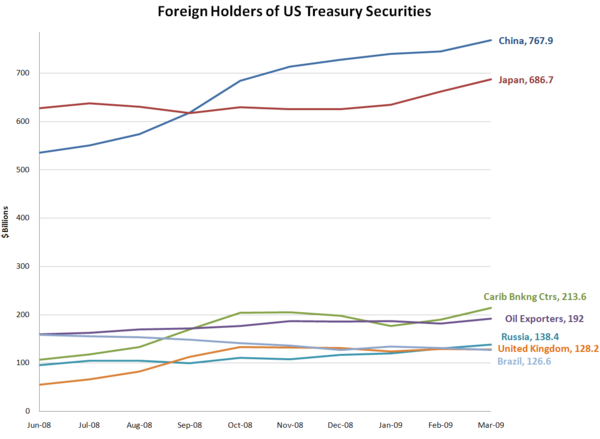
    This week, U.S. Treasury Secretary Timothy Geithner is in China. Mainland China holds $767.9 billion of Treasury securities at the end of March 2009 or about 7 percent of the total national debt. Japan, the second largest major foreign holder, has $686.7 billion.

    Notes: Data from Department of the Treasury. Caribbean Banking Centers (Carib Bnkng Ctrs) include Bahamas, Bermuda, Cayman Islands, Netherlands Antilles, Panama, and British Virgin Islands. Oil exporters include Ecuador, Venezuela, Indonesia, Bahrain, Iran, Iraq, Kuwait, Oman, Qatar, Saudi Arabia, the United Arab Emirates, Algeria, Gabon, Libya, and Nigeria.

    The U.S. bailout commitment of $11.6 trillion equals 89 percent of U.S. 2008 gross domestic product (GDP).

  • We Sneezed, They Got Pneumonia

    Don’t worry about China taking over the US economy. Despite what all the talking heads on TV and the radio talk shows are saying, there isn’t another country out there that hasn’t been hammered at least as badly as we have by the financial meltdown. The problem with any other country attacking the US dollar, for example, is that they are all holding a lot of US dollars. You probably remember last year they were worried about the fact that we import so many goods that we have big “trade imbalances” – meaning that we buy more of their goods than they buy of ours.

    Now remember this: we pay for those imports with dollars. So, again, if the dollar is worth less (or worthless) then they are not going to be getting as much for their imports. Raising the price of their goods, that is, simply charging more dollars won’t do them any good either. We’re in a recession, and Americans are tightening their belts. Demand for imported goods, like demand for all goods except luxury goods, is price sensitive. The more they charge, the less we buy. According to an article on CNN.com, our belt tightening has ended the “Road to riches for 20 million Chinese poor.”

    Furthermore, it’s in the best interest of countries around the world that the US dollar stays strong. The door does swing both ways. According to Jack Willoughby at Barrons.com, “European banks provided three-quarters of the $4.7 trillion in cross-border loans to the Baltic countries, Eastern Europe, Latin America and emerging Asia. Their emerging-markets exposure exceeds that of U.S lenders to all subprime loans.”

    To support all of that exposure, the European Central Bank has been obtaining dollars from the U.S. Federal Reserve in currency swaps. The value of these swaps, where dollars are exchanged for other currency at a fixed and renewable exchange rate, went from $0 to $560 billion this year.

    And the Federal Reserve printing presses keep rolling along.