Tag: workforce

  • 1099 Economy on the Rise

    Here at ZenPayroll, we care a lot about how compensation is done, and the effect compensation can have on the relationship between employers and employees. Using the employment data we have as a payroll provider, we decided to look at whether the 1099 economy, which has garnered quite a bit of media attention recently, is really growing as fast as people think.

    The short answer is that over the past year, the ratio of independent contractors to full-time employees has meaningfully risen among small and medium-sized businesses in states and major metropolitan areas across the country.

    The nature of work is changing given the decline of lifetime employment. Today, very few people plan to work for the same company their whole life, and people often have several jobs at one time. As a result, and as shown by ZenPayroll’s data, more small business owners are employing contractors as a part of running their business. There are a number of other reasons for this general trend toward a more flexible work structure.
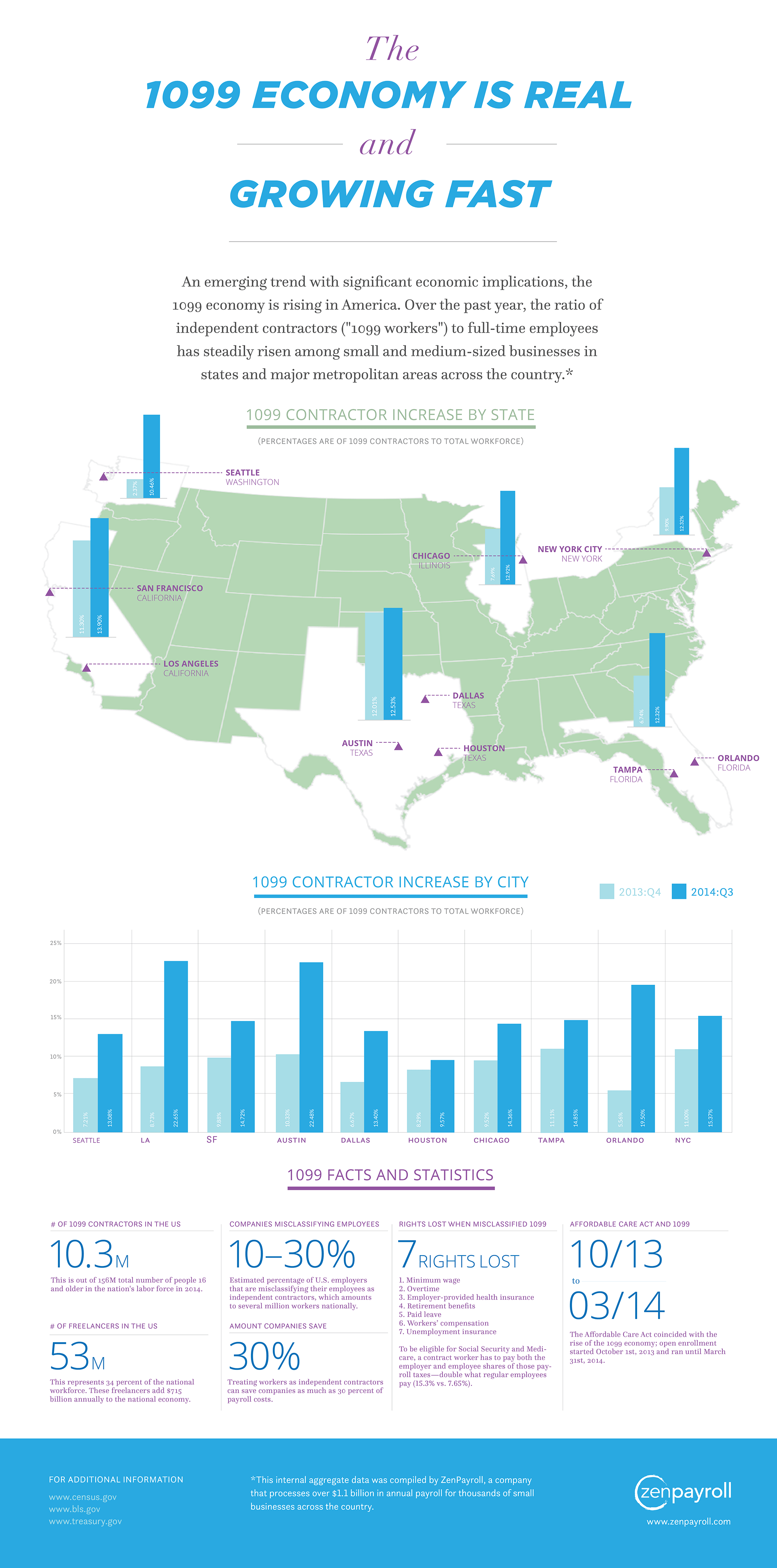
    Click the image to enlarge.

    First, employees want to have more choices when it comes to where and when they work, but also who they work for. Millennials in particular are frequently asking themselves whether they’re fulfilled by what they’re doing. Jess Ostroff, founder of a full-service virtual assistance agency called Don’t Panic Management, said that some of her contractors in New York City are aspiring actors, and they do contract work to support themselves as they pursue longer-term passions and ambitions. 

    Others do contract work purely for the flexibility — one of the first contractors to work for the Don’t Panic Management team is a mother of three who has her own cooking show and also runs a photography business. She supplements those jobs by contracting so she can earn money while spending time with her family.

    For some entrepreneurs, hiring independent contractors is key to their business. Lina Pakrosnyte is the founder and owner of UrbanLeash, a professional pet care company based in Chicago. There are four full-time employees on her team, but she works with over 30 contractors for tech and marketing help, as well as dog walking and cat sitting. With the high turnover in pet care professionals, Lina needs to keep finding contractors to serve her UrbanLeash clients.

    I’ve also talked to many small business owners who prefer having a remote or distributed workforce. Adam McLane, founder of a youth ministry resources company called The Youth Cartel, is one example. Because his business requires expert writers and public speakers, he works with over a hundred contractors from all over the country to produce content and events.

    After the economic downturn several years ago, many people who lost their full-time jobs found contract and part-time work as a way to fill that gap. When times are uncertain, employers also tend to prefer contractors. With the government promising to crack down on employers who misclassify their workers as contractors rather than employees, it’s important for business owners to know the distinction between the two. We published a post recently on the ZenPayroll blog to help small business owners avoid misclassifying their workers

    The future isn’t set in stone, and there will be ongoing debate about the responsibility employers have towards their workers, whether they are employees or contractors. It is important to care of your people if you want to attract and retain great talent.

  • Striking a Balance

    As noted by Wendell Cox, commuting and congestion have a large economic cost. Time spent behind the wheel, slowed by traffic, is time that could otherwise be put to more productive economic pursuits. Commuting and congestion also have social costs. Every minute lost trapped in snarled traffic is time that might have been spent with family, friends, relaxing, or getting involved in community building activities. Commuting can also lead to elevated stress levels, with studies showing finding that “greater exposure to congestion is related to elevated psycho-physiological stress among automobile commuters.”

    One proposed solution to the challenges presented by commuting and congestion is an enhanced embrace of telecommuting. Proponents argue that businesses looking to increase productivity, burnish their “green” credibility and reduce fuel use, and allow workers to strike a better balance between life and work should offer employees the option to work from home. Whatever the motivation, it does appear that there has been a rise in the adoption of telecommuting. According to varying estimates, somewhere between 20 and 35 million individuals telecommute occasionally. Numbers appear to be on the rise, with projections showing up to 63 million workers will be making use of some form of telecommuting by 2016.

    As businesses increase their adoption of telecommuting, they may also want to provide workers with increased schedule flexibility. A recent study conducted by BYU finds that workers given the option to make use of telecommuting and flex-scheduling had a much higher “breaking point” at which family life and work begin to interfere with one another. According to the study, “for office workers on a regular schedule, the breaking point was 38 hours per week. Given a flexible schedule and the option to telecommute, employees were able to clock 57 hours per week before experiencing such conflict.” As the study points out, this added flexibility allows workers to potentially make use of the equivalent of an “Extra Day or Two” in each work week, adding to productivity. According to the lead researcher, E. Jeffery Hill, the use of flexible scheduling can also contribute to greater worker satisfaction and morale. In challenging economic times the promise of increased worker productivity, improved worker happiness, and potential cost savings realized through reduced office space and facilities should be an attractive spur to increased corporate adoption of telecommuting.

  • Forgetting Middle Skill Jobs

    A new report from Skills2Compete attempts to address a national problem which continues to diminish our country’s competitive edge in the global economy. The loss of middle-skill jobs and the lack of qualified workers to fill the remaining jobs are major barriers, not only to our economic recovery, but also to our ability to sustain a high quality of life for succeeding generations. The report concludes that a new state policy is needed to align the workforce and education and training to better meet California’s labor market demand. Accomplishing that goal means improving basic skills in the workforce and ensuring that skills training and education is available to anyone post high school. A major policy change is a good start, but the report does not go far enough in addressing what is needed to restore the importance of middle-skill jobs to the economy.

    Part of the challenge lies with the current mindset of the public education system and parents who value and push college as the only track to a well-paying and satisfying job. This leaves out a large segment of youth and the workforce who are not college bound and who need training and skills and encouragement to fill middle-skill jobs. Where does a high school student get vocational training or learn about middle skill jobs? Remember woodworking? Metal shop? Drafting?

    Vocational education was the name of the program that provided these courses, but now it’s labeled “career tech” and the classes are no longer available in most public high schools. As a result, students have little awareness of these careers. A few years ago, while conducting focus groups of freshman and sophomore students, I was stunned to learn that many did not know what an electrician, welder, auto technician, or HVAC technician did and worse, they disdained those jobs because they thought they were “dirty” and didn’t pay well. This doesn’t bode well for a functioning society or economy. Who will service our cars, fix our plumbing, and build machinery to process our food or the solar panels to heat our homes? It will take more than a policy change to transform awareness, perceptions and values about middle-skill jobs.

    The last economic boom was sustained, not by wealth created by high value manufacturing jobs, but by unbridled consumer spending particularly for houses and retail goods. If we want that standard of living to return, then we must address the greater challenge of how to grow and sustain an economy driven by production of goods instead of consumption. Along with a paradigm shift in our educational system that recognizes the importance of middle skill jobs, we must change our attitudes about work and what creates value not only for our economy but our worth to society.

    We continue to hold on to arcane principles and entitled expectations about work that are increasingly less relevant in a fast-paced globalized world. We are not prepared to re-invent ourselves and our careers in terms of continuous learning of new skills and training either for middle-skill or knowledge jobs. That is what is ultimately needed to succeed in the rapidly changing workplace.

    Leslie Parks has spent over ten years as a practitioner and consultant in the fields of economic and workforce development. She recently served as Director of Downtown Management and Industrial Development for the San Jose Redevelopment Agency until September 23, 2009 when she and 24 colleagues were laid off due to significant budget cuts. Leslie is now preparing for yet another career in the 21st Century workplace.

  • More Machinists, Fewer Poets?

    Politicians from both parties, while on the campaign trail, often argue that they will work to make a college education accessible and affordable to all Americans. Very rarely will one hear calls for “better quality” of education at our colleges and universities, with such debates seemingly being restricted to our K-12 educational system. An opinion piece in the Chronicle of Higher Education claims, however, that many of our institutes of higher learning are failing to meet the challenge of providing a good return on investment for those attending their institutions.

    In his piece, education consultant Marty Nemko argues that “college is a wise choice for far fewer people than are currently encouraged to consider it,” and that colleges and universities need to be held accountable for their “defective products: students who drop out or graduate with far too little benefit for the time and money spent.”

    Nemko points out that over 40 percent of students who enter four-year institutions do not graduate in six years, and cites the “killer statistic,” that,

    “Among high-school students who graduated in the bottom 40 percent of their classes, and whose first institutions were four-year colleges, two-thirds had not earned diplomas eight and a half years later.”

    Nemko also takes issue with the quality of education received by those who do graduate, stating that “50 percent of college seniors scored below “proficient” levels on a test,” requiring them to perform basic tasks, and that “the percentage of college graduates deemed proficient in prose literacy has actually declined from 40 to 31 percent in the past decade.”

    Many young people, Nemko argues, should look to other routes of career development and education, such as apprenticeships and other vocational training.

    Other options do exist, even in the face of a difficult economy. Around the nation, there are communities reporting a need for more skilled workers, requiring training not necessarily linked to gaining a bachelors degree. Manufacturers in northeast Wisconsin face a shortage of new workers, with one company president noting that the local technical school, Northeast Wisconsin Technical College,

    “had 40 job openings posted for CNC technicians. They graduated seven people. In mechanical design, they had 85 job postings and graduated nine people. In electro-mechanical technology they had 75 job openings and graduated four people.”

    Austin, MN, faces a shortage of maintenance mechanics. According to one local technical instructor,

    “If we can’t get more [people] interested in two-year college educations and jobs that require a specialized skill like industrial maintenance mechanics or carpentry and electricians, we’re going be in a deep world of hurt in about five years when all these people retire and we can’t produce goods we need to produce.”

    Communities around the nation will need to find ways to meet such shortages, and build their productive economies. Failure to do so may lead to a loss of potential economic growth. According to the technical instructor, in the face of shortages of skilled workers, “companies may back off on the expansion or growth. Or they may end up relocating to a place where they can find these employees.” Convincing young people that there are other good career options outside the four year degree path will be among the many challenges faced in building our nation’s economic future.